Original citation:
Pelvic floor Society, National Institute for Health Research: Chronic Constipation Treatment
Pathway (Including: Grossi, U., Horrocks, E. J., Mason, James, Knowles, C. H. and Williams, A.
B.). (2017) Surgery for constipation : systematic review and practice recommendations :
Results IV : Recto-vaginal reinforcement procedures. Colorectal Disease, 19 (S3). pp. 73-91.
Permanent WRAP URL:
http://wrap.warwick.ac.uk/92936
Copyright and reuse:
The Warwick Research Archive Portal (WRAP) makes this work of researchers of the
University of Warwick available open access under the following conditions.
This article is made available under the Creative Commons Attribution 4.0 International
license (CC BY 4.0) and may be reused according to the conditions of the license. For more
details see:
http://creativecommons.org/licenses/by/4.0/
A note on versions:
The version presented in WRAP is the published version, or, version of record, and may be
cited as it appears here.
Surgery for constipation: systematic review and practice
recommendations
Results IV: Recto-vaginal reinforcement procedures
U. Grossi*, E. J. Horrocks*, J. Mason†, C. H. Knowles*, A. B. Williams‡, on behalf of the NIHR
CapaCiTY working group§ and The Pelvic floor Society¶
*National Bowel Research Centre, Blizard Institute, Queen Mary University of London, London, UK,†Health Economics, University of Warwick, Coventry, UK,‡Guy’s and St Thomas’ NHS Foundation Trust, London, UK,§National Institute for Health Research: Chronic Constipation Treatment Pathway, London, UK, and¶Affiliate section of the Association of Coloproctology of Great Britain and Ireland, London, UK
Abstract
AimTo assess the outcomes of recto-vaginal reinforce-ment procedures in adults with chronic constipation.
MethodStandardised methods and reporting of bene-fits and harms were used for all CapaCiTY reviews that closely adhered to PRISMA 2016 guidance. Main con-clusions were presented as summary evidence statements with a summative Oxford Centre for Evidence-Based Medicine (2009) level.
ResultsForty-three articles were identified, providing data on outcomes in 3346 patients. Average length of procedures ranged between 20 and 169 min, and length of stay between 1 and 15 days. Complications typically occurred after 7–17% of procedures (range 0– 61%). Post-operative bleeding was uncommon (0–4%) as well as haematoma or sepsis (0–2%). Fistulation did not occur in most studies. Two procedure-related deaths were observed for 3209 patients. Although
inconsistent, 78% of patients reported a satisfactory or good outcome, with 30–50% experiencing reduced symptoms of straining, incomplete emptying or reduced vaginal digitation. About 17% of patients developed anatomical recurrence. Considering measures of harm and global satisfaction rating scales, there was insuffi-cient evidence to prefer one type of procedure over another. There was no evidence to support better out-comes based on selection of patients with a particular size or grade of rectocoele.
ConclusionEvidence supporting recto-vaginal rein-forcement procedures is currently derived from observa-tional studies and comparisons, with only one high quality study. Large trials are needed to inform future clinical decision making.
Keywords Recto-vaginal reinforcement, constipation, rectocele, STARR, transvaginal repair, transanal repair
Introduction
Background and procedural variations
Chronic constipation is related to an inability to evacu-ate the rectum in over half of all adults presenting for specialist advice. This phenomenon, which may be vari-ably described as obstructed defaecation or rectal evacu-ation disorder (and many other terms), is characterised by excessive straining, the feeling of incomplete evacua-tion, post-defaecatory seepage and often mucous dis-charge, and pelvic pain [1]. In some of these patients there is clinical and radiological (usually proctographic)
evidence of a dynamic structural abnormality leading to physical impediment to emptying during defaecation. By far away, the way most common abnormalities are rectocoele and/or intussusception.
Traditionally a rectocoele may be considered either a bulge into the vagina, giving vaginal prolapse symp-toms, or the sensation of a lump or mass. Also, a herni-ation of the rectum into the vagina preventing complete evacuation may lead to ‘trapping’ of faeces in the ‘pocket’ and subsequent incomplete evacuation (bal-looning may also lead to loss of vector forces along the anorectal axis). This process can lead to dissatisfaction with emptying and repeated visits to the toilet, post-defaecatory soiling and the need to apply pressure to the posterior vaginal wall or perineum to splint the rec-tocoele and maximise emptying. Many women will also ‘digitate’ or manually assist emptying using a finger
Correspondence to: Andrew B. Williams, Consultant Colorectal and General Surgeon, Guy’s and St Thomas’ NHS Foundation Trust, St Thomas’ Hospital, Westminster Bridge Road London, SE1 7EH UK.
either in the rectocoele via the anus to aid with com-plete emptying or in the vagina to splint against the posterior vagina to prevent trapping and direct evacua-tory forces down along the axis of the anus.
It follows that strategies have been employed to anatomically correct a rectocele by reinforcing the barrier between the rectum and vagina (rectovaginal septum). Access for rectovaginal reinforcement varies with three main approaches described: the posterior vagina (poste-rior repair [2]), the perineum (transperineal repair [3]), or via the anus (transanal repair [4,5]). Vaginal repairs all involve an incision in the posterior wall either longitudi-nally to open the entire length of the rectocoele or trans-versely to produce a broad based flap and expose the entirety of the rectocoele, or a combination of the two incisions in the shape of an inverted ‘T’. In most repairs the redundant rectal wall is plicated outside the bowel wall. The vaginal wall is then reconstructed with resec-tion of any excess vaginal mucosa. Many repairs include some degree of approximation of thelevator aniand pel-vic side wall muscles to formally reinforce the reconstruc-tion of the rectovaginal septum, although with the reputed higher risk of dyspareunia. More recently attempts have been made to localise specific defects in the rectovaginal septum. This has led to ‘site specific’ repairs [6,7], where the individual defects are repaired before the vaginal wall is closed. All of these types of repairs may be augmented by mesh reinforcement, usu-ally using one of a variety of collagen meshes.
The rectovaginal septum may be entered through a transperineal route. A transverse or curved incision is made in the perineal body towards the vagina and the dis-section extended anterior to the sphincter complex to gain access to the rectovaginal septum. Having gained expo-sure, a repair is made in the same way as in a transvaginal approach. The potential advantage to this route is that it may be combined with a sphincteroplasty in those women with a deficient sphincter and a concurrent rectocoele.
Finally, a rectocoele can be considered as a redundant pocket of rectum, rather than a weakness in the rectovagi-nal septum leading to herniation of the rectum. A transa-nal repair addresses the rectal redundancy with either an anterior Delorme’s style repair (Sarle’s repair [5]) or with a sutured pexy of the anterior rectal wall (Block repair [4]). In the former repair, the mucosa is dissected free from the rectal muscle and excised. Following this, the rectal muscle coat is plicated longitudinally to obliterate the rectocoele pocket and the mucosa is re-approximated to close the defect. In the Block repair, full thickness lon-gitudinal sutures are placed anteriorly to draw together the redundant anterior rectal pocket and close the recto-coele. It is evident that these procedures necessitate a degree of rectal wall excision or suspension respectively.
Scope
The overall purpose of the CapaCiTY review series is to assess the efficacy and harms of procedures for chronic constipation in adults. The focus is therefore directed to a population presenting with symptoms of obstructed defecation, rather than women with only prolapse, uri-nary symptoms or both (see overview and methods paper). One group of procedures considered beyond the scope of this systematic review included those where excision is effected without reinforcement, e.g. rectal excision only, such as stapled transanal resection of the rectum (STARR). As is noted above, anterior Delorme’s or Sarle’s procedures are included, which include a degree of resection, but also have an significant element of reinforcement with muscle wall plication (targeted at the rectovaginal plane), which is not present in pure resection. This noted, a small number of studies have specifically focused stapled resection to the obliteration of a rectocele by anterior deployment of a stapler to exact mucosal excision (much like stapled haemor-rhoidopexy). In a sense, these reinforce the RV septum by tightening tissue and have been included for comple-tion in this review. Further, most compare this approach with one of the other approaches also covered in this review. The separate review covering rectal exci-sion includes numerous studies of STARR in which the device is used to excise circumferential full-thickness excision and the reviews overlap in only one study [8]. Circumferential Delorme’s procedures are excluded from this review as their focus is not on reinforcement of the rectovaginal septum but rather on general resec-tion for prolapse (covered in rectal suspension review). Studies where outcomes could not be segregated by eli-gible procedure were also excluded, due to a mixed patient population with internal and external rectal pro-lapse, mixed indications including numerous pelvic floor abnormalities or limited postoperative outcomes.
Previous reviews
There has been one systematic review of the use of bio-logics in urogynaecological repairs [20]. In addition, the International Continence Society, 5th International Consultation on Incontinence, Paris, February 2012, pages 1411–1414 [21], covers posterior repair. Neither this, nor the Cochrane process focussed on the specific management of patients with constipation.
Summary of search results and study quality
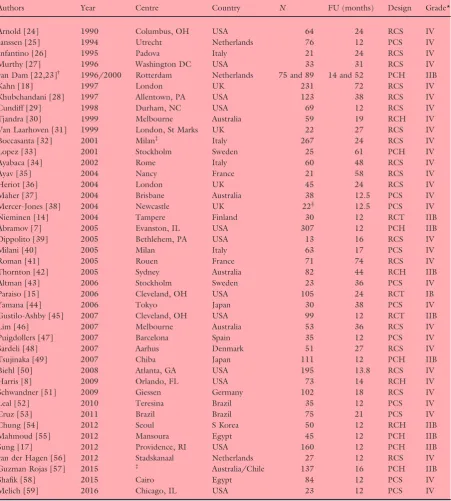
The search yielded a total of 72 citations for full text review (Fig. 1). From these, 44 articles published between 1990 and 2016 contributed 43 studies to the systematic review (one cohort was spread across two publications with a focus on perioperative morbidity [22] and clinical outcomes [23], respectively). Data on outcomes were provided for a total of 3346 patients (study mean: 78, range 13–307) (Table 1). Specific exclusions after full-text review (and after exclusion of five non-English language publications) included: four studies where the population sample was confirmed to be<20 patients; eight studies where follow up was less than 12 months; two studies of out of scope proce-dures; four studies where data were considered as dupli-cate; three studies where outcomes could not be segregated by eligible procedure; and two studies with no relevant outcome data.
The quality of studies varied. The 43 included stud-ies included three randomised controlled trials (RCTs) and 40 observational studies. The former included one good quality RCT (level IB) with a low level of suscep-tibility to bias and two with less well described method-ology (level IIB). The 40 observational studies included eight good quality cohort studies with low susceptibility
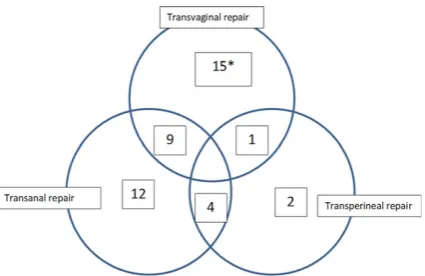
to bias (level IIB). Other studies were a mix of prospec-tive and retrospecprospec-tive case series. Mean study follow-up was 2.1 years (range 0.7–6.2 years); 19 studies origi-nated from European centres, 12 from the USA and 12 from other countries. The studies covered the full spec-trum of types of repair and are shown in Fig. 2.
Results
Perioperative data
The 43 studies included 62 patient cohorts receiving one of eight procedures (Table 2). Perioperative data were reported inconsistently by studies, with 24 (39%) cohorts reporting average procedural duration and 29 (47%) reporting average length of stay (Tables 2 and 3). There was considerable variation in these measures when com-paring procedures: design heterogeneity, small numbers of studies and large range of values precludes any clear pattern. The overall average duration of procedures was 67 (range 20–169) minutes, and the overall average length of stay was 3.9 (range 1–15) days.
Summary evidence statements: perioperative data
•
The average duration of procedures was about one hour, although this is inconsistently reported and ran-ged widely between studies from 20 to 169 min (level IV).•
The average length of stay was about 4 days although this is inconsistently reported and ranged widely between studies from 1 to 15 days (level IV). [image:4.595.218.515.515.703.2]•
There was inadequate evidence to determine varia-tions in procedural duration or length of stay by type of procedure (level IV).Table 1All studies included in systematic review.
Authors Year Centre Country N FU (months) Design Grade*
Arnold [24] 1990 Columbus, OH USA 64 24 RCS IV
Janssen [25] 1994 Utrecht Netherlands 76 12 PCS IV
Infantino [26] 1995 Padova Italy 21 24 RCS IV
Murthy [27] 1996 Washington DC USA 33 31 RCS IV
van Dam [22,23]† 1996/2000 Rotterdam Netherlands 75 and 89 14 and 52 PCH IIB
Kahn [18] 1997 London UK 231 72 RCS IV
Khubchandani [28] 1997 Allentown, PA USA 123 38 RCS IV
Cundiff [29] 1998 Durham, NC USA 69 12 RCS IV
Tjandra [30] 1999 Melbourne Australia 59 19 RCH IV
Van Laarhoven [31] 1999 London, St Marks UK 22 27 RCS IV
Boccasanta [32] 2001 Milan‡ Italy 267 24 RCS IV
Lopez [33] 2001 Stockholm Sweden 25 61 PCH IV
Ayabaca [34] 2002 Rome Italy 60 48 RCS IV
Ayav [35] 2004 Nancy France 21 58 RCS IV
Heriot [36] 2004 London UK 45 24 RCS IV
Maher [37] 2004 Brisbane Australia 38 12.5 PCS IV
Mercer-Jones [38] 2004 Newcastle UK 22§ 12.5 PCS IV
Nieminen [14] 2004 Tampere Finland 30 12 RCT IIB
Abramov [7] 2005 Evanston, IL USA 307 12 PCH IIB
Dippolito [39] 2005 Bethlehem, PA USA 13 16 RCS IV
Milani [40] 2005 Milan Italy 63 17 PCS IV
Roman [41] 2005 Rouen France 71 74 RCS IV
Thornton [42] 2005 Sydney Australia 82 44 RCH IIB
Altman [43] 2006 Stockholm Sweden 23 36 PCS IV
Paraiso [15] 2006 Cleveland, OH USA 105 24 RCT IB
Yamana [44] 2006 Tokyo Japan 30 38 PCS IV
Gustilo-Ashby [45] 2007 Cleveland, OH USA 99 12 RCT IIB
Lim [46] 2007 Melbourne Australia 53 36 RCS IV
Puigdollers [47] 2007 Barcelona Spain 35 12 PCS IV
Sardeli [48] 2007 Aarhus Denmark 51 27 RCS IV
Tsujinaka [49] 2007 Chiba Japan 111 12 PCH IIB
Biehl [50] 2008 Atlanta, GA USA 195 13.8 RCS IV
Harris [8] 2009 Orlando, FL USA 73 14 RCH IV
Schwandner [51] 2009 Giessen Germany 102 18 RCS IV
Leal [52] 2010 Teresina Brazil 35 12 PCS IV
Cruz [53] 2011 Brazil Brazil 75 21 PCS IV
Chung [54] 2012 Seoul S Korea 50 12 RCH IIB
Mahmoud [55] 2012 Mansoura Egypt 45 12 PCH IIB
Sung [17] 2012 Providence, RI USA 160 12 PCH IIB
van der Hagen [56] 2012 Stadskanaal Netherlands 27 12 RCS IV
Guzman Rojas [57] 2015 ‡ Australia/Chile 137 16 PCH IIB
Shafik [58] 2015 Cairo Egypt 84 12 PCS IV
Melich [59] 2016 Chicago, IL USA 23 12 PCS IV
N, Number of patients; PCS, Prospective Case Series; PCH, Prospective Cohort Study; RCS, Retrospective Case Series; RCH,
Retrospective Cohort Study; RCT, Randomised Controlled Trial. *Oxford CEBM [60].
†Same cohort of patients, study from 1996 used for peri-operative data and study from 2000 long term outcome data.
‡Multicentre study.
Harms
Perioperative complications
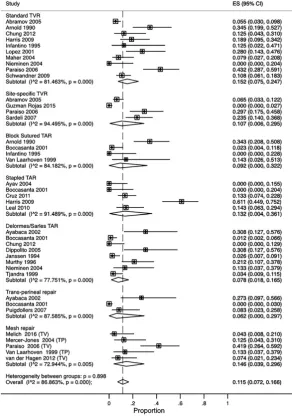
Four measures of harm were reported by a majority of studies within the review: overall complications, bleed-ing, fistulation and haematoma/sepsis. There was con-siderable heterogeneity in surgical morbidity, reported as overall procedural complication rates; with individual study rates varying from 0% to 61% (see Table 2). This heterogeneity may have reflected (for example) differ-ing inclusion, procedural content, context of care, or thresholds or conventions for recording complications. Random effects meta-analysis found the overall compli-cation rate to be 11.5% (95% CI: 7.2–16.6%),
I2=87% (Fig. 3). Overall complication rates varied within and between procedures without evidence to favour one or more procedures. Although variable, the bleeding complication rate was generally low being reported as zero in 50% of cohorts of procedures. Ran-dom effects meta-analysis found the pooled bleed rate to be 2.0% (95% CI: 0.7–3.6%), I2=68%. The
reported fistulation rate was consistently low (0% in 80% of cohorts). Random effects meta-analysis found the fistulation rate to be 0.0% (95% CI: 0.0–0.1%),
I2=0%. The rate of haematoma or sepsis varied between studies but was generally low (0% in 56% of cohorts). Random effects meta-analysis found the pooled rate of haematoma or sepsis to be 0.9% (95% CI: 0.2–2.0%), I2=54% (Fig. 4). Although there was some evidence of variation by procedure, sub-group findings are based on selective reporting of relatively few and small studies and should be viewed with cau-tion.
Other measures of short term harm were less consis-tently reported: perioperative pain (37% of cohorts), urine retention (6%) and UTIs (10%).
Long term adverse outcomes
Measures of long term harm were poorly reported: urgency (19%) and anal stenosis (13%). Although 37 cohorts (60%) made some assessment of dyspareunia, these assessments were not made in an adequately com-parable fashion. Wide variations between studies may reflect inconsistency in the studies when reporting improvement, deterioration orde novodyspareunia. Rates of mesh erosion were as high as 30% but were only reported in two studies [40,46]. This adverse outcome is devastating for the female sufferer and is rightly receiving extensive media coverage, focus by some regulatory bod-ies (e.g. Scottish Government) and much interest by sur-geons themselves. It is thus unfortunate that in the narrowly defined context of this systematic review, evi-dence regarding this outcome was of poor quality.
Summary evidence statements: harms
•
Evidence is drawn from observational studies and comparisons. Most comparisons featured considerable heterogeneity, which may have multiple causes (level IV).•
Overall procedural complication rates ranged from 0% to 61%. However, these complications typically occurred in about 7–17% of procedures (level IV).•
Post-operative bleeding rates were low, typically rang-ing from 0% to 4% (level IV).•
Fistulation was a very rare complication, not occur-ring at all in most studies (level IV).•
Mesh erosion was a common complication, but only reported in two studies (level IV).•
The occurrence of haematoma or sepsis was typically low at around 0–2% (level IV).•
Considering measures of harm, there was insufficient evidence to prefer one type of procedure over another (level IV).•
Long term adverse outcomes were poorly reported (level IV).•
Dyspareunia was reported too inconsistently to make meaningful comparisons between procedures, although it may be central to patient decision making (level IV).•
Only two procedure-related deaths were reported for 3209 patients included in studies (level IV).Efficacy
[image:6.595.64.277.75.213.2]Most studies used ad hoc questionnaire assessment of symptoms (n=27) to assess efficacy; other tools used included Cleveland Clinic Constipation score (n=2), Wexner constipation score (n=3), obstructed defaeca-tion score (n=4) with single studies using the follow-ing: PAC QOL; Short Form-36 (SF-36); St Mark’s
Figure 2 Venn diagram showing the distribution of studies between different types of repair. KEY: Box denotes number of
studies in each category.*includes only one Level IB RCT
Author
Year
N
Length of procedure* Length of stay
† Total Cx rate Bleeding Fistulation Pain Haematoma/ Sepsis Urgency Anal stenosis Urine retention UTI Dyspareunia (new) Other Repair type Mesh type (h) Mesh repairs
Van Laarhoven [31]
1999 15 NR NR 14 4.5 NR NR 9.1 NR NR NR NR NR NR TP Synthetic marlex Mercer-Jones [38] 2004 24 NR 2 (1 – 6) 14 0 0 0 1 4 0 NR NR NR 4.5 TP
Synthetic prolene/ Vipro
Table 3Summary of selected data from Table 2.
Procedure
Procedure duration (min) Length of stay (days) Follow-up (months)
N Mean Range N Mean Range N Mean Range
Standard TVR 8 67.6 (35.0–150.0) 9 5.2 (2.0–15.0) 17 22.9 (8.0–72.0)
Site-specific TVR 2 91.8 (32.5–151.0) 2 2.1 (2.0–2.1) 5 18.2 (12.0–27.0)
Block sutured TAR 2 55.1 (30.5–79.6) 3 6.4 (4.5–9.0) 5 22.2 (12.0–27.0)
Delormes/Sarles TAR 3 62.0 (45.0–79.6) 5 3.2 (1.9–4.5) 13 27.2 (12.0–74.0)
Delormes/Sarles TAR+TVR 0 – – – – (0.0–0.0) 1 52.0 –
Stapled transanal resection 5 47.9 (20.0–79.6) 6 2.4 (1.0–4.5) 6 20.4 (8.0–58.0)
Transperineal repair 1 73.4 – 1 5.2 – 3 28.0 (12.0–48.0)
Mesh repair 3 88.0 (39.0–169.0) 3 2.3 (2.0–3.0) 12 19.0 (12.0–36.0)
All procedures 24 66.6 (20.0–169.0) 29 3.9 (1.0–15.0) 62 23.1 (8.0–74.0)
Figure 3 Forest plot showing rates of total procedural complications (percentage of patients) by procedure
type.KEY: TVR, transvaginal repair;
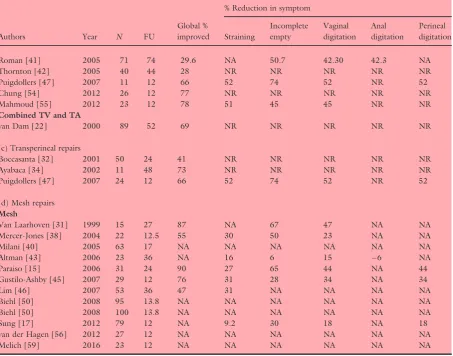
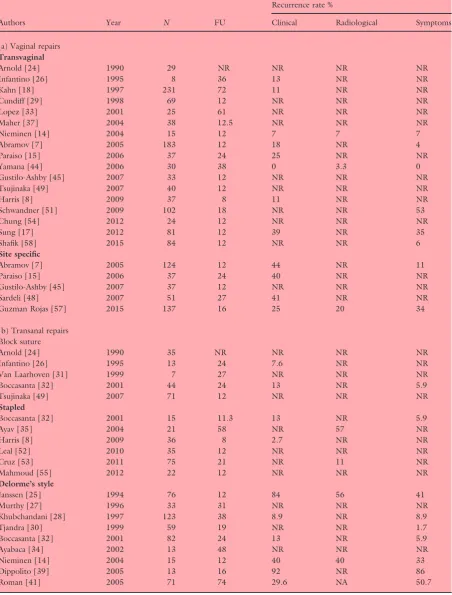
[image:10.595.216.509.290.708.2]incontinence score; Pelvic Floor Distress Inventory-20 (PFDI-20) questionnaire; Pelvic Floor Impact-7 (PFI-7) questionnaire; Pelvic Organ Prolapse/Urinary Incon-tinence Sexual Questionnaire (PISQ-12). Global ‘suc-cess’ or ‘satisfaction’ ratings (GSR) were obtained via a variety of methods for 47 of the 62 cohorts (where ‘sat-isfied’ or ‘very sat‘sat-isfied’, ‘good’, ‘very good’ and ‘excel-lent’ were interpreted as positive outcomes) (Table 4). Further, some studies also reported individual symp-toms. No study reported acquiring data objectively using personnel not involved in the surgical care of the patient or data collection blind to intervention status (RCTs were not observer-blinded).
Data were too inconsistently reported to usefully analyse efficacy outcomes either in their natural units or after standardisation. Instead a binary response of global improvement (yes/no) was derived for each cohort of
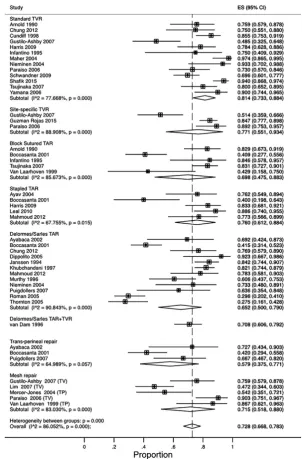
patients. Reported in 76% of procedures, random effects meta-analysis found global improvement to be 72.8% (95% CI: 66.8–78.3%), I2=86% (Fig. 5); again there was considerable heterogeneity between findings. Given the crudeness and imprecision of estimates, as well as small numbers of studies/patients for some procedures, there is insufficient evidence that particular procedures provide higher levels of improvement.
[image:11.595.83.375.72.492.2]For individual symptoms, changes in percentage of patients experiencing each symptom were not reported for a majority of studies. Straining was reported for 45% of total procedures; incomplete emptying for 47%; vaginal digitation for 50%. Other symptoms were less frequently reported. All symptom measures featured considerable heterogeneity and selective reporting by (generally) small studies limiting any comparison between procedures. These caveats accepted, the overall
Table 4Percentage success based on global satisfaction ratings and individual recorded symptoms.
Authors Year N FU
Global % improved
% Reduction in symptom
Straining
Incomplete empty
Vaginal digitation
Anal digitation
Perineal digitation
(a) Transvaginal repairs (including site specific repair) Transvaginal
Arnold [24] 1990 29 24 77 NR NR NR NR NR
Infantino [26] 1995 8 36 75 88 75 75 NR NR
Kahn [18] 1997 231 72 NR 11 11 67 77 77
Cundiff [29] 1998 69 12 * 30 NR NR NR NR
Lopez [33] 2001 25 61 NR NR 91 48 NR NR
Maher [37] 2004 38 12.5 97 60 NR 84 NR 84
Nieminen [14] 2004 15 12 93 NR NR 66 66 66
Abramov [7] 2005 183 12 NR 18 NR NR NR NR
Paraiso [15] 2006 37 24 74 32 17 24 NR 24
Yamana [44] 2006 30 38 90 90 60 42 NR NR
Gustilo-Ashby [45] 2007 33 12 48 31 28 34 NR 34
Tsujinaka [49] 2007 40 12 80 NR NR 35 NR 35
Harris [8] 2009 37 8 78 † NR NR NR NR
Schwandner [51] 2009 102 18 70 NR 83 67 NR 67
Chung [54] 2012 24 12 75 NR NR NR NR NR
Sung [17] 2012 81 12 NR 9 30 18 NR 18
Shafik [58] 2015 84 12 94 NR NR NR NR NR
Site specific
Abramov [7] 2005 124 12 NR 20 NR NR NR NR
Paraiso [15] 2006 37 24 88 35 18 37 NR 37
Gustilo-Ashby [45] 2007 37 12 50 31 28 34 NR 34
Sardeli [48] 2007 51 27 NR NR 14 NR NR NR
Guzman Rojas [57] 2015 137 16 85 36 NR NR NR NR
(b) Transanal repairs Block sutured
Arnold [24] 1990 35 NR 83 80 NR NR NR NR
Infantino [26] 1995 13 24 85 92 77 86 NR NR
Van Laarhoven [31] 1999 7 27 43 NR 0 17 NR NR
Boccasanta [32] 2001 44 24 42 NR NR NR NR NR
Tsujinaka [49] 2007 71 12 83 NR NR 34 NR 34
Stapled
Boccasanta [32] 2001 15 11.3 42 NR NR NR NR NR
Ayav [35] 2004 21 58 76 NR 76 67 NR NR
Harris [8] 2009 36 8 83 † NR NR
Leal [52] 2010 35 12 88 ‡ NR NR NR NR
Cruz [53] 2011 75 21 NR NR NR NR NR NR
Mahmoud [55] 2012 22 12 78 51 45 45 NR NR
Delorme’s style
Janssen [25] 1994 76 12 84 56 41 21 NA NA
Murthy [27] 1996 33 31 62 19 19 NR NR NR
Khubchandani [28] 1997 123 38 82 NR NR NR NR NR
Tjandra [30] 1999 59 19 NR NR 78 39 39 NR
Boccasanta [32] 2001 82 24 42 NR NR NR NR NR
Ayabaca [34] 2002 13 48 69 68 NR NR NR NR
Nieminen [14] 2004 15 12 73 NR NR 39 39 39
pooled finding for reduction in strain was 38.0% (95% CI: 27.1–49.6%), I2=94%; reduction in incomplete emptying was 44.4% (95% CI: 30.2–58.9%), I2=96%; and reduction in vaginal digitation was 42.7% (95% CI: 34.9–50.6%),I2=86%.
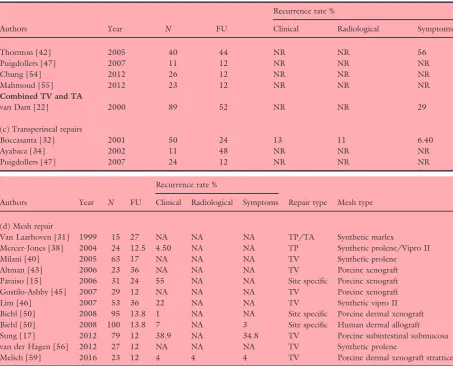
The aim of reinforcing the rectovaginal septum is to restore normal anatomy which theoretically will enable normal evacuation. Given the underlying aim of surgery is to correct anatomy, an assessment of anatomical recurrence is also important (although this is necessarily only a surrogate of clinical outcome). Studies variously and inconsistently reported clinical, radiological and symptom recurrence (Table 5). Clini-cal recurrence was reported for 44% of cohorts (Fig. 6). The overall clinical recurrence rate was 17.1% (95% CI: 11.7–23.3%), I2=89%, with individual
findings for procedures varying from 0% to 55%. There is a suggestion that site specific TVR features a higher clinical recurrence rate that other procedures, based on four studies and 349 patients, although this may be a chance finding given the selective reporting by studies (Fig. 6). One study showed that the results of a site specific repair are further compromised by the concur-rent use of collagen mesh [15].
Summary evidence statements: efficacy
•
Data on efficacy were inconsistently measured and findings heterogeneous, making estimates tentative and imprecise (level IV). [image:13.595.83.537.90.446.2]•
Although inconsistent, assessments of patient global improvement typically suggest a good outcome in about 67–78% of patients (level IV).Table 4(Continued).
Authors Year N FU
Global % improved
% Reduction in symptom
Straining
Incomplete empty
Vaginal digitation
Anal digitation
Perineal digitation
Roman [41] 2005 71 74 29.6 NA 50.7 42.30 42.3 NA
Thornton [42] 2005 40 44 28 NR NR NR NR NR
Puigdollers [47] 2007 11 12 66 52 74 52 NR 52
Chung [54] 2012 26 12 77 NR NR NR NR NR
Mahmoud [55] 2012 23 12 78 51 45 45 NR NR
Combined TV and TA
van Dam [22] 2000 89 52 69 NR NR NR NR NR
(c) Transperineal repairs
Boccasanta [32] 2001 50 24 41 NR NR NR NR NR
Ayabaca [34] 2002 11 48 73 NR NR NR NR NR
Puigdollers [47] 2007 24 12 66 52 74 52 NR 52
(d) Mesh repairs Mesh
Van Laarhoven [31] 1999 15 27 87 NA 67 47 NA NA
Mercer-Jones [38] 2004 22 12.5 55 30 50 23 NA NA
Milani [40] 2005 63 17 NA NA NA NA NA NA
Altman [43] 2006 23 36 NA 16 6 15 6 NA
Paraiso [15] 2006 31 24 90 27 65 44 NA 44
Gustilo-Ashby [45] 2007 29 12 76 31 28 34 NA 34
Lim [46] 2007 53 36 47 31 NA NA NA NA
Biehl [50] 2008 95 13.8 NA NA NA NA NA NA
Biehl [50] 2008 100 13.8 NA NA NA NA NA NA
Sung [17] 2012 79 12 NA 9.2 30 18 NA 18
van der Hagen [56] 2012 27 12 NA NA NA NA NA NA
Melich [59] 2016 23 12 NA NA NA NA NA NA
Negative values indicate increase in symptoms.
*Global improvement over all studied=8.6 (scale from 0 to 10).
†ODS score Post 1.86 (no data pre).
•
Findings for global improvement, derived from global satisfaction rating scales, provide insufficient evidence to prefer one type of procedure over another (level IV).•
Other patient symptom scores were inconsistently reported (level IV).•
Approximately 30–50% of patients may experience reduced symptoms of straining, incomplete empty-ing or reduced vaginal digitation (level IV).•
Anatomical recurrence (as judged by a variety of mea-sures) occurred in approximately 17% patients at mean follow up of 23.4 months (range 12–74) (level IV).Patient selection
[image:14.595.212.515.73.533.2]Patient selection is generally perceived by experts as impor-tant when choosing a surgical approach. There was a vast variation in the preoperative investigation of patients in the studies. Most studies included evacuation imaging (33 out of the total 43) where defaecation proctography was used in all but one (which used isotope imaging) [36]. There was selective use of anal ultrasound, anorectal physiological assessment, with colonic transit studies being recorded in 12 studies. There was however little correlation between the results of surgery and preoperative investigation results. Key features include the presence of a symptomatic
Figure 5 Forest plot showing rates of global rating of satisfaction (percentage of patients) by procedure type. KEY: TVR, transvaginal repair; TAR, transanal repair; TV, transvaginal; TP,
Table 5Recurrence rates by type of operation
Authors Year N FU
Recurrence rate %
Clinical Radiological Symptoms
(a) Vaginal repairs Transvaginal
Arnold [24] 1990 29 NR NR NR NR
Infantino [26] 1995 8 36 13 NR NR
Kahn [18] 1997 231 72 11 NR NR
Cundiff [29] 1998 69 12 NR NR NR
Lopez [33] 2001 25 61 NR NR NR
Maher [37] 2004 38 12.5 NR NR NR
Nieminen [14] 2004 15 12 7 7 7
Abramov [7] 2005 183 12 18 NR 4
Paraiso [15] 2006 37 24 25 NR NR
Yamana [44] 2006 30 38 0 3.3 0
Gustilo-Ashby [45] 2007 33 12 NR NR NR
Tsujinaka [49] 2007 40 12 NR NR NR
Harris [8] 2009 37 8 11 NR NR
Schwandner [51] 2009 102 18 NR NR 53
Chung [54] 2012 24 12 NR NR NR
Sung [17] 2012 81 12 39 NR 35
Shafik [58] 2015 84 12 NR NR 6
Site specific
Abramov [7] 2005 124 12 44 NR 11
Paraiso [15] 2006 37 24 40 NR NR
Gustilo-Ashby [45] 2007 37 12 NR NR NR
Sardeli [48] 2007 51 27 41 NR NR
Guzman Rojas [57] 2015 137 16 25 20 34
(b) Transanal repairs Block suture
Arnold [24] 1990 35 NR NR NR NR
Infantino [26] 1995 13 24 7.6 NR NR
Van Laarhoven [31] 1999 7 27 NR NR NR
Boccasanta [32] 2001 44 24 13 NR 5.9
Tsujinaka [49] 2007 71 12 NR NR NR
Stapled
Boccasanta [32] 2001 15 11.3 13 NR 5.9
Ayav [35] 2004 21 58 NR 57 NR
Harris [8] 2009 36 8 2.7 NR NR
Leal [52] 2010 35 12 NR NR NR
Cruz [53] 2011 75 21 NR 11 NR
Mahmoud [55] 2012 22 12 NR NR NR
Delorme’s style
Janssen [25] 1994 76 12 84 56 41
Murthy [27] 1996 33 31 NR NR NR
Khubchandani [28] 1997 123 38 8.9 NR 8.9
Tjandra [30] 1999 59 19 NR NR 1.7
Boccasanta [32] 2001 82 24 13 NR 5.9
Ayabaca [34] 2002 13 48 NR NR NR
Nieminen [14] 2004 15 12 40 40 33
Dippolito [39] 2005 13 16 92 NR 86
rectocoele greater than 2 cm on proctography with evi-dence of contrast trapping at the end of maximal evacua-tion. Where graded, generally rectocoeles operated upon were grade 2 or 3. Only one study measured the rectocoele clinically with POPQ assessment [37]. Other than medical co-morbidity precluding surgery there were very few con-sistent exclusion criteria in any of the studies, although sev-eral excluded those women with slow transit constipation. Furthermore, in the few studies that related preoperative assessment to outcome, none could show an association between baseline symptoms or size of rectocoele and func-tional outcome. The need to digitate to assist evacuation did not appear to predict outcome following surgery, but may predict the need to digitate postoperatively.
Summary evidence statements: patient selection
•
Although patient selection is perceived as vital in pre-dicting outcome it was inconsistently documented (level IV).•
There was no evidence to support better outcomes based on selection of patients with a particular size or grade of rectocoele (level IV).Conclusions
[image:16.595.60.514.87.453.2]A systematic review of evidence for the perioperative and long terms benefits and harms of recto-vaginal rein-forcement procedures to treat symptoms of constipation identified only one high quality study. Two further ran-domized controlled trials were identified although these were small and had methodological limitations. The evi-dence base was therefore characterised almost exclu-sively by observational studies of variable and often uncertain methodological quality. Future studies should provide robust and comparative evidence for clinicians to support patient decision making, both in terms of the incremental benefits and harms of procedures.
Table 5(Continued).
Authors Year N FU
Recurrence rate %
Clinical Radiological Symptoms
Thornton [42] 2005 40 44 NR NR 56
Puigdollers [47] 2007 11 12 NR NR NR
Chung [54] 2012 26 12 NR NR NR
Mahmoud [55] 2012 23 12 NR NR NR
Combined TV and TA
van Dam [22] 2000 89 52 NR NR 29
(c) Transperineal repairs
Boccasanta [32] 2001 50 24 13 11 6.40
Ayabaca [34] 2002 11 48 NR NR NR
Puigdollers [47] 2007 24 12 NR NR NR
Authors Year N FU
Recurrence rate %
Repair type Mesh type
Clinical Radiological Symptoms
(d) Mesh repair
Van Laarhoven [31] 1999 15 27 NA NA NA TP/TA Synthetic marlex
Mercer-Jones [38] 2004 24 12.5 4.50 NA NA TP Synthetic prolene/Vipro II
Milani [40] 2005 63 17 NA NA NA TV Synthetic prolene
Altman [43] 2006 23 36 NA NA NA TV Porcine xenograft
Paraiso [15] 2006 31 24 55 NA NA Site specific Porcine xenograft
Gustilo-Ashby [45] 2007 29 12 NA NA NA TV Porcine xenograft
Lim [46] 2007 53 36 22 NA NA TV Synthetic vipro II
Biehl [50] 2008 95 13.8 1 NA NA Site specific Porcine dermal xenograft
Biehl [50] 2008 100 13.8 7 NA 3 Site specific Human dermal allograft
Sung [17] 2012 79 12 38.9 NA 34.8 TV Porcine subintestinal submucosa
van der Hagen [56] 2012 27 12 NA NA NA TV Synthetic prolene
Greater understanding is required of the mediating effects of prognostic factors particularly preoperative definition of both functional and radiological parame-ters that impact upon treatment success.
Acknowledgements
We would like to acknowledge the following people in relation to the NIHR CapaCiTY working group: Mr Steven Brown, Sheffield Teaching Hospitals NHS Foundation Trust; Mr Kenneth Campbell, The Univer-sity of Dundee, NHS Education for Scotland; Mr Mark Chapman, Heart of England NHS Trust; Mr Andrew Clarke, Poole Hospital NHS Foundation Trust; Mr Neil
[image:17.595.159.459.72.486.2]Cruickshank, Sandwell and West Birmingham Hospitals NHS Trust; Mr Anthony Dixon, University of Bristol, Bristol, UK; Dr Christopher Emmett, County Durham and Darlington NHS Foundation Trust; Mr Ugo Grossi, Queen Mary University of London; Dr Richard Hooper, PCTU, Queen Mary University of London; Miss Emma Horrocks, University Hospital Southamp-ton NHS Foundation Trust; Professor Charles Knowles, Queen Mary University of London; Mr Jon Lacy-Col-son, Shrewsbury and Telford Hospital NHS Trust; Mr Ian Lindsey, Oxford University Hospitals NHS Trust; Professor James Mason, University of Warwick, Coven-try; Mr Mark Mercer-Jones, Gateshead Health NHS Foundation Trust; Mr Andrew Miller, University
Hospitals of Leicester NHS Trust; Mr David Pares, Hospital Germans Trias i Pujol, Barcelona, Spain; Miss Sophie Pilkington, University Hospital Southampton NHS Foundation Trust; Mr Neil Smart, Royal Devon & Exeter NHS Foundation Trust; Ms Natasha Stevens, PCTU, Queen Mary University of London; Professor Douglas Tincello, University Hospitals of Leicester NHS Trust; Miss Karen Telford, South Manchester NHS Foundation Trust; Mr Paul Vollebregt, Queen Mary University of London; Mr Andrew Williams, Guy’s and Thomas’ NHS Foundation Trust; Professor Yan Yian-nakou, County Durham and Darlington NHS Founda-tion Trust.
Conflicts of interest
The authors declare no conflict of interest.
Funding
This project was funded by the National Institute for Health Research (NIHR) Programme Grant for Applied Research (RP-PG-0612-20001). The views and opin-ions expressed in this report are those of the authors and are not those of the PGfAR Programme, NIHR, the UK National Health Service, or the UK Depart-ment of Health.
References
1 D’Hoore A, Penninckx F. Obstructed defecation.Colorectal
Dis2003;5:280–7.
2 Mellgren A, Anzen B, Nilsson BYet al.Results of rectocele
repair. A prospective study.Dis Colon Rectum 1995; 38:
7–13.
3 Farid M, Madbouly KM, Hussein A, Mahdy T, Moneim HA, Omar W. Randomized controlled trial between per-ineal and anal repairs of rectocele in obstructed defecation. World J Surg2010;34:822–9.
4 Block IR. Transrectal repair of rectocele using obliterative
suture.Dis Colon Rectum1986;29:707–11.
5 Sarles JC, Arnaud A, Selezneff I, Olivier S. Endo-rectal
repair of rectocele.Int J Colorectal Dis1989;4:167–71.
6 Miklos JR, Kohli N, Lucente V, Saye WB. Site-specific fas-cial defects in the diagnosis and surgical management of
enterocele.Am J Obstet Gynecol1998;179:1418–22.
dis-cussion 822-3.
7 Abramov Y, Gandhi S, Goldberg RP, Botros SM, Kwon C, Sand PK. Site-specific rectocele repair compared with
stan-dard posterior colporrhaphy. Obstet Gynecol 2005; 105:
314–8.
8 Harris MA, Ferrara A, Gallagher J, DeJesus S, Williamson P, Larach S. Stapled Transanal Rectal Resection vs.
Transvaginal Rectocele Repair for Treatment of
Obstructive Defecation Syndrome. Dis Colon Rectum
2009;52:592–7.
9 Maher C, Feiner B, Baessler K, Adams EJ, Hagen S, Glaz-ener CM. Surgical management of pelvic organ prolapse in
women. Cochrane Database Syst Rev 2010; 14:
CD004014.
10 Maher C, Baessler K, Glazener CM, Adams EJ, Hagen S. Surgical management of pelvic organ prolapse in women: a
short version Cochrane review. Neurourol Urodyn 2008;
27:3–12.
11 Maher C, Baessler K, Glazener CM, Adams EJ, Hagen S. Surgical management of pelvic organ prolapse in women. Cochrane Database Syst Rev2007;18:CD004014. 12 Maher C, Baessler K. Surgical management of posterior
vaginal wall prolapse: an evidence-based literature review. Int Urogynecol J Pelvic Floor Dysfunct2006;17:84–8. 13 Maher C, Baessler K, Glazener CM, Adams EJ, Hagen S.
Surgical management of pelvic organ prolapse in women. Cochrane Database Syst Rev2004;18:CD004014. 14 Nieminen K, Hiltunen KM, Laitinen J, Oksala J, Heinonen
PK. Transanal or vaginal approach to rectocele repair: a
prospective, randomized pilot study. Dis Colon Rectum
2004;47:1636–42.
15 Paraiso MF, Barber MD, Muir TW, Walters MD. Rectocele repair: a randomized trial of three surgical techniques
including graft augmentation.Am J Obstet Gynecol 2006;
195:1762–71.
16 Sand PK, Koduri S, Lobel RWet al.Prospective
random-ized trial of polyglactin 910 mesh to prevent recurrence of
cystoceles and rectoceles.Am J Obstet Gynecol2001;184:
1357–62. discussion 62-4.
17 Sung VW, Rardin CR, Raker CA, LaSala CA, Myers DL. Changes in bowel symptoms 1 year after rectocele repair. Am J Obstet Gynecol2012;207:423. e1–5.
18 Kahn MA, Stanton SL. Posterior colporrhaphy: its effects
on bowel and sexual function.Br J Obstet Gynaecol1997;
104:82–6.
19 Vijaya G, Dell’Utri C, Derpapas A et al., editors. A
prospective randomised trial comparing two surgical tech-niques for posterior vaginal wall prolapse using subjective and objective measures. Neurourology and Urodynamics; 2011: Wiley-Blackwell Commerce Place, 350 Main St, Mal-den 02148, MA USA.
20 Yurteri-Kaplan LA, Gutman RE. The use of biological materials in urogynecologic reconstruction: a systematic
review.Plast Reconstr Surg2012;130(5 Suppl 2):242S–
53S.
21 Karram M, Maher C. Surgery for posterior vaginal wall
prolapse.Int Urogynecol J2013;24:1835–41.
22 van Dam JH, Schouten WR, Ginai AZ, Huisman WM, Hop WC. The impact of anismus on the clinical outcome
of rectocele repair.Int J Colorectal Dis1996;11:238–42.
23 van Dam JH, Hop WC, Schouten WR. Analysis of patients
with poor outcome of rectocele repair.Dis Colon Rectum
2000;43:1556–60.
24 Arnold MW, Stewart WR, Aguilar PS. Rectocele repair. Four
25 Janssen LW, van Dijke CF. Selection criteria for anterior rectal wall repair in symptomatic rectocele and anterior
rec-tal wall prolapse.Dis Colon Rectum1994;37:1100–7.
26 Infantino A, Masin A, Melega E, Dodi G, Lise M. Does
surgery resolve outlet obstruction from rectocele? Int J
Colorectal Dis1995;10:97–100.
27 Murthy VK, Orkin BA, Smith LE, Glassman LM. Excellent
outcome using selective criteria for rectocele repair. Dis
Colon Rectum1996;39:374–8.
28 Khubchandani IT, Clancy JP 3rd, Rosen L, Riether RD,
Stasik JJ Jr. Endorectal repair of rectocele revisited. Br J
Surg1997;84:89–91.
29 Cundiff GW, Weidner AC, Visco AG, Addison WA, Bump RC. An anatomic and functional assessment of the discrete
defect rectocele repair. Am J Obstet Gynecol 1998; 179:
1451–6. discussion 6-7.
30 Tjandra JJ, Ooi BS, Tang CL, Dwyer P, Carey M. Transa-nal repair of rectocele corrects obstructed defecation if it is
not associated with anismus. Dis Colon Rectum1999;42:
1544–50.
31 Van Laarhoven CJ, Kamm MA, Bartram CI, Halligan S, Hawley PR, Phillips RK. Relationship between anatomic and symptomatic long-term results after rectocele repair for
impaired defecation.Dis Colon Rectum1999;42:204–10.
discussion 10-1.
32 Boccasanta P, Venturi M, Calabro Get al.Which surgical
approach for rectocele? A multicentric report from Italian
coloproctologists.Tech Coloproctol2001;5:149–56.
33 Lopez A, Anzen B, Bremmer Set al.Durability of success
after rectocele repair.Int Urogynecol J Pelvic Floor Dysfunct
2001;12:97–103.
34 Ayabaca SM, Zbar AP, Pescatori M. Anal continence after
rectocele repair.Dis Colon Rectum2002;45:63–9.
35 Ayav A, Bresler L, Brunaud L, Boissel P. Long-term results
of transanal repair of rectocele using linear stapler. Dis
Colon Rectum2004;47:889–94.
36 Heriot AG, Skull A, Kumar D. Functional and
physiologi-cal outcome following transanal repair of rectocele. Br J
Surg2004;91:1340–4.
37 Maher CF, Qatawneh AM, Baessler K, Schluter PJ. Midline rectovaginal fascial plication for repair of rectocele and
obstructed defecation.Obstet Gynecol2004;104:685–9.
38 Mercer-Jones MA, Sprowson A, Varma JS. Outcome after
transperineal mesh repair of rectocele: a case series. Dis
Colon Rectum2004;47:864–8.
39 Dippolito A, Esser S, Reed J 3rd. Anterior modification of Delorme procedure provides equivalent results to Delorme
procedure in treatment of rectal outlet obstruction. Curr
Surg2005;62:609–12.
40 Milani R, Salvatore S, Soligo M, Pifarotti P, Meschia M, Cortese M. Functional and anatomical outcome of anterior and posterior vaginal prolapse repair with prolene mesh.
BJOG2005;112:107–11.
41 Roman H, Michot F. Long-term outcomes of transanal
rectocele repair.Dis Colon Rectum2005;48:510–7.
42 Thornton MJ, Lam A, King DW. Laparoscopic or transanal repair of rectocele? A retrospective matched cohort study. Dis Colon Rectum2005;48:792–8.
43 Altman D, Zetterstrom J, Lopez A et al. Functional and
anatomic outcome after transvaginal rectocele repair
using collagen mesh: a prospective study.Dis Colon
Rec-tum 2005; 48: 1233–41. discussion 41-2; author reply
42.
44 Yamana T, Takahashi T, Iwadare J. Clinical and physiologic
outcomes after transvaginal rectocele repair.Dis Colon
Rec-tum2006;49:661–7.
45 Gustilo-Ashby AM, Paraiso MF, Jelovsek JE, Walters MD, Barber MD. Bowel symptoms 1 year after surgery for pro-lapse: further analysis of a randomized trial of rectocele
repair.Am J Obstet Gynecol2007;197:76. e1-5.
46 Lim YN, Muller R, Corstiaans A, Hitchins S, Barry C, Rane A. A long-term review of posterior colporrhaphy with
Vypro 2 mesh.Int Urogynecol J Pelvic Floor Dysfunct2007;
18:1053–7.
47 Puigdollers A, Fernandez-Fraga X, Azpiroz F. Persistent symptoms of functional outlet obstruction after rectocele
repair.Colorectal Dis2007;9:262–5.
48 Sardeli C, Axelsen SM, Kjaer D, Bek KM. Outcome of
site-specific fascia repair for rectocele.Acta Obstet Gynecol
Scand2007;86:973–7.
49 Tsujinaka S, Tsujinaka Y, Matsuo K, Akagi K, Hamahata Y.
Changes in bowel function following transanal and
transvaginal rectocele repair.Dig Surg2007;24:46–53.
50 Biehl RC, Moore RD, Miklos JR, Kohli N, Anand IS, Mat-tox TF. Site-specific rectocele repair with dermal graft
aug-mentation: comparison of porcine dermal xenograft
(Pelvicol) and human dermal allograft. Surg Technol Int
2008;17:174–80.
51 Schwandner T, Roblick MH, Hecker Aet al.Transvaginal
rectal repair: a new treatment option for symptomatic
rec-tocele?Int J Colorectal Dis2009;24:1429–34.
52 Leal VM, Regadas FSP, Regadas SMM, Veras LR. Clinical and functional evaluation of patients with rectocele and mucosal prolapse treated with transanal repair of rectocele and rectal mucosectomy with a single circular stapler
(TRREMS).Tech Coloproctol2010;14:329–35.
53 Cruz JV, Regadas FS, Murad-Regadas SMet al.TRREMS
procedure (transanal repair of rectocele and rectal mucosec-tomy with one circular stapler): a prospective multicenter
trial.Arq Gastroenterol2011;48:3–7.
54 Chung CS, Yu SH, Lee JE, Lee DK. Comparison of long-term clinical outcomes according to the change in the rec-tocele depth between transanal and transvaginal repairs for
a symptomatic rectocele. J Korean Soc Coloproctol 2012;
28:140–4.
55 Mahmoud SA, Omar W, Farid M. Transanal repair for treatment of rectocele in obstructed defaecation: manual or
stapled.Colorectal Dis2012;14:104–10.
56 van der Hagen SJ, van Gemert WG, Soeters PB, de Wet H, Baeten CG. Transvaginal posterior colporrhaphy com-bined with laparoscopic ventral mesh rectopexy for isolated Grade III rectocele: a prospective study of 27 patients. Colorectal Dis2012;14:1398–402.
functional and subjective outcomes. Aust N Z J Obstet Gynaecol2015;55:487–92.
58 Shafik AA, El Sibai O, Shafik IA. Rectocele repair with
sta-pled transvaginal rectal resection. Tech Coloproctol 2016;
20:207–14.
59 Melich G, Pai A, Kwak M et al. Transverse incision
transvaginal rectocele repair combined with levatorplasty
and biological graft insertion: technical details and case
ser-ies outcomes.Tech Coloproctol2016;20:51–7.