warwick.ac.uk/lib-publications
Original citation:
Qi, T., Feng, W., Chen, Yunfei and Wang, Y.. (2017) When NOMA meets sparse signal
processing : asymptotic performance analysis and optimal sequence design. IEEE Access
Permanent WRAP URL:
http://wrap.warwick.ac.uk/90396
Copyright and reuse:
The Warwick Research Archive Portal (WRAP) makes this work by researchers of the
University of Warwick available open access under the following conditions. Copyright ©
and all moral rights to the version of the paper presented here belong to the individual
author(s) and/or other copyright owners. To the extent reasonable and practicable the
material made available in WRAP has been checked for eligibility before being made
available.
Copies of full items can be used for personal research or study, educational, or not-for profit
purposes without prior permission or charge. Provided that the authors, title and full
bibliographic details are credited, a hyperlink and/or URL is given for the original metadata
page and the content is not changed in any way.
Publisher’s statement:
“© 2017 IEEE. Personal use of this material is permitted. Permission from IEEE must be
obtained for all other uses, in any current or future media, including reprinting
/republishing this material for advertising or promotional purposes, creating new collective
works, for resale or redistribution to servers or lists, or reuse of any copyrighted component
of this work in other works.”
A note on versions:
The version presented here may differ from the published version or, version of record, if
you wish to cite this item you are advised to consult the publisher’s version. Please see the
‘permanent WRAP URL’ above for details on accessing the published version and note that
access may require a subscription.
When NOMA Meets Sparse Signal Processing:
Asymptotic Performance Analysis and
Optimal Sequence Design
Ting Qi,
Student Member, IEEE,
Wei Feng,
Member, IEEE,
Yunfei Chen,
Senior Member, IEEE,
Youzheng Wang,
Member, IEEE,
Abstract—Due to limited radio resources, non-orthogonal mul-tiple access (NOMA) is a promising technology to enable massive connectivity in future 5G and beyond wireless networks. However, it suffers from the multiple access interference (MAI), which usually requires a high detection complexity to mitigate. In this paper, we consider NOMA with sparse multiple-access sequences, so as to leverage the message passing algorithm (MPA) for low-complexity and high-reliability multiuser detection. The optimal sparsity of spreading sequences is analyzed by minimizing the average bit error rate (BER) in the asymptotic large-system limit. Based on the analysis, the optimal sparse sequences that optimize the performance of MPA detector are designed in a systematically hierarchical way. The sparse structure is constructed given the target girth. Then, the values of nonzero entries are determined to maximize the minimum distance. The detection performance of the designed sparse sequences is presented for both additive white Gaussian noise (AWGN) and Rayleigh fading channels. Simulation results show the superiority of the proposed design in comparison with existing schemes.
Index Terms—Detection performance optimization, message passing algorithm (MPA), non-orthogonal multiple access (NO-MA), sparse multiple-access sequences.
I. INTRODUCTION
N
ON-ORTHOGONAL multiple access (NOMA) [1], [2] has been widely recognized as a promising technology to address the challenge of massive connectivity in future 5G wireless networks [3]. In NOMA, the system works in an overload way, i.e.,Kusers shareN orthogonal resources, e.g., time slots or orthogonal subcarriers, for K > N. Therefore, in NOMA systems, the multiple access interference (MAI) is usually severe, which should be carefully alleviated by using complicated multiuser detection (MUD).A. Prior Works
The way that K users shareN resources can be described using a multiple-access matrix, denoted byS, each column of which represents the spreading sequence of each user. Many
This work was partially supported by Natural Science Foundation (61231011, 61132002), National Basic Research Program of China (2013CB329001).
T. Qi and Y. Wang are with Tsinghua Space Center, Tsinghua Uni-versity, Beijing 100084, P. R. China (e-mail: [email protected]; [email protected]). W. Feng is with the Tsinghua National Laboratory for Information Science and Technology, Department of Elec-tronic Engineering, Tsinghua University, Beijing 100084, P. R. China (e-mail: [email protected]). Y. Chen is with the School of Engi-neering, University of Warwick, Coventry, United Kingdom (e-mail: [email protected]).
schemes have been proposed to implement NOMA with rela-tively low implementation complexity. One widely researched scheme is to superpose the signals of two users and transmit them on one resource [4], and the corresponding matrix is simplyS =[ 1 1 ]. Large gap between the channel gains of pairing users is expected so that successive interference cancellation MUD can be applied [5]. This scheme can achieve the sum capacity of the channel and can be extended to more than two users, and the system load, defined as K/N, takes integer values.
To achieve more diverse load, the matrix S has to be elaborately designed. Many researchers proposed to construct sparsely structured matrix so as to take advantage of sparse signal processing, i.e., the message passing algorithm (MPA) to largely reduce the practical complexity of MUD. The concept of sparse (also named low-density) spreading structure was introduced in [6], wherein the iterative soft-in-soft-out MUD based on MPA was studied and the advantage of this scheme was presented by simulation. This structure has further been applied to the orthogonal frequency division multiplex-ing system over the multipath fadmultiplex-ing channel and achieved significant performance improvement [7]. Recently, sparse code multiple access that jointly designs symbol mapping and sparse sequences was proposed in [8]. The sparse matrices discussed in these works are generated randomly or found by trial-and-error.
Be-sides the asymptotic large-system limit analysis, for finite-size multiuser systems, an iterative procedure utilizing the extrinsic information transfer chart was proposed in [14] to design the degree distribution for the low-density signature structure. Based on the sparse structure of low-density parity-check codes, the signature (value of non-zero entries) design was investigated in [15], [16].
B. Contribution
The above mentioned works do not provide a systematic design of the optimal sparse sequences that optimizes the performance of MPA detector, especially with the constraints on the transmission efficiency and the detection complexity. It is critical for the practical application of NOMA to deal with the MAI with low-complexity and high-reliability. This motivates our work. The main contributions of the paper can be summarized as follows:
• We propose a systematic scheme to construct the sparse sequences in a hierarchical way with the aim of optimiz-ing the performance of MPA. With this scheme, we are able to implement NOMA using sparse signal processing, i.e., MPA for low-complexity and high-reliability multius-er detection.
• We analyze the average BER of MPA in the asymptotic large-system limit by deriving the density evolution for-mula for the MPA detector, and forfor-mulate an optimization problem minimizing the average BER with the constraints on the system load and detection complexity. To solve the nonlinear integer programming problem, we propose an efficient algorithm to find the optimal sparsity.
• Based on the optimal sparsity using the large-system limit analysis, the optimal sparse sequences are designed in a hierarchical way. First, given the target girth, the sparse structure is constructed by leveraging the progressive edge growth method. Then, in regard to the choice of the values of nonzero entries, the minimum distance between two transmitted signals is maximized to further optimize the performance of MPA.
• The error performance of the designed sparse sequences is investigated for both AWGN and Rayleigh fading channels. The influence of constraints on the detection is illustrated, and the superiority of the proposed scheme is demonstrated in comparison with other schemes.
C. Organization
The rest of the paper is organized as follows. Section II presents the general system model of NOMA with sparse sequences, the factor graph representation and the MPA for multiuser detection. Section III performs the asymptotic large-system analysis of MPA and optimizes the sparsity by mini-mizing the average BER. The optimal sparse sequences are designed in a hierarchical way in Section IV. Section V evaluates the detection performance of the designed sparse sequences, and Section VI concludes the paper.
II. SYSTEMMODEL
A. NOMA with Sparse Sequences
Consider a NOMA system where K users share N or-thogonal resources and K > N. The system load is defined as β = K
N, which measures the user capacity, the ability of accommodating users in the system and the efficiency of the system. Assume that each user is equipped with one antenna and consider the uplink channel where the users simultaneously transmit to the base station.
Let xk denote the transmitted symbol of user k with a normalized average power of 1, i.e., E[x2k] = 1, ∀k = 1,· · ·, K. Assume that the symbols{xk}take values from the constellation alphabetX with equal probability. In this paper, we consider binary phase-shift keying (BPSK) modulation, thus X ={+1,−1}. Each user spreads its symbol onto the N resources using a sequence. Let the spreading sequence of user k be sk = √1Λ
k[s1k, . . . , sN k]
T where √1
Λk is the
normalization factor such that ∥sk∥2 = 1. The symbol xk is modulated with the spreading sequence sk with positive amplitude Ak. Assume that all symbols are transmitted with the same amplitude A. Let x = [x1, x2, . . . , xK]T be the transmitted vector andS = [s1, . . . ,sK]denote the multiple-access matrix, which represents the way users share the resources. The channel of userkon theNresources is denoted by the N ×1 vector hk. The received signal, which is the superposed version of the transmitted signals from all users, can be written in discrete-form as
y=
K ∑
k=1
Ahk⊙skxk+w
=AH⊙Sx+w,
(1)
where y = [y1, y2, . . . , yN]T is the received signal vector collected from the N resources, andw ∼ CN(0,I) denotes the white Gaussian noise vector, ⊙ represents the entrywise product and H = [h1, . . . ,hK] is the channel matrix. The channel considered here is either AWGN channel, where hnk= 1,∀n, k, or Rayleigh fading channel, wherehnkfollows i.i.dCN(0,1). The signal-to-noise ratio (SNR) of each user is equal to20 log10A dB.
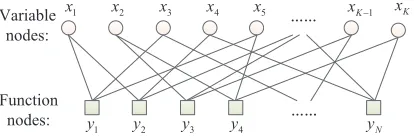
To reduce the detection complexity, the matrixSis designed to be sparse so as to leverage the low-complexity MPA detection to achieve near optimal performance. Specifically, each symbol is spread over a relatively small number of the N resources and each resource is used by a relatively small number of theK users. We define anN×K binary indicator matrix, denoted by G={gnk}N×K, where ’1’s indicate the nonzero entries in S, i.e., for∀n, k, if gnk= 0, setsnk= 0; if gnk = 1, set snk ̸= 0. With S being sparse, the signal model (1) can be represented by the factor graph, where the transmitted symbol xk, denoted by variable node, and the received symbolyn, denoted by function node, are connected by edge ek,n if gnk = 1, and the gain corresponding to the edge is snk√hnk
Λk A.
ĂĂ
1
x x2 x3 x4 x5 xK-1 xK
1
y y2 y3 y4 yN
ĂĂ Variable
nodes:
[image:4.612.75.282.57.125.2]Function nodes:
Fig. 1. The factor graph representation of sparse sequences withdv = 2
anddf = 3.
of the matrixS. The matrix Sis regular if the variable nodes and the function nodes are of identical sparsity respectively, otherwise it is irregular. Regular matrices potentially outper-form irregular ones in terms of spectral efficiency and bit error probability [11]. Therefore, in this paper, we focus on regular structures. Letdvanddfdenote the variable and function node sparsity respectively, and we have dv =
∑N
n=1gnk,∀k and df =
∑K
k=1gnk,∀n.Fig. 1 shows the factor graph of sparse sequences withdv = 2anddf = 3.For regular structures, the
following relationship must be satisfied:
β=df
dv
. (2)
B. MPA Detection
MPA is an iterative detection performed over the factor graph. In each iteration, messages that measure the aposterior
probability of the variable node are sent to the connected function nodes; each function node then computes messages to send back to the variable nodes based on the observed signal and the previously received messages. For detailed description, we refer the readers to [6]. Let vk(t→)n andu(nt→)k be the messages sent along edge ek,n between variable node xk and function node yn in the t-th iteration. The messages are represented in the form of log-likelihood ratio (LLR) for BPSK. The update equations are given by (3) and (4) (on the next page).
vk(t→)n = ∑
j∈ζk\n
u(jt→−k1), (3)
whereζk (ζn) is the index subset of function (variable) nodes connected to xk (yn), called its neighborhood;ζk\ndenote the neighborhood of xk excludingyn.
The initial condition of the iteration isvk(0)→n= 0. After the messages have converged or the maximum number of itera-tionsThas been met, all the messages coming to variable node xk are summed to compute the final LLRvk→n=
∑ j∈ζk
u(jT→)k, which can be used to make a final decision for symbol xk or be sent to the following decoding module.
III. ASYMPTOTICLARGE-SYSTEMANALYSIS
As there is no closed-form expression for the relationship between the detection performance of MPA and the sparse sequences, it is intractable to optimize the sparse sequences directly. To overcome this difficulty, we firstly investigate the performance of MPA in the asymptotic large-system limit, by letting K, N→ ∞ with their ratioβ fixed.
In the large-system limit, the average bit error rate (BER) will be evaluated for the limiting variable and function node sparsity of the matrix, based on which an optimization problem that minimizes the average BER is formulated with constraints on the system load and detection complexity. We perform the large-system limit analysis by adopting the density evolution (DE) framework. It was first introduced to calculate the threshold of the sum-product decoding [17] and was used to search for the capacity-approaching low-density parity check codes (LDPC) [18]. DE is an effective tool for analyzing the dynamic behavior of belief-propagation-like algorithms. We will first derive the DE formula for the MPA detector and analyze the impact of sparsity on the performance. We then formulate an optimization problem to minimize the average BER with the constraints of system load demand and detection complexity. An efficient algorithm is proposed to obtain the optimal variable and function node sparsity.
A. Analysis of MPA by Density Evolution
Assume that the indicator matrix G is uniformly and randomly picked from the indicator matrix ensemble for the given sparsity distribution. Nonzero entry snk is drawn i.i.d from the distribution ps with zero mean and unit variance. Average performance will be evaluated by DE.
Large-system limit renders the random sparse graphs to be locally tree-like, which ensures that the incoming messages are independent. DE treats the sent messages as independent random variables, and tracks the probability density function (PDF) of the messages. Without loss of generality, assume that all inputs are+1 and that the messages follow Gaussian distribution. This approximation has good performance as elaborated in [17], and we will show later that it is valid in this case. Moreover, the MPA detector fulfills the symmetry condition [13], which leads to σ2 = 2m for a Gaussian
distribution with meanmand varianceσ2. Thus, tracking the
mean of the message is enough, which dramatically reduces the computational complexity of DE.
Let v and u be the message from a variable node and a function node, respectively. The DE formula for the MPA detector is given as follows.
Theorem1: Denote mu and mv as the mean ofu andv, respectively. Then, mu andmv are calculated by (5) and (6) in thet-th iteration, respectively, written as
m(ut)= 2A 2
dv ∫ ∞
−∞
1
α 4ev (ev+1)2 + 1
· 1
4πm(vt) e−
(v−m(vt))2 4m(vt) dv,
(5)
m(vt)= (dv−1)m(ut−1), (6)
whereα= df−1
dv A
2. The initial condition is
m(0)u = 2A 2
dv(α+ 1)
. (7)
Proof:See the appendix.
u(nt→)k= log
∑
i∈ζn\k xk=+1
exp
( −1
2(yn−
∑ i∈ζn
sni√hni Λi Axi)
2+ ∑
i∈ζn\k
xi 2v
(t)
i→n )
∑
i∈ζn\k xk=−1
exp
( −1
2(yn−
∑
i∈ζn
sni√hni Λi Axi)
2+ ∑
i∈ζn\k
xi 2v
(t)
i→n
), (4)
0 2 4 6 8 10
10−6 10−5 10−4 10−3 10−2 10−1 100
SNR (dB)
BER
[image:5.612.49.568.59.337.2](2,3) (4,6) (8,12) (16,24) single user bound
Fig. 2. The asymptotic average BER of MPA in large-system limit for various sparsity settings(dv, df)and the fixed loadβ= 1.5.
Gaussian distribution N(m∗v,2mv∗)with m∗v =dvm
(T)
u . The equivalent average SNR is m∗v/2and the BER is given by
BER =Q(√m∗v
)
, (8)
whereQ(x)is theQ-function of standard normal distribution. We will use the derived DE formula (5) and (6) to evaluate the performance of MPA in the large-system limit and provide some insights on the influence of sparsity and system load.
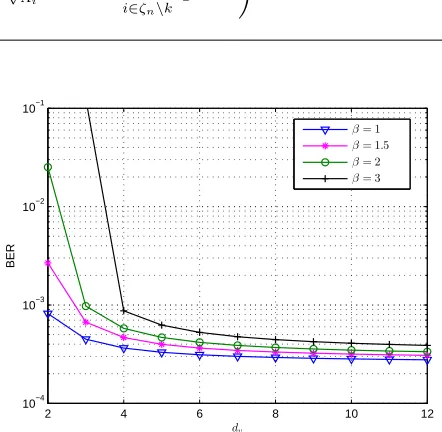
Fig. 2 shows the asymptotic average BER achieved by the MPA detector for various sparsity settings (dv, df)and fixed load β = 1.5. The single user bound, which is the BER of orthogonal multiple access system (OMA) system, is also plotted for comparison. It reveals that the performance of MPA approaches the single user bound as SNR increases. It is observed that, for fixed system load, the performance improves with increasing sparsity in the medium and high SNR regime, and the improvement reduces as the sparsity increases further. This feature is further examined in Fig. 3, which plots the variation of the BER vs. sparsity for different fixed system loads. The performance is improved dramatically when dv increases from 2 to 6 and remains approximately the same when dv is beyond 6.
Fig. 4 presents the variation of BER vs. the system load given SNR = 8 dB. The BER performance becomes worse as the system load increases, as expected. Moreover, there is a threshold of system load for each variable sparsity, beyond which the performance deteriorates rapidly.
2 4 6 8 10 12
10−4 10−3 10−2 10−1
dv
BER
β= 1
β= 1.5
β= 2
β= 3
Fig. 3. The variation of the asymptotic average BER vs. sparsity for different fixed system loads and SNR = 8 dB.
1 1.5 2 2.5 3 3.5 4
10−4 10−3 10−2 10−1 100
β
BER
dv= 2
dv= 3
dv= 4
[image:5.612.59.320.65.337.2]dv= 5
Fig. 4. The variation of the asymptotic average BER vs. system load under SNR = 8 dB.
B. Optimization of Sparsity
[image:5.612.323.544.117.333.2] [image:5.612.327.539.402.570.2]by
min
dv, df
Pe (9a)
s.t. β ≥β0, (9b)
df ≤df, (9c)
dv, df ∈N+ ≥2, (9d)
whereβ0is the required minimum system load, and inequation
(9c) gives the detection complexity constraint, because the complexity of MPA is O(|X |df)[15]. Constraint (9d) means
dv and df can only take positive integer values larger than 2. With these objective function and constraints, we have formulated a nonlinear integer programming problem.
This problem is hard to solve because no analytic expression can be derived forPe(dv, df), as MPA is a nonlinear iterative detection method. By leveraging the previous analysis of MPA and investigating the characteristics of the problem, we will propose an efficient algorithm to search for the optimal solution.
Theorem2: If we extend the feasible region to the real domain, i.e., remove the integer constraint (9d), the optimal solution to (9) is obtained when constraints (9b) and (9c) are satisfied with equality simultaneously.
Proof: Suppose there exists an optimal sparsity pair
(d′v, d′f), for which one of the following three cases is valid: 1) β′ = β0, d′f < df; 2) β′ > β0, d′f = df; 3) β′ > β0,
d′f < df, whereβ′ = d′f d′v.
For case 1), keep β′ fixed and increase (d′f, d′v) to
(d(1)f , d(1)v )so thatd
(1)
f =df. This will improve the detection performance, i.e.,Pe(d
(1)
v , d
(1)
f )< Pe(d′v, df′), so that(d′v, d′f) is not optimal. For case 2), decrease β′ by increasing d′v so that the detection performance is improved. For case 3) we can verify that (d′v, d′f) is not optimal in a similar manner. Thus the proposition is true.
[image:6.612.320.556.491.547.2]When the integer constraint is added, the optimal sparsity pair may not be the point that satisfies constraints (9b) and (9c) with equality any more, but it will be close to the optimal value. Based on this observation, an algorithm is proposed in TABLE I, where⌊z⌋means getting the largest integer smaller than or equal toz.The algorithm starts from the integer point nearest to the boundary of the feasible region and searches along the descent direction of objective function. The total number of points possible to be searched is evaluated to be (d(1)f −2)(d(1)v ). Therefore, the complexity of the algorithm is O((df−2)⌊
df β0⌋
)
. Since the searching space is limited, the algorithm will converge after a few loops. In each loop, the algorithm can search all the points superior to the current one in the feasible region. Thus the solution of the algorithm is optimal.
We will give the optimization results for various configura-tions of constraint parameters.
Result 1: Given SNR = 8dB and the system load demand β0 = 1.5, the optimal sparsity under various d¯f settings is presented in TABLE II.
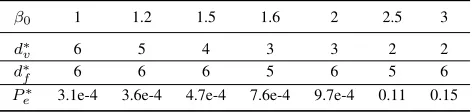
Result 2: Given SNR = 8dB and the complexity constraint parameterd¯f = 6, the optimal sparsity under various load β0
TABLE I
PROPOSED ALGORITHM FOR DESIGN OF OPTIMAL SPARSITY
Input:Given SNR, the system load demandβ0, complexity constraint parameterdf Output:Optimal sparsity(d∗v, d∗f).
Initialized∗f=df,d∗v=⌊d′v⌋withdf/d′v=β0,
i= 1,d(1)v =d∗v,d
(1)
f =d∗f; whiled(vi)>1
ifthe current loadd(fi)/d(vi)≥β0
ifPe(d(fi), dv(i))≤Pe(d∗f, d∗v)
Update the current optimal sparsity(d∗v, d∗f) = (dv(i), d(fi)); end
ifd(fi)> d(vi)+ 1
Update(d(vi+1), d(fi+1)) = (d
(i)
v + 1, d(fi)); else
Update(d(vi+1), d
(i+1)
f ) = (d
(i)
v , d
(i)
f −1); end
else
Update(d(vi+1), d
(i+1)
f ) = (d
(i)
v −1, d
(i)
f −1); end
i=i+ 1;
end
is presented in TABLE III.
TABLE II
THE OPTIMAL SPARSITY UNDER VARIOUSd¯f, SNR=8dB,β0= 1.5.
¯
df 3 4 5 6 7 8 9
d∗v 2 2 3 4 4 5 6
d∗f 3 3 5 6 6 8 9
Pe∗ 2.7e-3 2.7e-3 7.6e-4 4.7e-4 4.7e-4 4.1e-4 3.6e-4
TABLE III
THE OPTIMAL SPARSITY UNDER VARIOUS LOAD, SNR=8dB,d¯f = 6.
β0 1 1.2 1.5 1.6 2 2.5 3
d∗v 6 5 4 3 3 2 2
d∗f 6 6 6 5 6 5 6
Pe∗ 3.1e-4 3.6e-4 4.7e-4 7.6e-4 9.7e-4 0.11 0.15
IV. SPARSESEQUENCESDESIGN
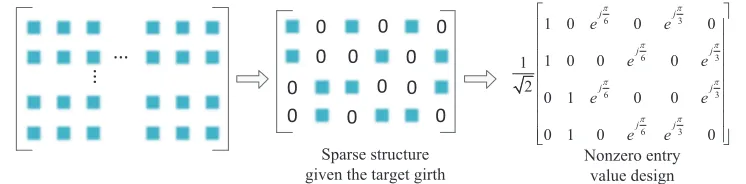
Based on the large-system limit analysis, in the following, the optimal sparse sequences that optimize the performance of MPA detector is designed in a systematically hierarchical way, as illustrated in Fig. 5. First, the dimensions of the matrix are determined and the sparse structure is constructed given the target girth. This step gives the indicator matrix. Then, the values of nonzero entries are designed with the aim of maximizing the minimum Euclidean distance of the transmitted vector, to optimize the detection performance.
A. Sparse Structure Design
... .. . 0 0 0 0 0 0 0 0 0 0 0 0 6 3 6 3 6 3 6 3
1 0 0 0
1 0 0 0
1 2
0 1 0 0
0 1 0 0
j j j j j j j j e e e e e e e e p p p p p p p p é ù ê ú ê ú ê ú ê ú ê ú ê ú ê ú ê ú ë û Sparse structure given the target girth
[image:7.612.119.492.54.146.2]Nonzero entry value design
Fig. 5. The schematic diagram of the proposed hierarchical scheme for the sparse sequences design.
nonzero entries in the matrix. This is performed under the condition of limited dimension, which may lead to cycles in the factor graph. The MPA over cycle-free factor graphs provide optimal detection, but cycles especially small cycles deteriorate the performance of MPA. Hence it is necessary to mitigate the influence of the cycles. The girth of a factor graph is defined as the length of the smallest cycle in the graph, and the smaller the girth, the worse the performance will be.
To guarantee the performance, a tolerable girth is set for this procedure and the goal is to construct the factor graph with girth meeting the requirement from an ensemble of factor graphs given the sparsity.
The problem of constructing sparse factor graphs was widely researched in LDPC [19]. Typical LDPC construction methods is introduced as follows. Gallager’s construction is based on a banded structure in check matrix with random submatrices. There is no guarantee that small cycles are not present. Progressive edge growth (PEG) is a graph based method, where edges are added to the factor graph progres-sively in an edge-by-edge manner, so as to maximize the local girth at the current variable node. Thus, PEG method avoids the occurrence of small cycles [20], and it is adopted in this paper to generate the indicator matrix, given the sparsity.
The following proposition gives the range of the number of resources so as to satisfy the girth requirements with the given sparsity.
Theorem3: Consider a regular indicator matrix with vari-able sparsity dv and function sparsity df. Given the desired girth g, the number of rows in the matrix, denoted by N, is in the interval[Nl, Nu)where
Nl=
[(df−1)(dv−1)]
g−2 4 −1
1− dv
df(dv−1)
+ 1,
Nu=
[(df−1)(dv−1)]
g
2 −1 df−
df
dv −1
(10)
Proof: The girthg is lower bounded and upper bounded by g≥2(⌊t⌋+ 2) andg≤4⌊t⌋+ 2, respectively [20] where
t= log(N df−
N df
dv −N+ 1) log[(dv−1)(df−1)] −
1. (11)
Therefore we have the bound for t given by
g−2 4 ≤t <
g
2 −1. (12)
Substituting (11) into (12) and solving (12), we can obtain the lower and upper bound given in (10).
There are actually multiple factor graphs satisfying the girth requirement. We will select the one with minimum dimension in order to make the system more flexible. The algorithm to generate the optimal sparse structure is listed in TABLE IV.
TABLE IV
ALGORITHM FOR THE CONSTRUCTION OF OPTIMAL INDICATOR MATRIX
Input:Given sparsitydvanddf, the minimum girthg, Output:Optimal indicator matrixG.
CalculateNlandNuby (10);
N=⌈Nl
dv⌉dv, K=⌈ Nl dv⌉df; loop
Construct the sparse indicator matrixGby the PEG algorithm with inputN, K, dv, df;
N=N+dv, K=K+df;
untilthe girth ofGis not smaller thang
The following example gives the constructed indicator ma-trices, denoted by G(dv,df),g, given the target girth g and
sparsity (dv, df).
Result 3:Given(dv, df) = (2,3), if we set the target girth g= 6, the indicator matrix is
G(2,3),6=
1 0 1 0 1 0
1 0 0 1 0 1
0 1 1 0 0 1
0 1 0 1 1 0
, (13)
if we set the target girthg= 8, the indicator matrix is then
G(2,3),8=
1 1 1 0 0 0 0 0 0 0 0 0
0 0 0 1 1 1 0 0 0 0 0 0
0 0 0 0 0 0 1 1 1 0 0 0
0 0 0 0 0 0 0 0 0 1 1 1
0 1 0 0 0 1 0 1 0 0 0 0
0 0 1 0 1 0 0 0 0 1 0 0
1 0 0 0 0 0 0 0 1 0 0 1
0 0 0 1 0 0 1 0 0 0 1 0
. (14)
B. Nonzero Entry Value Design
the constellation alphabet, determines the performance of opti-mal detection. The distance between two arbitrary transmitted vectors x1,x2 ∈ X is defined by D=∥AS(x1−x2)∥. Let ∆X ={0,±2}and∆XK be the set of lengthKvectors with entries taken values from ∆X. The minimum distance is thus given by
Dm= min
∆x∈∆XK,∆x̸=0D(S,∆x).
D(S,∆x) =
v u u t∑N
n=1
K ∑
k=1 1
√
Λk
Asnk∆xk
2 (15)
Since constant-modulus value is in favor of implementation, we assume the nonzero entries snk = ejθ, θ ∈ [0,2π) for hnk = 1 and denote S as the matrix set with such unit-modulus value. Particularly, the BER is approximately propor-tional to e−Dm at high SNR. Therefore, given the indicator
matrix, we design the optimal matrix with the maximum minimum distance.
However, finding the optimal matrix is generally an in-tractable problem with high complexity. The following propo-sition provides a method of reducing the size of searching space.
Proposition 1: ( [16],Theorem 3) Let G be the indicator matrix with cycles in the corresponding factor graph and denote E as the edge subset that after delating the edges inside, the graph becomes a tree. The optimal matrix with the maximum minimum distance is in the subset {S|snk = ejθk, θ
1 = 0, θ2,· · ·, θK ∈ [0,π2) for en,k ∈ E¯ and snk = ejθnk, θ
nk∈[0,2π)for en,k∈E}.
Nevertheless, it is still complicated to search for the optimal matrix when G is of relatively large dimension or sparsity. To simplify the problem, an efficient way is to limit the non-zero entries of each row of S to take values from the same finite constellation, represented by {ai}, and the size of the constellation equals to the function sparsity df. Specifically, non-zero entries of each row take distinct values from{ai}, i= 0,1,· · ·, df−1. Furthermore, let {ai}satisfy the row-wise unique decodability requirement, that is for two distinct transmitted vector x1,x2 and x1 ≠ x2,Sx1̸=Sx2
element-wisely, which guarantees that S is uniquely decod-able. A empirically good design based on extensive simulation is [15]
ai= exp (j
2π
Ci), i= 0,1,· · ·, df−1, (16)
whereC= 4df
gcd (2,df) is chosen to get good distance spectrum.
Let S(dv,df)(N,K) represent the designedN×K
multiple-access matrix with sparsity(dv, df). In the following, a simple example is given to demonstrate the design procedure.
Example 1:Settingβ0= 1.5,d¯f = 3and given SNR=8dB, the optimal sparsity is (2,3) according to TABLE I. Then let the target girth g = 6 and the constructed optimal indicator matrix is shown by (13). The value constellation is ai = exp (jπ6i), i = 0,1,2 according to (16). Thus the
0 2 4 6 8 10
10−6 10−5 10−4 10−3 10−2 10−1 100
SNR (dB)
BER
S(2,3)(4,6),d¯f= 3
S(3,5)(48,80),d¯f= 5
S(4,6)(228,342),d¯f= 6
[image:8.612.327.539.61.230.2]single user bound
Fig. 6. The average BER under matrices with variousd¯f, the sameβ0= 1.5 andg= 6.
0 2 4 6 8 10
10−6 10−5 10−4 10−3 10−2 10−1 100
SNR (dB)
BER
S(2,5)(6,15),β0= 2.5 S(3,6)(78,156),β0= 2 S(4,6)(228,342),β0= 1.5
[image:8.612.326.539.288.455.2]single user bound
Fig. 7. The average BER under matrices with variousβ0, the samed¯f = 6
andg= 6.
constructed matrix is
S(2,3)(4,6)= 1
√
2
1 0 ejπ
6 0 ejπ3 0
1 0 0 ejπ
6 0 ej
π
3
0 1 ejπ
6 0 0 ejπ3
0 1 0 ejπ
6 ej
π
3 0
. (17)
Other matrices for various parameter settings can be con-structed in a similar way.
V. NUMERICAL RESULTS AND DISCUSSION
In this section, we simulate the BER performance of the designed sparse sequences under different conditions. Firstly, we will depict the performance of MPA for AWGN channel and investigate the influence of constraints.
0 2 4 6 8 10 10−6
10−5 10−4 10−3 10−2 10−1 100
SNR (dB)
BER
S(2,3)(4,6), g= 6
S(2,3)(12,18), g= 10
S(2,3)(48,72), g= 12
[image:9.612.66.277.60.230.2]single user bound
Fig. 8. The average BER under matrices with various girth, the sameβ0=
1.5andd¯f = 3.
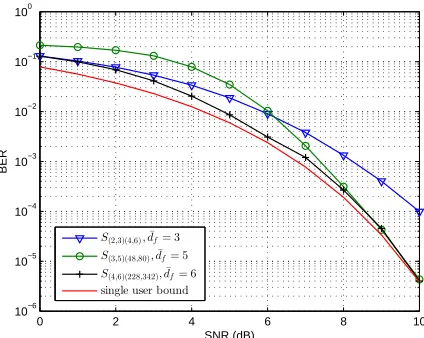
complexity can be traded for better performance approaching the single user bound in high SNR regime. Our NOMA scheme using the designed matrices S(3,5)(48,80) and S(4,6)(228,342)
can accommodate50% more users than OMA scheme with a performance loss of only about 0.07dB at BER = 10−5 over
the single user bound.
The performance of sparse matrices for various system loads is shown in Fig. 7 for the same complexity parameter and target girth. The increasing load incurs performance loss and especially, increasing the load from 2 to 2.5 aggravates the loss, which is also demonstrated in Fig. 4. Despite the high load, S(3,6)(78,156) achieves an excellent BER performance,
almost as good as S(4,6)(228,342) at high SNR.
Fig. 8 illustrates the performance of sparse matrices for various girths when β0 = 1.5 and d¯f = 3. Note that not all girth setting can obtain corresponding regular sparse matrix, for example for sparsity (2,3), g = 8 regular sparse matrix cannot be found. Given the sparsity, girth influences the dimension of the matrix and the optimality of MPA detection. It shows that the performance ofS(2,3)(48,72)andS(2,3)(12,18)
have very small gap but are better thanS(2,3)(4,6). This implies
that large girth improves the performance, but the impact becomes weaker as girth increases.
Assuming perfect channel state information at the receiver, we simulate the performance of the proposed scheme over Rayleigh fading channel. Fig. 9 gives the average BER perfor-mance ofS(4,8)(348,696)andS(3,6)(78,156)with the system load
β = 2.The performance of the NOMA scheme in [7] with also 200% overload and OMA with QPSK modulation are provided for comparison. It reveals that the proposed NOMA scheme outperforms the other two while achieving the same spectral efficiency.It can be observed that the proposed NOMA scheme is able to obtain the diversity gain in fading channel through spreading the signal over several resources. The diversity gain the NOMA scheme can obtain is approximately the same as the designed variable sparsity. The theoretical BER of OMA-QPSK with diversity gain being 3 and 4 are also plotted to verify the observation.
0 5 10 15 20
10−6 10−5 10−4 10−3 10−2 10−1 100
Eb/No (dB)
BER
[image:9.612.326.539.61.230.2]S(4,8)(348,696) S(3,6)(78,156) scheme in [6] QPSK OMA QPSK diversity=3 QPSK diversity=4
Fig. 9. The average BER in Rayleigh fading channel when the rates of various schemes are identical.
VI. CONCLUSION
In this paper, we consider the NOMA with sparse multiple-access sequences, so as to leverage the message passing algorithm (MPA) to largely reduce the practical complexity of MUD. Particularly, the optimal sparse sequences that optimize the performance of MPA detector have been investigated. To make the problem tractable, the optimal sparse sequences are designed in a systematically hierarchical way. The optimal sparsity of sequences is analyzed by minimizing the average BER in the asymptotic large-system limit. On this basis, the sparse structure is constructed given the target girth and then the values of nonzero entries are chosen with the aim of max-imizing the minimum distance. Simulation results have shown the detection performance of the designed sparse sequences in both AWGN and Rayleigh fading channel. It shows that by careful choice of parameters, the performance of the sparse NOMA schemes can approach the single user bound at high SNR while supporting system overload. The superiority of the proposed scheme in Rayleigh fading channel due to the ability of obtaining diversity gain is revealed.
APPENDIX PROOF OFTHEOREM1
According to (3), v is equal to the sum of the incoming messages from other connected function nodes, denoted by uj, j= 1,· · ·, dv−1, i.e.,
v=
d∑v−1
j=1
uj. (18)
Since uj’s are i.i.d. and have the same mean, the mean of v at thet-th iteration is updated as
m(vt)= (dv−1)m(ut−1). (19) To calculate mu, Gaussian approximation for interference is exploited. Specifically, the signal received at resourcencan be written as
yn= snk√hnk
Λk
whereznk= ∑
i∈ζn\k
sni√hni
Λi Axi+wncontains interference and
Gaussian noise. When dv is large enough, the central limit theorem works; then znk approximately follows a Gaussian distributionN(µz, σ2z)with
µz= ∑
i∈ζn\k
snihni
√
Λi
AE(xi), (21)
σz2= ∑
i∈ζn\k
|sni|2|hni|2
Λi
A2Var(xi) + 1, (22)
where E(xi) and Var(xi) denote mean and variance of xi respectively, written as
E(xi) =
evi→n−1
evi→n+ 1, (23)
Var(xi) =
4evi→n
(evi→n+ 1)2. (24)
Therefore, the message u(nt→) k reduces to
u(nt→)k = 2
σ2(t) z
s∗nkh∗nk
√
Λk
A(yn−µ(zt)). (25)
Givensnk, hnkandyn, taking the mean of (25) overvwith distributionN(mv,2mv), we obtain (we omit(t)for brevity)
mu(S, H, yn) =
2s∗nkh∗nk
√
Λk A
[ Ev(
1
σ2
z
)yn−Ev( µz σ2
z
)
]
. (26)
For all+1input, we haveyn ∼ N( ∑
i∈ζn
sni√hni
Λi A,1). Note that
the nonzero entries of S are i.i.d variables with zero mean and unit variance, and hnk is either equal to 1 or follows Gaussian distribution with zero mean and unit variance. Taking the expectation over the randomness ofS, H andyn, the first term and the second term in the right of (26) respectively equal to
E [
2s∗nkh∗nk
√
Λk
AynEv(
1
σ2
z
)
]
= 2A 2
dv E v
(
1
αVar(xi) + 1 )
,
(27)
E [
2s∗nkh∗nk
√
Λk AEv(
µz σ2
z
)
]
= 0. (28)
Substituting (27) and (28) into (26), we can obtain (5). To begin with, because of no message from the observed signal, let E(xi) = 0,Var(xi) = 1 to obtain the initial condition.
REFERENCES
[1] Z. Ding, Y. Liu, J. Choi, Q. Sun, M. Elkashlan, C. L. I, and H. V. Poor, “Application of non-orthogonal multiple access in LTE and 5G networks,”IEEE Commun. Mag., vol. 55, no. 2, pp. 185–191, Feb. 2017. [2] L. Dai, B. Wang, Y. Yuan, S. Han, C.-L. I, and Z. Wang, “Non-orthogonal multiple access for 5G: solutions, challenges, opportunities, and future research trends,”IEEE Commun. Mag., vol. 53, no. 9, pp. 74–81, Sep. 2015.
[3] W. Feng, Y. Wang, D. Lin, N. Ge, J. Lu, and S. Li, “When mmwave communications meet network densification: A scalable interference coordination perspective,”IEEE Journal on Selected Areas in
Commu-nications, vol. PP, no. 99, pp. 1–1, 2017.
[4] Y. Saito, A. Benjebbour, Y. Kishiyama, and T. Nakamura, “System-level performance of downlink non-orthogonal multiple access (NOMA) under various environments,” in Proc. IEEE 81st Veh. Technol. Conf.
(VTC Spring), May 2015, pp. 1–5.
[5] Z. Ding, P. Fan, and V. Poor, “Impact of user pairing on 5G non-orthogonal multiple access downlink transmissions,”IEEE Trans. Veh.
Technol., vol. PP, no. 99, pp. 1–1, Sep. 2015.
[6] R. Hoshyar, F. P. Wathan, and R. Tafazolli, “Novel low-density signature for synchronous CDMA systems over AWGN channel,” IEEE Trans.
Signal Process., vol. 56, no. 4, pp. 1616–1626, Apr. 2008.
[7] R. Hoshyar, R. Razavi, and M. Al-Imari, “LDS-OFDM an efficient multiple access technique,” inProc. IEEE 71st Veh. Technol. Conf., May 2010, pp. 1–5.
[8] H. Nikopour and H. Baligh, “Sparse code multiple access,” in Proc. IEEE 24th Annual International Symposium on Personal, Indoor, and
Mobile Radio Communications (PIMRC), Sep. 2013, pp. 332–336.
[9] T. Qi, W. Feng, and Y. Wang, “Optimal sequences for non-orthogonal multiple access: A sparsity maximization perspective,”IEEE Commun.
Lett., vol. 21, no. 3, pp. 636–639, Mar. 2017.
[10] M. Yoshida and T. Tanaka, “Analysis of sparsely-spread CDMA via statistical mechanics,” inProc. IEEE Int. Symp. Inf. Theory, Jul. 2006, pp. 2378–2382.
[11] J. Raymond and D. Saad, “Sparsely spread CDMA - a statistical mechanics based analysis,”J. Phys. A: Math. Theor., vol. 40, pp. 12 315– 12 333, Oct. 2007.
[12] D. Guo and C. C. Wang, “Multiuser detection of sparsely spread CDMA,” IEEE J. Sel. Areas Commun., vol. 26, no. 3, pp. 421–431, Apr. 2008.
[13] A. Montanari and D. Tse, “Analysis of belief propagation for non-linear problems: The example of CDMA (or: How to prove Tanaka’s formula),”
inProc. IEEE Information Theory Workshop, Mar. 2006, pp. 160–164.
[14] T. Huang, J. Yuan, X. Cheng, and W. Lei, “Design of degrees of distri-bution of LDS-OFDM,” inProc. IEEE 9th International Conference on
Signal Processing and Communication Systems (ICSPCS), Dec. 2015,
pp. 1–6.
[15] J. van de Beek and B. M. Popovic, “Multiple access with low-density signatures,” inProc. IEEE Global Telecommun. Conf., Nov. 2009, pp. 1–6.
[16] X. W. G. Song and J. Cheng, “Signature design of sparsely spread cdma based on superposed constellation distance analysis,” [online]
http://lanl.arxiv.org/abs/1604.04362, Apr. 2016.
[17] S.-Y. Chung, T. J. Richardson, and R. L. Urbanke, “Analysis of sum-product decoding of low-density parity-check codes using a gaussian approximation,”IEEE Trans. Inf. Theory, vol. 47, no. 2, pp. 657–670, Feb. 2001.
[18] T. J. Richardson, M. A. Shokrollahi, and R. L. Urbanke, “Design of capacity-approaching irregular low-density parity-check codes,” IEEE
Trans. Inf. Theory, vol. 47, no. 2, pp. 619–637, Feb. 2001.
[19] S. J. Johnson, “Introducing low-density parity-check codes,”University
of Newcastle, Australia, 2006.
Ting Qireceived her B.S degrees with the high-est honor from the School of Telecommunication and Information Engineering, Nanjing University of Posts and Telecommunications, Nanjing, China, in 2013. She is currently working toward the Ph.D. degree in the School of Aerospace Engineering at Tsinghua University, Beijing, China. Her research interests include non-orthogonal multiple access technology, 5G and coordinated satellite-terrestrial networks.
Wei Feng(S’06-M’10) received his B.S. and Ph.D. degrees (both with the highest honor) from the Department of Electronic Engineering, Tsinghua U-niversity, Beijing, China, in 2005 and 2010, respec-tively. From 2010 to 2011, he served as a Project Director in the National Science and Technology Major Project Management Office of Tsinghua U-niversity. From 2011 to 2014, he was a Postdoctoral Research Fellow with the Department of Electron-ic Engineering, Tsinghua University, where he has been an Assistant Professor since Oct. 2014 and then an Associate Professor since Dec. 2016. His research interests include maritime broadband communication networks, large-scale distributed antenna systems, and coordinated satellite-terrestrial networks. He has published over 70 journal and conference papers. He also holds over 10 granted patents. Dr. Feng has received the Outstanding Ph.D. Graduate of Tsinghua University Award in 2010, the IEEE WCSP Best Paper Award in 2013, the first Prize of Science and Technology Award of China Institute of Communications in 2015, the IEEE WCSP Best Paper Award in 2015, and the second Prize of National Technological Invention Award of China in 2016. He currently serves as the Assistant to the Editor-in-Chief of China Communications.
Yunfei Chen(S’02-M’06-SM’10) received the B.E. and M.E. degrees in electronics engineering from Shanghai Jiao Tong University, Shanghai, China, in 1998 and 2001, respectively, and the Ph.D. degree from the University of Alberta in 2006. He is cur-rently an Associate Professor with the University of Warwick, U.K. His research interests include wireless communications, cognitive radios, wireless power transfer, energy harvesting, channel modeling, SNR estimation, diversity, modulation, and UWB systems.