USER PARTICIPATION IN THE DESIGN AND DEVELOPMENT
OF WEB 2.0 TECHNOLOGIES FOR PEOPLE WITH LEARNING
DIFFICULTIES
by
SOTIRIS FANOU
A thesis submitted in partial fulfilment of the requirements of the University of the West of England, Bristol for the degree of Doctor of
Philosophy
Faculty of Health and Applied Sciences, University of the West of England, Bristol
Abstract
In the twenty-first century People with Learning Difficulties (PWLD) still face oppression, discrimination and exclusion from the mainstream of social life. Over recent decades the policy of the United Kingdom’s (UK) government and activist organisations regarding people with learning difficulties has been on enabling inclusion, ensuring rights, providing choice and developing advocacy and independence. People with learning difficulties have been moved out of
institutions with the intention to be included and respected as equal members of society. During the same decades that the government and activist organisations have been striving for the inclusion and equality of people with learning
difficulties, the use of Information Technology (IT) has reached pervasive levels, to the degree that it is almost impossible for individuals to socially function successfully, unless they have access to it. Unfortunately, most IT is not designed to be usable and accessible to people with learning difficulties and this is a major barrier for their social inclusion.
Participatory Design (PD) methodologies which emphasise end-user involvement in the software development process are widely considered the key to system usability and accessibility. However, most researchers and software developers believe that people with learning difficulties are not capable of participating in the process of development as a result of their disabilities. Others, report that they do not know how to work with this specific group of disabled end-users. This
discriminatory behaviour is a major reason why IT remains inaccessible to people with learning difficulties. The study described in this thesis combined
Disability, the issues they will face and how those issues can be overcome. Qualitative data was gathered during fourteen Participatory Action Research meetings, in which the Health Trainers were involved in research, software development and system use. The data was analysed using Thematic Content Analysis facilitated by the use of the NVivo software package. The findings were validated by the participating Health Trainers.
The findings suggest that during software development participation, the Health Trainers faced a number of challenges. However, the Health Trainers indicated the type of support they needed from the researcher in order to overcome them. The support required was easy to provide and the Health Trainers managed to engage in the software development process. The study conducted a system use
evaluation to explore if the developed system was usable and accessible to the Health Trainers. The Health Trainers managed to complete all the system tasks posed to them during the evaluation. This suggests that the developed system was usable and accessible to the Health Trainers. Further evidence suggests that a number of factors affected the participation of the Health Trainers during
development and during the use of the system. Finally, the study explored how the developed system was used over the long run, in a period of eighteen months. The findings suggest that system use over time was affected by factors other than the system’s accessibility and usability.
Acknowledgements
Author’s Declaration
I hereby declare that this entire thesis is the work of the author and works quoted have been referenced. This thesis has not been submitted to any other awarding body.
Signed:
Dedication
Table of Contents
ABSTRACT I
ACKNOWLEDGEMENTS III
AUTHOR’S DECLARATION IV
DEDICATION V
TABLE OF CONTENTS VI
LIST OF FIGURES X
LIST OF TABLES X
1 CHAPTER ONE: INTRODUCTION TO THE THESIS 1
1.1 Introduction 1
1.2 Language Used in this Thesis 1
1.3 The Research in Context 3
1.4 Relevance of the Research 8
1.5 Research Aims and Objectives 9
1.6 The Structure of the Thesis 10
2 CHAPTER TWO: CRITICAL REVIEW OF THE LITERATURE 13
2.1 Introduction 13
2.2 Defining Learning Difficulties 13
2.2.1 Terms Used for Learning Difficulties 14
2.2.2 Definition of Learning Difficulty 15
2.2.3 Learning Difficulties Severity Continuum 18
2.3 Incidence of Learning Difficulties in the UK 21
2.4 The Social Model of Disability 23
2.6 The New Vision 26
2.6.1 Valuing People 26
2.6.2 Web Accessibility Initiative 27
2.6.3 Web Accessibility Initiative and people with learning difficulties 29
2.7 People with Learning Difficulties and Information Technology Use 30 2.7.1 Impact of Learning Difficulty on Information Technology Use 31
2.7.2 Information Technology Access Barriers 33
2.7.3 Making Information Technology Accessible 35
2.8 User Participation 37
2.9 User Participation in Other Studies 40
2.10 Conclusion 72
3 CHAPTER THREE: METHODOLOGY 73
3.1 Introduction 73
3.2 Design and Social Science Methodologies 73
3.3 Research Paradigms 75
3.3.1 Research Position Adopted in this Thesis 80
3.4 Participatory Action Research 82
3.4.1 Short History 83
3.4.2 Definition 85
3.4.3 Basic Principles and Characteristics 87
3.4.4 Criticism 89
3.4.5 Justification for Use 91
3.4.6 Applying Participatory Action Research in Practice 93
3.5 Sample 95
3.5.1 Demographic Characteristics 99
3.5.2 Computing skills 100
3.5.3 Limitations of the Sample 106
3.6 Ethics 107
3.7 Data Collection and Analysis 115
3.7.1 Data Collection 115
3.7.1.1 The Participatory Action Research Meeting 116
3.7.2 Thematic Content Analysis 121
3.7.2.1 Findings Validation 125
4 CHAPTER FOUR: SOFTWARE DEVELOPMENT 127
4.1 Introduction 127
4.2 Web 2.0 127
4.3 The Developed System 128
4.4 Methodology 131
4.4.1 Evolutionary Prototyping 131
4.5 System Requirements 146
4.5.1 Analysis and Initial Requirements 149
4.5.2 The Rest of System Requirements 153
4.6 System Design 154
4.6.1 System Architecture 155
4.6.2 Class Structure 156
4.6.3 Tier-1 The Web pages 157
4.6.4 Tier-2 Business Services 159
4.6.5 Tier-3 Database 162
4.7 System Use Evaluation 165
4.7.1 Evaluation Observations 169
4.7.2 Evaluation Conclusions 175
4.8 System Limitations 176
5 CHAPTER FIVE: FINDINGS 178
5.1 Introduction 178
5.2 Could the Health Trainers be Involved? 179
5.2.1 Direct Evidence of Involvement 179
5.2.1.1 Acted Proactively 180
5.2.2 Involvement Challenges and Preferences 181
5.2.2.1 Preference for Simplicity 182
5.2.2.2 Preference for Consistency 188
5.2.2.3 Preference for Common Vocabulary 191
5.2.2.4 Preference for Non-Technical Terminology 194 5.2.2.5 Preference for Shorter Working Periods 199
5.2.2.6 Managing Disagreement 200
5.2.2.7 Learning Challenges 204
5.2.3 Factors Affecting Involvement 207
5.2.3.1 Computing Skills 208
5.2.3.2 Appreciation for Study Objectives 210
5.2.3.3 Interest and Excitement 212
5.2.3.4 Collaboration Affected by Tolerance 214
5.3 Could the Health Trainers Use the System? 215
5.3.1 Pre-existing Computing skills Affected Use 216 5.3.2 Preference for Information in Small Units 220
5.4 Use of the System over Time 223
5.4.1 Clients’ Preferences 223
5.4.2 Quantity and Stability of Material Used 224
5.5 Conclusions 225
6 CHAPTER SIX: DISCUSSION 227
6.1 Introduction 227
6.2 What We Already Know 227
6.3 Could the Health Trainers be Involved? 229
6.3.1 Acted Proactively 229
6.3.2 Involvement Challenges and Preferences 230
6.3.2.2 Preference for Consistency 233 6.3.2.3 Preference for Common Vocabulary and Non-Technical Terminology 235 6.3.2.4 Preference for Shorter Working Periods 237
6.3.2.5 Managing Disagreement 237
6.3.2.6 Learning Challenges 238
6.3.3 Factors Affecting Involvement 240
6.4 Could the Health Trainers Use the System? 242
6.4.1 Pre-existing Computing skills Affected Use 243 6.4.2 Preference for Information in Small Units 244
6.5 Use of the System Over Time 245
6.6 Contribution to Knowledge 246
6.6.1 Ability to Overcome Involvement Challenges 246
6.6.2 Factors Affecting Involvement 247
6.6.3 Use of the System 249
6.6.4 Use Over Time 249
6.6.5 Empowered Sample 249
6.7 Limitations of the Study 252
6.7.1 Level of Participatory Action Research Achieved 254 6.7.2 The Position of the Health Trainers in Relation to the Research 259 6.7.3 Video and Role-Play as a Research and Development Resource 263
6.8 Future Work 266
6.8.1 Requirements Gathering Procedure Change 268
7 CHAPTER SEVEN: CONCLUSIONS AND RECOMMENDATIONS 270
7.1 Introduction 270
7.2 Objectives of the Study 270
7.3 Social Applications and Recommendations 271
7.4 Study Challenges and Implications 275
7.5 Conclusion 278
8 APPENDICES 283
9 APPENDIX 1 - METHOD USED TO FIND MATERIAL FOR THE
CRITICAL REVIEW OF THE LITERATURE 283
10 APPENDIX 2 - RESEARCH DESIGN SUBMITTED TO THE
NATIONAL RESEARCH ETHICS SERVICE 287
11 APPENDIX 3 – SYSTEM REQUIREMENTS 288
13 APPENDIX 5 - LITERATURE SUPPORTED SYSTEM
REQUIREMENTS 306
14 APPENDIX 6 - ABBREVIATIONS 311
15 REFERENCES: 313
List of figures
Figure 2.1 - Learning difficulties severity continuum as defined by the Department of Health (DH, 2001). ... 19 Figure 2.2 – Number of people with learning difficulties depicted by age group (Source:
Valuing People: A New Strategy for Learning Disability for the 21st Century, DH 2001, 15)... 22 Figure 2.3 – The Simplex 2 Model (Source: Adapted from Adams, 2005). ... 32 Figure 3.1 - Morgan and Smircich’s six stage ontology continuum (Source: Adapted from
Morgan and Smircich, 1980). ... 76 Figure 3.2 – The Participatory Action Research cycle of plan, act and reflect (Source: Author
created) ... 84 Figure 3.3 – Severity of the Health Trainers’ learning difficulties (Author created)... 98 Figure 4.1 – The Home Page of the Health Trainers’ wiki based website. The images and
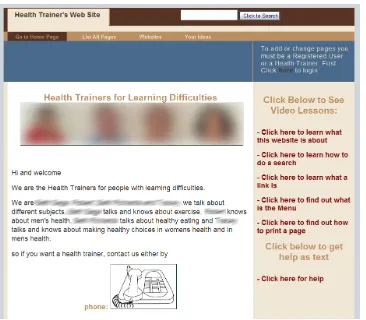
real names of the Health Trainers are blurred to hide their identity. ... 130 Figure 4.2 - How the horizontal menu expands to seven items after Registered Users or the
Health Trainers, log-in the developed system. The extra menus allow editing of the site. ... 131 Figure 4.3 – The iterative process of Evolutionary Prototyping (Author created). ... 135 Figure 4.4 – The 3-tier architecture on which the developed system was based (Author
created). ... 155 Figure 4.5 – The main groups of classes which the developed system contained (Author
created). ... 157 Figure 4.6 - A topic of the Health Trainers’ wiki in view mode. ... 158 Figure 4.7 – A topic of the Health Trainers’ wiki in edit mode. ... 159 Figure 4.8 - Interaction diagram which shows how the different objects of the system
collaborate (Author created). ... 161 Figure 4.9 - An entity relationship diagram of the two tables that make up the Health
Trainers’ wiki database (Author created). ... 163 Figure 4.10 – The search facility of the system developed for the Health Trainers. ... 164
List of tables
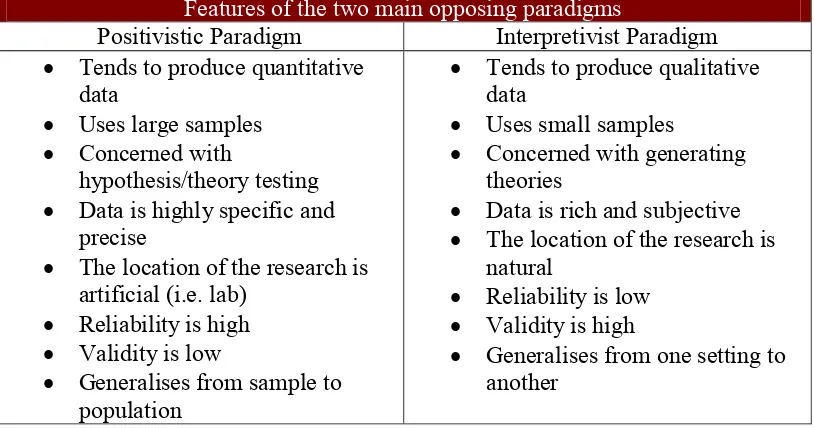
Table 2.1 - The various terms used to describe Learning Difficulty roughly categorised by geographical area. ... 14 Table 3.1 - The main features of the positivist and interpretivist paradigms (Source: Adapted
from Collis and Hussey, 2003). ... 77 Table 3.2 – The demographic characteristics of the Health Trainers. Each column represents
one Health Trainer. The column heads contain the pseudonyms used to replace the Health Trainers’ real names. ... 99 Table 3.3 – Summaries of answers to questions relating to the computing skills of each
Table 3.4 – The computer tasks that were executed by each Health Trainer and how they performed them. ... 104 Table 3.5 - Dates, number of Health Trainers, venue and short description of the
Participatory Action Research Meetings organised for the needs of the study... 118 Table 4.1 – The meetings which concentrated mostly on the development of the system. .... 137 Table 4.2 - The Structure Query Language (SQL) statements used to create the two tables of the developed system’s database. ... 163 Table 4.3 - Tasks that were performed by each Health Trainer for the purpose of system use
evaluation and to gather data for answering research question two. ... 168 Table 4.4 - The researcher’s verbatim notes written down when Bonnie performed the link
creation task. ... 169 Table 4.5- The researcher’s verbatim notes written down when Brenda tried to add an image to a page. ... 171 Table 4.6 – The researcher’s verbatim notes written down when Tanya tried to perform the
search task for system use evaluation. ... 172 Table 4.7 – The tasks during system use evaluation with which Tanya was challenged. ... 172 Table 4.8 - Tasks during system use evaluation with which Roy was challenged. ... 174 Table 5.1 – All the categories and themes identified during the data analysis to answer
research question one. ... 179 Table 5.2 - The first category and related theme identified for research question one. ... 179 Table 5.3 - The second category and related themes identified for research question one. .. 182 Table 5.4 - What the users saw when they tried to edit an article in the Simple English
version of Wikipedia. In edit mode the text contained a number of cryptic formatting tags. ... 183 Table 5.5 – Noted down system requirements along with the researcher’s verbatim notes,
which show the Health Trainers’ preference for simplicity (Comments in square brackets [ ] were added for clarification during the writing of the thesis). ... 187 Table 5.6 – The system requirement to make the separation between the wiki under
development and the Internet browser more apparent. ... 190 Table 5.7 - System change requested by the Health Trainers which suggests their preference for consistency. ... 191 Table 5.8 - Words which the Health Trainers found challenging and the more common
alternatives used. ... 194 Table 5.9 – The uncommon technical terms which the Health Trainers found challenging. 195 Table 5.10 – System requirements which show that the Health Trainers did not want the
developed system to contain any technical terminology. ... 196 Table 5.11 - The common computer terms with which Roy and Tanya were challenged.... 197 Table 5.12 - The third category and related themes identified for research question one. ... 208 Table 5.13 – The one category and two themes identified during data analysis for research
question two. ... 216 Table 5.14 – Researcher’s verbatim notes on how each of the four Health Trainers
performed the search task. Italics are used to emphasize and draw attention to phrases that support the findings. ... 217 Table 5.15 – Researcher’s verbatim notes on how each of the four Health Trainers
performed the task of creating a new page in the system. ... 218 Table 5.16 - All the tasks for which the Health Trainers retreated to using the Help during
system use evaluation. ... 219 Table 5.17 – The written down system requirement with which the Health Trainers asked
for short video tutorials, along with the researcher’s verbatim notes. ... 220 Table 5.18 – The three Health Trainers shown in the first column of the table kept pausing
1
Chapter One: Introduction to the Thesis
1.1 Introduction
This thesis documents research conducted into exploring how people with mild learning disabilities can be involved in the software development process. This introductory chapter sets the research context, demonstrates its relevance and describes its aims and objectives. It closes by describing the content of the rest of the chapters of the present work.
1.2 Language Used in this Thesis
Over recent decades there has been increasing interest in the role of language and its influence on attitudes towards contested social issues, such as discrimination towards minority groups (Barnes, Mercer 2006). In most cases, there has been a positive social response towards the use of none discriminatory language, although the same sensitivity has been slow to extend to people with disabilities. The debate over language and definitions has been central to the Disabled People’s Movement’s critique of academic approaches in the social sciences (Barnes, Mercer 2006). Therefore the researcher of this thesis tries to employ language that is not stigmatising or discriminatory.
Rather than using ‘learning disabilities,’ ‘learning difficulties’ is the term that will be employed in the rest of the thesis as it is believed to be the least
Many scientists, especially those educated in technology rather than the social sciences, such as the researcher of the current study, have not learnt the
sensitivities of language use, as they do not typically write about people. This is obvious in the literature reviewed for the study in which many authors with a background in technology often use stigmatising language. Here the researcher made a serious effort to avoid stigmatising terms both during the writing of the present work and during interaction with the Health Trainers. However in certain circumstances avoiding stigmatising language was difficult. The researcher found the use of non stigmatising language particularly challenging when he tried to describe and evaluate the findings of the study with the Health Trainers. Writing about the challenges that the Health Trainers faced during their involvement in software development (Section 5.2.2) was another circumstance where the use of non stigmatising language was more challenging compared to writing other thesis sections.
The research described in this thesis was interdisciplinary. The study explored whether and how people with learning difficulties could be involved in software development using a social science methodology. A software system was
developed for the needs of the study. The author of the present work acted both as a researcher and as a software developer. Therefore throughout this thesis the author refers to himself using two different terms: ‘the researcher’ and ‘the developer.’
The software system developed for the needs of the study is sometimes referred to as the system, the wiki, the site or the website. This situation arises as the
developed system was a Web based wiki type software system typically used to create websites (wikis are described in Section 4.3). The wiki system developed during the present inquiry was used to create a website for the occupational needs of the people with learning difficulties who participated in the study.
the names of participants in other studies referred in the literature review are pseudonyms. This was stated as such in the literature that describes the other studies. Finally, in order to make the writing and the explanation of the research easier, the following terms with specific meanings are used throughout the thesis:
Participatory Research Team – refers to the Health Trainers and the researcher of the present inquiry as we worked together in most aspects of the research.
Software development – refers to all three phases of software development, analysis, design/implementation and use evaluation or usability testing as described in Chapter Four. The software development part of the current study refers to the phases in the study which directly related to the development of the system built to meet the Health Trainers’ needs. It includes all three previously mentioned phases of analysis, design/implementation and system use evaluation.
Research part of the study – as the adopted methodology was Participatory Action Research (described in Section 3.4) most decisions regarding the research were taken with the Health Trainers. Therefore the Health Trainers were involved in both the software development and the research processes of the study. During the software development part the Health Trainers offered input to make the
developed system accessible. During the research part the Health Trainers were involved in the research process. For example, the Participatory Research Team decided the procedure to be followed for the findings evaluation. This example belongs to the research part of the study as it does not relate to software development. Therefore the research part of the study refers to the processes which did not directly relate to software development.
1.3 The Research in Context
In the twenty-first century disabled people still face oppression, discrimination and exclusion from the mainstream of social life (Barnes, Mercer 2005).
1991, Barton 1996, Barnes 1991, Barnes, Mercer et al. 1999, Oliver 1996).
Despite the fact that many activists, writers, researchers, and academics have done much to promote the issue of discrimination against the disabled, they still remain one of the most oppressed minorities in both Europe and the United States of America (USA) (Barnes, Mercer 2005). In the last two decades disability issues have become a major issue for political debate and many countries including the United Kingdom (UK) have introduced legislation to reduce discrimination (Bynoe, Oliver et al. 1991). Despite the introduction of legislation such as the Disability Discrimination Act (DDA) of 1995, progress has been limited (Barnes, Mercer 2005). One major reason behind the limited progress is the fact that discrimination is based on stereotypical beliefs which we learn as children and which remain within us for the rest of our lives (Oliver 1991, Oliver 1990).
For most of the twentieth century disability was viewed as a personal tragedy or misfortune. People with disabilities were ‘victims’ who ‘suffered’ from ‘mental illness,’ ‘mental handicap,’ blindness or deafness and other conditions that
affected their physical or mental state. Many were segregated and institutionalised and generally considered a ‘burden’ on society (Oliver 1996, Oliver 1990, Barnes, Mercer 2003).
In the USA the ILM emerged as an effort by groups of disabled people to improve their own lives and the actions of rehabilitation professionals. It was inspired by contemporary social movements such as the Civil Rights, Consumerism and Self-Help, opposed medicalisation and institutionalisation while supporting self-care. Ed Roberts and other disabled students at the University of California in Berkeley attracted national interest with campaigns for self managed accommodation with the aim of making themselves ‘independently dependent.’ Subsequently the ‘Rolling Quads,’ a group of disabled students formed by Roberts, were allowed to access California’s Aid to the Totally Disabled programme to recruit, train and fire their own care attendants. A marked increase in the number of off-campus users triggered the establishment of the first Centre for Independent Living (CIL) at Berkeley in 1972. Its goal was to facilitate the integration of disabled people into the community by providing a broad system of support services. These initiatives in the USA attracted considerable interest from disabled activists from Britain and the whole of Europe during the 1980s (Barnes, Mercer 2006).
Early disability activism in Britain centred on small groups of disabled people living in residential institutions. These groups promoted debate about disability and appropriate collective action. Their approaches to independent living stressed self-determination, choice, for example where and how to live, and control over support services like who assists, how and when. They also supported the removal of disabling barriers in mainstream society (Barnes, Mercer 2006, Oliver, Barnes 1998).
The term ‘independent living’ refers to disabled people having the same choice, control and freedom as any other citizen and as members of the community. This does not necessarily mean that disabled people will be doing everything for themselves, but it does mean that any practical assistance required should be under the control of disabled individuals. Independence is formed by having assistance when and how one requires it (Barnes, Mercer 2006, Oliver 1996).
people with learning difficulties to gain control over their lives by including them in decision-making, enfranchising them with full citizenship rights, maximising their autonomy and self-determination, and ensuring that they enjoyed similar standards of living and well-being as those without disabilities. These ideas reflected both the liberal ideals of the 1960s and the social model of disability (please see Section 2.4). For the first time social barriers where considered to be a disabling factor to people with disabilities (Oliver 1996, McConkey, McCormack 1983).
Since the publication of the previous Labour government’s White Paper for England, Valuing People in 2001, the policy and service focus in the UK regarding people with learning difficulties has been on enabling inclusion, ensuring rights, providing choice and developing advocacy and independence. The previous government was venturing to build a country in which, by 2025, disabled individuals are included and respected as equal members of society (DH 2001, Blair 2006). Over recent decades people with learning difficulties have been moved out of institutions with the expectation to participate as full and equal members of society (Barnes, Mercer 2006).
During the same decades that governments and social movements have been striving for inclusion and the equality of people with disabilities, the use of Information Technology has increased to a pervasive level. In the developed world at least, it has become almost impossible for individuals to successfully function unless they have access to and can use Information Technology.
A major reason for the inaccessibility of Information Technology to people with learning difficulties is the fact that they are seldom involved in the software development process. Involvement would allow them to offer their input to ensure that systems are designed in ways that they are accessible to them. User-centred and Participatory Design methodologies are considered by the software
engineering community to be the key for the development of usable products. Through engaging users in the development process the designers can better understand the users’ needs (Mao, Vredenburg et al. 2005, Lopresti, Mihailidis et al. 2004).
According to Henry (2011) accessibility can be approached through usability. The International Organisation for Standardisation (ISO) defines usability as the “extent to which a product can be used by specified users to achieve specified goals with effectiveness, efficiency and satisfaction in a specified context of use” (International Organization for Standardization (ISO) 1998) Accessibility focuses on including people with disabilities as the specified users and a range of
situations as the specified context of use. Usability means designing a system which is effective, efficient, and satisfying, while accessibility makes sure that the system is effective, efficient and satisfying in more situations and for more
people, especially people with disabilities (Henry 2011a).
Research on the Information Technology accessibility needs of people with learning difficulties is also limited. Lewis (2007) observed that people with learning difficulties are rarely included in Information Technology usability studies and that this has a dual impact. It reduces the extent to which the needs of people with learning difficulties are reflected in research and development, and it limits the understanding that the research and development community has of people with learning difficulties. A small number of studies have involved people with learning difficulties in software design and development as presented in Section 2.9 (Grammenos, Savidis et al. 2009, Dickinson, Gregor et al. 2003, Newell, Gregor 2000, Dawe 2007a, Aspinall 2008, Harrison, Stockton et al. 2008a). The emphasis of these studies was on the technology though, and there is a lack of research that concentrates on the engagement itself, to explore the question of how people with learning difficulties can be involved in the software development process. An answer to this type of question could be an instrument in the hands of advocacy organizations and policy makers which could be used to support the involvement of people with learning difficulties in software
development. It could also make a case towards convincing the industry and research communities to work more towards the inclusion of people with learning difficulties in the software development process thus making systems more accessible to them.
1.4 Relevance of the Research
Section 2.9 presents a number of research studies which involved people with learning difficulties in software development but whose emphasis was mostly on technology, how to elicit principles of design, and how to produce specialised software systems for targeted groups of users with learning difficulties. The examined studies assume that people with learning difficulties can be involved in the development of software and never ask questions such as what type of
challenges people with learning difficulties face during involvement or how easy or difficult it is to involve them. These questions are posed by many other
participation itself in order to establish how people with learning difficulties can be involved in the software development process.
If the aim is to include people with learning difficulties as equal members of society then most Information Technology and not just a few specialised systems, must become accessible to them. Therefore the software industry and a bigger fraction of the research community must be convinced to engage people with learning difficulties on a greater scale. Involvement will facilitate the
understanding of their needs and thus produce more accessible systems.
Furthermore, advocacy groups and policy makers must be convinced to further promote this issue. It is therefore important to understand how people with learning difficulties can be engaged in the software development process. The literature contends that one of the reasons for which developers and researchers do not involve people with learning difficulties is because of uncertainty of how to work with them (LoPresti, Bodine et al. 2008, Lewis 2005). Therefore if they could be shown how to do it then it would alleviate that uncertainty and this would make a case towards convincing them to engage this community of users in their projects.
1.5 Research Aims and Objectives
This research explored the factors and challenges that the Health Trainers with learning difficulties faced during software development involvement. The study also explored the issues and challenges which the software developer faced by involving this specific group of Health Trainers in software development. The study presents the approach taken by the developer to overcome such challenges.
The participants were a cohort of individuals with learning difficulties who were working as Health Trainers in the National Health Service (NHS). The Health Trainers’ role is to advise members of the learning difficulty community on health related issues (explained further in Section 3.5). The study concentrated on
1. How can Health Trainers with learning difficulties be involved in the development of software in order to create a system customised to their needs and for their own use?
2. Can Health Trainers with learning difficulties use a Web 2.0 based, e-learning system to help them in their health trainer duties?
3. How do Health Trainers with learning difficulties engage with such a system over time?
Regarding research question one, it was hoped that exploring how people with learning difficulties engage in the software development process, would make a contribution towards convincing the research and software development
communities to involve this group of end-users to a greater extent, and encourage activist organisations to promote this goal further. It would also demonstrate and explore how software developers can approach the field of learning difficulties, the issues they will face, and how these issues can be overcome. Research question two aimed to explore the factors and any challenges that the Health Trainers faced while using the system developed with their involvement. Research question three aimed to explore how the Health Trainers used the system over a long period of time. Exploring how the system was used over a longer period would show how useful the system was to the Health Trainers and their clients. It could also reveal factors that may affect the use of similar systems over a longer period of time. The study also wanted to produce a software system customised to the Health Trainers’ needs so that it could be used to enhance the service they offered.
1.6 The Structure of the Thesis
However, all the presented studies had mostly technological objectives. The chapter shows that there is a lack of research that takes participatory design as its focus and concentrates on the participation itself to address the question of how people with learning difficulties can be involved in the development process and how software developers can approach this field. An answer to this type of question would probably mobilise disability advocacy groups to work harder towards convincing the industry and research communities to involve people with learning difficulties thus making software more accessible.
Chapter Three describes and explains the methodological approach followed for conducting the present inquiry. The chapter starts by identifying an appropriate research and philosophical approach and explains the interpretive/constructivist research position assumed and the methodology of Participatory Action Research adopted. Participatory Action Research is first put into context by presenting a short history. Different elements of the methodology are considered, definition, basic principles, criticism, justification for choosing it and the difference between how it was intended to be applied and how it was applied in practice. Sampling and ethical issues along with the Health Trainers’ characteristics are also discussed. The chapter also considers data collection methods used with Participatory Action Research and describes the Participatory Action Research Meeting, the method chosen for the present study. The final section describes Burnard’s framework, the chosen data analysis method and how it was applied (Burnard, Gill et al. 2008, Burnard 1991, Burnard 1994).
In order to explore the participation of people with learning difficulties the present study developed a software system with the involvement of the Health Trainers. Chapter Four presents the process of developing this system. It starts with a description of Web 2.0, the type of technology used. The principles of
which was adapted in a number of iterations in order to meet the needs and requirements of the Health Trainers. Details of the system architecture, class and database structures are also presented in detail. The research performed a system usability and accessibility evaluation by observing the Health Trainers while using the system. The procedure used for the evaluation is described and the conclusions explained. The chapter ends by explaining a number of system limitations which were the result of limitation in resources.
Chapter Five presents the qualitative findings which arose by analyzing the data gathered during fourteen Participatory Action Research Meetings. The chapter lists the three research questions of the study along with their relevant identified categories and themes and discusses each theme individually. Important data are presented for each theme in order to demonstrate and support it. The final section of the chapter presents a summary of the conclusions reached.
Chapter Six includes a discussion of the findings presented in the previous chapter. The chapter starts with an overview of the key literature on the explored issue. It continues with a discussion of the findings outlined in Chapter Five. Each research question is presented along with the relevant categories and themes identified during the analysis. Each theme is then discussed in relation to
answering the research questions and in relation to the existing body of literature. The discussion reveals findings which support the unique contribution the study makes to the current scientific body of knowledge. Next, this unique contribution is discussed, taking cognisance of the limitations of the study. The chapter closes with suggestions for further research.
Chapter Seven presents a summary of the findings and their technical and social implications. It reiterates the objectives of the study and how the research questions were answered. The chapter recommends social applications of the findings, which could support attitudinal change towards people with learning difficulties so that they obtain the equitable and accessible lifestyle they desire. Finally the chapter discusses the implications of the findings and
2
Chapter Two: Critical Review of the Literature
2.1 Introduction
This chapter will explore the pertinent literature in order to set the present study in its proper context. The chapter provides a critical appraisal of the contributions of others, and identify limitations in the current evidence base. The process used to choose appropriate material and conduct a thorough literature review is described in Appendix 1. Before describing relevant existing studies a few sections are dedicated to the incidence of learning difficulty in the United Kingdom (UK), the social model of disability and the issues that people with learning difficulties face today, including issues accessing technology. This is necessary in order to reveal the position of the current study within a broader social context. Another section is dedicated to describe the various terms used for learning difficulty, which were encountered during the literature search. This is necessary as many of these terms appear in the thesis when directly quoting other researchers. The chapter also describes user participation, the different participation approaches and the range of involvements which individuals and groups may have in organizations, institutions and decisions affecting them and others.
2.2 Defining Learning Difficulties
multitude of terms and definitions makes it more difficult to identify relevant literature.
2.2.1 Terms Used for Learning Difficulties
The literature search conducted for the needs of the current study showed that a range of terms are used in different geographical locations and by different organizations to describe learning difficulties. During the search each found term was marked down and its definition examined. Using this method the researcher compiled the list shown in Table 2.1. The correctness of the list was confirmed by personal communication with the learning difficulties advisory group assigned to the study.
Table 2.1 - The various terms used to describe Learning Difficulty roughly categorised by geographical area.
Geographical area in which the term is used
The term used
UK Learning disabilities
Learning difficulties
United States of America (USA) Developmental disabilities Intellectual disabilities Mental retardation Cognitive disabilities
Common terms used internationally (other than the UK and the USA)
Intellectual disability Cognitive disability Cognitive disorder Cognitive dysfunction Cognitive impairment
Older stigmatising terms used internationally (including the UK)
Mental handicap Mental retardation Mental sub-normality Mental deficiency
thesis is using a specific term as described in Section 1.2 many of the terms presented in Table 2.1 may appear throughout the thesis while directly quoting an author, therefore all terms found in the literature are listed.
In the UK, the location of the current study, the term ‘learning disabilities’ was used officially for the first time in 1991 by Stephen Dorrell then Minister of Health in a speech to Mencap. The term ‘learning disabilities’ is now used by most services, professionals and carers (Emerson 2001). People First a self-advocacy movement, and some professionals, prefer the term ‘learning difficulties’ which sounds even less stigmatizing or intimidating. ‘Learning disabilities’ replaced some previously perceived negative terms such as ‘mental retardation,’ ‘mental handicap,’ ‘mental sub-normality’ and ‘mental deficiency.’ These terms are now considered obsolete in the UK (Emerson 2001).
Unfortunately, negative terms such as ‘mental retardation’ are still used by important organizations such as the World Health Organization (WHO) (WHO 2006a) and in the USA; however, this is changing. For example, in June 2006 the American Association on Mental Retardation (AAMR) changed its name to American Association on Intellectual and Developmental Disabilities (AAIDD) (AAIDD 2010a).
Another common term used internationally for learning difficulties is ‘intellectual disabilities.’ All the aforementioned terms refer to similar types of impairments but each carries different connotations. That is why some are preferred over others by different organizations and in different parts of the world (Emerson 2001).
2.2.2 Definition of Learning Difficulty
There is not a single and internationally accepted definition for learning
section). In the UK the Department of Health suggests the following definition for ‘learning disability’ (DH 2001, p14):
‘Learning disability’ includes the presence of:
A significantly reduced ability to understand new or complex information, to learn new skills (impaired intelligence), with;
A reduced ability to cope independently (impaired social functioning);
which started before adulthood, with a lasting effect on development.
The Department of Health also observes the following (DH 2001, pp14 – 15): “This definition encompasses people with a broad range of
disabilities; the presence of a low Intelligence Quotient (IQ), such as below 70, is not, of itself, a sufficient reason for deciding
whether an individual should be provided with additional health and social care support. An assessment of social functioning and
communication skills should also be taken into account when determining need. Many people with learning disabilities also have physical and/or sensory impairments. The definition covers adults with autism who also have learning disabilities, but not those with a higher level autistic spectrum disorder who may be of average or even above average intelligence; such as some people with Asperger’s Syndrome”
The World Health Organisation (WHO) uses the negative term ‘mental
retardation’ on its website with the following definition (WHO 2006b) [online]: “A condition of arrested or incomplete development of the mind,
Skills which contribute to the overall level of intelligence are defined as an IQ score more than two standard deviations below the mean of the general
population. This means an IQ below 70 on recognised IQ tests such as the UK editions of the Wechsler Adult Intelligence Scale 3rd edition or the Wechsler Intelligence Scale for Children 3rd edition (Emerson 2001).
In the USA the American Association on Intellectual and Developmental Disabilities (formerly American Association on Mental Retardation) defines ‘intellectual disability’ as (AAIDD 2010b) [online]:
“Intellectual disability is a disability characterised by significant limitations both in intellectual functioning and in adaptive
behaviour, which covers many everyday social and practical skills. This disability originates before the age of 18.
Intellectual functioning, also called intelligence, refers to general mental capacity, such as learning, reasoning, problem solving, and so on.
One criterion to measure intellectual functioning is an IQ test. Generally, an Intelligence Quotient test score of around 70 or as high as 75 indicates a limitation in intellectual functioning.”
All the above examples and indeed all definitions for learning difficulties encountered during this literature review have the following common characteristics (Emerson 2001, DH 2001, AAIDD 2010b, WHO 2006b):
A learning difficulty affects Intelligence Quotient scores, in effect lowering them below average
Learning difficulties impair the social functioning or the communication skills of an individual
The impairment must have started before adulthood
In the USA where the terms ‘developmental disabilities,’ ‘intellectual disabilities’ and ‘mental retardation’ are used most commonly, the term ‘learning disabilities’ means something different (LDA 2011). The Learning Disabilities Association of America (LDA) defines ‘learning disabilities’ in the following way, “A learning disability is a neurological disorder that affects one or more of the basic
psychological processes involved in understanding or in using spoken or written language” and “Generally speaking, people with learning disabilities are of average or above average intelligence” (LDA 2011) [online].
Unfortunately, this multitude of terms and definitions, but also the fact that people with learning difficulties typically have other disabilities, make it more difficult to identify relevant literature. The literature material chosen for the current study was deemed to be appropriate by examining the definition given. If a definition was not present, then logic and common sense were used in order to determine which literature was relevant to the study.
2.2.3 Learning Difficulties Severity Continuum
Figure 2.1 - Learning difficulties severity continuum as defined by the Department of Health (DH, 2001).
WHO uses a severity continuum sub-divided into four severity groups as follows: mild (IQ 50-69), moderate (IQ 35-49), severe (IQ 20-34), and profound (IQ below 20) (WHO 2006b) [online]. Furthermore for the mild category it states “Mild mental retardation: Approximate Intelligence Quotient range of 50 to 69 (in adults, mental age from 9 to under 12 years). Many adults will be able to work and maintain good social relationships and contribute to society” (WHO 2006b) [online].
However, labeling people with learning difficulties into severity groups of mild or more severe disabilities using IQ levels is a social construct, which promotes stigmatization and could encourage discrimination. The current study adopts the position and tenets of the social model of disability (described in Section 2.4) and opposes such labeling. The social model of disability supports that it is the social and environmental barriers build on top of the medical condition, which socially excludes people with disabilities. Therefore, labeling people with learning difficulties into severity groups can be seen as a socially constructed barrier.
According to Dajani (2001), the linguistic scholar Benjamin Lee Whorf,
and his present, but hopefully in terms of his future. Designation has an important bearing on destiny” (Rose 2009, p. 382).
Labels play an important role in defining groups and their members. Labels or names that define groups help to determine how both outsiders and also group members respond to the group. This is also true for disability groups such as people with learning difficulties. The language used by society regarding disability demonstrates that people with disabilities are frequently perceived exclusively in terms of their disabilities. “The community of disabled people is rarely contrasted or balanced with able bodied people. They are limited to a ‘handicapped role’ in which they are seen as recipients of medical treatment. This role includes ascribed traits of dependency, helplessness, abnormality of
appearance and mode of functioning, pervasive incapacitation and ultimately sub-humanness” (Dajani 2001, p. 197).
A disturbing aspect of language use toward disability affecting social attitudes, concerns the use of adjectives as nouns. Many people refer to disabled individuals as the blind, the deaf, the handicapped, the disabled, the mentally retarded and the developmentally disabled. This specific use of language evidently avoids the humanizing people, person, individual and the like. The practice sets disabled people apart from people without disabilities. All of these adjectives which are used as nouns contribute to the process of stigmatisation by reinforcing the tendency to view persons with disabilities only in terms of their disabilities (Dajani 2001).
Some people support that any term is stigmatizing and discriminatory and that none should be used. This, however, would make it very difficult and even impossible to offer services and support to people with learning difficulties including support for using Information Technology (IT) (Emerson 2001). Therefore, most experts including the participating Health Trainers who are people with learning difficulties, believe that some terms such as ‘learning disabilities’ or ‘learning difficulties’ which are less intimidating, should remain.
2.3 Incidence of Learning Difficulties in the UK
The numbers of people with learning difficulties in the UK are considerable and excluding them from the use of IT would indeed be socially unacceptable. This is one reason which makes the current study important. According to the
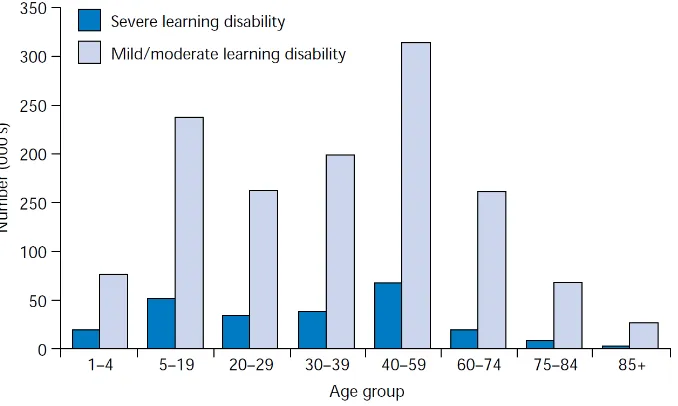
Department of Health’s white paper Valuing People in England alone there are about 1.2 million people with mild or moderate learning difficulties and about 210,000 people with severe learning difficulties, that is a total of about 2% of the general population (DH 2001). For the UK as a whole the figure for people with a learning difficulty is generally rounded up to 1.5 million (Mencap 2011).
Figure 2.2 – Number of people with learning difficulties depicted by age group (Source: Valuing People: A New Strategy for Learning Disability for the 21st Century, DH 2001, 15)
The prevalence of severe learning difficulties is uniformly distributed across the whole country and across socio-economic groups. Mild/moderate learning difficulties however do relate to socio-economic classes and rates are higher in deprived and urban areas (DH 2001).
The Valuing people report also observed that the number of people with severe learning difficulties was expected to increase by around 1% per year for the following 15 years (the report was published in 2001) as a result of (DH 2001, 16):
Increased life expectancy, especially among people with Down’s syndrome
A growing number of children and young people with complex and multiple disabilities who now survive into adulthood
A rise in the reported numbers of school age children with autistic spectrum disorders, some of whom will have learning difficulties Greater prevalence among some minority ethnic populations of South
2.4 The Social Model of Disability
During the last decades of the twentieth century several disability activists, writers and academics campaigned in support of the social model of disability rather than the medical one. They argued that even though an individual’s medical condition is important it is also important to recognise that barriers imposed by society also disable a person. The medical model used until then had focused on the
impairment itself while the social model offered a new paradigm for
understanding disability, where the person was disabled by society(Barnes 1991, Oliver 1996, Oliver 1990).
In developing what became known as a social or political approach to disability, disabled people in Britain argued that it is society that disables people with impairments, and therefore any significant solution should be directed at socio-political change rather than individual adjustment and rehabilitation (Barnes, Mercer 2006).
Barnes, Mercer et al. (2006) observed that in the forefront of those calling for an alternative model of disability was the Union of the Physically Impaired Against Segregation (UPIAS), an organization controlled and run by disabled people. In 1976 UPIAS released its manifesto, Fundamental Principles of Disability, which clearly placed the responsibility for disability on society’s failures stating:
“In our view it is society which disables physically impaired people. Disability is something imposed on top of our impairments by the way we are unnecessarily isolated and excluded from full
participation in society. Disabled people are therefore an oppressed group in society (UPIAS, 1976, p. 14)”
While impairment is regarded as an individual characteristic, disability is described as the result of an oppressive relationship between people with
prompted Mike Oliver to coin the phrase the ‘social model of disability’ (Barnes, Mercer 2006).
The social model equates disability with disabling barriers and attitudes instead of concentrating on the link between the underlying medical condition and functional limitations, and redirects attention to things like defects in the design of the built environment or the inaccessibility of technology that restrict social inclusion. Thus, measures of disability should focus mainly on the physical, social and economic disabling barriers experienced by disabled people and the impact of anti-discrimination policies. This politicisation of disability revolved around citizenship and rights. The construction of a social model of disability together with the formation of advocacy organisations of disabled people provided a base for political resistance. The emphasis shifted from charity to rights and from social exclusion to inclusion with the replacement of a culture of dependence and pity to one based on acceptance as equal citizens (Barnes, Mercer 2006).
A newer evolution of the social model of disability suggests that everyone should be seen as somehow impaired and not just disabled people, and that people with disabilities are just individuals with special needs (Barnes, Mercer 2006,
Shakespeare, Watson 2001). This model maintains that all of us are impaired at some point in our lives. Whether through a broken limb, an illness, an accident, a permanent injury, depression or old age, at some time in our lives we will all have some kind of impairment even if it is only for a short period of time (Shakespeare, Watson 2001). According to this paradigm the removal of barriers for people with disabilities is beneficial to everyone. This applies to IT as well. Any accessibility features integrated into software systems should be helpful not only to people with disabilities but eventually for everyone. If a software system is designed to be accessible to people with learning difficulties, the same system can also be accessible to individuals who, although they do not have a permanent disability, may suffer from a temporary impairment of short term memory for example, as a result of serious depression or even tiredness.
lapses in concentration, stress or a combination of such factors; they can produce significant changes over minutes, hours, or days” (Newell, Carmichael et al. 2002).
The current study adopts the views of the social model of disability which
maintain that society disables an individual by imposing social and environmental barriers. Software developers and the software industry impose social barriers to people with learning difficulties as a result of the fact that this community of users are not involved in software development (Lewis 2005, Gregor, Dickinson 2007, Czaja, Lee 2007, Keates, Adams et al. 2007). This non-involvement results in inaccessible software systems thus resulting in an environmental barrier. The current study aspires to make a case towards advocacy groups, to work in the direction of influencing researchers and the software industry to involve more people with learning difficulties in software development processes. This would in turn contribute towards creating more accessible software systems and towards removing an environmental barrier for people with learning difficulties.
2.5 Issues Faced by People with Learning Difficulties
Today, people with learning difficulties remain amongst the most vulnerable and socially excluded in our society. Most of them live at home throughout their lives with their parents or other carers (DH 2001). Consequently, they are denied the same opportunities as others to gain independence and make choices about their lives. Fifty-eight thousand people with a learning difficulty are supported by day care services (Mencap 2011). Less than a third of them can choose who to live with, and less than half where to live. Twenty-nine thousand adults with a learning difficulty live with parents aged seventy or over, many of whom are too old to be caregivers. About half of the families with a disabled child live in poverty
People with learning difficulties experience extreme health inequalities and are more likely to experience major illnesses and die prematurely. They are fifty-eight times more likely to die before the age of 50 compared to the general population. Furthermore, they are four times more likely to die of preventable causes (Mencap 2011). They are less likely to receive health assessments and essential treatments and face real obstacles in accessing services. Seventy-five percent of general practitioners (GPs) have received no training in the treatment of people with learning difficulties (Mencap 2011, Disability Rights Commission 2006). Most of them are unemployed, less than 20% work as compared with 50% of generally disabled people, but at least 65% of them want to work (Mencap 2011). Of the latter most only work part time and are low paid. Only 1 in 3 people take part in some sort of education or training program (Mencap 2011).
2.6 The New Vision
The social model of disability which evolved in the 1960s and 1970s described disability in terms of social oppression and barriers imposed by society. As a result of this model, inclusion, empowerment and the removal of barriers became the new vision of interested organizations and policy makers (Oliver, Barnes 1998). The Valuing People white paper represented the UK’s previous Labour government policy on the issue and it incorporated the tenets of the social model. It was the first such paper in more than thirty years (DH 2001, 14), the previous one was published in 1971 and had the stigmatizing title Better Services for the Mentally Handicapped (Department of Health and Social Security 2009).
2.6.1 Valuing People
It was based on four key principles (DH 2001, pp. 23-24):
Legal and Civil Rights: Eradicate discrimination; people with learning difficulties have the right to education, to vote, to marry and have a family, and to express their opinions.
Independence: Non-dependence from public services. Independence in this context does not mean doing everything without any type of support.
Choice: people with learning difficulty like everyone else should be able to make choices. They want to have a say in where they live, what work they should do and who looks after them. At the moment for too many of them these are unattainable goals.
Inclusion: Enabling people with learning difficulties to be part of the mainstream, something most of us take for granted. Make use of
mainstream services and be fully included in the local community and in society.
2.6.2 Web Accessibility Initiative
The Web Accessibility Initiative (WAI) (W3C 2011) is part of this new vision of inclusion. Its purpose is to try to make the Web universally accessible to everyone and its major emphasis is on the inclusion of people with disabilities. A number of other similar initiatives and regulations that aim toward providing universal access to the Internet also exist but the WAI is the most famous. The WAI is a global de facto accessibility standard as it is the most comprehensive compared to other initiatives and because it comes from an important international body, the World Wide Web Consortium (W3C).
developed a number of guidelines which, when implemented, should make websites more accessible to people with disabilities including people with learning difficulties. Most national laws and regulations on Web accessibility recommend adherence to the WAI guidelines. For example, the European Union (EU) action plan on accessibility states “The eEurope Action Plan 2002 proposes adoption of the Guidelines [WAI guidelines] as an initial step towards making European public websites and their content accessible to people with disabilities. By adopting the Guidelines, the Member States and European institutions will give the target of Web accessibility broad recognition and support, through the use of the global de facto Web accessibility standard which the work of the WAI represents” (COM 2001).
The WAI guidelines are divided into three categories:
Web Content Accessibility Guidelines (WCAG 1.0)
The WCAG is a set of guidelines on making content accessible for disabled users (W3C 1999).
Authoring Tool Accessibility Guidelines (ATAG 1.0)
The ATAG is a set of guidelines for authoring tool developers (i.e. HTML editors) in both creating a tool which is accessible to disabled end-users but also a tool which creates accessible Web pages (W3C 2000).
User Agent Accessibility Guidelines (UAAG 1.0)
The UAAG is a set of guidelines for user agent developers (i.e. Web browsers) whose purpose is to make the content they handle more accessible to disabled users (W3C 2002).
In the UK the 2010 Equality Act anti-discrimination legislation protects individuals with disabilities and their rights to access Web information (The National Archives 2011). The Equality Act which replaced the Disability
standards. Under the Disability Discrimination Act of 1995 website owners were obliged to make reasonable adjustments in order to resolve access issues and thus make a site accessible to people with disabilities. This requirement remains but the new Equality Act also requires that a person with disabilities must not be put at a ‘substantial disadvantage,’ compared to a non-disabled user. Thus, the new law is stricter on website owners and hosts. Furthermore, the 2010 Equality Act recommends the involvement of people with disabilities in the development process (Dalziel 2010).
2.6.3 Web Accessibility Initiative and people with learning difficulties
The WAI has been successful in bringing the issue of accessibility to the attention of the wider Web community, but the model of Web accessibility developed by the WAI has been criticized in many occasions for its limited scope (Kelly, Sloan et al. 2005). In relation to the current study the greatest weakness of the WAI is the fact that there are very few guidelines for making content accessible,
specifically to people with learning difficulties (Gregor, Dickinson 2007). Out of 14 specific guidelines for Web page authors only two guidelines (numbers 13 and 14) explicitly address the need to consider the cognitive processes involved in accessing, navigating, and understanding the content of Web pages (Keates, Adams et al. 2007).
This comparative lack of priority on addressing the needs of people with learning difficulties in the WAI guidelines is unfortunately representative of accessibility research in general. Concerning Web accessibility, the majority of research is focused largely on sensory impairments such as blindness and deafness and on motor impairments. Learning difficulties are rarely included when considering the accessibility of an IT system and people with learning difficulties are excluded from the use of IT in general and not just the World Wide Web (Keates, Adams et al. 2007).
2.7 People with Learning Difficulties and Information
Technology Use
In the last decade there has been a great deal of research looking at the reasons a number of social groups do not have equal access to IT. This has been called the ‘digital divide.’ Unfortunately people with learning difficulties are part of this digital divide and the promise of social inclusion, reinforced by IT, has not become the reality (McKenzie 2007, Gibson 2007, Wattenberg 2004).
The digital divide initially only considered financial reasons and was seen as a split between those groups in society which could financially afford IT and Internet connectivity and those who could not. Today this type of definition is seen as too narrow and the ‘divide’ now includes a number of different factors which affect access to IT. There is no single factor that determines whether a digital divide exists (Warschauer 2002). “Barriers go beyond the simple provision of computers and the availability of a supporting infrastructure to include factors such as cognitive ability, motivation, social identity and power” (McKenzie 2007).
and people with Traumatic Brain Injury (TBI) have problems accessing IT similar to those that people with learning difficulties have. As people get older, specific cognitive areas decrease their functioning levels (e.g. short-term memory, increased distractibility, reaction times, openness to learning, problem solving, reasoning) producing impairments similar to learning difficulties(Czaja, Lee 2007). People with Traumatic Brain Injuries suffer from similar symptoms also. If the numbers of these two groups were added to people with learning difficulties then the figures would be much higher. Excluding such a considerable number of citizens from the benefits that IT offers would be unacceptable. Developing technology that is accessible to people with learning difficulties would therefore benefit these other groups of people as well.
2.7.1 Impact of Learning Difficulty on Information Technology Use
This section attempts to explain how learning difficulties affect IT use. Many scientists use a medical model in order to explain why people with learning difficulties face challenges in using IT and it is important to be presented here. However, the current study adopts the position that it is the social and
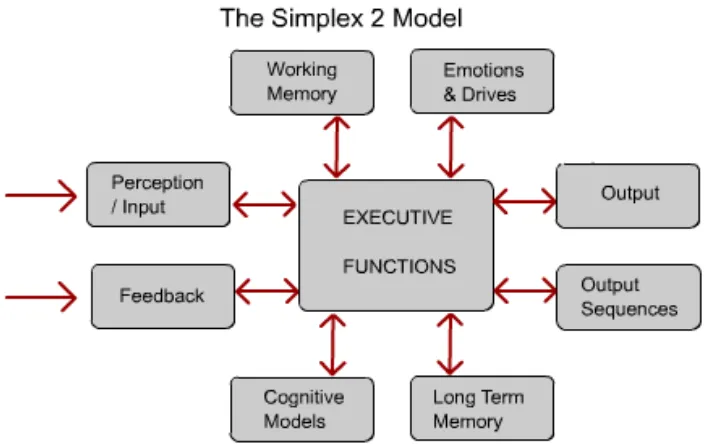
Figure 2.3 – The Simplex 2 Model (Source: Adapted from Adams, 2005).
Individuals with learning difficulties share a number of cognitive difficulties which make accessing IT systems challenging. A number of specialised areas in the brain can potentially play a role in a user’s interaction with an IT system. One model used as a framework for researchers in universal accessibility and for accessible systems design is Adams’ Simplex 2 model, Figure 2.3. As shown in the figure, the model depicts cognition as consisting of a number of different processes linking different specialised areas within the brain. All of these processes are coordinated by a central area called the ‘executive functions’ area. The model asserts that these processes and specialised areas in the brain are necessary for intelligent human behaviour. Each of these specialised areas can potentially play a role in a user’s interaction with an IT system. This sheds some light into the level of complexity involved in interacting with such a system.
Despite the variety in combinations though, most people with learning difficulties also share a number of specific intellectual difficulties. Examples of these shared difficulties include generalising information, learning and retaining new
information, understanding complex subjects and difficulty with language skills (McKenzie 2007). These shared difficulties make IT systems challenging to use. For example, a central technological barrier is the tremendous complexity of most software applications (Keates, Adams et al. 2007). Another is the language and assumptions associated with the use of Graphical User Interfaces (GUI). This language is a combination of technology terminology with metaphors from the real world which are misleading when used for a computer interface.
“We are to think about the television display as if it was like a desktop; that on this desktop there are windows (!) which we can look through to see the application which is running; that in this case this is a Web browser which can be controlled by using menus and a mouse;” (Gregor, Dickinson 2007).
This combination of technical jargon, such as that an application is ‘running’ and the misleading references to everyday objects such as ‘windows,’ is confusing to people with learning difficulties and makes it challenging for them to use IT.
2.7.2 Information Technology Access Barriers
as uncertainty of how to work with them or stereotypical ideas like they may not be able to articulate what they need (McKenzie 2007, Sullivan, McGrenere 2003, LoPresti, Bodine et al. 2008, Lewis 2005). As a result most commonly used commercial software systems remain inaccessible.
Information Technology is typically developed for mainstream users and there are only a limited number of available systems developed to specifically meet the needs of people with learning difficulties (Lewis 2007). The limitation is also exacerbated by economic factors such as a limited market for this kind of product (Wehmeyer 1998, Braddock, Rizzolo et al. 2004). The development of suitable systems has also been held back by the heterogeneity of the population of people with learning difficulties and the lack of design models that account for