IMPACT OF QUENCHING ON STRUCTURAL AND MAGNETIC PROPERTIES OF
Ni
0.5-XZn
XCu
0.5Fe
2O
4MIXED
1,*
Senthilkumar, S.,
1Selvakumar, C.,
1
PG and Research Department of Physics, Arignar Anna Govt Arts College Vil
2
Department of Physics, Pondicherry Univer
3
PG and Research Department of Physics, St.Joseph’s College of Arts & Science (Autonomous),
Cuddalore, 607001, Tamilnadu, India
ARTICLE INFO ABSTRACT
A system of Ferrites with formula
solid state route. During the second sintering the material is
dropping it in liquid nitrogen bath. The solid material is ground in agate pestle, mortar and made as powder. The powder form of ferrite is subjected to structural studies using XRD, thermal, FTIR and Raman measurements.XRD patterns
The structure of ferrite is confirmed as Face Centred Cubic (FCC) phase. The particle size of the ferrite system varies from 262 to 427 Å and they are bulk particles. Thermal study helps completion of reaction of formation of ferrite. FTIR and Raman spectroscopy measurements confirm the presence of tetrahedral and octahedral coordination of atoms in spinel structure of ferrite. However a dominating impact of defect states intruded
FTIR and Raman spectra. The presence of defect states is attributed to mainly to the quenching of the ferrite by a large range of temperature. The existence of defect states will contribute a big variation electrical and the magnetic properties.
Copyright © 2018, Senthilkumar et al. This is an open distribution, and reproduction in any medium, provided
INTRODUCTION
Ferrites are candidate substances which find wide applications in microwavedevices, computer memories and magnetic recording (Özgür et al., 2009; Goldman, 2006
their importance several researchers have studied the thermal and magnetic properties of ferrite materials in the pastseveral years (Tatarchuk et al., 2017; Golkhatmi et al
and Wijn (Smit, 1959) have systematically and elaborately studied the thermal (Kwon et al., 2017
properties of the ferrites NiFe2O4 and CuFe
reported that the saturation magnetization value of NiFe 300 Gauss at 0K and its Curie temperature is 585
CuFe2O4the values are 160 Gauss 455
Similarly Arrot andGoldman (Goldman, 2006
Boutron and Imbert (Hartmann, 1968) have studied ZnFe magneticallyand have found out ZnFe2O4 is antiferromagnetic
below 263 K. Many attempts have been madeto lower the Curie temperature of NiFe2O4 and CuFe2O4and for increasing
the transition point of ZnFe2O4 there by suitably tailoring the
saturation magnetization resistivity, chemicalstability and
*Corresponding author: Senthilkumar, S.,
PG and Research Department of Physics, Arignar Anna Govt Arts College Villupuram-605602, Tamilnadu, India.
ISSN: 0975-833X
Vol.
Article History:
Received 21st October, 2017
Received in revised form
10th November, 2017
Accepted 28th December, 2017
Published online 31st January, 2018
Citation: Senthilkumar, S., Selvakumar, C., Aravazhi, S., Chandrasekaran, G. and Sagayaraj, R.
magnetic properties of Ni0.5-X ZnX Cu0.5 Fe2O4mixed ferrites
Key words:
X-ray diffraction, Thermal, FTIR, Raman Spectroscopy, Magnetic Measurement.
RESEARCH ARTICLE
IMPACT OF QUENCHING ON STRUCTURAL AND MAGNETIC PROPERTIES OF
MIXED FERRITES PREPARED USING SOLID STATE ROUTE
Selvakumar, C.,
1Aravazhi, S.,
2Chandrasekaran, G. and
Research Department of Physics, Arignar Anna Govt Arts College Villupuram
Department of Physics, Pondicherry University, Pondicherry-605014, India
Research Department of Physics, St.Joseph’s College of Arts & Science (Autonomous),
Cuddalore, 607001, Tamilnadu, India
ABSTRACT
A system of Ferrites with formula Ni0.5-x Znx Cu0.5 Fe2O4 (x=0.0,0.1,0.2,0.3,0.4,0.5) synthesized through
solid state route. During the second sintering the material is quenched
dropping it in liquid nitrogen bath. The solid material is ground in agate pestle, mortar and made as powder. The powder form of ferrite is subjected to structural studies using XRD, thermal, FTIR and Raman measurements.XRD patterns present that the crystals formed are in the polycrystalline nature. The structure of ferrite is confirmed as Face Centred Cubic (FCC) phase. The particle size of the ferrite system varies from 262 to 427 Å and they are bulk particles. Thermal study helps completion of reaction of formation of ferrite. FTIR and Raman spectroscopy measurements confirm the presence of tetrahedral and octahedral coordination of atoms in spinel structure of ferrite. However a dominating impact of defect states intruded in the structure of ferrite is visualized through FTIR and Raman spectra. The presence of defect states is attributed to mainly to the quenching of the ferrite by a large range of temperature. The existence of defect states will contribute a big variation electrical and the magnetic properties.
access article distributed under the Creative Commons Attribution the original work is properly cited.
Ferrites are candidate substances which find wide applications computer memories and magnetic , 2006). In view of their importance several researchers have studied the thermal and magnetic properties of ferrite materials in the pastseveral
et al., 2017). Smit have systematically and elaborately ., 2017) and magnetic and CuFe2O4.They have
reported that the saturation magnetization value of NiFe2O4is
Gauss at 0K and its Curie temperature is 585oC.For the
the values are 160 Gauss 455oCrespectively.
, 2006) and Hartmann-have studied ZnFe2O4
is antiferromagnetic below 263 K. Many attempts have been madeto lower the and for increasing there by suitably tailoring the saturation magnetization resistivity, chemicalstability and
PG and Research Department of Physics, Arignar Anna Govt Arts
mechanical hardness. Such attempts have been made possible by mixing the end member ferrites namely NiFe
CuFe2O4 (Golkhatmi et al., 2017
ZnFe2 O4 and CuFe2O4(20-23). Continuing on the same lines,
several reports of earlier researchers
2016; Gawas et al., 2016) on mixed ferrite of Ni
motivated to prepare ferrites of ternary mixtures to provide additional thermal and magnetic data. It’s of interest to dope Zn2+ions in some of sites of Ni
system. It is known that the magnetic behaviour of Ni ferrite largely governed by Fe
interaction. Introducing Zn2+
expected to bring in a substantial change in magnetization and Curie temperature and hence the properties
It’s also of interest to investigate structural and magnetic properties of ferrites depending upon a) the different super exchange interaction developed in the ferrite and b) the effect caused by the cooling rate employed during the synthesis of the sample.
Experimental details
Synthesis
A series of ferrites with composition
x = 0.0, 0.1, 0.2, 0.3, 0.4, and 0.5 are synthesized using International Journal of Current Research
Vol. 10, Issue, 01, pp.64397-64402, January, 2018
Senthilkumar, S., Selvakumar, C., Aravazhi, S., Chandrasekaran, G. and Sagayaraj, R., 2018. “Impact of quenching on structural and ferrites prepared using solid state route”, International Journal of Current Research
IMPACT OF QUENCHING ON STRUCTURAL AND MAGNETIC PROPERTIES OF
FERRITES PREPARED USING SOLID STATE ROUTE
Chandrasekaran, G. and
3Sagayaraj, R.
lupuram-605602, Tamilnadu, India
605014, India
Research Department of Physics, St.Joseph’s College of Arts & Science (Autonomous),
x=0.0,0.1,0.2,0.3,0.4,0.5) synthesized through quenched from 1137 K to 77 K by dropping it in liquid nitrogen bath. The solid material is ground in agate pestle, mortar and made as powder. The powder form of ferrite is subjected to structural studies using XRD, thermal, FTIR and present that the crystals formed are in the polycrystalline nature. The structure of ferrite is confirmed as Face Centred Cubic (FCC) phase. The particle size of the ferrite system varies from 262 to 427 Å and they are bulk particles. Thermal study helps to infer completion of reaction of formation of ferrite. FTIR and Raman spectroscopy measurements confirm the presence of tetrahedral and octahedral coordination of atoms in spinel structure of ferrite. in the structure of ferrite is visualized through FTIR and Raman spectra. The presence of defect states is attributed to mainly to the quenching of the ferrite by a large range of temperature. The existence of defect states will contribute a big variation in
License, which permits unrestricted use,
mechanical hardness. Such attempts have been made possible by mixing the end member ferrites namely NiFe2O4 and
., 2017), NiFe2O4 and ZnFe2O4 and
. Continuing on the same lines, several reports of earlier researchers (Yue, 1999; Naghib et al., on mixed ferrite of Ni-Zn-Cu have tivated to prepare ferrites of ternary mixtures to provide additional thermal and magnetic data. It’s of interest to dope ions in some of sites of Ni2+ ions in Ni-Cu mixed ferrite system. It is known that the magnetic behaviour of Ni-Cu governed by Fe-O-Fe interaction and Ni-O-Fe
2+
ions in thespinel lattice is expected to bring in a substantial change in magnetization and Curie temperature and hence the properties (Erdemi, 2015). investigate structural and magnetic properties of ferrites depending upon a) the different super exchange interaction developed in the ferrite and b) the effect caused by the cooling rate employed during the synthesis of
A series of ferrites with composition Ni0.5-xZnxCu0.5Fe2O4 with
x = 0.0, 0.1, 0.2, 0.3, 0.4, and 0.5 are synthesized using OF CURRENT RESEARCH
Impact of quenching on structural and
ceramic sintering procedure. All the reactants used are of AR grade NiO, ZnO, CuO, and Fe2 O3. The systematic procedure
of preparation is highlighted in the flow chart given below. The reactant oxides are thoroughly mixed and grind well using in a pure platform of agate pestle and mortar yielding uniform and tiny powder particles. The powder is transferred to silica crucible and heated to 1137K by placing it in a muffle furnace with air atmosphere. It is maintained for 20 hrs and later gradually cooled to room temperature in steps of 100oC per hr. The burnt stuff is broken and crushed to form powder in a clean manner. The powder is made as pellet. The pellet is re-sintered at 1137 K. After this second sintering the pellet is quenched from 1137 K to 77 K by dropping it in liquid nitrogen bath. The solid material is ground in agate pestle, mortar and made as powder. The powder form of ferrite is subjected to structural studies using XRD, thermal, FTIR and Raman measurements.
Characterization
The XRD spectra of Ni0.5-xZnxCu0.5Fe2O4 with x = 0.0, 0.1, 0.2,
0.3, 0.4, and 0.5 are recorded using the PAN alytical X-ray Diffracto meter (Model: X’Pert PRO) with an X-ray radiation source of Cu-Kα(Kα1= 1.54056 Å;
Kα2= 1.54439 Å).The thermal decomposition process of Ni0.5-xZnxCu0.5Fe2O4 powdershave been carried out using TG-DTA analysis (Make: TA instruments, Model: Q600 SDT).The FTIR spectra are observed using the SHIMADZU 8700 FTIR spectrometer at
room temperature over the range 4000-350cm-1. Raman
scattering spectra are recorded using Confocal micro-Raman spectrometer (Renishawin Via Reflex) having a liquid-nitrogen cooled charge-coupled device multichannel detector (256 pixels X 1024 pixels). The measurements are carried out with an excitation wavelength of 418 nm at room temperature. The acquisition time and illumination power of the laser used for the present study are 20 s and 1mw respectively. Magnetization M(H) measurement were done using a vibrating sample magnetometer (VSM) Lakshore UK.
RESULTS AND DISCUSSION
X-Ray diffraction study
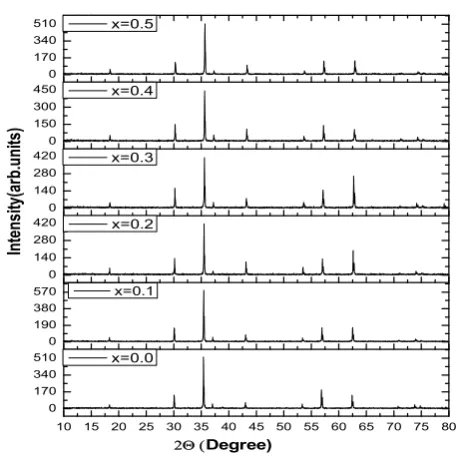
Fig1.Shows a typical XRD pattern of Ni0.5-xZnxCu0.5Fe2O4
samples sintered at 1100oC.The pattern shows well resolved peaks indicating that the prepared Ni0.5-xZnxCu0.5Fe2O4ferrites
are polycrystalline. They are characteristic peaks of a spinel structure which confirm the phase formation indicating absence of other impurity phases. All the peaks perfectly match with the crystalline phase of Face Centre Cubic structure ofNi0.5-xZnxCu0.5Fe2O4 ferrite (JCPD card: 74-2082).
[image:2.595.318.547.53.282.2]Experimental determination of lattice constants, molecular density, particle size and porosity is done and they are given value of Table1. In the present system of ferrites,Cu2+, Ni2+, Zn2+ andFe2+are the constituent cations. Using knowledge of site preference of the ions and the ionic size data of the respective ions as in Table2.Substitution of the ions in A and B sites of spine structure will be elucidated along with lattice parameter. It is seen from Table1. that the lattice constant decreases with Zn enhancement. By comparing the ionic radii of Ni and Zn ions it can be said that it is not a direct replacement of Ni by Zn. It is so because ionic size of Ni2+ is smaller than Zn2+ which is contradicted by change in lattice constant values.
Figure 1. XRD patterns of Ni0.5-xZnxCu0.5Fe2O4 system
It might be assigned to effect of migration of ions mutually between sites and ultrafine fine crystallite size. The crystallite size was calculated using Scherer’s formula
D = 0.9λ / βcosθ
where, λ is the X-ray wavelength, β is the width of the peak and θ is the Bragg’s position of the peaks (Murugesan et al., 2014). The values of crystallite size are in the range from 262 to 427A0 which is agreement with those reported by Parvatheeswararao et al. (1955). Molecular density rises with Zn substitution.
Thermal study
The phase transition points and phase formation are obtained by an analysis done using thermal data in STAR software for powder sample. The sample is taken in alumina crucible and heated and cooled in set temperature range between 100 and 900oC in steps of 20 oC/min. The specific heat curves of Ni-Zn-Cu mixed ferrites are plotted. The variation of specific heat flow with temperature for different concentration is shown in Fig. 2. The nature of the curves for specific heat of these ferrite samples certifies the completion of the chemical reaction meant for the preparation of ferrites. A shallow region of specific heat is a common trend observable around the phase transition point of these ferrites. It’s expected that there is a phase transition around550 – 570oC indicative of ferrimagnetic to paramagnetic phase (Viswanathan, 1990).
FT-IR Spectral Study
In order to confirm the formation of the spinel phase the FTIR spectra of the powders were recorded and shown in Fig 3. The spectra show characteristic absorption of ferrite phase. The strong absorption around 600cm-1 and weak absorption in the range 480cm-1 would correspond to tetrahedral and octahedral coordination ions respectively (Murugesan, 2015). This difference in the band position is expected because of difference in the system. Ni0.5-xZnxCu0.5Fe204 ferrites for the
octahedral and tetrahedral compounds. Waldron studied (Waldron, 1955) the vibrational spectra of ferrites and attributed the sharp absorption band around 600 cm-1to the intrinsic vibrations of the tetrahedral group an 450 cm-1to the other band of the octahedral group.
10 15 20 25 30 35 40 45 50 55 60 65 70 75 80
0 170 340 510 0 190 380 570 0 140 280 420 0 140 280 420 0 150 300 450 0 170 340 510
x=0.0 x=0.1 x=0.2
(Degree)
Intens
ity(ar
b.
u
ni
ts)
It is clearly noticed from the spectra and Table 3. that the ferrites invariably contain octahedral and tetrahedral coordination of ions which are basic composite substructures of spinel. The shift of the bands indicative of encroachment of different ions in the sites when Zn is substituted. Further a higher value band around 650-800cm-1 and above should indicate the formation of certain defect states in ferrites (Tarte, 1967; Chandrasekaran, 2000). It is bound to occur as the post sintering process is quenching. Normally quenching may lead to amorphous or defects state formation.
Raman Spectral Study
The room temperature Raman spectra of Ni0.5-xZnxCu0.5Fe2O4is
observed in the range of 50-1000cm-1.
The observed vibrational modes are shown in Fig 4. They are found at 189cm-1, 337cm-1, 492cm-1, 652cm-1, 697cm-1 as seen in Table 4. Normally modes above 600cm-1 correspond to the a distortion or vacancy sites in ferrites (Li et al., 2017;
Murugesan, 2013). Broadening of modes in Raman spectra is due to the strain developments and reduction in grain size (Murugesan et al., 2015) in bulk crystalline ferrite. The mass difference between the three ions (Ni2+, Fe3+, Zn2+) splits the mode in three different energy values. The lightest ionNi2+corresponds to around 697cm-1for x=0.3 to 0.5 the heaviest one i.e., Fe3+ corresponds to around 554cm-1and an intermediate mode of Zn2+ions around 572cm-1, 569cm-1. The relative intensity and peak position can be explained considering the effects, resulting from introducing Znion and its increasing content.
[image:3.595.102.492.58.463.2]Figure 2. Thermographs of Ni0.5-X ZnX Cu0.5 Fe2O4 system
Table 1. Experimental lattice constants, particle size, porosity and molecular density of sintered Ni0.5-xZnxCu0.5Fe2O4 ferrite system
Concentration (X)
lattice constant a (Å)
Crystallite Size (Å)
Molecular density ρm( Kg/m3)
Porosity P%
0.0 8.4047 407.7735 5.2977 23.49
0.1 8.3941 427.4872 5.3328 29.45
0.2 8.3812 338.1855 5.3725 22.06
0.3 8.3669 275.7480 5.4153 27.26
0.4 8.3555 303.3100 5.4527 23.85
Figure 3. FTIR spectra of Ni0.5-X ZnX Cu0.5 Fe2O4system
Figure 4. Raman spectra of Ni0.5-X ZnX Cu0.5 Fe2O4system
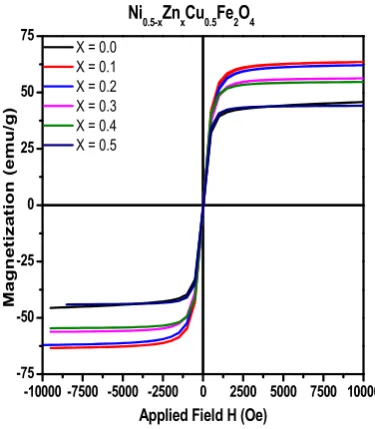
Figure 5. Magnetic hysteresis loop of Ni0.5-xZnxCu0.5Fe2O4 system
Table 2.Ionic radii and magnetic moments of the cations
Cations Ionic radius (Å) Magnetic moments (µB)
Fe3+ 0.6 5.92
Fe2+ 0.74 4.90
Ni2+ 0.69 2.84
Zn2+ 0.74 0.0
[image:4.595.323.542.74.136.2]Cu2+ 0.72 1.73
Table 3. Centre frequencies of the bands of FTIR spectra of the sintered Ni0.5-X ZnX Cu0.5 Fe2O4system
Concentration (X) ν1 ν2
0.0 453.20 775.27
0.1 495.63 744.41
0.2 503.35 740.56
0.3 543.85 732.84
0.4 518.77 725.13
[image:4.595.55.266.276.534.2]0.5 522.63 773.34
Table 4. Centre frequencies of the bands of Raman spectra of the sintered Ni0.5-X ZnX Cu0.5 Fe2O4system
Concentration Centre frequency cm-1
X V1 V2 V3 V4 V5
0.0 189 337 492 652 697
0.1 174 333 485 665 701
0.2 192 337 489 597 698
0.3 179 336 477 554 702
0.4 192 331 483 572 699
0.5 192 330 483 569 701
Further the Raman frequencies depend on the Fe (Ni) -O and bond length. The intensity of the highest wavelength Raman mode (initially around 697cm-1) decreases with increasing Zn contents the intensity of the Raman mode peaking around 702cm-1 increases proportionally. Thus the vacancy/ defect states formation is consistently observable in Raman as seen in IR spectra. Further the presence of absorption modes of respective sites namely octahedral and tetrahedral sites is confirming spinel formation.
Magnetic Study
Zinc substituted nickel, copper ferrite samples having the chemical formula Ni0.5-x Znx Cu0.5 Fe2O4 (where x=0.0,0.1,0.
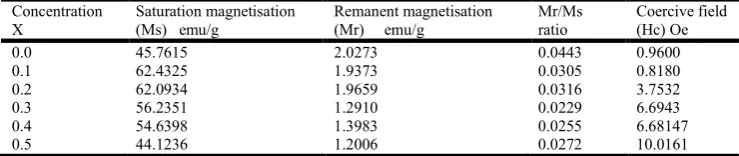
2,0.3,0.4,0.5) are subjected magnetic study. The room temperature magnetisation curves of the sample are shown in Fig. 5. These show variation of magnetization, coercive field zinc content. Magnetic parameters, namely the specific magnetization (Ms), remnant magnetization (Mr) and coercive filed (Hc) of the prepared fine particles Ni0.5-xZnx Cu0.5 Fe2O4
are measured at room temperature in a maximum field of 10000 gauss. The values of magnetic parameters are given in Table 5. It is noticed that magnetic properties of the samples are strongly dependent on the zinc concentration. The saturation magnetization (Ms) for the sample (system) was found to increase from x=0.1 to 0.4. Here is an increase in from x=0.1 to 0.2 and for x=0.5 Ms is very low. It is observed that the saturation magnetisation decreases. The respective reduction in magnetisation can be due to a rearrangement of cations, a change in distribution of Ni2+ and Zn2+ on the two sites (Tarte, 1967). In the present study the parameters of primary importance saturation magnetisation, coercive field remanance magnetisation and Mr/Ms ratio. The shape of hysteresis loop render explanation for the nature of a magnetic domain and type of the magnetic material. According to the fairly well established consideration, the loops obtained for the Ni0.5-xZnxCu0.5Fe2O4 quenched system Fig.5 of the present
study are indicative of multi-domains (Chandrasekaran, 2004).
500 1000 1500 2000 2500 3000
0 100 0 45 0 18 0 170 0 36 41 82 % o f Tr ansm it ta nce
Wavenumber (cm-1)
x = 0.0 Ni0.5-xZnxCu0.5Fe2O4
x = 0.1 x = 0.2 x = 0.3 x = 0.4 x = 0.5
0 200 400 600 800 1000
0 1000 2000 3000 4000 0 1000 2000 3000 4000 0 1000 2000 3000 4000 0 1000 2000 3000 4000 0 1000 2000 3000 4000 0 1000 2000 3000 4000
RamanShift (cm-1)
x=0.0) 189 337 492 652 697 x=0.1) 174 333 485 665701 x=0.2 192 337 481 597 698 x=0.3) 179 336 477 554 702 x=0.4 192 331 483 572 699 In te n s it y ( a rb .u n it ) x=0.5)
192 33 0
483 569
701
-10000 -7500 -5000 -2500 0 2500 5000 7500 10000
-75 -50 -25 0 25 50 75
X = 0.0 X = 0.1 X = 0.2 X = 0.3 X = 0.4 X = 0.5
Ni
0.5-xZnxCu0.5Fe2O4
Magn e tiz a tion (emu/g)
[image:4.595.323.541.286.366.2] [image:4.595.67.255.567.782.2]The values of coercive field varies between 0.82 Oe and 10.01 Oe, it is seen from the Table 5. That the coercive field is found to be fairly low and there is no much change with respect to concentration low value of coercive field is effected due to soft nature of the ferrite. It is found to be insensitive to concentration variation. The values of remanant ratio ranges from 0.0272 to 0.0443. Therefore it is understood that the ferrite prepared in the present study are multi domain cases (Li, 2017; Cullity, 2011). The saturation magnetisation (Ms) values ranges from 44emu/g to 62emu/g and. These values are in good agreement with the values reported by l. Neel (2013) and C. murugesan (Néel, 1952) for the similar types of ferrite. The present samples belong to cubic system of ferromagnetic spinel. In these systems the magnetic order is mainly due to an indirect exchange interaction mechanism occurring between the metal ions in the A and B sub lattices. The substitution of Zn2+ ions, which has a preferential A site occupancy results in the reduction of the exchange interaction between A and B sites. Hence magnetic properties of the particle can be varied by varying the degree of zinc substitution. Thus the changes in Hc and Ms Values are attributable to A-B and B-B exchange
interactions. Which could be caused by Zn variation and na no size particle. However study using Mossbauer spectrometer would give clear information about the magnetic structure of the ferrite to understand in terms of Neel’s two sub lattice models and canting spin on B site (Néel, 1952).
Conclusion
Ultra fine crystallites of Ni0.5-xZnxCu0.5Fe2O4 system of ferrites
are prepared using solid state route along with post quenching in Nitrogen liquid bath followed by a wild grinding of the solid pellet. XRD reports the lattice shrinking for Zn substitution. FTIR and Raman measurements confirm spinel structure of the ferrites prepared and show additional bands indicating the defect states due to quenching. Magnetic studies explain the enhancement of magnetisation in terms of change in the exchange interaction as there is unusual distribution of ions in sites due to the quenching of ferrites sample. Thus quenching along with wild grinding of sample during synthesis leads to formation of ultra-fine crystallites which house amusing change of magnetic properties.
REFERENCES
Chandrasekaran, G., Selvanandan, S., Manivanane, K. 2004. Electrical and FTIR Studies on Al Substituted Mn-Zn mixed ferrites. Journal of Materials Science: Materials in Electrinics 1515-18.
Choi, Y., Shim, H., Lee, J. 2001. Study on magnetic properties and structural analysis of Ni–Zn ferrite prepared through self-propagating high-temperature synthesis
reaction by neutron diffractometry, J. Alloys Compd., 326 56-60.
Cullity, B.D., Graham, C.D. 2011. Introduction to magnetic materials, John Wiley & Sons.
Cullity, B.D., Weymouth, J.W. 1957. Elements of X-ray Diffraction, American Journal of Physics, 25 394-395. Dias, A., Moreira, R. 1999. Chemical, mechanical and
dielectric properties after sintering of hydrothermal nickel– zinc ferrites, Mater. Lett., 39 69-76.
Erdemi, H., Baykal, A. 2015. Dielectric properties of triethylene glycol-stabilized Mn 1− x Zn x Fe 2 O 4 nanoparticles, Mater. Chem. Phys., 165 156-167.
Gawas, S.G., Gawas, U.B., Verenkar, V.M.S., Kothawale, M.M., Pednekar, R. 2016. Structural and Magnetic Studies of Cu-Substituted Nanocrystalline Ni–Zn Ferrites Obtained Via Hexamine–Nitrate Combustion Route, Journal of Superconductivity and Novel Magnetism, 1-6.
Goldman, A. 2006. Ferrites for Magnetic Recording, Modern Ferrite Technology, 353-373.
Golkhatmi, F.M., Bahramian, B., Mamarabadi, M. 2017. Application of surface modified nano ferrite nickel in catalytic reaction (epoxidation of alkenes) and investigation on its antibacterial and antifungal activities, Materials Science and Engineering: C, 78 1-11.
Hartmann‐Boutron, F., Imbert, P. 1968. Mössbauer Study of the Electronic and Magnetic Properties of Fe2+ Ions in Some Spinel‐Type Compounds, J. Appl. Phys., 39 775-785. Jacobo, S., Fano, W., Razzitte, A. 2002. The effect of rare earth substitution on the magnetic properties of Ni 0.5 Zn 0.5 M x Fe 2− x O 4 (M: rare earth), Physica B: Condensed Matter, 320 261-263.
Journal of material sciences: materials in Electronics 15(2004)15-1
Kumar, K.V., Ravinder, D. 2002. Electrical conductivity of Ni–Zn–Gd ferrites, Mater. Lett., 52 166-168.
Kwon, J., Kim, J.H., Kang, S.H., Choi, C.J., Rajesh, J.A., Ahn, K.S. 2017. Facile hydrothermal synthesis of cubic spinel AB2O4 type MnFe2O4 nanocrystallites and their electrochemical performance, Appl. Surf. Sci., 413 83-91. Li, L.Z., Zhong, X.X., Wang, R., Tu, X.Q. 2017. Structural,
magnetic and electrical properties of Zr-substitued NiZnCo ferrite nanopowders, J. Magn. Magn. Mater., 435 58-63. Li, Y.X., Li, J., Li, Q., Yu, G.L., Zhang, H.W. 2017. Structure
and magnetic properties of NiCuZn ferrite materials with La doping, Rare Metals, 36 202-204.
Modi, K., Tanna, P., Laghate, S., Joshi, H. 2000. The effect of Zn+ 2 substitution on some structural properties of CuFeCrO4 system, J. Mater. Sci. Lett., 19 1111-1113. Mohan, G.R., Ravinder, D., Reddy, A.R., Boyanov, B. 1999.
Dielectric properties of polycrystalline mixed nickel–zinc ferrites, Mater. Lett., 40 39-45.
[image:5.595.111.481.85.163.2]Murugesan, C., Chandrasekaran, G. 2015. Impact of Gd3+ substitution on the structural, magnetic and electrical
Table 5. Saturation magnetisation (Ms), remanent magnetisation (Mr), Mr/Ms ratio and coercive field( Hc) of sintered Ni0.5-X ZnX Cu0.5 Fe2O4
Concentration X
Saturation magnetisation (Ms) emu/g
Remanent magnetisation (Mr) emu/g
Mr/Ms ratio
Coercive field (Hc) Oe
0.0 45.7615 2.0273 0.0443 0.9600
0.1 62.4325 1.9373 0.0305 0.8180
0.2 62.0934 1.9659 0.0316 3.7532
0.3 56.2351 1.2910 0.0229 6.6943
0.4 54.6398 1.3983 0.0255 6.68147
properties of cobalt ferrite nanoparticles, RSC Advances, 5 73714-73725.
Murugesan, C., MDgazzali, P.M., Chandrasekaran, G. 2013. Influence of oxidizer to fuel ratio on structural and magnetic properties of Mn–Zn ferrite nanoparticles, Journal of Materials Science: Materials in Electronics, 24 3136-3141.
Murugesan, C., Perumal, M., Chandrasekaran, G. 2014. Structural, dielectric and magnetic properties of cobalt ferrite prepared using auto combustion and ceramic route, Physica B: Condensed Matter, 448 53-56.
Naghib zadeh, H., Oder, G., Hesse, J., Reimann, T., Töpfer, J., Rabe, T. 2016. Effect of oxygen partial pressure on co-firing behavior and magnetic properties of LTCC modules with integrated NiCuZn ferrite layers, J. Electroceram., 37 100-109.
Nanoti, V., Prakash, C., Kulkarni, D. 1995. Magnetic behaviour of Cr-substituted Zn-Cu ferrites, Mater. Lett., 24 167-169.
Néel, L. 1952. Antiferromagnetism and ferrimagnetism, Proceedings of the Physical Society. Section A, 65 869. Özgür, Ü., Alivov, Y., Morkoç, H. 2009. Microwave ferrites,
part 1: fundamental properties, Journal of Materials Science: Materials in Electronics, 20 789-834.
Ravinder, D., Kumar, K.V., Boyanov, B. 1999. Elastic behaviour of Cu–Zn ferrites, Mater. Lett., 38 22-27. Ravinder, D., Mohan, G.R. 2000. Thermoelectric power
studies of zinc-substituted nickel ferrites, Mater. Lett., 44 139-143.
Rezlescu, N., Rezlescu, E. 1993. The influence of Fe substitutions by R ions in a Ni Zn Ferrite, Solid State Commun., 88 139-141.
Rezlescu, N., Rezlescu, E., Pasnicu, C., Craus, M. 1994. Effects of the rare-earth ions on some properties of a nickel-zinc ferrite, J. Phys.: Condens. Matter, 6 5707.
Sileo, E.E., Rotelo, R., Jacobo, S.E. 2002. Nickel zinc ferrites prepared by the citrate precursor method, Physica B: Condensed Matter, 320 257-260.
Smit, J., Wijn, H.P.J. 1959. Ferrites.
Srivastava, C., Shringi, S., Patni, M., Joglekar, S. 1984. Influence of the presence of Fe 2+ ion in nickel-zinc ferrite,
Bull. Mater. Sci., 6 7-12.
Stewart, S., Multigner, M., Marco, J., Berry, F., Hernando, A.,
Gonzalez, J. 2004. Thermal dependence of the
magnetization of antiferromagnetic copper (II) oxide nanoparticles, Solid State Commun., 130 247-251.
Tarte, P. Infra-red spectra of inorganic aluminatesand characteristic vibrational frequencies of Alo4 tetrahedra and
Alo6 octahedra.Spectrochemica Acta ,1967, vol.23A, PP.
2127-2143.
Tatarchuk, T., Bououdina, M., Macyk, W., Shyichuk, O., Paliychuk, N., Yaremiy, I., Al-Najar, B., Pacia, M. 2017. Structural, Optical, and Magnetic Properties of Zn-Doped CoFe2O4 Nanoparticles, Nanoscale Research Letters, 12 141.
Verma, A., Goel, T., Mendiratta, R., Alam, M. 1999. Dielectric properties of NiZn ferrites prepared by the citrate precursor method, Materials Science and Engineering: B, 60 156-162.
Viswanathan, B., Murthy, V. 1990. Ferrite materials: science and technology, Springer Verlag.
Waldron, R. 1955. Infrared spectra of ferrites, Physical review, 99 1727.
Yue, Z., Li, L., Zhou, J., Zhang, H., Gui, Z. 1999. Preparation and characterization of NiCuZn ferrite nanocrystalline powders by auto-combustion of nitrate–citrate gels,
Materials Science and Engineering: B, 64 68-72.