doi:10.4236/apm.2011.16062 Published Online November 2011 (http://www.SciRP.org/journal/apm)
Application of Adomian’s Decomposition Method for
the Analytical Solution of Space Fractional
Diffusion Equation
Mehdi Safari1, Mohammad Danesh2 1Department of Mechanical Engineering
, Islamic Azad University, Aligoodarz Branch, Aligoodarz, Iran 2Department of Mechanical Engineering
, Isfahan University of Technology, Isfahan, Iran
E-mail: ms_safari2005@yahoo.com
Received July 1, 2011; revised September 26, 2011; accepted October 5, 2011
Abstract
Spatially fractional order diffusion equations are generalizations of classical diffusion equations which are increasingly used in modeling practical super diffusive problems in fluid flow, finance and others areas of application. This paper presents the analytical solutions of the space fractional diffusion equations by Adomian’s decomposition method (ADM). By using initial conditions, the explicit solutions of the equations have been presented in the closed form. Two examples, the first one is one-dimensional and the second one is two-dimensional fractional diffusion equation, are presented to show the application of the present tech-niques. The present method performs extremely well in terms of efficiency and simplicity.
Keywords: Adomian’s Decomposition Method, Fractional Derivative, Fractional Diffusion Equation
1. Introduction
Fractional diffusion equations are used to model prob-lems in Physics [1-3], Finance [4-7], and Hydrology [8- 12]. Fractional space derivatives may be used to formu-late anomalous dispersion models, where a particle plume spreads at a rate that is different than the classical Brownian motion model. When a fractional derivative of order 1 < α < 2 replaces the second derivative in a diffu-sion or disperdiffu-sion model, it leads to a super diffusive flow model. Nowadays, fractional diffusion equation plays important roles in modeling anomalous diffusion and subdiffusion systems, description of fractional ran-dom walk, unification of diffusion and wave propagation phenomenon, see, e.g. the reviews in [1-16], and refer-ences therein. Consider a one-dimensional fractional diffusion equation considered in [17]
,
,
,u x t u x t
d x q x t
t x
, (1)
on a finite domain xL x xR with 1 2. We
assume that the diffusion coefficient (or diffusivity) d(x)
> 0. We also assume an initial condition u(x, t = 0) = s(x) for xL x xR
L
u x
and Dirichlet boundary conditions of the form
,t
0 and u x
R,t
b tR
. Equation(1) uses a Riemann fractional derivative of order . Consider a two-dimensional fractional diffusion equa-tion considered in [18]
, , , , x y, ,
x x
, ,
, ,
u x y t u x y t u t
d x y e x y
t
q x y t
,
(2)
on a finite rectangular domain xL x xH and
L R
y y y , with fractional orders 1 < 2 and 1 < 2, where the diffusion coefficients d(x, y) > 0 and e(x, y) > 0. The ‘forcing’ function q(x, y, t) can be used to represent sources and sinks. We will assume that this fractional diffusion equation has a unique and suffi-ciently smooth solution under the following initial and boundary conditions. Assume the initial condition u(x, y,
t = 0) = f(x, y) for xL x xH and L R, and
Dirichlet boundary condition u(x, y, t) = B(x, y, t) on the boundary (perimeter) of the rectangular region
y y y
L H
x x x , yL y yR, with the additional
The values of 1 < 2 and 1 < 2 model a super diffusive process in that coordinate. Equation (2) also uses Riemann fractional derivatives of order and . In this paper, we use the Adomian’s decomposi-tion method (ADM) to obtain the soludecomposi-tions of the frac-tional diffusion Equations (1) and (2). Large classes of linear and nonlinear differential equations, both ordinary as well as partial, can be solved by the ADM. The de-composition method provides an effective procedure for analytical solution of a wide and general class of dy-namical systems representing real physical problems [19-25]. This method efficiently works for initial-value or boundary-value problems and for linear or nonlinear, ordinary or partial differential equations and even for stochastic systems. Moreover, we have the advantage of a single global method for solving ordinary or partial differential equations as well as many types of other equations. Recently, the solution of fractional differential equation has been obtained through ADM by the re-searchers [26-28]. The application of ADM for the solu-tion of nonlinear fracsolu-tional differential equasolu-tions has also been established by Shawagfeh, Saha Ray and Bera [27, 28]. However, we use the ADM to solve fractional diffu-sion Equations (1) and (2) and finally the results are il-lustrated in graphical figures.
2. Mathematical Aspects
The mathematical definition of fractional calculus has been the subject of several different approaches [29,30]. The most frequently encountered definition of an integral of fractional order is the Riemann-Liouville integral, in which the fractional order integral is defined as
1 0d 1 t
q
q q
d d
q
t
f t f t x
D f t
q t x
t
, (3)
while the definition of fractional order derivative is
0
1 dd
d d
d
1 d
d n q n q
t n n q
n t
n n
f t D f t
t t
q
f t x
n q t t x
, (4)
where ( and q ) is the order of the opera-tion and n is an integer that satisfies .
q q0 R
1
n q n
3. Basic Idea of Adomian’s Decomposition
Method
We begin with the equation
Lu R u F u g t
, (5)where L is the operator of the highest-ordered derivatives
with respect to t and R is the remainder of the linear op-erator. The nonlinear term is represented by F(u). Thus we get
Lug t R u F u
, (6)The inverse L1 is assumed an integral operator given by
10 d
t
t
L
t, (7) The operating with the operator on both sides of Equation (6) we have1
L
1 0
u f L g t R u F u , (8) where f0 is the solution of homogeneous equation
0
Lu , (9) involving the constants of integration. The integration constants involved in the solution of homogeneous Equation (9) are to be determined by the initial or boundary condition according as the problem is initial- value problem or boundary-value problem.
The ADM assumes that the unknown function u x t
, can be expressed by an infinite series of the form
0
, n
n
u x t u x t
, , (10) and the nonlinear operator F u
can be decomposed by an infinite series of polynomials given by
0n n
F u
A , (11) where u x tn
, will be determined recurrently, and Anare the so-called polynomials of u u0, 1,,un defined by
0 0
1 d
, 0,1, 2, ! d
n
i i n
n
An F u n
n
, (12)4. The Fractional Diffusion Equation Model
and Its Solution by ADM
We adopt Adomian decomposition method for solving Equation (1). In the light of this method we assume that
0 n n
u u
, (13) to be the solution of Equation (1). Now, Equation (1) can be rewritten as
,
,t x
L u x t d x D x t q x t,
, (14)where Lt
t
which is an easily invertible linear opera-
.Therefore, by Adomian decomposition method, we can write,
1
1
0
, , 0 t x n t ,
n
u x t u x L d x D u L q x t
,(15)
Each term of series (13) is given by Adomian decom-position method recurrence relation
0 ,
u f (16)
1
1 , 0
n t x n
u L d x D u n
, , (17)
where
1
, 0 t , .
f u x L q x t
It is worth noting that once the zeroth component 0 is defined, then the remaining components n can be completely determined; each term is computed by using the previous term. As a result, the components
0 1 are identified and the series solutions thus en-tirely determined. However, in many cases the exact so-lution in a closed form may be obtained.
u
1 ,
u n
, ,
u u
Similarly, for Equation (2) using Adomian decompo-sition method, we can obtain
1
0
1 1
0
, , , , 0 ,
, , , ,
t x n
n
t y n t
n
u x y t u x y L d x y D u L e x y D u L q x y t
,
(18) The Adomian decomposition method recurrence scheme is
0 ,
u f (19)
1 1
1 , ,
0,
n t x n t y n
u L d x y D u L e x y D u
n
(20)
where f u x y
, , 0
Lt1
q x y t
, ,
.5. Numerical Illustration
5.1. Example 1
Let us consider a one-dimensional fractional diffusion equation for the Equation (1), as taken in [17]
1.8
1.8, ,
,
u x t u x t
d x q x t
t x
, (21)on a finite domain 0 < x < 1, with the diffusion coeffi-cient
2.8 2.82.2 6 0.183634
d x x x , (22)
the source/sink function
3, 1 e t
q x t x x , (23)
the initial condition
3, 0 , for 0 1
u x x x , (24)
and the boundary conditions
0, 0, 1,
e , t for 0u t u t t
, (25)
Implementation of Adomian’s Decomposition Method Equation (21) can be rewritten in operator form as
1.8
, ,
t x
L u x t d x D u x t q x t,
, (26)where Lt t
symbolizes the easily invertible linear
differential operator, D1.8x
is the Riemann-Liouvillederivative of order 1.8. If the invertible operator
1 0
d
t
t
L t
is applied to Equation (26), then
1 1 1.8
, ,
t t t x
L L u x t L d x D u x t q x t
, , (27)
is obtained. By this
1
1.8
, , 0 t x , ,
u x t u x L d x D u x t q x t , (28)
is found. Here the main point is that the solution of the decomposition method is in the form of
0
, n
n
u x t u x t
, , (29) Substituting from Equation (29) into Equation (28), we find
0
1 1.8
0
, , 0
, ,
n n
t x n
n
u x t u x
L d x D u x t q x t
, (30)is found. Thus according to Equation (7) approximate solution can be obtained as follows:
30 ,
u x t x , (31)
3 4 4
3 4
1 , 1.000001369 e ,
t
u x t x x x t x x (32)
1.8
2 , 0 1 ,
t
x
u x t
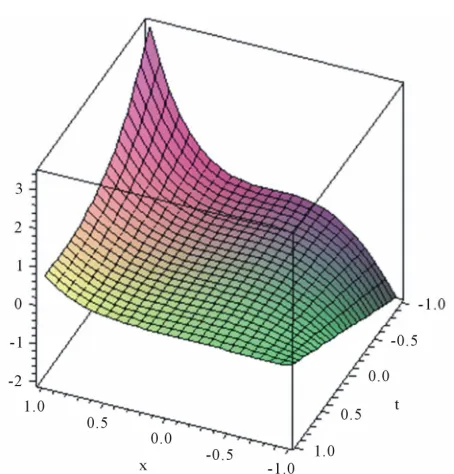
d x D u x t q x t, d , (33) tThe approximate solution of the one-dimensional frac-tional diffusion equation is obtained as
, 0
, 1
, 2
u x t u x t u x t u x t,
, (34)Figure 1. For the one-dimensional fractional diffusion equation with the initial condition (24) of Equation (21), ADM result for u(x, t).
5.2. Example 2
Let us consider a two-dimensional fractional diffusion equation for the Equation (2), considered in [18].
1.8
1.8
1.6
1.6
, , , ,
,
, ,
, , , ,
u x y t u x y t
d x y
t x
u x y t
e x y q x y t
y
(35)
on a finite rectangular domain 0 < x < 1, 0 < y < 1, for 0
< t < Tend with the diffusion coefficients
2.8, 2.2
d x y x y 6
, (36)
and
2.6
, 2 4.6
e x y x y , (37)
and the forcing function
3 3.6, , 1 2 e t
q x y t xy x y , (38)
with the initial condition
3 3.6, , 0
u x y x y , (39)
and Dirichlet boundary conditions on the rectangle in the
form and
, for all .
3, 0, 0, , 0, ,1, et ,
u x t u y t u x t x
1, ,t
ety3.6 t0u y
Implementation of Adomian’s Decomposition Method Now, Equation (35) can be rewritten in operator form as
1.8
1.6
, , , , ,
, , , , , , ,
t x
y
L u x y t d x y D x y t
e x y t D u x y t q x y t
(40)where Lt
t
symbolizes the easily invertible linear
differential operator, D1.8x
and and are theRiemann–Liouville derivatives of order 1.8 and 1.6, re-spectively.
1.6y
D
If the invertible operator 1
is applied to 0d
t
t
L
tEquation (40) , then
1 1 1.8
1.6
, , , , ,
, , , , , , ,
t t t x
y
L L u x y t L d x y D u x y t
e x y t D u x y t q x y t
(41) is obtained. By this
1 1.8
1.6
( , , ) , , 0 , , ,
, , , , , , ,
t x
y
u x y t u x y L d x y D u x y t
e x y t D u x y t q x y t
(42)
is found. Here the main point is that the solution of the decomposition method is in the form of
0
, , n , ,
n
u x y t u x y t
, (43) Substituting from Equation (43) into Equation (42), we find
0
1 1.8
0
1.6
0 , , , , 0
, , ,
, , , , , , ,
n n
t x n
n
y n
n
u x y t u x y
L d x y D u x y t
e x y t D u x y t q x y t
(44)
is found.
Thus according to Equation (7) approximate solution can be obtained as follows:
3 3.60 , , ,
u x y t x y (45)
3 185 4 235 4 23 118 23
3 5 4 5
, , 2 2
et 2e t ,
u x y t x y x y x y t
x y x y
5
(46)
1.8
2 0 1
1.6 1
, , , , ,
, , , , , , d , t
x
y
u x y t d x y D u x y t
e x y t D u x y t q x y t t
(47)
The approximate solution of the two-dimensional frac-tional diffusion equation is obtained as
, 0
, 1
, 2
u x t u x t u x t u x t,
Figure 2. For the two-dimensional fractional diffusion
lution of the two-dimensional fractional diff
. Conclusions
this paper, Adomian’s decomposition method
. References
] R. Metzler, E. Barkai and J. Klafter, “Anomalous
Diffu-equation with the initial condition (39) of Equation (35), ADM result for u(x, t) with y = 1.
so usion
equation by ADM.
6
In has
been successfully applied to find the solution of space fractional diffusion equation. All cases show that the results of the ADM method are very good and the ob-tained solutions are shown graphically. In our work, we use the Maple Package to calculate the functions ob-tained from the Adomian’s decomposition method.
7
[1
sion and Relaxation Close to Thermal Equilibrium: A Fractional Fokker-Planck Equation Approach,” Physics
Review Letters, Vol. 82, No. 18, 1999, pp. 3563-3567.
doi:10.1103/PhysRevLett.82.3563
[2] R. Metzler and J. Klafter, “The Random Walk’s Guide to Anomalous Diffusion: A Fractional Dynamics Ap-proach,” Physics Reports, Vol. 339, No. 1, 2000, pp. 1-77.
doi:10.1016/S0370-1573(00)00070-3
[3] R. Metzler and J. Klafter, “The Restaurant at the End of the Random Walk: Recent Developments in the Descrip-tion of Anomalous Transport by FracDescrip-tional Dynamics,”
Journal of Physics A, Vol. 37, No. 31, 2004, pp. 161-208.
doi:10.1088/0305-4470/37/31/R01
[4] R. Gorenflo, F. Mainardi, E. Scalas and M. Raberto,
,
00)00386-1
“Fractional Calculus and Continuous-Time Finance. III. The Diffusion Limit,” Mathematical Finance. Konstanz, 2000, Trends Math Birkhuser Basel, 2001, pp. 171-180. [5] F. Mainardi, M. Raberto, R. Gorenflo and E. Scalas
“Fractional Calculus and Continuous-Time Finance II: The Waiting-Time Distribution,” Physica A, Vol. 287, No. 3-4, 2000, pp. 468-481.
doi:10.1016/S0378-4371(
i, “Fractional
Cal--7
[6] E. Scalas, R. Gorenflo and F. Mainard
culus and Continuous-Time Finance,” Physica A, Vol. 284, No. 1-4, 2000, pp. 376-384.
doi:10.1016/S0378-4371(00)00255
i, “Waiting-Times [7] M. Raberto, E. Scalas and F. Mainard
and Returns in High Frequency Financial Data: An Em-pirical Study,” Physica A, Vol. 314, No. 1-4, 2002, pp. 749-755. doi:10.1016/S0378-4371(02)01048-8
[8] D. A. Benson, S. Wheatcraft and M. M. Meerschaert, “Application of a Fractional Advection Dispersion Equa-tion,” Water Resource Research, Vol. 36, No. 6, 2000, pp. 1403-1412. doi:10.1029/2000WR900031
[9] B. Baeumer, M. M. Meerschaert, D. A. Benson and S. W. Wheatcraft, “Subordinated Advection-Dispersion Equa-tion for Contaminant Transport,” Water Resource
Re-search, Vol. 37, No. 6, 2001, pp. 1543-1550.
doi:10.1029/2000WR900409
[10] D. A. Benson, R. Schumer, M. M. Meerschaert and S. W. Wheatcraft, “Fractional Dispersion, Lévy Motions, and the MADE Tracer Tests,” Transport in Porous Media, Vol. 42, No. 1-2, 2001, pp. 211-240.
doi:10.1023/A:1006733002131
[11] R. Schumer, D. A. Benson, M. M. Meerschaert and S. W. Wheatcraft, “Eulerian Derivation of the Fractional Ad-vection-Dispersion Equation,” Journal of Contaminant Hydrology, Vol. 48, No. 1-2, 2001, pp. 69-88.
doi:10.1016/S0169-7722(00)00170-4
[12] R. Schumer, D. A. Benson, M. M. Meerschaert and B. Baeumer, “Multiscaling Fractional Advection-Dispersion Equations and Their Solutions,” Water Resource
Re-search, Vol. 39, No. 1, 2003, pp. 1022-1032.
doi:10.1029/2001WR001229
[13] A. Carpinteri and F. Mainardi (Eds.), “Fractals and
Frac-ight Functions as tional Calculus in Continuum Mechanics,” Springer- Verlag, New York, 1997, pp. 291-348.
[14] F. Mainardi and G. Pagnini, “The Wr
Solutions of the Time Fractional Diffusion Equations,”
Applied Mathematics and Computation, Vol. 141, No. 1, 2003, pp. 51-62. doi:10.1016/S0096-3003(02)00320-X
[15] O. P. Agrawal, “Solution for a Fractional Diffusion-Wave Equation Defined in a Bounded Domain,” Nonlinear
Dynamics, Vol. 29, No. 1-4, 2002, pp. 145-155.
doi:10.1023/A:1016539022492
[16] W. R. Schneider and W. Wyss, “Fractional Diffusion and Wave Equations,” Journal of Mathematical Physics, Vol. 30, No. 1, 1989, pp. 134-144. doi:10.1063/1.528578
Vol. 211, No. 1, 2006, pp. 249-261.
doi:10.1016/j.jcp.2005.05.017
[18] C. Tadjeran, M. M. Meerschaert and H. Scheffler, “Finite Difference Methods for Two-Dimensional Fractional Dispersion Equation,” Journal of Computational Physics, Vol. 213, No. 1, 2006, pp. 205-213.
doi:10.1016/j.jcp.2005.08.008
[19] G. Adomian, “An Analytical Solution of the Stochastic Navier-Stokes System,” Foundations of Physics, Vol. 21, No. 7, 1991, pp. 831-843. doi:10.1007/BF00733348
[20] G. Adomian and R. Rach, “Linear and Nonlinear Schrödinger Equations,” Foundations of Physics, Vol. 21, No. 8, 1991, pp. 983-991. doi:10.1007/BF00733220
[21] G. Adomian, “Solution of Physical Problems by Decom-position,” Computers and Mathematics with Applications, Vol. 27, No. 9-10, 1994, pp. 145-154.
doi:10.1016/0898-1221(94)90132-5
[22] G. Adomian, “Solutions of Nonlinear PDE,” Applied
Mathematics Letters, Vol. 11, No. 3, 1998, pp. 121-123.
doi:10.1016/S0893-9659(98)00043-3
[23] D. D. Ganji, M. Safari and R. Ghayor, “Application of He’s Variational Iteration Method and Adomian’s De-composition Method to Sawada-Kotera-Ito Seventh- Order Equation,” Numerical Methods for Partial Differ-ential Equations, Vol. 27, No. 4, 2011, pp. 887-897.
doi:10.1002/num.20559
[24] M. Safari, D. D. Ganji and M. Moslemi, “Application of He’s Variational Iteration Method and Adomian’s De-composition Method to the Fractional KdV-Burgers- Kuramoto Equation,” Computers and Mathematics with
Applications, Vol. 58, No. 11-12, 2009, pp. 2091-2097.
doi:10.1016/j.camwa.2009.03.043
[25] D. D. Ganji, E. M. M. Sadeghi and M. Safari, “Application of He’s Variational Iteration Method and Adomian’s Decomposition Method to Prochhammer Chree Equation,” International Journal of Modern Physics
B, Vol. 23, No. 3, 2009, pp. 435-446.
doi:10.1142/S0217979209049656
[26] A. J. George and A. Chakrabarti, “The Adomian Method Applied to Some Extraordinary Differential Equations,”
Applied Mathematics Letters, Vol. 8, No. 3, 1995, pp. 91-104. doi:10.1016/0893-9659(95)00036-P
[27] N. T. Shawagfeh, “Analytical Approximate Solutions for Nonlinear Fractional Differential Equations,” Applied
Mathematics and Computation, Vol. 131, No. 2, 2002, pp. 517-529. doi:10.1016/S0096-3003(01)00167-9
[28] S. Saha Ray and R. K. Bera, “Analytical Solution of a Dynamic System Containing Fractional Derivative of Order One-Half by Adomian Decomposition Method,”
Applied Mathematics and Computation, Vol. 167, No. 1, 2005, pp. 561-571.
[29] I. Podlubny, “An Introduction to Fractional Derivatives, Fractional Differential Equations, Some Methods of Their Solution and Some of Their Applications,” Fractional
Differential Equations, Mathematics in Science and
En-gineering, Vol. 198, Academic Press, San Diego, 1999. [30] K. B. Oldham and J. Spanier, “Fractional Calculus: