A Hybrid GA-SQP Algorithm for Analog Circuits Sizing
Firas Yengui, Lioua Labrak, Felipe Frantz, Renaud Daviot, Nacer Abouchi, Ian O’Connor
The Lyon Institute of Nanotechnology (INL), University of Lyon, Lyon, France Email: [email protected]
Received December 30, 2011; revised March 2, 2012; accepted March 10, 2012
ABSTRACT
This study presents a hybrid algorithm obtained by combining a genetic algorithm (GA) with successive quadratic se-quential programming (SQP), namely GA-SQP. GA is the main optimizer, whereas SQP is used to refine the results of GA, further improving the solution quality. The problem formulation is done in the framework named RUNE (fRame-work for aUtomated aNalog dEsign), which targets solving nonlinear mono-objective and multi-objective optimization problems for analog circuits design. Two circuits are presented: a transimpedance amplifier (TIA) and an optical driver (Driver), which are both part of an Optical Network-on-Chip (ONoC). Furthermore, convergence characteristics and robustness of the proposed method have been explored through comparison with results obtained with SQP algorithm. The outcome is very encouraging and suggests that the hybrid proposed method is very efficient in solving analog de-sign problems.
Keywords: Genetic Algorithm; Sequential Quadratic Programming; Hybrid Optimization; Analog Circuits; Transimpedance Amplifier; Optical Driver
1. Introduction
Since their appearance, the EDA (Electronic Design Au-tomation) tools have helped to minimize the cost of pro-duction of very large scale integration (VLSI) elec- tron-ics. This improvement is achieved thanks to the re- duc-tion of development time and to the reladuc-tionship be- tween sizes of circuits on the one hand and the complex- ity of performed functions on the other hand. EDA tools allow designing automatically digital circuits from speci- fications of design masks. However, the development of these tools dedicated to analog circuits is perceived as a very difficult activity.
Analog components constitute an important part of in- tegrated electronic systems. This importance is mani- fested in terms of elements and area in mixed-signal sys- tems and also as a vital part in digital systems. The na- ture of analog circuits makes their design complex.
It does not consist only of topology and layout synthe- sis but also of component sizing. This sizing is an itera- tive process, which, for analog circuits, is often manual and strongly relies on the designer’s intuition and ex- perience to succeed. In manual procedures, it is common that the designer varies only one parameter of the circuit while keeping all the others fixed until obtaining the de- sired solution. Optimizing the sizes of the analog com- ponents automatically is an important issue towards be- ing able to rapidly design true high performance circuits.
The problem of sizing an analog circuit can, indeed, be
formulated as an optimization problem. Evolutionary algorithms, as a general purpose optimization technique, have proven strong efficiency for solving complex opti- mization problems. In this family of evolutionary algo- rithms, we find the Genetic Algorithms (GA) [1-3]. It remains the most recognized and practiced form of Evo- lutionary Algorithms. These are stochastic optimization techniques that mimic Darwin’s principles of natural selection and survival of the fittest. The main strength of GA is its fast convergence. However, GA performs better in a global search than in a localized one. In the last pe- riod of the evolution and when reaching a near optimal solution, the convergence rate decreases considerably, the algorithm stops optimizing, and thus the achieved accuracy of algorithm becomes limited [4].
framework, named RUNE (fRamework for aUtomated aNalog dEsign), to optimize a TIA and an Optical Driver circuits.
The remainder of the paper is organized as follows: Section 2 gives an overview of the RUNE framework. In Section3, we recall the working principles of genetic and SQP algorithms and propose our hybrid approach GA- SQP. In Section 4, two application examples are given. The first application is a mono-objective problem that deals with optimizing the sizing of an optical driver cir- cuit to meet fixed specifications. The second application is a multiobjective problem with two conflicting object- tives of a TIA circuit. Optimization results for the TIA circuit with proposed hybrid algorithm are compared with results obtained with SQP algorithm. Finally, we give a conclusion in Section 5.
2. The Framework RUNE
2.1. Overview of RUNE
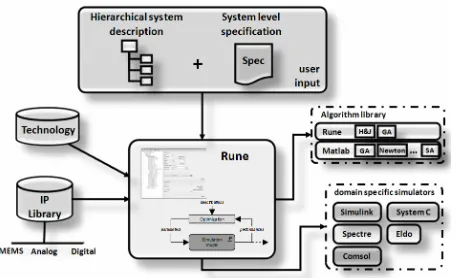
RUNE (fRamework for aUtomated aNalog dEsign) [6,7] is an Analog/Mixed-Signal (AMS) synthesis framework. As shown in Figure 1, the main inputs are the hierarchi- cal description of the system and associated system level performances. From the user’s point of view, there are two main phases leading to the synthesis of an (Intellec- tual Property) IP block:
Definition of AMS soft-IP, described in the Extended Markup Language (XML) format (directly into an XML file or through the graphical user interface, GUI). In this step, all information related to the sys- tem must be provided (hierarchy, models, variables, performances specifications, etc.).
Configuration of the AMS firm-IP synthesis method. In this step, the user must define an optimization strategy, i.e. a numerical method or algorithm and the formulation of the problem according to the specifi- cations.
In RUNE, different kinds of models describing the whole or part of the system at a given representational abstraction level can be entered. These models are stored in a database allowing each soft-IP to be used as part of a system. Also, in order to evaluate the performance of these domain-specific models, a simulation Application Programming Interface (API) has been developed in or- der to plug in several external simulators. In this way, the user can select the external simulators to use in the speci- fication evaluation phase.
2.2. Optimization Process
[image:2.595.311.539.85.224.2]The optimization process can be used at each abstraction level and for every structural (sub-)component. Three main steps are followed (Figure 2):
Figure 1. RUNE block diagram functions.
Figure 2. RUNE optimization steps.
A cost function is formulated from specifications and design parameters set and stored in XML files.
A design plan is set to define which optimization al- gorithms will be used to perform synthesis.
A model at a given abstraction level for each specifi- cation must be defined for the performance evaluation during optimization process.
[image:2.595.311.536.257.373.2]will be seen in the following section describing an appli- cation example.
3. Hybrid GA-SQP Algorithm
We have seen in the previous section that RUNE plat- form allows selection of several algorithms to perform optimization of complex circuits. We describe in the fol- lowing part the candidate algorithms that will be used in our hybrid approach.
3.1. Genetic Algorithm
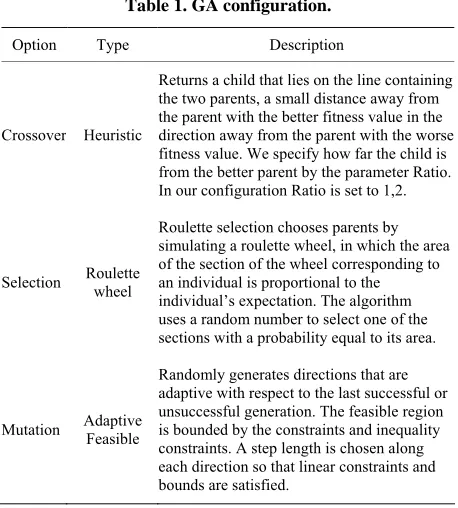
Genetic Algorithms are based on natural genetic and natural selection mechanism and some fundamental ideas are borrowed from Genetics in order to artificially con- struct an optimization procedure. The GA acts over a population of potential solutions, applying intensification (crossover) and diversification (mutation) operators to explore the problem space. The fittest individuals are selected and give birth to a new population, in the hope of improving the solution quality. GA is extensively dis- cussed in the literature and details on its mechanisms can be found in [1]. The GA used in this study is part of the MATLAB optimization toolbox. The GA is configured to use heuristic crossover, roulette wheel selection and adaptive feasible mutation (detailed in the Table 1). The generation and the population values used for GA are set respectively to 5 and 10.
3.2. Sequential Quadratic Programming (SQP)
Sequential quadratic programming (SQP) [5,9] is one of the most popular and robust algorithms for nonlinear continuous optimization. It starts from a single point and finds a solution using the gradient information. SQP re- quires a reasonable starting solution to increase the op- portunity to achieve an acceptable solution and to avoid the local optima. This algorithm allows to closely mimic Newton’s method for constrained optimization just as is done for unconstrained optimization. Each iteration con- tains an approximation made of the Hessian of the La- grangian function which uses a quasi-Newton updating method. This is then used to generate a Quadratic Pro- gramming (QP) subproblem whose solution is used to form a search direction for a line search procedure. Se- quential Quadratic Programming is an iterative method. It allows solving at the kth iteration a QP of the follow- ing form:
t k f xk d0, 1, , ,
0, 1, , ,
i p
Minimize 0.5dt d
H (1)
subject to: i k t i k t
i k i k
h x d h x
g x d g x
i p
[image:3.595.308.540.86.338.2]d is defined as the search direction and Hk is a positive
Table 1. GA configuration.
Option Type Description
Crossover Heuristic
Returns a child that lies on the line containing the two parents, a small distance away from the parent with the better fitness value in the direction away from the parent with the worse fitness value. We specify how far the child is from the better parent by the parameter Ratio. In our configuration Ratio is set to 1,2.
Selection Roulette wheel
Roulette selection chooses parents by simulating a roulette wheel, in which the area of the section of the wheel corresponding to an individual is proportional to the individual’s expectation. The algorithm uses a random number to select one of the sections with a probability equal to its area.
Mutation Adaptive Feasible
Randomly generates directions that are adaptive with respect to the last successful or unsuccessful generation. The feasible region is bounded by the constraints and inequality constraints. A step length is chosen along each direction so that linear constraints and bounds are satisfied.
definite approximation to the Hessian matrix of Lagran- gian function of the problem. The Lagrangian function can be described as:
, ,
ip1 i ih
pj p 1 j j
L x y f x
x
g x1
k k k k
X x d
(2)
where γ, β are the Lagrangian multipliers. The active set strategy allows to solve the developed QP.
According to Equation (3), the solution xk is updated at each iteration.
(3)
α is defined as the step size and takes values in the inter- val [0, 1]. After each iteration the matrix Hk is updated based on the Newton Method. The SQP used in this study is part of MATLAB tools.
3.3. Proposed Hybrid Approach: GA-SQP
[image:3.595.309.538.88.342.2]problem. It ensures computational robustness when it starts from a feasible initial solution. By combining the GA with SQP, a new algorithm referred to as GA-SQP hybrid algorithm is formulated in this paper. First, GA searches the global optimum in the whole solution region in order to obtain a quasi-optimal solution. Then the global optimal solution can be obtained by SQP. This SQP significantly increases the power of the GA in terms of solution quality and speed of convergence to the best solution. The proposed hybrid method allows eliminating the need to provide a suitable starting point and allows ensuring a faster convergence speed and a higher con- vergence accuracy to find the optimal solution. The flow chart of the proposed GA-SQP algorithm can be summa- rized as follows (Figure 3).
4. Optimization Results of the TIA and
Driver Circuits
[image:4.595.59.285.339.716.2]Optical Network-on-Chip (ONoC) is a technology for
Figure 3. Flow chart of the proposed hybrid method.
high speed communication inside a single chip (a system- on-chip) [10]. Instead of transmitting data via metallic routes, an ONoC converts electrical signals to light pulses and transmits them through a dedicated network of optical waveguides (λ-router). An ONoC is a multi- domain system, composed of digital elements for data flow control and analog and optical blocks to convert and modulate data as light impulsions. Together, these blocks compose transmission and reception interfaces with whom processors, memories and other intellectual prop- erty (IP) blocks can communicate.
In this paper we are interested only in the synthesis of the analog circuits of ONoC such as a transimpedance amplifier (TIA) used for reception and an optical driver (Driver) used in transmission, as illustrated in Figure 4. We used RUNE to optimize these circuits. The type of evaluation used for each performance, is based on equa- tions and electrical simulations. The technology used for the design of both the circuits is a CMOS 0.35 µm.
These two examples of application are given in order to show the effectiveness of the proposed GA-SQP to solve analog circuits design problems. The first applica- tion concerns a mono-objective problem. That issue deals with optimizing the sizing of driver circuit to meet fixed specifications with two nonlinear equality constraints. The second application is about a multi-objective prob- lem using the aggregation approach, and consists of siz- ing a TIA circuit with nonlinear inequality and nonlinear
[image:4.595.307.536.435.716.2]equality constraints. Then, the performance of the pro- posed GA-SQP algorithm is compared to SQP. All the experiments were run under a Linux environment on an Intel Xeon machine (2.6 GHz, 8 GB of RAM, 4 CPU).
4.1. Optical Driver
An optical driver is a circuit used to modulate informa- tion as a light signal. In the case of our ONoC system, the driver circuit (Figure 5) converts binary data into two current intensities, which in turn drive a laser beam.
The design problem of this circuit consists of mini- mizing the area of the transistors, while keeping the out- put current at levels required by the laser (bias and modulation currents). The optimization variables are the width (Wi) and length (Li) of each transistor (Mi), which dictate their electrical behaviour. The area objective can be calculated by the product of the widths and lengths of each transistor, while the output current values come from the electrical simulator. In this case study, the problem is formulated as follows, with two equality con- straints and that ensure proper functioning of the circuit in our target technology.
100μA 1 mA
X
Bias
Modulation min : Area
. : I s t
I
X
X
where X is the vector composed by the input variables
(W1, L1, W2, L2, W3, L3, W4 and L4). The variation range of the optimization variables of the vector X are set
as shown in Table 2.
The results obtained with GA-SQP are shown in Table 3. The transistor sizes for this optimal solution are listed in Table 4. Results show that the algorithm allows reach- ing the objective while respecting the nonlinear equality constraints.
4.2. Transimpedance Amplifier (TIA)
The Transimpedance Amplifier (TIA) is used in the re- ceiver side of the ONoC. The incoming light signal is
[image:5.595.309.539.99.254.2]Figure 5. Circuit of the optical driver.
Table 2. Parameters values of the driver.
Variable parameters Variation range
W1 [0.45 µm, 50 µm]
L1 [0.35 µm, 30 µm]
W2 [0.35 µm, 30 µm]
L2 [0.45 µm, 50 µm]
W3 [0.45 µm, 50 µm]
L3 [0.35 µm, 30 µm]
W4 [0.45 µm, 50 µm]
L4 [0.35 µm, 30 µm]
Table 3. Driver specifications and results.
Performance Area (μm2) Bias current
(µA)
Modulation current (mA)
CPU Time (mn)
Specification Min. =100 =1 -
GA-SQP
[image:5.595.309.537.376.529.2]results 4.3559 100 1 42
Table 4. Results of parameters sizing.
Parameters Size
W1 9.37 µm
L1 0.35 µm
W2 1.9 µm
L2 0.35 µm
W3 0.45 µm
L3 0.523 µm
W4 0.494 µm
L4 0.35 µm
converted to current by a photodetector, and the role of the TIA is to convert this weak current signal to a voltage level that can be used in a digital circuit. The structure of the TIA, with its internal inverter amplifier, is illustrated in Figure 6.
The desired TIA performance criteria are: the tran- simpedance gain Zg, the bandwidth BW, the quality fac- tor Q, the power consumption pwr and the transistors surface Area. Zg, BW and pwr are evaluated with the electrical simulator “Spectre”. Q and Area are evaluated with respectively the Equations (4) and (5).
* * 1 out
1 * 1
out
Rf Cd Av
R Cl
Q
Cd Rf
Cl R
[image:5.595.59.288.589.718.2]Figure 6. Circuit of the TIA.
AreaL W1* 1L2*W2L W3* 3
2,
0.707 4 mW 17μm BW
(5) where, Rout and Av are, respectively, output resistance and gain of internal amplifier. They are evaluated with electrical simulations.
The purpose consists in optimally sizing TIA circuit with maximizing Zg and BW. We transformed these multi-objective problems into a mono-objective using the aggregation approach. There are two nonlinear inequality constraint such as pwr and Area and one nonlinear equal- ity constraint such as Q.
The problem can be formulated as follows:
Max :
. : Area
Zg
Q s t Pwr
X X X
X
X X
where X is the vector composed by the input variables
(W1, W2, W3, Rf, Cd and Cl). The transistor length is fixed at 0.35 µm for all transistors and the variation range of the optimization variables of the vector X are set
as shown in Table 5.
Table 6 presents TIA specification and best results of GA-SQP algorithm for 52 runs. Results of parameters sizing with GA-SQP algorithm are shown in Table 7. Results show that the algorithm allows reaching the ob- jectives while respecting the nonlinear inequality and equality constraints.
4.3. Comparing GA-SQP to SQP
To show the effectiveness of hybrid optimization method, the proposed GA-SQP algorithm is compared to SQP. For this analysis we have collected, for both algorithms, runtime and fitness data over several independent runs of the TIA circuit optimization problem. A random multi start approach is used with the SQP algorithm to make comparison with GA-SQP which does not depend on its starting point. In all experiments, the stopping criteria of both algorithms are set to the same value. It takes into
Table 5. Parameters values of the TIA.
Variable parameters Variation range
W1 [1 µm, 20 µm]
W2 [1 µm, 20 µm]
W3 [1 µm, 20 µm]
Rf [1 kΩ, 3 kΩ]
Cd [100 fF, 500 fF]
Cl [100 fF, 200 fF]
Table 6. TIA specifications and results.
Perf. Zg (Ω) (GHz)BW (µmArea 2) (mW)pwr Q
Spec. Max. Max. <17 <4 =0.707
GA-SQP
results 966 0.713 15.78 3.79 0.707
Table 7. Results of parameters sizing with GA-SQP.
Parameters size
W1 (µm) 11.3
W2 (µm) 33.3
W3 (µm) 0.5
Rf (kΩ) 1.5
Cl (nF) 0.1
Cd (nF) 0.4
account the maximum number of iterations, the termina- tion tolerance for the objective function value and the termination tolerance for the nonlinear constraints. The main input parameters of SQP and GA-SQP are indicated in Table 8.
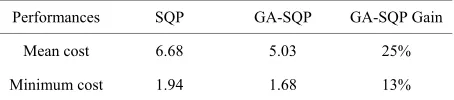
GA-SQP and SQP algorithms have been executed 52 times. As shown in Table 9, GA-SQP algorithm allows to obtain 82.76% success solution and SQP algorithm allows to obtain only 18.29% success solution. Table 10 shows that the GA-SQP outperforms SQP in terms of the best and mean cost for success solution obtained during our tests. The gain of GA-SQP compared to SQP in terms of mean and minimum are respectively 25% and 13%. It clearly shows that the GA provides a good start- ing point to the SQP method more efficiently than a sim- ple random start. Moreover, Table 11 shows that the GA-SQP consumes less time compared to SQP, because it requires less iteration to find the optimal solution.
Table 8. SQP and GA-SQP input parameters.
Algorithms Input parameters Value
Population size 10
Generations 5
GA-SQP
Max SQP iterations 50
SQP Max SQP iterations 50
Table 9. Success rate of GA-SQP and SQP.
Algorithms numbers Run solution numbers Success % Success rate
GA-SQP 52 42 80.76%
[image:7.595.59.286.304.354.2]SQP 52 12 18.29%
Table 10. Minimum and mean cost comparison.
Performances SQP GA-SQP GA-SQP Gain
Mean cost 6.68 5.03 25%
[image:7.595.56.285.383.434.2]Minimum cost 1.94 1.68 13%
Table 11. Mean execution time comparison.
SQP GA-SQP
Mean time (second) 866 749
Mean evaluation number 255 236
outperforms the SQP in terms of better optimal solution and significant reduction of computing times. The result for computational run time is impressive, because the combination of two algorithms consumes less than one. This explains that the genetic algorithm converges quickly to a near optimal solution, which allows to the SQP algo- rithm to find the optimum result with less effort.
5. Conclusion
We proposed a method based on a combination of GA algorithm and successive SQP algorithm, namely GA- SQP. It is implemented in the framework RUNE to opti- mize performances of analog circuits. GA-SQP seems to be suitable for solving both nonlinear mono-objective and multiobjective optimization problems. The results of the proposed hybrid method were compared with SQP algorithms to solve a TIA sizing problem. The results show that the proposed hybrid method outperforms the SQP in terms of better optimal solutions and signficant reduction of computing time. Furthermore, the hybrid GA-SQP algorithm does not require the user to specify he starting point. Finally, the proposed approach let us
conclude that depending on the nature of our analog siz- ing problem (degrees of freedom, number of perform- ances), efficient hybrid combination between an evolu- tionary approach and a direct search can be found.
t
REFERENCES
[1] G. Renner and A. Ekárt, “Genetic Algorithms in Com- puter Aided Design,” Computer-Aided Design, Vol. 35, No. 8, 2003, pp. 709-726.
doi:10.1016/S0010-4485(03)00003-4
[2] M. Taherzadeh-Sani, R. Lotfi, H. Zare-Hoseini and O. Shoaei, “Design Optimization of Analog Integrated Cir- cuits Using Simulation-Based Genetic Algorithm,” Pro- ceedings of International Symposium on Signals, Circuits and Systems, Iasi, 10-11 July 2003, pp. 73-76.
[3] A. Jafari, M. Zekri, S. Sadri and A. R. Mallahzadeh, “De- sign of Analog Integrated Circuits by Using Genetic Al- gorithm,” Proceedings of International Conference on Computer Engineering and Applications, Bali Island, 19-21 March 2010, pp. 578-581.
doi:10.1109/ICCEA.2010.118
[4] C. Wang, Q. Wang, H. Huang, S. Song, Y. Dai and F. Deng, “Electromagnetic Optimization Design of a HTS Magnet Using the Improved Hybrid Genetic Algorithm,”
Proceedings of Asian Conference on Applied Supercon- ductivity and Cryogenics, Miyazaki, 12 December 2004, pp. 349-353.
[5] N. Menezes, R. Baldick and L. T. Pileggi, “A Sequential Quadratic Programming Approach to Concurrent Gate and Wire Sizing,” Proceedings of International Confer- ence on Computer-Aided Design, San Jose, 5-9 Novem- ber 1995, pp. 867-881.
[6] L. Labrak and I. O’Connor, “Heterogeneous System De- sign Platform and Perspectives for 3D Integration,” Pro- ceedings of 21st IEEE International Conference on Mi- croelectronics, Marrakech, 19-22 December 2009, pp. 161-164.
[7] F. Tissafi-Drissi, I. O’Connor and F. Gaffiot “RUNE: Platform for Automated Design of Integrated Multi-Do- main Systems Application to High-Speed CMOS Photo- receiver Front-Ends,” IEEE Proceedings of Design, Auto- mation and Test in Europe Conference, Paris, 16-20 Feb-ruary 2004, pp. 16-21.
[8] E. G. Talbi, “Metaheuristics: From Design to Implemen- tation,” John Wiley and Sons Ltd., Hoboken, 2009. [9] P. T. Boggs and J. W. Tolle, “Sequential Quadratic Pro-
Gramming for Large-Scale Nonlinear Optimization,”
Journal of Computational and Applied Mathematics, Vol. 124, No. 1-2, 2000, pp. 123-137.
doi:10.1016/S0377-0427(00)00429-5
![Figure 4. Multi-domain ONoC description [10].](https://thumb-us.123doks.com/thumbv2/123dok_us/9270837.418296/4.595.59.285.339.716/figure-multi-domain-onoc-description.webp)