POTENTIAL BENEFITS OF WHIZ KID
CHILDREN; AN INITIATIVE TO UNLOCK THE POTENTIAL OF HUMAN
*
Shruti Marwaha and
Department of Research and Development, Maxpro Intellithon Ltd.
ARTICLE INFO ABSTRACT
Whiz Kid
environment and to start enjoying the student life aiding in the child development right from the crucial age. The program is enlisted for 3
specifically framed for weekend sessions; 2 hours/session, stre
that always delivers when the situation arrives. The in hand research study was conducted in Chandigarh, Panchkula, Hoshiarpur and Jalandhar. The sample was randomly selected that consisted of 200 students betwe
abilities of innate
programme, a drastic improvement in the activity marks was noticed. Children were found to engage more actively in practical learning thereby developing Ideation, Innovation
contemporary action oriented program
performance of the students after the successful implementation of the programme.
Copyright © 2016, Shruti Marwaha and Geetika seth. This
unrestricted use, distribution, and reproduction in any medium, provided the original work is properly cited.
INTRODUCTION
Whiz Kid - iclass program is a multiple intelligence classroom based training program for children aging between 3 and 7, which would help to increase the retention power and memory skills of children along with fastening their mathematical calculations. It helps to build interest in mathematics. Moreover it enables them to become excellent stage speaker with enhanced confidence and vocabulary. Besides, Personality Development program will boost their self confidence and groom personality that will have
impression on others. Cognition involves the thinking skills that children use to make sense of all the general knowledge that they acquire. Cognitive skills enable children to make meanings, patterns, and relationships in their learning, f example, the ability to understand how to count objects in order to pick up five blocks. Among the most basic cognitive skills are perception, attention, imitation, and memory. Children’s ability to retain memories increases over time, and they learn strategies to help with remembering, for example, practicing what they want to remember.
*Corresponding author: Shruti Marwaha,
Department of Research and Development, Maxpro Intellithon Ltd., India.
ISSN: 0975-833X
Article History:
Received 14th February, 2016
Received in revised form 25th March, 2016
Accepted 01st April, 2016
Published online 10th May,2016
Key words:
Child Development, Whiz Kid, Iclass.
Citation: Shruti Marwaha and Geetika seth, 2016.
unlock the potential of human brain”, International Journal of Current Research
RESEARCH ARTICLE
POTENTIAL BENEFITS OF WHIZ KID–iCLASS PROGRAMME IN THE DEVELOPMENT OF
CHILDREN; AN INITIATIVE TO UNLOCK THE POTENTIAL OF HUMAN
Shruti Marwaha and Geetika Seth
Department of Research and Development, Maxpro Intellithon Ltd.
ABSTRACT
Whiz Kid - iclass program is designed to enable students to enhance their intelligence in a stress free environment and to start enjoying the student life aiding in the child development right from the crucial age. The program is enlisted for 3-7 years of age. This 104
specifically framed for weekend sessions; 2 hours/session, stretching it for a year. It builds a mindset that always delivers when the situation arrives. The in hand research study was conducted in Chandigarh, Panchkula, Hoshiarpur and Jalandhar. The sample was randomly selected that consisted of 200 students between 3 and 7 years of age. The study intends
abilities and learning styles of the children and to groom their cognitive innate passion and mental faculties at the right age. After the success
programme, a drastic improvement in the activity marks was noticed. Children were found to engage more actively in practical learning thereby developing Ideation, Innovation
contemporary action oriented program witnessed tangible results and inevitably elevated the performance of the students after the successful implementation of the programme.
This is an open access article distributed under the Creative Commons Att use, distribution, and reproduction in any medium, provided the original work is properly cited.
iclass program is a multiple intelligence classroom based training program for children aging between 3 and 7, which would help to increase the retention power and memory skills of children along with fastening their mathematical It helps to build interest in mathematics. Moreover it enables them to become excellent stage speaker with enhanced confidence and vocabulary. Besides, Personality Development program will boost their self-confidence and groom personality that will have a long lasting impression on others. Cognition involves the thinking skills that children use to make sense of all the general knowledge that they acquire. Cognitive skills enable children to make meanings, patterns, and relationships in their learning, for example, the ability to understand how to count objects in order to pick up five blocks. Among the most basic cognitive skills are perception, attention, imitation, and memory. Children’s ability to retain memories increases over time, and rategies to help with remembering, for example,
Department of Research and Development, Maxpro Intellithon Ltd.,
The ability to combine cognitive skills helps children to expand their learning. Children begin to make observations, understand cause and effect, learn intentionally, and use symbolic and representational thinking for reading, writing, mathematics, and other skills. At the same time, children begin developing the ability to see relationships among objects by putting them in order and sorting them by type. As they develop and learn, children also learn to solve problems, think logically, and form explanations. General knowledge has two components. One component includes details about the world and social understandings. The second component is the processes of how things work. An important part of process knowledge that contributes to learning is the idea
conducted twice in the same way will have the same result. Cognitive skills and general knowledge are building blocks for school readiness. Cognitive development, along with language and social emotional development, predicts academic outcomes. The child uses intentional strategies to remember, learn, and do, including practice, private speech, planning, and reflecting. The child explores, observes, and compares things about himself and his world using color, size, shape, number, and other characteristics. The child makes predictions, conducts investigations, solves problems, and provides explanations by combining his knowledge and various cognitive skills.
Available online at http://www.journalcra.com
International Journal of Current Research
Vol. 8, Issue, 05, pp.30935-30943, May, 2016
INTERNATIONAL
2016. “Potential benefits of whiz kid–iclass programme in the development of children; An initiative to International Journal of Current Research, 8, (05), 30935-30943.
z
PROGRAMME IN THE DEVELOPMENT OF
CHILDREN; AN INITIATIVE TO UNLOCK THE POTENTIAL OF HUMAN BRAIN
Department of Research and Development, Maxpro Intellithon Ltd., India
iclass program is designed to enable students to enhance their intelligence in a stress free environment and to start enjoying the student life aiding in the child development right from the 7 years of age. This 104-hour unique programme is tching it for a year. It builds a mindset that always delivers when the situation arrives. The in hand research study was conducted in Chandigarh, Panchkula, Hoshiarpur and Jalandhar. The sample was randomly selected that consisted en 3 and 7 years of age. The study intends to trace and enhance the natural cognitive abilities for the development After the successful completion of the programme, a drastic improvement in the activity marks was noticed. Children were found to engage more actively in practical learning thereby developing Ideation, Innovation and Application. The witnessed tangible results and inevitably elevated the performance of the students after the successful implementation of the programme.
Commons Attribution License, which permits
The ability to combine cognitive skills helps children to expand their learning. Children begin to make observations, understand cause and effect, learn intentionally, and use symbolic and representational thinking for reading, writing, her skills. At the same time, children begin developing the ability to see relationships among objects by putting them in order and sorting them by type. As they develop and learn, children also learn to solve problems, think ns. General knowledge has two components. One component includes details about the world and social understandings. The second component is the processes of how things work. An important part of process knowledge that contributes to learning is the idea that a process conducted twice in the same way will have the same result. Cognitive skills and general knowledge are building blocks for school readiness. Cognitive development, along with language and social emotional development, predicts academic es. The child uses intentional strategies to remember, learn, and do, including practice, private speech, planning, and reflecting. The child explores, observes, and compares things about himself and his world using color, size, shape, number, characteristics. The child makes predictions, conducts investigations, solves problems, and provides explanations by combining his knowledge and various INTERNATIONAL JOURNAL OF CURRENT RESEARCH
The child acquires and uses knowledge about the world including names and attributes of things, categories, and relationships. This includes the traditional learning areas of mathematics, science, language and literacy, social studies, music, and art. Educational research clearly indicates that there are things early educators can do to increase the amount of cognitive skills and general knowledge children attain. Storytelling is an activity that can transfer emotions and feelings and also can boost thinking capacity. Storytelling instills virtues in child. Children all over the world love listening to stories. They want to know more about their favorite characters and often try to emulate them. Storytelling makes them aware of their own culture and roots, enhances verbal proficiency and improves listening skills: most children usually have a lesser attention span and find it difficult to concentrate on something for long. Listening to a story helps a child imagine the characters, places, plot etc. instead of seeing it on a visual medium. This also enhances creativity, making them more imaginative and open to ideas and free thinking. It also acts as a great tool for sharpening memory, broadens horizon and making academic learning easier. Storytelling helps children in learning the art of better communication and helps to face difficult situations with ease. As much as storytelling is important, it is also important to make sure that it is being told in the right way. A story should neither be too short nor too long.
The place should create the perfect mood and ambiance for storytelling. There has to be a proper introduction. Proper expressions and involvement of children is equally important. Storytelling is extremely important for children especially in the formative years. It’s a tradition that has been instrumental in transferring the human culture, wisdom, experiences of survival, do’s and don’ts of life, values, sense of humor and poetic perspective, languages and sciences. There is a plethora of fables, mythical, mythological, historical, folk, parables and fictional stories but storyteller is the only inevitable element among all the forms of stories. Few decades ago, the stories were mainly disseminated verbally, and then through printed books. In the modern age, the major dissemination of this internal universe is happening through modern communication media like radio, television, audio, videotapes, films, multimedia CDs and internet in addition to the printed books. The role of storyteller gets fairly articulated in the audio, video and film media but the interactive software can offer greater possibilities due to its interactive nature.
There have been several experiments in television and computer media to allow user participation in the molding and presentation of stories. The following deliberations record the observations of the author and analyze the issues relating to modeling of stories and role development of storyteller for interactive multimedia. Since the computers lack the ability to be imaginative and create stories from nothing, the human input becomes inevitable to provide the elements of story (Fraser, 2000). The cultural, ethnic, and linguistic diversity of the pacific region gives pacific educators an excellent opportunity to enrich children’s learning. Diverse points of view, personal histories, prior experiences, and learning styles can be used to greatly enhance teaching and learning. The professional literature suggests numerous ways to design
instruction so that all children learn. Storytelling is one way, it costs nothing, is enjoyable, and can be used anywhere and at any time (Zabel, 1991). All people have a basic need to share stories. Stories organize experiences and record important happenings. Stories are of great interest and significance in language and literacy development, especially when considering the increased linguistic and cultural diversity of students in pacific classrooms. Stories enable teachers to learn about their students’ cultures, experiences, and meaningful relationships. Through the sharing of stories, teachers and children “create the potential for new connections that link them together inside a new tale” (Dyson andGenishi, 1994). With th
is verbalization, children become the “narrated selves” of their own lives, sharing interpretations with others. Thus stories have interrelated social and evaluative functions (Dyson andGenishi, 1994). The stories we tell help define our socio-cultural landscape in particular ways and demonstrate connections between language, culture, and power (Dakhtin, 1981). Language is important to the learning process, and since children are just acquiring language, early educators must provide the vocabulary and descriptions of children’s mathematics and science activities and other projects for them. Conversations and questions are techniques that early educators use, but research shows that educators should also explicitly describe to the children what they observe them doing and ask questions that help a child move to the next level of understanding. In addition, early educators can support and reinforce children’s learning by writing what children say about their activities, using photos and work samples to help children remember what they have done, and recording key points that have been learned in their math and science activities.
Yoga seems to bestow mental benefits, such as a calmer, more relaxed mind. Now research by Chantal Villemure and Catherine Bushnell of the National Center for Complementary and Alternative Medicine in Bethesda, Md., explains how. Using MRI scans, Villemure detected more gray matter—brain cells—in certain brain areas in people who regularly practiced yoga, as compared with control subjects. Yogis had larger brain volume in the somatosensory cortex, which contains a mental map of our body, the superior parietal cortex, involved in directing attention, and the visual cortex, which Villemure postulates might have been bolstered by visualization techniques. The hippocampus, a region critical to dampening stress, was also enlarged in practitioners, as were the precuneus and the posterior cingulate cortex, areas key to our concept of self. All these brain areas could be engaged by elements of yoga practice. Children often face very challenging environments in their everyday life which can be stressful, uncertain, and emotionally demanding. Science has shown, and educators have experienced first-hand, that when children are anxious, stressed, distracted or unbalanced it is nearly impossible for them to learn. A calm and present state of mind is a prerequisite for children to be psychologically and physiologically ready for learning. Yoga is increasingly proving to be a great way to achieve this state of mind, and work towards the goals of stress reduction, self-regulation, and better ability to focus and sustain attention necessary for 30936 Shruti Marwaha and Geetika Seth, Potential benefits of whiz kid–iCLASS programme in the development of
learning. The neuroscience of child development research highlights that excessive stress damages the developing brain architecture, leading to vulnerability to lifelong problems in learning, behavior and overall health. Yoga can help cultivate a set of mental skills central to the aims of education in 21st century: self-regulation, pro-social dispositions, mastery and positive attitude towards academic success. Scientific evidence is accumulating that yoga and mindfulness training is an effective and cost-efficient way to promote healthy brain development and function, and to foster stress resilience. According to the most recent research, self-regulation is strongly predictive of school readiness as it allows children better to adapt to classroom demands, such as sitting still, sustaining both attention and motivation toward a task, and using creative problem-solving skills, as well as allowing children to learn in a more mindful, reflective fashion. In line with core goals of social-emotional learning, short but regular formal yoga and mindfulness training exercises, combined with informal mindfulness awareness practices, can strengthen children’s innate capacities for being mindful to any experience in ways that are responsive rather than reactive and reflexive.
Children are the primary consumers of media platforms (Rideout, Foehr, Roberts 2010). With the development of media technology and information transfer, children now have the possibility to access media everywhere, at any given time, starting from very small ages. Even though they now have the chance to enrich their knowledge using technology, this is thought to be having a more negative impact on their behavior on different levels, including aggression, pro social behavior and cognitive skills (Davidson 1979). One of the key innovations that educational technology has made available is new forms of representations, such as animation, multimedia, and virtual reality. Animations are a form of dynamic representation that display processes that change over time. Animations are used for a variety of reasons across a whole range of topics. They are often utilized when there is a need to show learners something not easily seen in the real world. More abstract representations can also be used to represent phenomena that are not inherently visual. If an animation focuses on one aspect of the event, then learners may make erroneous inferences about what is happening in the unviewed aspect of the animation. Schnotz (e.g., Schnotz and Rasch, 2005) discusses two ways that animations might facilitate cognitive processing.
The first he calls the enabling function of animation. Animations can provide additional information that cannot be displayed in pictures. This additional information allows for additional cognitive processing. The second is referred to as the facilitating function. Animations are able to help learners build dynamic mental models of situations by providing external support. In this way animations make cognitive processing easier. Cognitive Load Theory (e.g., Sweller, Van Merriënboer, and Pass, 1998) pays specific attention to the way that memory resources are used in learning and it has been applied to research on learning with animation (e.g., Ayres and Paas, in press). There is a long tradition of considering the role of motor actions in educational and developmental theories more generally. Piaget (e.g., Piaget and Inhelder, 1969)
believed that motor actions formed the basis of all learning. Infants begin with only sensorimotor representations, (at birth just simple reflexes, to deliberate sensorimotor actions to achieve effects in the world by two years). Only as children develop do they come to understand symbolic representations at first concretely and finally at eleven years they can master formal operations on abstract symbols. For Piaget, using one’s body to imitate a phenomenon is fundamental to the latter development of mental symbols to stand for the phenomena. Bruner (e.g., Bruner, 1966) also emphasized the role of action as learning is seen as progressing through enactive stages when knowledge is acquired and stored by actively engaging in manipulating objects through to iconic (mental representation of the objects) and then symbolic representations.
The expressive characteristics of animations resulted from the need to represent activities in a specific sequence. This could be advantageous for learners when the dynamic activity represented does need to be understood as one fully determined sequence but problematic when this is not the case. An analysis of cognitive, motor and perceptual consequences of learning with animations showed that while they may make dynamic information explicit, which should reduce the amount of cognitive effort required to learn about dynamic systems, they also introduce significant problems for perceptual processing and memory because of their transient nature. Affective accounts of learning with animations suggest that although learners may often report increased satisfaction and motivation as a result of using animations, this is not invariably the case. The strategies that learners use when studying with animations are crucial for their ultimate understanding.
The first five years matter and last a lifetime. The development of our brain determines the child as a whole. It is dependent upon the presence, pattern, frequency, quality and timing of experiences, good and bad. Although all brains have similar basic structures, the size, organization and functioning varies and changes over one’s lifespan, according to each individual’s genes, environment and experience. Neuroscience is providing unequivocal evidence that the brain physically changes, increasing and strengthening the neural connections through repetitive experience (McCain et al., 2007:19). The brain develops through use. It relies on sensory bathing. At birth, most of a person’s neurons have been generated, but most are not connected in networks. Brain development is about forming and reinforcing the connections (Shore, 1997). By the age of four years, a child’s brain can be 90% adult size. It is an ever-changing biological system, although no part of the brain will change unless it is activated by stimulation from the environment (Perry, 2000).
The brain is most sensitive to environmental input while it is developing and therefore variance in experience at an early age has more impact than later in life. Children’s sensory experiences (sight, hearing, touch, taste, smell, and movement) stimulate neural activity that differentiates and creates the complex nerve networks that are key for optimum development in early life (Cynader and Mustard, 1998), (Mustard, 2008). Children learn through being engaged and taking up the tasks.
The development of maps of representations in particular areas of the brain depends on experience. Experience that is repetitive, patterned and consistent will be represented by strong neural connections. Play is usually an enjoyable activity and hence encourages engagement and repetition leading to mastery and a sense of accomplishment and confidence. Play engages children’s attention, providing challenge, observation and opportunities for practice and success in the development of skills, creative problem solving, concepts and relationships (Perry, 2000). It is likely that ‘pretend play’ engages many areas of the brain because it involves emotion, cognition including executive functions, language, and sensorimotor actions and hence it is suggested that it promotes the development of dense synaptic connections (Bergen and Coscia in Bergen, 2002).
Neuroscientists assert that children learn skills through practice/trial and error and observation /imitation. It has been found that more than half of children entering school do so without sufficient levels of social-emotional and cognitive self regulation (Bodrova in Zaslow and Martinez-Beck, 2005). Children learn language by listening to it and using it. Experience is the catalyst for language acquisition. There is strong evidence that reading and talking in early childhood has a significant effect on language skills at later stages of development (Brewin in McCain et al., 2007; Hart and Risley, 2003). Geake (2009:129) asserts that for 95% of infants, it is children’s linguistic environment that makes the difference in verbal abilities in their early years. Similarly, Mustard (2008) reports that the extent of children’s language exposure in the early years has a significant effect on the verbal skills of children by age three.
Hart and Risley (2003) have found huge differences in the vocabulary size of young children related to social class correlated with the quantity of early family language experience (the amount and frequency of interaction between parents and children). These early differences translated into striking disparities in the children's later vocabulary growth rate, vocabulary use, and IQ test scores all of which are critical for success at school and in the workplace. These findings concur with the assertion of Snow (2006) that vocabulary is one of the most robust long term predictors of good literacy development.
MATERIALS AND METHODS
Whiz Kid - iclass is a research based training program that helps children build those skills which are most crucial for a successful life. The first step included sample selection and then, rapport was formed with the subjects. The parents/guardians were explained the programme in detail, along with its importance. The program is designed for children of 3-7 years of age. The sample was randomly selected from Chandigarh, Panchkula, Hoshiarpur and Jalandhar. In total, 200 students were selected, 40 students of each age. Pre admission Activity Marks were taken, following which the standardized weekend i-Class Training program was delivered by a certified i-Coach. The programme was impartedon weekends, 2 hours per session, making a total of
104 hours per student following the set scientific criteria. Later, the quarterly and a final assessment was carried out to trace the Potential benefits of Whiz Kid–iclass programme in the development of Children. The study intends to trace and enhance the natural abilities and learning styles of the children and to groom their cognitive abilities for the overall development of students.
Fig.1. Sampling Procedure
STATISTICAL ANALYSIS
Once the data was obtained, it was coded, tabulated and analyzed, keeping in mind the objectives of the study. Appropriate statistical tools were used to draw meaningful inferences. The statistical tools used in the present study are given in the table below;
RESULTS AND DISCUSSION
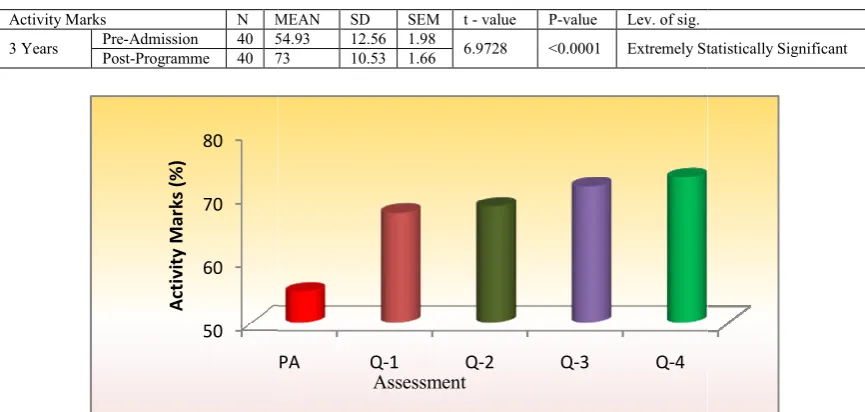
There is no doubt that after the successful completion of the programme, a drastic improvement in the activity marks was noticed among the 3 year olds and they were witnessed to perform significantly better. The statistical analysis affirmed the significant surge in their Activity Marks after attending the programme. It can be ascertained through the figures that the 4 year old children were found to engage more actively in practical learning thereby developing ideation, innovation and application. Consequently, an extremely significant rise was recorded after completion of the said programme.
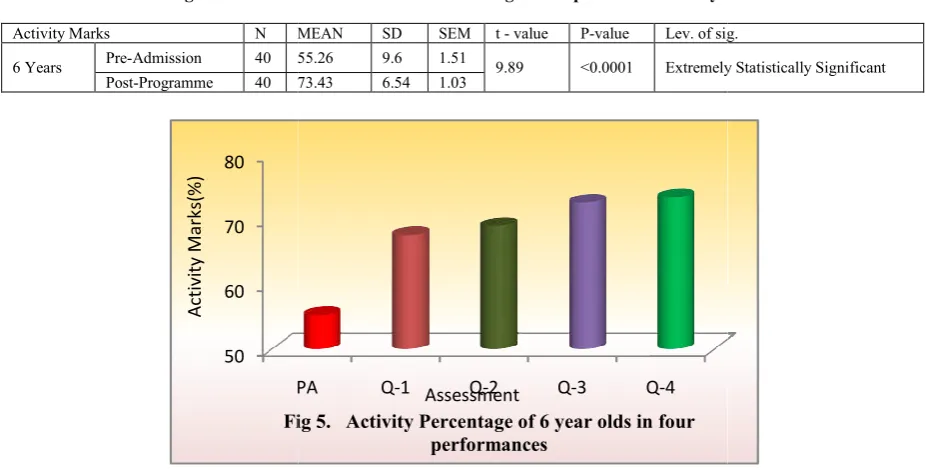
The contemporary action oriented program witnessed tangible results and inevitably elevated the performance of the 5 year old students after the successful implementation of the programme. It could not be more obvious that the 6 year old students performed significantly better after the completion of the programme. The Activity marks surged as the programme graded. It is self-evident that Post-programme activity marks of 7 year olds were extremely higher than their performance in pre admission activity It is apparent that as the Pre-Admission and Post-Programme Activity Marks of Students were analyzed, it was notified that the Post-Programme performance of all the students in all the age groups out figured their performance in the pre admission assessment.
Table 1
Performance of 3 years old students
Table 2.
Age PA
3 Years 54.93333
Table 3. Difference in the Mean Standard deviation, standard error, t Pre-Admission and Post
Activity Marks N MEAN
3 Years Pre-Admission 40 54.93
Post-Programme 40 73
50 60 70 80
Activi
ty
Mar
ks
(%
)
Fig.2. Activity Percentage of 3 year olds in four performances
[image:5.595.76.509.548.754.2]30939 International Journal of Current Research,
Table 1. Statistical tools used for analysis of data
. Activity Marks of 3 Year olds in the five stages
Q-1 Q-2 Q-3 Q-4
54.93333 67.36667 68.4 71.53333 73
Difference in the Mean Standard deviation, standard error, t-values and level of Significance of Admission and Post-Programme performance of 3 year olds
MEAN SD SEM t - value P-value Lev. of sig.
54.93 12.56 1.98
6.9728 <0.0001 Extremely Statistically Significant
73 10.53 1.66
PA Q-1 Q-2 Q-3 Q-4
Assessment
Fig.2. Activity Percentage of 3 year olds in four performances
International Journal of Current Research, Vol. 08, Issue, 05, pp.30935-30943, May, 2016
values and level of Significance of
Extremely Statistically Significant
Performance of 4 years old students
Table
Age PA
4 Years 50.71429
Table 5. Difference in the Mean Standard deviation, standard error, t
Activity Marks N
4 Years Pre-Admission 40
Post-Programme 40
Performance of 5 years old students
Table 6
Age PA
5 Years 59.11111
Table 7. Difference in the Mean Standard deviation, standard error, t Significance of Pre
Activity Marks N
5 Years Pre-Admission 40
Post-Programme 40
50 60 70 80
Activi
ty
Ma
[image:6.595.59.545.187.417.2]rks (%)
Fig.3 Activity Percentage of 4 year olds in four
50 60 70 80
Activi
ty
Mar
ks
(%
[image:6.595.90.517.539.753.2])
Fig.4 Activity Percentage of 5 year olds in four
30940 Shruti Marwaha and Geetika Seth,
children; An initiative to unlock the potential of human brain
Performance of 4 years old students
Table 4. Activity Marks of 4 Year olds in the five stages
Q-1 Q-2 Q-3 Q-4
50.71429 62.42857 64.7619 67.52381 68.71429
Difference in the Mean Standard deviation, standard error, t-values and level of Significance of Pre Post-Programme performance of 4 year olds
MEAN SD SEM t - value P-value Lev. of sig.
50.71 8.65 1.36
9.41 <0.0001 Extremely Statistically Significant
68.71 8.45 1.33
Performance of 5 years old students
Table 6. Activity Marks of 5 Year olds in the five stages
Q-1 Q-2 Q-3 Q-4
59.11111 71.11111 72.44444 78.55556 78.05556
Difference in the Mean Standard deviation, standard error, t-values and level of Significance of Pre-Admission and Post-Programme performance of 5 year olds
MEAN SD SEM t - value P-value Lev. of sig.
40 59.11 15.64 2.47
6.69 <0.0001 Extremely Statistically Significant
40 78.05 8.69 1.37
PA Q-1 Q-2 Q-3 Q-4
Assessment
Fig.3 Activity Percentage of 4 year olds in four performances
PA Q-1 Q-2 Q-3 Q-4
Assessment
Fig.4 Activity Percentage of 5 year olds in four performances
Geetika Seth, Potential benefits of whiz kid–iCLASS programme in the development of children; An initiative to unlock the potential of human brain
68.71429
values and level of Significance of Pre-Admission and
Lev. of sig.
Extremely Statistically Significant
78.05556
values and level of Programme performance of 5 year olds
Lev. of sig.
Performance of 6 years old students
Table 8.
Age PA
6 Years 55.26087
Table 9. Difference in the Mean Standard deviation, standard error, t of Significance of Pre
Activity Marks N MEAN
6 Years Pre-Admission 40 55.26
Post-Programme 40 73.43
Performance of 7 years old students
Table 10
Age PA
7 Years 52.52381
Table 11. Difference in the Mean Standard deviation, standard error, t Post
Activity Marks N
7 Years Pre-Admission 40
Post-Programme 40
50 60 70 80
PA
Activi
ty
M
ark
s(
[image:7.595.66.529.164.399.2]%)
Fig 5. Activity Percentage of 6 year olds in four
50 55 60 65 70 75 80
Activi
ty
Mar
ks
(%
[image:7.595.69.528.517.768.2])
Fig.6 Activity Percentage of 7year olds in four
30941 International Journal of Current Research,
Table 8. Activity Marks of 6 Year olds in the five stages
Q-1 Q-2 Q-3 Q-4
55.26087 67.56522 69 72.6087 73.43478
Difference in the Mean Standard deviation, standard error, t-values and level of Significance of Pre-Admission and Post-Programme performance of 6 year olds
MEAN SD SEM t - value P-value Lev. of sig.
55.26 9.6 1.51
9.89 <0.0001 Extremely Statistically Significant
73.43 6.54 1.03
Table 10. Activity Marks of 7 Year olds in the five stages
Q-1 Q-2 Q-3 Q-4
52.52381 64.80952 66.2381 69.90476 71.04762
Difference in the Mean Standard deviation, standard error, t-values and level of Significance of Pre Post-Programme performance of 7 year olds
MEAN SD SEM t - value P-value Lev. of sig.
52.52 10.58 1.67
8.55 <0.0001 Extremely Statistically Significant
71.04 8.68 1.37
PA Q-1 AssessmentQ-2 Q-3 Q-4
Fig 5. Activity Percentage of 6 year olds in four performances
PA Q-1 Q-2 Q-3 Q-4
Assessment
Fig.6 Activity Percentage of 7year olds in four performances
International Journal of Current Research, Vol. 08, Issue, 05, pp.30935-30943, May, 2016
73.43478
values and level Programme performance of 6 year olds
Lev. of sig.
Extremely Statistically Significant
71.04762
values and level of Significance of Pre-Admission and
Lev. of sig.
Performance of students in Pre-Admission and Post-Programme Activity Test
Table 12. Pre-Admission and Post-Programme Activity Marks of Students
Age Pre-Admission Post-Programme
3 Years 54.93333 73
4 Years 50.71429 68.71429
5 Years 59.11111 78.05556
6 Years 55.26087 73.43478
7 Years 52.52381 71.04762
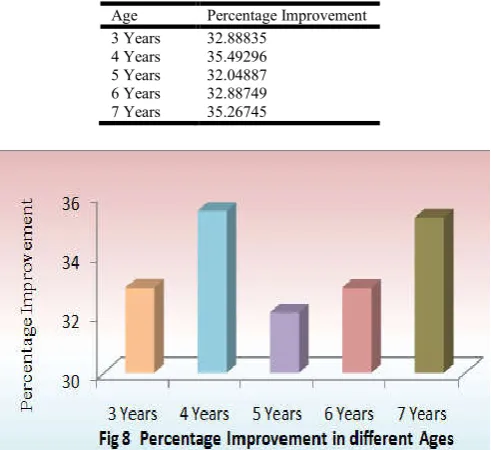
Table 13. Percentage Improvement after the Programme
Age Percentage Improvement
3 Years 32.88835
4 Years 35.49296
5 Years 32.04887
6 Years 32.88749
7 Years 35.26745
Percentage Improvement among Students after Successful completion of iclass Whiz Kid Programme
The evidence suggests that students of all the ages improved their performance after the successful completion of the iclass Whiz Kid Programme. The percentage improvement was found to be maximum among 4 year old students, followed by 7 year old students.
Conclusion
In conclusion, i-Class is a scientific process to keep a child ‘Stay Smart Forever’. Children when identified and nurtured
early in the age perform to the potential. i-Class trains to unlock the potential of human brain based on Cognitive Science Education Technology. It was notified that the subjects gained a quick learning process, character of adaptability, decisiveness, conviction, openness, reasoning, critical thinking ability, became more action oriented, innovative andwere found to perform at a time whenever the situation demands. The activity marks of all the age groups enhanced drastically after the successful completion of the iclass Whiz Kid Programme.
Acknowledgement
Authors express indebtedness to the Almighty, who is the apostle of strength. Authors are inevitably grateful to the subjects and all those directly as well as indirectly involved in the auspicious research work. Genuine thanks are expressed to all the authors/researchers whose work is referred for making the present study a real success. Special thanks are conveyed to Arjun Garg, Priya Sahrawat and Aavleen Bakshi for proofreading the paper.
REFERENCES
Ainsworth, S. and Loizou, A. T. 2003. The effects of self-explaining when learning with text or diagrams. Cognitive Science, 27(6), 937-937.
Ainsworth, S., and VanLabeke, N. 2004. Multiple forms of dynamic representation. Learning and Instruction, 14(3), 241-255.
Anderson, J, Johnstone, B. and Remley, D.1999 Breast-feeding and cognitive development: a meta-analysis, American Journal of Clinical Nutrition 70 (4), pp. 525–535.
Bierman, K et al. 2008 Promoting Academic and Social-Emotional School Readiness: The Head Start REDI Program, Child Development, Vol. 79, No. 6, The Pennsylvania State University, Blackwell Publishing, pp.1802–1817
Blair, C. 2003 Self-Regulation and School Readiness, CEEP, University of Illinois, viewed on 21/01/10 at http://ceep.crc.uiuc.edu/eecearchive/digests/2003/blair03.ht ml
Blakemore, S. and Frith, U. 2005 The Learning Brain: Lessons for education, Blackwell Publishing, Oxford.
Blakemore, SJ, Winston, J and Frith, U. 2004 Social neuroscience: where are we heading? TRENDS in Cognitive Science Vol. 8, No. 5: 338–352.
Bloch, M. 1991 Critical science and the history of child development's influence on early education research, Early Education and Care, Vol. 2, pp.95–108.
Blumer, H. 1986 Symbolic Interactionism; perspectives and methods, University of California Press, Berkeley.
Cacioppo, T, Berntson, G, Lorig, T, Norris, C, Rickett, E and Nusbaum, H. 2003 Just because you’re imaging the brain doesn’t mean you can stop using your head: a primer and set of first principles, Journal of Personality and Social Psychology, Vol. 85, No. 4, pp.650–661.
Chervin, RD, Archbold, KH, Dillon, JE, Pituch, KJ, Panahi, P, Dahl, RE et al. 2002 Associations between symptoms of 30942 Shruti Marwaha and Geetika Seth, Potential benefits of whiz kid–iCLASS programme in the development of
[image:8.595.42.288.369.594.2]inattention, hyperactivity, restless legs, and periodic leg movements. Sleep 25, Mar 15;25(2): pp.213–218.
Child Welfare Information Gateway. 2001 Understanding the Effects of Maltreatment on Early Brain Development: Bulletins for Professionals. Viewed on 26/02/10 @ http://www.childwelfare.gov/pubs/focus/earlybrain/index.c fm
Geake, J. 2009 The Brain at School: educational neuroscience in the classroom. OUP: Berkshire, England.
Gellens, S. 2008 Activities that Build the Young Child's Brain, 2nd edn, Early Childhood Association of Florida.
Hart, B and Risley, TR. 2003 The early catastrophe. The 30 million word gap. American Educator, 27 (1) pp.4–9 Hart, B, and Risley, T. 1995 Meaningful differences in the
everyday experiences of young American children. Baltimore: Paul H. Brookes.
Hughes, C. 1998 Executive function in preschoolers: links with theory of mind and verbal ability, British Journal of Developmental Psychology 16, pp. 233-253.
Johnson, W. L., Rickel, J., and Lester, J. C. (2000). Animated pedagogical agents: Face-to-face interaction in interactive learning environments. International Jounral of Artificial Intelligence in Education, 11, 47-78.
Kaiser, M., Proffitt, D., Whelan, S., and Hecht, H. 1992. Influence of animation on dynamical judgements. Journal of Experimental Psychology: Human Perception and Performance., 18, 669-690.
Knudsen, E. 2004 ‘Sensitive periods in the development of the brain and behaviour’, Journal of Cognitive Neuroscience, 16:14, pp.12–25.
Kotulak, R. 1998 Inside the brain: revolutionary discoveries of how the mind works, Preventative Medicine, 27, pp.246– 247.
Laevers, F. 1994 Defining and assessing quality in early childhood education Studia Paedagogia. Leuven University Press: Leuven.
Laevers, F. 1999 The project experiential education: concepts and experiences at the level of context, process and outcome in 7th National Convention of Early Childhood Education, Nelson, NZ.
Leutgeb, S. et al. 2005 Independent codes for spatial and episodic memory in hippocampal neural ensembles. Science 309.pp 619-623
Lewalter, D. 2003. Cognitive strategies for learning from static and dynamic visuals. Learning and Instruction, 13(2), 177-189.
Lowe, R. 2004. Interrogation of a dynamic visualization during learning. Learning and Instruction, 14(3), 257-274.
Lowe, R. K. 1999. Extracting information from an animation during complex visual learning. European Journal of Psychology of Education, 14(2), 225-244.
Lowe, R. K. 2003. Animation and learning: selective processing of information in dynamic graphics. Learning and Instruction, 13(2), 157-176.
Malone, T. W., and Lepper, M. R. (1987). Making learning fun: A taxonomy of intrinsic motivations for learning. In R. E. Snow and M. J. Farr (Eds.), Aptitute, Learning and Instruction III (pp. 223-253). Hilsdale, NJ: Lawrence Erlbaum Associates.
Martin, T., and Schwartz, D. L. 2005. Physically distributed learning: Adapting and reinterpreting physical environments in the development of fraction concepts. Cognitive Science, 29(4), 587-625.
Maxwell, K, Ritchie, S, Bredekamp, S and Zimmerman, T. 2009 Issues in Pre-K-3rd Education: Using developmental science to transform children’s early school experiences, Chapel Hill, The University of North Carolina, FPG Child Development Institute, First School.
Melhuish, E, Phan, M, Sylva, K, Sammons, P, Siraj-Blatchford, I, and Taggart, B. 2008 Effects of the Home Learning Environment and Preschool Center Experience upon Literacy and Numeracy Development in Early Primary School Journal of Social Issues Vol. 64, No. 1, pp.95–114.
Perry, B. 2002 Childhood experience and the expression of genetic potential: What childhood neglect tells us about nature and nurture In Brain and Mind 3, pp.79–100
Perry, B. 2004 How the brain learns best. Scholastic, viewed 21/01/2010, http:/teacher.scholastic.com/ professional/ bruceperry/ brainlearns.htm
Schnotz, W., and Lowe, R.K. (in press). A unified view of learning from animated and static graphics. In R.K. Lowe and W. Schnotz (Eds.) Learning with animation: Research and design implications. New York: Cambridge University Press
Siraj-Blatchford, I, Woodhead, M (eds). 2009 Effective Early Childhood Programmes. Early Childhood in Focus 4: The Open University, Child and Youth Studies Group, Walton Hall, Milton Keynes, UK
Zhang, J. J., and Norman, D. A. 1994. Representations in distributed cognitive tasks. Cognitive Science, 18(1), 87-122.