Master Thesis
Strukton Worksphere
First line managers and Human Resource Management
Supporting first line managers in the implementation of HR practices
Name: José Reinaardus
Studentnr.: s0155713
Tutor 1: A.C. Nehles
Tutor 2: dr. M.J. van Riemsdijk
Date: January 12, 2009
Institute: University of Twente
Faculty: Business Administration
Preface
The research has been carried out for the University of Twente in Enschede and for the organization Strukton Worksphere in the Netherlands in order to examine the factors that determine the
perceived lack of support by first line managers in the implementation of HR practices at the operational level of the organization.
Executive summary
Nowadays, organizations locate operational HR activities with line managers rather than HR specialists, because line managers have direct contact with their employees on the shop floor. This trend is also implemented at Strukton Worksphere. However, previous research showed that the devolvement of operational HR tasks and responsibilities to first line managers at Strukton Worksphere ensures dissatisfactions about the perceived support by first line managers in the implementing of HR practices at the operational level of the organization.
The current research examines the factors which determine the perceived lack of support by first line managers at Strukton Worksphere. The researcher hypothesizes that the structure of the HR
function, which is organized rather decentralized in a central HR department, Shared Service Center and local HR consultants, influences the effective communication and the consistency and
understandability of the partitioning of HR tasks and responsibilities between the HR director, HR consultants, the Shared Service Center and first line managers. This, in turn, leads to different expectations of the HR performances of all HR parties involved. Because the different expectations of the HR performances are not the same, first line managers perceive a lack of support from the HR function.
The data for the research is collected by the use of an interview protocol and a document analysis of function profiles. The results show that the support to first line managers is mainly offered by the HR consultants. The research determines that if the communication between HR consultants and first line managers is not frequently and structured organized, first line managers experience
dissatisfactions about the HR performance of HR consultants. Besides this, if first line managers find the partitioning of HR tasks and responsibilities between HR consultants and first line managers unclear, they are able to use own interpretations regarding the HR tasks and responsibilities of both HR parties. As a result, HR consultants and first line managers create different opinions about their HR performances.
HR consultants expect of first line managers that they ask for support, whereas first line managers expect of HR consultants that they show interest in their HR performance, give feedback and inform them about the partitioning of HR tasks and responsibilities within the organization, developments in the field of Human Resource Management and identified problems. Besides this, HR consultants do not create partnership with first line managers, whereas first line managers expect this. As first line managers expect more support of HR consultants than they actually receive, first line managers perceive a lack of support from the HR consultants in the implementation of HR practices.
After discussing the results, it becomes clear that, besides the ineffective communication and the unclarity about the partitioning of HR tasks and responsibilities between HR consultants and first line managers, the multifaceted and complex nature of the role of HR consultants and the presence of HR consultants in their establishments influence the perceived lack of support by first line managers. Therefore, the research recommends the follow adaptations:
Management samenvatting
In plaats van Human Resource specialisten zijn tegenwoordig lijnmanagers verantwoordelijk voor de uitvoering van operationele HR activiteiten binnen organisaties, omdat zij direct contact hebben met de werknemers op de werkvloer. Deze tendens is ook zichtbaar binnen Strukton Worksphere. Eerder onderzoek heeft echter aangetoond dat de verschuiving van operationele HR taken en
verantwoordelijkheden naar teamleiders binnen Strukton Worksphere resulteert in ontevredenheid bij deze managers over de ondersteuning in de uitvoering van operationele HR activiteiten.
Het huidige onderzoek richt zich op de factoren die de ontevredenheid van de ondersteuning aan teamleiders in de uitvoering van operationele HR activiteiten veroorzaken. De onderzoeker stelt vast dat de structuur van de HR functie binnen Strukton Worksphere, welke bestaat uit een centrale HR afdeling, een Shared Service Center en lokale HR consultants, invloed heeft op de effectiviteit van de communicatie en de consistentie en begrijpelijkheid van de verdeling van HR taken en
verantwoordelijkheden tussen de HR directeur, HR consultants, de Shared Service Center en teamleiders. Het gevolg hiervan is dat verschillende verwachtingen ontstaan omtrent de HR prestaties van de HR partijen in kwestie. Als de verwachtingen over de HR prestaties niet overeenkomen, zullen teamleiders een gebrek aan ondersteuning van de HR functie ervaren.
De gegevens voor het onderzoek zijn verzameld door het gebruik van een interview protocol en een analyse van de functieprofielen. De resultaten laten zien dat de ondersteuning aan teamleiders voornamelijk gegeven wordt door HR consultants. Het onderzoek definieert dat als de communicatie tussen HR consultants en teamleiders niet frequent en structureel georganiseerd wordt, teamleiders ontevreden zijn over de HR prestaties van HR consultants. Daarnaast definieert het onderzoek dat als teamleiders de verdeling van HR taken en verantwoordelijkheden tussen HR consultants en
teamleiders niet duidelijk vinden, zij eigen interpretaties zullen gebruiken omtrent de taakverdeling van beide partijen. Hierdoor zijn HR consultants en teamleiders in staat verschillende meningen te creëren over hun prestaties op het gebied van Human Resource Management.
Gegeven de HR prestaties verwachten HR consultants van teamleiders dat zij ondersteuning vragen, terwijl teamleiders verwachten dat HR consultants interesse tonen in hun prestaties, feedback geven en hen informeren over de taakverdelingen binnen de organisatie, de ontwikkelingen op het gebied van Human Resource Management en waargenomen problemen. Daarnaast creëren HR consultants geen partnerschap met teamleiders, terwijl teamleiders het juist wel verwachten. Omdat teamleiders meer ondersteuning verwachten dan dat zij daadwerkelijk ontvangen van HR consultants, ervaren zij een gebrek aan ondersteuning in de uitvoering van operationele HR activiteiten.
Nadat de resultaten van het onderzoek bediscussieerd zijn, blijkt uit het onderzoek dat, naast de ineffectieve communicatie en de onduidelijke taakverdeling tussen HR consultants en teamleiders, de veelzijdige en complexe aard van de rol van HR consultants en de aanwezigheid van HR
consultants in hun ondernemingen ook het waargenomen gebrek aan ondersteuning door teamleiders beïnvloeden. Hierdoor zien de aanbevelingen van het onderzoek er als volgt uit:
Om de effectiviteit van de communicatie te stimuleren, is het raadzaam dat HR consultants evaluatiegesprekken organiseren met hun teamleiders. Deze dienen op vaste tijdstippen plaats te vinden. Daarnaast is het aan te bevelen om de strategische en operationele taken en
verantwoordelijk zijn voor strategische HR activiteiten, terwijl andere HR consultants
verantwoordelijkheid dragen over de operationele werkzaamheden, waaronder de ondersteuning aan teamleiders. Op deze wijze zal de verdeling van de taken en verantwoordelijkheden van HR consultants duidelijker worden binnen Strukton Worksphere.
Table of Contents
1. INTRODUCTION ... 9
2. STRUKTON WORKSPHERE... 11
2.1 HISTORY... 11
2.2 STRATEGY... 11
2.3 STRUCTURE... 12
2.4 HR STRUCTURE... 12
2.5 IMPLICATIONS OF THE HR STRUCTURE... 13
3. LITERATURE REVIEW... 15
3.1 PERCEIVED LACK OF SUPPORT... 15
3.2 EXPECTATIONS... 16
3.3 COMMUNICATION... 18
3.4 DIVISION OF TASKS... 20
3.5 RESEARCH MODEL... 21
4. METHODOLOGY... 23
4.1 SAMPLE AND PARTICIPANTS... 23
4.2 PROCEDURE... 24
4.3 APPARATUS AND MEASURES... 25
4.3.1 Operationalization ... 25
4.3.2 Measures... 26
Interview protocol ... 26
Function profiles... 28
4.4 ANALYSIS... 28
5. RESULTS... 29
5.1 RESULTS INTERVIEWS... 29
5.1.1 Communication... 29
Communication within the HR function ... 29
Communication between HR function and first line managers ... 30
Conclusions communication ... 31
5.1.2 Division of tasks ... 32
Division of tasks within the HR function ... 32
Division of tasks between HR function and first line managers... 33
Conclusions division of tasks... 34
5.1.3 Expectations ... 34
Expectations of HR director ... 34
Expectations of Shared Service Center... 35
Expectations of HR consultants... 36
Expectations of first line managers ... 38
5.1.4 FLMs’ perceived support ... 42
Offered support by HR consultants ... 42
Perceived received support by FLMs... 44
Conclusions FLMs’ perceived support ... 46
5.2 RESULTS INTERVIEWS BY BUSINESS UNIT... 48
5.3 RESULTS DOCUMENT ANALYSIS OF FUNCTION PROFILES... 50
Function profile of HR consultants... 50
Function profile of first line managers ... 50
Conclusions function profiles... 50
6. DISCUSSION ... 51
7. CONCLUSION AND LIMITATIONS ... 55
7.1 CONCLUSION... 55
7.2 RESEARCH LIMITATIONS... 57
8. RECOMMENDATIONS ... 58
8.1 EVALUATION CONVERSATIONS... 58
8.2 MULTIFACETED AND COMPLEX NATURE OF THE ROLE OF HR CONSULTANTS... 59
8.3 PRESENCE OF HR CONSULTANTS IN THEIR ESTABLISHMENTS... 60
REFERENCES ... 62
APPENDIX 1: RESULTS RESEARCH NEHLES ET AL. (2006)... 64
APPENDIX 2: STRUCTURE STRUKTON WORKSPHERE... 67
APPENDIX 3: STRUCTURE SERVICE, MANAGEMENT & MAINTENANCE... 68
APPENDIX 4: INTERVIEW PROTOCOL... 69
1. Introduction
There have been considerable developments in the management of human resources during the last years. The allocation of tasks formerly undertaken by the personnel specialists to line managers (devolution) and the allocation of tasks formerly undertaken centrally to more local parts of the organization (decentralization) are trends across Europe (Brewster et al., 1994).
The debate about Human Resource Management versus personnel management has brought the devolution of HR responsibilities to the forefront (Hall et al., 1998). The HR department has had to become more business oriented, more strategic, and more oriented towards organizational change. As Ulrich (1997) put it, the HR department becomes a change agent and a strategic partner of the organization aligning HRM strategies and practices with business strategy. In order to change the role of the HR department, day-to-day HRM work should be integrated to line operations (Brewster et al., 2000). But why is the devolvement of HR activities to the line crucial?
It is now widely believed that operational HR activities should be located with line management rather than HR specialist functions, because line management has frequently contact with the employees of the organization (Nehles et al., 2006). Providing these managers with the authority and responsibility for controlling and rewarding their subordinates means that the organization is more likely to manage its human resources coherently. First line managers will invest a lot of time in guiding, monitoring, coaching and motivating employees, sometimes in the context of regular, structured bilaterals and sometimes in less structured contexts. Therefore, first line managers become business managers; they should not only ensure conformance with rules, budgets and schedules, but they should inspire, should be alert to market and customer needs and should be adapt at creating appropriate responses to those needs (Storey, 1995). As a result, the people-oriented approaches and production/operations management-driven changes depend for their implementation upon the behavior of first line managers. For example, employee motivation, the degree of involvement and direct participation in an organization depend on a competent and willing first line management contribution.
However, Storey (1992) argues that the role of first line managers is improved, but that the way in which they handle HRM issues has not altered to the same degree. Many first line managers who were traditionally supervisors with no managerial qualifications continued to regard their ‘new’ role in the ‘old way’. Brewster et al. (2000) mention that line managers, under pressure, tend to fall back on ‘the usual way of doing things’; they are not particularly interested in HR issues and are often not able to keep up to date with the latest HR thinking. However, ‘they were expected to embrace and embody the new managerial styles, become the key channel in the open two-way communication and they were to be monitored for involving and developing employees’ (Storey, 1992, p. 240).
The problems with the changes in the role of the first line manager are discussed by many researchers (Storey, 1992; Lowe, 1992; Brewster et al., 1994; Cunningham et al., 1995; Renwick, 2000; Brewster et al., 2000; Bond et al., 2003; Whittaker et al., 2003; and Nehles et al., 2006). They argue that first line managers are reluctant to take on HR responsibilities, because they may not be willing to perform HR activities (lack of desire), have no time left to spend on those activities (lack of capacity), have insufficient competences to apply them (lack of competences), are not well
Nehles et al. (2006) examined those problems concerning the devolvement of HR responsibilities to the line at Strukton Worksphere. Strukton Worksphere operates in the technical service industry. It offers reliable and durable technical services and aspires a safe, efficient, comfortable and durable work environment in which people can perform optimally. The quantitative study of Nehles et al. (2006) focused on the hindrances first line managers experience in the implementation of HR activities and the needs and expectations on behalf of the implementation of those activities. The results of the research have been incorporated in appendix 1. The results show that first line managers are not satisfied with the support they currently get from the HR function. However, it is not known why first line managers are not satisfied with the support they get from the HR function and it is not known what would help them in the implementation of HR activities at the operational level of the organization.
The current research elaborates on the results of the research of Nehles et al. (2006) and will provide information about the unanswered questions concerning the lack of support, because this is the largest hindrance first line managers experience in the implementation of HR practices at the operational level of Strukton Worksphere. The purpose of the research is to clarify what the lack of support actually means at Strukton Worksphere and to help the organization to remedy this situation by providing them with advice how to decrease the lack of support first line managers experience.
The relevance of the research is the direct applicability of the results of the research at Strukton Worksphere, because the research is practice-oriented. The recommendations of the research will help the HR function to reduce the lack of support first line managers experience at Strukton Worksphere. In order to influence the factors which determine the lack of support, the organization gets inside information about what the lack of support actually means and is able to change those factors so that the lack of support will be reduced. To provide this information about the lack of support, the central research question of the current research is:
Central research question: Which factors determine the perceived lack of support by first line managers in the implementation of HR practices at the operational level of Strukton Worksphere?
2. Strukton Worksphere
Strukton Worksphere is a subsidiary company of Strukton Groep NV. The organization advices, designs, installs, manages, implements and maintains installations and technical systems in buildings. It offers installations and systems in the field of comfort, management and maintenance,
communication, safety and fire security, law and legislation and energy management. The working process of the organization is based on a quick scan at its customers, risk analysis, strategic management and planning, implementation, analysis of the future needs and monitoring of the installations and systems.1
2.1 History
The history of Strukton Worksphere starts with Worksphere as a part of Stork NV. in which Worksphere is a component of the division ‘Technical Services’. In 2006, Stork NV. signs an agreement concerning the sale of Worksphere to Strukton Group NV. in order to concentrate her operations on products like plane components, textile machines and chickens processing machines (Strukton nv., 2008). In the acquisition approximately 1400 employees were involved.
Strukton Group NV. is an organization with 5.514 employees that offers total concepts in the field of infrastructure and accommodations (Strukton nv., 2008). The aim is to create an environment in which the costumer can enjoyably travel and comfortably remain. So far, expertise of technical installations in buildings was limited at Strukton. With Worksphere Strukton reinforces its position on the market of integrated projects and facility management.
2.2 Strategy
The mission of Strukton Worksphere is creating work and remain environments in which people feel comfortable and can perform optimally (Strukton Worksphere, 2008). The strategy of the
organization is to ensure technical resources in buildings that the organization can manage and maintain against the best integrated cost, so that its customers can realize products and services more efficiently in an optimal environment during their whole life span. Therefore, the organization contributes to a safe, efficient, durable and comfortable work-and-stay environment. The services consist of providing projects and services, management and maintenance in the areas: energy, light, climate, safety and security elevators, automation, information technology and communication systems. Besides this, the organization also ensures ‘main contracting’. Strukton Worksphere puts the customers at the centre of its services, applies for honest and safe treatments, durable and socially justified actions, well employers’ contribution and prevention of failures. The organization is a proactive, commercialized service institution.2
The central topic of the HRM strategy is the maintaining of employees at Strukton Worksphere (Strukton Worksphere, 2008). To maintain employees, the organization focuses on the quality of leadership. This is supported by the offering of management trainings to managers and first line managers. By developing and offering trainings, Strukton Worksphere invests in the development of their employees. In total, the organization counts 1464 employees, of which the business unit
1 http://www.worksphere.nl/nl-nl/AboutUs/Pages/Werkwijze.aspx, 16 June 2008
‘Service, Management & Maintenance’ has 1084 employees, the business unit ‘Projects’ has 78 employees and the business unit ‘Technique’ has 155 employees (Strukton Worksphere, 2008). Strukton Worksphere strives for one organization with one system and two processes. This means, that they want to have one organization who works in an univocal manner with the same rules, processes, resources and methods. The two processes consist of the business units ‘Service, Management & Maintenance’ and ‘Projects’. The business unit ‘Technique’ ensures the technical support to those business units (Strukton Worksphere, 2008).
2.3 Structure
Strukton Worksphere has different business units, like the business unit ‘Service, Management & Maintenance, the project business unit and the technical business unit. Controlling and Human Resource Management are the staff functions of the organization. The structure of Strukton Worksphere is shown in appendix 2.
The business unit ‘Service, Management & Maintenance focuses on jamming processes, maintenance processes for first, second and possible third lines jamming and service maintenance. The business unit consists of 14 establishments across the Netherlands. The structure of the establishments is shown in appendix 3. At large, complex projects the establishments engage the business unit ‘Projects’ to accomplish the tasks. The business unit ‘Projects’ ensures professional project management for complex processes. Both business units are technical supported by the business unit ‘Technique’. Moreover, the business units operate independently (Strukton Worksphere, 2008).
2.4 HR structure
The HR function of Strukton Worksphere consists of the HR director, HR consultants and the Shared Service Center. The HR director is responsible for the strategic Human Resource Management and participates in the Executive Board of the organization. The HR consultants are responsible for both strategic and operational HR activities. The strategic tasks and responsibilities of the HR consultants differ. For instance, one HR consultant is responsible for training and development within Strukton Worksphere as a whole, whereas another HR consultant is responsible for reward strategies and structures. Every HR consultant is assisted by other HR consultants in formulating policies at the specific area. This ensures teamwork and harmonization between HR consultants at the strategic level.
2.5 Implications of the HR structure
The HR function at Strukton Worksphere is organized rather decentralized in a central HR
department, Shared Service Center and local HR consultants. The central HR department, consists of the HR director, HR consultants and the director of the Shared Service Center, deals with strategic HR issues. The Shared Service Center also operates at the operational level by offering HR administrative support to the employees of the organization. The local HR consultants, who also participate in the central HR department, operates at the operational level of Strukton Worksphere by offering support to first line managers. First line managers perform operational HR activities as well. However, the hierarchical supervisor of the first line managers is the manager of the establishment or entity. This situation might very well lead to rather vague ideas with all parties concerned about tasks and responsibilities regarding HR and ineffective communication to manage expectations. Not very well synchronized expectations about support between first line managers and the HR function might be of the essence in this situation.
Because of the complex HR structure, the different HR parties might have different expectations about each other. For instance, first line managers might expect from the HR consultants that they would advice first line managers in all HR issues, even administration ones, because HR consultants are consultants of the first line managers. However, the HR consultants might expect from the Shared Service Center that they help first line managers in difficult situation regarding HR administration, because they are the central administrative department. Besides this, the HR consultants might not see themselves as consultants of the operational level, but of the strategic level. For instance, they expect that they should consultant the HR function in strategic HR issues. The different expectations that might arise from the complex HR structure of the organization, might lead to rather vague ideas about tasks and responsibilities of the several HR parties involved which might result in a lack of support experienced by first line managers.
Assumption: The complex HR structure of Strukton Worksphere might cause different expectations first line managers and the HR function have of each other which in turn may lead to a lack of support experienced by first line managers.
The communication between the HR parties might play a crucial role at forming expectations between the different HR parties. If the information is incomplete or transformed, different expectations between recipient and sender might arise. If support messages from HR consultant to first line managers are not well communicated, it might influence the expectations first line managers have concerning the received support from the HR function at Strukton Worksphere. For instance, if first line managers and HR specialists do not talk about the willingness to give support from the HR function and the need for support from the first line managers, both parties do not know what kind of support is expected or can be expected. This might result in different expectations which might not be realized. Because of this, first line managers might perceive a lack of support from the HR function.
Assumption: An ineffectiveness of the communication between the HR director, HR consultants, the Shared Service Center and first line managers might result in different expectations about the support first line managers receive from the HR function which in turn may lead to a lack of support
If the division of tasks between the different HR parties involved is unclear and they do not agree on who does what, also might be a fundamental reason for the perceived lack of support by first line managers. The task contents or the task interdependencies might be not clear or not accepted by the employees of Strukton Worksphere. For instance, if first line managers do not know the
responsibilities of their HR consultant concerning recruitment and selection, first line managers might expect that the HR consultant is present at the second application conversation of a new employee to transmit information about HR, such as contents of the contract. However, the HR consultant might not be responsible for it, but the first line manager is. The first line manager might experience a lack of support from the HR consultant, because, in his/her opinion, the HR consultant should be present at the second application conversation. The first line manager has no clear view about the HR tasks/responsibilities of the HR function.
Assumption: The vagueness of the division of tasks between the HR director, HR consultants, the Shared Service Center and first line managers might result in different expectations about the support first line manager receive from the HR function which in turn may lead to a lack of support
experiences by first line managers at Strukton Worksphere.
So, based on the empirical information about the HR structure of Strukton Worksphere, both the communication and the factual division of tasks might influence the expectations of the HR
performance by first line managers to the HR function and by the HR function to first line managers. The expectations of all HR parties concerning the perceived support may not correspond. For
instance, first line managers might expect support from the HR consultant in preparing job evaluation conversations, whereas the HR consultant thinks that first line managers should be able to prepare the job evaluation conversation themselves and therefore is not willing to offer support. First line managers may experience a lack of support as a consequence.
Assumption: Different expectations of the HR performance by the HR function might lead to a lack of support experienced by first line managers at Strukton Worksphere.
3. Literature review
In the literature review I elaborate on the perceived lack of support and discuss the factors
expectations, communication and division of tasks which might influence the lack of support first line managers (FLMs) experience at Strukton Worksphere in order to substantiate my assumptions that the structure of the organization leads to different expectations, ineffective communication and a vague division of tasks between the HR function and first line managers whereby first line managers might perceive a lack of support from the HR function. The HR function consists of the HR director, the Shared Service Center (SSC) and the HR consultants of Strukton Worksphere. Before I discuss the factors which determine the lack of support, I explain the support factor examined by McGovern et al. (1997), Hall and Torrington (1998), Cunningham et al. (1999), Whittaker et al (2003) and Nehles et al. (2006), so that a clear picture is created of what this factor exactly implies.
3.1 Perceived lack of support
Several researchers focused on the role of the personnel specialists after operational HR
responsibilities are devolved to the line (Lowe, 1992; Brewster et al., 1994; McGovern et al., 1997; Hall et al., 1998; Cunningham et al., 1999; Brewster et al., 2000; Wright et al., 2001; and Whittaker et al., 2003). This research shows that the role of HR specialists changes towards supporting first line managers in the implementation of HR practices.
According to these studies, the support factor consists of different aspects. First, according to Brewster et al. (2000) and Whittaker et al. (2003), the role of HR specialists to be played with the line is one of partnership. Interaction between first line managers and the HR function is essential, because this will give the implementation of the HR practices a more realistic chance. For instance, first line managers and HR specialists should work together in order to implement HR activities effectively at the operational level of the organization. This might counteract pay differentials that may cause problems in developing cross-sectional mobility in the organization (Whittaker et al. 2003).
Second, McGovern et al. (1997) argue that devolution is possible, but only if accompanied by increased monitoring by HR specialists. Monitoring is important, because the prospects for devolution are not promising given the current priorities of business. Brewster et al. (2000) and Wright et al. (2001) agreed with the statement of McGovern et al. (1997) by saying that without careful monitoring by a central HR department, coordination is extremely difficult or else fails to occur (Brewster et al., 2000, p. 207). The HR department has to ensure that local demands do not override the broader objectives of the organization.
Conform pervious research; the third aspect of supporting first line managers in the implementation of HR practices at the operational level of the organization is to give advice to first line managers. For instance, nowadays, many employees see the personnel department as being too remote
The support factor includes HR specialists supporting first line managers in the implementation of HR practices through partnership, monitoring and advice. In practice, first line managers are consulted less frequently over strategic issues relating to Human Resource Management (Hales, 2005). Besides this, the HR department is often seen as too distanced from or insufficiently robust to influence policies in the perception of the first line managers. This leads to a lack of commitment, leadership and direction from the HR specialists (Cunningham et al, 1999). So, in theory partnership, monitoring and advice are included in the support factor, but in practice those aspects of support are frequently not present in the form of commitment, leadership and giving direction. This might result in a lack of support first line managers experience from the HR specialists in the implementation of HR practices.
3.2 Expectations
With regard to the empirical information about Strukton Worksphere and the literature review about HR specialists supporting first line managers in the implementation of HR practices, I suggest that first line managers experience a lack of support if the expectations between the HR specialists and first line managers about partnership, monitoring and advice are not the same. First line managers and the HR function might have different expectations about the aspects of the support factor, but the several departments within the HR function, like the HR director, HR consultants and the Shared Service Center might also have different expectations from each other about their HR performance. Because these expectations are not in line, first line managers might experience a lack of support from the HR specialists. So, the focus is on what first line managers expect in terms of support from the different parts of the HR function and what the HR function is willing to offer in terms of support.
According to Hales (2005), HR specialists expect from line managers that they act as
‘team-leaders/co-ordinators’. This includes the function of facilitating, co-ordinating, mentoring, coaching and leading teams and suggests a wider span of control and detached concern with work
performance and quality. First line managers are expected to embody the new management style which includes involving, developing and communicating with employees and involvement in employee relation issues. Regarding the HR tasks, first line managers are responsible for operational HR tasks such as recruitment, performance appraisal and career development (McGovern et al., 1997 and Brewster et al., 2000).
The function of the HR specialists presents itself as a consultancy service to line managers (Brewster et al., 2000). The HR specialists should contribute their specific expertise, knowledge and skills to the debate, to argue their corner on the basis of that expertise. They should require additional trainings to first line managers and probably sharper monitoring of the process (McGovern et al., 1997). However, the line between HR specialists setting policy and first line managers implementing it is not as obvious as academics draw (Brewster et al. 2000). For instance, it is possible that the first line manager both places the advertisement for recruiting new employees and decides whether to recruit people for the unit and how to do it.
In practice, the distinction between making policy and implementing it is less clear and in many cases there will be advantages in having them brought together under one specialist. This unclear
responsibilities of the HR director, the HR consultants, the Shared Service Center and the first line managers of the organization.
Based on the literature review about the function of the HR specialists, as described earlier, I suggest that the HR function is willing to support first line managers in their HR activities as team-leader/co-ordinator. They might contribute their specific HR expertise, knowledge and skills if first line managers have problems or get stuck in the implementation of their HR tasks and responsibilities because HR specialists have a consultancy service to line managers.
This means that the HR function is willing to help first line managers if they are not able or uncertain to perform the HR tasks and responsibilities themselves. For instance, on the one hand, if a first line manager does not know how he/she should perform an appraisal conversation, the HR specialist can support him/her by offering trainings in conversation techniques. On the other hand, if a first line manager is able to perform an appraisal conversation himself/herself because he/she in trained in it, the HR specialist should not offer support. So, I suggest that the kind of support the HR function is willing to give is dependent on the capabilities of the first line manager. Because of this, the second element of expectations is based on the capabilities of the first line managers.
According to Nehles et al. (2006), the support demanded from the HR specialists depends on the perceived relevance of support received from the HR function and the interest the HR function shows in operational problems. However, there is no evidence when first line managers expect support from the HR function and there is also no literature describing what support the HR function is willing to give to first line managers. For instance, on the one hand, first line managers might expect
explanations from the HR specialists about how they must use the intended practices before they actually implement it. On the other hand, HR specialists might expect that first line managers should be able to implement the system without any explanations in advance, because the developed system will be translated in a way first line managers should be able to understand it. In this situation, the HR specialist would not support the first line manager in the implementation of the developed system. So, the third element of expectations is based on the willingness of the HR function to offer support. If first line managers know what kind of support the HR function offers, first line managers are able to create expectations that are in line with those of the HR function.
Concluding, the expectations depend on the clarity of the distinction between the tasks and responsibilities of the HR function and first line managers, the capabilities of the first line managers and the kind of support the HR function is willing to offer. If the HR function and first line managers have different contents of those elements, different expectations about the HR performance of the several HR parties might arise. This probably causes disappointments, disorder or dissatisfaction (Tubre and Collins, 2000), because the desired results of the several parties will not be reached. If the expectations about supporting first line managers in the implementation of HR activities are not univocal between the different parties concerned, first line managers might experience a lack of support.
3.3 Communication
As mentioned by Tubre and Collins (2000) and Brewster et al. (2000), communication is an important determinant to counteract differences in HR function’s expectations and first line managers’
expectations and help first line managers to effectively implement HR practices at the operational level of the organization. Communication involves individuals sharing ideas, helps to overcome ambiguity and uncertainty and provides information and power (Proctor and Doukakis, 2003). According to Koeleman (1997), communication is offering messages of senders to recipients who determine part of the same organization in order to realize organizational purposes and/or individual purposes (Koeleman, 1997). Sender and recipient can exchange their role frequently.
Effective communication consists of different aspects. First, managers should communicate to employees about why something needs to happen. It is important that HR specialists explain the ‘why’ of HR practices to first line managers instead of the ‘what’, because when first line managers understand the ‘why’, they generally accept the ‘what’ and do the ‘how’ (Ulrich and Brockbank, 2005). Because of this, first line managers will experience the usefulness of the information and will carry out what has been communicated. For instance, if a first line manager only knows what the HR specialists do, but not know why he/she does it in that way, they might not experience the
usefulness of the working methods of the HR specialist. If a first line manager knows that he/she gets no support from the HR specialist on recruitment because that is not what he/she should do, the first line manager might experience a lack of support. However, if the HR specialist explains why he/she does not support the first line manager and that he/she perhaps can ask the Shared Service Center for support, the first line manager might understand the situation and might no more experience a lack of support from the HR specialist on this topic.
Second, if the communication is not complete or there is too little communication, the information will not be used effectively. For instance, if some support messages about recruitment are not send at all, though they should have been sent, first line managers might not know to what extent HR specialists can support them in recruitment. Insufficient and incomplete communication might lead to different expectations about the support HR specialists are willing to offer to first line managers in HR practices concerning recruitment.
However, too much communication might also be ineffective. If there is too much communication, the recipient might find it difficult to follow or understand the information transmitted by the sender or different senders. The information might be interpreted incorrectly whereby perhaps expectations arise which can not be accomplished. For instance, if the HR specialist helps first line managers with appraisal conversations by preparing the conversation together and the next time the HR specialists is not willing to support them in the same situation and the Shared Service Center offers support, different support messages are send to the same first line manager. This might lead to different expectation about the clarity of the distinction between the tasks and responsibilities of the different HR parties. So, effective communication consistent of complete information which explains why something needs to happen.
line managers is better where policies are clearly defined in a staff handbook. However, an handbook is based on a one-way communication and explains mainly the ‘what’ of the information. As a result, an handbook might be preserve the accurate awareness among first line managers, but the use of only an handbook is not sufficient for effective communication.
The ‘why’ of HR practices can be transmitted by the use of HR specific trainings for first line managers. So, in order to ensure effective communication between HR specialists and first line managers, the HR specialists should have an handbook available for first line managers. First line managers should use the handbook and they should be trained in implementing HR practices. The availability and usefulness of an handbook and HR specific trainings for first line managers ascertain that the ‘right’ support messages gets through.
So, effective communication is carrying out complete messages which can be supported by the use of an HR handbook and HR specific trainings. However, internal communication is not only carrying out messages by management, the channels along which the communication spreads themselves are at least as important (Koeleman, 1997). Ulrich and Brockbank (2005) examine different channels like top-down information transmission and the bottom-up information transmission. Ulrich (2005) argues that there are some hindrances in the information transmissions. For example, bottom-up information flow does not occur naturally. First line managers might frequently recognize problems, but fear that the HR consultant will reject honest feedback with embarrassment or anger. As a result, first line managers might circulate wrong information whereby different expectations might be arise and first line managers might not receive the support they prefer. To counteract this, the HR function should stimulate bottom-up information transmission and make clear that even negative information is welcome.
To stimulate bottom-up communication HR specialists need to make sure that first line managers are trained in communication skills and that they have access to the messages that need to be shared and the information that is relevant for their respective teams (Ulrich and Brockbank, 2005). For instance, first line managers have to be trained in how to communicate with the HR specialists and have access to the HR handbook and the HR specific trainings. This ensures the two-way
communication within the organization. For instance, on the one hand, first line managers should communicate what kind of support they need from the HR function. On the other hand, the HR function should communicate what their support role exactly implies, should listen to their first line managers, understand and adopt the logic, language and concepts they use to think about business and recognize their personal styles, thus the HR specialists know whom to better contact in person, by phone or by e-mail.
The two-way communication might influence the support first line managers experience, because if both first line managers and HR specialists communicate their expectations concerning the support factor, the HR function knows the expectations of first line managers in terms of support from the different parts of the HR function and first line managers know what kind of support the HR function is willing to offer. This is also examines by Koeleman (1997) and Bowen and Ostroff (2004) who argue that if employees often communicate which each other, the cognitive structure shows overlap.
results of indirect communication frequently leads to deformed and simplified information, where sometimes words are added to senses that are not incurred in the first place. The sender might distort the information in its own interest, thus charging information about another employee can be thickened, whereas positive aspects are simply omitted. If the messages between the HR director, HR consultants, the Shared Service Center and first line managers are not consistent, the messages are ambiguous and subject to individual interpretations of what people ‘see’ and report happening to them as they make sense to their environment (Bowen and Ostroff, 2004).
With regard to the support factor, because a support message passes through too many people, who all add to or change or distort the original message, the information between the first sender and the last recipient might not be consistent. This might result in different expectations. For instance, if the Shared Service Center has send a message to a first line manager, but the information transmission should first passes the HR consultant, the information might be changed. As a result, expectations between the Shared Service Center and the first line manager might be different. Different
expectations about the support role of the HR function might lead to a lack of support perceived by first line managers.
Concluding, to stimulate effective communication organizations should use an handbook and offer specific HR trainings, ensure two-way communication and transmit information by means of the shortest route. This might lead to first line managers’ expectations and HR function’s expectations about support that show overlapping whereby first line managers might not perceive a lack of support from the HR function.
3.4 Division of tasks
Besides the internal communication, I suggest that the division of tasks influences the expectations between the HR director, HR consultants, the Shared Service Center and first line managers about their HR performances.
The division of tasks refers to the partitioning of tasks between the different parties involved. Through the devolvement of HR responsibilities to the line, the tasks of first line managers have been enlarged; they have more day-to-day people management responsibilities, more exceptionally increased financial responsibilities and customer/client contact (Hales, 2005). Nowadays, first line managers are responsible for most daily HRM procedures such as recruitment, training, assessment, determination of wages and salaries (within the frames of local agreements) and health and security (Brewster et al., 2004). The tasks of the central HR department are strategic management
developments especially involving environmental scanning, competitor analysis, comparisons of HR policies, giving a central incentive to decentralized policy development, evaluation of the quality of the decentralized human resource policies and the provision of HR information (Brewster et al., 2004). Thereby, the HR consultants and the Shared Service Center fulfill a consultancy role and an internal service role.
perform one’s role. For instance, with regard to the devolution, first line managers are dependent on HR specialists, because they are able to translate HR systems which have been determined centrally in order to make it understandable for the operational level. If HR specialists are not informed about this interdependency, they might not be willing to support first line managers in the translation of the HR system. However, if first line managers are not able to translate it themselves, different expectations about task contents and interdependencies might arise.
Task contents and task interdependencies of the HR director, HR consultants, the Shared Service Center and first line managers concerning their HR performance should enact in such a way that a consistent and understandable picture emerges (Bowen and Ostroff, 2004). Consistency refers to features that establish consistent relationships over time, people and context (Bowen and Ostroff, 2004). For instance, if first line managers are responsible for taking of appraisal conversations, they should perform it irrespective of the situation in which it occurs. Another example might be that if the HR consultants are responsible for helping first line managers in difficult situations during appraisal conversations, they should help them irrespective of the time in which it occurs. If the Shared Service Center is responsible for supplying data about employee turnover of the
establishments to the HR consultants, the Shared Service Center should supply those data
irrespective of the HR consultant so that the HR consultant is able to inform the first line managers about the determined situation.
Understandability refers to a lack of ambiguity and ease of comprehension of HR tasks content (Bowen and Ostroff, 2004). For instance, if the task content of the HR function is unclear and difficult to understand, it is likely that first line managers do not know how the HR function can help them in the implementation of HR activities at the operational level of the organization. The complex HR structure of Strukton Worksphere might also be difficult to understand for all HR parties involved. Perhaps, first line managers might not know who is responsible for HR administration within the HR function or who is responsible for recruitment and selection. If first line managers not know the kind of authority HR specialists have in order to support them in their HR tasks and responsibilities, they might create expectations that cannot be proved. Different expectations about support between the HR function and first line managers might arise.
So, consistency and understandability about the division of tasks ensure that the HR director, HR consultants, the Shared Service Center and first line managers know who is responsible for different HR tasks including supporting first line managers in the implementation of HR activities and what the task interdependencies are. If the organization creates a shared understanding about the division of tasks and what is described also happens, the HR function and first line managers are able to form a collective sense of what is expected of them. If they are not able to do this, dissatisfaction or disorder might be arise concerning supporting first line managers in the implementation of HR activities. This might ensures that first line managers perceive a lack of support from the HR function.
3.5 Research model
HR function and first line managers are able to create expectations about partnership, monitoring and advice that will correspond whereby first line managers might not perceive a lack of support from the HR function.
Central research question:Which factors determine the perceived lack of support by first line managers in the implementation of HR practices at the operational level of Strukton Worksphere?
Given the research question and the literature framework I come up with the following sub questions:
Research question 1: What does the HR function expect of the HR performance by first line managers at Strukton Worksphere?
Sub question 1.1: To what extent does the communication influence HR function’s expectations of the HR performance by first line managers at Strukton Worksphere?
Sub question 1.2: To what extent does the factual division of tasks HR function’s expectations of the HR performance by first line managers at Strukton Worksphere?
Research question 2: What do first line managers expect of the HR performanceby the HR function at Strukton Worksphere?
Sub question 2.1: To what extent does the communication influence first line managers’ expectations of the HR performance by the HR function at Strukton Worksphere?
Sub question 2.2: To what extent does the factual division of tasks influence first line managers’ expectation of the HR performance by the HR function at Strukton Worksphere?
Research question 3: How do the expectations of the HR function and first line managers influence the perceived lack of support by first line managers in the implementation of HR activities at Strukton Worksphere?
[image:22.612.93.507.511.719.2]The variables of the literature review and the research questions are reflected visually in the research model mentioned below.
4. Methodology
In this chapter I will describe how the research has been conducted and the research population, variables, strategy, measurements and analysis I am going to perform.
4.1 Sample and participants
The qualitative research was carried out within the business units ‘Service, Management & Maintenance’, ‘Projects’ and ‘Technique’ of Strukton Worksphere across the Netherlands. The HR consultant and three first line managers of each of the three business units of Strukton Worksphere participated in the research. Besides this, the respondent population of the research consisted of the central HR director and the director of the Shared Service Center. The participants were selected on the basis of the results of the research of Nehles et al. (2006), the demands of the principaland the research questions.
The HR director is responsible for the realization of the strategy of Strukton Worksphere concerning the combination of organization development and the development of employees and has direct contact with the HR consultants and the director of the Shared Service Center. The HR consultants are HR professionals who contribute to further decentralized professionalization of Human Resource Management and have direct contact with first line managers of Strukton Worksphere. The Shared Service Center is the central department who controls and monitors the administrative HR activities concerning the employment of people at the organization. The first line managers are supervisors at the lowest level of the organization who have direct contactwith their subordinates and are
responsible for the implementation of HR activities at the operational level of Strukton Worksphere.
An overview of the sample and participants are incorporated in table 1.
Participants Total sample
HR director 1
Director Shared Service Center 1
HR consultants 3
First line managers 9
Business unit ‘Service, Management & Maintenance Sample Gender Age Educational
level Years of work experience
Years of working in the current function
HR consultants 1 Woman 50 HBO/AC 8 8
First line managers 3 Man 44 MBO+ / HBO 25 6
Business unit ‘Projects’ Sample Gender Age Educational
level Years of work experience
Years of working in the current function
HR consultants 1 Man 48 HBO 11 11
First line managers 3 Man 47 MBO+ 20 8
Business unit ‘Technique’ Sample Gender Age Educational
level Years of work experience
Years of working in the current function
HR consultants 1 Man 42 HBO 1 1
First line managers 3 Man 49,5 MBO+ / HBO 19 8
4.2 Procedure
In the presentation of the results of the research of Nehles et al. (2006), during an HR meeting of Strukton Worksphere, the HR director, the HR consultants and the director of the Shared Service Center had been informed about the current research. The research is based on a qualitative study, in which I examine the factors which influence the perceived lack of support by first line managers in the implementation of HR practices at the operational level of Strukton Worksphere. The factors which influence the support factor is proposed to be the communication and the factual division of tasks at Strukton Worksphere, which in turn influence the expectations of the HR performance by first line managers to the HR function and by the HR function to first line managers. I hypothesize that if the expectations are not the same, first line managers might perceive a lack of support from the HR function.
The research took place in June and July of 2008. The data is collected by the use of an interview protocol and a document analysis of function profiles. The HR consultants informed the management team of their establishment or entity about the research in order to create a collective sense and to carry out the research from the top of the organization. This ensures internal support for the research whereby participation is more guaranteed.
The HR director recommended the establishment Utrecht within the business unit ‘Service, Management & Maintenance’ to participate in the research and the HR consultants recommended the first line managers in the establishments they are responsible for, because the researcher was not able to determine which first line managers need support from the HR function in advance. Both the HR director and the HR consultants partially had a say in choosing a research location and the participants, because this stimulates the willingness of the employees of the business units to participate in the research.
4.3 Apparatus and measures
4.3.1 Operationalization
In the operationalization, the different research entities based on the literature review are defined. Support for the following HR tasks is taken into consideration:
- Job evaluation conversations - Appraisal conversations - Recruitment
- Selection - Staff absence
- Employee career development - Leadership
- Personal development - Taking difficult decisions - Feedback
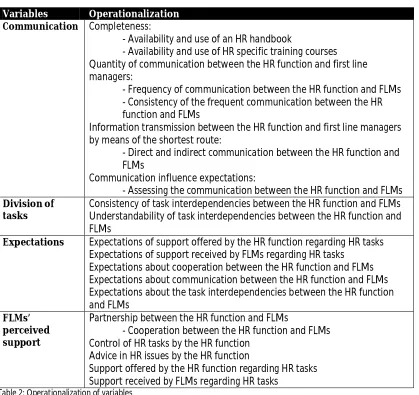
The items used to measure the unit of analysis are incorporated in table 2.
Variables Operationalization
Communication Completeness:
- Availability and use of an HR handbook
- Availability and use of HR specific training courses Quantity of communication between the HR function and first line managers:
- Frequency of communication between the HR function and FLMs - Consistency of the frequent communication between the HR function and FLMs
Information transmission between the HR function and first line managers by means of the shortest route:
- Direct and indirect communication between the HR function and FLMs
Communication influence expectations:
- Assessing the communication between the HR function and FLMs Division of
tasks Consistency of task interdependencies between the HR function and FLMs Understandability of task interdependencies between the HR function and FLMs
Expectations Expectations of support offered by the HR function regarding HR tasks Expectations of support received by FLMs regarding HR tasks
Expectations about cooperation between the HR function and FLMs Expectations about communication between the HR function and FLMs Expectations about the task interdependencies between the HR function and FLMs
FLMs’ perceived support
Partnership between the HR function and FLMs
- Cooperation between the HR function and FLMs Control of HR tasks by the HR function
Advice in HR issues by the HR function
[image:25.612.96.515.312.707.2]Support offered by the HR function regarding HR tasks Support received by FLMs regarding HR tasks
The operationalization of the research items contributes to the validity and the reliability of the research, because it makes it possible to measure the selected variables based on the literature review. The use of an interview protocol was most suitable to find a valid answer to the research question which stimulates the internal validity of the research (Babbie, 2007).
First, in advance, the researcher gives assumptions of the factors that might determine the perceived lack of support by first line managers like the communication and the division of tasks. However, it might be possible that the researcher did not include all the factors that determine the perceived support by first line managers in advance. By the use of an interview protocol, interviewees are able to discuss other factors of which the researcher did not reflected on in the first place.
Second, compared to the use of a survey, an interview protocol makes it able to clarify questions if it is interpreted incorrectly by the participants and to clarify indistinctly answers by keep on asking. Besides this, the outcomes of the interviews can be ascribed to the participants, because the researcher had direct, face-to-face contact with them.
The researcher related the interview protocol with the operationalization of the research which makes it able to work systematically. The questions and subjects were determined in advance which contributes to answering the sub questions and by that to answering the research question. Besides this, the analysis of the interviews is also based on the operationalization of the research. Because of the systematically of the research through the use of the operationalization for the interview protocol, the analysis and the results, the reliability of the research will increase (Babbie, 2007).
4.3.2 Measures
To collect data for the qualitative research, an interview protocol and a document analysis of function profiles is used.
Interview protocol
The interview protocols of the HR director, the director of the Shared Service Center, HR consultants and first line managers are incorporated in appendix 4.
Communication
The communication was measured by asking questions about the way the HR director, the director of the Shared Service Center, HR consultants and first line managers communicate with each other. The completeness of the communication was examined by asking the interviewee about the availability and usefulness of an HR handbook and specific HR training courses. Besides this, the quantity of the communication was measured by asking whether the interviewee had frequently and consistent consultations with the HR parties involved.
The influence of the information transmission by means of the shortest route was measured by asking questions about the influence of direct and indirect communication. The question: ’How do you communicate your support to first line managers’ provided an answer to this (Ulrich and
communication could influence the expectations about supporting first line managers in the implementation of HR practices.
Division of tasks
To measure the consistency of task interdependencies, the questions: ‘Is the division of tasks consistent? why/why not?’ were asked. The understandability of the tasks interdependencies were measured by asking if the interviewee understands the division of tasks and why the division of tasks is understandable or not. This provided answers about the possible vagueness of the division of tasks. The task interdependencies between all the different HR parties were taken into consideration.
Expectations
The expectations were reviewed by asking questions about the expectations of the different parties concerning offering support to first line managers and receiving support from the HR function. The expectations on both sides were questioned. For instance, the questions: ‘What do you expect of first line managers at appraisal conversations?, what does the first line manager expects at appraisal conversations of you?’ were included. The expectations about offered and received support regarding job evaluation conversations, appraisal conversations, recruitment, selection, staff absence, employee career development, leadership, personal development and taking difficult decision were discussed. These presentations of questions were also used at the questions about the expectations regarding the cooperation and communication between the different HR parties and the task interdependencies of the different HR parties in order to find similarities or differences whereby conclusions could be drawn concerning the perceived lack of support by first line managers.
First line managers’ perceived support
The support factor was assessed by using questions about the support the HR director, the director of the Shared Service Center and the HR consultants offer to first line managers in the
implementation of HR activities and the perceived received support experienced by first line managers.
The general question: ‘how do you support first line managers’ gave the possibility for the HR function to answer the question about the offering of support without a certain target. Moreover, the general question: ‘how does the HR director support you?’ provides an answer about the perceived received support by first line managers without a certain target.
The support regarding job evaluation conversations, appraisal conversations, recruitment, selection, staff absence and employee career development were discussed separately to measure both the support offered by the HR function and the perceived support by first line managers. Besides this, the interview protocol included questions about the offered and perceived support regarding leadership, personal development and taking difficult decisions by first line managers. The way of giving and receiving feedback could also be a kind of support experienced by first line managers and were also asked during the interviews.
the different parties and literally asking the interviewee if he/she experiences a partnership with the HR function or the first line managers.
At the end of the interviews, the interviewees were asked to give recommendations about improving the received support by the HR function to first line managers. The answers might be possible recommendations to Strukton Worksphere that could be included in the research.
Function profiles
The function profiles are used to collect data of the contents of the HR tasks of the participants in order to find out if the contents of the HR activities were clearly described in advance. This improved the understandability of the division of tasks between the different HR parties. The function profiles consisted of descriptions about the position of the function in the organization, the aim of the function, the activities and the function characteristics. So, the document analysis of function profiles is supportive to the outcomes of the interviews regarding the division of tasks.
4.4 Analysis
5. Results
In this chapter I will describe the results of the interviews with the HR director, the director of the Shared Service Center, HR consultants and first line managers of Strukton Worksphere. Per factor, I discuss the factor within the HR function and between the HR function and first line managers. However, the results of the expectations will be presented by describing the results of the HR
director, the director of the Shared Service Center, HR consultants and first line managers separately.
The citations will be presented in Dutch in order to maintain the expressions of the participants. The English translations of the citations are incorporated in appendix 5. Each citation has a number which correspond to the number in the appendix.
5.1 Results interviews
5.1.1 Communication
This paragraph will describe the results regarding the completeness and quantity of the
communication, the information transmission and the assessing of the communication within the HR function and between the HR function and first line managers.
Communication within the HR function
Completeness
The HR director, the director of the Shared Service Center and the HR consultants are informed about the availability of the HR handbook, which is published on the Intranet of the organization and is administered by the Shared Service Center. However, they do not know whether first line
managers use the HR handbook frequently. HR specific training courses are also available, but the need for training courses of the first line managers is not expressed. According to the HR consultants, first line managers should ask for HR specific training courses if they need them.
HR consultant: ‘het is aan hun (first line managers) om aan te geven; hé ik heb voldoende bagage of niet’. (1)
Each year, a training plan is drawn up by the HR consultants in which first line managers can announce their needs for HR specific training courses.
Quantity
Information transmission
To shortening the information transmission within the HR function, working parties are organized. A working party is specified in an HR area and consists of mainly three persons. For example, for improving the reward system, a working party is established which consists of the HR director, an HR consultant and the director of the Shared Service Center. They organize several consultations. If they have reached a decision, the outcomes will be discussed in the central HR conversation to inform the HR function.
Assessing the communication
The HR director, the director of the Shared Service Center and the HR consultants assess the communication within the HR function to be efficient. Both, the Shared Service Center and the HR consultants do not need structured communication with each other.
Communication between HR function and first line managers
Completeness
First line managers are informed about the availability of an HR handbook. However, three of nine first line managers never used the HR handbook on the Intranet. Six of nine first line managers are not informed about the availability and use of HR specific training courses. They experience this as an hindrance, because they do not exactly know what is expected of them and what their capabilities should be to be able to perform their HR responsibilities.
The answer of a first line manager to the question whether specific HR training courses are offered: ‘Nee, je moet alles zelf aangeven. Ik zou liever willen zien dat vanuit HRM een aantal trainingen aangeboden worden…, dan heb je ook daadwerkelijk de training dat vanuit HRM gedacht wordt; die heb je nodig, dit heeft een teamleider nodig’. (2)
Today, by experience, first line managers learned how to implement HR practices. However, according to first line managers, R consultants should offer HR specific training courses which are connected to the competences first line managers should have.
Quantity
The HR director and first line managers have no direct communication with each other. Besides this, the communication with the Shared Service Center is unstructured. First line managers contact the Shared Service Center by phone if they have administrative questions.
The communication between HR consultants and first line managers differs. The differences are based on the working method of the HR consultants. One HR consultant has structured face-to-face contact with his/her first line managers, whereas the other HR consultants have no structured contact and contact the first line managers mainly by phone or e-mail if it is necessary.
The answer of an HR consultant to the question how the communication with his/her first line managers looks like: ‘Ongestructureerd, ad hoc, naar aanleiding van concrete aanleidingen’. (3)
Often, if they call their HR consultant, the HR consultant has no time for conversations. Those first line managers expect structured communication. Three of nine first line managers mentioned that the communication is mainly based on what happens in the business, but they would also like to experience a more personal approach by the use of informal communication.
First line manager: ‘ik zou wel meer overleg willen hebben, al zou het alleen maar eens een keer informeel zijn’. (4)
So, structured communications as well as frequent communications are demanded by first line managers.
Information transmission
The information transmission between the Shared Service Center and first line managers goes by means of the HR consultant. However, six of nine first line managers find the communication
structures within the HR function vague or have no opinion about it. First line managers have contact with their HR consultant, but they have no idea if and how the HR director, the Shared Service Center and the HR