Study of Tribological Characteristics of Titanium
Dioxide Coating on Aluminum 7075
Sunilakumar Biradar
Assistant Professor, Department of mechanical Engineering, B.L.D.E.A’S College of Engineering & Technology, Vijayapur 586103
Abstract: Aluminum 7075 and its alloys are finding enormous applications in the field of automotive engineering for manufacturing of piston & its components, rivets in aircrafts construction, electrical cables, marine fittings and heavy vehicle components. During working the parts fabricated using Aluminum 7075 made contact with other surfaces usually in wear due to friction and reduction of life. To enhance the life of this parts their mechanical and wear properties must be improved it can be done by coating these surfaces or by reinforcing the metal with composites. But many times only the surface is undergoing wear and only the surface properties need to be enhanced. In such case reinforcing by composites become costly, coating the surface with a metal or its oxide is another popular way of improving the material properties. In this paper titanium dioxide is coated on Aluminum7075 with 110µm thickness is tested in Pin on disc machine for testing in dry condition and different test parameters are studied based on the experimental results conclusions are arrived.
Keywords: Coating, titanium dioxide, wear, Pin on disc machine.
I. INTRODUCTION
In modern day scenario Aluminum (Al7075) and its alloys are finding enormous applications in the field of automobile engineering, marine engineering, rivets in aircrafts construction and food packing industries. During working, the parts fabricated using these metals inevitably make contact with other metal surfaces resulting in wear and reduction of life.
In order to improve the life of these parts, their mechanical properties and wear properties should be improved. This can be done by reinforcing the metal parts with metal composites or by coating these surfaces with other hard substances. In the above two methods, surface coating method is a popular way of improving tribological properties.
Aluminum7075 isused in many industries like automobile, textile, aero space etc because of its light weight. To make these alloys of aluminum7075 further versatile and flexible for varieties of application, during which these materials are expected to behave as expected and provide a long life under different environments.
Coatings are applied to provide better service and better quality
The major concern in all these applications is the friction in turn wear of the metal parts . In the case of Aluminum7075 wear is slightly higher because it is a soft metal. So a method has to be adopted to minimize the wear of the aluminum to the possible extent in working conditions, by which its life should be increased
A. Properties of Aluminum 7075
Aluminum7075 alloy, with magnesium and silicon as the alloying elements. It has generally good mechanical properties and is heat treatable and weld able. It is one of the most common alloys of aluminum for general purpose use.
1) Aluminum7075 Composition: 7075 aluminum alloy's composition roughly includes 5.6–6.1% zinc, 2.1–2.5% magnesium, 1.2– 1.6% copper, and less than a half percent of silicon, iron, manganese, titanium, chromium, and other metals
a) Typical Properties of Aluminum Alloy i) Medium to high strength
ii) Good toughness
iii) Good surface finish
iv) Excellent corrosion resistance to atmospheric conditions
v) Good corrosion resistance to sea water
vi) Can be anodized
vii) Good weld ability and brazability
b) Physical Properties i) Density: 2.8 g/cm3
ii) Melting Point: Approx 580°C
iii) Modulus of Elasticity: 70-80 GPa
iv) Poisson Ratio: 0.33
c) Thermal Properties
i) Co-Efficient of Thermal Expansion (20-100°C): 23.5x10⁻⁶ m/m.°C
ii) Thermal Conductivity: 173 W/mk
d) Applications
i) Aluminum7075 is widely used for construction of aircraft structures, such as wings and fuselages, more commonly in homebuilt aircraft than commercial or military aircraft.
ii) Aluminum7075 is used for yacht construction, including small utility boats.
iii) Aluminum7075 is commonly used in the construction of Bicycle Frames and components. The Cycling industry also uses 7005 and 7075 aluminum alloys.
2) Coating: A coating in its true verbal sense is a covering that is applied to the surface of any object, usually known as the base or substrate in general. In many cases that we deal with, coatings are applied to improve surface properties such as appearance, corrosion and wear resistance, and also scratch resistance. Some new coatings that are being formulated these days are using nanotechnology to create surface protection. Also many products that are used in construction of buildings are essentially coming in the form of coated products like color bound steels. In many other cases the substrate that is being used is generally a wafer on which coating is applied. Here in these cases the coating forms an essential part of the finished product.
3) Titanium Dioxide (TiO2): Titanium dioxide (Tio2) is a white solid inorganic substance that is thermally stable, non-flammable,
poorly soluble, and not classified as hazardous according to the United Nations’ (UN) Globally Harmonized System of Classification and Labeling of Chemicals (GHS). Tio2 is the oxide of Titanium occurs naturally in several kinds of rock and mineral sands and ores such as rutile and lumenite. Titanium is as strong as steel but 45% lighter. It is corrosive resistant and do not react with other metals. Its melting point is around 3000 F, which makes it able to bear high treat environments
II. LITERATURE SURVEY
A. Wear
In materials science, wear is the erosion of material from a solid surface by the action of another solid. The study of the processes of wear is part of the discipline of tribological.
B. Adhesive Wear
The definition of wear does not include loss of dimension from plastic deformation, although wear has occurred despite no material removal. This definition also fails to include impact wear, where there is no sliding motion, cavitations, where the counter body is a fluid, and corrosion, where the damage is due to chemical rather than mechanical action.
Wear can also be defined as a process in which interaction of the surfaces or bounding faces of a solid with its working environment results in dimensional loss of the solid, with or without loss of material. Aspects of the working environment which affect wear include loads (such as unidirectional sliding, reciprocating, rolling, and impact loads), speed, temperature, type of counter body (solid, liquid, or gas), and type of contact (single phase or multiphase, in which the phases involved can be liquid plus solid particles plus gas bubbles).
In the results of standard wear tests the loss of material during wear is expressed in terms of volume. The volume loss gives a truer picture than weight loss, particularly when comparing the wear resistance properties of materials with large differences in density. For example, a weight loss of 14 g in a sample of tungsten carbide + cobalt (density = 14000 kg/m³) and a weight loss of 2.7 g in a similar sample of aluminum alloy (density = 2700 kg/m³) both result in the same level of wear (1 cm³) when expressed as a volume loss.
1) Primary or early stage or run-in period, where rate of change can be high.
2) Secondary or mid-age process where a steady rate of aging process is maintained. Most of the useful or working life of the component is comprised in this stage.
3) Tertiary or old-age stage, where a high rate of aging leads to rapid failure.
With increasing severity of environmental conditions such as higher temperatures, strain rates, stress and sliding velocities, the secondary stage is shortened and the primary stage tends to merge with the tertiary stage, thus drastically reducing the working life. Surface engineering processes are used to minimize wear and extend working life of material.
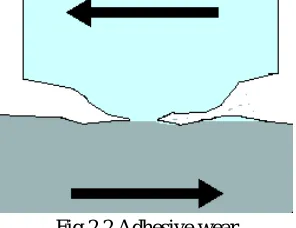
Adhesion is the phenomenon resulting in of attractive forces between two surfaces in close contact. Interfacial adhesion may be due to ionic, covalent, metallic, hydrogen and Vander Wall’s bonds. Adhesive bonding is favored by plastic deformation and cleanliness.
Adhesive wear is also known as scoring, galling, or seizing. It occurs when two solid surfaces slide over one another under pressure. Surface projections, or asperities, are plastically deformed and eventually welded together by the high local pressure, temperature and velocity. As sliding continues, these bonds are broken, producing cavities on the surface, projections on the second surface, and frequently tiny, abrasive particles, all of which contribute to future wear of surfaces and thus increasing the co-efficient of wear.
[image:3.612.233.381.266.380.2]Fig 2.2 Adhesive wear
A study is conducted to evaluate the tribological properties like wear. To enhance the tribological properties of aluminum, it was decided to apply titanium dioxide coating on aluminum 7075 by plasma spray coating and study its wear behavior by conducting pin on disc wear test.
III. METHODOLOGY
Measurement of wear rate using Pin on disc wear tester.Pin on disc wear testing machine with digital indicator, digital weighing balance. Materials Used Acetone, Cotton etc
A. Procedure
1) Clean the surface of the disc and specimen by acetone.
2) Fix the specimen (Pin) on the horizontal measure the track radius by a scale.
3) Set the time to zero.
4) Switch on the motor and fix the speed of disc (RPM) by digital tachometer.
5) Adjust the displacement sensor to read zero.
6) For every five minutes note down the following readings.
7) a) Wear in microns. b) Frictional Force. c) Temperature.
8) Repeat the above procedure on the other specimen for a given period at constant sliding velocity and increasing load.
Fig 3.2 Pin on disc controls
In the above experimental set up pin size is varied from 3 to 12 mm ,disc size 120mm , wear track radius 20mm to 60 mm sliding speed range 26m/s to 6 m/s and also wear measurement range 4mm digital readout
IV. RESULTS AND DISCUSION
A. Measurement Of Wear Rate Using Pin On Disc Wear Tester
(For constant speed, track radius and varying load) Track radius : 50mm
Load : 10-50N
Load in Newton Initial weight in gms Final weight in gms Weight loss
10 9.0810 9.0674 0.0136
20 8.1335 8.1185 0.015
30 8.8825 8.8652 0.0173
40 9.0200 8.9996 0.0204
50 9.0543 9.0140 0.0403
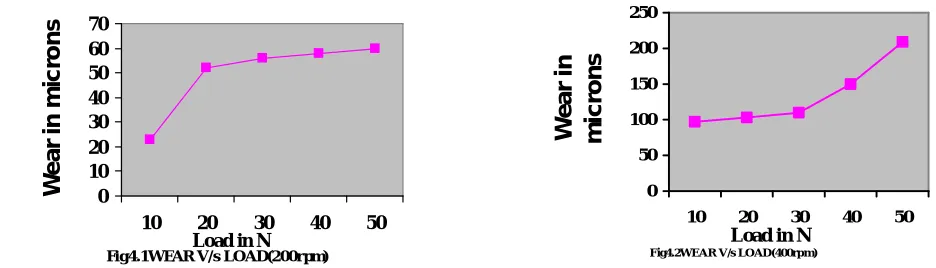
The initial weight includes the titanium dioxide which is coated on base metal with thickness of 110µm and the difference in final weight will gives weight loss in grams. The above table shows that as the load increases weight loss is also increases
B. Graphs
Fig4.2WEAR V/s LOAD(400rpm) 0
50 100 150 200 250
10 20 30 40 50
Load in N
W
e
a
r
in
m
ic
ro
n
s
Fig4.1WEAR V/s LOAD(200rpm) 0
10 20 30 40 50 60 70
10 20 30 40 50
Load in N
W
e
a
r
in
m
ic
ro
n
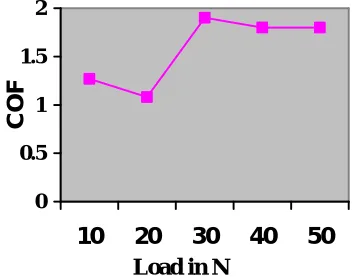
Fig 4.3:COF V/S LOAD( 200rpm)
0 0.5 1 1.5 2
10
20
30
40
50
Load in N
C
O
F
Fig 4.4:COF V/S LOAD( 400rpm)
0 0.5 1 1.5 2
10
20
30
40
50
Load in N
C
O
F
V. CONCLUSIONS
Based on the tests carried out to study the effect on wear, Aluminium 7075 as explained in the previous chapter and within the scope of this investigation the following conclusion have been drawn. in on disc wear test:
A. Increase in speed of the disc wear rate of uncoated specimen increases. Where as coated specimen decreases
B. By increasing the load on the specimen wear rate increases. of uncoated specimen increases whereas coated specimen decreases.
VI. SCOPE FOR FUTURE WORK
In future, some more experiments can be conducted on Al7075 1. SEM (Scanning Electro Microscope) study of surface texture.
2. Vickers micro hardness can be done to compare hardness between coated and uncoated specimens.
3. In order to increase the life of the component reinforcement is necessary i.e surface coating by different coating methods.
REFERENCES
[1] Prof. Ph.D.VirgilGeaman, Lecturer Ph.D. MihaiAlinPop,Assoc. Prof. Ph.D. Dana Luca Moto, Prof. Ph.DIrinelRadomir, “tribological properties of thermal spray coatings”,European Scientific Journal December 2013 /SPECIAL/ edition vol.3 ISSN: 1857 – 7881
[2] M.Murali, M.Sambathkumar, M.S.SenthilSaravanan, “Micro Structural and Mechanical Properties of AA 7075/Tio2 In Situ Composites”,Universal Journal of Materials Science 2(3): 49-53, 2014
[3] Takayoshi Fujino and TeppeiMatzuda,” Synthetic Process of Titanium Dioxide Coating on Aluminum by Chemical Conversion Method”,Materials Transactions, Vol. 47, No. 3 (2006) pp. 849 to 853
[4] A.J.Clegg and A.A.Das, department of engineering production, university of technology, Wear of a hyper eutectic aluminum silicon alloy, pp:367-373 [5] Davis J.R., Aluminum and aluminum alloys J.R.Davis and associates ,ASM international. Hand book committee, pp: 3-8., Cu alloys Vol-429(2007), pp:
[image:5.612.324.500.95.234.2]