Review on Concurrent Image Retrieval
Miss. Pallavee Pol1, Mrs. Manasi Dixit2
1, 2
Department of Electronics Engineering, KIT’s College of Engineering, Kolhapur
Abstract: Organization of large volume of image data has become most important need the era due to variety of applications involving digital imagery. Automated image annotations and contributions by various authors for image retrieval techniques are discussed in this paper. We address some of key challenges in image retrieval in automated image annotations. Techniques of the real world image data handling for image retrieval is main focus of this paper.
Keywords: Image retrieval, texture based image retrieval, shape, color, descriptor based image retrieval.
I. INTRODUCTION
There is large demand of image search on the basis of entire image or partial image information. These demands can be handled by retrieval systems with automatic annotation methods. Mostly images are associated with text information and hence common retrieval systems make use of Text-Based Image Retrieval (TBIR) systems. In these techniques images are automatically or manually annotated for the information associated with them using text information. A query string is first taken which is processed to find similar text information first and then associated images are taken into consideration for retrieval procedure based on text matching score. This creates ambiguity such that, sometimes controversial information associated for particular images irrespective of content information. In Google image based search is one of the TBIR system examples. The text was matching less time consuming for computations. The information match solely depends on image content descriptions available in database which may vary compared to actual visual contents of the images. This result of TBIR ends up with irrelevant image retrieval results. Retrieval on the basis of annotation text information requires maintaining such information in the database. On considerations of these disadvantages of such TBIR systems, Content-Based Image Retrieval systems (CBIR) were developed which is more intuitive and user-friendly. Features of image such as texture, shape, spatial locations and descriptors, color are used in a CBIR system. This type of information matching is done on the basis of query, which contains image visual information contents. Some of the representative CBIR systems are Photobook [18], Virage [17], and SIMILI city [14] etc. One of the categories of CBIR system is Region-Based Image Retrieval systems (RBIR). This system utilizes features extracted from region or part of the image to represent images in the database. RBIR systems can further be classified into System Designated Region of interest (SDR) approaches and User Designated Region of interest (UDR) approaches. In SDR approaches [11,15,16] system automatically specify region of interest (ROI) by dividing the image into significant regions and designate each of these regions as ROI's for querying to the database whereas UDR methods [10,15] facilitate the user to manually select ROI's in the image for query formulation. Success of SDR methods relies heavily on the accuracy of segmentation technique used to divide images into regions. However, segmentation of images is not always reliable as it can introduce unexpected noise in the output and result in reduction of retrieval accuracy. Region of interest or object in an image along with its surroundings is responsible for the nature of the information that distinguishes images from one another. Image partitioning or segmentation into meaningful regions is the primary step in image information estimation. The identification of segments on the basis of their internal relativity and characteristics is the next step of this system. The interleaving top-down and bottom-up processes seem to be an incompatible. The first argument to support this approach relies on recent research conducted in neurobiology and psychophysics. The hypothesis about symbiotic relations between high-level cognitive vision and the low-level visual processing is supported by exploration of interactions of various cortical visual processing pathways in human and animal visual systems, e.g. [12].
II. FEATURESEXTRACTION
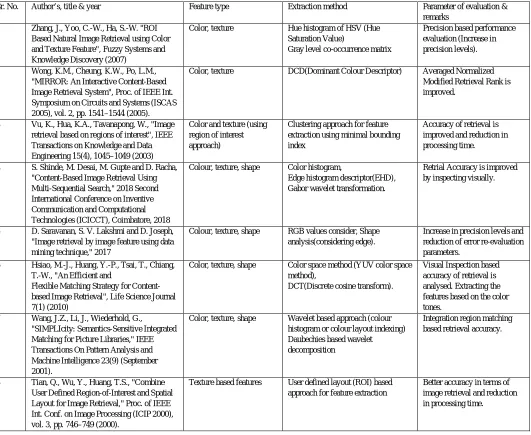
error parameter. Browsing and retrieval is done using color and histogram based descriptors along with texture and spatial descriptors. Generalized Gaussian distributions based wavelet coefficients are used as texture features [7]. The system which is exclusive as it takes into consideration one particular feature at one step and uses the result of the above prior step as the input. This is done for the next step instead of fusing all the features at one step and thus providing an edge over the earlier used methods and also showing improvement in the retrieval quality. In the system, the accuracy of color histogram-based matching can be increased by using Color Coherence Vector. The approximation of the boundary is considered thereby ignoring the exact shape in order to enhance the speed of shape-based matching [1]. The technique, content-based retrieval used for retrieve the images which are most similar to the input image. Here researchers have taken the texture, color, and shape of the image and stored in the database. When the user asks the query, then it will be matched with the database and retrieve the image. It retrieves the exact image by comparing the texture, color, and shape [3]. The color images are indexed using the features extracted from Error Diffusion Block Truncation Coding (EDBTC). A framework of CBIR with unsupervised clustering is used here in which the amount of time required for comparing the target and query image is significantly reduced [2].Table I: provides brief overview of varieties of techniques developed by various authors.
TABLE I
Study of various techniques of feature extraction and performance evaluation strategies
Sr. No. Author’s, title & year Feature type Extraction method Parameter of evaluation &
remarks
1 Zhang, J., Yoo, C.-W., Ha, S.-W. "ROI
Based Natural Image Retrieval using Color and Texture Feature", Fuzzy Systems and Knowledge Discovery (2007)
Color, texture Hue histogram of HSV (Hue
Saturation Value)
Gray level co-occurrence matrix
Precision based performance evaluation (Increase in precision levels).
2 Wong, K.M., Cheung, K.W., Po, L.M.,
"MIRROR: An Interactive Content-Based Image Retrieval System", Proc. of IEEE Int. Symposium on Circuits and Systems (ISCAS 2005), vol. 2, pp. 1541–1544 (2005).
Color, texture DCD(Dominant Colour Descriptor) Averaged Normalized
Modified Retrieval Rank is improved.
3 Vu, K., Hua, K.A., Tavanapong, W., "Image
retrieval based on regions of interest", IEEE Transactions on Knowledge and Data Engineering 15(4), 1045–1049 (2003)
Color and texture (using region of interest approach)
Clustering approach for feature extraction using minimal bounding index
Accuracy of retrieval is improved and reduction in processing time.
4 S. Shinde, M. Desai, M. Gupte and D. Racha,
"Content-Based Image Retrieval Using Multi-Sequential Search," 2018 Second International Conference on Inventive Communication and Computational Technologies (ICICCT), Coimbatore, 2018
Colour, texture, shape Color histogram,
Edge histogram descriptor(EHD), Gabor wavelet transformation.
Retrial Accuracy is improved by inspecting visually.
5 D. Saravanan, S. V. Lakshmi and D. Joseph,
"Image retrieval by image feature using data mining technique," 2017
Colour, texture, shape RGB values consider, Shape
analysis(considering edge).
Increase in precision levels and reduction of error re-evaluation parameters.
6 Hsiao, M.-J., Huang, Y.-P., Tsai, T., Chiang,
T.-W., "An Efficient and
Flexible Matching Strategy for Content-based Image Retrieval", Life Science Journal 7(1) (2010)
Color, texture, shape Color space method (YUV color space
method),
DCT(Discrete cosine transform).
Visual Inspection based accuracy of retrieval is analysed. Extracting the features based on the color tones.
7 Wang, J.Z., Li, J., Wiederhold, G.,
"SIMPLIcity: Semantics-Sensitive Integrated Matching for Picture Libraries," IEEE Transactions On Pattern Analysis and Machine Intelligence 23(9) (September 2001).
Color, texture, shape Wavelet based approach (colour
histogram or colour layout indexing) Daubechies based wavelet
decomposition
Integration region matching based retrieval accuracy.
8 Tian, Q., Wu, Y., Huang, T.S., "Combine
User Defined Region-of-Interest and Spatial Layout for Image Retrieval," Proc. of IEEE Int. Conf. on Image Processing (ICIP 2000), vol. 3, pp. 746–749 (2000).
Texture based features User defined layout (ROI) based
approach for feature extraction
9 Zhang, D., Islam, M.M., Lu, G., Hou, J., "Semantic Image Retrieval Using Region-Based Inverted File", Proceedings of Digital Image Computing: Techniques and Applications, pp. 242–249 (2009)
Color, texture Dominant color descriptor,
Gabor texture features, Vector quantization, Bayesian annotation method.
Single instance learning based classification reduces process time & increases accuracy.
10 Prasad, B.G., Biswas, K.K., Gupta, S.K.,
"Region-Based Image Retrieval using Integrated Color, Shape and Location Index", Computer Vision and Image Understanding, vol. 94, pp. 193–233 (2004).
Color, shape, location index in terms of region (left, right, top, bottom, mid)
Color histogram grid based approach, Anisotropic diffusion,
Color matching with respect to region properties.
Better accuracy of similarity matching area with respect to retrieved and query image.
11 Carson, C., Thomas, M., Belongie, S.,
Hellerstein, J.M., Malik, J., "Blobworld: Image Segmentation Using Expectation-Maximization and Its Application to Image Querying," IEEE Transactions on Pattern Analysis and Machine Intelligence 24(8), 1026–1038 (2002)
Color, texture, position in terms of co-ordinates
Texture descriptors- multi orientation filter banks, moment matrix, Position of pixel of image.
Observed effect of background on detection accuracy which is found optimum and reduction in processing time.
12 S. Devi and A. Mathew, "Fast image retrieval
using error diffusion block truncation coding and unsupervised clustering," 2016
Color histogram features, Bit pattern of histogram features,
Pixel brightness & colour distribution characteristics
Two EDBTC (Error Diffusion Block Truncation Coding) color quantizers, EDBTC bitmap images,
CHF(colour histogram features).
Visual inspection with respect to object relevance which shows better accuracy and reduction in processing time.
13 Shrivastava, N., Tyagi, V.: Content-based
image retrieval based on relative locations of multiple regions of interest using selective regions matching. Inform. Sci. 259, 212–224 (2013).
Relative locations of regions, region selection, texture, shape
User defined region of interest segmentation and feature extraction.
Processing time is reduced and increase in accuracy by visual inspection.
14 Wang, Z., Liu, G., Yang, Y.: A New ROI
Based Image Retrieval System using an auxiliary Gaussian Weighting Scheme. Multimedia Tools Application (2012), doi:10.1007/s11042-012-1059-3
Descriptor features SIFT, Auxiliary Gaussian
Weighting(AGW)
Query verses retrieved image accuracy is better & analysed by visual inspection And processing time is reduced.
15 Yang, L., Geng, B., Cai, Y., Hua, X. S.,
"Object Retrieval Using Visual Query Context", IEEE Transactions on Multimedia (December 2011).
Local visual feature descriptors like SIFT
Difference of Gaussian (DoG) or Harris Affine Detectors SIFT Descriptors
Visual inspection for accuracy with respect to object relevance and found optimum along with reduction in processing time.
16 Chen, T., Chen, L.-H., Ma, K.-K., "Colour
Image Indexing Using SOM for Region-of-Interest Retrieval," Pattern Analysis & Applications 2, 164–171 (1999).
Histogram based approach for colour information indexing
Colour histogram of images to be processed and retrieved based on matching the histogram
Performance based accuracy in retrieval is measured and found improved.
17 Gupta, A., Jain, R., "Visual information
retrieval," Commun. ACM 40(5), 70–79 (1997).
Visual approach along with image storage links which has linked description database for respective image.
Visual information dataset maintaining
Image information retrieval trueness and goodness measure which is optimum.
18 Pentland, A., Picard, R.W., Schroff, S.,
"Photobook: content-based manipulation for image databases," Int. J. Comput. Vision 18(3), 233–254 (1996).
Image compression consideration for preserving content information in case of matching processes.
Concept of photobook or indexing the content information in terms of 3D visual information, texture features, object shapes etc.
Conceptual explanation of evaluation method based on visual inspection and accuracy approaches.
III.APPROACHESTORETRIEVAL
lesser number of feedback iterations required from the user [2]. An object retrieval method that exploits the information about the visual context of the query object. A language modelling approach is employed to devise a contextual object retrieval (COR) model. This model improves the object retrieval performance [6]. Image retrieval system with local or global match with semantically formulated query. The experiments show that this approach provides a generic and efficient solution for image retrieval [7]. A general bag of words image retrieval method, an auxiliary Gaussian weighting (AGW) scheme is incorporated in this ROI based image retrieval system. It is used to compute the score of each image in database [5]. The semantic image retrieval model with text based retrieval using a region based inverted file indexing method. For this images are translated into textual documents which are then indexed and retrieved the same way as the conventional text based search. It is not only providing text based search efficiency, but also better performance than the conventional low level image retrieval [8]. An image region segmentation algorithm using wavelet-based feature extraction and the k-means statistical clustering algorithm have developed in [14]. The Integrated Region Matching (IRM) measure, defined based on a region matching scheme that integrates properties of all the regions in the images, resulting in a simple querying interface. This soft matching is the improved robustness against poor segmentation. The system is also easier to use than other region-based retrieval systems. Color and texture based retrieval of color natural image algorithm using three ROIs was proposed, the first advantage is that clustering algorithm: K-Means method is used to the image retrieval system. It segments image to three parts using K-Means clustering algorithm, and use a simple, speedy method to extract three ROIs from different parts; the second advantage is that it does partial match for retrieving image, this makes the speed and accuracy of the retrieval are improved. The third advantage is the method of computing many-to many relationships distance, query image has three ROIs, database image has three ROIs and all ROIs have two features, this method can compute the best distance between query image and database image. It gives encouraging results when comparing its retrieval performance to texture based retrieval using one ROI algorithm [9].
MPEG-7 Image Retrieval Refinement based On Relevance feedback (MIRROR) is an interactive CBIR system using relevance feedback algorithm with novel similarity measure to increase the usability and retrieval accuracy [10]. Compared to color and texture, Blobworld based image retrieval is precise [13]. The Integrated Region Matching (IRM) measure, defined based on a region matching scheme that integrates properties of all the regions in the images, resulting in a simple querying interface. This soft matching is the improved robustness against poor segmentation. Compared to other retrieval systems this system is easy to use. A novel approach combining user defined Region-of-Interest and spatial layout is shown for CBIR. Better capture of image object is achieved by the user. So, more accurate relevance feedback is achieved and thus leads to a more powerful search engine. the rest of the approach that relies on global features of the image is 'denoted as global approach, our spatial layout approach is denoted as layout approach and user defined ROI combined with the spatial layout is denoted as user defined ROI approach [15]. A neural network is used based on self-organising map (SOM) for the sake of image indexing in content based image retrieval. The indexes generated from the resultant prototypes of SOM learning demonstrate fairly good performance [16]. For the sake of tuning with any user applications Visual Information Retrieval (VIR) system is quiet flexible [17]. In [18] the system, which is a set of interactive tools for browsing and searching images and image sequences. The three types of Photobook descriptions in detail: one that allows search based on appearance, one that uses 2-D shape, and a third that allows search based on textural properties [18].
IV.CONCLUSION
This paper addresses the study of the variety of techniques. The techniques are dependent on expected outcome type. When the region of interest ROI is to be segmented for feature extraction various techniques are application oriented in terms of image types. The feature extraction procedures are still having shortfall to achieve successful matching in terms of accuracy while using conventional classifiers. It is concluded from the above studies that features based on color shape and sizes of the objects are most important for accurate retrieval of images. The segmentation of ROI along with shape-based approach is successful in most of the techniques compared to features such as color and intensity, the matching accuracy based on descriptor details depends upon accurate matching image retrieval.
REFERENCES
[1] S. Shinde, M. Desai, M. Gupte and D. Racha, "Content-Based Image Retrieval Using Multi-Sequential Search," 2018 Second International Conference on Inventive Communication and Computational Technologies (ICICCT), Coimbatore, 2018, pp. 973-978. doi: 10.1109/ICICCT.2018.8473054
[2] D. Saravanan, S. V. Lakshmi and D. Joseph, "Image retrieval by image feature using data mining technique," 2017 International Conference on Inventive Systems and Control (ICISC), Coimbatore, 2017, pp. 1-4. doi: 10.1109/ICISC.2017.8068747
[4] Shrivastava, N., Tyagi, V.: Content-based image retrieval based on relative locations of multiple regions of interest using selective regions matching. Inform. Sci. 259, 212–224 (2013).
[5] Wang, Z., Liu, G., Yang, Y.: A New ROI Based Image Retrieval System using an auxiliary Gaussian Weighting Scheme. Multimedia Tools Application
(2012), doi:10.1007/s11042-012-1059-3.
[6] Yang, L., Geng, B., Cai, Y., Hua, X. S., "Object Retrieval Using Visual Query Context", IEEE Transactions on Multimedia 13(6) (December 2011).
[7] Hsiao, M.-J., Huang, Y.-P., Tsai, T., Chiang, T.-W., "An Efficient and Flexible Matching Strategy for Content-based Image Retrieval", Life Science Journal 7(1) (2010).
[8] Zhang, D., Islam, M.M., Lu, G., Hou, J., "Semantic Image Retrieval Using Region-Based Inverted File", Proceedings of Digital Image Computing: Techniques
and Applications, pp. 242–249 (2009).
[9] Zhang, J., Yoo, C.-W., Ha, S.-W. "ROI Based Natural Image Retrieval using Color and Texture Feature", Fuzzy Systems and Knowledge Discovery (2007).
[10] Wong, K.M., Cheung, K.W., Po, L.M., "MIRROR: An Interactive Content-Based Image Retrieval System", Proc. of IEEE Int. Symposium on Circuits and Systems (ISCAS 2005), vol. 2, pp. 1541–1544 (2005).
[11] Prasad, B.G., Biswas, K.K., Gupta, S.K., "Region-Based Image Retrieval using Integrated Color, Shape and Location Index", Computer Vision and Image Understanding, vol. 94, pp. 193–233 (2004).
[12] Vu, K., Hua, K.A., Tavanapong, W., "Image retrieval based on regions of interest", IEEE Transactions on Knowledge and Data Engineering 15(4), 1045–1049
(2003)
[13] Carson, C., Thomas, M., Belongie, S., Hellerstein, J.M., Malik, J., "Blobworld: Image Segmentation Using Expectation-Maximization and Its Application to
Image Querying," IEEE Transactions on Pattern Analysis and Machine Intelligence 24(8), 1026–1038 (2002).
[14] Wang, J.Z., Li, J., Wiederhold, G., "SIMPLIcity: Semantics-Sensitive Integrated Matching for Picture Libraries," IEEE Transactions On Pattern Analysis and
Machine Intelligence 23(9) (September 2001).
[15] Tian, Q., Wu, Y., Huang, T.S., "Combine User Defined Region-of-Interest and Spatial Layout for Image Retrieval," Proc. of IEEE Int. Conf. on Image Processing (ICIP 2000), vol. 3, pp. 746–749 (2000).
[16] Chen, T., Chen, L.-H., Ma, K.-K., "Colour Image Indexing Using SOM for Region-of-Interest Retrieval," Pattern Analysis & Applications 2, 164–171 (1999).
[17] Gupta, A., Jain, R., "Visual information retrieval," Commun. ACM 40(5), 70–79 (1997).