Original Article
The identification of the key genes and pathways in
septic shock using an integrated bioinformatics analysis
Min Lin1, Wei Lin2, Jianxin Chen2,3
1Electronics and Engineering College, Putian University, Putian 351100, Fujian, P. R. China; 2The First Depart-ment of Gastrointestinal Surgery, The Affiliated Hospital of Putian University, Putian 351100, Fujian, P. R. China; 3Department of Colorectal Surgery, The First Affiliated Hospital of Guangxi Medical University, Nanning 530021, Guangxi, P. R. China
Received July 9, 2019; Accepted September 4, 2019; Epub October 15, 2019; Published October 30, 2019
Abstract: Sepsis is a critical illness with a high mortality rate in intensive care units. Septic shock is a severe, dan-gerous type of sepsis; however, the molecular mechanisms involved in septic shock are largely unclear. The present study integrated three datasets with 210 septic shock and 68 control samples to identify the hub genes involved in septic shock progression. Datasets GSE9692, GSE26378, and GSE26440 were downloaded from the Gene Expres-sion Omnibus (GEO). Using bioinformatics tools such as GEO2R, Gene Ontology (GO) analysis, Kyoto Encyclopedia
of Genes, and Genomes (KEGG) pathway analysis, and a protein-protein interaction (PPI) network analysis, five clusters and ten hub genes were successfully identified. The hub genes, including ITGAM, TLR4, TLR8, TLR2, MMP9, C3AR1, CCL5, FPR2, MPO, and LCK, were mainly enriched in the immune signaling pathway and in the inflammatory response. In summary, the present study identified ten septic shock-related genes using a bioinformatics analysis. The results indicate that the candidate genes may be involved in the regulation of immunity and the inflammatory
response in septic shock and may act as predictors or therapeutic targets for septic shock.
Keywords: Sepsis, gene expression omnibus, differentially expressed genes, immunity, inflammation
Introduction
Sepsis is defined as a life-threatening organ dysfunction, which is often induced by a dys-regulated host response to infection; septic shock is a type of sepsis with serious circulato-ry, cellular, and metabolic dysregulation and is associated with high mortality [1]. Septic shock is particularly dangerous as it is often followed by organ function failure [2, 3]. Despite prog-ress in clinical strategies, severe sepsis still one of the most common causes of death in intensive care units [4, 5].
The high mortality of severe sepsis is due to a dysregulated immune response and inflamma -tion in the pathophysiological process, in which the expression levels of numerous molecules are significantly altered in vivo, contributing to the progression of the disease [6-8]. Gene microarray is a gene detection technique that is suitable for differentially expressed gene (DEG) screening, because it can easily detect gene expression levels at various time points [7].
The present study aimed to obtain gene targets contributing to the diagnosis or therapy of sep-tic shock by screening key disease-related genes and integrating the analyzed microarray datasets. The study was approved by the Committee of the First Affiliated Hospital of Guangxi Medical University (approval no. 2019 KY-E-031).
Materials and methods
Microarray data source
GPL570 Platforms (Affymetrix Human Genome U133 Plus 2.0 Array). The trials were conducted at Cincinnati Children’s Hospital Medical Center (Cincinnati, OH, USA).
Data preprocessing and DEGs screening
In this work, we used GEO2R (Internet site: http://www.ncbi.nlm.nih.gov/geo/geo2r/) to sc- reen DEGs. GEO2R is a web tool often used to screen DEGs in GEO datasets [9]. Following the data collection, GEO2R was applied to identify the DEGs between the septic shock samples and the control samples. The adjusted P-value <0.05 and |log2 [fold change (FC)]|>1 were set as the cut-off criteria.
Gene ontology (GO) and the Kyoto Encyclope-dia of Genes and Genomes (KEGG) pathway analysis of the DEGs
The DEGs of the three datasets were grouped as upregulated and downregulated genes based on the direction of the change. VENNY 2.1.0 software (Internet site: http://bioinfogp.
cnb.csic.es/tools/venny/index.html) was used to select the intersecting upregulated and downregulated genes in the three datasets. The DAVID 6.8 database (Internet site: https:// david.ncifcrf.gov) was used to perform the func-tion annotafunc-tion and pathway analysis. The interacting genes were classified according to the GO and KEGG pathways. Based on the enriched GO terms and significant KEGG path -ways, the functions of the intersecting DEGs were explored. P-value <0.05 and count ≥2 were considered statistically significant.
DEGs protein-protein interaction (PPI) network and module analysis
The intersecting genes were imported into the STRING database 11.0 (Internet site: https// string-db.org) to construct a PPI network, which was subsequently imported into Cytoscape 3.6.0 to create a graphic of the network.
Based on the Plugin Molecular Complex Detection (MCODE) with the following
[image:2.612.92.520.68.367.2]ing parameters: degree cutoff ≥2; K-score ≥6; node score cutoff ≥0.2; and maximum depth = 100, the modules were picked out from the PPI network and then analyzed using DAVID 6.8 database.
Hub genes screening and function analysis
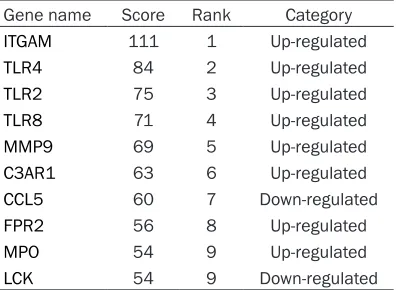
Among the nodes in the PPI network, the top 10 hub genes were identified using the degree algorithm of the CytoHubba plugin. The node degree was ranked by calculating the numbers of inter-connections in the PPI network. These hub genes were then imported into the DAVID
6.8 database to determine their function in septic shock.
Results
Identification of DEGs in septic shock
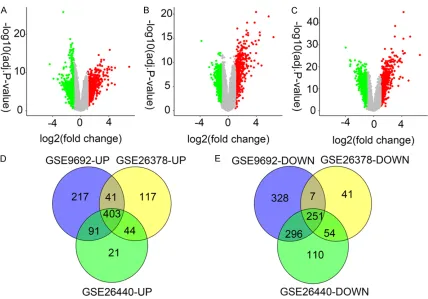
[image:3.612.93.517.84.518.2]The gene expression levels of the three datas-ets were downloaded from the GEO database. Based on the GEO2R analysis, 22,185 DEGs were identified in septic shock compared with the healthy control samples. Based on the cut-off criteria of the adjusted P-value <0.05 and |log2(FC)|>1, 752 upregulated and 882
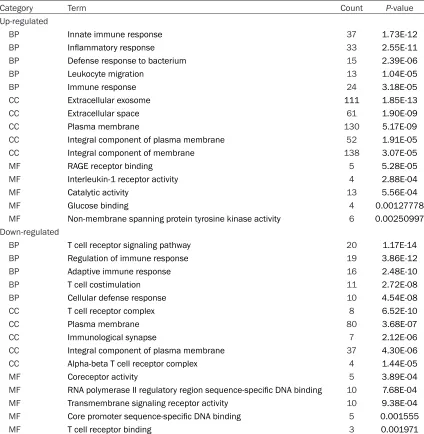
down-Table 1. Top 30 enriched Gene Ontology terms of the differentially expressed genes
Category Term Count P-value
Up-regulated
BP Innate immune response 37 1.73E-12
BP Inflammatory response 33 2.55E-11
BP Defense response to bacterium 15 2.39E-06
BP Leukocyte migration 13 1.04E-05
BP Immune response 24 3.18E-05
CC Extracellular exosome 111 1.85E-13
CC Extracellular space 61 1.90E-09
CC Plasma membrane 130 5.17E-09
CC Integral component of plasma membrane 52 1.91E-05
CC Integral component of membrane 138 3.07E-05
MF RAGE receptor binding 5 5.28E-05
MF Interleukin-1 receptor activity 4 2.88E-04
MF Catalytic activity 13 5.56E-04
MF Glucose binding 4 0.00127778
MF Non-membrane spanning protein tyrosine kinase activity 6 0.00250997
Down-regulated
BP T cell receptor signaling pathway 20 1.17E-14
BP Regulation of immune response 19 3.86E-12
BP Adaptive immune response 16 2.48E-10
BP T cell costimulation 11 2.72E-08
BP Cellular defense response 10 4.54E-08
CC T cell receptor complex 8 6.52E-10
CC Plasma membrane 80 3.68E-07
CC Immunological synapse 7 2.12E-06
CC Integral component of plasma membrane 37 4.30E-06
CC Alpha-beta T cell receptor complex 4 1.44E-05
MF Coreceptor activity 5 3.89E-04
MF RNA polymerase II regulatory region sequence-specific DNA binding 10 7.68E-04
MF Transmembrane signaling receptor activity 10 9.38E-04
MF Core promoter sequence-specific DNA binding 5 0.001555
MF T cell receptor binding 3 0.001971
regulated genes were iden- tified in GSE9692, 605 upregulated and 353 down-regulated genes were identi-fied in GSE26378, and 559 upregulated and 711 down-regulated genes were identi-fied in GSE26440 (Figure 1A-C). Using VENNY 2.1 software, 403 upregulated and 251 downregulated in- tersecting genes among the three datasets were select-ed (Figure 1D, 1E).
GO ontology and KEGG pathway analysis of the DEGs in septic shock
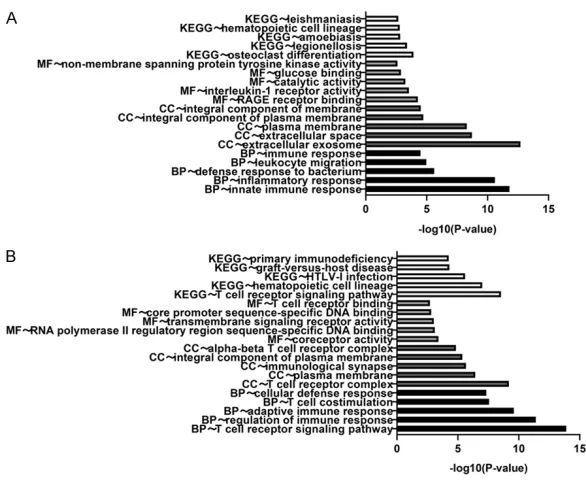
The functional enrichment of the 403 upregulated and 251 downregulated candi-date DEGs were analyzed using the DAVID 6.8 data-base. Biological processes, cellular components, mo- lecular functions and KE- GG pathways were obtained (Tables 1, 2; Figure 2A, 2B). The biological process re- sults revealed that the upregulated DEGs were ma- inly enriched in an ‘innate immune response’, an ‘infla-mmatory response’ and a ‘defense response to bacte-rium’, but the downregulat-ed DEGs were mainly en- riched in the ‘T cell receptor (TCR) signaling pathway’, ‘regulation of the immune response’ and the ‘adaptive immune response’. The cel-lular component results de- monstrated that the upre- gulated DEGs were mainly enriched in ‘extracellular exosomes’, ‘extracellular sp- ace’, and ‘plasma membr- ane’, but the downregulated DEGs were mainly enriched in the ‘T cell receptor com-plex’, ‘plasma membrane’, and ‘immunological
syn-Table 2. Top 20 enriched pathways of the differentially expressed genes
Category Terms Count P-value
Up-regulated
KEGG Osteoclast differentiation 13 1.21E-04
KEGG Legionellosis 8 4.09E-04
KEGG Amoebiasis 10 0.001493
KEGG Hematopoietic cell lineage 9 0.001636
KEGG Leishmaniasis 8 0.002132
KEGG Staphylococcus aureus infection 7 0.002402
KEGG Complement and coagulation cascades 7 0.008141
KEGG Pertussis 7 0.012066
KEGG Tuberculosis 11 0.01507
KEGG Toll-like receptor signaling pathway 8 0.018582
Down-regulated
KEGG T cell receptor signaling pathway 13 2.86E-09
KEGG Hematopoietic cell lineage 11 1.00E-07
KEGG HTLV-I infection 15 2.57E-06
KEGG Graft-versus-host disease 6 4.89E-05
KEGG Primary immunodeficiency 6 5.68E-05
KEGG Viral myocarditis 7 6.98E-05
KEGG Allograft rejection 6 8.64E-05
KEGG Natural killer cell mediated cytotoxicity 9 1.30E-04
KEGG Type I diabetes mellitus 6 1.61E-04
KEGG Measles 9 2.36E-04
[image:4.612.90.384.94.402.2]KEGG: Kyoto Encyclopedia of Genes and Genomes.
Figure 2. Top five GO enrichment analysis and KEGG pathways. A. GO terms
[image:4.612.89.382.431.671.2]apse’. The molecular function analysis revea- led that the upregulated DEGs were mainly enriched in ‘RAGE receptor binding’, ‘interleu-kin-1 receptor activity’, and ‘catalytic activity’, but the downregulated DEGs were mainly enriched in ‘coreceptor activity’. ‘RNA poly-merase II regulatory region sequence-specific DNA binding’, and ‘transmembrane signaling receptor activity’. The KEGG pathway analysis results indicated that the upregulated DEGs were mainly enriched in ‘osteoclast differentia-tion’, ‘legionellosis’, and ‘amoebiasis’, but the downregulated DEGs were mainly enriched in the ‘T cell receptor signaling pathways’,
‘hema-topoietic cell lineage’, and ‘HTLV-1 infection’. These results demonstrated that the majority of the selected DEGs were significantly enriched in the immune and inflammatory responses.
PPI network construction and module analysis
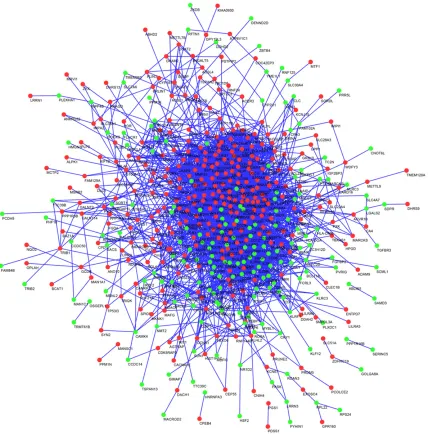
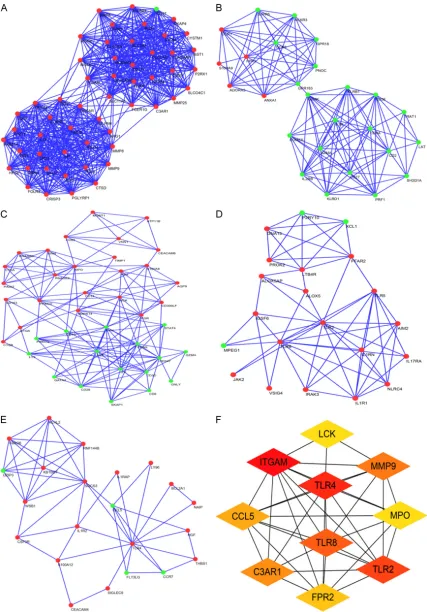
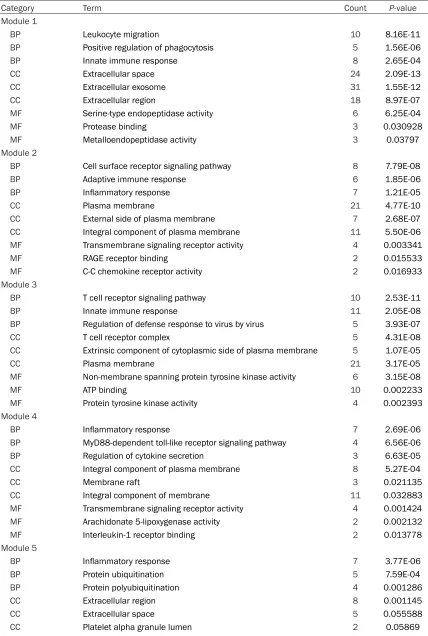
[image:5.612.94.522.72.506.2]The candidate DEGs (n = 654) were analyzed using the STRING 11.0 database and Cytos- cape 3.6.0 software. A total of 511 nodes and 3,289 edges were included in the PPI network (Figure 3). Screened by MCODE, five clusters were obtained (Figure 4A-E). There were 54 nodes and 693 edges in cluster 1, 26 nodes
Table 3. Significantly enriched Gene Ontology terms of the module genes
Category Term Count P-value
Module 1
BP Leukocyte migration 10 8.16E-11
BP Positive regulation of phagocytosis 5 1.56E-06
BP Innate immune response 8 2.65E-04
CC Extracellular space 24 2.09E-13
CC Extracellular exosome 31 1.55E-12
CC Extracellular region 18 8.97E-07
MF Serine-type endopeptidase activity 6 6.25E-04
MF Protease binding 3 0.030928
MF Metalloendopeptidase activity 3 0.03797
Module 2
BP Cell surface receptor signaling pathway 8 7.79E-08
BP Adaptive immune response 6 1.85E-06
BP Inflammatory response 7 1.21E-05
CC Plasma membrane 21 4.77E-10
CC External side of plasma membrane 7 2.68E-07
CC Integral component of plasma membrane 11 5.50E-06
MF Transmembrane signaling receptor activity 4 0.003341
MF RAGE receptor binding 2 0.015533
MF C-C chemokine receptor activity 2 0.016933
Module 3
BP T cell receptor signaling pathway 10 2.53E-11
BP Innate immune response 11 2.05E-08
BP Regulation of defense response to virus by virus 5 3.93E-07
CC T cell receptor complex 5 4.31E-08
CC Extrinsic component of cytoplasmic side of plasma membrane 5 1.07E-05
CC Plasma membrane 21 3.17E-05
MF Non-membrane spanning protein tyrosine kinase activity 6 3.15E-08
MF ATP binding 10 0.002233
MF Protein tyrosine kinase activity 4 0.002393
Module 4
BP Inflammatory response 7 2.69E-06
BP MyD88-dependent toll-like receptor signaling pathway 4 6.56E-06
BP Regulation of cytokine secretion 3 6.63E-05
CC Integral component of plasma membrane 8 5.27E-04
CC Membrane raft 3 0.021135
CC Integral component of membrane 11 0.032883
MF Transmembrane signaling receptor activity 4 0.001424
MF Arachidonate 5-lipoxygenase activity 2 0.002132
MF Interleukin-1 receptor binding 2 0.013778
Module 5
BP Inflammatory response 7 3.77E-06
BP Protein ubiquitination 5 7.59E-04
BP Protein polyubiquitination 4 0.001286
CC Extracellular region 8 0.001145
CC Extracellular space 5 0.055588
and 126 edges in cluster 2, 40 nodes and 156 edges in cluster 3, 21 nodes and 63 edges in cluster 4 and 22 nodes and 52 edges in cluster 5. Gene ontology and KEGG pathways of the DEGs in the five clusters were analyzed; the results revealed that these genes were also mainly enriched in the immune signaling
path-inflammatory response’, and ‘regulation of cyto -kine secretion’. The cellular component results revealed that the top ten genes were mainly enriched in the ‘intrinsic component of plasma membrane’, ‘extracellular space’, and ‘the inte-gral component of the plasma membrane’. The molecular function analysis revealed that the top ten genes were mainly enriched in ‘lipopoly-saccharide receptor activity’, ‘receptor activity’, and ‘lipopolysaccharide binding’. The KEGG pathway analysis results indicated that the top ten genes were mainly enriched in ‘the toll-like receptor signaling pathway’, ‘phagosome’, and ‘staphylococcus aureus infection’. (Table 6;
Figure 5). These results indicated that the top ten genes may serve important roles in the immune and inflammation processes.
Discussion
Over the past several decades, studies have aimed to reveal the underlying mechanisms of
MF Ubiquitin-protein transferase activity 7 1.15E-06
MF Interleukin-1 receptor activity 2 0.007854
MF Protein binding 16 0.015119
[image:8.612.92.378.159.434.2]BP: biological process; CC: cellular component; MF: molecular function.
Table 4. Significantly enriched pathways of the module genes
Category Term Count P-value
Module 1
KEGG Staphylococcus aureus infection 4 6.34E-04
KEGG Sphingolipid signaling pathway 3 0.055555
KEGG Transcriptional misregulation in cancer 3 0.098635
Module 2
KEGG Cytokine-cytokine receptor interaction 5 0.001977
KEGG Natural killer cell mediated cytotoxicity 4 0.002575
KEGG Hematopoietic cell lineage 3 0.016913
Module 3
KEGG T cell receptor signaling pathway 9 1.89E-09
KEGG Chagas disease (American trypanosomiasis) 5 5.71E-04
KEGG Measles 5 0.001435
Module 4
KEGG Legionellosis 3 0.005182
KEGG Toll-like receptor signaling pathway 3 0.018971
KEGG Amoebiasis 3 0.018971
Module 5
KEGG Cytokine-cytokine receptor interaction 5 6.01E-04
KEGG Hematopoietic cell lineage 3 0.009612
KEGG Malaria 2 0.08227
[image:8.612.91.289.483.628.2]KEGG: Kyoto Encyclopedia of Genes and Genomes.
Table 5. Top 10 genes ranked by degree
Gene name Score Rank Category
ITGAM 111 1 Up-regulated
TLR4 84 2 Up-regulated
TLR2 75 3 Up-regulated
TLR8 71 4 Up-regulated
MMP9 69 5 Up-regulated
C3AR1 63 6 Up-regulated
CCL5 60 7 Down-regulated
FPR2 56 8 Up-regulated
MPO 54 9 Up-regulated
LCK 54 9 Down-regulated
way and the inflammatory response (Tables 3, 4).
Hub gene selection and enriched function analysis
septic shock; however, reducing the mortality of sepsis is still difficult [4, 10]. The majority of studies indicated that the high mortality of sep-tic shock was associated with immune dysfunc-tion, particularly due to T cell dysfunction [11, 12]. In addition, excessive inflammation is an
may serve important roles in innate immunity and in the inflammatory response. These find -ings are consistent with previous studies. For example, Pop-Began et al. [14] demonstrated that the toll-like receptor (TLR) family is an important upstream sensor and effector
sys-Table 6. Significantly enriched Gene Ontology terms and pathways of the top 10 genes
Category Term Count P-value Genes
BP Leukocyte migration 5 3.25E-07 C3AR1, MMP9, LCK, FPR2, ITGAM
BP Inflammatory response 6 6.67E-07 C3AR1, TLR2, TLR4, FPR2, CCL5, TLR8
BP Regulation of cytokine secretion 3 1.40E-05 TLR2, TLR4, TLR8
CC Intrinsic component of plasma membrane 2 0.013746 TLR2, TLR4
CC Extracellular space 4 0.024141 MMP9, MPO, CCL5, ITGAM
CC Integral component of plasma membrane 4 0.027505 C3AR1, TLR2, TLR4, FPR2
MF Lipopolysaccharide receptor activity 2 0.002663 TLR2, TLR4
MF Receptor activity 3 0.00558 TLR2, TLR4, TLR8
MF Lipopolysaccharide binding 2 0.011671 TLR2, TLR4
KEGG Toll-like receptor signaling pathway 4 2.79E-04 TLR2, TLR4, CCL5, TLR8
KEGG Phagosome 4 7.75E-04 TLR2, MPO, TLR4, ITGAM
KEGG Staphylococcus aureus infection 3 0.002102 C3AR1, FPR2, ITGAM
BP: biological process; CC: cellular component; MF: molecular function. KEGG: Kyoto Encyclopedia of Genes and Genomes.
Figure 5. Significantly enriched GO terms and KEGG pathways of the top
ten genes. GO, Gene Ontology; KEGG, Kyoto Encyclopedia of Genes and Ge-nome.
important factor that contrib-utes to the mortality of septic shock [13]. However, the ex-act molecular changes in the immune and inflammatory pathways and how they inter-act with each other during sepsis are still unclear. The present study integrated th- ree datasets to analyze data using bioinformatics meth-ods. Through DEG screening, GO terms, the KEGG pathway and PPI network analysis, and the application of CytoHub-ba, ten disease-related hub genes, including ITGAM, TLR4, TLR8, TLR2, MMP9, C3AR1, CCL5, FPR2, MPO, and LCK, were identified, among which CCL5 and LCK were downreg-ulated, but the others were upregulated.
[image:9.612.92.522.84.257.2] [image:9.612.90.376.287.585.2]tem of innate immunity. Chong et al. [15] indi-cated that TLRs linking to pattern recognition receptors form a key step in initiating pro-inflammatory signaling pathways, which con -tribute to the further production of pro-inflam -matory cytokines. The matrix metalloproteinase (MMP) family are a series of proteases that can mediate immunological and neoplastic pro-cesses [16]. MMP-9 is one member of the MMP family and often significantly upregulated in sepsis, which is associated with disease sever-ity [17]. ATGAM is a gene that encodes CD11b, which serves an anti-inflammatory role in leu -kocytes by negatively regulating the TLR signal-ing pathways and B cell autoreactivity [18, 19]. CCL5 is a key modulator of host response that can trigger the upregulation of pro-inflammato -ry cytokines in vivo, leading to an increase of mortality in sepsis [20]. Targeting CCL5 can decrease inflammatory responses, which may become a novel therapeutic method for inflam -matory disease [21].
A limited number of previous studies involved key gene screening in septic shock. Yang et al. screened DEGs from the GSE26440 dataset and identified 10 hub genes including GAPDH, TNF, EGF, MAPK3, IL-1β, IL-10, TLR2, TLR4, PIK3CB, and MAPK14 [22]. The hub genes obtained in their study were partially different from the ones obtained in the present study; however, the majority of the hub genes identi-fied in the previous study were mainly enriched in inflammatory pathways, which was consis -tent with the results of the present study. Liu et al. [23] also used the GSE26440 dataset for a bioinformatics analysis. The top five genes they obtained were KDM6B, HDAC2, MYC, HSP90AB1, and PABPC1. Although their results differed from the present study, the functions of the genes were also mainly enriched in immunity and inflammation. The above authors all used a single dataset for analysis; the pres-ent study integrated three datasets from GEO and screened the intersecting genes, so the findings may be more reliable due to a larger sample size analyzed using the same experi-mental design.
Following the accomplishment of the Human Genome Project, genome analysis has contrib-uted to the understanding of the molecular mechanisms that may influence therapy and disease evaluation and lead to precision medi-cine, which includes determining the molecular characteristics of each patient, the selection of
the best therapeutic method, and the reduction of adverse reactions [24]. Precision medicine is recommended for various conditions, including sepsis. The application of precision medicine requires a clear understanding of the molecular basis of disease progression. Precision medi-cine may serve an important role in subtype classification, risk assessment, and the selec -tion of suitable patients for new therapies [25]. Microarray, high-throughput technologies and other tools have contributed to the insight in the molecular level of disease progression, which may be an important factor in precision medicine.
In summary, using microarray datasets and bio-informatical analysis, ten sepsis-related genes were identified, genes which are involved in the immune signaling pathway and the inflamma -tory response. These findings may improve the understanding of the underlying molecular events in septic shock, and the candidate genes may be diagnostic or therapeutic targets for septic shock.
Conclusion
Using GEO datasets and a bioinformatics analy-sis, ten hub genes were identified to be involved in septic shock. These hub genes are involved in the regulation of immunity and the inflamma -tory response, which suggests that they may be predictors or therapeutic targets for septic shock.
Acknowledgements
The authors would like to thank Hector R. Wong et al. for presenting the datasets. The present study was supported by Fujian Provincial Natural Science Foundation (grant no. 2019J- 01585).
Disclosure of conflict of interest
None.
Address correspondence to: Dr. Jianxin Chen, First
Department of Gastrointestinal Surgery, The Affi-liated Hospital of Putian University, 999 Dongzhen
East Road, Putian 351100, Fujian, P. R. China. E-mail: [email protected]
References
[1] Singer M, Deutschman CS, Seymour CW,
Bernard GR, Chiche JD, Coopersmith CM,
Hotchkiss RS, Levy MM, Marshall JC, Martin
GS, Opal SM, Rubenfeld GD, van der Poll T, Vin-cent JL and Angus DC. The third international
consensus definitions for sepsis and septic
shock (sepsis-3). JAMA 2016; 315: 801-810. [2] Carcillo JA. Pediatric septic shock and multiple
organ failure. Crit Care Clin 2003; 19: 413-440.
[3] Cecconi M, Evans L, Levy M and Rhodes A. Sepsis and septic shock. Lancet 2018; 392: 75-87.
[4] Mayr FB, Yende S and Angus DC. Epidemiology of severe sepsis. Virulence 2014; 5: 4-11. [5] Siontis B, Elmer J, Dannielson R, Brown C, Park
J, Surani S and Ramar K. Multifaceted inter-ventions to decrease mortality in patients with severe sepsis/septic shock-a quality improve-ment project. PeerJ 2015; 3: e1290.
[6] Luo Q, Liu G, Chen G, Guo D, Xu L, Hang M and
Jin M. Apelin protects against sepsisinduced cardiomyopathy by inhibiting the TLR4 and NLRP3 signaling pathways. Int J Mol Med 2018; 42: 1161-1167.
[7] Maslove DM and Wong HR. Gene expression profiling in sepsis: timing, tissue, and transla -tional considerations. Trends Mol Med 2014; 20: 204-213.
[8] Vincent JL. Individual gene expression and per-sonalised medicine in sepsis. Lancet Respir Med 2016; 4: 242-243.
[9] Barrett T, Wilhite SE, Ledoux P, Evangelista C, Kim IF, Tomashevsky M, Marshall KA, Phillippy
KH, Sherman PM, Holko M, Yefanov A, Lee H,
Zhang N, Robertson CL, Serova N, Davis S and Soboleva A. NCBI GEO: archive for functional genomics data sets--update. Nucleic Acids Res 2013; 41: D991-995.
[10] Gobatto AL, Besen BA and Azevedo LC. How
can we estimate sepsis incidence and mortal-ity? Shock 2017; 47: 6-11.
[11] Patil NK, Bohannon JK, Luan L, Guo Y,
Fenster-heim B, Hernandez A, Wang J and Sherwood
ER. Flt3 ligand treatment attenuates T cell dys-function and improves survival in a murine model of burn wound sepsis. Shock 2017; 47: 40-51.
[12] Ramonell KM, Zhang W, Hadley A, Chen CW,
Fay KT, Lyons JD, Klingensmith NJ, McConnell KW, Coopersmith CM and Ford ML. CXCR4 blockade decreases CD4+ T cell exhaustion and improves survival in a murine model of polymicrobial sepsis. PLoS One 2017; 12: e0188882.
[13] van der Poll T, van de Veerdonk FL, Scicluna BP and Netea MG. The immunopathology of sep-sis and potential therapeutic targets. Nat Rev Immunol 2017; 17: 407-420.
[14] Began V, Paunescu V, Grigorean V, Pop-Began D and Popescu C. Molecular mecha-nisms in the pathogenesis of sepsis. J Med Life 2014; 7: 38-41.
[15] Chong DL and Sriskandan S. Pro-inflammatory
mechanisms in sepsis. Contrib Microbiol 2011; 17: 86-107.
[16] Vanlaere I and Libert C. Matrix metalloprotein-ases as drug targets in infections caused by gram-negative bacteria and in septic shock. Clin Microbiol Rev 2009; 22: 224-239. [17] Cuenca AG, Gentile LF, Lopez MC, Ungaro R,
Liu H, Xiao W, Seok J, Mindrinos MN, Ang D,
Baslanti TO, Bihorac A, Efron PA, Cuschieri J,
Warren HS, Tompkins RG, Maier RV, Baker HV
and Moldawer LL. Development of a genomic metric that can be rapidly used to predict clini-cal outcome in severely injured trauma pa-tients. Crit Care Med 2013; 41: 1175-1185. [18] Ding C, Ma Y, Chen X, Liu M, Cai Y, Hu X, Xiang
D, Nath S, Zhang HG, Ye H, Powell D and Yan J.
Integrin CD11b negatively regulates BCR sig-nalling to maintain autoreactive B cell toler-ance. Nat Commun 2013; 4: 2813.
[19] Han C, Jin J, Xu S, Liu H, Li N and Cao X. Integ -rin CD11b negatively regulates TLR-triggered
inflammatory responses by activating Syk and
promoting degradation of MyD88 and TRIF via Cbl-b. Nat Immunol 2010; 11: 734-742. [20] Ness TL, Carpenter KJ, Ewing JL, Gerard CJ, Ho
-gaboam CM and Kunkel SL. CCR1 and CC che-mokine ligand 5 interactions exacerbate in-nate immune responses during sepsis. J Immunol 2004; 173: 6938-6948.
[21] Marques RE, Guabiraba R, Russo RC and
Teix-eira MM. Targeting CCL5 in inflammation. Ex -pert Opin Ther Targets 2013; 17: 1439-1460. [22] Yang J, Zhang S, Zhang J, Dong J, Wu J, Zhang
L, Guo P, Tang S, Zhao Z, Wang H, Zhao Y, Zhang W and Wu F. Identification of key genes
and pathways using bioinformatics analysis in septic shock children. Infect Drug Resist 2018; 11: 1163-1174.
[23] Liu SY, Zhang L, Zhang Y, Zhen Y and Wu YF. Bioinformatic analysis of pivotal genes
associ-ated with septic shock. J Biol Regul Homeost
Agents 2017; 31: 935-941.
[24] Ravegnini G and Angelini S. Toward precision medicine: how far is the goal? Int J Mol Sci 2016; 17: 245.
[25] Atreya MR and Wong HR. Precision medicine in