Enriching the Swedish Sign Language Corpus with Part of Speech Tags
Using Joint Bayesian Word Alignment and Annotation Transfer
Robert ¨Ostling, Carl B¨orstell, Lars Wallin Department of Linguistics
Stockholm University SE-106 91 Stockholm
{robert,calle,wallin}@ling.su.se
Abstract
We have used a novel Bayesian model of joint word alignment and part of speech (PoS) annotation transfer to enrich the Swedish Sign Language Corpus with PoS tags. The annotations were then hand-corrected in order to both improve anno-tation quality for the corpus, and allow the empirical evaluation presented herein.
1 Introduction
While Swedish Sign Language (SSL) is a recog-nized language of Sweden, there are no NLP tools available for it. We used a novel method for part of speech (PoS) annotation transfer to create the first automatically PoS-tagged corpus of any sign language, by exploiting the existing translation of the corpus into written Swedish. We then manu-ally corrected the resulting annotations, in order to provide high-quality data that could be used for e.g. future supervised PoS taggers.
2 Parts of Speech in Sign Languages
In early sign language (SL) linguistics, Su-palla and Newport (1978) observed that consis-tent phonological patterns can distinguish PoS in phonologically and semantically related noun– verb pairs in American SL: nouns more often be-ing restrained and repeated; verbs havbe-ing a con-tinuous articulation. A number of studies have similarly investigated nouns and verbs in a vari-ety of SLs—e.g. Johnston (2001) for Australian SL; Hunger (2006) for Austrian SL; Kimmelman (2009) for Russian SL; and Tkachman and San-dler (2013) for Al-Sayyid Bedouin SL and Israeli SL—finding that e.g. manner, repetition, duration,
size and mouthing1 can differentiate nouns from verbs. However, extensive research of PoS in SLs is generally lacking (Schwager and Zeshan, 2008). Turning to SSL, one study looked at mor-phosyntactic constraints differentiating e.g. verbs and adjectives (Bergman, 1983), and a recent overview of the linguistic structure of SSL lists 8 PoS (Ahlgren and Bergman, 2006)—based mainly on semantic and syntactic criteria identified in pre-vious research—which is the set used in this work. There are currently a number of ongoing SL corpus projects around the world, but few of them have extensive annotations for e.g. grammatical categories. One exception is the Auslan Corpus (Johnston, 2010), which features annotations of “grammatical classes” that to a large extent cor-respond to functional PoS (Johnston, 2014). How-ever, the annotations in all of these SL corpora are done manually, which is rather time-consuming.
3 The Swedish Sign Language Corpus
The Swedish Sign Language Corpus (SSLC) (Mesch et al., 2012; Mesch et al., 2014) contains 25 hrs of partially transcribed, conversational data from 42 different signers of SSL. Its annotations mainly consist of a gloss for each sign (see 4.3), and a translation into written Swedish. The ver-sion used in our evaluations contains 24 976 SSL tokens, not sentence-segmented, and 41 910 Swedish tokens divided into 3 522 sentences.
Segmenting SSL data into sentences or utter-ances is no trivial task (B¨orstell et al., 2014), and there is currently no such segmentation in the SSLC. In order to use sentence-based word align-ment models, we follow Sjons (2013) in using the Swedish sentences as a basis for segmentation.
1
jag
PRO-1 PRON PRON
Target Source
pt
pg
pc
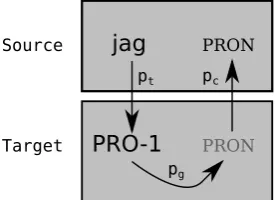
Figure 1: Circular generation model for joint word alignment and part of speech transfer, where Swedishjag‘I’ is aligned to the SSLC glossPRO -1. All variables are observed except the alignment and the target-side PoS tag (in grey).
4 Method
Since SSLC contains translations of each utter-ance into written Swedish, it is in effect a parallel corpus of Swedish and SSL. It has long been rec-ognized that parallel corpora are useful for trans-fering annotation between languages (Yarowsky et al., 2001), and so our goal is to automati-cally transfer part of speech (PoS) tags from the Swedish translations to the SSL glosses. Given the relatively small size of the corpus, and the signif-icant differences between the two languages, the error rate is expected to be high enough to warrant a final stage of manual correction.
4.1 Bayesian word alignment
Most previous research on word alignment has been building on the IBM models Brown et al. (1993) using Expectation-Maximization (EM) for inference. Recently, Bayesian models have been proposed as an alternative, offering a theoretically well-founded way of introducing soft constraints that encourage linguistically plausible solutions (DeNero et al., 2008; Mermer and Sarac¸lar, 2011; Riley and Gildea, 2012; Gal and Blunsom, 2013).
4.2 Alignment and part of speech transfer
Several authors, starting from Brown et al. (1993), have used word classes to aid word alignment in various manners. Toutanova et al. (2002) show that if both parts of a bitext are annotated with PoS tags, alignment accuracy can be improved simply by using a tag translation modelp(tf|te)in
addi-tion to the word translaaddi-tion modelp(f|e).
Given that PoS tags improves the quality of word alignments, and that word alignments can be used to transfer PoS tags from one language to
[image:2.595.112.250.63.163.2]an-other, we use a model that jointly learns PoS tags and word alignment.
Figure 1 illustrates our circular generation model, so termed because a source language to-ken is assumed to generate a target language toto-ken (throughpt(f|e) = θte), which then generates its
corresponding PoS tag (throughpg(tf|f) =θgf),
which finally generates a PoS tag for the source language token (throughpc(te|tf) =θctf).
We assume categorical distributions with Dirichlet priors:
θt∼Dir(αt);θg ∼Dir(αg);θc∼Dir(αc)
These priors are symmetrical, except forαcwhich
is biased towards consistency between the tagsets. In our evaluations, we useαc = 1000for
consis-tent tag pairs,αc= 1for others.
Inference in this model is performed using col-lapsed Gibbs sampling, where the alignment vari-ableaj(which links target tokenfjto source token ei) is sampled jointly with the target PoS tagtfj.
The sampling equation is similar to those used by Mermer and Sarac¸lar (2011) and Gal and Blunsom (2013), with extra factors for the PoS tag depen-dencies. We also use the HMM-based word order model of Vogel et al. (1996), but as this does not directly interact with the PoS tags, we exclude it from Figure 1 for clarity.
From this model we obtain SSL part of speech tags in one of two different ways: directly from the model (thetfj variables), or by direct
projec-tion through the final alignment variablesaj. In
both cases the sampling procedure is identical, the difference lies only in how the final PoS tags are read out.
4.3 Data processing
The first step of processing is to group SSL glosses according to which Swedish sentence they overlap most with. Second, glosses with certain marks are removed:
• Interrupted signs (marked@&). • Gestures (marked@g).
• Incomprehensible signs (transcribed as XXX).
Finally, some marks are simply stripped from glosses, since they are not considered important to the current task.
• Signs performed with the non-dominant hand (marked@nh).
• Signs held with the non-dominant hand dur-ing production of signs with the dominant hand. The gloss of the held sign (following a<>symbol) is removed.
• Signs where the annotator is uncertain about which sign was used (marked @xxx) or whether the correct gloss was chosen (marked@zzz).
In all, this is nearly identical to the procedure used by Sjons (2013, p. 14). Example 1 illustrates the output of the processing, with English glosses and translation added.
(1) STAMMA¨ be.correct
OCKSA˚ also
PRO-1 1
PERF PRF
BARN children BRUKA
usually SE watch
SAGAˆTRAD¨ Sagotr¨adet
PRO>n¨arv
2 ‘I also have children—do you watch Sagotr¨adet?’
The Swedish translations were tokenized and PoS-tagged with Stagger ( ¨Ostling, 2013), trained on the Stockholm-Ume˚a Corpus (SUC) (Ejerhed et al., 1992; K¨allgren, 2006) and the Stockholm Internet Corpus (SIC).2
4.4 Evaluation data
At the outset of the project, two annotators man-ually assigned PoS tags to the 371 most frequent sign glosses in the corpus. This was used for ini-tial annotation transfer evaluations, and when the methods reached a certain level of maturity the remaining gloss types were automatically anno-tated, and the resulting list of 3 466 glosses mually corrected. Thus the initial goal of using an-notation transfer to facilitate the PoS anan-notation was achieved, since all of the currently transcribed SSLC data now has manually verified annotations.
2http://www.ling.su.se/sic
PoS SSLC SUC
Pronoun PN DT, HD, HP, HS, PS, PN
Noun NN NN, PM, UO
Verb VB PC, VB
Adverb AB AB, HA, IE, IN, PL Numeral RG RG, RO
[image:3.595.314.528.62.183.2]Adjective JJ JJ Preposition PP PP Conjunction KN KN, SN
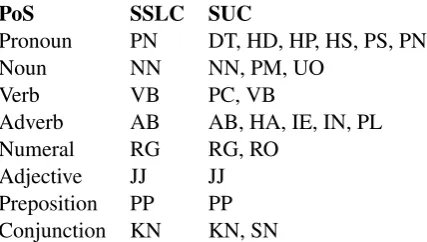
Table 1: PoS tags in the SSLC, and their counter-parts in SUC.
In order to evaluate the performance of the an-notation transfer algorithms, we use this final set of 3 466 annotated types as a gold standard.
4.5 Tag set conversion
As previously mentioned, we use the eight PoS categories suggested by Ahlgren and Bergman (2006) for SSL. The Swedish side is tagged us-ing the SUC tagset, whose core consists of 22 tags (K¨allgren, 2006, p. 20). For direct tag projection and the tag translation priors in the circular gen-eration model, the SUC tags are translated as in Table 1.
4.6 Task-specific constraints
Types Tokens
Project Model Project Model
[image:4.595.119.486.63.158.2]baseline 58.4±0.5% 12.2±0.6% 75.3±0.7% 10.8±3.6% constraints 58.4±0.4% 60.7±0.4% 75.1±0.8% 58.1±1.0% circular 64.7±0.5% 68.3±0.4% 77.4±0.8% 77.6±0.7% circular + bigrams 64.8±0.3% 68.4±0.3% 77.3±0.7% 77.6±0.7% circular + constraints 69.1±0.4% 77.1±0.3% 79.7±0.6% 78.7±0.6%
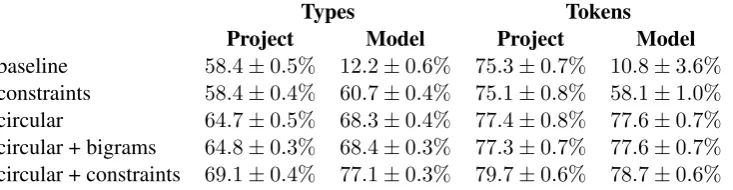
Table 2: Token-level PoS tagging accuracy, using direct projection from the final alignment (projection) or for the joint models, the sampled PoS tag variablestfj (model). Note that in the former case, the PoS
tag variables are ignored except during the alignment process. Figures given are averages ±standard deviation estimated over 64 randomly initialized evaluations for each configuration.
these constraints alone reach a fairly high level of accuracy.
5 Results
Table 2 shows the per-type and per-token accu-racy for a number of different configurations, us-ing both direct projection (project) and the sam-pled tfj PoS tag variables (model). While the
model itself assigns tags on the token level, when obtaining the figures in Table 2 we ensure type-level tagging by assigning each token the major-ity tag of its type. This is also done for the to-kenscolumns. Since the SSLC annotation does not contain glosses with ambiguous part of speech, us-ing only token-level would introduce unnecessary noise.
The baseline model performs word alignment only, assigning random values to the PoS tag variables. Projection accuracy is fair (indicating that the word alignments are acceptable), but the much lower scores in the model columns repre-sent an entirely random baseline. When the con-straints described in Section 4.6 are enforced dur-ing sampldur-ing, the model scores increase as ex-pected. Without coupling between the word align-ment and PoS tags, the projected tags are not changed.
Using the circular generation model, the cou-pling between PoS tags and word alignment leads to better accuracy, as expected. This is also the case when using direct projection, indicating that the joint model increases word alignment quality (which we are unable to evaluate directly, lacking a gold standard word alignment).
Adding bigram dependencies between SSLC PoS tags allows the model to use (monolingual) contextual information, but this does not seem to affect the accuracy. The probable reason for this is
that the coupling between Swedish and SSLC PoS tags is quite strong, and the contextual information can not significantly affect the final tagging.
The best results were obtained by using the circular model in conjunction with enforcing the task-specific constraints. The improvement when adding the constraints is particularly large on the type level, because this allows reasonable guesses for many of the rare types where there is not enough data for reliable word alignments. This is important for our goal, since we actually want type-based part of speech assignments.
The 77% accurate type-level tag list was man-ually corrected by two annotators (reaching con-sensus) in order to obtain the final tagging of the corpus, which is also used as the gold standard for the evaluation described in this section.
6 Conclusions
We have shown that annotation transfer, per-formed in a Bayesian model of joint word align-ment and part of speech transfer, can be a useful tool when annotating a sign language corpus with parts of speech.
References
Inger Ahlgren and Brita Bergman. 2006. Det svenska teckenspr˚aket. InTeckenspr˚ak och teckenspr˚akiga: kunskaps- och forsknings¨oversikt, volume 2006:29 of Statens offentliga utredningar (SoU), pages 11– 70. Ministry of Health and Social Affairs, March.
Brita Bergman. 1983. Verbs and adjectives: morpho-logical processes in Swedish Sign Language. In Jim Kyle and Bencie Woll, editors,Language in sign: An international perspective on sign language, pages 3–9, London. Croom Helm.
Lars Borin and Markus Forsberg. 2009. All in the family: A comparison of SALDO and WordNet. In NODALIDA 2009 Workshop on WordNets and other Lexical Semantic Resources – between Lexical Semantics, Lexicography, Terminology and Formal Ontologies, pages 7–12, Odense, Denmark.
Carl B¨orstell, Johanna Mesch, and Lars Wallin. 2014. Segmenting the Swedish Sign Language corpus: On the possibilities of using visual cues as a ba-sis for syntactic segmentation. In Onno Crasborn, Eleni Efthimiou, Evita Fotinea, Thomas Hanke, Julie Hochgesang, Jette Kristoffersen, and Johanna
Mesch, editors, Beyond the Manual Channel.
Pro-ceedings of the 6th Workshop on the Representa-tion and Processing of Sign Languages, pages 7–10, Reykjav´ık, Iceland. ELRA.
Peter F. Brown, Vincent J. Della Pietra, Stephen
A. Della Pietra, and Robert L. Mercer. 1993.
The mathematics of statistical machine translation:
Parameter estimation. Computational Linguistics,
19(2):263–311, June.
John DeNero, Alexandre Bouchard-Cˆot´e, and Dan
Klein. 2008. Sampling alignment structure
un-der a Bayesian translation model. In Proceedings
of the 2008 Conference on Empirical Methods in Natural Language Processing, pages 314–323, Hon-olulu, Hawaii, October. Association for Computa-tional Linguistics.
E. Ejerhed, G. K¨allgren, O. Wennstedt, and M. ˚Astr¨om.
1992. The linguistic annotation system of the
Stockholm-Ume˚a corpus project. Technical report, Department of Linguistics, University of Ume˚a.
Yarin Gal and Phil Blunsom. 2013. A systematic
Bayesian treatment of the IBM alignment models. InProceedings of the 2013 Conference of the North American Chapter of the Association for Computa-tional Linguistics: Human Language Technologies, Stroudsburg, PA, USA. Association for Computa-tional Linguistics.
Barbara Hunger. 2006. Noun/verb pairs in Austrian Sign Language ( ¨OGS). Sign Language & Linguis-tics, 9(1/2):71–94, January.
Trevor Johnston. 2001. Nouns and verbs in Australian
sign language: An open and shut case? Journal
of Deaf Studies and Deaf Education, 6(4):235–57, January.
Trevor Johnston. 2010. From archive to corpus: Tran-scription and annotation in the creation of signed
language corpora. International Journal of Corpus
Linguistics, 15(1):106–131.
Trevor Johnston. 2014. Auslan corpus annotation
guidelines. Centre for Language Sciences, Depart-ment of Linguistics, Macquarie University.
Vadim Kimmelman. 2009. Parts of speech in Russian Sign Language: The role of iconicity and economy.
Sign Language & Linguistics, 12(2):161–186.
Gunnel K¨allgren, 2006. Manual of the Stockholm
Ume˚a Corpus version 2.0. Department of
Lin-guistics, Stockholm University, December. Sofia
Gustafson-Capkov´a and Britt Hartmann (eds.).
Cos¸kun Mermer and Murat Sarac¸lar. 2011. Bayesian word alignment for statistical machine translation. In Proceedings of the 49th Annual Meeting of the Association for Computational Linguistics: Human Language Technologies: short papers - Volume 2, HLT ’11, pages 182–187, Stroudsburg, PA, USA. Association for Computational Linguistics.
Johanna Mesch, Lars Wallin, and Thomas Bj¨orkstrand.
2012. Sign language resources in Sweden:
Dic-tionary and corpus. In Proceedings 5th Workshop
on the Representation and Processing of Sign Lan-guages: Interactions between Corpus and
Lexi-con, Language Resources and Evaluation
Confer-ence (LREC), pages 127–130, Istanbul, Turkey.
Johanna Mesch, Maya Rohdell, and Lars Wallin. 2014. Annoterade filer f¨or svensk teckenspr˚akskorpus.
Version 2.http://www.ling.su.se.
Robert ¨Ostling. 2013. Stagger: An open-source part of
speech tagger for Swedish.North European Journal
of Language Technology, 3:1–18.
Darcey Riley and Daniel Gildea. 2012. Improving the IBM alignment models using variational Bayes. In
Proceedings of the 50th Annual Meeting of the Asso-ciation for Computational Linguistics: Short Papers - Volume 2, ACL ’12, pages 306–310, Stroudsburg, PA, USA. Association for Computational Linguis-tics.
Waldemar Schwager and Ulrike Zeshan. 2008. Word classes in sign languages: Criteria and classifica-tions. Studies in Language, 32(3):509–545, Septem-ber.
Johan Sjons. 2013. Automatic induction of word
classes in Swedish Sign Language. Master’s thesis, Stockholm University.
Oksana Tkachman and Wendy Sandler. 2013. The noun-verb distinction in two young sign languages.
Gesture, 13(3):253–286.
Kristina Toutanova, H. Tolga Ilhan, and Christopher Manning. 2002. Extensions to HMM-based
statisti-cal word alignment models. In2002 Conference on
Empirical Methods in Natural Language Processing (EMNLP 2002), pages 87–94.
Stephan Vogel, Hermann Ney, and Christoph Tillmann.
1996. HMM-based word alignment in statistical
translation. InProceedings of the 16th Conference
on Computational Linguistics - Volume 2, COLING ’96, pages 836–841, Stroudsburg, PA, USA. Associ-ation for ComputAssoci-ational Linguistics.
Lars Wallin, Johanna Mesch, and Anna-Lena Nils-son. 2014. Transkriptionskonventioner f¨or tecken-spr˚akstexter (version 5). Technical report, Sign Lan-guage, Department of Linguistics, Stockholm Uni-versity.
Peter Wittenburg, Hennie Brugman, Albert Russel, Alex Klassmann, and Han Sloetjes. 2006. ELAN: a professional framework for multimodality
re-search. In Proceedings of the Fifth International
Conference on Language Resources and Evaluation (LREC’06). http://tla.mpi.nl/tools/ tla-tools/elan/.
David Yarowsky, Grace Ngai, and Richard
Wicen-towski. 2001. Inducing multilingual text