Molecular event extraction from Link Grammar parse trees
J¨org Hakenberg1, Ill´es Solt2, Domonkos Tikk2,3, Luis Tari1,
Astrid Rheinl¨ander3, Quang Long Ngyuen3, Graciela Gonzalez1, and Ulf Leser3 1Arizona State University, Tempe, AZ 85283, USA,
2Budapest University of Technology and Economics, 1117 Budapest, Hungary, 3Humboldt Universit¨at zu Berlin, 10099 Berlin, Germany.
Abstract
We present an approach for extracting molec-ular events from literature based on a deep parser, using in a query language for parse trees. Detected events range from gene ex-pression to protein localization, and cover a multitude of different entity types, including genes/proteins, binding sites, and locations. Furthermore, our approach is capable of rec-ognizing negation and the speculative char-acter of extracted statements. We first parse documents using Link Grammar (BioLG) and store the parse trees in a database. Events are extracted using a newly developed query lan-guage with traverses the BioLG linkages be-tween trigger terms, arguments, and events. The concrete queries are learnt from an an-notated corpus. On BioNLP Shared Task data, we achieve an overall F1-measure of 29.6%.
1 Introduction
Biomedical text mining aims at making the wealth of information available in publications available for systematic, automatic studies. An important area of biomedical text mining is concerned with the ex-traction of relationships between biological entities, especially the extraction of protein–protein inter-actions from PubMed abstracts (Krallinger et al., 2008). The BioNLP’09 Shared Task addresses the problem of extracting nine different types of molec-ular events (Kim et al., 2009) and thus targets a problem that is considerable less-well studied than protein-protein interactions. Such molecular events include statements about the expression level of genes, the binding sites of proteins, and the up/down
regulation of genes, among others. All events fo-cus on genes/proteins and may include only a single protein (e.g., protein catabolism), multiple proteins (e.g., binding), and other arguments (e.g., phospho-rylation site; protein location). The most complex type of event considered in the task are regulations, which may refer to other events (negative regulation of gene expression) and may also include causes as arguments. The task also addresses the problem that experimental findings often are described in a defen-sive manner (“Our results suggest ...”) or may appear in negated context. This meta-information about an extracted event should be taken into account when text mining results are used in automated analysis pipelines, but recognizing the degree of confidence that can be put into an event adds further complex-ity to the task. Overall, the three tasks in BioNLP’09 are: 1) event detection and characterization, 2) event argument recognition, and 3) recognition of nega-tions and speculanega-tions.
The approach we present in this paper addresses all three tasks. Essentially, our system consists of three components: A deep parser, a query language for parse trees, and a set of queries that extract spe-cific events from parse trees. First, we use the Bio-LG parser (Pyysalo et al., 2006) for parsing sen-tences into a graph-like structure. Essentially, Bio-LG recognizes the syntactic structure of a sentence and represents this information in a tree. It adds links between semantically connected elements, such as the links between a verb and its object and sub-ject. Second, we store the result of BioLG in a re-lational database. This information is accessed by a special-purpose query language (Tu et al., 2008) that
! "
[image:2.612.315.539.59.123.2]"
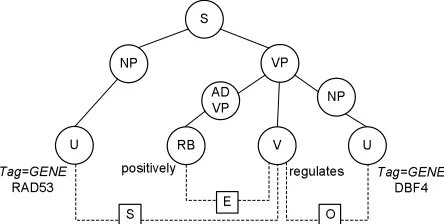
Figure 1: Parse tree where constituents are connected by solid lines, linkages between terminals shown as dotted lines. E: adverb to verb, S: subject to verb, O: verb to object.
matches a user-defined linguistic pattern describ-ing relationships between terms (the query) to the database of stored graphs. The query language thus is a powerful, scalable, extensible, and systematic way of describing extraction patterns. Using these tools, we can solve the BioNLP tasks by means of a set of queries, extracted from the training data set.
2 Methods
The Link Grammar parser is a deep syntactic parser based on the Link Grammar theory (Sleator and Temperley, 1993), which consists of a set of words and linking requirements between words. The par-ticular implementation of Link Grammar parsing we use in our system is the BioLG parser described in Pyysalo et al. (2006), which modifies the origi-nal parser by extending its dictionary and by adding more rules for guessing structures when facing un-known words. The output of the parser is twofold: it produces a constituent tree as well as a linkage that shows the dependencies between words. In Fig-ure 1, solid lines indicate parent-child relationships in the constituent tree, and dotted lines represent the linkage. Three links were detected in the sentence: Sconnects the subject-nounRAD53to the transitive verb regulates, O connects the transitive verb regulatesto the direct objectDBF4, andE con-nects the verb-modifying adverb positivelyto the verbregulates.
Our detection of arguments for events is based on Link Grammar linkages obtained from training data. Essentially, we automatically extract all shortest link paths that connect event trigger terms to themes, themes to sites, themes to locations, and so on. We
+---Jp---+ | +---CH---+ | | +---CH---+ +----Mp----+ | | +----CH----+
| | | | | |
expression of P53, Rb, and Bcl-xL proteins
Figure 2: Linkage in a gene expression evidence. Mp: prepositional phrase modifying a noun; Jp: connects preposition to object; CH: noun modifier.
describe these examples as queries against a parse tree, and evaluate these queries on the test data to ex-tract and assemble events. An example for a linkage in a gene expression evidence is shown in Figure 2. It illustrates that the event trigger term ‘expression’ is connected to the three proteins ‘P53’, ‘Rb’, and ‘Bcl-XL’ in exactly the same way.
Our method for event argument recognition is based on three components. The first parses train-ing as well as test data ustrain-ing the BioLG parser, and stores the result in a relational database. The second component is a query language to search the databases for known linkages. The third compo-nent extracts these linkages from training data and rewrites into such queries. These components are de-tailed in Sections 2.1 to 2.3. Section 2.4 explains our methods for context identification with respect to negations and speculations. Sections 2.5 and 2.6, finally, explain how we handle anaphora and enu-merations, respectively.
2.1 Parse Tree Database and Query Language
A fundamental component of our approach is a parse tree database (PTDB) for storing and querying parse trees (Tu et al., 2008). PTDB is a relational database for storing the results of the BioLG parser on arbi-trary texts. For the task, we parsed all texts from the training, development and testing data set. Recogni-tion of entity types (gene etc.) of word tokens relied on the provided annotation. Each abstract is repre-sented in a manner that captures both the document structure (such as title, sections, sentences) and the parse trees of sentences.
[image:2.612.74.296.62.174.2]of constituent trees together with additional require-ments on linkages between matches. More specifi-cally, a PTQL query consists four components de-limited by colons: 1) tree pattern, 2) link conditions, 3) proximity conditions, and 4) return expression. A tree pattern describes the hierarchical structure and the horizontal order between the nodes of a parse tree, a link condition describes the linking dependen-cies between nodes, a proximity condition specifies words that are within a specified number of words in the sentence, and the return expression defines which variables should be returned as query result. An example PTQL query is shown in Figure 3.
PTQL queries are evaluated on a PTDB using a two step process. A query is first translated into an IR-style keyword query to efficiently filter out irrelevant sentences. This step is performed out-side the database using an inverted index built with Lucene (2009). In the second step, the query is trans-lated into a complex SQL command which is re-stricted to the sentence IDs that passed the first step. This query is evaluated on the database, and the re-sults are projected onto the return expression.
2.2 Extracting PTQL queries
From all events in the training data, we searched for the shortest link paths that connected event trig-gers to themes, themes to sites, themes to locations, and so on. For each of the different event classes, we obtained a set of link paths connecting the event trigger to the theme. Links from themes to sites (required for phosphorylation, binding, and regula-tion events) where extracted from all three and then joined into one set. We transformed all linkages into PTQL queries, and ran these queries on the develop-ment and test data sets, respectively. Note that this entire process is performed automatically. As many link paths are identical expect for their event trigger terms, we manually grouped similar terms together; queries were then expanded automatically to allow for either one. An example is the following group of inter-changeable terms that could replace ‘expres-sion’ in gene expression events (see Figure 3):
expression ≡ {expression, overexpression, coex-pression, production, overproduction, generation, synthesis, biosynthesis, transfection, cotransfection} For evaluation on the development data, we ex-tracted all queries from the training data; for
evalu-ation on the test set, queries originate from training and development data together.
2.3 Regular expressions for regulation events
Regarding regulation events, we concentrated on the recognition of events with only the theme slot filled. In the training data, 73.8% of the regulations (incl. positive and negative regulation) do not have any site, cause, or cause-site arguments/participants. We addressed this task using regular expressions that were matched against the annotated sentences in the PTDB. Therefore, we sought for trigger expressions of regulation events that immediately precede or fol-low an annotation (protein name or event trigger). For all four possible combinations (precede/follow and protein/trigger) we created regular expressions that were able to recognize the given patterns, for example:
• (NOUN:trigger) (of) (PROTEIN), finds [up-regulation]Trigger:Pos regof [Fas ligand]Protein • (PROTEIN) (NOUN:trigger), finds mediate [IL-8]Protein[induction]Trigger:Pos reg • (VERB:trigger) (EVENT:trigger), finds [inhibit]Trigger:Neg reg[secretion]Event:Loc
• (EVENT:trigger) (VERB:trigger), finds TNF-alpha [release]Event:Loc[peaked]Trigger:Pos reg
The actual patterns also allowed some event class specific prepositions (of, with, to, etc.) and deter-miners between the regulation trigger and the pro-tein or event trigger. However, care has to be taken as regulation events often are embedded in nested structures which are not properly recognized by regular expressions. Therefore, whenever a regula-tion event pattern had been identified, we also con-structed another event candidate with the appropri-ate subexpression as the trigger, such as:
[[IkappaBalpha]Protein induction]]Event:Pos reg was completely [inhibited]Trigger:Neg reg.
2.4 Context identification to find negations and speculations
//S{ //N[value=‘expression’](e) -> //PRP[value=‘of’](a) => //?[tag=‘gene’](t) -> //N[value=‘gene’](h) }
[image:4.612.113.498.60.97.2]: e !Mp a and a !Jp t and t !CH h : : e.value, t.value
Figure 3: PTQL query for the extraction of some gene expression event. It searches for a sentence S that contains a noun ‘expression’, followed by a preposition ‘of’, which is then followed by a noun phrase (2nd line) that contains a gene name (‘//?’, any node with tag=gene) and has ‘gene’ as head noun. The link types are specified in the 3rd line using the variables each node is bound to (e,a,t,h): ‘expression’ has to be connected to ‘of’ with an ‘Mp’ link, the link from ’of’ to the head noun has to be ’Jp’, and the ‘CH’ link specifies ‘gene’ as head noun. The return values of the query are the values of nodes ’e’ and ’t’, which are bound to the event trigger ‘expression’ and the gene, respectively. This query would return all three event/theme pairs from the phrase in Figure 2.
of sentences including negated event using a set of queries for the identification of candidate NTEs. To fine tune the combined prediction, we used some manually encoded exceptions.
1) NTEs inside the trigger of an event: these ex-pressions are partly or entirely event triggers and usually suggest negative context, such as inability and undetectable. In the training set, sometimes an NTE indicated negation for some event classes but not for others; we added exceptions to exclude such NTE–event class combinations (e.g.,deficient with a negative regulation).
2) NTEs immediately preceding an annotation (protein name or event trigger), e.g., no(t), lack of, minimal, absence of, cannot, etc.
3) NTEs in the span of all the annotation related to an event (triggers, attributes recursively): these NTEs can span over multiple sentences. Starting with a hand-crafted dictionary of negation context triggers (Solt et al., 2009), we selected those dictio-nary items that had a positive effect on overall F1-measure.
4) NTEs from parse tree patterns: We identi-fied on the training data parse tree patterns in-cluding NTEs (using hand-made NTE dictionary) and protein names or event triggers. Candidate pat-terns, e.g., regulate*⇒in⇒but→not⇒in, were then formulated as queries against the PTDB and filtered via optimization.
We also applied the parse tree based method to identify speculation context (details not shown). We observed that some apparently speculative contexts were, to our surprise, considered as facts by the an-notators if the pattern occurred in the last sentence of the abstract, such as:These data suggests. . . . To counteract such situations, we developed a pattern-location heuristic by dividing the abstract into title,
body, and conclusion part. Frequent speculation can-didate patterns were evaluated separately on each part and filtered via optimization.
2.5 Resolving anaphora
Almost 8% of all events in the training set span multiple sentences. Our solution outlined so far works at the sentence level and is therefore unable to correctly recognize such events. To overcome this deficiency, we developed a baseline method for anaphora resolution, which is implemented as a pre–processing step. First, we identified all events spanning multiple sentence in the training set and collected typical anaphora expressions for proteins (e.g., this gene, these proteins, both factors). For each anaphora occurrence in development and test sets, we searched the closest preceding protein(s); here we also took into account if the anaphora was singular or plural. We also expected that resolved anaphora would generate additional PTQL queries and would thus improve the overall recall twofold. Unfortunately we could not analyze the results of our resolution approach on the train set (due to lack of time) and could hence not take full advantage of this idea. So far, we only addressed anaphora ring to protein(s). Once an anaphora and its refer-enced expression(s) were recognized, we effectively duplicated the original sentence with referenced ex-pressions substituting the anaphora; PTQL queries would thus run on the original sentence as well as on the resolved version.
2.6 Handling enumerations
incor-rect parse trees, our queries were not able to extract all annotated events. We applied post-processing to solve this problem, which was applicable when at least one protein in the enumeration was annotated as a part of an event. Post-processing was based on regular expressions searching for additional proteins occurring in the neighborhood of an initial one, sep-arated from it only by an enumeration separator. If found, the original event was replicated by substitut-ing the original protein with the new ones.
3 Datasets and results
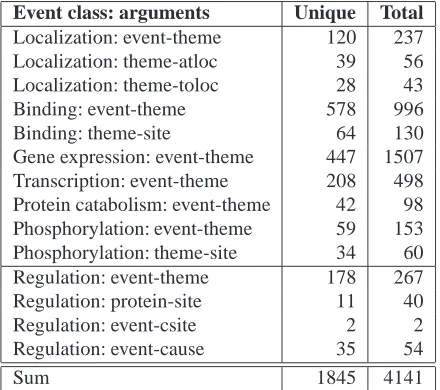
[image:5.612.315.535.60.255.2]Statistics concerning event classes and number of in-stances per event class can be found in the overview paper for the shared task, see (Kim et al., 2009). All in all, we extracted 1845 different link paths from the training data (2197 from training plus devel-opment) that connect two constituents each (event trigger term to protein, or protein to site, for in-stance), corresponding to as many PTQL queries. Table 1 shows the number of link paths per event class and argument type. From Table 2, which lists the top query per event class according to support in the training data, it becomes obvious that most events are described in fairly simple ways (“gene expression” or “phosphorylation of gene”). Adding the development data increased the number of events by 20.8% and the number of unique link paths by 19.1%. This might indicate that adding more data in the future will produce less and less new link paths, but we still observe a decent amount of link paths yet not covered. Per link path type, the increase rate ranged from only 9% (localization: theme to at-loc) over 11-15% for basic events (gene-expression or transcription trigger term to theme) to almost 27% (regulation: theme to site).
On the BioNLP’09 Shared Task test set, the method achieved an F1-score of 45.6% for the ba-sic types, 9% on regulation events, with a total of 29.3% for Task 2 (see Table 3). On Task 3, the F1-score was 8.6%. For Task 1, which was handled by us implicitly with Task 2, the F1-score was 32.1%. The combined F1-score for all tasks was 29.6%. Pre-cision was significantly higher than recall in all cases (overall: 60% precision at 20% recall).
Concerning regulation events, since we only aimed to recognize the simplest ones with this
Event class: arguments Unique Total
Localization: event-theme 120 237 Localization: theme-atloc 39 56 Localization: theme-toloc 28 43 Binding: event-theme 578 996
Binding: theme-site 64 130
Gene expression: event-theme 447 1507 Transcription: event-theme 208 498 Protein catabolism: event-theme 42 98 Phosphorylation: event-theme 59 153 Phosphorylation: theme-site 34 60 Regulation: event-theme 178 267 Regulation: protein-site 11 40 Regulation: event-csite 2 2 Regulation: event-cause 35 54
Sum 1845 4141
Table 1: Number of link paths per event class and pair of arguments (based on the training data). Themes are pro-teins for the first block of events, and propro-teins or other events for the three regulation types. atloc: at location, toloc: to location.
Event class TP FP FN Rec Prec F1
Localization 42 28 132 24.14 60.00 34.43 Binding 69 86 280 19.77 44.52 27.38 Gene expr. 373 99 349 51.66 79.03 62.48 Transcription 22 30 105 16.06 42.31 23.28 Protein cat. 7 5 7 50.00 58.33 53.85 Phosphoryl. 31 57 108 22.30 35.23 27.31
Sub-total 544 305 991 35.44 64.08 45.64 Regulation 1 12 291 0.34 7.69 0.66 Positive reg. 70 146 917 7.09 32.41 11.64 Negative reg. 14 14 365 3.69 50.00 6.88
Reg. total 85 172 1573 5.13 33.07 8.88
Task 2 total 629 477 2564 19.70 56.87 29.26 Negation 9 24 218 3.96 27.27 6.92 Speculation 13 33 195 6.25 28.26 10.24
Task 3 total 22 57 413 5.06 27.85 8.56
Overall 710 475 2907 19.63 59.92 29.57
Table 3: Official results for the BioNLP’09 Shared Task tasks 2 and 3, approximate span, recursive matching.
method, not surprisingly the recall of the method is very low, but the precision is on par with the ones of other events (for positive and negative regulation). The precision gets diminished because only a partial event was submitted, accounting for a false positive and false negative.
[image:5.612.315.534.330.538.2]Pair Nodes Links Support
[image:6.612.71.545.60.147.2]Localization↔theme GENE(t1) =>localization(e1) t1→CH→e1 36/237 Binding↔theme GENE(t1) =>association(e1) t1→CH→e1 42/996 Gene expression↔theme GENE(t1) =>expression(e1) t1→CH→e1 347/1507 Transcription↔theme GENE(t1) =>gene(a1) =>transcription(e1) t1→CH→a1 and a1→CH→e1 72/498 Protein catab.↔theme proteolysis(e1) =>of(a1) =>GENE(t1) e1→M→a1 and a1→J→t1 32/98 Phosphorylation↔theme phosphorylation(e1) =>of(a1) =>GENE(t1) e1→M→a1 and a1→J→t1 48/153
Table 2: Queries per argument pair (event↔theme) with the highest support in the training data. All nodes are bound to variables (round brackets) that are use in the links to depict connections between nodes. Note that all event trigger terms are placeholders for alternatives (see text): ‘expression’ also refers to instances that used the terms ‘co-expression’, ‘synthesis’, ‘production’, etc. GENE: wildcard for any gene name; RES: residue. CH: links head noun to modifying noun; M: connects nouns to post-nominal modifiers; J: connects prepositions to objects.
Method TP FP FN P R F1
Inside trigger 15 8 92 65.2 14.0 23.1 Before trigger 62 17 45 78.5 57.9 66.7 Span-based 6 3 101 66.7 5.6 10.3 Parse tree query 4 1 103 60.0 5.6 10.7
(I∪B∪S) 79 27 28 74.5 73.8 74.2
(I∪B∪S∪P) 82 28 25 76.6 74.6 75.6 I∪B∪S∪PnoF 84 79 23 50.9 75.7 60.9
Table 4: Performance for negation context identification on the development set. The last row indicates the im-portance of fine tuning (F): when event class–trigger pair exceptions and NTE exceptions are not applied, the pre-cision decreases considerably with only a small increase in recall. See text for details in each method.
events its impact was higher since for those no Bio-LG based solution was applied. Its overall effect on Task 2 was almost a 4% improvement in F1-score and recall, at 15% decreased precision.
Identification of negative context
Table 4 shows the effectiveness of each method for the identification of negative context on the de-velopment set. Searching for the negation inside the event trigger had little effect on the final results, since a specific word was rarely identified as being the trigger of more than one event classes. The most reliable spot to look for negation was immediately before the term that triggered the event (lack of ex-pression of . . . ).
Identification of speculation
Table 5 shows the effectiveness of our parse tree based method for the identification of spec-ulation context on the development set. With the use of location-based heuristic we could improve
Method TP FP FN P R F1
[image:6.612.71.298.233.336.2]w/o location hrst. 53 47 42 53.0 55.8 54.4 with location hrst. 52 34 43 60.5 54.7 57.5
Table 5: Performance of parse tree based speculation identification, with or without location heuristics; eval-uated on the development set.
the F1-score of our method by 3%, at 7% bet-ter precision and 1% worse recall. The parse tree based method worked significantly better for spec-ulative context than for negation, because specula-tions are expressed in less multifarious way, and trig-ger words are more specific for the context.
3.1 Error analysis
An analysis of false positives (FP) and false neg-atives (FN) revealed the following main types of errors (in order of decreasing gravity). Our system produced much better precision than recall, which is reflected in dominance of FNs over FPs. Note that, as we used parse trees on training and test data, parse errors result both in incorrect queries and wrongly extracted results. Some of these errors, mainly due to missing or incorrect parse trees or links, could be recovered by the post-processing if the surface pat-terns were simple.
1. FNs: no corresponding link path query
2. FNs: there exists a corresponding yet slightly different link
3. FNs: query links to a (pre or post) modifier of the gene, but not the actual gene name
4. FNs: query misses one argument
6. FNs: unseen event trigger term, location, or site 7. FPs: wrong despite perfect match wrt. a link path from the training data
8. FNs, FPs: incorrect or partial parse tree
9. FNs: problems with anaphora, brackets, or enumerations
We discuss these error classes in more detail. The first problem may be attributed to the small size of the training data, but is also a general property of pattern-based methods in NLP. The second class stems from the current inability of our query lan-guage to deal with morpho-syntactical variation in language (see next Section). A large portion (3) of false negatives was due to link paths that went to the gene/theme in the training data, but to the head of a noun phrase that contained a gene/theme in the test data (or vice versa); or the link went to a noun pre-modifier. An example is the following, where the first phrase originates from the training data and gene is placeholder for the actual gene/protein name:
“... phosphorylates gene ...”
“... phosphorylates gene protein ...” “... phosphorylates X domain of gene ...”
In all three cases, there is a link from the verb to its object, but in the lower two examples, that object is ‘protein’ and ‘domain’, respectively. Only for a few such cases, all three link paths were contained in the training data.
For 5% of the false positive events (5), we predicted the wrong event class, while all trigger terms/arguments were correct. Half of those were mix-ups of positive regulation, predicted as gene ex-pression; another group has gene expression pre-dicted as localization. 13% of FPs were a result of both: the prediction was part of a corresponding FN (but some argument was missing), and at the same time we predicted the wrong type. For a small frac-tion (1.5%) of false negative events on the devel-opment set, we found a corresponding false posi-tive event where one argument (ToLoc, Cause, Site, Theme2) was missing; 11 of those were binding events (comprising 9% of FNs for binding).
A relatively small portion of false negatives were due to non-existing linkages (8) for a sentence. We stopped parsing after 30sec per sentence; this yields partial linkages in some cases, which we could still use for extraction of link paths (training data) or
querying against (test data); sometimes, no linkage was available at all. This timeout also influences the quality of linkages, which result in false positives as well as false negatives.
As for context identification, our approach per-formed significantly weaker on the test set, since over 70% of negations and speculations were re-lated to regulation events (measured on the joined train and development sets), for which we applied a coarse baseline method, i.e., here a large part of the base events were missing.
4 Related work
We focus our discussion on approaches to informa-tion extracinforma-tion that also use LinkGrammar. Evalua-tions of other deep parsers for information extrac-tion in the life sciences may, for instance, be found in Miyao et al. (2009) and Pyysalo et al. (2008). Note that most other systems based on deep pars-ing convert IE into a classification problem, often using some kind of convolution kernels, for exam-ple, Kim et al. (2008); instead, we employ a pattern-matching approach where patterns are expressed as queries. A similar approach is described in Fundel et al. (2007), where three rules are defined to ex-tract protein-protein interactions from an aggregated form of dependency graphs. These rules could in fact easily be expressed as queries in our language.
Ding et al. (2003) studied the extraction of protein-protein interactions using the Link Grammar parser. After some manual sentence simplification to increase parsing efficiency, their system assumed an interaction whenever two proteins were connected via a link path; an adjustable threshold allowed to cut-off too long paths. As they used the original ver-sion of Link Grammar, Ding et al. argue that adap-tations to the biomedical domain would enhance the performance. Pyysalo et al. (2004) extracted inter-action subgraphs, spanning all predicates and ar-guments at the same time, from the Link Gram-mar linkage of known examples. Failure analysis re-vealed that 34% of the errors were due to unknown grammatical structures, 26% due to dictionary issues and a further 17% due to unknown words.
lexicon expansion, and disambiguation using a POS tagger. Adding morpho-guessing rules and using a domain-specific POS tagger for disambiguation sulted in an increase from 74.2 to 76.8% in re-call; it also increased parsing efficiency by 45%. Szolovits (2003) adapted the Link Grammar parser by expanding the lexicon with data from UMLS Specialist. This expansion consisted of 200k new en-tries (including 74k phrases), resulting in a 17% in-crease in coverage on a corpus of 495k words.
The main differences between the cited previous works and our approach are: 1) we extract only pair-wise subgraphs (e.g., from a trigger term to a sin-gle protein) and then attempt to construct events based on such small components; 2) we consider link types, predicates, prepositions, and other nodes as requirements for a valid linkage with respect to event argument recognition; 3) we use a query lan-guage to query persistently stored parse trees instead of parsing each sentence and then comparing it to known link paths; 4) we combine subgraph match-ing with extensive pre- and post-processmatch-ing rules us-ing regular expressions and other filterus-ing rules.
5 Conclusions
We presented a method for extraction of molecu-lar events from text. We distinguished nine classes of events and identified arguments associated with them. We also characterized each event for either be-ing speculative or negated. The underlybe-ing method extracts link paths between all relevant pairs of ar-guments involved in the event from a Link Grammar parse (BioLG, see Pyysalo et al. (2006)). These link paths connect, for instance, an event trigger term to its theme, or a protein theme to a binding site. We query the graph formed by these linkages us-ing a dedicated query language for parse trees (Tu et al., 2008) which allows us to very quickly imple-ment large sets of rules. We combine queries with extensive pre- and post-processing using a mixture of different techniques. For the BioNLP’09 Shared Task, we focused on all event classes but the three types of regulation. For the other six, we obtain an overall F1-score of 45.6%, for all nine it was 29.3% (task 2). Including speculation and negation (task 3), the overall total on all nine event classes was 29.6%. All in all, we found that link paths
connect-+----Js----+ +--Js-+
+--Mp--+ +--CH--+ +--Mp--+ |
| | | | | | |
[image:8.612.317.536.57.96.2]expression of c-Fos gene expression of c-Fos
Figure 4: Example for alternative structures / optional nodes. In this case, the linkage should reflect the connec-tion from ‘expression’ to a noun that refers to a gene, in-dependent of its head. The ‘Mp’ and ‘Js’ links would be required, the ‘CH’ link from head to actual gene optional.
ing constituents of known types (e.g., event trigger term, gene) as extracted from training data yield a precise way for event argument detection. Using a specialized query language on pre-processed data (NER; parsing) greatly enhances the utility of such extracted rules to put together more complex events. Still, our current approach lacks in overall recall (20–52%, depending on event class), often due to slight variations that include, for instance, alterna-tive nodes along a link path that were not observed in training data.
Our approach could be improved in various ways. First, we currently extract queries from the train-ing corpus and use them directly as they are. We see that to improve recall, queries need to be gen-eralized further. In previous work (Hakenberg et al., 2008) we showed that such generalized rules may be learned automatically (from much larger corpora), which helped to increase recall considerably at a modest precision penalty. Second, our query lan-guage currently performs exact matching, while it would be more advantageous to implement some form of fuzzy semantics, producing a ranked list of hits. This could include wildcards, alternative nodes, alternative sub-paths, optional nodes etc. An exam-ple is discussed in Figure 4. Finally, we also believe that it would be rather easy to include more sophis-ticated ways of performing anaphora resolution to properly address events spanning multiple sentences and referential phrases within sentences.
Acknowledgments
References
Steven Bird, Yi Chen, Susan B. Davidson, Haejoong Lee, Yifeng Zheng. 2006. Designing and Evaluating an XPath Dialect for Linguistic Queries. In: Proc ICDE, pp.52, Washington, DC, USA.
Jing Ding, Daniel Berleant, Dan Nettleton, Eve S. Wurtele. 2002. Mining MEDLINE: Abstracts, Sen-tences, or Phrases? In: Proc. PSB, pp. 326–337, Kaua’i, Hawaii, USA.
Jing Ding, Daniel Berleant, Jun Xu, Andy W. Ful-mer. 2003. Extracting Biochemical Interactions from MEDLINE Using a Link Grammar Parser. In: Proc
IEEE ICTAI, pp. 467–471.
Katrin Fundel, Robert K¨uffner, Ralf Zimmer. 2007. RelEx–relation extraction using dependency parse trees. Bioinformatics, 23(3):365–371.
J¨org Hakenberg, Conrad Plake, Loic Royer, Hendrik Strobelt, Ulf Leser, Michael Schroeder. 2008. Gene mention normalization and interaction extraction with context models and sentence motifs. Genome Biology, 9(S1):S14.
Seonho Kim, Juntae Yoon, Jihoon Yang. 2008. Kernel approaches for genic interaction extraction.
Bioinfor-matics, 24(1):118–126.
Jin-Dong Kim, Tomoko Ohta, Sampo Pyysalo, Yoshi-nobu Kano, Jun’ichi Tsujii. 2009. Overview of BioNLP’09 Shared Task on Event Extraction. In:
Proc Natural Language Processing in Biomedicine (BioNLP) NAACL 2009 Workshop, June 4-5, Boulder,
CO, USA.
Martin Krallinger, Alfonso Valencia, Lynette Hirschman. 2008. Linking genes to literature: text mining, infor-mation extraction, and retrieval applications for biol-ogy. Genome Biol, 9(Suppl 2):S8.
Lucene, available at http://lucene.apache.org
Yusuke Miyao, Kenji Sagae, Rune Sætre, Takuya Mat-suzaki, Jun’ichi Tsujii. 2009. Evaluating contribu-tions of natural language parsers to proteprotein in-teraction extraction. Bioinformatics, 25(3):394–400. Sampo Pyysalo, Filip Ginter, Tapio Pahikkala, Jorma
Boberg, Jouni J¨arvinen, Tapio Salakoski, Jeppe Koivula. 2004. Analysis of Link Grammar on Biomedical Dependency Corpus Targeted at Protein-Protein Interactions. In: NLPBA/BioNLP at
COLING-2004, pp. 15–21, Geneva, Switzerland.
Sampo Pyysalo, Tapio Salakoski, Sophie Aubin, Ade-line Nazarenko. 2006. Lexical adaptation of link grammar to the biomedical sublanguage: a compara-tive evaluation of three approaches. BMC
Bioinfor-matics, 7(Suppl 2):S2.
Sampo Pyysalo, Antti Airola, Juho Heimonen, Jari Bj¨orne, Filip Ginter, Tapio Salakoski Pyysalo. 2008.
Comparative analysis of five protein-protein interac-tion corpora. BMC Bioinformatics, 9(Suppl 3):S6. Daniel Sleator and Davy Temperley. 1993. Parsing
En-glish with a Link Grammar. In: Proc 3rd Int Workshop
on Parsing Technologies, Aug 10-13, Tilburg/NL and
Durbuy/B.
Peter Szolovits. 2003. Adding a medical lexicon to an English Parser. In Proc AMIA, pp. 639–643, Nov 8-12, Washington DC, USA.
Ill´es Solt, Domonkos Tikk, Viktor G´al, Zsolt T. Kard-kov´acs. 2009. Semantic classification of diseases in discharge summaries using a context-aware rule based classifier. JAMIA, in press.
Luis Tari, J¨org Hakenberg, Graciela Gonzalez, Chitta Baral. Querying a Parse Tree Database of Medline Text to Synthesize User-Specific Biomolecular Net-works. In Proc Pac Symp Biocomput, 14:87-98. Phan Huy Tu, Chitta Baral, Yi Chen, and Graciela