Should we be Austere? A Normative
look at Public Debt
Jafri, Juvaria
Shaheed Zulfikar Ali Bhutto Institute of Science and Technology,
Karachi
24 October 2014
Should we be Austere? A Normative look at Public Debt
Juvaria Jafri1
Presented at the National Debt Conference, Islamabad, 25th October 2014
Acknowledgements are due to Ali Salman and his colleagues at the Policy Research Institute of Market Economy and also to conference participants for their very useful feedback.
Abstract
Excessive debt accumulation is an important policy concern in both developing and advanced economies
because it is associated with various issues, particularly low growth and high inflation. This is apparent
from the deleveraging vs. deficit spending debate; in this, the focus has tended to be on two specific
outcomes, that is, on economic growth, and inflation. So, this debate often overlooks the repercussions of
debt on economic freedom. Economic freedom may be regarded not just as a means to macroeconomic
growth and stability, but also as an end in itself. It tends to be inhibited when the full consequences of
rising public debt, whether from external or domestic sources, are misunderstood, particularly when the
underlying basis for debt accumulation is neither stimulus nor smoothing.
1
1.Introduction
The objective of this essay is to provide a normative context to in which to discuss policies that increase public debt, since they tend to limit economic freedom. Excess debt accumulation is an important policy concern in both developing and advanced economies because it is associated with various issues, particularly low growth and high inflation.
A key contention of this paper is that there has been a gratuitous emphasis on only two macroeconomic variables. As such, there is room to shift the discussion beyond the present impasse onto a more productive plane. This may be done by considering not only the empirical arguments for and against public debt but also taking into account the political and moral aspect of the discussion.
A noticeable feature of the discussion is that the case against high public debt is supported by many arguments; so it might seem odd that governments in both advanced and developing countries, particularly in the last decade or so, have continued to not only hold but also grow their debt burdens. It is hence relevant to consider the counter arguments, that is, the case for increasing public debt.
Discussions about public debt are difficult to separate from those about the role of the state. Government borrowing is a policy tool with long term as well as short term objectives. This tendency has its roots in the social liberal need for redistributive justice, and is especially noteworthy when considering the moral basis against public debt.
Since public debt or government borrowing is a form of state intervention, the arguments for and against it tend to rely on differing perceptions of the role of the state. These are central to the development of classical, and subsequently, social liberal thought in the 18th century where the importance of individual freedom vis-a-vis social justice was debated by several political philosophers as well as economists including Adam Smith, Jean-Baptise Say, Thomas Malthus, and David Ricardo.
2.The Role of the State
Classical liberalism is based on ideas of individual liberty and limited government. This eventually came to be known as distinct from social liberalism, which advocates a balance between individual liberty and social justice. This argument, which underlies all forms of economic intervention by governments, developed in the Western democracies that had experienced the Enlightenment and took root in the newer democracies that became post colonial independent states in the latter part of the 20th century.
As public finance became more developed in the 19th and 20th centuries, so did the argument for government intervention. A gradual transformation occurred and the role of the state was no longer limited to redistributive justice but was also to smooth business cycles and to minimize the damage from episodes of financial uncertainty, including during economic crises. Since growth, associated with economic confidence and stability, in itself can enhance social justice, the extended role of the state is a natural corollary for the state that seeks to enhance socioeconomic outcomes.
One of the two of the most important aspects of the transformation as noted by Seiferling (2012), is the move from a regressive to a progressive system of taxation as direct taxes, historically abhorred, replaced indirect taxes as the primary supply of government revenue. Not only did this allow for bigger government, but it also marked an ideological shift where the redistributive aspect of government expenditure gained prominence.
The second aspect is the use of discretionary expenditure outside of wartime. This is a relatively recent trend that can be attributed to J.M Keynes2, who has come to known as one of the more influential proponents of government intervention based on his proposals to use expansionary fiscal policy to counter persistent and high unemployment. This was based on the contention that aggregate savings always equate to aggregate investment. What came to be known as Keynesian economics may be held partially responsible for the high levels of debt in both advanced and developing countries today3. It also reflects the short-term aspect of what Elmendorf and Mankiw (1999) refer to as the conventional view of debt where a rise in debt results in an increased demand for output. The long term aspect of the same view holds that debt results in reduced public savings and a consequent drop in the capital stock (Elmendorf and Mankiw, 1999).
2 In “The General Theory of Employment, Interest and Money” which was first published in 1936.
This view has recently been challenged by adherents of the Modern Monetary Theory or MMT4 approach, who have sought to provide an alternative perspective on some of the issues associated with government spending and deficits. One of the foremost proponents of MMT, Wray (2009) argues that a government with a sovereign currency does not face economic constraints to spending, even if it results in a deficit. Money is created when governments spend as bank deposits are credited5. So, higher public debt results in higher net financial wealth, or in other words; government deficits equate to private sector surpluses. If the private sector has a desired level of surplus, that might be less/ more than the what the government eventually spends, a concern might be that government spending will exceed (or fall short of) the desired level of private sector saving. MMT assumes that the private sector will adjust to this as private spending will be higher (lower), taxes will be higher (lower), and private incomes will be higher (lower).
This is also the basis for rejecting the crowding out hypothesis, which assumes that money supply is fixed and contends that deficits lead to the absorption of saving that would have otherwise been used to finance investment. This argument is opposed on the grounds that since government deficits lead to
saving, which lead to the creation of bank deposits, which lead to the creation of money6, government deficit spending, however high it may be, cannot restrain banks from creating deposits
that firms can use to finance investment (Wray, 2003).
Perhaps the most recent context in which the role of the state in managing debt has come up has been the aftermath of the global economic meltdown that was triggered by the 2007 US subprime financial crisis. This scenario provides a useful backdrop against which to view shifting perspectives. Reinhart and Rogoff (2010) study selected countries, and note that during the 2007 to 2009 period average debt levels
rose by 20% to 75% 7. This buildup of debt may be contrasted with the public deleveraging that took place in the 2003 to 2006 period. The role of the state in managing the crises is evident in the fact that rising debt levels may be directly attributed to bail-out measures as well as stimulus programmes and falling government revenues.
4
This may be described as a heterodox approach to monetary theory. MMT synthesizes the work of earlier theorists including Knapp, Keynes, Innes, Lerner, Minsky, and Godley, and relies on alternative theories of money including the state theory of money, credit theory of money, and functional finance.
5
The same approach notes that money is destroyed when the government collects taxes. So government surpluses are associated with lower net financial wealth.
6
As bank deposits are used to finance investment. 7
The revival of Keynesian approaches is of course not the only noteworthy observation that may be made from recent events. Another is the contrasting experiences of advanced economies vis a vis emerging economies. Emerging economies are more prone to weakened growth as a result of debt; this is so because they face a lower threshold of external debt8 in percentage of GDP terms at which growth is compromised, compared to the threshold they face for domestically issued debt. It is likely that the foreign currency element is of especial relevance because the same study finds that when considering the impact of the domestically issued component of public debt, the relationship is similar for advanced and emerging economies (Reinhart and Rogoff, 2010). The use of thresholds also highlights the important observation that the relationship between debt and growth is non-linear.
On the topic of inflation; the same study finds that though there are individual country exceptions, advanced countries as a group with more public debt, do not face higher inflation. For emerging countries however, there is a clear positive relationship between high inflation and high debt. This is disparity is a likely outcome of fiscal dominance.
3.To deleverage or to deficit spend?
The deleveraging vs. deficit spending question is old enough to have developed a number of dimensions and particularly over the last five or six years it has gathered unprecedented attention. The context of the debate is not restricted to economic crisis; even prior to 2007 there were concerns in advanced countries about the sustainability of public debt burdens given spending and consumption patterns. Emerging country concerns tend to be based on the large external debt burdens which expose the economy to foreign currency risk and soak up government revenues. The prescription, particularly as recommended by the IMF, is different for both cases; advanced countries are urged to use counter-cyclical government fiscal stimulus policies whereas emerging countries are encouraged to be austere.
Apprehension about fiscal austerity is primarily based on its potential impact on growth. Advocates of deleveraging argue that every country faces a fiscal limit, which is determined by economic or political circumstances and is the point at which taxes and spending can no longer adjust to stabilize debt (Davig, Leeper, and Walker, 2011). Consequently, countries with large debt burdens are confronted with uncertainty about future taxes and transfers. This can be destabilizing and inhibit growth, particularly through the channel of reduced consumption and investment. On the other hand, it is also argued that
8
since deleveraging entails fiscal austerity, it results in unemployment and reduced social spending, thus having a contractionary effect on output.
Another issue related to fiscal austerity is that of inflation. This is a somewhat more complicated matter as it can be caused by austere and expansionary fiscal policies, both. As noted earlier in this paper, this has tended to be more of a concern for emerging countries as they are more prone to inflation when their debt burdens are higher. When fiscal austerity measures entail the reduction or removal of subsidies on sensitive items such as fuel and electricity they tend to cause inflationary supply shocks. However, stimulus measures also tend to build inflationary pressures.
Post crisis experiences in advanced countries indicate that the matter is more complex given the role of private debt because the private sector tends to remain on a path of sharp deleveraging even when fiscal policy is expansionary9. This is a probable explanation for why despite the widespread use of fiscal stimulus programmes in many advanced countries, the possibility of deflation remains a bigger concern than that of inflation.
4.Positive and normative approaches
The deleveraging vs. deficit spending debate provides a useful and current synopsis of the implications of public debt from the standpoint of the tradition that is known as positive economics. This is a vast branch of the subject and seeks to be objective, restricting itself to the description and explanation of economic phenomena. Where policy formulation is concerned, in the context of public debt, the positive approach considers how and why public debt affects some aspects of economies, namely growth and inflation. So, the debate is framed in terms of two specific variables, which have been selected according to some criteria. This makes it possible for empirical evidence to be applied to the discussion to draw conclusions about whether or not a certain policy approach is associated with growth or inflation.
The issue of policy necessitates a shift away from positive economics, and requires a different approach; this is the tradition known as normative economics, which is subjective and value based. Given this approach and the context of public debt, it is pertinent to consider what ought to be done from the perspective of the policy maker responsible for intervening in the economy on behalf of the state.
The deleveraging vs. deficit spending controversy indicates that policy decisions are dominated by the emphasis on growth and inflation, with scholars analyzing the effect of policy tools, timing, and scale affect these two specific macroeconomic variables. As a result, the debate largely ignores a number of other aspects of the political economy of public debt. This may be at least partially overcome by re-evaluating the debate through the lens of economic freedom.
Both positive and normative approaches are relevant to discussions on economic freedom and public debt, and this apparent in the existing literature. For instance, the literature on the former tends to regard economic freedom as an independent variable that shares a positive relationship with macroeconomic variables such as economic growth (Doucouliagos & Ulubasoglu, 2006), and foreign direct investment (Bengoa and Sanchez-Robles, 2003).
The normative literature tends to see economic freedom as an extension of individual freedom and hence draws heavily upon classical liberal thought, including the works of John Locke and Adam Smith10. In this context, economic freedom is regarded as having intrinsic value; so it may be regarded not just as a means towards the achievement of ends such as higher growth or investment, but as an end unto itself. More recently, arguments made by Knut Wicksell in the eighteenth century and developed by James Buchanan after 194811 and Amartya Sen also emphasize the importance of economic freedom as something that holds its own inherent value.
Buchanan (1989) describes the contribution of Wicksell as a challenge to the “orthodoxy of public finance theory”. According to Wicksell, cited in Buchanan (1989); ... “whether the benefits of the proposed activity to the individual citizens would be greater than its cost to them, no one can judge this better than the individuals themselves.” Building on this, it is argued that there is a lack of consent, when debt burdens arising from the deficit financing and the welfare state are planned so that they are borne by generations separate from those that incurred the debt (Buchanan, 1989).
Amartya Sen is in recent times, perhaps one of the most influential proponents of the intrinsic value of freedom, based on his critique of dominant approaches have tended to equate development to per capita, food security to food availability; and seen poverty only as income deprivation (Vizard, 2001). His emphasis is not on economic freedom; rather it is focused on political and civil freedoms which tend to be
10 John Tomasi presents a “The Moral Case for Economic Liberty in http://www.heritage.org/index/book/chapter-3
compromised through approaches that are evaluated based on market outcomes. Nevertheless, his work is extremely relevant to the concept of economic freedom because the prominence it gives to human ends has facilitated a paradigm shift, particularly in the area of development economics.
A discussion about whether or not public debt reduces economic freedom may be based on structured measures of economic freedom, which has been used as a variable in a number of macroeconomic studies. Indices used to measure economic freedom are useful not only for providing a detailed definition but also for empirical studies, including the ones mentioned above
Here, it is relevant to mention that the question of how to manage debt is always a normative issue. That is, that given the premise that public debt reduces economic freedom, the decision to take on debt for the sake of growth at the cost of freedom, becomes a value judgment. At any time, it may be argued that there is a possibility that the public would opt for more freedom and less growth.
5.Measurement through indices
Since the 1990s a number of attempts have been made to quantify economic freedom through the construction of indices (Gwartney and Lawson, 2003). These have tended to be based on measurements of what are considered to be fundamentals of economic freedom. Some instances include personal choice, voluntary exchange, freedom to compete, and protection of person and property12.
Among the most widely used indices measuring economic freedom are the Economic Freedom of the World Index or EFW, and the Index of Economic Freedom or IEF. Gwartney and Lawson note that both of these have been updated on an annual basis since 1996 and 1995 respectively (2003). The EFW is prepared by the Fraser Institute and the IEW is prepared by the Heritage Foundation/WSJ.
6.Economic freedom and public debt
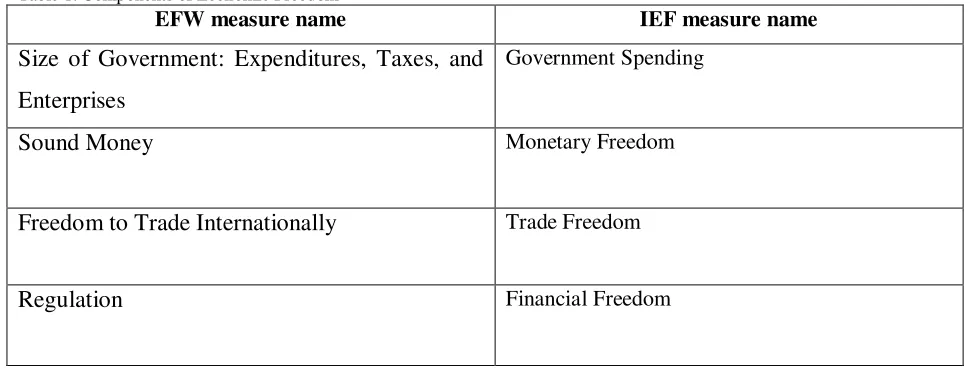
Neither of these indices includes a measure of public debt, although measurements of variables that have been known to share a close relationship with public debt have been included in both the more widely used indices. These include:
Table 1: Components of Economic Freedom
EFW measure name IEF measure name
Size of Government: Expenditures, Taxes, and
Enterprises
Government Spending
Sound Money
Monetary FreedomFreedom to Trade Internationally
Trade FreedomRegulation
Financial FreedomGovernment expenditure
Alternatively described as
government spending, thisdoes not explicitly measure the occurrence or
size of budget deficits which may arise from government intervention, so it is at best an indirect
indicator of the extent to which economic freedom is compromised from public debt. Higher
government expenditure means more taxes, including in the form of inflation.
Miller, Holmes, andKim (2013) observe that “excessive government spending that causes chronic budget deficits and the accumulation of sovereign debt is one of the most serious drags on economic dynamism”.
Kremer and Jayachandran (2002) note that some debts may be considered illegitimate because they were undertaken under dubious circumstances or with doubtful intent. This is the doctrine of “odious debt” which olds that new regimes should not be responsible for debts incurred by old ones, particularly when rulers in the past are known to have been corrupt and/or inclined to make poor decisions on how loans should be utilized13.
13 The argument extended here is analogous to one extended by individuals who do not feel responsible for the repayment of what has been borrowed illegitimately in their name. Similarly, in corporate law, companies are not compelled to honour contracts negotiated by an executive without authority. The historical precedent for this view was set in the early 20th century when the United States argued that neither Cuba nor the United States should be responsible for debt incurred by the colonial Spanish government (Ginsburg and Ulen, 2007). More recently, a similar discussion was held in the Iraqi context when the Saddam Hussein regime was overthrown by a US led coalition. Another instance of such an argument was presented in Pakistan in August 2014 during anti-government protests lead by the Pakistan Tehreek-e-Insaaf party, when party leader Imran Khan urged the IMF and World Bank not to lend to the Nawaz Sharif government on the basis that they were elected through poll rigging and that the people should not be liable for their loans.
Sound Money
Alternatively known as ‘monetary freedom’, this measure highlights the issue of inflation which reduces economic freedom by distorting relative prices and changing the terms of contracts,thus constraining future planning (Gwartney and Lawson, 2003). The occurrence of inflation is directly attributable to the government when intra-temporal budgetary deficits are addressed through seigniorage
Freedom to Trade Internationally
Alternatively known as ‘t
rade freedom’, this measure seeks to assess the extent to which trade barriershinder the import and export of goods and services. When the country holds foreign debt the issue of economic freedom tends to acquire an additional dimension; this extends beyond the matter of the protectionist-influenced trade restrictions of various sorts that exist in virtually every country. Sjaastad (1983, cited in Reisen 1989) notes that the debt servicing becomes problematic as the largest share of debt is owed by governments whereas countries' export earnings and most of their foreign assets are usually in private hands. The burden of debt servicing thus falls disproportionately on the private sector, making this issue an instance of the common pool problem that will be discussed later in this paper.
Regulation
Similar to the measures of financial freedom and investment freedom, this relates to public debt in the context of capital market controls and financial repression. The latter according to Reinhart, Kirkegaard, and Sbrancia (2011) has historically been applied to reduce debt-GDP ratios, and has been resurgent in recent times given large public debt increases in advanced economies. Financial repression, which refers to government led market manipulation to push down debt financing costs, may appear in a number of forms, either explicitly or implicitly. Some instances include caps on interest rates, regulation of international capital movements, and heavy government involvement in the banking sector.
Other hindrances to capital market movements include foreign exchange restrictions, labour regulations, corruption, red tape, poor infrastructure, and political instability.
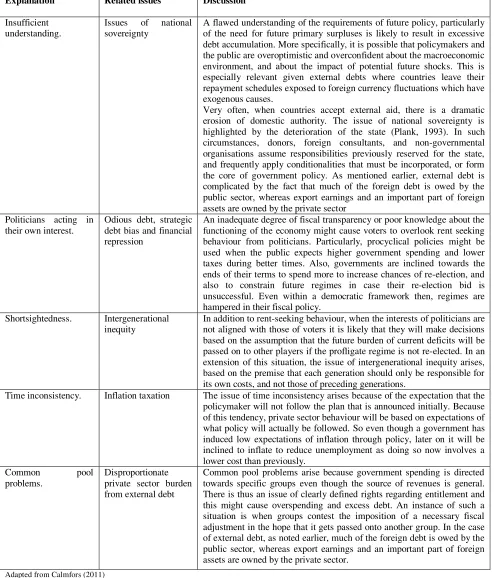
Table 2: Reasons for the excessive accumulation of debt
Adapted from Calmfors (2011)
Explanation Related issues Discussion
Insufficient understanding.
Issues of national
sovereignty
A flawed understanding of the requirements of future policy, particularly of the need for future primary surpluses is likely to result in excessive debt accumulation. More specifically, it is possible that policymakers and the public are overoptimistic and overconfident about the macroeconomic environment, and about the impact of potential future shocks. This is especially relevant given external debts where countries leave their repayment schedules exposed to foreign currency fluctuations which have exogenous causes.
Very often, when countries accept external aid, there is a dramatic erosion of domestic authority. The issue of national sovereignty is highlighted by the deterioration of the state (Plank, 1993). In such circumstances, donors, foreign consultants, and non-governmental organisations assume responsibilities previously reserved for the state, and frequently apply conditionalities that must be incorporated, or form the core of government policy. As mentioned earlier, external debt is complicated by the fact that much of the foreign debt is owed by the public sector, whereas export earnings and an important part of foreign assets are owned by the private sector
Politicians acting in their own interest.
Odious debt, strategic debt bias and financial repression
An inadequate degree of fiscal transparency or poor knowledge about the functioning of the economy might cause voters to overlook rent seeking behaviour from politicians. Particularly, procyclical policies might be used when the public expects higher government spending and lower taxes during better times. Also, governments are inclined towards the ends of their terms to spend more to increase chances of re-election, and also to constrain future regimes in case their re-election bid is unsuccessful. Even within a democratic framework then, regimes are hampered in their fiscal policy.
Shortsightedness. Intergenerational
inequity
In addition to rent-seeking behaviour, when the interests of politicians are not aligned with those of voters it is likely that they will make decisions based on the assumption that the future burden of current deficits will be passed on to other players if the profligate regime is not re-elected. In an extension of this situation, the issue of intergenerational inequity arises, based on the premise that each generation should only be responsible for its own costs, and not those of preceding generations.
Time inconsistency. Inflation taxation The issue of time inconsistency arises because of the expectation that the
policymaker will not follow the plan that is announced initially. Because of this tendency, private sector behaviour will be based on expectations of what policy will actually be followed. So even though a government has induced low expectations of inflation through policy, later on it will be inclined to inflate to reduce unemployment as doing so now involves a lower cost than previously.
Common pool
problems.
Disproportionate private sector burden from external debt
7.Concluding Remarks
An important point that emerges from this discussion about the implications of high public debt is that the debate often overlooks the repercussions that debt has that arise from the reality of politics and economic freedom. This is apparent from the deleveraging vs. deficit spending debate where the focus has tended to be on two specific outcomes, that is, on economic growth, and inflation.
The complexity of the debate that focuses on growth and inflation may be highlighted in a comparison of advanced and emerging countries. In case of the former the dominant concerns tend to be about the sustainability of public debt burdens given spending and consumption patterns. In the case of emerging countries the concerns tend to be based on the large external debt burdens which expose the economy to foreign currency risk and soak up government revenues. The prescription, particularly as recommended by the IMF, is different for both cases; advanced countries are urged to use counter-cyclical government fiscal stimulus policies whereas emerging countries are encouraged to be austere.
Bibliography
Alesina, A., & Tabellini, G. (1990). A positive theory of fiscal deficits and government debt. The Review of Economic Studies, 57(3), 403-414
Alesina, A., & Tabellini, G. (1992). Positive and normative theories of public debt and inflation in historical perspective. European Economic Review, 36(2), 337-344.
Bavetta, S. (2004). Economic Freedom and Its Measurement. In The Encyclopedia of Public Choice (pp. 485-487). Springer US.
Bengoa, M., & Sanchez-Robles, B. (2003). Foreign direct investment, economic freedom and growth: new evidence from Latin America. European journal of political economy, 19(3), 529-545.
Buchanan, J. M. (1987). The constitution of economic policy. The American economic review, 243-250
Calmfors, L. (2011). Institute for International Economic Studies Seminar paper No. 767 The Role Of Independent Fiscal Policy Institutions. Institute for International Economic Studies.
Colander, D. (1984). Was Keynes a Keynesian or a Lernerian?. Journal of Economic Literature, 1572-1575
Davig, T., Leeper, E. M., & Walker, T. B. (2011). Inflation and the fiscal limit.European
Economic Review, 55(1), 31-47.
De Haan, J., & Sturm, J. E. (2000). On the relationship between economic freedom and economic growth. European Journal of Political Economy, 16(2), 215-241
Doucouliagos, C., & Ulubasoglu, M. A. (2006). Economic freedom and economic growth: Does specification make a difference?. European Journal of Political Economy, 22(1), 60-81
Elmendorf, D. W., & Gregory Mankiw, N. (1999). Government debt. Handbook of macroeconomics, 1, 1615-1669.
Fletcher, Gordon (1989). The Keynesian Revolution and Its Critics: Issues of Theory and Policy for the Monetary Production Economy. Palgrave MacMillan.
Fiebiger, B., Fullwiler, S., Kelton, S., & Wray, L. R. (2012). Modern Monetary Theory: A Debate (No. wp279)
Ginsburg, T., & Ulen, T. S. (2007). Odious Debt, Odious Credit, Economic Development, and Democratization. Law and Contemporary Problems, 115-136
Guajardo, J., Leigh, D., & Pescatori, A. (2014). Expansionary Austerity? International
Evidence. Journal of the European Economic Association
Gwartney, J., & Lawson, R. (2003). The concept and measurement of economic freedom. European Journal of Political Economy, 19(3), 405-430
Jayachandran, S., & Kremer, M. (2006). Odious debt. The American economic review, 96(1), 82-92.
John Derbyshire (12 July 2010). The origins of social liberalism. New Statesman.
Keynes, J. M. (1961). General theory of employment, interest and money. MacMillan, London.
Leijonhufvud, A. (2009). No ordinary recession. VoxEU, February, 13.
Miller, T, Holmes, K. R., & Kim, A.B, (2013). The Index of Economic Freedom. Heritage Foundation.
Parguez, A. (2002). A Monetary Theory of Public Finance: The New Fiscal Orthodoxy: From Plummeting Deficits to Planned Fiscal Surpluses.International Journal of Political Economy, 32(3), 80-97
Plank, D. N. (1993). Aid, debt, and the end of sovereignty: Mozambique and its donors. The Journal of Modern African Studies, 31(03), 407-430.
Ray, R., Johnston, J., Cordero, J. A., & Montecino, J. A. (2009). IMF-supported
macroeconomic policies and the world recession: a look at forty-one borrowing countries. Centre
for Economic Policy Research.
Reinhart, C. M., & Rogoff, K. S. (2010). Growth in a Time of Debt (No. w15639). National Bureau of Economic Research
Reinhart, C. M., Reinhart, V. R., & Rogoff, K. S. (2012). Public debt overhangs: advanced-economy episodes since 1800. The Journal of Economic Perspectives, 26(3), 69-86
Reinhart, C. M., Kirkegaard, J. F., & Sbrancia, M. B. (2011). Financial Repression Redux. Finance & Development, 23(22).
Reisen, H. (1989). Public Debt, External Competitiveness, and Fiscal Discipline in Developing Countries (No. 66). International Economics Section, Department of Economics Princeton University.
Sargent, T. J., & Wallace, N. (1981). Some unpleasant monetarist arithmetic.Federal reserve bank of minneapolis quarterly review, 5(3), 1-17.
Seiferling, M. (2012). Essays on the political economy of public finance: taxation and debt (Doctoral dissertation, London School of Economics and Political Science).
Sen, A. K. (2009). The Idea of Justice. Harvard University Press.
Tomasi, J. (2001). Liberalism beyond justice: citizens, society, and the boundaries of political theory. Princeton University Press.
Wray, L. R. (2003). Monetary policy: An Institutionalist approach. In Institutional Analysis and Economic Policy (pp. 85-113). Springer US
Wray, L. R. (2003). 5. Seigniorage or Sovereignty? Modern Theories of Money: The Nature and Role of Money in Capitalist Economies, 84