ISSN Online: 2160-8806 ISSN Print: 2160-8792
DOI: 10.4236/ojog.2018.85060 May 24, 2018 531 Open Journal of Obstetrics and Gynecology
Differences in Adolescent Effective
Contraception Use between
Population Densities
Tess M. Crouss
1*, Ruofan Yao
2, Ryan Brannon
11Department of Obstetrics and Gynecology, Drexel University College of Medicine, Philadelphia, USA 2Department of Obstetrics and Gynecology, University of Maryland School of Medicine, Baltimore, USA
Abstract
Objective: Studies addressing effective contraceptive use by population density are lacking. We hypothesize that contraception counseling and effective contra-ception use vary by population density. Study Design: This is a cross-sectional study using the 2006-2010 National Survey of Family Growth data, including female subjects ages 15 to 19. The primary exposure was population density, de-fined as Principal city of a Metropolitan Statistical Area (MSA) or “city”, Other MSA or “non-city urban”, and Not MSA or “rural.” The primary outcome was effective contraception use and the secondary outcome was contraceptive counseling exposure. Multivariate analysis using logistic regression was per-formed to estimate the association between population density and effective contraception use, as well as the likelihood of receiving contraceptive counsel-ing. Results: 2284 subjects were studied. Compared to non-city urban dwellers, city adolescents had similar effective contraception use (aOR: 0.99, [0.79, 1.24]), whereas rural adolescents had significantly higher use (aOR: 1.79, [1.35, 2.36]). Among sexually active respondents who were not using contraception, the rate of contraception counseling in non-city urban adolescents was 66.7%. In com-parison, the city dwellers had higher rate of counseling (79.1%, aOR: 1.87; 95% CI: [1.09, 3.22]). Similarly, rural adolescents also had higher rate of counseling (81.5%, aOR: 2.37; 95% CI: [1.08, 5.19]). Conclusions: Rural residents were more likely to use effective contraception methods than their city and non-city urban counterparts. However, higher rates of contraception counseling among sexually active adolescents not using contraception in city and rural densities could suggest ineffective counseling in these groups.
Keywords
Contraception, Adolescent, Population Density, Unintended Pregnancy How to cite this paper: Crouss, T.M., Yao,
R.F. and Brannon, R. (2018) Differences in Adolescent Effective Contraception Use between Population Densities. Open Jour-nal of Obstetrics and Gynecology, 8, 531- 539.
https://doi.org/10.4236/ojog.2018.85060
Received: March 9, 2018 Accepted: May 21, 2018 Published: May 24, 2018
Copyright © 2018 by authors and Scientific Research Publishing Inc. This work is licensed under the Creative Commons Attribution International License (CC BY 4.0).
DOI: 10.4236/ojog.2018.85060 532 Open Journal of Obstetrics and Gynecology
1. Introduction
Undesired pregnancy is a particular problem in the adolescent population. Close to 90% of the pregnancies in this population are unintended and account for significant economic and health burdens [1]. An estimated $11 billion was spent in 2006 on unintended pregnancy alone [2]. The maternal risks of unin-tended pregnancy include increased incidence of depression and physical vi-olence [3] [4] [5] [6] [7]. Teens experiencing unintended pregnancies have a lower likelihood of high school graduation and lower income achievement [8] [9]. The fetal risks include less exposure to breast-feeding, delayed prenatal care initiation, increased incidence of birth defects, lower birth weight and lower overall education attainment [3]-[9]. These negative effects fuel a self-fulfilling cycle from generation to generation that inevitably leads to future unintended pregnancy.
The National Survey of Family Growth (NSFG) 2010 data reveal that while 78% of females and 85% of males used contraception during first episode of in-tercourse, their most common method was condoms, a highly unreliable method of contraception [10]. Current recommendations from the American College of Obstetricians and Gynecologists (ACOG) and the American Academy of Pedia-trics encourage the use of long acting reversible contraceptives (LARCs) in sex-ually active adolescents [11] [12] [13]. Despite this, a mere 6% of high-school students used non-pill hormonal methods of contraception at first intercourse
[10].
Counseling the adolescent population is especially challenging, the population have vast reproductive variability and sexual behaviors are highly influenced by the cultural norms established by their peer groups [14]. Disparities in adoles-cent pregnancy rates have several contributing factors, including differences in cultural or religious preferences, access to quality family planning services and contraceptive counseling, and insurance barriers. As demonstrated by the CHOICE project, if adolescents are provided with quality contraception coun-seling and access to family planning services, they will readily use highly effec-tive methods of contraception like LARC, and will have significantly lower pregnancy rates than their counterparts [15]. Despite this, studies show that contraception counseling is not yet comprehensive and varies based on several factors including the type of clinic administering care [16]. We therefore would expect regional variations in contraception counseling effectiveness and contra-ception use. Identifying regional deficiencies will allow for a more targeted dis-tribution of family planning efforts to achieve an eventual goal of reducing un-intended adolescent pregnancy rates.
DOI: 10.4236/ojog.2018.85060 533 Open Journal of Obstetrics and Gynecology
2. Methods
We performed a cross-sectional study using the NSFG 2006-2010 dataset. This database is constructed by the National Center for Health Statistics, which sur-veys a nationally representative sample of the US to collect data on reproductive health. The data was collected using in-person questions about reproductive health topics. Sensitive questions were offered to the participants via laptop re-sponse, also by an in-person encounter. The participants included over 12,000 females aged 15 - 44 nationwide [10] [17]. For this analysis, we included all fe-males between the age of 15 and 19, cumulating to a total of 2284 subjects. We excluded males and those outside of this age range.
The primary exposure of interest was the population density at each subject’s registered address. The NSFG database used 2010 census population counts and definitions established by the US Office of Management and Budget to categor-ize subjects into one of three population types based on density: Principal city of a Metropolitan Statistical Area (MSA), which we will refer to as “city”, Other MSA or “non-city urban”, and Not MSA or “rural.” Loosely defined, an MSA is a county with at least 50,000 people with adjacent counties that are integrated via commuting ties [10] [18]. A principal city is “the largest incorporated place with a population of at least 10,000 in a core based statistical area” and Not MSA is a population with less than 50,000 people [10] [18].
Contraception use was broken into the following categories: none, combined hormonal contraceptive methods (pill, patch, ring), intermediate acting contra-ceptives (depot medroxyprogesterone acetate), LARCs (progesterone implant, intrauterine devices), barrier methods (condoms and diaphragms), sterilization, pregnancy, and other (withdrawal, spermicidal agents, rhythm method). The primary outcome of interest was effective methods of contraception, which we defined as any of the following: combined hormonal methods, intermediate act-ing methods, LARCs and barrier methods (excludact-ing sterilization or pregnancy). The secondary outcome of interest was contraception counseling (whether the subject reports receiving counseling or information about birth control from a medical care provider in the last 12 months).
DOI: 10.4236/ojog.2018.85060 534 Open Journal of Obstetrics and Gynecology
3. Results
There were 2284 females aged 15 - 19 included for analysis, with a mean age of 17. Significant racial differences were present within the population density strata, with a greater proportion of black residents in city populations (34.8%), compared to non-city urban (13.2%) and rural areas (14%), (p < 0.001). The city population comprised the highest percentage of adolescents who had ever been pregnant (16.4%), compared to the rural (15.4%) and non-city urban (9.6%) populations, as well as the highest percentage of those who had been pregnant greater than or equal to 2 times (5.4%), compared to rural (4.2%) and non-city urban adolescents (2.5%), (p < 0.001). There was no significant difference in percentages of undesired pregnancies across populations (city at 23.4%, non-city urban at 16%, rural at 16.4%, p = 0.63), (Table 1).
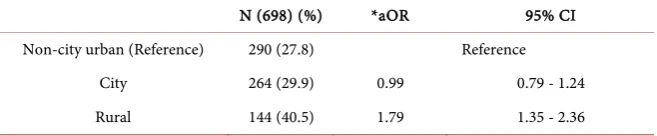
[image:4.595.208.538.404.737.2]Contraception use was different between population density strata, with a higher proportion of rural adolescents (46.5%) using a current method of con-traception, compared to city (36.6%) and non-city urban (32.5%) adolescent fe-males, (p < 0.001). Combined contraceptive methods were the most common across all populations, and LARC use was low. Using non-city urban adoles-cents as a reference (27.8%), rural adolesadoles-cents were more likely to use effective contraception methods (40.5%, aOR: 1.79; 95% CI: [1.35, 2.36]), whereas city
Table 1. Characteristics of female adolescents aged 15 - 19 in the NSFG by geographic distribution.
City Non-city urban Rural P-Value
N (2284) 884 1043 357
% 38.7 45.7 15.6
Age (mean (SD)) 17.2 (1.4) 17 (1.4) 17 (1.4) 0.009
Race <0.001
Black 307.6 (34.8) 137.7 (13.2) 50 (14) White 457 (51.7) 745.7 (71.5) 260 (72.8) Other 119.3 (13.5) 158.5 (15.2) 47.1 (13.2)
Total Pregnancies <0.001
none 739 (83.6) 942.9 (90.4) 302 (84.6)
1 97.2 (11) 74.1 (7.1) 40 (11.2)
≥2 47.7 (5.4) 26.1 (2.5) 15 (4.2)
Livebirths 0.71
none 311.2 (35.2) 427.6 (41) 136.4 (38.2) 1 457 (51.7) 531.9 (51) 188.1 (52.7) ≥2 115.8 (13.1) 83.4 (8) 32.5 (9.1)
Undesired Pregnancies 0.63
none 677.1 (76.6) 876.1 (84) 298.5 (83.6) 1 164.4 (18.6) 135.6 (13) 45.3 (12.7)
DOI: 10.4236/ojog.2018.85060 535 Open Journal of Obstetrics and Gynecology adolescents has similar rates of use (29.9%, aOR: 0.99; 95% CI: [0.79, 1.24]). (Table 2).
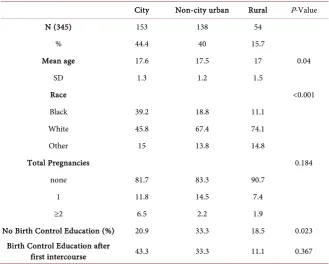
Among sexually active respondents who are not using contraception (see Ta-ble 3), the city population comprised the highest percentage of adolescents who had ever been pregnant (18.3%), compared to the non-city urban (16.7%) and rural (9.3%) populations, as well as the highest percentage of those who had been pregnant greater than or equal to 2 times (6.5%), compared to non-city ur-ban (2.2%) and rural adolescents (1.9%), (p = 0.184). Within this smaller cohort, significant differences existed in exposure to contraception counseling within the population density strata. The percentage of contraception counseling in non-city urban adolescents was 66.7%. In comparison, the city dwellers had a significantly higher rate of counseling (79.1%, aOR: 1.87; 95% CI: [1.09, 3.22]). Similarly, rural adolescents also had higher rate of counseling (81.7%, aOR: 2.37; 95% CI: [1.08, 5.19]) (Table 4).
4. Discussion
In this nationally representative sample of adolescent females, adolescents re-siding in rural populations were 1.79 times more likely to use effective contra-ception than adolescents of other populations. However, the pregnancy rate among rural adolescents was higher than non-city urban residents and compa-rable to city residents. Regarding the high-risk group of sexually active non-users of contraception, city and rural adolescents had higher exposure to birth control counseling, yet still failed to initiate using contraception compared to non-city urban adolescents. Additionally, these high-risk adolescents living in non-city urban environments who have significantly less exposure to contraception counseling, still have an overall lower pregnancy rate than their city cohorts.
[image:5.595.211.540.640.708.2]These findings highlight important differences in contraception use and counseling between US adolescent populations. It was particularly interesting to find that rural adolescents were more likely to use effective contraception me-thods, but did not have lower pregnancy rates. These findings suggest a dichot-omy of the rural adolescent population, with a significant portion of adolescents using effective contraception and not getting pregnant, and the remaining por-tion becoming pregnant more frequently, whether due to desired fertility or un-desired fertility without effective contraception use. There are differences in ru-ral populations that are too granular to be captured in the NSFG categories, which leads to the clumping of those in very rural populations where women are
Table 2. Effective contraception use in adolescents by population density.
N (698) (%) *aOR 95% CI
Non-city urban (Reference) 290 (27.8) Reference
City 264 (29.9) 0.99 0.79 - 1.24
Rural 144 (40.5) 1.79 1.35 - 2.36
DOI: 10.4236/ojog.2018.85060 536 Open Journal of Obstetrics and Gynecology
Table 3. Sexually active non-users of contraception.
City Non-city urban Rural P-Value
N (345) 153 138 54
% 44.4 40 15.7
Mean age 17.6 17.5 17 0.04
SD 1.3 1.2 1.5
Race <0.001
Black 39.2 18.8 11.1
White 45.8 67.4 74.1
Other 15 13.8 14.8
Total Pregnancies 0.184
none 81.7 83.3 90.7
1 11.8 14.5 7.4
≥2 6.5 2.2 1.9
No Birth Control Education (%) 20.9 33.3 18.5 0.023 Birth Control Education after
first intercourse 43.3 33.3 11.1 0.367
Table 4. Contraception education among sexually active adolescents not using birth con-trol.
N (257) (%) *aOR 95% CI
Non-city urban 92 (66.7) reference
City 121 (79.1) 1.87 1.09 - 3.22
Rural 44 (81.7) 2.37 1.08 - 5.19
*adjusted for age and race.
known to have less access to family planning services with those in less rural areas and adequate access [19]. It is possible that those residing in less rural en-vironments are receiving more effective contraception counseling and have a higher uptake of effective contraception, while those residing in extremely rural environments are not receiving counseling and getting pregnant more readily, although this was unable to be addressed in the study. Nonetheless, these varia-tions are useful when imagining the implementation of targeted family planning services across the US.
[image:6.595.209.539.395.461.2]DOI: 10.4236/ojog.2018.85060 537 Open Journal of Obstetrics and Gynecology
about birth control from a medical care provider in the last 12 months, which
could range from receiving pamphlets that list methods, to more thorough counseling sessions with a gynecologist. Interestingly, our findings showed that exposure to contraception counseling in general was associated with more up-take of effective methods of birth control. However, there are clearly other va-riables affecting contraception use even when counseling is present, which stresses the importance of a combination of quality counseling and access to ob-taining the methods.
As mentioned above, differences in access to obtaining contraception is likely part of the explanation for the variation in effective use of contraception and contraception counseling by population density. Contraception use is known to vary based on certain variables such as socioeconomic status and race [20]. There may also exist population disparities pertaining to access to family plan-ning services. Women living in rural areas traditionally have less access to re-productive services compared to metropolitan women [19]. Therefore, while our findings that rural adolescents had a higher uptake of effective contraception seems contradictory, it possibly reflects the abovementioned wide variation in rural populations, from more desolate farm country to areas just outside subur-ban populations [19]. Regarding the quality of contraception counseling, this likely does differ between population densities, but again, it seems unlikely that rural settings with a traditionally lower quality reproductive health care would be receiving higher quality counseling [19].
This study has several strengths. Importantly is its large sample size of a na-tionally representative sample of the US adolescent population. Addina-tionally, both in-person and computer-based methods of surveying were used to elicit respondents’ answers in an attempt to minimize responder bias inherent when questioning people about sensitive health and reproductive topics. There were also limitations. Important to consider are the different variations of “rural” populations that exist, which were unable to be ascertained in this dataset. Addi-tionally, given the study’s strategy of obtaining information via self-report as opposed to objective measures, it has the potential of leading to ascertainment bias, specifically responder reporting bias. Where this was avoided to the best extent possible by ensuring confidentiality and providing both in-person and lap-top interviewing methods, subjects have a natural tendency to answer ques-tions in a way that allows them to align with cultural beliefs [21]. This likely lead to a decrease in the overall reported number of undesired pregnancies and in in-crease in the overall reported contraception use, and therefore our results likely underestimate the true unintended pregnancy rate. And lastly, the analysis is based on a cross-sectional study rather than an experimental or prospective study, which naturally limits the conclusions we can draw.
5. Conclusion
ur-DOI: 10.4236/ojog.2018.85060 538 Open Journal of Obstetrics and Gynecology ban adolescents which warrant further study. This study stimulates several ques-tions as it sheds light onto population differences in the US adolescent popula-tion regarding contraceppopula-tion counseling and use, and pregnancy rates. Clear from the start is the need for better access to and increased uptake of effective methods of contraception. Also important is both the presence, and likely the quality of the counseling that accompanies. From this analysis, one could suggest that higher quality contraceptive counseling may be occurring in rural popula-tions, considering their higher use of effective methods of contraception. More studies are needed to understand how to more effectively increase contraception knowledge across all populations, for an ever-changing group of adolescents.
Implications
Effective contraception use does vary between population densities in the ado-lescent population, and does not necessarily correlate with lower unintended pregnancy rates.
Funding
This research did not receive any specific grant from funding agencies in the public, commercial or not-for-profit sectors.
References
[1] Finer, L.B. and Zolna, M.R. (2014) Shifts in Intended and Unintended Pregnancies in the United States, 2001-2008. American Journal of Public Health, 104, S43-S48.
https://doi.org/10.2105/AJPH.2013.301416
[2] Sonfield, A., Kost, K., Gold, R.B. and Finer, L.B. (2011) The Public Costs of Births Resulting from Unintended Pregnancies: National and State-Level Estimates. Pers-pectives on Sexual and Reproductive Health, 43, 94-102.
https://doi.org/10.1363/4309411
[3] Logan, C., Holcombe, E., Manlove, J. and Ryan, S. (2007) The Consequences of Unintended Childbearing. Washington DC Child Trends Natl Campaign to Prev Teen Pregnancy, 28, 142-151.
https://scholar.google.com/scholar?q=Cassandra,+et+al.+(2007).+The+Consequenc es+of+Unintended+Childbearing&btnG=&hl=en&as_sdt=0%252
[4] Cheng, D., Schwarz, E.B., Douglas, E. and Horon, I. (2009) Unintended Pregnancy and Associated Maternal Preconception, Prenatal and Postpartum Behaviors. Con-traception, 79, 194-198. https://doi.org/10.1016/j.contraception.2008.09.009
[5] Kost, K., Landry, D.J. and Darroch, J.E. (1998) Predicting Maternal Behaviors dur-ing Pregnancy: Does Intention Status Matter? Family Planning Perspectives, 30, 79.
https://doi.org/10.2307/2991664
[6] D’Angelo, D.V., Gilbert, B.C., Rochat, R.W., Santelli, J.S. and Herold, J.M. (2004) Differences between Mistimed and Unwanted Pregnancies among Women Who Have Live Births. Perspectives on Sexual and Reproductive Health, 36, 192-197.
https://doi.org/10.1363/3619204
DOI: 10.4236/ojog.2018.85060 539 Open Journal of Obstetrics and Gynecology
Reporting Areas, 2004. MMWR Surveill Summ Morb Mortal Wkly Report Surveill Summ/CDC, 56, 1-35.
[8] Hoffman, S.D., Kean, T.H., et al. (2006) By the Numbers Chairman Surgeon Gener-al Covenant House.
[9] Hoffman, S.D. and Maynard, R. (2008) Kids Having Kids: Economic Costs and So-cial Consequences of Teen Pregnancy. 2nd Edition, Rowman & Littlefield Publish-ers.
[10] Lepkowski, J.M., Davis, K.E., Groves, R.M. and Van Hoewyk, J. (2010) The 2006-2010 National Survey of Family Growth: Sample Design and Analysis of a Continuous Survey. Vital and Health Statistics, 2.
[11] Pediatrics, A.A. (2014) AAP Updates Recommendations on Teen Pregnancy Pre-vention.
https://www.aap.org/en-us/about-the-aap/aap-press-room/pages/AAP-Updates-Rec ommendations-on-Teen-Pregnancy-Prevention.aspx
[12] American College of Obstetricians and Gynecologists (2012) Adolescents and Long-Acting Reversible Contraception: Implants and Intrauterine Devices. Obste-trics & Gynecology, 120, 983-988.
[13] American College of Obstetricians and Gynecologists (2009) Increasing Use of Contraceptive Implants and Intrauterine Devices to Reduce Unintended Pregnancy.
Obstetrics & Gynecology, 114, 1434-1438.
[14] Buhi, E.R. and Goodson, P. (2007) Predictors of Adolescent Sexual Behavior and Intention: A Theory-Guided Systematic Review. Journal of Adolescent Health, 40, 4-21. https://doi.org/10.1016/j.jadohealth.2006.09.027
[15] Secura, G.M., Madden, T., McNicholas, C., et al. (2014) Provision of No-Cost, Long-Acting Contraception and Teenage Pregnancy. New England Journal of Med-icine, 371, 1316-1323. https://doi.org/10.1056/NEJMoa1400506
[16] Liddon, N., Steiner, R.J. and Martinez, G.M. (2018) Provider Communication with Adolescent and Young Females during Sexual and Reproductive Health Visits: Findings from the 2011-2015 National Survey of Family Growth. Contraception, 97, 22-28.
[17] Centers for Disease Control and Prevention. About the National Survey of Family Growth. National Survey of Family Growth.
http://www.cdc.gov/nchs/nsfg/about_nsfg.htm
[18] 2010 Standards for Delineating Metropolitan and Micropolitan Statistical Areas. Notice, 1-8.
[19] American College of Obstetricians and Gynecologists (2014) Health Disparities in Rural Women. Obstetrics & Gynecology, 123, 384-388.
[20] Dehlendorf, C., Park, S.Y., Emeremni, C., Comer, D., Vincett, K. and Borrero, S. (2014) Racial/Ethnic Disparities in Contraceptive Use: Variation by Age and Women’s Reproductive Experiences. American Journal of Obstetrics & Gynecology, 210, 526.e1-9.https://doi.org/10.1016/j.ajog.2014.01.037