34
Rating Prediction based on Social Sentiment from
Textual Reviews using MaxEnt Classifier
M. Kotinaik
M.Tech, CSE Dept Gudlavalleru Engineering College
Gudlavalleru, India
N. Rajeswari
Associate Professor, CSE Dept Gudlavalleru Engineering College
Gudlavalleru, India
ABSTRACT
Lately, we have seen a twist of survey sites. It introduces an incredible chance to share our perspectives for different items we buy. Be that as it may, we face the data over-burdening issue. The most effective method to mine significant data from surveys to comprehend a client's inclinations and make an exact proposal is vital. Customary recommender systems (RS) think about certain variables, for example, client's buy records, item classification, and geographic area. In this work, we propose an algorithm called MaxEnt classifier to improve prediction precision in recommender systems. Right off the bat, we propose a social client wistful estimation approach and ascertain every client's conclusion on things/items. Furthermore, we consider a client's own wistful qualities as well as mull over relational nostalgic impact. At that point, we think about item notoriety, which can be induced by the wistful disseminations of a client set that mirror clients' exhaustive assessment. Finally, we combine three components client assumption comparability, relational nostalgic impact, and thing's notoriety closeness into our recommender framework to make a precise rating prediction. We direct a presentation assessment of the three nostalgic factors on a genuine data gathered from IMDB.
Keywords
MaxEnt, Social Sentiment Analysis
1.
INTRODUCTION
Here is much close to home data in online literary audits, which assumes a significant job on choice procedures. For instance, the client will choose what to purchase on the off chance that the person sees significant surveys posted by others, particularly client's confided in companion. We trust surveys and analysts will do help to the rating prediction dependent on the possibility that high-star ratings may significantly be joined with great audits. Henceforth, how to mine surveys and the connection between analysts in interpersonal organizations has turned into a significant issue in web mining, AI and common language preparing. We center around the rating prediction task. Nonetheless, client's rating star-level data isn't constantly accessible on many survey sites. Alternately, audits contain enough nitty gritty item data and client sentiment data, which have incredible reference an incentive for a client's choice. Most significant of each of the, a given client on site is absurd to expect to rate each thing. Subsequently, there are numerous unrated things in a client thing rating network. It is inescapable in many rating prediction approaches for example [1], [4]. Audit/remark, as we as a whole know, is constantly accessible. In such case, it's advantageous and important to use client surveys to help foreseeing the unrated things. The ascent like DouBan1, Yelp2 and other survey sites gives an expansive idea in mining client inclinations and anticipating client's ratings. By and large, client's advantage is steady in present moment, so client themes from audits can be delegate. For instance, in the class of Cups and Mugs, various individuals have various tastes.
A few people focus on the quality, a few people center around the cost and others may assess exhaustively. Whatever, they all have their customized subjects. Most theme models present clients' interests as subject dispersions as indicated by surveys substance [10],[13]. They are generally connected in assumption investigation, travel suggestion, and informal organizations examination [19].
35 the organized information, which isn't constantly accessible on
certain sites. Notwithstanding, client audits can give us thoughts in mining relational induction and client inclinations.
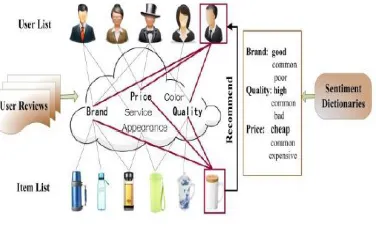
To address these issues, a slant based rating prediction method in the structure of framework factorization.We utilize social clients' assumption to surmise ratings. Fig. 1 is a model that shows our inspiration. To start with, we separate item includes from client audits. At that point, we discover the notion words, which are utilized to depict the item includes. Additionally, we influence supposition word references to figure conclusion of a particular client on a thing/item. In addition, we join social companion hover with conclusion to prescribe. In Fig.1, the last client is keen on those item includes, so dependent on the client surveys and the opinion word references, the last thing will be suggested. Contrasted and past work [2-5], [8], [9], the fundamental distinction is that: we utilize unstructured data to suggest rather than other organized social components. Contrasted and [6], [20], the primary distinction is that: their work fundamentally centers around characterizing clients into twofold slant (for example positive or negative), and they don't go further in mining client's notion. In our paper, we mine social client's notion, yet additionally investigate relational nostalgic impact and thing's notoriety. At last, we bring every one of them into the recommender framework. The fundamental commitments of our methodology are as per the following: 1) we propose a client nostalgic estimation approach, which depends on the mined notion words and opinion degree words from client surveys. Also, some adaptable applications are proposed. For instance, we investigate how the mined feeling spread among clients' companions. Also, we influence social clients' assessment to surmise thing's notoriety, which indicated incredible improvement in precision of rating prediction. 2) We utilize feeling for rating prediction. Client feeling likeness centers around the client intrigue inclinations. Client assessment impact reflects how the slant spreads among the confided in clients. Thing notoriety likeness demonstrates the potential pertinence of things. 3) We meld the three elements: client slant likeness, relational nostalgic impact, and thing notoriety comparability into a probabilistic network factorization system to complete an exact suggestion. The exploratory outcomes and exchanges demonstrate that client's social notion that we mined is a key factor in improving rating prediction exhibitions.
[image:2.595.313.554.104.220.2]The rating prediction method takes more time to process client reviews so we propose an algorithm MaxEnt classifier.Compared to previous method it process the client reviews in less time and improve the prediction.
Fig. 1. Recommendation system
Figure 1 shows The product features that user cares about are collected in the cloud including the words “Brand”, “Price”, and “Quality”, etc. By extracting user sentiment words from user reviews, we construct the sentiment dictionaries. And the last user is interested in those product features, so based on the user
reviews and the sentiment dictionaries, the last item will be recommended.
The basic recommendation system flow diagram
2.
EXISTING METHOD
Rating prediction method (RPS):The following sub-sections describe more details RPS,
2.1
Extracting Product Features
Product features mainly focus on the discussed issues of a product. In this paper, we extract product features from textual reviews using LDA [11]. We mainly want to get the product features including some named entities and some product/item/service attributes. LDA is a Bayesian model, which is utilized to model the relationship of reviews, topics and words. In Fig. 2, the shaded variables indicate the observed variables and the unshaded variables indicate the latent variables. The arrow indicates a conditional dependency between the variables and plates represented by the box.
Fig2. Graphical model representation of LDA.
Figure 2 shows the borders are representing replicates. The outer border represents user document, while the inner border represents the repeated choice of topics and words within a document.
2.1.1
Data preprocessing for LDA
[image:2.595.79.267.571.689.2]36 constructed in the vocabulary �, each word has a label �� ∈
{1,2, ⋯ , �� }.
2.1.2
The generative process of LDA
The input of LDA model is all users’ document sets �, and we assign the number of topic (we set 50 empirically). The output is the topic preference distribution for each user and a topic list, which contains at least 10 feature words under each topic. The For each document ��, we choose a dimensional Dirichlet random variable �� ∼Dirichlet (a).
topic, where [1, �] , we choose �� ∼Dirichlet (b). For each topic, the inference scheme is based upon the observation that:
[image:3.595.311.554.85.313.2](�, �|������ , �, �) = Σ (�, �|�, �� , �, �) � �(�, |������ , �, �)
We obtain an approximate posterior on � and � by using a Gibbs sampler to compute the sum over z.
output of LDA.
2.1.3
Extracting product features
From the three steps above, we obtain each user’s topic preference distribution and the topic list. From each topic, we have some frequent words. However, we need to filter the noisy features from the candidate set based on their co-occurrence with adjective words and their frequencies in background corpus. We have given an example of topics (cluster center of a review) and product features in Table 1. After we obtained all product features in a review, we add tags (i.e. the symbol “/” before product features) to distinguish other words in reviews. From Table 1, we can see that users in each topic care about a different subset of features, and each subset mainly reveals a different kind of product features.
2.2
User Sentimental Measurement
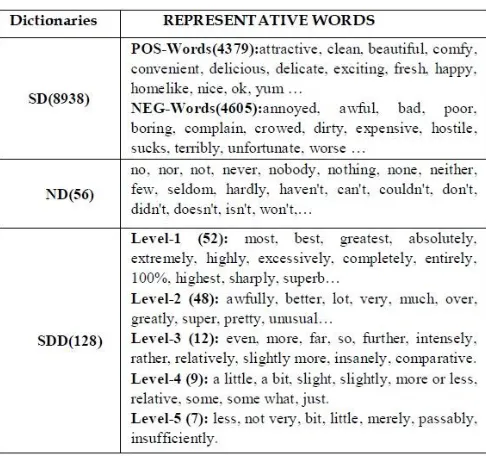
We extend HowNet Sentiment Dictionary3 [12] to calculate social user’s sentiment on items. In our paper, we merge the positive sentiment words list and positive evaluation words list of HowNet Sentiment Dictionary into one list, and named it as POS-Words; also, we merge the negative sentiment words list and negative evaluation words list of HowNet Sentiment Dictionary into one list, and named it as NEG-Words. Our sentiment dictionary (SD) includes 4379 POS-Words and 4605 NEG-Words. Besides, we have five different levels in sentiment degree dictionary (SDD), which has 128 words in total. There are 52 words in the Level-1, which means the highest degree of sentiment, such as the words “most”, and “best”. And 48 words in the Level-2, which means higher degree of sentiment, such as the words “better”, and “very”. There are 12 words in the Level-3, such as the words “more”, and “such”. There are 9 words in the Level-4, such as the words “a little”, “a bit”, and “more or less”. And there are 7 words in the Level-5, such as the words “less”, “bit”, and “not very”. Also, we built the negation dictionary (ND) by collecting frequently-used negative prefix words, such as “no”, “hardly”, “never”, etc. These words are used to reverse the polarity of sentiment words. The representative words and the sizes of all dictionaries are introduced in Table 1.
Table 1.Brief Introduction of the Sentiment Dictionaries
We firstly divide the original review into several clauses by the punctuation mark. Then for each clause, we firstly look up the dictionary SD to find the sentiment words before the product features. A positive word is initially assigned with the score +1.0, while a negative word is assigned with the score −1.0. Secondly, we find out the sentiment degree words based on the dictionary SDD and take the sentiment degree words into consideration to strengthen sentiment for the found sentiment words. Finally, we check the negative prefix words based on the dictionary ND and add a negation check coefficient that has a default value of +1.0. If the sentiment word is preceded by an odd number of negative prefix words within the specified zone, we reverse the sentiment polarity, and the coefficient is set to −1.0. When we have a level-1 sentiment degree word before the sentiment word, �� is set a value of 5.0; when we have a level-2 sentiment degree word before the sentiment word, �� is set a value of 4.0, etc. There is a one-to-one correlation between �� and five sentimental degree levels, �� =[0.25, 0.5, 2, 4, 5]. �� denotes the initial score of the sentiment word w.
2.3
Three Sentimental Factors
This section describes the major components of the system. Each sentiment factor is described as follows:
2.3.1
User Sentiment Similarity
Generally, user’s friends are trustworthy [2], [4], [8]. If a user has similar interest preferences with his/her friends, then he/she may hold similar attitudes towards the item. Based on this view, we firstly get all users’ sentiment, and then calculate the sentiment similarity between the user and his/her friends.
2.3.2
Interpersonal Sentiment Influence
37 a small influence on others. Generally, in mathematical
statistics, the variance is used to measure the degree of deviation between random variable and its mathematical expectation (average). According to information theory, large variance means the giant information. Therefore, the reviews with more information will have more influence. So we introduce the method of interpersonal sentiment influence by taking advantage of the concept of variance.
2.3.3
Item Reputation Similarity
From typical item-based collaborative filtering algorithms in [22], we know that similar items can help predicting ratings. Thus, it is important for us to find items that have similar features.We assume item’s reputation can indirectly reflect its real ratings. We leverage users’ sentiment distribution to infer item’s reputation. Based on users’ sentiment, we believe that if two items have similar sentiment distribution, then they may have similar reputation, and they will be posted with similar ratings.
3.
PROPOSED METHOD
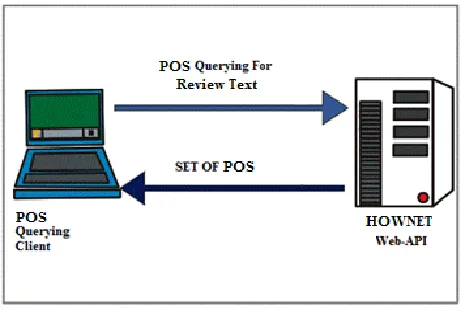
The word’s POS classification under a fore mentioned Sentiment Analytics method utilized the HowNet Sentiment Dictionary API. HowNet is an on-line common-sense knowledge base unveiling conceptual relations and inter-attribute relations of concepts as connoting in lexicons of the Chinese and their English equivalents. The first step is to extract keywords from the input text. The input considered in our work are product reviews. We identify all the nouns, verbs and adjectives in the metadata and store them as vectors using HowNet web api. Usage of HowNet web api requires the following architectural implementations from the current systems context.
Architectural diagram for HowNet
Such implementations increases querying time complexity during run time meta data classifications and also requires having a network to initiate text POS requests. So we propose to replace the How Net web api with an open-source maximum entropy based POS algorithm that comes with an embedded maxent pos database that can generate relevant pos’s fastly and efficiently. This format is useful for quickly perceiving the most prominent terms and for locating a term to determine its relative prominence. Algorithmic approach to select good quality POS’s for the given descriptors by giving preference to tags that seem very related when compared against the objects of less relevant. Given a query q and a scoring function s, this approach proceeds as follows
Algorithm for MaxEnt Classifier
4.
RESULTS
Table 2. Review processing in Hownet
Using HowNet the time taken to process the clinet reviews
[image:4.595.56.288.417.572.2]Shown in above table 2 by considering some reviews.
Table 3. Review processing in MaxEnt
Using MaxEnt clasiffier the time taken to process the clinet reviews shown in above table by considering some reviews.
Disadvantages of HowNet:-
38 up on the internet connection and it takes more time to add the
parts of speech tags to reviews.
Comparism Graph between Hownet and Maxent
The above graph shows time taken to process the review using both Hownet and MaxEnt..
5.
CONCLUSION:
In this paper, MaxEnt classifier was proposed by mining sentiment information from social users’ reviews and improve prediction score. Significant improvements over existing approaches on a real-world dataset. In our future work, we can consider more linguistic rules when analyzing the context, and we can enrich the sentiment dictionaries to apply fine-grained sentiment analysis. Besides, we can adapt or develop other hybrid factorization models such as tensor factorization or deep learning technique to integrate phrase-level sentiment analysis.
6.
REFERENCES
[1] R. Salakhutdinov, and A. Mnih, “Probabilistic matrix factorization,” in NIPS, 2008.
[2] X. Yang, H. Steck, and Y. Liu, “Circle-based recommendation in online social networks, ” in Proc. 18th ACM SIGKDD Int. Conf. KDD, New York, NY, USA, Aug. 2012, pp. 1267–1275.
[3] M. Jiang, P. Cui, R. Liu, Q. Yang, F. Wang, W. Zhu, and S. Yang, “Social contextual recommendation,” in proc. 21st ACM Int. CIKM, 2012, pp. 45-54.
[4] M. Jamali and M. Ester, “A matrix factorization technique with trust propagation for recommendation in social networks,” in Proc. ACM conf. RecSys, Barcelona, Spain. 2010, pp. 135-142.
[5] Z. Fu, X. Sun, Q. Liu, et al., “Achieving Efficient Cloud Search Services: Multi-Keyword Ranked Search over Encrypted Cloud Data Supporting Parallel Computing,” IEICE Transactions on Communications, 2015, 98(1):190-200.
[6] G. Ganu, N. Elhadad, A Marian, “Beyond the stars: Improving rating predictions using Review text content,” in 12th International Workshop on the Web and Databases (WebDB 2009). pp. 1-6.
[7] J. Xu, X. Zheng, W. Ding, “Personalized recommendation based on reviews and ratings alleviating the sparsity
problem of collaborative filtering,” IEEE International Conference on e-business Engineering. 2012, pp. 9-16. [8] X. Qian, H. Feng, G. Zhao, and T. Mei, “Personalized
recommendation combining user interest and social circle,” IEEE Trans. Knowledge and data engineering. 2014, pp. 1763-1777.
[9] H. Feng, and X. Qian, “Recommendation via user’s personality and social contextual,” in Proc. 22nd ACM international conference on information & knowledge management. 2013, pp. 1521-1524.
[10]Z. Fu, K. Ren, J. Shu, et al., “Enabling Personalized Search over Encrypted Outsourced Data with Efficiency Improvement,” IEEE Transactions on Parallel & Distributed Systems, 2015:1-1.
[11]D.M. Blei, A.Y. Ng, and M. I. Jordan, “Latent Dirichlet Allocation,” Journal of machine learning research 3. 2003, pp. 993-1022.
[12]W. Zhang, G. Ding, L. Chen, C. Li , and C. Zhang, “ Generating virtual ratings from Chinese reviews to augment online recommendations,” ACM TIST, vol.4, no.1. 2013, pp. 1-17.
[13]Z. Xia, X. Wang, X. Sun, and Q. Wang, “A Secure and Dynamic Multi-keyword Ranked Search Scheme over Encrypted Cloud Data,” IEEE Transactions on Parallel and Distributed Systems, vol. 27, no. 2, 2015, pp. 340-352. [14]J. Weston, R. J. Weiss, H. Yee, “Nonlinear latent factorization by embedding multiple user interests,” 7th ACM, RecSys, 2013, pp. 65-68.
[15]J. Huang, X. Cheng, J. Guo, H. Shen, and K. Yang, “ Social recommendation with interpersonal influence,” in Proc. ECAI, 2010, pp. 601-606.
[16]Y. Lu, M. Castellanos, U. Dayal, C. Zhai, “Automatic construction of a context-aware sentiment lexicon: an optimization approach,” World Wide Web Conference Series. 2011, pp. 347-356.
[17]T. Kawashima, T. Ogawa, M. Haseyama, “A rating prediction method for e-commerce application using ordinal regression based on LDA with multi-modal features,” IEEE 2nd Global Conference on Consumer Electronics (GCCE). 2013, pp. 260-261.
[18]K.H. L. Tso-Sutter, L. B. Marinho, L. Schmidt-Thieme, “Tag-aware recommender systems by fusion of collaborative filtering algorithms,” in Proceedings of the 2008 ACM symposium on Applied computing, 2008, pp. 1995-1999.
[19]B. Wang, Y. Min, Y. Huang, X. Li, F. Wu, “ Review rating prediction based on the content and weighting strong social relation of reviewers,” in Proceedings of the 2013 international workshop of Mining unstructured big data using natural language processing, ACM. 2013, pp. 23-30 [20]F. Li, N. Liu, H. Jin, K. Zhao, Q. Yang, X. Zhu,
“Incorporating reviewer and product information for review rating prediction,” in Proceedings of the Twenty-Second international joint conference on Artificial Intelligence, 2011, pp. 1820-1825..