HAND GESTURE RECOGNITION USING GRADIENT ORIENTATION
P.K. Srimani
1Department Of Comp2Department of MCA, Dayananda Sagar College of Arts,
ARTICLE INFO ABSTRACT
Hand gesture recognition system can be used for providing the interface between computer and human using hand gestures. The main objective of the present work is to develop
recognition of thirty six static hand gestures in the American Sign Language (ASL). By employing a pattern recognition technique in which the orientation histogram is used as a feature vector for gesture classification and interpolation
INTRODUCTION
Hand gesture recognition system can be used for interfacing between computer and human using hand gesture. This work presents a technique for a human computer interface through hand gesture recognition that is able to recognize 36 static gestures from the American Sign Language hand alphabet. The objective of this paper is to develop an algorithm for recognition of hand gestures with reasonable accuracy. Recently, there has been a surge of interest in recognizing human hand gestures. Hand-gesture recognition has various applications like computer games, machinery control (e.g. crane), language for speech and hearing impaired and thorough mouse replacement. One of the most structured sets of gestures belongs to sign language. In sign language, each gesture has an assigned meaning (or meanings).
recognition of hand gestures may provide a more natural computer interface, allowing people to point, or rotate a CAD model by rotating their hands. Hand gestures can be classified in two categories: static and dynamic. A static gesture is a particular hand configuration and pose, represented by a single image. A dynamic gesture is a moving gesture, represented by a sequence of images. We will focus on the recognition of static images [1] to [3].
APPLICATIONS
Creating a proper sign language (ASL – American Sign Language) dictionary is not the desired result at this point. This would combine advanced grammar and syntax structure understanding of the system, which is outside the scope of this work.
*Corresponding author: [email protected], [email protected],
ISSN: 0975-833X
International Journal of Current Research
Vol.
Article History:
Received 17th November, 2011
Received in revised form
14th
December, 2011
Accepted 18th
January, 2011
Published online 29th February, 2012
Key words:
American Sign Language, Blurring, Gradient Orientation,
Hand gesture recognition, Computer interface
RESEARCH ARTICLE
HAND GESTURE RECOGNITION USING GRADIENT ORIENTATION
Srimani
1and Mrs. S. Kavitha
2Of Computer Science and Maths, B.U, Director, R&D, B.U. of MCA, Dayananda Sagar College of Arts, Sc. & Commerce, Bangalore,
ABSTRACT
Hand gesture recognition system can be used for providing the interface between computer and human using hand gestures. The main objective of the present work is to develop
recognition of thirty six static hand gestures in the American Sign Language (ASL). By employing a pattern recognition technique in which the orientation histogram is used as a feature vector for gesture classification and interpolation accurate results are obtained.
Copy Right, IJCR, 2012, Academic Journals
Hand gesture recognition system can be used for interfacing between computer and human using hand gesture. This work technique for a human computer interface through hand gesture recognition that is able to recognize 36 static gestures from the American Sign Language hand alphabet. The objective of this paper is to develop an algorithm for th reasonable accuracy. Recently, there has been a surge of interest in recognizing gesture recognition has various applications like computer games, machinery control (e.g. crane), language for speech and hearing impaired and rough mouse replacement. One of the most structured sets of gestures belongs to sign language. In sign language, each gesture has an assigned meaning (or meanings). Computer recognition of hand gestures may provide a more
natural-ng people to point, or rotate a CAD model by rotating their hands. Hand gestures can be classified in two categories: static and dynamic. A static gesture is a particular hand configuration and pose, represented by a single ving gesture, represented by a sequence of images. We will focus on the recognition of
American Sign Language) dictionary is not the desired result at this point. This would combine advanced grammar and syntax structure understanding of the system, which is outside the scope of this
,
The ASL will be used as the database since it’s a tightly structured set. From that point further appli
suited.
American Sign Language
ASL is the language of choice for most deaf people in the United States. ASL is one of the many sign languages of the world. ASL consists of approximately 6000 gestures of common words with finger spelling
obscure words or proper nouns [4] to [6]. Finger spelling uses one hand and 26 gestures to communicate the 26 letters of the alphabet signs which can be seen in
[image:1.612.316.550.522.717.2]communicate the 9 digits can be seen in Fig. 2 bel
Fig. 1. American Sign Language(ASL) alphabets from A to Z
ternational Journal of Current Research
Vol. 4, Issue, 02, pp.191-195, February,2012
INTERNATIONAL
OF CURRENT RESEARCH
HAND GESTURE RECOGNITION USING GRADIENT ORIENTATION
R&D, B.U.
Bangalore, India
Hand gesture recognition system can be used for providing the interface between computer and human using hand gestures. The main objective of the present work is to develop algorithms for the recognition of thirty six static hand gestures in the American Sign Language (ASL). By employing a pattern recognition technique in which the orientation histogram is used as a feature vector for
, Academic Journals. All rights reserved.
The ASL will be used as the database since it’s a tightly structured set. From that point further applications can be
ASL is the language of choice for most deaf people in the United States. ASL is one of the many sign languages of the world. ASL consists of approximately 6000 gestures of common words with finger spelling used to communicate [4] to [6]. Finger spelling uses one hand and 26 gestures to communicate the 26 letters of the alphabet signs which can be seen in Fig.1 and 9 gestures to communicate the 9 digits can be seen in Fig. 2 below.
American Sign Language(ASL) alphabets from A to Z INTERNATIONAL JOURNAL
Fig. 2. American Sign Language(ASL) digits from 1 to 9
Background
Research on hand gestures can be classified into three categories. The first category, glove based analysis, employs sensors (mechanical or optical) attached to a glove that transducers finger flexions into electrical signals for determining the hand posture. The second category, vision based analysis, is based on the way human beings perceive information about their surroundings. It is probably the most difficult to implement in a satisfactory way. The third category, analysis of drawing gestures, usually involves the use of a stylus as an input device. Analysis of drawing gestures can also lead to recognition of written text.
Goals
The scope of this investigation is to create a method to recognize hand gestures, based on a pattern recognition technique; employing histograms of local orientation. The orientation histogram will be used as a feature vector for gesture classification and interpolation.
METHODOLOGY
The present investigation is carried out by using MATLAB. MATLAB is an interactive system whose basic data element is an array that does not require dimensioning. This allows us to solve many technical computing problems, especially those with matrix and vector formulations. In a fraction of time it would take to write a program in a scalar non-interactive language such as C or Fortran. The reason for selecting the MATLAB tool for the development of this paper is its toolboxes. Toolboxes allow you to learn and apply specialized technology. Toolboxes are comprehensive collections of MATLAB functions (M-files) that extend the MATLAB environment to solve particular classes of problems. It includes among other image processing and neural networks toolboxes.
Approach
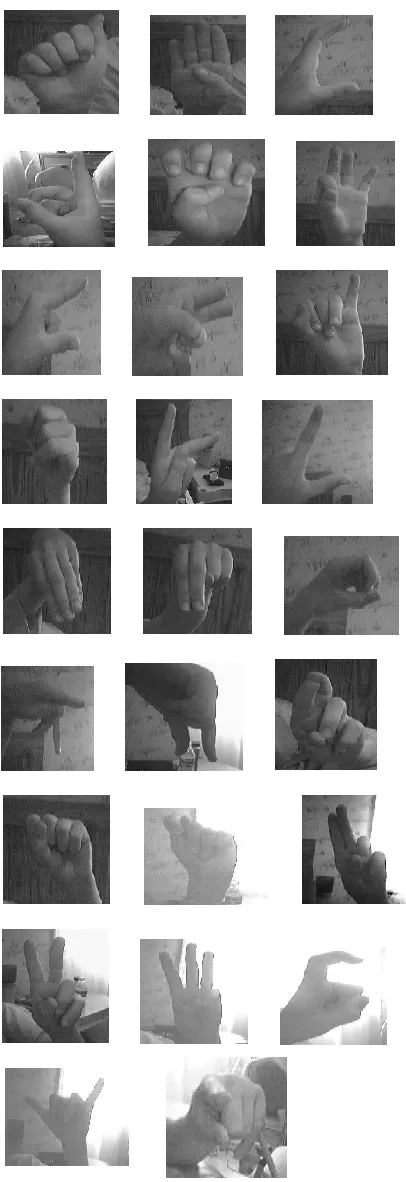
The images were taken from the ASL database on the Internet. Three operations were carried out in all of the images. They were converted to grayscale, the background was made uniform and applied three types of Blurring methods (Gaussian, Motion and Smart) to each image [7]. The final form of the database is Fig. 3.
Training set
There are thirty six training sets of images, each one containing three images. Each set originates from a single image for testing.
Fig. 3. Blurred images for the test image database (Gaussian
[image:2.612.61.303.49.142.2]Blur, Motion Blur , Smart Blur)
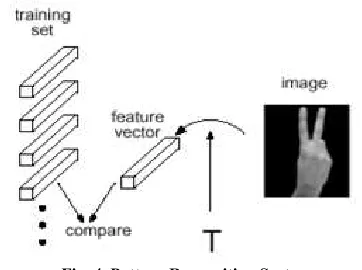
Fig. 4. Pattern Recognition System
The pattern recognition system that will be used can be seen in Fig. 4. Some transformation T, converts an image into a feature vector, which will be then compared with feature vectors of a training set of gestures. Histogram orientation has the advantage of being robust in lighting change conditions. If we follow the pixel-intensities approach certain problems can arise for varying illumination. Taking a pixel-by-pixel difference of the same photo under different lighting conditions would show a large distance between these two identical gestures. Orientation analysis should give robustness in illumination changes while histogramming will offer translational invariance. This method will work if examples of the same gesture map to similar orientation histograms, and different gestures map to substantially different histograms[8] and [9].
Orientation histograms
[image:2.612.339.520.257.392.2](dx, dy). It was decided to use the edge orientation as the only feature that will be presented to the neural network. The reason for this is that if the edge detector was good enough it would have allowed us to test the network with images from different databases[6]. Another feature that could have been extracted from the image would be the gradient magnitude using the formula below
ds= dx2 + dy 2
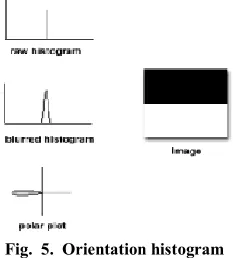
[image:3.612.331.494.69.303.2]This would lead to testing the algorithm with only similar images. Apart from this the images that are before resized should be of approximately the same size. This is the size of the hand itself in the canvas and not the size of the canvas. Once the image has been processed the output will be a single vector containing a number of elements equal to the number of bins of the orientation histogram. Fig. 5 shows the orientation histogram calculation for a simple image. Blurring can be used to allow neighboring orientations to sense each other.
Fig. 5. Orientation histogram
The program is ‘divided’ into 5 steps:
STEP 1:
Read the image database. A for loop is used to read an entire folder of images and store them in MATLAB’s memory. The folder is selected by the user from menus. A menu will firstly pop-up asking you to run the algorithm on test image set. Then a second menu will pop-up for the user to choose which ASL sign he wants to use.
STEP 2:
Resize all the images that were read in Step1 to 150x140 pixels. This size seems the optimal for offering enough detail while keeping the processing time low.
STEP 3:
Detection of the edges. As mentioned before two filters were used.
For the x direction x = [0 -1 1] For the y direction y= [0 1 -1] '
In Fig. 6. We can see two images of the result of convolving an ASL sign of number 2 with the x-filter and y-filter. This is the only feature extracted from the images and it has to offer enough discrimination among them. From the images above it doesn’t seem like a good edge detector. In fact it doesn’t look like an edge detector.
STEP 4
Dividing the two resulting matrices (images) dx and dy
element by element and then taking the atan (tan−1 ). This will
give the gradient orientation. The Gradient of an image is:
[image:3.612.121.241.260.389.2]
Fig. 6. X-Y filters
STEP 5:
Conversion of the column matrix with the radian values to degrees. This way we can scan the vector for values ranging from 0ο to 90ο. This is becuuse for real elements of X, atan(X) is in the range. This can also be seen from the orientation histograms where values come up only on the first and last quarter.Determination of the number of the histogram bins is another issue that is solved by experimenting with various values. We have tried with 18 20 24 and 36 bins. What was expected was the differentiation (or not) among the images. The smaller the vector the faster the processing. Finally, the actual resolution of each bin is set to 10ο , which means 19 bins.
Fig. 7. Orientation Histogram for digit 2 in ASL
The algorithms were developed by keeping in mind MATLAB weaknesses. The major one is speed. MATLAB is perfect for speeding up the development process but it can be very slow on execution when bad programming practices have been employed. Nested loops slow down the program considerably. It is probably because MATLAB is built on loops. Therefore, unnecessary back-tracking is avoided and even some routines are written in full instead of using for
[image:3.612.339.544.492.602.2]EXPERIMENTS AND RESULTS
Fig. 8 shows the pop-menu for the user to select the particular alphabet or digit to display the hand gesture
Fig. 9. The test results for digits from 1 to 9 when user chooses the option from pop-up menu
[image:4.612.80.278.57.474.2]Fig. 10. Test results for alphabets from A to Z
Fig. 10, shows the test results for alphabets from A to Z when user chooses the option from pop-up menu
Conclusion
[image:4.612.68.289.510.709.2]tried to use it in various applications from hand recognition to cat recognition and geographical statistics. In other approaches of pattern recognition orientation histograms have used different ways of comparing and classifying images. Euclidean distance is a straight forward approach to it. It is efficient as long as the data sets are small and not further improvement is expected. As far as the orientation algorithm is concerned it can be further improved. The main problem is how effective differentiation one can achieve. This of course is dependent upon the images but it comes down to the algorithm as well. Edge detection techniques are keep changing while line detection can solve some problems.The main objective of this paper was the speed and the avoidance of special hardware. MATLAB is slower but allows its users to work faster and concentrate on the results and not on the design. Finally, it is concluded that the present methodology is excellent for problems of similar types.
REFERENCES
1. William T. Freeman, Michael Roth, “Orientation Histograms for Hand Gesture Recognition” IEEE Intl.
Wkshp. On Automatic Face and Gesture
Recognition,Zurich, June, 1995.
2. Maria Petrou, Panagiota Bosdogianni, “Image Processing, The Fundamentals”, Wiley Vladimir I. Pavlovic, Rajeev Sharma, Thomas S Huang, “Visual Interpretation of Hand Gestures for Human-Computer Interaction :
A review” IEEE Transactions of pattern analysis and machine intelligence, Vol 19, NO 7, July 1997.
3. Srinivas Gutta, Ibraham F. Imam, Harry Wechsler, “ Hand gesture Recognition Using Ensembles of Radial Basis Functions (RBF) Networks and Decision Trees”
International Journal of Pattern Recognition and Artificial Intelligence, Vol 11 No.6 1997.
4. http://www.merl.com/people/freeman/
5. http://deafness.about.com/health/deafness/gi/dynamic/ offsite.htm?site=http://www.lifeprint.com/ASL101/welco me.htm
6. http://deafness.about.com/health/deafness/
7. Prof. Dr. P.K.Srimani and S. Kavitha "A comparative study of Different Deblurring methods using Filters" © 2011, American Institute of Physics 978-0-7354-0879-1/11/$30.00
8. Duane Hanselman, Bruce Littlefield, “Mastering
MATLAB, A comprehensive tutorial and reference”, Prentice Hall
9. Lalit Gupta and Suwei Ma “Gesture-Based Interaction and Communication: Automated Classification of Hand
Gesture Contours”, IEEE transactions on systems, man,
and cybernetics—part c: applications and reviews, vol. 31, no. 1, February 2001