ISSN Online: 2152-7393 ISSN Print: 2152-7385
DOI: 10.4236/am.2018.96042 Jun. 13, 2018 602 Applied Mathematics
Statistics of Projected Motion in One
Dimension of a D-Dimensional Random Walker
Jayeeta Chattopadhyay
1,2, Muktish Acharyya
21Department of Physics, Indian Institute of Science, Bangalore, India 2Department of Physics, Presidency University, Calcutta, India
Abstract
We are studying the motion of a random walker in generalised d-dimensional continuum with unit step length (up to 10 dimensions) and its projected one dimensional motion numerically. The motion of a random walker in lattice or continuum is well studied in statistical physics but what will be the statistics of projected one dimensional motion of higher dimensional random walker is yet to be explored. Here in this paper, by addressing this particular type of problem, it shows that the projected motion is diffusive irrespective of any dimension; however, the diffusion rate is changing inversely with dimensions. As a consequence, it can be predicted that for the one dimensional projected motion of infinite dimensional random walk, the diffusion rate will be zero. This is an interesting result, at least pedagogically, which implies that though in infinite dimensions there is diffusion, its one dimensional projection is mo-tionless. At the end of the discussion we are able to make a good comparison between projected one dimensional motion of generalised d-dimensional random walk with unit step length and pure one dimensional random walk with random step length varying uniformly between −h to h where h is a “step length renormalizing factor”.
Keywords
Higher Dimensions, Random Walk, Projected Walk, Renormalizing Factor, Diffusive
1. Introduction
The basis of random walk theory can be described by the irregular motion of in-dividual pollen particle, famously studied by botanist Brown (1828), now known as Brownian motion. It is somewhat quite surprising that it was only at the be-How to cite this paper: Chattopadhyay,J.
and Acharyya, M. (2018) Statistics of Pro-jected Motion in One Dimension of a D-Dimensional Random Walker. Applied Mathematics, 9, 602-617.
https://doi.org/10.4236/am.2018.96042
Received: May 10, 2018 Accepted: June 10, 2018 Published: June 13, 2018
Copyright © 2018 by authors and Scientific Research Publishing Inc. This work is licensed under the Creative Commons Attribution International License (CC BY 4.0).
DOI: 10.4236/am.2018.96042 603 Applied Mathematics ginning of the twentieth century that random walk was described in the litera-ture but its application is widely spread all over in nalitera-ture starting from move-ment of animals, micro-organisms [1], cell migration [1], motion of reagent molecules in a solution [2], process of polymerization [3] [4] to today’s stock prices [5]. The absorbing phase transition in a conserved lattice gas with random neighbor particle hopping [6], quenched averages for self avoiding walks [7] on random lattice is also studied. In biology and real life random walk problem has a great importance. Apart from opening and closing of cell membrane channels
[8] it has also a great importance on cell migration leading blood vessel growth (angeogenesis) [1]. Very recently the first passage property [5] of a random walker has great importance in various aspects; for example, fluorescence quenching [5], in which light emission by a fluorescent molecule stops when it reacts with a quencher; integrate-and-fire neurons [5], in which a neuron fires only when a fluctuating voltage level first reaches a specified level; and the ex-ecution of buy/sell orders when a stock price [5] first reaches a threshold. The statistics of Pearson walker in two dimensions for shrinking step size and the transition of the endpoint distribution by varying the initial step size are studied in [9]. Studying random walk in lattice (or continuum) with constant step length is an age old problem. But how does this motion get affected if the walker be-comes tired gradually is mentioned in [10]. Random walk for randomly varying step length and its return probability have been studied recently [11].
Nowadays random walk in higher dimensions is a challenging problem. Study of planer motion of a random walker was started with Pearson [12]. Rayleigh was apparently the first to have been study random walk in 3 dimensions (known as random flight) [13]. Then random walk in higher dimensions has been studied by G.N. Watson [14]. Arithmetic properties of short uniform ran-dom walk in arbitrary dimensions with probability densities in the case of up to five steps have been studied in [15]. Diffusion limits of the Random walk in higher dimensions by Metropolis algorithm has already been calculated [16]. In the classic paper in 1921, Poyla proved that a simple symmetric random walk on
d
Z was recurrent for d≤2 and transient otherwise [17]. Recurrence relation for arbitrary dimensions has been studied recently [18]. As an application of all these, multidimensional random walk has been studied in polymer with an em-phasis on naturalrenormalised renewal structure [19] and in probabilistic Road maps for path planning in higher dimensional configuration spaces [20].
DOI: 10.4236/am.2018.96042 604 Applied Mathematics walk may open a new way to address the problem of light propagation through thin slabs. But statistical properties of simple random walk in continuum irres-pective of any dimension and its projected one dimensional motion are yet to be explored. In this context it is to be mentioned that according to our knowledge in standard textbooks of statistical mechanics one, two and three dimensional random walk are exactly solvable. So we address that the study of projected mo-tion may open a new way to solve the random walk problem analytically irres-pective of any dimension. Here, in this paper addressing this particular problem we have tried to find out the following answers computationally.
1) What are the characteristics of projected one dimensional motion of gene-ralised d-dimensional random walk with unit step length?
2) Is it diffusive?
3) And finally, can we construct a pure one dimensional random walk with which projected motion of generalised d-dimensional random walk can be compared?
The point (3) is important in the context that if we can get equivalent statis-tical properties of projected motion from pure one dimensional random walk which is exactly solvable then the exact solution of higher dimensional random walk may be possible.
In this study by pure 1 dimensional random walk we wanted to say random walk in 1 dimensional continuum and projected random walk of higher dimen-sions means 1 dimensional projection of higher dimensional random walk. The numerical results of detailed statistical analysis of random walk in dimensions 1, 2, 3, 4, 5, 6, 7, 8, 9, 10 and its projected motion are reported here. The manu-script is organised as follows: In the next section (Section (2)) the model and numerical results observed from the numerical simulation are reported and the paper ends with a concluding remarks mentioned in Section (3).
2. Model and Results
pro-DOI: 10.4236/am.2018.96042 605 Applied Mathematics jected step length in every co-ordinate varies between −1 to +1. The formalism of random walk in generalised d-dimensional continuum is as follows.
Suppose we are considering random walk in d-dimensional continuum with unit step length. Let, the projected step lengths in each coordinate are (r r r1 2 3′ ′ ′, , , , rd′). Then the step length in d-dimensions is:
( ) ( )
2 2( )
21 2 d
R′= r′ + r′ ++ r′ (1)
But this not normalised, so the actual projected step length in every co-ordinate so that the step length in d-Dimensions is unity are:
3
1 2
1 r , 2 r , 3 r , , d rd
r r r r
R R R R
′ ′
′ ′
= = = =
′ ′ ′ ′ (2) Now the step length in d-dimensions becomes
2 2 2
1 2 d 1
R= r + + +r r = (3)
The mathematical rule for a random walker moving in generalised d-dimensional continuum can be expressed as:
(
)
( )
(
)
( )
(
)
( )
(
)
( )
1 1 1
2 2 2
3 3 3
1 1 1
1
d d d
x t x t r
x t x t r
x t x t r
x t x t r
+ = + + = + + = + + = + (4)
where
(
x t x t1( ) ( )
, 2 , , x td( )
)
are the positions of the random walker at time t and(
x t1(
+1 ,) (
x t2 +1 , ,)
x td(
+1)
)
are the the positions of the random walker in the next time step,(
r r r1 2 3, , , , rd)
are the projected step lengths in ponding coordinates varying between −1 to 1 so that the step length in corres-ponding dimensions is unity.We have classified this method as vector method for generalized d-dimensional random walk which can be well understood by selecting some points randomly on the surface of a d-dimensional hypersphere of unit radius.
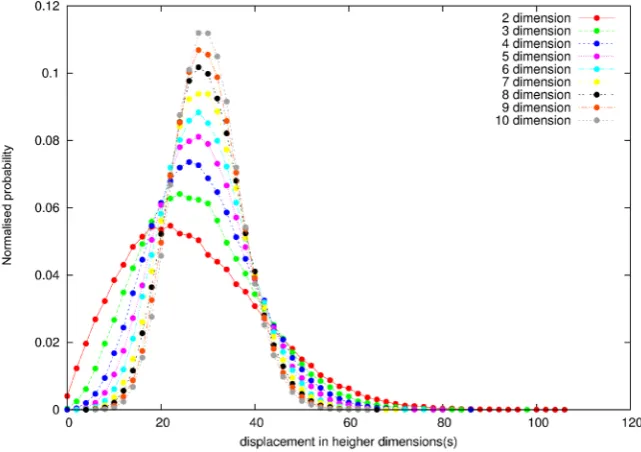
Now we know random walk is purely diffusive. But still for verification we have calculated mean square displacement S2 for the dimensions (1, 2, 3, 4, 5, 6, 7, 8, 9, 10) which is proportional to time (t) that reveals diffusive behavior (Figure 1). The distribution of absolute displacement after time steps (Nt =1000) in d-dimensional continuum is plotted in (Figure 2) where it is seen that the distributions are non-monotonic and unimodal and as we increase the dimension, the most probable value i.e. maximum probability of finding the walker at a distance (Sm) from the starting point is shifting towards higher
val-ue.
DOI: 10.4236/am.2018.96042 606 Applied Mathematics
Figure 1. Mean-square-displacement
( )
S2 versus time (t) is plotted for 1, 2, 3, 4, 5, 6,7, 8, 9, 10 dimensions. Here number of samples Ns = 100,000.
Figure 2. Distribution of absolute displacement P(s) after 1000 time steps (Nt = 1000) for
d-dimensional (d = 2, 3, 4, 5, 6, 7, 8, 9, 10 dimensions) random walk with unit step length. here Ns = 100,000.
DOI: 10.4236/am.2018.96042 607 Applied Mathematics
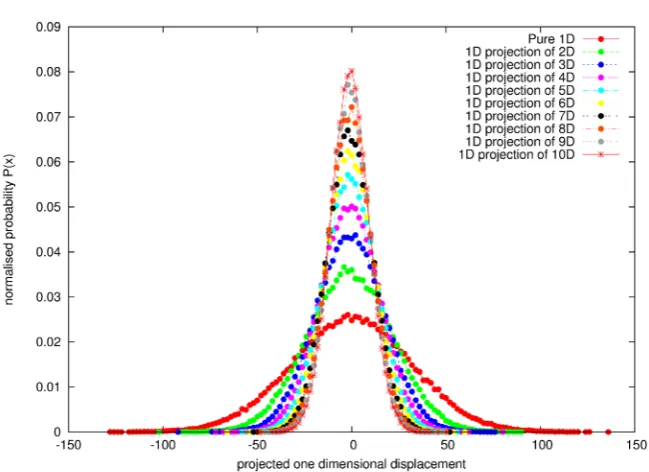
Figure 3. Distribution of displacement of 1 dimensional projection of d-dimensional random walk (d = 2, 3, 4, 5, 6, 7, 8, 9, 10 dimensions) with unit step length and Distribution of displacement for pure one dimensional random walk with unit step length after the time step Nt = 1000 for Ns = 100,000. Here it is seen that as dimensions are
[image:6.595.211.536.61.297.2]increasing the distributions are getting sharper and sharper.
Figure 4. Mean-square-displacement
( )
2 1x of 1 dimensional projection of d-dimensional random walk (d = 2, 3, 4, 5, 6, 7, 8, 9, 10 dimensions) versus time t for Ns = 100,000. Here
it is seen that as we increase the dimension, the slope of the graph i.e. diffusion rate decreases.
[image:6.595.214.534.381.609.2]DOI: 10.4236/am.2018.96042 608 Applied Mathematics
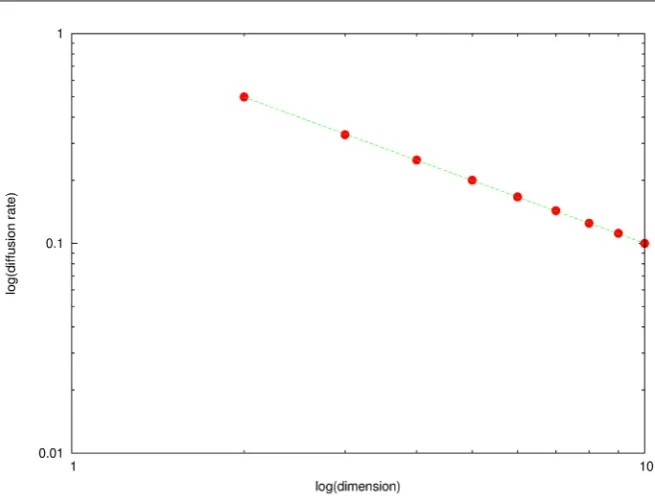
Figure 5. Diffusion rate (c) of 1 dimensional projection of d-dimensional random walk (d = 2, 3, 4, 5, 6, 7, 8, 9, 10 dimensions) versus dimensions (d). The dotted line is
( )
1 f x = x.1
c d
= (5)
From this dependence of c on d it can be predicted that in case of infinite di-mensions c goes to “0”. This is an interesting result at least pedagogically which can be well interpreted as, though there is a motion in infinite dimensions, but its one dimensional projection is motionless.
In the following table numerical values (observed from simulation) of Diffu-sion rate of projected motion corresponding to dimenDiffu-sions (2 to 10 dimenDiffu-sion) are mentioned:
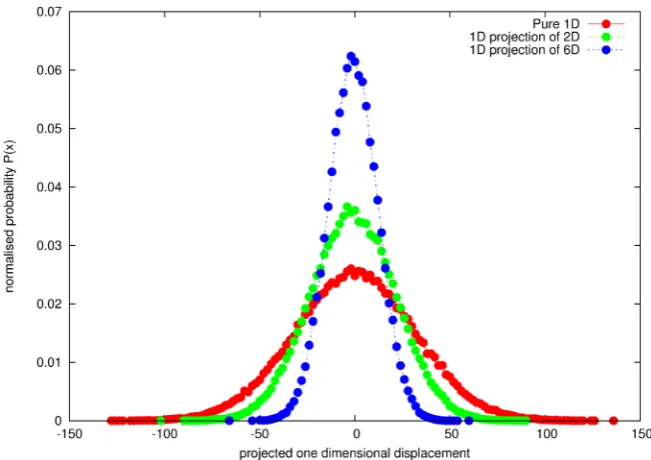
DOI: 10.4236/am.2018.96042 609 Applied Mathematics 1) The distribution of displacement for projected motion is Gaussian like pure 1 dimensional random walk with zero mean but the width of the distribution is not similar rather it is decreasing as the dimension is increasing (Figure 6).
2) The mean-square displacement of projected motion
( )
x2 isproportion-al to time i.e. diffusive like pure 1 dimensional random walk but the diffu-sion-rate (c) is not same rather decreasing inversely as we increase the dimen-sion.
Now the question is: is there any generalized one dimensional random walk from which we can get similar statistical properties (diffusion rate, distribution of displacements) of the projected motion of higher dimensional random walk with unit step length? The answer can be given by the following analysis.
From mathematical formalism (discussed above) it is clear that projected mo-tion of higher dimensions (2, 3, 4, ..., d) is a random walk with random step length varying between −1 to +1. But Figure 3 shows that distribution of dis-placement of projected motion after Nt =1000 time steps are getting sharper and sharper as we increase the dimensions. So the possible reason for the distri-butions getting sharper and sharper may be the decrease of magnitude of pro-jected step length r1 as d increases. From this consideration we can say that, the
magnitude of r1 changes along with dimensions and the boundary values of r1 is
no longer −1 to +1 rather it is different for different dimensions. So the ultimate question is how we can modify the pure one dimensional step length so that we can get equivalent statistical properties of projected motion from pure one di-mensional random walk? In this regard we have introduced a factor h named as step length renormalizing factor and multiplied r1 by this factor. Now r1 varies
[image:8.595.209.535.457.687.2]between −h to +h instead of −1 to +1 and the value of h is different for different
DOI: 10.4236/am.2018.96042 610 Applied Mathematics dimensions. For every dimension we choose h in such a way so that the average mismatching between two distributions (distribution of displacement after Nt
times for projected motion and pure one dimensional motion) is minimum. We define the average mismatching factor by following way.
Let, the probability density for pure 1 dimensional random walk is P x1D
( )
and probability density for projected motion is PdDp( )
x then the average mis-matching factor Q is defined as( )
( )
(
)
21
dDp D
x P x P x
Q
M −
=
∑
(6)Q is obviously function of h i.e. Q Q h=
( )
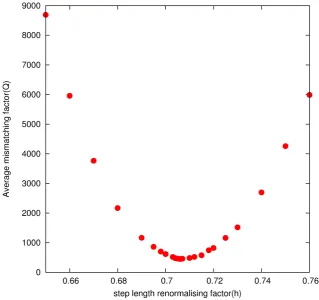
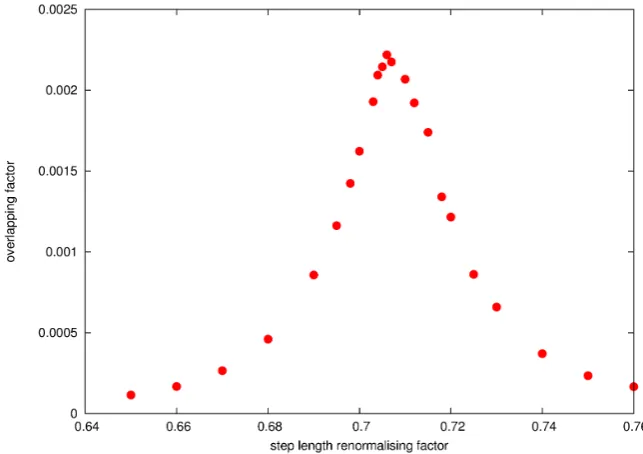
and M is the number of points [image:9.595.214.534.390.690.2]over which we are averaging. But estimating the value of h from (in Figure 7) is not precise as the minima is smeared. So we have plotted 1Q h
( )
which is named as average overlapping factor, versus h where maxima is sharp and from this maxima we have estimated the value of h for every dimension precisely. For these values of h corresponding to every dimension, the distributions (men-tioned earlier) are almost similar i.e. overlap maximally (Figure 8). In this con-text it is to be mentioned that this definition of overlapping factor is not valid for 100 percent accuracy (i.e. if difference between PdDp( )
x and P x1D( )
is “0”, then 1Q h( )
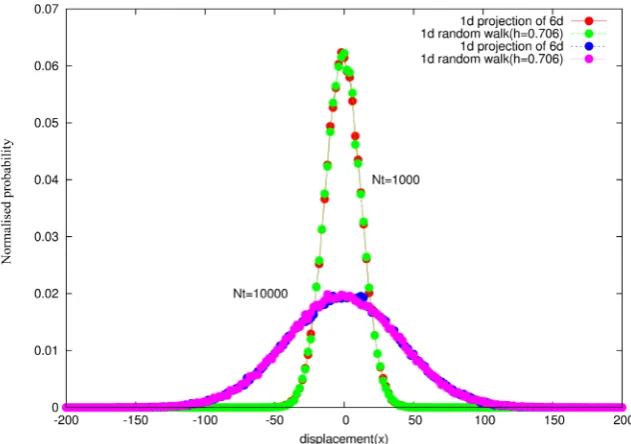
goes to ∞).DOI: 10.4236/am.2018.96042 611 Applied Mathematics Now in Figure 9 it is seen that the distribution of displacement after time steps Nt for 1 dimensional projection of 6 dimensional random walk is almost
similar with pure 1 dimensional random walk with random step length multip-lying by h where h = 0.706. Figure 10 proves that estimated value of h is inva-riant of Nt. We have plotted x2 versus Nt which is almost similar. So the
[image:10.595.263.487.250.385.2]dif-fusive nature and the diffusion rate are also similar for these two motions (in
Figure 11).
Let us calculate the value of h in other dimensions in the same way.
In the following table numerical values (observed from simulation) of Step length renormalizing factor corresponding to dimensions (2 to 10 dimensions) are mentioned.
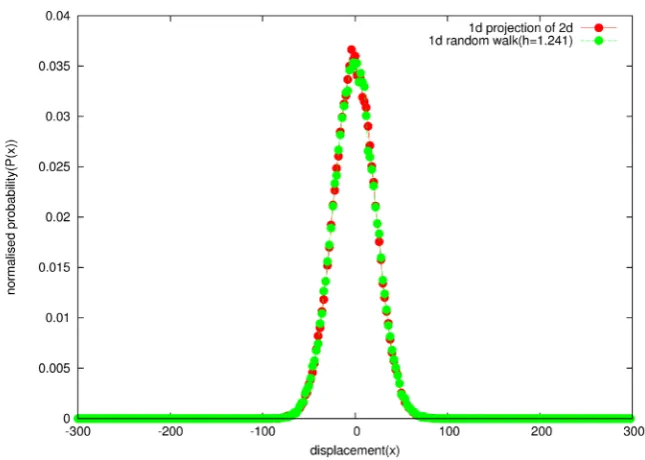
Here in this table it is seen that for all dimensions h≤1 but in case of 2 di-mensions it is 1.24 which is greater than 1 (Figure 12). It is a surprising result in
Figure 8. Average overlapping factor (1/Q) (y axis in the graph) versus step length renormalizing factor (h) in 6 dimensions for Ns = 100,000, Nt = 1000. Here it is seen that
[image:10.595.212.534.445.672.2]DOI: 10.4236/am.2018.96042 612 Applied Mathematics
Figure 9. Distribution of displacement of 1 dimensional projection of 6 dimensional random walk with unit step length and distribution of displacement of pure one dimensional random walk with random step length varying uniformly between −h to h
where h = 0.706 for Ns = 100,000, Nt = 1000. Here it is seen that the two distributions
overlap maximally for the estimated value of h.
Figure 10. Distribution of displacement of 1 dimensional projection of 6 dimensional random walk with unit step length and distribution of displacement of pure one dimensional random walk with random step length varying uniformly between −h to h
where h = 0.706 for Ns = 100,000, Nt = 1000 and Nt = 10,000. Here it is seen that
estimated value of h is invariant of Nt.
[image:11.595.216.532.377.599.2]DOI: 10.4236/am.2018.96042 613 Applied Mathematics
Figure 11. Diffusion of 1 dimensional projection of 6 dimensional random walk with unit step length and pure 1 dimensional random walk with random step length varying uniformly between −h to h where h = 0.706 for Ns = 100,000.
Figure 12. Distribution of displacement of 1 dimensional projection of 2 dimensional random walk with unit step length and distribution of displacement of pure one dimensional random walk with random step length varying uniformly between −h to h
where h = 1.241 for Ns = 100,000, Nt = 1000. Here it is seen that the two distributions are
almost same.
[image:12.595.213.536.350.580.2]DOI: 10.4236/am.2018.96042 614 Applied Mathematics In Figure 13 we have plotted the distribution of projected step length r1 for
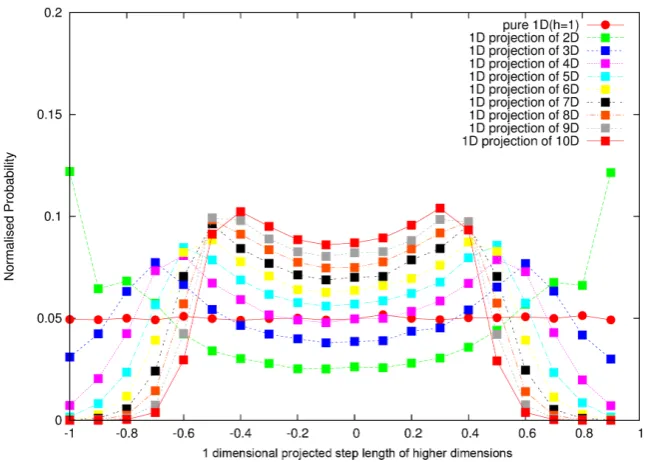
different dimensions and pure one dimensional step length. Here it is observed that the step length of pure 1 dimensional random walk is uniformly distributed between (−h to h) (here it is plotted for h = 1 but this is true for any value of h) but the projected step length (r1) are no longer uniformly distributed between −1
to 1. For example, for 2 dimensions, probability of getting large value of step length i.e. near boundary (−1, +1) is high. So to have a comparison between projected walk of 2 dimensions and pure 1 dimensional random walk, the mag-nitude of pure one dimensional step length should be increased. So the value of h is greater than 1. But for d>2 probability of getting large value of step length (i.e. near boundary) is low; as we increase the dimension, the boundary value of r1 decreases and the most probable value of r1 is shifted towards 0. As a
comprehensive effect the magnitude of r1 is decreasing. Naturally the value of h
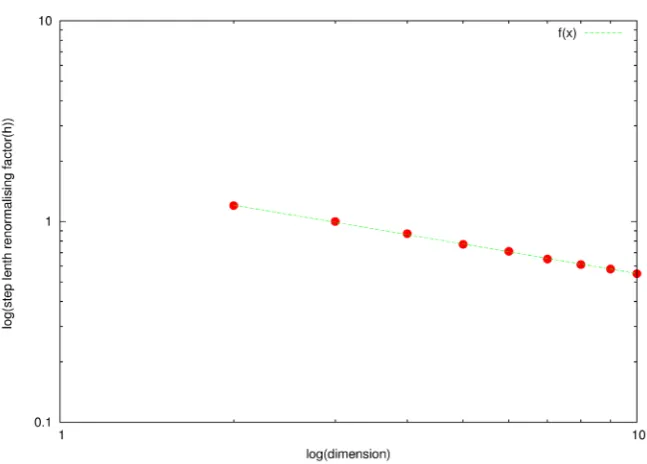
is also decreasing as dimension is increasing following the relation (Figure 14). 1.7
h d
≈ (7)
It also supports the previous result Equation (5) that for d→ ∞ there is no projected one dimensional random walk.
[image:13.595.212.535.448.679.2]Now we are able to establish a generalized one dimensional random walk with which the projected random walk can be compared. In all, it can be said that, we can get equivalent statistical properties of projected one dimensional motion of d-dimensional random walk with unit step length from pure one dimensional random walk with random step length varying uniformly between −h to h where h is the step length renormalizing factor. In this context it is to be mentioned
DOI: 10.4236/am.2018.96042 615 Applied Mathematics
Figure 14. Step length renormalizing factor is plotted with different dimensions (d) (d = 2, 3, 4, 5, 6, 7, 8, 9, 10 dimensions). The dotted line is f x
( )
=1.7 x.that in the simulation we have taken number of samples Ns =100000 and 1000
t
N = . These choices of Ns and Nt in this study are observed to be adequate to have stable statistics.
3. Concluding Remarks
In this paper we have discussed random walk problem extensively in generalised d-dimensional continuum by numerical simulation where we have observed how the statistical properties of random walker are changing with dimensions. Shifting of most probable value of the distribution of absolute displacement after a certain time (Nt) towards higher value with dimension is observed statistically.
numeri-DOI: 10.4236/am.2018.96042 616 Applied Mathematics cal results of random walk in generalised d-dimensional continuum and its pro-jected motion, but rigorous mathematical formulations of these are yet to be ex-plored. And finally, there is a interesting aspect to think that, why for getting equivalent statistical properties for the projected motion of three dimensional random walk from pure one dimensional random walk, the step length renor-malising factor h is exactly equal to 1 i.e. and pure one dimensional step length is unrenormalised.
Acknowledgements
We thank Amitava Banerjee and Abyaya Dhar for their help in preparing the figures and specially Amitava Banerjee for careful reading of the manuscript.
References
[1] Codling, E.A., Plank, M.J. and Benhamou, S. (2008) Random Walk Models in Biol-ogy.Journal of the Royal Society Interface, 5, 813-834.
[2] Freund, J.A. and Pöschel, T. (2000) Stochastic Processes in Physics, Chemistry, and Biology (Lecture Notes in Physics). Springer, Berlin.
[3] Bhattacherjee, S.M., Giacometti, A. and Maritan, A. (2013) Flory Theory for Poly-mers. Journal of Physics: Condensed Matter, 25, Article ID: 503101.
[4] Hsu, H.-P. and Grassberger, P. (2011) A Review of Monte Carlo Simulations of Po-lymers with PERM. Journal of Statistical Physics, 144, 597.
https://doi.org/10.1007/s10955-011-0268-x
[5] Redner, S. (2001) A Guide to First-Passage Processes. Cambridge University Press, Cambridge. https://doi.org/10.1017/CBO9780511606014
[6] Lubeck, S. and Hucht, A. (2001)Absorbing Phase Transition in a Conserved Lattice Gas with Random Neighbour Particle Hopping. Journal of Physics A: Mathematical and Theoretical, 34, L577. https://doi.org/10.1088/0305-4470/34/42/103
[7] Sumedha and Dhar, D. (2006) Quenched Averages for Self-Avoiding Walks and Polygons on Deterministic Fractals. Journal of Statistical Physics, 125, 55-76.
https://doi.org/10.1007/s10955-006-9098-7
[8] Phillips, R., et al. (2013)Physical Biology of the Cell. 2nd Edition, Garland Science, London, New York.
[9] Serino, C.A. and Redner, S. (2010)The Pearson Walk with Shrinking Steps in Two Dimensions. Journal of Statistical Mechanics: Theory and Experiment, 2010, P01006. https://doi.org/10.1088/1742-5468/2010/01/P01006
[10] Acharyya, M.(2015)Model and Statistical Analysis of the Motion of a Tired Ran-dom Walker in Continuum. Journal of Modern Physics, 6, 2021-2034.
https://doi.org/10.4236/jmp.2015.614208
[11] Acharyya, A.B. (2015) Return Probability of a Random Walker in Continuum with Uniformly Distributed Jump-Length. arXiv:1506.00269.
[12] Pearson, K. (1905) The Problem of the Random Walk. Nature, 72, 294.
[13] Rayleigh, L. (1919) On the Problem of Random Vibrations, and of Random Flights in One, Two, or Three Dimensions. The London, Edinburgh, and Dublin Philo-sophical Magazine and Journal of Science, 37, 321-347.
DOI: 10.4236/am.2018.96042 617 Applied Mathematics
[15] Borwein, J.M., Straub, A. and Vignat, C.(2015) Densities of Short Uniform Random Walks in Higher Dimensions. arXiv:1508.04729.
[16] Mattingly, J.C., Pillai, N.S. and Stuart, A.M. (2012) Diffusion Limits of the Random Walk Metropolish Algorithm in High Dimensions. The Annals of Applied Proba-bility, 22, 881-930.https://doi.org/10.1214/10-AAP754
[17] Poyla, G. (1921) Über eine Aufgabe der Wahrscheinlichkeitsrechnung betreffend die Irrfahrt im Straßennetz. Mathematische Annalen, 84, 149-160.
https://doi.org/10.1007/BF01458701
[18] Abramov, V.M. (2016) Eventual Return Probability in Multidimensional Random Walks. arXiv:1601.02297.
[19] Ioffe, D. (2014) Multidimensional Random Polymers: A Renewal Approach. ar-Xiv:1412.0229.
[20] Kavraki, L.E., Svestka, P., Latmbe, J.-C. and Overmans, M.H. (1996) Probabilistic Roadmaps for Path Planning in High-Dimensional Configuration Spaces. IEEE Transaction on Robotics and Automation, 12, 566-580.
https://doi.org/10.1109/70.508439