Economics Working Paper Series
2018/014
Product Proliferation and Pricing in a Market
with Positional Effects
George Deltas and Eleftherios Zacharias
The Department of Economics
Lancaster University Management School
Lancaster LA1 4YX
UK
© Authors
All rights reserved. Short sections of text, not to exceed two paragraphs, may be quoted without explicit permission,
provided that full acknowledgement is given.
Product Proliferation and Pricing in a Market
with Positional Effects
∗George Deltas† Eleftherios Zacharias‡
June 5, 2018
Abstract
We provide an explanation for product versioning that is not driven by differential costs or
consumer preference heterogeneity, and investigate its implications. Consumers care whether a
product they own is better than that owned by others, and whether others own a better product
than them. These positional effects can induce a firm to offer products of different quality, with
the high quality product becoming more exclusive as these effects strengthen. Consumers with
no positional preferences become worse off when the broader market acquires them, except
following the introduction of the second product, when some such consumers become better off.
Positional preference also reduce total consumer surplus holding the number of products fixed;
however, they increase consumer surplus if they lead the firm to introduce a second product of
sufficiently high quality. We discuss empirical implications of the theory.
J.E.L. Codes: L11, D11, D42.
Keywords: Relative consumption, status effects, positional externalities, Veblen goods.
∗
We would like to thank Alexei Alexandrov, Camelia Bejan, Evangelos Constantinou, Anthony Creane, Vincenzo Denicolo, Hanmming Fang, Jean J. Gabszewicz, Daniel Grodzicki, Marina Halac, Rogerio Mazali, Devin Pope, Stan Reynolds, Jean Tirole, and Hisayuki Yoshimoto for insightful discussion, and comments from seminar participants in the Lancaster Conference on Auctions and Competition, the University of Crete, the University of Macedonia, the EARIE conference, the Conference for Research in Economic Theory and Econometrics (CRETE), the Interna-tional Industrial Organization Conference (IIOC, Drexel), the Midwest Economic Theory Conference, and the Greek Competition Authority. Of course, we alone are responsible for any errors contained here.
†
Department of Economics, University of Illinois, Urbana-Champaign, Urbana, United States ([email protected]), and Department of Economics, Lancaster University, United Kingdom.
‡
1
Introduction
Consumers like to “keep up with the Joneses.” In fact, they often prefer to do better than the Joneses. The consumption level and product choices of others are benchmarks with which consumers often evaluate their own consumption and product choices. Owning a better product than other people can confer higher status, or simply make someone just feel better. One may also be tangibly worse off if his/her product choices are dominated by those of other consumers, as we explain later in this section. But reduced satisfaction from falling behind their peer group could simply be behavioral. Perhaps the intrinsic enjoyment that a consumer gets from a product stems from the knowledge that it is the best one around. Consumers who would be happy with the latest version of the iPhone or a tablet might be less happy purchasing it once the new version of that same gadget gets introduced. Research in behavioral economics and the economics of happiness does in fact provide support for the general idea that comparisons one makes with his or her peers do matter for his or her general happiness and welfare (see, for example, Luttmer 2005, Ferrer-i-Carbonell 2005, and Solnick and Hemenway 2005).1 Most recently, Bursztyn et. al. (2017) have performed a very convincing field experiment using credit cards that demonstrates consumers value owning a good that is better than that of other consumers (and more exclusive), and have shown that this effect is stronger when possession of the good is observable to others.2 Providing an explicit rationale for this behavioral norm is the subject of some prior theoretical literature.3 Many insights, however, can be obtained by taking such preferences as given and investigating their implications for economic choices and markets.
This paper sheds light on the implications of status concerns, or more generally “positional effects,” for product pricing, product characteristics, and the number of products a firm offers to consumers. These positional effects are considered exogenous for the purpose of our analysis, their micro-foundations being the subject of behavioral microeconomics. We consider a monopolist that
1For some broader perspectives see Solnick and Hemenway (1998) and Clark, Frijters and Shields (2008).
2Recent work by Agarwal, Mikhed, and Scholnick (2018) uses lottery winners are “randomized treatment” to
show that those exposed to it increase their expenditure of physical goods, but only those that are viewed by other consumers and thus subject to comparison.
3For example Bagwell and Bernheim (1996) argue that purchasing a more expensive product acts, under certain
sells a vertically differentiated good. The monopolist chooses whether to offer one, two, or more versions of that good. If two versions (or products) are offered, one would be the lower quality “standard” variant, while the other would the higher quality “premium” variant. If more than two versions are offered, the standard and premium variant would be complemented by a number of variants of intermediate quality. In the standard model of vertical differentiation, consumers care about product quality and product price; this remains the case in our set-up. However, in our model consumers also have positional considerations. They care about how many consumers have a product that is worse than the one they own, and how many consumers have a product that is better than the one that they own. The utility (and thus willingness to pay) for a product is higher the fewer the consumers who own a better product and the more numerous the consumers who own a worse one. Owing none of the products, i.e., not owning the good at all, is equivalent to owning a “version” that is inferior to the lowest quality product on sale.
Our framework provides an explanation for product versioning that is not driven by differential costs or by heterogeneity of consumer preferences. Indeed, to better examine the link between positional effects and product versioning or proliferation, our point of departure is a parametrization of the standard model of vertically differentiation under which a monopolist finds it optimal to produce only a single variant/product in the absence of such effects. Supply-side and other demand-side drivers for product proliferation, such as differential marginal costs for higher quality products, decreasing returns, horizontal differentiation, or demand non-linearities which can lead to price discrimination and multiple product offerings are excluded from our model.4 This benchmark model is characterized by a uniform distribution of consumer willingness to pay for quality; fixed costs of product development are increasing in quality, but marginal costs are independent of it. In this environment, we characterize changes in the equilibrium induced by a strengthening of positional preferences.
In these comparative statics, we first consider the case when the monopolist optimally offers only a single product. As positional considerations become more important, the monopolist progressively charges higher prices, sells more units and earns higher profits, holding product quality fixed. But with the marginal consumer having a smaller value for quality, the returns to raising it diminish. As a result, product quality falls (sometimes sufficiently fast that product price declines rather than increases). Eventually, with further increases in positional considerations, the monopolist
4
may find it optimal to introduce a second product. At the point when the introduction of the second product becomes profitable, the two products “bracket” the quality of the single product they replace; one is of higher quality, and the other of lower quality. The high quality product becomes more “exclusive” with additional increases in positional considerations: its price goes up, and its sales volume relative to the base product decline; in contrast, the low quality product maintains the same price and its sales volume increases. Eventually, positional effects become so large that the market becomes fully covered.5
We perform standard welfare comparisons and show that, holding the number of products fixed, consumers become worse off under positional preferences. However, consumers who purchase the product will become better off when the firm introduces a second product, if that happens when positional preferences are relatively weak.6 These welfare comparisons are made across different levels of importance for positional effects; thus, they might be viewed as ill-defined.7 However, one definitely meaningful comparison is for the welfare of a small measure of consumers who do not have any positional considerations themselves, i.e., who are purely utilitarian, even as the bulk of consumers become more sensitive to the consumption choices of others. If that set of utilitarian consumers is small, it will not have an effect in the nature of the comparative statics described above. We show that these consumers become worse off as positional considerations increase in the market, as long as the number of products offered by the firm stay the same. This is because product quality does not increase, while product prices generally rise. In the one exception when prices fall (when there is a single product and the market becomes nearly covered), the accompanying quality decrease more than outweighs the reduction in prices, so that utility is lower in that case as well. However, there is one instance when some utilitarian consumers will be better off, and that is when the firm switches from selling one to selling two products. With one of the new products having a higher quality than the one that is replaced, utilitarian consumers who value quality sufficiently
5
By design, the introduction of a third product is never optimal in our benchmark model. Under more general conditions, discussed in the extensions section, multiple products may be optimal. This does not detract from the insights obtained here.
6
These findings echo, but also qualify, those in prior research. Some contributors to the broad literature, such as Frank (1991, 2005) argue that positional considerations have large negative effects on welfare and even argue for policy interventions. This appears to be true in our case when the number of products is fixed, but not necessarily in general.
7
high may be better off even though they have to pay a higher price (and even if they themselves do not have positional preferences). Conversely, with the other product having lower quality but much lower price, some utilitarian consumers who hitherto were not purchasing the product will now purchase the low quality one.
Our results contrast with those of network effects, the other area of product demand where the consumption choices of all consumers affect the value of a product for each one of them. In network models, products are not vertically ranked, which makes a direct comparison with our framework somewhat difficult. However, when network effects are present, a product is more valuable the more people purchase it. A rival product may become less valuable as more consumers purchase the other product if the two networks are in competition for the provision of third party services.8 If the networks are not in competition, then the value of a product is independent of the number of consumers who purchase rival products. With positional preferences, the value of a top product is reduced if its market share is increased. The value of an intermediate (or low) ranked product increases with its market share, if its market share expands at the expense of a superior product, but it decreases with its market share if it expands at the expense of an inferior product (or the outside option). This qualitative difference in the relationship between market share and consumer willingness to pay for a product may also be useful in empirically distinguishing positional effects even in markets where other types of valuation spillover effects are present (such as network effects).9 Positional preferences and, more broadly, relative consumption, is a topic which received limited but growing attention in the Industrial Organization literature. Among the few contributions on the topic are Lambertini and Orsini (2002, 2005, 2006) and Ghazzai (2008), which are discussed in the next section. Very recent work by Mazali and Rodrigues-Neto (2013) and Rayo (2013) forms a bridge between the IO and signaling literatures on this topic. Of direct relevance to our own work are their results that product proliferation can take place even when consumers do not have an intrinsic value for a product characteristics, if the product variant they purchase acts as a unobserved signal of a personal type.10 In this case, the product is effective a signal that consumers purchase from the firm. In our paper consumers value an intrinsic characteristic, and we are agnostic about the source
8For example, if the products are computer devices or game consoles and software developers have a limited
capacity to create applications, then they may tend to focus on the larger networks and spend less effort developing applications for the smaller networks.
9
Positional externalities are also distinct from congestion effects, both conceptually and in terms of implications for market equilibrium.
10
of the positional preferences, i.e., whether they are innate or arise from signaling considerations. The latest contribution to this vein of research is Friedrichsen (2018), who has investigated the equilibrium and welfare properties of a market with consumer heterogeneity in willingness to pay for both quality and status (the complexity of the model requires heterogeneity to be limited to binary types). That model has a unique feature in that the status level associated with a good arises endogenously from the proportion of consumers who value quality among those purchasing that good, i.e., a good is confers a positive signaling value depending on who buys it.
Relative consumption and positional effects have been more widely studied in other areas of economics. The public finance literature has given some attention to relative consumption and positional effects, and in particular in their implications for taxation and public goods provision (e.g., Boskin and Sheshinski, 1978, Ljungqvist and Uhlig 2000, and Wendner and Goulder 2008). In the most recent contribution to this literature, Hopkins and Kornienko (2009) formulate a model in which consumers derive utility from a consumption good and from status (obtained based on relative consumption of a positional good). In their framework, prices are exogenous and there is a single variant of each good; consumer choice corresponds to the allocation of income to units of the each good. They focus on how changes in the distribution of income affect consumer utility, and how the government can affect welfare through taxation. Positional considerations also have implications for macroeconomics (e.g., Abel 1990 and Dupor and Liu 2003). Much of the literature emphasizes the effects of positional concerns on consumption and draws some broader conclusions (e.g., Clark and Oswald 1998, and Alpizar, Carlsson and Johansson-Stenman 2005). Somewhat unique from these research agendas is the contribution of Moldovanu, Sela, and Shi (2007) who show that positional preferences can also be used by a firm (or a society) for the design of performance-based award levels to better incentivize workers (or citizens).
It is worth noting that positional effects do not necessarily have a purely behavioral founda-tion. They sometimes have tangible material impact on the utility that a consumer obtains from the consumption of a good. The market for personal computers offers one important illustration. In that market, a computer becomes worse for the user in a real and tangible way if it is slower rel-ative to the other computers. This happens because software code is optimized for the capabilities of the more recent and faster computers.11 A related explanation is that when a better product
11A computer can appear slow from a user’s standpoint if it uses slow or inefficiently written software, or if it
is available, consumers who would normally purchase the inferior product are no aware of more advanced features and capabilities; the more people purchase the better product, the more likely it is that other consumers will be aware of such features. Awareness of these additional possibilities can make a consumer less satisfied with a dominated product. Moreover, firms have incentives to cultivate positional effects for their products, something that we discuss in one of the extensions. Finally, exclusivity can be valued by consumers even when it is not associated with a better quality or a superior product. For example, Grilo, Shy, and Thisse (2001) provide a theoretical analysis of the market equilibrium when consumers value exclusivity in a horizontally differentiated product market. Amaldoss and Jain (2008) also belong to this class of models, broadly defined. A unique feature is the multi-period nature of their model, in which different types of consumers are con-sidering the product in each period. The “leaders” have intrinsic value for the product, but also want to differentiate themselves from the “followers,” while the “followers” have no intrinsic value for the product but want to mimic the “leaders” if the product is sufficiently popular with them. The multi-period nature of the model permits a meaningful analysis of quantity commitment by the seller, e.g., limited edition products.12
The next section of this paper outlines the model, and explains the formulation that we have chosen. It is followed by a section that solves for the market equilibrium when the monopolist has a fixed number of products to offer to the consumers. In section 4, we turn our attention to the implications for product proliferation, and solve for the equilibrium in a market where the monopolist can choose not only the prices and number of products that are offered, but also the product characteristics. We then consider, in section 5, the welfare implications for consumers. The paper concludes with some remarks on extensions to more general specifications and on avenues for additional research on this broad agenda. All proofs are in an Appendix.
in execution time. As computers become faster, software and operating systems become more demanding. Thus, a computer that was perfectly adequate when purchased, may need to be replaced in five years because it would not be practical to run the new operating system and software on it. This is a clear positional effect. A recent paper by Deltas, Stengos, and Zacharias (2011) provides strong evidence to this effect.
12Some contributors, such as Frank (1991) and Klemperer and Padilla (1999), have extended the notion of positional
2
Model Outline and Initial Analysis
Our model is a variation of the standard models of vertical differentiation (see Gabszewicz and Thisse 1979, Mussa and Rosen 1978, and Tirole 1988 for a textbook treatment). There is a mass of consumers, normalized to 1, with preferences for a good characterized by a single attribute. This attribute is traditionally referred to as quality, but given our focus on positional externalities, it could also be thought of as “luxuriousness.” There are a number of products of this good for sale, each with a different level of quality/luxuriousness. Purchasing a product of higher quality is intrinsically valuable to each consumer, holding its price constant. Our point of departure from the benchmark model is the incorporation of an additional indirect effect, that of positional preferences. A consumer obtains additional utility from the consumption of a product that is proportional to the fraction of other consumers who own products of lesser luxuriousness or do not own the good at all (which is considered a “purchase” of a product with zero quality). Conversely, a consumer who purchases a particular product has a disutility that is proportional to the number of other consumers who purchase products of higher luxuriousness than his own. Thus, a consumer gains in utility if another consumer can no longer afford to buy the same product as his or hers and buys an inferior one; he or she loses utility if another consumer who would hitherto be purchasing the same product now purchases a superior one.
More formally, let there beK products. The value of the positional attribute for product j is denoted by Sj, with higher values of j indicating products of higher quality, i.e., with Sj > Sk if j > k. Each consumer iis characterized by the money-equivalent value, θi, he attaches to a unit increment of luxuriousness. Consumers have identical positional preferences, which we parametrize in a simple way based on the rank-order of the product he or she purchases relative to those of other consumers. In particular, consumeriwho purchases product j at pricePj obtains surplus of
Vi,j =θiSj+λ
X
∀k<j Qk−
X
∀k>j Qk
−Pj (1)
where Qj is the fraction of consumers who purchase product j and θ is uniformly distributed in the interval [0,1]. A consumer who does not make a purchase has direct utility of zero from not owning the product but incurs positional disutility from being among those who do not own any product of the good at all. In other words, non-purchase results in utility of
Vi,0 =−λ X
∀k
which is decreasing in the number of people who purchase any of the K products on offer. It is worthwhile pointing out some additional implications of this preference structure. The utility differ-ence between purchasing two products of adjacent quality/luxuriousness levels, i.e., from upgrading from one product to the next better one, is equal to
Vi,j+1−Vi,j =θi(Sj+1−Sj) +λ(Qj+1+Qj)−(Pj+1−Pj) (3)
In other words, positional considerations provide an additional willingness to pay for upgrading from one quality to the next that is proportional to the number of consumers who purchase either of the two products. This is because upgrading from productjmeans that there areQj consumers that you now dominate in terms of your consumption choice and Qj+1 consumers that used to
dominate you but no longer do.
This preference structure has a direct implication for the calculation of market shares conditional on prices. As is standard in vertical models, there will be a series of critical preference parameters, θc
j, j = 1, . . . , K, with θjc+1 > θjc, ∀j and θjc+1 = 1, such that consumers with a value of θ ∈
[θjc, θcj+1] purchase productj. Then, given the uniform distribution ofθ, equation (3) becomes Vi,j+1−Vi,j =θi(Sj+1−Sj) +λ(θcj+2−θjc)−(Pj+1−Pj) (4)
Since by definition a consumer with θi = θcj derives equal utility from purchasing product j or product j−1 (with the 0-th product being the null purchase for which by conventionS0 = 0 and
P0= 0), when θi =θcj,Vi,j−Vi,j−1= 0, and equation (4) yields
θjc(Sj −Sj−1) +λ(θcj+1−θjc−1)−(Pj−Pj−1) = 0 (5)
where θc0 ≡ 0. In the absence of the positional effects, i.e., when λ = 0, solving for θjc yields the market share cutoffs for each product conditional on prices, which provides a straightforward way to derive the demand for each product. When positional considerations are present, however, the demand for each product is not independent of the sales of the other, i.e., the market share cutoffs cannot be solved independently even conditional on prices. Rather, they are determined simultaneously through a system of linear equations, of the form
λθjc+1+ (Sj−Sj−1)θcj−λθcj−1−(Pj−Pj−1) = 0 (6)
For the special case when there is a single product on offer, the difference in utility from purchasing it and not purchasing it is given by
Vi,1−Vi,0 =θiS1+λ−P1 (7)
Notice that in this case, positional preferences are isomorphic to a uniform increase in the utility of purchasing the product. When plotting the demand for the product, an increase in positional considerations (i.e., an increase inλ) is equivalent to a parallel shift in its demand. This is a natural consequence of the assumption that all consumers share the same value ofλ.
The preference specification and the product space are two of the differences of our work with that of Lambertini and Orsini. They consider either a monopolist who sells a single positional good (Lambertini and Orsini 2002) or two firms one of which sells a positional good and the other a standard good, with the sum of the two firms’ sales being fixed (Lambertini and Orsini 2005). The second model is nearly equivalent to the first, except that the standard good (that plays the role of outside option) has utility level that is endogenously chosen by a firm. In both cases, the utility difference between purchasing and not purchasing the positional good is a function of the number of consumers who purchase the good. The reason is that, in their formulation, the consumer who does not purchase the positional good does not become worse off if more consumers purchase the positional good.13 This induces some unexpected comparative statics of the market share as positional preferences become stronger, i.e., it can either increase or decrease, whereas on our model one obtains the more natural comparative static that the market share of the positional good monotonically increases with the intensity of the positional preferences.14 Note that our work goes beyond their contribution in a number of ways, as we consider markets with more than one positional product, investigate the effect of positional preferences not only on quality but also on mark-ups, derive their effect on product introduction, and investigate the impact of positional preferences on a (few) consumers who do not have them.
The design, development, production, and marketing of each product carries a fixed cost, which
13
Our preference specification is also related, but distinct, to that in Hopkins and Kornienko (2009). Unlike in
our framework, they treat “ties” in the consumption of the positional good differently from strict dominance. But
unlike them, we allow for different intensity in the positional preferences relative to the non-positional good. Neither
specification is more general than the other. But if we introduced a difference between the disutility from being
“dominated” by a set of consumers from the utility of “dominating” a set of consumers, our specification would
generalize theirs. 14
is a function of its quality. This cost is denoted by the function Γ(S), with Γ(S)0 >0, Γ(S)00 >0, and Γ(S)000 ≥0, i.e., the cost function is not only increasing in quality and convex but also (weakly) increasingly convex. There are no cost synergies from developing a second product, i.e., if the firm sells two products of quality Sa and Sb the total cost is Γ(Sa) + Γ(Sb). We obtain some results without further restrictions in the relationship between product quality and fixed costs, and also examine some special cases. Quality can take any value above a minimum level of S. This level reflects some minimum functionality of the product and possibly also a constraint on quality imposed by the desire to maintain the image of a firm’s brand. For example, when choosing the features of the iWatch, Apple was constrained by the fact that a watch must have some minimal functions (e.g., telling the time/date and having alarm and stopwatch functions). It was also implicitly constrained by the fact that an Apple smart watch had to additionally combine some of the functions of smart metering or athletic data bands. Beyond this minimal level, Apple could add further features and design elements. In section 6 we model the reputation costs that a firm’s brand would suffer by introducing products below some threshold quality level and derive the (few) differences this imparts to the analysis that assumes a fixed exogenous lower bound in quality.
Producing a unit of a product of any luxuriousness has the same marginal cost, which we nor-malize to zero. This assumption is a reasonable approximation to reality when quality is mostly driven by R&D and the goods are electronic or digital (e.g., software). Importantly, this assump-tion ensures that in our framework, a firm has no incentives to introduce multiple products for the purpose of price discrimination in the absence of positional considerations. Thus, product prolifer-ation arises solely due to their presence. Qualitatively similar results can be obtained if marginal costs are assumed to be increasing in quality, but these models are far messier, without necessarily being more insightful.
3
Markets with a Fixed Number of Products
3.1 Single Product
We first analyze the pricing strategy of the monopoly that produces a single product. Denote its quality bySj, its price by Pj, the sales volume (fraction of consumers who purchase the product) byQj, and the profits earned, gross of fixed costs, byπj. Separating the gross profits from the net profits, Πj, is analytically convenient, as will become clear. For all results that are obtained for a given value of quality, i.e., for all results except for those where the quality level is determined, we will report and discuss gross profits (since development costs are sunk at that point). Equilibrium values are denoted by a star (∗). Dependence of equilibrium values on the value of λ and Sj will be made explicit when necessary and omitted when it is not, e.g.,πj∗ and π∗j(Sj, λ) are equivalent. Equilibrium values at the optimal value of quality with a single product are indicated with the subscript of 1 rather than j, i.e.,P1∗ rather thanPj∗.
Having defined the notation, we proceed to the analysis. In equilibrium, consumers with low values ofθchoose not to purchase the good and consumers with high values ofθchoose to purchase it, with θcj the critical value of θ below which the consumers do not purchase; when the market is covered θcj = 0. Given that θi is distributed uniformly on [0,1], Qj = 1−θcj. The following Proposition describes the product market equilibrium under the above conditions. Its proof, along with all other proofs, are in an Appendix.
Proposition 1 Suppose λ < Sj and only one product is produced, with quality Sj. Then, the firm
sets a price of Pj∗ = λ+Sj
2 , sells Q
∗ j =
λ+Sj
2Sj units, and earns (gross) profits π
∗ j =
(λ+Sj)2
4Sj . Suppose instead λ ≥ Sj. In that case, the firm sets a price of Pj∗ = λ, sells to the entire market (i.e., Q∗j = 1) and earns (gross) profits of πj∗=λ.
To ascertain what is the optimal choice of quality and how it is affected by positional preferences, it is necessary to examine how the gross profit function, πj∗(Sj, λ), depends on λand Sj. We first examine the comparative statics of the market equilibrium with respect to λ, conditional on a product with qualitySj being the only product offered. We readily obtain the following Corollary.
Corollary 1 Until the market is covered, the equilibrium price, volume, and gross profits all
in-crease with λ when a single product of quality Sj is offered. When the market becomes covered,
Intuitively, when positional effects are stronger, more consumers are willing to purchase the product at any given price. With the demand for the product shifting outwards through a parallel shift, the firm also finds it optimal to raise its price. Thus, firm profits increase. When the market becomes fully covered, further increases in positional effects permit the firm to extract more surplus from the marginal consumer, who is now the “lowest valuation” consumer and who is willing to pay more to not be left without the product.
We now look at the effect of the quality level, Sj, on gross profits, prices and sales volume. These effects are relevant for determining the optimal quality when there is a single product, and also for the comparative statics of the market equilibrium when a change in λinduces the firm to add products. It follows by inspection that the optimal price increases withSj when the market is not covered, and is independent ofSj when the market is covered. The reason for this independence when the market is covered is that the marginal consumer has (by assumption) no valuation for quality; his willingness to pay for the product arises solely from positional considerations. Hence, the price depends only on the strength of positional preferences. When the market is not covered, equilibrium sales volume decreases withSj. This counter-intuitive response is due to the change in demand elasticity as quality increases and the fact that elasticity is a function ofλ(see Balan and Deltas 2013 for further details).15 In fact, the market is covered when product quality is low (e.g., Sj < λ) and is only partially covered when quality is high.16
The partial derivative of equilibrium gross profits with respect toSj when the market is partially covered is given by
∂πj∗(Sj, λ) ∂Sj =
2(λ+Sj)4Sj−4(λ+Sj)2 16S2
j
= (λ+Sj)(2Sj−λ−Sj)) 4S2
j
(8) which is positive if Sj−λ >0, i.e., when the market is not covered.
Finally, the equilibrium price, quantity (sales volume) and gross profit are all continuous in quality when the market switches from being fully covered to being only partially covered. Substi-tuting in the equilibrium expressionsSj =λ, the threshold at which the market becomes covered,
15
This is one instance where assuming zero marginal cost simplifies the analysis. With a positive marginal cost, the effect of quality of market coverage would depend on whether the marginal cost is greater or lower thanλ, yielding more complicated comparative statics of the market equilibrium with respect toλwhenSjis endogenized.
16
With marginal costs being zero, the monopolist prices at the point of the demand curve were the elasticity is equal to one. When demand is linear, this point is half of the demand intercept, i.e., the optimal price is λ+Sj
shows that the full market coverage expressions become the same as those pertaining to partial coverage. Moreover, the slope of the profit function goes to zero as Sj approaches λfrom above, implying that the profit function is also differentiable at that point. These findings are summarized in the corollary below.
Corollary 2 An increase in quality level Sj has no effect on price, sales volume, and gross profits until it reaches the value of λ. For Sj > λ, further increases in quality increase the price and
profits but result in reduced sales volume. Price, volume, and gross profits are all continuous inSj
at Sj =λ, while gross profits are also differentiable at that point.
The above analysis derived the equilibrium treating product quality as fixed at an exogenous level. We now examine the choice of quality if the firm were to produce a single product. This question is relevant because in practice some firms choose to offer only a single version (or model) of their iconic products. The presence of high fixed costs at the product level may be one explanation for this, but there may be others (e.g., concerns about brand image). Some preliminary analytics will greatly facilitate the determination of this optimal quality level. Straightforward manipulation of gross profit function reported in Proposition 1 allows us to write it as
πj∗(Sj;λ) =
λ if Sj ≤λ λ
2 +
Sj
4 +
λ2
4Sj if Sj > λ
(9)
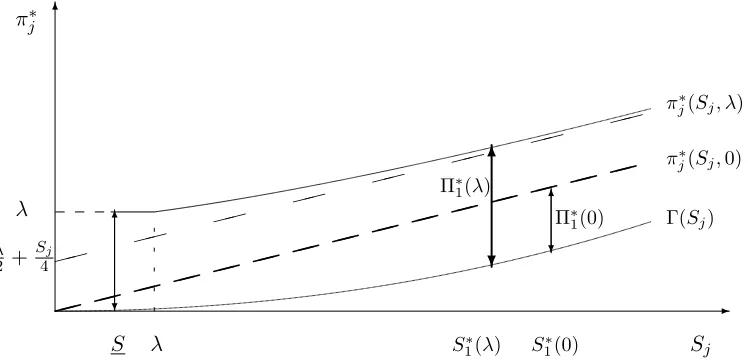
The gross profit function is flat until quality reachesλ. Thereafter, it consists of the linear term (the first two fractions in expression (9)) plus a term that is diminishing inSj and goes to zero as quality increases (the last fraction in expression (9)). As noted earlier, the profit function is continuous and differentiable at λ. Therefore, the gross profit function is initially flat, then increases with an increasing slope and asymptotes from above to λ2+Sj
4 . The optimal choice of quality maximizes the
6
-π∗j
Sj λ λ 2 + Sj 4 λ S
πj∗(Sj, λ)
πj∗(Sj,0)
Γ(Sj)
S1∗(λ) S∗1(0) Π∗1(λ)
[image:16.612.122.496.80.260.2]Π∗1(0) 6 ? 6 ? 6 ?
Figure 1. Profit function with a single product and optimal choice of quality.
When λ = 0, (net) profits are concave in quality, being equal to the difference between the linear gross profit function and the convex cost function. There is a unique profit maximizing quality, S1∗(0), that yields profits Π∗1(0). These are labeled in Figure 1. When λ > 0, the gross profit’s asymptote makes a parallel shift upwards, while the profit function is now located above its asymptote and consists of an initial flat segment and followed by a convex segment that is
decreasingly convex (i.e., recall that π0(Sj;λ) > 0, but observe that π00(Sj;λ) = 2λS23
j
> 0 while π000(Sj;λ) = −3 λ
2
2S4
j
< 0). When the value of λ is relatively small, as drawn in Figure 1, there are two local optima. The first is at the lowest possible quality level, S (i.e., it is a corner local optimum). The other is at the quality level where π0(Sj;λ) = Γ0(Sj) and where the second order condition of profit maximization is satisfied (π00(Sj;λ)−Γ00(Sj)<0). Given our assumptions on the cost function, there can be no other local optima (the proof of this and other technical statements is reserved for Proposition 2). For sufficiently small values of λ, such as that plotted in Figure 1, the second (interior) local optimum yields maximal profits. It is also apparent from the figure that S1∗(λ)< S1∗(0), i.e., optimal quality declines withλ.
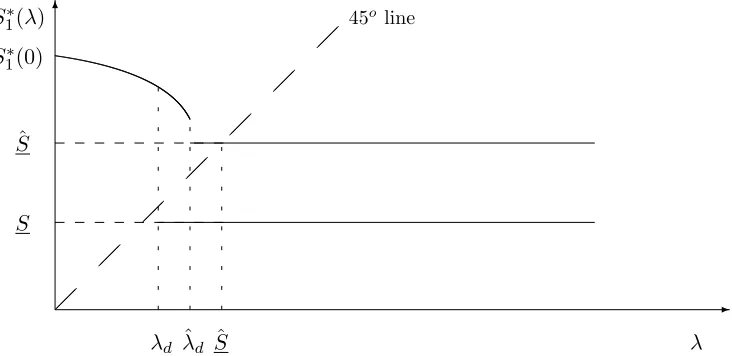
As the value ofλincreases, optimal quality declines further. At some point, the market becomes nearly covered, and the profit obtained by the corner solution (Sj =S) nearly equals that from the interior local optimum. This is shown in Figure 2 below, forλ=λ0. A further increase inλ, to say λ00, results in optimal quality jumping down to S and to the market becoming fully covered.17
17
Figures 1 and 2 are approximate plots of the numerical example with Γ(S) = 0.02S2, λ = 1.25, λ0 = 1.75,
6
-π∗j
Sj λ0
λ00
λ0 λ00 S
πj∗(Sj, λ00)
πj∗(Sj, λ0)
Γ(Sj)
S1∗(λ0) 6
? 6
[image:17.612.130.495.79.260.2]?
Figure 2. Profit function shifts and optimal quality changes with increases inλ. The full comparative statics of the equilibrium when the firm produces a single product are described in the following Proposition.
Proposition 2 Optimal product quality declines smoothly withλ, until it jumps down toS. Output and (net) profits are monotonically increasing in λ (output weakly so after the market is fully covered). Finally, the effect of λ on equilibrium price is ambiguous: increasing if optimal quality declines slowly with λ (which is guaranteed to happen for low λ), but decreasing if optimal quality declines rapidly with λor jumps down to S.
The intuition for the results in Proposition 2 is as follows. When positional considerations become stronger, part of the value of acquiring the product is its mere possession. The intrinsic quality of the product is not relevant for this component of its value. Moreover, as sales increase, the marginal consumer has a smaller value of θ, i.e., values quality less. Since the firm’s quality choice reflects the trade-offs at the margin of its consumer base, its incentives to invest in quality decline and thus so does its optimal quality. With the upwards shift in demand from increase in λand its flattening because of lower quality, optimal monopoly quantity increases. Price generally increases, but is not guaranteed to do so because the lower demand slope can lead to a reduction in its elasticity.
that quality drops to its minimum level, while the market still remains partially covered. This is illustrated in Figure 3, which plots the optimal quality level,S1∗(λ), as a function of λ. The dashed line in this figure is the 45-degree line where quality is equal to λ.
6
-S1∗(λ)
λ S
ˆ S S1∗(0)
λd ˆλd Sˆ
[image:18.612.122.488.151.329.2]45o line
Figure 3. Market coverage and optimal quality as a function ofλand S.
In Figure 3, when the minimum quality level is equal to S, optimal quality jumps down to that level at λ = λd. This jump results in full market coverage, since S < λd. As S increases, but stays belowλd, the profit the firm obtains from the corner solution falls, because the costs of producing quality level S increase, but there is no gain in revenue. Therefore, the value of λ at which optimal quality jumps down to the minimum value rises, but the function S1∗(λ) otherwise remains the same. At some point,S exceeds the value ofλat which quality jumps to the minimum value. When this happens, the market will not be covered, while quality will be at its minimum. This is illustrated in Figure 3 for minimum quality ˆS, with quality dropping to the minimum value atλ= ˆλd. Optimal quality is at ˆS but the market is not covered for values of λ∈[ˆλd,Sˆ].
3.2 Two or More Products
The market share conditions from equation (6) yield in the case of two products the system λθbc+Saθac−Pa = 0 (10) λ+ (Sb−Sa)θcb−λθca−(Pb−Pa) = 0 (11) Solving this system of equations, we obtain
θac= λ
2−S
aPa+SbPa+λPa−λPb λ2+S
aSb−Sa2
(12)
θbc= SaPb+λPa−SaPa−λSa λ2+SaS
b−Sa2
. (13)
These expressions yield the sales volume of each product as a function of prices, qualities, and λ. The results below provide the equilibrium in this market, given the quality levels.
Proposition 3 When the monopoly offers two products and the market is not covered, i.e., when
Sa> λ, the profit maximizing prices are given by
Pa∗ = Sa
2 (14)
and
Pb∗= λ 2 +
λ2 2Sa
+Sb
2 (15)
the sales volume for the two products given by
Q∗a=θb−θa= λ 2Sa
(16)
and
Q∗b = 1−θb = 1
2 (17)
and gross profits by
πa,b∗ = 2λ+Sb 4 +
λ2
4Sa (18)
When the market is fully covered, i.e., when Sa≤λ, Pa∗ = λ2, P
∗ b =
3λ+Sb−Sa
2 , Q
∗
a=Q∗b =
1 2, and
πa,b∗ = 4λ+Sb−Sa
4 . Moreover, all outcomes are continuous at Sa=λ, i.e., when the market becomes
fully covered.
Corollary 3 The price of the high quality product increases in λ but its sales volume is constant. The price of the low quality product is independent of λ but its sales volume is increasing until the market is covered; thereafter, its price is increasing in λ, but the sales volume remains constant. Profits are increasing in λ.
We now turn to the determination of the optimal quality levels when the firm produces two products. Note that the gross profit function is additive separable in the quality levels of the two products, whether or not the market is covered, so that their optimum values are determined inde-pendently. Moreover, gross profits are monotonically increasing inSband monotonically decreasing inSa, regardless of whether the market is covered or not. Then, since quality is costly, the optimal quality of the low quality product is Sa∗ = S. The profit maximizing quality of the high quality product when the market is not fully covered is obtained from the condition
dπa,b∗ dSb −Γ
0(S∗
b) = 0 ⇒ 1 4 −Γ
0(S∗
b) = 0 (19) This is the same first order condition as the one for a single product when λ = 0. Therefore, Sb∗ = S1∗(0). The same first order condition holds when the market is covered, leading to the same value forSb∗. Notice that the optimal quality of neither the low nor the high quality product depends on the value of λ. Therefore, the above corollary describes the comparative statics of the optimal price and sales volumes. The value of λ only determines whether the market is fully covered (when λ > S) or whether it is not.
We now investigate what quality levels the firm would choose if it were to offer three products, of qualitiesSl (low),Sm (intermediate), andSh (high). As a first step, we derive equilibrium prices and market shares for any pre-specified level of qualities. We are able to obtain the following result.
Proposition 4 When the monopoly offers three products of different quality, the profit maximizing
prices result in zero market share for the product of intermediate quality.
Given this result, the product of intermediate quality is effectively absent, which makes the three product case not relevant.18 The equilibrium would be as described in the two product case, regardless of the values of λ. It follows that the firm will not introduce four or more products.
18This result is driven by our simplifying assumptions, which keep the analysis tractable and transparent. It will
4
Choice of the Number of Products
We now describe how the number of products and the market equilibrium changes asλ increases, using the results obtained in the preceding sections. We start by the observation that if λ > S and the market is covered, changes in λdo not affect the optimal number of products. If the firm chooses to sell one product whenλ=S, it will also sell one product for any higher values ofλ, and similarly if the firm chooses to sell two products. The reason for this is that the difference in the profits of the two product lines when the market is covered is equal to
Π∗2(λ|λ > S)−Π∗1(λ|λ > S) =
λ+S
∗
1(0)−S
4 −Γ(S
∗
1(0))−Γ(S)
−[λ−Γ(S)] (20) = S
∗
1(0)−S
4 −Γ(S
∗
1(0)). (21)
This expression is independent of λ. If positive, the firm offers two products; otherwise it offers only one. The following proposition summarizes the equilibrium for values of λ low enough that the market is not fully covered under either product line.
Proposition 5 For low values ofλ, the optimal number of products is one. Profits increase slower withλwhen the firm sells one product rather than two, until the market is covered. After the market is covered profits increase at the same rate with λregardless of the number of products. Therefore, the firm may switch from selling one product to selling two before λbecomes large enough that the market becomes covered, but it will not switch back to selling only one.
6
-Π∗k(λ)
λ S
λc
Π∗1(0, S1∗(0))
Π∗
2(0, Sa∗, Sb∗)
market covered
dΠ∗k
dλ = 1
market not covered
1 2 <
dΠ∗k
dλ <1
[image:22.612.99.488.71.258.2]
Figure 4. One or two product profits as a function ofλ: Two products optimal forλ > λc.
6
-Π∗k(λ)
λ S
Π∗1(0, S1∗(0))
Π∗2(0, Sa∗, Sb∗)
market covered
dΠ∗k
dλ = 1
market not covered
1 2 <
dΠ∗k
dλ <1
Figure 5. One or two product profits as a function ofλ: Two products never optimal.
[image:22.612.92.494.309.492.2]5
Welfare Analysis
5.1 Welfare Effects for Purely Utilitarian Consumers
Does the presence of positional effects make consumers (and society) worse off? Though we do consider this question in the next section, we believe that welfare comparative statics with different preferences are fraught with difficulties of interpretation. In this section, we ask a more limited but equally interesting question. Suppose that a consumer does not have positional considerations, perhaps because he considers them frivolous, or perhaps because he belongs in a social group that does not find them important. How would such a consumer fare if the positional preferences of other consumers become more pronounced?
This turns out to be a more complicated question than it first appears. The reason is that an increase in positional considerations not only affects the optimal prices, conditional on quality, but it also affects the optimal choice of quality. It can additionally affect the number of products offered, thus providing a consumer with no positional preferences with an increased choice set, and the possibility that a product matches his or her preferences more closely. We thus first analyze the consumer surplus effects holding the number of products fixed (though allowing their quality to adjust optimally), and then investigate the effects of changing the number of products. Throughout, we assume that the mass of consumers who have no positional preferences is “epsilon” so that their presence does not affect the profit maximization calculations of the firm.
Suppose there was a single product. The utility of a “utilitarian” consumer, R, with no posi-tional preferences, from purchasing that product is
VR=θRS1∗(λ)−P
∗
1(λ) (22)
are stated below.
Proposition 6 A “utilitarian” consumer who purchases the product becomes worse off when the
rest of the consumers have positional preferences. Moreover, his utility declines monotonically with
the strength of these positional preferences effects (except when there are two products, he buys the
lower quality one, and the market is not covered, in which case his utility is unaffected).
Changes in the welfare of the utilitarian consumer from marginal increases inλmap into changes in market shares. These are worth stating separately in the proposition below to highlight some qualitative differences between the one product and the two product cases.
Proposition 7 When a single product is offered, the proportion of utilitarian consumers who
pur-chase it monotonically declines with λ and reaches zero when the market is covered. When two products are offered, the proportion of utilitarian consumers who purchase either one is constant in
λuntil the market is covered and equal to the set of utilitarian consumers who purchase the product in the absence of positional preferences for all consumers. The proportion of utilitarian consumers
who purchase the low (high) quality one monotonically increases (decreases) withλ, until it reaches one-half (zero) or the market is covered. After the market is covered, further increases inλdecrease the proportion of utilitarian consumers who purchase either product.
One might think that since marginal strengthening of positional preferences negatively affects the welfare of utilitarian consumers in either the one or the two product case, there can be no situation that they are better off in a market with strong positional preferences relative to a market where these preferences are weak. This, however, is not the case. When the firm switches from offering one product to offering two, consumers are offered simultaneously greater variety and different prices. As a result, utilitarian consumers with relatively high or relatively low willingness to pay for quality are better off when the firm introduces two products.
Proposition 8 Among utilitarian consumers who purchase the product when there are no
posi-tional effects in the population, those with low values of θbecome better off when a firm introduces a second product at λ =λ0, while those with sufficiently high values of θ also become better off if
S∗
1(0)−S1∗(λ0)
λ0 >1.
low willingness to pay for quality will find that product a better deal, especially since they do not mind that the product of other consumers dominates their own. But those utilitarian consumers at the other end of the spectrum may also become better off because their high valuation for quality. Recall that when the firm produces a single product, its quality declines when positional effects are more important. At some point, the firm may choose to sell two products. If at that point it did not change the quality of the high quality product, all “utilitarian” consumers would have been worse off, because its price would have increased by 2λS2, as the firm price discriminates against high valuation consumers. However, the firm finds it optimal to also increase the quality of that product. This leads to an additional increase in price, but this increase in price is only half as large as the willingness to pay of a consumer with θR= 1. Hence, the highest valuation consumer could become better off from the increase in the number of products if the quality increase is sufficiently large relative to the value ofλ.
5.2 Consumer Surplus Effects Inclusive of the Positional Component
We now perform welfare analysis on the entire set of consumers, interpretational difficulties of welfare comparisons across different preferences notwithstanding.19 It is worth noting that this analysis can be of material importance in our setting only because the number of products is small. In the limit, if there were a continuum of product varieties and all consumers purchased a product, the rank-dependent component of utility would go to zero.20
It turns out the consumer surplus comparative statics inclusive of the positional component have similarities to those derived in the preceding section, which ignore the positional component. In particular, we are able to show that:
Proposition 9 All consumers become monotonically worse off when positional considerations strengthen,
as long as the firm keeps the number of products the same.
Though an increase in positional considerations is bad for consumers when the number of
19One possibility to avoid these interpretational difficulties is to explicitly model the underlying causes of positional
preferences, and then do comparative statics with respect to a change in the economy that would lead to a different equilibrium value for higher position.
20
products are fixed, the situation is far more nuanced when a marginal increase in λleads the firm to sell two rather than one product.
Proposition 10 Consumers who do not purchase any product are worse off when two are offered
instead of one. However, total consumer surplus is higher with two rather than one products for
low values ofλ, when S is sufficiently large.
The intuition for this result is that the introduction of a second product expands the market. Those consumers who, despite the greater set of options, choose to not purchase are dominated by more consumers, and thus become worse off. Aggregate consumer surplus, can be higher if the switch to the second product happens at a low value of λ. In that case, the positive effects from increased variety outweigh the effects from higher prices, which are minimal due to the low levels of positional considerations. The condition on large value for S ensures that the increased variety does provide a product of sufficiently high intrinsic value, i.e., the additional product is sufficiently “relevant” for consumers.
6
Extensions and Discussion
Endogenizing the Lower Bound of Quality. In our framework, there is a quality level that the product must meet to be marketable. One reason is that a product must have some minimum functionality to belong to a product class. For example, a smart phone must be a fully functional phone and have internet capabilities; a smart watch must be able to tell the time, and also provide minimal vital statistics and information. This provides a minimum standard that products in that category must meet. A more relevant constraint for firms with a high brand capital, which are the firms most likely to produce “status” goods, is that the product must have a level of functionality that is consistent with the brand name of the firm. The Apple iWatch must exceed in some meaningful way the basic functions of smart bands already in the market. Apple would not introduce it otherwise, without a substantial cost to its reputation. Brand considerations do not impose a strict exogenous minimum quality. Rather, the firm would trade off a slightly lower quality with a slightly larger loss in reputation capital.
function that attains the value of zero atS =Sth, with a derivative of zero at that point; the value of Γρ(S) remains zero for any higher values of S. In choosing the quality level, a firm would add this reputation cost to the fixed cost of product development, Γ(S). This leads to only a minor modification of the analysis of the single product case. Denote the sum of the reputation and development costs by Γσ(S) = Γ(S) + Γρ(S). Then, the derivation of the optimal quality would proceed as before, with Γσ(S) taking the place of Γ(S). The sole modification is that Γσ(S), while still convex, is now decreasing for sufficiently low values ofS. Let the minimum value of Γσ(S) be attained atS =Smin < Sth. Since gross profits are weakly increasing in S (see Figures 1 and 2), the firm would never choose a quality level that is lower thanSmin. Because Γσ(S) is qualitatively the same as Γ(S) to the right of Smin, the analysis with endogenous lower bound of quality is the same as the one developed in this paper, but withS=Smin.
A slightly messier modification would take place in the two product case. As can be seen from Proposition 3, gross profits are increasing in the separation between the quality levels of the two products both when the market is partially covered and also after the market is fully covered. Because gross profits are separable in the two quality levels, and becauseSthis certainly lower than the unconstrained high quality optimum, adding reputation costs for low quality does not affect the quality level of the higher quality product. The optimal quality of the lower quality product is, however, affected. In particular, the first order conditions of (net) profit maximization with respect toSa when the market is not fully covered now yield
dπ∗a,b dSa −Γ
0 σ(S
∗
a) = 0 ⇒ − λ2 4(Sa∗)2 −Γ
0 σ(S
∗
a) = 0 (23) It is immediately apparent that at Sa∗, Γ0σ(Sa∗) < 0, i.e., that Sa∗ < Smin. Moreover, the higher the value of λ, the higher the value of −Γ0σ(Sa∗) must be to satisfy the first order condition, and thus the smaller the optimal value ofSa∗. The value of Sa∗ declines until the market becomes fully covered (when Sa∗=λ), at which point it is given by the first order condition
dπ∗a,b dSa −Γ
0 σ(S
∗
a) = 0 ⇒ − 1 4−Γ
0 σ(S
∗
absent for the single product firm. While endogenizing the lower bound in this manner is relatively straightforward, it also leads to relatively little additional gain in insight. Therefore, this case is kept separate from the main model, and presented here in the form of an extension.
Differential Marginal Costs. We have assumed that products have the same marginal cost regardless of the quality level, which we have normalized to zero. As a result, the firm would need to introduce no more that two products. It is quite possible, however, that products of higher quality are more costly to produce, and not just more costly to develop. It is well known from the literature (e.g., Mussa Rosen 1978, Itoh 1983, etc.) that in that case a firm may offer multiple quality levels of a vertically differentiated product, which complicates the analysis of the impact of positional considerations. The case of a maximum of two possible products can be analyzed with a quite general cost structure, albeit with a far greater notational load. It yields results of similar flavor to those obtained here: When consumers have positional preferences, firms raise prices (conditional on product quality), they tend to reduce quality levels (at least weakly) when the number of products is held fixed, and for some parameter values they go from selling one to selling two products (but never the reverse).
Going beyond a maximum of two products becomes rather intractable, and with no obvious gain in insight. Nonetheless, equation (3) provides some intuition on how an increase in positional considerations affects the incentives of a firm to introduce additional products. In particular, note that an increase inλincreases the value from upgrading one quality level and thus shifts the demand functions outwards. This allows the firm to charge higher prices and earn higher profits, holding the number of products offered constant (even though aggregate sales volume may not increase, especially if the market is already covered). With the demand of all products, even notional ones, shifting outwards, incentives to introduce more products become stronger. However, balancing this is not only the fixed cost of product introduction, but also a reduction in the sales volume per product as more are offered. The latter tends to reduce the value of upgrading one quality level through a reduction of the termQj+1+Qj. This yields an equilibrium in the number of products offered for any value of λ.21 Indeed, as the sales volume of each product becomes smaller with increased product proliferation, a given increase in the value of λ provides smaller shifts in the
21
demand curve, and smaller incentives for further product introduction. In the case analyzed in this paper, with marginal costs being independent of quality, the maximum number of products that can be profitably introduced is only two.
Endogenous Positional Concerns. The positional preferences we have considered have been taken as exogenously given. Clearly, however, firms would benefit if consumers did compare their consumption relative to that of others, as the comparative statics in this paper show.22 It is, therefore, in their interest to expend resources to cultivate these innate tendencies of consumers. Much advertising seems designed to do exactly this. It may not fit neatly into the traditional “persuasive” versus “informative” classification that most of the literature considers. Rather, it may attempt to provide an aura of distinctiveness in a product, often relative to thatsame firm’s other products. In fact, some well known branding distinctions seem to have this as the primary motive. The proliferation of luxury car brands such as Lexus, Infinity, and Acura, to separate the premium (and pricey) line-ups of Toyota, Nissan, and Honda from the lesser but not radically different standard models seems to be a good example of this strategy. Vikander (2010) provides formal analysis of these advertising strategies in a signaling model of status.23
Generalized Positional Effects. The framework we have developed assumes that positional effects are equally important for every consumer and ordinal, i.e., based on the quality rank order of the products. Quite clearly these are extreme cases. For example, Landis and Gladstone (2017) provide evidence that low income extraverts are more likely to spend on status goods, and thus may be more likely to plumb for a high quality product over its low quality sibling. Status con-siderations might also be more important for young people or other groups. In the terminology of our framework, this would suggest that λ is not a constant, but follows a joint distribution with θ. In other words, consumer heterogeneity would be reflected by a pair of draws (λi, θi). The forces identified in our simpler framework continue to be relevant to this more general framework, though this two dimensional extension greatly complicates the calculation of market shares and of optimal prices and quality. Two dimensional heterogeneity, however, may allow for additional product proliferation.24
22Indeed, firms profit from positional effects even if they are unaware of their presence and price as if they were
absent.
23See also Lin and Narasimhan (2006). These ideas also permeate the business community and press (see for
example “Involvement and Motivational Advertising Strategies” by Alan Shaw, 2011, in Strategic-Planet.com). 24But in extreme cases, results may differ qualitatively. For example, suppose there was a deterministic relationship
A more drastic departure from our framework is the possibility that the positional effects are of cardinal nature, i.e., that positional effects may depend on the quality difference between the products (see Bilancini and Boncinelli 2008). A product that is only marginally superior to another one may only confer marginally higher positional effects. If the positional effects have both an ordinal and a cardinal component, but the ordinal component is dominant, our findings would continue to hold qualitatively. However, in the extreme case when the positional effects are purely vertical, then some qualitative differences emerge. For example, in the single product case, optimal quality will be increasing rather than decreasing inλ, because stronger cardinal positional considerations are tantamount to a outward shift in the consumer willingness to pay for quality. However, the relatively small quality differences between the luxury branded and similarly equipped regularly branded vehicles mentioned earlier suggests that the ordinal component is dominant.
Empirical Content of the Theory. Does this model have any empirical implications? Is it possible to separately identify willingness to pay for quality from willingness to pay to have a rank-superior product, without relying on functional form restrictions? To meaningfully investigate this question, we need to generalize the model and allow the distribution of θ to be an arbitrary function F(θ) (the examples below implicitly also assume marginal costs are positive). It is not too difficult to see that, holding prices, qualities, and number of products fixed, for any observed outcome that arises from the combination ofλ >0 andF(θ) there is exists a distribution ˜F(θ) that can yield the same outcomes whenλ= 0. However, the two primitives yield different comparative statics, which in fact differ qualitatively, not just quantitatively. Therefore, there is no possibility that there exists a distribution ˜F(θ) that yields the same outcomes as F(θ) if λ where to change from a positive value to zero.
Though we do not make an exhaustive discussion of identification, we can demonstrate the above statement through the use of two illustrations. These demonstrate that the theory does generate meaningful restrictions to the data when we consider exogenous variations in prices (or, equivalently, quality) or when the number of products changes.
In both illustrations, we consider a market that is not fully covered and in which two products are offered for sale. For our first illustration, suppose that the firm reduces the price of the high quality product,P2(possibly due to a decrease in marginal costs). Ifλ= 0, then for any distribution
˜
F(θ), a reduction inP2 would not affect the number of people who do not purchase either product.
In insteadλ >0, then for any distribution F(θ) a reduction in P2 increasesthe number of people
who purchase neither product. The reason for this is that a reduction in P2 expands the sales of
the high quality product at the expense of the low quality one. Since the utility difference between buying the low quality product and buying nothing is Vi,1 −Vi,0 = θiS1 +λ(Q1 +Q0) −P1, a
reduction inQ1 reduces the value of product 1 (relative to the outside option) and thus increases
the number of consumers who make no purchase. Intuitively, part of the value of the low quality product to someone who buys neither is that it moves him/her up the positional pecking order. If few people buy that product, then it does not move this consumer that far up the pecking order, so it is less valuable.
For our second illustration, suppose that the firm introduces a product of intermediate qual-ity. With a general distribution of θ and marginal costs that are increasing in quality, such an introduction could be profitable and the market share of the intermediate quality good would be positive. Let the observed market shares and critical values of θ when the firm still offers two products be rationalized by two sets of primitives: (i)λ >0 andF(θ), and (ii) (i) λ= 0 and ˜F(θ). Now suppose that the pricing and quality of this newly introduced product is chosen so that the sales of the low quality product are unaffected in a world where λ= 0 and the distribution ofθ is
˜
F(θ). Then, in a world withλ >0 and the distribution ofθgiven byF(θ), the introduction of the new product will lead to an increase in the sales of the low quality product. The reason is that the product of next higher quality above the low quality product now has a smaller market share, and is less appealing to someone with positional preferences, a consideration that is absent whenλ= 0. In addition, the introduction of this product also reduces the fraction of consumers who purchase none of the products (paralleling the discussion in the preceding paragraph), while under the world whereλ= 0 it will have no effect.
7
Concluding Remarks
The framework in this paper provides an additional explanation for price discrimination and product proliferation. Product proliferation is supported here not to cater to difference in consumer tastes but because of consumer preference for distinctiveness and exclusivity. In this paper, dis-tinctiveness and exclusivity are of a “vertical” sort, though one can also imagine situations where it may take a different form. Similarly, differential prices and markups are supported here not from cost differences or from differences in demand elasticities for different types of consumers, but because of endogenous non-linearities in the demand that arise in equilibrium.
Empirical assessment of the presence of positional considerations is certainly feasible for markets with rapid product turnover when both old and new products are trading simultaneously. The ideas discussed at the end of the preceding section could serve as a starting point for such empirical investigation. There may also be instances where there are well identified changes in the importance of status or prestige in some markets, but not in others, leading to opportunities to test the predictions of this framework. The work of Bursztyn et al (2017) uses one such environment by comparing usage of exclusive credit cards when others observe the payer versus when they do not.25 We believe that formally exploring the quantitative importance of positional preferences and their implications for product proliferation and advertising are important possible directions to extend this of line research.
25