© 2019, IRJET | Impact Factor value: 7.211 | ISO 9001:2008 Certified Journal
| Page 1697
Load Optimization with Coverage and Connectivity for Wireless
Sensor Networks
Shreyas R
1, Abdul Haq N
21,2
Dept. of ECE Engineering, REVA University, Karnataka, Bangalore-India, 560064
---***---Abstract -
The main important function of wireless sensor networks is coverage, sensing and connectivity. Life time of the network is mainly reduced due to the coverage problem imposed by the densely congested sensors in the wireless sensor networks (WSNs) .To overcome such issues, in this paper the proposed novel maximum connected load balancing cover tree(MCLCT) to get entire coverage and base station connectivity of every node by formulating load balanced routing cover trees. For the limited energy of sensor nodes, we are gathering these nodes in to subgroups, which is efficient of monitoring all discrete point of interest (DPOIs).And it is a maximum cover tree problem, which is non-probabilistic complete problem. The MCLCT consists of two strategies: a coverage optimizing recursive heuristic for coverage and the probabilistic load balancing for the determination of the routing path. By using the MCLCT less amount of energy consumption can be done by balancing the load evenly on the nodes. The simulation results show that the energy efficiency and the connectivity of the nodes.Key Words: (Size 10 & Bold) Key word1, Key word2, Key
word3, etc (Minimum 5 to 8 key words)…
1.INTRODUCTION
Fast growing [10] and demanding in the field in today’s world of computing is data gathering. Sensors give a easy solution to these applications particularly in the remote and low-maintenance areas where conservative approaches prove to be very expensive. Networking of these unattended sensors is expected to have significant impact on the effectiveness of many military and civil applications, such as combat field observation, security and disaster management. Power is a very scarce reserve for such sensor systems. Even in WSN power is considered as scarce resource and should be efficiently used.
The main aim of this paper to provide the better coverage and connectivity [1] of the WSNs. The deployment of the wireless sensor nodes near the discrete point of interest (DPOIs), the region where there is no efficient signal or remote area. And how each DPOI will be covered is the main issue. This is one of the problem in WSNs. And scheduling the process is the main feature which will determine the time of activation [1] and time of inactivation of the nodes. By using the localization technologies, it is possible to locate the sensor nodes. Grouping the sensor nodes in to a maximum no. of cover sets which are disjoint sets or non-disjoint sets is proved to be NP-complete problem. This
nodes [1] in the cover sets can monitor all the DPOIs. To achieve the longer life time alternate activation of this cover set will be done.
The connected set cover (CSC) [2] which targets to find a maximum number of cover sets. The sensor nodes will be activated only when it is connected to the base station and it is a non-probabilistic complete problem. To overcome this issues they have come up with two algorithms: an integer programming based heuristic and a breadth heuristic. And to deal with connected cover set problem distributed heuristic was also implemented which is on minimum spanning tree. Sleep scheduling mechanisms and coverage mechanisms are used to extend the life time of the network. Virtual robust spanning tree and modified virtual robust spanning tree is used for connectivity preservation[3]. This is best when compared to cardei method because it reduces energy consumption than the cardei method. By using VRST and MVRST has less depth and data latency. And uses existing point coverage methods to reduce energy consumption of sensor node and to construct a load balanced tree to fight against network failure.
And some solutions [4] to forming k-connected coverage of targets with minimum number of active nodes .This is a k-connected argumentation problem which is a target coverage problem, it is a NP-hard. To overcome this issues, heuristic algorithm is used. This aforementioned [2-3-4] studies tells about the CSC problem. They are only practical about sensing and communications. And it will not effect to the distance between the nodes. And equal amount of energy is consumed for both sensing and relaying. Based on the size of the data to be transmitted only energy consumption should be done.
© 2019, IRJET | Impact Factor value: 7.211 | ISO 9001:2008 Certified Journal
| Page 1698
Large no. of sensors are deployed for the surveillance applications to get [15] efficient coverage. Due to the unexpected node failures, they focus on the fault tolerance and energy efficiency in sensor coverage. To overcome the node failures, the proposed distributed technique to facilitate switching between active covers without the urge for node synchronization. This [15] framework is called as “resilient online coverage” framework. It allows only sensor node to take control over the degree of redundancy and surveillance in its region according to the current network condition.
2.
DESIGN EQUATIONS AND ANALYSIS
This section [1] tells about the main optimization problem is maximum cover tree problem. The load of sensor nodes are formulated and providing load balance among the nodes. Let n number of sensor nodes are there in WSN which is denoted by S, Where S={S1,S2,S3…………..Sn} and m number of DPOIs is denoted by P. And P={P1,P2,P3,……..Pm}.Assume at least one sensor node will cover one dpoi. And initial energy is denoted by E0.And let τ denotes the operational time of the cover tree. The nodes[1] undergoes three modes of operations sensing, relaying and sleep mode/inactive mode. And ts(si, τ ), tr(si, τ ), and tinact (si, τ) will also denote the operational period of time of the cover tree.
ts(si, τ )+tr(si, τ )+ tinact(si, τ)= τ (1)
For the energy consumption for communication and sensing operations both free space and multipath fading channels are used depending on the distance between the transmitter and receiver. So the energy consumed for transferring information depends on the transmitter and receiver. The free space model is used when the distance is less than the threshold, or otherwise the multipath model is used.
‘ect’ is represented as consumption of energy by transmitted circuit per data bit. ‘ecfs’ and ‘ecmp’ denote the energy consumption for the power amplifier per data bit for free space and multipath model respectively. Euclidian distance is denoted by dij between the node Si and Sj. d0 denoted as,
d
0=
(3)
2.1 MAXIMUM CONNECTED LOAD BALANCING
COVER TREE ALGORITM
The main agenda of the MCT problem is to build several connected cover trees. [10] By doing so, a longer network lifetime and full coverage can be acquired. The MCT problem
is a complicated NP-Complete problem, so finding a suboptimal solution is a generic approach in order to decrease the time of computation. The proposed MCLCT is composed of two sub-strategies: a coverage-optimizing recursive (COR) heuristic and a probabilistic load-balancing (PLB) strategy. The COR heuristic aims at finding a maximum number of disjoint sets of nodes, which can be achieved by one of the sensor nodes (such as the sink node). In each disjoint set, the nodes are able to monitor all the DPOIs together. That is, the COR heuristic focuses on dealing with the full coverage preservation issue. Moreover, the PLB strategy is used to figure out the appropriate path from each node to the BS after the disjoint sets are initiated.
Fig.1 Flowchart of methodology used in MCLCT
The main aim[1] of this paper to provide full coverage and connectivity in the wireless sensor networks and which is comprises of:
Lost coverage and base station connectivity of sensing nodes can be dynamically recovered because some of the factors such as weather change, man-made interference, congestion.. etc., some set nodes are reserved which is called as residual nodes which are used recover the lost data by coverage optimizing recursive heuristic strategy.
© 2019, IRJET | Impact Factor value: 7.211 | ISO 9001:2008 Certified Journal
| Page 1699
Size of every disjoint set is minimized by the existing maximum load balancing cover tree selects as few nodes as possible and put them into the disjoint sets using the coverage optimizing recursive heuristic. Only necessary sensing nodes will be activated during the operation in order to reduce energy waste.
[image:3.595.43.274.239.454.2]And by avoiding the simultaneous operations playing as sensing and relaying by the nodes, a node plays one role at one time as sensing or relaying.
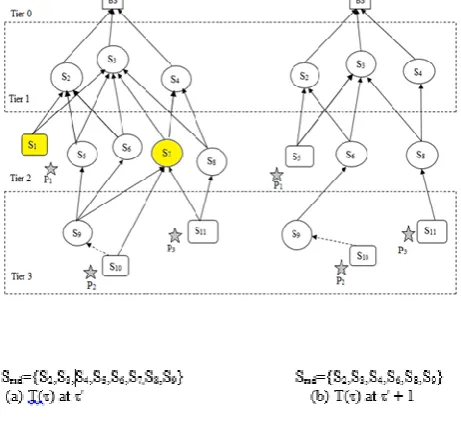
Fig.2 Coverage recovery by MCLCT
Fig. 2(a). Tells about the [1]dynamic coverage recovery in which P1, P2, P3 are the DPOIs and which there are 3 sensing nodes that will monitor this DPOIs.8 relaying nodes used to transfer the sensed data. And s1, s10, and s11 are the sensing nodes that form the disjoint set S2,S3,S4,S5,S6,S7,S8,S9 form the set Srsd. ) At the T(τ) at τ' there will be connection established between s9 and s10.And s10 has a sole candidate parent node (s7) in the lower tier
(Tier-2). Under such circumstances, maximum connected load balancing cover tree algorithm will conduct a dynamic coverage recovery, because the p1 will not be covered, which is due to the malfunction of S1. Fig. 2 (b) tells about the new topology of T(τ) at τ' + 1. As seen in the fig.2(b) node S5 originally serving as a relaying node would be changed to serve as a sensing node at τ' + 1, because its coverage resembles with that of S1.And without connecting to S10 at
τ' + 1, the sensed data of S10 will not be transferred to the base station. And by the dynamic compensation mechanism of the maximum connected load balancing cover tree for coverage and connectivity, the roles of sensor nodes can be efficiently determined.
The main objective of the probabilistic load balancing strategy is to fulfill the load balance among the wireless sensor nodes by sharing load equally among the nodes. The main function of the sensing nodes to monitor the DPOIs and transfer the data that sensed by it. By undergoing this, there will be less amount of energy consumption can be maintained. And equation (4), the residual energy is represented as ef(τ') of the node Si at τ'.’α’ denotes exponential factor used to set the response strength of the curve from energy to distance ratio. The sensing node si to the candidate parent node, the forwarding probability can be expressed as,
Equation (4), is further simplified. Before performing the forwarding probability for the relaying node, the normalization of the residual energy of the candidate parent nodes using their expected loads. It is done with the expected load, the weight of the one-hop transmission path from the relaying node Sk to its candidate parent node [srh
Prt(sk) at τ'].
© 2019, IRJET | Impact Factor value: 7.211 | ISO 9001:2008 Certified Journal
| Page 1700
3. RESULTS AND COMPARISON
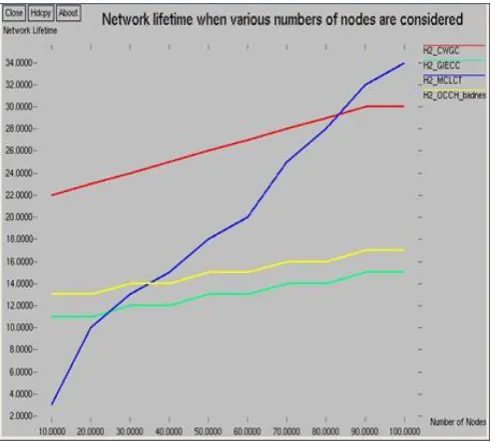
[image:4.595.308.561.96.301.2]In this section, the simulation results regarding the performance of the proposed MCLCT and compare it with previously mentioned algorithms which include CWGC [1], OCCH [2], GIECC [4]. All the simulations are carried out on the network simulation -2 platform.
Fig 3. Network lifetime when various numbers of nodes are considered (10 to 100 nodes).
[image:4.595.39.287.181.392.2]Fig 4. Network lifetime when various numbers of nodes are considered
Fig 5.Network lifetime when various number of DPOIs are considered
.
4. CONCLUSION
The simulation results show that network life duration is efficiently increased because of the traffic, the burden generated by the sensing nodes is dynamically organized to various relaying nodes. Further, for power conservation, the MCLCT will definitely performs well-arranged power utilization for nodes through the construction of dynamic cover tree.
REFERENCES
[1] [1]. Chia-Pang Chen, Member, IEEE, S.C.
Mukhopadhyay, Fellow, IEEE, Cheng-Long Chuang, Member, IEEE, Maw-Yang Liu, Member, IEEE, and Joe-Air Jiang, Senior Member, IEEE “Efficient Coverage and Connectivity Preservation with Load Balance for Wireless Sensor Networks”
[2] [2] I. Cardei and M. Cardei “Energy-efficient connected –
coverage in wireless sensor networks,” Int. J. Sens. Netw., vol. 3, no. 3, pp. 201–210, 2008..
[3] [3]. P. Ostovari, M. Dehghan, and J. Wu, “Connected point
coverage in wireless sensor networks using robust spanning trees,” in Proc. 31st International Conference on Distributed Computing Systems Workshops (ICDSC’11), 2011, pp. 287–293.
[4] [4]. N. Jaggi and A. A. Abouzeid, “Energy-efficient
connected coverage in wireless sensor networks,” in Proc. 4th Asian International Mobile Computing Conference (AMOC’06), 2006, pp. 77–86.
[5] [5]. D. Zorbas and C. Douligeris, “Connected coverage in
WSNs based on critical targets,” Comput. Netw., vol. 55, pp. 1412–1425, 2011.
[6] [6]. Q. Zhao and M. Gurusamy, “Lifetime maximization
[image:4.595.39.287.434.655.2]© 2019, IRJET | Impact Factor value: 7.211 | ISO 9001:2008 Certified Journal
| Page 1701
[7] [7]. X. Han, X.G. Cao, E. L. Loyd, and C.-C. Shen,
“Fault-tolerant relay node placement in heterogeneous wireless sensor networks,” IEEE T. Mobile Comput., vol. 9, no. 5, pp. 643–656, 2010.
[8] [8]. A. Krause, R. Rajagopal, A. Gupta, and C. Guestrin,
“Simultaneous optimization of sensor placements and balanced schedules,” IEEE Trans. Autom. Control, vol. 56, no. 10, pp. 2390–2405, 2011.
[9] [9]. D. Yang, S. Misra, X. Fang, G. Xue, and J. Zhang,
“Two-tiered constrained relay node placement in wireless sensor networks: computational complexity and efficient approximations,” IEEE Trans. Mobile Comput., vol. 11, no. 8, pp. 1399–1411, 2012.
[10] [10]. P.Gowtham1, P.Vivek Karthick2, “Optimized
Coverage and Efficient Load Balancing Algorithm for WSNs-A Survey [11].H. M. Ammari and S. K. Das, “Centralized and clustered k-coverage protocols for wireless sensor networks,” IEEE T. Comput., vol. 61, no. 1, pp. 118–133, 2012.
[11] [12]. M. Ashouri, Z. Zali, S.R. Mousavi, and M.R. Hashemi,
“New optimal solution to disjoint set K-coverage for lifetime extension in wireless sensor networks,” IET Wirel. Sens. Syst., vol. 2, no. 1, pp. 31–39, 2012
[12] [13]. Y. Lin, J. Zhang, H.S.-H. Chung, W. H. Ip, Y. Li, and
Y.-H. Shi, “An ant colony optimization approach for maximizing the lifetime of heterogeneous wireless sensor networks,” IEEE Trans. Syst., Man, Cybern. C, Appl. ,Rev., vol. 42, no. 3, pp. 408–420, 2012.
[13] [14]. X. He, H. Yanh, and X. Gui, “The maximum coverage
set calculated algorithm for WSN area coverage,” J. Netw., vol. 5, no. 6, pp. 650–657, 2010.
[14] [15]. O. M. Younis, M. M. Krunz, and S.