RESEARCH ARTICLE
COST REDUCTION IN DIFFERENT DISCIPLINES
*1
Gaurav Harish Yadav,
1Rahul Kumar Jain,
2Mayank Kapoor and
3Raman Nateriya
1
Department of Mechanical Engineering, Rajiv Gandhi Technical University, Bhopal
2
Department of Civil Engineering, Rajiv Gandhi Technical University, Bhopal
3
Department of Civil Engineering, Maulana Azad National Institute of Technology, Bhopal (M.P.)
ARTICLE INFO ABSTRACT
The Intense competition and pressure from customers to reduce prices has forced many companies to reduce their costs to survive. The cost must be reduced earlier in the product life cycle, particularly while the product is in the planning and design stages. But in this case study we have found stages after launch of product in the market to reduce the price. Few more factors which influence the cost of products and are determined by various cost allocation methods. Cost Allocation method is the process used to assign costs to production or services. When assigning costs to production and/ or service activities it is important to know whether the cost is a direct or an indirect cost. This will let the management of the concern know how to deal with the particular cost. The treatment of direct costs will be different from the treatment of indirect costs or overheads. Direct costs such as direct material, direct labor are used to make specific product or service. The term cost tracing is used to describe what happens when it is possible to assign a cost directly to a specific product or service. An example of this would be the wood. It is possible to calculate how much wood was used to make a desk or a chair. But, indirect costs or overheads benefit several products or services and cannot be traced directly to a specific product or service. An example of this would be the wood glue that is used to manufacture the tables, chairs and desks. It is hard to say exactly how much glue was used in making tables, chairs and desks. So, another method of allocating such costs to products that used the glue must be found. Such methods are referred to as cost allocation methods. These methods are used when it is not possible to say exactly how much of a particular resource has been used to make a particular product or service. Since it has been acknowledged that the cause of a product should be taken into consideration while planning and strategy that is before actuating the production. In this research paper we have studied how to reduce cost of a product after production, and factors taken into picture for the cost reduction. When an organization launches a product in the market, it starts reflecting the demand and position of a product in competition. And also for an effective cost of a product after a particular time it is necessary to forecast the demand of the product in the market by various forecasting techniques. Forecasting leads to compute the amount of production to be done so that, organization buy adequate amount of raw materials which reduces the cost of storing and maintaining. Similarly as the virtual demand is a computed organization start with the production and delimit it according to the demand which helps in reducing the cost of inventory and which further leads to reduce the cost of the product. Reduced cost in the market may increase the demand of the particular product which makes out maximum profit. Since we have focused the right time to make out a survey in the market and to analysis the demand and accordingly start the production and delimit various factors to abate the price of a product.
Copyright © 2013 Gaurav Harish Yadav, et al., This is an open access article distributed under the Creative Commons Attribution License, which permits
unrestricted use, distribution, and reproduction in any medium, provided the original work is properly cited.
INTRODUCTION
In a firm there are two functions, namely
production function
cost function
The relationship between inputs and output is known as "production function" and the relationship between output and costs is known as "cost function". In a production firm the cost of the product is determined by the total cost of a product. This total cost consists of total costs and variable costs. At the time of starting the production firm the fixed cost is decided and varies circumstantially. The fixed cost includes the machine cost, rent, insurance, salaries, etc. The variable cost is the cost which changes continuously with the production process. As the production increases the fixed cost remains the same but the variable cost increases with increase in the production or in other words it can be written as,
*Corresponding author: Gaurav Harish Yadav,Department of Mechanical Engineering, Rajiv Gandhi Technical University, Bhopal.
And the total cost can be given as,
= +
We need to reduce the total cost of our organization with increase in output or volume of production.
LITERATURE REVIEW
What is Cost Reduction?
The terms cost saving and cost reduction sounds quiet similar to a common man but they holds different meaning. Cost saving means to just reduce the production cost by any means it can be by using poor quality of raw material, by improper handling of goods or even by improper storage whereas cost reduction means to reduce the total cost of the produced good without compromising with the quality of the finished product. Cost reduction is reducing the amounts of money spend on the production and wages in order to make the industry run more profitably at the same time maintaining the quality of the product. While reducing the cost the quality of final product is
ISSN: 0975-833X
International Journal of Current Research
Vol. 5, Issue, 10, pp.2821-2825, October,2013
INTERNATIONAL JOURNAL
OF CURRENT RESEARCH
Article History:
Received 05th July, 2013
Received in revised form
30th August, 2013
Accepted 14th September 2013
Published online 10th October, 2013
Key words:
Cost Reduction, Business Models, Inventory, Red tape,
emphasized most. The cost reduction is defined as "The process of looking for, finding and removing unwarranted expenses from a business to increase the profit without having a negative impact on product quality". In other words cost reduction can also be defines as "the way of doing the ongoing work in a new, different and more efficient pattern in order to reduce the excess cost."
RESEARCH METHODOLOGY
Why Cost Reduction is necessary?
The main aim of any firm is to produce more with fewer inputs. The managing of company is like attempt of viewing both sides of coin simultaneously. At one side the entrepreneur requires growth of the firm and on the other side it demands to reduce the costs which never go away. In many cases outsourcing is seems to be an easy approach, but once company decides to outsource for various operating processes, it unfolds new forms of risks. For example, outsourcing with an inferior supplier may scathe the relationship among suppliers and customers. So for increasing the overall efficiency and effectiveness of an organization, cost reduction is must. Today, many industries are trying to use the waste material of some other industry which can be used for their production. What if, the byproducts of an industry become the major raw material for the production of the other industry? Some examples of such organizations are as follows:
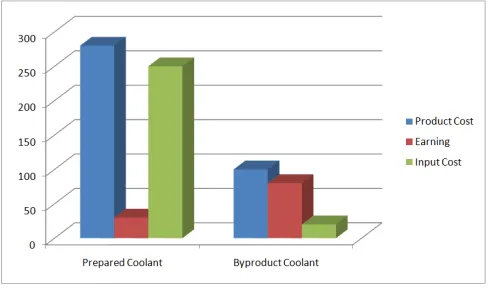
1) Glycol is a byproduct of most alcohol based industries, as it is used as solvent therefore after various processes it can be recovered completely in the end. But still it remains as the byproduct for that industry. Glycol is used as coolant in various Automobiles. Even low grade of glycol fulfills the need. Getting the waste glycol from an industry at low rates (Rs 10 per liter or lower) and on the other hand if we manufacture fresh glycol then the expected cost may vary from Rs 100 to Rs 200. The best composition for coolant contains 50% glycol by volume and rest 50% contains water and other chemicals in minor quantities. So by comparing their costs we get -:
[image:2.595.40.286.466.611.2]Freshly manufactured glycol costs Rs 200 per liter. Byproduct glycol costs from Nil to Rs 10 per liter.
Fig. 1. Comparison of cost of coolant
If, we use the byproduct glycol and talking 50% of glycol to produce best coolant, then the cost of coolant produced will be reduced by 90%.
2) There are many brands now available in the Indian market, but a true Indian knows the name of “WASHING POWDER NIRMA”. The owner of Nirma industry is Mr. KarsanBhai Patel he is one of the greatest entrepreneur in the world’s history. He used gutter of all the industries like he used paper mills to obtain Alkalis, Acids from Ordinance factory etc and made the cheapest detergent in the world “NIRMA”. This is how by making the byproduct of various industries as his major raw product he gave birth to this detergent.
In the field of Food Management
COST REDUCTION IN THE FIELD OF FOOD MANAGEMENT PROCESS CONTROL: -
It is a modern approach of food preservation. In process control, the food is prepared in 0B (zero B) condition. Example ->Rasgulla is
prepared and is carried out to a temperature of 120 ˚C for a while,
after sometime it attains Zero B, and then it is packed in perstarlized packages for its longer lifetime. Through the zero B process the demand in market can be met and a constant supply can be maintained. Similarly, Namkeens are mostly affected by moisture. The process of getting affected by moisture is known as Rensification. To make it moisture free non respiring material is used i.e. aluminum coated polymer is used to store it. (Note-: Polyethene is respiring material)
CHALLENGES IN COST REDUCTION
Cost reduction is a never ending struggle for an entrepreneur or for a company. It is an obvious thing for a company for having cost reduction strategies. These types of strategies will definitely maximize companies’ potential and efficiency excluding exceptions. Growth potential sometimes is a tricky proposition. For this one need to identify the core competencies where efficiency can be improved to an extent. In some companies, third party provider is gaining acceptance. This is known as outsourcing. In this company decides to take help from the third member who may even break the flow of relationship between supplier and customers. In outsourcing the company also exposes itself to the market which is a new form of risk over the organization.
MODEL SENSITIVITY
Model sensitivity or robust analysis is done by using the given formula.
= ( )
( ∗)
Where, Q is any order size and ∗ is the order size at break-even
point.
Model sensitivity is used to determine the variations of input on to the variations of output. This basically deals with the design of the product and the decisions taken will be on the change in design of the product if needed. The design solution must be strong and insensitive towards the changing environment it the output variance is small. If the output variance caused by the same input distribution is large then the design solution is not robust and sensitive.
Business models
There are some business models which help in reducing the cost of the firm
Managing Cost
Managing cost is always a challenge for the active entrepreneur. The pressure to save money year-over-year is persistent at all companies. However, resale values are countervailing some of the other rising costs, at least for now. Many managers report that they are given a specific percentage cost reduction goal and it is up to them how they are going to achieve it.
“Cancellation” of net savings
salaries solely under the control of the appropriate unit manager. Furthermore, savings should be calculated on a per-unit basis relative to historical costs, marketbaselines, or otherwise expected spend levels, depending on the context of the project.
Supply Management’s Role in the Allocation Decision
If the team is cross-functional, then a decision needs to be made in front of all the members, by an appropriate manager, with respect to how much of the cost savings will be attributed to supply management and how much to the other business unit(s). This could be an even split or a weighted split dependent on who is taking the lead and how the work is expected to be split among the team members. There’s no hard-&-fast rule here, but all parties involved should agree that the split is fair before the project gets underway.
TCO (total cost of ownership) concept for purchases items/ services
It includes all the direct cost components that go into the landed cost calculation, inventory costs, and operating costs. Probably the easiest way to approach this calculation in cost reduction calculation is to base the cost on landed costs and then factor in adjustments for any additional costs that are above or below average. For example, if a buyer was sourcing a food product and only one option is frozen, then the storage costs for all items but the frozen item will essentially be the same, with the frozen item costing more due to increased energy costs of using a freezer over a fridge, and only the landed cost for the frozen item needs to be adjusted. Similarly, when computing savings, a buyer needs to adjust for differences in incurred costs between respective time periods. It could be argued that this is not a proper TCO, but when it comes to calculating savings, mathematically speaking, it is only the differences in cost between last year’s buy and this year's buy that matters and this simple approach is sufficiently accurate for TCO calculation purposes.
= −
5.1.5 Multi-Year Issues
sometimes the switch over to a new product or new supplier will not be realized by the entrepreneur until second or third year of a contract, due to heavy costs associated with investments in new equipment, workers etc. However, it is important that supply and spend managers be rewarded each and every year for their contribution to this savings initiative. Although one may think that one may not be able to accurately calculate savings from such an endeavour until the contract ends, since investment costs have to be amortized, if investment costs are equally amortized over a fixed period, then an organization could adopt a calculation that realized savings each and every year. (And if losses occurred in the first year, they could be carried over and then the sourcing team could be rewarded as soon as hard savings were realized.)
= ( )−(
+ )
5.1.6 Competition in market by other providers
This is another major challenge to cost reduction. As if some other company is providing costumers better quality in same price as we are providing then for being in the competition with other companies in market we are under constrain that we can neither reduce the quality of the product nor we reduce cost in order to seek profit from our company point of view.
Visibility
Visibility here refers to the systems, people, and metrics (calculations). The agreed-upon metrics and the data that the cost avoidance metrics are calculated on need to be accessible to the entire organization so that there are no challenges as to their accuracy and validity.
COST MODELS
Following are the cost models
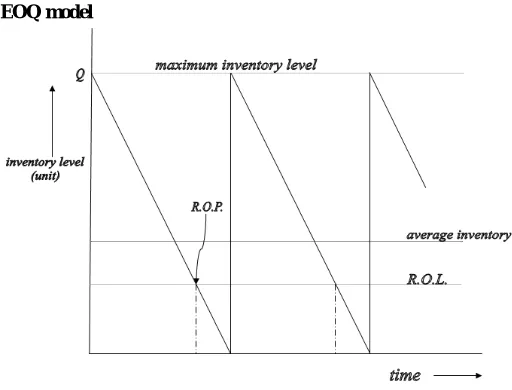
[image:3.595.306.562.180.375.2]EOQ model
Fig. 2. Economic Order Quantity Model
Production or Build up Model
Fig. 3. Build up model
pillows remaining. These 2 remaining pillows are called work in progress (WIP). The raw material for the third boy is the pillows provided by the second boy. Again, he produces the minimum on his die or the pillows available. For this case the capacity of the third boy is 5, but only 2 pillows are available as raw material. The remaining 3 units of capacity are wasted. This is disappointing to the third boy because his capacity was so much greater than his production. There is no additional WIP. Their mother has a demand that also depends on the throw of the die. For the first iteration, the mother demands 4 pillows. The third boy has only produced 2, so the mother takes these two pillows. The unsatisfied demand is lost. The mother is disappointed with the third boy who seems to be the bottleneck in this system. In this first iteration, the system produces 2 pillows. Two matches remain in the system as WIP waiting for processing by boy 2. This WIP has already been processed by boy 1 and is available for boy 2 to process in the next iteration.
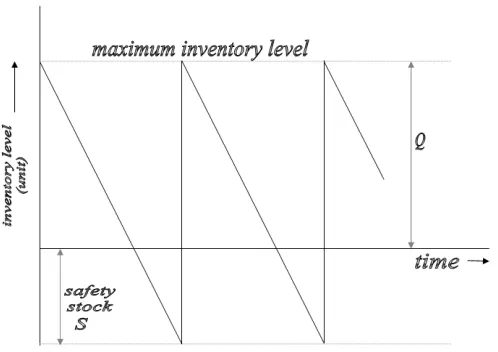
[image:4.595.41.290.246.422.2]Shortage or Backorder Model
Fig. 4. Backorder model
Where, Q=quantity to be ordered at each order point S=safety stock
This model is the extension of EOQ (economic order quantity) model and here shortages are allowed. Planned shortages or backorder is the situation in which a customer places an order and finds that inventory is out of stock. Then he waits for the next shipment to get his order fulfilled.
These shortages are pre-planned because it has some advantages. The advantages are listed below:
1. It increases the cycle time, thus reducing ordering cost.
2. It reduces the net stock in inventory thus reducing holding or
inventory cost.
Total inventory cost through this model is given as
( ) = +( − )
2 +2
Where, D=annual demand of inventory item =cost of placing an order
=cost of holding one unit in inventory for one year =backorder or shortage cost per unit
RESULTS
How Cost can be reduced
Cost can be reduced but some points are to be considered
Cheap raw material with same quality.
Energy efficient technology.
Time efficient Technology.
Low cost of Human resource.
Use of government subsidies availing them.(No taxes and free
water availability etc.)
Governmental Aids. (Partnerships and aids for labor)
Cheap transport communication -> Example in Assam They Blow
away the natural wood through river and elephants for the transportation of logs, is the best example of cheap labors.
Availability Of resources.
Devoted workers.
Reduce Reuse & Recycle.
By reducing red tape.
Red Tape
Red Tape is the way of working of the bureaucrats which normally is not in the favour of public, which cause delay in the process of decision making and execution of the task. In other words red tape is the sequential way of getting an approval or favour from the bureaucrats and the government. If red tape increases, there is delay in the process of production and hence the cost of production increases. Usually, these processes are not very easy. Sometimes producers need to pay a lot to skip away from red tape and increases the corruption. Let's take an example to briefly examine the red tape. There was a company which uses the red tape as follows "They started up the industry in various firms like petroleum, power etc. and according to the government policies in a region of India they got 5 years subsidy and various provisions. Later after 5 year period they changed the name of the firm, got it registered with new name and asked the government to provide them with the provisions of new industry again but government denied there appeal". Hence, government got benefited through the red tape policy as this company was unable to take bureaucrats in their favour and the company got loss from the red tape policy. Red tape makes an effort to reduce the cost and also reduce the corruption, but it is not found efficient in many times. Since, corruption is mixed in the heart of the people, hence sometimes it becomes ineffective. So the company can take another step. An industry can make the production cheaper by bringing the youth in action as earlier as possible. Example -> Train the young upcoming engineers in the training programs of the industry during their education period (graduation and masters period) and charge them to get trained. Use them in production during training period and then later on keep them as worker in the industry after their education is completed so that an industry can get a well-trained and much efficient worker, who is very much familiar to the industry and hence can work freely and more effectively towards the betterment of the industry.
IMPLICATIONS
Cost reduction is the process of removing the unwanted expenses from the overall cost which requires in the business process. Basically every organization uses the cost reduction technique. But we specially applied it and observed it in food management by using zero B condition. We also have seen it in some industries which use the by-product of another company to use as a raw material for its company. Especially this technique is used by automobile industries and soap producing industries like Nirma. There are various models which when used in different managerial decisions to control the overall cost of the process. Eicher tractors, a most versatile industry of manufacturing tractors, uses different layout process in manufacturing there tractors which vary widely reduces the cost of manufacturing as well as cost of maintenance.
LIMITATION
1) A strong watch over the quality is required, even a small error can cause threatening effects. In cost reduction we use various techniques to reduce the cost of the final product without compromising with the quality. Hence quality keeps an extra important role in the cost reduction process and so it can’t be compromised.
2) If the Trade secrets or the cost reduction policies of the firm
leaks, it will increase the competition in the market and indirectly will cause loss to same firm whose secrets were leaked. Thus, the workers and strategists must be very loyal to the firm and the firm should trust them too.
3) If the relation with bureaucrats or the politicians get disturbed due
to any reason, can lead to massive destruction for an industry. The results can be breakage of mutual understanding, deals, cancellation of subsidies and various benefits from the government etc. As a region is governed by the local government and the bureaucrats therefore they can even slow down or interrupt the production process by disturbing the functioning. Hence it becomes greatly important for industrialist and investors to maintain good relations with almost everyone.
4) It is not necessary that the cheap and good resources will be
available all the time. Hence, the balance should be maintained between the stock of raw material and consumption, so as to maintain a regular flow of supply at the reduced cost.
5) It is not very easy to get benefits and subsidies from the
government as it is very difficult to take bureaucrats in favor. Red Tape also delays the processes and ultimately harms the process of cost reduction.
6) Due to untrusted government policies it is not very sure to get
subsidies throughout. Once industry is started and if then government denies for providing the subsidies or revoking the subsidies, can lead to budget failure and may make the investors to shut the industry.
7) Continuous maintenance of the reduced cost is a challenge in long
run while maintaining the quality along with it. It needs a very strong management to look after the proper and efficient working. Therefore, research and development is must. It benefits the industry in two ways-:
a) For searching new raw materials, efficient technology. b) For searching new market and efficient investors.
Conclusion
This paper concludes that the cost of a product or services can be reduced to a certain limit and hence efficiency of an organization by various theories of operations and production management and through the implication of different business models. The case study reviews the relation between different variables involved in business strategies and variables affecting the cost of a product or service. Content in the research ameliorate the working process and business strategies through different models and theories. It reflects that the supply chain management plays an important role in an organization. Paper concludes the efficient use of technology and low cost of human resources. There are certain barriers for the development of the industry, but these are somehow necessary for the proper functioning of the government and red tape is one of these processes.
This paper puts light on the red tape and the problem arises due to this for the development of the industry. It also concludes both pros and cons of red tape. Also involves various factors and aspect affecting and puts up the bar in the development of an organization like environmental, government, relationship disturbances, and physical issues.
SCOPE FOR FUTHER RESEARCH
1) Further researchers should emphasize on the quality maintenance,
so as to maintain the quality for a longer period of time.
2) Red tape stability.
3) To make the resources available everywhere.
4) Relations should be maintained.
5) Stable and strong laws are needed to be made so as to get
benefited.
REFERENCE
"Application of business model to insurance contracts". HUB global insurance group. Retrieved 2011-06-03.
"Business Models Matter (for Accounting, That Is)". Cfo.com. Retrieved 2011-06-03.
"Exposure Draft: Leases”. International Accounting Standards Board. August 2010. p. 31. Retrieved 2011-06-03
"FASB Exposure Draft: Recognition and Measurement of Financial Assets and Financial Liabilities". Financial Accounting Standards Board. April 12, 2013. p. 174. Retrieved 2013-06-11.
Business Models , Business Model Generation, A. Osterwalder, Yves Pigneur, Alan Smith, and 470 practitioners from 45 countries, self published, 2010
Business Models, Costs: Getting to the Root Causes by James B. Ayers, November-December 2003
Business Models, Daas, D., Hurkmans, T., Overbeek, S. and Bouwman, H. 2012. Developing a decision support system for business model design. Electronic Markets - The International Journal on Networked Business, published Online 29. Dec. 2012. Business Models, Do Some Business Models Perform Better than
Others?, Malone et al., May 2006
Business Models, George, G and Bock AJ. 2011. The business model in practice and its implications for entrepreneurship research. Entrepreneurship Theory and Practice, 35(1): 83-111
Business Models, Hummel, E., G. Slowinski, S. Matthews, and E. Gilmont. 2010. Business models for collaborative research. Research Technology Management 53 (6) 51-54.
Business Models, Osterwalder, A., Pigneur, Y. and C. L. Tucci. 2005. Clarifying Business Models: Origins, Present, and Future of the Concept. Communications of the Association for Information Systems 16 1-40.
Business Models, Reducing the Costs of Purchased Services: What Strategies are Available to Help Reduce the Costs of Purchased Services? by ISM, 2004
Business Models, Transaction Cost Analysis in Supply Chains: Theoretical Consideration and Practical Application by Stefan Securing, October 2004
Business Models, Lim, M. 2010. Environment-Strategy-Structure-Operations (ESSO) Business Model. Knowledge Management Module at Bangor University, Wales.