Abstract— This paper is devoted to the consideration of
possible solution for the analysis of stress-strain state of anisotropic massif containing the deep located diagonal mines of arbitrary profile under the propagation of elastic longitudinal and shift waves. The special case of generalized plane deformation is considered at this paper to get solutions for different located mines (drifts, crosscuts and diagonal mines). The cases of the first and second fundamental problems are formulated in the given paper as well as rigorous mathematical solutions based on theory of cylindrical function are demonstrated.
Index Terms—anisotropic (transtropic) massif, generalized
plane deformation, deep founded mines, drifts, crosscuts, diagonal mines, diffraction, PP-wave, SV-wave, SH-wave.
I. INTRODUCTION
Underground structures, the longitudinal axis of which makes an arbitrary angle with the extending line of the massif isotropy plane, find wide application in the area of the capital mining. For example, close to bole mine development crosses sloping rock layers in different directions: highway traffic tunnels are usually randomly oriented with respect to the elements of bedding surfaces of the rock stratification.
Anisotropic (or simplified transversal-isotropic) model of the folded-layered massif with tilted plane-parallel layers near the underground structures allows you to consider the horizontal mines, depending on the spatial orientation, namely , the rock drifts (are developed across the line of spread), crosscuts and so-called diagonal mines, which occupy an intermediate position between the drifts and crosscuts. [1]
Diagonal mines by definition contain as limiting cases of drifts and crosscuts. A detailed analysis of the stress state of such rock mining provides a framework to assess the stability and strength of the drifts and crosscuts at the case of deflection of their longitudinal axis from its position in relation of the bedding of rock layers. Design scheme of the diagonal mines is the most generalized scheme for determining the dynamic stress in the massif around the underground structures because the wave propagation is not always directed strictly along or transverse to the longitudinal
Lyazzat B. Atymtayeva with the Kazakh-British Technical University, and Research Institute of Mechanical Engineering and Machine named after U. Joldasbekov, Almaty, Republic of Kazakhstan (phone: 8-727-272-15-02; fax: 8-727- 250- 46-51, e-mail: [email protected], [email protected] )
axis of the underground structures that is usually taken into consideration by researchers. Moreover, such design scheme allows us to consider different cases of the waves propagation.
II. PROBLEM STATEMENT
Since the rock massif around the underground structures can be modeled by anisotropic (in simplified cases - transversely isotropic) medium, for consideration of the elastic properties of such medium we can use the generalized Hooke's law [2].
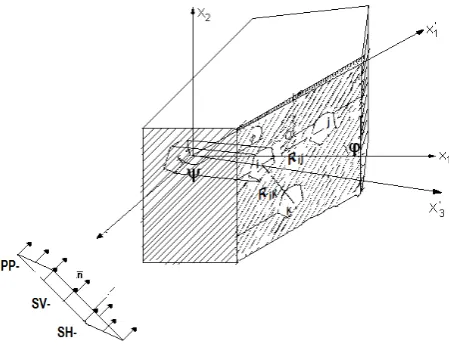
Let us write the generalized Hooke's law equations for the massif with diagonal cavities (simulating the mines) in the coordinate system Ox'1x2x'3 which has the axis Ox'3 deflected by angle from Ox3(in the main coordinate systemOx1x2x3) (see figure 1). On the figure 1 we can demonstrate the scheme of plane harmonic waves propagation within transversal-isotropic (annotated as transtropic) massif containing cavities that are deeply located a-cross the spreading of inclined isotropy plane under the generalized deformation conditions.
In order to make it clear the generalized plane deformation conditions let us suppose that the proper external forces do not vary along the longitudinal axis of the mines. The cross-sections of diagonal mines have the curvature. The homogeneity of the mechanical properties of the considered massif together with the assumption of infinite extent of the mines (or cavities) causes the similar distortion of cross-sections of diagonal mines throughout their length. Therefore, the displacements will be dependent only from the coordinates of their cross-sectional plane, namely,
) , ( 2 3'
' 2 '
2 u x x
u , u3' u3'(x2,x3'). These conditions give us the plane deformation conditions and allow considering all suggestions of the plane deformation theory [1,2].
Under these conditions the generalized Hook’s law equations for transtropic massif with inclined plane of isotropy containing the diagonal mines (cavities, or holes) may have the following view [1,2]:
, , , , ,
13 66 12 65 23 64 22 62 11 61 13
13 56 12 55 23 54 22 52 11 51 12
13 46 12 45 23 44 22 42 11 41 23
13 26 12 25 23 24 22 22 11 21 22
13 16 12 15 23 14 22 12 11 11 11
c c
c c
c
c c
c c
c
c c
c c
c
c c
c c
c
c c
c c
c
(1)
Possible Solutions of the Generalized Plane
Deformation at the Multilinked Rock Massif
under the Actions of Elastic Waves
Figure 1- Rock massif with diagonal mines under the actions of elastic waves
Here the elastic coefficients cij cji besides the five adjusted elastic constants – Young's modulus and Poisson's ratio for transtropic medium -E1, E2 ,
1,
2 , G2 - depend on angle of inclined isotropy plane and angle of mine's axis deflection from the line of isotropy plane spreading.Specified coefficients may be considered as adjusted coefficients along the diagonal cavity axis:
' 33 ' 3 ' 3 ' b b b b
cij ij i j . (2)
where , 2 sin ] 2 cos 5 . 0 sin ) ( cos ) [( , 2 sin ] 2 cos 5 . 0 sin ) ( cos [ sin ] sin cos ) [( , sin cos , cos sin )] 2 ( 2 [ , sin cos sin ) 2 ( 2 cos 66 2 22 12 2 12 11 ' 16 66 2 46 25 2 15 ' 15 2 25 2 46 15 ' 14 2 23 2 13 ' 13 2 2 66 12 22 11 12 ' 12 4 22 2 2 66 12 4 11 ' 11 b b b b b b b b b b b b b b b b b b b b b b b b b b b b b 2 sin ] 2 cos 5 . 0 cos ) ( sin ) [( cos ] cos sin ) [( sin ] cos ) ( sin [ , cos sin , cos cos sin ) 2 ( sin 66 2 22 12 2 12 11 ' 26 2 25 2 46 15 ' 25 2 46 25 2 15 ' 24 2 23 2 13 23 4 22 2 2 66 12 4 11 ' 22 b b b b b b b b b b b b b b b b b b b b b b (3) 2 sin ) 2 ( , 2 cos sin 2 sin cos ) ( , sin cos , 2 sin sin ) ( 2 cos cos , 2 sin ) ( 5 . 0 , sin cos , sin ] [ 2 cos , 2 sin , 2 66 12 22 11 16 ' 66 46 25 15 ' 56 2 44 2 55 ' 55 46 15 46 ' 46 55 44 ' 45 2 55 2 44 ' 44 23 13 ' 36 35 ' 35 35 ' 34 33 ' 33 b b b b b b b b b b b b b b b b b b b b b b b b b b b b b b b b
Coefficients bij mentioned above in the expressions (1), (2) can be extracted from the source [1,2,3].
By using physical equations of the stress-strain state and kinematic Cauchy relations the motion equations in the case of generalized plane deformation may be presented in the types with operators (by similarity with [4,5]):
, 0 . 0 , 0 2 3 ) 1 ( 32 1 3 ) 1 ( 31 3 ) 0 ( 33 2 ) 0 ( 32 1 ) 0 ( 31 3 3 ) 1 ( 23 2 3 ) 1 ( 22 1 3 ) 1 ( 21 2 2 3 ) 2 ( 22 1 2 3 ) 2 ( 21 3 ) 0 ( 23 2 ) 0 ( 22 1 ) 0 ( 21 3 3 ) 1 ( 13 2 3 ) 1 ( 12 1 3 ) 1 ( 11 2 2 3 ) 2 ( 12 1 2 3 ) 2 ( 11 3 ) 0 ( 13 2 ) 0 ( 12 1 ) 0 ( 11 u A u A u A u A u A u A u A u A u A u A u A u A u A u A u A u A u A u A u A u A u A (4)
Here Aij(k)(i,j=1,2,3; k=0,1,2) – operators, at that
2 2 45 2 1 56 14 2 1 16 ) 0 ( 13 ) 0 ( 31 2 2 25 2 1 55 12 2 1 15 ) 0 ( 12 ) 0 ( 21 2 1 2 2 55 2 1 15 2 1 11 ) 0 ( 11 ) ( , ) ( , 2 c c c c A A c c c c A A c c c A , , ) ( ) ( ), ( 2 ), ( 2 , 2 ) ( , 2 2 46 1 66 ) 1 ( 31 ) 1 ( 13 2 26 45 1 56 14 ) 1 ( 21 ) 1 ( 12 2 24 1 45 ) 1 ( 22 2 56 1 16 ) 1 ( 11 2 1 2 2 44 2 1 46 2 1 66 ) 0 ( 33 2 2 24 2 1 45 26 2 1 56 ) 0 ( 32 ) 0 ( 23 2 1 2 2 22 2 1 25 2 1 55 ) 0 ( 22 c c A A c c c c A A c c A c c A c c c A c c c c A A c c c A (5) 44 ) 2 ( 22 46 ) 2 ( 21 ) 2 ( 12 66 ) 2 ( 11 2 44 1 46 ) 1 ( 23 ) 1 ( 32 , , , c A c A A c A c c A A , 2 0 2 1
is a circular frequency.
Let us suppose that Sl (l1,L) are areas of the cavities cross-sections, and L
l Sl S 1 2 0
Horizontal mines with radius Rl (l1,L ) are spread along the axis Ox3 and have cross-section with the contour
l
Г . We assume that the exterior of the unit circle using the function ~(l) is displayed on the exterior of the boundary contour Гlof the Sl (l1,L) area[6]:
l l
l R
z ~( ) (6) This function transforms the circular shape of the cavities cross-sectors. For non-circular shape of cross-sectors we can use the next expression (following by [6]):
) (
) ( ~
1
N
m m m
d R
z ,
, ,
2 1
ei x
i x
z (6*) We assume that inside the transtropic massif in the cross section plane of the cavities along the direction given by the unit vector n(n1,n2) the stationary elastic harmonic wave
falls. The wave front is parallel to the axes of the cavities, the wave itself is polarized in the plane of the cavities cross section in case of consideration of elastic longitudinal (PP-) and shift (SV-, SH-) waves.
Wave representation can be shaped by the following expression
t i
e u u *
(7) where u*is a wave amplitude that is described by the following (in case of the dividing the waves into types that is possible because of transtropic nature of massif [7]) :
)] (
exp[
)] (
exp[
2 ) 1 ( 2 1 ) 1 ( 1 *
1
2 2 1 1 *
* 1
x k x k i U
x n x n k i U
u pp PP
,
)] (
exp[
)] (
exp[
2 ) 2 ( 2 1 ) 2 ( 1 *
2
2 2 1 1 *
* 2
x k x k i U
x n x n k i U
u SV SV
, (8)
)] (
exp[
)] (
exp[
2 ) 3 ( 2 1 ) 3 ( 1 *
3
2 2 1 1 *
* 3
x k x k i U
x n x n k i U
u SH SH
Here - wave frequency, (kPP,kSV,kSH )=(k(1), )
2 (
k , k(3)) is a vector of wave numbers, (n1,n2)are the direction cosines of the angle of wave incidence that is an angle between axis Ox1 and vector n
(see figure 1). In the case of generalized plane deformation the diffraction field is characterized by the movement components
u1,u2,u3
up , depending on the coordinates of the cavities cross sections [1,2].
Boundary value problem is formulated based on the motion equations (4), taking into account that the characteristics of the stress-strain state depends only on the coordinates of the points (х1,х2) in the cross section of the cavities. After simple transformations we can get the following expressions for deep founded mines that are based on non-zero operators from (4):
, 0
. 0
, 0
3 ) 0 ( 33 2 ) 0 ( 32 1 ) 0 ( 31
3 ) 0 ( 23 2 ) 0 ( 22 1 ) 0 ( 21
3 ) 0 ( 13 2 ) 0 ( 12 1 ) 0 ( 11
u A u A u A
u A u A u A
u A u A u A
(9)
In case of the diffraction of longitudinal and shift waves in the cross sector planes of cavities, the differential equations (4) can be transformed into the matrix form:
(B012B112 B222 B3)up 0, (10) where
66 56 16
56 55 15
16 15 11 0
c c c
c c c
c c c
B ,
46 45
26 56 14
45 26 25 55
12
56 14 55 12 15 1
2 2
2
c c
c c c
c c c c
c
c c c c c
B ,
44 24 45
24 22 25
45 25 55 2
c c c
c c c
c c c
B ,
2 1 2 1 2 1 3
0 0
0 0
0 0
B ,
u1,u2,u3
up (11) Coefficients сij (i,j=1,6) in (11) are elastic parameters that are defined by formulas (2), (3). up
u1,u2,u3
is a vector of displacements in the reflected waves that is represented by relations to Rl - linear l’s cavity size.For the formulation of the problem we can consider the solution of the first and second main elasticity theory problems, that is the cases when the cavity contour is not supported by lining (case of free of loads contour) – the first problems, and the case of fixed non-deformable lining of the cavity contour – the second problem. In general, we can consider the mixed problem for different types of cavity boundary conditions.
III. SOLUTION OF THE FIRST FUNDAMENTAL PROBLEM Suppose that the deep founded mines have contours with radius Rl (l1,L) that are free from the outside loadings. In our terms above we formulate the first fundamental problem of elasticity theory. The boundary conditions on the contours Гlmay be viewed as [2,8]
0 )
(nn nn* Гl , 0
)
( *
l
Г n n
, (15a) 0
)
(n3n*3 Гl , 0 )
(3*3 Гl (15b) The initial conditions are represented as:
0 | )
(nn nn* Гl t0 , (16a)
0 | )
(n n* Гl t0 , (16b)
0 | ) ( n3 n*3 Г t0
l
,
0 | )
Here *nn, *n are the normal and tangential stresses on the planes with (n1,n2) normal that are caused by falling stress-strain waves in cross-sectors of the cavities; n*3*3 are tangential stresses on the plane with (n1,n2) normal that are influenced by falling shift SH-waves; nn, n , n3,
3
are relevant amplitude stress components at the reflected waves.
For integrating the partial differential equations of the second form as (10) we can introduce the affine transformation by the following expressions (by analogy with [5,9-11]):
} { } { }
{ }, { }
{ 2 2'()
) ( 1 1 )
( 2 ) ( 1 ) ( 1
i i
i i
i x
x ,i1,2( 17) where 1 i 2 is a root of characteristic equation of the second form and 2 0 is a positive defined symmetric matrix. This root may be identified from the following transformations:
0
2 1 2
0 B B
B ,
and
2 1 2 1 1 0 2 1 0 2
1 1 0
1 [4 ( ) ]
2 1 ,
2 1
B B B B B
B
.
Furthermore we can carry out the next conversions:
}, { } { } {
} { } { } { } {
}] { }) { } { [( *
* }] { }) { } { [(
}) { } { } { (
2 ) ( 2 ) ( 2 2 2
) ( 1 2
) ( 2 )
( 1 )
( 2 )
( 1
) ( 2 2 )
( 2 1 ) ( 1
) ( 2 2 )
( 2 1 ) ( 1 0
2 ) ( 2 2 ) ( 2 ) ( 1 1 2 ) ( 1 0
2 1 i i
i
i i
i i
i i
i
i i
i
i i
i i
i i
i E
i E
B
B B
B
where { ()2} 2 1 i
is a Laplace operator’s vector derived on the vectors-variables {1(i)} and {2(i)}.
Thus the differential equation (10) can be reduced to Helmholtz equation with vector-coordinates ({1(i)},{2(i)}) as the following (by following the analogy with [5, 9-11]):
0 )} , ( ){ }
({ (i)2 01 3 1(i) 2(i) 2
1
B B ui (18)
In general case the points {Ol(i)}, i1,2,3, l1,L that are centers of local coordinate systems ({x1(li)},{x(2il)}) after transformation (17) will be converted to the points {O(il)}. They can be considered as origins of the coordinate systems ( {1(li)} , {2(il)} ) with axes that are oriented along coordinate axes ({1(i)} ,{2(i)} ) and polar coordinates
({rl(i)},{l(i)}) with polar angle l(i) measured from the axis
}
{Ol(i) {1(li)}.
We can derive the displacements up
u1,u2,u3
at the case of diffraction of longitudinal and shift waves and, in particular, when elastic coefficients c15=0, c16=0, c56=0. Hence, we can represent the Helmholtz equation (18) as the following0 ) , ( )
( 2 () 0()2 1() 2()
2 )
(
i i
i i u i
i
l
, i1,2,3
Now in accordance with principle of generalized superposition [4] we can get displacements
1, 2, 3
}
{u u u u
u i as infinite series with unknown coefficients Anl(i),i1,2,3 and cylindrical Hankel functions of the first kind [4,5,10,11] :
L
l n
in i l i n i nl i
i l e r H
A u
1( )
) ( ) ( 0 ) 1 ( )
( ()
)
( , n,, 3
, 2 , 1
i (19) where
11 1 ) 1 (
0 / c
, 0(2) 1 / c55 , 0(2) 1 / c66 By using theorems of cylindrical functions addition [4], [5], we can get representations for displacements
uiu ,i1,2,3 in any of coordinate systems (rl(i),l(i)) as
} ) (
}{ {
} ) (
}{ { } {
) (
) (
) ( ) ( 0 )
( ) (
) ( ) ( 0 ) 1 ( ) (
i l
i l
in i l i n i nl
n
in i l i n i nl i
e r J s
e r H
A u
,
(rl(i) Rlq(i)), i1,2,3, l1,L (20) Here
L
l q q p
n p i i lq i n p i pq i
nl
i lq e R H
A s
, 1( )
) ( ) ( ) ( 0 ) 1 ( ) ( )
(
} )
( }{ { }
{
) (
( Rlq(i) ,lq(i) ) are the coordinates of the point O(li) in coordinate system (rq(i),q(i)).
In the expressions (20) as cylindrical function we consider cylindrical Hankel function of the first kind because the time dependency is given by factor eit and solutions of the proposed task are characterized by a wave of going to infinity.
Then, following the theorems of cylindrical functions addition, the method of cylindrical functions decomposition, and the method of contour changing [4,5,6] as well as by using contour representations for displacements and stresses and boundary conditions (15), (16), we can transform the solutions to the infinite system of linear algebraic equations related to unknown coefficients Anl(i) , snl(i) by using the method of equality of coefficients at equal degrees of the components eipl:
3 1( )
) ( * 2
3 1( , )
) ( ) ( ) ( ) (
4 ) (
i p i pl i l
i np
i npl i nl i npl i
nl U
R i s
3 1( )
) ( * 2
3 1( , )
) ( ) ( ) ( ) (
4 ) (
i p i pl i l
i np
i npl i nl i npl i
nl U
R i s
A (21)
where (npli) , npl(i) , (pli), npl(i) , npl(i) , (pli) are complex potentials that are calculated by analogy with [9-11].
IV. SOLUTION OF THE SECOND FUNDAMENTAL PROBLEM The second fundamental problem of elasticity theory in our considered case of elastic wave propagation within the rock anisotropic medium containing the diagonal mines can be formulated by analogy with the first fundamental problem. The boundary conditions in this case will include the expressions with displacements like
0 )
(uiui* Гl , i1,2,3 (22) The initial boundary conditions are considered as
0 | )
(ui ui* Гl t0 , i1,2,3 (23) Furthermore we can define all mentioned above characteristics including complex potentials, special boundary solutions and etc., from the consideration of displacements at falling and reflected waves. The finished infinite system of linear algebraic equations related to unknown coefficients Bnl(i), and tnl(i) may be represented as the following
) ( * )
(
) ( ) ( ) ( ) (
)
( i pli
n
i npl i nl i npl i
nl Q t P U Q
B
, i1,2,3,
,
p . (24) Here Qnpl(i), Pnpl(i), Q(pli) are complex potentials that can be calculated by analogy with [9-11].
V. CONCLUSION
The given systems (21) and (24) may be solved by reduction method. By the reason of complicated rigorous justification approaches of such systems we can show the convergence of the solution numerically.
Further we can demonstrate the applications of the considered solutions for the different anisotropic rock massifs containing the diagonal mines. We can get the dependencies of stress-strain state of the massif from the forms of cavities, their mutual influence, from the different physical, mechanical, and geometrical properties of the medium, falling waves, and cavities, as well as from location of cavities at the rock massif.
REFERENCES
[1] Zh.S.Erzhanov, Sh.M.Aitaliyev, Zh.K.Masanov, “Seismically stressed
state of underground constructions in anisotropic layered massif”,
Alma-Ata, Publishing House “Nauka”, 1980, Russian
[2] S.G. Lechnitsky “Theory of elasticity for the anisotropic media”. Moscow, 1951 (in Russian)
[3] Lyazzat Atymtayeva “Research of dynamics of anisotropic multiply massif under the impact of stationary diffraction of elastic waves at the
case of solving the first fundamental problem” //Reports of Kazakhstan
Republic National Academy of Science, No2, 2010. - pp.105-113, Russian
[4] A.N.Guz, V.D.Kubenko, M.A.Cherevko, “Diffraction of elastic
waves”, Kiev, Publishing House “Naukova dumka”, 1978, Russian
G.I.
[5] A.S.Kosmodamianski, V.I.Storozhev, “Dynamical tasks of elasticity
theory for anisotropic environments”, Kiev, Publishing House
Naukova dumka”, 1985, Russian
[6] N.I. Muskhelishvili, “Some basic problems of the mathematical theory
of elasticity”, Moscow, 1977, Russian
[7] Petrashen “Propagation of waves in anisotropic elastic mediums”, Leningrad, Nauka, 1980. - 280 p., Russian
[8] E. Delesan, D. Ruaie “Elastic waves in solids”, Moscow, Nauka, 1982. – 424 p., Russian
[9] Atymtayeva L., Masanov Zh., Yagaliyeva B., Myrzakhmetova G.
“Dynamics of transtropic elastic continuums with non-homogeneities”
//Proceedings of World Congress on Engineering 2010, the 2010 International Conference of Mechanical Engineering, London, UK, 30 June-2 July, 2010. - P. 1024-1027.
[10] Atymtayeva L., Masanov Zh., Yagaliyeva B., Myrzakhmetova G.
“Stationary diffraction of elastic waves on the mine tunnels in the
anisotropic layered massif” // Proceedings of the International
conference “Modern problems of applied mathematics and mechanics: theory, experiment and practice”, Novosibirsk, Russia, May 30 – June 4 , 2011, http://conf.nsc.ru/niknik-90/reportview/36661
[11] L. B. Atymtayeva , Zh. K. Masanov, and .B. E. Yagaliyeva “Diffraction of Elastic PP-, SV-and SH-Waves on the Arbitrary Deep-founded
Cavities in the Anisotropic Rock Massif” //Proceedings of the World