Abstract— Conventional cooling technologies are generally based on the electrically driven refrigeration system. These systems have several disadvantages: they require high levels of primary energy consumption, causing electricity peak loads and employ refrigerants with negative environmental impacts. Solar adsorption refrigeration is an option to overtake the drawbacks of the conventional cooling system. The adsorption refrigeration is based on the evaporation and condensation of a refrigerant combined with adsorption and phase change material for higher performance. A Phase-change material (PCM) is a substance with a high heat of fusion which, melting and solidifying at a certain temperature, is capable of storing and releasing large amounts of energy. Heat is absorbed or released when the material changes from solid to liquid and vice versa; thus, PCMs are classified as latent heat storage (LHS) units and sensible heat (SHS).
Index Terms— Solar energy, Adsorption cooling, Phase Change Material, Solid adsorption.
1) INTRODUCTION
In the present energy scenario the devices needed to gather its energy are simple, quiet and non-polluting. International environment protection initiatives have led to the intensification of research efforts on development of ozone and global warming safe refrigeration technology. During recent decades an increasing attention has been paid to the development of adsorption refrigeration technology due, on the one hand to the negative environmental consequences related to the conventional vapor compression refrigeration machine and on the other hand to the benefit of the adsorption system whose refrigerant are absolutely begin for the environment, i.e. this refrigerant satisfy the Montreal Protocol on Ozone layer depletion and the Kyoto protocol on
Manuscript received April, 2017
1. Prashant S. Pathak: Mechanical Department, SRTTC. FOE PUNE UNIVERSITY, Kamshet, Pune, India, 9970216887
2. Harshal J. Badhe: Mechanical Department, SRTTC. FOE PUNE UNIVERSITY, Kamshet, Pune, India, 8483993231
3. Aasif S. Shaikh: Mechanical Department, SRTTC. FOE PUNE UNIVERSITY, Kamshet, Pune, India, 8796159394
4. Kunal A. Chhattiskar: Mechanical Department, SRTTC. FOE PUNE UNIVERSITY, Kamshet, Pune, India, 7066879085
5. Pratik Thakur: Mechanical Department, SRTTC. FOE PUNE UNIVERSITY, Kamshet, Pune, India, 8983092927
6. Ashwinikumar S. Patil: Mechanical Department, SRTTC. FOE PUNE UNIVERSITY, Kamshet, Pune, India, 9970377029
global warming [0]. Additionally, solar adsorption refrigeration system are attractive, mostly in remote areas without grid-connected electricity, since solar radiation are freely available, and cooling requirements increase particularly in the sunny regions. India has a great potential for solar energy because it lies on the equator between 8°4’ North latitude to 37°6’ North latitudes and between 68°7’ East longitudes to 97°25’ East longitudes. Most locations in India receive abundant solar energy throughout the year. The average daily solar radiation is 14.5 MJ/m2 and the total annual sunshine duration in Western India is given in the following table [01].
Place State Hours
Ahmedabad Gujarat 3020 Mumbai Maharashtra 2584 Nagpur Maharashtra 2807 Panaji Goa 2828 Pune Maharashtra 2900 Table. 1 (Ref. 01)
The favorable working pairs in the adsorption system are Ammonia and activated carbon, Methanol and silica gel, Water and silica gel, Zeolite and water. The aim of this study is to design, construct and evaluate a solar assisted adsorption refrigerating machine with composite adsorbent. Although studies have been done before on adsorption systems, more research could be done to further enhance the results obtained by experimenting using different sets of working pairs and testing them in different locations and weather conditions. For example, in 1998, Li and Sumathy attempted on a study based on the solar adsorption system. They utilized activated carbon-methanol as the working pair to start a solar-powered ice-maker. To generate ice, the evaporator temperature must be< 0 oc. The above system could generate a COP of about 0.1 to 0.12. However, a cooling system without ice maker has not been studied yet in Malaysia and in this study the aim of increasing the COP more than 0.12 has been successful. Abdul Wahab et al. designed a system of using 10 thermoelectric modules to power up a refrigerator and have been successful as well. Bigger wattage module was utilize to power up a refrigerator and manage to acquire almost similar results discussed. This study proves to utilize a combined system rather than a single system, where cooling could be produced continuously in places far away from conventional grid. Most rural folks may benefit from this system in years to come.
A Review on Solar Adsorption Cooling System
with Phase Change Material
Prashant S. Pathak1, Harshal J. Badhe2, Asif S. Shaikh3, Kunal A. Chhattiskar4, Pratik P. Thakur5, Ashwinikumar S. Patil*
1,2,3,4,5
UG Student,*Asst. professor, Suman Ramesh Tulsiani Technical Campus (VIT-Kamshet)-Faculty of Engineering
2) SOLAR COOLING TECHNOLOGIES AVAILABLE: In order to evaluate the potential of the different solar cooling systems available, a classification was made. The relevant cooling technologies are:
1. Intermittent adsorption; 2. Continuous adsorption; 3. Diffusion; and
4. Absorption systems
For this study, intermittent solar adsorption cooling will be adopted as resources are readily available and affordable. The solar adsorption cooling system ehtotralimissi htiwmetsysnoitaregirfernoisserpmocruopavlanoitidartthe
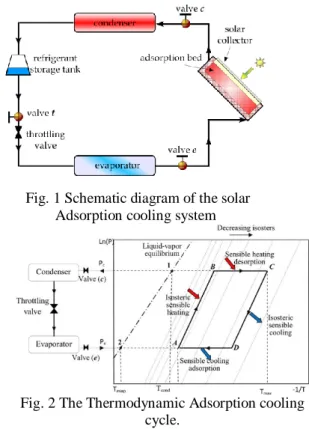
electricity driven compressor is replaced with a thermal powered one, Fig 1.sireniatnocnoitprosdaehT.detargetni
suoropasniatnocdnarotcellocralosetalptalfahtiw otytiniffaehtsahtnebrosdadilosehT.muidemtnebrosda irferehtbrosdagerant vapour. Furthermore, the thermodynamic cycle of the adsorption refrigeration system is illustrated on Clapeyron diagram, Figure no: 2. The cycle consists of four processes; ssecorpgnitaeherpnoitazirusserp
itaehciretsosi(noitartnecnoctnatsnocatang process 1-2), desorption at ssecorpgnitaehcirabosi(erusserptnatsnoc 2 -3 ciretsosi(noitartnecnoctnatsnoctanoitazirusserped,) cooling process 3-4), and adsorption at constant pressure (isobaric cooling process 4-1). During the daytime period, the adsorption reactor is isolated dnaresnednocehthtobmorf
the evaporator by valves c and e and is completely saturated with the refrigerant. The pressure inside the reactor initially equals the evaporator pressure and its temperature is uniform and equals the ambient temperature , state 1 on Fig 2. The pressure and the temperature inside the bed increase when the reactor is heated by the solar radiation. This process continues till the pressure approaches at etats2 .
At the end of this process valve c opens to allow the refrigerant vapour desorbed from ehtsdrawotwolfotdebeht condenser while the adsorption reactor is still being heated by
the solar radiation. The pressure inside the bed is fixed at the condenser pressure while the temperature otseunitnoc
ehtedisnitnetnoctnaregirfereht,eromrehtruF.esaercni reactor continues to decrease as more adsorbate is being freed
from the reactor. The condensed refrigerant is then collected and stored in the refrigerant storage tank. Pressure swing adsorption (PSA) - is the removal of water vapour from compressed air flows. This process uses the dried air expanded to a lower pressure to purge the saturated bed for regeneration purposes. Temperature swing adsorption (TSA) - Regeneration of adsorbent in a TSA process is achieved by an increase in temperature. For any given partial pressure of the adsorbate in the gas phase, an increase in temperature leads to a decrease in the quantity adsorbed.
Fig. 1 Schematic diagram of the solar
Adsorption cooling systemFig. 2 The Thermodynamic Adsorption cooling cycle.
3) SOLAR ADSORPTION
Adsorption air-conditioning is an attractive alternative to the latter-mentioned methods. The emphasis when reviewing the research was on the design, evaluation and cost effectiveness of the prototypes. Cooling is used in many aspects of human life. It is necessary for food storage or air conditioning. The use of conventional compression cooling systems contradicts the concept of sustainable development because of environmental pollution and considerable energy consumption. Freon used in this system cause ozone layer depletion and are currently being withdrawn from production and marketing under the Montreal Protocol and UE regulations [1]. Moreover, large amount of energy supplied to compressor refrigerators. It was estimated that 15% 9of the total world electricity production and 45% of energy consumed in household, workplaces and public buildings is used for refrigeration and air-conditioning[2]. The electricity consumption for these purposes is particularly significant in industrialized countries with the warm climate, where increased energy demand for Air conditioning in the summer can cause electric grid overloads and blackouts.
Date Duration Place Number of
people affected August 1996 Several dozen hours Western states of USA 15 Million
July 2006 9 days USA (New
York)
174 Thousand
July 2006 4 hours England
(London)
3 thousand June 2007 Several days Greece 7 Million January 2009 Several dozen hours Australia (Victoria) 340 Thousand
In recent years there has been a considerable adsorption cooling system [8, 9]. Refrigerants use in this system, such as water or Methanol, are environmental friendly. What is more, these devices can be driven by low temperature sources such as solar energy or waste heat. Adsorption refrigeration system attracted more and more attention in research and development. These systems have two main advantages, compared to traditional vapor compression system. Firstly, adsorption refrigeration systems employ natural substances as refrigerant, such as water, methanol and ammonia among others, which have zero GWP and ODP. Secondly, adsorption refrigeration system can be powered with waste heat or solar energy, hence could contribute greatly to electricity energy conservation. However, adsorption refrigeration system show a lower COP compared to absorption refrigeration system. It is well known fact that the amount of adsorbate that an adsorbent can hold in its pores usually decreases as the temperature increases. This phenomenon allows its application to refrigeration cycles: successive heating and cooling an adsorptive bed can turn into successive condensation and evaporation of the adsorbate. Then the evaporation process permits the extraction of heat from a suitable container. In a practical adsorption cooling machine, a good affinity between the adsorbate/ refrigerant and its adsorbent is necessary, and the thermal properties of the former must be suitable, especially a high latent heat of vaporization. A number of pairs have been investigated in the literature. Methanol- activated carbon, ammonia- activated carbon, water – silica gel and water- zeolites seem to be the most adequate couples [1]. It has additional advantages like avoiding the use of halogenated hydrocarbons, reducing the impact on the ozone layer, and justifying an increased installed area of low-temperature solar collectors [2]. Currently, most of the solar cooling systems commonly used are hot water drive lithium bromide adsorption chillers. Kumar and Devotta described a mathematical model of a solar regenerator, which could be used in either open-cycle desiccant-cooling system or an open-cycle absorption cooling system [3]. Muneer and Uppal developed a detailed numerical simulation model for a commercially available solar absorption chiller. The study established the high potential of solar operated, water- cooled absorption coolers especially for arid conditions [4]. Mateus and Oliveira used the TRNSYS software to evaluate the potential of integrated solar absorption cooling and heating system for building applications [5]. Desideri et al. analyzed the technical and economic feasibility of solar absorption cooling systems, designed for two different application fields: industrial refrigeration and air conditioning. The purpose of this paper was to determine technical solutions for greater energy efficiency, which were also repeatable for companies or users with similar processing cycles [6]. A simple configuration of a solar powered adsorption refrigerator requires only three main elements: the generator and two heat exchangers. The generator includes a sorption bed in thermal contact with a solar collection system. the first heat exchanger operates as a condenser for the vapors released by the bed, and the second one is the evaporator and must be enclosed in a cold box.
4) PHASE CHANGE MATERIAL
The submitting author is responsible for obtaining
agreement of all coauthors and any consent required from sponsors before submitting a paper. It is the obligation of the authors to cite relevant prior work.
Authors of rejected papers may revise and resubmit them to the journal again. Fundamental investigations of effective methods of thermal energy storage have been significantly intensified since the 1973–1974 energy crises, with numerous countries commencing development programs of power systems utilizing non-conventional energy sources at both the national and international level. The results obtained from these investigations have been published in many research papers and academic books; see for example monographs by Schaetzle [1], Schmidt [2], Beckmann and Gill [3], Garg et al. [4] and Garg [5]. General principles and various technologies for solar energy storage were summarized by Garg et al. [4], A great number of scientific publications and patents on latent heat storage for solar energy conservation stimulated the appearance of Lane’s monograph [6, 7], with a review of the information on this subject which was available at the time of publication. Another monograph dedicated to the problems of thermal energy storage was prepared by Dincer and Rosen [8]. In [9], the following phase change material (PCM) properties to be used for latent heat storage were highlighted as desirable:
1. A high value of the heat of fusion and specific heat per unit volume and weight,
2. A melting point which matches the application, 3. A low vapor pressure (1 bar) at the operational
temperature,
4. A chemical stability and non-corrosiveness,
5. A PCM should not be hazardous, highly inflammable or poisonous,
6. A PCM should have a reproducible crystallization without degradation,
7. A PCM should have a small super cooling degree and high rate of crystal growth,
8. A PCM should have a small volume variation during solidification,
9. A high thermal conductivity.
10. A PCM should be of abundant supply and at a low cost.
Application of PCMs in thermal energy storage systems: 1. Cooling of heat and electric engines.
2. Cooling: use of off-peak rates.
3. Cooling: food, wine, milk products (absorbing peaks in demand), and greenhouses.
4. Heating and hot water: using off-peak rates.
5. Medical applications: transportation of blood, operating tables, hot–cold therapies.
6. Passive storage in bio-climatic building/architecture (HDPE, paraffin).
7. Safety: temperature level maintenance in rooms with computers or electrical/electronic appliances.
8. Smoothing exothermic temperature peaks in chemical reactions.
9. Solar power plants. 10. Spacecraft thermal systems. 11. Thermal comfort in vehicles.
12. Thermal protection of electronic devices (integrated in the appliance).
13. Thermal protection of food: transport, hotel trade, ice-cream, etc.
5) LITERATURE SURVEY
A detailed literature search was conducted to find out what research has been done in the area of solar assisted cooling, with the aim of obtaining fundamental understandings of solar adsorption systems with phase change material and to gain useful guidelines regarding designs parameters as applied in both air-conditioning and refrigeration. Solar adsorption refrigeration devices are of importance to meet the needs for cooling requirements such as air-conditioning and ice-making and food preservation in remote areas. They are also noiseless, non - corrosive and environmentally friendly. For the latter reasons, research activities in this sector are on the increase in order to solve the crucial factors which render these systems not ready to compete with the well-known vapour compression system. Environmental-friendly means of air-conditioning and refrigeration are attracting a lot of attention nowadays since traditional methods such as vapor compression cycles require consumption of expensive electric energy and are responsible for emission of greenhouse gases. Adsorption air-conditioning with PCM is an attractive alternative to the VCC System.
[0] A.El Fadar, A.Mimet, M. Perez-Garcia; study of an adsorption refrigeration system powered by parabolic trough collector and coupled with a heat pipe; Renewable Energy 34(2009) 2271-2279; the aim of the current paper is to propose a study of a novel solar adsorption cooling system, using activated carbon-ammonia pair, coupled with a PTC and a water- stainless steel heat pipe.
[01] Zhu, Bin; et al. Age of initiation of the India- Asia Collision in the East-Central Himalaya Department of Earth and Atmospheric Sciences, University of Albany. p. 281.Retrived 19 Nov. 2008.
[1] Chen, C.J., R.Z. Wang, Z.Z. Xia, Study on a silica gel–water adsorption chiller integrated with a closed wet cooling tower; The system performance was investigated against the heat source temperature of 85°C with 65 kg of silica gel and 169 kg of water; The achieved COP and SCP were 0.51 and 165W/kg respectively.
[2] X.L. Wang, H.T. Chua, Two bed silica gel-water adsorption chiller: an effectual lumped parameter model; International Journal of Refrigeration 30 (2007) 1417-1426; This article develops an improved lump-parameter design model to investigate the water-circulation heat recovery scheme as applied to the two-bed silica gel water adsorption chillers. We demonstrate that performance predictions stemming from this improved lump-parameter formalism compare favorably with experimental results at various conditions, particularly at the industrial rated conditions. We find that the present lump-parameter formalism adequately elucidates the water-circulation heat recovery scheme as does the distributed-parameter formalism. In the studied working condition of a two-bed silica gel water adsorption chiller, the differences in cooling capacities and coefficients of performance (or COP) by using the two different formalisms are typically less than 10%. This gives rise to a useful and rapid design tool for the industry
[3] B. B. Saha, E.C. Boelman, T. Kashiwagi, Computer simulation of a silica gel-water adsorption refrigeration cycle – the influence of operating conditions on cooling output and
COP; American Society of Heating, Refrigerating and
Air-Conditioning Engineers 1995 This work deals with the use of adsorption refrigerant cycles driven by waste heat of near ambient temperature. A parametric study was conducted by computer simulation to determine the effects of operating conditions on cooling output and coefficient of performance (COP). A simulation program verified the influence of operating temperatures (hot and cooling water), water flow rates, and adsorption-desorption cycle times. The most influential parameter is the operating temperatures, followed by water flow rates. Cycle time is less influential in quantitative terms but qualitatively is very important. [4] H.T. Chua, K.C. Ng. W. Wang, C. Yap, X.L. Wang, Transient modeling of a two bed silica gel-water adsorption chiller; International Journal of Heat and Mass Transfer page: 659-669 2004; This article presents a transient distributed-parameter model for a two-bed, silica gel–water adsorption chiller. Compared with our previous
lumped-parameter model, we found better
agreement between our model prediction and experimental data. We discussed the important effect of heat recovery and the effect of extra system piping on the system performance.
5] X.Q. Zhai, R.Z. Wang; Experimental investigation and performance analysis on a solar adsorption cooling system with/ without heat storage; The experimental results of two days with similar ambient condition were chosen to compare the operating characteristics of the solar cooling system under different operating modes. The solar cooling system was in operation from 9:00 to 17:00, corresponding to the working schedule of the green building. The daily solar insolation was 17.5 MJ/m2 and the average temperature was 32.56 oc.
[6] Henning Hans-Martin; Solar assisted air conditioning of
buildings an overview; Applied Thermal
Engineering 27(10):1734-1749, July 2007; Goal of this contribution is to draw a picture about some general issues for using solar thermal energy for air conditioning of buildings. The following topics are covered:–A basic analysis of the thermodynamic limits for the use of heat cooling in combination with solar thermal energy is drawn; thereby fundamental insights about control needs for solar thermal driven cooling are obtained.–A short overview about the state-of-the-art of available technologies, such as closed thermal driven cooling cycles (e.g., absorption, adsorption) and open cooling cycles (e.g., desiccant employing either solid or liquid sorbents) is given and needs and perspectives for future developments are described.–The state-of-the-art of application of solar assisted air-conditioning in Europe is given and some example installations are presented.–An overview about new developments of open and closed heat driven cooling cycles for application in combination with solar thermal collectors is given and some of these new systems are outlined more in detail.
[7] Casals Xavier Garcia; Solar absorption cooling in Spain: Perspectives and outcomes from the simulation of recent installation; Renewable Energy, vol. 31, issue 9, pages
1371-1389, 2006; Cooling energy demand is now experiencing a fast growing rate as this comfort requirement becomes internalized. Domestic air conditioning equipments based on vapour compression cycles are being used to reach comfort conditions in some of the rooms of buildings that were designed without taking into account cooling requirements. In spite of their so far small contribution to the total building sector energy demand, these equipments are already imposing important constraints on the environment and the electricity distribution system. Solar absorption cooling arises as an interesting alternative, which at the same time allows reaching a higher solar contribution to the heating demand. However, solar cooling installations present several peculiarities with respect to the more known DHW or even heating installations, which require incorporating a more detailed approach and additional considerations in the design and performance evaluation processes.
[8] Kumar Pradeep, Devotta S. Modeling of the thermal behavior of a solar regenerator for open cycle cooling system; Applied Energy, vol. 33, issue 4, pages 287-295, 1989; This paper describes a mathematical model of a solar regenerator, which could be used in either an open-cycle
desiccant-cooling system or an open-cycle
absorption-cooling system. The model has been validated by experimental data from the published literature. The effects of the variation of the values of various parameters on the performance of the regenerator have also been analyzed. [9] Muneer T. Uppal AH. Modeling and simulation of a solar absorption cooling system; Applied Energy 19(3): 209-229 · December 1985; A detailed numerical simulation model is developed for a commercially available solar absorption chiller. The model incorporates the performance data of a Yazaki-manufactured water-cooled system. We take into consideration the variation of the COP and cooling water temperature. Using a summer season's meteorological data for an arid location in the Sahara desert, the system performance is computed for different collector types, areas and storage volumes. The results show that an optimum storage volume/collector area ratio exists. Also a high solar fraction can be obtained with relatively small areas of collectors, even when the collectors are of the inexpensive type. The interesting feature was that the system operated at design load conditions with generator temperatures as low as 80°C owing to the fact that very low cooling water temperatures are available in the dry conditions of the Sahara. The study establishes the high potential of solar operated, water-cooled absorption coolers especially for arid conditions.
ACKNOWLEDGMENT
We have taken efforts in reviewing of on Solar Adsorption Cooling System with Phase Change Material project. However, it would not have been possible without the kind support and help of guide and organizations. I would like to extend my sincere thanks to all of the staff members and to our head of Mechanical department without of them this would not be possible. I would like to express my gratitude towards my parents & member of mechanical department for their kind co-operation and encouragement which help me in completion of this project Review. Our thanks and
appreciations also go to my colleague in developing the project and people who have willingly helped me out with their abilities.
REFERENCES
1) C.J. Chen, R.Z. Wang, Z.Z. Xia, J.K Kiplagat, “Study on a silica gel-water adsorption chiller integrated with a closed wet cooling tower,” International Journal of Thermal Sciences, 49, 611–620, 2010
2) X.L. Wang, H.T. Chua, “Two bed silica gel-water adsorption chiller: an effectual lumped parameter model,” Int. J. Refrig, 30, 1417-1426, 2007.
3) B. B. Saha, E.C. Boelman, T. Kashiwagi, “Computer simulation of a silica gel-water adsorption refrigeration cycle – the influence of operating conditions on cooling output and COP,” ASHRAE Trans Re, 101 348-357, 1995
4) H.T. Chua, K.C. Ng. W. Wang, C. Yap, X.L. Wang, “Transient modeling of a two bed silica gel-water adsorption chiller,” Int. J. Heat Mass Trans, 47, 659-669, 2004.
5) X.Q. Zhai, R.Z. Wang, “Experimental investigation and performance analysis on a solar adsorption cooling system with/ without heat storage,” Applied Energy, 87(3): 824-835, March 2010.
6) Henning Hans-Martin. Solar assisted air conditioning of buildings an overview,” Applied Energy, 27(10): 1734-49, 2008.
7) Casals Xavier Garcia, “Solar absorption cooling in Spain: Perspectives and outcomes from the simulation of recent installation,” Renew Energy, 31(9), 1371-89. 2006.
8) Kumar Pradeep, Devotta S, “Modeling of the thermal behavior of a solar regenerator for open cycle cooling system,” Applied Energy, 33(4):287-95, 1989.
9) Muneer T. Uppal, “Modeling and simulation of a solar absorption cooling system,” Applied Energy, 19(3):209-229,1985.