Centers for Medicare & Medicaid Services
CMS Implementation Guide for
Quality Reporting Document Architecture
Category I and Category III
Eligible Professional Programs
and Hospital Quality Reporting (HQR)
Supplementary Implementation Guide for 2015
Version: 1.0
07/29/2014
Disclaimer
This information was current at the time it was published or uploaded onto the web. Medicare policy changes frequently, so links to any source documents have been provided within the publication for your reference.
This combined guide was prepared as a tool for eligible professionals and eligible hospitals and is not intended to grant rights or impose obligations. Although every reasonable effort has been made to assure the accuracy of the information within these pages, the ultimate responsibility for the correct submission of claims and response to any remittance advice lies with the provider of services. The Centers for Medicare & Medicaid Services (CMS) employees, agents, and staff make no representation, warranty, or guarantee that this compilation of Medicare information is error-free and will bear no responsibility or liability for the results or consequences of the use of this guide. This publication is a general summary that explains certain aspects of the Medicare program, but is not a legal document. The official Medicare program provisions are contained in the relevant laws, regulations, and rulings.
This publication contains content from the HL7 Implementation Guide for Clinical Document Architecture (CDA) Release 2: Quality Reporting Document Architecture (QRDA) Category I, Draft Standard for Trial Use Release 2, its errata update, and the HL7 Implementation Guide for Clinical Document Architecture (CDA) Release 2: Quality Reporting Document Architecture Category III (QRDA-III), Draft Standard for Trial Use Release 1—copyright © 2013 Health Level Seven (HL7) International® (http://www.hl7.org). HL7 and Health Level Seven are registered trademarks of Health Level Seven International. Reg. U.S. Pat & TM Off. Additional information regarding the use of HL7 materials is available at http://www.hl7.org/legal/ippolicy.cfm.
This publication contains content from SNOMED CT® (http://www.ihtsdo.org/snomed-ct/). SNOMED CT is a registered trademark of the International Health Terminology Standard Development Organization (IHTSDO).
This publication contains content from LOINC® (http://loinc.org). The LOINC table, LOINC codes, and LOINC panels and forms file are copyright © 1995-2013, Regenstrief Institute, Inc. and the Logical Observation Identifiers Names and Codes (LOINC) Committee. All are available at no cost under the license at http://loinc.org/terms-of-use.
Table of Contents
Combined QRDA Guide Overview ... 1
1.
Introduction ... 1
1.1
Overview ... 1
1.2
Organization of the Guide ... 2
2.
Conformance Conventions Used in This Guide ... 2
2.1
Conformance Verbs (Keywords)... 2
2.2
Cardinality ... 3
2.3
Null Flavor ... 3
PART A — QRDA-I DSTU R2 Supplementary Implementation Guide for Eligible
Professional Programs and Hospital Quality Reporting ... 5
3.
Overview ... 5
3.1
Background ... 5
3.2
How to Read This QRDA-I Guide ... 5
4.
QRDA Category I Requirements ... 6
4.1
QRDA Category I Reporting ... 6
4.2
Succession Management ... 6
4.2.1
Final Action Processing used in QRDA-I Report Succession
Management for PQRS ... 6
4.2.2
QRDA-I Report Succession Management for Pioneer ACO ... 6
4.2.3
QRDA-I Report Document Succession Management for HQR ... 6
4.2.4
Program Identifiers used in Succession Management ... 7
4.3
Value Sets ... 7
4.4
Time Zone ... 7
5.
QRDA Category I Validation ... 8
5.1
Document-Level Template: QRDA Category I Report - CMS EP & HQR ... 8
5.1.1
General Header ... 8
5.1.2
recordTarget ... 9
5.1.3
custodian ... 13
5.1.5
informationRecipient ... 18
5.2
Section-Level Templates ... 19
5.2.1
Measure Section... 19
5.2.2
Reporting Parameter Section ... 21
5.2.3
Patient Data Section ... 22
PART B — QRDA-III DSTU R1 Supplementary Implementation Guide for Eligible
Professional Programs ... 23
6.
Overview ... 23
6.1
Background ... 23
6.2
How to Read This QRDA-III Guide ... 24
7.
QRDA Category III Submission Rules ... 25
7.1
Comprehensive Primary Care (CPC) Initiative Submissions ... 25
7.2
EHR Incentive Program (Meaningful Use) Submissions ... 26
7.3
Physician Quality Reporting System (PQRS) Submissions ... 26
7.4
Identifiers ... 26
7.5
Succession Management ... 27
7.5.1
Final Action Processing used in Succession Management ... 27
7.5.2
FAP Rules for PQRS ... 27
7.5.3
FAP Rules for CPC ... 27
7.5.4
Program Identifiers used in Succession Management ... 28
8.
QRDA Category III Validation ... 29
8.1
Document-Level Template: QRDA Category III Report - CMS EP ... 29
8.1.1
recordTarget ... 30
8.1.2
author ... 30
8.1.3
custodian ... 31
8.1.4
informationRecipient ... 32
8.1.5
legalAuthenticator ... 33
8.1.6
participant is Device ... 34
8.1.7
participant is Location ... 35
8.1.8
documentationOf ... 36
8.1.9
authorization ... 37
8.1.10
component ... 38
8.2
Section-Level Templates ... 39
8.2.1
QRDA Category III Measure Section (CMS EP) ... 39
8.2.2
QRDA Category III Reporting Parameters Section (CMS EP) ... 41
8.3
Entry-Level Templates ... 42
8.3.1
Aggregate Count (CMS EP) ... 42
8.3.2
Continuous Variable Measure Value (CMS EP) ... 44
8.3.3
Ethnicity Supplemental Data Element (CMS EP) ... 46
8.3.4
Measure Data (CMS EP) ... 48
8.3.5
Measure Reference and Results (CMS EP) ... 53
8.3.6
Payer Supplemental Data Element (CMS EP) ... 56
8.3.7
Performance Rate for Proportion Measure (CMS EP) ... 60
8.3.8
Race Supplemental Data Element (CMS EP) ... 62
8.3.9
Reporting Parameters Act (CMS EP) ... 64
8.3.10
Reporting Stratum (CMS EP) ... 66
8.3.11
Sex Supplemental Data Element (CMS EP) ... 69
APPENDIX ... 72
9.
Troubleshooting and Support ... 72
9.1
Resources ... 72
9.2
Support ... 72
9.3
Errata or Enhancement Requests ... 72
10.
QRDA-I DSTU R2 Supplemental Implementation Guide Changes to Base
Standard ... 73
10.1
Program Specific Constraints ... 76
10.2
Validation Rules for EP ... 76
11.
QRDA-III DSTU R1 Supplemental Implementation Guide Changes to Base
Standard ... 77
12.
Change Log for 2015 CMS QRDA Supplementary Implementation Guide from
the 2014 CMS QRDA-I and CMS QRDA-III Guides ... 88
12.1
General Changes ... 88
12.3
Changes from 2014 QRDA-I EP Implementation Guide ... 91
12.4
Changes from 2014 QRDA-III EP Implementation Guide ... 91
13.
Acronyms ... 92
14.
Glossary ... 93
Table of Figures
Figure 1: Constraints Format – only one allowed ... 3
Figure 2: Constraints Format – only one like this allowed ... 3
Figure 3: nullFlavor Example ... 4
Figure 4: Time Zone Example ... 7
Figure 5: General Header Example ... 9
Figure 6: recordTarget Example ...13
Figure 7: CCN as custodian Example ...14
Figure 8: documentationOf/serviceEvent Example for EP Individual Provider ...17
Figure 9: documentationOf/serviceEvent Example for EP Group Practice ...17
Figure 10: documentationOf/serviceEvent Example for HQR ...18
Figure 11: informationRecipient Example ...19
Figure 12: Measure Section Example ...20
Figure 13: Reporting Parameter Section Example ...21
Figure 14: Patient Data Section Example ...22
Figure 15: QRDA-III Report Structure Example ...24
Figure 16: recordTarget Example ...30
Figure 17: Device author Example ...31
Figure 18: Person author Example ...31
Figure 19: custodian Example ...32
Figure 20: informationRecipient Example ...33
Figure 21: legalAuthenticator Example ...34
Figure 22: Device participant Example ...34
Figure 23: Location participant Example ...35
Figure 24: documentationOf Example ...37
Figure 25: authorization Example ...38
Figure 26: structuredBody Example ...39
Figure 27: QRDA-III Measure Section (CMS EP) Example ...40
Figure 28: QRDA-III Reporting Parameters Section (CMS EP) Example...42
Figure 29: Aggregate Count (CMS EP) Example ...44
Figure 30: Continuous Variable Measure Value (CMS EP) Example ...46
Figure 31: Ethnicity Supplemental Data Element (CMS EP) Example ...48
Figure 32: Measure Data (CMS EP) Example ...52
Figure 34: Payer Supplemental Data Element (CMS EP) Example ...59
Figure 35: Performance Rate for Proportion Measure (CMS EP) Example ...62
Figure 36: Race Supplemental Data Element (CMS EP) Example ...64
Figure 37: Reporting Parameters Act (CMS EP) Example ...66
Figure 38: Reporting Stratum (CMS EP) Example ...69
Table of Tables
Figure 1: Constraints Format – only one allowed ... 3
Figure 2: Constraints Format – only one like this allowed ... 3
Figure 3: nullFlavor Example ... 4
Figure 4: Time Zone Example ... 7
Figure 5: General Header Example ... 9
Figure 6: recordTarget Example ...13
Figure 7: CCN as custodian Example ...14
Figure 8: documentationOf/serviceEvent Example for EP Individual Provider ...17
Figure 9: documentationOf/serviceEvent Example for EP Group Practice ...17
Figure 10: documentationOf/serviceEvent Example for HQR ...18
Figure 11: informationRecipient Example ...19
Figure 12: Measure Section Example ...20
Figure 13: Reporting Parameter Section Example ...21
Figure 14: Patient Data Section Example ...22
Figure 15: QRDA-III Report Structure Example ...24
Figure 16: recordTarget Example ...30
Figure 17: Device author Example ...31
Figure 18: Person author Example ...31
Figure 19: custodian Example ...32
Figure 20: informationRecipient Example ...33
Figure 21: legalAuthenticator Example ...34
Figure 22: Device participant Example ...34
Figure 23: Location participant Example ...35
Figure 24: documentationOf Example ...37
Figure 25: authorization Example ...38
Figure 26: structuredBody Example ...39
Figure 27: QRDA-III Measure Section (CMS EP) Example ...40
Figure 28: QRDA-III Reporting Parameters Section (CMS EP) Example...42
Figure 29: Aggregate Count (CMS EP) Example ...44
Figure 30: Continuous Variable Measure Value (CMS EP) Example ...46
Figure 31: Ethnicity Supplemental Data Element (CMS EP) Example ...48
Figure 32: Measure Data (CMS EP) Example ...52
Figure 34: Payer Supplemental Data Element (CMS EP) Example ...59
Figure 35: Performance Rate for Proportion Measure (CMS EP) Example ...62
Figure 36: Race Supplemental Data Element (CMS EP) Example ...64
Figure 37: Reporting Parameters Act (CMS EP) Example ...66
Figure 38: Reporting Stratum (CMS EP) Example ...69
Combined QRDA Guide Overview
1.
Introduction
1.1
Overview
The Health Level Seven International (HL7) Quality Reporting Document Architecture (QRDA) defines constraints on the HL7 Clinical Document Architecture Release 2 (CDA R2). QRDA is a standard document format for the exchange of electronic clinical quality measure (eCQM) data. QRDA reports contain data extracted from electronic health records (EHRs) and other
information technology systems. The reports are used for the exchange of eCQM data between systems for quality measurement and reporting initiatives.
This combined QRDA guide contains the Centers for Medicare & Medicaid Services (CMS) supplemental implementation guides to the HL7 Implementation Guide for CDA Release 2: Quality Reporting Document Architecture, Category I, DSTU Release 2, (US Realm),Draft Standard for Trial Use—July 2012 (and its December 2012 and 20141 errata updates) and the HL7 Implementation Guide forCDA Release 2: Quality Reporting Document Architecture, Category III, DSTU Release 1, November 2012 and its 2014 errata update2 for the 2015 reporting year.
This guide combines business requirements and information from three previously published CMS guides and is updated for the 2015 reporting year:
The 2014 CMS QRDA Implementation Guide for Eligible Hospital Clinical Quality
Measures — Hospital Quality Reporting (HQR) Quality Reporting Document Architecture Category I, Release 2, Supplementary Implementation Guide, Version 2.2 (4/21/2014).
The 2014 CMS QRDA I Implementation Guides for Eligible Professionals Clinical Quality Measures — CMS Eligible Professional Programs Quality Reporting Document
Architecture Category I, DSTU Release 2, Supplementary Implementation Guide for 2014, Version 4.0 (4/18/2014).
The 2014 CMS QRDA III Implementation Guides for Eligible Professionals Clinical Quality Measures — CMS Eligible Professional Programs Quality Reporting Document Architecture Category III, Release 1, Implementation Guide for 2014, Version 2.0 (4/18/2014).
Combining the above three guides into a single document provides a unified resource for implementers, eliminating the need to locate the individual program guides at several sources. Most importantly, combining guides harmonized discrepancies among earlier versions of the CMS QRDA guides, especially between the QRDA-I guides for the Eligible Professional (EP) programs and Hospital Quality Reporting (HQR). Harmonization also provided the opportunity to align business requirements among various programs. Creating a combined QRDA guide is a step toward producing a single CMS QRDA guide with minimum CMS specific constraints to the base HL7 QRDA standards to be shared by various CMS programs.
1 A new DSTU errata update to the HL7 Implementation Guide for CDA Release 2: Quality Reporting
Document Architecture, Category I, DSTU Release 2, (US Realm) is currently under development and is expected to be released in summer 2014.
2 A new DSTU errata update to the HL7 Implementation Guide for CDA Release 2: Quality Reporting
Document Architecture, Category III, DSTU Release 1, (US Realm) is currently under development and is expected to be released in summer 2014.
1.2
Organization of the Guide
This preliminary portion contains introductory material that pertains to all three CMS QRDA standards.
Chapter 1: Introduction
Chapter 2: Conformance Conventions Used in This Guide — describes the formal representation of templates and additional information necessary to understand and correctly implement the content found in this guide
PART A: QRDA-I DSTU R2 Supplementary Implementation Guide for Eligible Professional Programs and Hospital Quality Reporting
Chapter 3: Overview
Chapter 4: QRDA Category I Requirements — includes reporting requirements and information on succession management, value sets, and time zones
Chapter 5: QRDA Category I Validation — contains the formal definitions for the QRDA Category I Report:
o Document-level template that defines the document type and header constraints specific to CMS reporting
o Section-level templates that define measure reporting, reporting parameters, and patient data
o Entry-level templates
PART B — QRDA-III DSTU R1 Supplementary Implementation Guide for Eligible Professional Programs
Chapter 6: Overview
Chapter 7: QRDA Category III Submission Rules — includes guidelines for submissions under the Comprehensive Primary Care (CPC) initiative, the Electronic Health Record (EHR) Incentive Program (Meaningful Use), and the Physician Quality Reporting System (PQRS) Program.
Chapter 8: QRDA Category III Validation — contains the formal definitions for the QRDA Category III Report for the CMS EP programs:
o Document-level template that defines the document type and header constraints specific to CMS reporting
o Section-level templates that define measure reporting and reporting parameters o Entry-level templates that define entry templates
APPENDIX: Chapters 9-15 provide references and resources, including a list of all changes made to the QRDA Category I base standard to produce the Supplementary Implementation Guide in Part A, a list of all changes made to the QRDA Category III base standard to produce the Supplementary Implementation Guide in Part B, and a list of changes made to the three CMS QRDA implementation guides for 2014.
2.
Conformance Conventions Used in This Guide
2.1
Conformance Verbs (Keywords)
SHALL: an absolute requirement for the particular element. Where a SHALL constraint is applied to an Extensible Markup Language (XML) element, that element must be
present in an instance, but may have an exceptional value (i.e., may have a
nullFlavor), unless explicitly precluded. Where a SHALL constraint is applied to an XML attribute, that attribute must be present, and must contain a conformant value.
SHALL NOT: an absolute prohibition against inclusion.
SHOULD/SHOULD NOT: best practice or recommendation. There may be valid reasons to ignore an item, but the full implications must be understood and carefully weighed before choosing a different course.
MAY/NEED NOT: truly optional; can be included or omitted as the author decides with no implications.
2.2
Cardinality
The cardinality indicator (0..1, 1..1, 1..*, etc.) specifies the allowable occurrences within a document instance. The cardinality indicators are interpreted with the following format "m…n" where m represents the least and n the most:
0..1 zero or one
1..1 exactly one
1..* at least one
0..* zero or more
1..n at least one and not more than n
When a constraint has subordinate clauses, the scope of the cardinality of the parent constraint must be clear. In the following figure, the constraint says exactly one participant is to be present. The subordinate constraint specifies some additional characteristics of that participant.
Figure 1: Constraints Format – only one allowed
1. SHALL contain exactly one [1..1] participant (CONF:2777). a. This participant SHALL contain exactly one [1..1] @typeCode="LOC" (CodeSystem: 2.16.840.1.113883.5.90 HL7ParticipationType) (CONF:2230).
In the next figure, the constraint says only one participant “like this” is to be present. Other participant elements are not precluded by this constraint.
Figure 2: Constraints Format – only one like this allowed
1. SHALL contain exactly one [1..1] participant (CONF:2777) such that it
a. SHALL contain exactly one [1..1] @typeCode="LOC" (CodeSystem:
2.16.840.1.113883.5.90 HL7ParticipationType) (CONF:2230).
2.3
Null Flavor
Information technology solutions store and manage data, but sometimes data are not available; an item may be unknown, not relevant, or not computable or measureable. In HL7, a flavor of null, or nullFlavor, describes the reason for missing data.
Figure 3: nullFlavor Example
<raceCode nullFlavor="ASKU"/><!—coding a raceCode when the patient declined to specify his/her race-->
<raceCode nullFlavor="UNK"/>
<!--coding a raceCode when the patient's race is unknown--> Use null flavors for unknown, required, or optional attributes:
NI No information. This is the most general and default null flavor.
NA Not applicable. Known to have no proper value (e.g., last menstrual period for a male).
UNK Unknown. A proper value is applicable, but is not known.
ASKU Asked, but not known. Information was sought, but not found (e.g., the patient was asked but did not know).
NAV Temporarily unavailable. The information is not available, but is expected to be available later.
NASK Not asked. The patient was not asked.
MSK There is information on this item available but it has not been provided by the sender due to security, privacy, or other reasons. There may be an alternate mechanism for gaining access to this information.
OTH The actual value is not and will not be assigned a standard coded value. An example is the name or identifier of a clinical trial.
This above list contains those null flavors that are commonly used in clinical documents. For the full list and descriptions, see the nullFlavor vocabulary domain in the in the HL7 standard, Clinical Document Architecture, Release 2.0.
Any SHALL conformance statement may use nullFlavor, unless the attribute is required or the nullFlavor is explicitly disallowed. SHOULD and MAY conformance statements may also use nullFlavor.
PART A —
QRDA-I DSTU R2 Supplementary
Implementation Guide for Eligible Professional Programs
and Hospital Quality Reporting
3.
Overview
3.1
Background
Part A of this guide is a CMS Quality Reporting Document Architecture Category I (QRDA-I) supplementary implementation guide to the HL7 Implementation Guide for CDA Release 2: Quality Reporting Document Architecture, Category I, DSTU Release 2, (US Realm),Draft Standard for Trial Use—July 2012, its December 21, 2012 errata update, and its 2014 errata update (together referred to as the QRDA-I Implementation Guide in this guide). This guide describes additional conformance statements and constraints for electronic health record (EHR) data submissions that are required for reporting information to the Centers for Medicare and Medicaid Services (CMS) EHR Incentive Program and the Hospital Inpatient Quality Reporting Program 2015 Reporting Year for both the Eligible Professional programs and the Hospital Quality Reporting.
The purpose of this Part A of the supplemental guide is to serve as a companion to the original QRDA-I Implementation Guide for entities such as Eligible Professional (EP), Group Practice Reporting Option (GPRO), Accountable Care Organizations (ACO), Eligible Hospitals (EH), Critical Access Hospitals (CAH), and Data Submission Vendors (DSV) to submit QRDA-I data for consumption by CMS systems including the Physician Quality Reporting System (PQRS) and Hospital Quality Reporting (HQR).
Each QRDA Category I report contains quality data for one patient for one or more quality measures, where the data elements in the report are defined by the particular measure(s) being reported on. A QRDA Category I report contains raw applicable patient data. When pooled and analyzed, each report contributes the quality data necessary to calculate population measure metrics.
3.2
How to Read This QRDA-I Guide
CMS will process Clinical Quality Measure (CQM) QRDA-I documents originating from EHR systems. Submitted QRDA-I documents for EHR Incentive Program 2015 must meet the conformance statements specified in this guide in addition to the conformance statements specified in the QRDA-I Implementation Guide. Only documents that are valid against the Clinical Document Architecture (CDA) Release 2 schema enhanced to support the sdtc namespace (CDA_SDTC.xsd) will be accepted for processing. Documents that are invalid against this rule will be rejected.
This guide is based on following rules:
1. The QRDA-I Implementation Guide provides information about QRDA data elements with conformance numbers and constraints. Some of these existing conformance restrictions have been modified in accordance with CMS system requirements. The "CMS_" prefix (e.g., CMS_0001) indicates the new conformance statements including those existing conformance statements that are further constrained in this guide.
2. The original SHALL/SHOULD/MAY keywords along with conformance numbers from the QRDA-I Implementation Guide for relevant data elements and attributes have been included in this guide for ease of reference. For brevity, the hierarchy of enclosing elements has not been shown.
4.
QRDA Category I Requirements
4.1
QRDA Category I Reporting
A QRDA-I document should be submitted for each patient who meets the Initial Patient Population criteria of an eCQM. The QRDA-I base standard allows either one or multiple measures to be reported in a QRDA-I document. For group practice reporting, CMS requires only one QRDA-I report to be submitted per patient aggregated for the group's Tax Identification Number (TIN) for a reporting period. For individual provider reporting, there should be one QRDA-I report per patient for the eligible professional's unique National Provider Identification (NPI) and Tax Identification Number (TIN) combination. For Hospital Quality Reporting, there should be one QRDA-I report per patient for the facility CMS Certification Number (CCN).
4.2
Succession Management
This section describes the management of successive replacement documents for QRDA-I reports. (For example, a submitter notices an error in an earlier submission and wants to replace it with a corrected version.) The document that replaces a previous document will have a replacement relationship and will have a new unique QRDA-I document/id. The
document/id of the previous QRDA-I will be referenced in the current document's /ClinicalDocument/relatedDocument/parentDocument/id.
Currently, references to the 'id' of a parentDocument are not consistently used. A more reliable means of determining the current version of a QRDA-I document is used for different CMS programs by the receiving system at CMS.
4.2.1
Final Action Processing used in QRDA-I Report Succession Management for
PQRS
For the PQRS program, managing replacement documents is sometimes referred to as Final Action Processing (FAP). For group practice reporting, the FAP rules include the combination of the CMS program name, the TIN, the EHR Patient ID, and the submission timestamp. For individual provider reporting, the FAP rules include the combination of the CMS program name, the TIN, the NPI number, the EHR Patient ID, and the submission timestamp.
4.2.2
QRDA-I Report Succession Management for Pioneer ACO
For the Pioneer ACO program, the combination of the last submission timestamp, Patient's Medicare HIC Number, the NPI, and the TIN is used for determining the current version of a QRDA-I document that will be used by the receiving system at CMS.
admission date, discharge date, and eCQM version specific identifier will be used by the receiving system at CMS.
4.2.4
Program Identifiers used in Succession Management
The CMS program name requirement for QRDA-I submission is specified in 5.1.5
informationRecipient, Each QRDA-I report must contain only one CMS program name, which shall be selected from the QRDA-I CMS Program Name value set
(2.16.840.1.113883.3.249.14.103).
4.3
Value Sets
There are some cases where the value sets specified in electronic Clinical Quality Measures (eCQMs) contradict the value sets specified in the QRDA-I standard. In these cases, the value sets that are specified in eCQMs take precedence. For example, the Tobacco Use
(2.16.840.1.113883.10.20.22.4.85) QRDA-I template requires "Tobacco Use
(2.16.840.1.113883.11.20.9.41)" value set, but an eCQM criterion uses "Tobacco User
Grouping Value Set (2.16.840.1.113883.3.526.3.1170)", the "Tobacco User Grouping Value Set (2.16.840.1.113883.3.526.3.1170)" shall take precedence over the "Tobacco Use
(2.16.840.1.113883.11.20.9.41)" value set in constructing a QRDA-I document. This
precedence rule also applies to cases where a value set specified in an eCQM is a subset of the value set that is specified in the QRDA-I standard.
4.4
Time Zone
Time comparisons or elapsed time calculations are frequently involved as part of determining measure population outcomes. The use of Coordinated Universal Time (UTC) time zone offsets is recommended whenever precision is specified to hour, minute, or second, however inclusion of time zone offsets is not required for successful QRDA-I submissions to CMS. Due to the calculation process, when reporting data elements that use the effectiveTime or time elements, especially those directly utilized in measure calculations or outcomes, consistency in the usage of UTC time zone offsets is critical. To ensure the highest accuracy in measure outcomes, if UTC time zone offsets are used in any template within a QRDA-I document, it is best that offsets be used throughout the file, otherwise it is best to not utilize offsets at all.
Figure 4: Time Zone Example
<encounter><text>Encounter Performed: Hospital Measures-Encounter Inpatient</text>
...
<effectiveTime>
<!-- Attribute: admission datetime --> <low value="20140325090000+0500"/> <!-- Attribute: discharge datetime --> <high value="20140329103000+0500"/> </effectiveTime>
...
5.
QRDA Category I Validation
5.1
Document-Level Template: QRDA Category I Report - CMS EP & HQR
This section defines the document-level templates in a QRDA-I document. All of the templates in the QRDA-I Implementation Guide are Clinical Document Architecture (CDA) templates.5.1.1
General Header
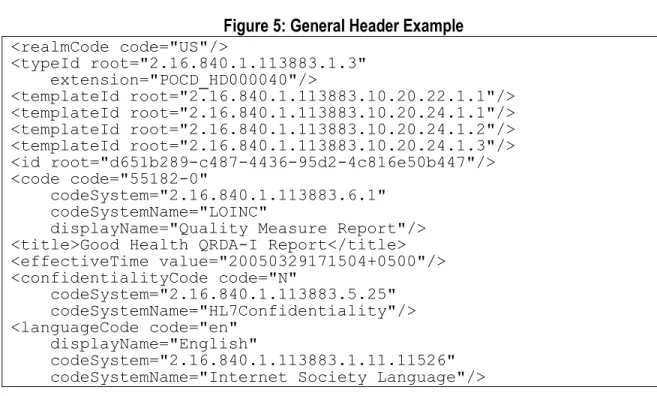
This template describes header constraints that apply to the CMS Quality Reporting Document Architecture (QRDA) Category I document.
Table 1: General Header Constraints Overview
Parameter Name: XPath Attribute/ Element Card. Verb CONF# Fixed Value
Clinical Document Template Id: /ClinicalDocument/templateId/ @root 1..1 SHALL CMS_0001 CMS_0002 2.16.840.1.113 883.10.20.24.1. 3
Globally Unique Identifier (GUID): /ClinicalDocument/id/ @root 1..1 SHALL 5363 9991 n/a Version Number: /ClinicalDocument/ version Number 0..1 MAY 5264 6387 n/a
Document Created Date:
/ClinicalDocument/ effectiveTime/ @value 1..1 SHALL 5256 16865 n/a Language Code: /ClinicalDocument/ languageCode/ @code 1..1 SHALL CMS_0010 en
CMS EHR Certification ID:
/ClinicalDocument/participant/ associatedEntity/id [@root='2.16.840.1.113883.3. 2074.1']/ @extension 0..1 MAY CMS_0003 CMS_0004 CMS_0005 CMS_0006 n/a
1. Conforms to QDM-Based QRDA template (2.16.840.1.113883.10.20.24.1.2). 2. SHALL contain exactly one [1..1] templateId (CONF:CMS_0001) such that it
a. SHALL contain exactly one [1..1] @root="2.16.840.1.113883.10.20.24.1.3" (CONF:CMS_0002).
3. SHALL contain exactly one [1..1] id (CONF:5363).
a. This id SHALL be a globally unique identifier for the document (CONF:9991). 4. MAY contain zero or one [0..1] versionNumber (CONF:5264).
6. This languageCode SHALL contain exactly one [1..1] @code="en" English (CodeSystem: Language 2.16.840.1.113883.6.121) (CMS_0010). 7. MAY contain zero or more [0..*] participant (CONF:CMS_0003) such that it
a. SHALL contain exactly one [1..1] associatedEntity (CONF:CMS_0004) b. This associatedEntity MAY contain zero or one [0..1] id (CONF:CMS_0005)
such that it
i. SHALL contain exactly one [1..1]
@root='2.16.840.1.113883.3.2074.1' CMS EHR Certification Number (formerly known as Office of the National Coordinator
Certification Number) and the value of @extension is the Certification Number (CONF: CMS_0006).
Figure 5: General Header Example
<realmCode code="US"/> <typeId root="2.16.840.1.113883.1.3" extension="POCD_HD000040"/> <templateId root="2.16.840.1.113883.10.20.22.1.1"/> <templateId root="2.16.840.1.113883.10.20.24.1.1"/> <templateId root="2.16.840.1.113883.10.20.24.1.2"/> <templateId root="2.16.840.1.113883.10.20.24.1.3"/> <id root="d651b289-c487-4436-95d2-4c816e50b447"/> <code code="55182-0" codeSystem="2.16.840.1.113883.6.1" codeSystemName="LOINC"displayName="Quality Measure Report"/> <title>Good Health QRDA-I Report</title> <effectiveTime value="20050329171504+0500"/> <confidentialityCode code="N" codeSystem="2.16.840.1.113883.5.25" codeSystemName="HL7Confidentiality"/> <languageCode code="en" displayName="English" codeSystem="2.16.840.1.113883.1.11.11526" codeSystemName="Internet Society Language"/>
5.1.2
recordTarget
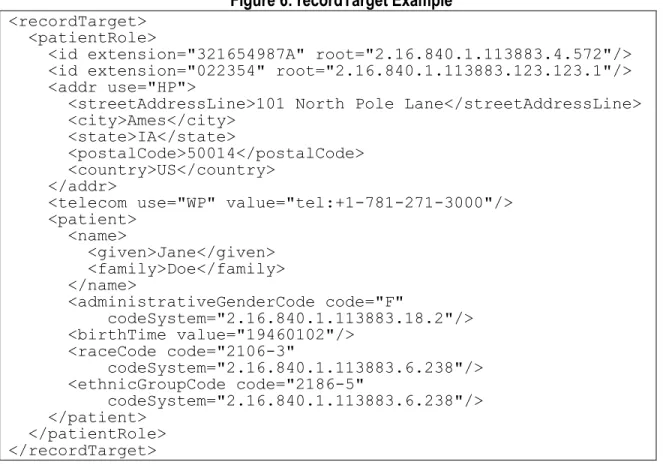
The recordTarget records the patient whose health information is described by the clinical document; it must contain at least one patientRole element.
Table 2: recordTarget Constraints Overview
Parameter Name: XPath Attribute/Element Card. Verb CONF# Fixed Value
Medicare HIC Number:
/ClinicalDocument/record Target/patientRole/ id [@root='2.16.84 0.1.113883.4.5 72']/ 0..1 SHOULD 16858 n/a
EHR Patient ID Root:
/ClinicalDocument/record Target/patientRole/id/
@root 1..1 SHALL CMS _0007
Parameter Name: XPath Attribute/
Element Card. Verb CONF# Fixed Value
EHR Patient ID Extension: /ClinicalDocument/record Target/patientRole/id/ @extension 1..1 SHALL CMS _0007 n/a City: /ClinicalDocument/record Target/patientRole/addr/ city 1..1 SHALL 7292 10412 n/a State: /ClinicalDocument/record Target/patientRole/addr/ state 0..1 SHOULD 7293 10024 2.16.840.1.1138 83.3.88.12.80.1 (State Value Set)
Patient Postal Code:
/ClinicalDocument/record Target/patientRole/addr/ postalCode 0..1 SHOULD 5271 CMS _0008 10025 n/a Country: /ClinicalDocument/record Target/patientRole/addr/ country 0..1 SHOULD CMS _0009 n/a Address: /ClinicalDocument/record Target/patientRole/addr/ street Address Line 1..4 SHALL 5271 10412 7291 n/a First Name: /ClinicalDocument/record Target/patientRole/patient/ name/ given 1..* SHALL 5283 5284 10411 7157 n/a Last Name: /ClinicalDocument/record Target/patientRole/patient/ name/ family 1..1 SHALL 5284 10411 7159 n/a Gender: /ClinicalDocument/record Target/patientRole/patient/ administrative GenderCode 1..1 SHALL CMS _0011 2.16.840.1.1137 62.1.4.1 (ONC Administrative Sex Value Set) or 2.16.840.1.1138 83.1.11.1 (Administrative Gender Value Set)
Parameter Name: XPath Attribute/
Element Card. Verb CONF# Fixed Value
Birth Date: /ClinicalDocument/record Target/patientRole/patient/ birthTime/ @value 1..1 SHALL 5298 CMS _0012 n/a Race: /ClinicalDocument/record Target/patientRole/patient/ raceCode 1..1 SHALL CMS _0013 2.16.840.1.1142 22.4.11.836 (Race Value Set)
Race (if multiple race):
/ClinicalDocument/record Target/patientRole/patient/ sdtc:raceCode 0..* MAY CMS _0014 2.16.840.1.1142 22.4.11.836 (Race Value Set)
Ethnicity: /ClinicalDocument/record Target/patientRole/patient/ ethnicGroup Code 1..1 SHALL CMS _0015 2.16.840.1.1142 22.4.11.837 (Ethnicity Value Set)
1. SHALL contain exactly one [1..1] recordTarget (CONF:12913).
a. This recordTarget SHALL contain exactly one [1..1] patientRole (CONF:16856).
i. This patientRole SHOULD contain zero or one [0..1] id (CONF:16857) such that it
1. SHALL contain exactly one [1..1]
@root='2.16.840.1.113883.4.572' Medicare HIC number3Error! Hyperlink reference not
valid.(CONF:16858)
ii. This patientRole SHALL contain exactly one [1..1] id such that it 1. SHALL contain exactly one [1..1] Patient Identifier Number4
(CONF:CMS_0007)
iii. This patientRole SHALL contain at least one [1..*] addr (CONF:5271). 1. The content of addr SHALL be a conformant US Realm
Address (AD.US.FIELDED)
(2.16.840.1.113883.10.20.22.5.2) (CONF:10412). a. The content of addr SHALL contain exactly one [1..1]
city (CONF:7292).
b. SHOULD contain zero or one [0..1] state (ValueSet: StateValueSet
2.16.840.1.113883.3.88.12.80.1 DYNAMIC) (CONF:7293).
i. State SHALL be provided if the country is US. If country is not specified, it is assumed to be the US. If country is something other than US, the state MAY be present but MAY be bound to different vocabularies (CONF:10024). c. SHOULD contain zero or one [0..1] postalCode
(CONF:CMS_0008).
3 See Appendix 10.2 for Medicare HIC number validation rule.
i. PostalCode SHALL be provided if the country is US. If country is not specified, it is assumed to be the US. If country is something other than US, the postalCode MAY be present but MAY be bound to different vocabularies
(CONF:10025).
d. SHOULD contain zero or one [0..1] country (CONF:CMS_0009).
e. contain at least one and not more than 4 streetAddressLine (CONF:7291).
iv. This patientRole SHALL contain exactly one [1..1] patient (CONF:5283).
1. This patient SHALL contain exactly one [1..1] name (CONF:5284).
a. The content of name SHALL be a conformant US Realm Patient Name (PTN.US.FIELDED)
(2.16.840.1.113883.10.20.22.5.1) (CONF:10411). i. SHALL contain at least one [1..*] given
(CONF:7157).
ii. SHALL contain exactly one [1..1] family (CONF:7159).
2. This patient SHALL contain exactly one [1..1]
administrativeGenderCode, which SHALL be selected from either ValueSet ONC Administrative Sex
2.16.840.1.113762.1.4.1 or ValueSet Administrative Gender (HL7 V3) 2.16.840.1.113883.1.11.1 DYNAMIC (CONF:CMS_0011).
3. This patient SHALL contain exactly one [1..1] birthTime (CONF:5298).
a. SHALL be precise to day (CONF:CMS_0012).
4. This patient SHALL contain exactly one [1..1] raceCode, which SHALL be selected from ValueSet Race
2.16.840.1.114222.4.11.836 DYNAMIC (CONF:CMS_0013).
Note: Use nullFlavor="ASKU" when the patient declined to specify his/her race. Use nullFlavor="UNK" when the patient's race is unknown.
5. This patient MAY contain zero or more [0..*] sdtc:raceCode, where the @code SHALL be selected from ValueSet 2.16.840.1.114222.4.11.836 DYNAMIC
(CONF:CMS_0014).
6. This patient SHALL contain exactly one [1..1]
ethnicGroupCode, which SHALL be selected from ValueSet Ethnicity Value 2.16.840.1.114222.4.11.837 DYNAMIC (CONF:CMS_0015).
Note: Use nullFlavor="ASKU" when the patient declined to specify his/her ethnicity. Use nullFlavor="UNK" when the patient's ethnicity is unknown.
Figure 6: recordTarget Example
<recordTarget><patientRole>
<id extension="321654987A" root="2.16.840.1.113883.4.572"/> <id extension="022354" root="2.16.840.1.113883.123.123.1"/> <addr use="HP">
<streetAddressLine>101 North Pole Lane</streetAddressLine> <city>Ames</city>
<state>IA</state>
<postalCode>50014</postalCode> <country>US</country>
</addr>
<telecom use="WP" value="tel:+1-781-271-3000"/> <patient> <name> <given>Jane</given> <family>Doe</family> </name> <administrativeGenderCode code="F" codeSystem="2.16.840.1.113883.18.2"/> <birthTime value="19460102"/> <raceCode code="2106-3" codeSystem="2.16.840.1.113883.6.238"/> <ethnicGroupCode code="2186-5" codeSystem="2.16.840.1.113883.6.238"/> </patient> </patientRole> </recordTarget>
5.1.3
custodian
The custodian element represents the organization that is in charge of maintaining the document. The custodian is the steward that is entrusted with the care of the document.
Table 3: custodian Constraints Overview
Parameter Name: XPath Attribute/ Element Card. Verb CONF# Fixed Value
CMS Certification Number (CCN) Root:
(Required ONLY for HQR)
/ClinicalDocument[templateId/ @root= '2.16.840.1.113883.10.20.24.1.3']/ custodian/assignedCustodian/ representedCustodianOrganization/ id [@root='2.16.840. 1.113883.4.336']/ 1..1 SHALL 12914 12915 12916 12917 CMS _0016 26960 n/a CMS Certification Number (CCN) Extension:
(Required ONLY for HQR)
/ClinicalDocument[templateId/ @root= '2.16.840.1.113883.10.20.24.1.3']/ custodian/assignedCustodian/ representedCustodianOrganization/i d[@root='2.16.840.1.113883.4.336']/ extension 1..1 SHALL 12914 12915 12916 12917 CMS_ 0016 n/a
1. SHALL contain exactly one [1..1] custodian (CONF:12914).
a. This custodian SHALL contain exactly one [1..1] assignedCustodian (CONF:12915).
i. This assignedCustodian SHALL contain exactly one [1..1] representedCustodianOrganization (CONF:12916).
1. This assignedCustodian SHALL represent the organization that owns and reports the data (CONF:12917).
This representedCustodianOrganization id/@root='2.16.840.1.113883.4.336' coupled with the id/@extension represents the organization's Facility CMS
Certification Number (CCN). CCN is required for HQR only.
2. This representedCustodianOrganization SHALL contain exactly one [1..1] id(CONF:CMS_0016)such that it
i. SHALL contain exactly one [1..1]
@root='2.16.840.1.113883.4.336' CMS Certification Number (CONF:26960).
SHALL contain exactly one [1..1] @extension (CONF:26959).5
Note: nullFlavor is not allowed for CCN.
Figure 7: CCN as custodian Example
<!-- This is an example for QRDA-I test submission to HQR. --> <custodian>
<assignedCustodian>
<representedCustodianOrganization>
<!-- extension attribute contains the submitter's CCN --> <id root="2.16.840.1.113883.4.336" extension="800890"/>
<name>Good Health Hospital</name>
<telecom value="tel:(555)555-1212" use="WP"/> <addr use="WP">
<streetAddressLine>17 Daws Rd.</streetAddressLine> <city>Blue Bell</city> <state>MA</state> <postalCode>02368</postalCode> <country>US</country> </addr> </representedCustodianOrganization> </assignedCustodian> <custodian>
5.1.4
documentationOf/serviceEvent
A serviceEvent represents the main act, such as a colonoscopy or a cardiac stress study, being documented.
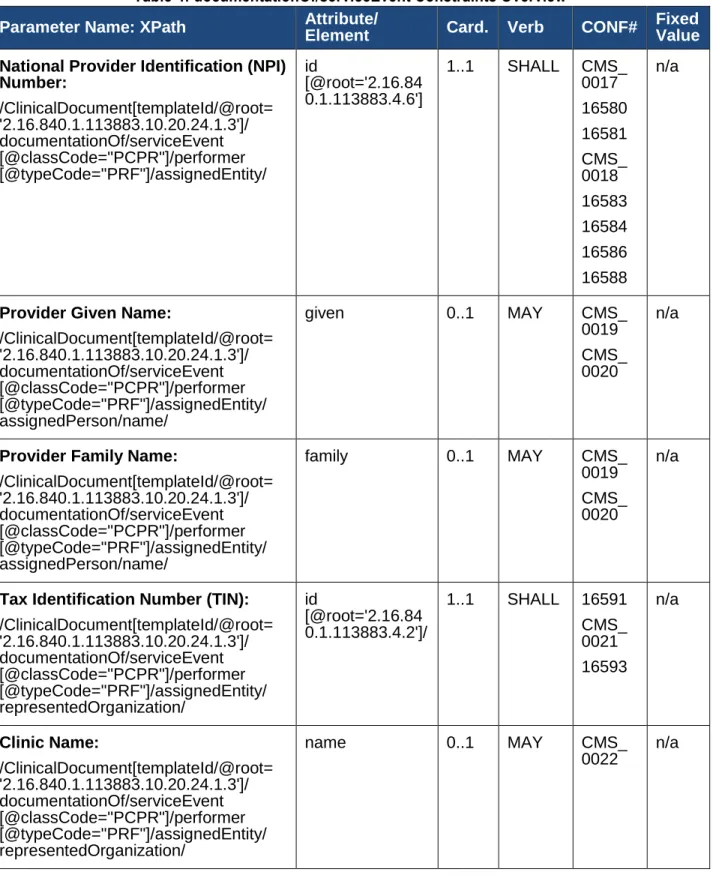
Table 4: documentationOf/serviceEvent Constraints Overview
Parameter Name: XPath Attribute/ Element Card. Verb CONF# Fixed Value
National Provider Identification (NPI) Number: /ClinicalDocument[templateId/@root= '2.16.840.1.113883.10.20.24.1.3']/ documentationOf/serviceEvent [@classCode="PCPR"]/performer [@typeCode="PRF"]/assignedEntity/ id [@root='2.16.84 0.1.113883.4.6'] 1..1 SHALL CMS_ 0017 16580 16581 CMS_ 0018 16583 16584 16586 16588 n/a
Provider Given Name:
/ClinicalDocument[templateId/@root= '2.16.840.1.113883.10.20.24.1.3']/ documentationOf/serviceEvent [@classCode="PCPR"]/performer [@typeCode="PRF"]/assignedEntity/ assignedPerson/name/ given 0..1 MAY CMS_ 0019 CMS_ 0020 n/a
Provider Family Name:
/ClinicalDocument[templateId/@root= '2.16.840.1.113883.10.20.24.1.3']/ documentationOf/serviceEvent [@classCode="PCPR"]/performer [@typeCode="PRF"]/assignedEntity/ assignedPerson/name/ family 0..1 MAY CMS_ 0019 CMS_ 0020 n/a
Tax Identification Number (TIN):
/ClinicalDocument[templateId/@root= '2.16.840.1.113883.10.20.24.1.3']/ documentationOf/serviceEvent [@classCode="PCPR"]/performer [@typeCode="PRF"]/assignedEntity/ representedOrganization/ id [@root='2.16.84 0.1.113883.4.2']/ 1..1 SHALL 16591 CMS_ 0021 16593 n/a Clinic Name: /ClinicalDocument[templateId/@root= '2.16.840.1.113883.10.20.24.1.3']/ documentationOf/serviceEvent [@classCode="PCPR"]/performer [@typeCode="PRF"]/assignedEntity/ representedOrganization/ name 0..1 MAY CMS_ 0022 n/a
1. SHALL contain exactly one [1..1] documentationOf (CONF:CMS_0017) such that it a. SHALL contain exactly one [1..1] serviceEvent (CONF:16580).
i. This serviceEvent SHALL contain exactly one [1..1] @classCode="PCPR" Care Provision (CONF:16581).
ii. This serviceEvent SHALL contain at least one [1..*] performer (CONF:16583).
1. Such performers SHALL contain exactly one [1..1] @typeCode="PRF" Performer (CONF:16584). 2. Such performers SHALL contain exactly one [1..1]
assignedEntity (CONF:16586).
This assignedEntity id/@root='2.16.840.1.113883.4.6' coupled with the id/@extension represents the individual provider's National Provider Identification number (NPI).
For the Eligible Professional (EP) programs, NPI is required except for the Group Practice Reporting Option (GPRO). For GPRO,
id/@root='2.16.840.1.113883.4.6' is coupled with @nullFlavor="NA", and @extension SHALL be omitted.
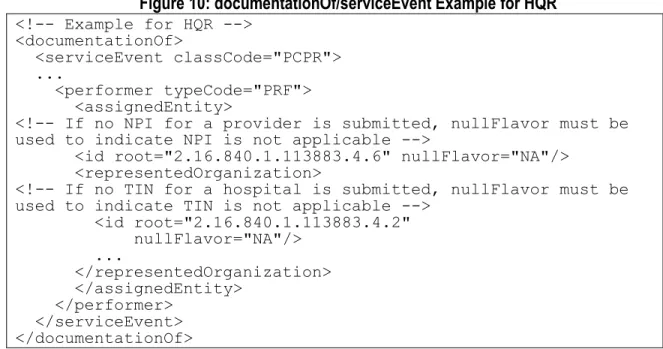
For the Hospital Quality Reporting (HQR), NPI is optional and MAY be submitted. If no NPI is submitted for HQR, id/@root='2.16.840.1.113883.4.6' is coupled with @nullFlavor="NA", and @extension SHALL be omitted.
3. This assignedEntity SHALL contain exactly one [1..1] id (CONF:CMS_0018) such that it
a. SHALL contain exactly one [1..1]
@root='2.16.840.1.113883.4.6' National Provider ID (CONF:16588).
4. This assignedEntity MAY contain zero or one [0..1] assignedPerson (CONF:CMS_0019)
a. This assignedPerson MAY contain zero or one [0..1] name (CONF:CMS_0020)
This representedOrganization id/@root='2.16.840.1.113883.4.2' coupled with the id/@extension represents the organization's Tax Identification Number (TIN).
For the EP programs, TIN is required.
For the HQR, TIN is optional and SHOULD be submitted. If no TIN is submitted for HQR, id/@root='2.16.840.1.113883.4.2' is coupled with @nullFlavor="NA", and
@extension SHALL be omitted.
5. This assignedEntity SHALL contain exactly one [1..1] representedOrganization (CONF:16591).
a. This representedOrganization SHALL contain exactly one [1..1] id (CONF:CMS_0021) such that it
i. SHALL contain exactly one [1..1]
@root='2.16.840.1.113883.4.2' Tax ID Number (CONF:16593).
b. This representedOrganization MAY contain zero or one [0..1] name (CONF:CMS_0022)
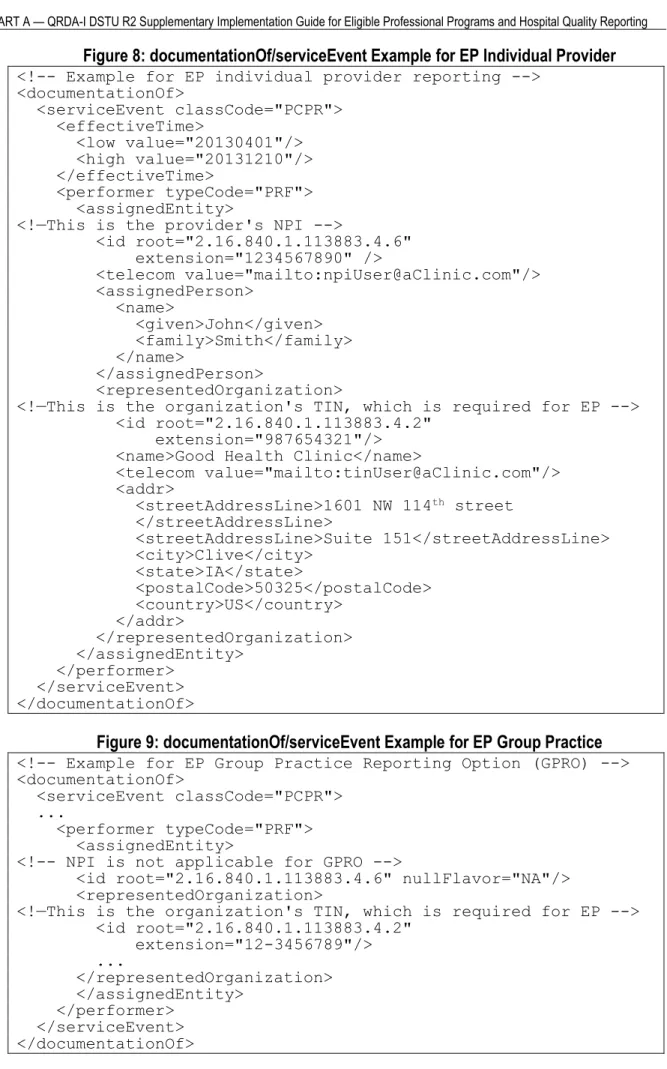
Figure 8: documentationOf/serviceEvent Example for EP Individual Provider
<!-- Example for EP individual provider reporting --><documentationOf> <serviceEvent classCode="PCPR"> <effectiveTime> <low value="20130401"/> <high value="20131210"/> </effectiveTime> <performer typeCode="PRF"> <assignedEntity>
<!—This is the provider's NPI -->
<id root="2.16.840.1.113883.4.6" extension="1234567890" /> <telecom value="mailto:[email protected]"/> <assignedPerson> <name> <given>John</given> <family>Smith</family> </name> </assignedPerson> <representedOrganization>
<!—This is the organization's TIN, which is required for EP --> <id root="2.16.840.1.113883.4.2"
extension="987654321"/> <name>Good Health Clinic</name>
<telecom value="mailto:[email protected]"/> <addr> <streetAddressLine>1601 NW 114th street </streetAddressLine> <streetAddressLine>Suite 151</streetAddressLine> <city>Clive</city> <state>IA</state> <postalCode>50325</postalCode> <country>US</country> </addr> </representedOrganization> </assignedEntity> </performer> </serviceEvent> </documentationOf>
Figure 9: documentationOf/serviceEvent Example for EP Group Practice
<!-- Example for EP Group Practice Reporting Option (GPRO) --> <documentationOf><serviceEvent classCode="PCPR"> ...
<performer typeCode="PRF"> <assignedEntity>
<!-- NPI is not applicable for GPRO -->
<id root="2.16.840.1.113883.4.6" nullFlavor="NA"/> <representedOrganization>
<!—This is the organization's TIN, which is required for EP --> <id root="2.16.840.1.113883.4.2" extension="12-3456789"/> ... </representedOrganization> </assignedEntity> </performer> </serviceEvent> </documentationOf>
Figure 10: documentationOf/serviceEvent Example for HQR
<!-- Example for HQR --> <documentationOf> <serviceEvent classCode="PCPR"> ... <performer typeCode="PRF"> <assignedEntity><!-- If no NPI for a provider is submitted, nullFlavor must be used to indicate NPI is not applicable -->
<id root="2.16.840.1.113883.4.6" nullFlavor="NA"/> <representedOrganization>
<!-- If no TIN for a hospital is submitted, nullFlavor must be used to indicate TIN is not applicable -->
<id root="2.16.840.1.113883.4.2" nullFlavor="NA"/> ... </representedOrganization> </assignedEntity> </performer> </serviceEvent> </documentationOf>
5.1.5
informationRecipient
The informationRecipient element records the intended recipient of the information at the time the document is created.
Table 5: informationRecipient Constraints Overview
Parameter Name: XPath Attribute/Element Card. Verb CONF#
Fixed Value CMS Program Name: /ClinicalDocument/information Recipient/intendedRecipient/id[root= '2.16.840.1.113883.3.249.7']/ @extension 1..1 SHALL CMS_0023 16704 CMS_0024 CMS_0025 CMS_0026 n/a
1. SHALL contain exactly one [1..1] informationRecipient (CONF:CMS_0023). a. The informationRecipient, if present, SHALL contain exactly one [1..1]
intendedRecipient (CONF:16704).
b. This intendedRecipient SHALL contain exactly one [1..1] id (CONF:CMS_0024)
i. It SHALL contain exactly one [1..1]
@root='2.16.840.1.113883.3.249.7'(CONF:CMS_0025) ii. It SHALL contain exactly one [1..1] @extension, the value of
@extension is CMS Program Name, which SHALL be selected from ValueSet QRDA-I CMS Program Name
Table 6: QRDA-I CMS Program Name
Value Set: QRDA-I CMS Program Name 2.16.840.1.113883.3.249.14.103 Specifies the CMS Program for QRDA-I report submissions.Code Code
System
Code System OID Print Name PQRS_MU_INDIVIDUAL CMS Program 2.16.840.1.113883.3.249.7 PQRS Meaningful Use Individual PQRS_MU_GROUP CMS Program 2.16.840.1.113883.3.249.7 PQRS Meaningful Use Group PIONEER_ACO CMS Program 2.16.840.1.113883.3.249.7 Pioneer ACO HQR_EHR CMS Program
2.16.840.1.113883.3.249.7 Hospital Quality Reporting for the EHR Incentive Program
HQR_IQR CMS
Program
2.16.840.1.113883.3.249.7 Hospital Quality Reporting for the Inpatient Quality Reporting Program
HQR_EHR_IQR CMS Program
2.16.840.1.113883.3.249.7 Hospital Quality Reporting for the EHR Incentive Program and the IQR Program
Figure 11: informationRecipient Example
<!-- This example shows the extension attribute with a value of "PQRS_MU_INDIVIDUAL", which indicates that this QRDA-I report is submitted to the PQRS Meaningful Use Individual program --> <informationRecipient> <intendedRecipient> <id root="2.16.840.1.113883.3.249.7" extension="PQRS_MU_INDIVIDUAL"/> </intendedRecipient> </informationRecipient>
5.2
Section-Level Templates
5.2.1
Measure Section
This section contains information about the eMeasure or eMeasures being reported. (An eMeasure is called an "eCQM" in the Meaningful Use program.) It must contain entries with the identifiers of all the eMeasures so that corresponding QRDA Quality Data Model (QDM) data element entry templates to be instantiated in the Patient Data Section are identified. Each eMeasure for which QRDA QDM data elements are being sent must reference eMeasure version specific identifier (QualityMeasureDocument/id).
Table 7: Measure Section Constraints Overview
Parameter Name: XPath Attribute/ Element Card. Verb CONF# Fixed Value
Measure Version specific identifier:
//section[templateId/@root= '2.16.840.1.113883.10.20.24.2.3']/entry/ organizer[templateId/@root= '2.16.840.1.113883.10.20.24.3.97']/ reference[@typeCode="REFR"]/external Document[@classCode="DOC"] [@moodCode="EVN"]/id/ @root 1..1 SHALL 12808 12809 12810 12811 12812 12813 n/a
1. SHALL contain exactly one [1..1] reference (CONF:12808) such that it
a. SHALL contain exactly one [1..1] @typeCode="REFR" refers to (CodeSystem: HL7ActRelationshipType 2.16.840.1.113883.5.1002 STATIC) (CONF:12809).
b. SHALL contain exactly one [1..1] externalDocument="DOC" Document (CodeSystem: HL7ActClass 2.16.840.1.113883.5.6) (CONF:12810).
i. This externalDocument SHALL contain exactly one [1..1] id (CONF:12811) such that it
1. SHALL contain exactly one [1..1]
@root="2.16.840.1.113883.4.738" (CONF:12812). Note: This OID indicates that the @extension contains the version specific identifier for the eMeasure.
2. SHALL contain exactly one [1..1] @extension (CONF:12813). Note: This @extension SHALL equal the version specific identifier for eMeasure (i.e. QualityMeasureDocument/id)
Figure 12: Measure Section Example
<section><templateId root="2.16.840.1.113883.10.20.24.2.2"/> <templateId root="2.16.840.1.113883.10.20.24.2.3"/>
<code code="55186-1" codeSystem="2.16.840.1.113883.6.1"/> <title>Measure Section</title>
<text>...</text> <entry>
<organizer classCode="CLUSTER" moodCode="EVN">
<templateId root="2.16.840.1.113883.10.20.24.3.98"/> <templateId root="2.16.840.1.113883.10.20.24.3.97"/> <statusCode code="completed"/>
<reference typeCode="REFR">
<externalDocument classCode="DOC" moodCode="EVN"> <!-- This is the eMeasure version specific identifier --> <id root="2.16.840.1.113883.4.738" extension="40280381-3d61-56a7-013e-666032b244f7"/> </externalDocument> </reference> </organizer> </entry> </section>
5.2.2
Reporting Parameter Section
The Reporting Parameters Section provides information about the reporting time interval, and may contain other information that provides context for the patient data being reported.
Table 8: Reporting Parameter Section Constraints Overview
Parameter Name: XPath Attribute/ Element Card. Verb CONF# Fixed Value
Reporting Period Effective Start Date:
//act[templateId/@root='2.16.840.1.113883.1 0.20.17.3.8']/effectiveTime/low/ @value 1..1 SHALL 3273 3274 CMS_ 0027 n/a
Reporting Period Effective End Date:
//act[templateId/@root='2.16.840.1.113883.1 0.20.17.3.8']/effectiveTime/high/ @value 1..1 SHALL 3273 3275 CMS_ 0028 n/a
1. SHALL contain exactly one [1..1] effectiveTime (CONF:3273).
a. This effectiveTime SHALL contain exactly one [1..1] low (CONF:3274). i. SHALL be precise to day (CONF:CMS_27)
b. This effectiveTime SHALL contain exactly one [1..1] high (CONF:3275). i. SHALL be precise to day (CONF:CMS_28)
Figure 13: Reporting Parameter Section Example
<section><templateId root="2.16.840.1.113883.10.20.17.2.1"/>
<code code="55187-9" codeSystem="2.16.840.1.113883.6.1"/> <title>Reporting Parameters</title>
<text>...</text>
<entry typeCode="DRIV">
<act classCode="ACT" moodCode="EVN">
<templateId root="2.16.840.1.113883.10.20.17.3.8"/> <code code="252116004" codeSystem="2.16.840.1.113883.6.96" displayName="Observation Parameters"/> <effectiveTime> <low value="20140101"/> <high value="20141231"/> </effectiveTime> </act> </entry> </section>
5.2.3
Patient Data Section
The Patient Data Section QDM contains entries that conform to the QDM approach to QRDA.
Table 9: Patient Data Section Constraints Overview
Parameter Name: XPath Attribute/ Element Card. Verb CONF# Fixed Value
QDM-based QRDA Entries:
//section[templateId/@root='2.16.840.1. 113883.10.20.24.2.1']/
entry 1..* SHALL CMS_0029 16573
n/a
1. SHALL contain at least one [1..*] entry (CONF:CMS_0029)
a. Where the clinical statement codes SHALL contain the @sdtc:valueSet extension to reference the value set from which the supplied code was drawn (CONF:16573).
Note: For PQRS program, validation for the generic constraint CONF:16573 is applied at an individual data element constraint level where applicable.
Figure 14: Patient Data Section Example
<section> <templateId root="2.16.840.1.113883.10.20.17.2.4"/> <templateId root="2.16.840.1.113883.10.20.24.2.1"/> <code code="55188-7" codeSystem="2.16.840.1.113883.6.1" displayName="Patient Data"/> <title>Patient Data</title> <text>...</text> <entry> ... </entry> ... </section>This guide follows the specifications of entry templates as defined in the base HL7 QRDA-I Implementation Guide.
For a QDM data element that is not done (when negationInd="true") with a reason, such as "Medication, Order not done: Medical Reason", an entryRelationship to a Reason
(templateId: 2.16.840.1.113883.10.20.24.3.88") with an actRelationship type of "RSON" is required. This is specified in the section 1.11.8 Asserting an Act Did Not Occur with a Reason in the base HL7 QRDA-I Implementation Guide.
PART B
— QRDA-III DSTU R1 Supplementary
Implementation Guide for Eligible Professional Programs
6.
Overview
6.1
Background
Part B of this guide is a CMS Quality Reporting Document Architecture Category III (QRDA-III) supplementary implementation guide to the HL7 Implementation Guide forCDA Release 2: Quality Reporting Document Architecture, Category III, DSTU Release 1 (US Realm), Draft Standard for Trial Use—November 2012, and its 2014 errata update (together referred to as the QRDA-III Implementation Guide in this guide).Templates defined in this supplementary
implementation guide are conformant with the QRDA-III Implementation Guide. CMS EP Programs QRDA-III templates address aggregate reporting requirements for:
Comprehensive Primary Care (CPC) initiative
Electronic Health Record (EHR) Incentive program (Meaningful Use)
Physician Quality Reporting System (PQRS)
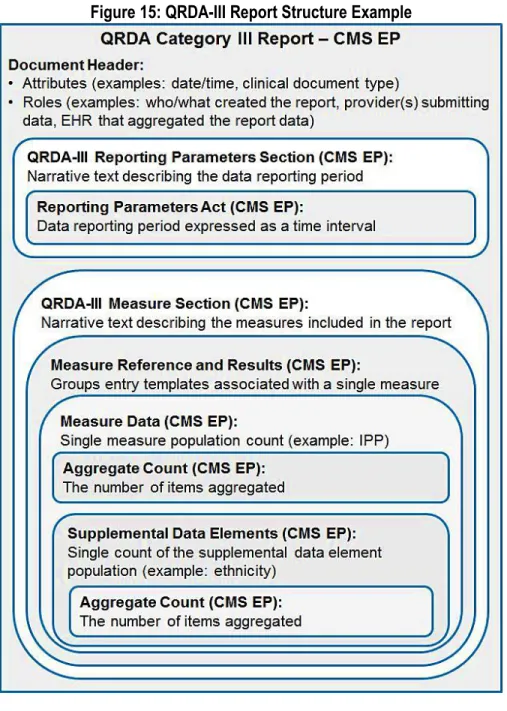
A QRDA-III report is an aggregate quality report using data collected in patient-level QRDA-I reports. Each QRDA-III report contains calculated summary data for one or more measures for a specified population of patients within a particular health system over a specific period of time. Summary data in the QRDA-III report are defined in the HL7 Health Quality Measures Format (HQMF), which standardizes the representation of a health quality measure as an electronic document. The structure of a QRDA-III report is depicted in the following figure.
Figure 15: QRDA-III Report Structure Example
6.2
How to Read This QRDA-III Guide
This guide includes the formal template definitions and submission criteria for submitting QRDA-III documents to CPC initiative, EHR Incentive Program (Meaningful Use), and PQRS for
Eligible Professionals. Some of the conformance statements in the HL7 CDA Release 2: QRDA Category III (QRDA-III), DSTU Release 1 have been further constrained to meet the specific requirements from these CMS EP programs. This guide shows all parent template definitions from the base QRDA-III Implementation Guide together with the CMS specific constraints.
7.
QRDA Category III Submission Rules
CMS will process CQM III documents originating from EHR systems. Submitted QRDA-III documents must meet the conformance statements specified in 8–QRDA-III Validation of this implementation guide.
7.1
Comprehensive Primary Care (CPC) Initiative Submissions
CPC QRDA-III submissions for the 2015 Measurement Year must contain all data for all measures recorded by a CPC practice site. Each CPC practice site is a single, physical (brick and mortar) location.For CPC measures, the CQM population is inclusive of all patients seen at the CPC practice site location as follows:
1) If the CPC practice site is a solo-practitioner site, the CQM population includes all patients who had one or more visits at the CPC practice site location in the
Measurement Year and who meet the initial patient population criteria of the CQM. 2) If the CPC practice site includes multiple practitioners, the CQM population must include
all patients who had one or more visits at the CPC practice site in the Measurement Year and who meet the initial patient population criteria of the CQM.
3) If the CPC practice site is part of a larger group practice that includes non-CPC
practitioners, the CQM population of the CPC practice site must include all patients who had one or more visits at the CPC practice site location only.
a) The aggregate numbers must be a representation of those patients seen at the CPC practice site location only.
i) If a patient was seen at both a CPC practice site and a non-participating practice site within the same larger group practice, the aggregate CQM report for the CPC practice site includes this patient if the patient had one or more visits in the Measurement Year at the CPC practice site location and meets the initial patient population criteria for the measure.
ii) If a patient is only seen at a non-participating practice site, but the data reside within the larger group practice's certified EHR, the patient is excluded from any CPC practice aggregate CQM report.
b) Note that CPC practice sites on a shared EHR system with a non-CPC practice site may count quality criteria that were performed at the non-CPC practice site if the data are contained within the CPC practice site's certified EHR and the patient had one or more visits in the Measurement Year at the CPC practice site location and meets the initial patient population criteria for the measure.
4) For CPC reporting, the same TIN (Tax Identification Number) has to be reported for all of the National Provider Identification (NPI) numbers listed for the CPC practice site.
Therefore each CPC practice site can only report one TIN for CPC. This TIN will be used for the PQRS aligned reporting option if the PQRS waiver is selected by the CPC
practice site.
5) The measurement period for the CPC program begins on January 1, 2015 and ends on December 31, 2015. Data collected during the measurement period should be submitted from January 1, 2016 through February 28, 2016.
6) QRDA–III submissions for the CPC initiative will use the June 2014 versions of EP CQMs.
7) As a part of satisfactory reporting criteria, the QRDA-III submission for the CPC initiative must include at least 9 measures from the CPC clinical quality measure set.
a) The CPC 2015 program year clinical quality measure set will be posted to the CMS website later this year. It can also be obtained by contacting CPC/Telligen support at [email protected] or calling 1-800-381-4724.
7.2
EHR Incentive Program (Meaningful Use) Submissions
EHR Incentive Program submissions must contain nine of the 64 EP CQMs outlined for
reporting as part of the EHR Incentive Program (Meaningful Use). The nine CQMs selected for submission must cover at least three of the six National Quality Strategy domains. QRDA-III submissions for the EHR Incentive Program will contain June 2014 versions of EP CQMs.
The EHR Incentive Program CQM populations include all patients seen by the EP during the reporting period, which is one full year (January 1, 2015 – December 31, 2015) or a calendar quarter within the calendar year (i.e., January 1, 2015 – March 31, 2015). EPs who are in their first year of participation in the EHR Incentive Program can also use any 90-day period within the calendar year 2015 as the data reporting period. Data collected during the reporting period may then be submitted January 1, 2016 through February 28, 2016. Please note that EPs who are in their first year of participation in the EHR Incentive Program must submit their CQMs via attestation by October 1, 2015 in order to avoid the EHR Incentive Program payment
adjustment in the subsequent year.
7.3
Physician Quality Reporting System (PQRS) Submissions
PQRS QRDA-III submissions must contain nine of the 64 EP CQMs outlined for reporting as part of the EHR Incentive Program (Meaningful Use). The nine CQMs selected for submission must cover at least three of the six National Quality Strategy domains. QRDA-III submissions for PQRS reporting programs will contain June 2014 versions of EP CQMs.
For PQRS Group Practice Reporting Option (GPRO) QRDA-III submissions, a "group practice" consists of a physician group practice defined by a single TIN with two or more individual EPs who have reassigned billing rights to the TIN. If the EP also reports through a different TIN that is not participating as a GRPO, then the EP may also report individually through that alternate TIN.
For the PQRS individual EP reporting, CQM populations include all Medicare patients seen by the EP during the reporting period, which is one full year (January 1, 2015 - December 31, 2015). For PQRS GPRO reporting, CQM populations include all unique Medicare patients from all practice sites in the group practice seen by the group during the reporting period (January 1, 2015 - December 31, 2015). Data for both individual EPs and GPROs is then submitted January 1, 2016 through February 2, 2016.
7.4
Identifiers
For all CMS EP program reporting, certain identifiers are mandatory, meaning that they must be present in the QRDA-III report and no nulls are allowed. Exceptions and considerations are noted where applicable. Mandatory identifiers for CMS EP program reporting include:
o For a practice site with a single provider, the TIN is an organizationID
o When a provider has more than one TIN, the provider is recorded for each NPI/TIN combination
Note: The CPC program requires each CPC practice site, use only one TIN and this TIN shall be the same for all CPC Practice Site practitioners (NPIs) who are eligible professionals at that CPC practice site ID location.(See 7.1–CPC Initiative
Submissions above.)
Each measure included in the QRDA-III report must reference the Version Specific ID.
7.5
Succession Management
This section describes the management of successive replacement documents for QRDA-III reports. (For example, a submitter notices an error in an earlier submission and wants to replace it with a corrected version.) For the PQRS program, managing replacement documents is sometimes referred to as Final Action Processing (FAP). The document that replaces a previous document will have a replacement relationship and will have a new unique QRDA-III document/id. The document/id of the previous QRDA-III will be referenced in the current document's /ClinicalDocument/relatedDocument/parentDocument/id.
7.5.1
Final Action Processing used in Succession Management
Currently, references to the 'id' of a parentDocument are not consistently used. The PQRS receiving system at CMS uses FAP to reliably determine the current version of a QRDA-III document. There are different sets of FAP rules that apply to the PQRS program and the CPC program respectively.
Please note that the CMS receiving system will not be able to analyze specific elements out of earlier QRDA-III submissions. Therefore submitters should ensure all QRDA-III reports are complete data re-submissions.
7.5.2
FAP Rules for PQRS
For group practice reporting (except for the CPC program), the FAP rules include the
combination of the CMS program name, the TIN, the eCQM measure version specific identifier, the eCQM reporting stratification identifier when it is applicable, and the submission timestamp. For individual reporting (except for the CPC program), the FAP rules include the combination of the CMS program name, the TIN, the NPI number, the eCQM measure version specific
identifier, the eCQM reporting stratification identifier when it is applicable, and the submission timestamp.
When submitting a replacement QRDA-III report for the PQRS program use the same TIN or the same TIN/NPI. For example, if a QRDA-III report containing data for eC