Procedia Computer Science 17 ( 2013 ) 1073 – 1082
1877-0509 © 2013 The Authors. Published by Elsevier B.V.
Selection and peer-review under responsibility of the organizers of the 2013 International Conference on Information Technology and Quantitative Management
doi: 10.1016/j.procs.2013.05.136
Information Technology and Quantitative Management , ITQM 2013
A Multiple-Criteria and Multiple-Constraint Levels Linear
Programming Based Error Correction Classification Model
B. Wang
a,∗, Y. Wang
baSchool of Mathematical Sciences, University of Chinese Academy of Sciences bSchool of Management, University of Chinese Academy of Sciences
Keywords: Classification, Two Types of Error, Multiple-Criteria Linear Programming, Multiple-Criteria and Multiple-Constraint Levels Linear Programming, Matrix Representation
1. Introduction
Linear programming (LP) is a useful tool for discriminating analysis of a problem given appropriate groups (e.g., Good and Bad) [1]. Furthermore, unlike support vector machine (SVM) [2], [3], [4], [5], [6], [7]multiple-criteria linear programming (MCLP) has improved the result by minimizing the sum external deviations and maximizing the sum of the internal deviations simultaneously [8], [9], [10]. Mostly, the cutoffof MCLP is fixed to be a given number (e.g., 1), while this will cause some other problems. For instance, it cannot involve those possible cases that can achieve the ideal cutoffscore to be zero. Formally, this means that the solutions obtained by linear programming are not invariant under linear transformations of the data [11], [12]. Particularly, it is not invariant under vector addition. Moreover, if the classes of the samples exchange, i.e. Good and Bad classes swap to each other, the solutions are different, which doesn’t make sense [13].
Noticing these problems, some researchers made many efforts on this topic. Consequently, a new model based on multiple-criteria and multiple-constraint levels linear programming (MC2LP) was posed [12], [14]. However,
∗Corresponding author
E-mail address:[email protected]. Abstract
Optimization based classification methods find classifier of a classification problem by solving one or a series of optimization problems, such as linear programming, convex programming and so on. In addition to this, in many applications, for example, credit card account classification, how to handle two types of error is a key issue. Combining linear programming method and error correction, using the structure of a multiple-criteria and multiple-constraint levels linear programming (MC2LP), which allows two alterable cutoffs, two types of error can be systematically corrected. Therefore, in this paper, we pose a new MC2LP model that can correct two types of error. In the new model, two parallel hyperplanes are used to indicate the relative positions between the points and hyperplanes. In other words, it can treat two types of error differently. Especially, it can be developed into a pair of models, which can deal with two types of error respectively. Besides, we will give the matrix representation of the new models and discuss some properties of them. Moreover, experiment result will show the effectiveness of this new dual-hyperplane model.
© 2013 The Authors. Published by Elsevier B.V.
Selection and peer-review under responsibility of the organizers of the 2013 International Conference on Information Technology and Quantitative Management
Open access under CC BY-NC-ND license.
these methods were domain-driven, which meant they needed some domain knowledge to help finding the best cutoff. As a result, a new model which can solve the problems automatically is needed. That is to say, it can solve the problems that no domain knowledge is prepared. In particular, it solves classification twice. The maximal external deviation is found for the first time, while MC2LP is exploited to search for the optimal hyperplane based on minimizing two types of error for the second time [13].
Besides, we also hope the new model have some other properties, that is, playing a key role in error correction. Nowadays, by virtue of many optimization based classification algorithms, the transactions data collected by the bank can be analyzed in many ways. For instance, the profit of the new accounts can be predicted, that is, which accounts are easy to bankrupt and which ones have good credit. However, for many real-life problems, the accounts cannot be separated perfectly by the hyperplane in spite of using some kernel techniques [15]. Thus, how to decrease the number of misclassified samples becomes a big issue. Moreover, in some applications, misclassifications have unequal importance. For example, in credit card account classification, it is essential to classify credit card customers precisely in order to provide effective services while avoiding losses due to bankruptcy from users’ debt. Actually, even 0.01 percent increase in early detection of bad accounts can save millions, while losing of a good account does not influence much [11], [12]. In this paper, we also provide another MC2LP based model to the purpose of errors correction. In this model, we fix the cutoffto be 1 whereas we also add two more hyperplanes to detect the misclassification points carefully. Accordingly, a subtle discussion is involved about the relationship between two types of error and the deviations. In fact, in the statistics theory, two types of error influence on each other oppositely. In other words, decreasing of Type I error will cause the increasing of Type II, and vice versa. Hence, we obtain two different models by focusing on different types of error respectively. Next, some more elaborate introductions are demonstrated in the coming sections.
2. Multiple-criteria and multiple-constraint levels linear programming for classification
According to some analysis, a non-fixedbis very important to a classification problem [13]. At the same time, for the simplicity and existence of the solution,bshould be fixed in some interval. As a result, for different data, we fixbin different pairs of interval [bl,bu], whereblandbuare two fixed numbers. Now our problem is to search
the best cutoffbetweenblandbuat every level of their trade-offs, that is to say, to test every point in the interval
[bl,bu]. We keep the multiple criteria the same as the ones in original MCLP, that is, MMD and MSD. And then,
the following model is posed [12]:
min i αi max i βi s.t. AiX=[bl,bu]+αi−βi, Ai∈bad, AiX=[bl,bu]−αi+βi, Ai∈good, αi, βi0,i=1,2, ...,l. (1)
Based on the technical of Multiple-criteria and multiple-constraint levels linear programming (MC2LP), we can test each trade-offbetween the multiple-criteria and multiple-constraint as follows:
minλ1 i αi−λ2 i βi s.t. AiX=γ1bl+γ2bu+αi−βi, Ai∈bad, AiX=γ1bl+γ2bu−αi+βi, Ai∈good, αi, βi0,i=1,2, ...,l. (2)
Here, the parameters ofλ×γare fixed for each programming problem. Moreover, the advantage of MC2LP is that it can find the potential solution for all possible trade-offs in the parameter space systematically [16] [17], where the parameter space is
Of course, in this model, choosing a suitable cutoffpair for the goal problem is a key issue and needs domain knowledge. Consequently, a non-parameter choosing MC2LP method should be posed.
3. A new two alterable cutoffs model based on MC2LP
3.1. The definition of dual-hyperplane MC2LP model
As it is discussed in another paper, the former MC2LP is sensitive to the choice of cutoff, and the changeable multiple-constraint levels are not effectively used [13]. Therefore, we want to modify this model and pose a new MC2LP based model, which is flexible and effectual. Actually, the key issue of the problem involved is how to choose the interval of cutoff. That is to say, even though the former MC2LP model has a changeable cutoff, it still test the trade-offs in a fix interval. As a result, the deviations are measured according to one certain hyperplane. To overcome this shortcoming, a dual-hyperplane model is advanced. In this new model, avoiding measuring the deviations according to one fixed hyperplane, two parallel hyperplanes are constructed, instead of a single one in the former MC2LP. The idea is to combine the former MC2LP with two different intervals together, and measure the deviations according to the trade-offs in two intervals respectively. Assuming that two intervals have no intersection andγ=(γ1, γ2) is the trade-offvector, the new MC2LP model can be promoted as follows:
A former MC2LP model with interval of [b1
l,b1u]: min i α1 i max i β1 i s.t. AiX=γ1b1l +γ2b1u+α1i −β1i, Ai∈bad, AiX=γ1b1l +γ2bu1−α1i +β1i, Ai∈good, α1 i, β1i 0,i=1,2, ...,l. (3)
A former MC2LP model with interval of [b2
l,b2u]: min i α2 i max i β2 i s.t. AiX=γ1b2l +γ2b2u+α2i −β2i, Ai∈bad, AiX=γ1b2l +γ2bu2−α2i +β2i, Ai∈good, α2 i, β2i 0,i=1,2, ...,l. (4) Suppose thatb1
ub2l, we combine the above two models together as follows:
min i (αri+αli) max i (βri+βli) s.t. AiX=γ1bll+γ2blu+αli−βli, Ai∈Bad, AiX=γ1brl+γ2bru+αri −β r i, Ai∈Bad, AiX=γ1bll+γ2bul −αli+βli, Ai∈Good, AiX=γ1brl+γ2bru−αri +β r i, Ai∈Good, αr i, αli, βri, βli0,i=1,2, ...,l. (5)
In the above dual-hyperplane model, we replace [b1
l,b1u] and [b2l,b2u] by [bll,blu] and [brl,bru] respectively. Then, the
deviations are measured according to two different hyperplanes, that is, the left one and the right one. In this way, we avoid the shortcoming referred above [13].
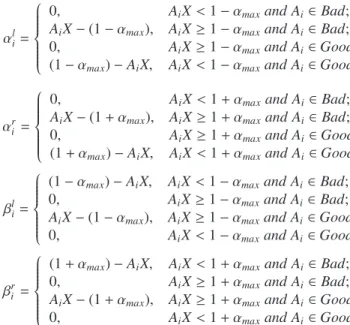
Definition 1. The conditions that the deviations should satisfy are stated as follows:
αl i= ⎧⎪⎪⎪ ⎪⎪⎪⎨ ⎪⎪⎪⎪⎪ ⎪⎩
0, AiX<1−αmaxand Ai∈Bad;
AiX−(1−αmax), AiX≥1−αmaxand Ai∈Bad;
0, AiX≥1−αmaxand Ai∈Good;
(1−αmax)−AiX, AiX<1−αmaxand Ai∈Good.
αr i = ⎧⎪⎪⎪ ⎪⎪⎪⎨ ⎪⎪⎪⎪⎪ ⎪⎩
0, AiX<1+αmaxand Ai∈Bad;
AiX−(1+αmax), AiX≥1+αmaxand Ai∈Bad;
0, AiX≥1+αmaxand Ai∈Good;
(1+αmax)−AiX, AiX<1+αmaxand Ai∈Good.
βl i= ⎧⎪⎪ ⎪⎪⎪⎪⎨ ⎪⎪⎪⎪⎪ ⎪⎩
(1−αmax)−AiX, AiX<1−αmaxand Ai∈Bad;
0, AiX≥1−αmaxand Ai∈Bad;
AiX−(1−αmax), AiX≥1−αmaxand Ai∈Good;
0, AiX<1−αmaxand Ai∈Good.
βr i = ⎧⎪⎪⎪ ⎪⎪⎪⎨ ⎪⎪⎪⎪⎪ ⎪⎩
(1+αmax)−AiX, AiX<1+αmaxand Ai∈Bad;
0, AiX≥1+αmaxand Ai∈Bad;
AiX−(1+αmax), AiX≥1+αmaxand Ai∈Good;
0, AiX<1+αmaxand Ai∈Good.
The following figure is a sketch of dual-hyperplane MC2LP model:
Fig. 1. A dual-hyperplane MC2LP model
repre-sentation of the model. It comes as follows: min(λ1, λ2) eT 0 0 −eT αl+αr βl+βr s.t. A A X+ Y 0 0 Y αl−βl αr+βr = e 0 0 e bl l blu brl bru γ1 γ2 (αl, αr, βl, βr)T 0. (6)
HereY is a diagonal matrix with the label vector in the diagonal andeis anl×1 matrix whose elements are all 1. Then, combining the deviation variables as a vector, we have:
min(λ1, λ2) eT eT 0 0 0 0 −eT −eT ⎛⎜⎜⎜⎜⎜ ⎜⎜⎜⎜⎜ ⎜⎜⎝ αl αr βl βr ⎞ ⎟⎟⎟⎟⎟ ⎟⎟⎟⎟⎟ ⎟⎟⎠ s.t. A A X+ Y 0 −Y 0 0 Y 0 −Y ⎛⎜⎜⎜⎜⎜ ⎜⎜⎜⎜⎜ ⎜⎜⎝ αl αr βl βr ⎞ ⎟⎟⎟⎟⎟ ⎟⎟⎟⎟⎟ ⎟⎟⎠= e 0 0 e bl l b l u br l bru γ1 γ2 (αl, αr, βl, βr)T 0. (7)
At last, the model can be represented as follows:
min(λ1, λ2) 0 eT eT 0 0 0 0 0 −eT −eT ⎛ ⎜⎜⎜⎜⎜ ⎜⎜⎜⎜⎜ ⎜⎜⎜⎜⎜ ⎜⎜⎝ X αl αr βl βr ⎞ ⎟⎟⎟⎟⎟ ⎟⎟⎟⎟⎟ ⎟⎟⎟⎟⎟ ⎟⎟⎠ s.t. A Y 0 −Y 0 A 0 Y 0 −Y ⎛ ⎜⎜⎜⎜⎜ ⎜⎜⎜⎜⎜ ⎜⎜⎜⎜⎜ ⎜⎜⎝ X αl αr βl βr ⎞ ⎟⎟⎟⎟⎟ ⎟⎟⎟⎟⎟ ⎟⎟⎟⎟⎟ ⎟⎟⎠= e 0 0 e bl l b l u br l b r u γ1 γ2 (αl, αr, βl, βr)T 0. (8)
3.2. Discussion of the dual-hyperplane model
There are some direct viewing properties of the new model. For instance, suppose that all the misclassified points are projected into the grey zone [18]. Then, as it is shown in Figure 1, after fixing (γ1, γ2), we take
b =0.5∗bl+0.5∗br as the final cutoff. Next, if a sample in good class is misclassified as bad class, it means
αr i > β l i ≥ 0 andα l i = β r
i = 0. And then, if a sample in bad class is misclassified as good class, it means
αl
i> β
r
i ≥0 andαri =βil =0. For the points that are correctly classified,βl+βrshould be maximized. Thus, for
the misclassified ones,αri +αli−βri−βlishould be minimized.
Lemma 2. Ifλ1> λ2, then we have(αl)T·βl=0and(αr)T·βr=0.
Proof. The model is equal to the following system:
min(λ1−λ2)(eTαl+eTαr)+λ2eT(αl−βl)+λ2eT(αr−βr) s.t. Y 0 0 Y A A X+ αl−βl αr−βr = Y 0 0 Y e 0 0 e bl l b l u br l b r u γ1 γ2 (9)
To the contrary, for a certain solution ( ˆX,αˆl,αˆr,βˆl,βˆr)T, suppose that ( ˆαl)T·βˆl>0 or ( ˆαr)T·βˆr >0. Without loss of generality, let’s assume that ( ˆαl)T·βˆl >0. When (γ1, γ2) is fixed, we can decrease the value of objective function by decreasing αl andβl at the same degree, because the objective function is a strict monotonically increasing function with respect toαl. This contradicts the fact that shown above.
3.3. Unacceptable solution
Unacceptable solution means the solution withX=0. In this case, the result is unreasonable and unacceptable. In other words, it is trivial. As a result, in this section, we will see that when we keepλ1> λ2, our dual-hyperplane model will not yield an unacceptable solution if some condition can be satisfied.
According to Lemma 2, whenλ1 > λ2, any solution of dual-hyperplane model satisfies (αl)T ·βl = 0 and (αr)T ·βr = 0. The next theorem shows that: in which situation, our dual-hyperplane model will not yield an
unacceptable solution.
Theorem 3. For the dual-hyperplane MC2LP model, suppose the data matrix A satisfies that
l yiyj=1,j=1 n k=1 aikajk> l yiyj=−1,j=1 n k=1 aikajk,i=1,2, ...,l. (10)
Moreover, let’s assume thatλ1> λ2. Then, the model will not yield an unacceptable solution.
Proof. To the contrary, assume that there is a solution withX =0. Then, according to the proof in Lemma 2,
αl−βlandαr−βrare fixed values, whenγ=(γ
1, γ2) is fixed. Hence, the increase of the first item of the constraint will cause the decrease ofαl−βlandαr−βr, which makes the value of objective function decrease.
Taking the first item of Y 0 0 Y A A
Xinto account, we checkY AX. LetX=ATy, which is nonzero. Here,y=(y
1,y2, ...,yl)T is the label vector. Then, we have
(0,0, ...,0,yi,0,0, ...,0)TAX=yT1(AATy)i=yi l j=1 yjaiaj = l yiyj=1,j=1 n k=1 aikajk− l yiyj=−1,j=1 n k=1 aikajk>0,i=1,2, ...,l.
As a result, we haveY AX>0, which makes the value of objective function decrease.
Remark 4. As we all know, inner product can measure the similarity of data. The data matrix which satisfies
l yiyj=1,j=1 n k=1 aikajk> l yiyj=−1,j=1 n k=1 aikajk,i=1,2, ...,l. (11)
means: the sum of the inner products between one point and all the samples in the same group is bigger than the sum of that between the point and all the samples in the alternative group.
3.4. Various forms of dual-hyperplane model
In many classification models, including original MCLP model, two types of error is a big issue. In credit card account classification, correcting two types of error can not only improve the accuracy of classification but also help to find some important accounts.
Accordingly, many researchers have focused on this topic. Based on this consideration, more attention should be paid to the samples that locate between two hyperplane in the original MCLP model, that is, the points in the grey zone [18]. Consequently, we define the external deviations and internal deviations related to two different hyperplanes, the left one and the right one, that is,αl,αr,βlandβr. While, different definitions of two hyperplanes
lead to different kinds of dual-hyperplane models.
At first, a more meticulous model could be stated as follows:
min i (αri +αli) max i (βri+βli) s.t. AiX=1+[0, αmax]+αri −β r i, Ai∈Bad, AiX=1+[0, αmax]−αri+βri, Ai∈Good, AiX=1−[0, αmax]+αli−β l i, Ai∈Bad, AiX=1−[0, αmax]−αli+βli, Ai∈Good, αr i, αli, βri, βli0,i=1,2, ...,l. (12)
whereAiis given andXis unrestricted. The parameterαmaxdefines the largest gap between two hyperplanes.
As it is discussed in another paper, there are two different versions of dual-hyperplane, which can handel two types of error respectively [13].
Model I (Type I error correcting model)
min i (αri+αli) max i (βri +βli) s.t. AiX=1−[0, αmax]+αli−βli, Ai∈Bad, AiX=1−[0, αmax]−αli+β l i, Ai∈Good, AiX=1+αri −βri, Ai∈Bad, AiX=1−αri+βri, Ai∈Good, αr i, αli, βri, βli0,i=1,2, ...,l. (13)
whereAi andαmax > 0 are given, and X is unrestricted. Because the interval is on the negative side of the
The matrix representation of (1) is as follows: min (λ1, λ2) 0 eT eT 0 0 0 0 0 −eT −eT ⎛ ⎜⎜⎜⎜⎜ ⎜⎜⎜⎜⎜ ⎜⎜⎜⎜⎜ ⎜⎜⎝ X αl αr βl βr ⎞ ⎟⎟⎟⎟⎟ ⎟⎟⎟⎟⎟ ⎟⎟⎟⎟⎟ ⎟⎟⎠ s.t. A Y 0 −Y 0 A 0 Y 0 −Y ⎛ ⎜⎜⎜⎜⎜ ⎜⎜⎜⎜⎜ ⎜⎜⎜⎜⎜ ⎜⎜⎝ X αl αr βl βr ⎞ ⎟⎟⎟⎟⎟ ⎟⎟⎟⎟⎟ ⎟⎟⎟⎟⎟ ⎟⎟⎠= e 0 0 e 1−αmax 1 1 1 γ1 γ2 (αl, αr, βl, βr)T 0. (14)
The same as Model I, we have Model II to deal with type II error, whose matrix representation is described as follows:
Model II (Type II error correcting model)
min (λ1, λ2) 0 eT eT 0 0 0 0 0 −eT −eT ⎛ ⎜⎜⎜⎜⎜ ⎜⎜⎜⎜⎜ ⎜⎜⎜⎜⎜ ⎜⎜⎝ X αl αr βl βr ⎞ ⎟⎟⎟⎟⎟ ⎟⎟⎟⎟⎟ ⎟⎟⎟⎟⎟ ⎟⎟⎠ s.t. A Y 0 −Y 0 A 0 Y 0 −Y ⎛ ⎜⎜⎜⎜⎜ ⎜⎜⎜⎜⎜ ⎜⎜⎜⎜⎜ ⎜⎜⎝ X αl αr βl βr ⎞ ⎟⎟⎟⎟⎟ ⎟⎟⎟⎟⎟ ⎟⎟⎟⎟⎟ ⎟⎟⎠= e 0 0 e 1 1 1 1+αmax γ1 γ2 (αl, αr, βl, βr)T0. (15)
whereAi, andαmax>0 are given, andXis unrestricted.
In all the models introduced above,AX=1 is used as the final classification hyperplane. 4. Experiment
In this section, a simple experiment will be given to show the validity of Lemma 2 and the effectiveness of Model I and Model II. The data is displayed in the following figure. As we can see, this is a binary classification problem. There are ten ”Good” class points and ten ”Bad” class points. The task is to find a hyperplane in this two dimension space, which can classify these points as well as possible.
Fig. 2. The Data
Using Model I and choosing parameters asαmax = 1, λ =(4,1) andγ = (0.5,0.5), we obtain the solution
X =(−0.292,0.961) andαl,αr,βlandβr. Next, we calculate (αl)T ·βland (αr)T ·βr. The result is (αl)T·βl =
9.504×10⁻¹¹and (αr)T·βr=1.301×10⁻¹⁰, which means that Lemma 2 holds.
Furthermore, the following figure is a comparison between Model I and II. In this experiment,αmax =2. By
choosing appropriateγ, we can make the pair of hyperplane be fixed to beAX=−0.3,AX =1 for Model I and
AX =1,AX =2.3 for Model II. At the same time,λ =(4,1) is applied. In addition to this, the original MCLP model is also applied by choosing parameterλ=(4,1).
Fig. 3. A comparison of Model I and II
is obtained from Model I and the green circle indicates the point of Type I error correction; the yellow hyperplane (L2) is obtained from Model II and the yellow circle indicates the point of Type II error correction.
As we can see, Model I can help correcting some Type I errors, at the same time, Model II can correct some Type II errors, which are all misclassification in the original MCLP model. The result shows the capability of the new dual-hyperplane model in error correcting. However, some points, which are correctly classified in the original MCLP model, are misclassified in dual-hyperplane models. One important reason is the models, original MCLP and new dual-hyperplane MC2LP, are not based on minimizing the number of misclassification points. Instead of that, the models optimize the sum of deviations. As a result, a more profound discussion should be studied in the following work.
5. Conclusion
This paper poses a brand new model for classification, which is based on MC2LP method. The characteristic of the new model is that it is equipped a pair of parallel hyperplanes, thus it is called dual-hyperplane MC2LP model. Some theoretical analysis on the new model has been discussed, such as the complementarity between the interior and exterior deviations, condition of avoiding unacceptable solutions and so on. The experiment part validates the dual-hyperplane model’s effectiveness. Especially, it can correct two types of error in some degree. As a result, taking advantage of MC2LP, the new model manifests the capability in error correcting.
6. Acknowledgement
This work has been partially supported by grants from National Natural Science Foundation of China (No. 70921061, No. 71110107026), the CAS/SAFEA International Partnership Program for Creative Research Teams. References
[1] N. Freed, F. Glover, Simple but powerful goal programming models for discriminant problems, European Journal Operational Research 7 (1981) 44–60.
[2] Y. Tian, Y. Shi, X. Liu, Recent advances on support vector machines research, Technological and Economic Development of Economy 18 (1) (2012) 5–33.
[3] Z. Qi, Y. Tian, Y. Shi, Robust twin support vector machine for pattern classification, Pattern Recognition 46 (1) (2013) 305–316. [4] Z. Qi, Y. Tian, Y. Shi, Laplacian twin support vector machine for semi-supervised classification, Neural Networks 35 (2012) 46–53. [5] Z. Qi, Y. Tian, Y. Shi, Twin support vector machine with universum data, Neural Networks 36 (2012) 112–119.
[6] Z. Qi, Y. Xu, L. Wang, Y. Song, Online multiple instance boosting for object detection, Neurocomputing 74 (10) (2011) 1769–1775. [7] Z. Qi, Y. Tian, Y. Shi, Structural twin support vector machine for classification, Knowledge-Based Systems, 2013.
[8] Y. Shi, Multiple criteria optimization-based data mining methods and applications: a systematic survey, Knowledge Information System 24 (2010) 369–391.
[9] G. Kou, X. Liu, Y. Peng, Y. Shi, M. Wise, W. Xu, Multiple criteria linear programming to data mining: Models, algorithm designs and software developments, Optim. Methods Softw. 18 (2003) 453–473.
[10] Y. Shi, Y. Peng, W. Xu, X. Tang, Data mining via multiple criteria linear programming: applications in credit card portfolio management, Int. J. Inf. Technol. Decis. Mak. 1 (2002) 131–151.
[11] L. Thomas, D. Edelman, J. Crook, Credit Scoring and Its Applications, SIAM, 2002, Ch. 5.
[12] J. He, Y. Zhang, Y. Shi, G. Huang, Domain-driven classification based on multiple criteria and multiple constraint-level programming for intelligent credit scoring, IEEE Transactions on Knowledge and Data Engineering 22 (6) (2010) 826–838.
[13] B. Wang, Y. Shi, Error correction method in classification by using multiple-criteria and multiple-constraint levels linear programming, International Journal of Computers, Communications and Control.
[14] Y. Shi, Y. Tian, G. Kou, Y. Peng, J. Li, Optimization Based Data Mining: Theory and Applications, Advanced Information and Knowl-edge Processing, World Scientific,, 2001.
[15] Z. Zhang, D. Zhang, Y. Tian, Y. Shi, Kernel-based multiple criteria linear program, Proceedings of Conference on Multi-criteria Decision Making.
[16] Y. Shi, Multiple Criteria and Multiple Constraint Levels Linear Programming: Concepts, Techniques and Applications, Springer,, 2011, Ch. 11.
[17] Y. Shi, J. He, Computer-based algorithms for multiple criteria and multiple constraint level integer linear programming, Computer Mathematics Application 49 (5) (2005) 903–921.
[18] Y. Chen, L. Zhang, Y. Shi, Post mining of multiple criteria linear programming classification model for actionable knowledge in credit card churning management, in: ICDM, 2011.