Software-Defined Enterprise Wireless
Local Area Networks
Yunong Han
School of Computer Science and Electronic Engineering
University of Essex
This thesis is submitted for the degree of
Doctor of Philosophy
With the growing popularity of Bring Your Own Device (BYOD), modern enterprise Wireless Local Area Networks (WLANs) deployments always consist of multiple Access Points (APs) to meet the fast-increasing demand for wireless access. In order to avoid network congestion which leads to issues such as suboptimal Quality of Service (QoS) and degraded user Quality of Experience (QoE), intelligent network traffic control is needed. Software Defined Networking (SDN) is an emerging architecture and intensively discussed as one of the most promising technologies to simplify network management and service development. In the SDN architecture, network management is directly programmable because it is decoupled from forwarding layer. Leveraging SDN to the existing enterprise WLANs framework, network services can be flexibly implemented to support intelligent network traffic control.
This thesis studies the architecture of software-defined enterprise WLANs and how to improve network traffic control from a client-side and an AP-side perspective. By extending an existing software-defined enterprise WLANs framework, two adaptive algorithms are proposed to provide client-based mobility management and load balancing. Custom protocol messages and AP load metric are introduced to enable the proposed adaptive algorithms. Moreover, a software-defined enterprise WLAN system is designed and implemented on a testbed. A load-aware automatic channel switching algorithm and a QoS-aware bandwidth control algorithm are proposed to achieve AP-based network traffic control.
Experimental results from the testbed show that the designed system and algorithms significantly improve the performance of traffic control in enterprise WLANs in terms of network throughput, packet loss rate, transmission delay and jitter.
This thesis would not exist without the help of many people that supported me throughout the years of research. First of all, I would like to express my deepest gratitude to my supervisor Prof. Kun Yang, who helped me with his advice and inspirational ideas. Without his continuous support, all this would not have been possible. Also, I would like to take the opportunity to thank my colleagues and friends from the School of Computer Science and Electronic Engineering at the University of Essex, in particular, the Network Convergence Laboratory group. Their support made University of Essex to a great place to study and live. Finally, I would like to send my huge thanks to my parents and my lovely wife as they always have loved me, trusted me and encouraged me throughout all the long years of study.
List of figures xi
List of tables xv
1 Introduction 1
1.1 Background . . . 1
1.2 Problem Statement and Motivation . . . 4
1.3 Contributions . . . 10
1.4 Structure of Thesis . . . 11
2 Literature Review 13 2.1 Introduction . . . 13
2.2 Software-Defined Enterprise WLANs . . . 14
2.3 Traffic Control in Enterprise WLANs . . . 20
2.3.1 Mobility Management . . . 20
2.3.2 Load Balancing . . . 27
2.3.3 Automatic Channel Switching . . . 31
2.3.4 Bandwidth Control . . . 37
3 Adaptive Mobility Management and Load Balancing 39 3.1 Introduction . . . 39
3.1.1 Problem Statement . . . 40
3.1.2 Contributions . . . 41
3.1.3 Structure of Chapter . . . 41
3.2 The Selected System Architecture . . . 43
3.3 Proposed Adaptive Algorithms . . . 48
3.3.1 AP Load . . . 48
3.3.2 Adaptive Mobility Management Algorithm . . . 52
3.3.3 Adaptive Load Balancing Algorithm . . . 55
3.4 Performance Evaluation . . . 56
3.4.1 Experiment Setup . . . 56
3.4.2 Adaptive Mobility Management Experiments . . . 57
3.4.3 Adaptive Load Balancing Experiments . . . 63
3.5 Chapter Summary . . . 68
4 Load-Aware Automatic Channel Switching 71 4.1 Introduction . . . 71
4.1.1 Problem Statement . . . 73
4.1.2 Contributions . . . 74
4.1.3 Structure of Chapter . . . 74
4.2 System Design . . . 75
4.2.1 Local Information Base . . . 75
4.2.2 Central Information Base . . . 77
4.2.3 Automatic Channel Switching Application . . . 78
4.3 Proposed Channel Switching Algorithms . . . 79
4.3.1 Channel Interference Factor . . . 79
4.3.2 Proposed SS and DS Algorithms . . . 82
4.4.1 Experiment Setup . . . 87
4.4.2 Performance Evaluation . . . 87
4.5 Chapter Summary . . . 94
5 QoS-Aware Bandwidth Control 97 5.1 Introduction . . . 97
5.1.1 Problem Statement . . . 100
5.1.2 Contributions . . . 100
5.1.3 Structure of Chapter . . . 101
5.2 System Introduction . . . 101
5.2.1 QoS-Aware Bandwidth Control . . . 103
5.3 Proposed QoS-Aware Bandwidth Control Algorithm . . . 106
5.4 Performance Evaluation . . . 106 5.4.1 Experiment Setup . . . 106 5.4.2 Performance Evaluation . . . 107 5.5 Chapter Summary . . . 115 6 Conclusions 117 6.1 Future Work . . . 120 References 123
1.1 Traditional architecture of an enterprise WLAN . . . 2
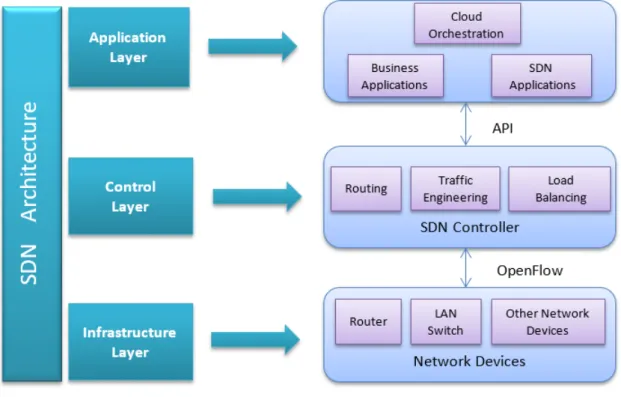
1.2 Architecture of SDN . . . 3
1.3 Architecture of an OpenFlow Switch . . . 5
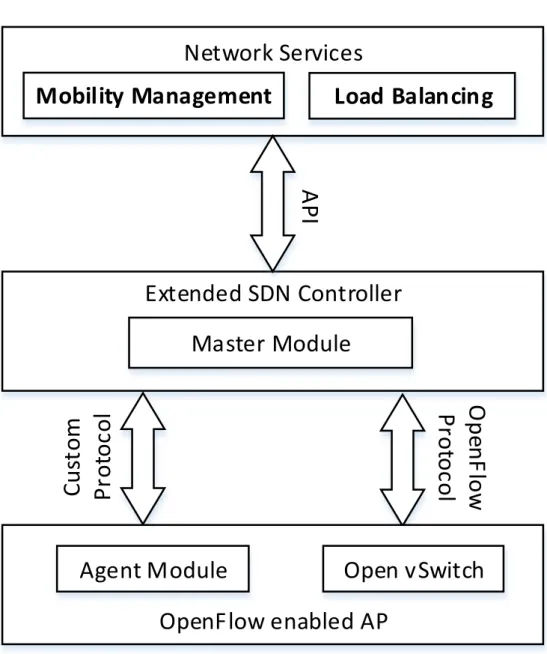
3.1 Architecture of the selected software-defined enterprise WLAN system . . 42
3.2 Format of the custom protocol message FORWARD_AP_LOAD . . . 44
3.3 An example of custom protocol messages that are exchanged during the process of seamless handover in the selected software-defined enterprise WLAN system . . . 45
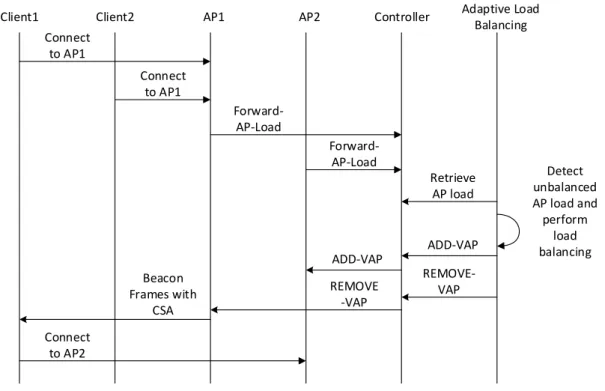
3.4 An example of custom protocol messages that are exchanged during the process of adaptive load balancing in the selected software-defined enterprise WLAN system . . . 47
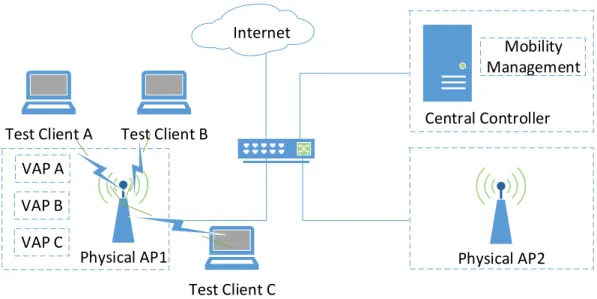
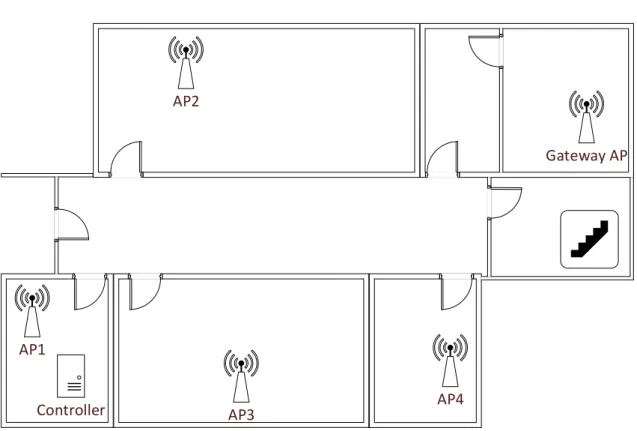
3.5 Architecture of the testbed for mobility management experiments . . . 49
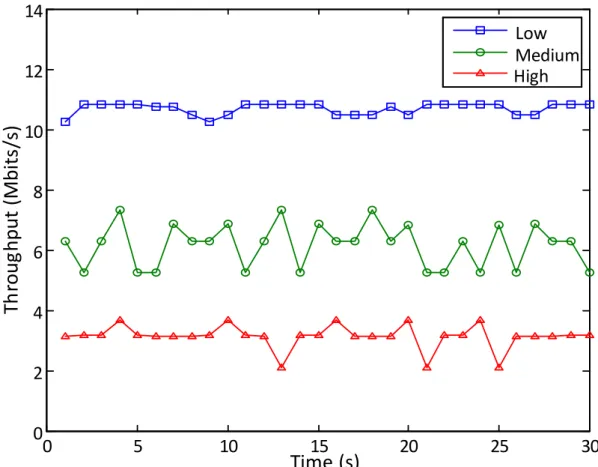
3.6 Network throughput achieved with different levels of AP load . . . 50
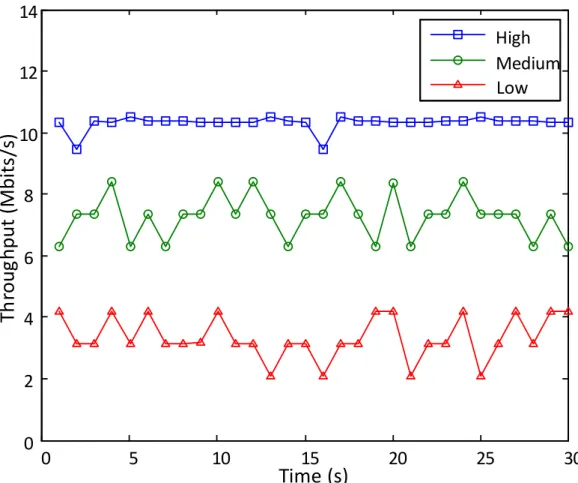
3.7 Network throughput achieved with different levels of RSSI . . . 51
3.8 Layout of the extended testbed . . . 56
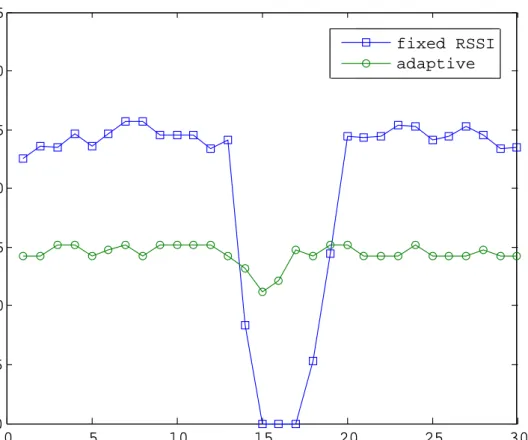
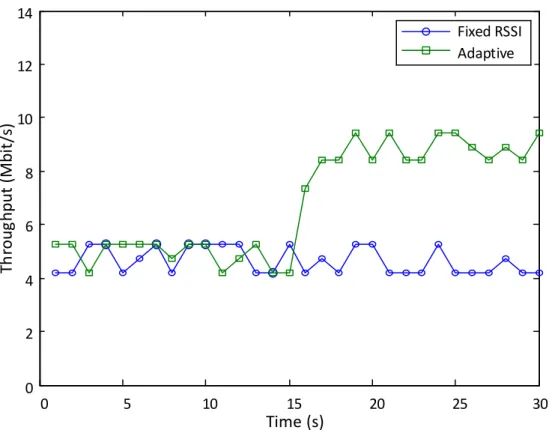
3.9 Network throughput comparison for mobility management experiment sce-nario 1 . . . 58
3.10 Network throughput comparison for mobility management experiment sce-nario 2 . . . 59
3.11 Network throughput comparison for mobility management experiment
sce-nario 3 . . . 60
3.12 Network throughput comparison for mobility management experiment sce-nario 4 . . . 62
3.13 Average packet loss rate comparison with 2 APs . . . 64
3.14 Average packet loss rate comparison with 4 APs . . . 65
3.15 Average network throughput comparison with 2 APs . . . 66
3.16 Average network throughput comparison with 4 APs . . . 67
4.1 The 2.4GHz frequency band Wi-Fi channels overlapping . . . 73
4.2 Architecture of the designed software-defined enterprise WLAN system . . 76
4.3 Format of the custom protocol message FORWARD_AP_CHAN . . . 77
4.4 An example of custom protocol messages that are exchanged during the process of automatic channel switching in the designed software-defined enterprise WLAN system . . . 78
4.5 Average network throughput achieved with different levels of RSSI . . . 80
4.6 Initial channel configurations of experiment APs . . . 85
4.7 The 2.4GHz band channel information of experiment environment . . . 86
4.8 Single user throughput SS vs static method . . . 88
4.9 Average user throughput comparison SS vs RSSI . . . 89
4.10 Average jitter and delay comparison SS vs RSSI . . . 90
4.11 Total user throughput comparison DS vs RSSI . . . 92
4.12 Total jitter and delay comparison DS vs RSSI . . . 94
5.1 An example of forwarding rules and flow table of an OpenFlow switch . . . 98
5.2 An example of the conventional bandwidth control queuing architecture . . 99
5.3 The proposed QoS-aware bandwidth control algorithm is implemented in the SDN application layer . . . 102
5.4 Sequence diagram of protocol messages exchanged with the proposed QoS-aware bandwidth control algorithm . . . 103 5.5 Traffic flow for uplink bandwidth control . . . 104 5.6 Network throughput achieved with the proposed light bandwidth control . . 108 5.7 Packet loss rate achieved without bandwidth control and with the proposed
light bandwidth control . . . 109 5.8 Network throughput achieved without bandwidth control . . . 111 5.9 Network throughput achieved with the proposed heavy bandwidth control . 112 5.10 Packet loss rate achieved without bandwidth control and with the proposed
heavy bandwidth control . . . 113 5.11 Network throughput achieved with the proposed adaptive bandwidth control 114
3.1 Device information and Experiment configuration . . . 57
4.1 List of software and hardware information for experiments . . . 88
Introduction
1.1
Background
Over the past decades, IEEE 802.11-based Wireless Local Area Networks (WLANs) [1] have become the global trend in wireless communication technologies because of their characteristics such as easy deployment, great mobility and high data throughput. WLANs can be deployed in homes, campus, companies and more recently even on aeroplanes, in cars or on trains as wired network extensions to provide Internet access that enables users to roam freely anywhere within the coverage. Because of the random additions of APs, unmanaged WLANs suffers interference and unbalanced traffic, which lead to significant performance degradation. To solve the issue caused by unmanaged WLANs, enterprise WLANs are introduced. Enterprise WLANs are different from typical WLAN infrastructure mode by introducing a special entity called the wireless controller. Fig.1.1 shows an example of the traditional architecture of enterprise WLANs. An enterprise WLAN normally consists of one wireless controller, several LAN switches and multiple APs. The wireless controller runs on the server cannot only control various parameters of the AP such as operating channel and transmission power but also monitor the whole network by collecting wireless medium information and all APs’ status information. Furthermore, centralised network services such
Fig. 1.1 Traditional architecture of an enterprise WLAN
as mobility management, interference management and load balancing can be implemented on the wireless controller to guarantee the network Quality of Service (QoS) and user Quality of Experience (QoE). In order to achieve those control functions and network services, the wireless controller needs information such as Received Signal Strength Indication (RSSI) of APs and clients, traffic load of APs and so on.
Software-Defined Networking (SDN) is an emerging architecture and intensively dis-cussed as one of the most promising technologies to simplify network management and service deployment. The main idea of SDN is to decouple the forwarding of data flow from network control that enables the underlying infrastructure to be highly abstracted for applications and network services. In the traditional network architecture, both control and data plane are managed by network devices, and the vendor-proprietary software that is in-stalled on those devices are extremely hard to be modified. However, with SDN, the network intelligence is logically centralised in the software-based SDN controller to maintain a global
Fig. 1.2 Architecture of SDN
view of the network. As a result, the network appears to the applications and network services as a single, logical switch, which greatly simplifies the network design and operation. Driven by the architecture presented in [2], theOpen Networking Foundation(ONF) proposed the SDN logical architecture [3], which is illustrated in Fig.1.2. In this architecture, an SDN can be divided into an application layer, a control layer and an infrastructure layer. Network devices in the infrastructure layer provide access to the data plane and communicate with the SDN controller, which acts as the control plane for the network. The control plane then ex-poses open Application Programming Interfaces (APIs) to applications and network services that are implemented in the application layer. In recent years, SDN has been implemented into several areas such as Internet research [4], rural connectivity [5], updating data centre networks [6], mobile application offloading [7] and mobile virtual machine [8].
OpenFlow [9] is the first standard communications interface defined between the control and forwarding layers of the SDN architecture. It is a key enabler for SDN and currently is the only standardised SDN protocol that allows direct access to and manipulation of the
forwarding plane of network devices such as switches and routers, both physical and virtual. The OpenFlow protocol is implemented on both sides of the interface between network infrastructure devices and the SDN control software. OpenFlow uses the concept of flows to identify network traffic based on pre-defined match rules that can be statically or dynamically programmed by the SDN control software. Since OpenFlow allows the network to be programmed on a per-flow basis, an OpenFlow-based SDN architecture provides extremely granular control, enabling the network to respond to real-time changes at the application, user, and session levels. Fig.1.3 illustrates the architecture of an OpenFlow switch. An OpenFlow logical switch consists of one or more Flow-Tables, a Group-Table and one or more OpenFlow Channel. Each Flow-Table maintains multiple flow entries, and every flow entry is associated with an action to tell the switch how to process the flow respectively. The Group-Table performs packet lookups and forwarding, and the OpenFlow Channel connects the switch to a remote control process which allows commands and packets to be sent between the controller and switch. By using the OpenFlow protocol, the controller can add, update and delete flow entries in Flow-Tables, both reactively and proactively. Each flow entry consists of three main fields which are match fields, counters and a set of instructions to apply to matching packets. The match fields contain a set of packet headers which specifies the flow while the counters update the statistics such as the number of forwarded and received packets for each flow. Instructions associated with each flow entry either contain simple actions (e.g. forward packets to a given port (or ports), encapsulate and send packets to the controller, drop packets) or modify pipeline processing which allows packets to be transferred to subsequent Flow-Tables for future processing.
1.2
Problem Statement and Motivation
Today's modern enterprise WLANs typically consist of dozens to hundreds of APs providing WLAN services for multiple user devices such as smartphones, laptops and tablet PCs and
Fig. 1.3 Architecture of an OpenFlow Switch
if the traffic load is concentrated to specific APs, clients associated to those APs suffer from significant performance degradation. To avoid issues caused by network congestion, enterprise WLANs always require network services such as mobility management, load balancing, and bandwidth control to run on top of the fundamental management functionality of the individual APs to achieve efficient network traffic control. However, different devices offered by different vendors may not provide the needed functions because of the difference of devices’ firmware. Additionally, with the growing popularity of Bring Your Own Device (BYOD) that is extensively adopted in today's enterprise WLANs, it is more difficult for the network to accommodate an even more diverse set of client device types. Moreover, the complexity of setting up, management and maintenance of current enterprise WLAN is heavily increased due to the explosion of novel technologies such as Network Function Virtualization (NFV) and cloud computing. Thus, the author argues that the traditional static network architecture is ill-suited to orchestrate the requirements of modern enterprise
WLANs and novel network paradigms as well as improved network services, are needed for network operators to address the growing complexity.
In IEEE 802.11 WLANs, the handover function refers to the sequence of messages exchanged by a mobile station and APs which then results in a transfer of state information and physical layer connectivity of this wireless station from one AP to another. The whole handover process can be divided into three steps which are scanning, authentication and re-association. During the initial stage of a handover, the mobile station first scans the wireless channels either passively or actively. In the passive scan mode, the mobile station listens to the beacon frame which is sent out by APs periodically and decides the best target AP to associate with based on the information from the beacon frame. In the active scan mode, the mobile station not only waits for beacon frame but also broadcasts additional probe request frame and receives probe responses from APs. Once the scanning step is finished, the mobile station attempts to authenticate and re-association with the newly selected target AP. The station credentials and other state information will be transferred from the old-AP to the new-AP during these two steps, and after that, the handover process is finished. Also, the 802.11 standard lets clients make AP association decisions locally, and the infrastructure has no control over these decisions. With the trend of fast adaption to implement real-time multimedia services, such as video conferencing over enterprise WLANs, seamless and infrastructure controlled handover of client devices has become one of the crucial criteria to guarantee satisfied QoS and user QoE. To enable efficient control on client handover in current enterprise WLANs, intelligent mobility management service is required. With conventional mobility management algorithm, clients always prefer to connect to the AP with the best signal strength. However, this mechanism can cause unbalanced traffic load among APs as it does not consider the AP load condition during handover.
Load balancing is one of the major challenges in current enterprise WLANs. Traffic load on APs is often unevenly distributed as wireless stations (WS) independently select the AP to
associate with, where APs with a large number of associated users have much heavier traffic load than those with less associated users. The unbalanced traffic distribution can cause issues such as constant packet loss and sub-optimal network throughput, which dramatically degrades network QoS and user QoE. Although AP load balancing problems have been extensively studied for years, existing solutions continue to exhibit inefficiencies. Because without knowing future traffic demands on individual APs, it is very hard to make an optimal assignment or adjustment of WLAN users among a set of APs. Additionally, it can cause link disruption when dynamically migrate users from heavy-duty APs to those with light traffic load. In order to achieve efficient AP load balancing and maintain satisfied QoS and user QoE, seamless user mobility over multiple wireless channels is required. Moreover, not only the AP signal strength but also the AP traffic load need to be considered when making load balancing decisions.
Due to the explosive increase in demand for wireless connectivity, modern enterprise WLANs always deploy multiple APs to provide large signal coverage. APs based on IEEE 802.11 standards can operate on the 2.4GHz and the 5GHz unlicensed industrial, scientific and medical (ISM) band. The 5GHz band offers a large number of non-overlapping channels, but higher frequency bands have a larger propagation loss, which reduces the effective coverage of the signal. In the 2.4GHz band, there are only three non-overlapping channels, which are clearly not enough for dense deployments. When two or more APs operate on the same channel frequency, their associated users will have to contend for the same portion of the spectrum. In case that two users transmit at the same time, their radio signals collide which results in data corruption and packet loss. In order to avoid collisions, 802.11 users perform the Clear Channel Assessment (CCA) to detect if other users are transmitting on the channel before starting its own transmission. If another transmission is detected, it will wait for a random short period after which it would perform another check before attempting to transmit again. With the increasing number of contenders on the same channel, users have
to wait longer to send data. This transmission delay is caused by the so-called co-channel interference. On the other hand, an interfering transmission on a partially-overlapping channel is called adjacent channel interference. Depending on its intensity and on the channel distance, adjacent channel interference can cause data corruption and packet loss as the CCA check may not detect the collision due to channel overlapping. With the number of interfering users increasing, the potential of re-transmission is raised, and it takes longer for users to successfully send or receive a data packet. The outcome of both types of channel interference is the degradation of network performance, such as low network throughput, high packet loss rate and transmission delay, which can significantly affect QoS and user QoE. To minimise the channel interference issue, optimised channel allocation mechanism is critical to modern enterprise WLANs in order to make intelligent network traffic control, especially in the 2.4GHz band. In traditional enterprise WLANs deployment, network administrators manually assign the operating channel for APs based on detailed site surveys. However, with the increasing traffic variability and user mobility, the performance of existing static channel assignment approach is bound to suffer; furthermore, it is insufficient for modern enterprise WLANs as the airtime demand in enterprise WLANs can vary significantly both across APs and across time. To be effective for usage patterns of modern enterprise WLANs, a centralised automatic channel switching approach that adapts to the rapidly changing wireless environment and supports seamless user channel switching is needed.
Bandwidth control in another key service to enable efficient traffic control in enterprise WLANs. In the past few years, the introduction of BYOD attracts significant attention on improving enterprise productivity and efficiency. According to the prediction from Gartner [10], 50% of employers will require employees to supply their own devices for work purposes by 2017. With the fast increasing trend of BYOD in modern enterprise WLANs, bandwidth control becomes a key challenge for network administrators. In general, wireless bandwidth resource should be allocated according to user priorities. For instance, staff and BYOD
users should be assigned with higher priorities than visitors as the data traffic generated by staff and BYOD users are more concerned about the productivity of the company. To manage the bandwidth allocation, network administrators always configure relative policies on APs to distribute a larger amount of bandwidth to users with high priorities. However, users in an enterprise WLAN may roam between the coverage of APs, resulting in changing users'association state. Thus, the conventional bandwidth control solution based on fixed bandwidth allocation policy is inefficient for modern enterprise WLANs. Because network traffic varies with the fast-changing users'association state, it's vital for the bandwidth control algorithm to be adaptive to the AP traffic load in order to perform efficient dynamic bandwidth control on users with different priorities.
Because of the low-cost equipments and ease of setup, WLAN deployments used to be unplanned, which lead to a large number of uncoordinated and interfering deployments. To solve this issue, novel WLAN deployments have emerged, especially in the large enterprise, where network management is performed by centralised network controllers. In order to achieve intelligent network traffic control in modern enterprise WLANs, commercial vendors offer solutions [11] [12] [13] through vendor proprietary software and hardware. However, these solutions do not have open programmable interface and are unable to be achieved with the low-cost commodity AP hardware that is used by provider networks. Recently, SDN has gained increasing popularity as a novel network architecture, which introduces programmability to provide more flexibility in network management. SDN aims to separate control policies from forwarding mechanisms and enable network administrators to easily implement control policies through a set of high-level open APIs. Leveraging SDN to the existing enterprise WLAN architecture, network intelligence can be logically centralised and infrastructure controlled network traffic management can be achieved with the low-cost OpenWrt-based [14] AP hardware. By utilising the high-level open APIs, network services such as mobility management, load balancing, automatic channel switching and bandwidth
control can be simply added on top of the central controller, and by monitoring real-time network traffic load, the performance of these network services can be improved significantly.
1.3
Contributions
This thesis merges SDN into the existing architecture of enterprise WLANs, and investigates how to improve network traffic control from a client-side and an AP-side perspective. More-over, five novel algorithms for WLAN-specific network services are proposed to achieve efficient traffic control in software-defined enterprise WLANs. A brief description of each contribution is listed below.
Adaptive Mobility Management and Load Balancing
Mobility management and load balancing are two key network services to achieve efficient traffic control in enterprise WLANs. As the first contribution of this thesis, the author proposes two novel adaptive algorithms and implements both algorithms on an existing software-defined enterprise WLAN framework to improve the performance of client mobility management and AP load balancing respectively. AP load is defined as a novel metric together with the RSSI to enable the proposed adaptive algorithms, and a custom protocol message called Forward_AP_Load is introduced to enable the central controller to have the knowledge of each AP's load information. Channel Switch Announcement (CSA) is added to custom beacon frame to achieve seamless client over multiple wireless channels. The results have been published in paper 1 and 2.
Load-Aware Automatic Channel Switching
Channel interference is one of the major problems that can significantly affect the network performance. To mitigate the influence of channel interference, intelligent channel selection mechanism is required in modern enterprise WLANs. As the second contribution of this
thesis, the author presents a software-defined enterprise WLAN system and a load-aware automatic channel switching solution. Two channel switching algorithms are proposed to improve the overall user QoE and the QoE of users with highest traffic load respectively. AP load which is defined in Chapter 3 is used together with a novel metric called Channel Interference Factor (CIF) to enable the proposed algorithms. In order to make the central controller aware of the channel information of each AP, a new custom protocol message called Forward-AP-Chan is defined. Beacon frame with CSA is used to achieve seamless channel switching. The system and the results have been published in paper 3.
QoS-Aware Bandwidth Control
With the growing trend of BYOD, bandwidth control becomes an indispensable network service in enterprise WLANs that enable AP-based traffic control on clients with different priorities. As the final contribution of this thesis, the author proposes a QoS-aware bandwidth control algorithm and implements it on the software-defined enterprise WLAN system which is presented in Chapter 4. The proposed algorithm utilises AP load that is defined in Chapter 3 as the bandwidth control metric to achieve adaptive uplink bandwidth control on users with different priorities. Virtual OpenFlow switch Open vSwitch [15] is used to achieve queue-based traffic shaping, and OpenFlow protocol is used to direct user traffic flows. The main contents have been submitted for publication as paper 4.
1.4
Structure of Thesis
The rest of this thesis is organised as follows. Chapter 2 presents comprehensive and critical literature reviews of software-defined enterprise WLAN systems and traffic control services which include mobility management, load balancing, automatic channel selection and bandwidth control. The literature review chapter is followed by Chapter 3, where two adaptive algorithms are proposed and implemented on an existing software-defined enterprise
WLAN framework to improve the performance of client mobility management and AP load balancing respectively. Chapter 4 introduces a software-defined enterprise WLAN system and a load-aware automatic channel switching solution. Two channel switching algorithms are proposed to improve the overall user QoE and the QoE of users with highest traffic load respectively. Chapter 5 further extends the system that is presented in Chapter 4 by proposing and implementing a QoS-aware bandwidth control algorithm to achieve dynamic bandwidth control on users with different priorities. Finally, Chapter 6 concludes the thesis with a summary and an outlook to future work.
Literature Review
2.1
Introduction
SDN is a new paradigm for the programmable network, and it has demonstrated to be an important technology driver for flexible service development. Recent advances in SDN and OpenFlow has led the trend of reformation of wired networks with flexible programmatic control mechanisms. Enabling SDN for enterprise WLAN presents a promising perspective towards more manageable, agile enterprise WLAN deployments that network services can be easily implemented. This chapter provides an insight into this exciting new area starting with the introduction of the existing software-defined enterprise WLAN frameworks. Then moving into a technical review of the network services (i.e., Mobility Management, Load Balancing, Automatic Channel Switching and Bandwidth Control) that are used for traffic control in enterprise WLANs. Finally, the related state-of-the-art network services in software-defined enterprise WLANs are introduced by highlighting their key technical features as well as their drawbacks.
2.2
Software-Defined Enterprise WLANs
In recent years, several research works have been focused on investigating the possibility of implementing SDN into enterprise WLANs. For instance, the authors in [16] [17] have presented a system called FlowVisor which uses OpenFlow as a means to enable wireless network virtualisation. FlowVisor is built on OpenFlow as an abstraction of the underlying hardware, and it switches virtualisation in which the same hardware forwarding plane can be shared among multiple logical networks, each with distinct forwarding logic. The authors clarify that FlowVisor runs on existing or new low-cost hardware, is backwardly compatible with the current legacy network and might be used to virtualise networks in data centres, enterprises, homes, Wide Area Networks (WANs) and so on.
OpenRoads [18] [19] is the first work that implements OpenFlow into mobile wireless networks. The OpenRoads'architecture consists of three layers: flow, slicing and controller. These layers provide flexible control, virtualisation and high-level abstraction which make OpenRoads an open platform to implement wildly different algorithms and run them con-currently in one network. OpenRoads also incorporates multiple wireless technologies, specifically Wi-Fi and Worldwide Interoperability for Microwave Access (WiMAX). Also, FlowVisor [16] [17] is used to create and isolate network slices which enable multiple experiments to run simultaneously in production wireless network, and Simple Network Management Protocol (SNMP) demultiplexer is implemented to mediate device configuration access among experiments.
In [20] [21], the authors present CloudMAC, an OpenFlow-based novel architecture for enterprise WLANs where the MAC layer processing is partially offloaded to virtual machines provided by cloud services. With CloudMAC, APs only perform MAC frames forwarding between virtual APs and mobile stations. All the processing of MAC layer frames and the generation of management frame is done by virtual APs while the binding between the virtual APs and the physical APs is managed using OpenFlow. With the integration of
OpenFlow, CloudMAC achieves similar performance as normal WLANs but a higher level of flexibility and programmability which allows novel services to be easily implemented with high-level programming languages. Moreover, the authors present a case study which shows that dynamically switching off APs to save energy can be performed seamlessly with CloudMAC, while a traditional WLAN architecture causes large interruptions for users.
Kimet al. [22] proposes the OpenFlow AP system that is a software-defined enterprise WLAN system based on the OpenFlow-based AP and the OpenFlow controller. By extending the OpenFlow protocol to apply to WLAN control, it applies the SDN framework to Enterprise WLAN and achieves seamless mobility and total network throughput improvement. However, it uses expected data rate based on the RSSI of the client to select the best handover target which cannot be trusted completely as the channel interference can be quite large when in a noisy environment. Also, it handover low data rate client to most crowded AP to alleviate the performance anomaly effect which sacrifices the user experience of low data rate clients.
The authors in [23] [24] present a scalable software-defined wireless network called AeroFlux. AeroFlux uses a 2-tiered control plane: the Global Control (GC) plane and the Near-Sighted Control (NSC) plane. The GC is logically centralised to handle network functions that require global visibility, such as mobility management and load balancing, whereas the NSCs are located close to the wireless APs to control per-client or per-flow transmission settings such as power and rate. By offloading latency-critical or high-load tasks from the GC to the NSCs, AeroFlux supports large enterprise and carrier Wi-Fi deployments with low latency programmatic control of fine-grained Wi-Fi specific transmission settings. Moreover, AeroFlux inherits LVAP abstraction from Odin to enable infrastructure controlled user handovers and application-aware service differentiation.
Zhaoet al. [25] [26] proposes a flexible architecture of enterprise WLAN called SD-WLAN which introduce two salient features. First, most of 802.11 AP functions are decou-pled from forwarding devices and centralised in an SDN controller, leaving some simplified
devices (i.e., wireless AP) manipulated by the controller through extended OpenFlow proto-col. Second, the control of APs and wired backbone are consolidated to provide a unified network control platform. By reorganising 802.11 AP's functional modules, SDWLAN can achieve remarkable flexibility. Moreover, SDWLAN requires no client-side modification and supports a client-unaware fast AP handoff mechanism which achieves negligible throughput fluctuation of on-going connection compared to traditional architecture with 802.11 standard handoff mechanism.
Odin [27–30] is a novel OpenFlow-based SDN framework for enterprise WLANs. Based on the architecture of SDN, the system separates the control plane from the data plane by having a logically centralised SDN controller, which uses OpenFlow and a custom control plane protocol to manage the wired and wireless networks respectively. Odin provides a virtual AP association for each mobile client by introducing a novel programming abstraction called Light Virtual Access Points (LVAP). Every time a client performs a probe scan, the central controller assigns an LVAP on the physical AP that first receive the probe request. The assigned LVAP is what responds to the client's probe scan with a probe response. After receiving the probe response, the client can then continue the regular 802.11 association handshake with the LVAP. Once the handshake is finished, the association between a client device capable of mobility, and an LVAP is formed. At this point, the client is only concerned with getting acknowledgements (ACKs) for the data frames it generates and receiving beacons from its LVAP in a fixed time interval. With LVAP abstraction, clients no longer need to re-associate with AP during a handoff process as the LVAP can be migrated between physical APs and the migration is fast enough such that it retains all the association state of the client, who continues to receive ACKs and beacon frames, and transmit data frames without noticing any period of disconnectivity. This method works because the client only cares about the responses it gets from an AP which is identified by a Basic Service Set Identifier (BSSID) and is oblivious to the actual physical radio that is generating these responses. Therefore,
LVAP abstraction decouples the association state of a Wi-Fi link from the physical APs in the network and makes clients see the same consistent virtual AP regardless of the actual physical AP the client is connected.
Riggioet al.propose EmPOWER [31–34], a set of high-level programming abstractions modelling the fundamental aspects of a wireless network, namely state management, resource provisioning, network monitoring, and network reconfiguration. The proposed abstractions hide away the implementation details of the underlying wireless technology which enable a flexible management of the network. Moreover, a Software-Defined Radio Access Network (SDRAN) controller for Enterprise WLANs and a Python-based Software Development Kit (SDK) implementing the proposed abstractions are presented. The authors further clarify that the platform can be effectively leveraged in order to implement typical control tasks such as mobility management and traffic engineering as well as applications and services such as multicast video delivery and dynamic content caching.
By building upon Odin [27–30] and AeroFlux [23], the authors in [35–38] introduces OpenSDWN, an SDN and Network Functions Virtualisation (NFV) based novel Wi-Fi framework. OpenSDWN exploits virtualisaton across the wired and wireless network and introduces datapath programmability to enable service differentiation and fine-grained trans-mission control, facilitating the prioritisation of critical applications. OpenSDWN imple-ments per-client virtual access points and per-client virtual middleboxes, to render network functions more flexible and support mobility and seamless migration. Moreover, OpenSDWN increases the security of upcoming Wi-Fi HotSpot architectures by following a functional split approach. Finally, the authors clarify that OpenSDWN can also be used to out-source the control over the home network to a participatory interface or an Internet Service Provider (ISP).
The authors in [39] propose ISD-WiFi (Intelligent Software-Defined WiFi), a pro-grammable networking architecture for enterprise WLANs. In ISD-WiFi, an intelligent
centre is introduced to enable information sharing between SDN controllers and is responsi-ble for learning about the station's traffic pattern and making predictions. Because user traffic often shows periodicity for regular movement, user traffic pattern can be learned by using historical traffic statistics. By adding new reason type for Packet-in message and new actions for Packet-out message in the extensions of OpenFlow, SDN controllers in ISD-WiFi could periodically request APs for interference and traffic statistics information, which is sent to intelligent centre for storage and further analysis. Based on intelligent SDN, ISD-WiFi could offer programmability and flexible network applications such as access control, mobility management and interference management for enterprise WLANs.
In [40], the authors propose a new SDN-based architecture named Light-weighted Edge Network Virtualization (LENV) to provide a scalable and agile management for enterprise WLANs. Based on the concept of SDN, LENV virtualises edge network functions towards a centralised logical module called Virtual Wireless Access Device (VWAD), which hosts in the wireless AP. Each VWAD corresponds to an associated client and can be seen like a virtual AP to guide the physical entity to provide network functions based on client's requirement. With the help of VWADs, the authors develop two network management services which are access control and mobility management. The proposed access control scheme achieves a feasible joint design between the authentication process and access authority management according to clients'identifies. While for mobility management, the authors consider not only the specific mobility handover scheme but also the handover policies based on reversed signal strength measurement.
The authors in [41] develop a software-defined networking architecture for 802.11 dense WLANs called Ethanol. The Ethanol architecture is composed of two types of devices which are the POX-based SDN controller [42] and Ethanol-enabled APs. The Ethanol-enabled AP consists two parts that are wired and wireless components. The wired component is a configurable switching element that supports the OpenFlow protocol. Because OpenFlow
does not provide a control interface for QoS and wireless components, custom APIs are added to the AP by Ethanol agent which is running on top of the AP for controlling wireless links and for defining the QoS of wired flows. Ethanol agent receives custom messages from the Ethanol Controller via a secure channel. With Ethanol-enabled AP which is programmable, the Ethanol architecture refactors the control plane functionalities between the APs and the controller. The centralised controller actuates on APs, controlling features such as QoS support, user mobility and association control, link-level parameters and virtual APs by using custom APIs. The authors demonstrate the feasibility by implementing the proposed architecture on OpenWrt-based commodity APs. Three use cases involving quality of service, the control of client association, and Address Resolution Protocol (ARP) packet suppression are studied, and experiment results show that Ethanol-enabled APs can significantly enhance network performance.
In [43], the authors propose SWAN (Software defined Wireless Access Network), an open campus WLAN framework based on SDN. SWAN uses a logically centralised controller to control APs in the campus WLAN. The controller has a global view of the network and defines programmable interfaces to configure and manage the whole network by programming network applications. Each AP in the system runs an agent, and the agent uses a special protocol called SWAN protocol to communicate with controller. In addition, SWAN uses software access point (SAP) to abstract the connection between the user equipment (UE) and the AP. Each physical AP can hold multiple SAPs, which virtualise association and authentication state and separate them from physical APs. From the point of network operators'view, multiple UEs connected to a single physical AP are treated as a set of logically isolated UEs connected to different ports of a switch. The authors clarify that with the user association abstraction, network applications such as access control, seamless handover and load balancing could be realised in SWAN. However, no physical testbed and
experiment results are presented to evaluate the performance of the proposed framework, which raises a question regarding its feasibility.
2.3
Traffic Control in Enterprise WLANs
According to research work [44], the applications used on the WLAN changed dramatically. Initial WLAN usage was dominated by Web traffic. However, with the growing number of smartphones and fast increasing network bandwidth, there are significant increases in peer-to-peer, streaming multimedia, and voice over IP (VoIP) traffic. On-campus traffic now exceeds off-campus traffic, a reversal of the situation at the WLAN's initial deployment. In order to guarantee satisfied QoS and user QoE, modern enterprise WLANs always use specific network services such as mobility management, load balancing, automatic channel switching and bandwidth control to achieve traffic control. In the past decades, many research works have been conducted to improve the performance of these network services. However, the existing solutions continue to exhibit inefficiencies. With the growing popularity of SDN, software-defined enterprise WLANs provide a promising solution for achieving intelligent traffic control.
2.3.1
Mobility Management
In current enterprise WLANs, mobility management service has a great influence on user-perceived QoS due to the service disruption during a handover process. Each of the handover phases incurs different extent of delays. The longest delay is believed to occur during scanning phase based on research work in [45]. Thus, most previous research work has been focused on reducing the scanning delay. In SyncScan [46], authors proposed using implicit time synchronisation to reduce the key cost of scanning new target APs. By synchronising the announcement of beacon frames, clients can arrange to listen to other wireless channels
with very low overhead. As a result, the system is able to perform a fast handover in 5ms. However, driver modification to the client network adapter is required to achieve the proposed system. The authors in [47] reduced the probe delay by using a selective scanning algorithm combined with a caching mechanism. With the proposed selective scanning algorithm, the station only scans the orthogonal channels of station's current channel. However, it may still need to perform a full scan depends on the wireless channel setting of neighbour APs.
In FastScan [48], a client-based database which stores information about the neighbour best APs and their corresponding channel settings is used to reduce the scanning delay. However, the database needs to be updated to maintain the correct information which led to additional scanning time. In [49], each AP is equipped with dual wireless network interface cards (NICs) to reduce handoff delay. One interface is used to perform typical AP functions, and the other one is dedicated to handover assistance. With the additional interface and help of the central controller, the mobile station can maintain the association with the current connected AP during the scanning process which guarantees the QoS for WLAN services. However, it requires the central controller to maintain and update a neighbour information table and the states of the second interface of neighbour APs need to be checked by the controller before a handover can be processed. This process could introduce additional delay when the number of neighbour APs increased and as a result, the handover delay could increase.
The necessity for infrastructucontrolled handovers is not only motivated by the re-quirement for seamless user mobility but also has the potential for being used to balance the network traffic load. Many of these existing research works achieve these handover mech-anisms by installing some specialised software on the client side which the infrastructure can use to control client associations [50–52]. The 802.11r amendment [53] specifies “fast basic service set (BSS) transition”, wherein a client that is to handover between two APs can perform a re-association faster. It is done by pre-caching intermediary results of the
key negotiation process between the original AP where the client first authenticated, and the authentication server at different parts of the wireless network. The IEEE 802.11k standard [54] enables better management of WLANs by introducing a signalling technique into the protocol for APs to assist wireless clients in selecting the target AP for re-association, as opposed to having clients blindly choose the new AP to handover based on the signal strength, which can potentially lead to traffic overload of APs. The authors in [55] investigate a simple, proactive roaming method using the IEEE 802.11k standard to collect information about the wireless environment prior to roaming. Actual handover is then based on an assessment of the signal strength.
Handover based on signal strength is a common strategy and is easy to be implemented. In [56], the authors study how interference among both APs and STAs affects throughput and propose a decentralised AP selection scheme that avoids interference. In addition, the authors implemented the proposed architecture on actual devices and added a function for avoiding interference. The authors in [57] propose a handover management scheme adaptable to multi-rate WLANs to enhance the practicality of handover scheme in a realistic environment where WLAN supports multiple data rates and automatically changes the rate in response to wireless link condition. The proposed scheme exploits two sorts of information to recognise the wireless condition appropriately that are data rate used most frequently (DRMF) by each interface and frame re-transmission ratio (FRR) on each interface for some duration. The former of two criteria first enables the estimation of the area where the handover should start, and if DRMFs of two interfaces are same in the area, the latter then achieves a precise comparison of wireless condition on two interfaces, thereby giving an optimal handover point. However, both schemes need client-side modification which is not suitable for real-world implementation.
The authors in [58] proposes an adaptive network selection scheme, called as DMMT (Dynamic Match of Mobility Threshold) scheme. By considering the distribution of the whole
users'movement character and arrival rate, the Mobility Threshold (MT) can be achieved from the solution of optimisation problem, which minimise the global network blocking probability. By using the MT, mobile users can be differentiated to access different network. To obtain the parameters in the optimisation problem, the authors use the prediction of arrival and mobility characteristics. The heterogeneous networks adjust the MT to adapt to the variation of environment. Based on the simulation results, it shows that the proposed DMMT scheme reduced call blocking and handoff probabilities compared to the referenced schemes.
Rousseauet al. in [59] introduce the concept of the virtual access point (VAP) to manage client mobility in infrastructure networks. With the proposed VAP scheme, every client is connected to its own VAP, and when they need to handover between physical APs, the VAPs are migrated along with them to enable seamless client mobility on the same wireless channel. The authors use a packet manipulation framework calledPacMapto implement the VAP, which is compatible with existing clients without any hardware nor software modification. Based on the concept of VAP, Rousseau et al. further propose a mobility management solution called Multichannel Virtual APs (mVAP) in [60]. mVAP uses custom Inter-AP messages that contain CSA elements to achieve seamless client handovers in networks with APs operating on multiple channels. However, mVAP require each AP to have a list of its neighbour APs to send relevant Inter-AP messages for user handover, which adds extra effort to deploy the solution. Moreover, it does not consider AP traffic load when making handover decisions.
In recent years, SDN has gained increasing popularity as a novel network architecture. Some research works have been focusing on utilising SDN to improve the performance of mobility management in enterprise WLANs. The authors in [61] present an integrated energy and mobility management solution, which combines Energino [62] with Odin [27] for enterprise WLANs. With the proposed solution, clients joining the network are handed over by the Mobility Manager to the AP that provides the best performance in terms of
Signal–to–noise ratio (SNR). In [63], the authors merge the work of [60] into [37] to develop a WLAN centralised mobility management solution which is able to provide seamless handovers between APs in different channels and meeting the QoS requirements of real-time services. The proposed solution uses a low-frequency rate when the client remains in the same AP and a high-frequency beacon rate to obtain a fast and seamless handoff. However, it does not consider AP traffic load when making handover decisions which can cause unbalanced traffic load on APs.
The authors in [64] propose an RSSI-based fast handoff scheme for SDN based WLAN system. With the proposed solution, clients start to perform a fast pre-scan process when RSSI falls below the Scan Threshold (ST), and when RSSI falls below the Handoff Threshold (HT), clients execute handoff process. By utilising SDN controller, clients can obtain the best alternative AP after the fast pre-scan process. When handoff process is triggered, clients can perform the authentication and re-association process toward the alternative AP directly that reduces the handoff delay. In addition, the authors adopt Kalman filter to minimise the fluctuation of RSSI, which may lead to unnecessary pre-scan process and serious ping-pong effect. However, this solution only uses RSSI as the handoff metric which is inefficient in enterprise WLANs. In [65], the authors propose a seamless, client-unaware handover mechanism on a software-defined enterprise WLAN framework which is based on the Split-MAC design of CAPWAP [66]. The proposed solution requires APs to report the RSSI value of the user, and if the value at the current AP is less than a threshold value and is also less than the RSSI value at any other AP, the controller will initiate the handover process. However, the solution does not take AP traffic load into consideration for handover decision and is only evaluated by simulations which makes its practicability questionable.
In [67], the authors achieve lossless handover between WLAN and WiMAX nodes on the OpenRoads platform [18] [19] by redirecting the flows dynamically through the network. It shows that OpenRoads has the capability to provide very efficient mobility control and
the OpenRoads deployment can be used to support mobility management in OpenFlow Networks. However, OpenRoads does not involve multi-hop wireless communications and integration with existing routing protocols. The authors in [68] propose an intelligent mobility enhancement control and then develop an algorithm to decide which neighbour switches need to be selected for the installation of new flow entries and to allocate the appropriate idle-timeout for the selected switches. The proposed approach provides a simple solution to solve the user mobility problem in wireless OpenFlow environments which can handle the fast migration of user addresses (e.g. IP addresses) between several wireless access points and base stations which leads to improvement in the end users'experience. However, the algorithm is not implemented, and no experiment is run to test the performance of the purposed algorithm.
Benefiting from the extended OpenFlow protocol and the unified control platform, authors [26] proposed the abstraction of “One Big AP” illusion with a client-unaware fast AP handover mechanism in SDWLAN. Simulation results demonstrated that AP handover operation in SDWLAN leads to negligible throughput fluctuation of on-going connection compared to traditional architecture with 802.11 standard handover mechanism. However, the results are based on simulations which make the practicability of this architecture and the handover application on actual physical devices questionable. In [69], the authors introduced a load-aware handoff algorithm for SDN-based WLAN, which considers traffic load of APs in addition to received signal strength at wireless clients to address load imbalance issues among APs and achieve seamless mobility for wireless users. By using the signal strength and traffic load threshold, the proposed algorithm improves the mobile users'throughput as well as static clients compared to legacy handoff algorithms used in WLANs. However, the proposed algorithm uses fixed hysteresis margin of Traffic Intensity, which is not efficient under the certain channel load conditions. Our work uses dynamic hysteresis margin of
AP load and the RSSI value to achieve efficient mobility management in software-defined enterprise WLANs.
Delyet al. in [70] proposed an SDN-based WLANs framework for handoff management with real-time video streaming. The system allows clients to associate with multiple APs simultaneously and to perform fast handovers between them, which improves the quality of real-time video streaming over WLANs significantly. Moreover, Delyet al.introduce a new mechanism for selecting the best AP based on a novel available bandwidth estimation scheme. The available bandwidth provided by an AP depends mainly on the signal quality and the load on the wireless channel. Based on measurements, the authors first analyse how those factors vary stochastically over time and motivate why a frequent estimation of available bandwidth is necessary. The authors then develop BEST-AP [71], a system for bandwidth estimation of APs, which uses regular data traffic to estimate the available bandwidth from all APs in reach in a non-intrusive way, even if they are on a different channel. Based on OpenFlow, BEST-AP allows the station to be associated with multiple APs simultaneously and to switch between APs with low overhead. By using the available bandwidth estimates, the system exploits the best AP for a longer duration while probing the less good APs for a shorter duration to update the bandwidth estimations.
The authors in [27] [28] propose a simple mobility manager for software-defined enter-prise WLANs. The proposed mobility manager utilise LVAP migration to achieve seamless user mobility. However, it can only perform seamless handovers when APs are operated on the same wireless channel. In addition, it only uses fixed hysteresis margin of signal strength to make handover decisions, which is inefficient as APs with the best signal strength may not guarantee the satisfied QoS and user QoE. Our solution supports seamless handover over multiple wireless channels and uses dynamic hysteresis margin of AP load and signal strength to achieve efficient mobility management in software-defined enterprise WLANs.
2.3.2
Load Balancing
Load balancing is an important service in modern enterprise WLANs as, without load balancing, wireless users scan all available APs and independently selects the AP with the best signal strength to associate with by default, without considering the traffic load condition of the AP. This mechanism often causes unbalanced traffic load on APs, leading to issues such as high packet loss rate and low network throughput which can significantly degrade QoS and user QoE. Over the past decade, several solutions have been developed by researchers to solve the unbalanced traffic load problem. To force a client to re-associate to another AP, the authors in [72] present a new load balancing technique by controlling the size of WLAN cells (i.e., AP's coverage range), which is conceptually similar to cell breathing in cellular networks. The proposed scheme does not require any modification to the users neither the IEEE 802.11 standard. It only requires the ability of dynamically changing the transmission power of the AP beacon messages. The authors develop a set of polynomial time algorithms that find the optimal beacon power settings which minimise the load of the most congested AP. However, cell breathing would affect the signal-to-noise (SNR) ratio of all the stations that remain associated with the AP that has just decreased its transmission power and does not solve the handover delay issue for the client. There are also standardisation efforts that are relevant in the direction of re-association based load balancing. The 802.11k amendment [54] deals specifically with load balancing in WLANs. It requires changes in the client devices as well. The amendment defines a mechanism by which APs can provide the client with information such that the latter can make better association decisions.
In [73], authors proposed a new AP selection strategy for high-density IEEE 802.11 WLANs. Instead of using the received signal strength, the new strategy calculates the effective throughput for each neighbouring AP and use the result as a basis for the AP selection. The selection strategy solves the relevant problem of which AP can be selected and associated with a station so that efficient resource utilisation can be obtained. The authors in [74] focus on the
presentation of a QoS management solution for wireless communication systems. It mainly defends that a balanced distribution of mobile stations among the available access points leads to better performances of the Wireless LAN. With the proposed approach, better resources allocation and efficiency on QoS metrics are achieved. Moreover, a protocol structure between mobiles and APs is also specified for the implementation of this approach. In [75] [76], the authors present an efficient solution to determine the user-AP associations for max-min fair bandwidth allocation. With proposed algorithms, the authors first compute a fractional association solution, in which users can be associated with multiple APs simultaneously. This solution guarantees the fairest bandwidth allocation in terms of max-min fairness. Then, by utilising a rounding method, the authors obtain the integral solution from the fractional solution. In addition, the authors also consider time fairness and present a polynomial-time algorithm for an optimal integral solution.
The authors in [77] propose a load-balancing scheme for overlapping wireless LAN cells. With the proposed solution, agents on each AP periodically broadcast the local load level via the Ethernet backbone and determine whether the access point is overloaded, balanced or under-loaded by comparing it with the received reports. The load metric is the network throughput. Overloaded access points force the handover of some stations to balance the load. Only the under-loaded access points accept the roaming stations in minimising the number of handovers. In [78], authors propose a load balancing procedure, which acts on two separate levels. First, the AP is either distributed across the channels (if the number of AP is small) or located in the same channel that is specified by taking into account the channel-location and the received RSSI of the neighbour AP. Second, the wireless station (WS) are distributed across all the available AP based not only on RSSI measurements but also on the number of WS already associated with the AP and other link quality measurements. With proposed algorithm, the network performance is improved.
Unlike the most load balancing solutions in WLANs that focuses on the optimisation of AP operations, Xueet al.in [79] propose a user sociality-aware AP selection scheme to tackle the load balancing problem in enterprise WLANs. Through the analysis of AP usage based on a real WLAN trace, the authors found that users'social activities would disruptively affect the load balance among APs in enterprise environments. By taking into account the social relationships of users, the proposed scheme assigns users with intense social relationships to different APs so that jointly departure of those users would have a minor impact on the load balance of APs. In addition, the authors clarify that the problem of allocating an AP for each user so that the average of the sums of social relation intensity between any pair of users in each AP is NP-complete and propose an online greedy algorithm to tackle the problem. Extensive trace-driven simulations show that the proposed method can achieve about 64.7 percent balancing performance gain on average compared to the traditional AP selection algorithms. In [80], Xueet al. further study the social behaviour of users through analysis of intensive WLANs data traces and find out that users with similar application usage have the potential to leave together. Inspired by those observations, the authors propose a user-friendly AP load balancing scheme for enterprise WLANs. The proposed solution characterises the sociality of users by grouping users with similar application usage profiles and elegantly assign users to different APs based on their history sociality information and application profiles. Moreover, the authors clarify that the proposed scheme does not migrate users from one AP to another and is very resilient to network churns as it can resist sudden traffic demand changes caused by users'co-leaving behaviour. The authors in [81] further extend the work and present an online heuristic algorithm, which can actively learn users'sociality information and assign users with certain social relations to different APs so that users in one AP are more likely to leave at the different time.
With the growing popularity of SDN, researchers have been studied the emergence of SDN in enterprise WLANs which provides a promising solution for improving the performance of
load balancing service. In [28], the authors implemented a load balancing application on the Odin [27] framework. The proposed application queries the system once per minute to obtain the list of clients that can be seen by different APs and their corresponding RSSI values. It uses this information to build a map of clients to lists of agents that are candidates for hosting their respective virtual APs. The application then evenly re-distributes virtual APs (clients) across physical APs with round robin algorithm. However, it does not consider the traffic load condition of each AP which can cause unnecessary migration of clients. Moreover, it does not support seamless handover over multiple wireless channels which can disrupt user association during the process of reassigning users to new APs.
The authors in [82] propose a novel load balancing mechanism for WLAN, which is implemented on a client-network collaborative architecture based on SDN and 802.11u [83]. In the presented collaborative architecture, SDN applications monitor load and traffic of each infrastructure. Network Resource Query Protocol (NRQP), based on Generic Advertisement Service (GAS) of 802.11u, enables clients and networks to exchange information of AP selection. The network will calculate the load of APs by the channel utilisation and clients'link speed, and the AP with the lowest load is selected by the load-aware load balancing algorithm as the handover target. However, this solution does not support seamless handover when making the association adjustment. As a result, user experience can be affected significantly because of the service disruption and re-association delay.
In [84], the authors propose an SDN-based adaptive load balancing scheme for Wi-Fi APs through association control. With the help of SDN, the proposed method uses the SDN controller to collect the load of APs and user connection situations. In the case that the load of APs is detected as imbalanced, the SDN controller adaptively configures the beacon power of relevant APs by sending the Beacon-Config messages. Based on the power adjustment, some users are forced to change association from low-power APs to high-power APs. However,
the proposed solution is evaluated through simulations which raise questions of its feasibility and practicability.
The authors in [85] introduce Wi-Balance, an SDN-based load balancing mechanism for enterprise WLANs. Wi-Balance is implemented as a network application on the open source 5G–EmPOWER platform [86]. The proposed application gathers the information related to the ongoing transmissions and the channel status of the clients in the network by using the Minstrel rate control algorithm [87] which is presently available in the Linux kernel. By analysing the collected information, the proposed application first estimates the number of concurrent transmissions in the same AP. In this case, it evaluates if the handover of a client connected to one of these affected APs to another available one may isolate the flows and improve the performance. To prevent the flows sharing the same collision domain, the proposed application performs a channel switch of the involved APs after the reassignment of users. However, no experiment is conducted to evaluate the performance of the proposed solution.
In [88], the authors propose an SDN-based AP selection scheme called TPR (Throughput, Packet_drop and RSSI based AP selection) for IEEE 802.11 network. TPR uses the through-put, packet loss rate and RSSI as the metrics for AP selection. All measured metrics are sent to the SDN controller to make centralised load balancing, and the AP with highest packet loss rate will be adjusted first to migrate loads. Moreover, the proposed method endeavours to first migrate the high-throughput client to other AP as it makes more contributions to the network load. However, the proposed method does not support seamless handover over multiple channels which can cause service disruption during the migration of clients.
2.3.3
Automatic Channel Switching
With the increasing deployment of APs, channel interference in the 2.4GHz frequency band remains a key issue in modern enterprise WLANs. In order to minimise the interference
problem and guarantee satisfied QoS and user QoE, optimised channel allocation mechanism is required in enterprise networks. Previous research works have proposed several channel switching schemes. For instance, the authors in [89] mentioned one approach called least congested channel switch. With this approach, each AP scans beacon frames that are sent by neighbouring APs to get the number of APs and the total number of clients associated with each AP. It then switches to the channel with least number of clients. However, the channel with least number of clients may not always be the least congested channel as the channel utilisation must be considered as well. In [90], the authors propose an approach of optimising AP placement and channel assignment in WLAN by formulating an optimal integer linear programming (ILP) problem. The optimisation objective is to minimise the maximum of channel utilisation, which qualitatively represents congestion at the hot spot in WLAN service areas.
The authors in [91] propose two fully distributed algorithms that allow multiple interfering 802.11 APs to select their operating frequency to minimize interference, and user devices to choose the AP they attach to, in order to get their fair share of the whole network bandwidth. The proposed algorithms rely on Gibbs sampler and do not require explicit coordination among the wireless devices. They only require the participating wireless nodes to measure local quantities such as interference and transmission delay. In [92], the authors argue that network throughput alone, as obtained by simulations or direct measurement, is not an adequate measure for evaluating a frequency plan, so that any direct optimisation of network throughput would indeed not be advisable as it is especially inadequate for fairness. In addition, the authors propose an efficient frequency planning algorithm to mitigate unfairness service to users based on a novel framework which models the load of WLAN cells considering inter-cell interference.
Yuet al.in [93] propose a new framework for radio channel allocation (RCA) strategy for WLAN APs with power control capabilities. The authors formulate the RCA as a min-max
optimisation problem regarding channel utilisation with constraints of data rate, channel quality, and transmission power. The authors also derive an expression to evaluate the channel utilisation, which incorporates the condition of wireless channels, such as SNR ratio and transmission power, in addition to the transmitting probability of a station. Moreover, a new RCA algorithm that considers both link adaptation and power control mechanisms, in addition to the impact of co-channel interference (CCI) and multiple data rates is proposed. Based on the same framework, Yuet al. in [94] further propose a new algorithm to dynamically estimate the number of active stations by using the least square estimator (LSE), which is unbiased and has minimum variance. The authors also derive an expression to evaluate the impact of the co-channel stations of an AP on the channel utilisation of the AP based on the number of equivalent co-channel stations, which is the difference between the numbers of stations that are sensed by and associated with the AP. Finally, the authors develop a new distributed RCA (DRCA) that considers the changing number of active stations, the impact of co-channel interference (CCI), and different traffic demands for different APs.
Mishraet al.[95] propose an efficient client-based approach for channel management (channel assignment and load balancing) in 802.11-based WLANs that lead to better usage of the wireless spectrum. The proposed approach is based on a “conflict set colouring” formulation that jointly performs load balancing along with channel assignment. The proposed formulation explicitly captures interference effects on clients and intr