Human-Robot Interaction using
a Behavioural Control Strategy
by
Paramin Neranon
Thesis submitted in fulfilment of the requirements for the Degree of Doctor of Philosophy Department of Mechanical and Systems Engineering
Newcastle University United Kingdom
i
ABSTRACT
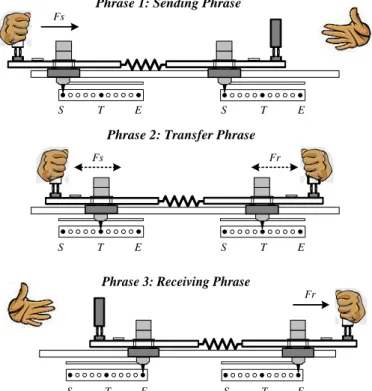
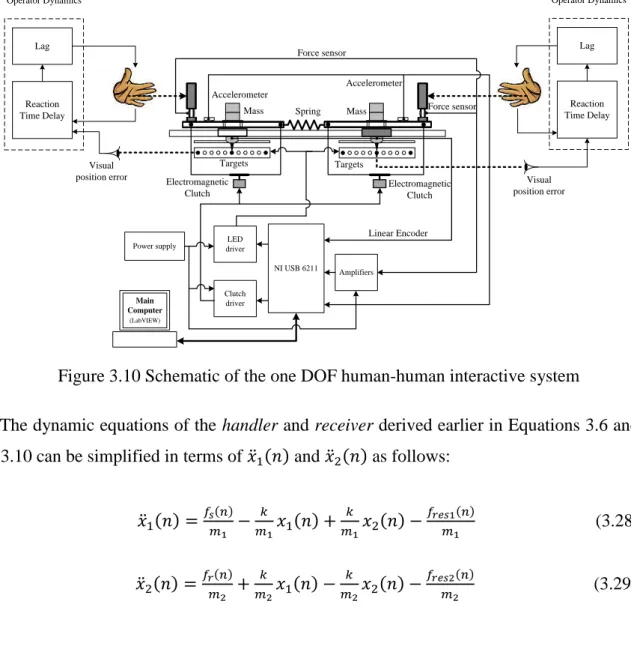
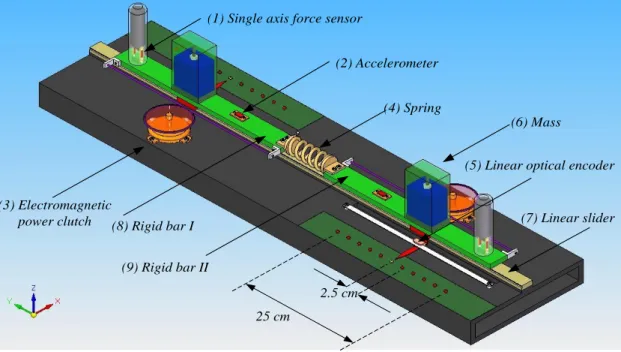
A topical and important aspect of robotics research is in the area of human-robot interaction (HRI), which addresses the issue of cooperation between a human and a robot to allow tasks to be shared in a safe and reliable manner. This thesis focuses on the design and development of an appropriate set of behaviour strategies for human-robot interactive control by first understanding how an equivalent human-human interaction (HHI) can be used to establish a framework for a robotic behaviour-based approach. To achieve the above goal, two preliminary HHI experimental investigations were initiated in this study. The first of which was designed to evaluate the human dynamic response using a one degree-of-freedom (DOF) HHI rectilinear test where the
handler passes a compliant object to the receiver along a constrained horizontal path. The human dynamic response while executing the HHI rectilinear task has been investigated using aBox-Behnken design of experiments [Box and Hunter, 1957] and was based on the McRuer crossover model [McRuer et al. 1995].
To mimic a real-world human-human object handover task where the handler is able to pass an object to the receiver in a 3D workspace, a second more substantive one DOF HHI baton handover task has been developed. The HHI object handover tests were designed to understand the dynamic behavioural characteristics of the human participants, in which the handler was required to dexterously pass an object to the
receiver in a timely and natural manner. The profiles of interactive forces between the
handler and receiver were measured as a function of time, and how they aremodulated whilst performing the tasks, was evaluated. Three key parameters were used to identify the physical characteristics of the human participants, including: peak interactive force (fmax), transfer time (Ttrf), and work done (W). These variables were subsequently used
to design and develop an appropriate set of force and velocity control strategies for a six DOF Stäubli robot manipulator arm (TX60) working in a human-robot interactive environment. The optimal design of the software and hardware controller implementation for the robot system has been successfully established in keeping with a behaviour-based approach. External force control based on proportional plus integral (PI) and fuzzy logic control (FLC) algorithms were adopted to control the robot end effector velocity and interactive force in real-time.
ii The results of interactive experiments with human-to-robot and robot-to-human handover tasks allowed a comparison of the PI and FLC control strategies. It can be concluded that the quantitative measurement of the performance of robot velocity and force control can be considered acceptable for human-robot interaction. These can provide effective performance during the robot-human object handover tasks, where the robot was able to successfully pass the object from/to the human in a safe, reliable and timely manner. However, after careful analysis with regard to human-robot handover test results, the FLC scheme was shown to be superior to PI control by actively compensating for the dynamics in the non-linear system and demonstrated better overall performance and stability. The FLC also shows superior performance in terms of improved sensitivity to small error changes compared to PI control, which is an advantage in establishing effective robot force control. The results of survey responses from the participants were in agreement with the parallel test outcomes, demonstrating significant satisfaction with the overall performance of the human-robot interactive system, as measured by an average rating of 4.06 on a five point scale.
In brief, this research has contributed the foundations for long-term research, particularly in the development of an interactive real-time robot-force control system, which enables the robot manipulator arm to cooperate with a human to facilitate the dextrous transfer of objects in a safe and speedy manner.
KEYWORDS: Human-human interaction, Human-robot interaction, Object handover
task, Real-time system, Proportional integral control and Fuzzy logic control
PUBLICATIONS:
Neranon, P. and Bicker, R. 'Human-human interaction using a behavioural control strategy', Technologies for Practical Robot Applications (TePRA), 2013 IEEE International Conference, 22-23 April 2013. pp. 1-6.
Neranon, P. and Bicker, R. 'A behavioural control strategy of human-human interaction in an object transfer task', Technologies for Practical Robot Applications (TePRA), 2014 IEEE International Conference, 14-15 April 2014. pp. 1-6.
Neranon, P. and Bicker, R. 'Design of Force/Position Controller of Robotic System in Human-Robot Handover Task' Technologies for Practical Robot Applications (TePRA), 2015 IEEE International Conference (Submitted).
Neranon, P. and Bicker, R. Human-Robot interaction using a behavioural control strategy' Journal of Human-Robot Interaction (In preparation).
iii
ACKNOWLEDGEMENTS
First of all, I would like to express my sincere gratitude to my supervisor, Dr R. Bicker, for all his help, support, encouragement, advice, motivation, enthusiasm, immense knowledge and guidance given throughout the research. I would like to thank my second supervisor, Dr J. Hedley, for his support, advice and direction in this research. I would also like to thank all technicians and staff at the School of Mechanical and Systems Engineering at Newcastle University.
I am truly grateful to the Thai government and Prince of Songkla University (PSU) for financial support throughout my PhD study at Newcastle University, and I promise that I will subsequently use all my knowledge acquired to advance mechatronics know-how at PSU and across educational institutions in Thailand.
I am especially grateful to my dearest parents, my wife, my sister and my wife’s family for their continuous love, understanding, support and encouragement every day. Finally, I would like to thank my test participants: Arisara Romyen, Bhathrapol Dhanasobhon, Phatthanawan Chanrattanayothin, Simon Ignance Marandu, Ababukar Surajo Imam, Charuwan Manmee, Ahmad Alsaab, Wan Nurshazwani, Mehmet Serdar Guzel, Kanida Sinmai, Prattana Phuekvilai, Jaya Bhanu Rao, Alaa Jaber, Erwin Wern-Juin Choy, Napaporn Tangtinthai, Kanungnid Busarakam, Patchanok Kitikanan and Nuatip Sumkaew for their assistance in interactive tests.
iv
LIST OF ABBREVIATIONS AND SYSBOLS
Abbreviations:
A/D Analog-to-digital converter
ALTERtrsf ALTER transformation matrix
ANOVA Analysis of variance
ANSI America National Standard Institute
ARMAX Auto Regressive Moving Average with Exogenous Input
DOF Degree of freedom
E_RMS Root mean square error
FFT Fast Fourier transform
FIFO First in first out
FLC Fuzzy logic control
H0 and H1 Hypothesis and alternative hypothesisof the test
HHI Human-human interaction
HRI Human-robot interaction
HRI with PI Human-robot interaction based on proportional control HRI with FLC Human-robot interaction based on fuzzy logic control IFPS Interface power supply
LabVIEW Laboratory Virtual Instrument Engineering Workbench
MCP Manual control panel
NI-DAQ National Instruments data acquisition
NL Negative large
NM Negative medium
NS Negative small
PEM Prediction error method
PI Proportional integral control
PID Proportional plus integral and derivative control
PL Positive large
PM Positive medium
PS Positive small
v RT Linux OS Real-time Linux operating system
SD Standard deviation
Sig. Significance value
TCP/IP Transmit control protocol and internet protocol
Ze Zero
Following notation is used for robot-to-human tasks Phase A Sending posture
Phase B Transfer posture
Phases B1 and B2 Actual interaction time between the robot and human and
the time delay of the robot gripper’ operational process Phase C Receiving posture
Following notation is used for human-to-robot tasks Phase A Object velocity tracking phase Phase B Sending posture
Phases B1, B2 and B3 The movement of the robot end effector is maintained
acceleration, constant movement and the robot gripper’ operational process
Phase C Transfer posture Phase D Receiving posture
Matrix and Vector Symbols:
Symbols Description
(6×6) Designed damping matrix (N.s/m)
f (6×1) Cartesian force and moment vector (N and N.m)
fd (6×1) Designed Cartesian force and moment vector (N and N.m) fe (6×1) Cartesian force and moment error vector (N and N.m) J (6×6) Manipulator Jacobian matrix
K (6×6) Cartesian stiffness matrix (N/m) (6×6) Designed stiffness matrix (N/m) (6×6) Designed inertia matrix (kg.m2)
S (6×6) Diagonal matrix with the elements being either a one for position control or zero for no position control
vi
X (6×1) Cartesian position and orientation vector (m and rad)
Xd (6×1) Designed Cartesian position and orientation vector
(m and rad)
Xe (6×1) Cartesian position and orientation error vector
(m and rad)
Parameter Symbols:
Symbols Description
A Actual hand moving distance or amplitude (m)
a and b Two constants relating to the task and the person (s/bit)
α Significance level
Mean of overall experimental responses Coefficient effecting to the variable
c damping factor (N.s/m)
de Change in error (e) (N)
df Sample degrees of freedom
dfdemon Demonstrator degrees of freedom
An incremental angle of the robot end effector (degree)
e(t) Difference between and (N)
Error observed in estimated human force response (N)
f and F Human applied force (N)
F1 and F2 Frictional forces produced by the right- and left- hand
electromagnetic clutches respectively (N)
Fc Frictional force added to a one DOF HHI system (N) fc Force of dashpot (N)
Desired force which was initially defined as 0 (N)
fint Interactive force (N)
fk Force of spring (N)
Fleft handle and Fright handle Forces applied to the left/right handles (N) fmax Maximum magnitude of interactive forces (N)
vii
fres1 and fres2 Frictional forces at masses m1 and m2 (N)
Actual force (measured by the ATI force sensor) (N)
fs and fr External force applied by the handler and receiver(N) FT Tangential force (N)
Fx, Fyand Fz Force values recorded along the x, y and z axes (N) FE External variable force (N)
External frictional force (N)
External net force (N)
External receiver force (N) External handler force (N)
FI Internal interactive force (N)
GH(s) Human transfer function as a linear feedback controller Gp(s) Machine or plant transfer function
H(s) Sensory feedback transfer function
i, j Process orders
ID Index of difficulty (bits)
k Spring stiffness (N/m)
K Spring stiffness used in a one DOF HHI system (N/m) Derivative gain and
KH Human muscle gain
Integral gain Proportional gain
m Mass (kg)
M Mass added to a one DOF HHI system (kg)
m1 and m2 Two set of masses (kg)
mr, kr and cr Impedance parameters of the human receiver arm (kg, N/m and
N.s/m)
ms, ks and cs Impedance parameters of the human handler arm (kg, N/m and
N.s/m)
MT Performance time (s)
N Number of participants (People)
and Total numbers of sample participants of the first and second groups (People)
viii
s Object displacement (m)
and Standard deviations of task completion times of the first and second groups (s)
Sˊ The number of sample participants (People)
T Transfer displacement (m)
t Continuous time (s)
Ttrf Transfer time in object handover tasks (s)
and Lead and lag coefficients respectively (s) Sampling time period (s)
Reaction time delay of the human (s)
PID incremental displacement control output (m)
Angle of the ‘crank’ based on the world coordinates (degree)
Population variance
A A value used in determining power quantity
Incremental PI robot displacement control output (m)
v Object velocity (m/s)
Desired velocity (m/s)
Vleft handle and Vright handle Output voltages of the left/right handles (V)
Actual velocity (m/s)
W Work done by the handler and receiver (J or N.m)
ωC Crossover frequency (Hz)
Human arm’s displacement (m)
x0 Position at time t0 (m)
x1and x2 Object displacements of masses m1 and m2 (m)
x1, x2, x3, and x4Input variables of a second order RSM model: (x1:N/m), (x2:kg),
(x3:N), and (x4: m) xf Position at time tf (m)
Human arm’s velocity (m/s)
and Corresponding velocity of masses m1 and m2 (m/s)
and Corresponding acceleration of masses m1 and m2 (m/s2)
and or µ1 and µ2 The means of task completion times the first and second
ix
The world coordinates of the home position (m)
The world coordinates of the current position of the robot end effector based on (m)
The world coordinates of the updated position of the robot end effector (m)
y Estimated human force output of a second order RSM model (N)
Desired force output (N)
1
CHAPTER I
INTRODUCTION
Robots are poised to fill a growing number of roles in today’s society; these include applications in automated factories, and medical and other facilities. Robots continue to be successfully employed in industry to improve productivity, quality, accuracy, and reliability, carrying out spray painting, welding, grinding and assembly. Industrial robots are used particularly in static environments, using only minimal feedback signals for position and joint torque, and are normally isolated from humans for safety; however, the next generation of intelligent robots will be expected to have a larger operating range and to offer increased flexibility, as well as sharing the workspace with humans in order to further improve productivity. To achieve successful collaboration, robots are required to collaborate with humans in a safe and natural manner.
Human-robot interaction (HRI) is the scientific study of the dynamics of interaction between humans and robots, in an attempt to maximise the benefits of collaboration between a human and a robot to successfully accomplish a specific set of interactive tasks in a shared workspace [Heyer et al., 2010]. Consider the car assembly process of installing the front windshield. This task requires two semi–skilled operators to manipulate and position the front windshield, which is supported on a passive compensator as shown in Figure 1.1. A more cost effective solution would be to use a robot arm to replace one of the semi–skilled workers and utilize an interactive human-robot strategy.
2 Figure 1.1 Installing the front windshield
[http://www.assemblymag.com/articles/human-robot-collaboration]
With regard to both human and robot capabilities, human-robot interaction provides several benefits. Burghart et al [2007] suggested that, in the near future, human-robot interaction will be significantly developed and implemented, with robots used as assistants to industrial workers, tour guides, teachers, receptionists, or as household aids or assistive devices for the elderly. Dong et al. [2009] stated that interest in HRI has increased considerably and that industrial robots can collaborate with human operators through physical interaction in the same workspace. Furthermore, the direct teaching technology of human-robot cooperation enables operators with no experience to work together with robots in completing processes.
Safety is a crucial issue in haptic human-robot interaction, and so intelligent robots should be developed to facilitate safe and effective collaboration with human partners in shared workspaces, and the timing of any interaction is a crucial aspect in enhancing system efficiency, safety and acceptability. In addition, in order to increase confidence in predicting handover actions in time and space, it was recommended that the kinematics and dynamics of both position and movement parameters between humans and humans and robots should be comprehensively studied [Glasuer et al., 2010]. A control scheme which can compute and perform grasping movements whilst reaching targets has been proposed and scientifically developed by investigating the kinematics and dynamics of object grasping by robots and understanding the behavioural characteristics [Smeets et al., 1995].
3 Researchers have studied and developed a variety of different HRI control strategies. Nevertheless, in human-robot interactive applications, robots are usually controlled to cope with various uncertainties in the behaviour carried out by human partners. Therefore, this challenge is further complicated by the dynamic nature of the human-robot environment, which by its nature necessitates very careful design of the control strategy and its implementation in order to protect the human operator from the risk of harm or injury by the robot, particularly if the sensing system becomes occluded by the pose of the robot or any object within its workspace.
1.1 Motivation and Aim of the Research
Reed et al. [2007; 2008] stated that understanding the principle of human haptic interaction when two humans work together in a joint effort to complete a shared task is crucial in designing an effective human-robot interactive system. This body of work highlights the development of human-robot interaction in which an ‘intelligent’ robot manipulator has been configured with the capability of generating natural and synchronized responses with a human partner to facilitate safe and effective collaboration in a shared workspace. To achieve a conceptual guideline for a robotic human-like control strategy, human behavioural characteristics in human-human interaction were investigated.
To achieve the above goal two preliminary experimental investigations were initiated. The first was designed to evaluate the human dynamic response using a one degree-of-freedom (DOF) human-human interactive rectilinear test in which the handler passes a compliant object to the receiver by sliding it along a constrained horizontal path. To mimic a real-world human-human object handover task where the handler is able to pass an object to the receiver in a 3D workspace, a second more substantive handover task in which the handler transfers a baton type object to the receiver has been undertaken.
4 This preliminary work formed the basis for further research and postulated the research question of whether a behavioural control strategy can be developed for use in Human-Robot Interaction by understanding the dynamics of a human-human object handover task. Furthermore, is it possible feasible to utilize fuzzy logic control (FLC) techniques in the robot control strategy to improve the effectiveness and reliability of the human-robot object handover procedure in terms of force and velocity-control?
The scope of this research was focused on developing a robot behavioural control strategy which would allow a robot manipulator to safely and effectively perform object handover tasks with a human. To achieve this, the behavioural and dynamic characteristics of both a handler and receiver in human-human object handover tasks were first investigated, and used to establish the behavioural control strategy for robot force and velocity control to enable the robot to successfully transfer an object from/to a human in a safe and reliable manner. Finally, the robot’s performance whilst performing the handover task with the human will be compared with the outcomes of the HHI tests in order to assess the robot control system. The outline of the sequence of key experiments in this study is illustrated in Figure 1.2.
Understanding how HHI can achieve its goal
Designing and developing an appropriate set of behaviours in a HRI control strategy Implementing the HRI control strategy in a robot
Comparing the performance of HHI with HRI
to evaluate the control
strategy
5 To satisfy the aim of this project, the following objectives have been defined:
To determine an appropriate set of trials, based on a number of participants and sequence of physical tasks, to satisfy a preliminary one DOF HHI rectilinear task.
To investigate the human dynamic response based on the McRuer cross-over model [McRuer et al. 1995] while performing compliant object handover in the preliminary one DOF HHI rectilinear experiment designed using a Box-Behnken statistical technique [Box and Hunter, 1957].
To evaluate human physical characteristics in using a one DOF human-human object handover task in order to successfully design and develop an appropriate set of behaviours in a human-robot interactive control strategy which permits a robot manipulator arm to effectively transfer an object from/to a human.
To validate the quantitative performance of the implemented robot system based on both conventional proportional plus integral (PI) control and ‘intelligent’ fuzzy logic control (FLC) implementation in human-to-robot and robot-to-human object handover tasks, and which can be compared to that of the robot-to- human-human handover tests, and
To evaluate the stability of robot control in human-robot interaction based on its acceptability to the humans involved using a survey questionnaire.
1.2 Layout of the Thesis
The work presented in this thesis addresses issues related to the design and development of an appropriate set of behaviours in a human-robot interaction (HRI) control strategy by studying the kinematics and dynamics of human behaviour in an effective human-human interactive (HHI) task. The effectiveness of robot control schemes have been established based on human-to-robot and robot-to-human handover tasks which were specifically designed for this investigation. Chapter 2 critically reviews the relevant recent and contemporary research in the area of interactive behaviour-based robots, human-robot interaction technologies, human-human interaction strategy and the conceptual frameworks of HHI and HRI control strategies.
6 Chapter 3 presents a one DOF human-human interactive study, which introduces two preliminary HHI tests. The first is a one DOF human-human interactive rectilinear task in which an appropriate set of trials, number of participants and sequence of the physical test were statistically carried out by a pilot study. In addition, the experiment has been designed using a Box-Behnken methodology [Box and Hunter, 1957] to evaluate the human dynamic response based on the McRuer crossover model [McRuer et al. 1995] while performing compliant object handover. Nevertheless, the sliding test does not mimic a real-world human-human object handover task; therefore, a substantive human-human object handover task, in which the handler is able to transfers an object to the receiver in a 3D shared workspace, has also been undertaken. Physical dynamic responses in the interactive tasks have been investigated to establish an appropriate set of behaviours in a human-robot interactive control strategy. Furthermore, all of the HHI tests were arranged based on the recommendations arising from the one DOF pilot study, as proposed in the first preliminary test.
Chapter 4 describes the design of external force and velocity control systems, which was strategically developed in order to ascertain its capability in HRI task execution, where the performance evaluations of an ATI multi-axis force/torque sensor and an ALTER real-time robotic control path were applied to quantify the effectiveness of the robot control system as explained in Appendix D. Optimized proportional plus integral control is typically used to complete an effective task with satisfactorily stable performance in a specific environment, and also has some disadvantages such as high starting overshoot, sensitivity to controller gains and steady-state error [Khuntia et al. 2009]. According to the complicated dynamic nature of human behaviour, fuzzy logic control (FLC), which has higher capability in dealing with non-linear dynamic applications, was therefore adopted. Fuzzy logic control was appropriately designed and developed based on understanding of the kinematics and dynamics of human behaviour in a one DOF human-human handover task.
Safety issues are crucial aspects in the design of human-robot interaction, and were addressed using control software and stand-alone emergency stop buttons available in the robot manual control panel and external control box. Furthermore, the robot control modelling was conducted using the active compliant motion control method suggested by De Schutter [1987], and it includes simple models of the robot, an ATI force/ torque sensor, a gripper and workpiece components.
7 The results, discussion and evaluation of the overall human-to-robot and robot-to-human handover tasks using the proportional integral and fuzzy logic control schemes are fully explained in Chapter 5. The test programme was carried out to evaluate the comparative performance of human-robot and human-human interaction at the various required velocities in terms of the human force profile, maximum interactive force, transfer time and work done. Finally, Chapter 6 provides the conclusions drawn from the human-robot interactive study and offers recommendations for future work based on the current research findings.
8
CHAPTER II
LITERATURE REVIEW
Industrial robots are typically programmed by operators to execute a sequence of predefined functions. Although early industrial robots were not developed to interact with humans directly, the next generation of smart robots will be designed to further increase flexibility and to share their workspaces with humans in aiming for product improvement. There are two key issues which should be addressed to facilitate successful human-robot interaction. Firstly, robots should be able to physically interact and work naturally with humans in a safe and reliable way. Secondly, the robots themselves should be able to decide their task priority or action levels that can allow them to interact with humans in a timely and speedy manner.
Human-robot interaction (HRI) has become the crucial aspect when robots have been used for collaboration with humans in industrial applications, due to the requirements of technological feasibility and productivity improvements in terms of quality, accuracy reliability and flexibility. Interest in human-robot interaction has tended to increase significantly. Consequently, various human-robot cooperative technologies, which are used to enable unskilled workers to be able to directly teach intelligent robots, have been developed. For example, when a human operator gives instructions about task trajectory to a manipulator, the trajectory ordered can be automatically created by the robot instead of requiring offline programming [Dong et al 2009]. Human-robot interaction has been investigated significantly since 1994 [Fong et al. 2003], and interactive control methods were previously applied in basic on-off control systems or manipulator joint control systems by using analog joysticks. Human-robot collaborative technology has since developed so as to be more intelligent, smooth, natural, and safe, as in human-human interactive relationships. Human-robot interaction (HRI) has also defined as ‘the study of humans, robots, and the ways they influence each other’ [Fong et al. 2003]. Additionally, the essential factors of self-awareness, self-reliance, capacity for dialogue and adaptive systems, must be taken into account to provide an effective control system.
9
There has been much research in safe and effective Human-Robot Interaction (HRI) particularly with respect to robot design and control algorithms. Chanhun [2010] designed and developed a control strategy for industrial robot manipulators which allows easy and safe human–robot collaboration by directly teaching a robot high speed and high precision movements. Arai et al. [2000] demonstrated a human-robot master control method for moving an object in the horizontal plane, where the operator coordinates the action with the assistance of the robot. In order to support human-robot interaction in cellular manufacturing the human-human interactive task analysis, investigation and safety issues, were addressed by Tan et al. [2010]. Huber et al [2008] studied a simple physical robot interactive handover task and compared the results of human-human handover coordination with the same task completed by a human-human-robot combination. Their results illustrate a shorter reaction time for minimum-jerk profiles and provide a background for joint action strategies in humanoid robot systems.
Haddadin et al [2009] developed robot capabilities in the areas of sensor and actuator systems. The aim of the study was to design a robot to mimic human behaviour and to develop a prototype of a co-worker scenario. Various researchers [Ikeura et al, 1997; 2002; Daesik et al, 1998; Tsumugiwa et al, 2002; Aggarwal, 2007] have developed designs of robot control strategies for human-robot collaboration while moving an object to different targets, and it has been suggested that intelligent control systems designed for smart robots should be developed by imitating human behaviour.
Cakmak and his colleagues [2011] studied human handover configurations, which are an essential aspect of applications involving an assistive robot, and the most significant of human preferences whilst performing an object handover task were identified and evaluated. The observation of human-human handover interaction was conducted before implementing the handover structure on human- robot interaction. Handlers and
receivers were evaluated in terms of gestures when approaching, carrying, reaching and transferring [Strabala et al., 2013]. Other researchers, who also investigated different issues to improve human-robot handover interactive tasks, have studied how a human applies grip force during an object transfer task [Mason and MacKenzie, 2005; Wesley et al., 2012].
10
2.1 Conceptual Framework for Human-Human Interaction (HHI)
As human-robot interaction has developed, industrial robots have been used increasingly in more complex structured tasks and activities. Human-robot interactive design attempts to maximize the benefits of collaboration between a human and a robot to successfully accomplish a specific set of tasks in a shared workspace. It can be postulated that the understanding of the kinematics and dynamics of human-human interaction (HHI) during two humans working together in a joint effort to complete a smooth and efficient task is fundamental in designing an effective human-robot interactive system. Breazeal et al. [2005] stated that the robot applications involved in human-robot interaction, which include industrial robots, robots working in hazardous environments, service or transportation robots or those assisting the elderly, have to be able to recognize the other teammate’s actions in order to accomplish effectively coordinated goals. For instance, both partners should realize that they have to appropriately apply their forces based on interactive force feedback.
There are several studies that have examined the cooperation between two human subjects in a shared workspace in order to help in implementing human-robot interaction more efficiently. Raman et al [2000a; 2000b; 2002], investigated the control characteristics of two humans in a cooperative task, and designed control systems for cooperative robots to work with other partners by imitating human-based behaviour strategies. Firstly, control characteristics such as impedance analysis based on a biomechanical model of two humans working together were analysed. A cooperative task was then modelled by evaluating the system parameters. Finally, the results of the impedance characteristics from the proposed model were implemented in a robot to mimic the same interactive tasks with a human partner.
A single degree of freedom linear horizontal movement in a human-human cooperative task was investigated, as shown in Figure 2.1. Two types of cooperation were analysed: master-master and master-slave. The two subjects were required to grasp each handle of an object and rapidly move it to a target whilst acceleration and force were measured and analysed. A linear motor served as an actuator to drive the linear slider, and the system was implemented to simulate the collaborative task with one human. In master-slave cooperation, the master moves the object while the master-slave grasps the handle and performs passive movements.
11
Human Human
x Object to be moved
15 cm 15 cm
Figure 2.1Human-human interactive task with an object in horizontal motion [Raman et al. 2002]
As proposed by Raman et al. [2002], the human muscle can be mechanically represented in the system as a spring and damper, as shown in Figure 2.2. The dynamic model of the arm can be described by the second-order equation shown in Equation 2.1 based on an equivalent of the arm’s mass, stiffness and damping factors. The key abbreviations of m,
c and k represent human arm impedance parameters for the mass, damping factor and stiffness respectively, and f and x represent the force that acts on the arm and its displacement, respectively.
Figure 2.2 Human arm impedance model [Raman et al 2002]
(2.1)
(2.2)
(2.3)
Substituting Equations 2.2 and 2.3 into Equation 2.1 gives:
(2.4)
where,
12 Studies by Reed et al. [2007; 2008] have demonstrated that understanding the kinematics of how humans physically collaborate with each other is a major goal of human-robot research as shown in Figure 2.3 to investigate this interaction. The experiment requires a single DOF crank with a projector to simulate targets and two randomly selected participants attempting to turn the crank to the targets with a curtain between them. The tasks consisted of a human working individually, two human individuals working together and a human working with a motorized partner, where one of the participants was replaced by a robot to perform an interactive task.
Figure 2.3 Experimental set-up of human-human interactive task with two-handled crank [Reed et al., 2007; 2008]
Both human subjects were commanded to turn the rigid handles as quickly as they could to a set of targets which appeared randomly. The interactive force profile of each human subject was tracked. After the analysis and understanding of the human-human haptic communication, Reed et al. [2007; 2008] implemented a robot which simulated the human behaviour strategies used to enable the robot to perform the same cooperative tasks as a human. The experimental results demonstrated that the performance time for achieving the targets by two humans working together is significantly faster than the average time of a human working individually. Furthermore, the results shown that the completion times of human-robot interactive tasks in both cases, where the human participants may or may not have known that the resistant force belonged to a robotic partner, scarcely differed.
13 In order to provide appropriate human-robot interaction, Ikeura et al. [1995; 1997; 2002] studied human behavioural characteristics based on a physical human-human interactive task. The characteristics of two humans carrying an object were investigated in order to provide a suitable control property for a robot. One of the two human subjects was instructed to move the object in a desired curve while the other person had no knowledge of the object’s trajectory. The human characteristics were approximated based on an impedance model using the least-square method, and the experimental results demonstrated that the damping value was large in quick movement and low in slow movement. A behavioural control strategy was subsequently implemented in the robot for HRI execution.
It is reasonable to learn from human performance in safe and efficient collaboration in order to enable robots to cooperate directly with humans. Erlhagen et al. [2006] have developed high-level joint action strategies for HHI, and these techniques were transferred to competitive robot control. In addition, Huber et al. [2008] postulated that an important research area was to understand the joint action of humans working together and then the behaviour patterns could be transferred directly to HRI. The timing characteristics of physical coordination in transferring an object from a robot to a human have been investigated and compared to the performance of HHI and HRI tasks.
The human behavioural characteristics in HHI when moving an object have been investigated and implemented in a robot to ensure that the robot collaborates with a human as smoothly as possible [Bakar et al., 2006; 2009; 2010]. Completing interactive tasks naturally and smoothly allows both participants to communicate using audiovisual and tactile means. The experimental devices involve 3D position sensors and force sensors. Two human subjects were selected to work together in the tasks, where one of them performed as a leader (master) and another acted as a follower (slave) as illustrated in Figure 2.4. Additionally, in investigating human characteristics whilst performing the interactive task of moving an object together, behaviour can be described using the minimum jerk trajectory (MJT) model developed by Flash and Hogan [1985].
14 Figure 2.4 Human-human interactive experimental set-up [Bakar et al., 2010] Miossec and Kheddar [2008] have also studied the physical interactive tasks between humans. Their person-object-person experiment was arranged to allow human subjects (individually and cooperatively) to move a handle-shaped object into a circular area. The observed characteristics of human performance show that the minimum jerk trajectory model [Flash and Hogan, 1985] was not the most advantageous measure to use in this set of experiments. Flash and Hogan formulated a mathematical model used to predict the qualitative features and details of human arm movements. Additionally, the integrated time of the square of jerk was proposed as a measure to determine the best performance of the arm movements of human participants. However, their results could be characterized explicitly by using a solver for local optimization (SOLVOPT) to achieve movement prediction, and this technique proved more accurate than the minimum jerk trajectory method.
2.2 Object Grasping
Humans can perform a rich diversity of manipulation strategies which are suitable for the robot manipulator in mimicking the tool acquisition and manipulation dexterity. Although the robot manipulator can be programmed or re-programmed to complete a desired task of grasping an object in a fixed environment, human subjects adapt their manipulation and behavioural strategies more easily given novel interactive task conditions. In the observation of human grasping actions, it has been found that human participants rarely grasp a given object directly without adjustments to the object configuration [Chang et al. 2008]. For example, a human may pull a mug handle to bring it closer to the body before lifting; or when a person attempts to grasp a pencil on a table, it could be quickly rotated to the writing position before lifting it.
15 The word (grasp) can be defined as the actions of a robot or a human hand to firmly hold an object so as to prevent its movement. Two factors should be taken into consideration in terms of stability of the grasp. These are form closure, which relates to the capability of a hand to prevent the object’s motion, and force closure which involves the ability of the stable grasp to resist external disturbances [Bicchi, 2000; Xiangyang and Jun, 2003]. A grasp can be classified into various groups based on the shapes of the objects involved [Rezzoug and Gorce 2003]. The categories suggested by Napier [1956] are defined by the properties of the grip, which generally relate to the patterns of the human palm and the precision of the grip.
The observation of human behaviour allows robotics researchers to understand the principles of a human hand as they relate to an object manipulation task. Understanding human motions in HHI tasks gives significant information which can be used to enhance the capability of robotic hand movements when a robot helps a human to manipulate or keep hold of an object in a gentle manner [Bicchi, 2000]. Typically, the study of the motor control of robotics hand movements tends to concentrate on simple actions, such as elbow flexion or finger tapping, before applying those to the more complex movements that require several motions in various joints [Rotman et al. 2004]. Several studies have investigated improvements in the area of robot grasping capability. For example, the aims of a study by Raphael [2011] were to increase the understanding of object grasping, and the outcome was a significantly descriptive model of the grasp, consisting of the following elements:
i. A defined goal, which includes the factors causing a grasp to be initiated.
ii. Human-object relationships or feelings during grasping; for example, a person tends to pick up a used paper towel with a pinching grasp if it does not belong to them.
iii. Differences in the characteristics of human hand anatomy while grasping an object, such as hand size or finger size.
iv. The setting, which includes factors relating to the environment where the grasp takes place; for example, an object is pulled out of a crate or picked from a shelf. v. The properties of the object, which are factors intrinsic to the object such as its
16 In the task of humans lifting or holding objects with different properties, such as the shape, weight and density, it is important to perform the tasks as smoothly as possible. For instance, passing a glass of water without jerky movements requires gentle grasping and transfer. Human subjects can rapidly change their performance of grasping and manipulating a variety of unknown objects after a few experiences with the objects and this learning has been carefully analysed [Gordon et al. 1993]. In this study, humans generally estimated the weights of objects based on their knowledge of similar objects and then generated appropriate power amplitudes before lifting each object.
Johansson [1998] investigated human characteristics in picking up unknown objects which can unexpectedly vary in weight. The subjects could not estimate the exact object weight; for example, if a box is lighter than anticipated, it will be lifted more quickly than a heavier one. Through experiments, the objects are identified and the relevant models conveyed by using virtual or haptic information. Before executing the tasks, these model formations are then adapted to give motor commands along with simultaneous updating of the object’s properties. Therefore, the objects, where weights can be varied, can be gripped and transferred by increasing or decreasing the gripping force in order to ensure that the objects do not slip.
Unlike the studies of Gordon et al. [1993] and Johansson [1998] which considered human-human interaction with passive objects by updating models generated from the subjects’ existing knowledge, Scheidt et al. [2001] examined how humans learn to act given unpredictable disturbances. Twenty participants were chosen and each was instructed to hold a handle connected to a two-DOF robotic manipulator, which provided viscous force to randomly disturb the movements. The human subjects were commanded to complete the tasks by moving the mechanism to an ordered target within half a second. The results suggested that only a single piece of past information was necessary to anticipate performance i.e. only human short-term memory is required for the neural structures concerned to be modified during motor adjustment.
When a human makes an attempt to perform the task of grasping, he/she cannot immediately achieve the exact positioning of a movable object through the manipulation interaction because of its complexity. To achieve an effective grasp, pre-grasp interaction is therefore required to update the information about the object. Chang et al. [2009] stated that pre-grasp action strategies which can adjust object orientation were
17 used while the object was moving. This was used to identify the location of objects before adopting a hand formation, and a taxonomy was developed to classify pre-grasp interactive primitives. In the experiment, video filming was selected to capture the richness of reach-to-grasp interactive behaviour. The ten activities which related to both individual working and group participation were studied, such as food preparation, basic mechanical repairs, housekeeping and office work.
The key step in manipulation movements is object acquisition. The use of vision based on 2D images for the robotic grasping of novel objects has been studied by developing learning algorithms in order to identify object location and predict how to perform an efficient grasp. A learning algorithm for robot implementation was successful in providing effective robotic execution in grasping several objects such as screwdrivers, plates, jugs, pens, or tape rolls. The proposed algorithm was successfully applied in unloading dishes from a dishwasher machine [Saxena, et al. 2008]. Yoshikawa et al. [2008; 2009] and Romero et al. [2001] established a shape recognition technique of unknown objects in order to achieve effective positions for robotic grasping with soft fingers by utilizing differences in vision systems and grasp quality criteria. Huebner et al. [2008a; 2008b], and Geidenstam et al. [2009] developed a method to classify object properties by fitting and splitting the 3D data points of objects such as mugs, models, phones or notebooks into minimum volume bounding boxes.
Virtual reality technology provides objects to be grasped and transferred by creating and interacting with virtual objects [Boud et al. 1999]. However, the object localization and reorganization based on visual methods is not sufficient to capture certain types of data such as the weight or surface friction of the objects. This restriction was emphasized by Earnshaw et al. [1993]. Burdea [1996] postulated that when users are allowed to touch and explore objects, their performance can markedly improve. Lederman and Klatzky [2001] studied the haptic system, which is a perceptual system for the collection of desired inputs from mechanoreceptors embedded in human skin, muscles and joints. Touching objects enables humans to recognize their shapes, weights and forms. Tactile sensationsinclude the vibrations and surface textures of the objects which are measured by the receptors. Typically, humans can detect frequency of force up to 30Hz and can perform exercise movements up to around 30Hz. The tactile receptors on a fingertip can sense vibration inputs of a maximum of 400Hz, whilst dextrous robot manipulator can measure up to 10kHz [Burdea, 1996].
18
2.3 Human Perception and Cognition
One of the key aspects in improving human-robot interaction is to develop the cognitive system for the control of the robot’s behaviour in real-time. The cognitive system is chiefly used in the detection of human states and object properties in order to perform the appropriate responses and to optimize human-robot interactive tasks, and should be able to recognize and identify notable actions signifying human anxiety or stress in order for the interactive performance and smoothness to be improved. These cognition reorganizations would lead to benefits for the robot control architecture [Rani et al. 2004; Kulic and Croft, 2005].
The development of human-robot interactive cognition is an interesting area of robotics research. The responses of robots whilst appropriately interacting with humans as co-workers and the investigation of how reliable recognition and perception systems can be constructed are significant areas of concern. The main goal of a cognitive system is to develop intelligent robots with human-like cognition given the complexity of conditions involved in decision making, planning and reasoning [Begum and Karray, 2001]. The cognitive robotics engine (CRE) was implemented so that robots could identify callers and to follow callers in a real environment with various other noises. The experimental results revealed that the robot’s capabilities were improved in terms of their dependability and stability [Sukhan et al. 2006a; 2006b].
Qining et al. [2006] mentioned that the human brain often involves the integration of object recognition and visual experiences. In the human cognitive process, object recognition is not only used to sense the surroundings in real time, but also the recognition of the surroundings is applied to take account of unnecessary features. To mimic human behaviour in the cognitive system, robots should be designed to automatically achieve localization. The use of vision-based self-localization robots to extract the features of the dynamic environment has been realized by Rofer and Jungel [2003]. In addition, a vision-based state estimation method applied to robot localization has been proposed by Schmitt et al. [2002].
19 The need to improve the capacities of robots to coordinate with humans in constrained environments has led to the investigation of the human’s visual, haptic, proprioceptive, and motor systems and their relationships [Garcia et al., 2000]. The term ‘attention’ has been defined as the robot’s ability to notice an interesting phenomenon from which useful information might be extracting. The principal challenges identified by Garcia and his colleagues are as follows: firstly, to construct an effective mechanism which can adapt itself to enhance attention focus; secondly, to construct the pattern categorization and attention control which are used to achieve efficient interaction between the robot and its environment; thirdly, to understand the characteristics of objects; and finally, to the attention map carried out.
The cognitive info-communication channels proposed by Soros et al. [2009], have been applied to human-machine interaction in order to enable unskilled operators to teach robots. These studies divided the information and communication technologies into three major sections, consisting of: the media used to create and store information, such as databases; secondly, videos and music, where communication is used to transfer information with high efficiency, security and reliability; and finally, informatics or information processing tools.
The basic anatomy of human perception and cognition is modelled in Figure 2.5, consisting of vision, hearing, and sensation systems, learning memory, and problem solving as well as operation and evaluation capacities. In the model, each ‘sense’ has an individual processor accompanied by a short term memory which is able to store images (visual short term memory), sound (audio short term memory) and object shapes (short term memory for sensation). Memory contexts are analysed by the sensory processor before the information is transferred to the central cognitive short term memory and cognitive processor in order to identify the input. These shorter memory contexts are still in the form of abstract information, and their meanings are constructed once they are conveyed to the central cognitive short term memory processor [Sutcliffe, 1988], whose purpose is to identify meanings by using the information from past experience that is fetched from the sensory processors or the long term memory. All of the cognition results may be stored in short term memory or long term memory, or may be transferred to the motor processor for the control of muscle movement based on human responses and human behaviour [Sutcliffe, 1988].
20
Visual short term memory
Audio short term memory
Short term memory for sensation Virtual processor Audio processor Tactile processor Cognitive short term memory Cognitive Processor Muscle Processor Long term memory
Figure 2.5 Information processing model of human perception and cognition [Sutcliffe, 1988]
Much of the relevant human operator modelling research has been extensively reviewed. For instance Zhihao et al. [2007], Trujillo et al. [2011], and Gagne and Lloyd [Fitt, 1954] have considered human abilities such as successful flying skills aimed at developing pilot tests to enhance training effectiveness. In the 1960s, the studies of McRuer et al. [1967; 1995] evaluated a human characteristics model based on dynamic responses in human-machine interaction. The general perceptual control architecture of the major human pathways are described as precognitive, pursuit and compensatory modes. The McRuer crossover model was based on a combination of sensing, computation and actuating systems, whereas the human operator model was defined as a set of linear differential equations. Nevertheless, a noise term, namely the remnant, is also added to the crossover function in order to take into account variations in the performance of individual humans.
2.4 Conceptual Framework for Human-Robot Interaction (HRI)
Since new technology has developed so rapidly, robotics innovations have become useful in various applications. One of the major motivations for improvements in robotics technology was to replace humans working in hazardous jobs or environments. Recently, as a result of the need for improvements in technological feasibility and productivity, robots have been required to function in a friendly manner with humans as co-workers to achieve complex collaborative tasks. The number of research projects in the field of human-robot coordination has steadily increased in order to enhance system development, such as in discussing and proposing their new conceptual designs, methods, model algorithms, safety, behaviour-based strategies or system performance evaluation.
21 According to Gini et al [2002], the classification of human-robot interaction in terms of the perception of a robot and the interpretation of humans was investigated. There are two general key categories of human-robot interaction as shown in Figure 2.6. Here cooperation in the interactive class without an object can be divided into two types called leading such as when a human operator teaches a robot manipulator arm, and
restriction such as when an operator constrains the robot’s movement by stopping the robot as a safety mechanism. When, an object is directly involved in human-robot interaction, cooperation can be divided into two schemes: firstly, a handing over scheme such as a direct handover, where an object transferred hand-to-hand using a medium; and secondly, a manipulation scheme. The latter may be a symmetrical object manipulation where a robot and a human carry or push or pull an object together, or anti-symmetric object manipulation where a robot force and a human force are generated against each other such as when opening a screw plug, and independent object manipulation with a human taking an object held by a robot.
Human-robot-cooperation
Without object With object
Leading Restricting Handing Over Manipulation
In tight kinematic chain In loose kinematic chain In tight kinematic chain Room guardian Via medium Direct Static Dynamic From fixed configuration From open configuration Symmetric Anti-symmetric Independent
Figure 2.6 Possible classification of human-robot cooperation [Gini et al 2002] Yanco and Drury [2004a] discussed the different combinations of humans and robots that can collaborate with individuals or in teams. Their classification was based on the number of humans giving commands to one or more robots resulting in eight categories as shown in Figure 2.7 in which a human is represented by H and a robot by R. The double arrow-headed connections indicate bilateral commands which flow between humans and robots, and vice versa.
22 The simplest case, as shown in Figure 2.7(a), represents an operator providing a set of commands to one robot which can transmit information back. Consider for example an operator directing a robot manipulator arm handling radioactive materials in a nuclear fuel reprocessing plant. In this situation, the operator needs a sufficient level of human-robot situational awareness to understand the positions, identities, activities, or surroundings of the robot. Furthermore, the robot needs a similar level of robot-human interactive awareness of its activities and human-delineated constraints that may require command non-compliance or a modified course of actions. Figures 2.7(f) through (h) illustrate multiple humans controlling multiple robots, and Figure 2.7(h) demonstrates individual operators controlling a team of robots using different commands. The robots have to prioritize all instructions before performing tasks. For example, a cluster of industrial robots are required by individual humans to accomplish parts of an assembly.
H R H R R H R R H H R H H R H H R R H H R R H H R R (a) (b) (c) (d) (e) (f) (g) (h)
Figure 2.7 Possible combinations of single or multiple humans and robots, acting as individuals or in teams [Yanco and Drury, 2004a]
In order to efficiently establish human-robot interactive behaviour strategies for advanced intelligent robots, a set of principles are required to make interaction efficient, such as neglect time, interaction time, robot attention demand, free time, and fan out. Goodrich and Olsem [2003] proposed the seven principles for efficient human-robot interaction, consisting of: implicitly switching modes, using natural cues, directly manipulating the world coordinates, manipulating the robot-world relationship where information is meant to be manipulated, externalizing memory, and supporting attention management. However, these seven principles of efficient interaction still need to be validated due to the presence of unknown factors and new experience gained while
23 developing efficient human-robot interactive interfaces. Kleinehagenbrock et al. [2004] introduced the conceptual design of an agent-based architecture for human-robot coordination, whereas Fritsch et al [2005] argued that the proposed system infrastructures for robot companion learning and evolution (SIRCLE) can be used to enable human-robot interaction to be stable, powerful and more natural.
Previously, the physical interaction of humans and robots has largely been based on a master-slave strategy, in which a human operator teleoperates or programs all instructions off-line; moreover, the workspaces are strictly separated to ensure safety. The current trend is for human-robot interaction to be improved by enhancing the capabilities of robots to work with humans as partners and to combine the advantages of workers and robot manipulators. Lawitzky et al. [2010] investigated and evaluated load sharing policies, as shown in Figure 2.8, from the perception of a task’s geometric, dynamic and environmental properties in a restricted environment.
Robot R obot Object C y xC C I yI xI Obstacle Free space
Figure 2.8 Manipulation of a bulky object by multi-agents [Lawitzky et al., 2010] The problem of multiple humans and robots carrying a rigid bulky object has been defined using the following conditions:
i. One or more human operators collaborate with one or more robots,
ii. All participants know the common goal, such as a human and a robot physically manipulating an object to a desired target,
iii. All participants gently grasp the object whose shape and dynamics are known, iv. The haptic interaction between a human and a robot via the object is the key
24 Lenz et al. [2008] designed the concept of a smart working system between humans and industrial robots in order to assemble industrial products using the model of the architecture of joint action for humans and industrial robots (JAHIR), as shown in Figure 2.9. The main purpose of the system is to authorize peer to peer collaboration by dealing with data from multiple input modalities and a cognitive system. The capability for interaction between industrial robots and human workers is crucial in physical interactive tasks, which require both participants to create a perceptual common ground in order to share the work [Sebanz et al 2006; Lenz et al, 2008].
Figure 2.9 The modules of architecture of joint action for humans and industrial robots [Lenz et al, 2008]
According to Figure 2.9, the focus of attention is to be extracted by virtual devices and then stored in a database as a known object. For a production process, human skills are needed to manage a predefined goal in product assembly; hence the allocation of both partners should be dynamically adapted throughout the process. The workspace model is drafted by the sensor information, including elements such as the inventory and the assembly line. The decision maker is crucial in deciding the next action according to sensory information and task knowledge from the building plan module. The motion control module is necessary to authorize the robot’s movements since the robot cannot be programmed off-line during human-robot interaction for safety reasons.
25 Takubo et al. [2002] presented a robot assistant to help a human to lift or manipulate a large bulky object in which they would find it difficult to perform alone. A virtual nonholonomic constraint method based on impedance control was proposed in order to demonstrate an industrial robot collaborating with a human by dealing with a simple tool. The schematic control of impedance control in 2D motion and the free rotation of the robot wrist was also examined. The experimental results revealed that the operator and the robot could suitably carry and transport the object to the desired locations and orientation. All participants could share the gravitational load equally by using “skills similar to steering a wheelbarrow”. This study was then extended to object transfer in 3D space by combining virtual nonholonomic constraints in vertical and horizontal motion. The control method for human-robot interactive manipulation can be described as follows: if the operator wants to move an object directly down to a desired configuration, the human subject should drop his/her end and pull down the object before the robot trajectory will be finally adjusted to the same height.
Robot manipulator’s arms are mainly used to replicate the human capacities to complete complex tasks. The key to human-robot collaborative control is to build robot abilities in order to perform efficient actions and help humans in interactive tasks by learning from human behaviour strategies and imitating human actions [Becker et al. 1999; Acosta-Calderon and Hu, 2005]. Studies by Breazeal and Scassellati [2002] presented a taxonomy of social learning in robotics, which can be described by the following set of definitions as shown in Table 2.1.
26 Wolper et al. [2003] suggest that a robot observes human performance to set-up a predictive framework, which enables the robot to be able to simultaneously imply the human state and predict incoming actions in order to effectively perform a coordinative task. Shibata et al. [2003] have studied the movement coordination between humans and robots in a scenario of human-robot interactive movement. The motions involved were described in terms of the timing of interpersonal collaboration, which reveals that both participants delay their actions during the overlapping space of the coordinated working area. In the long term, the human-human interactive parameters are extracted in order to implement the results with robots so as to execute interactive tasks with humans.
To achieve effective human-robot interaction, a robot working as a mimicking partner has to be able to understand and recognize the structural congruence between the imitator and the demonstrator [Meltzoff and Brooks, 2001]. A robot can work together with a human in common tasks by mimicking the human’s movements; however, there are situations where this cannot be accomplished due to the physical differences between the demonstrator’s and imitator’s bodies. This is called the correspondence problem [Dautenhahn and Nehaniv, 2002; 2004]. Experiments completed by Calderon and Hu [2004] successfully solved this issue by proposing a representation of the demonstrator’s body and providing a relevant method.
Luh and Shuyi [1998] stated that when a robot and a human jointly move an object, it is important to assign the human to the decision making with the robot being strategically trained to achieve the task trajectory. A set of learning strategies for the robot manipulator has been considered along with the analysis of human action models in interactive tasks using a fuzzy model. In Luh and Shuyi’s experiment, the calculations of robotic dynamics and kinematics were not necessary, since force sensors, encoders and a microcontroller were used for robotic trajectory control. This system can be sufficiently fast to accomplish the force control, and is illustrated schematically in Figure 2.10.
Human Fa Object Fm Robot
X0
27 Behaviour-based robotics systems have become one of the most attractive approaches to human-robot interaction, and are made up of four key principles, as follows: providing rule collections; secondly, collecting the required information from input sensors or other behavioural strategies which relate to the system; thirdly, computing and analyzing the information received; and finally, transferring the output signals to the system effectors for effective robot performance. Although, behaviour-based robotics systems have been increasingly applied to robots and are successful in several applications, they have not often been used for more complex problems such as the control of hierarchical tasks [Monica and Maja, 2002]
The three key methods in designing and constructing behaviour-based robotics systems, are expressing, encoding and coordinating behaviour methods. In addition, the robotics architectures which include software systems, a robotics language and tool specifications are also crucial in developing suitable behaviour-based systems for robots [Ronald, 1998]. Behaviour-based architecture is required to clarify the problem in the robotics control system in order to enable a robot to appropriately solve a problem in the right way to achieve a goal. A reactive control architecture based on behaviour is illustrated in Figure 2.11, where each sensor used collects suitable input information and then distributes it to reactive behaviour modules. Action selection controls individual interactive actions by either choosing one of the various behaviour modules using an arbitration method, or combining all relevant behavioural modules so as to generate an appropriate output behaviour which is called the common fusion method, as shown in Figure 2.12(a) and (b) respectively [Mataric, 2007].
Sensory input Sensory input Sensory input Sensory input Actuators Sense Act Sense Act Sense Act Sense Act
Figure 2.11 Parallel reactive architecture together with task achievment modules [Mataric, 2007]
28 Sense Act
Sense Act
Actuator
Sensory input
(a) Common arbitration
+
Sense Act Sense Act Actuator Sensory input (b) Common fusionFigure 2.12 Types of the action-selection mechanism [Mataric, 2007]
2.5 Force Control in Robotic Systems
Robot force control is a fundamental requirement in t
![Figure 2.7 Possible combinations of single or multiple humans and robots, acting as individuals or in teams [Yanco and Drury, 2004a]](https://thumb-us.123doks.com/thumbv2/123dok_us/527693.2562144/32.892.244.740.489.738/figure-possible-combinations-single-multiple-humans-robots-individuals.webp)
![Figure 2.9 The modules of architecture of joint action for humans and industrial robots [Lenz et al, 2008]](https://thumb-us.123doks.com/thumbv2/123dok_us/527693.2562144/34.892.285.702.352.766/figure-modules-architecture-joint-action-humans-industrial-robots.webp)
![Figure 2.15 Position-based implicit force control or external force control [Farid and Redouane, 2009]](https://thumb-us.123doks.com/thumbv2/123dok_us/527693.2562144/42.892.192.789.96.431/figure-position-implicit-control-external-control-farid-redouane.webp)