Annual Progress Report 2012
April 2013
WASH Alliance programme:
Project number:
Lead Agency:
Members of the Alliance:
Empowered through WASH
22168
Simavi
Akvo, AMREF Flying Doctors,
ICCO, RAIN, WASTE
Requested budget 1.7.2010:
€ 68,628,000 (100%)
Table of Contents
Executive Summary ... 1
1
Introduction ... 5
1.1 Contents of this document ... 5
1.2 Trends in the WASH sector ... 5
1.3 Introduction to the Dutch WASH Alliance ... 7
2
Programme Results – country activities ... 9
2.1 Introduction ... 9
2.2 Result Area 'MDGs' ... 9
2.3 Result area ‘Southern Organisations’ ... 22
3
Programme Results – International Activities ... 23
3.1 Introduction ... 23
3.2 International lobby and advocacy ... 23
3.3 Linking and Learning ... 25
3.3.1 Progress on the learning agenda ... 25
3.3.2 Other Linking and Learning activities ... 30
4
Organisational Monitoring Results ... 33
4.1 Own contribution & DG Norm ... 33
4.2 Annual financial budget and payments of the Alliance by country ... 33
4.3 Efficiency of the Alliance ... 34
4.4 Partner policy ... 34
4.5 Quality systems – External Assessment (auditor & other systems) ... 35
4.6 Quality systems – Internal Alliance Assessment & Processes ... 35
4.7 Harmonisation & Complementarity ... 37
Acronyms & Terminology ... 41
Annex 1 – WASH Alliance output progress by MDG (Results Framework) ... 42
Annex 2 – WASH Alliance 2012 output progress by country (in the Results Framework) ... 44
Executive Summary
This executive summary gives a concise overview of the main activities and results for 2012 of the Dutch WASH Alliance. The programme results are divided into country activities and international (alliance-‐wide) activities respectively. This is followed by the main organisational monitoring results.
Programme Results
The programme results executed by our partner organisations in the eight country programmes contribute to the result area “Millennium Development Goals” (MDGs) or to the result area called “Southern Organisations”. In all countries the programme is being implemented as planned, except for Mali. Due to the crisis in Mali since the coup d'état, the alliance withdrew from Mopti area and is reorienting the programme towards the ‘South’.
To ensure that interventions of the WASH Alliance programme lead to truly sustainable change, an integrated and holistic framework has been developed consisting of five sustainability principles: Financial, Institutional, Environmental, Technological and Social. Together, they form the FIETS sustainability principles, which have been adopted as the leading principles in the WASH programme with the aim to enhance a systems change. The WASH Alliance strengthens the civil society and believes that only if civil society, private sector and government cooperate to address all FIETS sustainability elements, sustainable WASH services can be delivered which are inclusive for women and marginalised groups. This requires from the Country Programme Partners first a shift in thinking and acquiring new knowledge, then a change in the implementation of the programmes away from ‘business as usual’, towards a fully sustainable integrated WASH approach. Most of the output indicators have been formulated in terms of capacity building of all the stakeholders involved on the FIETS elements, or on products or cooperation structures that contribute to the FIETS elements. Together they are expected to lead to this systems change. However, the extent to which output results contribute to the systems change (as expressed in outcomes) is not fully clear and will be part of examination in the Mid-‐Term Evaluation to be carried out in 2013.
Result Area 'MDGs'
The overall conclusion is that after its second year of implementation the WASH Alliance is well on track in terms of output achievements. The results are presented in two ways:
-‐ Results’ Framework as requested by the Ministry with an overview of the results reached in 2012 against the set targets for 2012 and 2015.
-‐ WASH Alliance logical framework as this provides better insight into the intertwined relationship between the various components of the programme.
As per the revised logical framework objective 1 reads: “Increased sustainable access to and use of safe water and sanitation services and improved hygiene practices”. 8 out of 11 outputs under this objective are on track or score higher than the 2012 target. Although the other 3 outputs are below the 2012 targets, they are sufficient to reach the 2015 targets (2012 targets were relatively high). Key to objective 1 is financial sustainability with the goal to have WASH services to be financed locally, without subsidies from the international donor community. Four outputs contribute to financial sustainability: 1) training of people including local service providers (output 3661 people trained, 63% women, above target) ensuring local expertise for installation, operation and maintenance of WASH systems. 2) Eleven pilots have been developed to offer loans to WASH service providers and/or consumers for e.g. construction of toilets (below 2012 target, but sufficient for 2015 target). 3) 172 lobby meetings have been attended by WASH Alliance representatives to lobby for increased local public WASH budgets (above target) and 4) 245 staff and target group have been trained on budget tracking methodologies (above target). On these four outputs overall achievements reflect the WASH Alliance is well on track, while differences between country programmes exist. As such the steps taken lead to improved financial sustainability, but much more capacity building and private sector involvement is needed to reach full financial sustainability.
On institutional sustainability the ultimate goal is that all actors know their specific role in providing WASH services, are capacitated to fulfil their role, and cooperate well together. Overall, in all eight countries a close collaboration between the WASH alliance and local, regional and/or national governments have been established and coordination structures are set up at various levels ranging from community up to national level according to target. Government representatives of local departments have been trained on their role in the WASH sector (1021 trained, above target) so that they can fulfil a leading and coordinating role in the
WASH sector. The cooperation with the private sector is mainly in its initial stage, as many partners are not used to this cooperation and the private sector has to be capacitated and convinced of the business perspective of WASH service delivery.
Under Objective 1 of the WASH Alliance programme, social sustainability is being measured in terms of awareness of the practical implications of the Rights to Water and Sanitation based on equity and inclusion principles, with a focus on women and marginalised groups. Corresponding progress measured in terms of government officials trained (835, above target) on the Right to Water and Sanitation for inclusive policies and programmes is slightly above target.
Objective 2 of the revised logical framework is that “Civil society actors are strengthened to jointly and individually better respond to the needs of the communities and influence decision making on WASH service delivery”. This is directed to civil society building, which will benefit sustainable WASH service delivery in the long term, but does not immediately contribute to more people having access to sustainable WASH services. For the civil society to adequately fulfil its role it is crucial that community groups successfully influence policies, budget allocations and design of WASH services and infrastructures. One of the gender related outputs in this area is being monitored through the representation of women and marginalized groups in WASH related community groups. For 2012 the overall target was to reach progress in 6 out of the 8 countries, which has been achieved. In most of the projects participation of and decision-‐making by women in community groups is emphasized. It is however still difficult to assess up to what extent this leads towards gender equity. Another output is related to the training of community representatives and private sector on the RTWS so that they can better influence policies (8619 people trained).
Another area of work of the Alliance on civil society strengthening, is the support to community groups on options to (re)use waste and waste water amongst others to improve their economic situation (5.210 people trained, target not met). Capacity building to country programme partners was also provided on environmental sustainability (414 staff trained, overall target was met, but not in all countries). As it appeared unrealistic to bring the whole alliance on board, it was decided to adjust the strategy and engage with interested partners in specific change trajectories.
The WASH Alliance is currently in the process of developing the Sustainability Monitoring Framework in two countries, and will report on the framework and the progress made from 2013 onwards (as agreed).
Result area “Southern Organisations”
In all countries partners were capacitated on relevant issues based on their organisational capacity assessments (73% of country partners received tailor-‐made trainings, above target). Gender, financial sustainability and networking are on top of the agenda. No new measurement has been conducted as the next reporting on 5C will be done in the 2013 progress report.
International activities and the learning agenda
The international lobby and advocacy of the WASH alliance was mostly carried out through individual campaigns of DWA members and thematic partners Wetlands International, Wateraid and Both ENDS on the RTWS (e.g. End Water Poverty Campaign), budget tracking and an enhanced ecosystems approach. There are two joint lobby and advocacy campaigns of the WASH Alliance: FIETS and Water grabbing. With regard to FIETS, The WASH Alliance is collaborating with DGIS, the Dutch Water Authority and research institute Deltares to explore how the FIETS sustainability principles could be applied to the broader water sector. In 2012 the FIETS advocacy work has become fully linked to communications, capacity development and learning on FIETS. With regard to ‘water grabbing’, the WASH Alliance organised a thematic workshop at Stockholm Water Week and is currently preparing a publication on the subject.
The learning agenda of the DWA focuses on the ‘financial’ and ‘institutional’ components of the FIETS strategy. The DWA has made much progress in capacity building and tool development at the WASH Alliance level as well as on Country Programme Partner level through a.o. MSA workshops, Finance Trainings, various local films on finance and business topics and multi-‐stakeholder workshops on productive use of waste. Although there is good follow-‐up of these activities at the country level, it is complex to make an inventory of these experiences and reflect and learn from these at the WASH Alliance level and for this to result in best practices, tools and
dissemination. Consultancy firm Avance has been selected to assist the DWA in facilitation of the learning process in order to make it feasible and more coherent.
Since 2012 Akvo has become a co-‐owner of the mobile monitoring tool called Akvo FLOW. FLOW makes it easy to run on-‐the-‐ground surveys with mobile phones and can collect, manage, analyse and display geographically referenced monitoring and evaluation data. Two pilots were carried out in Kenya and Nepal to see if FLOW could be applied for WASH Alliance projects. The conclusion is that data collection with FLOW is more efficient and effective than paper-‐based surveys with high error rates. The DWA will continue to use FLOW and will expand the use of FLOW to Bangladesh, Mali and Uganda. In December 2012 Akvo launched a new website for the DWA: www.washalliance.nl, which increased the visibility of the WASH Alliance and supported learning and sharing amongst the Alliance members and Country Programme Partners.
On the technological sustainability an important achievement was the development of the drinking water decision support tool by thematic partner Practica, in cooperation with WASTE and Akvo. On environmental sustainability many valuable lessons were learned from the rainwater harvesting innovation pilots implemented by RAIN, which focused on sub-‐surface sand storage dams and water holes and promoting water use for productive activities. Another project was carried out by RAIN on e-‐sustainability in Uganda; purpose was to learn about integration of rainwater harvesting and wetland management into WASH projects.
Organisational Results
Expenditure and efficiencyThe programme has expanded largely according to plan, with payments by DWA members on the programme at 97%, due to careful and pro-‐active financial management. The 3% less expenditure is mainly due to lower payments to Mali, due to the crisis and subsequent shift of our programme.
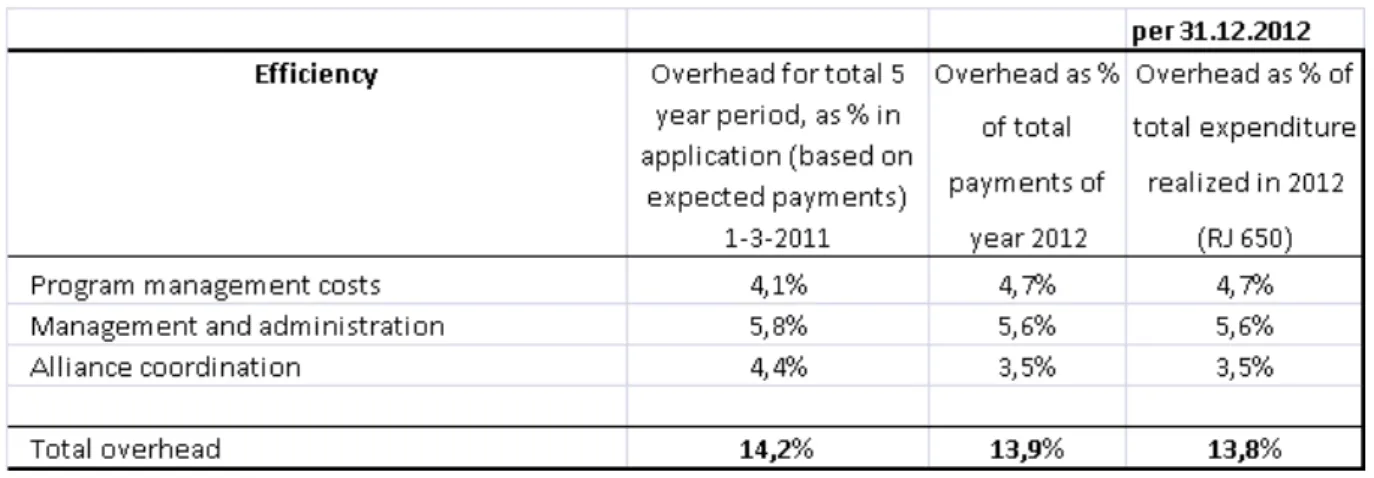
The efficiency of the DWA (measured as the percentage of overhead compared to total payments) has improved since last year from 15,7% to 13,9% and is within the plan (budgeted at 14,2%). The reason for improved efficiency is the increased implementation of programmes (from € 7.757 mln in 2011 to € 9.343 mln in 2012) relative to the overhead. Further efficiency will remain priority in the years to come.
Quality systems
All Alliance members received an unqualified opinion of their auditors for the year 2012 (goedkeurende controle verklaring).
This year the necessary governance structures and managerial processes were in place, country coordinators operational and Country Programme Partners on board in all 8 countries, so programme implementation accelerated. Besides managing the programme, attention of the WASH Management Unit and the Programme Managers went to the quality of country programmes. The Balanced Score Card (BSC) proved to be a helpful tool in managing the programme. Programme managers can see on one A4 sheet how the whole Alliance is performing, but can also see if they – as an individual Alliance member – are underperforming, or if a country is underperforming, and take corrective action. The ‘quality of performance of country programmes’ tool (part of the BSC) was used to analyse to what extent the country programmes take into account: integration of WASH, FIETS principles, working with multiple stakeholders and whether they work on Upscaling. In August Mid-‐Year Reviews were carried out in the countries, again using the same tool. We can conclude that the tool is very useful for analysing the progress of the country programme and using it as a tool for reflection. In terms of getting more stakeholders on board, progress is visible in linking with government. The involvement of the private sector is mainly in its initial stage, these processes take more time since working with the private sector is new to the majority of our partners. Various workshops in 2012 (such as the finance workshops) focused on creating a shift in thinking of our partners and this will remain focus of attention in 2013, e.g. through the Theory of Change planning workshops.
Much progress was made on internal and external communication and the visibility of the WASH Alliance. A communications officer was appointed, who developed the communication strategy called ‘Engaging Stakeholders’, which focuses on brand and communication management, internal communication and external communications. The FIETS sustainability approach is not only the shared way of working in the WASH Alliance, but also connects all partners on a value and believes level. This is reflected in brochures for external
communication. The Alliance had a stand at the Stockholm Water Week with banners explaining FIETS, which generated much attention and three leads for partnerships, a.o. with an investment fund and with Reed Elsevier for cooperation around their price called ‘the Environmental Challenge’, a price for innovation in WASH.
Revision of the logical framework took place to better reflect the perspectives of the six member organisations and for improved coherence. User-‐friendliness was enhanced and inconsistencies addressed, while retaining compliance with commitments made to the Ministry and the original baseline figures. The revised logical framework was approved by the Ministry in January 2013.
1
Introduction
1.1 Contents of this document
This report describes the achievements of the Dutch WASH Alliance (DWA) in 2012. Before the results of the Alliance are presented, the Dutch WASH Alliance and the context it works in are introduced in chapter 1. The first chapter starts with the description of some important trends in the WASH sector in 2012, followed by an overview of the characteristics of the DWA.
The remaining chapters describe the results of the DWA in 2012. Chapter 2 and 3 are about the programme results; which can be divided in ‘country activities’ and ‘international activities’ respectively. Country activities are those activities that are implemented by our partner organisations in all of the partner countries and that directly contribute to the result areas ‘Millennium Development Goals’ (MDGs) or ‘Southern Organisations’ (these result areas relate to Part 1 of the Monitoring Protocol, the so-‐called “Programme Part”). International activities are executed by the Dutch partners and thematic partners and contribute to the creation of an enabling environment for sustainable WASH services. Basically, these activities can be divided into two clusters; lobby and advocacy activities and linking and learning activities.
Chapter 4 deals with the results related to the organisation and management of the WASH Alliance, relating to Part II of the WASH monitoring protocol-‐ ‘the Organisation Part’. This chapter describes the financial situation (including own contribution, expenditures and efficiency of the Alliance), the quality of systems, lessons learned and the harmonization with other programmes.
1.2 Trends in the WASH sector
Quality of drinking water at household level
While access to safe drinking water is increasing worldwide at a pace that was not foreseen when the MDGs were drafted at the beginning of this millennium, there is still a problem in maintaining the quality of the water between the moment it is extracted from the source and the moment it is consumed. In practice, it seems that the quality of the water often significantly decreases during transport and storage, thereby annihilating much of the potential health benefits of improved water supply. This was an important finding of the IOB evaluation1. The importance of transporting, handling and storing water in hygienic ways should be emphasized at the consumer level, through education and behavioural change campaigns. Other feasible options are e.g. the usage of household water treatment.
Due to the advancing technical possibilities, household water treatment techniques become available for lower prices delivering higher quality of drinking water. The new options can be divided in two types: chemical water treatment and filtering of water. Both techniques are becoming affordable nowadays, even for the bottom of the pyramid. Companies are eagerly targeting this section of the population where there is a strong need for purification of water. As long as the problem with contamination during transport and storage of water is not totally solved, the market for household water treatment products will grow, which will significantly contribute to the improvement of health of the affected communities.
Water grabbing
In a world dictated by growth (growth of populations, growth of consumption, growth of wealth), water resources become scarcer every day. In the fight for water, powerful actors take more and more control of valuable water resources for their own benefit, depriving local communities whose livelihoods often depend on these resources and ecosystems. This trend is called water grabbing. In order to avoid that water grabbing will have disastrous consequences for the potential for development of marginalized communities, it is important to better regulate access to and use of water. Based on the right to drinking water, people that use the water for direct consumption should always have priority over other users. This has to be enforced by local governments through the development of integrated water resource management (IWRM) programmes that take into account the five pillars of sustainability (i.e. Financial, Institutional, Environmental, Technical, Social;
1
http://www.minbuza.nl/binaries/content/assets/minbuza/nl/import/nl/producten_en_diensten/evaluatie/afgeronde_onderzoeken/2011/impact- evaluation-of-drinking-water-supply-in-benin/iob-evaluatie-nieuwsbrief--11-09---impactevaluatie-drinkwater--en-sanitaire-voorzieningen-in-benin
FIETS). Moreover, governments of developed countries should enforce that multinationals take into account the right to drinking water for local communities in their policies. A study of Oxfam states that currently only 10% of the food multinationals take this into account.
Sanitation
Sanitation remains very much behind target under MDG 7. This is beginning to get global recognition. One of the important trends influencing sanitation is a growing global urbanisation, with a growing gap between rich and poor. The rich can afford western type of sanitation solutions like flush toilets, worsening the water shortage, while the poor in the slums in general do not have any sanitation facilities. Existing larger sanitation infrastructures, like public toilets, sewage lines, and waste water treatment facilities, in general are not being maintained or repaired by the public sector as they don’t have sufficient budget nor the capacities needed, and therefore pose a risk to public health. Increasingly the
private sector (mainly social enterprises) is involved as part of the solution, but this requires affordable prices to increase the willingness to pay.
At the same time there is another trend to link between food security and the WASH sector, which was the main topic in the 2012 World Water Week. Recognizing the importance of nutrient cycles, and thus the use of human waste as a resource for compost production, is a first step for the private sector to proof that there are ways to improve the profitability of sanitation services in conjunction with offering environmental sustainability. This will increase the affordability of public sanitation services.
Post MDG development
The MDGs have served as a shared framework for global action and cooperation on development since 2000. As the world approaches 2015, the overall target date for achieving the MDGs, thinking has begun on how to advance the global development agenda beyond 2015. It is important that water and sanitation will keep their position on this newly emerging agenda. In this respect, the fact that it is likely that environmental goals will be included in this new framework might be seen as a challenge but also as an opportunity. Water and sanitation might lose their independent position on the agenda, but the right to drinking water as part of an IWRM framework and the right to sanitation as part of a framework that addresses a clean living environment might serve as strong new paradigms that serve the mission and vision of the WASH sector.
There is a shift from ‘development cooperation’ to ‘international cooperation and trade’, which in the Netherlands is also marked by the new ministers’ post for ‘international trade and development cooperation’. Private sector will undoubtedly play an important role in the new framework. The WASH Alliance welcome this development and is already closely working with the local private sector in the country programmes, as it believes that the involvement of the private sector is essential for delivering sustainable WASH services to the poor. Equally it will be a challenge to engage (big) corporations to take into account the water rights of local communities when doing business.
Trends and the WASH alliance programme
The WASH alliance reacts on and incorporates the trends in the sector as much as possible. Many trends described above are already part of the WASH Alliance programme at conceptual level as well as at programme level:
• A hygiene component is part of our integrated WASH approach and offered in all our country programmes: it is our firm belief that Water, Sanitation and Hygiene should be offered in conjunction for programmes to be effective in improving sustainable access to water and sanitation.
• In our programme we have higher focus and targets on sanitation, because it is lagging behind in the results under MDG 7. Our sanitation programme focuses on both rural as well as urban slum sanitation and uses a business approach.
• The cooperation with the local private sector is at the core of the ‘financial sustainability’ we are trying to achieve. This includes cooperation with Micro Finance Institutions and Cooperatives to provide
loans to both consumers as well as to companies involved in construction, operation and maintenance of WASH facilities. We also provide training to the above-‐mentioned companies. It also includes research and pilots on the productive use of waste.
1.3 Introduction to the Dutch WASH Alliance
The WASH Alliance was formed by six Dutch Civil Society Organisations (CSOs) with extensive experience in WASH: Simavi, Akvo, AMREF, ICCO, RAIN and WASTE. They cooperate with six thematic partners in the North: Wetlands International, IRC (International Water and Sanitation Centre), WaterAid, Both ENDS, PRACTICA Foundation and ETC. A much broader group of Southern and Northern CSOs cooperates with the WASH Alliance. In total, the DWA currently works with close to seventy southern partners in eight countries: Bangladesh, Nepal, Ethiopia, Uganda, Kenya, Mali, Benin and Ghana. In these countries the formation of formal or more informal Southern WASH Alliances is being facilitated with the help of the country coordinators.
This broad cooperation offers unique added value. Firstly, a combined outreach and impact, by bringing to the sector increased learning, better focus and critical mass. Secondly, sustainability of WASH service delivery through the systematic joint adherence to five key sustainability principles, called ‘FIETS’: Financial, Institutional, Environmental, Technological and Social sustainability. Thirdly, true integration throughout the programme is achieved, covering the entire WASH chain from water supply to sanitation and hygiene promotion on community to international level. And fourthly, an emphasis on in-‐country and cross-‐country linking and learning, by building networks and using innovative web-‐based ICT tools.
The main objective of the DWA’s five year programme (2011 -‐ 2015) is to achieve increased sustainable access to and use of safe water and sanitation services and improved hygiene practices for women and marginalised groups. In order to ensure harmonisation and ownership, the WASH Alliance has followed a careful participatory methodology while developing the programme.
To implement its coordinated water, sanitation and hygiene programme, the members of the DWA work with their country programme partners in a multi-‐stakeholder approach. This involves stakeholders from Civil Society, private and public sector: building Civil Society from the community level up to the local, national and international level, strengthening CSOs and key stakeholders as well as the networks that link them. The main objective is to ensure that all relevant stakeholders have the capacity to perform well, leading to improved and sustainable access to safe drinking water, improved sanitation and hygienic living conditions.
The WASH Alliance is closely working with the local private sector in the country programmes, as it believes that the involvement of the private sector is necessary to bring sustainable WASH services to the poor. Equally it will be a challenge to engage (big) corporations to take into account the water rights of local communities when doing business. Besides the country programmes, an international activities component has been developed to create an enabling environment for sustainable WASH services, which focuses on lobby and advocacy as well as on linking and learning.
This main objective and the multi-‐stakeholder approach to strengthen civil society are translated into two supporting objectives:
1) Increased improved access to and use of safe water and sanitation services and improved hygiene practices.
2) Civil society actors are strengthened to jointly and individually respond better to the needs of the communities and influence decision-‐making on WASH service delivery.
The ultimate beneficiaries of the programme are marginalised people in the eight developing countries, with a special emphasis on women and marginalised groups, who lack access to and use of safe drinking water, improved sanitation and hygienic living conditions. During the five year period, the programme aims to provide access to an additional 1,2 million people with improved sanitation facilities and an additional 440,000 people with improved drinking water facilities, mostly in rural areas, through country programme partners and multi-‐ stakeholder platforms.
Another target group are the country programme partners and public and private stakeholders, whose capacities are enhanced to build up a strong Civil Society. The ultimate goal of the WASH Alliance is to create a
‘systems change’, through the FIETS approach and Multi Stakeholder Approach, where civil society, public and private sector all play their different roles in providing sustainable access to WASH services, without any international development cooperation subsidies.
The governance model of the DWA can be summarized as follows:
In the North: the steering committee (directors) provides strategic guidance to the Alliance, the programme group (programme managers of each alliance member) provides the daily operational management. The lead agency (Simavi) is responsible to oversee the quality of programme implementation and ensuring requirements of the subsidy are adhered too. Simavi’s Supervisory Board holds final oversight over Simavi’s role as lead agency. The programme staff of the alliance members are organised into country teams, which are coordinated by the country lead. The country lead coordinates the WASH programme for a country, is the link for external harmonisation activities and liaises with the corresponding country coordinator on coordination between the country programme partners.
In the South: all country programme partners work together to form the WASH Alliance country programme. Some countries have a structured alliance with a steering committee, other countries do not have such a formalized structure. In all the countries local country coordinators have been appointed to facilitate the process of multi-‐stakeholder alliance formation and develop an integrated WASH programme.
2
Programme Results – country activities
2.1 Introduction
Chapter 2 is the first of two chapters that describe the programme results. While chapter 3 deals with the results concerning ‘international activities’, this chapter focuses on the ‘country activities’ results. Country activities are those activities that are executed by our partner organisations in the eight country programmes and that directly contribute to the result areas “Millennium Development Goals” (paragraph 2.2) or “Southern Organisations” (paragraph 2.3) (Part 1 of the Monitoring Protocol, the so-‐called “Programme Part”).
In all countries the programme is being implemented as planned, except for Mali. Due to the crisis in Mali since the coup d'état on 21 March 2012, the DWA was forced to adapt its programme. As the WASH Alliance programme strategy is designed for sustainable development and not for relief and rehabilitation, it was decided to withdraw from Mopti area (except for Koro), and reorient the programme towards the ‘South’, i.e. Sikasso and Koulikoro for the full DWA programme duration, where a sustainable WASH programme can be developed and implemented.
2.2 Result Area 'MDGs'
This paragraph deals with all the achievements under the result area on the MDGs (for the WASH Programme most notably MDG 7c, but also MDG 7a and MDG 1) based on the data from the WASH Alliance country reports, and DWA country programme partner reports.
Annex 1 provides the Results’ Framework as requested by the Ministry with an overview of the results reached in 2012 against the set targets for 2012 and 2015. The overall conclusion is that after its second year of implementation the WASH Alliance is well on track in terms of output achievements. In a number of cases actual results have exceeded the set targets; in other cases a number of countries are on track while others are behind.
A detailed reflection on the progress by output is given by following the WASH Alliance logical framework as this provides better insight into the intertwined relationship between the various components of the DWA programme. As explained in paragraph 4.6 the logical framework is revised around the following two main objectives:
• Objective 1. Increased sustainable access to and use of safe water and sanitation services and improved hygiene practices
• Objective 2. Civil society actors are strengthened to jointly and individually better respond to the needs of the communities and influence decision making on WASH service delivery
To ensure that interventions of the WASH Alliance programme lead to truly sustainable change, an integrated and holistic framework has been developed consisting of five sustainability principles: Financial, Institutional, Environmental, Technological and Social. Together, they form the FIETS sustainability principles, which have been adopted as the leading principles in the WASH programme with the aim to enhance a systems change. The WASH Alliance strengthens the civil society and believes that only if civil society, private sector and government cooperate to address all FIETS sustainability elements, sustainable WASH services can be delivered which are inclusive for women and marginalised groups. This requires first a shift in thinking and acquiring new knowledge of our country programme partners, then a change in the implementation of the programmes away from ‘business as usual’, towards a fully sustainable integrated WASH approach. Most of the output indicators have been formulated in terms of capacity building of all the stakeholders involved on the FIETS elements, or on products or cooperation structures that contribute to the FIETS elements and are thus expected to contribute to this systems change. However, the extent to which output results contribute to the systems change is not fully clear and will be part of examination in the Mid-‐Term Evaluation to be carried out in 2013.
The progress data by country are presented in Annex 2. The revision of the logical framework caused some challenges as work plans were based on the first logical framework and reporting had to be done on the revised version. Changes in the formulation of indicators as well as the introduction of new indicators are difficult to communicate to all the various levels of the Alliance. This resulted in some country programmes submitting incomplete targets. At the same time it is, yet again, noticed that partner organisations are finding it difficult to report their work against the alliance framework. Now that the logical framework has been made more coherent and user-‐friendly, it is hoped that reporting on outputs will be easier next year and the data thus of better quality. Since PME has been identified as a point of attention for most of the country programme partners, extra budget has been set aside to train and guide country programme partners on outcome monitoring which is to be done at the end of 2013. When we monitor the outcome, this is also a good time to re-‐evaluate the output targets for 2015 and see if they need to be adjusted (some outputs for 2015 now appear to be rather low as compared to the 2012 output).
Objective 1. Increased sustainable access to and use of safe water and sanitation services and improved hygiene practices
Table 1 provides an overview of the outputs (the white rows) under objective 1 with corresponding indicator, targets and, where relevant, gender-‐specific 2012 achievements. Adjustment of the indicators led in many cases to a change of unit of measurement which hinders adding up the 2011 achievements to the 2012 ones which is why they are not presented in the tables. Results reached are elaborated in the text below. General explanations will be provided as well as examples of activities that took place in the eight country programme countries.
Result Indicator 2012 result male female
Objective 1 Increased improved access to and use of safe water and sanitation services and improved hygiene practices Outcomes under objective 1
Outcome 1 The access and use of improved sanitation facilities has significantly increased by the end of 2015
Number of people that use improved sanitation facilities Outcome 2 The access of and use of improved safe (drinking) water has
significantly increased by the end of 2015
Number of people that use improved drinking water sources Outcome 3 The target population has significantly improved its hygiene and
sanitation practices by the end of 2015
(research activity)
Intermediary outcome
F 4 The role of the private sector in the WASH service delivery has significantly increased by the end of 2015
(research activity) Output 5 Small producers, businesses and service providers are trained
and/or supported to play an increased role in improved WASH service delivery
Number of people (small producers, businesses or service providers) trained and/or supported on WASH service delivery
no target set (1) 3.661 1.338 2.313
Intermediary outcome
6 Locally based financial institutions finance WASH activities for consumers or for service providers as part of their normal operations by the end of 2015
Number of credit products for WASH that have been institutionalised
Output 7 Locally based finance institutions pilot credit for WASH service construction, operation and maintenance
Number of pilots on credit for WASH service construction, operation and maintenance developed and tested
6 (2) 11 +63 in Bangladesh n/a n/a Intermediary outcome
8 The local public WASH budget has increased by the end of 2015 Number of countries where, in the areas where the Alliance is working, the local public WASH budget has increased Output 9 The country programme partners lobby for increased WASH
financing
Number of lobby meetings attended by the Alliance representatives
200 (2) 172 n/a n/a
Output 10 Country programme partners and WASH networks are capacitated on methodologies to track budgets
Number of people from country programme partners or other WASH stakeholders trained on budget tracking methodologies
80 (2) 245 175 69
(1) The 2015 target had not been (re)defined because the result is new or because the indicator was adjusted when the logical framework was revised. (2) Based on the outcomes of the MTE and the outcome monitoring data end of 2013 this 2015 target is likely to be revised upwards.
(3) When a target is expressed in number of countries it means that each country has defined its own target. This way each country programme can conxtualize the aimed results. (4) Progress on this result will not be measured quantitatively but rather be followed with case studies or research activities
2012 target Table 1. WASH Alliance 2012 achievements by output
5
148 82
Main Objective:
Intermediary outcomes (and corresponding outputs)
14 +8 in Bangladesh 2015 target 1.206.000 441.000 no target (4) no target (4) 3 817
Result Indicator 2012 result male female
Intermediary outcome
I 11 Improved coordination between WASH stakeholders (business sector, public sector and civil society) to respond to the need for improved WASH services by the end of 2015.
Number of countries where multi-stakeholder WASH programmes are (being) implemented
Output 12 Active WASH stakeholders coordination structures exist Number of countries with active WASH stakeholder coordination structures in the areas where the Alliance is working
7 (3) 6 6 n/a n/a
Intermediary outcome
13 The public sector fulfils a leading and coordinative role in the WASH sector by the end of 2015
(research activity) Output 14 The local government departments are capacitated to fulfil a leading
and coordinative role in the WASH sector
Number of government representatives of local departments trained on their role in the WASH sector
no target set (1) 1.021 671 350
E / /
Intermediary outcome
T 15 Technical sollutions are locally acceptable and based on the principles of appropriate technology
(research activity)
S / /
Intermediary outcome
16 Increased awareness within the government institutions has been established regarding the practical implications of the right to (drinking) water and sanitation (RTWS) and inclusion in WASH policy and programme design by the end of 2015.
Number of measures taken within governmental institutions as a result of the awareness on the practical implications of the RTWS
no target set (1)
Output 17 Local government departments trained on RTWS (NEW) Number of government representatives of local departments trained on RTWS
no target set (1) 719 835 621 214
Output 18 The population having access to improved sanitation systems at public places like schools, health centers and markets has significantly increased
Number of people that have access to improved sanitation facilities in public places like schools, health centres and markets
200.000 104.885 74.935 36.358 38.587
Output 19 The access to improved drinking water sources has significantly increased
Number of people that have access to improved drinking water sources
100.000 (2) 112.109 122.288 59.134 59.742
Output 20 There is a significant increase in the number of campaigns on hygiene and sanitation
Number of people that are reached with awareness campaigns on hygiene and sanitation
1.000.000 339.561 318.098 285.316 173.360
Output 21 There is a significant increase in the number of campaigns on hygiene and sanitation
Number of people that are reached through the media on hygiene and sanitation
10.000.000 3.169.196 4.248.368 2.114.328 2.134.040 (1) The 2015 target had not been (re)defined because the result is new or because the indicator was adjusted when the logical framework was revised.
(2) Based on the outcomes of the MTE and the outcome monitoring data end of 2013 this 2015 target is likely to be revised upwards.
(3) When a target is expressed in number of countries it means that each country has defined its own target. This way each country programme can conxtualize the aimed results. (4) Progress on this result will not be measured quantitatively but rather be followed with case studies or research activities
2012 target
7
n/a (4)
598
n/a (4)
Outputs directly contributing to an outcome (not through an intermediary outcomes)
Out of the 11 outputs that fall under this objective 8 are on track or score higher than the 2012 target. Output 7 (pilots on credit products), output 18 (access to improved sanitation systems at public places) and output 20 (number of campaigns on hygiene and sanitation) are behind the 2012 targets. The achieved results on these 3 outputs are however sufficient to reach the targets set for 2015. The 2012 targets were set by the countries itself and were high – and perhaps unrealistic -‐ compared to the 2015 target, which was set by the DWA.
Results on Financial sustainability
The DWA has four outputs under the financial sustainability component that support the private sector in playing a more prominent role in WASH service delivery, in having better access to credit with local finance institutions and in ensuring an increased local public WASH budget. The goal of ‘financial sustainability’ is that WASH services can be financed locally, without subsidies from the international donor community. On the four outputs the overall achievements reflect the DWA is well on track, differences between country programmes however exist. Below examples provide insight into the different country level activities.
Output 5 on support and training of small producers, businesses and service providers in improved WASH service delivery is well on track. By supporting local service providers the WASH Alliance aims at ensuring local expertise for installation, operation and maintenance thereby moving away from the dependency on external subsidies. Female target groups are reached, with an average female participation of 63%. For example in Benin a range of efforts have been taken, such as the training of small private entrepreneurs (e.g. pit-‐emptiers, masons, welders) on setting up business plans. In addition, maintenance agencies for private health care centres received training on hygiene in a sanitary environment and training on health care waste. In the commune of Sinendé, masons received training on the constructions of latrines of the ‘Mozambique’ type. In Dalle San Plat the carters (waste transporters) learned about organizing and working within a structure for pre collection and welders learned how to make motorized carts for household waste collection. In Ghana, practical trainings were organized in soak-‐away and simple latrine construction for a group of 42 artisans (in Kpanvo in the Tamale south Metropolis and Aduyili in the central Gonja District). This led to construction of latrines in 21 communities.
In Ethiopia, as a result of the WASH Finance training, a plan was developed to identify 9 enterprises. During the training financial institutions such as Eshet Micro Finance, Bosa-‐ Gonofa Micro Finance, Commercial Bank of Ethiopia participated and reflected on these 9 business ideas, like shower and cars wash services in Awash, waste and urban agriculture in Dire Dawa. This has however not yet resulted in funding for these enterprises. In spite of this
one WASH enterprise was set up (see box). The WASH Alliance will thus continue to invest in this area in the coming years.
The second example is result 7 on the number of pilots developed and tested on finance mechanisms for WASH (e.g. micro-‐financing and self-‐help groups). In 2012 14 pilots were planned. Eleven pilots in seven countries were set up. Uganda and Mali each contributed with four pilots. Progress on this indicator is behind schedule in Benin, Ethiopia, Ghana and Nepal. In Benin, for example, attempts were made to link up with local financial institutions (e.g. Ecobank, CLCAM, PADME, Sian-‐Son, Pepco) to set up new pilots but partners met with difficulties. MFIs and banks are not accustomed to activities related to water, sanitation and hygiene. By collecting evidence an effort is being made to convince these institutions, but this is a long-‐term process. In Nepal, country partner organisation Lumanti has started a partnership with a women-‐led savings and credit cooperative to provide sanitation loans with a subsidized interest rate to their beneficiaries. Lumanti has provided the capital to the cooperative, and the small amount of capital limits the number of beneficiaries under the otherwise successful credit scheme. In order for the scheme to be fully sustainable, non-‐subsidized interest rates need to be charged, and this will require further development of the scheme. Nepal country programme partners have further been successful in setting up water user committees, which collect fees for the operation and maintenance of community operated water schemes.
WASH business in Ethiopia
In Ethiopia partners had limited experience with linking water and sanitation facilities to business models. In 2012 partners managed to set up a WASH business at a bus station. They constructed public showers (2 for men 2 for women) near the public latrines. It aims at providing a service due to absence of water within the vicinity for cleaning and hand washing. These showers now generate income through user fees that can be used for the operation and maintenance of the scheme.