MOOL: an Object-Oriented Programming Language with Generics and Modules.
by
María Lucía Barrón Estrada
Maestro en Ciencias, en Ciencias Computacionales Instituto Tecnológico de Toluca
México
Licenciado en Informática Instituto Tecnológico de Culiacán
México
A dissertation submitted to Florida Institute of Technology in partial fulfillment of the requirements
for the degree of
Doctor of Philosophy in
Computer Science
Melbourne, Florida May, 2004
© Copyright 2004 María Lucía Barrón Estrada All Rights Reserved
We the undersigned committee hereby recommend that the attached document be accepted as fulfilling
in part the requirements for the degree of Doctor of Philosophy in Computer Science
“MOOL: an Object-Oriented Programming
Language with Generics and Modules,” a dissertation by María Lucía Barrón Estrada
_________________________________ Ryan Stansifer, Ph.D.
Associate Professor, Computer Sciences Dissertation Advisor
_________________________________ Phil Bernhard, Ph.D.
Associate Professor, Computer Sciences
_________________________________ Pat Bond, Ph.D.
Associate Professor, Computer Sciences
_________________________________ Dennis E. Jackson, Ph.D.
Associate Professor,
_________________________________ William Shoaf, Ph.D.
iii
Title:MOOL: an Object-Oriented Programming Language with Generics and Modules.
Author: María Lucía Barrón Estrada
Major Advisor: Ryan Stansifer, Ph.D.
Modern object-oriented languages like Java and C# do not support parametric polymorphism and do not have a traditional module system to allow the development of large systems. They overload the class mechanism with several tasks and they use packages and namespaces to organize clusters of classes providing weak control for accessing members. Other languages that support generic programming and objects do not have a simple object model to support object-oriented features.
In this thesis the language MOOL is presented. MOOL is a class-based object-oriented language that supports modular programming and genericity.
The main goal in the design of MOOL was simplicity rather than efficiency. MOOL contains separated mechanisms for different concepts like classes and modules, which are unified in other languages. MOOL is not a pure object-oriented language where everything is an object. Non-object features like functions and modules are part of the language to enhance expressivity, to structure programs and to support code reuse.
iv
Keywords ...viii
List of Figures... ix
List of Tables ... xii
Acknowledgement ...xiii Dedication ... xiv Chapter 1. Introduction... 1 1.1. Problem description ... 3 1.2. Road map ... 4 Chapter 2. Modules ... 6 2.1. Concepts... 7 2.2. Modularity goals ... 9 2.3. Kinds of modules ... 11
2.3.1. Modules and interfaces... 12
2.3.2. Libraries... 13
2.3.3. Shared data areas ... 13
2.3.4. Generic modules... 14
2.3.5. Parametric generic modules ... 15
2.4. Examples in some programming languages... 17
2.4.1. Ada packages... 18
2.4.2. Modula-3 modules... 18
2.4.3. SML structures, signatures, and functors ... 20
2.4.4. Objective Caml... 22
2.4.5. Java packages ... 23
2.4.6. C# namespaces and assemblies ... 26
2.4.7. Dylan ... 27
Chapter 3. Object-Oriented Concepts... 29
3.1. Classification of object-oriented languages ... 30
3.1.1. Passive languages ... 30
3.1.2. Active languages ... 31
3.1.3. Multimethod languages ... 33
3.2. Abstract data types and objects... 36
v
3.4. The special variables this and super... 42
3.5. Inheritance... 42 3.5.1. Single inheritance ... 43 3.5.2. Multiple inheritance... 45 3.5.3. Mixin inheritance... 47 3.5.4. Interface inheritance ... 49 3.6. Polymorphism ... 51
3.7. Types and Subtypes ... 53
3.8. Some other concepts ... 57
3.8.1. Type equivalency... 57 3.8.2. Typechecking ... 57 Chapter 4. Generics... 59 4.1. Parametric polymorphism ... 60 4.2. Kinds of genericity... 61 4.2.1. Unconstrained genericity... 62 4.2.2. Constrained genericity... 63
4.2.2.1. Simply bounded genericity ... 64
4.2.2.2. Recursively bounded genericity... 67
4.3. Translation... 70
4.3.1. Homogeneous ... 71
4.3.2. Heterogeneous ... 73
4.3.3. Hybrid... 75
4.4. Examples of generics in some PL... 77
4.4.1. Templates in C++ ... 77
4.4.2. Parameterized classes in Pizza ... 79
4.4.3. Virtual binding in BETA ... 80
4.4.4. Class substitution in BOPL ... 82
Chapter 5. Analysis and Goals... 84
5.1. Core features ... 85
5.2. Classes or objects? ... 86
5.3. Type annotations and typechecking... 88
5.4. Subtypes ... 89
5.5. Inheritance... 93
5.6. Bindings ... 95
5.7. OOL without modules... 97
5.7.1. Roles of the class in Java... 100
5.7.2. Modularity problems in object-oriented languages... 102
5.7.2.1. Structures that need no local data... 102
vi
5.8.2. Second approach: specialized code for each type ... 114
5.9. Language design goals ... 118
Chapter 6. MOOL ... 120
6.1. Definitions... 121
6.2. Types and Subtypes ... 124
6.2.1. Predefined boolean and numeric types... 125
6.2.2. Class interfaces... 126 6.2.3. Classes ... 127 6.2.3.1. Class variables... 129 6.2.3.2. Fields... 129 6.2.3.3. Constructors ... 129 6.2.3.4. Methods... 130 6.2.3.5. Inheritance... 130 6.2.3.6. Class hierarchy... 131
6.2.3.7. The special variables this and super... 131
6.2.4. Functions ... 131 6.2.5. Subtyping rules... 132 6.3. Expressions ... 135 6.3.1. Constant expressions ... 135 6.3.2. Literals... 135 6.3.3. Operands... 135 6.3.4. Function call ... 136 6.3.5. Operators ... 136 6.4. Declarations... 138 6.4.1. Modifiers ... 139 6.4.2. Constants ... 139 6.4.3. Variables... 140 6.4.4. Functions ... 140 6.4.5. Types ... 140
6.4.6. The import declaration ... 141
6.5. Statements ... 142
6.5.1. Assignment statement... 142
6.5.2. Function call statement... 143
6.5.3. Sequential composition ... 143
6.5.4. Block statement ... 144
6.5.5. Selection ... 144
6.5.5.1. The if statement... 144
6.5.5.2. The switch statement... 145
vii
6.5.7. The continue, return, and break statements ... 147
6.6. Modules and module interfaces ... 148
6.6.1. Module interface... 148
6.6.2. Module implementation... 149
6.6.3. Classes inside modules ... 150
6.6.4. Separate compilation ... 152 6.7. Generics... 152 6.7.1. Type variables ... 153 6.7.2. Type constraints... 154 6.7.2.1. Unconstrained genericity ... 154 6.7.2.2. Constrained genericity ... 155 6.7.3. Generic types ... 156
6.7.4. Subtyping rules for parameterized types ... 158
Chapter 7. Language Evaluation ... 159
7.1. Methodology ... 161
7.2. Examples approached in MOOL... 162
7.2.1. Structures that need no local data... 163
7.2.2. Structures with dependencies on other structures ... 166
7.2.3. Generics classes and interfaces ... 169
7.2.4. A generic sort function ... 172
7.2.5. Inheritance and binary methods... 175
7.2.6. A problem with mixin inheritance... 177
Chapter 8. Conclusions... 179
8.1. The traditional “Hello World” program ... 180
8.2. Comparison of MOOL and other OOL... 182
8.3. Contributions... 185
8.4. Future work ... 186
References ... 187
viii Class Inheritance Interface Generics Modules Objects Object-oriented programming Parameterized types Polymorphism
Programming languages: Ada, BeCecil, BETA, C#, C++, Cecil, CLOS, Dylan, Eiffel, GJ, Jam, Java, Kevo, Mesa, MOBY, Modula-3, OCaml, Pizza,
PolyTOIL, Self, Simula, Smalltalk, and SML. Subtype
ix
Figure 2.1. Abstraction, encapsulation and information hiding... 9
Figure 2.2. A software architecture design ... 12
Figure 2.3. A Math library interface and implementation in Modula-3... 13
Figure 2.4. A module with a shared data area in Ada... 14
Figure 2.5. A package as a data structure manager... 14
Figure 2.6. A generic package in Ada... 15
Figure 2.7. A parametric generic package in Ada... 16
Figure 2.8. An interface and module implementation in Modula-3... 19
Figure 2.9. Signatures, structures, and functors in SML... 21
Figure 2.10. Modules in OCaml... 23
Figure 2.11. Java packages... 25
Figure 2.12. C# namespaces and assemblies ... 26
Figure 2.13. A module definition in Dylan... 27
Figure 3.1. A classification of object-oriented languages... 30
Figure 3.2. Prototypical objects in Self and Kevo ... 32
Figure 3.3. Overloaded generic functions in BeCecil... 35
Figure 3.4. A class and a subclass definition in Java... 38
Figure 3.5. Dynamic method invocation with single dispatch... 39
Figure 3.6. Dynamic method lookup in BETA... 40
Figure 3.7. Executing generic functions in BeCecil ... 41
Figure 3.8. Definition of classes using single inheritance ... 43
Figure 3.9. A hierarchy of classes with single inheritance ... 44
Figure 3.10. Class definition with multiple inheritance... 45
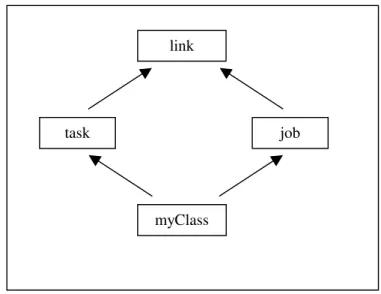
Figure 3.11. The diamond problem... 46
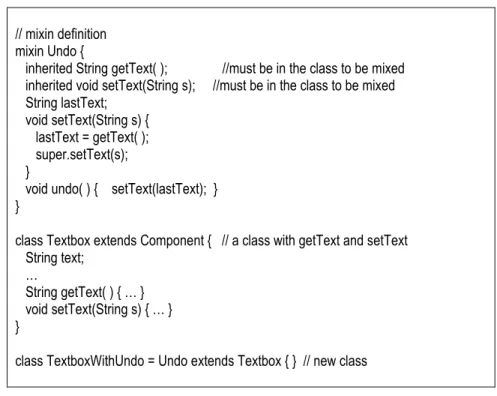
Figure 3.12. Mixin inheritance... 48
Figure 3.13. A mixin declaration and its use to produce a new class ... 48
Figure 3.14. An example of multiple inheritance of interfaces... 49
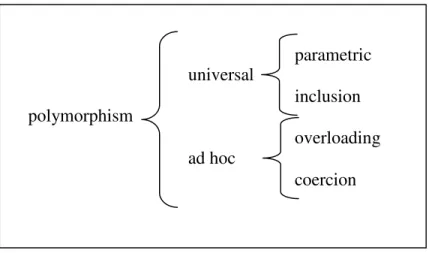
Figure 3.15. Kinds of polymorphism ... 51
Figure 3.16. Rule of subsumption... 53
Figure 3.17. Subtype rule for functions ... 54
Figure 3.18. Subtype rules for records ... 55
Figure 3.19. Binary method problem in Eiffel and Java... 56
Figure 4.1. Two Polymorphic functions in Objective Caml ... 60
Figure 4.2. Parameterized class stack written in Eiffel... 62
Figure 4.3. Two instantiations of class STACK ... 63
Figure 4.4. A parameterized class with a simple bound in GJ... 65
x
Figure 4.8. Subclasses cannot be used as type parameters ... 69
Figure 4.9. Translation of a parameterized class... 72
Figure 4.10. A template class with two instantiations ... 74
Figure 4.11. A parameterized class with two instantiations in C#... 76
Figure 4.12. Stack template in C++ ... 78
Figure 4.13. A definition of a parameterized class in Pizza... 79
Figure 4.14. Instantiation of the parameterized class Stack... 80
Figure 4.15. Generic Stack in BETA ... 81
Figure 4.16. Stack definition and instantiation in BOPL... 83
Figure 5.1. An example of a simple class in PolyTOIL... 92
Figure 5.2. A typical definition of a class Math... 103
Figure 5.3. Using inheritance to access a library member ... 104
Figure 5.4. Using composition to access a library member ... 104
Figure 5.5. Java definition of class Math in java.lang.Math... 105
Figure 5.6. Importing static class members ... 106
Figure 5.7. Separated classes with dependencies... 107
Figure 5.8. Classes in a package ... 108
Figure 5.9. Inner class ... 109
Figure 5.10. A stack in Java and C# using the generic idiom... 113
Figure 5.11. Specialization of stack for type int ... 115
Figure 6.1. Static and runtime type in MOOL ... 125
Figure 6.2. A class interface declaration in MOOL... 127
Figure 6.3. Two class declarations in MOOL... 128
Figure 6.4. Functions and function types in MOOL ... 132
Figure 6.5. Examples of expressions with primary operators... 137
Figure 6.6. Examples of expressions with unary operators ... 137
Figure 6.7. Examples of expressions with binary operators ... 138
Figure 6.8. Examples of constant, variables, functions, and types ... 141
Figure 6.9. Example of the import declaration ... 141
Figure 6.10. Examples of the assignment statement... 142
Figure 6.11. Sequence of statements... 143
Figure 6.12. Examples of if and switch statements... 146
Figure 6.13. Examples of for and while statements... 147
Figure 6.14. Example of a module interface... 149
Figure 6.15. A module implementation ... 150
Figure 6.16. A module interface and a module implementation... 151
Figure 6.17. Examples of unconstrained type variable... 154
Figure 6.18. Some instantiations of class List<T>... 155
Figure 6.19. A parameterized class with a constrained type parameter... 155
xi
Figure 7.2. A program using the library of mathematical functions... 164
Figure 7.3. Java’s Math library and two programs using the library ... 165
Figure 7.4. A module interface and implementation of a linked list... 168
Figure 7.5. A module interface and implementation of a generic stack ... 170
Figure 7.6. Creating instances of a generic stack class ... 171
Figure 7.7. A module interface and implementation of a generic sort... 173
Figure 7.8. A module implementation using a generic function... 174
Figure 7.9. Inheritance and binary methods in MOOL... 176
Figure 7.10. Implementation of a mixin class in MOOL... 178
Figure 8.1. Comparing “Hello world” in MOOL and Java... 180
xii
Table 6.1. List of keywords and reserved words ... 122
Table 6.2. List of types... 124
Table 6.3. Predefined numeric and boolean types in MOOL ... 126
Table 6.4. Subtyping relation for classes and interfaces... 134
Table 6.5. Primary operators... 137
Table 6.6. Unary operators... 137
Table 6.7. Binary operators... 138
Table 6.8. Visibility of methods inside the module implementation ... 152
Table 6.9. Visibility of methods outside the module implementation ... 152
Table 8.1. Features related to types... 183
Table 8.2. Statements ... 183
Table 8.3. Features related with modules and genericity... 184
xiii
I would like to express my gratitude to my advisor Dr. Ryan Stansifer. His patience, support, and guidance during these past years helped me to accomplish this goal.
I would also like to thank the other members of my committee Dr. Pat Bond, Dr. Phil Bernhard, and Dr. Dennis E. Jackson for their valuable comments.
I’m grateful for the financial support I received from the Mexican Government and Instituto Tecnológico de Culiacán. Without their support I could not have completed this work.
Special thanks go to my family in México: To my mother, Lucia, who always encouraged me to pursue a professional career. To my father, Eulogio, who supported and helped me in many different ways. To my sisters Arminda, for being my role model, Maguie, Lety, and Norma for their help, my brothers Adolfo, Hernán, César, Javier, Eduardo, and Jesús for their unconditional love. To my niece Lucia Margarita and her dad Jorge for being there when I needed them.
I want to thank my husband, Ramon for helping me to accomplish this project and my daughters Naomi, Ana, and Lucia for their love and company.
1
Introduction.
In the past few years the focus of many researchers has been the inclusion of polymorphism in the two popular object-oriented languages, Java and C# [BCK+ 01, BCK+ 03, BOSW 98a, CS 98, EKMS 97, MBL 97, OW 97, T 97, V 01b, and KS 01].
At the same time, the concept of module doesn’t seem to exist in these two languages, in which the class is the only structuring mechanism for programs [GJSB 00, C# 01]. Modules are constructs used to build large programs, supporting encapsulation and information hiding and are of a different nature from classes. Some researchers have recognized the importance of having a module system in object-oriented languages [S 92, FF 98, BPV 98, AZ 01].
The lack of a module system in object-oriented languages leads to overloading the class with different purposes. And, the absence of parametric polymorphism obligates the programmer to implement non-natural solutions resulting in many problems.
These two problems motivated this work. The main goal of this dissertation is the design of a programming language that supports parametric polymorphism to
develop generic code, provides a module construct to safely create large programs, and supports object-oriented programming. Our main goal in the design is simplicity, i.e., keep the language as simple as possible.
The design of a programming language involves many decisions when selecting the features of the language and their interaction with each other. Many concepts are not included in the language. Out of the scope of this thesis are:
• Exception handling. • Concurrency.
• Parallel programming. • Implementation details. • Formal semantic definition.
We have designed a Modular Object-Oriented Language called MOOL. The language is designed to support the development of small or large programs. Small programs, which express the details of algorithms and data structures, can be created in a single module implementation with a standard predefined module interface. The language allows the definition of several modules and module interfaces to support “programming in the large”. Interconnected modules and module interfaces express the way the system is organized. Object-oriented programming is achieved by the use of classes and other features that are
part of the language. Parameterized types and type variables are also part of the language to support the definition of generic code.
1.1. Problem description.
In the 1970’s modules were recognized as an important mechanism for structuring large programs. Programming languages which incorporate modules were designed to satisfy three important principles in the development of software: encapsulation, information hiding, and separate compilation. A module is a static entity that contains an interface to describe how a module can be interconnected with other modules. Modules are neither types nor extensible structures.
Object-oriented languages appeared with Simula and were popularized by Smalltalk and C++ in the 1980’s. Object-oriented languages and methodologies have been widely used in the development of software over the past decade. Designers of object-oriented languages have decided to adopt only one structuring mechanism (the class) trying to reduce the number of concepts in the language. As a result, the class mechanism is overloaded with several functionalities and the concept of class is blurred. The absence of a module system in these languages does not allow one to express some concepts naturally.
Parametric polymorphism has proven to be a valuable feature that is not part of several widely used object-oriented programming languages. Several approaches
can be taken to implement generic code, but the solutions suffer from various problems.
Our challenge is to design an object-oriented programming language that supports the definition of modules to structure large programs and allows generic programming to write polymorphic code that can be used with several types.
1.2. Road map.
Chapter 2 presents concepts related to modularity. It describes the module system of some programming languages as well as other mechanisms used in some object-oriented languages that do not have a module system.
Chapter 3 includes a classification of object-oriented programming languages and describes the most important concepts related to object-oriented programming languages. The chapter contains examples of these concepts in several languages.
Chapter 4 explores concepts related to generics. It describes different kinds of generic code and different translation approaches implemented in different languages. It also presents examples of generic programming in several programming languages.
Chapter 5 sets up the goals of the new language design. It analyzes the concepts that need to be included in the language.
Chapter 6 introduces MOOL -Modular Object-Oriented Language. In this chapter, the general features of MOOL are described as well as the elements that are part of the language. The formal description of the grammar of MOOL is presented in an appendix.
Chapter 7 is dedicated to the assessment of MOOL. It revisits the issues mentioned in previous chapters as problems in some other languages and approaches them in MOOL.
Finally, chapter 8 contains our conclusions, contributions, limitations of MOOL, and future work.
6
Chapter 2.
Modules.
Modules are the abstractions used to structure large programs. Modules emerged in several programming languages after Parnas’ seminal papers [P 72, P 72b]. Modules were introduced in the 70’s in Mesa [MMS 79] and popularized in the 80’s by Modula-2 [W 83]. Many programming languages that were designed later also incorporated this concept although they used different names for it. Packages, clusters, and structures are the names of modules in Ada [ADA 80], CLU [L+ 81], and Standard ML [MTH 90]. Recently, designers of modern object-oriented languages have tried to unify this concept providing only the class to structure programs.
This chapter contains the definition of concepts related to modules in programming languages. It also contains a description of different kinds of modules and some examples of the module system of several programming languages.
2.1. Concepts.
Modules in programming languages are recognized as an important mechanism for structuring large programs. They allow decomposing a system into smaller units that are easier to understand and manipulate. Modules encapsulate abstractions and provide a mechanism for protection. Modules are conceptually related to another concept: separate compilation. They are self-contained units and can be used as compilation units [Ca 89].
In this section we provide definitions for concepts related to modularity.
Modularization is a process in which a program is partitioned into a group of independent modules that expose their functionality and hide their internal structure. “Modularization is the process of decomposing a program in small units
(modules) that can be understood in isolation by the programmers, and making
relations between these units explicit to the programmer.” [L 94]
Modular programming is a programming discipline that follows Ingalls’ modularity principle: “no part of a complex system should depend on the internal
details of any other part.” [I 78]
A compilation unit is a unit that can be received by the compiler to translate it into target code.
“Separate compilation is the process of decomposing a program in small
units (compilation units) that can be typechecked and compiled separately by the compiler.” [L 94]
A module is a static unit used to encapsulate elements, hide information and separate compilation. Modules have two parts: a module interface and a
module implementation. Modules allow us to divide programs in smaller units. We
can develop, check, deliver, optimize, and maintain these units separately. Several modules of a system can be developed in parallel if their module interfaces are provided.
A module interface is a specification of the elements that are provided by the module. It contains a subset of the definitions of the module implementation. A module interface describes only those elements that are not hidden. A module interface describes how the module can be plugged into another module to interact with it.
A module implementation contains at least the definition of the elements listed in its interface. Elements not listed in the interfaces are hidden from users of the module. Separating the module interface form the implementation makes possible to hide some information, which is necessary to avoid code dependencies.
Three concepts are closely related to modularity. They are: abstraction, encapsulation, and information hiding. Abstraction is the ability to represent only the important aspects of an entity but not its details. Encapsulation is a concept that relates aggregation and information hiding. Aggregation allows the definition of a set of elements in a unit. Information hiding is a design principle proposed by Parnas [P 72]. It allows making visible only some of the elements defined in a unit.
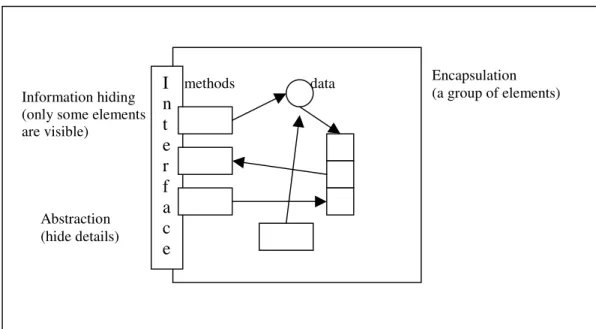
Encapsulation facilitates, but does not enforce, information hiding. Information hiding restricts the elements that can be seen in a unit helping to prevent code dependencies. In figure 2.1 we show how these three concepts are related in the definition of a module interface and implementation.
Figure 2.1. Abstraction, encapsulation and information hiding.
2.2. Modularity goals.
After a “software crisis” was recognized in the 1970’s, many researchers started searching for solutions. Parnas proposed a technique for software module specification in which the goals of the specification scheme were based on the information hiding principle [P 72]:
methods data I n t e r f a c e Encapsulation (a group of elements) Information hiding
(only some elements are visible)
Abstraction (hide details)
1. The specification must provide to the intended user all the information that he will need to use the program correctly, and nothing more.
2. The specification must provide to the implementer, all the information about the intended use that he needs to complete the program, and no additional information; in particular no information abut the structure of the calling program should be conveyed.
It is not easy to split large programs into modules. Module boundaries depend on what we want to achieve, maintainability, performance, etc. The criteria used to modularize a system affect the time to develop the system as well as its flexibility and comprehensibility [P 72].
Two concepts related to the decomposition of a system into modules are
coupling and cohesion. Modules should be as independent as possible from other
modules, i.e., coupling should be minimized. Modules should enclose closely related data types, i.e., cohesion should be maximized.
The goals in modularizing a system can be described as follows:
• Maximize encapsulation. Data and procedures that manipulate this data must be in the same unit.
• Minimize information leaks in units. Procedures that access instance variables must be in the same implementation unit.
• Maximize information hiding. Restrict visibility and access to data and data types defined in units. Define separated units to describe and implement code. Implementation units can implement one or more interfaces. Interface units describe a set of types and the public operations allowed in those types. Two kinds of interfaces can be
generated: clientinterfaces describe the information needed by clients to use the unit, and specializer interfaces describe the information provided for designers to specialize code.
• Provide default values to avoid run-time errors due to initialization. • Restrict and control access and visibility of members.
• Separate compilation. Compilation units can be compiled at different times, but their compilations are not independent of each other if either unit accesses or uses any entities of the other.
2.3. Kinds of modules.
Modules are the units of decomposition in large systems but modules serve some other purposes. Cardelli [Ca 89] describes three kinds of modules: any part of a program that could be reused, a collection of routines that maintains an invariant, and collections of related data types with their operations.
In this section we describe several kinds of modules that are used to solve specific problems. The kinds of modules are:
• Modules and interfaces. • Libraries.
• Shared data area. • Generic modules.
2.3.1. Modules and interfaces.
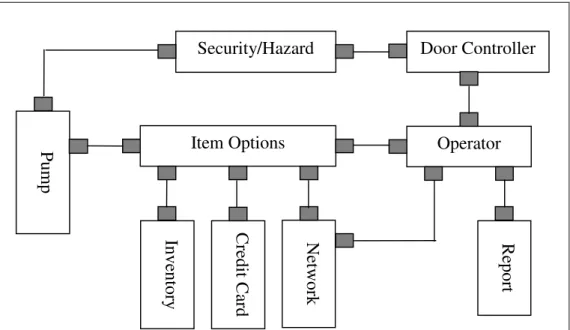
A system can be described as a set of interconnected modules where the functionality of each module provides part of the functionality of the whole system. A module can have several interfaces that define the connections with other modules. Figure 2.2 shows a graphical representation of a set of interconnected modules that describe the architecture of a system for a convenience store.
Figure 2.2. A software architecture design.
In this example, the system was modularized into 9 modules. Each module contains one or more interfaces represented by small gray squares, which are used to describe the interconnection with other modules.
Item Options R ep ort N etw ork In ve nto ry C re dit C ard Pu m p
Security/Hazard Door Controller
2.3.2. Libraries.
A library is a kind of module that encapsulates a set of constants and functions. Libraries do not contain any data structure and they are, usually in compiled form, for linking with other programs. The most common example of a library is the one that contains a set of mathematical functions. Figure 2.3 shows an example of a library definition.
! " # $ " # % # ! " # $ " # & ' ( ) *+,) , - ($ %
Figure 2.3. A Math library interface and implementation in Modula-3.
2.3.3. Shared data areas.
Modules that contain data structures but no functions are in this category. This kind of module allows the definition of some data structures that are going to be shared among several subprograms. The data structures defined in the package are available for those subprograms that use the package. Figure 2.4 shows an example of a module that defines a data structure that can be used by any other module that imports it.
* . / 0, 1 2 & 3 4 " ' " 5
2 6 2 " ' 7 0, 5 4 " 5
& " 77 8 5 4 $ - 9 1 " 5 4 : ; ;$ , < 1 2 &
Figure 2.4. A module with a shared data area in Ada.
2.3.4. Generic modules.
The Ada package shown in figure 2.5 encapsulates a data structure (STACK) and provides an interface to access it. A program can use the package by including a use declaration. However, the package describes a single data structure and it is not possible to have more than one stack in a program.
* . / 0, = 3 *7- . ,< > 7, 1 # " ' $ *7- . ,< > 7, # " - > ' $ 9> . - ? 7, > 7 & # , < = * . / 0, @ - < 8 = 3 " 77 8 5 5 $ - 9 ' " ' 5 " *7- . ,< > 7, 1 # " ' $ 3 AA 1 ) *+,) , -, < 1 % , < =
Figure 2.5. A package as a data structure manager.
When a program needs more than one data structure, it is not a good decision to copy the package to create a new one. Ada provides a way to define a template for packages that can be instantiated as needed. Figure 2.6 shows a
generic package in Ada. The package specification, shown in the left part of figure 2.6, starts with the word generic, that means the package defines a template. The package body is exactly the same as the one defined in the right part of figure 2.5.
0, ,7 . * . / 0, = 3 *7- . ,< > 7, 1 # " ' $ *7- . ,< > 7, # " - > ' $ 9> . - ? 7, > 7 & # , < = * . / 0, 2 = 3 ,B = * . / 0, 2 = 3 ,B =
Figure 2.6. A generic package in Ada.
Two instances of the generic package are defined in the right part of figure 2.6. Every instantiation of the generic package creates a copy of the data defined in
STACK and the procedures can be shared by all instances.
In this example, the elements of the stack are restricted to type INTEGER; this generic does not have a way to generalize the type of elements that the STACK
can handle. The next section shows how this is accomplished.
2.3.5. Parametric generic modules.
Ada’s generic packages can have several types of parameters. A type-independent package can be defined specifying a generic type parameter. This type parameter can be used in the package. An example of a generic package that is type independent is shown in figure 2.7. The left part shows a generic stack
specification where two parameters are defined: MAX is the maximum number of elements the stack can contain and ELEMENT is the type parameter that will receive the specific type when an instance of the package is created. It is possible to restrict the types that can be used as arguments to instantiate the generic package. In this example only two operations (assignment and equality comparison) are available for ELEMENT within the package.
0, ,7 . 4 " ' " 5 5 8 *, # 3 *7 C , * . / 0, = 3 *7- . ,< > 7, 1 # " # $ *7- . ,< > 7, # " - > # $ 9> . - ? 7, > 7 & # , < = * . / 0, @ - < 8 = 3 " 77 8 4 $ - 9 # " ' 4 D " *7- . ,< > 7, 1 # " # $ 3 AA 1 ) *+,) , -, < 1 % , < = AAAAAAAAAAAAAAAAAAAAAAAAAAAAAAAAAAAAAAAAAAAAAAAAAAAAAAAAAAAAAAAAAAAAAAAA * . / 0, @ - < 8 3 * . / 0, 3 ,B = 5 5 6 ' $ * . / 0, # 3 ,B = 6 1 $ % , <
Figure 2.7. A parametric generic package in Ada.
Two instances of the generic package are created in the package MAIN
shown in right bottom part in figure 2.7. The package named SCORES is an instance of the generic package STACK where the maximum number of elements is 100 and the type of elements it stores are INTEGER. INITIALS is also an instance
2.4. Examples in some programming languages.
The module system of a programming language facilitates the design and reuse of software. A module is a static entity that, once defined, cannot be changed. A programming language supports modular programming if it provides facilities to create and express a modular structure. If the language does not provide these facilities, it is still possible to develop a modular structure but greater effort will be required. We can say that almost any language permits modular programming but only those with a module system support it. Many programming languages like Mesa, Modula-2, Ada, Modula-3, and Oberon have a module construct. Leroy [L 00] suggested that the design of a module system is independent of the base language used and a general module system can be applied to a variety of languages. Although he recognized that the code structuring features of object-oriented languages overlap with a module system.
The major features of a module system are: 1) Encapsulation
2) Information hiding 3) Separate compilation.
In this section we show the features of the module system of several languages.
2.4.1. Ada packages.
Ada modules are called packages. A package is a program unit that contains a group of entities. It has two parts: a package specification and a package body, which is the implementation. Ada packages support data abstractions when they contain a declaration of a type and a set of operations (subprograms) on that type. The package specification exposes the information available for clients. The package body provides the implementation of the data abstraction. Ada packages are considered second-class objects because they are not types. Some examples of Ada packages are shown in sections 2.3.3, 2.3.4, and 2.3.5.
2.4.2. Modula-3 modules.
Modula-3 [N 91] provides two basic program units: modules and interfaces, which can be generic. A collection of both modules and interfaces defines a program. A module is a unit that implements one or more interfaces that are exported by the module. A module defines a block where all declared entities are visible inside itself as well as all entities declared in imported interfaces.
An interface is a unit that contains a group of declarations where variable initialization is constant and procedure declarations specifies only its signature. They are used to hide information and restrict access to members of the module. Interfaces are separated from their implementation. Only the elements listed in the
interface are available for clients. Since interfaces do not contain implementation details, code dependencies are avoided.
A module imports an interface to make its entities available. A module exports an interface if it provides bodies for its procedures. A module restricts the visibility and accessibility of its members using interfaces to export them. When a module does not specify an exported interface, all the elements of the module are exported. Figure 2.8 shows an example of an interface and a module implementation for a linked list.
# / # 3 ? # / ,< # 3 &E 1 < < - " $ ) * 8 $" & # # / # 3 # # / # 3 ? # / @ +, &E - < , " ,! " # / @ +, " # # / ,< # 3 & &E , < " # / @ +, " # 1 < < - " $ " < < 7- . ) * 8 $ " ) * 8 7- . < < 7- . 3,+9" # / ,< # 3 - " $ F ! " # / @ +, & ' ! " G # / @ +,6 - < ," - $ ! ,! " , < 3,+9 , < " ! < < 7- . ) * 8 7- . 3,+9" # / ,< # 3 $ " & # & ' 3,+9 , < # ) * 8 7- . & ' # / # 3
2.4.3. SML structures, signatures, and functors.
SML is a functional programming language that supports modular programming [MTH 90]. The module system of SML is considered one of the most powerful due to its treatment of parameterized modules as functors [L 00].
SML module system has structures, signatures, and functors. A structure is a unit that encapsulates a collection of types and values. A signature specifies the type of a structure, i.e., it is a “structure type” and can restrict the accessibility of the members of a structure. The types and values declared in a structure can be referred using qualified names, i.e., using the dot notation structureName.identifier.
A functor is a function that receives a structure as argument and produces a
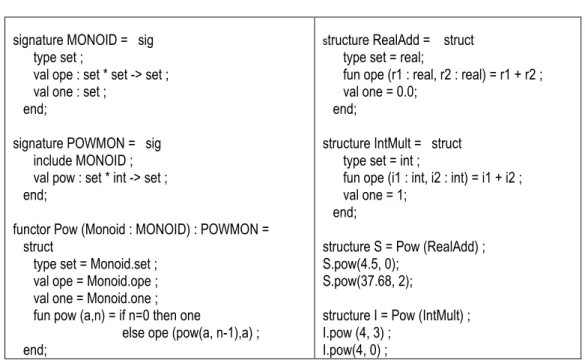
structure as result, i.e., a function from modules to modules. Figure 2.9 shows an example of a signature, a structure, and a functor in SML.
The left part of figure 2.9 contains the definition of two signatures
MONOID and POWMON, and a functor called Pow. Functor Pow receives as a
parameter a structure of type MONOID and gives as a result a structure of type
POWMON. In the right part, we see the definition of two structures RealAdd and
IntMul which type is MONOID. Two new structures, S and I, are obtained by
applying the functor Pow with arguments RealAdd and IntMul. These two structures S and I have type POWMON.
3 0 > 7, 3 0 8 *, 3, C + - *, " 3, ( 3, A: 3, C + - , " 3, , < 3 0 > 7, G 3 0 . +> < , C + *- B " 3, ( A: 3, , < 9> . - 7 - B - - < " $ " G 3 7> . 8 *, 3, - - < 3, C + - *, - - < - *, C + - , - - < - , 9> *- B 6 $ 9 5 , - , ,+3, - *, *- B 6 A $6 $ , < 37> . > 7, , + < < 3 7> . 8 *, 3, 7, + 9> - *, 7 " 7, +6 7 " 7, +$ 7 D 7 C + - , 5 5 , < 3 7> . > 7, > + 3 7> . 8 *, 3, 9> - *, " 6 " $ D C + - , , < 3 7> . > 7, - B , + < < $ *- B 6 5 $ *- B H 6 $ 3 7> . > 7, - B > + $ *- B 6 $ *- B 6 5 $
Figure 2.9. Signatures, structures, and functors in SML.
SML modules are first-class values. They can be passed as parameters and returned as results in functors and they can be stored in data structures.
A problem of the SML module system is related to separate compilation. As stated in its definition, “ML is an interactive language” [MTH 90, page 1]. Leroy attempts to apply the separate compilation technique found in Modula-2 to the SML module system [L 94]. This cannot be directly applied because the use of transparent types specifications prevents the complete type specification of signatures, which is required to detect type clashes in modules. Leroy proposed the use of manifest type declarations to provide enough type information for separate compilation.
2.4.4. Objective Caml.
Objective Caml (OCaml) is a general-purpose language that supports functional, imperative, and object-oriented programming styles [R 02]. OCaml supports two models to structure programs: the parameterized module model and the object model.
The parameterized module model allows decomposing a program into software units, which are called modules. They can be developed independently and compiled separately. Modules can be also parameterized increasing the possibility of code reuse.
There are two ways to create modules: as compilation units and using the
module language. A compilation unit is created with two files with different
extensions: an interface file (.mli) and an implementation file (.ml). Modules as compilation units have some drawbacks: a one-to-one relation between modules and files exist making impossible to use several implementations of an interface, and nested modules are not supported. The module language of OCaml is similar to the module system of SML. It contains two kinds of modules: signatures and structures to define interfaces and implementation respectively. A structure can be constrained by a signature making accessible to clients of the module, only those elements listed in the signature. Functors are also part of the module language of OCaml and they have the same functionality than in SML. Figure 2.10 shows an
interface with its implementation. The example is based on an example from [CMP 00, page 408]. ) - < > +, 8 *, = 3 0 8 *, ; ,! . ,* - ) * 8 C + . 7, , " > A: ; C + *> 3 " ; A: ; A: > C + *- *" ; A: ; , < ) - < > +, . / 3 7> . 8 *, ; I) > @ +, - * " ) > @ +, 3 - 7, " ; 77 8 J ,! . ,* - ) * 8 +, . 7, 3,3 3 ! 3 3 - 7, KA 77 8 **, < 3 3 - 7, 77 8 . 7, , ! $ +, . 7, , $ I - * 5 3 - 7, L M M N J +, *> 3 ! 3 9 3 - * : 77 8 +, 0 3 3 - 7, , . 7, 3, 3 ! 3 3 - 7, 3 - *$ KA ! 3 - * KA 3> . . 3 - * +, *- * 3 9 3 - * 5 , 7 3, ) * 8 ,+3, 3 - * KA *7,< 3 - * 3 3 - 7, 3 - *$$ , < OO 3 . , - 9 . / . - 3 7 ,< @ 8 = 3 0 > 7, ) - < > +, . / . / " = $ +, 3 . / . 7, , $ . / *> 3 3
Figure 2.10. Modules in OCaml.
2.4.5. Java packages.
The Java programming language does not have a traditional module system. Classes and packages in Java are used to support language features that are part of the module system in other languages. Java provides classes to structure programs
and packages to group related classes and interfaces under a common name. Java packages serve three main purposes:
• Define package scope. Classes defined in the same package may share some of their information. Packages can be nested to organize related packages, but no special access is provided for them. Package scope applies only to the package itself and no other nested packages.
• Define namespaces. A package can contain several definitions of interfaces and classes. Packages have a one-to-one relation with file directories. They are used to create naming contexts.
• Import. The elements of a package can be accessed using fully qualified names or they can be imported. A program can import all or part of a package. The use of a package prefix ensures that names in one context do not conflict with names in another context.
The Java platform has several standard packages that define the core Java classes. Figure 2.11 shows an example of a group of classes that belong to a package.
Figure 2.11. Java packages.
Three classes are defined in the package, which is named figures. In each file, the first statement declares that all classes and interfaces in the file are part of the package. When many classes are defined in file, only the one whose name coincides with the file name can be annotated as public. The name of the package is prefixed to each element contained in the package. Classes within the package can refer to each other members. Fields and methods that are not annotated as
private can be used in all the code within the package. Class members’ access is by default package, which means they can be used by other classes in the package. Some problems of the Java package mechanism are:
• Name collision. The same name can be given to different packages. • Packages cannot completely control the access to their member classes. • Packages do not have interfaces and cannot provide different views.
* . / 0, 9 0> 7,3 *> @ + . . + 33 7. +, I OO 7. +, ) *+,) , -J * . / 0, 9 0> 7,3 *> @ + . . + 33 ,. 0+, I OO ,. 0+, ) *+,) , -J * . / 0, 9 0> 7,3 *> @ + . . + 33 - I OO - ) *+,) , -J
2.4.6. C# namespaces and assemblies.
C# provides files, namespaces, and assemblies to organize the source code.
A namespace is a logical structuring mechanism that can contain several classes
and interfaces. They are used to avoid the use of long class names. A namespace can be imported making accessible all the classes and interfaces that it contains. An
assembly is an executable file (.exe or .dll) generated by the compiler. An assembly
is used to pack and deploy a component. Figure 2.12 shows an example borrowed from [C# 01 p. 45].
// class library with a single class // HelloLibrary.cs
namespace Csharp. Introduction { public class HelloMessage { public string Message { get { return “hello, world”; } }
} }
// application // HelloApp.cs
using Csharp. Introduction; class HelloApp
{
static void Main( ) {
HelloMessage m = new HelloMessage ( ); System.Console.WriteLine (m.Message); }
}
Figure 2.12. C# namespaces and assemblies.
The left part of figure 2.12 shows an example of a namespace named
Csharp.Introduction, which contains only a class named HelloMessage. The fully
name of this class is Csharp.Introduction.HelloMessage. The right part of figure 2.12 shows an application that uses the class HelloMessage which is available without its fully qualified name because a using namespace directive imports it.
These two files can be compiled to generate a class library and an application that uses that library.
2.4.7. Dylan.
In Dylan a module defines a namespace. It contains typically several functions and classes. A module definition can have three kinds of clauses: export, create and use. An export clause specifies which names are exported. Exported elements like classes, slots, variables, and functions are available for users of the module. A uses clause describes the modules used by the module being defined. A
create clause specifies the names declared and exported by the module. An
example of two module definitions borrowed from [S 97] is shown in figure 2.13.
< ,9 , ) - < > +, 07 * . 3 > 3, < 8 + . 7, , < 7 BA+ ,6 ,7 3,A+ ,6 C ,7 A+ ,6 3/ ,BA+ ,6 97 ) ,A7,. 6 9 ++A7,. 6 ,7 3,A7,. 6 C ,7 A7,. , < ) - < > +, 07 * . 3 < ,9 , ) - < > +, + ,3 > 3, < 8 + > 3, 07 * . 36 ) *- 7 " I< 7 BA+ ,6 ,7 3,A+ ,6 C ,7 A+ ,6 3/ ,BA+ ,J , < ) - < > +, + ,3
The module graphics uses the module called dylan, which contains all the basic language primitives. The module lines uses modules dylan and graphics but the import declaration specifies that only some elements of graphics are available (draw-line, erase-line, invert-line, and skew-line).
29
Chapter 3.
Object-Oriented Concepts.
Objects, classes, and inheritance are some of the concepts related to object-oriented programming. They emerged in the 1970’s with the programming language Simula and Smalltalk [DN 81, I 78]. Now, the object-oriented concept refers to both a methodology for software design as well as a programming language feature. Although there is no consensus about the exact meaning of that concept, some features are commonly recognized to be part of it. Most object-oriented programming languages provide mechanisms for: encapsulation, inheritance, dynamic dispatch, open recursion, and inclusion (subtype) polymorphism. These features have a lot of variations and their combination gives a unique flavor to each language.
In this chapter we present a classification of object-oriented programming languages and review the different variations of the most important concepts that distinguish an object-oriented language. We also show examples of how these concepts are used in some specific programming languages.
3.1. Classification of object-oriented languages.
Three varieties of object-oriented languages are distinguished in figure 3.1, they are: passive, active, and multimethod languages. Bruce [B 02] uses a similar categorization with another naming convention: class-based, object-based and multimethods languages. We adopted different names to prevent confusion with the categories proposed by Wegner [W 87] that uses the terms object-based language and class-based language for non-object-oriented languages.
Figure 3.1. A classification of object-oriented languages.
A brief description of each kind of object-oriented language is presented in this section.
3.1.1. Passive languages.
Passive languages are also known as class-based languages because they contain a class construct to describe the implementation of a group of objects. Objects are instances of the class. All the objects generated from a class share the
Object-Oriented Languages
Passive
same behavior, which cannot be changed at runtime. The class defines a set of values, called instance variables or fields, and a set of operations over those values, called methods. Classes can contain also special functions called constructors to generate and allocate instances of that class. Subclasses are specializations of classes and they are defined using inheritance. In many languages classes and subclasses generate types and subtypes.
Some examples of class-based languages are Java [AG 98], C# [C# 01], C++ [S 91], Eiffel [M 92], OCaml [R 02], MOBY [FR 99b].
3.1.2. Active languages.
Active languages are also called classless or object-based languages because they do not contain a class construct to define objects. Objects are formed directly by constructing concrete objects called prototypes or exemplars. In these languages, every object has its own behavior, which is set when the object is created and, like fields, the behavior can change at runtime. Since no class mechanism exists, these languages provide different mechanisms to derive new objects from existing ones.
Prototype-based languages are a kind of active language. These languages allow the user to generate “prototypical” objects that are used to create new objects. They also allow dynamic update of methods so that an object can change its behavior at runtime. Cloning is an operation to create a new object from a
prototype. All clones have the same structure but new features can be defined using extension or delegation. Extension works like inheritance in classes. An object created by extension inherits everything and it is independent of its parent. Delegation allows an object to delegate certain operations to another object. An object created by delegation retains ties to its prototype parent such that changes to the prototype will be visible to the delegate and vice versa.
Self [US 87] and Kevo [T 93] are prototype-based object-oriented languages with an associated programming environment. Objects in Self are made up of slots, which can represent state or behavior. The environment provides a graphical representation for objects. In this graphical representation, every slot has an icon that represents data (constant or assignable) or behavior. The state of an object can be altered only by passing messages to it. The types of variables are not restricted so static typechecking is not possible. An example of an object in Self, borrowed from [WS 03] is presented in the left part of figure 3.2. Another example of a prototypical object called point written in Kevo, is presented in the right of figure 3.2. *- "A LF ! "A 5 5 6 F 8 "A 5 5 6 < 7 B "A I3. 7,, < 7 B ! ,+ 3,+9 ! 6 3,+9 8 $J N
3.1.3. Multimethod languages.
Some object-oriented languages are not distinguished by the mechanism they use to create objects, but by how they deal with dynamic dispatch. Dynamic dispatch is divided into single and multiple dispatch.
In languages with multiple dispatch the object itself does not contain the methods. The methods are implemented as functions, which can have the same name as other functions but different parameters. A group of functions with the same name and different parameters are called overloaded generic functions. A theoretical study of this model of message sending appears in [CGL 95].
Multimethod languages are object-oriented languages with multiple dispatch. They use overloaded generic functions to support dynamic method invocation. When a message is sent, the name of the message and the type of the arguments are used to select which overloaded generic function is going to be executed. If there is only one match, it is selected but if there were more than one, the selection of the method would be the one with the best fit. Some ambiguities can arise in the selection of the method. Sometimes it is the programmer responsibility to solve any ambiguity and sometimes the language contains a mechanism to solve the ambiguity. A similar problem emerges in programming languages with multiple implementation inheritance and similar solutions are provided.
Multimethod languages do not encapsulate data and functions together, they are separated, and sometimes they are encapsulated in modules. This separation of data and functions increases the expressiveness of the language but it breaks encapsulation. Most multimethods languages are classless but some of them have a class construct that defines only data members, e.g., Dylan [S 97]. Proponents of multimethods languages argue that languages with multiple dispatch are more expressive than single dispatched languages because multiple dispatch is more symmetric than single dispatch. Multiple dispatch solves the problem with binary methods allowing covariant redefinition of parameters, and procedures. Single dispatched methods and overloaded functions can be generalized by multiple dispatch [CL 97].
Some examples of multimethod languages are BeCecil [CL 97], Cecil [C 98], CLOS [BDG+ 88], and Dylan [S 97].
Figure 3.3 shows an example of an object definition and an overloaded generic function written in BeCecil [CL 97].
BeCecil is a statically typed, classless object-oriented language with multiple dispatch and multiple inheritance where classes and types are separated in two different hierarchies. It supports a prototype-based model unifying classes and objects. BeCecil is a core language designed as a subset of Cecil but it does not include all its features. Cecil is a multimethod language with parameterized types and a module system [C 98].
- @ P,. - 2 7,* - 2 7,* ,7 3 8 - @ P,. - +- 7 - 2 7,* - +- 7 - 2 7,* ,7 3 - 2 7,* - +- 7 - 2 7,* ,7 3 - +- 72 7,* - @ P,. ! ! ,7 3 ' , ,7 . > 2 7,* ! 3 3 - 7 0, *Q - 2 7,*$ " 5 ! 3 ) , - < *Q - 2 7,*$ I ! 2 7,* *$ J AA 3 ) , . - < , - 9 - @ P,. ! - < ,9 , 3 . , C 7 @ +, 8 - @ P,. ,R > + ,R > + ,7 3 ' , ,7 . > 2 7,* ,R > + 3 ) , - < C Q 2 7,*6 C Q 2 7,*$ I C C J ,R > + 3 ) , - < * Q - 2 7,*6 * Q - 2 7,*$ I < ,R > + ! * $6 ! * $$6 ,R > + 8 * $6 8 * $$$ J
Figure 3.3. Overloaded generic functions in BeCecil.
In the example of figure 3.3, an object called Point_rep is defined. It is derived from any, which is a special object from which almost all objects inherit. Another object called ColorPoint_rep is defined with multiple inheritance. A generic function is a collection of multimethods. Generic functions x and equal are objects that inherit from GenericFun_rep, which is a predefined object derived from any. A generic function is extended with a has declaration. The generic function equal is extended with two methods in the example.
3.2. Abstract data types and objects.
“A type is a (partial) description of behavior- a statically verifiable interface” [B 92]. An abstract data type (ADT) is a type that contains a set of values and a set of operations on those values. The structure or representation of the values and the implementation of the operations are not important to the client and can be hidden.
Transparent data types expose their representation to clients, while opaque data types hide their representation to clients. Hiding the representation from the client avoids code dependencies; thus the implementation can be changed without affecting the client code. Programming languages that support ADTs usually contain the following:
• A mechanism to separately define the declaration of an ADT from its implementation. These two parts can be placed in different units.
• Separate compilation for the program units that declare and implement the ADT.
• A mechanism to restrict visibility and access to the implementation part. • A mechanism to allow the client to access the ADT.
On the other hand, an object contains state (a set of fields) and behavior (a set of operations, called methods). The operations of an object are executed by
passing a message to the object, which is the name of the method to be executed. A class is a template to define a group of objects. An object is an instance of a class.
Objects and abstract data types have some common properties but they also have some properties that make them different. For example, the use of inheritance in the definition of objects makes encapsulation more complex than simple data abstraction. Objects carry with themselves the set of operations they can execute and select the method to execute dynamically. On the other hand an abstract data type stores the operations in a module and they are statically located. An object can be replaced at runtime by another one that has the same interface.
3.3. Dynamic dispatch.
The selection of the method to be executed can be resolved at compile time or at runtime. Object-oriented languages use a mechanism known as dynamic dispatch for the selection at runtime; the method selected can change during program execution. Static binding takes place at compile time and remains unchanged in the execution of the program.
Dynamic dispatch is an important feature of object-oriented languages. The definition of subclasses allows redefining methods that were inherited from superclasses. Dynamic dispatch allows selecting dynamically the method to execute depending on the runtime type of the object that receives the message, in
languages with single dispatch, or on the runtime types of one or more arguments, in languages with multiple dispatch.
Dynamic dispatch is the default in Java while in C# and C++ must be explicitly declared by making the methods virtual.
3.3.1. Single dispatch.
In programming languages with single dispatch, when a method is called the selection of the method body is based on the runtime type of the designated object who receives the message. Figure 3.4 shows the definition of a class and a derived class which are going to be used in this example.
*> @ + . . + 33 - I ! C +6 8 C + - ! 6 8 $ I ! C + ! 8 C + 8 J *> @ + . C - < ) - C , < ! 6 < 8 $ I ! C + D < ! 8 C + D < 8 J *> @ + . 7 0 - 7 0 $ I 7, > 7 S! SD ! C +D S6 8 SD 8 C + J J *> @ + . . + 33 - +- 7 - ,! , < 3 - I 7 0 . C + - +- 7 - ! 6 8 6 7 0 . $ I 3> *,7 ! 68 $ . C + . $ *> @ + . C - < 3, - +- 7 7 0 . $ I . C + . J *> @ + . 7 0 - 7 0 $ I 7, > 7 3> *,7 - 7 0 D S6 . - +- 7 SD . C + J J
Figure 3.4. A class and a subclass definition in Java.
A common approach to select the method to execute is described as follows. When an object receives a message, it looks for the method in its method table, if
the method is not there, then it goes up into its parent method table. This process is repeated until the method is found. An example of a dynamic method invocation is presented in figure 3.5. % - *- ,B - 6 $ 8 3 ,) - > *7 + *- - 3 7 0 $$ *- ,B - +- 7 - 6 6T7,< T$ 8 3 ,) - > *7 + *- - 3 7 0 $$
Figure 3.5. Dynamic method invocation with single dispatch.
In the previous example, when the variable point1 contains a Point object, the method toString executed is the one defined in Point class. On the other hand when variable point1 contains a ColorPoint object, the method toString executed is the one in ColorPoint class.
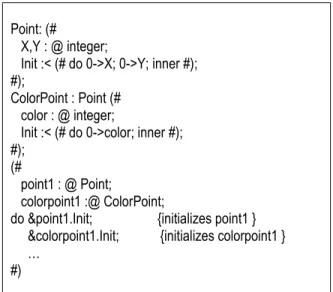
C++, Java, C#, and BETA are programming languages with single dispatch. The BETA programming language has a different strategy for method lookup [MMN 93]. When a message is sent, the execution of the method starts at the top element of the hierarchy of objects. If the method is found it starts execution. If the method is not found then it will go into the object hierarchy looking for it. An example that illustrates this process is presented in figure 3.6
There are three patterns in figure 3.6, Point, ColorPoint and a pattern to use those two patterns. Patterns are delimited by (# #). Pattern ColorPoint is defined with inheritance using Point as parent, and it overrides the pattern Init. The
sentence &colorpoint1.Init; calls to execution Init of ColorPoint. This execution of
Init, will execute first the actions defined in its superpattern Point, initializing X
and Y with 0. The inner sentence following the initialization indicates that possible actions are going to be executed in a subpattern, so the control goes to the Init of
ColorPoint where the initialization of color takes place. In this case, the inner part
of Init in ColorPoint is an empty action because no subpatterns exist. This strategy
to start looking for the method to be executed in the top of the hierarchy allows to preserve the behavior defined in parent classes, because overriding methods must execute first the methods they override.
- " U 4 6? " Q ,0,7 "K U < - 5 A:4 5 A:? ,7 U $ U $ - +- 7 - " - U . - +- 7 " Q ,0,7 "K U < - 5 A:. - +- 7 ,7 U $ U $ U *- " Q -. - +- 7*- "Q + 7 -< - V *- I + W ,3 *- J V . - +- 7*- I + W ,3 . - +- 7*- J % U $
Figure 3.6. Dynamic method lookup in BETA.
3.3.2. Multiple dispatch.
In languages with multiple dispatch the selection of the method to be executed is based on the runtime type of one or more parameters. Multiple dispatch
is implemented by the definition of overloaded generic functions. A generic function contains many implementations of a method name with different parameter types. They are a set of overloaded functions.
Figure 3.7 shows an example where several generic functions are called. This example uses the code presented in figure 3.3.
- @ P,. *-*- ,7 3 - 2 7,* ! *- $ " 8 *- $ " - @ P,. *-*- ,7 3 - 2 7,* ! *- $ " 8 *- $ " C 7 - " - @ P,. " *-C 7 - " - @ P,. " *-,R > + - 6- $ AA . - ) * 7, *- 6 *- $ 7,3> + 3 9 +3, - " ! *- $ - " 8 *- $ ,R > + - 6- $ AA . - ) * 7, 9 ,+< 3 ! < 8 - 9 *- 7,3> + 3 7> ,
Figure 3.7. Executing generic functions in BeCecil.
Two objects point1 and point2 are defined. They are derived from the object
Point_rep. Their instance variables x and y are initialized, which are themselves objects derived from GenericFun_rep, and contain storage and a method to recover their value. The generic function equal, is called to execution twice. The first time object o1 and o2 contain point1 and point2 respectively, so generic function equal
code) object o1 and o2 contain objects of Int_rep which are the result of the execution of the generic functions x and y with the same parameter point1.
3.4. The special variables this and super.
Object-oriented languages define two special variables this, sometimes called self, and super. Variable super refers to the immediate parent class (object) while variable this refers to the object that originated the message. These two variables have an important role in finding the right method to be executed at runtime.
When a method is called with super, this is still bound to the original caller. The use of this in a method invocation represents a late-bound thus a method call from inside an ancestor class may not be the method of the ancestor class, but the method overridden by some descendent class.
3.5. Inheritance.
Inheritance is a language construct that allows the definition of new objects based on existing ones. It is an important feature that encourages code reuse. Given the definition of an object (class or prototype) a specialization of it can be generated by specifying the differences with respect to the given one. The new class is called a subclass, derived class, or child class, and the extended class is called the superclass, parent, or base class.
Inheritance can be classified in several ways. Single and multiple inheritance are related with the number of classes used as parents in the definition of new classes. Single and multiple inheritance are explained in sections 3.6.1 and 3.6.2. Another kind of inheritance, known as mixin inheritance is detailed in section 3.6.3. Interface inheritance refers to the inheritance of types rather than implementation and it is explained in section 3.6.4.
3.5.1. Single inheritance.
In languages with single inheritance, the definition of a new class called a subclass is derived only from one class. The class hierarchy created by single inheritance corresponds to a tree. Figure 3.8 shows an example of single inheritance.
. + 33 7, I J
. + 33 +< ,! , < 3 7, I J . + 33 +< ,! , < 3 7, I J
Figure 3.8. Definition of classes using single inheritance.
In this example three classes are defined. Classes Child1 and Child2 are subclasses of class Parent. They inherit everything from Parent. Inherited members of the Parent class can be redefined in any subclass. The graphic representation of single inheritance is a tree, as shown in figure 3.9.