Public industry analysis #1 2014
Firefox, Ubuntu, Tizen, Sailfish
Why more operators should care about
alternative smartphone OSs
Of global smartphone shipments Q3 2013, the four major operating systems1 stood for 99.4%2 – entirely dominated by Android. Why on earth should telecom operators then care to support the remaining 0.6%?
Yet some operator groups, often with exposure to maturing markets, are actually doing a whole lot to breed viable alternatives to Android, iOS and Windows Phone. Why?
It’s not just about cost. In the established ecosystems, operators see the risk of being squeezed out. Partnering with providers of alternative smartphone OSs can re-establish operators in the ecosystem and give back control over the end-user experience.
The status is aggregated just weeks before Mobile World Congress 2014 – like last year, there might be news coming.
1 Google’s Android, Apple’s iOS, Microsoft’s Windows Phone and BlackBerry 2www.gartner.com/newsroom/id/2623415
Market shares
According to Gartner2, the global smartphone shipments Q3 2013 were distributed according to Figure 1.
Figure 1. Global smartphone OS market share – shipments Q3 2013
The dominance of Google’s Android is obvious – and it is increasing. Smartphone OSs other than Android, iOS, Windows Phone and BlackBerry held an aggregated market share of only 0.6% of Q3 2013 shipments. Only a part of this can be attributed to the new smartphone OSs covered here – Firefox OS, Ubuntu, Tizen and Sailfish. Most of it is attributed to discontinued or to-be-discontinued OSs like Symbian and Bada. Even though iOS – and to a lesser extent Windows Phone – in a local perspective can be more dominating than what is shown in Figure 1, the distribution is still an issue of concern for operators. The tightly integrated ecosystems leave little flexibility for the telecom operator. Operator differentiators like e.g. own content or services are typically just given the same visual importance as any other app the end-user has downloaded. It sits doing nothing in a grid alongside potentially a hundred other apps and might eventually be forgotten.
There are also cost aspects to consider: Smartphones are still too expensive for a majority of the world’s population. Open source software – as in the alternative OSs – has, at least in the computer world, been positive for cost and adoption. On the other hand, the more OSs an operator needs to support, the higher the customer service and support cost grow.
81,9%
12,1%
3,6%
1,8%
0,6%
Android
iOS
Windows Phone
BlackBerry
Others
Status of alternative smartphone OSs
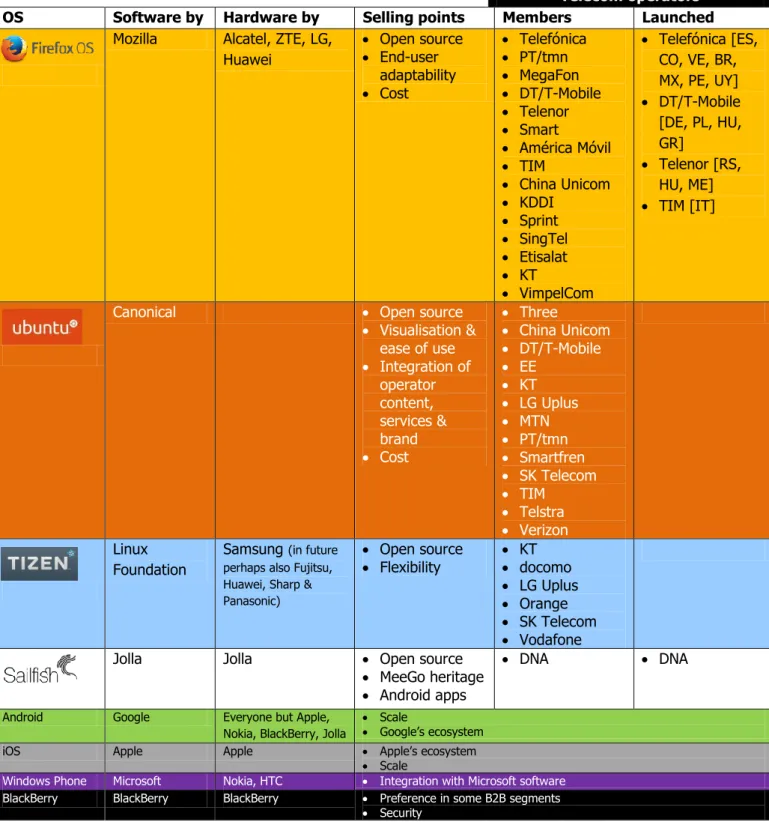
Table 1 summarises the status of four alternative smartphone OSs – Firefox OS, Ubuntu, Tizen and Sailfish. To complete the table, the four major smartphone OSs are also briefly covered.
Telecom operators
OS Software by Hardware by Selling points Members Launched Mozilla Alcatel, ZTE, LG,
Huawei Open source End-user adaptability Cost Telefónica PT/tmn MegaFon DT/T-Mobile Telenor Smart América Móvil TIM China Unicom KDDI Sprint SingTel Etisalat KT VimpelCom Telefónica [ES, CO, VE, BR, MX, PE, UY] DT/T-Mobile [DE, PL, HU, GR] Telenor [RS, HU, ME] TIM [IT]
Canonical Open source
Visualisation & ease of use Integration of operator content, services & brand Cost Three China Unicom DT/T-Mobile EE KT LG Uplus MTN PT/tmn Smartfren SK Telecom TIM Telstra Verizon Linux Foundation
Samsung (in future perhaps also Fujitsu, Huawei, Sharp & Panasonic) Open source Flexibility KT docomo LG Uplus Orange SK Telecom Vodafone Jolla Jolla Open source
MeeGo heritage
Android apps
DNA DNA
Android Google Everyone but Apple, Nokia, BlackBerry, Jolla
Scale
Google’s ecosystem iOS Apple Apple Apple’s ecosystem
Scale
Windows Phone Microsoft Nokia, HTC Integration with Microsoft software
BlackBerry BlackBerry BlackBerry Preference in some B2B segments
Security
Mozilla is best known for its browser software, Firefox, which has stood up well against commercial
competition like Google Chrome and Microsoft Internet Explorer in the Windows desktop domain. Firefox is also available for Android, where it competes with the built-in Chrome browser. To complement the Firefox browser, Mozilla has a large collection of browser-apps in the Firefox Marketplace. Mozilla has now entered the smartphone OS world with Firefox OS – “The Adaptive Phone”.
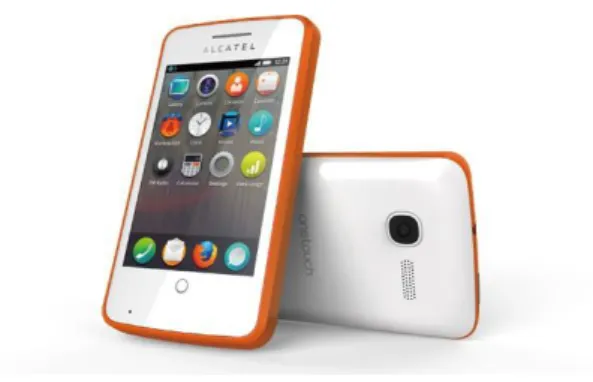
Firefox OS is arguably the alternative smartphone OS that has come furthest in its development. Several operators have already launched smartphones using Firefox OS – most typically the Alcatel One Touch Fire (see Figure 2) which retails at around 180 USD.
Figure 2. Alcatel One Touch Fire
In the same price point, there is also another alternative – launched as late as October 2013: The LG Fireweb with a retail price of about 200 USD. A Huawei model called Ascend Y300II is expected early 2014 and seems to have similar specs as the Alcatel and LG models.
But there are also cheaper options around: The ZTE Open (see Figure 3) has a retail price below 100 USD.
Figure 3. ZTE Open
With price points like the ZTE Open, it’s understandable why operators with exposure in maturing markets show interest in alternative smartphone OSs. It is however clear that also Android based smartphones can trade below 100 USD even when manufactured by global brands (and down to 70 USD when manufactured
by local Chinese or Indian brands). This can indicate that operators expect yet lower price points with alternative OSs like Firefox OS as scale grow – or that operators associate certain risks with Android. As described in Why the smartphone growth is over (for smartphones as we got to know them),
smartphones have to come down to about 30 USD in order to reach similar penetration rates in maturing markets as what today is present in the most mature markets.
Mozilla has collected many heavy-weight operators and operator groups in its Open Web Device initiative, some of which are exclusively with Firefox OS. The operators are quite leveraged to maturing markets, indicating that device cost might be a decisive factor.
Much of the Firefox publicity centres on Latin America driven by the fact that Telefónica has gone all in with Firefox OS and seems committed to support and sell all the mentioned handsets in many of its Latin American markets.
It’s not within the scope of this paper to review the end-user experience associated with the various OSs and phones, but the reviews of Firefox OS can be summarised as “mixed”. Reviewers found stability and
functionality issues with the software – but also point out that software can be expected to be in much faster development than major OSs where maturity, release cycles and backwards compatibility slow things down.
Canonical – with its open source Ubuntu software – plays a more important role than one might initially think as Ubuntu is often used in server and cloud environments without us end-users seeing it. Canonical claims that Ubuntu is the leading OS in the cloud. But Ubuntu is also pre-installed on 10% of the world’s new PCs. Ubuntu will be able to run on all clients with a similar end-user experience: PCs, tablets, TVs and smartphones.
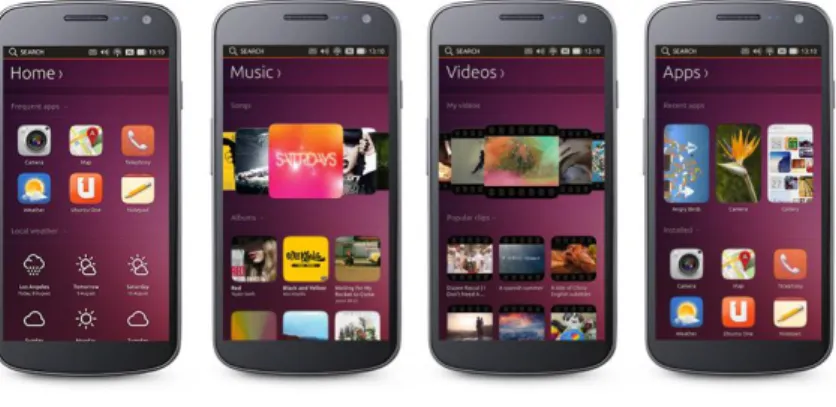
With Ubuntu for phones, Canonical enters the smartphone OS space. Ubuntu’s differentiation focusses on the content experience and the ability for an operator to integrate their services into the UI. According to Canonical, Ubuntu allows a greater degree of operator customisation and ownership than operators are currently experiencing. For operators whose current experience is one of being squeezed out of the ecosystems as defined by Google and Apple, this can be critical.
Ubuntu is also targeted at inexpensive hardware. Therefore, as with other alternative OSs, there is an anticipation that costs will be lower.
Unlike Firefox OS, Ubuntu has not yet been launched by any smartphone manufacturer or operator. In December 2013, Canonical said it signed its first deal with a smartphone manufacturer and that a high-end product would be out sometime in 20143.
In its Carrier Advisory Group, Canonical has collected many heavy-weight operators and operator groups, some of which are exclusively with Canonical. Compared to Firefox OS, the operator group is more geared towards mature market operators which might indicate that Ubuntu is more valued for its ability to integrate operator content and branding than for pure cost reasons.
It is the Linux Foundation who is behind Tizen, but the elements come from three different sources: Tizen builds partly on Intel and Nokia’s MeeGo OS which Nokia brought to the smartphone market through the Nokia N9. Nokia stopped supporting MeeGo, but Intel has taken some of the MeeGo inheritage into Tizen as a member of the Tizen Association. Samsung is another member and has brought its Bada OS into Tizen. A third – and perhaps the most important – element in Tizen is the original LiMo platform which was supported by the Linux Foundation and Samsung.
With the backing of Samsung, the world’s largest smartphone manufacturer, there’s been a lot of interest in Tizen and speculation around Samsung’s future support of Android. So far, no products have been launched though.
Tizen Association member docomo earlier said it would launch a Samsung smartphone running Tizen in March 2014. However, in January 2014, docomo changed their mind saying it would no longer launch as planned. Even though a setback for Tizen, it should be seen in light of docomo’s iPhone introduction Q4 2013. Prior to this, iPhones could only be bought through competitors Softbank and KDDI. When also docomo eventually started to sell iPhones, docomo added more customers than both Softbank and KDDI – for the first time in 24 months. The Tizen introduction would likely have been done if the iPhone introduction wouldn’t have been successful.
In addition to docomo, Tizen Association has five other operator members, some of which exclusively with Tizen. The Korean operator support is strong with all three operators as members – perhaps natural given Samsung’s involvement. The operators are rather mature market operators than maturing market operators, indicating that Tizen is not primarily considered for cost reasons.
Unlike other alternative OSs, there’s currently no official visual information on Tizen. It’s however clear that Tizen is intended not only for smartphones, but also for other platforms like tablets, netbooks, in-vehicle infotainment systems and smart TVs.
January 26th, Samsung and Google signed a patent licensing deal. This, together with the fact that Google three days later announced that it sells Motorola to Lenovo, has been taken as indication of that Samsung will stop supporting Tizen and continue with Android. Further communication, perhaps during Mobile World Congress in February, will show if this is just speculation.
Sailfish
The Sailfish OS is supported by what must be one of the smallest smartphone manufacturers – Jolla. Sailfish OS is based on the MeeGo OS as abandoned by Nokia and appears to work in a similar, though not identical, gesture-based, way.
A problem for all alternative OSs is the lack of a fully stuffed app ecosystem. To address this, Jolla has made it possible to run Android apps in the Sailfish OS.
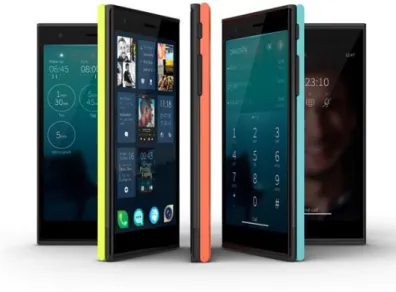
Unlike Ubuntu and Tizen, Sailfish OS is commercial (although with a beta designation) and available in the Jolla smartphone (Figure 5).
Figure 5. Jolla
The smartphone currently retails for 399 EUR (540 USD) and is thereby clearly not addressing the low cost smartphone segment. On the contrary, the design of both hardware and software signals quality and high end4.
Even though Jolla is the only smartphone manufacturer using Sailfish OS, Jolla’s intention is to offer the OS also to other manufacturers.
So far, Jolla has one operator partner: DNA of Finland. DNA was also first in the world to sell a Jolla phone in November 2013. In December Jolla opened a direct sales e-channel to European consumers.
Jolla was the 5th bestselling phone in DNA’s channels during December – selling better than Apple’s new
iPhone 5s and 5c and better than Samsung Galaxy S4. The four phones selling better than Jolla were all lower cost smartphones.
DNA’s success with Jolla should be seen in a Finnish perspective. After Nokia’s sale of its handset business to Microsoft, Jolla – with roots in the abandoned Nokia N9/MeeGo project – represents the only remaining
4 Even though reviewers, similar to Firefox OS, identify the need for software updates to improve stability and functionality. Jolla is clear
Finnish handset maker. The importance to DNA should not be underestimated, though: When was the last time an independent operator with less than 2.5 million mobile subscribers could influence the design of a new smartphone and be the first retailer globally?
There is also much evidence on the close cooperation between Jolla and DNA. In a joint press release from June 2013, DNA writes:
DNA has also been involved in the Jolla smart phone's development from the very beginning. “In a spirit of 'co-creation' that is characteristic of Jolla, we have been able to influence the device's design and usability, allowing us to convey our customers' wishes directly to Jolla's development team, already at the design stage”
This statement is perhaps the best motivation to why operators could benefit from engaging with alternative OS providers: It gives operators control over the end-user experience, something few operators feel they have when it comes to the major OSs and ecosystems.
Operator strategies dealing with alternative smartphone OSs
As seen in Table 1, quite many operators and operator groups are already engaged with providers of alternative smartphone OSs. This section outlines the different strategies operators have taken.
“Take no risk” – 1 operator
This approach is best exemplified with KT from Korea who is a partner to all of Firefox OS, Ubuntu and Tizen.
“Spread the risk” – 6 operators
KT’s two local competitors, SK Telecom and LG Uplus, have also safeguarded a bit: They are both partners to Firefox OS and Tizen in parallel.
Some of the groups with European origin – PT/tmn, DT/T-Mobile and TIM – are partnering both with Firefox and with Ubuntu. Also China Unicom falls into this category.
“Bet on one horse” – 20 operators
Telefónica clearly bets on Firefox OS – having launched terminals in seven markets already – but doesn’t have any other partnerships. This is possibly granting Telefónica greater impact than it otherwise would have.
Telenor follows the same approach as Telefónica. It has recently communicated launches in Serbia, Hungary and Montenegro and will at a later stage address also its Asian markets. Also Russian operators MegaFon and VimpelCom bet solely on Firefox OS – alongside Smart, América Móvil, KDDI, Sprint5, SingTel and Etisalat.
Ubuntu, on its hand, has a number of operator partners that don’t work with other alternative OSs: Three Group, EE of the UK, MTN Group, Smartfren of Indonesia, Telstra6 and Verizon.
Tizen has the full attention from Vodafone and Orange groups – alongside docomo. As said, docomo just decided not to launch their first Tizen phone as planned, though.
And then there’s Finnish operator DNA who – as the only operator globally – made a partnership with Jolla on Sailfish OS and Jolla’s smartphone.
“We don’t care” – 200+ operators
Quite a few operator groups – e.g. TeliaSonera, KPN, MTS, Telekom Austria and Tele2 – have currently not taken any stance when it comes to upcoming alternative smartphone OSs. It can be a risk since some of their local competitors have.
5 Mozilla has in November 2013 said it will not launch in the USA which would rule out Sprint for now 6 Even though Telstra was said to be “welcoming” Firefox OS it’s not part of the core operator support group
Conclusion
Should alternative smartphone OSs be of interest only to operators in maturing markets? Should device cost be the sole motivation?
No. The motivation for operators to be involved with alternative OS providers goes beyond cost: Many operators feel the need to reposition themselves in the mobile ecosystem and take control over the end-user experience.
Some operators judge that it’s too late to influence the major ecosystems. By supporting new alternative OSs they attempt to correct an industry business model which they feel is broken.
tefficient is an international efficiency specialist providing telecom operators and -suppliers with analysis,
benchmarks, consulting and coaching. Efficiency Index is invented and managed by tefficient.