Software Configuration Management:
State of the Art, State of the Practice
Karol Fr¨uhauf1and Andreas Zeller2 1 INFOGEM AG
Informatiker Gemeinschaft f¨ur Unternehmensberatung R¨utistrasse 9, CH-5401 Baden, Switzerland
Karol [email protected]
2 Universit¨at Passau Lehrstuhl f¨ur Softwaresysteme Innstraße 33, D-94032 Passau, Germany
Abstract. Which are the open problems in Software Configuration Management
(SCM)? The purpose of this paper is to ignite a discussion on current and future SCM directions. Based on the findings of a Dagstuhl Seminar on the current state of Software Engineering, we assess the state of SCM with the goal to identify effective SCM tasks and solutions, to establish a core body of SCM knowledge, and to denote remaining real-world SCM problems.
1
Introduction: An Assessment of SCM
Which are the open problems in SCM? Software Configuration Management (SCM) is one of the few success stories in Software Engineering. All software organizations admit the importance ofSCMas a prerequisite for a coordinated software development. Consequently,SCMis widely used—and with success. Already, theSCMtools market is expected to be worth over a billion dollars [4].
The 1999 Dagstuhl Seminar on “Software Engineering Research and Education: Seeking a new Agenda” [7] has joined experts in several Software Engineering fields to take stock of the current state of Software Engineering research and education. Within this Seminar, we have addressed this task for theSCMarea—assessing the state of
Soft-ware Configuration Management. In particular, we have attempted to cover the
ques-tions:
What do we know? Which are theSCMtasks and solutions that every practicing
soft-ware engineer should be able to perform?
What should we teach? Which is the core body ofSCMknowledge that has been
vali-dated as useful in practice?
What should we know? What are the most important openSCMproblems?
In contrast to earlier approaches, we have not searched for novel ideas “that should keep researchers busy for the next several years” [31] or examined possible similarities between some area X andSCM[10, 34], but attempted to identify remaining real-world SCMproblems—problems faced by today’s practitioners, yet not sufficiently addressed
bySCMresearch. This paper summarizes our results; its purpose is to ignite a discussion on current and futureSCMdirections.
Documentation Communication Task Management Lifecycle Support History Traceability Logging Workspaces Conflict Resolution Families Building Snapshots Optimization Change Impact Analysis
Regeneration System Model Interfaces Relationships Selection Consistency Access Control Change Requests Bug Tracking Change Propagation Partitioning Statistics Status Reports Kinds of Components Repository Project Contexts Baselines Versions of Configurations Configurations Versions Connectivity ACCOUNTING CONTROLLING AUDITING CONSTRUCTION STRUCTURE TEAM COMPONENTS PROCESS DEPLOYMENT Installation Parameterization Instantiation Re-Configuration
Fig. 1. SCM Functionality Areas (after Dart [6])
2
Assessing SCM Solutions
In this paper, we have focused on thoseSCMsolutions that are provided or supported by some automatedSCM tool or system, be it a research prototype or a full-fledged commercial system. (This is just a matter of economy; if some solution has only been proposed, but never realized, we will not regard it here.) Note that we do not consider SCMorganisational matters. The reason is not their irrelevance; in fact we are convinced thatSCMwork procedures need to be defined in an organisation before anySCMtool can be selected (which will of course backfire on the work procedures). The difficulty is that as every organisation has its own flavour of work procedures, there is no such thing as a solution.
Relying on Dart’s survey [6], the functionality ofSCMsystems can be grouped into two major functionality areas, as shown in Figure 1.1The team-centered functionality areas deal with the technical aspects ofSCM:
Components. Identify, classify, store and access the components that form the product. Structure. Represent the architecture of the product.
Construction. Support the construction of the product and its artifacts. Team. Enable a project team to develop and maintain a family of products.
Deployment. Support the remote installation and maintenance of the product.
In contrast to the team-centered areas, the process-centered functionality areas cover management issues:
Auditing. Keep an audit trail of the product and its process. Accounting. Gather statistics about the product and its process. Controlling. Control how and when changes are made. Process. Support the management of how the product evolves.
For each of these areas, we shall discuss the state of the art, assessing available and proposedSCMsolutions—means that solve specificSCMtasks. Following the
assess-ment categories as elaborated at the Dagstuhl seminar [7], eachSCMsolution is ranked according to five categories:
Effectiveness. How well does the solution work? This considers factors such as how much of the task it covers and how good a solution it is to the problem posed by accomplishing the task. Ratings are
– high (the solution is very effective),
– medium (the solution is somewhat effective), and – low (the solution is hardly effective at all).
Affordability. The extent to which a typical software development organization can afford to perform the solution. (Note that it may be that a solution is high cost, but that an organization cannot afford not to use it.) Ratings are
– high (the solution is very affordable),
– medium (the solution is somewhat affordable), and – low (the solution requires relatively high investment).
Teachability. The extent to which the solution can be taught in a university, includ-ing the body of knowledge that must be conveyed to students and how well we understand how to convey that body of knowledge. Ratings are
– high (we know how to teach the solution very well),
– medium (we know how to teach the solution to some extent), and – low (we do not really know how to teach the solution).
Use in Practice. The class of users who have adopted the solution:
– laboratory users (LU) – researchers developing prototypes and models, – innovators (IN) – willing to use early prototypes of the solution, – early adopters (EA) – willing to use advanced prototypes
– early majority (EM) – willing to be the first users of industrial-quality versions of the solution
– late majority (LM) – not willing to use the solution until there is considerable industrial experience with it.
Research Potential. The extent to which further research is supposed to increase ef-fectiveness, affordability, teachability, or use in practice. Ratings are
– high (major breakthroughs can be expected), – medium (substantial improvements are likely), and – low (details may be improved).
3
SCM Team Tasks and Solutions
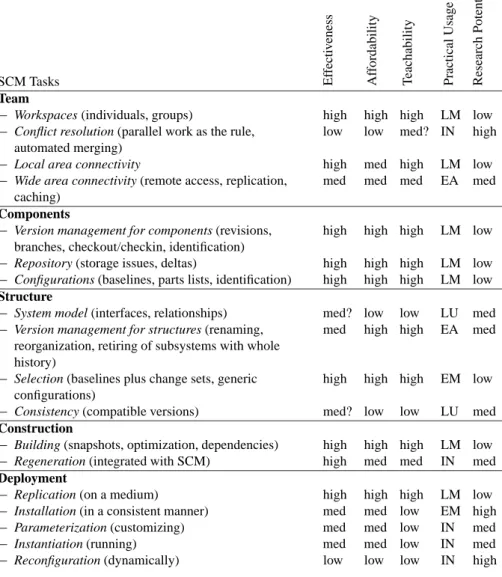
We begin with a discussion of the solutions available in the team functionality area; Table 1 on the next page summarizes our findings.
3.1 Team
The notion of a workspace that isolates a developer from other’s work is crucial to SCM. Generally, workspaces should provide their own structure, states for the con-figuration items and concon-figurations, and access rights for the different functions in the project [14]. The extent to which these requirements are met systems varies from file-based checkin/checkout mechanisms as inRCS[28] over virtual file systems as in CLEARCASE[18] or in n-DFS[13] to database-supported workspaces inADELE[9].
However, since everySCMsystem provides means to generate, propagate, and apply changes, everySCMsystem allows to simulate workspaces—even if the “workspace” is but a developer’s private directory or a branch in the version graph. This problem is thus considered solved.
With an uncontrolled propagation of changes, the chances for two or more people’s changes interfering with each other are high; this leads to conflicts that must be resolved. This merging of changes is still manual work. Textual merging is considered too unsafe for many environments; the effectiveness of syntactic merging [33, 3] and semantic merging [16, 2] has not yet been validated. Any solutions that ease the pain of manual conflict resolution are likely to save valuable developer time; here is still work to do.
A group working together needs connectivity to propagate changes. Given a small group with good interconnection, a central repository suffices for all project sizes. Things get more difficult for multi-site, multi-organization software developments (so-called virtual software corporations). Here, local copies of shared resources must be replicated and cached; remote access must be designed such that cooperation is pos-sible while avoiding total project disclosure. Although several commercialSCMtools such as CLEARCASE [18] offer support for wide-area connectivity, the area remains subject to further research.
3.2 Components
Managing the history of individual components is a well-understoodSCMtask. Tools likeSCCS[25] andRCS[28] are being used for more than two decades now. Efficient means to store and retrieve huge amounts of versions in a repository are available and have been thoroughly validated [17]. Identifying and reconstructing a configuration by means of its components or changes applied to a baseline is a task easily solved with all availableSCMtools.SCMat the component level may well be theSCMarea that is best understood of all.
3.3 Structure
Versioning of structures, i.e. systems of related components, is still not completely
Ranking of SCM Solutions SCM Tasks Ef fecti v eness Af fordability T eachability Practical Usage Research Potential Team
− Workspaces (individuals, groups) high high high LM low
− Conflict resolution (parallel work as the rule, automated merging)
low low med? IN high
− Local area connectivity high med high LM low
− Wide area connectivity (remote access, replication, caching)
med med med EA med
Components
− Version management for components (revisions, branches, checkout/checkin, identification)
high high high LM low
− Repository (storage issues, deltas) high high high LM low
− Configurations (baselines, parts lists, identification) high high high LM low
Structure
− System model (interfaces, relationships) med? low low LU med
− Version management for structures (renaming, reorganization, retiring of subsystems with whole history)
med high high EA med
− Selection (baselines plus change sets, generic configurations)
high high high EM low
− Consistency (compatible versions) med? low low LU med
Construction
− Building (snapshots, optimization, dependencies) high high high LM low
− Regeneration (integrated with SCM) high med med IN med
Deployment
− Replication (on a medium) high high high LM low
− Installation (in a consistent manner) med med low EM high
− Parameterization (customizing) med med low IN med
− Instantiation (running) med med low IN med
− Reconfiguration (dynamically) low low low IN high
systems do not go beyond simple part lists; relationships and interfaces are barely sup-ported, let alone versioned. (Exception to this rule are build dependencies, as discussed in Section 3.4.) The extent to which system modeling is part ofSCMis still being dis-cussed [32].
Although several commercialSCMsystems and even free tools likeCVS[1] allow decent versioning of file hierarchies, issues like renaming or reorganizing structures are still not handled in a fully satisfying manner.
AllSCM systems offer methods to select specific configurations; the range goes from tags as inRCSorCVSto elaborated rules as inCLEARCASE[18] orADELE[9]. The organization of versions (or changes) within anSCMsystem, the version model, has considerable impact on the way users interact with anSCMsystem [5]. Although it has been shown that all existing versioning models can be unified to applying constrained changes [37], the quest for user-friendly and intuitiveSCMinteraction continues.
A still open problem is how to identify and denote consistent configurations in pres-ence of multiple variants. So far, systems likeICE[36] orCMA[24] are confined to lab use only. On the other hand, one must ask whether variability at construction time—that is, permanent variants—is still anSCMissue. In general, product variability is best han-dled by the product and within the product. The more we design for change, the more we abstract from system issues, the less variability we have at construction time, and the more variability we have at run time. Although consistency issues may rise again within the scope of dynamic reconfiguration (see Section 3.5), efforts spent in variability may thus better be directed towards software design.
3.4 Construction
TheSCMtask of building products can be summarized as “MAKErules”. Virtually ev-ery software product is built usingMAKE [12] or one of its numerous descendants. Significant improvements on the originalMAKEinclude smart recompilation [29], par-allel and distributed building [27], automatic dependency tracking [18], or caching of derived versions [18]. All of these are widely used today, and it is difficult to see room for further improvements.
A more important problem is the traditional distinction between construction tools (i.e.MAKE) andSCMtools (i.e.RCS), as this separation hampers the regeneration of de-rived files. A notable exception and an example of good integration is the build facility integrated inCLEARCASE[18].
3.5 Deployment
Deployment is a new field ofSCM, traditionally subsumed under “maintenance”. Ac-cording to Heimbigner and Wolf [15], deployment encompasses installation,
parame-terization, instantiation, and reconfiguration;ISO9000-3 also lists replication.
Replication means to make sure that the intended configuration is correctly and
completely copied on the medium chosen for delivery. Copying from master to an EPROM, preparing a package with CD and paper documents, and putting the files to an area from where they are electronically transferred to the customer site are all
techniques for replication. This is evidently a topic for process engineering in an orga-nization. The main challenge is to define (and apply) it as a process with self-check so that the mistakes can be detected before delivery. We cannot see research opportunities in this area.
Installation is the task of transferring the product to the user. Basic installation is
easy—a set of files is copied to places reachable by users. But this task becomes the more difficult the more the product depends on other products, maybe in specific ver-sions. Managing these dependencies and denoting consistency is only partially solved today; the more applications depend on each other, the more the need for installation support will increase.
Parameterization is the task of adapting the product to the user’s context—a task
either done on site (by the user) or in the factory (especially when hardware is part of the delivery). Parameterization is traditionally carried out by customization files and environment variables; more recently. tools likeGNU AUTOCONF[19] are used to de-termine system properties automatically. In future, such checks will be increasingly carried out at run time and will thus need system support; the Windows registry is a yet rudimentary form of such capabilities.
Instantiation is the task of starting the product into execution. This is trivial (and
solved) for simple, monolithic applications, but becomes a challenge as soon as mul-tiple components interact with each other; trading services like the ones specified for CORBA[22] can serve as base for determining a consistent configuration.
Reconfiguration means adapting the product to new requirements while it is
execut-ing. This includes all decisions made during installation, parameterization, and instan-tiation, and may also mean that the product entirely re-creates and replaces itself. This problem is well-understood when speaking of isolated applications: uploading software releases dynamically to space probes or telecommunication switches is common usage. However, dynamic reconfiguration will gain even more importance as more and more software products interact with each other for an undetermined time. The challenge for SCMis to see how far classicalSCMconcepts can be applied dynamically.
Our observation is that the aspects of deployment are considered late in the life cycle of a software product, usually after the software is finished and somebody discovers that it has to be shipped to the customer site. Very few requirements specifications contain paragraphs for requirements on deployment issues. Most software producers can improve in this area; complex software systems offer new research issues.
4
SCM Process Tasks and Solutions
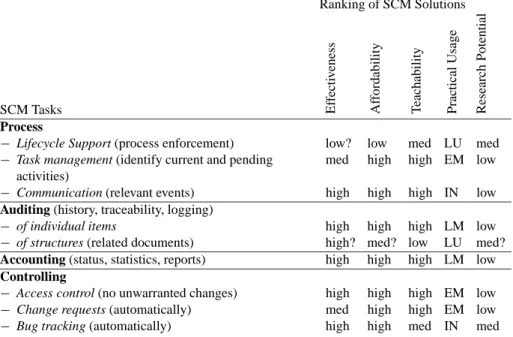
Let us now turn to the process functionality area. Our findings are summarized in Ta-ble 2 on the following page.
4.1 Process
How far should theSCMsystem support the user’s lifecycle model and their organiza-tion’s policies? Although everySCMsystem comes with a built-in process in the small
Ranking of SCM Solutions SCM Tasks Ef fecti v eness Af fordability T eachability Practical Usage Research Potential Process
− Lifecycle Support (process enforcement) low? low med LU med
− Task management (identify current and pending activities)
med high high EM low
− Communication (relevant events) high high high IN low
Auditing (history, traceability, logging)
− of individual items high high high LM low
− of structures (related documents) high? med? low LU med?
Accounting (status, statistics, reports) high high high LM low
Controlling
− Access control (no unwarranted changes) high high high EM low
− Change requests (automatically) med high high EM low
− Bug tracking (automatically) high high med IN med
Table 2. SCM Process Tasks
(i.e. checkin/checkout-cycle, long transactions, etc.), the degree to which large-scale processes are supported varies.
Our experience tells us that the big leap forward is the clear definition of software processes. Use of tools is beneficial only if they are really supportive; often they take the role of bureaucrats increasing the number of required interactions for the developers. Consequently,SCMsystems that are too rigid in enforcing a process will be cursed by developers and reduce effectiveness. The distinction between support and discipline and thus the effectiveness of lifecycle support remains to be validated.
Rather than enforcing activities, more advancedSCMsystems offer means to track current and pending activities. Task management is an area overlapping with (project) management. If tools are used it must be carefully decided which type of information is kept in theSCMtool and which in a project management tool. The interface is thin if theSCMsystem handles the states of the configuration items (and configurations) and this information is used by the (project) management for the progress control. Tight coupling of work activities with the state control of the work results leads to sluggish SCMsystems.
Ultimate process support is achieved with automated work flow systems. These are not widely used (yet); their validation is a pending research topic. In practice, work flow is typically organized by informal communication. Most SCM systems support
triggers that are associated with specific events—such as automatic notification by
e-mail whenever a change occurred. These communication features are well-understood, cheap and effective means for a simple work flow support [9].
4.2 Auditing
EverySCM system provides features to inquire the change history of specific config-uration items; these features are mature and widely used. A yet unsolved problem is the traceability of related documents: How does one trace a change in implementation back to the design and back to the requirements? How is a change in the implementa-tion related to a change in the documentaimplementa-tion? Although change-based versioning or
activity-basedSCM[21] allows these changes to be associated with each other, there is still room for improvement here.
4.3 Accounting
Accounting facilities let users (and managers) inquire about the status of a product.
SCMsystems at least allow classifying components and versions according to specific properties (i.e. experimental, proposed, or stable); it may well be this simple tagging method is already sufficient. Again, we know of no research that has addressed pending problems in this area.
4.4 Controlling
Access control is one of the fundamental principles of automatedSCM. EverySCM system features some kind of access control, typically via locks (only one user at a time can edit a file). Several SCMsystems also support access control lists (only specific users are allowed to do changes); others rely on the security features of the underlying repository. Access control is widely used; it has never been aSCMresearch topic.
Tracking of change requests and defect reports is at the heart of the maintenance process, starting as soon as independent testing begins. The process of handling these, especially responsibility for decisions and definition of records to be kept, determines the responsiveness of an organization on user needs. In small organizations, a simple Excel sheet will provide enough support; bigger organizations require an elaborated data base with dedicated queries.
Advanced SCM systems like LIFESPAN[35] offer an elaborated management of
change requests; in fact, the whole development process is organized along the
pro-cessing of change requests. Although the effectiveness of the process remains to be validated, improvements are more likely to come from SCMvendors than fromSCM researchers.
An importantSCMtopic is the tracking of product defects, as it provides immediate insight on the current product quality. Bug-tracking tools frequently come as stand-alone tools, from the freely availableGNATS[23] to elaborated commercial systems. However, the integration withSCMrepositories as well as automated testing facilities still leaves to be desired—a challenge forSCMvendors and researchers.
5
Conclusion
SCM is a mature discipline. It is mature in practice, as it is successfully used. And it is mature in research, since there is much to be taught—and not so much left to
be researched. The only two research areas that are considered to have high potential are automated change integration and deployment issues; major improvements are also feasible in wide area connectivity, version management of structures, system modeling, consistency issues, lifecycle support, and integration issues.
Although several well-understood solutions are available, no singleSCMsystem of-fers all solutions at once. Integration and flexibility are thus still issues forSCMusers andSCMvendors—maybe also forSCMresearchers, provided they find a way to vali-date the practical benefits of newSCMmodels.
Validation is also an issue for this paper, and the state ofSCM in general. Upon compiling the tables, it was amazing to see how few hard facts were available to back specific judgements. The most important result of our assessment is that many more SCMexperience reports and experiments are needed—we need to know what we know
before we can move on. We thus encourage theSCMcommunity to prove us right or wrong and look forward to fruitful discussions.
Acknowledgments. We thank the participants and organizers of the Dagstuhl Work-shop on Software Engineering Research and Education [7] for their suggestions and contributions. Gregor Snelting provided useful comments on an earlier revision of this paper. Walter F. Tichy initiated the discussion on the state ofSCMand helped a lot in ranking the individualSCMsolutions.
References
1. BERLINER, B. CVS II: Parallelizing software development. In Proc. of the 1990 Winter USENIX Conference (Washington, D.C., 1990).
2. BINKLEY, D., HORWITZ, S.,ANDREPS, T. Program integration for languages with proce-dure calls. ACM Transactions on Software Engineering and Methodology 4, 1 (Jan. 1995), 3–35.
3. BUFFENBARGER, J. Syntactic software merging. In Estublier [8], pp. 153–172.
4. BURROWS, C., ANDWESLEY, I. Ovum Evaluates: Configuration Management. Ovum, Inc., Burlington, MA, 1999.
5. CONRADI, R.,ANDWESTFECHTEL, B. Version models for software configuration man-agement. ACM Computing Surveys 30, 2 (June 1998), 232–282.
6. DART, S. Concepts in configuration management. In Feiler [11], pp. 1–18.
7. DENERT, E., HOFFMAN, D. M., LUDEWIG, J.,ANDPARNAS, D. L. Software engineering research and education: Seeking a new agenda. Workshop Report 230, Dagstuhl, Feb. 1999. 8. ESTUBLIER, J., Ed. Software Configuration Management: selected papers / ICSE SCM-4 and SCM-5 workshops (Seattle, Washington, Oct. 1995), vol. 1005 of Lecture Notes in Computer Science, Springer-Verlag.
9. ESTUBLIER, J.,ANDCASALLAS, R. The Adele configuration manager. In Tichy [30], ch. 4, pp. 99–133.
10. ESTUBLIER, J., FAVRE, J.-M.,ANDMORAT, P. Towards scm/pdm integration? In Mag-nusson [20], pp. 95–106.
11. FEILER, P. H., Ed. Proc. 3rd International Workshop on Software Configuration Manage-ment (Trondheim, Norway, June 1991), ACM Press.
12. FELDMAN, S. I. Make—A program for maintaining computer programs. Software— Practice and Experience 9 (Apr. 1979), 255–265.
13. FOWLER, G., KORN, D.,ANDRAO, H. n-DFS: The multiple dimensional file system. In Tichy [30], ch. 5, pp. 135–154.
14. FRUHAUF¨ , K. Hygiene in software works—Software configuration management. In Pro-ceedings of the Second European Conference on Software Quality (Oslo, 1990), pp. 1–17. 15. HEIMBIGNER, D., ANDWOLF, A. Post-deployment configuration management. In
Som-merville [26], pp. 272–276.
16. HORWITZ, S., PRINS, J.,ANDREPS, T. Integrating noninterfering versions of programs. ACM Transactions on Programming Languages and Systems 11, 3 (July 1989), 345–387. 17. HUNT, J. J., VO, K.-P.,ANDTICHY, W. F. Delta algorithms: An empirical analysis. ACM
Transactions on Software Engineering and Methodology 7, 2 (Apr. 1998), 192–214. 18. LEBLANG, D. B. The CM challenge: Configuration management that works. In Tichy [30],
ch. 1, pp. 1–37.
19. MACKENZIE, D., AND ELLISTON, B. Autoconf—Creating Automatic Configuration Scripts. Free Software Foundation, Inc., Dec. 1998. Distributed with GNU autoconf. 20. MAGNUSSON, B., Ed. Proc. 8th Symposium on System Configuration Management
(Brus-sels, Belgium, July 1998), vol. 1349 of Lecture Notes in Computer Science, Springer-Verlag. 21. MICALLEF, J., AND CLEMM, G. M. The Asgard system: Activity-based configuration
management. In Sommerville [26], pp. 175–186.
22. OBJECTMANAGEMENTGROUP. The Common Object Request Broker: Architecture and Specification, Aug. 1991.
23. OSIER, J. M.,ANDKEHOE, B. Keeping Track: Managing Messages With GNATS. Cygnus Support, 1996.
24. PLOEDEREDER, E.,ANDFERGANY, A. The data model of the configuration management assistant. In Proc. 2nd International Workshop on Software Configuration Management (Princeton, New Jersey, Oct. 1989), W. F. Tichy, Ed., ACM Press, pp. 5–13.
25. ROCHKIND, M. J. The source code control system. IEEE Transactions on Software Engi-neering SE-1, 4 (Dec. 1975), 364–370.
26. SOMMERVILLE, I., Ed. Proc. 6th International Workshop on Software Configuration Man-agement (Berlin, Germany, Mar. 1996), vol. 1167 of Lecture Notes in Computer Science, Springer-Verlag.
27. STALLMAN, R.,ANDMCGRATH, R. GNU Make—A Program for Directing Recompilation, 0.48 ed. Free Software Foundation, Inc., 1995. Distributed with GNU Make.
28. TICHY, W. F. RCS—A system for version control. Software—Practice and Experience 15, 7 (July 1985), 637–654.
29. TICHY, W. F. Smart recompilation. ACM Transactions on Software Engineering and Methodology 8, 3 (July 1986), 273–291.
30. TICHY, W. F., Ed. Configuration Management, vol. 2 of Trends in Software. John Wiley & Sons, Chichester, UK, 1994.
31. VAN DERHOEK, A., HEIMBIGNER, D.,ANDWOLF, A. L. Does configuration management research have a future? In Estublier [8], pp. 305–310.
32. VAN DERHOEK, A., HEIMBIGNER, D.,ANDWOLF, A. L. System modeling resurrected. In Magnusson [20], pp. 140–145.
33. WESTFECHTEL, B. Structure-oriented merging of revisions of software documents. In Feiler [11], pp. 86–79.
34. WESTFECHTEL, B.,ANDCONRADI, R. Software configuration management and engineer-ing data management: Differences and similarities. In Magnusson [20], pp. 95–106. 35. WHITGIFT, D. Methods and Tools for Software Configuration Management. John Wiley &
Sons, Chichester, UK, 1991.
36. ZELLER, A. Smooth operations with square operators—The version set model in ICE. In Sommerville [26], pp. 8–30.
37. ZELLER, A.,ANDSNELTING, G. Unified versioning through feature logic. ACM Transac-tions on Software Engineering and Methodology 6, 4 (Oct. 1997), 398–441.
![Fig. 1. SCM Functionality Areas (after Dart [6])](https://thumb-us.123doks.com/thumbv2/123dok_us/9583505.2444286/2.892.201.723.167.552/fig-scm-functionality-areas-after-dart.webp)