Communications &
Social Media
T r e n d r e p o r T #2
Introduction
The advent of social media and mobile technology is changing the way medical management personnel and systems communicate with patients, providers, payors and other stakeholders within the health care industry. While it was common practice decades ago for doctors to make a home visit when a patient needed medical attention, today a myriad of new communication platforms—such as texting and social media—are transforming patient/provider relationships.
This Trend Report decodes the results of the communications and social media segment of the 2012 Health IT (HIT) Survey to reveal important trends for the health care industry. The survey, conducted by Schooner Healthcare Services, LLC for study sponsors TCS Healthcare Technologies (TCS), the Case Management Society of America (CMSA), the American Board of Quality Assurance and Utilization Review Physicians, Inc. (ABQAURP) and Trajectory Healthcare LLC, is the third such study conducted since 2008.
The following analysis compares results with the 2008 and 2010 surveys to identify traditional, existing and emerging communication avenues. This report identifies how health care professionals are communicating with their patients or other clients, and tracks the development of trends over time.
Seven more Trend Reports will be published in 2013 that analyze and unveil more findings from the
2012 HIT Survey. Details about survey execution and research methodology are discussed in Trend
Report #1, which is available at www.tcshealthcare.com
and www.cmsa.org.
Analysis
The 2012 online survey posed dozens of detailed questions to not only determine how providers communicate with patients, but how they interact electronically to support different business
transactions within the health care system. The survey questions were broad enough in scope to cover a wide range of communication platforms. The analysis is divided into three sub-categories—traditional communications, current communications, and emerging communications.
Trend Report #1 points out that responders to
all three HIT surveys over the past five years were similar in type of business, size of business, and provider type. The absolute difference in responder characteristics was never more than 10%.
Like past HIT surveys, the 2012 study asked respondents to predict future use of each type of communication “two years from now.” Table 2A highlights the general communication trends by communication type based on results from both the 2010 and 2012 surveys. Table 2B further breaks down the 2012 results by specifying the type of care management program.
Traditional Communications
Traditional communications describes the methods for information exchange that have been in use for several decades. While a majority of the respondents indicate they communicate with patients via face-to-face meetings (71%), letters (74%), telephone (91%), and electronic facsimiles (32%), use of these traditional methods are on the decline with the possible exception of face-to-face meetings.Face-to-Face
For years, in-person meetings have been the hallmark of the physician-patient relationship. In past decades, it was common for utilization review nurses and case managers to pay regular visits to patients in the hospital, but these visits became less frequent as software systems emerged and more case management was handled telephonically.
While times have certainly changed, how often are face-to-face communications being used in today’s care management environment? In 2010, about 60% of respondents used face-to-face conversations to speak with patients or clients, and in 2012 this increased to just over 70%. In both surveys, when asked about the future frequency of in-person meetings with patients or clients, both groups predicted a drop in future contacts by about 4–5% (see Table 2A).
Clearly, the respondent’s setting influences the frequency of face-to-face meetings as highlighted in Table 2B. When comparing case management, disease management (DM), and utilization management (UM) programs in the 2012 survey, about 60% of the respondents supporting a case management program report having face-to-face contacts compared to 50% of those participating in a DM program and 49% in a UM program. Interestingly, the entire respondent pool predicts about a 4-5% drop in future face-to-face communications, but respondents in case management programs predict no change over the next two years. Those participating in DM and UM programs predict a slight increase of 4% and 3%, respectively.
As Table 2C shows, respondents in a “provider” setting were much more likely to engage in face-to-face communications versus respondents in a “health plan” setting (i.e., 71% vs. 33%). Health plan respondents predict only a 3% increase in face-to-face conversations by 2014, while providers expect to maintain the status quo.
At the same time, it’s hard to forecast the impact health care reform initiatives could have on face-to-face communications. Efforts to create a more integrated delivery system, including initiatives such as the medical home, accountable care organizations, or readmission prevention programs for that matter, will certainly be an integral part of the equation. New reimbursement methodologies also could have a significant influence on a rise or decrease in face-to-face visits with patients.
Letters
Patients often receive updates regarding their health plan coverage via mailed letter, especially as relates to reimbursement issues. But beyond this type of information exchange, how often are written letters being used to support care management programs?
In the two most recent surveys, three out of four respondents (76% in 2010 and 74% in 2012) report using letters with their clients and patients (Table 2B). In both surveys, respondents predicted a reduction of letter use over the next two years; however, 2012 respondents foresee a faster decline (i.e., a 5-point absolute drop from 2010 to 2012, and a 9-point absolute drop from 2012 to 2014).
As Table 2C denotes, health plan respondents use letters more frequently than provider respondents (89% and 78%, respectively). Both groups predict a slight decline in letter use over the next two years.
In 2012, a smaller percentage of respondents indicate their HIT platform or care management
software system can automatically generate letters for patients or providers (Table 2D). Note that this rate has been decreasing since the first survey was conducted (i.e., 50% in 2008, 42% in 2010, and then a drop to 38% in 2012). This represents an absolute point drop of 12 and a relative percentage drop of 24%.
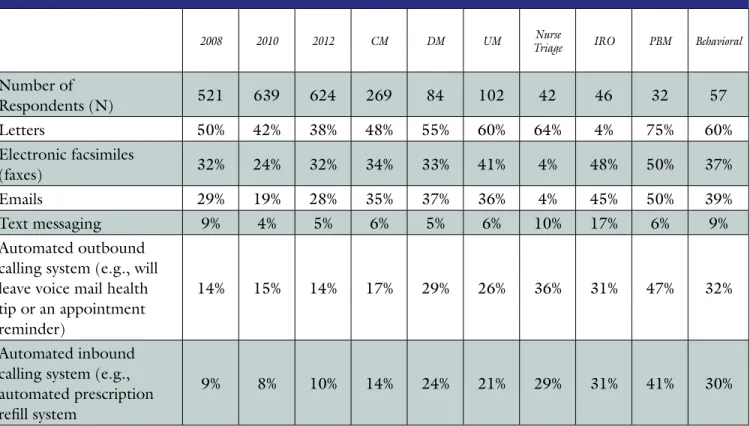
However, the results in Table 2E prove that care management systems consistently are above the 2012 average. Whereas only 38% of the entire respondent pool report being able to send out letters automatically through their respective IT systems, the percentage is much higher for respondents associated with a care management program (i.e., 47% for case management, 55% for DM, 60% for UM, 64% for nurse triage, 48% for IRO, 75% for PBM, and 60% for behavioral).
This trend is partially driven by an increased emphasis on electronic health records in recent years, as well as exploding growth in mobile technology.
Telephone
Telephones have been in use in the United States since the late 1800s, emerging from electrical telegraphs. The first coast-to-coast service began in 1915, and telephones have been a central part of communication between health care provider and patient ever since—from scheduling doctor’s appointments to helping case managers coordinate care with patients and their attending providers.
Reliance on the telephone to support patients remains high. In both the 2010 and 2012 surveys, nine out of 10 respondents report using the telephone, but that declined a bit from 93% in 2010 to 91% two years later. By 2014, 86% of the respondents predict they will use the telephone to communicate with their patients and clients, representing a 5-point drop.
Interestingly, only 71% of respondents indicate their patients have access to a home phone or landline. This result may be due to the wording of
the questions—the second question in the 2012 survey specifies “landline,” whereas the first question in the same survey simply identifies “telephone.” Some respondents may have interpreted telephone to include work phones or cellular phones.
Although telephone usage will likely continue a slow decline due to popularity of other
communication platforms, including the use of smartphones and email, most patients will likely maintain their landlines for the time being. That’s not necessarily a bad thing—the landline has several advantages over the cellular phone including better reception, no need to re-charge the batteries while traveling (except for cordless landline phones), and more reliable connection to 911 emergency services.
Electronic Facsimiles
Electronic facsimiles (faxes) have been routinely used by health plans and providers since the late 1980s primarily to verify the medical necessity of a procedure through the UM process. Faxes have not been traditionally used between providers and patients. With the move to complex condition management and less emphasis on strict UM review, the question is how quickly is the use of electronic facsimiles declining?
In 2010, four out of 10 respondents (42%) said they used faxes, and in 2012, only about one-third of the participants (32%) indicated fax use—representing about a 25% drop in relative terms and a 10-point
Interestingly, only 71% of respondents
indicate their patients have access to a
home phone or landline.
absolute reduction (Table 2A). Interestingly, the respondents in both surveys did not predict much change in the next two years. Clearly, the 2010 survey pool was off-base when respondents predicted a 2-point absolute increase from 2010 to 2012, when in fact the use of faxes dropped significantly over the two-year period. Again, the move to electronic health records (EHRs) and other forms of electronic communication likely explain the decreasing reliance on faxes.
This rapid downward trend is not surprising as health professionals, health plans and others have increasing access to EHRs and other HIT systems. In fact, some predict fax machines may soon become obsolete. This is especially true in the health care arena where traditional faxes pose more of a security threat to personal health information (PHI) due to the paper output.
Health care communication is complex, and today’s fast-paced, high-tech environment indicates a growing need for more interactive transactions. Faxing is a static, one-way communication that stifles interaction between sender and recipient. Even though many organizations have moved to computer-to-computer faxes, electronic facsimiles will likely be phased out as health care moves to more interoperable IT platforms.
Current Communications
Current communications are defined as health care platforms that have been in use for about the past 20 years. The 2012 survey respondents provided feedback on their use of a variety of platforms, including cellular or mobile phones (used by 82% of the respondents), smartphones (8%), emails (54%), personal health records (15%), text messages (13%), and wireless remote monitoring solutions (8%).
Cellular Phones
Popularity of mobile phones in the U.S. began to take off in the 1980s. Early mobile phones were installed in automobiles, but then moved to handheld devices over the next decade. Initially, cell phones ran on an analog network—digital networks were not introduced until the 1990s. Due to increasing bandwidth needs, 4G (fourth generation) networks are now available to support cellular and related communications.
Although the survey did not ask respondents to distinguish specifically between landline and cellular phone patterns, research shows a rapid move to cellular. About one in four U.S. households relies on mobile phones and have cancelled their landlines.
The last two surveys asked respondents if their patients had access to or use of a cell phone (see Table 2F). In both 2010 and 2012, respondents estimated that more than eight out of 10 patients have access to a mobile phone (see Table 2F). However, a 4-point absolute decrease was observed between the two surveys (i.e., 86% in 2010 and 82% in 2012). This trend appears to be counter-intuitive. The downward trend might be based upon some sort of question bias between the 2010 and 2012 surveys or otherwise is within the normal parameters of response variances. Nonetheless, the vast majority of patients appear to have access to a mobile phone, which should lead to new modes of communication (e.g., on the move and via texting).
Smartphones
A smartphone is a device that allows a user to make telephone calls, but also integrates the features of a personal digital assistant (PDA) along with email and internet capabilities. PDAs did not appear on the market in the U.S. until the late 1990s, but have unveiled a host of new ways to monitor and manage a broad range of health conditions. Apple’s iOS (operating system) and Google’s Android OS are
prime examples of devices that support these new operating systems.
In terms of how respondents use smartphone applications to communicate with their patients or clients, respondents report a slight increase in use of smartphone applications in the past two years, from 6% in 2010 to 8% in 2012 (Table 2A). On a similar note, 2012 respondents estimate that 14% of their patients currently use smartphones or tablets with Internet access (Table 2F).
When respondents were asked how much they would be using smartphone applications two years from now, both groups optimistically projected a 10% increase from 2010 to 2012, and a 25% increase from 2012 to 2014. Simply put, one out of four respondents predicts they will be using a smartphone or similar device over the next two years as they support their patients and other clients.
Emails
Electronic mail, also known as email, is a method of exchanging digital messages from an author to one or more recipients. Modern email operates through the Internet or other computer networks and plays a central role in helping support the health care system.
Over half of the respondents in 2010 (52%) and 2012 (54%) reported using email to communicate with patients and clients (see Table 2A). When asked the same question about their patients having email accounts, the response was a bit lower in both 2010 (47%) and 2012 (49%) as seen in Table 2F. Although both groups predict an increase in future use of this
type of communication, the 2012 respondents are not quite as optimistic as the 2010 group (i.e., 69% in 2010 and 65% in 2012), which perhaps reflects an expectation that there will be a greater reliance in the future on social media and other emerging communication platforms as discussed below.
In all three surveys, less than three out of 10 respondents report their HIT platform or care management software system can automatically generate email communications with patients or providers (Table 2D).
In terms of care management respondents, two out of three respondents report using emails to communicate with their patients or clients (Table 2B) when compared to 52% of the respondents for the entire group (Table 2A). When looking at three key care management programs, the percentage of respondents sending emails is 68% for case management, 69% for DM, 71% for UM.
Similar to automated letters, a higher percentage of care management respondents say their health IT systems allow automated email communications. Whereas 28% of 2012 respondents answered
affirmative for automated emails, that same response was higher (35-50%) for those with care management programs (Table 2E).
Personal Health Records
A personal health record (PHR) implies that health data and information related to the care of a patient is maintained by the patient or the patient’s provider, and the patient is allowed access to the information. Personal health records, which have been gaining popularity since 2000, should be distinguished from an electronic health record (EHR) that is maintained by the attending provider typically at the point of care.
Interestingly, when respondents were asked about whether their patients have access to a personal
In all three surveys, less than three out of
10 respondents report their HIT platform
or care management software system can
automatically generate email communications
with patients or providers.
health record, 29% in 2010 and 23% in 2012 said yes, representing an absolute drop of 6 points and a relative percentage drop of over 20% (See Table 2A). However, both survey groups predicted PHR use would double in the next two years following their survey, but this was not the case in the two years following the 2010 survey.
Text Messages
The advent of text messaging has changed the way we communicate both personally and professionally. No longer is communication restricted to face-to-face con-versations, a phone call, a letter, or even an email. Over the past 20 years, the ability to communicate in 140 characters or less (smartphones sometime allow more characters) has revolutionized the way people interact.
In recent years, text messaging has taken off in the health care arena. Many programs are emerging that support the health care needs of patients through texting. The Wounded Warrior Program, for example, is using text messaging tools to provide real-time support for mental health patients and veterans with traumatic brain injuries and other conditions.
As highlighted in Table 2A, respondents note increased use of texting with patients and clients. In fact, use of text messaging doubled since the 2010 survey, and respondents predict growth to double again by 2014. The percent of survey participants using texting grew from 7% in 2010 to 13% in 2012, and that is expected to grow to 28% by 2014.
As for those in care management, 20% report using texting, and 38% predict that they will be texting patients and clients by 2014 (Table 2B). Respondents in DM (44%) and UM (38%) programs were even more optimistic about texting two years from now.
Twenty percent of respondents in a provider setting report using text messages compared to 9% of individuals associated with health plans (Table 2C). However, 32% of respondents associated with health plans predict that they will use texting in the future, compared to 24% of providers.
As highlighted in Table 2D, automated texting launched from a more integrated software application is much less common (i.e., only 5% of respondents reported this capability in 2012 compared to 4% in 2010 and 9% in 2008). Interesting for the care management field, respondents associated with different care management programs report the same levels of automated texting as the larger group, with the exception of 17% of respondents associated with IROs (Table 2E).
Protecting patients’ privacy and security is vital in the health care field. And with text messaging to communicate with patients being a relatively new medium, some gray areas loom regarding compliance with the Health Insurance Portability and Accountability Act (HIPAA).
Wireless Remote Monitoring
Solutions
Wireless remote monitoring allows for mobile and in-home tracking of a patient’s health status, alerting providers to any significant changes. The patient data can be captured, transmitted and distributed to doctors who can keep tabs on patients with long-term or chronic illnesses such as cardiovascular disease or diabetes. According to a report from Swedish firm Berg Insight, about 2.2 million patients worldwide were using remote medical monitoring services by the end of 2011.
use of text messaging doubled since the
2010 survey, and respondents predict
growth to double again by 2014.
In 2010, 6% of HIT survey respondents reported using wireless remote monitoring devices and predicted an increase of usage to 15% within two years. In 2012, 7% of respondents reported using wireless remote devices and predict an uptick to 19% by 2014. The care management sub-analysis reflected similar trends to the larger 2012 survey group (see Tables 2A and 2B).
As Table 2C shows, respondents in a “provider” setting are more likely to use remote monitoring devices versus those in a “health plan” setting (i.e., 20% to 11%). For both settings, one out of every four respondents predicts using remote monitoring communications in two years.
Interactive Voice Response/
Automated Calling
Interactive voice response and automated calling systems use voice recognition to allow for input and responses gathered from the spoken word. It is a method of patient communication and data gathering that has risen in popularity within the health care industry over the past several years. Advances in technology using voice recognition have allowed for more fluid patient follow-ups regarding satisfaction with treatment, post discharge patient safety, outcomes monitoring, care coordination and home monitoring.
The use of automated outbound calling systems to communicate with patients has remained unchanged
over the past six years, with 2008, 2010 and 2012 respondents all reporting a 14% usage. The use of inbound calling, such as automated prescription refill systems, decreased 1% between 2008 and 2010 (9% to 8%), but for 2012 increased to 10% (Table 2D).
As Table 2E indicates, the care management sub-pools show different levels of use based on specialty. The use of automated outbound calling systems is highest by pharmacy benefits management respondents at 47%. Nurse triage (36%), behavioral health (32%), independent review (31%), disease management (29%), utilization management (26%), and case managers (17%), all report a significantly higher use of automated outbound calling to
communicate with patients as well when compared to the overall survey respondents.
Similarly, the use of automated inbound calling systems by the care management sub-pools is significantly higher than that of the main pools. Again, pharmacy benefits managers report the highest usage, coming in at 41%. Independent review (31%), behavioral health (30%), nurse triage (29%), disease management (24%), and utilization management (21%) all report higher usage than the larger population. Case managers, while still reporting higher usage than the large pool, only report a 14% usage of automated inbound calling systems to communicate with patients and clients.
emerging Communications
Blogging and Micro-blogging
Blogs are no longer simply online personal diaries. A blog is now a way for companies to communicate with customers, for media outlets to offer timely insights, and for industry experts to inform readers about a topic related to their area of interest.
Micro-blogging is similar to a traditional blog, but the content is shorter and more concise, allowing users to exchange small bits of content rather
Interactive voice response and automated
calling systems use voice recognition to allow
for input and responses gathered from the
spoken word.
than long, detailed posts. Micro-blogging became prevalent in 2007 when Tumblr and Twitter began offering a platform for users to share and collaborate.
Blogging in the health care industry is no exception. Doctors, case managers, insurance brokers and health advocacy groups are now making blogging a priority to regularly communicate with key audiences, post health tips, educate patients and discuss current topics—all while building a presence on the Internet through search engine optimization (SEO). Blogging facilitates conversation and communication and often allows for an interactive platform of comments and responses.
Only 2% of respondents in the 2010 survey reported using blogging as a means to communicate with patients/clients, but predicted that would rise to 5% by 2012 (Table 2C). Although 2012 survey results indicate an increase in blogging to communicate with patients, it did not rise to the anticipated 5% mark. Three percent of 2012 respondents report using blogs or micro-blogs to communicate with patients and clients, and on average respondents predict that usage will jump to 8% by 2014. No major differences were seen in the care management sub-group from the large group findings.
Only 2% of 2012 case management respondents are using blogging and micro-blogging to
communicate with patients, but this group predicts an increase to 14% within two years. The disease management group reports the same low usage, but also predicts similar growth in usage to 13% of their sub-group. Utilization management respondents predict a jump in the use of blogs and micro-blogs from 3% to 15% by 2014.
Social Networking Sites
Swift and dramatic changes in the health care industry are also largely due to the rise in health care-related communication through social media. Social media
can be used to educate patients, advertise offerings for potential patients, and assist patients in finding quality health information online. An increasing need for transparency in the health care industry is another reason social media use is on the rise.
When asked to indicate the types of
communication currently being used to connect with patients and clients, 4% of 2010 respondents said they were using social media and 8% expected to be engaged in social media by 2012 (Table 2A).
The percentage of respondents using social media to communicate with patients and clients in 2012 actually exceeded the 2010 prediction, with 9% using social media to communicate. Respondents predict use of social media tools to grow to 14% by 2014.
While only 9% of case managers report the use of social media to communicate with patients in 2012, this group expects a jump to 16% in the next two years. 2012 disease management respondents forecast social media applications in this group to grow from the current 16% to 21% by 2014. The utilization management group predicts the most dramatic increase of all—from 15% to 26% in the next two years.
iPads/Tablets
Increasingly health care providers are using iPads or tablets to enter medical data and record valuable information during patient visits. Although use of tablets in the health care arena was not addressed
While only 9% of case managers report the
use of social media to communicate with
patients in 2012, this group expects a jump
to 16% in the next two years.
The 2012 Health IT Survey was conducted by Schooner Healthcare Services for TCS Healthcare Technologies (TCS), the Case Management Society of America (CMSA), the American Board of Quality Assurance and Utilization Review Physicians, Inc. (ABQAURP) and Trajectory Healthcare LLC. TCS, CMSA and ABQAURP teamed together for the third time to sponsor the survey, which examines how various health IT applications are changing the care management field. Trajectory Healthcare, LLC assisted in the 2012 analysis, and an advisory panel of volunteers supervised the administration, analysis and
reporting of the survey.
For more information on the survey or download to the series of Trend Reports, visit www.tcshealthcare.com or www.cmsa.org.
specifically in any of the three surveys, it is a trend worth noting.
In addition to taking medical history and charting information, health care workers are also utilizing tablets to e-prescribe. According to a data brief from ONC, e-prescribing among physicians increased approximately 41% across the United States between December 2008 and June 2012.
Although the most recent survey did not pose a direct question about iPad use, 14% of respondents indicated having access to a “smartphone/tablet with Internet access” (Table 2F).
As noted in a 2012 Manhattan Research report, “Physician tablet adoption for professional purposes almost doubled since 2011, reaching 62% in 2012, with iPad being the dominant platform. Furthermore, one-half of tablet-owning physicians have used their device for point of care.”
It will be interesting to see how the use of tablets impacts health care over the next few years, as well as the new tools that will emerge to assist health professionals in their daily routines.
Conclusions
As predicted in the 2010 Health IT Survey, social networking site usage such as Facebook and micro-blogging (including Twitter), doubled by 2012. Nearly a two-fold increase also occurred in the use of text messaging. Use of smartphone applications, wireless remote monitoring, online personal health records (PHRs), member/patient portals, and remote monitoring devices grew at a slower pace.
The most drastic, but not surprising change, occurred in commonly used forms of communication that were formerly staples of the health care industry. Facsimile use declined by 10% between 2010 and 2012, most likely due to the shift to EHRs.
Adoption of the emerging communication trends will take some time. Some concerns include HIPAA compliance associated with some of the new technologies such as text messaging, the cost of using the new technology, and the extent of the need to adopt and implement the new technologies.
Our society has become increasingly mobile and the health care industry is being forced to react. Patients are now analogous to e-patients—with the world at their fingertips and no longer willing to sit back idly and wait for a response. The Internet is now a resource for patients to research their symptoms, insurance policies and health concerns. This paradigm shift to 24/7 accessibility has forced the health community to react and meet the need for available knowledge with increased communication modalities and ways of responding to and informing patients.
The Internet is now a resource for patients
to research their symptoms, insurance
policies and health concerns.
2010 2012
Appendix
TABle 2A: pATIenT CoMMunICATIon opTIonS
Currently and Two Years from now
please indicate the forms or types of communication that you “are currently using” or “plan on using two years from now” to communicate with your client/patients?
(respondents could select more than one option)
Current Use Planned Two Years from Now
Absolute
Change Current Use
Planned Two Years from Now Absolute Change Current Use: 2010/2012 absolute difference Telephone 93% 89% -4 91% 86% -5 -2 Letter 76% 71% -5 74% 65% -9 -2 Face-to-face conversations 62% 57% -5 71% 67% -4 +9 Facsimile 42% 44% +2 32% 31% -1 -10 Email 52% 69% -17 54% 65% +11 +2
Personal health records (online) 17% 37% +20 15% 34% +19 -2 Member/patient portals 12% 25% +13 15% 32% +17 +3 Text messaging 7% 19% +12 13% 28% +15 +6 Smartphone applications e.g.,
iPhone, Blackberry 6% 16% +10 8% 25% +17 +2 Remote monitoring devices 6% 15% +9 7% 19% +12 +1 Wireless remote monitoring
solutions (e.g., pedometer, blood pressure device)
5% 15% +10 8% 18% +10 +3
Social networking sites such as
Facebook 4% 8% +4 9% 14% +5 +5
Blogging & micro-blogging
such as Twitter 2% 5% +3 3% 8% +5 +1
TABle 2B: pATIenT CoMMunICATIon opTIonS
Currently & Two Years from now
please indicate the forms or types of communication that you “are currently using” or “plan on using two years from now” to communicate with your clients/patients? 2012 Care Management pool Sub-Analysis
(respondents could select more than one option)
Total Current Planned Total In 2014 CM Current Planned CM In 2014 DM Current Planned DM In 2014 UM Current Planned UM In 2014 Number of Respondents (N) Could select more than one response 637 629 212 212 84 84 100 100 Face-to-face conversations 71% 67% 60% 60% 50% 54% 49% 52% Telephone 91% 86% 96% 92% 95% 89% 95% 89% Letter 74% 65% 87% 79% 89% 77% 91% 81% Facsimile 32% 31% 37% 33% 30% 27% 40% 36% Email 54% 65% 68% 75% 69% 76% 71% 77% Text messaging 13% 28% 19% 38% 16% 44% 12% 38% Social networking sites such as
Facebook 9% 14% 9% 16% 16% 21% 15% 26%
Personal health records
(online) 15% 34% 19% 34% 23% 44% 23% 47% Smartphone applications e.g.,
iPhone, Blackberry 9% 25% 12% 30% 7% 36% 10% 38% Blogging & micro-blogging
such as Twitter 3% 8% 2% 9% 2% 13% 3% 15% Remote monitoring devices 7% 19% 8% 19% 10% 26% 10% 27% Member/Patient portals 15% 32% 19% 34% 31% 50% 32% 55% Wireless remote monitoring
solutions (e.g., pedometer, blood pressure device)
8% 18% 9% 21% 13% 31% 13% 32% Other, please specify 6% 7% 4% 6% 1% 6% 6% 7%
TABle 2C: pATIenT
CoMMunICATIon opTIonS
Health plans versus provider organizations
Health Plan Current Health Plan In 2014 Provider Current Provider In 2014 Blogging & micro-blogging such as Twitter 4% 15% 7% 17% Email 64% 72% 61% 66% Face-to-face conversations 33% 36% 71% 71% Facsimile 28% 27% 34% 34% Telephone 93% 93% 90% 85% Letter 89% 81% 78% 76% Member/ Patient Portals 36% 50% 22% 42% Personal health records (online) 25% 36% 37% 51% Remote monitoring devices 11% 25% 20% 24% Smartphone applications (e.g., iPhone, Blackberry, Android) 12% 36% 15% 32% Social networking sites such as Facebook 16% 29% 20% 22% Text messaging 9% 32% 20% 24% Video conferencing (e.g., Skype) 7% 22% 7% 20% Wireless remote monitoring solutions (e.g., pedometer, blood pressure device) 14% 35% 17% 24% Other, please specify 4% 7% 7% 17%
TABle 2d: CoMMunICATIon
AuToMATIon QueSTIon SerIeS
please indicate if your health information technology platform, care management software system or call center system automatically generates the following communications or correspondence to patients or providers? (respondents could select more than one option)
2008 N=521 N=6702010 2008 to 2010 Absolute Change 2012 N=624 2008 to 2012 Absolute Change Letters 50% 42% -8 38% -12 Electronic facsimiles (faxes) 32% 24% -8 32% 0 Emails 29% 19% -10 28% -1 Text messaging 9% 4% -5 5% -4 Combined -31 NA Automated outbound calling system (e.g., will leave voice mail health tip or appointment reminder) 14% 14% 0 14% 0 Automated inbound calling system (e.g., automated prescription refill system) 9% 8% -1 10% +1 Not Sure 5% 3% -2 4% -1
TABle 2e: CoMMunICATIon AuToMATIon QueSTIon SerIeS
please indicate if your health information technology platform, care management software system or call center system automatically generates the following communications or correspondence to patients or providers?
2012 Care Management pool Sub-Analysis
(respondents could select more than one option)
2008 2010 2012 CM DM UM TriageNurse IRO PBM Behavioral
Number of Respondents (N) 521 639 624 269 84 102 42 46 32 57 Letters 50% 42% 38% 48% 55% 60% 64% 4% 75% 60% Electronic facsimiles (faxes) 32% 24% 32% 34% 33% 41% 4% 48% 50% 37% Emails 29% 19% 28% 35% 37% 36% 4% 45% 50% 39% Text messaging 9% 4% 5% 6% 5% 6% 10% 17% 6% 9% Automated outbound
calling system (e.g., will leave voice mail health tip or an appointment reminder)
14% 15% 14% 17% 29% 26% 36% 31% 47% 32%
Automated inbound calling system (e.g., automated prescription refill system
9% 8% 10% 14% 24% 21% 29% 31% 41% 30%
TABle 2F: pATIenT CoMMunICATIon opTIonS—
oVerVIeW
do most of your patients have access to or use the following items? (respondents could select more than one option)
2010 2012 Absolute Change
Use a computer at home? 58% 56% -2 Have an email account? 47% 49% +2 Have access to a personal health record? 29% 23% -6 Own a cell phone? 86% 82% -4 Own a smart phone/tablet with Internet access? n/a 14% n/a Have a home phone or land line? n/a 72% n/a