Developing a Customer Relationship Management Model for Better
Health Examination Service
Prof. Jr-Jung Lyu
Professor in Department of Industrial and Information Management, National Cheng Kung University, Taiwan, R.O.C.
Dr. Hai-Lun Chao
Associate Professor in Department of Health Care Administration, Chung Hwa University of Medical Technology, Taiwan, R.O.C.
Dr. Chia-Wen Chen
Department of Industrial and Information Management, National Cheng Kung University, Taiwan, R.O.C.
Li-Yu Huang
Department of Industrial and Information Management, National Cheng Kung University, Taiwan, R.O.C.
ABSTRACT
People emphasize on their own health and wish to know more about their conditions. Chronic diseases now take up to 50 percent of top 10 causes of death. As a result, the health-care industry has emerged and kept thriving. This work adopts a customer-oriented business model since most clients are proactive and spontaneous in taking the “distinguished” health examination programs. We adopt the soft system dynamics methodology (SSDM) to develop and to evaluate the steps of introducing customer relationship management model into a case health examination organization. Quantitative results are also presented for a case physical examination center and to assess the improved efficiency. The case study shows that the procedures developed here could provide a better service.
Keywords: Customer Relationship Management, Health Examination Service, Soft System Dynamics
Methodology
1.0
Introduction
Recently, health concept is from the "early cure" into an "early detection, early treatment." The concept is in filtering through the early detection of diseases in order to provide timely treatment. Therefore, people are looking for health examination services, paying their own expense. In order to develop speedy services for the customers, many hospitals have set up the internal health examination centers. Facing a highly competitive market, however, hospitals need to develop strategies to effectively utilize testing equipment and information. It is therefore critical for a health examination center to investigate how to give customers better service with a strong customer relationship.
Customer Relationship Management (CRM) model has been widely adopted and reported by various enterprises, though it is still rarely adopted by the hospitals. Spending lots of money, time and effort, some research claimed that up to70% of the CRM implementation projects failed (Mishra, &Mishra, 2009). Reasons for failure are due to lack of appropriate implementation process, poor change management, and the mis-communication among customers, managers, and CRM system providers.
This study develops a process to implement customer relationship management model in the health examination service providers. To reduce the risks and to justify the effectiveness of the model, Soft
System Dynamics Methodology (SSDM) shall be adopted for a systematic way of the design and develop of CRM. A case physical examination center is used to illustrate how it facing the problem, potential performance through simulation-based evaluation, and possible alternatives to improve the customer services. Feasibility of the application of CRM model in health examination services is therefore demonstrated.
2.0
Literature Review
2.1 Customer Relationship Management (CRM)
CRM was originally from contact management, specializes in collecting information about customer contact with the company. The key idea of CRM is to provide the value of customer expectations, in order to achieve customer satisfaction, and creating customer loyalty (Gneiser, 2010). Therefore, an effective customer relationship management model, with appropriate technology to support the interaction between enterprises and customers, can enhance the good relationships between enterprises and customers. This will result in customers retention and effectively enhance customer loyalty. Implementation of the customer relationship management can help to distinguish the target customers, listen to the voices and understand the needs of key customers, and to establish the business focus and position therefore. The value of the enterprise should be customer-oriented, to provide appropriate products, services and prices at the right time to the appropriate customers in order to maximize the customer relationship value.
According to IDC (International Data Corporation) and Gartner, Group statistics, the success rate to implement customer relationship management is less than 30% (Mishra, & Mishra, 2009). Payne and Frow (2006) also pointed out that 70% of the CRM projects reported failure within 18 months, and 60% of them would end in failure. Nguyen et al (2007) believes that the lack of high-level support to make proper adjustments to the internal processes, too much focus on the ROI (return on investment), and do not have patience for a serious planning process would all result in the failure of the implementation projects. Pedron and Saccol, (2009) also pointed out factors that will cause the failure including: managers did not understand the value of its potential, customer-center culture does not establish, and poor performance metrics. There are many different reasons lead to failure, but some of them do can avoid (Payne & Frow, 2004). Overall, CRM implementation is correlated with the whole organization and many technologies, so its complexity is very high.
2.2 The Soft System Dynamics Methodology (SSDM)
SSDM was proposed by Paucar-Caceres Rodriguez-Ulloa, a combination of soft (Soft System Methodology, SSM) and system dynamics (SD) (Paucar-Caceres & Rodriguez-Ulloa, 2007). SSDM integrates the merits of both SSM and SD, which includes four phases, and containing ten systematic steps. Reasons to adopt SSDM include:
1. A health examination service environment can be regarded as a complex system, and applying CRM
model needs to consider many complex factors. So, careful analysis is necessary to deal with wide customers' needs.
2. Through the flexible system dynamics simulations of the validation phase, one be able to analyze the
overall environment of the health examination process without the impact of physical operations.
3. A clear problem definition, situation analysis through simulation, and performance of alternatives can
3.0
Case Study
3.1 Case Background
Case physical examination center has been re-decorating, renovating and purchasing of advanced medical facilities, and is an important unit in the hospital attention. It provides various packages to meet a variety of inspection needs. The leader of the center commits to provide better service quality for the customers, subjects with the best service and the best medical team which provides an efficient and correct diagnosis. Focus on the high-end health examination customers, the case health examination center is interested to implement CRM model in order to provide “distinguish” services.
3.2 Implementation Process
This section will describe how the case health examination center can apply soft system dynamics to construct a detailed process to implement the customer relationship management project.
Stage 1: Health check service to the actual inspection (unstructured problem situation)
Higher health check is a key part of the case of health examination center revenue. Due to its high cost, its main customer base is usually 45-75 years old group. CRM is of people-based, service types that take customer demand as the center-oriented. It must address the customer needs to provide more customized options, so it is suitable for CRM to manage and maintain the health examination center of the high-end health check customer. The case health examination centers have a variety of high-end suite of health examination, according to individual needs to choose a different health check suit. Health examination takes place on the 11th floor and basement of the F & B medical building.
The health check process can be divided into pre-process health check and health check daily process, but differ according to the health check package choice. Customer appointment, an appointment date of the health check and pay the booking fee, nurses and customer confirmation and the required precautions. Customer needs to register on the first floor of the first medical report, see the nursing staff to explain the process, and then check in accordance with the scheduling system. Most of the inspection process focused on the 11th floor of the B medical building, but a whole body MRI need to go to the basement of the medical building B, Abdominal CT scan is in medical building A on the first floor. The nursing staff concern will lead the customer to health examination room to check.
Stage 2: The health check process question about the problem situation of the (structured)
The end of this stage for the actual inspection for the case of health examination center will take advantage of rich graphical methods (Rich Picture) depicts the thinking of the situation from different points of view. The doctors should pay attention to whether the machine can be effectively used. If there are no knowledge from the customers, it would likely result in the increase in the time for explanation. This will, in turn, require growth of the overall test time, and will also cause the next one waiting customer inconvenience. For nurses, they need to know about the adequacy of the customer's travel and trends, and the allocation of nursing manpower. There may need to schedule to make the appropriate adjustments. Explanation of the health check results to the customers are most concerned during the health check process. These processes have to be smoothed again, hoping to reduce the waiting time, physicians, nurses, attitude, equipment, old and new, providing a comfortable environment is the main points of the customer consideration.
Stage 3: Health Screening Services range of factors set
In accordance to the above steps, we can use the principles of problem definition (CATWOE) to clarify the case of health examination center into the range of customer relationship management project, as described in Table 1.
Table 1: Case health examination center point to draw Import CATWOE definition of the CRM project scope project the rich icon
Name Scope
Customer Cases of high-end health examination center health check service to
customers.
Actor The case of health examination center of the implementation of the relevant
personnel. Transformation
Enhance the service quality of high-end health check services in case of health examination center, changing customer needs as the core business model.
Weltanschauung (World View)
Mainly in the case of health examination center for high-end health check services to perform the import customer relationship management processes.
Owner Mainly the case of health examination center.
Environment Cases of high-end health examination center health
check services environment. Stage 4: The health check service problem modeling
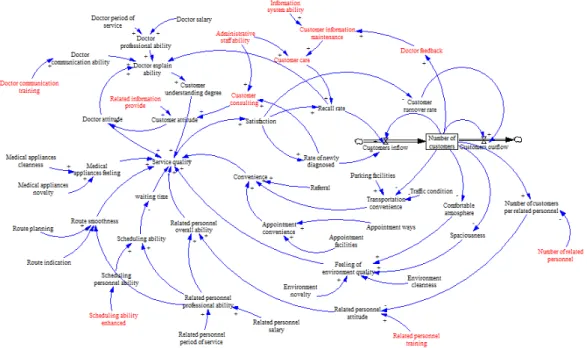
This step will be based on the third chapter of the construction of simulation models of the health check service, to modify and build the case of health examination center of the high-end health check service services simulation model, dynamic model for the case of this study, high-end health examination center health check service environment shown in Figure 1.
Stage 5: Validate the model to meet the real health check situation
The case health examination center of the high-end customer can handle the daily number of customers between 25 and 35. Figure 2 this study is to simulate the real situation from the trend for the case of health examination center of high-end simulation model of the health check service.
13,000 0.8 6,500 0.65 0 0.5 2 2 2 2 2 2 2 2 2 2 2 2 2 2 1 1 1 1 1 1 1 1 1 1 1 1 1 1 1 0 5 10 15 20 25 30 35 40 45 50 Time (Year)
Number of customers : Current 1 1 1 1 1 1 1 1 1 1 Service quality : Current 2 2 2 2 2 2 2 2 2 2 2
Figure 2: Simulation model of the original simulated Figure of the health examination service At the beginning of the simulation, the number of customers of the initial value is set to20, treated as a unit for this study, the number of customers into the 4800.
In the case of dynamic simulation, we can see when the number is more, in the case of the same overall environment, the health check service quality with the rise in the number decreased after several cycles, the quality of service and the annual average number of customers finally reach the steady state. Service quality is close to 0.6, while the annual average number of customers is close to 7212 people, that is, about 30 people a day, in line with actual operating conditions of the case of health examination center.
Stage 6: Construction of the implementation program
This stage will focus on the case of health examination and customer relationships to maintain, set out the actual improvement and customer relationship programs TO reach a good relationship maintain customer expectations import. According to interviews with the case of health examination center after the following strategic objectives is to hope to reach the case of health examination center. This study is to understand the actual ability to load in case health examination centers program of action. The following will be fulfilled for the case health examination center strategic objectives set out performance indicators and to develop relevant and viable program of action (see Table 2)
Table 2: Case of health examination center action Customer
understanding
1. health examination for health
check service to provide relevant information
2. Doctors explain the ability of training
Nurses' attitude 1. nursing education and training
2. increase the nursing staff
Customer waiting time 1. A scheduling ability
2. increase the nursing staff
1. raising customer
satisfaction
2. Customer waiting
time reduced
3. back to the clinic rate
increase
4. Service quality
improvement
5. Reduce the Customer
complaints Customer Care
1. A customer information management
system to build
2. physician feedback
Stage 7: Implement CRM modules and the factors set
Implement module and related factors to develop good customer relationship management into a viable improvement plan that is required for the program settings, to help build the case of health examination center to import the system dynamic simulation model for customer relationship management solutions, import by the model to understand the program after the individuals involved health screening center as a whole environment, the impact.
Stage 8: Build health check CRM model
This step will be required in accordance with the sixth step for the case health examination center to improve and maintain key customer program. It will be improved after the items changed by the factors established by the health check service model, to develop a model of customer relationship management into the health check service. By stipulated want to import the CRM scope and objectives of the health examination, one can load equipment or ability to carry out dynamic simulation, in order to import the overall health check of environmental change.
Figure 3: This study the health examination of the overall analog Stage 9: simulation analysis of health check CRM program
This step will be required for programming content, showing a CRM program to import the simulation results of the health check service model to compare the current situation, to observe and to change the analysis after import to the overall environment.
The doctors should pay attention to whether the use of the machine can be effectively used; and if there is no understanding of customers, would likely result in the increase in the time of more health check before the explanation. This would make the overall test time longer, and will also cause the next one waiting
customer inconvenience. For nurses, the need at any time concerned about the adequacy of the customer's travel and trends, and the allocation of nursing manpower, there may need to schedule to make the appropriate adjustments; the customer, the explanation of the health check results are most concerned about customer the health check process smooth again, hoping to reduce the waiting time, physicians, nurses, attitude, equipment, old and new, providing a comfortable environment is the main points of the customer consideration.
Stage 10: Implementation advice and learning
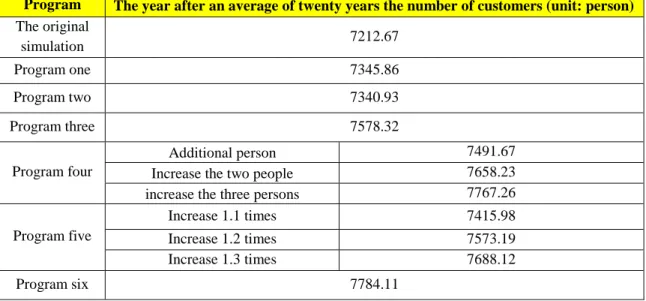
Based on the sixth to the ninth step of the simulation program, the system dynamics is to simulate the changes in the overall quality of service changes and the number of customers. Its simulation results are summarized in Table 3.
Table 3: Comparison of Programs
Program The year after an average of twenty years the number of customers (unit: person)
The original simulation 7212.67 Program one 7345.86 Program two 7340.93 Program three 7578.32 Additional person 7491.67
Increase the two people 7658.23
Program four
increase the three persons 7767.26
Increase 1.1 times 7415.98 Increase 1.2 times 7573.19 Program five Increase 1.3 times 7688.12 Program six 7784.11
4.0
Conclusions
People emphasize on their own health and wish to know more about their conditions, while chronic diseases now take up to 50 percent of top 10 causes of death. As a result, the health-care industry has emerged and kept thriving. Nevertheless, with a cost structure limited by the comprehensive health insurance programs, hospitals are developing and investing in the market of “distinguished” health examinations in order to attract high value-added customers. Thus, in facing the fierce, ever-increasing competition, a health examinations organization has to develop a unique business model to improve customer loyalty and customer satisfaction through creating, fortifying, and maintaining the relationships with their clients. This work adopts a customer-oriented business model since most clients are proactive and spontaneous in taking the “distinguished” health examination programs. Since only few literatures can be found in related to the application of customer relationship management (CRM) model to the hospitals, a systematic methodology is therefore necessary to design and to justify the process and potential performance. This work adopts the soft system dynamics methodology (SSDM) to develop and to evaluate the steps of introducing customer relationship management model into a case health examination organization.
Quantitative results are also presented for a case physical examination center and to assess the improved efficiency.
For the case physical examination center, schema to constitute the customer relationship management model is illustrated. The major steps include: a) identify problems in the real world through actual exploration into the medical examination service procedures; b) problems are simulated through scenario planning involving aspects of systems thinking; c) performance of the simulated problems with proposed solutions is estimated, and d) solutions to those real-world problems are proposed. The case study shows that the procedures developed here could provide a better step for the physical examination center and effectively assess the efficiency of the introduced solution.
References
Benz, G., & Paddison, N. V. (2004). Developing Patient-Based Marketing Strategies. Healthcare
Executive, vol. 19, no. 5, pp. 40-42.
Centers for Disease Control and Prevention, Chronic Disease and Health Promotion, Available at: http://www.cdc.gov/chronicdisease/overview/index.htm, Accessed June 5, 2010.
Chahal, H. (2010). Two Component Customer Relationship Management Model for Healthcare Services.
Managing Service Quality, vol. 20, no. 4, pp. 343-365.
Chalmeta, R. (2006). Methodology for Customer Relationship Management. Journal of Systems and
Software, vol. 79, no. 7, pp. 1015-1024.
Donabedian, A. (1989). The End Results of Health Care: Ernest Codman's Contribution to Quality Assessment and Beyond. The Milbank Quarterly, vol. 67, no. 2, pp. 233-243.
Gneiser, M. S. (2010). Value-Based CRM The Interaction of the Triad of Marketing, Financial Management, and IT. Business & Information Systems Engineering, vol. 2, no. 2, pp. 95-103. Handelsman, S. F. (1991). An Investigation of Determinants that Influence Consumer Satisfaction with
Inpatient Health Care Encounters (patient Satisfaction). Rush University, Unpublished Dissertation,
Mishra, A., & Mishra, D. (2009). Customer Relationship Management: Implementation Process Perspective. Acta Polytechnica Hungarica, vol. 6, no. 4, pp. 83-99.
Nguyen, T. H., Sherif, J. S., & Newby, M. (2007). Strategies for Successful CRM Implementation.
Information Management & Computer Security, vol. 15, no. 2, pp. 102-115.
Paucar-Caceres, A., & Rodriguez-Ulloa, R. (2007). An Application of Soft Systems Dynamics Methodology (SSDM). Journal of the Operational Research Society, vol. 58, no. 6, pp. 701-713. Payne, A., & Frow, P. (2004). The Role of Multichannel Integration in Customer Relationship
Management. Industrial Marketing Management, vol. 33, no. 6, pp. 527-538.
Payne, A., & Frow, P. (2006). Customer Relationship Management: From Strategy to Implementation.
Journal of Marketing, vol. 22, no. 1/2, pp. 135~168.
Pedron, C. D., & Saccol, A. Z. (2009). What Lies Behind the Concept of Customer Relationship Management? Discussing the Essence of CRM through A Phenomenological Approach. BAR.
Brazilian Administration Review, vol. 6, no. 1, pp. 34-49.
Scotti, D. J., J., H., & Behson, S. J. (2007). Links Among High-Performance Work Environment, Service Quality, and Customer Satisfaction: An Extension to Healthcare Sector. Journal of Healthcare
Management, vol. 52, no. 2, pp. 109-124.
Young, G. J., Meterko, M., & Desai, K. R. (2000), Patient Satisfaction with Hospital Care: Effects of Demographic and Institutional Characteristics. Medical Care, vol. 38, no. 3, pp. 325-334.
Authors’ Background
Prof. Jr-Jung Lyu is a Professor in the Department of Industrial and Information Management at National Cheng Kung University, Taiwan. Professor Lyu obtained a PhD degree in Industrial Engineering from the University of Iowa, USA. He has participated in many projects, public services and reviewing committees over the last two decades. Dr. Lyu has published over 70 journal papers and earned the National Quality Award in 2002. His current research interests are in the areas of healthcare quality, strategic service, participant-centered learning, supply-chain innovation and cloud computing applications.
Dr. Hai-Lun (Helen) Chao is an Associate Professor in the Chung Hwa University of medical technology. Professor Chao obtained a PhD degree in University of South Carolina in health care administration. Dr. Chao has published several journal papers and earned National Investigating Creativity Marketing Competition Excellence. She has major on Health Insurance, Medical Sociology, Medical and Health Laws, Innovation Management, Medical Ethics.
Dr. Chia-Wen Chen obtained a PhD degree in Industrial Engineering from Chung Yuan University. Her research interests are in the fields of hospital management, capacity planning, and scheduling of semiconductor manufacturing.
Ms. Li-Yu Huang graduated from Industrial and Information Management of National Cheng Chung University. Her major is in customer relationship management.