Exploring the professional identity of
health and social care staff via
experiences of interprofessional
education and collaborative practice
Viktoria Cheryl Taz Joynes
Submitted in accordance with the
requirements for the degree of Doctor of
Philosophy
The University of Leeds
Leeds Institute of Medical Education
School of Medicine
ii The candidate confirms that the work submitted is his/her own and that appropriate credit has been given where reference has been made to the work of others.
This copy has been supplied on the understanding that it is copyright material and that no quotation from the thesis may be published without proper acknowledgement.
The right of Viktoria Cheryl Taz Joynes to be identified as Author of this work has been asserted by her in accordance with the Copyright, Designs and Patents Act 1988.
iii
Acknowledgements
The work of this thesis is entirely my own but I would like to acknowledge Clair Atkinson who transcribed ten of the interviews for me. No PhD has ever been completed without the guidance of supervisors, and I extend my heartfelt thanks to both Professor Trudie Roberts and Sue Kilminster not only for their guidance but also for their extreme patience and willingness to bring a sociologist into the world of medical education. Acknowledgements are also due to Dr Rebecca O’Rourke who has been very generous with her time, giving me feedback on draft documents and presentations, and to my line-manager Dr Richard Fuller who has been extremely forgiving in the last couple of years allowing me to juggle PhD, work and home commitments, while also keeping me entertained along the way. Similarly if it had not been for the encouragements of my previous line-manager Trish Walker (alongside Trudie) I’m quite sure I would still be saying “I’m not quite ready to do a PhD yet”. I hope that the completion of this thesis justifies the belief that all of the individuals named above have shown in me. I also owe an immense thanks to all those professionals who gave freely of their time to respond to my surveys or take part in interviews and who made this research possible.
For extra-ordinary amounts of help in distributing my survey I shall ever be grateful to Shelley Fielden, and the proof-reading debt I own to Dr Gary Fry will doubtless never be paid, though I hope the wine helped. A huge number of colleagues - friends - have helped and advised me both academically and otherwise, but in particular Dr Chrissy Buse, Dr Rosa Mas-Giralt, Dr Alison Ledger, Dr Cait Dennis (with her knitted beard), Jools Symons, Nancy Davies, Elaine Brock, Chris Essen, Dr Anne-Marie Reid and Dr Naomi Quinton have all extended great kindnesses and shared their wisdom with me. Outside of academia I have been fortunate to have friends who take time to remind me that I don’t have to work ALL the time. Kate Henderson and Rick Steckles, who put up with my erratic commitment to the band, and to my whims when I am committed to it. Vicky and James Peck, who make sure I go out in Leeds at least once a year. Andy (and his ilk) and Ruth Burrell, Trudi and Jason Knight and Givvi and Percy who have all been there with ‘keep going hugs’ or words of encouragement at least several hundred times. In memory also of Violet and Trace – I miss you both terribly, but I hope I’ve done you proud reaching the end of this adventure. The music of Willie Dowling, Jon Poole, Givvi Flynn, CJ and Chris Catalyst (and combinations thereof) must also be acknowledged as the wonderful, stimulating and occasionally soothing soundtrack that got me through many hours of reading and writing.
Last of all, the biggest thanks go to my family, to whom this thesis is dedicated. To my dear friend Kate - pantoufle has always been pronounced ‘pan-too-full’. To my Mum, Cheryl, and Grandma, Zita, who have always supported me in any choice I have made. And most of all to Paul, who unwittingly married a PhD student, and Nikolas, our beautiful son who arrived during the journey and changed both our identities forever to ‘mum’ and ‘dad’. I love you all very much.
iv
Abstract
The study of professional identities in health and social care (H&SC) was last prominent in the 1980s, with social theorists and policymakers taking an interest the way in which identities and roles were formed. This thesis proposes that the study of professional identity in H&SC requires renewed attention, especially in the context of expectations that students will both train and work across professional boundaries. Specifically, the thesis questions whether experiences of interprofessional education (IPE) and collaborative practice have any impact on perceptions of professional identity for those working in H&SC, and examines how socialisation processes influence the development of ‘professional identities’ as well as considering the implications for patient care. A case study of a large-scale interprofessional programme – the ALPS CETL – is also drawn upon to examine the long-term impact of IPE initiatives on the identities and roles of staff involved in interprofessional initiatives.
The empirical elements of this study consisted of surveys of practicing (n=288) and academic (n=31) staff, and interviews with participants drawn from the same groups (n=33). Drawing upon both thematic and narrative analysis of the data, the thesis argues that previous conceptualisations of professional identity aligned to a ‘whole’ profession do not relate to the way in which H&SC professionals actually perceive their identities. As respondents were far more likely to identify as being part of a branch or sub-group of a profession, it is proposed here that the concept of an ‘intra-professional identity’ is a more useful way to conceptualise the identity of H&SC professionals. More ‘senior’ professionals appeared to be more comfortable with their own professional identity, and with working across professional boundaries, than junior colleagues. This has implications for the way in which IPE is ‘taught’. Finally, in order to address identified tensions between professional identities and cross-professional working, it is proposed that the concept of ‘interprofessional responsibility’ can and should be incorporated into the professional identities of all H&SC staff.
v
Table of Contents
Authorship statement……….……….ii
Acknowledgements………..iii
Abstract………..iv
Table of Contents……….…….………..…..v
List of tables………xi
List of figures……….xii
Chapter One: The implications of interprofessional education for uni-professional identity 1.1 Introduction………...1
1.2 Background to the study……….5
1.3 Terminology………...………8
1.4 Research questions.………10
1.5 Context: IPE and understandings of ‘learning’ and ‘practice’………11
1.6 Approach to identity………...12
1.7 ‘Interprofessional Responsibility’………..13
1.8 Structure of the thesis………...13
Chapter Two: ‘Professions’, Professional Status and Professional Identity 2.1 Why defining ‘professional identity’ is important………16
2.2 The ‘place’ of professions in society………....….17
2.3 Identity and Identities………...23
2.4 The professional identities of the health and social care professions……….…...33
2.41 The role of regulators and professional bodies……….33
2.42 All professions are equal, but some are more equal than others?...36
vi 2.44 Nursing………42 2.45 Midwifery………...47 2.46 Physiotherapy……….49 2.47 Occupational Therapy………50 2.48 Social Work………..53
2.49 The ‘younger’ professions and ‘assistants’………55
2.5 Uniform and signifiers………...58
2.6 Occupational ideology and the notion of vocation………...61
2.7 Health and social care professions in competition: Silos and Tribalism………..61
2.8 Academic Identity………64
2.9 Summary………66
Chapter Three: Interprofessional Education: Policy, Literature and Evidence 3.1 The literature searching process………68
3.2 Government policies and curricula changes………69
3.3 IPE as a dominant policy discourse………...73
3.4 Existing literature reviews on IPE……….77
3.41 ‘Forms’ of IPE………..78
3.42 Exploring the evidence for the effectiveness of IPE…………79
3.5 IPE and learning theories………87
3.6 Themes and variables in existing studies………..90
3.61 ‘Readiness for’, and attitudes towards, interprofessional learning………..92
3.62 Student evaluations of IPE initiatives………..98
vii
3.64 Resources and organisation………106
3.65 IPE delivered through e-Learning………...108
3.66 Classroom versus clinical based IPE………..111
3.7 Staff………...113
3.71 The need to support staff as IPE facilitators……….114
3.72 Staff perspectives on IPE and collaborative practice……..115
3.8 IPE, socialisation and professional identity………..118
3.9 What next for IPE?...121
Chapter Four: Methodology 4.1 The importance of staff perspectives………124
4.11 The practicalities of gaining staff perspectives………...125
4.2 Ethics……….126
4.3 Approach to research and mixing methods………..127
4.4 Research phases……….128 4.5 Surveys………...129 4.51 Sampling……….133 4.52 Distribution………...136 4.53 Respondent numbers………..137 4.6 Interviews………..139
4.61 Interview participant numbers……….145
4.7 The ALPS CETL case study………...145
viii Chapter 5: Exploring the impact of a large-scale interprofessional
programme of work. Case study: The ALPS CETL
5.1 Introduction………...154
5.2 The ALPS CETL………...154
5.21 The ALPS programme of work………..157
5.22 ALPS programme implementation……….159
5.23 Context……….160
5.3 Programme Outcomes and Evaluation………...….163
5.4 Collaborative Networks extension programme……….172
5.5 Evaluations of other large scale IPE programmes………174
5.6 Impact of the ALPS programme on staff……….179
5.61 Themes from interview data………..181
5.61i Some partners benefitted more than others………181
5.61ii IPE / collaborative practice happens anyway………….182
5.61iii Politics and existing working cultures as a barrier to the implementation of IPE……….185
5.61iv The ALPS legacy……….188
5.7 Summary……….191
Chapter Six: Exploring perceptions of professional identity via experiences of interprofessional education and collaborative practice 6.1 Introduction……….192
6.2 Survey respondents……….193
6.21 Experiences of IPE………194
6.22 Opinions on IPE………..198
6.23 Attitudes towards collaborative practice………...200
ix 6.25 Relationship between perceptions of professional identity
and opinions of IPE………..………205
6.26 Contact with students……….206
6.3 Interview data………207
6.31 Conceptualisation of ‘own’ professional identity……..……207
6.32 Defining moments……….210
6.33 The ‘academic’ identity………..213
6.34 Socialisation………..216
6.35 ‘Strength’ of professional identity………...217
6.36 The intra-professional identity……….220
6.37 Professional identity as context specific……….222
6.4 Conceptualisations of the professional identities of others………223
6.5 Experiences of IPE………229
6.6 Collaborative practice………..……..233
6.7 Professional identity, IPE and collaborative practice……….236
6.8 Summary……….240
Chapter Seven. Conclusion: Professional identity in an interprofessional world 7.1 Introduction………..242
7.2 Summary of Findings………..244
7.3 Implications and recommendations………..256
x
Bibliography………..262
Glossary……….299
Appendix 1: Research Protocol submitted to IRAS………..302
Appendix 2: Approval letter received from Leeds East Research Ethics Committee………...306
Appendix 3: Approval letter received from the University Research Ethics Committee………310
Appendix 4: Survey tool for NHS staff………311
Appendix 5: Survey tool for academic staff………...318
Appendix 6: Interview Schedule with NHS staff……….326
Appendix 7: Interview Schedule with academic staff………328
Appendix 8: Structure of the ALPS Core Team………331
Appendix 9: ALPS Organisational Structure: Management and Working Groups………...332
xi
List of Tables
Table 2.1: Professional Bodies in England, 2013………...35 Table 3.1: Interprofessional Education Joint Evaluation Team
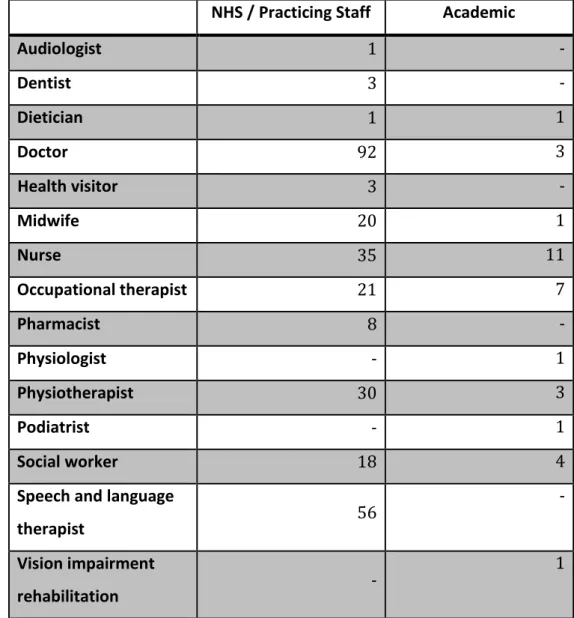
classification of interprofessional education outcomes………..83 Table 3.2: Summary of outcomes after classification of 107 IPE studies…84 Table 4.1: Professional background of survey respondents………138 Table 4.2: Current role or professional background of
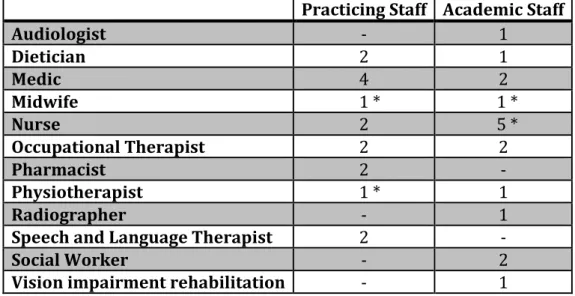
interview respondents………..145 Table 5.1: ALPS Management and Working Groups and their function…161 Table 6.1: Types of IPE experienced by survey respondents………..194 Table 6.2: Reported experience of IPE and self-rated seniority……….195 Table 6.3: Experience of any IPE as part of professional training
by professional background………..196 Table 6.4: Opinions of task specificity and respect between
professionals by professional group: There are tasks that my
profession is responsible for that no other profession can undertake……201 Table 6.5: Opinions of task specificity and respect between
professionals by professional group: I think there is a lot of respect between professionals at work, regardless of which
profession they belong to………201 Table 6.6: Respondents’ opinions on professional identity and role boundaries………204 Table 6.7: Academic staff view on their own professional identity……….205 Table 6.8: NHS respondents’ level of contact with students on
placement……….206 Table 6.9: Key Findings from Empirical Research………..……...….241
xii
List of Figures
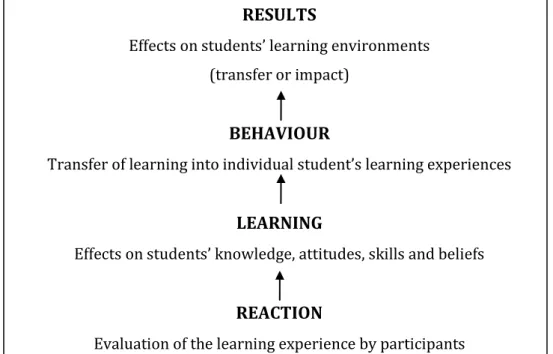
Figure 2.1: Machin et al’s (2011) Role identity equilibrium process………32 Figure 3.1: Cooper et al.’s (2001) Hierarchical levels of evaluation
of IPE interventions developed from Kirkpatrick (1967)……….80 Figure 6.1: Respondents’ ratings of how successful they believe IPE
can be in achieving certain aim...……….199 Figure 6.2: Respondents’ views on collaborative practice………200 Figure 6.3: NHS respondents’ attitudes towards collaborative
practice by self-rated level of seniority………..……….202 Figure 6.4: Respondents’ perceptions of professional identity………..204 Figure 6.5: Common narrative elements in describing
professional roles……….209 Figure 6.6: Common narrative elements in describing reasons
1
Chapter One
The implications of interprofessional education for
uni-professional identity
1.1 Introduction
When thinking about health care provision in England in the twenty-first century, it is impossible not to consider the myriad health and social care (H&SC) professions involved in providing care and supporting service users in both hospital and community settings. When systems of H&SC fail, or fall below the expected standards of modern times, large inquiries often ascribe the blame for such failings onto breakdowns in communication between professionals or across professional boundaries (Kennedy 2001; Laming 2003; Laming 2009; Francis 2013). The recommendations in such reports often reiterate the need for effective communication and team-working to achieve high quality and efficient care, and to ‘avoid tragedies’ (Cooper et al. 2004).
A brief study of the history of H&SC shows that placing an emphasis on team-centred healthcare provision to ensure that service users receive the best possible care has not always been the dominant model. The purpose of ‘caring’ for patients did not exist until the eighteenth and nineteenth centuries when hospitals moved away from being ‘instruments of repression’ and started to focus on becoming ‘important institutions in the delivery of healthcare’ (Waddington 2011, p145). The point at which those involved in all H&SC occupations and professions started to co-operate, that is to work collaboratively and interprofessionally, in order to provide and improve service user care, is harder to locate. Many histories of the various H&SC roles do exist, but are written with a focus less on professional co-operation than on exploring and understanding their own journey to ‘professionalisation’ (see for example Dingwall et al. 1988; Lane 2001). Leathard (1994) suggests that the background developments for interprofessional working were laid in Britain in the 1970s, with the
2 ‘pressure to go inter-professional’ increasing considerably as a result of government policy from the mid-1980s, and ‘noticeably in the 1990s’ (p9). Both the Local Government and Housing Act 1989 and the NHS and Community Care Act 1990, for example, placed a great deal of emphasis on inter-agency co-operation and information sharing between local authority social services and healthcare providers. Consequently, successful H&SC delivery in the modern health care system is now seen to depend upon the effectiveness of a professional team made up of members from many different professions. Subsequently there has been (and still is) much debate about how to best educate and prepare health and social care students so that when they graduate they are ready to work in teams involving two or more professions. The primary aim of this thesis is to explore the way in which H&SC professionals perceive their professional identity and consider what interrelationship this has with their interpretations and experiences of interprofessional education and working.
The concept of ‘interprofessional education’ (IPE) emerged in the late 1980s. In the UK the concept developed alongside the formation of CAIPE (Centre for the Advancement of Interprofessional Education), who were responsible for the definition of IPE as it is now most commonly recognised; where two or more professions ‘learn with, from and about each other to improve collaboration and the quality of care’ (CAIPE 2002 from CAIPE website; Hammick 2007). Thus, ‘interprofessional education’ was considered a step further on than ‘shared-learning’ models, with the focus of IPE being on collaborative practice and ‘on interactive learning between [the] different professional groups involved’ (Leathard 1994, p29). While questions remain over whether educating H&SC students together using IPE results in graduates who are better able to work in multi-professional teams than those receiving other forms of education (Thistlethwaite 2012; Craddock et al. 2006; Pirrie et al. 1999), it is accurate to claim that by the 2000s IPE had become the dominant discourse – ‘the way forward’ – for improving H&SC provision. In the UK, this approach
3 was particularly prevalent, as can be seen in the developing policy framework of the Health Act 1999 and Health and Social Care Act 2001 which, as Cooper et al. argue, paved the way for ‘requisite structural and organisational change’ (2004, p179).
Such a change in emphasis toward IPE is also evident in ‘Tomorrow’s Doctors’, the General Medical Council’s (GMC) ‘standards for knowledge skills and behaviours that medical students should learn at UK medical schools’ (GMC Website), first published in 1993. The 2003 version stipulated that graduates needed be aware of both current developments and the guiding principles in the NHS, including understanding ‘the importance of working as a team within a multi-professional unit’ (GMC 2003, p15). The 2009 version of the same document was much more explicit concerning the standard of interprofessional behaviour expected from graduate doctors, highlighting that they need to be able to both learn and work in multi-professional teams, understand and respect the expertise and roles of other H&SC professionals as well as understand: …the contribution that effective interdisciplinary teamworking makes to the delivery of safe and high-quality care.
(GMC 2009, p27) IPE is also a significant issue on the international policy agenda. In 1988 the World Health Organisation (WHO) published Learning Together to Work Together for Health, an influential report which reviewed multi-professional education initiatives throughout the world, and which recommended that such educational initiatives should be promoted as a complementary aspect to the education of health professionals (and offered suggestions as to how such initiatives may be instigated). By 2010 the WHO had published a ‘Framework for Action on Interprofessional Education and Collaborative Practice’, in which it is stated:
The WHO and its partners recognize interprofessional
4 that will play an important part in mitigating the global health workforce crisis. (WHO 2010, p7) However, while answering this call to ‘interprofessional arms’, it is recognised that H&SC professionals must still be trained to their own regulatory body’s professional standards, and be able to perform their own roles, carrying out profession-specific tasks that they are in the healthcare organisations to provide; they must work in an interprofessional way (that is, collaboratively, with other professions) while in essence ‘maintaining’ their own ‘discrete’ professional identity (Pirrie et al. 1999; Hornby and Atkins 2000). In order to understand ‘hindrances’ to collaborative, interprofessional working it is therefore important to understand the concepts of ‘identity, role and boundaries’ (Hornby and Atkins 2000, p97). The notion that professional identity partly develops through a ‘socialisation’ process in the health and social care professions has become a popular theory, explored in various ethnographic studies of the professions since the 1960s, and perhaps most famously in health and social care in Becker et al.’s 1961 study ‘Boys in White: student culture in medical school’, although it is a concept that can be applied to all H&SC professions. Socialisation into a profession is understood to be a complex process, but one of the key parts is exposure to professional behaviour and interaction in the ‘real world’, through what Thompson and Ryan (1996) refer to as ‘fieldwork’ experiences, but what in the UK are more commonly referred to as ‘placements’. Nevertheless, while socialisation is a recognised part of professional identity formation, the concept of professional identity (explored in detail in Chapter Two) is contested and debated, with no single, agreed definition.
Olckers et al. (2007 p2) argue that professional identity is widely accepted to be associated with the way professions perform their roles and that developing such an identity is often associated with the ‘internalising’ of ‘professionalism’. Notably, conceptualisations of professional identity are commonly linked to single-professions, so that people performing those
5 roles have such identities as, for example, ‘doctors’, ‘nurses’, ‘midwives’ or ‘social workers’. As such, professional identities have been depicted as a ‘barrier’ to interprofessional education and working (see Elston and Holloway 2001). However, more latterly an emerging tension in the academic debate surrounding IPE and professional identity stems from IPE being portrayed as something that strengthens individual professional identities (see Jakobsen et al. 2011). Chapter Three explores in depth the evidence in the literature that supports both sides of this argument.
In this thesis, I suggest that in order to enable H&SC professionals to better work together, it is fundamentally important to understand what relationship exists between IPE and professional identity, because of the impact that professional roles and (inter)professional working have on service user care. The need to understand this relationship is recognised by Cameron (2011, p53), who suggests there is a:
…need to move beyond the current focus on the role of
education, training and regulation which structure professional boundaries to appreciate the ‘human and social aspects’…in order to understand how individual professionals perceive and
experiences the boundaries between professional groups. To reiterate, exploring the interrelationship between perceptions of professional identity and the way in which H&SC professionals interpret and experience interprofessional education and working is therefore the primary objective of this thesis.
1.2 Background to the study
I first became aware of the concept of ‘interprofessional education’ when I started working for the Assessment and Learning in Practice Settings (ALPS) Centre for Excellence in Teaching and Learning (CETL). ALPS was initially funded as a five year programme by the Higher Education Funding Council for England (HEFCE) as one of 74 CETLs in the country. ALPS
6 involved sixteen H&SC professions across five Higher Education Institutions (HEIs) in West Yorkshire, as well as partnering with professional bodies, the (then) West Yorkshire and the Humber Strategic Health Authority (WYHSHA) and practice networks. The ALPS mission was:
to explore ways which ensured that students from courses in Health and Social Care graduate fully equipped to perform confidently and competently at the start of their professional
careers. (ALPS Website)
There were many strands to the ALPS programme of work, but one of the main aspects was to develop a series of ‘Common Competency’ maps that were relevant to all sixteen H&SC professions involved. From these maps, a series of assessment tools was developed for students to use while out on practice placement, with one of the key features of the tools being that they involved an element of interprofessional feedback – i.e. the student would receive feedback from either staff or students in professions other than the one they were training to join.
While already aware of a body of literature on the sociology of the professions, it was during the development phase of the ALPS maps and tools that I became conscious of academic debates on the ‘tribalistic’ nature of H&SC professions and the way in which allegiances to professions were sometimes depicted as a barrier to people from different professions working successfully together (Carlisle et al. 2004; Smith and Roberts 2005). As a result, I questioned what impact, if any, a long-term large-scale interprofessional project such as ALPS would have on the professionals who were involved in it. In particular I was interested on the impact of such a project on staff involved in developing and delivering it, rather than on students taking part in the programme. This was because I considered that some of the opinions expressed by staff involved in ALPS were indicative that their opinions could be one of the barriers to an interprofessional programme of work being implemented successfully.
7 Resultantly, I wanted to further explore what IPE qualified staff had themselves experienced, in order to consider the impact of these experiences on IPE programmes they were subsequently involved in facilitating.
As is discussed in Chapter Three, most of the existing literature on IPE focuses on students, including a large body of work on their ‘readiness’ or willingness to engage with interprofessional material (see for example the works of Parsell and Bligh 1999; McFadyen et al. 2006). The literature that does concentrate on staff perceptions of IPE most commonly focuses on the organisational structures that restrict interprofessional initiatives and on ways to address this (Deutschlander et al. 2012; Salfi et al. 2012; Reeves et al. 2007). However, there is a growing recognition of the need for staff to be ‘signed up’ to the idea of IPE and to be well-trained for it to ‘work’ (Williamson et al. 2011; Anderson et al. 2011). As socialisation is such an important part of developing professional role and identity (see Chapter 2), for IPE to achieve its aims of improving service user care by preparing students to communicate and work more effectively in interprofessional teams, part of the success of this process will rest with those doing the ‘socialisation’.
Meerabeau (1998, p83) identifies two broad analytical approaches to occupational socialisation:
1. the induction approach, which derives from functionalism, focuses on the acquisition of professional roles, but takes motivation for granted and neglects the expectations which individuals bring with them…
2. the reaction approach, which analyses how students react to their educational experiences, explores their motivation, and regards the training institution as an independent social unit. However, neither of these approaches encompasses the entire approach of this thesis. While the acquisition of professional roles through both formal and informal learning is a concern of this research, the impact of
pre-8 existing ideas concerning professional identities is viewed as an important part of identity formation (Chapters Two and Six). The reaction of students to educational experiences of students are also understood here as key to the socialisation experience, but this thesis is additionally concerned with exploring the opinions of those responsible (in part at least) for ‘doing’ the socialisation, the practicing and academic staff who influence the experiences of students.
The influence of staff as professionals, both in an academic and practice environment is potentially very great, as they will likely be the first role models for students in their chosen profession. I therefore argue that the focus of this thesis, which involves understanding the attitudes of (some) qualified H&SC staff towards professional identity and IPE, that may have arisen as a result of experiences of IPE, is an extremely important area of research, because it may yield knowledge about the successful implementation of initiatives that could lead to more effective collaborative practice.
Another advantage to focusing the research on qualified H&SC staff is that these groups already possess a ‘professional identity’ – that is, an identity as a ‘practicing professional’. Focusing the research on students would be complicated and far more questionable in terms of its results, as students are likely to be still developing their ‘professional identity[ies]’ and, at the very least, would have a dual identity associated with being a ‘student’ of a ‘profession’. As such, to explore potential relationships between perceptions of professional identity and IPE, it was more appropriate to focus the research on qualified staff, and offers a different approach to the study of socialisation than the two previously identified by Meerabeau (1998).
1.3 Terminology
At this juncture it is important to define some of the terminology that will be used throughout this thesis. The terms ‘interprofessional’,
‘multi-9 professional’ and ‘multi-disciplinary’ are sometimes used interchangeably, as if they describe the same phenomenon (Craddock et al. 2006, p221). However, as already discussed, the term ‘interprofessional’ does have a specific meaning when applied to education and is now commonly understood and accepted to refer to occasions where two or more professions ‘learn with, from and about each other to improve collaboration and the quality of care’ (CAIPE 2002). It is the emphasis on learning with and from one another to which I refer whenever the term ‘interprofessional’ is used in this thesis. The concept of ‘multiprofessional’ I define as when more than one profession contributes to an educational initiative or work practice, but where there is little or no interaction or learning between the professions. Nevertheless, as Leathard (1994, 2003) indicates with a long list of alternative terminology, contrasting definitions of ‘multiprofessional’ and ‘interprofessional’ have been described as a ‘semantic quagmire’ (Craddock et al. 2006, p221, citing Leathard 1991 and McPherson et al. 2001). As such, even though I am using ‘interprofessional’ and ‘multiprofessional’ to mean separate things, unless it is explicitly stated, it cannot be assumed that other authors make the same distinction. Applying the term ‘interprofessional’ to working is not so clear cut, with there being no suggestion that ‘interprofessional working’ is in any way different or distinct from ‘multiprofessional working’. However, the concept of interprofessional ‘collaborative practice’ could be argued to describe more usefully the intended outcome of IPE, with the interactional nature of IPE more likely to enhance ‘collaborative practice’ than either multiprofessional or uniprofessional education (Reeves et al. 2008, p3). It is the term ‘collaborative practice’ that I shall therefore use throughout this thesis to describe meaningful interprofessional working.
Lastly, I have throughout this chapter referred to all health and social care occupations as ‘professions’. As will be discussed in Chapter Two, this label can be somewhat problematic, with a long history of debate over which occupations are entitled to such a label (and accompanying status). Nevertheless, for ease of discussion I shall continue to use ‘professions’ and
10 ‘professionals’ as the collective label for those working in health and social care, while the detail of how accurate this is discussed in the following chapter.
1.4 Research questions
The overarching aim of this study is to understand how practicing H&SC professionals perceive their own professional identities and how this relates to what they consider their professional roles and boundaries, which will be addressed by answering the following inter-related research questions:
1. How do practicing H&SC staff conceptualise their professional identity, and the professional identity of other professions with whom they work or learn?
2. Do practicing H&SC staff perceive that ‘professional identities’ are reinforced, challenged or changed by interprofessional education and / or collaborative practice?
3. What implications do conceptualisations of professional identities and IPE have for the implementation of educational initiatives aimed at improving teamwork between professions for the ultimate aim of improving service user care?
Using a case study approach, one further research question is addressed to help answer the three main research questions cited above:
4. What impact does the implementation of a large-scale interprofessional programme have on staff involved in delivering the programme?
The study is also concerned with understanding how health and social care staff regard IPE; this is based not only upon their experiences but also upon their perceptions (which may not be based on any experience of IPE). In the analysis, attention is given to whether there is a link between perceptions of interprofessional experiences and perceptions of
11 professional identity. The study was started under the premise that it is possible that there is no ‘link’ between professional identity perception and IPE / collaborative practice, but that this itself would have implications for the way that IPE is conceptualised and consequently how it is taught. The study was not therefore designed to look explicitly for a ‘link’; rather, it is concerned with exploring whether it is possible to establish such a link. As such, the research is exploratory in nature and the methods adopted (discussed in Chapter Four) reflect this. The nature of undertaking ‘identity’ as a research topic also means that the study makes no claims that the findings could be generalised to the entire H&SC staff population. Instead, individual perspectives are explored that, if contributing to a ‘cohesive picture’ of interpretations of professional identity, may have implications for the way IPE is developed and delivered.
1.5 Context: IPE and understandings of ‘learning’ and ‘practice’
The premise of interprofessional education – IPE, the theories and evidence underlying approaches to it, are covered in detail in Chapter Three. However there are also associated concepts that will benefit from discussion at this juncture, as their definition impacts upon understandings and interpretations of any form of educational initiative, but in this instance IPE. In particular, the terms ‘learning’ and ‘practice’ require definition, although the task of defining each of these could, and indeed has in the past, taken entire chapters and books. The definitions given here are therefore necessarily brief, and are not intended as a complete summary of the much wider academic debates which surround their use, but are presented here only to outline the context in which the terms are understood and used in this thesis.
Following a sociocultural perspective, professional learning is understood here through the ‘participational’ metaphor of learning, where ‘knowing is…situated in activity and therefore is particular to settings and communities’ (Fenwick and Nerland 2014, p3). This is in contrast to the
12 conceptualisation of learning as ‘acquisitional’, that is as an individual experience that involves ‘the acquisition of disciplinary and problem-solving competencies in knowing what to do, how and why’ (Fenwick and Nerland 2014, p2). Simultaneously, and from the same sociocultural perspective, ‘practice’ is understood to involve ‘practitioners knowing and learning in everyday activity’ (Fenwick and Nerland 2014, p3). Thus it is possible to understand that ‘learning’ cannot be separated from ‘practice’ because from this perspective one necessarily involves the other.
The purpose in this thesis of using this approach to ‘learning’ and ‘practice’ is that they highlight the importance of understanding ‘situatedness’; that is, they are based on the premise that the social situation and the material setting must be considered as the context for ‘knowing, working, learning and innovating’ (Gherardi 2014, p12). Such methods highlight the extremely complex and challenging nature of understanding an educational innovation such as IPE, which is intended to result in organisational change. While, as has been acknowledged, the sociocultural understandings used here are only one of a number of interpretations of ‘learning’ and ‘practice’, they do raise questions about the extent to which IPE is based upon an ‘over-simplified understanding of work, learning and change’ (Kilminster and Zukas 2007). Using such a lens is thus particularly useful in a project concerned with exploring the impact of IPE on professional identities, which must be understood to involve a web of enmeshed activity and not a straightforward, linear relationship. It is in this context which IPE and professional identity are discussed throughout this thesis.
1.6 Approach to ‘identity’
The approach taken to identity in this thesis is a sociological one. While there is much work grounded in psychology on the topic of identity, such approaches tend to focus on the individual conceptualisations of ‘the self’, where sociological perspectives are concentrated around the notion that
13 identity is ‘fundamentally social and collective’ (Lawler 2008, p1). The focus of this thesis concerns ‘professional identity’, that is an identity that can only be earned through membership of a group (as one of many, simultaneous ‘identities’ that an individual may possess at any given time). As such it was important for the theoretical approach to identity to be able to provide explanation for the significance of an individual being labelled as a member of a professional group, and simultaneously, as not being labelled as something else. This discussion is elaborated in detail in Chapter Two.
1.7 ‘Interprofessional Responsibility’
The notion of ‘interprofessional responsibility’ is an emerging theme of the work of the entire thesis. The results of the literature review, case study and interview data all raise questions about the extent to which professions – either individually or collectively depending on the context, have a responsibility to engage with, share best practice concerning, or educate their own members about, interprofessional education and collaborative practice. In the final chapter, the thesis also questions the extent to which individual H&SC professionals should view ‘interprofessional responsibility’ as part of their own professional identity, and the extent to which this may be achievable. The term is defined here, then, as any instance where an individual professional or profession as a whole could be perceived to have a responsibility concerning interprofessional behaviour.
1.8 Structure of the thesis
The arguments of this thesis are presented in the following order:
Chapter Two outlines dominant theories concerning professional identity. It is argued that to understand concepts of professional identity, it is first essential to understand how ‘professions’ have been conceptualised and
14 how, through earning the status of a profession, occupations adopt and present a professional identity. Attention is given to various theories of identity, and how it is possible for professional identities to be viewed as tribalistic or even as ‘subcultures’, resulting in the need for students to be socialised into their profession by ‘good’ role models. The extent to which members of health and social care professions have been able to lay claim to a professional identity is also discussed.
Chapter Three presents an extensive review of the literature on IPE, and critically evaluates previous research and theories concerning IPE. It argues that a large amount of attention has been given to work on student ‘readiness’ for interprofessional learning and staff and student perspectives about IPE, at the expense of developing evidence-based practice for IPE interventions. The chapter then explores existing research on staff perspectives on IPE, and discusses the outcomes, relevance and implications of existing studies linking professional identity to IPE. Finally it questions whether there is a need for ‘interprofessional responsibility’ to be incorporated into individual professional identities, and discusses the potential implications of this for introducing IPE into curricula.
Chapter Four discusses in detail the methodologies used to complete the empirical elements of the research – namely, surveys, semi-structured interviews, and a case study, and outlines the methods used to analyse the collected data.
Chapter Five presents a case study of the ALPS CETL. It describes the aims and objectives of the CETL and goes on to explore the evidence for how successful ALPS was at achieving its aims relating to the introduction of interprofessional teaching and assessment. Using interview data collected for this study, it then examines what impact staff involved in the CETL perceived that being involved in a large-scale interprofessional programme had on them as individuals, their departments and the institutions which they work for. In this chapter, the question of ‘interprofessional responsibility’ is raised regarding whether larger professions should invite
15 and include smaller professions to take part in interprofessional initiatives, in order to ensure that best-practice is shared as widely as possible.
Chapter Six presents further findings from the empirical research carried out specifically for this thesis. After outlining some of the key findings from the survey, it outlines several recurring narratives which emerged from the interviews, and relates these to the literature discussed in earlier chapters. In particular, attention is paid to the notions of ‘intra-professional’ and ‘academic / teaching’ identities, as well as to the suggestion that professional identity can be a hindrance to patient care. It also returns to one of the key themes of this thesis, the notion of the need to incorporate ‘interprofessional responsibility’ into individual professional identities.
Chapter Seven is the concluding chapter which summarisesthe key findings and central arguments of the thesis, and discusses the possibilities and directions for future research. While recognising that the narratives told around professional identities and experiences of IPE were unique to the participants of this research, it also proposes that there are broader implications for the findings of this work, for both the introduction of IPE into curricula and also for the further study of professional identities in H&SC.
16
Chapter Two
‘Professions’, Professional Status and Professional Identity
…all professionals are laymen to the other professions…-Harold Perkin (2002) This chapter explores all aspects of ‘professional identity’, by first explaining why professional identity and status are so important, and still worthy of study. It then discusses in detail how ‘identity’ and ‘professional identities’ have been theoretically conceptualised, before going on to explore how the specific professional identities of a number of different H&SC professions have developed by looking briefly at their history and claims to a ‘professional identity’. Finally, the chapter explores some notable points for consideration arising in the study of identity such as the concepts of ‘occupational ideology and vocation’ and the issues of tribalism and silos working.
2.1 Why defining ‘professional identity’ is important
Exploring and explaining identity has been a key concern of social theorists for many years. Nevertheless, as will be made evident in this discussion, there is no consensus around what identity ‘is’, and no agreed, simple definition that encapsulates ‘an’ identity. However, despite differences in interpretations of the reasons behind it (such as individual, social and cultural transformations), much work exploring the subject recognises that ‘identities’ change over time and context, and are dependent upon interpretations made by the self and others. These ideas play a key role in trying to understand how people define, and interpret, their own ‘professional identity’.
As made clear in this chapter, and previously, ‘identity’ is very much associated with situation – that is, with the time and space in which it is being viewed or experienced. The ‘professional identity’ of a doctor, nurse
17 or any other H&SC professional is likely to vary greatly from country to country, as it will be associated with the educational systems and expected role that each profession fulfils in each location. As such, unless otherwise specified, the majority of the following discussion on professions and their history refers specifically to the UK, where this research was undertaken, and is therefore most relevant to later analysis and discussion of empirical data collected specifically for this project.
Why then is understanding ‘professional identity’ so important? As Woodward (2002) suggests, being able to ‘lay claim to an identity’ distinguishes us from others; it not only ‘marks us out as sharing culture [or] experience with those whom we identify’ but also results in the ability to exclude or ‘exile’ those who do not share the same identity (p156). McDonald (2004) also notes that sharing a common, stable identity can advance practice for H&SC professionals and that conversely unmanaged, unstable identities can lead to feelings of disempowerment. Being able to ‘lay claim’ to a ‘professional identity’ is therefore important because of what such an identity means to both individuals and professional practice; and so to understand why professional identity is so important, it is firstly necessary to understand what it means to be a member of a ‘profession’.
2.2 The ‘place’ of professions in society
To be considered ‘professional’ has, historically at least, been considered desirable for occupations and individuals, because of both the status and the privileged position in society which professionals are afforded (Hughes 1971). However the concept of the profession/al is itself is historically specific and has long-been criticised as uncritical reproduction of the knowledge of those attempting to define it, usually ‘professionals’ themselves (Witz 1992; Brante 1988). These critiques, stemming from both sociological and feminist literature provide for some interesting academic debate, but do not detract from the ‘desirability’ of a professional status for occupations. Perkin suggests that the notion of a ‘professional
18 society’ is more complicated than being about a society dominated by professionals, with professional hierarchies transcending traditional class boundaries and allowing many occupations to aspire to professional status, with the consequence that many jobs have ‘become subject to specialized training’, allowing them to ‘claim expertise beyond the common sense of the layman’ (2002, p3). It is argued that being able to claim such a status brings rewards – a claim examined here – which itself makes professional status and identity as a ‘professional’ desirable. Macdonald suggests that: The professional project is intended to secure for its members economic and social advantage, thus achieving upward social
mobility. (1995, p63)
While Becker et al. also propose:
In our society, among the most desired and admired statuses is to be a member of a profession. Such status is attained not by going into the woods for intense, but brief, ordeals of initiation into adult mysteries, but by a long course of professional instruction and supervised practice. (1961, p4) To achieve a professional status is therefore seen as desirable for individuals; but to do this they must first earn membership of an occupation which itself is regarded as a ‘profession’. The achievement of ‘professional status’ by occupations has in itself been the topic of sociological study and debate for a number of years, and is worthy of some attention at this juncture.
Many academic works have attempted to define ‘professions’ by the ‘traits’ they possess, with the consequence that ‘professional status’ is seen as being achieved once an occupation can lay claim to possessing such attributes. This body of work, often referred to as the ‘trait approach’, defines professions as possessing ‘systematic theory, authority, community sanction, ethical codes and a culture’ (Greenwood 1957, and similarly Horobin 1983 and Atkinson 1983). The trait approach is, however, widely regarded as problematic due to the way in which it delineates professions
19 with an ‘idealized conception of the characteristics of the archetypal professions – medicine and law’ (Abbott & Meerabeau 1998, p4). Wilding suggests that a key problem in defining ‘professional’ using the trait approach is that there seems to be an ‘endless search for one true profession, an archetypal, ideal type…exuding the very esse of professionalism’ (1982, p3), whilst Freidson argues that one cannot define a ‘profession’ by ‘struggling to formulate a single definition which is hoped to win the day’ (1983, p35). In a later in-depth discussion on ‘identifying professions’ Freidson also suggests that the problem of definition is created by:
…attempting to treat profession as if it were a generic concept rather than a changing historic concept with particularistic roots in those industrial nations that are strongly influenced by American institutions. (1986, p32) Ultimately, using a trait approach has been dismissed as unhelpful because it focuses on what professionals claim to do (Abbott and Meerabeau 1998, p4). Abbott and Meerabeau propose that alternative conceptualisations are considered, such as Becker’s (1971) proposal that the concept of ‘profession’ is a symbol attached to some occupations but not others, or Freidson’s (1986) suggestion that it is more helpful to use the notion of ‘professionalism’ as used in practice. However, whilst using a trait approach may now be considered an inappropriate and misleading way to define the professions, it remains important and must be referred to because of the considerable contribution it has made to academic debate around the subject. It also highlights how professions have been viewed historically, which is important when trying to understand the attributes to which occupations may have been expected to aspire in order to become professions.
Whether one accepts that a set of ‘traits’ can define a profession as a full or partial list, there is nonetheless one attribute referred to as defining access to a professional status above all others: knowledge. However, as already
20 discussed, it is not just access to facts and figures that turn a layman into a professional; it is the training in how to use and apply them, what Freidson (1986) defines as ‘formal knowledge’. Today, it could be argued that the notion of the ‘all-knowing professional’ is far less stable than in the past, because of the way in which the internet can be used to acquire information, something previously only in the domain of professionals. The ‘systematic theory’ owned only by professionals in the past is now often available for all to access, but it is the training received by professionals that still provides the distinction for what can be done with such information, turning it in to usable skills and knowledge. Eve and Hodgkin (1997) add to this by highlighting that ‘professionalism’ is about using this knowledge in the ‘affairs of others’:
A professional task is one which requires the exercise of discretion or initiative on behalf of another in a situation of
complexity. (p70)
However, they suggest that, ideally, the definition of a professional task would be:
…where one person exercises discretion with another in a situation of complexity ensuring so far as possible that all
necessary information, together with any financial incentives and constraints which the professional may be under, are transparent to the patient or client.
(Eve and Hodgkin 1997, p84, original emphasis) Although they recognise that such a feat is not likely to be achieved easily, and would be reliant upon ‘sophisticated information technology’. But this, they suggest, is the way that professionalism will adapt and survive in a ‘rapidly changing world’ (Eve and Hodgkin 1997, p84). While it is clear that this is an ‘ideal type’ description of the role performed by professionals, it does highlight the significance of other characteristics that arise when professional knowledge is used: trust and power.
21 Giddens proposes that trust is necessarily involved in a relationship where one member of that relationship has much less access to knowledge than the other:
Trust is only demanded where there is ignorance – either of the knowledge claims of technical experts of the thoughts and
intentions of intimates upon whom a person relies…Thus trust is much less a leap to commitment than a tacit acceptance of
circumstances in which other alternatives are largely foreclosed.
(1990, pp89-90)
The necessity for a trust relationship between professionals and their clients (or patients) can be seen as an example of what Weber (and subsequently Parsons) refer to as a ‘legitimation’ of power (Dingwall 1983, p2). Foucault interprets the process by which professionals achieve power and dominance. He describes that ‘discipline’ has a double meaning, being both a result of formal knowledge and a ‘consequence of its application to the affairs of others’, and results in power being gained through the ‘normalization’ of such ‘disciplines’ as health care (amongst others) (Freidson 1986, p6). In terms of financial reward for such knowledge, Perkin (2002) argues that members of professions are no different from any other members of society (from the ‘richest capitalist’ to the ‘most unskilled labourer’) when it comes to the ‘economic battle’ for their services, but that the difference for professionals is that:
…beyond the layman’s knowledge or judgement, impossible to pin down or fault even when it fails, and which therefore must be taken on trust…[the professional] is dependent on persuading the client to accept his valuation of the service rather than allowing it to find its own value in the marketplace. (p117) The consequence of doing this successfully, Perkin argues, is what leads to professionals rising above the ‘economic battle’, with the result that it is in the interest of those afforded this status to:
22 play down class conflict…[and] play up mutual service and
responsibility and the efficient use of human resources.
(2002, p117) Trust and power, it could therefore be argued, are a desirable part of being a professional, allowing freedom and control over their own work. On the other hand, it could be suggested that the consequence of being afforded trust and power are the responsibilities of holding such status, of being seen always to do the ‘right’ thing and to take the blame when things go wrong. Freidson also argues that the relationship between professional status and power represents two diametrically opposed views; the first, following Foucault and others, that it is the professions who are rewarded by dominance and as such have a great deal of influence on state policy and on the affairs of individuals; the second, that professions are ‘passive instruments of capital, the state or their individual clients’ and that as such they have little or no control over policy or their own affairs (Freidson 1994, p31).
For the purposes of this thesis, I would suggest that the first of these theories is still the most relevant to the health and social care professions in the UK today. Whilst it may be true that today people are more inclined to question professionals (and those in positions of power), it is still the case that health and social care occupations are regulated by professional and regulatory bodies made up of their own members (albeit often with representation from other professions). This gives those in H&SC the ability to define their own ‘systematic theory’ and ‘ethical codes’, and suggests that they are not entirely passive instruments of the state. On an individual level, H&SC professionals can also be seen to hold power in the sense that clients / patients who need expert advice and opinion must consult professionals when they perceive there is no alternative, and also must accept their diagnosis or judgement without knowing if they are being given the ‘right’ information. The nature of this type of contact with clients is what leads to the need for a code of ethics (Millerson 1964, p153).
23 Whilst association with certain attributes (such as having a ‘code of ethics’ or ‘systematic theory’) may define (or be a result of) the ‘professionalisation’ of an occupation, there is a further distinction to be drawn between the occupation as a ‘profession’, and the individual as a ‘professional’ who displays ‘professionalism’. As Johnson (1972) suggests: It is not at all clear then that professionalisation refers to the same process as occurs when claims for professional status are made. However, professionalism is a successful ideology and as such has entered the political vocabulary of a wide range of occupational groups who compete for status and income. (p32, emphasis added) As an individual, being a member of a profession dictates the need for a certain standard of conduct to be met, and by adhering to and displaying that standard through one’s ‘professionalism’, an identity as a professional can be gained and reinforced (or, in cases where the standards are not met, denied). Nevertheless, understanding the various interpretations and nuances of the terms ‘professional’ and ‘professionalism’ still only represents half the story of why ‘professional identity’ remains both difficult to describe and define and, the key to understanding professional roles. The following section explores some theories of identity in order to complete this task.
2.3 Identity and Identities
Identity and identities have long been considered to be ‘socially produced’, with a variety of interpretations focusing on the ‘mechanisms’ by which identity can be ‘achieved’ (Lawler 2008, p1). For George Mead, whose approach came to be known as symbolic interactionism, the self is something that develops: ‘it is not initially there, at birth, but arises in the process of social experience and activity’ (1934, p135). For Mead, the ‘self’ could only be understood and given meaning in relation to other people, based upon the interactions with others and the meanings given to those (inter)actions. Indeed, for Mead, the ‘self’ did not exist without
24 communication, and he proposed that the self develops as part of the communicative process, suggesting that: ‘it is impossible to conceive of a self arising outside of social experience’ (1934, p140). Developing the arguments of Cooley and James, Mead proposed there was a distinction between the ‘I’ and the ‘me’, with the process that links the two and develops the ‘self’ being the interactions between the internal ‘inner dramatization, by the individual’ and the external ‘conversation of significant gestures’ with ‘individuals belonging to the same society’ (1934, p173):
Thus ’I’ understand myself through imagining how I am understood by others – as ‘me’. (Woodward 2002, p9) Consequently any meaning given to the ‘self’ (our ‘self-consciousness’ – and therefore our identity, and our interpretation of the identity of others) comes through a shared understanding of language.
Mead’s interpretation of the ‘self’ also allows for the possibility that the ‘self’ can have multiple identities, so that in different social contexts we can, or are required to, ‘present different selves’ (Woodward 2002, p9), a theme also developed by Goffman. Goffman (1959) contributed to discussions on the interpretation of identity by suggesting that the ‘self’ can be both presented and interpreted through a series of signs. Using the metaphor of the stage to explain how people ‘perform’ or ‘act’ their ‘roles’ in a variety of ‘settings’, Goffman suggested that:
A setting tends to stay put, geographically speaking, so that those who would use a particular setting as part of their performance cannot begin their act until they have brought themselves to the appropriate place and must terminate their performance when they leave it. (1959, p33) Using this interpretation, one can understand how it is possible to have, or to be seen to have, different identities in different places; thus one can have a different identity at work than in one’s personal life. As with Mead, Goffman’s work also has implications for the notion that identity is open to
25 interpretation, and that the ‘self’ that one hopes to present is not necessarily interpreted correctly by the ‘audience’. Goffman talks about the subsequent need for ‘impression management’ to enable a ‘performer’ to successfully ‘stage a character’ (Goffman 1959, p203), but he also acknowledges that under certain circumstances, ‘misrepresentation’ may be desired by the ‘performer[s]’ (Goffman 1959, p65 - 73) – for example, by acting as if everything is fine when there is a problem the ‘performer’ wishes to conceal from the ‘audience’. The theories that both Mead and Goffman offer also suggest that identity is not static; it can be situation and context specific, and as such individuals can have multiple, simultaneous identities.
Garfinkel’s ethnomethodological approach also has relevance to theories of identity. Garfinkel proposed that the self is produced through social interaction, and as such, the ‘self’ can change from moment to moment, dependent upon whom the person is interacting with, the context of that interaction, and the (meaningful production of) interpretation placed upon that interaction by the social actors involved. However, in attempting to define ‘the factual world’, Garfinkel was concerned to use only the ‘observable-and-reportable’ to describe how people organize and make sense of their lives and produce and present their identities (Garfinkel 1967). Garfinkel’s work has been criticised because of its tendency to describe what we already know, and its failure to take a firm theoretical position (Woodward 2002, p12), but it does further support the notion that one person (or self) can have multiple and simultaneous identities.
More recently, academic narrative on identity has turned its attention to the extent to which people are able to shape, and actively participate in constructing their own identities (Woodward 2002; Calhoun 1994). Michel Foucault’s (1988) work on the ‘technologies of the self’, explored how subjects ‘actively constitute themselves, through engaging in the cultural practices of everyday life’ (Woodward 2002, p30). Giddens (1991) discusses the reflexive nature of the self in an age of modernity, suggesting that coherent but continuously revised biographical narratives take place