Trading Costs and Informational Efficiency
∗ Eduardo Dávila NYU Stern Cecilia Parlatore NYU Stern April 18, 2017 AbstractWe study the effect of trading costs on information aggregation and acquisition in financial markets. For a given precision of investors’ private information, an irrelevance result emerges when investors are ex-ante identical: price informativeness is independent of the level of trading costs. This result holds for quadratic, linear, and fixed trading costs in competitive and strategic environments. When investors are ex-ante heterogeneous, trading costs reduce (increase) price informativeness if and only if investors who disproportionately trade on information are more (less) elastic than investors who mostly trade on hedging. Through a reduction in information acquisition, trading costs reduce price informativeness.
JEL Classification: D82, D83, G14
Keywords: learning, trading costs, information aggregation, information acquisition, financial transaction taxes
∗
Contact: [email protected] and [email protected]. We would like to thank comments from Fernando Álvarez, Snehal Banerjee, Gadi Barlevy, Markus Brunnermeier, Eric Budish, Bruno Biais, Philip Bond, James Dow, Emmanuel Farhi, Simon Gervais, Piero Gottardi, Joel Hasbrouck, Arvind Krishnamurthy, Thomas Philippon, Adriano Rampini, Tom Sargent, Alp Simsek, Venky Venkateswaran, Xavier Vives, Laura Veldkamp, Brian Weller, Wei Xiong, and Jeff Zwiebel, as well as our discussants Kerry Back and Liyan Yang. We would also like to thank seminar participants at NYU, 2016 London FTG Summer Conference, SED, MIT, UCSB LAEF Conference, 2017 AFA, Duke, ASU-Sonoran Winter Conference, Princeton, and Stanford. Yangjue Han provided excellent research assistance. Financial support from the CGEB at NYU Stern is gratefully acknowledged.
1
Introduction
Technological advances have dramatically reduced the cost of trading in financial markets. However, has this reduction in trading costs made financial markets better at aggregating information? Has the ability to trade more cheaply encouraged information acquisition in financial markets? More broadly, what are the implications of changes in trading costs for the aggregation and generation of information in financial markets? In this paper, we seek to provide an answer to these questions by systematically studying the implications of trading costs for information aggregation and information acquisition in financial markets.
In our model, investors trade for two reasons. They trade on private information, after receiving a private signal about asset payoffs, and due to a privately known hedging demand, which is stochastic and uncertain in the aggregate. The combination of trading based on private information and the aggregate uncertainty in hedging motives makes prices only partially informative. This forces investors – or any interested external observer – to solve a filtering problem to recover the information about asset payoffs aggregated by asset prices. Using this framework as the core building block, in the spirit of Modigliani and Miller (1958), we structure our paper around several irrelevance results that emerge in different canonical models of financial trading.
Our first main result is an irrelevance theorem that applies to competitive economies with ex-ante identical investors. We show that, for a given precision of investors’ private signals, price informativeness is independent of the level of trading costs. The logic behind our main result is elementary and intuitive. The effect of trading costs on how prices aggregate information is a function of how the relevant signal-to-noise ratio contained in asset prices is affected. For example, an increase in trading costs necessarily reduces the amount of trading due to information motives, reducing the informational content of prices. However, this same increase in trading costs also reduces trading due to hedging needs, reducing the noise component of asset prices. When investors are ex-ante identical, the ratio of these trading motives – which becomes the relevant signal-to-noise ratio of the economy – remains constant as trading costs change. This is the logic that underlies our irrelevance results.
Our second set of results illustrates how specific forms of heterogeneity break our irrelevance result. We show that only when investors who disproportionally trade on information are more price sensitive than investors who disproportionally trade for hedging reasons, do we expect prices to become less informative when trading costs are higher and vice versa. Formally, we allow for heterogeneity in the precision of the private signals about the fundamental, in the variance of hedging needs, and in investors’ risk aversion. First, we show that all three sources of heterogeneity, in isolation, are associated with a reduction in price informativeness when trading costs increase. This result arises because investors with more precise information, either about the fundamental or the aggregate hedging, or with relatively high risk tolerance, trade more aggressively in general and react more to trading costs, while putting more weight on their private signal about the fundamental and contributing relatively more information to the price. Next, we formally establish that for most combinations of two-dimensional heterogeneity across the three sources of heterogeneity that we consider, an increase in trading costs is associated with a
reduction in price informativeness. Intuitively, only very specific forms of two-dimensional heterogeneity are able to overturn the one-dimensional result. Finally, we provide a characterization of the effect of trading costs on price informativeness in terms of demand sensitivities to private signals and hedging needs that applies to multidimensional forms of heterogeneity. This characterization illustrates the intuition behind the economic mechanisms that drive the results.
Since our model with heterogeneous investors nests the classic noise trading formulation, we are able to highlight the importance of how economic “noise” is modeled when studying information aggregation.1 Classic noise trading, as in Grossman and Stiglitz (1980), is often modeled as an exogenous stochastic demand or supply shock and it is often justified as standing in for hedging needs of unmodeled traders. Although a classic noise trading formulation may be a useful shortcut at times, it is not satisfactory when we seek to understand the effects of trading costs on price informativeness: it is silent on how noise traders react to changes in the level of trading costs, a form ofLucas (1976) Critique.
Subsequently, we allow investors to choose the precision of their private signal about the fundamental. In our benchmark model with ex-ante identical investors, we show that an increase in trading costs endogenously reduces the precision of the signal about the fundamental chosen by investors. Intuitively, high trading costs make it harder for a given investor to profit from acquiring private information. Since the investors anticipate that they will be able to profit less from having better information, they choose less precise signals, which reduces equilibrium price informativeness.2 We can draw two conclusions from this exercise. First, trading costs have sharply different implications for information aggregation and information acquisition. Second, trading costs tend to reduce the endogenous precision of signals about the fundamental, decreasing equilibrium price informativeness.
We return to the benchmark model without information acquisition and show that our irrelevance theorem extends to economies with a) alternative forms of trading costs, b) random heterogeneous priors as a source of aggregate uncertainty, and c) strategic investors. First, we show that our irrelevance result continues to hold when investors face linear trading costs or fixed trading costs, instead of quadratic, the sustained assumption in most of the paper. Second, we allow investors to have stochastic privately known heterogeneous priors, which are random in the aggregate. This shows that our irrelevance result is robust to having other sources of aggregate uncertainty, in addition to hedging. Third, we show that changes in trading costs in economies in which investors’ strategic behavior matters (for instance, when there is a finite number of investors) do not affect the level of price informativeness. Strategic behavior changes the trading sensitivities of investors, but it does so symmetrically. Therefore, the logic underlying the results in the competitive model with a continuum of investors still applies.
1
A consequence of modeling aggregate noise from first principles is that our model features multiple equilibria. Our formulation, similar but not identical to the one used inGanguli and Yang(2009) andManzano and Vives(2011), who also find multiple equilibria, guarantees equilibrium existence for any set of primitives. Note that our irrelevance result remains valid under their formulation.
2In the Online Appendix, we extend the model by allowing investors to choose the precision of a private signal about
the aggregate hedging need (noise). We show that investors also choose less precise signals about the noise when they face higher trading costs. Less precise signals on the noise also reduce the equilibrium level of price informativeness.
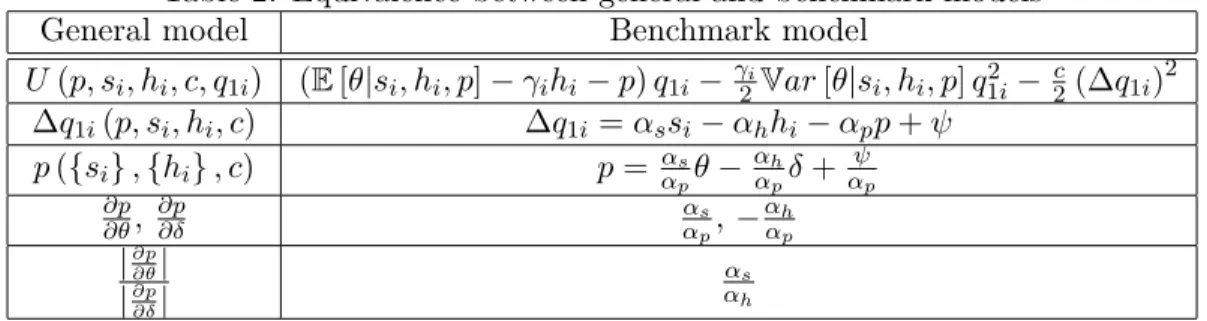
In our final extension, we consider a model in which investors have general preferences and signals.3 We show that the condition for the irrelevance result to hold when investors are ex-ante identical in a symmetric equilibrium is that the averageex-postdemand sensitivities to information and noise (hedging needs) react identically to a change in trading costs. This result shows that the forces behind our irrelevance argument apply generally.
In addition to improving the understanding of whether the secular trend of reduction in trading costs has affected the role played by financial markets in aggregating information, our results have important practical implications for the broader discussion on the effect of transaction taxes as a policy instrument. It is somewhat surprising that our irrelevance results and our directional result in the model with endogenous information acquisition have been absent from policy discussions. Stiglitz (1989) and
Summers and Summers(1989) are good examples of policy-oriented articles which would have benefited from using the results of this paper as a benchmark for policy analysis.
Like other irrelevance results in finance and economics, e.g., Modigliani and Miller (1958), Barro
(1974),Wallace(1981),Krueger and Lustig(2010), our irrelevance results are pedagogical in nature. We do not argue that changes in trading costs do not affect price informativeness in practice.4 Our main contribution is identifying the set of assumptions (investor homogeneity and exogenous information precision) that must be violated for trading costs to affect price informativeness, as well as those that are irrelevant (among others, the form of trading costs or the presence of market power). Our results allow us to shed light on how different forms of investor heterogeneity affect the relation between trading costs and price informativeness.
Related Literature
This paper lies at the intersection of two major strands of literature. On the one hand, we share the emphasis of the work that studies the role played by financial markets in aggregating and originating information, following Grossman (1976), Grossman and Stiglitz (1980), Hellwig (1980) and Diamond and Verrecchia (1981). From a modeling perspective, our benchmark formulation with a continuum of investors is closest to the large economy model in Admati (1985). Investors in our model have private information about both the fundamental and the noise contained in the price. The existence and multiplicity properties of the equilibria in related – but not identical – setups have been studied by Ganguli and Yang (2009) and byManzano and Vives(2011). In contrast to these papers, the noise structure we assume in our model guarantees that an equilibrium always exists. In our model, aggregate hedging needs are stochastic and not observable, similar toManzano and Vives (2011) and Hatchondo, Krusell and Schneider (2014). Goldstein, Li and Yang (2014) find that multiple equilibria may arise when market segmentation leads to heterogeneous hedging needs. Our result in the case of general
3
We consider a CARA-Gaussian setup for most of the paper. Therefore, our results should be interpreted as a first-order approximation to more general environments (Ingersoll(1987),Huang and Litzenberger(1988)).
4For instance, our results associating a reduction in trading costs with an increase in information acquisition can be used
to rationalize the rise in the share of trading-type financial activities in aggregate GDP since the mid-1970’s, as documented byPhilippon(2015) andGreenwood and Scharfstein(2013).
preferences and noise structure relates to the work ofBarlevy and Veronesi(2000),Yuan(2005),Albagli, Tsyvinski and Hellwig(2012),Breon-Drish(2015), andChabakauri, Yuan and Zachariadis(2015), which are relevant examples of the growing literature that explores information aggregation and acquisition in alternative environments to the canonical CARA-Gaussian model.
Our results on endogenous information acquisition are related to the large literature that follows
Verrecchia(1982) andKyle(1989). SeeBiais, Glosten and Spatt(2005),Vives(2008),Veldkamp(2009) for recent thorough reviews of this line of work. We first allow investors to acquire information about the fundamental as in Hellwig and Veldkamp (2009), Van Nieuwerburgh and Veldkamp (2010), and
Manzano and Vives (2011). Ganguli and Yang (2009) and Farboodi and Veldkamp (2016) study the choice of whether to acquire information about fundamental or non-fundamental variables. These papers abstract from modeling trading costs, which is the focus of our paper.
On the other hand, our results also relate to the body of literature that studies the effects of transaction costs/taxes on financial markets, followingConstantinides(1986) andAmihud and Mendelson
(1986). More recent contributions areVayanos(1998),Vayanos and Vila(1999),Gârleanu and Pedersen
(2013),Abel, Eberly and Panageas(2013), and Gârleanu, Panageas and Yu(2014). These papers focus on the implications of trading costs for volume or prices, while we focus on the effects on information aggregation and information acquisition. We refer the reader to Vayanos and Wang (2012) for a recent survey of this vast literature.
Only a handful of papers feature both technological trading costs and learning, as ours. Vives
(2016) shows in a linear-quadratic market game that introducing a quadratic trading cost can be welfare improving by reducing the degree of private information acquisition. Subrahmanyam (1998) and Dow and Rahi(2000) discuss the effect of quadratic trading costs in models of trading with strategic agents. The inherent asymmetry among investors embedded in these papers explains their findings regarding the effects of trading costs. Budish, Cramton and Shim (2015) show that a tax on trading is a coarse instrument to reduce high frequency trading in a model with learning. In the context of a model of bilateral trading with information acquisition but without information aggregation, Dang and Morath
(2015) compare profit and transaction taxes.
Finally, our paper is related to the body of work that studies whether structural changes in the financial industry, as those motivated by the reduction in the cost of trading, have affected the role played by financial markets in modern economies. Greenwood and Shleifer (2013), Philippon (2015),
Bai, Philippon and Savov (2015), and Turley (2012) document and interpret these trends, explaining the forces behind them.
Outline Section 2 describes the benchmark model and Section 3 characterizes the equilibrium of the model for the cases with ex-ante identical and ex-ante heterogeneous investors. Section 4 illustrates how to break the main irrelevance result by varying the form of ex-ante heterogeneity. Section 5 allows for endogenous information acquisition and Section 6 extends the irrelevance results to the cases with linear and fixed trading costs, random heterogeneous priors, strategic investors, and general utility and signal structure. Section 7 concludes. The Appendix contains derivations and proofs. The Online Appendix
contains additional derivations and results.
2
Benchmark model: competitive investors with trading costs
As a benchmark, we initially study a competitive model of trading in financial markets with rational investors who receive private signals about asset payoffs and have stochastic hedging needs. Within this canonical framework, we characterize the conditions under which trading costs affect price informativeness. In Section 6, we extend our model in multiple dimensions.
Preferences There are two dates t = 1,2 and a unit measure of investors, indexed by i. Investors choose their portfolio allocation at date 1 and consume at date 2. They maximize constant absolute risk aversion (CARA) expected utility. Therefore, expected utility of investor iis given by
E[Ui(w2i)] with Ui(w2i) =−e−γiw2i, (1)
where Eq. (1) imposes that investors consume all their terminal wealth w2i. The parameter γi > 0 represents the coefficient of absolute risk aversion γi ≡ −U
00 i
Ui0.
Investment opportunities There are two assets in the economy, a riskless asset and a risky asset. The riskless asset is in elastic supply and pays a gross interest rate R. Without loss of generality, we normalize R to 1. The risky asset is in exogenously fixed supply Q ≥ 0. This asset is traded in a competitive market at date 1 at price p. This price is quoted in terms of an underlying consumption good (dollar), which acts as numeraire. Each investor i is endowed withq0i units of the risky asset at date 1, where´ q0idi=Q, since investors must hold as a whole the total supply of the assetQ. Similarly, market clearing at date 1 implies that ´q1idi =Q, where q1i denotes investor i’s final holdings of the risky asset. Investors face no constraints when choosing portfolios: they can borrow and short sell freely.
The per unit asset payoff at date 2 is normally distributed and denoted by θ, where
θ∼Nθ, τθ−1. (2)
This formulation implies that there is aggregate uncertainty about the expected asset payoff. The unconditional expected asset payoff is given by the constantθ≥0, while its precision (the inverse of its variance) corresponds toτθ.
Hedging needs Every investor i has a stochastic endowment of the consumption good at date 2, denoted by n2i. This random endowment is normally distributed and potentially correlated with the risky asset payoff θ.5 This endowment captures the fundamental risks associated with each individual
5
Formally, each investor i draws a random pair (hi,Var[n2i]) that characterizes the joint normal distribution of his
endowment process n2i and the risky asset payoff θ, where Var[n2i] is such that the variance-covariance matrix of the
joint distribution is positive semi-definite. To be more specific, each investor i draws a random pair (hi,Var[n2i])
that characterizes the joint normal distribution of the endowment process n2i and the risky asset payoff θ, where
n2i θ ! ∼ N E[n2i] 0 ! ,Σi ! with Σi= " Var[n2i] hi hi τhi−1+τ −1 δ #
and the restriction that, given hi, Var[n2i] is
investor’s normal economic activity. The covariancehi≡Cov[n2i, θ] determines whether the risky asset is a good hedge for investor i (if hi < 0) or not (if hi > 0). More specifically, we assume that the conditional covariance between the consumption good endowment and the asset payoff is constant and equal to hi.6 At the beginning of date 1, before trading, every investor i learns the realization of his individual hedging needshi, given by
hi =δ+εhi, (3)
where
δ ∼N0, τδ−1 and εhi∼N
0, τhi−1, (4)
and the realizations of εhi are independent across investors. This formulation implies that there is uncertainty about the aggregate magnitude of hedging needs δ. The expected level of total hedging needs is zero. Without loss of generality, we normalize the initial endowmentn1i to zero for all investors and assume that E[n2i]−γ2iVar[n2i] = 0.
Information structure Investors do not observe the actual realization of the risky asset payoff, θ. However, every investor observes a private signalsiabout the asset payoffθ, with the following structure
si=θ+εsi,
where
εsi ∼N
0, τsi−1.
The realizations of εsi are independent across investors. In principle, we allow for the precision of the private signal to be different for each investor. For now, we take the precisions of investors’ private signals {τsi}i as a primitive of the economy.
Investors do not observe the aggregate hedging needs in the economy either. Investors only observe their own realization of the hedging need, that is, hi is private information of investor i. Given the formulation of hi in Eq. (3),hi contains information about the aggregate hedging need δ.
Trading costs Investors face quadratic trading costs. In particular, a change in the asset holdings of the risky asset |q1i−q0i| incurs a trading cost, in terms of the numeraire, due at the same time the transaction occurs, for both the buyer and the seller of
c
2(∆q1i)
2
,
where ∆q1i ≡ q1i −q0i. We model trading costs as quadratic in the size of the trade to preserve tractability.7 Whether c corresponds to the use of economic resources (a trading cost) – our sustained
6
This formulation is isomorphic to assuming thatn2i covaries only with an unlearnable component of the asset payoff.
To avoid introducing additional notation, we relegate the specifics of this formulation to the Appendix. This assumption is only important to guarantee existence of equilibrium but not to attain our main results. We thank our discussant Liyan Yang for this suggestion.
7Our results easily extend to the case of trading costs that are proportional to the asset price level, as in c 2p(∆q1i)
2
. We show in Section6.1that our irrelevance results also extend to the cases of linear and fixed costs.
assumption – or whether it corresponds to a transfer (a transaction tax) is irrelevant for every positive result in this paper.
The consumption/wealth of a given investor iatt= 2 is given by his stochastic endowmentn2i, the stochastic payoff of his asset holdingsq1iθ, and the return on the investment in the riskless asset. This includes the net purchase or sale of the risky asset (q0i−q1i)p and the total trading cost −2c(∆q1i)2. Formally, the final wealth of investoriis
w2i=n2i+q1iθ+q0ip−q1ip−
c
2(∆q1i)
2. (5)
Remark. There are four relevant dimensions of ex-ante heterogeneity among investors.
Ex-ante, investors can have different risk aversion γi, different initial asset holdings q0i, different precision of their hedging needsτhi, and different precision of their private signalsτsi. Ex-post, they also differ in the realizations of their hedging needshi and their signal si, which are stochastic.
Remark. Aggregate uncertainty on the level of stochastic hedging needs make the filtering problem non-trivial, given that there are no exogenous noise traders in the model.
The presence of aggregate stochastic hedging needs make the filtering problem non-trivial: ifτδ→ ∞, the equilibrium of the economy becomes fully revealing. In order to have a meaningful filtering problem, many papers studying learning introduce an unmodeled stochastic demand shock or, equivalently, a shock to the number of shares available: this modeling approach is often referred to as having “noise traders”. Allowing for noise traders in its standard form – as in Grossman and Stiglitz (1980) – is not appropriate to study the effects of trading costs. In particular, in those models it is hard to understand how the behavior of noise traders varies with the level of trading costs: this is a form of Lucas (1976) Critique. Our theoretical results allow us to elaborate on this remark, which we do at the end of Section
3.
3
Equilibrium
We restrict our attention to rational expectations equilibria in which net demands are linear in the investor’s private signal, his private hedging needs, and the price.
Definition. (Equilibrium)A rational expectations equilibrium in linear strategies consists of a linear net portfolio demand ∆q1i for each every investor iand a price function p such that: a) each investori chooses ∆q1i to maximize his expected utility subject to his budget constraint and given his information set and b) the price function pis such the market for the risky asset clears, that is ´ ∆q1idi= 0.8
To characterize the equilibrium, we first study the portfolio problem of an individual investor i. Subsequently, we study the equilibrium of the model with ex-ante identical investors, which allows us to introduce our first irrelevance result. Finally, we characterize the equilibrium of the model in the general
8Because we adopt a formulation with a continuum of investors, asAdmati(1985), our investors do not suffer from the
case with ex-ante heterogeneous investors and qualify the conditions under which trading costs affect price informativeness and the direction of these effects.
Investors’ portfolio choice
Because of the CARA-Gaussian structure of preferences and returns, the demand for the risky asset of every investoriis given by the solution to a mean-variance problem inq1i. Note that an investoriknows the actual realization of his hedging needs when trading, although that realization is not known to other investors. In particular, investorichooses q1i to solve
max q1i (E[θ|si, hi, p]−γihi−p)q1i− γi 2Var[θ|si, hi, p]q 2 1i− c 2(∆q1i) 2 . (6)
The first term in the objective function of investorirepresents the expected payoff of holdingq1iunits of the risky asset. This expected payoff increases with the investor’s expected value of the fundamental, E[θ|si, hi, p], decreases with the level of his realized hedging needs, hi,and decreases with the price he has to pay for the risky asset, p. The second term captures the utility loss suffered by a risk-averse investor who faces uncertainty about the asset payoff. The last term represents the trading cost the investor must pay to adjust his asset holdings from q0i toq1i.
The first order condition of the problem stated in (6) yields the following demand for the risky asset
q1i = E
[θ|si, hi, p]−γihi−p+cq0i
γiVar[θ|si, hi, p] +c
. (7)
Intuitively, investoridemands more shares of the risky asset when the expected asset payoffE[θ|si, hi, p] is high, when the risky asset is a good hedge (hi <0), when the price of the risky asset is low, and when the variance of risky asset Var[θ|si, hi, p] is low. More risk averse investors demand fewer shares of the risky asset.
To interpret the effect of trading costs on the investors’ demands more easily, we rewrite the investors’ optimal portfolio decisions in the form of net demands
∆q1i =ωi(c) ∆ˆq1i, (8) where ∆ˆq1i= E [θ|si, hi, p]−γihi−p γiVar[θ|si, hi, p] −q0i and ωi(c) = γiVar[θ|si, hi, p] γiVar[θ|si, hi, p] +c . (9)
Eq. (8) decomposes the investor’s net demand in two components: ∆ˆq1i and ωi(c). ∆ˆq1i represents the net demand of investor i if he did not face trading costs. ωi(c) takes into account how trading costs affect the net demand for the risky asset. ωi(c)∈[0,1], it is a decreasing function of the trading cost c and it satisfies limc→0ωi(c) = 1 and limc→∞ωi(c) = 0. This coefficient ωi(c) can be interpreted as an attenuation weight that measures how the net demand of an investor changes relative to the case in which the investor faces no trading costs. Alternatively, we can write Eq. (7) in the form of a weighted average of investors’ initial asset holdings q0i and the hypothetical optimal portfolio demand in the absence of trading costs, that is,q1i =ωi(c) ˆq1i+ (1−ωi(c))q0i.
The equilibrium of the model is fully characterized by combining the portfolio decision of investors, characterized in Eq. (7), with the market clearing condition for the risky asset, accounting for the filtering problem solved by the investors. When forming their expectations about the fundamental, investors use all the information available to them. Each investoriobserves two signals about the fundamentalθ: the private signalsiand the public signal revealed by the pricep. Moreover, the realization of the individual hedging hi need reveals information about the aggregate hedging need in the economy, δ, and, thus, about the noise contained in the asset price.9
Equilibrium with ex-ante identical investors
As a benchmark, we consider the case in which all investors are ex-ante identical. That is, we assume that all investors have identical risk aversion, initial asset holdings, variance of their hedging motives, and precision of the private signal. Formally, γi =γ,q0i =q0,τhi=τh, and τsi =τs,∀i.
In the class of symmetric equilibria in linear strategies that we study, we guess (and subsequently verify) that investor i’s optimal net portfolio demand takes the form
∆q1i=αssi−αhhi−αpp+ψ, (10)
where αs,αh, andαp are positive scalars, while ψ can take positive or negative values. αs,αh,and αp respectively represent the demand sensitivities of investor i to his private signal, his realized hedging needs and the price. All these sensitivities take into account the informational content of the relevant variable. In particular, the price sensitivityαp accounts for the pecuniary cost of acquiring the asset and for the informational content of prices, while the sensitivity to the hedging needs,αh, captures the level of risk aversion as well as the informativeness of the individual hedging need about the aggregate level of hedging needs in the economy, δ.
Market clearing implies that the equilibrium price takes the form
p= αs αp θ− αh αp δ+ ψ αp . (11)
A higher fundamental value of the assetθ and higher aggregate hedging needs, lowδ, increase the asset price. The last term in Eq. (11) embeds both the unconditional expected payoff of the risky asset and a risk premium.
The price p contains information about the fundamental value of the asset and about the aggregate hedging needs in the economy, as can be seen from Eq. (11). While investors intrinsically care about the value of θ, they care about the aggregate hedging needδ only insofar it allows them to predictθ more accurately from prices. Therefore, an investori uses his information about the aggregate hedging need when extracting information from prices. Let ˆp= αp
αsp−
ψ
αs be the unbiased signal of θcontained in the
price p for an external observer. Then, the (augmented) unbiased signal of the fundamental contained
9
For reference, we characterize the equilibrium of our model when investors do not learn from prices in the Online Appendix.
in the price for an investor with hedging needshi is ˆ p+ αh αsE [δ|hi] θ∼Nθ, τpˆ−1, where E[δ|hi] = τh τδ+τh hi and τpˆ= α s αh 2 (τδ+τh). (12)
This signal corresponds to the unbiased signal in prices ˆp, augmented by the information contained in the private hedging needs. When the realization of hi is high, investor i assigns a high probability to the aggregate level of hedging needsδ also being high, which, for a given pricep, increases the perceived expected payoffθ.
After solving the filtering problem, investor i’s conditional expectation of the fundamental value of the assetE[θ|si, hi, p] takes the form
E[θ|si, hi, p] = τθθ+τssi+τpˆ ˆ p+αh αsE[δ|hi] τθ+τs+τpˆ . (13)
The expectation in Eq. (13) is a weighted average of the prior on the fundamentalθ, the private signal
si, and the augmented signal contained in prices, ˆp+ ααhsE[δ|hi].
An external observer only gathers information from the asset price. Therefore, from an external observer’s perspective, the unbiased signal contained in the price is distributed as follows
ˆ p|θ∼N θ,τpˆe−1 , where τpˆe= α s αh 2 τδ. (14)
Not surprisingly, an investor i extracts more precise information from the price than an external observer, i.e., τpˆ ≥ τpˆe, because the investor can filter out part of the aggregate noise. When τpˆe → 0,
observing the asset price does not reveal any information about the asset payoff θ. Alternatively, when
τpˆe→ ∞, asset prices are arbitrarily precise and observing the asset price perfectly reveals the realization of θ. Without aggregate risk on hedging needs, that is, τδ → ∞, it is evident from Eq. (12) that the equilibrium price is fully revealing and thatGrossman (1976) paradox applies.
Definition. (Price Informativeness)We define price informativeness as the precision of the unbiased signal of the payoffθcontained in the asset price, from the perspective of an external observer. Formally, we useτe
ˆ
p, as defined in Eq. (14), as the relevant measure of price informativeness.
This measure of price informativeness, which captures the precision of the information about fundamentals contained in the price, is the relevant welfare measure for an outside observer whose utility depends on knowing the value of θ.10 See the Online Appendix for a derivation. This result justifies why we use price informativeness as our variable of interest, as opposed to focusing on the welfare of the investors within the model, which is only driven by risk-sharing considerations. In our model, it’s
10
For clarity, we abstract from production in our model. It is easy to append a production side to this model which exclusively uses asset prices as a source of information to guide production decisions, as we show in the Online Appendix. It is somewhat more involved to introduce feedback effects between real and financial markets, as discussed inBond, Edmans and Goldstein(2012). There is no a priori reason for why that would affect our results.
straightforward to show that whenever the irrelevance results apply, investors are worse (better) off when trading costs are higher (lower), regardless of whether trading costs are rebated or not.
Lemma 1. (Existence and multiplicity) An equilibrium always exists. There are at most three equilibria.
The existence and uniqueness properties of the equilibrium are determined by studying the solutions of the following cubic equation in αs
αh γ(τδ+τh) α s αh 3 −τh α s αh 2 +γ(τs+τθ) α s αh −τs= 0. (15)
In the Appendix, we show that Eq. (15) has at least one positive real solution, establishing equilibrium existence. We also show that Eq. (15) generically has one or three positive real solutions, depending on primitives. Moreover, we also show in the Appendix that, if there are multiple equilibria, the middle equilibrium is not stable. This allows us to direct our analysis to the higher and lower equilibria, which can be made stable under plausible assumptions on equilibrium convergence.
Multiple equilibria in this environment arise when strategic complementarities in learning are sufficiently strong. The equilibrium price contains information about the fundamental asset payoff θ
and about the aggregate hedging need in the economyδ, which acts as noise and makes the price only partially revealing. Therefore, the price is a public signal of the fundamental and the noise. When price informativeness increases, the precision of the price as a signal of the fundamental increases while its precision as a signal of the noise decreases. Intuitively, an increase in price informativeness αs
αh has
two effects on an individual investor’s behavior. First, given that the price becomes a better public signal aboutθ, the investor optimally assigns less weight to his private signal, which reducesαs and the informativeness of the individual investor’s demand, αs
αh. This channel makes investors’ decisions strategic
substitutes and pushes towards a unique equilibrium. Second, since an increase in price informativeness also makes the price a worse public signal about δ, the investor optimally assigns more weight to his hedging need hi as a private signal about the aggregate noise and reduces his αh, which increases the price informativeness of the investor’s demand αs
αh.
11 This channel makes investors’ decisions strategic
complements and, when strong enough, can generate multiple equilibria. The two stable equilibria share the following properties:
a)∂ αs αh ∂τh >0, b)∂ αs αh ∂τs >0, c)∂ αs αh ∂γ <0, d) ∂αs αh ∂τθ <0, ande)∂ αs αh ∂τδ <0. (16)
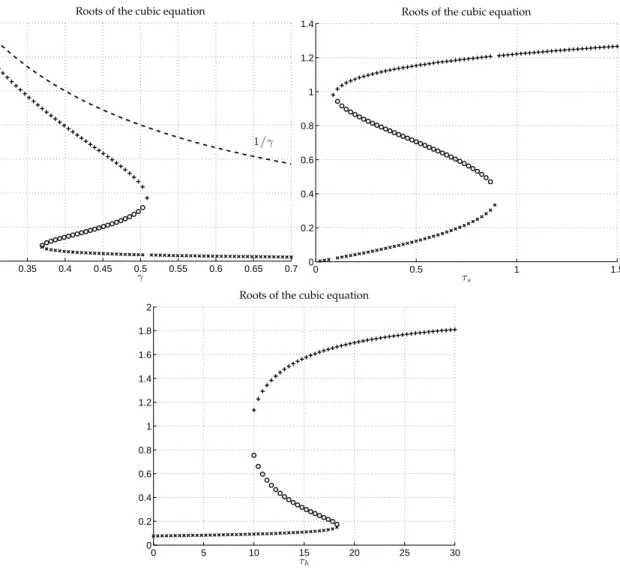
Figure 1 illustrates how the equilibrium values of αs
αh vary with γ, τs, and τh, for the reference
parameters in Table 1. As described above, the ratio αs
αh measures the demand’s relative sensitivity
to information versus hedging needs. On the one hand, as shown by a) and b) above, very precise private signals and very small dispersion of hedging needs make investors relatively more willing to trade
11
The more an investor relies onhi as a signal aboutδ, the lowerαh. Intuitively, a highhi for an investor that learns
aboutδ from the equilibrium price suggests that other investors are selling the risky asset for reasons not related to its payoffs, which dampens the desire to sell purely for hedging reasons, reducing the sensitivity of investors’ demand tohi.
on information, as opposed to trading based on their hedging needs. On the other hand, high levels of risk aversion and low degrees of prior uncertainty (high precision) either about the fundamental or aggregate hedging needs make investors relatively more willing to trade on hedging needs as opposed to information, as can be seen inc), d), ande) above.
0.3 0.35 0.4 0.45 0.5 0.55 0.6 0.65 0.7 0 0.5 1 1.5 2 2.5 3 3.5 1/γ
Roots of the cubic equation
γ 0 0.5 1 1.5 0 0.2 0.4 0.6 0.8 1 1.2 1.4
Roots of the cubic equation
τs 0 5 10 15 20 25 30 0 0.2 0.4 0.6 0.8 1 1.2 1.4 1.6 1.8 2
Roots of the cubic equation
τh
Figure 1: Equilibrium values of αs
αh for different γ,τs, and τh
Table 1: Reference parameters for Figure 1
γ= 0.5 τs= 0.4 τh = 10 τθ = 10 τδ= 0.1
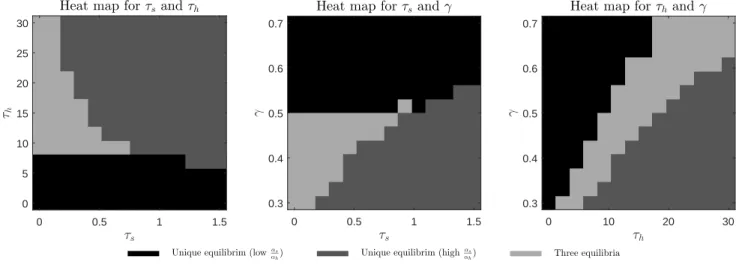
Figure 2 provides heat maps of the multiplicity regions for different combinations of γ, τs, and τh. Whenγ is sufficiently high, only the unique equilibrium with low price informativeness survives. On the contrary, whenγis sufficiently low, only the unique equilibrium with high price informativeness survives. For intermediate values of risk aversion, increased precision of private information and hedging needs make more likely the unique equilibrium with high price informativeness and vice versa.
All other equilibrium objects are uniquely pinned down given an equilibrium value of αs
Heat map forτs andτh 0 0.5 1 1.5 τs 0 5 10 15 20 25 30 τh
Heat map forτs andγ
0 0.5 1 1.5 τs 0.3 0.4 0.5 0.6 0.7 γ
Unique equilibrim (lowαs
αh) Unique equilibrim (high αs
αh) Three equilibria
Heat map forτh andγ
0 10 20 30 τh 0.3 0.4 0.5 0.6 0.7 γ
Figure 2: Uniqueness/multiplicity regions for different combinations of γ,τs, and τh
conjectured coefficients of investors’ net demands are given in equilibrium by
αs= 1 κ τs τθ+τs+τpˆ , αp = 1 κ τs τs+τpˆ , αh= 1 κ γ− αs αh τh τθ+τs+τpˆ ! , and ψ=αp τθ τθ+τs+τpˆ θ−γVar[θ|si, p]q0 ! , where we define κ≡γVar[θ|si, p] +c.
The coefficientαs, which determines the sensitivity of the demand for the risky asset with respect to investors’ private signals, is increasing in the precision of investors private signals τs. When the signal is more informative, investors put more weight on their signals since a higher realization of the signal increases the expected payoff of the asset.
The coefficientαh determines the sensitivity of the demand for the risky asset with respect to hedging needs. Naturally, more risk averse investors react more to their hedging needs, as captured byγ. Because investors’ partially infer the aggregate component of hedging from their individual realization, they dampen their demand response to hi. Intuitively, a high realization of hi, which induces investors to sell for hedging reasons, implies that other investors also desire to sell for hedging reasons, which, for a given price, makes investing in the risky asset more desirable.
The coefficient αp, which determines the sensitivity of the demand for the risky asset with respect to the asset price, features a substitution effect and an information effect. When τpˆ → 0, there is no
information effect and αp → κ1. In this case, the elasticity of investor i portfolio demand the prices is given by κ1, as in the model without learning: this is the standard substitution effect caused by price changes. When prices are somewhat informative, i.e., whenτpˆ>0, an information effect arises. Investors
are less sensitive to price changes since high prices induce investors to infer that the expected asset payoff is high and vice versa. The value of information contained in asset pricesτpˆ relative to the information
in private signalsτs determines the relative sensitivity of the investor’s demand to the asset price αp. The coefficient ψ determines the autonomous demand for the risky asset, which does not depend on private signals, prices or hedging needs. This autonomous demand is proportional to the price coefficient
αp and it has two components. Its first component captures the (weighted) unconditional expected value of the asset. Its second component captures the risk premium associated with holding the risky asset.
Importantly, the equilibrium values ofαs,αh, andαpare directly modulated byκ, which is a measure of investors risk tolerance and trading costs. The fact thatκenters multiplicatively in all three variables makes the ratios αs
αh,
αs
αp, and
αh
αp independent of the level of trading costs, which is crucial to establish
our main result.
Theorem 1. (Irrelevance theorem with ex-ante identical investors) When investors are ex-ante identical, price informativeness in any equilibrium is independent of the level of trading costs. Formally, the precision of the unbiased signal about the fundamental revealed by the asset priceτpˆe does not depend onc.
Theorem 1 establishes the first main irrelevance result of the paper. Theorem 1 shows that price informativeness is independent of the level of trading costs. Two identical economies with different levels of trading costs c have equally informative prices. Intuitively, high trading costs make investors less willing to trade on both their private information and their hedging needs, leaving unchanged the total relative demand sensitivities to hedging and information and, consequently, the signal-to-noise ratio in asset prices. Therefore, price informativeness is not affected by changes in the level of trading costs. Moreover, changes in the level of trading costs do not affect the structure of the set of equilibria. That is, in the context of Theorem1, the set of equilibrium levels of price informativeness is invariant to the level of trading costs. Theorem 1 provides a natural benchmark to understand the role of trading costs on the informational efficiency of the economy: only departures from ex-ante homogeneity across investors can generate an effect of trading costs on information aggregation.
Although this paper focuses on the effects of trading costs on learning and price informativeness, Theorem1 (and all other irrelevance results in this paper) apply to the unconditional volatility of asset prices, as we show in the Appendix. Intuitively, given that the reduction on buying and selling pressures is symmetric across all investors, asset prices remain unaffected by variations in the level of trading costs.12
Even though price informativeness and volatility are independent of c, other equilibrium outcomes, like portfolio holdings and trading volume do depend on the level of trading costs. The net trading in equilibrium by investorican be written as a function of the realizations of εsi andεhi as follows
∆q1i=αsεsi−αhεhi.
Becauseαs andαh are decreasing in the level of trading costsc, the level of net trading by an individual investor is decreasing inc.
The effects on aggregate trading volume are similar. Using a Law of Large Numbers, we can exactly
12
InDavila and Parlatore(2017), we systematically study the relation between price informativeness and price volatility in a general class of models of financial market trading.
express trading volume in this economy, defined as the number of shares traded and denoted by V, as V = 1 2 ˆ |∆q1i|di= 1 √ 2π αs2 τs +α 2 h τh !12 .
Becauseαsand αh are decreasing in the level of trading costsc, the level of aggregate trading volume is decreasing inc. Formally, we show that
dV
dc <0.
Therefore, even when price informativeness remains unchanged, trading volume will decrease when trading costs are higher.
Equilibrium with ex-ante heterogeneous investors
Theorem 1 is an important benchmark to understand how trading costs affect informational efficiency. However, investors may be ex-ante heterogeneous along different dimensions. In this section, we study how ex-ante asymmetries among investors break our irrelevance result. Formally, we let γi,τsi,τhi, and
q0i take arbitrary values across the distribution of investors.
Given a price p, Eq. (7) continues to determine investor i’s demand for the risky asset. In the equilibrium in linear strategies that we study, we guess and subsequently verify that the optimal portfolio of investoritakes the form
∆q1i =αsisi−αhihi−αpip+ψi, (17)
whereαsi,αhi, andαpi are positive scalars for every investoriand ψi can be positive or negative. Market clearing implies that the equilibrium price takes the form
p= αs αp θ− αh αp δ+ ψ αp , (18)
where we denote the cross sectional averages of the individual coefficients byαs=
´ αsidi,αh= ´ αhidi, αp = ´ αpidi, and ψ = ´
ψidi. The interpretation of Eq. (17) and Eq. (18) is the analogous to the interpretation of Eq. (10) and Eq. (11) in the model with ex-ante identical investors. We denote by ˆ
pe= αp
αsp−
ψ
αs the unbiased signal ofθfrom the perspective of an external observer, which is distributed
as follows ˆ pe|θ∼N θ,τpˆe−1 , where τpˆe= α s αh 2 τδ. As before, we adopt τe ˆ
p as the relevant measure of price informativeness. We relegate the exact characterization of the equilibrium to the Appendix, and exclusively focus on the implications of trading costs for price informativeness.
Theorem 2 focuses on the case in which two groups of investors are heterogeneous across a single dimension. In that case, we show that an increase in trading costs is associated with a reduction in price informativeness for any set of primitives.
Theorem 2. (One-dimensional heterogeneity) When two groups of investors differ along one dimension of heterogeneity in i) risk aversion, ii) precision of private information, or iii) precision
of hedging needs across, an increase in trading costs is always associated with a decrease in price informativeness.
We show that one dimensional heterogeneity in primitives across two groups of investors in risk aversion, the precision of private information, or hedging needs implies that trading costs reduce price informativeness. This result arises because investors with more precise information, either about the fundamental or the aggregate hedging, or with relatively high risk tolerance, trade more aggressively in general and react more to trading costs, while putting more weight on their private signal about the fundamental and contributing relatively more information to the price. Intuitively, all three forms of heterogeneity endogenously generate a positive cross-sectional correlation between aggressive trading behavior and relative sensitivities to information versus hedging. We describe in detail how this pattern emerges endogenously in our numerical illustration in Section 4.
Theorem 3 extends the result in Theorem 2 to multi-dimensional heterogeneity. When investors differ in two dimensions, we show that an increase in trading costs is associated with a reduction in price informativeness for most combinations of primitives.13 We also provide a general characterization of the directional change in price informativeness that accommodates multi-dimensional heterogeneity. This directional change is expressed as a function of asset demand sensitivities, which in our model are equilibrium objects, and clearly illustrates the intuition behind the economic mechanisms that drive the results.
Theorem 3. (Two-dimensional heterogeneity and general directional effects of trading costs with ex-ante heterogeneous investors) a) When two groups of investors differ along two out of the three following dimensions: i) risk aversion, ii) precision of private information, or iii) precision of hedging needs across, an increase in trading costs is associated with a decrease in price informativeness for most parameter combinations.
b) When the difference in relative-to-the-average sensitivities between information and hedging motives for trading, αsi
αs −
αhi
αh, is positively (negatively) correlated in the cross-section of investors with
the demand sensitivity κ1
i, an increase in trading costs c decreases (increases) price informativeness in
a given equilibrium. Formally, the sign of dτ
e ˆ p dc is determined by sgn dτ e ˆ p dc ! =−sgn Covi α si αs −αhi αh , 1 κi . (19)
When investors are heterogeneous along multiple dimensions of heterogeneity, price informativeness can either increase or decrease with trading costs. For example, when a group of investors with high risk aversion also have a high precision of private information, an increase in trading costs disproportionally reduces the amount of information incorporated into the price and price informativeness increases when trading costs increase. In Section4, we provide specific examples of this phenomenon and illustrate the specific combinations that are associated with a positive value for dτ
e ˆ p
dc.
In Theorem 3b, independently of the primitives of the economy, the equilibrium objects αsi, αhi, and κi are sufficient statistics to determine how changes in the level of trading costs affect price informativeness. This characterization illustrates the economic mechanisms at play. In general, when investors are heterogeneous, an increase in trading costs can increase or decrease price informativeness, depending on the sign of −Covi
hα si αs − αhi αh, 1 κi i
. This is the negative of the cross-sectional covariance of two terms. The first term corresponds to the difference between relative sensitivities to private signals on the fundamental and relative sensitivities to hedging. The second term corresponds to the demand sensitivity of investors to trading costs: when κ1
i is high, investors trade aggressively and their overall
demand is highly sensitive to price changes and trading costs. Intuitively, when the investors who are relatively more sensitive to information than to hedging needs, that is, those with a high αsi
αs −
αhi
αh, are
also the more responsive to changes in trading costs, that is, those for which κ1
i is high, we show that
high trading costs reduce price informativeness and vice versa.
Not every form of heterogeneity breaks down the irrelevance result. In particular, heterogeneity about initial positions leaves price informativeness unaffected by changes in the level of trading costs, sinceαsi,αhi, andκi remain unaffected. Trading costs affect price informativeness as long as investors differentially trade on information and hedging needs. Therefore, wheneverγi,τsi, andτhi are constant, demand sensitivities are identical across all investors, which leaves the signal-to-noise raise unchanged.
Remark. (Comparison with standard noise trading formulations)Our irrelevance results crucially depend on the fact that all investors are symmetrically affected by the change in trading costs. At times, for tractability, models of learning in financial markets assume an ad-hoc supply/demand shock, often referred to as “noise trading”. Taken at face value, this assumption leads us to believe that high trading costs are associated with low price informativeness. In these models, an increase in trading costs reduces the amount of information in asset prices because only informed investors react to this change, while noise traders’ demand is fully inelastic. The classic noise trading formulation can be viewed as a special case of our model in which a group of investors inelastically trades on hedging motives. Theorem2shows that increasing trading costs in an economy with a set of perfectly inelastic investors who do not trade on information makes prices less informative.
4
Numerical illustration
To provide a deeper understanding of Theorems 1 through 3, we conduct three different numerical exercises. First, we illustrate how price informativeness and trading volume vary with the level of trading costs for different combinations of risk aversion and precision about the fundamental for a subset of investors. Second, we illustrate how most combinations of heterogeneity in risk aversion and the precision of the private signal about the fundamental are associated with a decrease in price informativeness when trading costs increase. Third, we show that most combinations of risk aversion and the precision of hedging needs are also associated with a decrease in price informativeness when trading costs increase.
4.1 Effects of trading costs on price informativeness and volume
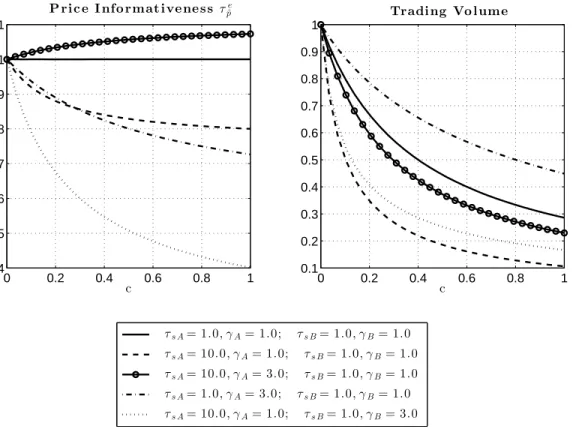
Figure 3 illustrates the effect of trading costs in the equilibrium price informativeness and trading volume. To build on the insights from Theorems 2 and 3, we assume that there are two groups of investors, denoted byi=A, B, each of them accounting for one half of the total population. Investors’ initially own a single share of the risky asset, so q0i = Q = 1, ∀i. We assume that all investors have identically distributed hedging needs, i.e., τhi= 1, ∀i. We also assume thatτδ=τθ = 1. This choice of parameters guarantees that we are in a region with a unique equilibrium.
We compare five different parameter configurations. First, we consider the benchmark with ex-ante identical investors assume that τsA = τsB = 1 and γA = γB = 1. In that case, the irrelevance result of Theorem1 applies and τpˆ is independent of the level of trading costs. Trading volume, as expected,
decreases with the level of trading costs.
0 0.2 0.4 0.6 0.8 1 0.4 0.5 0.6 0.7 0.8 0.9 1 1.1 P ri c e I nfo rmat i ve ne s s τpˆe c 0 0.2 0.4 0.6 0.8 1 0.1 0.2 0.3 0.4 0.5 0.6 0.7 0.8 0.9 1 Tradi ng Vo l ume c τs A= 1.0,γA= 1.0; τs B= 1.0,γB= 1.0 τs A= 10.0,γA= 1.0; τs B= 1.0,γB= 1.0 τs A= 10.0,γA= 3.0; τs B= 1.0,γB= 1.0 τs A= 1.0,γA= 3.0; τs B= 1.0,γB= 1.0 τs A= 10.0,γA= 1.0; τs B= 1.0,γB= 3.0
Figure 3: Comparative statics on trading costs c(values are relative to c= 0)
Second, we assume that A-investors are better informed than B-investors by increasing the precision of their private signal about the fundamental. Specifically, we setτsA = 10 andγA= 1. In this case, τpˆ
decreases with the level of trading costs. With this parametrization, A-investors are more informed and more price sensitive than B-investors. Therefore, as shown in Theorem 2, price informativeness must decrease when trading costs increase: the reduction in trading by the more informed and more sensitive A-investors makes prices less informative.
Third, we preserve the asymmetry on information precision while also making A-investors more risk averse. In particular, we set τsA = 10 andγA= 3. In this case, A-investors are more informed and less
price sensitive than B-investors at the margin. Exploiting Theorem3b), we expect an increase in trading costs to increase price informativeness. Less informed but more sensitive B-investors disproportionally trade less, while the smaller reduction in trading by the less sensitive and better informed A-investors makes prices more informative.
Fourth, we assume that A-investors are more risk averse than B-investors, although both groups are equally informed. In this case, A-investors give a higher weight to trading due to hedging needs at the same time that they have a less sensitive demand. An increase in trading costs has a bigger impact on the trades of B-investors, who are relatively more demand sensitive, reducing price informativeness. This is again consistent with Theorem2.
Finally, we assume that B-investors are more risk averse than A-investors, who are better informed. This configuration is similar to the second one. An increase in trading costs in that case disproportionally reduces the demand by the relatively better informed A-investors, reducing price informativeness.
Figure3illustrates how price informativeness and trading volume vary with the level of trading costs
c for the different parameter combinations. We express all variables as a ratio relative to the c = 0 reference point. For all parameter configurations, trading volume goes down, as expected.
4.2 Heterogeneity on the precision of signals on fundamental and risk aversion
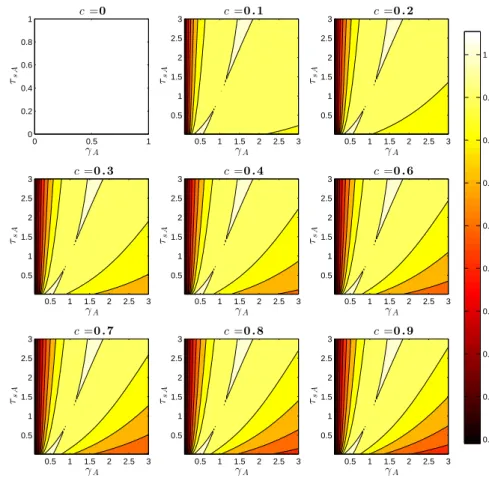
We systematically study how two-dimensional heterogeneity in risk aversion and in the precision of private information about the fundamental determines the effect of trading costs on price informativeness. We adopt as reference the case in which γB = 1 and τsB = 1. In Figure 4, we plot equilibrium price informativeness relative to the case whenc= 0 for different combinations of γA, in the horizontal axis, and τsA, in the vertical axis. This analysis generalizes Figure 3. By design, when γA = 1 and τsA = 1, the heat map takes a unit value, because price informativeness is invariant to the level of trading costs. Figure4shows that most combinations of risk aversion and precision of the signal on the fundamental heat map values are less than unity.14 Intuitively, investors with relatively high risk aversion become less aggressive traders and, at the same time, more prone to trade on their hedging. This implies that an increase in trading costs disproportionally reduces the trading of the less risk averse investors, who are those adding more information to the price. Similarly, investors with precise information on the fundamental are, in general, more aggressive and at the same time more willing to trade on their private information. This implies that an increase in trading costs disproportionally reduces the trades of the investors with more precise signals, who are those adding more information to the price.
Only parameter combinations in which a group of investors has high risk aversion, making them less aggressive traders, and high precision of their signal on the fundamental, implying that they react strongly to their private information on the fundamental, are associated with increases in price informativeness when trading costs increase. As expected, the higher the level of trading costs, the stronger the effects on equilibrium price informativeness.
14
Theorem1implies that the point (γA, τsA) = (1,1) takes a unit value. Theorem2implies that points of the form (x,1)
c=0 γA τ s A 0 0.5 1 0 0.2 0.4 0.6 0.8 1 c=0 . 1 γA τ s A 0.5 1 1.5 2 2.5 3 0.5 1 1.5 2 2.5 3 c=0 . 2 γA τ s A 0.5 1 1.5 2 2.5 3 0.5 1 1.5 2 2.5 3 c=0 . 3 γA τ s A 0.5 1 1.5 2 2.5 3 0.5 1 1.5 2 2.5 3 c=0 . 4 γA τ s A 0.5 1 1.5 2 2.5 3 0.5 1 1.5 2 2.5 3 c=0 . 6 γA τ s A 0.5 1 1.5 2 2.5 3 0.5 1 1.5 2 2.5 3 c=0 . 7 γA τ s A 0.5 1 1.5 2 2.5 3 0.5 1 1.5 2 2.5 3 c=0 . 8 γA τ s A 0.5 1 1.5 2 2.5 3 0.5 1 1.5 2 2.5 3 c=0 . 9 γA τ s A 0.5 1 1.5 2 2.5 3 0.5 1 1.5 2 2.5 3 0.1 0.2 0.3 0.4 0.5 0.6 0.7 0.8 0.9 1
Figure 4: Heat map of price informativeness (values are relative toc= 0)
4.3 Heterogeneity on the precision of signals on hedging needs and risk aversion
Finally, we study how two-dimensional heterogeneity in the precision (volatility) of investors’ hedging needs determines the effect of trading costs on price informativeness. In this case, we assume that
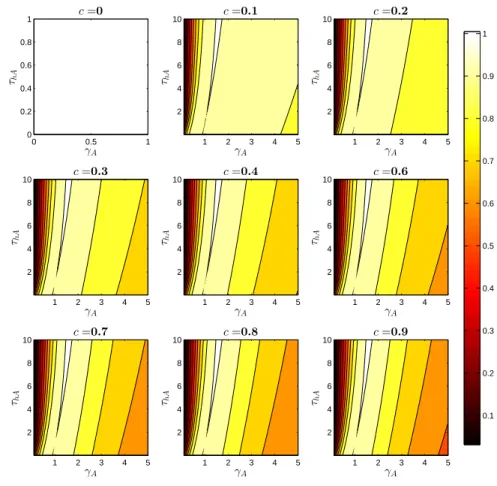
τsA = τsB = 1, and take as reference the case in which γB = 1 and τhB = 1. In Figure 4, we plot equilibrium price informativeness relative to the case whenc= 0 for different combinations ofγA, in the horizontal axis, and τhA, in the vertical axis. Again, by design, whenγA= 1 andτhA= 1, the heat map takes a unit value, because price informativeness is invariant to the level of trading costs.
Figure 5 also shows that most combinations of risk aversion and precision of hedging needs for A-investors are associated with reductions in price informativeness. Intuitively, A-investors with very volatile hedging needs (low precision τh) in general trade less aggressively, because their perceived variance of the fundamental Var[θ|si, hi, p] is higher. At the same time, because they are relatively less informed about the noise in asset prices, they react more strongly to the realization of hi. This implies that an increase in trading costs disproportionally reduces trading by investors with less volatile hedging needs, which are those who react more strongly in relative terms to their private signals about the fundamental, reducing price informativeness. As before, the higher the level of trading costs, the stronger the effects on equilibrium price informativeness.
c=0 γA τh A 0 0.5 1 0 0.2 0.4 0.6 0.8 1 c=0.1 γA τh A 1 2 3 4 5 2 4 6 8 10 c=0.2 γA τh A 1 2 3 4 5 2 4 6 8 10 c=0.3 γA τh A 1 2 3 4 5 2 4 6 8 10 c=0.4 γA τh A 1 2 3 4 5 2 4 6 8 10 c=0.6 γA τh A 1 2 3 4 5 2 4 6 8 10 c=0.7 γA τh A 1 2 3 4 5 2 4 6 8 10 c=0.8 γA τh A 1 2 3 4 5 2 4 6 8 10 c=0.9 γA τh A 1 2 3 4 5 2 4 6 8 10 0.1 0.2 0.3 0.4 0.5 0.6 0.7 0.8 0.9 1
Figure 5: Heat map of price informativeness (values are relative toc= 0)
Remark. (Heterogeneity and price informativeness) Consistent with Theorem 3, Figures 4 and 5, show that most combinations of parameters involving risk aversion, the precision of the private signal about the fundamental, or the precision of hedging needs, that generate heterogeneity across investors are associated with a negative response of price informativeness to trading costs. Consistent with Theorem
2, one-dimensional heterogeneity is also associated with negative responses of price informativeness to trading costs.
5
Endogenous information acquisition
So far, our analysis has treated the precision of investors’ private information as a primitive of the model. In this section, we allow investors to optimally choose the precision of their private signals.15 In the paper, we consider the case in which investors choose the precision of their private signals about the fundamentalθ. In the Online Appendix, we extend the benchmark model by allowing investors to receive a private signal about the aggregate hedging needδand allow them to choose the precision of that signal. Both scenarios yield identical insights. To isolate the effects coming from information acquisition, we
15
The model with exogenous precision can be interpreted as modeling the short-run response to trading costs changes, when investors have not adjusted their information gathering technology. The model with endogenous information acquisition can be interpreted as modeling long-run responses, after investors adjust how they gather information.
focus our attention on the case with ex-ante identical investors. To simplify our calculations, we assume that the risky asset is in zero net supply throughout this section.
5.1 Endogenous precision of the signal about the fundamental
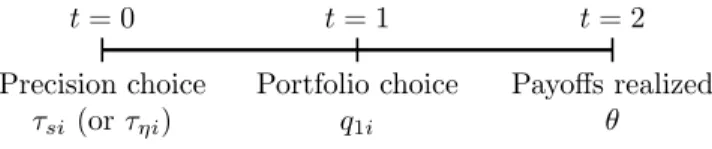
The exact timing of the investors’ choices is represented in Figure 6. As in the benchmark model, investors choose their portfolio allocation q1i at date 1, after observing the realizations of si and hi, while filtering the information contained in the asset price. Now, at date 0, every investor chooses the precision of his private signal τsi at a cost λ(τsi), where λ(·) is continuous and twice differentiable and it satisfies, λ0(·)>0, λ00(·) ≥0 and the Inada condition limτsi→∞λ0(τsi) = ∞. In the simulations, we assume thatλ(·) is quadratic.
Precision choice τsi (orτηi) Portfolio choice q1i Payoffs realized θ t= 0 t= 1 t= 2
Figure 6: Timeline endogenous information acquisition
The equilibrium of this augmented game is subgame perfect, i.e., it takes into account the equilibrium played in the trading stage. However, since there may be multiple equilibria in the trading stage of the game, the probability with which each equilibrium is played at date 1 is also an equilibrium outcome. We continue to restrict our attention to equilibria in linear strategies in the trading stage.
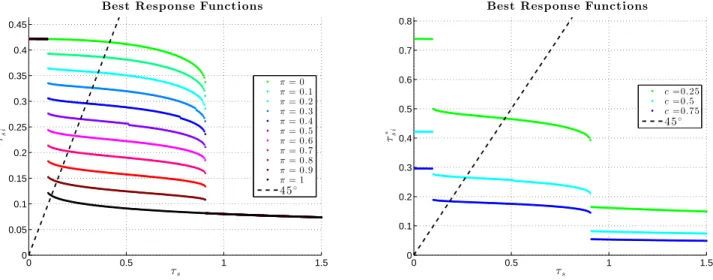
Definition. (Equilibrium) An equilibrium in the information acquisition game is a set of precision choices for each investor i,{τsi}i, and a probabilityπ with which the high equilibrium is played if there are multiple equilibria in the trading game such that a) each investor chooses the precision of his private signalτsito maximize his expected utilityV
τsi;{τsj}j6=i
, as defined in Eq. (20), givenπand the other investors’ precision choices {τsj}j6=i, and b) the probability π is a sunspot equilibrium of the trading game at date 1 given the precision choices{τsj}i.
We prove Theorem 4 allowing for π ∈ [0,1]. To simplify the analysis and highlight the economic mechanisms, we focus on equilibria with a degenerate distributionπ ∈ {0,1} in what follows.
Investors’ information choice Each investor i takes the equilibrium of the model starting at date 1 and the other investors’ precision choices as given when he chooses his own precision. Specifically, an investori optimally choosesτsi by solving
max τsi V τsi;{τsj}j6=i , where V τsi;{τsj}j6=i =E[vi]−λ(τsi), (20) and E[vi] is given by16 E[vi] =Cov[(E[θ|si, hi, p]−γhi−p), q1∗i]− 1 2(γVar[θ|si, hi, p] +c)E h (q∗1i)2i,
16Our choice of objective function is standard in these environments. It is studied and justified inVeldkamp(2009) and