Students’ Out-of-class Web 2.0 Practices in Foreign Language Learning
Natalya Kuznetsova University of Utah, USA. [email protected]
Kamal Ahmed Soomro
Institute of Business Management, Pakistan [email protected]
Abstract
The scholarship on foreign language (FL) learning and teaching shows various ways Web 2.0 technologies are used to promote and ease communication and gives access to and cultural exchange of information, which are the main purposes of language
learning. Despite prolific examination of strategies and impact of Web 2.0 to enhance language learning, researchers have not yet sufficiently examined technology
practices initiated by students themselves to support their FL experiences and the
awareness of this use. The present study reports on the findings of an exploratory
survey research project that investigated university students’ activities to use Web 2.0 sites to support their FL learning and awareness of those practices. Moreover, the study attempts to analyze students’ reported actions through the framework of 5 Cs (communication, comparison, communities, cultures, connections) of ACTFL (American Council of Teaching on Foreign Languages). The data collected from 137 FL students revealed that students are moderately engaged with Web 2.0 technologies in their FL learning practices and use such tools primarily for comparing the foreign language and culture to the native language and culture in different mediums. Video sharing and Social Networking were reported as favorite tools to support students’ foreign language learning experience.
Keywords: ACTFL standards, foreign language learning, social media, Web 2.0 Introduction
Digital environment has vigorously reshaped different facets of our lives: the way we communicate, acquire, process and deliver information and consequently,
the way we teach and learn. Smartphones become ever-present and they easily connect people to the entire world. Research shows that teenagers are pre-occupied with social networks (Boyd & Ellison, 2007), and are engaged in a range of online activities pertaining to social and literary activities embedded in everyday lives (Davies, 2012). Many educators and researchers have already recognized pedagogical affordances of various online technologies called Web 2.0 tools as a necessity in their work with digital natives 21st century learners. Digital natives or students of net generation are agents of their own learning who frequently use technology for various purposes. Bower, Hedberg, and Kuswara (2010) state that the open and collaborative landscape of Web 2.0 model holds a great potential for
future education. Although Web 2.0 tools have been found beneficial especially to
distance education, they are also used to support conventional face-to-face mode of learning.
The fervent development of CALL (Computer Assisted Language-Learning) and TELL (Technologically Enhanced Language Learning) domains of foreign language pedagogy over the past two decades demonstrate an array of opportunities and affordances that technologies provide for FL education. It provides access not only to authentic content in the target language, but also opportunities for interactive practice of different language skills (reading, listening, writing, and speaking) regardless of the location and the development of cultural and intercultural competence. Chang, Pearman, and Farha (2012) highlight that the technological
mediation of foreign language is beneficial for students who experience shyness and
language barrier, and Web 2.0 allows learners engage with multiple native speakers
in different contexts. Similarly, Faizi, Afia, and Chiheb (2014) propose that Web
2.0 technologies offer learners wider opportunities to practice their language and communication skills outside the formal learning environment. Among the returns of the use of online technologies in foreign language learning, Pop (2010) stresses “connectivity, diversity of experiences and needs, instant response and feedback”,
as well as a variety of modes of interaction and flexibility (P. 52). Technology has
demonstrated the prospective for creating a collaborative and participatory learning platform (Antenos-Conforti, 2009; Dippold, 2009) and autonomous learner-directed learning (Lai, Hu, & Lyu, 2017).
Although both, teachers and FL learners are widely employing Web 2.0 sites to optimize and augment their instructional practices in different learning
settings including higher education, educational community and researchers are still curious to unfold frameworks that can guide to effective learning experiences supported with the second generation of web (Bower et al., 2010). Despite many studies focusing on possible impacts of individual Web 2.0 tools to enhance
language learning and various language skills, researchers have not yet sufficiently
examined technology practices initiated by students themselves to support their foreign language experiences. Moreover, the majority of empirical research is still devoted to the utilization and outcomes of technology in ESL/EFL (English as a second/foreign language) settings. Research engaging a variety of foreign languages, languages taught not in the target language environment, can provide more insight into the powers of Web 2.0 in educational contexts. Most importantly, none of the studies to our knowledge have examined in detail the features of Web
2.0 tools through the lenses of the five Cs (communication, cultures, connections,
comparisons, and communities) of foreign language learning standards, proposed by American Council on the Teaching of Foreign Languages (ACTFL). Therefore, many important questions are still not adequately answered by the existing literature. The research questions of the present study pursue two major research questions:
1. What are FL students’ activities with Web 2.0. in their out of class language learning practices?
2. How students’ practices with Web 2.0 respond to the ACTFL (2012) standards of foreign language learning?
Information gained from this study is helpful to cast the light on students’ initiatives to use web 2.0 in foreign language learning and whether those activities
correspond with the ACTFL standards of foreign language learning. The findings
from this study provide valuable information for foreign language educators about the potential and the ways of Web 2.0 use in their instruction.
Purpose
The present investigation was aimed to examine students’ Web 2.0 practices to to enrich their foreign language learning experiences, to acquire knowledge and master foreign language skills. We concentrated on the following questions:
1. What are the frequency, duration, and experience of Web 2.0 use by the foreign language learners?
2. Which Web 2.0 tools do FL learners use beyond the classroom to improve/ practice their FL skills?
3. What specific learning activities do the FL learners engage in by means of
Web 2.0?
4. How do those activities correspond with ACTFL standards for FL learning? Literature Review
The following segment of this paper gives a brief review of the literature, talking about description and characteristics of Web 2.0, their possible role in language learning, and a comprehensive overview of ACTFL standards of foreign language learning.
Web 2.0 in Foreign Language Learning
Web 2.0 tools are attributed as being read-write, bi-directional, dynamic, participatory and second generation of web (Ajjan & Hartshorne, 2008; Bartolomé, 2008; Chun, Smith, & Kern, 2016). Some common and widely used Web 2.0 tools include Facebook, blogs, wikis, social bookmarking, podcasts, and YouTube. Aforesaid dynamics of Web 2.0 are described by various terms such as the collective authoring, crowd-sourcing, and participatory web (Collis & Moonen, 2008).
Nowadays the utilization of emerging online technologies in FL learning is not a question of why, but how. These technologies shrink distances between continents, connecting people and ideas with tremendous speed, creating the world without borders, bringing authentic linguistic and cultural situations closer to the learner and supporting and strengthening cultural exchange. Due to the swift development of ICTs, the web has transformed into an interactive and collaborative universal medium where the clients are consumers as well as creators of the
content (Faizi et al., 2014, p. 64). Researchers argue that 2.0 technologies diffuse
into everyday activities of young population and educators, which marks it nearly unreasonable to keep them away from this phenomenon (Campion, Nalda, & Rivilla, 2012). Moreover, Wang & Vasques (2012) claim that Web 2.0 technologies
Their free read/write capability, free availability and sharing and collaboration features make them popular in each segment of the population. Since these tools
can be generously personalized to fulfill specific needs and interests of the people
who use them (Pan & Franklin, 2011), they have permeated diverse aspects of life and become an integral part of everyday communication.
Students’ engagement is of critical important in language learning. The
findings from the study conducted by Akbari, Naderi, Simons, and Pilot (2016)
disclose that Web 2.0 tools have positive effect on student engagement and motivation in language acquisition. Further, the affordances of Web 2.0 not only enhance improve creativity, exchange of information and collaboration (Tu, Blocher, & Ntoruru, 2008), but transform our thinking about teaching styles (Chang et al., 2012) and making the learning process more student-centered (Pop, 2010). Dubravac, Siskin-Gasparro, and Lacorte argue that the advances in technology-assisted teachers to move out of the center of the activity. The charming features and pedagogical-supported characteristics of Web 2.0 have made them a must for both the learners and teachers to enhance and promote learning experiences in a variety of areas in foreign language learning.
The most common ways to utilize Web 2.0 in FL instruction are providing
access to authentic linguistic and cultural input and opportunities. The findings
from a review of empirical investigations examining technology use for language learning suggest that technology effectively facilitates (a) access to linguistic and cultural materials, (b) opportunities for communication, and (c) provision of feedback to learners (Zhao, 2003). Similarly, Chang et al (2012) report that Web 2.0 enables FL learners’ knowledge construction and deep linguistic and cultural engagement with the target language. Among the linguistic gains are enriched
vocabulary (Song & Fox, 2005), improved writing (Antenos-Conforti, 2009; Pop,
2010) and pronunciation (Sun, 2009). On the other hand, effective communication requires not only a good command of the linguistic system but pragmatic competence as well. Classical in-classroom foreign language instruction, even the one that follows communicative instructional method, has limitation and learners
might experience difficulty in authentic cross-cultural communication in the target
language. Emerging technologies extend foreign language learners a venue for interesting and engaging activities beyond their regular classroom experience (Pop,
O’Dowd’s study (2007) showed that telecollaborative activities facilitate the growth
of learners’ intercultural and communicative proficiency.
Research shows that students recognize didactic use of Web 2.0 technologies
(Faizi et al, 2014; Lai et al., 2017; Steel & Levy, 2013; Wang & Vasquez, 2012)
and actively use technological resources beyond their FL classroom environment.
In a survey study with university students in Morocco, Faizi et al. (2014) found
that most of the respondents already use social media applications to enhance their four language skills: listening, speaking, reading and writing skills. Steel and Levy (2013) found that undergraduate FL students in an Australian university preferred
to use discipline-specific technologies to acquire the basics of language. Lai et al.
(2017) acknowledged three categories of technological experiences that language learners are engaged outside the classroom:
a) Information and entertainment-oriented. b) Social-oriented
c) Instruction-oriented
Moreover, various resources could fall under different categories with different students.
Thus, there is evidence that both educators and learners widely use Web 2.0 in foreign language learning and recognize unambiguous affordances they provide.
The benefits of technologies in providing communication, engaging learners into
a variety of language communities, exposing them to foreign language cultures and encouraging analytical thinking through making connections and comparison foreign cultures and language with their native one are clearly stated. However, it would be interesting to explore how the learners’ perception of their autonomous
use of technology in FL learning corresponds with the proposed five basic activities
of FL learning proposed by ACTFL, communication, cultures, connections, comparisons, and communities. Understanding of this correspondence will help to enhance FL pedagogy and learners’ language learning experiences.
ACTFL Standards of Foreign Language Learning
disseminated by the American Council on the Teaching of Foreign Language
(ACTFL), there are five core components of language proficiency: Communications,
Communities, Cultures, Connections, and Comparisons. In the book Technology in the L2 Curriculum, Dubravac et al. (2012) describe how different types of
technologies can help to address each of the 5 C’s of FL standards (ACTFL). While
Web 2.0 technologies may provide opportunities to boost various aspects of foreign language learning, there is lack of research discussing which particular elements of foreign language learning such as communication, culture, communities, cultures, connections and comparisons is best facilitated with these online technologies and which element is not supported to a great extent.
We used ACTFL standards as the theoretical lenses to examine the students’ individual practices of Web 2.0 to extend and enhance their foreign
language learning. These standards will be further referred to as the five Cs of
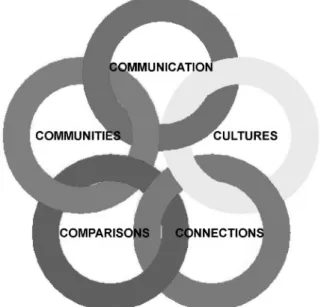
foreign language learning: communication, cultures, connections, comparisons and communities (Figure 1). These standards have been explained and published in the form of a document called Standards for Foreign Language Learning: Preparing for the 21st Century (ACTFL, 2000). The document serves as a remarkable agreement on the interpretation and performance of foreign language instruction among the community, educators, and government (Kirby, 2012).
Methodology Research Design
To investigate students’ use of second generation of web to support their foreign language learning, we employed a survey research design based on open as well as close-ended questions.
Participants
A total of 137 participants completed the survey questionnaire. They were university students who were enrolled in any foreign language course of beginners/ elementary, intermediate, or advanced level at a university in the USA. They reported being formal learners of at least one foreign language including Spanish,
German, Russian, French, Arabic, English, and Italian. About 43% of the survey participants were male and 57% were female students.
Instrument
In an attempt to examine students’ use of second generation of web to support their foreign language learning experiences, the researchers developed an online survey as the tool to collect data. The questionnaire comprised three sections. The leading section of the survey focused to collect some demographic information of the participants. The second section collected data on respondents’ general use of the web, measuring the frequency, duration, and purpose of their
Web 2.0 use. The third part specifically focused on how participants use various
Web 2.0 technologies to support their foreign language learning experience. The survey was hosted at Qualtrics.com and was made open to the participate after it had been piloted.
The third section of the questionnaire included 25 items representing 5
domains of foreign language learning and teaching (communications, communities,
comparison, connections, and culture). This part was specifically focused to assess
the alignment of participants’ Web 2.0 use of foreign language learning based on ACTFL standards. Cronbach’s alpha of the ACTFL standards scale was .97 which indicated a high level of internal consistency of the items. Table 1 displays the reliability for each domain of the ACTFL standards scale.
Table 1
Reliability of ACTFL Standards Scale
Domain No. of items Cronbach’s alpha
Communication 5 .872 Community 5 .827 Cultures 6 .851 Connections 5 .832 Comparisons 4 .882 Overall 25 .967 Procedure
The Institutional Review Board of the university where the data were collected, approved all data collection procedures. We collected data using an online survey through Qualtrics.com. Prior to actual data collection, a small group of potential participants was invited to pilot the instrument to test its suitability for the target sample.
We employed multiple means to reach potential participants for this study. We contacted the administrative personnel and instructors working in language departments of various universities in West Virginia State by email and requested them to forward the link of our online survey questionnaire to the students who were enrolled in any foreign language course. The e-mail addresses of potential
points of contacts were collected through official university web sites and personal
contacts. We also spread the word about our study on various groups of language learning on the Facebook.
Findings
Frequency, Duration, and Experience of Web 2.0 Use by the FL Learners The participants of the present study were learners of various foreign languages such as English, German, Italian, Spanish, Russian, French and Chinese.
Most of them (n=69, 50.4%) were beginners/elementary level language learners, followed by 42.3% (n=58) intermediate level learners. Only nine participants (6.6%)
reported being advanced foreign language learners. Fifty-eight of the participants
Out of 137 valid responses, 125 of the participants (91.2%) of the participants
reported using at least any one of the Web 2.0 tools included in the questionnaire.
Most of them (n=104, 76%) reported using Web 2.0 technologies many times a day. While about 81% of the respondents said that they use such online tools at least once a day, 77.6% of the participants agreed to use Web 2.0 to enrich their foreign
language learning experience.
Specific Tools to Support Participants’ Foreign Language Learning
The results of our study indicated that video sharing sites (Youtube, DailyMotion, etc.), followed by social network sites, were the most widely used tool for the participants’ foreign language learning. Furthermore, video sharing sites, followed by social network sites, were also considered as the best Web 2.0 tool for foreign language learning by the participants of this study. Wiki type of online resources were third in popularity. Table 2 presents the list of various Web 2.0 tools used for foreign language learning by the participants. Such a distribution of preferences in use of online tools is the evidence that learners actively use technologies as a source of information, or in other words, a virtual library. The use of more communication-oriented resources and those indicating the participation in a target culture community, such as video conferencing, image sharing, and virtual worlds, require more advanced language skills, and given that most of the respondents were pre-advanced learners, our respondents were not comfortable to use those extensively out of class.
Table 2
Comparison of Web 2.0 Tools Used for Foreign Language Learning
Web 2.0 tool Use to support FL LearningN % 1 N Best for FL Use%2
Social Networking Sites 40 29.2% 15 10.9%
Video sharing 57 41.6% 49 35.8% Image/Photo sharing 10 7.3% 1 .7% Blogs 12 8.8% 3 2.2% Video Conferencing 10 7.3% 6 4.4% Presentation Tools 10 7.3% 13 9.5% Wiki 28 20.4% 7 5.1% Virtual Worlds 4 2.9% 1 .7% Online Storage 12 8.8% 2 1.5% Note:
1. Respondents choose all that are relevant to which of the following technologies you use to help you to learn a foreign language?
Specific FL Learning Activities by Means of Web 2.0
Responding to the question “What they found most valuable about using Web 2.0 tools in foreign language learning”, the participants reported various reasons/
benefits of using such tools. The most reported reasons include practicing listening
skill, learning slang terms that wouldn’t be taught in the class, being able to see and hear the language in a more native way and learning new words, connecting with the group of people learning the same foreign language and availing opportunity to communicate with the people who are native speakers. The majority of responses demonstrated the learners’ use of online tools more as an authentic language resource and less as a platform for communication.
Web 2.0 FL Learning Activities and Their Correspondence with ACTFL standards
In order to assess correspondence between participants’ Web 2.0 based foreign language learning activities and ACTFL standards, we calculated an average of items within each of the sub-scale measuring ACTFL standards – Culture, Communication, Communities, Comparisons, and Connections. Since each item
for all five ACTFL standards was measured on a five-point Likert scale, the possible
value of the participants’ score for each of these standards ranged between 1 and
5. Descriptive statistics indicated that the score for Comparison standard was the highest (M=3.5110, SD=.955) among the five C’s of foreign language learning.
The participants’ use of Web 2.0 for the Comparison component was followed by their use for Connections, Culture, Communities, and Communication respectively. Interestingly, participants’ score for the Communication standard was the least
(M=2.75, SD=.946). Table 3 presents descriptive statistics of participants’ score for all five ACTFL standards.
Table 3
Descriptive Statistics for the Five ACTFL Standards
N Valid Mean SD Culture 92 3.168 .856 Communication 92 2.750 .946 Communities 92 3.052 .908 Comparisons 91 3.511 .955 Connections 91 3.257 .815
Further, we calculated a composite variable to reflect each participants score for the five standards altogether. This was done by taking the average of
participant’s separate score of each standard. The results indicated that their overall
score ranged between 1.08 to 4.93 with a mean score of 3.16 and standard deviation of .815. Additionally, one-way ANOVA between subjects tests were performed to test existence of significant differences in participants’ overall score for Web 2.0
use with respect to their gender and their course level – beginners/elementary,
intermediate and advanced.. Results revealed that significant difference existed in their score between male (M=3.421, SD=.661) and female (M=2.970, SD=.869) participants; [F(1, 81) = 6.621, p =.012]. However, no statistically significant difference with respect to the difficulty level of foreign language course.
Discussions
In the context of an array of 2.0 technologies with features conducive for educational purposes and active promotion of computer assisted language learning
and students learning autonomy, it is important to find ways to match students’
independent language learning practices with the standards of language learning to maximize students’ learning experiences. Despite ‘digital generation’s’ (Tapscott, 2009) increasing use of Web 2.0 on every day basis, the results of the students’ survey indicated that students enrolled in foreign language courses were moderately engaged with Web 2.0 technologies outside their classrooms to support their FL endeavor. We can assume that moderate engagement is the result of a traditional approach to education and the premise that learning is a structured activity. If not guided by an instructor, the learners might not have motivation or see the opportunities for independent practices in language learning beyond the classroom. However, the study did not aim to explore students’ motivations, and more research on this matter is necessary.
Video sharing and social network sites were reported as learners’ favorite tools to expand their foreign language learning experience beyond the classroom
walls. This finding corroborates with Canning-Wilson and Wallace (2000), who
also reported that video sharing was the best in foreign language learning among the students. However, it is not clear whether the students consciously engage in video sharing and social networking with the purpose to enhance their language learning experiences or whether the language learning component came as the byproduct of their overall active use of Web 2.0. Further, the active use of videos
for information digging could be prompted by the language curriculum and the instructors’ pedagogy strategies.
Students’ responses also demonstrated that students’ use of Web 2.0 focused primarily on comparing the foreign language and culture under study to their native language and culture, and less on communication and engagement with the native speakers. The ACTFL’s comparison goal, according to which learners develop an insight into the nature of language and culture in order to interact with cultural
competency, is an essential learning activity leading to the language proficiency
and intercultural competency. Chun, Smith and Kern (2016) argued that technology offers novel techniques for languages, cultures and the world to be represented,
articulated, and understood. For example, earlier Lee and Markey (2014) reported
that intercultural online communication project allows the students to become aware of cultural norms and practices in the students’ own culture. Our study also revealed learners’ awareness of comparison practices.
Furthermore, our study found significant gender differences in participants’ Web 2.0 practices corresponding to the five C’s of foreign language learning
standards suggested by the ACTFL. This might have occurred possibly due to differences in Web 2.0 practice in general between male and female students. Previous studies have suggested that females’ attitude toward digital technology is still on the lower side than that of their male counter parts (Cai, Fan & Du, 2017). More research pertaining to gender differences in the use of Web 2.0 is necessary.
Pursuing the goal of finding ways to optimize language learners’ experiences
and the use of Web 2.0 tools in foreign language education, this study provides valuable insight on students’ initiatives to use contemporary technologies in foreign language learning and the correspondence of those to the ACTFL standards of
foreign language learning. The findings from this study can guide foreign language
educators on the potential and the use of particular Web 2.0 in their instruction, in order to enhance learners’ experiences and achieve foreign language learning
standards as suggested by ACTFL. Both educators and language learners can benefit
from understanding the affordances of the use of online tools in language practices. If educators elevate the correspondence of students Web 2.0 practices with ACTFL standards in their classes, students will be able to slowly move to autonomous work on language acquisition. Language instructors may start by assigning structured and semi-structured activities which are aligned with the ACTFL standards and shift
instruction to project work, with a more complex structure nurturing independency in students’ learning. One of the further developments of the use of Web 2.0 in language learning with ACTFL standards aligned could be oral history project, which has recently been promoted in world language education (Burgo, 2016).
Conclusions and Recommendations
This study focused on investigating whether learners of foreign languages in a higher education institution use Web 2.0 technologies for language learning and how these initiatives correspond to the ACTFL world-readiness standards for foreign language learning. We believe that listening to the students’ voices can
sufficiently contribute to more articulated and more beneficial implementation of computer-assisted language learning in FL education. The findings from the
study suggested that foreign language learners are moderately engaged with Web 2.0 technologies. We found that they use Web 2.0 tools primarily for comparing the foreign language and culture to the native language and culture in different mediums. “Video sharing” and “Social Networking” were found to be the most favorite tools to support foreign language learning.
We believe that Web 2.0 technologies can act as a valuable and constructive mediation tool between students and their foreign language learning experiences. Language learner’s practice with the target language outside the classroom is as
much significant as much it is inside the classroom. Even The prospects for learning foreign languages in the classroom are rather limited (Richards, 2015). So there
is a strong need to streamline a channel or platform that can effectively facilitate learners’ interaction with the target language beyond classroom boundaries. We believe Web 2.0 tools can help in facilitation such environment.
The present study was a small-scale project involving a small sample at a single university. Although the designed instrument showed an acceptable level
of internal consistency of the items, a smaller sample did not allow us to confirm the factor structure of the items measuring five c’s of foreign language learning.
A similar study with relatively large sample size involving multiple institutions is recommended for better understanding and more reliable results. Additionally, this study focused on Web 2.0 technologies as a whole; however, there is a need for
further studies which highlight students’ out of class practices with specific tools to
Limitations
This study is not without limitations. One of the limitations of the present study is that the study relied on self-reported data provided by the participants. Further, the present study was a small-scale project involving a small sample at a single university. Although the designed instrument showed an acceptable level
of internal consistency of the items, a smaller sample did not allow us to confirm the factor structure of the items measuring five c’s of foreign language learning. A
similar study with a relatively large sample size involving multiple institutions is recommended for better understanding and more reliable results. Additionally, this study focused on Web 2.0 technologies as a whole, there is a need for further studies
which highlights students’ out of class practices with specific tools to support their
language learning in relation with the language learning standards. References
Ajjan, H., & Hartshorne, R. (2008). Investigating faculty decisions to adopt Web 2.0 technologies: Theory and empirical tests. The Internet and Higher Education, 11(2), 71-80. https://doi.org/10.1016/j.iheduc.2008.05.002
Akbari, E., Naderi, A., Simons, R., & Pilot, A. (2016). Student engagement and foreign language learning through online social networks. Journal of Second and Foreign Language Education, 1(4), 1–22. doi: 10.1186/s40862-016-0006-7
American Council of Teachers of Foreign Language (ACTFL), (2012). Standards for foreign language learning: Preparing for the 21st century. Alexandria: U.S. Dept. of Education.
Antenos-Conforti, E. (2009). Microblogging on Twitter: Social networking in intermediate Italian classes. In L. Lomicka & G. Lord (Eds.). The next generation: Social networking and online collaboration in foreign language learning (pp. 59-90). San Marcos, Texas: CALICO.
Bartolomé, A. (2008). Web 2.0 and new learning paradigms. eLearning Papers,8, 1-10. Bower, M., Hedberg, J. G., & Kuswara, A. (2010). A framework for Web 2.0 learning
design. Educational Media International, 47(3), 177-198. https://doi.org/10.1080 /09523987.2010.518811
Boyd, D., & Ellison, N. (2007). Social network sites: Definition, history, and scholarship. Journal of Computer-Mediated Communication, 13, 210–230.
Burgo, C. (2016). Oral history as an innovative language teaching technique for Spanish heritage language learners. International Journal of Teaching and Learning in
Higher Education, 28(3), 451-459.
Cai, Z., Fan, X., & Du, J. (2017). Gender and attitudes toward technology use: A meta-analysis. Computers & Education, 105, 1-13.
Campion, R. S., Nalda, F. N., & Rivilla, A. M. (2012). Web 2.0 and higher education: Its educational use in the university environment. European Journal of Open, Distance and E-Learning, 2.
Canning-Wilson, C., & Wallace, J. (2000). Practical aspects of using video in the foreign language classroom. The Internet TESL Journal, 6(11), 36-1.
Chang, C. W., Pearman, C., & Farha, N. (2012). Second language acquisition: Implications of Web 2.0 and beyond. Critical Questions in Education, 3(2), 52-64.
Chun, D., Smith, B., & Kern, R. (2016). Technology in language use, language teaching, and language Learning. The Modern Language Journal, 100, 64–80. doi: 10.1111/ modl.12302
Collis, B., & Moonen, J. (2008). Web 2.0 tools and processes in higher education: Quality perspectives. Educational Media International, 45(2), 93-106. https://doi. org/10.1080/09523980802107179
Davies, J. (2012). Facework on Facebook as a new literacy practice. Computers & Education,59(1), 19-29. doi:10.1016/j.compedu.2011.11.007
Dippold, D. (2009). Peer feedback through blogs: Student and teacher perceptions in an advanced German class. ReCALL, 21(1), 18-36.
Dubravac, S., Liskin-Gasparro, J. E., & Lacorte, M. (2012). Technology in the L2 curriculum. Pearson Higher Ed.
Faizi, R., Afia, A. E., & Chiheb, R. (2014). Social Media: An optimal virtual environment for learning foreign languages. International Journal of Emerging Technologies in Learning, 9(5), 64-66.
Kirby, P. S. (2012). Research into the utility of standards in foreign language instruction: A case study of methods used in the high school setting. Doctoral dissertation, Utah State University, USA.
Lai, C., Hu, X., & Lyu, B. (2018). Understanding the nature of learners’ out-of-class language learning experience with technology. Computer Assisted Language Learning, 31(1-2), 114-143. https://doi.org/10.1080/09588221.2017.1391293 Lee, L., & Markey, A. (2014). A study of learners’ perceptions of online intercultural
exchange through Web 2.0 technologies. ReCALL, 26(3), 281-297.
O’Dowd, R. (Ed.). (2007). Online intercultural exchange. An introduction for foreign language teachers. Clevedon: Multilingual Matters.
and Web 2.0 tools for integration. New Horizons in Education, 59(3), 28-40. Pop, A. (2010). The impact of the new technologies in foreign language instruction our
experience. Procedia-Social and Behavioral Sciences, 2(2), 1185-1189.
Richards, J. C. (2015). The changing face of language learning: Learning beyond the classroom. RELC Journal, 46(1), 5-22. doi: 10.1177/0033688214561621
Song, Y., & Fox, R. (2005). Integrating M-technology into web-based ESL vocabulary learning for working adult learners. In Proceedings of IEEE International Workshop on Wireless and Mobile Technologies in Education 2005 (pp. 154–158). Los Alamitos, CA: IEEE Computer Society.
Steel, C. H., & Levy, M. (2013). Language students and their technologies: Charting the evolution 2006–2011. ReCALL, 25(3), 306-320. https://doi.org/10.1017/ S0958344013000128
Sun, Y. C. (2009). Voice blog: An exploratory study of language learning. Language Learning & Technology, 13(2), 88-103.
Tapscott, D. (2009). Grown up digital: How the next generation is changing your world. New York: McGraw Hill.
Thorne, S. L. (2005). Internet-mediated intercultural foreign language education: Approaches, pedagogy, and research.Pennsylvania State University: CALPER. Tu, C., Blocher, M., & Ntoruru, J. (2008). Integrate Web 2.0 technology to facilitate online
professional community: EMI special editing experiences. Educational Media International, 45(4), 335–341. https://doi.org/10.1080/09523980802588634 Wang, S., & Vásquez, C. (2012). Web 2.0 and second language learning: What does the
research tell us? Calico Journal, 29(3), 412-430.
Zhao, Y. (2003). Recent developments in technology and language learning: A literature review and meta-analysis. CALICO journal, 21(1), 7-27.
Received on: February, 2019 Revised on: March, 2019 Accepted on: April, 2019 Citation of this Article:
Kuznetsova, N., & Soomro, K. A. (2019). Students’ out-of-class Web 2.0 practices in foreign language learning. Journal of Education and Educational Development, 6(1), 78-94