This may be the author’s version of a work that was submitted/accepted for publication in the following source:
Barker, Ryan,Nuttall, Kenneth, &Millar, Graeme (2018)
Softening of coal seam gas associated water with aluminium exchanged resins.
Journal of Water Process Engineering,21, pp. 27-43.
This file was downloaded from: https://eprints.qut.edu.au/115295/
c
Consult author(s) regarding copyright matters
This work is covered by copyright. Unless the document is being made available under a Creative Commons Licence, you must assume that re-use is limited to personal use and that permission from the copyright owner must be obtained for all other uses. If the docu-ment is available under a Creative Commons License (or other specified license) then refer to the Licence for details of permitted re-use. It is a condition of access that users recog-nise and abide by the legal requirements associated with these rights. If you believe that this work infringes copyright please provide details by email to [email protected]
Notice:Please note that this document may not be the Version of Record (i.e. published version) of the work. Author manuscript versions (as Sub-mitted for peer review or as Accepted for publication after peer review) can be identified by an absence of publisher branding and/or typeset appear-ance. If there is any doubt, please refer to the published source.
Softening of Coal Seam Gas Associated Water with Aluminium Exchanged Resins
1Ryan E. Barker, Kenneth Nuttall and *Graeme J. Millar
Institute for Future Environments, Science and Engineering Faculty, Queensland University of Technology (QUT), Brisbane, Queensland, Australia.
and
1School of Chemistry, Cardiff University, Cardiff CF10 3AT, Wales, United Kingdom
This study concerned aluminium exchanged strong acid cation resin for the removal of alkaline earth ions from simulated coal seam gas (coal bed methane) associated water samples which comprised of significant bicarbonate concentrations. The hypothesis was that use of aluminium exchanged resins for water softening would require only one regenerant stage, thus avoiding health and safety issues associated with strong acids and alkali on a coal seam gas water treatment site. Equilibrium exchange tests revealed that the selectivity of the aluminium exchanged resin was in the order Ba > Sr > Ca > Mg, albeit the exchange was unfavourable unless a stoichiometric excess of bicarbonate ions was present in solution. Equilibrium studies of multi-component solutions of alkaline earth ions indicated that at low loadings the alkaline earth ions co-sorbed on the resin surface, but the more preferred ion displaced ions of lesser affinity as monolayer exchange was approached. The presence of sodium ions not only reduced alkaline earth ion loading when in concentrations relevant to coal seam gas associated water application but also appeared to be incorporated into flocs in the form of salts. Column studies revealed significant loading of alkaline earth ions (0.787 eq/kg resin) but regeneration with AlCl3 (aq) did not recover all these species (0.67 eq/kg
resin). Partial restriction of the flow was noted during column tests due to floc formation. A subsequent loading/regeneration cycle resulted in further diminishment in alkaline earth ion uptake and an inability to achieve low effluent concentrations of alkaline earth ions.
Key Words: Coal seam gas; coal bed methane; softening; aluminium exchanged resin; produced water
*Corresponding author: Graeme J. Millar | Professor
Science and Engineering Faculty | Queensland University of Technology P Block, 7th Floor, Room 706, Gardens Point Campus, Brisbane, Qld 4000, Australia ph (+61) 7 3138 2377 | email [email protected]
Highlights
Softening of coal seam gas water with aluminium exchanged resins demonstrated
Bicarbonate concentrations in large stoichiometric excess promote softening process
Column studies confirm ion preference by resin as Ba > Sr > Ca > Mg
Floc formation can negatively impact stability of loading/regeneration cycle
1. Introduction
Softening of water samples comprising of excessive amounts of alkaline earth ions is a common procedure [1, 2]. For example, laundry detergents comprise of zeolites which demonstrate high capacity for calcium and magnesium uptake [3]. Boiler water used in the power generation industry is also softened to inhibit scaling of equipment which would ultimately result in reduced operational efficiency [4]. More recently, unconventional energy sources have been developed such as coal seam gas (CSG) [5-7] which inherently produce significant volumes of brackish water which contains alkaline earth ions in addition to the major dissolved species of sodium chloride and sodium bicarbonate [8, 9].
It is often necessary to desalinate the produced or associated water from the CSG industry in order to allow application of the water for beneficial reuse options such as irrigation or stock watering [9, 10]. Reverse osmosis has emerged as the leading technology for desalination of coal seam (CS) water [11-13]. However, fouling of equipment and the membrane can occur due to the deposition of scale forming species [14]. Therefore the use of anti-scalants or a softening stage is recommended [15, 16]. Ion exchange softening can be achieved by use of either strong acid cation (SAC), weak acid cation (WAC) or chelating resins [2, 17]. The basic concept of the exchange process is described in Equations 1 & 2.
Equation 1: 𝐂𝐚𝟐++ 𝟐 𝐇+𝐑 ↔ 𝐂𝐚𝟐+𝐑𝟐+ 𝟐 𝐇+
Equation 2: 𝐂𝐚𝟐++ 𝟐 𝐍𝐚+𝐑 ↔ 𝐂𝐚𝟐+𝐑𝟐+ 𝟐 𝐍𝐚+
For example, Jiang et al. [18] examined the exchange of calcium and magnesium ions with two chelating resins and discovered that regardless of the resin type very high removal efficiencies for both alkaline earth ions could be achieved (>99.5 %). Snoeyink et al. [19] applied strong acid cation resin to also successfully remove barium ions from solutions with significant alkalinity. Resins once loaded with alkaline earth ions were then regenerated in a two stage process as follows [Equations 3 & 4] [20].
Equation 3: 𝟐 𝐇++ 𝐂𝐚𝟐+𝐑𝟐 → 𝟐 𝐇+𝐑 + 𝐂𝐚𝟐+
Equation 4: 𝐍𝐚++ 𝐇+𝐑 → 𝐍𝐚+𝐑 + 𝐇+
The regeneration is a two stage process; first the resin is treated with a strong acid to remove the cations that have been exchanged onto the resin. Hydrochloric acid in the range 4 to 5 % concentration is typically preferred as it avoids issues with precipitation of sulphates when
sulphuric acid is employed [20]. To convert the resin to the original sodium ion exchanged form a solution of sodium hydroxide is used to remove the hydrogen ions from the resin [20].
Despite the demonstrated success of conventional ion exchange softening approaches, when considering the constraints of the CSG industry there is a desire to further improve aspects such as: use of only one regenerant stage to simplify operation; avoidance of health and safety issues associated with strong acids and alkali on a CSG water treatment site; and, minimisation of waste stream volumes. Thus an innovative strategy is required to address these latter requirements. It is noted that a characteristic of produced water from coal seam gas operations is high bicarbonate alkalinity relative to the amount of alkaline earth ions present [8, 21, 22]. A recent study by Li et al. [23] reported a new softening method which used aluminium exchanged resin to soften simulated surface water comprising of calcium, sodium, bicarbonate and sulphate ions at pH 7.5. The basis of this latter approach was to make use of the presence of bicarbonate ions in solution as illustrated in Equations 5 and 6, where R2 and R3 represent 2 and 3 resin exchange sites, respectfully [23].
Equation 5: 𝟑 𝐂𝐚𝟐++ 𝟐 𝐀𝐥𝟑+𝐑𝟑 ↔ 𝟑 𝐂𝐚𝟐+𝐑𝟐+ 𝟐 𝐀𝐥𝟑+ Equation 6: 𝟐 𝐀𝐥𝟑++ 𝟔 𝐇𝐂𝐎𝟑− → 𝟐 𝐀𝐥(𝐎𝐇)𝟑+ 𝟔 𝐂𝐎𝟐
The premise was to use aluminium loaded resins to remove the alkaline earth ions from solution. Normally, the exchange process in Equation 5 would not be favourable due to the normal preference of resins for ions of higher charge [24]. However, the secondary reaction of bicarbonate ions with aluminium species conceptually provided a thermodynamic driver for the overall exchange process [23]. The formation of aluminium hydroxide which is commonly used as a coagulant also appears to be potentially advantageous in relation to purifying coal seam water by reducing the presence of silicates [25], turbidity and dissolved organic carbon [26, 27]. Once the resin is loaded with alkaline earth ions, regeneration with 3 % aluminium chloride solutions has been demonstrated by Li et al. [23] to be effective.
The aim of this study was to determine the feasibility of softening CSG associated water with aluminium exchanged resins and to gain an insight into parameters which influence resin performance. The hypothesis underpinning this investigation was that softening of coal seam gas associated water may be viable if the concentration of bicarbonate ions was sufficient to
react with aluminium ions released from the resin to produce aluminium hydroxide flocs. Based upon published literature there were many issues which had not been addressed as yet including: (1) What are the loading characteristics of aluminium species with SAC resin; (2) How does solution bicarbonate concentration impact the uptake of alkaline earth ions; (3) Is there are preference for certain alkaline earth ions by aluminium exchanged resin; (4) What is the fundamental equilibrium behaviour of alkaline earth ions with aluminium loaded resin; (5) Can simulated CSG water be “treated” with aluminium loaded resins in columns; (6) What is the effectiveness of resin regeneration after treating simulated CSG water. Consequently, this study investigated an aluminium exchanged strong acid cation resin for the removal of alkaline earth ions from both simple solutions of individual alkaline earth ions and multicomponent solutions representative of coal seam water. Our approach was to use a combination of equilibrium and column tests to determine resin performance using both simple solutions of alkaline earth ions with bicarbonate ions present and more complex simulated CSG associated water.
2. Materials and Methods 2.1 Resin
The resin was Lewatit MonoPlus S108H (S108) which is a strong acid cation (SAC) resin based on a styrene-divinylbenzene copolymer. The stated exchange capacity for this material was 2.0 eq/L and a packing density of 0.790 kg/L. The resin was used as received without further pre-treatment. Moisture content of the resin was measured by freeze drying under vacuum for the aluminium exchanged cation resin. Three resin samples (ca. 1 to 1.5 g) were weighed into 25 x 50 mm soda glass vials (0.0001 g accuracy) and then capped. The resins were dried using a CHRiST Alpha 1-4 LO plus vacuum freezing apparatus set to 0.044 mbar and -54.0 oC
for no less than 24 hours. The difference between the ‘wet’ weight of the resin and the ‘dry’ weight was calculated and converted to a % mass loss for each vial. The average % mass loss was found to be 55 %.
2.2 Chemicals and CSG Water Composition
The chemicals used in this study (AlCl3.6H2O, BaCl2.2H2O, CaCl2.2H2O, K2CO3, MgCl2.6H2O,
SrCl2.6H2O, NaCl, and NaHCO3) were all of analytical reagent (AR) standard (> 99 % pure), with
the exception of NaCl which was laboratory grade (LR) standard and NaHCO3 which was food
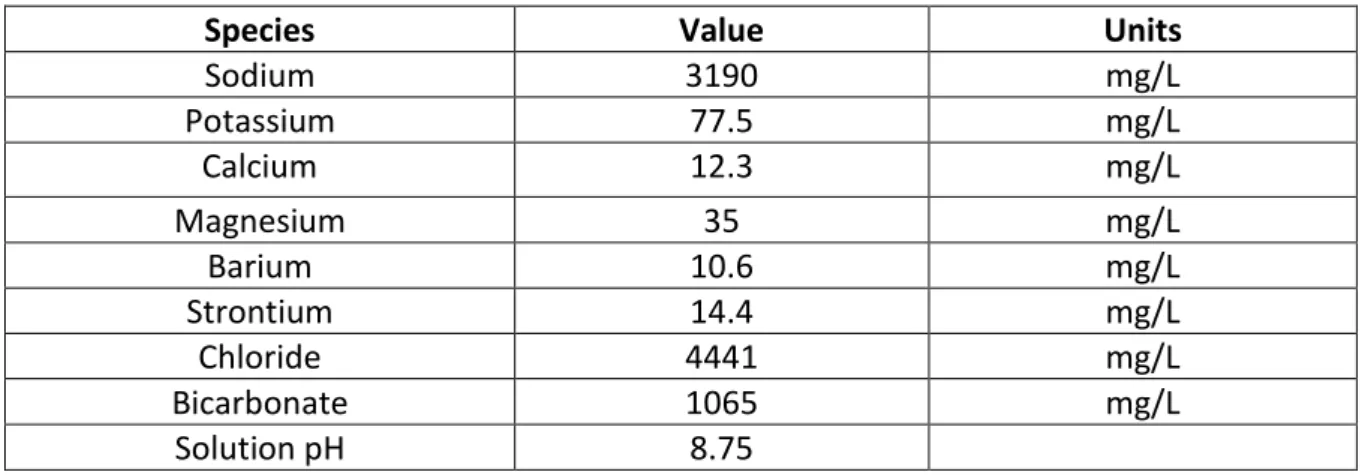
grade standard. All chemicals used were purchased from Chem-Supply. Solutions were prepared by addition of appropriate quantities of salt to purified water. The simulated CSG associated water sample had the approximate composition illustrated in Table 1 and was based upon extensive analysis of typical CSG associated water compositions found in the Surat Basin in Queensland [28]. At a pH of 8.75 it would be expected that some carbonate species were present in addition to bicarbonate ions, however tabulated is only the amount of bicarbonate as inferred from mass of sodium bicarbonate added to the solution. We note that simulated solutions were used in this study for several pertinent reasons. Firstly, as indicated in Section 1 a key research objective was to understand the impact of changing concentrations of bicarbonate ions in the saline solutions upon resin softening performance. Hence, it was necessary to prepare samples wherein precise ratios of alkaline earth ions and bicarbonate species were present. In terms of the CSG associated water sample, due to the remoteness and cost of sampling, it is challenging to obtain actual CSG associated water from an operating well. However, as shown in previous published investigations the difference in
water quality between real and simulated CSG associated water is not substantial with the main parameter not addressed in simulated water being no boron (usually < 5 mg/L) [29].
2.3 Equilibrium Isotherms
Equilibrium isotherms were conducted in 250 ml Nalgene containers, filled with approximately 100 ml of solution and a range of resin masses. The constant concentration bottle point method was used in accord with previous literature for providing meaningful isotherm data [30, 31]. The samples were placed in a shaking incubator system (New Brunswick Innova 42R) for 24 hours at 30oC at a rotational speed of 200 rpm to ensure
equilibrium occurred (verified by kinetic tests in the same apparatus which suggested that equilibrium was achieved once > 6 hours of agitation was completed). Subsequently, the supernatant solution was collected and prepared for analysis. The loading of the ions on the resin was calculated by means of Equation 7:
Equation 7: 𝒒𝒆 = 𝒎𝑽(𝑪𝒐− 𝑪𝒆)
Where, qe = equilibrium concentration of ion on resin (mg/g); V = solution volume (L); m =
mass of resin (g); Co = initial concentration of ion in solution (mg/L); Ce = equilibrium
concentration of ion (mg/L). It is noted that each test was conducted in duplicate to ensure veracity of the equilibrium data.
Table 1: Composition of simulated CSG water used in equilibrium and column studies
Species Value Units
Sodium 3190 mg/L Potassium 77.5 mg/L Calcium 12.3 mg/L Magnesium 35 mg/L Barium 10.6 mg/L Strontium 14.4 mg/L Chloride 4441 mg/L Bicarbonate 1065 mg/L Solution pH 8.75
To analyse the equilibrium isotherms several isotherm models were required. Molar concentrations were considered and not solution activities due to the low concentrations utilized and the fact that demonstration of the new softening process was the primary intent of this study not detailed mechanistic analysis.
2.3.1 Langmuir Vageler Model
The Langmuir Vageler approach to examining the sorption of species on sorbents has been shown in recent years to be important in relation to determination of whether maximum occupation of surface sites has occurred [21, 31-34] [Equation 8].
Equation 8: 𝑞𝑒 =
(𝑉𝐶𝑜⁄ )𝑞𝑚 𝑚𝑎𝑥
((𝑉𝐶𝑜⁄ )+𝐾𝑚 𝐿𝑉)
Where, qmax = maximum loading of ion on resin at equilibrium (mg/g) and KLV is the “half
value”.
2.3.2 Competitive Langmuir Isotherm Model
The Competitive Langmuir expression was employed to model the equilibrium isotherms as it is more suitable for ion exchange processes than the conventional Langmuir expression [35]. Equation 9 has been written in terms of calcium ions but could be readily used in the same form for the other alkaline earth species.
Equation 9: 𝑞𝑒,𝐶𝑎2+ = 𝑘 𝑞𝑚𝑎𝑥 𝐶𝑒,𝐶𝑎
𝐶𝑜+ (𝑘−1) 𝐶𝑒,𝐶𝑎
Where Ce,Ca = concentration of calcium ions in solution at equilibrium and k = equilibrium
coefficient (L/meq) and Co (meq/L) = Ce,Ca (meq/L) + Ce,Al (meq/L).
2.3.3 Aranovich-Donohue Isotherm Model
The Aranovich-Donohue model is particularly adapted to isotherm profiles where more than one sorption process is occurring, for example stoichiometric exchange with resin sites and multilayer sorption [36]. Equation 10 shows the Aranovich-Donohue model based upon the Langmuir expression.
Equation 10: 𝑞𝑒 = 𝑞𝑚𝑎𝑥𝐾𝐿𝐶𝑒 (1+𝐾𝐿𝐶𝑒) (1−𝐶𝑒𝐶𝑜)
𝑛
2.3.4 Hill Equation
The Hill equation has is useful for interpretation of complex isotherm profiles [37, 38] and can be represented as shown in Equation 11.
Equation 11: 𝑞𝑒 = (𝑞𝑚𝑎𝑥 𝐶𝑒
𝛼)
(𝐾𝛼+ 𝐶 𝑒𝛼) ⁄
Where α = Hill coefficient and K = Hill equilibrium coefficient (mg/L or mmol/L).
To fit the latter isotherm models to the experimental data we employed non-linear least squares (NLLS) fitting procedures as linearized equations were known to introduce errors [39-41]. The approach of Ho et al. [42] was followed wherein five error functions were used: hybrid fractional error function (HYBRID); sum of errors squared (ERRSQ); average relative error (ARE); sum of the absolute errors (EABS) and Marquardt’s percent standard deviation (MPSD). The reader is referred to the cited literature for more details regarding the form of these error functions. The Solver add-on in Microsoft Excel was used to solve the modelling of the isotherm data using the latter methodology.
2.5 Column Studies
Column studies were carried out at room temperature using uPVC columns of 2.54 cm internal diameter and an initial resin height of 91.3 cm. A peristaltic pump (Masterflex II) was used to flow solution through the column at a desired rate (typically 4.5 bed volumes (BV) per hour for the aluminium loading test and 30 BV/h for coal seam gas associated water treatment); whereupon samples were then collected at the column outlet at various times throughout the loading period. The pump was regularly calibrated to ensure accuracy of the measured flow rates. Resins were loaded in the column while wet and were agitated by counter-current flow, then allowed to pack to prevent the formation of preferential flow channels within the column. A ca. 3 % solution of aluminium chloride was used to exchange
the sites on the as supplied resin with aluminium ions. For experiments involving simulated CSG water it was necessary to operate the column under significant back pressure to stop the evolution of CO2 in the column and subsequent formation of void spaces. Regeneration of
the resin column was carried out with a ca. 0.3 % aluminium chloride solution which was passed through the column at ca. 4.5 BV/h. Water samples were again collected at regular intervals to facilitate analysis of the regeneration process.
2.5 Solution Analysis
2.5.1 Inductively Coupled Plasma Optical Emission Spectroscopy (ICP-OES)
Solutions were analysed for elemental composition by inductively coupled plasma optical emission spectrometry (ICP-OES) (PerkinElmer Optima 8300 DV), with samples being filtered using 0.45 µm filters then diluted using a Hamilton Autodiluter and acidified to pH 2 with purified nitric acid (Savillex DST-1000 distillation unit) as appropriate. The instrument was calibrated using suitable multi-element standards prepared by Australian Chemical Reagents.
2.5.2 Solution pH and Conductivity
The pH of the solutions were recorded using a TPH Aqua pH probe with a three point calibration at a pH of 4, 7 and 10; along with electrical conductivity using electrical conductivity probes with K values of 1 and 10, calibrated at 0 and 2760 μs/cm.
2.5.3 Optical Microscopy
As floc generation was inherent to the exchange model which was to be investigated in this study it was pertinent to examine the floc material created. Thus, optical microscopy images were collected of wet flocs in a petri dish using a Leica M125 Zoom Stereo Microscope at 8x and 7x magnification.
3. Results and Discussion
3.1 Aluminium Loading of “As Received” S108 Resin
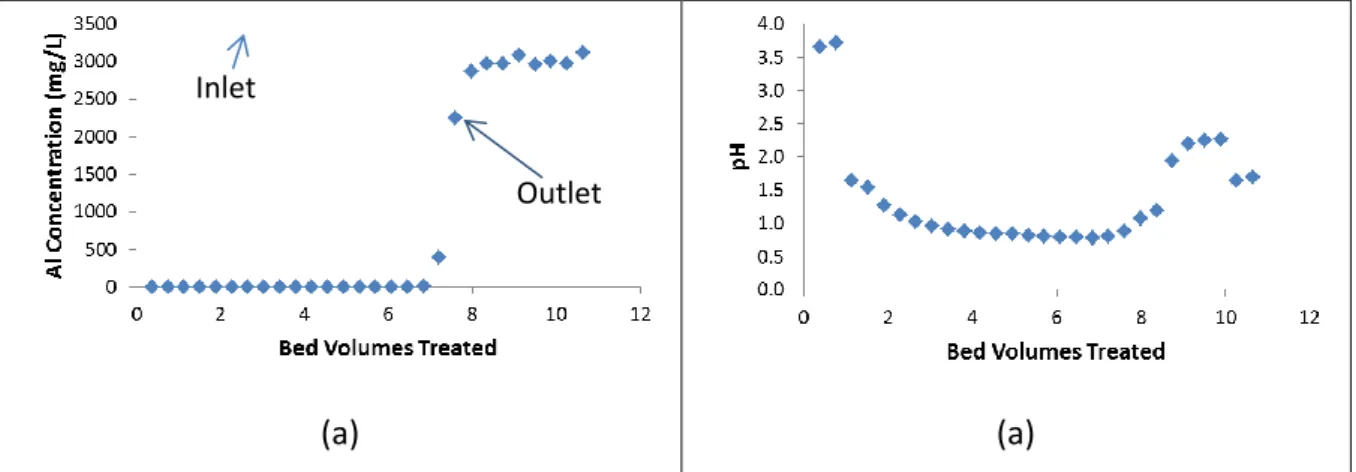
Initially the loading behaviour of aluminium ions on strong acid cation resins was investigated by flowing solutions of ca. 3 % aluminium chloride through a column packed with S108H resin (350.1 g; initial height 92.4 cm) at 4.56 BV/h [Figure 1].
(a) (a)
Figure 1: Aluminium breakthrough curves with Lanxess S108H at 4.56 BV/h and 3347 mg/L Al (from AlCl3 solution)
The resin exhibited the ability to remove essentially all of the aluminium ions in solution for a period up to ca. 6.7 BV, upon which time a relatively steep breakthrough profile was observed. Concomitant to the uptake of aluminium ions the solution pH was noted to decrease from an initial value of 3.66 to 0.78 pH units, for the S108H resin prior to a gain in pH to 2 pH units. This latter behaviour was consistent with the elimination of protons from the resin surface as the aluminium ions exchanged. Integration of the breakthrough curve suggested that the S108H resin removed 12.22 g of aluminium ions which equated to a loading of 34.9 g Al/kg (1.3 mol or 3.9 eq Al/kg) resin. Assuming packing densities of 0.84 kg/L for S108H; the aluminium loading capacity was estimated to be 3.26 eq/L. Notably, the stated exchange capacity of the resin tested was only 1.8 eq/L. The quantity of protons ejected from the S108H resin during the aluminium exchange process was estimated from the pH data as 2.41 eq H+/kg resin.
Inlet
Based upon a simple stoichiometric exchange process Equation 7 would have been expected to explain the loading of aluminium ions on the resin.
Equation 12: 𝐀𝐥𝟑+ + 𝟑 𝐇+𝐑 ↔ 𝐀𝐥𝟑+𝐑𝟑+ 𝟑 𝐇+
However, it was apparent that loading behaviour of aluminium ions on the resin was more complex in character. By comparing the moles of aluminium loaded and the moles of protons removed from the S108 resin, it appeared that for every mole of aluminium loaded 1.85 moles of protons was removed. Based on this latter observation it was inferred that aluminium loaded onto the resin in the form of [Al3+(OH)-]2+ to remove approximately two moles of
hydrogen [Equation 13, where R and R2 represents one and two resin sites].
Equation 13: [𝑨𝒍𝟑+(𝑶𝑯)−]𝟐++ 𝟐 𝐇+𝐑 ↔ [𝑨𝒍𝟑+(𝑶𝑯)−]𝟐+𝐑𝟐+ 𝟐 𝐇+
Praipipat et al. [43] examined the use of aluminium exchanged strong acid cation resin for the removal of fluoride ions from solution. Computational modelling indicated that Al(OH)2+ ions
should be dominant in solution at pH values of less than 3 and this result was in accord with our experimental data. Similar observations of relatively high levels of iron due to the formation of various hydrolyzed iron species with strong acid cation resin have also been published [44]. Hence, it is important to control the solution physical parameters when exchanging multi-valent metal ions with cation resins and the speciation of the exchanged species on the resin considered when discussing ion exchange processes.
3.2 Equilibrium Isotherms of Alkaline Earth Ions with Aluminium Exchanged Resins 3.2.1 Individual Alkaline Earth Ions in the Presence of Various Bicarbonate Concentrations The following set of experiments were performed with varying molar ratios of alkaline earth ions to bicarbonate ions in order to determine not only the influence of bicarbonate concentration relative to the alkaline earth ion but also the impact of different alkaline earth ions upon the exchange process.
Figure 2: Langmuir Vageler and Competitive Langmuir isotherms for aluminium loaded S108 resin with individual alkaline earth ion solutions in the presence of no sodium bicarbonate
(a) Ba (20.92 mg/L), (b) Sr (19.28 mg/L), (c) Ca (15.97 mg/L) and (d) Mg (19.31mg/L)
The first series of experiments involved the equilibration of individual alkaline earth ions (ca. 20 mg/L) in the presence of no bicarbonate ions [Figure 2]. Resin masses were adjusted to
maintain a similar driving force for the exchange process (ca. 5 mmol alkaline earth ion/g of resin). The Langmuir Vageler plots confirmed that the equilibrium test conditions employed were indeed sufficient to achieve maximum uptake of the resin surface with alkaline earth ions as a plateau in alkaline earth loading was apparent in each instance. Application of the Langmuir Vageler model revealed that the maximum loadings of the alkaline earth ions onto the resin were: barium 0.9 mol/kg; strontium: 0.6 mol/kg; calcium: 0.5 mol/kg; and for magnesium 0.4 mol/kg. Based upon the resin supplier specifications the resin should have a capacity of 1.07 mol/kg for “2+” ions. It was thus apparent that the resin at equilibrium with
the alkaline earth solution was not fully exchanged with alkaline earth ions and that instead a fraction of the exchange sites were still occupied by aluminium ions. It is noted that when isotherms are unfavourable in character (see below) the Langmuir Vageler model is required in order to determine the maximum loading of the sorbate [29]. The Competitive Langmuir isotherms for each ion further revealed that the loading of the alkaline earth ions onto the resin was progressively unfavourable when transitioning from Ba (K = 0.769 L/mg) to Sr (K = 0.248 L/mg) to Ca (K = 0.211 L/mg) and then magnesium (K = 0.014 L/mg) [Figure 2]. Moftah [20] indicated that strong acid cation resins exchanged with sodium ions exhibited the following affinity to alkaline earth ions: barium > calcium > magnesium. The same author also noted that aluminium ions were more preferred by Na-SAC resin compared to any of the alkaline earth ions which was in harmony with our observation of unfavourable exchange of these ions with the aluminium exchanged resin. Bonner and Smith [45] found that the selectivity of alkaline earth ions when exchanged with acid form of DOWEX 50 strong acid cation resin was barium > strontium > calcium > magnesium which was consistent with our investigation. In terms of the reason for the outlined selectivity preference by the resin, as indicated by Foster et al. [17] barium ions have the largest ionic radius, followed by strontium and then calcium ions. Moreover, barium has the smallest hydrated radius, whereas strontium is approximately the same size and calcium ions are larger.
In a second set of equilibrium experiments bicarbonate ions were introduced to solutions of the individual alkaline earth ions (ca. 20 mg/L) in a 1:1 molar ratio to establish the effect of adding bicarbonate ion amounts which were in theory 50 % of what was required to convert all the aluminium ions on the resin to aluminium hydroxide (Al(OH)3) according to Equations
14 and 15 (where X is barium, strontium, calcium or magnesium and R2 represents two resin
sites).
Figure 3: Langmuir Vageler and Competitive Langmuir isotherms for aluminium loaded S108 resin with individual alkaline earth ion solutions in the presence of sodium bicarbonate in a 1:1 mole ratio in solutions of (a) Ba (21.04 mg/L), (b) Sr (19.60 mg/L), (c) Ca (16.29 mg/L) and
Equation 14: [𝐀𝐥𝟑+(𝐎𝐇)−]𝟐+𝐑𝟐+ 𝐗𝟐+ → [𝐀𝐥𝟑+(𝐎𝐇)−]𝟐++ 𝐗𝟐+𝐑𝟐 Equation 15: [𝐀𝐥𝟑+(𝐎𝐇)−]𝟐++ 𝟐 𝐇𝐂𝐎𝟑− → 𝐀𝐥(𝐎𝐇)𝟑+ 𝟐 𝐂𝐎𝟐
The Langmuir Vageler model appeared to have limitations in terms of simulating the experimental equilibrium data [Figure 3] as the predicted profiles did not appear to predict where the plateau in the data was. For example, for the magnesium uptake on the aluminium exchanged resin the maximum loading was estimated as 1.06 mol/kg resin which was visually in excess of the approximate value of ca. 0.8 mol/kg observed in Figure 3. Nevertheless, it did appear that the experimental conditions again generated a plateau in alkaline earth ion uptake. The Langmuir and Hill fits of the equilibrium data [Figure 3] showed that in general the maximum loading of the alkaline earth ions onto the resin was enhanced compared to the case with no bicarbonate ions present [Figure 2]: barium qmax = 1.19 mol/kg, K = 1.67;
strontium qmax = 1.10 mol/kg, K = 8.77, α = 6.32; calcium qmax = 1.05 mol/kg, K = 7.45, α = 7.19;
and magnesium qmax = 0.80 mol/kg, K = 8.99, α = 14.77. This data suggested that the
introduction of bicarbonate ions did indeed promote the removal of aluminium ions from the resin as shown in Equations 14 and 15 in agreement with the study of Li et al. [23]. However, it was evident that the isotherm profiles were still complex in character especially for the exchange of strontium, calcium, and magnesium ions with the aluminium species on the resin surface [Figure 3]. At low equilibrium concentration values of these latter alkaline earth ions the exchange with aluminium on the SAC resin was still unfavourable as evidenced by the concave nature of the isotherm profile. However, at higher values of equilibrium concentration the uptake of alkaline earth ions appeared to become favourable. Such inflections in exchange behaviour have been reported by other authors such as Pabalan [46] who studied the exchange of calcium and potassium ions with sodium exchanged zeolites, thus there is a precedent for changes of ion affinity for the sorbent as a function of equilibrium ion concentration in solution.
Finally, equilibrium isotherms were derived for the situation where individual alkaline earth ions (ca. 20 mg/L) were in the presence of an excess of bicarbonate ions (1:10 molar ratio). This latter situation was considered common for CSG associated water samples and hence relevant to field application of this softening technology [9, 47]. Figure 4 shows that clear
plateaus in alkaline earth uptake were observed in all the isotherm plots which suggested that the increasing bicarbonate ions concentration promoted the exchange process with the aluminium on the resin. As a plateau in the alkaline earth uptake was apparent there was no need to display the Langmuir Vageler model fits in this instance.
Figure 4: Competitive Langmuir isotherms for aluminium loaded S108 resin with individual alkaline earth ion solutions in the presence of sodium bicarbonate in a 1:10 mole ratio in solutions of (a) Ba (20.68 mg/L), (b) Sr (19.31 mg/L), (c) Ca (18.06 mg/L) and (d) Mg (17.96
mg/L)
From the Competitive Langmuir plots the maximum loading of the alkaline earth ions onto the resins were estimated as: barium 1.04 mol/kg, K = 135.1 L/mmol; strontium 0.93 mol/kg, K = 118 L/mmol; calcium 0.99 mol/kg, K = 22.0 L/mmol; and magnesium 0.72 mol/kg, K = 59.9 L/mmol. The maximum loading values for the 1:10 molar ratio were slightly depressed compared to the 1:1 molar ratio of alkaline earth ions to bicarbonate ions. Yet the isotherm profile indicated that the uptake of alkaline earth ions was now strongly preferred (as indicated by the substantially greater equilibrium coefficient for barium ions for the two bicarbonate quantities, for example). It is noted that total solution concentration is important with respect to the shape of the isotherm profile recorded. For instance, Pabalan
demonstrated that increasing dilution of a solution of “2+” & “+” ions resulted in a preference by the zeolite sorbent for the cation with highest charge [46]. However, in this case the total solution concentration increased in Figure 3 compared to Figure 2. Hence, the change in profile shape can be most probably attributed to the presence of bicarbonate ions which promoted processes shown in Equations 14 & 15. The slight reduction in alkaline earth ion may conceivably reflect the blockage of a minor fraction of the pores in the resin by the aluminium hydroxide floc. Praipipat et al. [43] inspected the location of aluminium hydroxide flocs in SAC resin which had been exchanged with alkaline earth ions. They concluded that this hydrated alumina phase was majorly in the gel structure of the resin and did not extensively block the resin pores. This latter deduction was in agreement with this study where only minimal reduction in cation capacity was recorded when increasing the bicarbonate concentration to in excess of stoichiometric values.
3.2.2 Mixtures of Alkaline Earth Ions in the Presence of Bicarbonate Species
The aim of this test was to identify the competitive behaviour between alkaline earth ions in the presence of a fixed amount of bicarbonate species, with the aluminium loaded resin. Figure 5 shows the isotherm model fits for aluminium loaded S108 resin with barium (ca. 20 mg/L) and either magnesium/strontium in a 1:1 mole ratio in the presence of bicarbonate ions (in a 1:10 mole ratio of alkaline earth ions to bicarbonate ions). For the sake of brevity not all ion combinations are shown as the provided examples were sufficient to demonstrate the underlying exchange behaviour. From the isotherm profiles it was evident that barium was the most favoured ion to be loaded onto the aluminium form of the resin. The Competitive Langmuir plots illustrated that at low equilibrium concentrations both ions in each experiment were exchanged onto the resin. However, as the equilibrium concentration was increased competition between barium and the other alkaline earth ion in solution began to take effect. This can be seen where at higher equilibrium concentrations the loading of barium increased gradually whereas for the other alkaline earth ions in each solution the loading decreased. This latter behaviour suggested that when fewer sites were available for the alkaline earth ions to load on the resin, the more favoured barium ions displaced the other less favoured alkaline earth ions from the resin exchange sites. This latter analysis was consistent with the study of Indarawis and Boyer [48] who investigated the interaction of alkaline earth ions with cationic resins in the presence of dissolved organic matter. These
authors discussed that alkaline ions would firstly displace the ion originally on the resin surface and then the various alkaline earth ions would compete for sites on the resin. Examination of the isotherm profiles for the combined loading of “2+” ions on the resin [Figure
5] confirmed that overall a monolayer of alkaline earth ions on the resin surface was obtained with maximum loading values of 0.979 mol/kg for barium/magnesium solutions and 0.870 mol/kg for barium/strontium solutions.
Barium and Magnesium Barium and Strontium
Figure 5: Equilibrium isotherms for aluminium loaded S108 resin with barium and calcium/magnesium/strontium in a 1:1 mole ratio and with bicarbonate ions in a 1:10 mole
3.2.3 Impact of Sodium Ions upon the Uptake of Calcium Ions in the Presence of Bicarbonate Species
CSG associated water samples invariably contain sodium ions as the dominant cation species [9, 49, 50]. Therefore, the influence of sodium ions upon the softening behaviour of aluminium exchanged resin required consideration. Hence, tests were conducted using a solution of calcium ions (ca. 20 mg/L) with bicarbonate ions and sodium chloride ions. Figure 6 shows the Langmuir Vageler and Competitive Langmuir isotherms for aluminium loaded S108 resin with calcium ions, bicarbonate ions and sodium chloride in 1:1:1, and 1:1:20 molar ratios, respectfully. For the lowest amount of sodium ions present the calcium loading on the resin was calculated as 1.00 mol/kg resin with a K value of 9.45 and α equal to 6.64. When the concentration of sodium was substantially increased compared to the quantity of calcium ions, the loading of calcium ions decreased to 0.80 mol/kg resin with a K value of 9.73 and α equal to 11.60. One suggestion for the latter result was that sodium ions were competing with alkaline earth ions to displace [Al3+(OH)-]2+ from the resin [Equation 17].
Equation 16: [𝐀𝐥𝟑+(𝐎𝐇)−]𝟐+𝐑𝟐+ 𝟐𝐍𝐚+ → [𝐀𝐥𝟑+(𝐎𝐇)−]𝟐++ 𝟐𝐍𝐚+𝐑
Sodium ions are known not to be as favoured by resins compared to alkaline earth ions and aluminium, however the abundance of sodium ions would have promoted the exchange of a fraction of this species with the surface sites [51, 52]. The sodium equilibrium isotherm graphs in Figure 6 supported the conclusion that sodium ions are not preferred by the resin exchange sites in the presence of alkaline earth ions as the profile was highly concave. As the sodium ion concentration was elevated the loading of sodium ions measured also increased. The number of moles of sodium loaded was relatively high and was indicative of an uptake mechanism which was not ion exchange in nature. Instead, processes such as salt inclusion may have occurred. Both Kokotov [53] and Christensen and Thomsen [54] discussed how both cation and anion uptake on ion exchange materials was accelerated at high salt concentrations.
(a) 1:1:2 Ca:HCO3:Na
(b) 1:1:21 Ca:HCO3:Na
Figure 6: Langmuir Vageler and Competitive Langmuir isotherms for aluminium loaded S108 resin with calcium ions, bicarbonate ions and sodium chloride in respective molar
3.3 Equilibrium Ion Exchange Behaviour of CSG Associated Water
The aim of this experiment was to determine the effectiveness of alkaline earth ion removal by aluminium exchanged resin when treating a simulated CSG associated water sample [Figure 7].
Figure 7: Langmuir Vageler and Competitive Langmuir isotherms for aluminium loaded S108 resin with simulated CSG water
From the Langmuir Vageler model plots the maximum loadings of the alkaline earth ions onto the resin were: barium 0.15 mol/kg; strontium: 0.12 mol/kg; calcium: 0.15 mol/kg; and for magnesium 0.65 mol/kg. Even considering the relatively higher concentration of magnesium ions to the other alkaline earth ions present the significantly substantial uptake of magnesium ions was surprising based upon the data shown in for example Figure 5. The Competitive Langmuir plots provided some insight as to this latter observation as all four alkaline earth ions were shown to unfavourably exchanged with the resin surface sites due to the concave nature of the isotherms. Nevertheless, barium ions were still the most preferred of the alkaline earth ions and magnesium ions were least favoured. The shape of the magnesium equilibrium exchange profile was similar to that noted in Figure 6 for sodium ion uptake, which suggested that at least a portion of the magnesium ions were removed due to salt inclusion [53, 54]. Interestingly, both sodium and potassium ions were removed from the CSG associated water in substantial amounts [Figure 7]. From the Langmuir Vageler model plot the maximum loading of potassium was 0.55 mol/kg which was significantly higher than either of the alkaline earth ions present. Similarly, the maximum sodium loading on the resin was
75 mol/kg which was evidently not due to ion exchange effects alone as the exchange capacity of the resin was substantially less. It is tentatively proposed that potassium and sodium salts were possibly incorporated into the flocs formed when aluminium was removed from the resin surface [55].
3.4 Column Trials of CSG Water Softening using Aluminium Exchanged Resins
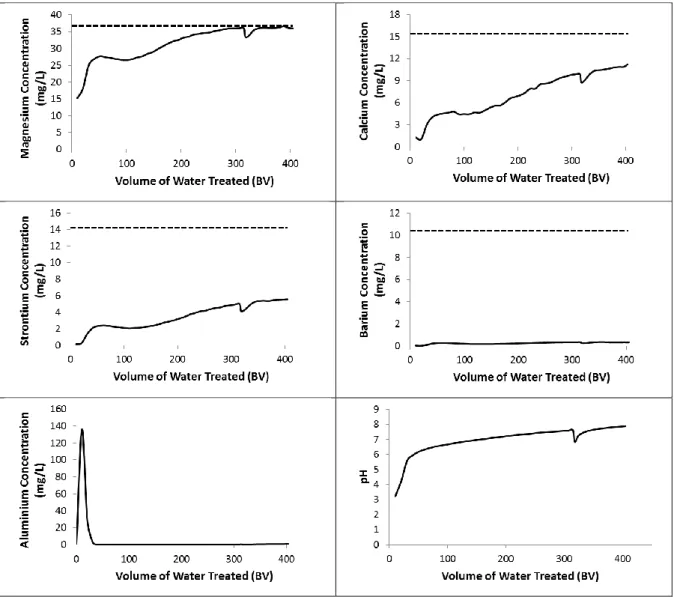
Column trials were employed in order to determine the ability of aluminium exchanged SAC resin to soften simulated CSG associated water under conditions similar to those encountered in industrial operation. The test conditions were a flow rate of 28.35 BV/h with a resin bed initial height of 88.8 cm and resin mass of 351.083 g [Figure 8].
Figure 8: Breakthrough curves with Al-loaded Lanxess S108H at 28.35 BV/h; dashed line = inlet concentration; solid line = effluent concentration
From the column data it was evident that magnesium ions were least preferred by the resin as the outlet concentration rapidly increased (especially during the initial 50 BV of CSG associated water treated). In contrast, barium ions were almost completely removed from solution over the entire 400 BV of simulated CSG water treated. Strontium was the next most favoured ion and finally calcium ions. In harmony with the equilibrium tests the column trial confirmed that the selectivity of the resin for the alkaline earth ions in the simulated CSG water was in the order: barium > strontium > calcium > magnesium.
Integration of the breakthrough curves suggested that the aluminium exchanged S108 resin removed 3.00 g of barium, which equated to a loading of: 8.54 g Ba/kg (0.062 mol or 0.124 eq Ba/kg) resin; 2.13 g of strontium, which equated to a loading of 6.06 g Sr/kg (0.069 mol or 0.138 eq Sr/kg) resin; 1.66 g of calcium, which equated to a loading of 4.73 g Ca/kg (0.118 mol or 0.236 eq Ca/kg) resin; and 1.23 g of magnesium which equated to a loading of 3.51 g Mg/kg (0.144 mol or 0.288 eq Mg/kg) resin. From the estimated loadings of the alkaline earth ions on the resin, it was calculated that the total uptake was 0.787 eq/kg resin. Notably, the resin had not been completely exchanged with alkaline earth ions at the point where the column test was stopped due to magnesium ion concentration in the effluent being equal to the concentration in the inlet; hence not all the exchange sites on the resin may have been loaded with alkaline earth ions. It is noted that specific breakthrough capacities for each alkaline earth ion have not bene provided for the data collected in Figure 8. The CSG industry has not published breakthrough values for alkaline earth ions required to minimise the potential for scaling of downstream equipment and membranes. Indeed, the variable nature of CSG associated water means that a single value for breakthrough concentrations of alkaline earth ions is probably not possible. In practice, a company evaluating the benefit of the resin softening process would have to decide from the breakthrough curves presented the optimal operational parameters to employ for their water treatment unit.
An interruption test was conducted after 315 BV of CSG water was softened in order to determine of the exchange process was internally diffusion controlled [24]. As the effluent concentration of the alkaline earth ions decreased after the interruption event the exchange with the surface species was deduced to be diffusion limited.
In this column run it was observed that there was a relatively rapid increase in the outlet concentration of all alkaline earth ions from 0 to 50 BV [Figure 9]. An explanation of this phenomena can be extracted from consideration of the effluent pH of the treated solution [Figure 9]. In the initial stage of the column test the effluent pH was ca. 3 and subsequently increased to ca. pH 6 after 50 BV of CSG associated water was treated. The question arose as to why the effluent pH was acidic. One possibility was that some aluminium chloride solution remained in the resin bed after the initial aluminium exchange process with the resin. This latter explanation was interesting in that the resin was thoroughly rinsed with pure (DI) water after the aluminium loading procedure for 30 mins during. At a pH of 3 there would not be any bicarbonate ions present in the solution as carbonic acid is favoured at this low pH value. As a consequence, the uptake of alkaline earth ions by the resin according to Equations 14 & 15 would be inhibited. Once the solution pH increased to ca. 6 the quantity of bicarbonate ions present would have substantially increased to approximately a 50:50 mixture of carbonic acid and bicarbonate ions. Therefore, the exchange of alkaline earth ions would be more preferred and thus the breakthrough profile exhibited a decreased breakthrough rate. Integration of the breakthrough curves for sodium and potassium (not shown for sake of brevity) also suggested that the aluminium exchanged S108 resin removed 0.27 g of potassium, which equated to a loading of 0.78 g K/kg (0.02 mol or 0.02 eq K/kg) resin, and 17.48 g of sodium, which equated to a loading of 49.79 g Na/kg (2.17 mol or 2.17 eq Na/kg) resin. This data was again consistent with salt uptake during the water treatment process.
During the column run it was also noticed that the flowrate through the column gradually decreased with time. The logical explanation was that the a fraction of the aluminium hydroxide flocs formed likely resided in the resin column and as a result restricted the flow of the CSG associated water. Li et al. [23] examined the aluminium exchanged beads for the presence of aluminium hydroxide precipitates by means of scanning electron microscopy (SEM)/Energy Dispersive Spectroscopy (EDS). These authors reported that aluminium precipitates were predominantly only found at the periphery of the resin beads. Moreover, they indicated that the flow was not impeded by aluminium precipitates or indeed apparent in the salt solution in the column. In contrast, in our study we observed aluminium hydroxide precipitate in the effluent during the entire column run.
Therefore, a sample of the precipitate was collected and imaged using optical microscopy to determine if any physical features may explain the aforementioned discrepancy between our study and that of Li et al. [23] [Figure 9].
(a) (b)
(c) (d)
(e) (f)
Figure 9: Image of precipitate formed during column run using optical emission spectroscopy at 8x magnification after (a) 20 minutes (b) 40 minutes (c) 80 minutes (d) 140
The aluminium precipitate appeared to form a dendritic structure which varied with time of column operation. In each instance, the floc appeared relatively dense which may have contributed to the issue observed with flow rate decrease due to pressure build up in the column. Li et al. [23] did not show any images of the flocs in their study thus we cannot compare images. However, we note that the experimental conditions employed in the outlined investigations were inherently different and floc structure is known to differ depending upon the water composition treated [56]. It is noted that electron microscopy was not employed in this instance in order to avoid any artefacts induced by the necessary drying of the samples prior to analysis. Infrared spectroscopy was also used to characterise the flocs but the spectra were dominated by vibrations from the resin and thus not particularly informative.
3.5 Regeneration of Aluminium Exchanged Resin Following CSG Water Treatment with AlCl3 Solution
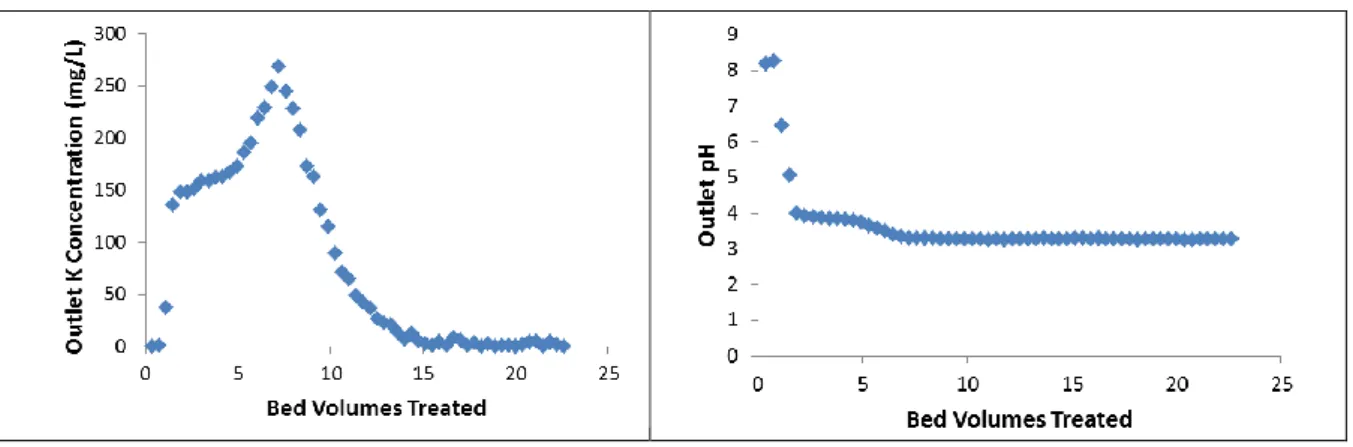
Regeneration of the resin which had treated the CSG associated water was performed by flowing ca. 0.3 % aluminium chloride solution through the column at a flow rate of 4.52 BV/h [Figure 10]. As expected the aluminium ions were majorly consumed and by 10 BV of regenerant solution used, the aluminium concentration approached the value of the inlet aluminium concentration. Notably, magnesium was initially the easiest alkaline earth ion to remove as the effluent concentration increased markedly during the initial BV’s of regenerant employed. In contrast, barium ions did not elute into the regenerant solution until more than 5 BV of regenerant had been used, a result consistent with the selectivity series already deduced in this study (Section 3.2.1).
Integration of regeneration profiles for the individual ions was conducted. 8.84 g of aluminium was loaded onto the resin, which equated to a loading of 25.17 g Al/kg (0.93 mol or 2.79 eq Al/kg) resin. This latter value was considerably lower than the corresponding loading during the formation of the aluminium form of the resin (34.9 g Al/kg; 1.3 mol or 3.9 eq Al/kg resin). Possible explanations included: the fact that none of the alkaline earth outlet ion concentrations had returned to zero which suggested the regeneration strategy employed was not sufficient to regenerate the resin surface sites completely; the observed higher pH values which may have influenced the form of the aluminium species in solution [c.f. Figure 1
and 10]. Integration of the alkaline earth curves suggested that: 0.52 g of barium, which equated to an unloading of 1.48 g Ba/kg (0.01 mol or 0.02 eq Ba/kg) resin; 1.32 g of strontium, which equated to an unloading of 3.76 g Sr/kg (0.043 mol or 0.086 eq Sr/kg) resin; 1.34 g of calcium, which equated to an unloading of 3.82 g Ca/kg (0.10 mol or 0.19 eq Ca/kg) resin; and 1.57 g of magnesium, which equated to an unloading of 4.47 g Mg/kg (0.18 mol or 0.37 eq Mg/kg) resin, was removed from the S108 resin.
Figure 10: Aluminium regeneration curves with alkaline-earth-loaded Lanxess S108H at 4.52 BV/h and 3039 mg/L Al (from AlCl3 solution)
It was calculated that a total of 0.67 eq/kg of alkaline earth ions were desorbed from the resin surface during the regeneration procedure which was slightly less than the value of 0.787 eq/kg resin recorded during the column loading stage. As shown in Figure 10, not all the alkaline earth ions had been removed during regeneration in harmony with the difference in loading/desorption values. Integration of the potassium and the sodium curves suggested that 0.79 g of potassium, which equated to a desorption of 2.26 g K/kg (0.06 mol or 0.06 eq K/kg) resin, and 13.58 g of sodium, which equated to a release of 38.68 g Na/kg (1.68 mol or 1.68 eq Na/kg) resin, was removed from the S108 resin. As noted above it was believed that sodium ions were primarily incorporated into the aluminium flocs rather than being loaded onto the resin. For ease of interpretation of the loading and regeneration data, Table 2 summarises the information.
Table 2: Summary of loading and regeneration data for coal seam gas associated water exchange with aluminium exchanged SAC resin
Element Loading (g/kg resin) Regeneration (g/kg resin) Loading (eq/kg resin) Regeneration (eq/kg resin) Calcium 4.73 3.82 0.236 0.19 Magnesium 3.51 4.47 0.288 0.37 Strontium 6.06 3.76 0.138 0.086 Barium 8.54 1.48 0.124 0.02 Sodium 38.68 1.68 Potassium 2.26 0.06 Aluminium 25.17 2.79
The pH profile at the start of the regeneration process [Figure 10] indicated that the outlet pH was ca. 8 before decreasing sharply to a pH of ca. 4 at 2 BV, followed by a steady decrease to a pH of 3.28. The high pH at the start of the column run was likely caused by displacement of alkaline aluminium hydroxide flocs from the column. In harmony with this observation was evolution of a “spike” in the aluminium released into solution during the initial regeneration process which also correlated with the substantial release of sodium and potassium ions. This information supported the hypothesis that sodium and potassium salts were included in the floc structure. The resultant waste stream in practice would then typically be added to the brine storage pond located on the CSG associated water treatment site [9].
3.6 2nd Column Trial of Water Softening using Aluminium Exchanged Resin
The aim of this experiment was to determine the ability of aluminium exchanged SAC resin to soften a second batch of simulated CSG associated water after the first loading/regeneration cycle [Figure 11].
Figure 11: Breakthrough curves with Al-loaded Lanxess S108H at 27.34 BV/h; dashed line = inlet concentration; solid line = effluent concentration
From the column data it was evident that the exchange process was now significantly inhibited as the removal of the alkaline earth ions was notably less than with a fresh aluminium exchanged resin column. Integration of the breakthrough curves suggested that the S108 resin removed: 1.20 g of barium, which equated to a loading of 3.41 g Ba/kg (0.02 mol or 0.05 eq Ba/kg) resin; 1.09 g of strontium, which equated to a loading of 3.12 g Sr/kg (0.04 mol or 0.07 eq Sr/kg) resin; 1.18 g of calcium, which equated to a loading of 3.36 g Ca/kg (0.08 mol or 0.17 eq Ca/kg) resin; and 1.14 g of magnesium which equated to a loading of 3.26 g Mg/kg (0.13 mol or 0.27 eq Mg/kg) resin. In total, the amount of alkaline earth metal loaded onto the resin was 0.57 eq/kg. This latter value was significantly lower than the uptake of 0.76 eq/L when alkaline earth ions were loaded during the first column treatment of CSG associated water and less than the value of 0.67 eq/kg of alkaline earth ions removed during regeneration. Moreover, the outlet concentrations of the alkaline earth ions were not as low as recorded during the first column run. Such decreases in loading of cations on SAC resins as a function of number of loading cycles has been reported [57].
3.7 2nd Regeneration of Aluminium Exchanged Resin
Regeneration of the resin was again conducted following the second loading stage with CSG associated water using the following conditions: 0.3 % aluminium chloride solution; 351.083 g resin; bed height 85.1 cm; and a flow rate of 4.33 BV/h [Figure 12]. In general, the profiles were similar for each parameter as those shown in Figure 10. However, the magnitude of the alkaline earth ions evolved into the regenerant solution was depressed, particularly for strontium, magnesium, and calcium ions. Integration of the regeneration profiles indicated that 5.73 g of aluminium was loaded back onto the resin, which equated to a loading of 16.32 g Al/kg (0.60 mol or 1.81 eq Al/kg) resin. The aluminium loading was less than that recorded during the first regeneration step (2.79 eq Al/kg). Integration of the alkaline earth and alkali curves is summarized in Table 3 and in total, 0.33 equivalents per kg of the alkaline earth ions was removed from the resin.
Table 3: Summary of loading and regeneration data for coal seam gas associated water exchange with aluminium exchanged SAC resin
Element Loading (g/kg resin) Regeneration (g/kg resin) Loading (eq/kg resin) Regeneration (eq/kg resin) Calcium 3.36 1.62 0.17 0.08 Magnesium 3.26 2.21 0.27 0.18 Strontium 3.12 1.87 0.07 0.04 Barium 3.41 1.58 0.05 0.02 Sodium 24.85 1.08 Potassium 1.78 0.05 Aluminium 16.32 1.81
Overall, the loading and regeneration performance degraded with cycle time. Li et al. [23] found that the loading and regeneration behaviour of water softening using aluminium exchanged resin was more stable compared to what we observed. These authors intimated that the pH of the regenerant solution employed was important in order to dissolve the flocs formed which resided in the column. However, in this investigation we used a similar regeneration solution and the pH profiles during the regeneration process were also comparable between the two studies. Hence, an unequivocal reason for the relative instability in ion exchange performance cannot be provided at this point. Nevertheless, it is worthy of further study as the premise of employing aluminium exchanged resins for softening of high alkalinity water samples is important to several industries.
Figure 12: Aluminium regeneration curves with alkaline-earth-loaded Lanxess S108H at 4.33 BV/h and 3323 mg/L Al (from AlCl3 solution)
4. Conclusions
The softening of water comprising of alkaline earth ions with aluminium exchanged resins has been demonstrated to be dependent upon the concentration of bicarbonate ions in solution (ratios of up to 10 to 1 mole ratio bicarbonate ions:alkaline earth ions explored). The general preference for alkaline earth ions by the resin was barium > strontium > calcium >magnesium regardless of bicarbonate availability. However, the exchange behaviour was promoted by increasing amounts of bicarbonate ions present, which was consistent with the formation of aluminium flocs driving the softening process. In terms of optimal concentration of bicarbonate ions in solution, 1:1 ratio was sufficient to obtain maximum loading of alkaline earth ions on the resin (ca. 0.8 to 1.2 mol/kg), but higher ratios promoted the affinity of the alkaline earth ions for the resin. Competitive equilibrium exchange of alkaline earth ions revealed that the more preferred ions displaced ions of lesser affinity for the resin once exchange sites became saturated. The applicability of the aluminium exchanged resin technology is of particular relevance to industries such as the coal seam gas sector which produces substantial quantities of associated water comprising of high bicarbonate levels. Hence, sodium ion uptake was also investigated and it was found that when this species was in significant excess to the alkaline earth ions in solution, uptake of the alkaline earth was inhibited (0.8 to 1.0 mol/kg). Column studies with CSG associated water samples typical of those found in the Queensland revealed that softening was indeed feasible using the aluminium exchanged resins. However, in contrast to previously published research, the present study identified issues with aluminium floc formation blocking the flow of water through the column. In addition, the regeneration of the resin with aluminium chloride solution was not found to be 100 % effective. Future work is strongly recommended to elucidate how to operate the ion exchange process in a stable manner where the flocs do not impede water flow or impact the regeneration stage. Conducting ion exchange in a fluidized bed or continuous ion exchange process wherein the resin is moved between stages may be worthwhile. Examination of the influence of solution temperature upon resin performance is also recommended as the CSG industry operates in many environments worldwide.
5. Acknowledgements
We acknowledge the Science and Engineering Faculty at Queensland University of Technology for supporting an Occupational Trainee position for Ryan Barker. We thank the Central Analytical Research Facility (CARF) at Queensland University of Technology for access to the analytical equipment used in this study.
6. References
[1] G.J. Millar, S. Papworth, S.J. Couperthwaite, Exploration of the fundamental equilibrium behaviour of calcium exchange with weak acid cation resins, Desalination, 351 (2014) 27-36.
[2] H. Hoffmann, F. Martinola, Selective resins and special processes for softening water and solutions; A review, Reactive Polymers, Ion Exchangers, Sorbents, 7 (1988) 263-272.
[3] E. Costa, A. De Lucas, M.A. Uguina, J.C. Ruíz, Synthesis of 4A zeolite from calcined kaolins for use in detergents, Industrial and Engineering Chemistry Research, 27 (1988) 1291-1296.
[4] P. Čuda, P. Pospíšil, J. Tenglerová, Reverse osmosis in water treatment for boilers, Desalination, 198 (2006) 41-46.
[5] T.A. Moore, Coalbed methane: A review, International Journal of Coal Geology, 101 (2012) 36-81. [6] C.A. Rebello, S.J. Couperthwaite, G.J. Millar, L.A. Dawes, Understanding coal seam gas associated water, regulations and strategies for treatment, Journal of Unconventional Oil and Gas Resources, 13 (2016) 32-43.
[7] B. Towler, M. Firouzi, J. Underschultz, W. Rifkin, A. Garnett, H. Schultz, J. Esterle, S. Tyson, K. Witt, An overview of the coal seam gas developments in Queensland, Journal of Natural Gas Science and Engineering, 31 (2016) 249-271.
[8] L.D. Nghiem, T. Ren, N. Aziz, I. Porter, G. Regmi, Treatment of coal seam gas produced water for beneficial use in australia: A review of best practices, Desalination and Water Treatment, 32 (2011) 316-323.
[9] G.J. Millar, S.J. Couperthwaite, C. Moodliar, Strategies for the management and treatment of coal seam gas associated water, Renewable and Sustainable Energy Reviews, 57 (2016) 669-691.
[10] M.H. Plumlee, J.F. Debroux, D. Taffler, J.W. Graydon, X. Mayer, K.G. Dahm, N.T. Hancock, K.L. Guerra, P. Xu, J.E. Drewes, T.Y. Cath, Coalbed methane produced water screening tool for treatment technology and beneficial use, Journal of Unconventional Oil and Gas Resources, 5 (2014) 22-34. [11] S. Chalmers, A. Kowse, P. Stark, L. Facer, N. Smith, Treatment of coal seam gas water, Water, 37 (2010) 71-76.
[12] A. Averina, M.G. Rasul, S. Begum, Management of coal seam gas (CSG) by-product water: a case study on spring gully mine site in Queensland, Australia, in, WSEAS Press, 2008, pp. 169-174.
[13] A. Altaee, G.J. Millar, G. Zaragoza, A. Sharif, Energy efficiency of RO and FO–RO system for high-salinity seawater treatment, Clean Technologies and Environmental Policy, 19 (2017) 77-91.
[14] A. Antony, J.H. Low, S. Gray, A.E. Childress, P. Le-Clech, G. Leslie, Scale formation and control in high pressure membrane water treatment systems: A review, Journal of Membrane Science, 383 (2011) 1-16.
[15] M.A. Salman, G. Al-Nuwaibit, M. Safar, A. Al-Mesri, Performance of physical treatment method and different commercial antiscalants to control scaling deposition in desalination plant, Desalination, 369 (2015) 18-25.
[16] J. Lipnizki, B. Adams, M. Okazaki, A. Sharpe, Water treatment: Combining reverse osmosis and ion exchange, Filtration and Separation, 49 (2012) 30-33.
[17] J.T.T. Foster, Y. Hu, T.H. Boyer, Affinity of potassium-form cation exchange resin for alkaline earth and transition metals, Separation and Purification Technology, 175 (2017) 229-237.
[18] S. Jiang, B. Gao, B. Dong, Ion exchange behaviors of Ca(II) and Mg(II) on Lewatit MonoPlus TP 207 and TP 208 chelating resins, Advanced Materials Research, 347-353 (2012) 937-951.
[19] V.L. Snoeyink, C. Cairns-Chambers, J.L. Pfeffer, Strong acid ion exchange for removing barium, radium and hardness, Journal / American Water Works Association, 79 (1987) 66-72.
[20] K. Moftah, What makes the weakly acidic cation exchanger strong?, Ultrapure Water, 20 (2003) 26-36.
[21] G.J. Millar, S.J. Couperthwaite, S. Papworth, Ion exchange of sodium chloride and sodium bicarbonate solutions using strong acid cation resins in relation to coal seam water treatment, Journal of Water Process Engineering, 11 (2016) 60-67.
[22] G.J. Millar, J. Lin, A. Arshad, S.J. Couperthwaite, Evaluation of electrocoagulation for the pre-treatment of coal seam water, Journal of Water Process Engineering, 4 (2014) 166-178.
[23] J. Li, S. Koner, M. German, A.K. Sengupta, Aluminum-Cycle Ion Exchange Process for Hardness Removal: A New Approach for Sustainable Softening, Environmental Science and Technology, 50 (2016) 11943-11950.
[24] F.G. Helfferich, Ion Exchange, McGraw-Hill, New York, 1962.
[25] J. Lin, S.J. Couperthwaite, G.J. Millar, Effectiveness of aluminium based coagulants for pre-treatment of coal seam water, Separation and Purification Technology, 177 (2017) 207-222.
[26] M. Kabsch-Korbutowicz, Effect of Al coagulant type on natural organic matter removal efficiency in coagulation/ultrafiltration process, Desalination, 185 (2005) 327-333.
[27] N. Wei, Z. Zhang, D. Liu, Y. Wu, J. Wang, Q. Wang, Coagulation behavior of polyaluminum chloride: Effects of pH and coagulant dosage, Chinese Journal of Chemical Engineering, 23 (2015) 1041-1046. [28] C.A. Rebello, S.J. Couperthwaite, G.J. Millar, L.A. Dawes, Coal seam water quality and the impact upon management strategies, Journal of Petroleum Science and Engineering, 150 (2017) 323-333. [29] G.J. Millar, S.J. Couperthwaite, L.A. Dawes, S. Thompson, J. Spencer, Activated alumina for the removal of fluoride ions from high alkalinity groundwater: New insights from equilibrium and column studies with multicomponent solutions, Separation and Purification Technology, 187 (2017) 14-24. [30] G.J. Millar, S.J. Couperthwaite, C.W. Leung, An examination of isotherm generation: Impact of bottle-point method upon potassium ion exchange with strong acid cation resin, Separation and Purification Technology, 141 (2015) 366-377.
[31] G.J. Millar, G.L. Miller, S.J. Couperthwaite, S. Papworth, Factors influencing kinetic and equilibrium behaviour of sodium ion exchange with strong acid cation resin, Separation and Purification Technology, 163 (2016) 79-91.
[32] G.J. Millar, S.J. Couperthwaite, M. de Bruyn, C.W. Leung, Ion exchange treatment of saline solutions using Lanxess S108H strong acid cation resin, Chemical Engineering Journal, 280 (2015) 525-535.
[33] G.J. Millar, A. Winnett, T. Thompson, S.J. Couperthwaite, Equilibrium studies of ammonium exchange with Australian natural zeolites, Journal of Water Process Engineering, 9 (2016) 47-57. [34] T. Nur, P. Loganathan, J. Kandasamy, S. Vigneswaran, Removal of strontium from aqueous solutions and synthetic seawater using resorcinol formaldehyde polycondensate resin, Desalination, 420 (2017) 283-291.
[35] R. Petrus, J.K. Warchoł, Heavy metal removal by clinoptilolite. An equilibrium study in multi-component systems, Water Research, 39 (2005) 819-830.
[36] X. Liang, W. Hou, J. Xu, Sorption of Pb(II) on Mg-Fe layered double hydroxide, Chinese Journal of Chemistry, 27 (2009) 1981-1988.
[37] S. Goutelle, M. Maurin, F. Rougier, X. Barbaut, L. Bourguignon, M. Ducher, P. Maire, The Hill equation: A review of its capabilities in pharmacological modelling, Fundamental and Clinical Pharmacology, 22 (2008) 633-648.
[38] G.J. Millar, S.J. Couperthwaite, K. Alyuz, Behaviour of natural zeolites used for the treatment of simulated and actual coal seam gas water, Journal of Environmental Chemical Engineering, 4 (2016) 1918-1928.
[39] S.J. Allen, Q. Gan, R. Matthews, P.A. Johnson, Comparison of optimised isotherm models for basic dye adsorption by kudzu, Bioresource Technology, 88 (2003) 143-152.
[40] M.I. El-Khaiary, G.F. Malash, Y.S. Ho, On the use of linearized pseudo-second-order kinetic equations for modeling adsorption systems, Desalination, 257 (2010) 93-101.
[41] M. Naushad, Z.A. Alothman, G. Sharma, Inamuddin, Kinetics, isotherm and thermodynamic investigations for the adsorption of Co(II) ion onto crystal violet modified amberlite IR-120 resin, Ionics, 21 (2015) 1453-1459.
[42] Y.S. Ho, J.F. Porter, G. McKay, Equilibrium isotherm studies for the sorption of divalent metal ions onto peat: Copper, nickel and lead single component systems, Water, Air, and Soil Pollution, 141 (2002) 1-33.
[43] P. Praipipat, M.M. El-Moselhy, K. Khuanmar, P. Weerayutsil, T.T. Nguyen, S. Padungthon, Enhanced defluoridation using reusable strong acid cation exchangers in Al3+ form (SAC-Al) containing hydrated Al(III) oxide nanoparticles, Chemical Engineering Journal, 314 (2017) 192-201.
[44] G.J. Millar, A. Schot, S.J. Couperthwaite, A. Shilling, K. Nuttall, M. De Bruyn, Equilibrium and column studies of iron exchange with strong acid cation resin, Journal of Environmental Chemical Engineering, 3 (2015) 373-385.
[45] O.D. Bonner, L.L. Smith, A selectivity scale for some divalent cations on Dowex 50, Journal of Physical Chemistry, 61 (1957) 326-329.
[46] R.T. Pabalan, Thermodynamics of ion exchange between clinoptilolite and aqueous solutions of na+ k+ and na+ ca2+, Geochimica et Cosmochimica Acta, 58 (1994) 4573-4590.
[47] L.D. Nghiem, C. Elters, A. Simon, T. Tatsuya, W. Price, Coal seam gas produced water treatment by ultrafiltration, reverse osmosis and multi-effect distillation: A pilot study, Separation and Purification Technology, 146 (2015) 94-100.
[48] K. Indarawis, T.H. Boyer, Alkaline earth metal cation exchange: Effect of mobile counterion and dissolved organic matter, Environmental Science and Technology, 46 (2012) 4591-4598.
[49] D. Blair, D.T. Alexander, S.J. Couperthwaite, M. Darestani, G.J. Millar, Enhanced water recovery in the coal seam gas industry using a dual reverse osmosis system, Environmental Science: Water Research and Technology, 3 (2017) 278-292.
[50] I. Hamawand, T. Yusaf, S.G. Hamawand, Coal seam gas and associated water: A review paper, Renewable and Sustainable Energy Reviews, 22 (2013) 550-560.
[51] S. Melis, J. Markos, G. Cao, M. Morbidelli, Multicomponent equilibria on ion-exchange resins, Fluid Phase Equilibria, 117 (1996) 281-288.
[52] J. Horst, W.H. Höll, S.H. Eberle, Application of the surface complex formation model to exchange equilibria on ion exchange resins. Part I. Weak-acid resins, Reactive Polymers, 13 (1990) 209-231. [53] Y.A. Kokotov, Generalized thermodynamic theory of ion-exchange isotherm, Solvent Extraction and Ion Exchange, 17 (1999) 1001-1082.
[54] S.G. Christensen, K. Thomsen, Experimental measurement and modeling of the distribution of solvent and ions between an aqueous phase and an ion exchange resin, Fluid Phase Equilibria, 228– 229 (2005) 247-260.
[55] J. Duan, J. Gregory, Coagulation by hydrolysing metal salts, Advances in Colloid and Interface Science, 100-102 (2003) 475-502.
[56] R. Jiao, H. Xu, W. Xu, X. Yang, D. Wang, Influence of coagulation mechanisms on the residual aluminum - The roles of coagulant species and MW of organic matter, Journal of Hazardous Materials, 290 (2015) 16-25.
[57] M. Naushad, Z.A. Alothman, Separation of toxic Pb2+ metal from aqueous solution using strongly acidic cation-exchange resin: analytical applications for the removal of metal ions from pharmaceutical formulation, Desalination and Water Treatment, 53 (2015) 2158-2166.