Mobile Spam Reporting Technical Specification
Approved Version 1.0 ??? 19 Jun 2012
Open Mobile Alliance
OMA-TS-SpamRep-V1_0-20120619-A
Use of this document is subject to all of the terms and conditions of the Use Agreement located at
http://www.openmobilealliance.org/UseAgreement.html.
Unless this document is clearly designated as an approved specification, this document is a work in process, is not an approved Open Mobile Alliance??? specification, and is subject to revision or removal without notice.
You may use this document or any part of the document for internal or educational purposes only, provided you do not modify, edit or take out of context the information in this document in any manner. Information contained in this document may be used, at your sole risk, for any purposes. You may not use this document in any other manner without the prior written permission of the Open Mobile Alliance. The Open Mobile Alliance authorizes you to copy this document, provided that you retain all copyright and other proprietary notices contained in the original materials on any copies of the materials and that you comply strictly with these terms. This copyright permission does not constitute an endorsement of the products or services. The Open Mobile Alliance assumes no responsibility for errors or omissions in this document.
Each Open Mobile Alliance member has agreed to use reasonable endeavors to inform the Open Mobile Alliance in a timely manner of Essential IPR as it becomes aware that the Essential IPR is related to the prepared or published specification. However, the members do not have an obligation to conduct IPR searches. The declared Essential IPR is publicly available to members and non-members of the Open Mobile Alliance and may be found on the ???OMA IPR Declarations??? list at
http://www.openmobilealliance.org/ipr.html. The Open Mobile Alliance has not conducted an independent IPR review of this document and the information contained herein, and makes no representations or warranties regarding third party IPR, including without limitation patents, copyrights or trade secret rights. This document may contain inventions for which you must obtain licenses from third parties before making, using or selling the inventions. Defined terms above are set forth in the schedule to the Open Mobile Alliance Application Form.
NO REPRESENTATIONS OR WARRANTIES (WHETHER EXPRESS OR IMPLIED) ARE MADE BY THE OPEN MOBILE ALLIANCE OR ANY OPEN MOBILE ALLIANCE MEMBER OR ITS AFFILIATES REGARDING ANY OF THE IPR???S REPRESENTED ON THE ???OMA IPR DECLARATIONS??? LIST, INCLUDING, BUT NOT LIMITED TO THE ACCURACY, COMPLETENESS, VALIDITY OR RELEVANCE OF THE INFORMATION OR WHETHER OR NOT SUCH RIGHTS ARE ESSENTIAL OR NON-ESSENTIAL.
THE OPEN MOBILE ALLIANCE IS NOT LIABLE FOR AND HEREBY DISCLAIMS ANY DIRECT, INDIRECT, PUNITIVE, SPECIAL, INCIDENTAL, CONSEQUENTIAL, OR EXEMPLARY DAMAGES ARISING OUT OF OR IN CONNECTION WITH THE USE OF DOCUMENTS AND THE INFORMATION CONTAINED IN THE DOCUMENTS. ?? 2012 Open Mobile Alliance Ltd. All Rights Reserved.
Contents
1. SCOPE ... 6
2. REFERENCES ... 7
2.1 NORMATIVE REFERENCES ... 7
2.2 INFORMATIVE REFERENCES ... 8
3. TERMINOLOGY AND CONVENTIONS ... 10
3.1 CONVENTIONS ... 10
3.2 DEFINITIONS ... 10
3.3 ABBREVIATIONS ... 10
4. INTRODUCTION ... 11
4.1 VERSION 1.0 ... 11
5. MESSAGES AND MESSAGE FORMATS ... 12
5.1 SPAMREP CLIENT ORIGINATED MESSAGES ... 14
5.1.1 Spam Report Message Element ... 14
5.1.2 Action Request ... 26
5.1.3 Status Query ... 27
5.1.4 Quarantined Messages Query ... 27
5.2 SPAMREP SERVER ORIGINATED MESSAGES ... 27
5.2.1 Report Status ... 27
5.2.2 Action Response ... 28
5.2.3 Quarantined Messages List ... 29
5.2.4 Share Permission List ... 29
5.3 SPAMREP XMLDOCUMENT ... 30
5.3.1 Mime Type ... 30
5.3.2 XML Schema ... 30
5.3.3 Structure ... 30
5.4 DESCRIPTION OF FREQUENTLY USED PARAMETERS ... 30
6. PROCEDURES ... 32
6.1 COMMON PROCEDURES ... 32
6.2 CLIENT PROCEDURES ... 32
6.2.1 Spam Report Submission ... 32
6.2.2 Requesting an Action ... 32
6.2.3 Spam Report Status Query ... 32
6.2.4 Quarantined Messages Query ... 33
6.3 SERVER PROCEDURES ... 33
6.3.1 Receiving a SpamRep Message ... 33
6.3.2 Sending a Response ... 34
7. PROTOCOL ... 35
8. STATUS CODE AND TEXT ... 36
9. SYSTEM CONCEPTS ... 38
9.1 AUTHENTICATION ... 38
9.2 AUTHORIZATION ... 38
9.3 PRIVACY ... 38
9.4 SECURITY CONSIDERATIONS (INFORMATIVE) ... 38
9.4.1 Email Content ... 38
10. MANAGEMENT OBJECT ... 41
10.1 MANAGEMENT OBJECT TREE ... 41
10.2 MANAGEMENT OBJECT PARAMETERS ... 41
10.2.1 Node: /<X> ... 41
10.2.2 Node: /<X>/SpamRepServerAddress ... 41
10.2.4 Node: /<X>/SharePermission/<Y> ... 41
10.2.5 Node: /<X>/SharePermission/<Y>/ThirdPartyID ... 42
10.2.6 Node: /<X>/SharePermission/<Y>/ThirdPartyName ... 42
10.2.7 Node: /<X>/SharePermission/<Y>/CurrentPermission ... 42
10.2.8 Node: /<X>/SharePermission/<Y>/DenyAllowed ... 42
APPENDIX A. CHANGE HISTORY (INFORMATIVE) ... 43
A.1 APPROVED VERSION 1.0HISTORY ... 43
APPENDIX B. STATIC CONFORMANCE REQUIREMENTS (NORMATIVE) ... 44
B.1 SCR FOR SPAMREP CLIENT (PROTOCOL) ... 44
B.2 SCR FOR SPAMREP SERVER (PROTOCOL) ... 44
B.3 SCR FOR SPAMREP CLIENT (MESSAGES) ... 44
B.4 SCR FOR SPAMREP SERVER (MESSAGES) ... 44
B.5 SCR FOR SPAMREP CLIENT (DOCUMENTS) ... 44
B.6 SCR FOR SPAMREP SERVER (DOCUMENTS) ... 45
B.7 SCR FOR SPAMREP CLIENT (PROCEDURES) ... 45
B.8 SCR FOR SPAMREP SERVER (PROCEDURES) ... 45
B.9 SCR FOR SPAMREP CLIENT (AUTHENTICATION) ... 46
B.10 SCR FOR SPAMREP SERVER (AUTHENTICATION) ... 46
APPENDIX C. SPAMREP MANAGEMENT OBJECT (INFORMATIVE)... 47
APPENDIX D. IANA MEDIA TYPE REGISTRATION TEMPLATE (INFORMATIVE) ... 48
APPENDIX E. EXAMPLES (INFORMATIVE)... 49
E.1 EMAIL ... 49
E.1.1 Email spam ... 49
E.1.2 SpamRep Report from Client ... 49
E.1.3 SpamRep Report response from Server ... 50
E.1.4 SpamRep Client re-submission ... 51
E.1.5 SpamRep Report response from Server ... 52
E.1.6 SpamRep Client requests a status report ... 52
E.1.7 SpamRep Server responds with a status report ... 53
E.1.8 SpamRep Server error ... 53
Figures
Figure 1: SpamRep Statement and Simple SpamRep Message Structure ... 12Figure 2: Complex SpamRep Message Structure ... 13
Tables
Table 1: Parameters in a Spam Report Message Element ... 15Table 2: The SharePermission Structure ... 16
Table 3 Parameters in Detection Information Structure ... 17
Table 4: Email message attributes ... 17
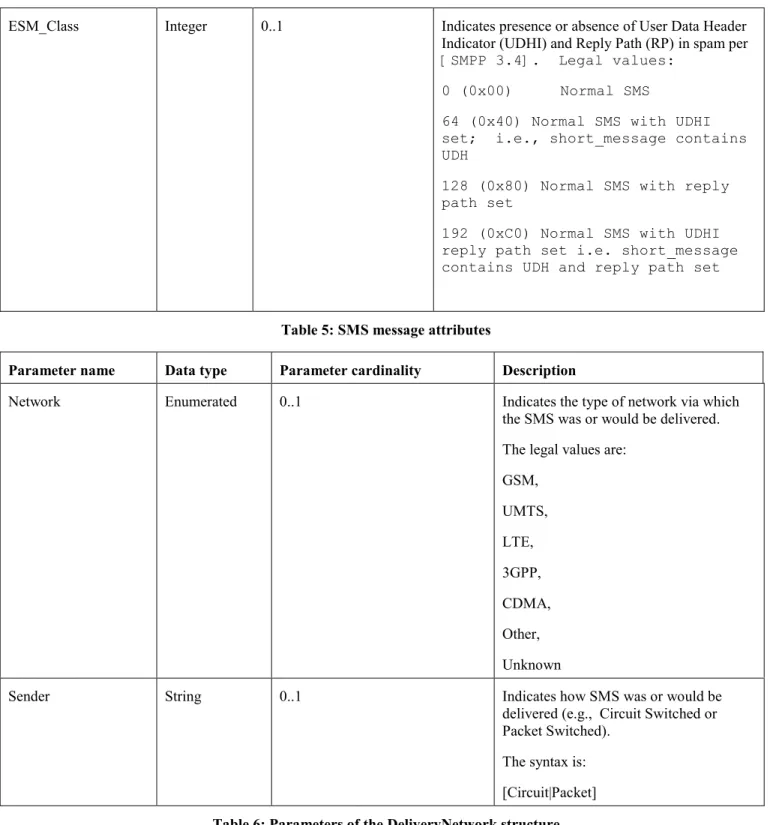
Table 5: SMS message attributes... 23
Table 6: Parameters of the DeliveryNetwork structure ... 23
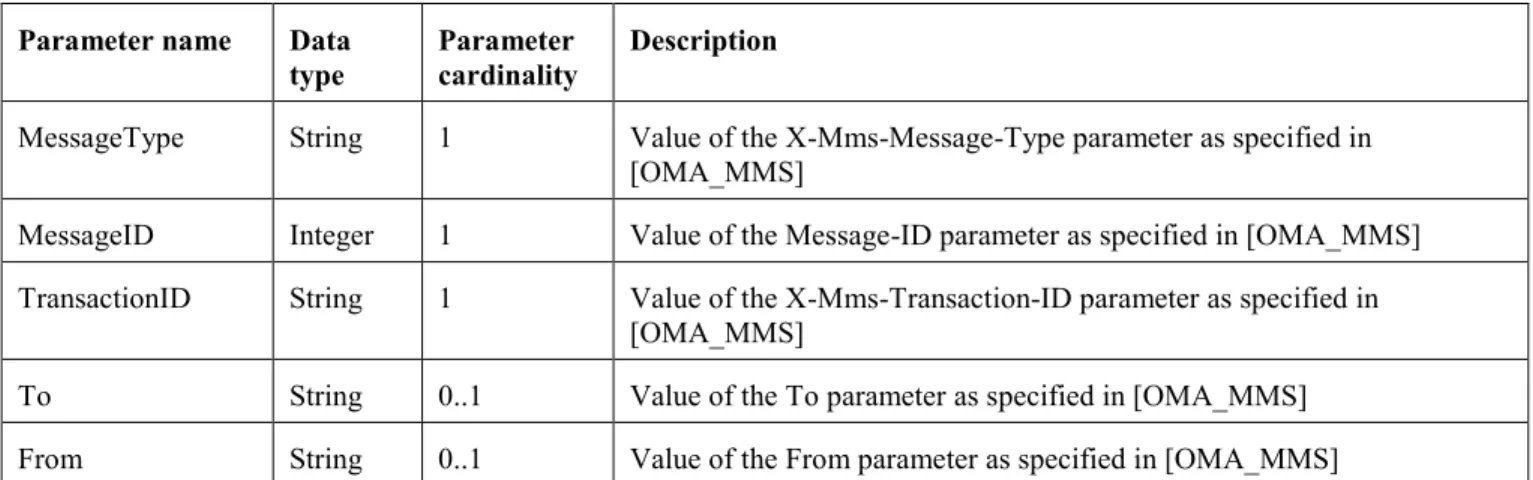
Table 7: MMS message attributes ... 24
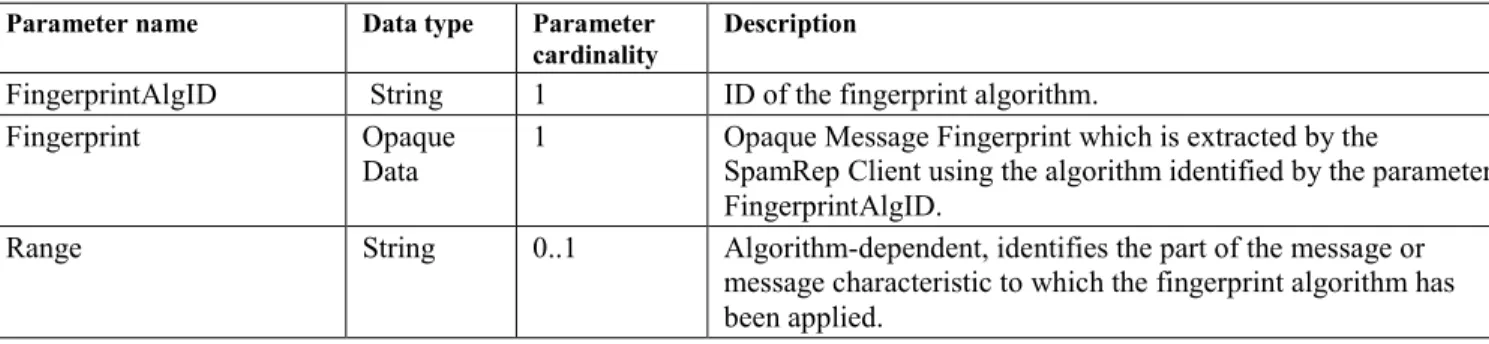
Table 9: Parameters in the MessageFingerprint structure ... 25
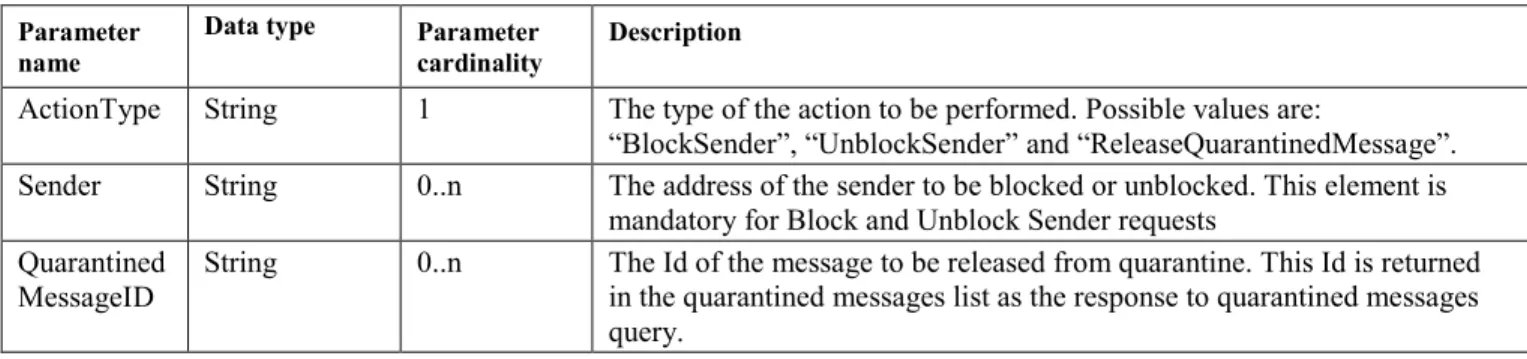
Table 10: Action Request Parameters ... 26
Table 11: Parameters in a Status Query message ... 27
Table 12: Information elements in the Spam_Report_Status Message Element... 28
Table 13: Parameters in an Action Response Message Element ... 28
Table 14: Parameters in a Quarantined Messages List Message Element... 29
Table 15: The QuarantinedMessage Structure ... 29
Table 16: SharePermissionList Elements ... 30
Table 17: Frequently used parameters ... 31
1. Scope
The scope of this document is to define the technical details of the SpamRep Enabler, including:
??? SpamRep message format and characteristics
??? SpamRep Client-Server protocol
??? Client procedures
??? Server procedures relevant to the SpamRep Client-Server interface
This document does not address technical areas that are outside the scope of the SpamRep 1.0 Enabler, such as server-to-server message forwarding, processing the SpamRep message, or server-to-server interaction with any external spam-mitigation infrastructure.
2. References
2.1 Normative References
[3GPP2-X.P0027-002] 3GPP2 X.P0027-002 ???Presence Security???, URL: http://3gpp2.org/Public_html/specs/index.cfm
Note: Work in progress, awaiting IETF drafts
[3GPP-TR_33.978] 3GPP TR 33.978 ???Security aspects of early IP Multimedia Subsystem (Release 6)???, URL: http://www.3gpp.org/ftp/Specs/archive/33_series/33.978/
[3GPP-TS 23.003] 3GPP TS 23.003 V9.2.0 (2010-03), ???Numbering, addressing and identification??? URL: http://www.3gpp.org/ftp/Specs/archive/23_series/23.003/23003-920.zip
[3GPP-TS_23.040] 3GPP TS 123.040 version 9.2.0???Technical Specification Group Core Network and Terminals;Technical realization of the Short Message Service (SMS) (Release 9)???,
URL: http://www.3gpp.org/ftp/Specs/archive/23_series/23.040/
[3GPP-TS_33.141] 3GPP TS 33.141 ???Presence service; Security???,
URL: http://www.3gpp.org/ftp/Specs/archive/33_series/33.141/
[3GPP-TS_33.222] 3GPP TS 33.222 ???Generic Authentication Architecture (GAA); Access to network application functions using Hypertext Transfer Protocol over Transport Layer Security (HTTPS)???,
URL: http://www.3gpp.org/ftp/Specs/archive/33_series/33.222/
[3GPP-TS_33.937] 3GPP TS 33.937, ???Study of mechanisms for Protection against Unsolicited Communication for IMS (PUCI)???, Release 9, June 2010, URL: http://www.3gpp.org/ftp/specs/archive/33_series/33.937/33937-920.zip
[E.164] ITU-T Recommendation E.164 (02/2005), ???The international public telecommunication numbering plan??? URL: http://www.itu.int/rec/dologin_pub.asp?lang=e&id=T-REC-E.164-200502-I!!PDF-E&type=items
[E.212A] ITU; "LIST OF MOBILE COUNTRY OR GEOGRAPHICAL AREA CODES (POSITION ON 1 DECEMBER 2007)??? or later version
URL: http://www.itu.int/dms_pub/itu-t/opb/sp/T-SP-E.212A-2007-PDF-E.pdf
[FIPS.180-2.2002] US Department of Commerce FIPS PUB 180-2, ???Secure Hash Standard???, August 2002.
[IANAADFAM] IANA; "Address Family Numbers,??? February 5, 2010
URL: http://www.iana.org/assignments/address-family-numbers
[OMA_MMS] ???Multimedia Messaging Service Encapsulation Protocol???, Version 1.3, Open Mobile Alliance???, OMA-
TS-MMS-ENC-V1_3-20080128-C, URL: http://www.openmobilealliance.org/
[RFC1320] IETF RFC 1320 ???The MD4 Message-Digest Algorithm???, R. Rivest, April 1992, URL: http://www.ietf.org/rfc/rfc1320.txt
[RFC1321] IETF RFC 1321 ???The MD5 Message-Digest Algorithm???, R. Rivest, April 1992, URL: http://www.ietf.org/rfc/rfc1321.txt
[RFC2045] IETF RFC2045 ???Multipurpose Internet Mail Extensions (MIME) Part One: Format of Internet Message Bodies???; Freed, N., Borenstein, N.; November 1996
URL: http://www.ietf.org/rfc/rfc2045.txt
[RFC2046] IETF RFC 2046 ???Multipurpose Internet Mail Extensions (MIME) Part Two: Media Types,??? N. Freed et. al, November 1996.,
URL: http://www.ietf.org/rfc/rfc2046.txt
[RFC2047] IETF RFC2047 "MIME (Multipurpose Internet Mail Extensions) Part Three: Message Header Extensions For Non-ASCII Text???; Moore, K.; November 1996
URL: http://www.ietf.org/rfc/rfc2047.txt
[RFC2119] IETF RFC2119 ???Key words for use in RFCs to Indicate Requirement Levels???, S. Bradner, March 1997,
[RFC2616] IETF RFC 2616 ???Hypertext Transfer Protocol ??? HTTP/1.1???, R. Fielding, June 1999,
URL: http://www.ietf.org/rfc/rfc2616.txt
[RFC2617] IETF RFC 2617 ???HTTP Authentication: Basic and Digest Access Authentication???, Franks, J., Hallam-Baker, P., Hostetler, J., Lawrence, S., Leach, P., Luotonen, A. and L. Stewart, June 1999, URL:
http://www.ietf.org/rfc/rfc2617.txt
[RFC2818] IETF RFC 2818 ???HTTP Over TLS???, Rescorla, E., May 2000, URL: http://www.ietf.org/rfc/rfc2818.txt
[RFC3339] IETF RFC3339 Date and Time on the Internet: Timestamps, RFC 3339 URL: http://tools.ietf.org/html/rfc3339
[RFC3462] IETF RFC 3462 ???The Multipart/Report Content for the Reporting of Mail System Administrative Messages,??? G. Vaudreuil, January 2003.,
URL: http://www.ietf.org/rfc/rfc3462.txt
[RFC4234] IETF RFC4234 ???Augmented BNF for Syntax Specifications: ABNF???. D. Crocker, Ed., P. Overell. October 2005, URL:http://www.ietf.org/rfc/rfc4234.txt
[RFC4648] IETF RFC4648 ???The Base16, Base32, and Base64 Data Encodings,??? RFC 4648 URL: http://tools.ietf.org/html/rfc4648
[RFC4871] IETF RFC4871 ???DomainKeys Identified Mail (DKIM) Signatures???, E. Allman, J. Callas, M. Delany, M. Libbey, J. Fenton; May 2007
URL http://www.ietf.org/rfc/rfc4871.txt
[RFC4880] IETF RFC4880 ???OpenPGP Message Format???, J. Callas, L. Donnerhacke, H. Finney, D. Shaw, R. Thayer; November 2007
URL http://www.ietf.org/rfc/rfc4880.txt
[RFC5246] IETF RFC 5246 ???The Transport Layer Security (TLS) Protocol???, Dierks, T., Rescorla, E., August 2008, URL: http://www.ietf.org/rfc/rfc5246.txt
[RFC5322] IETF RFC5322 ???Internet Message Format???; Resnick, P. (editor); October, 2008. URL: http://www.ietf.org/rfc/rfc5322.txt
[RFC5598] IETF RFC5598 ???Internet Mail Architecture???, D. Crocker; July 2009 URL http://www.ietf.org/rfc/rfc5598.txt
[RFC5751] IETF RFC5751 ???Secure/Multipurpose Internet Mail Extensions (S/MIME) Version 3.2 Message Specification???, B. Ramsdell, S. Turner; January 2010
URL http://www.ietf.org/rfc/rfc5751.txt
[SCRRULES] ???SCR Rules and Procedures???, Open Mobile Alliance???, OMA-ORG-SCR_Rules_and_Procedures,
URL:http://www.openmobilealliance.org/
[SMPP] The SMPP Forum, ???Short Message Peer to Peer
Protocol Specification v3.4,??? Document Version:- 12-Oct-1999 Issue 1.2
[SpamRep_AD] ???Mobile Spam Reporting Architecture???, Version 1.0, Open Mobile Alliance???, OMA-AD-SpamRep-V1_0, URL: http://www.openmobilealliance.org/
[SpamRep-RD] ???SpamRep Requirements???, Open Mobile Alliance???, OMA-RD-SpamRep-V1_0, URL: http://www.openmobilealliance.org/
[XSD_spam_rep] ???XML Schema Definition: ???SpamRep Document???, Version 1.0, Open Mobile Alliance???, OMA-SUP-XSD_spam_rep-V1_0, URL: http://www.openmobilealliance.org/
2.2 Informative References
[DMBOOT] ???OMA Device Management Bootstrap, Version 1.2???. Open Mobile Alliance???. OMA-TS-DM_Bootstrap-V1_2. URL:http://www.openmobilealliance.org
[DMPRO] "OMA Device Management Protocol, Version 1.2". Open Mobile Alliance??? OMA-TS-DM_Protocol-V1_2. URL: http://www.openmobilealliance.org
[OMADICT] ???Dictionary for OMA Specifications???, Version x.y, Open Mobile Alliance???, OMA-ORG-Dictionary-Vx_y, URL:http://www.openmobilealliance.org/
[RFC3986] IETF RFC3986 ???Uniform Resource Identifier: Generic Syntax???, T. Berners-Lee, R. Fielding, L. Masinter; Januaryu 2005
URL http://www.ietf.org/rfc/rfc3986.txt
[RFC4288] IETF RFC4288 ???Media Type Specifications and Registration Procedures???; Freed, N., Klensin, J.; December 2005
3. Terminology and Conventions
3.1 Conventions
The key words ???MUST???, ???MUST NOT???, ???REQUIRED???, ???SHALL???, ???SHALL NOT???, ???SHOULD???, ???SHOULD NOT???, ???RECOMMENDED???, ???MAY???, and ???OPTIONAL??? in this document are to be interpreted as described in [RFC2119]. All sections and appendixes, except ???Scope??? and ???Introduction???, are normative, unless they are explicitly indicated to be informative.
3.2 Definitions
By-Fingerprint See [SpamRep-RD]
By-Reference See [SpamRep-RD]
By-Value See [SpamRep-RD]
Content See [SpamRep-RD]
IMEI International Mobile Equipment Identityis a globally unique number identifying a mobile device in GSM,
WCDMA, and iDENnetworks
Local Spam Box See [SpamRep-RD]
MEID Mobile Equipment Identifieris a globally unique number identifying a mobile device in CDMA networks
Network Spam Box See [SpamRep-RD]
Reporter See [SpamRep-RD]
Spam See [SpamRep-RD]
Spam Report See [SpamRep-RD]
SpamRep Client See [SpamRep-RD]
SpamRep Document An XML document conforming to the XML schema described in [XSD_spam_rep]. It is used inside SpamRep Statements in messages exchanged between SpamRep Clients and Servers.
SpamRep Statement A multipart/report MIME part representing a Spam Report, Action Request, Status Query, Quarantined Messages Query, Report Status, Action Response, or Quarantined Messages List. SpamRep Statements contain human and machine readable text, and optionally a copy of Spam Content.
SpamRep Message A message exchanged between SpamRep Client and Server. It consists of a SpamRep Document and optionally a message deemed as Spam.
Simple SpamRep
Message The more basic of two SpamRep Message formats containing a single SpamRep Statement Complex SpamRep
Message A SpamRep Message format typically used to package multiple SpamRep Statements into a single message. SpamRep Server
See [SpamRep-RD]
3.3
Abbreviations
4. Introduction
The SpamRep Enabler provides a capability wherein messages or content that is received can be designated, either by the User or autonomously by the SpamRep Client, as Spam and a report containing information about the Spam is sent to a Server for further processing. The report typically contains information about the origin(s) and content of the Spam message, and this information may be used to blacklist the originator or block future transport of the same or similar messages. The SpamRep 1.0 Enabler only specifies the Client-Server interface and message format; any processing of the received Spam Report by the Server is out of scope.
In addition to the basic capability described above, the SpamRep Enabler provides a mechanism for the SpamRep Client (e.g., the device User)to request the blocking or unblocking of specific Spam message originators, as well as an ability to indicate the type of abusive message received (e.g., malware, phishing attack, etc.).
4.1 Version 1.0
The SpamRep 1.0 Technical Specification addresses the requirements targeted for this release. Some features may require updates in later releases, as some requirements have been deferred to a future release.
Please refer to [SpamRep-RD] for those features that are addressed in this release. The architecture, functional components and the high level call flows are described in [SpamRep_AD].
5. Messages and Message Formats
The SpamRep Enabler defines the SpamRep Message format and the request-response protocol used by a SpamRep Client and a SpamRep Server for exchanging messages related to messaging abuse.
Within each SpamRep Message, information is conveyed by one or more SpamRep Statements. A SpamRep Statement may, for example, contain a User???s report of Spam received on a mobile device, action requests, a SpamRep Server???s response, or another type of communication. There are two SpamRep Message formats:
??? Simple SpamRep Message (containing one SpamRep Statement) and
??? Complex SpamRep Message (containing one or more SpamRep Statements).
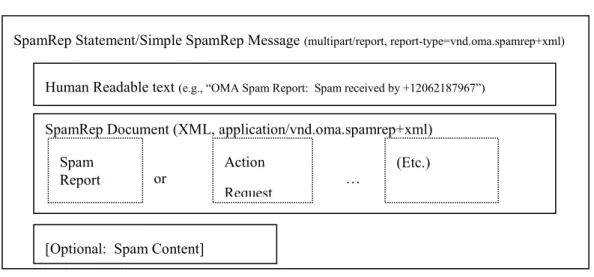
The Simple SpamRep Message format is identical to the SpamRep Statement format; no encapsulation is needed. The Complex SpamRep Message format, discussed later in this section, uses two extra Multipart Internet Mail Extensions (MIME, [RFC2045]) layers of encapsulation.
If it contains only one SpamRep Statement, a SpamRep Message SHOULD be formatted as a Simple SpamRep Message, as illustrated in Figure 1. Otherwise, or if it contains multiple SpamRep Statements, a SpamRep Message MUST be formatted as a Complex SpamRep Message as discussed later in this section and as illustrated in Figure 2 below.
Each SpamRep Statement SHALL be formatted as [RFC3462] multipart/report MIME content of
report-type=vnd.oma.spamrep+xml. A SpamRep Statement SHALL consist of two mandatory and an optional third parts:
??? First part: Human-readable message text providing some information on the conditions that caused the SpamRep Document to be generated per [RFC3462].
??? Second part: A SpamRep Document, which is the machine-readable XML payload information, formatted as ???application/vnd.oma.spamrep+xml??? MIME content.
??? Optional third part: Spam Content, the possibly-abridged and/or anonymized message being reported as Spam, formatted as a MIME object, with the corresponding content type consistent with [RFC2045].
??? Where a third MIME part is included, a Content-ID field MUST be added in accordance with [RFC2045].
Figure 1: SpamRep Statement and Simple SpamRep Message Structure
SpamRep Statement/Simple SpamRep Message (multipart/report, report-type=vnd.oma.spamrep+xml)
SpamRep Document (XML, application/vnd.oma.spamrep+xml) or ???
[Optional: Spam Content]
Human Readable text (e.g., ???OMA Spam Report: Spam received by +12062187967???)
Spam Report
Action Request
A SpamRep Document SHALL be an XML document containing a SpamRep Message Element. There are several types of SpamRep Message Elements; the following types of complex XML elements SHALL be SpamRep Message Elements:
??? Spam Report
??? Action Request
??? Status Query
??? Quarantined Messages Query
??? Report Status
??? Action Response
??? Quarantined Messages List
The XML schema for the SpamRep Document and SpamRep Message Elements is described in section 5.3.
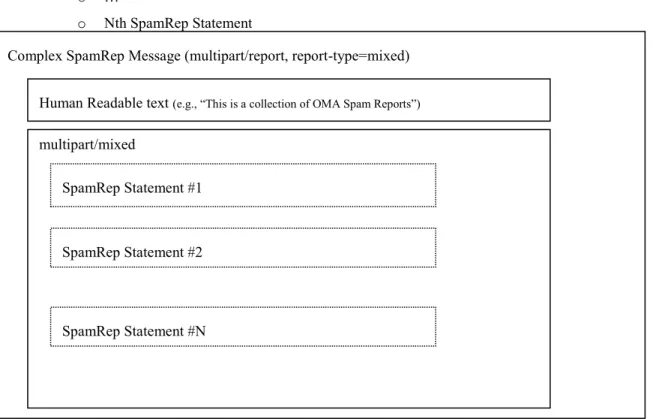
As mentioned above, to optimize communications, the SpamRep Enabler allows SpamRep Messages to contain one or more SpamRep Statements using the Complex SpamRep Message format. Formally, a SpamRep Message SHALL either be a Simple SpamRep Message with MIME parts as in Figure 1 above, or SHALL be a collection of one or more SpamRep Statements contained within an outermost [RFC3462] multipart/report MIME part of report-type=mixed and inner multipart/mixed part as in Figure 2 below.
A Complex SpamRep Message SHALL have the following two parts:
??? First part: Human-readable message text providing some information on the conditions that caused the message to be generated per [RFC3462] (e.g., ???This is a collection of OMA spam reports???)
??? Second part: [RFC2046] message/vnd.oma.spamrep.multipart.mixed MIME part containing one or more SpamRep Statements
o 1st SpamRep Statement o ???
o Nth SpamRep Statement
Figure 2: Complex SpamRep Message Structure
Complex SpamRep Message (multipart/report, report-type=mixed)
multipart/mixed
???
Human Readable text (e.g., ???This is a collection of OMA Spam Reports???)
SpamRep Statement #1
SpamRep Statement #2
5.1 SpamRep Client Originated Messages
The following SpamRep Message Elements are legal in and only in messages sent from SpamRep Client to SpamRep Server: 1. Spam report;
2. Action request; 3. Status query, and
4. Quarantined messages query.
5.1.1
Spam Report Message Element
A Spam Report message containing one or more Spam Report Message Elements is sent by the SpamRep Client, either automatically or manually initiated by the User, to report a message deemed to be Spam. The structure and format of the Spam Report Message Element is defined by the XML schema as described in section 5.3. The Spam Report Message Element is implemented as the <spam-report> element of the <spam-rep-document> root element with the following clarifications:
The following table specifies parameters in a Spam Report Message Element: Parameter name Data type Parameter
cardinality Description SpamRepMessageI
D Integer 1 Contains the unique id for this SpamRep Message Element
SpamRepClientID String 1 Identifies the SpamRep Client, assigned and provisioned by the MNO. ReportType Enumera
ted
1..3 Indicates the type of spam reporting: Value, Reference, By-Fingerprint. Multiple ReportType parameters indicate a report containing a combination of reporting methods.
MessageType String 1 Indicates the message type, e.g.: Email, SMS, MMS, IM, etc
ValueType String 1 When ReportType is set to By-Value, indicate whether the full or partial Content is included in the Spam Report. Possible values for the
???ValueType??? attribute are: ???full??? and ???partial???
MessageReference String 1 When reporting By-Reference, this parameter is a reference to the Spam message.
HashingFunction String 1 Indicate the hashing function applied to the reference when ReportType is set to By-Reference.
MessageFingerprint Data
Structure 0..n When reporting By-Fingerprint, each MessageFingerprint parameter contains a fingerprint of the message. ReportedMessageP
rotocol String 0..1 The protocol used to transport the Spam message to the reporting node. RFC821, SMPP, GSM_MAP, GSM SMS, etc MessageAttributes Data
Structure 0..1 Contains additional information about the reported abuse message, typically included if there is no or inadequate Content, such as when ReportType is By-Reference or By-Fingerprint. Each MessageType has its own set of attributes. The attributes are generally transmitted in, and extracted from message headers.
SubmissionTime String 0..1 Contains the date and time of a Spam Report???s original submission, formatted as per [RFC3339] Section 5.6, ???Internet Date/Time Format???. OriginatingAddress String 0..1 See Table 16 (Description of Frequently Used Parameters)
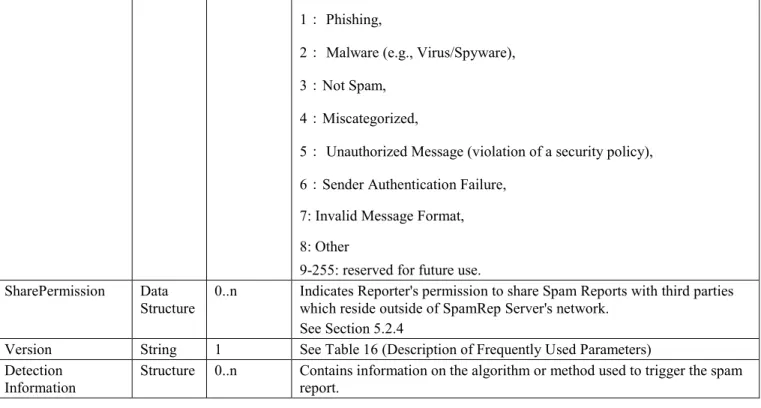
ForwardStatus Boolean 0..1 See Table 16 (Description of Frequently Used Parameters) AbuseType Integer 0..1 Indicates the type of abuse:
1??? Phishing,
2??? Malware (e.g., Virus/Spyware), 3???Not Spam,
4???Miscategorized,
5??? Unauthorized Message (violation of a security policy), 6???Sender Authentication Failure,
7: Invalid Message Format, 8: Other
9-255: reserved for future use. SharePermission Data
Structure
0..n Indicates Reporter's permission to share Spam Reports with third parties which reside outside of SpamRep Server's network.
See Section 5.2.4
Version String 1 See Table 16 (Description of Frequently Used Parameters) Detection
Information Structure 0..n Contains information on the algorithm or method used to trigger the spam report.
Table 1: Parameters in a Spam Report Message Element
The SpamRep Client SHALL generate the SpamRepMessageID parameter and SHALL ensure its uniqueness locally. This parameter SHALL be used to correlate this Message Element with a Message Element contained in the subsequent SpamRep Server response.
SpamRepClientID parameter SHALL contain the IMEI of the reporting device when the SpamRep Client is deployed on a mobile device in a GSM network, or the MEID of the reporting device when the SpamRep Client is deployed on a mobile device in a CDMA network, or the value of a provisioned identifier otherwise.
The value of the ReportType parameter SHALL be determined by Mobile Network Operator???s policies. For example, based on MessageType, SMS messages are reported By-Value, MMS messages are reported By-Fingerprint and Email messages are reported By-Reference, or based on the message size, messages smaller then certain size are reported By-Value and all others are reported By-Reference.
When ReportType is set to By-Value, attribute ???ValueType??? SHALL be provided to indicate whether the full or partial Content is included in the Spam Report. Possible values for the ???ValueType??? attribute are ???full??? and ???partial???.
When ReportType is set to By-Reference, attribute ???HashingFunction??? SHALL be provided to indicate the hashing function applied to the reference. Possible values for the ???HashingFunction??? attribute are specified in section 5.1.1.2.
When ReportType is set to By-Fingerprint, attribute ???FingerprintAlgID??? of the MessageFingerprint data structure SHALL be provided to indicate the fingerprinting function applied to the Content. Possible values for the ???FingerprintAlgID??? attribute are specified in section 5.1.1.3.
The value of MessageType parameter SHALL indicate the type of the messaging system which delivered the message being reported as Spam. The Message Type parameter SHALL have one of the following values: EMAIL, SMS, MMS, IM or OTHER.
When the Spam Report is By-Reference, MessageReference SHALL be included, and SHOULD contain a message reference in a format which can be processed by the SpamRep Server (e.g., a mutually-agreed format per service provider policy). When Spam Report is By-Fingerprint, one or more MessageFingerprint attributes SHALL be included. At least one MessageFingerprint attribute SHOULD be in a format and based on an algorithm which can be processed by the SpamRep Server (e.g., a mutually-agreed format per service provider policy).
Note that it is permissible for a single Spam Report to report both By-Reference and By-Fingerprint.
MessageAttributes SHALL contain the additional information about the message being reported as Spam as specified in section 5.1.1.1.
The SpamRep Client SHOULD report the date and time of a Spam Report???s original submission.
The SpamRep Client SHALL set the ForwardStatus parameter to ???1??? if it is forwarding a Spam Report. By default, if the parameter is not present, this is not a forwarded report.
The SpamRep Client SHOULD set the AbuseType parameter if available.
The value of AbuseType parameter SHALL indicate the type of abuse or lack of abuse in the case when the value is set to ???Not Spam???. The AbuseType parameter SHALL have one of the following values: Spam, Phishing, Malware, Not Spam, Miscategorized, Unauthorized Message, Sender Authentication Failure, Invalid Message Format, Other or Unspecified. Spam indicates an unsolicited, usually commercial, message. Phishing indicates a message trying to fraudulently obtain confidential information. Malware indicates a message containing a virus or adware. Not Spam indicates that a message previously identified as Spam is not Spam and that it should be released from the Network or Local Spam Box. Miscategorized indicates that an incorrect message content classification has been applied. Unauthorized indicates that the message was sent without permission. Sender Authentication Failure indicates that the identity of the sender failed authentication including signalling discrepancies such as seen in SMS spoofing or faking. Invalid Message Format ??? indicates a message that is encoded incorrectly. Other indicates other types of abuse not covered by predefined types. Unspecified indicates that no specific type of abuse is specified.
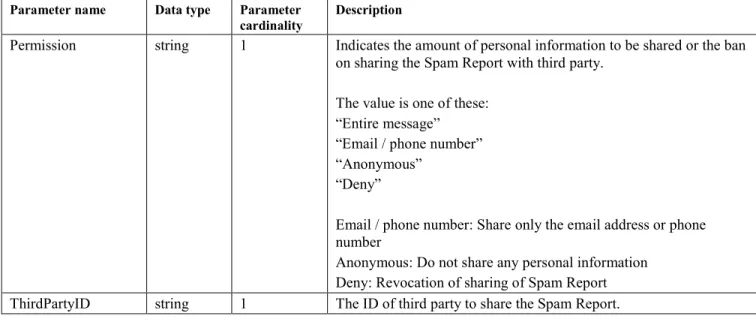
SharePermissionList is provisioned initially by the Mobile Network Operator (see section 5.2.4). The SharePermission parameter SHALL be included in a Spam Report, when the CurrentPermission element of the SharePermissionList is changed in the SpamRep Client (.e.g. by external entity such as Reporter or any other system). If there is no change, the SharePermission parameter SHOULD be empty, indicating to the SpamRep Server to use previously stored version of SharePermission. The following table defines the SharePermission structure.
Parameter name Data type Parameter cardinality
Description
Permission string 1 Indicates the amount of personal information to be shared or the ban on sharing the Spam Report with third party.
The value is one of these: ???Entire message??? ???Email / phone number??? ???Anonymous???
???Deny???
Email / phone number: Share only the email address or phone number
Anonymous: Do not share any personal information Deny: Revocation of sharing of Spam Report ThirdPartyID string 1 The ID of third party to share the Spam Report.
Table 2: The SharePermission Structure
The Version parameter SHALL indicate the version of specification that the SpamRep Client is using to generate the report. The version number in this specification is set to "1.0".
The following table defines the parameters in the DetectionInformation structure: Parameter name Data type Parameter
cardinality Description
DetectionMethod String 1 Detection method that caused this message to be classified as spam (flooding, faking, content etc.)
PolicyName String 0..1 If this message was classified as spam due to operator or subscriber setting, the name of the individual filter involved
AbuseScore String 0..1 As per [3GPP-TS_33.937] (Prevention of Unsolicited Communications for IMS) recommendations
Table 3 Parameters in Detection Information Structure
5.1.1.1
Message Attributes
When preparing a Spam Report and the MessageType Parameter is set to ???Email???, the SpamRep Client SHALL include the following data in the MessageAttributes parameter:
Parameter name Data type
Parameter cardinality
Description
MessageHeaderField String 0..n The contents of a header field as defined in [RFC5322]. These MUST be included in the order in which they appeared in the message about which a SpamRep report is being generated and with no changes such as space compression or comment removal. If the header field is wrapped (i.e. contains newlines), it MUST be encoded using one of the
mechanisms defined in [RFC2047]. All header fields on the message SHOULD be included; the From, To, Cc, Subject and Date fields MUST be included if present except if specifically disallowed by privacy or anonymization policies.
HeaderFrom String 0..1 Value of the From party (subscriber identifier) referenced in upper HTTP layer
Table 4: Email message attributes
When preparing an SMS Spam Report the SpamRep Client may include SMS parameters from the following table with the indicated cardinality in the MessageAttributes parameter. All parameter values SHALL be represented as printable character strings.
In many client implementations, it is expected that only a small subset of these parameters will be utilized. For subscriber-generated abuse reports from device-based clients of mobile-terminated spam, there is a recommended subset of parameters which should be included in Spam Reports if available and consistent with policy. These parameters are designated ???(R)???; they in the common case of subscriber-generated abuse reports representing SMS messages received by a mobile device. It is also recommended that the entire User Data (TP-UD) field be included as Content in SpamRep Messages.
Parameter Name Data Type Parameter cardinality (R) = Recommended for mobile reportin
Description
DCS Integer 0..1 (R) Data Coding Scheme (TP-DCS) per [3GPP-TS 23.040]
OriginationAddress String 0..1 (R) Spammer???s purported address. [3GPP-TS23.040] ???International number??? and ???ISDN/telephone numbering plan??? formats shall be preferred, and assumed if the TON and NPI are omitted. Syntax is:
<TP-Origination-Address per [3GPP-TS23.040] in decimal string
format> [???,??? <TON in integer
format {0-7} per [3GPP-TS 23.040]>
???,??? <NPI in integer format per
[3GPP-TS23.040> ]
Destination Address String 0..1 (R) Address that the abusive message was addressed to. [3GPP-TS23.040] ???International number??? and ???ISDN/telephone numbering plan??? formats shall be preferred and assumed if the TON and NPI are omitted. Syntax is:
<TP-Destination-Address per [3GPP-TS23.040] in decimal string
format> [???,??? <TON in integer
format {0-7} per [3GPP-TS 23.040]>
???,??? <NPI in integer format per
[3GPP-TS23.040> ]
SCA String 0..1 (R) Address of SMS Service Centre in delivery path. Contained in SMS but not necessarily stored in device.
Syntax is:
Up to 15 characters as defined in [E.164]
ServiceCenterTimesta
mp String 0..1 (R) In 3GPP services this is the timestamp added by SMSC. Syntax is:
[3GPP-TS 23.040] Service Center Timestamp in [RFC 3339] ???Internet Date/Time Format??? In 3GPP services this is the timestamp added by SMSC
DeviceTimestamp String 0..1 (R) ???Received at device??? timestamp in [RFC 3339]
???Internet Date/Time Format.???
PID Integer 0..1 (R) [3GPP-TS 23.040] TP-PID (Protocol ID) in decimal string format
UDL Integer 0..1 (R) User data length per [3GPP-TS 23.040] UDL. Note that this may represent a number of octets or septets, depending on the DCS value.
UDIndicator String 0..1 Indication as to whether the Content of the SpamRep Message (the UD) is a verbatim copy of the spam, or a decoded (e.g., rendered into a different character set) version, or is removed entirely.
Legal values are:
RAW, DECODED, REMOVED
UDHI String 0..1 Indication that UDH is present in body of an SMS message.
Legal values are(if possible) the [3GPP-TS 23.040] TP-UDHI:
Present, Absent, Unknown
If this attribute is not specified, the assumed value is Unknown.
UDHAttached Enumerated 0..1 Indicates whether the Content of the SpamRep Message (the UD) includes UDH, or only the body of the UD. [Note: It is desirable to include UDH in the Content; however this is not always possible.] Legal values are:
True, False, Unknown
If this attribute is not specified, the assumed value is True.
UDH String 0..1 Attribute may be used only if a Universal Data Header (UDH) is present in the spam message???s body and the UDL attribute is present. This attribute includes the [3GPP-TS 23.040] UDH, beginning with UDHL and excluding any trailing Fill bits, in [RFC 4648] Base64 format.
Note: This information should also be incorporated in any raw UD Content included in the SpamRep Message.
MTI String 0..1 SMS Message Type Indicator (MTI) field. Value should be [3GPP-TS 23.040] TP-MTI if possible, otherwise ???UNKNOWN??? or ???OTHER'
Legal values are:
SMS-DELIVER, SMS-DELIVER-REPORT, SMS-SUBMIT, SMS-SUBMIT-REPORT, SMS-STATUS-REPORT, SMS-COMMAND, UNKNOWN, OTHER
If this attribute is not specified, the assumed value is SMS-DELIVER, by the SpamRep server. DeliveryNetwork Data
Structure
0..1 Indicates how SMS was or would be delivered (e.g., Circuit Switched or Packet Switched)
InterfaceType Enumerated 0..1 Used to convey information about type of interface / nature of the transaction in the messaging node for which the spam event occurs
The legal values are:
0 - Mobile Originated/Mobile Terminated 1 ??? Mobile Originated/Application
Terminated
2 ??? Application Originated/Mobile Terminated
3 ??? Mobile Originated/Destination Unknown 4 ??? Origination Unknown/Mobile Terminated 5 ??? Application Originated/Application Terminated 6 ??? Inter-carrier Application Originated/Mobile Terminated 7 ??? Mobile Originated/Inter-carrier Application Terminated 8 ??? Mobile Originated/Inter-carrier Application Terminated
OriginationIMSI String 0..1 Origination IMSI or MT-Correlation-ID. There are security risks in disclosing IMSI, and given MSISDN, IMSI can be retrieved by an authorized party. The syntax follows the definition of IMSI as per [3GPP-TS 23.040].
DestinationIMSI String 0..1 Destination IMSI or MT-Correlation-ID. There are security risks in disclosing IMSI, and given MSISDN, IMSI can be retrieved by an authorized party. The syntax follows the definition of IMSI as per [3GPP-TS 23.040].
IMEI String 0..1 ReceivingReceiving device IMEI per [3GPP-TS 23.003]. Effectively a serial # of the associated device.
CellID String 0..1 Cell ID associated with the Spam Report. A mobile device likely will report the current rather than the spam???s forward path Cell ID. SC Timestamp vs. Report Timestamp may provide confidence. LAC String 0..1 Cellular ???Location Area Code??? associated with the
Spam Report. This may be the current rather than the forward path LAC.
MCC String 0..1 Mobile Country Code per ITU-T [E.212A] associated with the report.
MNC String 0..1 Mobile Network Code per ITU-T [E.212A] associated with the report.
MessageFlood String 0..1 Used to collectively describe a flood of messages. Format is: <Count of messages> [???,??? <receipt time period in seconds>]]
VPF Integer 0..1 TP-Validity-Period-Format ??? a single-digit integer per [3GPP-TS 23.040]. Legal values are: {0-3}.
VP String 0..1 Must not be present if VPF = ???0???.
Presence and legal values depend on VPF per [3GPP-TS 23.040]. Legal values:
Integer (if VPF =1) , SpamRep Time Format (if VPF =2),
Enhanced VP in [RFC 4648] Base64 format (if VPF = 3)
MR Integer 0..1 TP-Message-Reference per [3GPP-TS 23.040]. Legal values are: {0-255}.
SR Integer 0..1 1 if status report indicated by TP-SRI or requested by TP-SRR per [3GPP-TS 23.040]. Legal values are: {0,1}.
ConcatenatedMessage
Segments String 0..1 Indicates that the SpamRep represents a concatenation of two or more SMS segments per [3GPP-TS 23.040].
Legal values are:
<integer - # of segments>, CONCATENATED, UNKNOWN
Note that unless this parameter is set to ???1??? indicating a single segment, other parameters (e.g., delivery times) may represent the values from any one or more message segments. Default (if attribute absent) is ???UNKNOWN.???
MMS Boolean 0..1 Indicates more messages to send per [3GPP-TS 23.040] TP-MMS.
RD Boolean 0..1 Reject duplicate per [3GPP-TS 23.040] TP-RD. SRQ Integer 0..1 For Status messages only. Status report qualifier
per [3GPP-TS 23.040] SRQ. Legal values are:
{0,1}.
DT String 0..1 For Status messages only. Discharge time per [3GPP-TS 23.040] DT in [RFC 3339] ???Internet Date/Time Format???
ST (status) Integer 0..1 For Status messages only. Status per [3GPP-TS 23.040] ST
MSC_E164 String 0..1 [E.164] format addressa of associated MSC. ReportingNode String 0..1 If populated, indicates the type of element that
reported the spam. If not present, ???Mobile_Device??? assumed. Legal values: SMS_Router, IP-SM-GW, SMS-SC, Mobile_Device, Subscriber, Email_Gateway, Unknown, Other ReportingNodeAddres s
String 0..1 SCCP or IP address of node which reported the SMS. Address type indicated as per [IANAADFAM]
OriginationNodeAddre ss
String 0..1 SCCP or IP address of node which was the originator of the SMS. Address type indicated as per [IANAADFAM]
DestinationNodeAddre
ss String 0..1 SCCP or IP address of node which was the recipient of the SMS.. Address type indicated as per [IANAADFAM]
ESM_Class Integer 0..1 Indicates presence or absence of User Data Header Indicator (UDHI) and Reply Path (RP) in spam per
[SMPP 3.4]. Legal values: 0 (0x00) Normal SMS
64 (0x40) Normal SMS with UDHI set; i.e., short_message contains UDH
128 (0x80) Normal SMS with reply path set
192 (0xC0) Normal SMS with UDHI reply path set i.e. short_message contains UDH and reply path set
Table 5: SMS message attributes
Parameter name Data type Parameter cardinality Description
Network Enumerated 0..1 Indicates the type of network via which the SMS was or would be delivered. The legal values are:
GSM, UMTS, LTE, 3GPP, CDMA, Other, Unknown
Sender String 0..1 Indicates how SMS was or would be delivered (e.g., Circuit Switched or Packet Switched).
The syntax is: [Circuit|Packet]
Table 6: Parameters of the DeliveryNetwork structure
When preparing a Spam Report and the MessageType Parameter is set to ???MMS???, the SpamRep Client SHALL include the following data in the MessageAttributes parameter:
Parameter name Data type
Parameter cardinality
Description
MessageType String 1 Value of the X-Mms-Message-Type parameter as specified in [OMA_MMS]
MessageID Integer 1 Value of the Message-ID parameter as specified in [OMA_MMS] TransactionID String 1 Value of the X-Mms-Transaction-ID parameter as specified in
[OMA_MMS]
To String 0..1 Value of the To parameter as specified in [OMA_MMS] From String 0..1 Value of the From parameter as specified in [OMA_MMS]
Table 7: MMS message attributes
When preparing a Spam Report and the MessageType Parameter is set to ???IM???, the SpamRep Client SHALL include the following data in the MessageAttributes parameter:
Parameter name Data type
Parameter cardinality
Description
ServiceType String 1 Identifier of the IM service, e.g. ICQ, MSN, etc
To String 0..1 Address of the recipient of the message (e.g. OMA IM UserID) From String 0..1 Purported address of the sender of the message
Table 8: IM message attributes
5.1.1.2
Message Reference
The SpamRep Enabler supports reporting spam messages By-Reference.
For the purposes of the SpamRep Enabler, the message reference SHALL consist of full or partial message metadata (e.g. message headers), and optionally partial message data, to which a hashing function has been applied.
The applied hashing function SHALL be specified in the ???HashingFunction??? parameter of the Spam Report Message Element. Example values for this attribute are:
1. ???null??? ??? indicates that no hashing function is applied to the message reference
2. ???MD4??? ??? indicates that MD4 hashing function as defined in [RFC1320] is applied to the message reference. 3. ???MD5??? ??? indicates that MD5 hashing function as defined in [RFC1321] is applied to the message reference. 4. ???SHA-1??? ??? indicates that SHA-1 hashing function (Secure Hash Algorithm) [FIPS.180-2.2002] is applied to the
message reference.
5. ???SHA-2??? ??? indicates that SHA-2 hashing function [FIPS.180-2.2002] is applied to the message reference. 6. Other hashing functions can be used depending on the messaging server.
The default value for the ???hashing-function??? attribute is ???MD5???.
The SpamRep Server SHALL support both MD4 and MD5 hashing functions. The SpamRep Client SHOULD support both MD4 and MD5 hashing functions. The preferred hashing function SHALL be determined by operator???s policies.
When preparing a Spam Report and the MessageType Parameter is set to ???Email??? and ReportType is set to ???By-Reference???, the SpamRep Client SHALL include the following data in the message reference:
1. All message headers in the order in which they were received, with no modifications whatsoever to spacing, line wrapping, line termination, removal of duplicates, or any other changes. The structure of the email message is defined in [RFC5322]
When preparing a Spam Report and the MessageType Parameter is set to ???SMS??? and ReportType is set to ???By-Reference???, the SpamRep Client SHALL include the following data in the message reference:
1. The entire SMS-DELIVER PDU as defined in [3GPP-TS_23.040] except for the last field (TP-UD).
When preparing a Spam Report and the MessageType Parameter is set to ???MMS??? and ReportType is set to ???By-Reference???, the SpamRep Client SHALL include the following data in the message reference:
1. The entire M-Notification.ind PDU as defined in [OMA_MMS].
When preparing a Spam Report and the MessageType Parameter is set to ???IM??? and ReportType is set to ???By-Reference???, the SpamRep Client SHALL include the following data in the message reference:
1. Entire message including both Content and metadata.
5.1.1.3
Message Fingerprint
The SpamRep Enabler supports reporting spam messages By-Fingerprint.
Cryptographic hash algorithms such as MD5, SHA-1, SHA-256 and also proprietary algorithms can be applied to part of or the entire spam message to generate a message ???fingerprint???. Some keywords can also be identified and extracted to form a message fingerprint. A recent standardized robust fingerprinting algorithm for image is the MPEG-7 Image Signature Tools [MPEG-7-IMG-SIG], which can be applied to an image in a message.
A given message may have more than one fingerprint. For example, for a URL fingerprinting algorithms, there may be one fingerprint for each URL contained in a Spam message. Therefore, the SpamRep Enabler supports the inclusion of multiple fingerprints. When reporting By-Fingerprint, for each reported fingerprint there SHALL be one ???MessageFingerprint??? structure in the Spam Report Message Element.
Each fingerprint is represented by a MessageFingerprint data structure, as specified in the following table: Parameter name Data type Parameter
cardinality
Description
FingerprintAlgID String 1 ID of the fingerprint algorithm. Fingerprint Opaque
Data 1 Opaque Message Fingerprint which is extracted by the SpamRep Client using the algorithm identified by the parameter FingerprintAlgID.
Range String 0..1 Algorithm-dependent, identifies the part of the message or message characteristic to which the fingerprint algorithm has been applied.
Table 9: Parameters in the MessageFingerprint structure
A fingerprint algorithm identifier, FingerprintAlgID, identifies the particular fingerprint algorithm used to generate the message fingerprint. Within each MessageFingerprint structure, the applied fingerprint algorithm(s) SHALL be specified in the ???FingerprintAlgID??? parameter. Example values for this parameter are:
1. ???MD5??? ??? indicates that MD5 hashing function as defined in [RFC1321] is applied to the message. 2. ???SHA-1??? ??? indicates that SHA-1 hashing function is applied to the message.
3. ???SHA-256??? ??? indicates that SHA-562 hashing function is applied to the message.
4. ???KEYWORD??? - indicates that the fingerprints extracted are keywords from the message body.
Other fingerprint algorithms may be used.
Within each MessageFingerprint structure, the ???Fingerprint??? parameter SHALL be specified, and its value set to the result of the particular fingerprint algorithm specified in the ???FingerprintAlgID???, using the Range parameter value if appropriate. Within each MessageFingerprint structure, the optional ???Range??? parameter MAY be used to identify the part of the message body or transport characteristic the fingerprint algorithm is applied to. The meaning of the range parameter is dependent on the particular fingerprint algorithm. For MD5, SHA-1 and SHA-256 algorithms, the absence of the ???Range??? parameter SHALL indicate that the algorithm has been applied to the entire message body, including headers if any.
5.1.2
Action Request
An Action Request message is initiated by the User and sent by the SpamRep Client, to request an action to be performed by the SpamRep Server. SpamRep Server SHALL and SpamRep Client SHOULD support the following actions:
1. Block Sender; 2. Unblock Sender.
SpamRep Server and SpamRep Client MAY additionaly support the following action: 1. Release Quarantined Message.
The structure and format of the Action Request Message Element is defined by the XML schema as described in section 5.3. The Action Request Message Element is implemented as the <action-request> element of the <spam-rep-document> root element with the following clarifications:
The following table specifies parameters in an Action Request Message Element: Parameter
name
Data type Parameter
cardinality Description
ActionType String 1 The type of the action to be performed. Possible values are:
???BlockSender???, ???UnblockSender??? and ???ReleaseQuarantinedMessage???. Sender String 0..n The address of the sender to be blocked or unblocked. This element is
mandatory for Block and Unblock Sender requests Quarantined
MessageID String 0..n The Id of the message to be released from quarantine. This Id is returned in the quarantined messages list as the response to quarantined messages query.
Table 10: Action Request Parameters
The value of the ActionType parameter SHALL indicate the type of the action being requested. The ActionType parameter SHALL have one of the following values: ???BlockSender???, ???UnblockSender???, or ???ReleaseQuarantinedMessage???.
The Sender parameter SHALL be mandatory when ActionType is either ???BlockSender??? or ???UnblockSender???, otherwise it SHALL be optional. The value of the Sender parameter SHALL contain the address of the sender to be blocked or
unblocked. The sender address MAY be one of the following: MSISDN or SIP URI in case of SMS or MMS, email address in case of email messages, or a specific sender URI applicable to the IM service.
The QuarantinedMessageID parameter SHALL contain the value of the identically named parameter in the Quarantined Messages List returned as the response to the Qurarntined Messages Query corresponding to the message which is requested to be released from quarantine.
5.1.3
Status Query
Status Query message is initiated by the User and sent by the SpamRep Client in order to obtain status of a previously submitted Spam Report from the SpamRep Server. The structure and format of the Status Query Message Element is defined by the XML schema as described in section 5.3. The entire Message Element is represented by the <status-query> element of the <spam-rep-document> root element with the following clarifications:
The following table specifies parameters in a Spam Report Status Query Message Element: Parameter name Data type Parameter
cardinality
Description
SpamReportID String 1..n List of SpamReportID???s that identify the Spam Reports whose status is queried.
Table 11: Parameters in a Status Query message
5.1.4
Quarantined Messages Query
Quarantined Messages Query message is initiated by the User and sent by the SpamRep Client in order to obtain a list of quarantined messages from the SpamRep Server. The structure and format of the Quarantined Messages Query Message Element is defined by the XML schema as described in section 5.3. The Quarantined Messages Query Message Element is implemented as the <quarantined-messages-query> element of the <spam-rep-document> root element with following the clarifications:
There are no query-specific parameters.
5.2 SpamRep Server Originated Messages
The following SpamRep Message Elements are legal in and only in messages sent from SpamRep Server to SpamRep Client: 1. Report status;
2. Action response, and 3. Quarantined messages list.
5.2.1
Report Status
Report Status message is sent by the SpamRep Server as the initial response to the Spam Report message received from the SpamRep Client. This message is also sent in response to the Status Query message, and as an asynchronous status
notification message. The structure and format of the Report Status Message Element is defined by the XML schema as described in section 5.3. The entire Message Element is represented by the <report-status> element of the <spam-rep-document> root element with the following clarifications:
The following table specifies parameters in a Report Status Message Element
Table 12: Information elements in the Spam_Report_Status Message Element
The SpamReportID parameter SHALL contain the newly generated ID when Report Status is sent in response to the initial Spam Report, and the value of the SpamReportID parameter of the received Status Query Message Element when Report Status is sent in response to a Status Query.
The StatusCode parameter SHALL contain either one of the predefined values in Section 8.
Upon receipt of a ???By Value Required??? response, a SpamRep Client SHOULD re-generate its original report message, using a ReportType of ???By-Value??? and including the entire offending message in the report???s Content. The SpamRep Client SHALL NOT generate any other reply.
StatusText parameter SHOULD contain optional textual information pertaining to the Spam Report status.
SpamRepMessageID parameter SHALL contain the value of the SpamRepMessageID parameter of the received Spam Report Message Element when Report Status is sent in response to the initial Spam Report. When Report Status is sent in response to a Status Query Message Element this parameter SHALL NOT be present.
If the AbuseType is not included in Spam Report (e.g. Unauthorized Message, Sender Authentication Failure), the SpamRep Server or external anti-spam structure MAY insert the proper value for the AbuseType. A SpamRep Server MAY include this attribute containing its conclusion on the correct classification of the Spam Report.
5.2.2
Action Response
Action Response message is sent by the SpamRep Server in response to the Action Request message received from the SpamRep Client. The structure and format of the Action Response Message Element is defined by the XML schema as described in section 5.3. The Action Response Message Element is implemented as the <action-response> element of the <spam-rep-document> root element with the following clarifications:
Parameter name Data type Parameter
cardinality Description
SpamRepServerID String 1 Identifies the SpamRep Server. See Table 16 StatusCode Integer 1 Provides information about the status of an Action
Response. See Section 8.
StatusText String 0..1 Information pertaining to the status. See Section 8.
Table 13: Parameters in an Action Response Message Element
Parameter name Data type Parameter
cardinality Description
SpamReportID String 1 See Table 16 (Description of Frequently Used Parameters) StatusCode Integer 1 Status of Spam Report identified by SpamReportID. See
Section 8
StatusText String 0..1 Information pertaining to the status. See Section 8.
SpamRepMessageID String 0..1 When Report Status is sent in response to a Spam Report this parameter SHALL specify the same value as the parameter with the same name in the Spam Report. When Report Status is sent in response to a Status Query this parameter SHALL NOT be present.
AbuseType Integer 0..1 The SpamRep Server MAY return its own AbuseType classification of the Spam Report.
5.2.3
Quarantined Messages List
Quarantined Messages List message is sent by the SpamRep Server in response to the Quarantined Messages Query message received from the SpamRep Client. The list of quarantined messages is obtained from an entity external to the SpamRep Server (e.g. message box located in the Messaging System). The structure and format of the Quarantined Messages List Message Element is defined by the XML schema as described in section 5.3. The entire Message Element is represented by the <quarantined-messages-list> element of the <spam-rep-document> root element with the following clarifications: The following table specifies parameters in a Quarantined Messages List Message Element.
Parameter name Data type Parameter cardinality
Description
QuarantinedMessage Data
Structure 0..n A quarantined message structure.
StatusCode Integer 1 Provides information about the status of Query. See Section 8.
StatusText String 0..1 Information pertaining to the status. See Section 8.
Table 14: Parameters in a Quarantined Messages List Message Element
Parameter name Data type Parameter cardinality
Description
QuarantinedMessageID String 1 ID of a quarantined message, assigned by the SpamRep Server or an external entity such as a Messaging System.
QuarantinedMessageAddI
nfo Opaque 0..1 Contains additional information about the quarantined message, typically extracted from the message header, to allow a user to judge if the quarantined message is a mis-blocked message.
Table 15: The QuarantinedMessage Structure
5.2.4
Share Permission List
A list of Share Permissions is provisioned to the SpamRep Client. The way it is provisioned is out of scope and dependent on implementation (e.g. downloaded from a web site, supplied via OMA DM, etc) and service provider???s policy.
A Share Permission contains attributes for a third party, its name and current permission. Even if the SpamRep Client does not want to share the Spam Report, depending on the third party it can be limited (e.g. government agency, DenyAllowed is set to ???False???).
The following table specifies the attributes of the Share Permission element: Element name Data type Parameter
cardinality
Description
ThirdPartyID String 1 The ID of third party to share the Spam Report.
ThirdPartyName String 1 The name of third party. The SpamRep Client can display this name instead of the ID to the Reporter to get the confirmation of sharing the Spam Report.
CurrentPermission String 1 Indicates the current permission for sharing with the related third party. If Share Permission element is not included in the Spam Report, the value of CurrentPermission is assumed by default. Allowed values are the same as for the SharePermission element of the Spam Report:
???Entire message??? ???Email / phone number??? ???Anonymous???
??? Deny???
If CurrentPermission is ???Entire message???, the SpamRep Client can insert all of elements. If CurrentPermission is ???Email / phone number???, the SpamRep Client can insert three of them except ???Entire message???. If CurrentPermission is
???Anonymous???, the SpamRep Client can insert ???Anonymous??? and ???Deny???.
DenyAllowed Boolean 1 Indicates to allow the SpamRep Client to deny sharing with the related third party. If the value is ???True???, the SpamRep Client can revoke sharing the Spam Report with the third party as it inserts ???Deny??? in Permission parameter of Spam Report.
Table 16: SharePermissionList Elements
5.3 SpamRep XML Document
SpamRep XML document SHALL be used as the container for the SpamRep Message Element in both SpamRep Server and Client originated messages.
5.3.1
Mime Type
The MIME type for SpamRep XML document SHALL be ???application/vnd.oma.spamrep+xml???.
5.3.2
XML Schema
The SpamRep XML document SHALL conform to the XML schema described in [XSD_spam_rep].
5.3.3
Structure
The SpamRep XML document SHALL conform to the XML schema described in section 5.3.2 ???XML Schema???, with the following clarifications:
??? The root element of the SpamRep XML document SHALL be <spam-rep-document>
??? The root element of the SpamRep XML document SHALL contain one message.
5.4 Description of Frequently Used Parameters
The following table contains descriptions of frequently used parameters throughout the document: Parameter name Data type Description
SpamRepClientID String Identifies the SpamRep Client, assigned and provisioned by the MNO.
SpamRepServerID String Identifies the SpamRep Server, assigned and provisioned by the MNO.
SpamReportID String Identifies the SpamRep Report, assigned by the SpamRep Server after receiving the report and is communicated back to the client in the response.
SpamRepMessageID Integer Contains a unique identifier that is given by the SpamRep Enabler (i.e. SpamRep Client, or SpamRep Server) to each SpamRep Message. The response to a given message SHALL contain the same
SpamRepMessageID.
AbuseType String Indicates the type of abuse: Spam, Phishing, Malware (e.g.,
Virus/Spyware), Not Spam, Miscategorized, Unauthorized Message (violation of a security policy), Sender Authentication Failure, Invalid Message Format, Other, Unspecified.
SubmissionTime String The date and time of a Spam Report???s submission, per the format defined by [RFC3339] Section 5.6, ???Internet Date/Time Format???. OriginatingAddress String Identifies the actual or purported originating address of the abusive
message. In the case of a report of an email message, this is the first address taken from the content of the From: header field.
ForwardStatus Boolean Specifies whether or not the report is a forwarded report. SharePermission Data
Structure Indicates Reporter's permission to share Spam Reports with third parties that reside outside of SpamRep Server's network. Version String Indicates the SpamRep version.
6. Procedures
6.1 Common Procedures
A SpamRep Client and SpamRep Server interact through a single interface exposed by the SpamRep Server, using SpamRep Messages defined in Section 5. For information about SpamRep call flows for each of the functions described below, refer to Appendix B. Flows (informative) of [SpamRep_AD].
6.2 Client Procedures
The procedures described in the following subsections are performed by the SpamRep Client.
6.2.1
Spam Report Submission
For information about the spam reporting call flow, refer to the informative Appendix B.1 of [SpamRep_AD]. When reporting messaging abuse, the SpamRep Client:
1. SHALL assemble a SpamRep Message (i.e., either a Simple SpamRep Message or Complex SpamRep Message) containing one or more Spam Report Message Elements as described in section 5, and
2. SHALL send the SpamRep Message to the SpamRep Server as described in section 7.
6.2.2
Requesting an Action
For information about the call flow for requesting an action, refer to the informative Appendix B.4 of [SpamRep_AD]. When requesting an action, the SpamRep Client:
1. SHALL assemble an Action Request message as described in section 5.1.2;
2. SHALL assemble a SpamRep Document containing the assembled Action Request Message Elemente as described in section 5.3; and,
3. SHALL send the SpamRep Message to the SpamRep Server as described in section 7. The SpamRep Message SHALL contain the assembled SpamRep Document.
6.2.3
Spam Report Status Query
For information about the call flow for requesting a Spam Report status, refer to the informative Appendix B.2 of [SpamRep_AD].
When requesting a Spam Report status, the SpamRep Client:
1. SHALL assemble a Status Query message as described in section 5.1.3;
2. SHALL assemble a SpamRep Document containing the assembled Status Query Message Element as described in section 5.3; and,
3. SHALL send the SpamRep Message to the SpamRep Server as described in section 7. The SpamRep Message SHALL contain the assembled SpamRep Document.
6.2.4
Quarantined Messages Query
For information about the call flow for querying for quarantined messages, refer to the informative Appendix B.4 of [SpamRep_AD].
When querying for quarantined messages, the SpamRep Client:
1. SHALL assemble a Quarantined Messages Query message as described in section 5.1.4;
2. SHALL assemble a SpamRep Document containing the assembled Quarantined Messages Query Message Element as described in section 5.3; and,
3. SHALL send the SpamRep Message to the SpamRep Server as described in section 7. The SpamRep Message SHALL contain the assembled SpamRep Document.
6.3 Server Procedures
The procedures described in the following subsections are performed by the SpamRep Server.
6.3.1
Receiving a SpamRep Message
After receiving a SpamRep Message from a SpamRep Client, the SpamRep Server:
1. SHALL extract and parse the SpamRep Document(s) in order to extract the SpamRep Message Element enclosed within each SpamRep Document.
2. SHALL process each of the extracted SpamRep Message Elements as described in sections 6.3.1.1-6.3.1.4 3. SHALL send a response to the requesting SpamRep Client as described in section 6.3.2
6.3.1.1
Processing a Received Spam Report
After receiving a Spam Report Message Element, the SpamRep Server:
1. SHALL verify that the message being reported as spam is either included in the Spam Report Message Element when reporting is By-Value, or can be uniquely identified if reporting is By-Reference or By-Fingerprint. 2. SHALL generate the unique SpamReportID, create a Status Report Message Element and set the StatusCode
element to ???110??? and/or StatusText to ???Received??? if the step 1 was successful.
3. SHALL create a Status Report Message Element. Depending on the Spam Report, the SpamRep Server set the StatusCode element, (e.g. StatusCode to ???425??? and/or StatusText to ???By Value Required??? if the step 1 was not successful because SpamRepServer wants the whole content and not a fingerprint).
4. SHALL update the SharePermissionList for the Reporter if SharePermission element is present in the Spam Report.
6.3.1.2
Processing a Received Action Request
After receiving an Action Request Message Element, the SpamRep Server:
1. SHALL attempt to perform the requested action by accessing external systems.
2. SHALL create an Action Response Message Element including StatusCode and/or StatusText, and enclose the response received from the external systems.
6.3.1.3
Processing a Received Spam Report Status Query
After receiving a Spam Report Status Query Message Element, the SpamRep Server:
1. SHALL retrieve the status for each SpamReportID contained in the Spam Report Status Query Message Element, either from its internal records or by accessing external systems.
2. SHALL create a Status Report Message Element for each SpamReportID and set the StatusCode element and/or StatusText to the value of the retrieved status.
6.3.1.4
Processing a Received Quarantined Messages Query
After receiving a Quarantined Messages Query Message Element, the SpamRep Server:
1. SHALL attempt to retrieve a list of quarantined messages by accessing external systems, e.g., using existing Messaging System interfaces to access the message box located in the Messaging System.
2. SHALL create a Quarantined Messages List Message Element and populate it with the list of quarantined messages obtained in step 1 and set the StatusCode element as ???220??? and/or StatusText as ???Success???. If there are no
quarantined messages, the Quarantined Messages List Message Element SHALL be empty and set the StatusCode element as ???404??? and/or StatusText as ???Not Found???.
6.3.1.5
Preparing an Asynchronous Status Notification Message
If specified by policy, SpamRep Server MAY send asynchronous Spam Report status notification messages to the SpamRep Client. In such a case, the SpamRep Server:
1. SHALL retrieve the status for each intended SpamReportID, either from its internal records or by accessing external systems.
2. SHALL create a Status Report Message Element for each intended SpamReportID and set the StatusCode element and/or StatusText to the value of the retrieved status.
6.3.2
Sending a Response
After processing all