HIRING, ORIENTATION, PROFESSIONAL DEVELOPMENT, AND EVALUATION: THE ADMINISTRATIVE SUPPORT OF ADJUNCT FACUTLY
A dissertation presented to the faculty of the Graduate School of Western Carolina University in partial fulfillment of the
requirements for the degree of Doctor of Education
By
Celeste Pramik Oprean
Director: Dr. Meagan Karvonen Associate Professor Department of Psychology
Committee Members:
Dr. Frederick Buskey, Department of Human Sciences Associate Professor
Dr. Brian Gastle, Department of English Professor
ACKNOWLEDGEMENTS
The doctoral degree may be a journey of one but that journey is always supported by many. Thank-you:
To my dissertation committee member Dr. Brian Gastle and Dr. Frederick Buskey for your suggestions input and support has I have worked through this study. I want to extend a special thanks to Dr. Megan Karvonen for taking on the responsibilities of my chair and seeing me through what likely seemed to be a never ending process.
To Roberta Keller, chief editor, who has lived through four versions, and three chairs of this “Never Ending Story,” for without your support and encouragement I would not have made it through this process. The funny hat has been earned by both of us!
To my husband for enduring part of your life with a professional student. I truly am indebted to my two daughters, Danielle and Bridget for living through this seemingly endless journey and taking the time to listen when I needed it and to walk away from me when I needed to be alone. I want to thank my mother, Margaret Horchor Pramik for encouraging me to never stop learning.
To the Business and Service Career faculty and several staff members of Blue Ridge Community College: You have also lived through my journey wondering if I would ever make it. Well, guess what???? We did. Special thanks to Leanne and Debra for making it all come together and Jim for your ideas and suggestions.
In memory of Dixie McGinty; we would have completed one unique study had you lived. I was so looking forward to the road trips to interview midlevel administrators with you. I am truly sorry that journey never took place.
To my Western Carolina classmates, thank you for your advice and support. Someone had to be last out of our group. While that is not an achievement I am proud of, I can say I feel like I can walk among my peers much as we did when we were students.
DEDICATION
To the memory of my dad, Joseph V. Pramik and my family and friends for all your support.
TABLE OF CONTENTS
Page
List of Tables ...8
List of Figures ...10
Abstract ...11
Chapter One: Introduction ...14
Significance of Adjunct Faculty ...14
History of adjunct faculty ...15
Advantages and disadvantages of adjunct faculty ...17
Need for Adjunct Faculty Support ...19
Theoretical Framework ...20
Types of Support for Adjunct Faculty ...22
Hiring ...23
Orientation ...23
Professional development ...24
Evaluation of instruction ...24
Research Problem ...24
Overview of the Study ...28
Scope and Delimitations ...30
Definitions...31
Chapter Summary ...32
Chapter Two: Literature Review ...34
History of Adjunct Faculty Employment in Community Colleges ...34
Advantages and Challenges of Adjunct Faculty Employment ...37
Flexibility ...37
Effectiveness ...38
Communication ...40
Need for Adjunct Faculty Support ...41
Theoretical Framework ...44
Types of Support for Adjunct Faculty ...49
Hiring……… ...50 Orientation ...53 Professional development ...57 Evaluation of instruction ...63 Rewards...66 Perceptions of quality ...67 Chapter Summary ...68
Chapter Three: Methodology ...70
Research Design...71
Population and Sample ...71
Survey content ...73
Expert review ...74
Pilot test ...75
Pre-/post-test ...77
Pilot test analysis...78
Pre-/post-test analysis ...79
Data Collection Procedures ...81
Data Analysis ...83
Survey data cleaning ...83
Support practices ...85
Support practices and perception of quality ...85
Chapter Summary ...87
Chapter Four: Results ...88
Description of the Sample ...89
Research Question One: Adjunct Hiring Practices ...92
Research Question Two: Adjunct Orientation Practices ...98
Research Question Three: Adjunct Professional Development Practices. ....107
Research Question Four: Adjunct Evaluation Practices ...115
Research Question Five: Association of Support Practices with Perceptions of Quality...124
Course design/delivery (CDD) ...128
Student success (FSS) ...131
Classroom challenges (SCC) ...134
Administrative aspects of teaching (ATT) ...137
Supporting institutional mission (SIM) ...140
Knowledge of operations (KIO) ...143
Chapter Summary ...146
Chapter Five: Conclusions and Recommendations ...149
Interpretation of Results ...150
Research question one: Adjunct hiring practices ...150
Research question two: Adjunct orientation practices ...154
Research question three: Adjunct professional development practices ...158
Research question four: Adjunct evaluation practices ...162
Research question five: Adjunct support practices and administrators’ perceptions of the adjunct quality ...170
Contribution to the Knowledge Base ...177
Strengths and Limitations ...178
Recommendations ...180 Future practice ...180 Future study ...183 Conclusions ...185 References ...187 Appendices ...219
Appendix A: Adjunct Faculty Survey ...219
Appendix C: Preliminary Participant Survey Email Notification...242 Appendix D: Alignment of Support Program Questions with Adjunct
LIST OF TABLES
Table Page
1. Alignment of HRM Theory with Adjunct Faculty Support Study ...22
2. Percent Agreement for Pre-/post-test Responses to Support Questions by Section (N = 4) ...80
3. Percent Agreement in Pre-/post-test Responses to Adjunct Faculty Quality Questions (N = 4)...81
4. Respondents’ Years of Experience (N = 234) ...90
5. Percentage Faculty Classified Adjunct by Respondent in 2010-2011 (N = 198) ...90
6. Percentage of Administrators’ Time Dedicated to Adjunct Faculty Support (N = 198) ...91
7. Responsibility for Hiring ...93
8. Process used to Recruiting Adjunct Faculty (N = 174) ...94
9. Recruiting Information Provided to Adjunct Faculty (N = 174) ...95
10. Methods for Conducting Adjunct Faculty Interviews (N =170) ...96
11. Evidence for Demonstrating Adjunct Faculty Qualifications (N = 170) ...97
12. Percentage Adjunct Faculty Hired within Varying Time Frames (N = 173) ...98
13. Position Responsible for Orientation (N = 179) ...99
14. Structure of Orientation Program (N = 178) ...100
15. Institutional Topics Covered During Orientation (N = 176) ...101
16. Instructional Topics Covered During Orientation (N = 178)...102
17. Student Services Topics Covered During Orientation (N = 170) ...103
18. Logistical Support Topics Covered During Orientation (N = 175) ...104
19. Method of Delivery of Orientation (N = 175) ...105
20. Scheduling of Adjunct Faculty Orientation (N = 176) ...105
21. Duration of Adjunct Faculty Orientation (N = 176) ...106
22. Adjunct Faculty Incentives for Attending Orientation (N = 174) ...107
23. Responsibility for Professional Development (PD, N = 172) ...109
24. Types of Professional Development Available (N = 167) ...110
25. Method of Professional Development Delivery (N = 170) ...111
26. Scheduling Professional Development (N = 168) ...112
27. Funding Adjunct Faculty Professional Development (N =173) ...113
28. When Evaluation of Professional Development Occurred (N = 170) ...113
29. Adjunct Faculty Incentives for Attending Professional Development (N = 172) ...114
30. Responsibility for Adjunct Faculty Evaluation...116
31. Focus of Adjunct Faculty Evaluation (N = 180) ...117
32. Frequency Adjunct Faculty are Evaluated (N = 181) ...118
33. Method of Evaluating Adjunct Faculty...119
35. When Observations of Adjunct Faculty Occur (N = 155) ...121
36. Analysis of Adjunct Faculty Evaluation (N = 179) ...121
37. Review of Adjunct Faculty Evaluation (N = 176) ...122
38. Use of Adjunct Faculty Evaluation Results (N = 180) ...123
39. Adjunct Faculty Rewards for Evaluations (N = 178) ...124
40. Dimensions of Quality for Adjunct Faculty (N = 187) ...126
41. Relationship between Orientation Supports and CDD (N = 163) ...129
42. Relationship between Professional Development Support and CDD (N = 166) ...130
43. Relationship between Evaluation Support and CDD (N = 173) ...131
44. Relationship between Orientation Support and FSS (N = 171) ...132
45. Relationship between Professional Development Support and FSS (N = 174) ...133
46. Relationship between Evaluation Support and FSS (N = 179) ...134
47. Relationship between Orientation Support and SCC (163) ...135
48. Relationship between Professional Development Support and SCC (N = 165) ...136
49. Relationship between Evaluation Support and SCC (N = 172) ...137
50. Relationship between Orientation Support and ATT (N = 168) ...138
51. Relationship between Professional Development Support and ATT (N = 171) ...139
52. Relationship between Evaluation Support and ATT (N = 177) ...140
53. Relationship between Orientation Support and SIM (N = 166) ...141
54. Relationship between Professional Development Support and SIM (N = 169) ...142
55. Relationship between Evaluation Support and SIM (N = 173) ...143
56. Relationship between Orientation Support and KIO (N = 166) ...144
57. Relationship between Professional Development Support and KIO (N = 169) ...145
58. Relationship between Evaluation Support and KIO (N = 174) ...146
LIST OF FIGURES
Figure Page
1. Adjunct and Full-time Faculty Employment in North Carolina ...17
2. The Human Resource Cycle ...46
3. The soft HRM Model ...47
ABSTRACT
HIRING, ORIENTATION, PROFESSIONAL DEVELOPMENT, AND EVALUATION: THE ADMINISTRATIVE SUPPORT OF ADJUNCT FACULTY
Celeste Pramik Oprean, Ed.D.
Western Carolina University (July 2012) Director: Dr. Meagan Karvonen
In North Carolina (NC) there are a total of 58 community colleges, each of which
provides a unique approach to handling support for adjunct faculty. The NC Community College System provided a good setting to explore how one state in particular compares to current research on administrative support of adjunct faculty in the areas of hiring, orientation, professional development, and evaluation. This study addressed the following research questions: (1) What adjunct faculty hiring practices have been implemented in North Carolina community colleges? (2) What adjunct faculty orientation practices have been implemented in North Carolina community colleges? (3) What adjunct faculty professional development practices have been implemented in North Carolina community colleges? (4) What adjunct faculty evaluation practices have been implemented in North Carolina community colleges? (5) What is the relationship between adjunct support
practices implemented at community colleges and administrators’ perceptions of the quality of their adjunct faculty?
A total of 208 mid-level administrators from curriculum programs in 42 of the 58 NC community colleges participated in this descriptive quantitative study, via a newly developed, web-delivered survey (46.4% response rate). The study was based on a conceptual model associated with a Human Resource Management (HRM) theory in order to better address administrative support when dealing with adjunct faculty. Little research has been done to examine these support areas individually, allowing this study to clarify and expound upon details regarding recruitment during hiring, orientation
practices, professional development programs, and evaluation practices.
The outcomes of this study provided insight into the practices of NC community colleges when examining administrative support for adjunct faculty. Practices within the areas of hiring, orientation, professional development and evaluation were examined through frequency analysis. The mid-level administrator most often associated with supporting adjunct faculty was the department chair. Hiring practices were less formal and
orientation programs often had a narrow focus. Professional development programs predominately addressed administrative duties and evaluations most often examined course development and delivery. The final question examined the relationship between administrators’ perception of adjunct faculty quality and support practices. Orientation program support practices with a focus on the institutional mission had a significant relationship to the administrators’ perception of adjunct faculty quality. Overall
orientation, professional development and evaluation support practices with a focus on fostering student success had no relationship to administrators’ perception of adjunct
faculty quality. The findings of this study suggest support for adjunct faculty exists but more should be done to develop a systematic and cyclic approach of support. The next steps in this area of research would be to take these descriptive findings and explore why and how these support practices are in the shape they are in, as well as to better
understand how current support practices influence administrator’s perceptions of their programs.
CHAPTER ONE: INTRODUCTION
The employment of adjunct faculty is inextricably woven into the fabric of the American community college. Often referred to in the literature as part-time faculty, contingent faculty, portable faculty, adjunct faculty, or simply adjuncts (Lyons, 2007), this segment of faculty, while an integral part of all higher education, has had a long standing association with public community colleges. This cadre of faculty is hired to teach a wide array of subjects from remedial to specialized and advanced topics (Gappa & Leslie, 1993). While the scope of instruction covered by adjunct faculty is diverse, it is the increasing reliance by public community colleges on adjunct faculty that raises questions of their effectiveness (Haeger, 1998). In order to understand the impact adjunct faculty members have on adult education, institutions should first develop a deeper understanding of their dependency on these faculty members.
Significance of Adjunct Faculty
Adjunct faculty play a key role in all facets of post-secondary education
(American Federation of Teachers, 2008). However, the prevalence of adjunct faculty in community colleges is much higher than in other post-secondary institutions (Cataldi, Fahimi, Bradburn, & Zimbler, 2005; Smith, 2007).A number of factors contribute to community colleges’ employment of adjunct faculty. Through the years adjunct faculty employment has followed a waxing and waning pattern, fluctuating in association with external pressures such as changes in accreditation, curriculum and the economy (Ellison, 2002). In 1998, adjunct faculty comprised 64% of the teaching staff on community
college campuses (Parsons, 1998). Green (2007) indicated that in 2003 there were half a million adjunct faculty in higher education classrooms in America with 66% of that number found in the public community college system. By 2008, adjunct faculty constituted the largest percentage 68% (Pope, 2008) or 69% (AFT, 2009) of all faculty working on community college campuses. With adjunct faculty now a relatively large percentage of the instructional faculty at community colleges, they play an important role in success of community college education where integrating them into the institutional culture to create a homogeneous faculty will help support student success (Bogert, 2004). Historically, adjunct faculty have always had a visible presence on community college campuses.
History of adjunct faculty. Adjunct employment in public community colleges,
whether examined from an historic perspective or viewed as part of future trends, is tied to a specific focus or demand at the institution. By looking at the history of adjunct faculty in community colleges, one can begin to understand how this distinct yet diverse group has impacted the American community college movement. Throughout its history, American community colleges have often tied employment of adjunct faculty to K-12 education changes, four-year institutional initiatives, or national and global events.
Employing post-secondary instructors as adjunct faculty was often tied to the community college location (Eells, 1931). Institutions located at or near high schools would often draw from existing secondary education teachers while community colleges located near four-year institutions would draw upon college faculty for part-time teaching assignments. As institutions sprang up across the country, both national and global events created the need for vocational and technical adjunct instructors.
From World War I through the Great Depression and into World War II, demand for technical expertise was growing across the United States. Junior colleges were being called upon to develop a skilled workforce for the automotive, agricultural and medical fields (Starrak & Hughes, 1954). By the end of World War II and into the late 1950s, expansion of community colleges surpassed that of private institutions (Medsker, 1960).
By the 1960s, demand for adjunct faculty had not diminished but actually increased even more dramatically than in previous decades in response to the “Baby Boom” generation entering college. The open-door philosophy was enacted, allowing more Americans access to higher education (Cohen & Brawer, 2003). As the 1960s gave way to the 1970s and 1980s, an aging American population, an influx of immigrants, global economic competition, and a national shift in funding led to the unprecedented growth of adjunct faculty employment in the 1990s.
Palmer (1999) found the growing presence of adjunct faculty in higher education as an increasing trend, “…from 38% in 1962, to 40% in 1971, 50% in 1974, and 64% in 1995” (p. 45). Shrinking federal and state funding combined with shifting global markets were all factors contributing to adjunct faculty growth trends in the 1990s and beyond (Cohen & Brawer, 2003). This has resulted in adjunct faculty becoming the largest segment of faculty in community colleges (Roueche, Roueche, & Milliron, 1995). North Carolina community colleges are visibly part of that national trend, where adjunct faculty numbers have continued to climb (see Figure 1).
Figure 1. Adjunct and Full-time Faculty Employment in North Carolina. Adapted from data collected from the North Carolina Community College System Annual Statistical Reports: Table 80 Staff Information Curriculum Faculty by Instructional Category, by Employment Classification.
Advantages and disadvantages of adjunct faculty. Adjunct faculty have
developed an increasing presence in the community college workforce. The reason for the expanded presence of adjunct faculty on community college campuses is often tied to several key factors: reduced labor costs, expansion of course offerings, diversity in course offerings, workplace experience, and classroom effectiveness.
As the cost associated with delivering higher education courses continues to climb and public community colleges have less financial support from state and federal funds, institutions are taking steps to meet educational demands through portable labor sources. One institutional advantage for hiring adjunct faculty is that they earn about one-third less than full-time faculty and rarely earn benefits (Avakian, 1995; Banachowski, 1997; Wilkinson, 2003).
Number
Adjunct faculty allow institutions to control the number and types of course offerings. This flexibility also extends to when courses can be offered. Institutions are able to support courses and entire programs by employing adjunct faculty when
enrollment numbers are too low to support a full-time faculty position (McGuire, 1993; Osborn, 1990).
Hiring adjunct faculty benefits the institution by supporting increased enrollment, too. The versatility of course offerings often comes from the diverse background of the adjunct faculty (Gappa & Leslie, 1993; Wilkinson, 2003). Collectively, adjunct faculty also bring their experience, expertise, and flexibility to the classroom. Adjunct faculty can offer flexibility to course scheduling with their availability for evening, weekend, online, and emergency needs (Lyons & Burnstad, 2007).
Adjunct faculty provide portability, diversity, and workplace expertise and have been valued for their effectiveness in the classroom. Some studies have suggested that adjunct faculty provide effective instruction and have a positive impact on student success (Bolt & Charlier, 2010; Leslie & Gappa, 2002).
In contrast, the literature has also identified the ineffectiveness of adjunct faculty in the classroom as a disadvantage. Other studies found that adjunct faculty were
ineffective instructors (Hagedorn, Perrakis, & Maxwell, 2002; Jacoby, 2006; Richardson, 1992; Umbach, 2006). Richardson (1992) suggested the lack of formal classroom training has translated into lower student success rates. Most adjunct faculty are hired for their professional knowledge rather than their pedagogical preparation (Galbraith & Shedd, 1990; Pedras, 1985).
Educational research has also identified communication problems as a potential drawback associated with the employment of adjunct faculty. Adjunct faculty are often given teaching assignments at remote locations, in the evenings and on weekends as well as through distance education (Jacobs, 1998). While scheduling affects communication, exclusion from other institutional activities reduces informational exchange. Many of these disadvantages are associated with the exclusion of adjunct faculty from duties like book selection, committee membership, and department meetings (Wyles, 1998). Need for Adjunct Faculty Support
Supporting adjunct faculty is a critical factor for institutions as the number of adjunct faculty continues to grows, yet supporting adjunct faculty is also one of the most challenging aspects of management (Yackee, 2000). Administrators must first examine where adjunct faculty have the most impact on their institution before implementing support (Yantz & Bechtold, 1994). Two areas frequently identified by research have been the quality of instruction and support for student diversity.
Quality of instruction impacts every aspect of an institution. When adjunct faculty are not given institutional support, they are often estranged and detached from their students, other instructors, and institutional personnel, reducing their effectiveness (Schuetz, 2002). Using data from the Higher Education Research Institute faculty survey, Umbach (2008) found that part-time faculty’s commitment to student success was
directly related to the level of support these faculty members received. Adjunct faculty who engaged in institutional support programs were more likely to participate in additional course preparation and provide student support outside of the classroom (Umbach, 2008).
Adjunct faculty support is also important because of the student population adjunct faculty serve. Community colleges have one of the most diverse student populations among all post-secondary institutions (Cohen & Brawer, 2003; Grubb, Badway, & Bell, 2003). Both the comprehensive curriculum and open door policy have contributed to that diversity by promoting lower tuition, convenient access, flexible scheduling, and diverse programs (Phillippe & Patton, 2000). The open door policy has resulted in pathways to higher education for a diverse group of individuals including single parents, full-time workers, and the educationally and/or economically
disadvantaged (Choy 2002).
Further, communicating course materials to diverse student populations often requires additional training in educational pedagogy and instructional delivery which adjunct faculty often lack (Freeland, 1998; Miller, 2001). Effective classroom
management can include the use of technology, which Twombly (2005) found adjunct faculty often ill prepared to use. With online course delivery, this lack of preparation was quite prevalent among adjunct faculty (Bogglett, 2008; Orlando & Poitrus, 2005).
Theoretical Framework
The Human Resource Management (HRM) theory provides the framework for understanding adjunct faculty support. The theory was selected as the framework for this study for two reasons. First, HRM focuses on workforce management which McLean & McLean (2001) defined as the process or activities designed to support adult growth for personal or organization outcomes. The employees are further defined as “human capital” and as a resource that the organizations consider nurturing and supporting (Bratton & Gold, 1999, p.71). Second, the largest group of faculty employed by community colleges
nationwide is adjunct faculty (Green, 2007) and, as Pynes (2009) has indicated, public organizations are labor-intensive agencies that depend on competent and professional employees to provide a service.
For institutions, the rationale for supporting adjunct faculty will be recognized when administrators understand how they impact institutional operations and educational outcomes. From an educational perspective, the need to implement the HRM theory to support them is driven by shrinking budgets, increased demand for more programs, student retention goals and success rates, instructional delivery, and the growth of the adjunct faculty workforce.
Framed within the “soft” HRM model, there are five functional areas of HRM identified in the Bratton and Gold (1999) model: staffing, employee relations, employee development, employee maintenance, and rewards. Each of the five areas identified by Bratton and Gold were aligned with the areas of support identified in this study (see Table 1). An in-depth examination of hiring, orientation, professional development, and evaluation practices was conducted in North Carolina community colleges. Rewards were investigated in the context of three of the four areas of support: orientation, professional development, and evaluation.
Table 1
Alignment of HRM Theory with Adjunct Faculty Support Study
Bratton and Gold Model This Study
Staffing Hiring
Employee relations Orientation
Employee development Professional development
Employee maintenance Evaluation
Rewards Rewards
With public institutions using business models and employing part-time personnel to address a competitive, global economy (Levin, 2001, 2007; Wagoner, 2007),
institutional management might consider how HRM theory and models now apply to public institutions and their need to support adjunct faculty through all phases of employment. The work done by Bratton and Gold (1999) has addressed the theoretical constructs of HRM from both the business and academic perspectives. Adjunct faculty are human capital that needs support that will allow them to develop a sense of
commitment not only to their students but to the institution that they serve. Types of Support for Adjunct Faculty
The key to creating “one” faculty requires institutions to take steps to integrate adjunct faculty into the institution, which can be accomplished through support that is consistent for both full-time and adjunct faculty (Bogert, 2004; Gadberry & Burnstad, 2005; Gappa & Leslie, 1993). From hiring and orientation, to professional development and evaluation, adjunct faculty who are given support can be assimilated into institutional culture (Ridley, 2010).
Hiring. Finding an effective adjunct instructor begins with proper hiring
techniques, yet many institutions take very little time to properly recruit adjunct faculty (Grieve, 2000; Smith, & Wright, 2000). Identified as the first area of support for adjunct faculty, hiring requires planning and preparation (Gadberry & Burnstad, 2005; Green, 2007). Recruiting is the initial step in the hiring process. Succinct information describing job duties, expectations, and required competencies when provided to potential adjunct faculty leads to informed decisions about employment, which Ridley (2010) suggests could lead to an improved work experience. Screening and interviews during the hiring process also support adjunct faculty. These provide instructional expectations and subject knowledge as well as help the institution identify potential training topics for the
subsequent orientation (Gadberry & Burnstad, 2005).
Orientation.Once adjunct faculty are hired and placed in the classroom, how
much they know, or do not know, about the institution’s policies and procedures may affect how well they can support the institutional vision and mission. An orientation supports adjunct faculty by giving them an opportunity to become familiar with the culture of the institution and its students. The orientation also provides newly hired adjunct faculty with information specific to job expectations: course content, delivery of content, and procedures associated with classroom management.
For example, Smith and Wright (2000) posited that adjunct faculty orientation programs affect the success of the institution as students become consumer-oriented, expecting both institutional information and specific course content knowledge from adjunct instructors. As a result of an adjunct faculty satisfaction study, Tomanek (2010) suggested implementing orientation programs to improve communication and support.
Professional development. Professional development can support the building of educational skills once the adjunct faculty member is employed (Carreiro, Guffey, & Rampp, 1999). Fugate and Amey (2000) recommended that all adjuncts have
professional development in instructional delivery prior to entering the classroom due to the extremely diverse student populations that community college faculty encounter. Banachowski (1997) found those adjunct faculty members who attended professional development programs were more likely to incorporate effective teaching techniques in the classroom. Classroom technology use, teaching strategies, and distance learning were professional development programs adjunct faculty were most interested in attending (Boord, 2010).
Evaluation of instruction. Licata and Andrews (1990, 1992) found in three
separate studies, each covering both full-time and adjunct faculty, that evaluation results provided a focus for professional development and incentives for improvement. The importance of evaluating adjunct faculty instructional performance has even been recognized at state levels. For example, in 1979 the state of California recognized the need for qualified instructors in the community college classroom and passed California Assembly Bill 1550 (Academic Senate for California Community Colleges, 2002). The bill required reporting of adjunct faculty evaluation procedures used by the community colleges in California to the state legislature.
Research Problem
The number of adjunct faculty hired and the way community colleges employ them contributes to the need for a better understanding of adjunct faculty support. The employment trends associated with adjunct faculty have shown steadily increasing
numbers in all post-secondary institutions since the 1970s (Tipple, 2010), with the largest growth in community colleges (Cohen & Brawer, 2003). As a result of national faculty studies, such as those conducted by Snyder and Dillow (2011) and Cataldi et al. (2005), adjunct faculty collectively have been identified as the largest group of faculty employed by community colleges. While research has identified the heavy reliance on adjunct faculty, studies focused on administrative support for adjunct faculty are limited in number (Colwell, 2011; Hinkel, 2007; Meixner, Kruck, & Madden, 2010).
Even with limited information addressing the administrative perspective on adjunct faculty support, research has often consisted of small-scale studies conducted at single institutions (Hoerner, Clowes, & Impara, 1991; Twombly & Townsend, 2008) or state-level studies (Cashwell, 2009; Colwell, 2011). Few national or large-scale studies addressing adjunct faculty support have focused specifically on community colleges (Roueche et al., 1995). More common are the national studies comparing adjunct faculty at two-year institutions with adjunct faculty at four-year institutions (Gappa & Leslie, 1993; Keim, 1989; Twombly & Townsend, 2008).
The literature has provided information about adjunct faculty employment
characteristics, demographics, and employment satisfaction (Eagen, 2007; Mangan, 1991; Wallin, 2007), but fails to focus on administrators and their adjunct faculty support efforts. More information is needed about current administrative support practices for adjunct faculty to help solidify and improve support practices.
Adjunct faculty have an established employment relationship with community colleges, which spans the entire history of public community colleges. Through the years, research has examined different aspects of employment of this group of faculty:
community college employment trends (Backhaus, 2009; Benjamin, 1998; Christensen, 2008; Jacobs, 1998; Mattson, 2000); adjunct faculty effectiveness in the classroom (Bolt & Charlier, 2010; Fulton, 2000; Landrum, 2009); reasons adjunct faculty seek
employment (Eagen, 2007; Monks, 2009); and the level of job satisfaction among adjunct faculty (Bosley, 2004; Gappa, 2000; Lee, 2001; Satterlee, 2008; Schuetz, 2002; Weglarz, 2000). There are also a number of studies addressing the increased employment of adjunct faculty (Eagan, 2007; Eagan & Jaeger, 2009; Heuer, et al., 2004; Jacoby, 2006; Leslie, 1998; Schuster & Finkelstein, 2007).
The growing dependence of community colleges on adjunct faculty is a trend that has been examined for a number of years (Boggs, 1984; Leslie, 1998; Phillippe & Patton, 2000) along with studies that suggest that this dependence is becoming permanent
(Jacoby, 2006; Wagoner, Metcalfe, & Olaore, 2005). Missing from the literature is information about the role that support will play in this sustained reliance on adjunct faculty. Administrators may need to consider the best ways to implement support if relying on adjunct faculty is to be successful. The research suggests that institutions are implementing support programs targeting adjunct faculty (Emerson & Fisher, 2003; Ryesky, 2004; Schuetz, 2002; Wallin, 2007), yet questions arise about the type, quality, and focus of the support.
Hiring practices for adjunct faculty have been identified as haphazard and lacking structure. Studies suggest the need for research focused on the development of a standard hiring program (Flannigan, Jones, & Moore, 2004; Jacobs, 1998). Of the hiring programs that have been studied, the research has typically focused on unique hiring programs having specific applications rather than programs with broader based applications that
would apply to common practices (Fagan-Wilen, Springer, Ambrosino, & White, 2006; Gadberry & Burnstad, 2005; Granville, 2001).
The need to develop a standard orientation program for adjunct faculty has been suggested in several studies (Bogert, 2004; Flannigan et al., 2004; Mujtaba & Gibson, 2007; Pearch & Marutz, 2005). Determining the program focus, responsible parties, program timing, delivery methods, and incentives have all been themes of adjunct faculty orientation studies (Charlier & Duggan, 2010; Hutti, Rhodes, Allison, & Lauterbach, 2007).
A number of studies have also examined adjunct faculty professional
development (Backhaus, 2009; Barker & Mercier, 2007; Baxter, 2011; Messina 2011; Velez, 2010). Based on past studies, additional information is needed in the following areas: determining what administrative position is responsible for adjunct faculty professional development, what planning process is used for professional development activities, what process is used to determine the types of professional development, and finally what evaluation procedures are used to review the activity (Buyok, 2008: Gappa & Leslie, 1993; Grant & Keim, 2002; Hoerner et al., 1991; Murray, 1999a; Roueche et al., 1995). These identified gaps surrounding professional development activities suggest additional research is warranted.
Studies have examined various aspects of evaluation: what to evaluate, when to evaluate, who should participate, delivery methods, how the information is collected, and what the information is used for (Langen, 2011; Roueche et al., 1995; Webb, 2007). Some gaps found in the literature deal with the lack of multiple forms of evaluating instruction (Campbell, 2005; Hightower, 2010). Also, very few studies have examined
classroom observations of adjunct faculty (Bogert, 2004, Langen, 2011). Based on the available information, gaps in the area of evaluation still exist. Yet the outcomes from these studies continue to suggest additional information is needed in the areas of hiring, orientation, professional development, and evaluation.
Administrative perceptions of adjunct faculty support have been studied (Coffey, 1992; Davis, 2004; Stout, 2008; Yackee, 2000), but compared to other studies that look at perceptions, those focused strictly on the administrators’ view have been very limited in number. One of the few studies found differing opinions between the senior and junior administrators about what support adjunct faculty needed (Stout, 2008). Comparative studies have examined adjunct faculty support from both administrators and adjunct faculty (Colwell, 2011; Diegel, 2010; Hinkel, 2007) again finding different opinions. One of the few studies that looked at adjunct quality, Wagoner et al. (2005) examined the administrators’ perceptions of adjunct quality based on the culture of the institution. There is an absence of studies in the literature that have examined the mid-level administrators’ perception of adjunct faculty quality in relation to what support is provided.
Overview of the Study
When looking at the largest cohort of faculty in community colleges, adjunct faculty, little is known about their support, particularly from an administrative
perspective (Hinkel, 2007; Meixner et al., 2010). As reliance on adjunct faculty grows, so should institutional support. The success of community college programs is dependent on many variables including adjunct faculty support. Hiring, orientation, professional
explore the gap in knowledge about current adjunct faculty support. Also, it is important to understand the perceptions of mid-level administrators about current support practices.
The purposes of this study are to describe adjunct faculty support programs in North Carolina community colleges and to assess the relationships between
administrative support of adjunct faculty and the administrators’ perception of adjunct faculty quality. Support is generally defined as hiring, orientation, professional
development, and faculty evaluation. The specific research questions addressing the purpose of this study are as follows:
1. What adjunct faculty hiring practices have been implemented in North Carolina community colleges?
2. What adjunct faculty orientation practices have been implemented in North Carolina community colleges?
3. What adjunct faculty professional development practices have been implemented in North Carolina community colleges?
4. What adjunct faculty evaluation practices have been implemented in North Carolina community colleges?
5. What is the relationship between adjunct support practices implemented at
community colleges and administrators’ perceptions of the quality of their adjunct faculty?
A quantitative study using a web-delivered survey was used to collect information from mid-level administrators about the types of hiring, orientation, professional
examined mid-level administrators’ perceptions of adjunct faculty quality associated with areas of administrative support.
Support of adjunct faculty is one aspect of instructional commitment that institutions will want to incorporate into institutional planning. By identifying current support for adjunct faculty that is implemented within the North Carolina Community College System (NCCCS), the information gathered from this study can be shared with all institutions in the NCCCS. The knowledge gained from the study can also be shared with other community colleges nationwide. The knowledge gained from this study may also provide information for state, national, and private organizations that study and/or design adjunct faculty support programs.
Scope and Delimitations
Identifying support for adjunct faculty at North Carolina community colleges and how the relationship between this support and the administrators’ perception of adjunct faculty quality are related are the scope of this study, with perceived quality being an indicator of teaching effectiveness. The study is limited to describing adjunct faculty support for curriculum programs. Support is defined as hiring, orientation, professional development, and evaluation. The study is tied to the soft HRM model and is limited to examining the relationship between support practices and the administrators’ perception of adjunct quality with student success being the ultimate purpose of the study. The population is limited to mid-level administrators identified as Dean, Division Director, or Department Chair. The assumption is that the mid-level administrator is the individual most knowledgeable about adjunct faculty support at his or her community college. There may or may not be an association that exists between the mid-level administrators’
perception of the quality of their adjunct faculty and adjunct support practices implemented at the institution.
Definitions
The following terms are used throughout this dissertation. The accompanying definitions reflect the meanings of these terms.
Adjunct faculty—Faculty who usually work with contracts for one academic term
and who hold the rank of instructor or lecturer and rarely have tenure (Berger, Kirshstein, Zhang, & Carter, 2002).
Community College—“accredited two-year institutions of higher education
dedicated to serving the educational and workforce needs of their local communities” (Stafford, 2006, p. 3).
Department Chair, Dean or Director—Positions identified by four specific job duties: faculty development, manager, leader, and scholar. These mid-level administrators handle recruitment, selection, evaluation and professional development (Gmelch & Miskin, 1993).
Evaluation—The process used by students, administrators, and colleagues to review classroom teaching as well as other aspects of the instructor’s professional performance (Miller, Finley, & Vancko, 2000).
Hiring—An employment process involving activities such as originating a position, developing a job description, establishing a process for recruiting and screening applicants, and selection (Twombly, 2005).
Human Resource Management (HRM)—The process or activity either initially or in the long term that develops the adults’ knowledge, expertise, productivity, and
satisfaction whether for personal or organizational gains (McLean & McLean, 2001).
North Carolina community college—A two-year degree granting institution, single or multi-campus headed by a president or chancellor as established and operated in North Carolina under North Carolina General Statute 115D (State Board of Community Colleges, 2005).
Orientation—The way adjunct faculty are “socialized” to their roles, their job, and the culture of the institution (Gappa & Leslie, 1993). Orientation is identified as occurring from a period of time prior to employment up through the first month of employment.
Professional Development—“…those processes and activities designed to
enhance the professional knowledge, skills, and attitudes of educators so that they might, in turn, improve the learning of students” (Guskey, 2000, p.16).
Professional development is defined as any process or activity occurring after the first month of employment.
Support—“Any services, programs, or activities provided by the college in an
attempt to facilitate or improve the faculty execution of his/her task” (Hinkle, 2007, p.7).
Chapter Summary
Adjunct faculty have played and continue to play an important role in community colleges’ supporting courses and programs. Chapter one explained how this group of faculty has developed a growing presence on community college campuses, explored the reasons they have been both praised and maligned for their instructional abilities, and
examined the need for supporting them. Identified gaps in the literature led to the development of research questions that explored adjunct faculty support with human resources management used as the theoretical framework to support the research. The remaining chapters will review the literature, present the methods and results for the study, and conclude with interpretations, conclusions, and recommendations.
CHAPTER TWO: LITERATURE REVIEW
Adjunct faculty continue to play a key role in post-secondary education. There are half a million adjuncts in higher education classrooms in America with 66% of that number found in the community college system (Green, 2007). The prevalence of adjunct faculty is but one factor that lends credence to the need for developing adjunct faculty support.
With adjunct faculty playing a vital role on the community college campus, the institutional management of this group of faculty has been seen as an area of concern (Grubb, 1991). In today’s community college classrooms, the major role of adjunct faculty is providing instruction to vocational students and freshman and sophomore level college students (Carreiro, et al., 1999). This cadre of faculty faces the most diverse student population, many of whom are entering higher education for the first time (Quigley & Bailey, 2003). The literature in chapter two has been organized to provide a conceptual understanding of the impact adjunct faculty play on community college success: the historical employment of adjunct faculty, advantages and challenges of employing adjunct faculty, the need to support adjunct faculty, the theoretical foundation for supporting adjunct faculty, and existing types of adjunct faculty support.
History of Adjunct Faculty Employment in Community Colleges
Community colleges and adjunct faculty have been joined from the beginning of the community college movement. The intent of early junior colleges was to function as an extension of the high school experience (Ratcliff, 1994). These early junior colleges
were established to remove the burden of providing the general educational requirements of a four-year degree, thus giving four year institutions the ability to focus on more specific research within identified disciplines (Diener, 1986). Community colleges came about as part of a tiered system of education where changes in the junior colleges
somewhat mirrored the changes that occurred in K-12 education (Levin, 2007). Just as junior high schools were added to the K-12 educational system, junior colleges bridged the gap between secondary and higher education. As a part of this tiered educational system, community colleges grew in number and popularity. To meet this growing demand for community colleges, the employment of adjunct faculty began to flourish.
The early growth in adjunct numbers coincided with the growing diversity in programs offered by public community colleges (Medsker, 1960). This period of growth and diversification could be considered the beginning of comprehensive education at community colleges since both transfer and vocational education were available.
Medsker (1960) found, “… public junior colleges by the late 1950s were accounting for 17% of all higher education enrollment while supporting a diverse range of educational opportunities for students” (p. 12).
Between 1960 and 1970, the number of community colleges grew tremendously. More than 457 community colleges were opened during the 1960s, more than existed during the previous decade (Phillippe & Patton, 2000). During this period, community colleges needed qualified faculty to teach, and, in many cases, full-time faculty were not available; hence, adjuncts were hired (Lombardi, 1992). During this same time,
community colleges were pressured to meet the demands for industrial growth in communities (Doyle & Gorbunov, 2007).
With the transition to the 1980s came a slowing trend in the expansion of
community colleges, yet the need for adjunct faculty continued to be an important factor (Floyd, Haley, Eddy, & Antczak, 2009; Kuchera & Miller, 1988). The changes in the labor market required curriculum adaptations to meet advances in technology (Floyd et al., 2009). The growth of adjunct faculty during this period has also been tied to the growing number of part-time students (Cohen, 1998).
By the 1990s, community colleges’ use of adjunct faculty addressed shrinking budgets and expanding distance education (Tipple, 2010). Also during this same period the focus on student success rates was shifting from secondary education to
post-secondary education (Murray, 2010). The reliance on adjunct faculty has been associated with budget cuts and the shifting of funding sources to support social programs (Cohen & Brawer, 2003; Schuster & Finkelstein, 2007). By the mid-1990s, adjunct faculty
comprised 53% of all American community college faculty (Phillippe & Patton, 2000) and by the early 2000s, 67% of all community college faculty were identified as adjunct faculty (Cataldi et al., 2005). During the 1990s, the expansion of distance education was supported through the employment of adjunct faculty (Tipple, 2010). Accountability became a key focus in community colleges during the late 1990s, as student success rates and learning outcomes reflected the effectiveness of both full-time and adjunct faculty (Murray, 2010).
The extended reliance on adjunct faculty is not limited to community colleges. The financial pressures of the 1990s have plagued all post-secondary institutions, contributing to the elevated employment levels of adjunct faculty (Ehrenberg & Zhang, 2005). As a result of the increased dependence on adjunct faculty by all post-secondary
institutions, adjunct faculty are collectively the largest cohort of faculty employed in higher education (Wagoner, 2007).
Through the years, adjunct faculty have supported the community college mission. Historical events, which have impacted that mission, have led to the increased employment of adjunct faculty. Today, adjunct faculty are the largest group of faculty employed in higher education.
Advantages and Challenges of Adjunct Faculty Employment
The hiring of adjunct faculty today continues to be a common practice with multiple reasons cited for the unprecedented dependence on this group of faculty. Factors such as costs, enrollment, course and program expansion, and instructional proficiency have all been viewed as advantages and challenges associated with adjunct faculty. These factors can be associated with flexibility, effectiveness, and communication.
Flexibility. Balancing budgets has become a bigger challenge for community
colleges as enrollment numbers have continued to climb. As funding from federal and state budgets is being diverted into social programs, monetary strains have been placed on community college management to support more demand with fewer funds. To address this shortage of funds, community colleges have turned to the use of adjunct faculty to help deflect budget shortfalls (Barker, 1998; Benjamin, 2002; Bettinger & Long, 2006; Conley, Leslie, & Zimbler, 2002; Haeger, 1998; Johnson, 2006; Liu & Zhang, 2007; Mangan, 1991; Slaughter & Leslie, 1997). Adjunct faculty provide this flexibility because they are portable labor that can be hired to meet demand or released if there are not sufficient student numbers to run a course (Banachowski, 1997; Wilkinson,
2003), and their employment can be directly tied to cost savings for the institutions (Spalter-Roth & Hartmann, 1998).
As student numbers increase (Provasnik & Planty, 2008), added pressure is placed on administrators to provide access through the addition of more courses (Wallin, 2004). The resulting increase in enrollment has contributed to an increase in adjunct faculty numbers (Jacobs, 1998). However, when student numbers are down, adjunct faculty are also employed to support low enrollment programs that are not cost effective to run by employing full-time faculty (Kuchera & Miller, 1988).
Support, expansion, and retention of programs are also achieved by the flexibility of adjunct faculty employment. In competitive labor markets, hiring qualified full-time faculty in some disciplines can be difficult; institutions hire adjunct faculty to support programs when full-time faculty are not available (Boggs, 1984). To meet the expanding needs of the comprehensive role of community colleges, adjunct faculty are also hired for their expertise and work experience (Beckford-Yanes, 2005; Osborn, 1990). Also,
meeting the demands of fluctuating enrollment numbers in classes and support for low enrollment programs could be accomplished by employing an adjunct faculty workforce (Leslie, 1998).
Effectiveness. Adjunct faculty have been recognized for the versatility they give
institutional leaders through course and program expansion and the real-world experience they bring to the classroom (Leslie & Gappa, 1995). However, their effectiveness in the classroom has been both praised and questioned. Results from multiple studies have identified student success associated with adjunct faculty instruction (Bolt & Charlier, 2010; Ghaffari-Samai, Davis, & DeFilippis, 1994; Iadevaia, 1991; Landrum, 2009); other
studies suggest the opposite. The lack of pedagogical preparation by adjunct faculty has had a profoundly negative impact on student success rates (Burgess & Samuels, 1999; Jacoby, 2006; Preuss, 2008; Schibik & Harrington, 2004; Schuetz, 2002; Umbach, 2006). The effectiveness of adjunct faculty has been examined from a number of different perspectives: instructional outcomes, retention rates, and student satisfaction.
In comparative studies of adjunct faculty and full-time faculty, findings suggested the quality of education provided by adjunct faculty was equal or higher to that of full-time faculty (Bolt & Charlier, 2010; Landrum, 2009; Wollert & West, 2000). Landrum (2009) found similar grade distributions and comparable student evaluations between full-time and adjunct faculty teaching the same courses. Wollert and West (2000) reviewed student evaluations and found student perceptions of educational quality to be similar.
The use of improper testing methods to examine student knowledge and a lack of compensation for adjunct faculty for duties outside of the classroom contributes to a reduction in student learning in courses taught by adjunct faculty (Benjamin, 1998). The lack of compensation for adjunct faculty to conduct other academic duties, Benjamin found, contributes to limited student access to faculty outside the classroom and limited grading time that leads to improper testing methods for measuring student knowledge. For example, writing-intensive courses might be reduced to less rigorous multiple choice and short answer tests.
Retention rates studies have focused in two main areas: retention within courses or programs, and persistence rates of students between semesters and years. A recent longitudinal study suggested adjunct instructors have had a positive impact on student
retention in both courses and programs (Bettinger & Long, 2010). Adjunct faculty with workplace experience and knowledge exhibited the highest impact on students’ retention rates, and there was no significant impact on program retention rates where adjunct faculty were hired.
However, in a two-year study that compared grade inflation between adjunct faculty and full-time instructors, higher levels of grade inflation were found within the adjunct faculty cohort (Sonner, 2000). Sonner surmised that higher grades awarded by adjunct faculty were due to the contractual work arrangement between the adjunct faculty and the institution. Inflating grades created higher student satisfaction and retention rates which led to adjunct faculty receiving new contracts. Kezim, Pariseau and Quinn (2005) also found a direct correlation between inflated grades and adjunct faculty employment.
Communication. While adjunct faculty provide institutions with more flexibility
in budgeting, course planning, and implementation, they can also present unique challenges for institutions (Bethke & Nelson, 1994). Communication issues were identified as creating the most problems for adjunct faculty (Bethke & Nelson, 1994; Marti, 2005). Bethke and Nelson found four elements necessary to improve
communication: joint instructional focused meetings between full-time and adjunct faculty, joint school-sanctioned social events with full-time and adjunct faculty,
collaborative training between the two faculty groups, and inclusion of adjunct faculty in planning and policy development.
The lack of communication that often exists is directly related to institutional and instructional support for adjunct faculty. Lack of institutional support is visible when institutions do not provide dedicated office space and communication tools like email and
telephones, or do not compensate adjunct faculty for any work outside of classroom teaching (Benjamin, 2002). Exclusion from book selection, syllabi development, and professional development associated with teaching and learning styles all contribute to limitations in communication which effectively create challenges associated with the employment of adjunct faculty (Wyles, 1998).
The employment of adjunct faculty has created both advantages and challenges for community colleges. Adjunct faculty have provided institutions with the flexibility to support increases and decreases in enrollment, and reductions in budgets. They have demonstrated their effectiveness in the classroom. Yet, student success and retention rates associated with adjunct faculty instruction have been questioned, and communication continues to be an ongoing challenge.
Need for Adjunct Faculty Support
The need for adjunct faculty support can be tied to the particular motivation of each adjunct faculty member to teach, the diverse reasons institutions hire adjunct faculty, and the unique work setting in academe when compared with other employment settings (Sandford & McCaslin, 2003). While support for adjunct faculty may be found at most post-secondary institutions, support often depends on the administrative structure of the institution and the management philosophy of the institutional leadership (Greive, 2000). Regardless of the managerial arrangements of the institution, there are three specific areas where adjunct faculty support can have a direct impact on institutional operations: the quality of instruction, student success, and the institutional mission.
In recognizing the areas that adjunct faculty impact, institutional administrators have an opportunity to focus support efforts. Today, student success and accountability in
higher education have become a major focus of accreditation agencies, state agencies, and federal agencies (Harbour, Davies, & Gonzales-Walker, 2010; Zusman, 2005). Both Lei (2007) and O’Banion (2010) recommended institutions evaluate the instructional quality of adjunct faculty with a focus on student success rates and instructional
outcomes to meet accreditation standards. In a comparative study of instructional quality between full-time and adjunct faculty, results indicated adjunct faculty were more likely to use lower levels of cognitive assessment than their full-time counterparts. Adjunct faculty were also less likely to employ instructional techniques to address multiple learning styles (Lei, 2007). Adjunct instructors who were given support were more likely to incorporate advanced teaching techniques and to address critical thinking than adjunct faculty who were not given instructional support programs (Keim & Biletzky, 1999; Lei, 2007).
Not only is instructional content being scrutinized, but so is the method of delivery. As distance education has grown in popularity, the use of adjunct faculty has also grown (Schnitzer & Crosby, 2003). The need for institutional support has become particularly prevalent in studies addressing adjunct faculty instruction in the online environment (Floyd, 2003; Lei, 2007; Maguire, 2005; Shulman, Cox, & Richlin, 2004). In a review of the literature on instructional quality, Maguire (2005) found quality instruction was an extension of the support provided to online instructors, yet administrators often misidentified the type of support faculty needed to create and support quality instruction.
The effectiveness of adjuncts in the classroom continues to be scrutinized as a dichotomy exists within the literature. Through the years, studies surrounding the
employment of adjunct faculty either show their ability to teach (Iadevaia, 1991; Johnson, 2006) or point to their lack of success in the classroom (Jaeger & Hinz, 2008). To provide effective instruction, administrators could work one-on-one with adjunct faculty to ensure college standards are maintained; however, most academic administrators do not have the time to work with individual faculty members (Marti, 2005).
The success rate of students taking classes from adjunct faculty has been examined by several studies (Harrington & Schibik, 2001; Preuss, 2008; Smith, 2010). Harrington and Schibik (2001) recommended additional adjunct faculty support was needed to improve student success rates. Examining student success rates in a math courses and instructor characteristics and traits, Preuss (2008) found adjunct and full-time faculty needed professional development activities specifically associated with advanced and developmental math. In a case study of the impact of part-time faculty on student retention conducted by Smith (2010), the outcomes were similar. Exposure to more adjunct faculty than full-time faculty led to lower retention rates among full-time students in their first year of classes. Recommendations from Smith included professional
development programs for adjunct faculty focused on instructional delivery.
Gappa and Leslie (1993) recognized the heterogeneous characteristics of adjunct faculty and the importance of locating programs that would best support this diverse group of faculty. Finley, Miller, and Vancko (2000) found most adjunct instructors were not prepared to deal with the diverse backgrounds and interests of students entering community colleges. How institutions focus their management efforts to address support for adjunct faculty becomes an important part of institutional operations. The process of tying adjunct faculty to the institution through its mission will help to provide the
necessary focus on adjunct faculty support. The institutional mission provides a focus for the operations of the college and ties the vision and values to students, faculty and staff. Within the institutional mission, colleges develop and manage curriculum programs and faculty. Institutions that support adjunct faculty often include adjunct faculty in the operations of the institution, utilizing the orientation process to emphasize the values and mission of the institution along with expectations in the classroom (Green, 2007).
Institutions that have embraced the support of adjunct faculty often look upon adjunct faculty as a valuable asset (Bird, 2006). Bird recommended that institutions create a supportive atmosphere for all faculty, staff, and students where learning is a collaborative process. This collaborative process is achieved through a shared vision that has included support for adjunct faculty (Bird, 2006).
Theoretical Framework
The theoretical framework for this study is based on the fundamental Human Resource Management (HRM) constructs: workforce management focused on selection, training, assessment, and rewards (Bratton & Gold, 1999; Fombrun, Tichy & Devanna, 1984; Storey, 1989). The initial development of HRM was driven by business and, “…a need to respond to an external threat from increasing competition” (Guest, 1999, p. 5).While HRM has ties to business, the fundamental constructs can be applied to other operational models such as education. Public organizations are “labor-intensive
enterprises depending on the knowledge, skills and abilities, and other characteristics of their employees” (Pynes, 2009, p. 23). Based on the skill set needed for the educational labor force, Pynes viewed HRM as a tool to help achieve the required characteristics of
an education labor force. In this study the educational labor force consists of community college adjunct faculty and support is defined by elements of the HRM model.
The HRM theory is divided into two fundamental managerial philosophies based on the recognition of the human resources (Bratton & Gold, 1999). Those two
philosophies could be viewed as “hard “or “soft” (Storey, 1989). The hard HRM and soft HRM address two different views of achieving organizational outcomes through
management of the workforce.
The hard HRM model of management focuses on the value the human resource added to production and the organizational outcomes that resulted from training that resource (Fombrun et al., 1984; Guest, 1990, Storey, 1989). Fombrun et al. (1984)
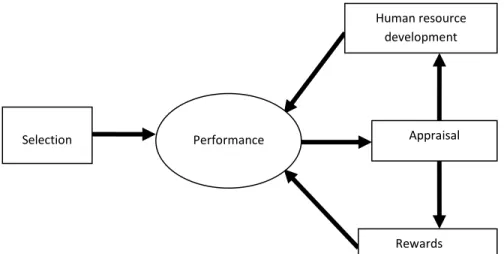
developed a concept map depicting the hard HRM philosophy of utilization of the human resource through a cycle (see Figure 2). The cycle represents the organizational process used to increase productivity from the resource. The cycle focuses on optimizing productivity, through each phase of the cycle, from selection to performance, performance to appraisal and appraisal to either development or reward.
Figure 2. The Human Resource Cycle. From “The Human Resource Cycle.” by C. J.
Fombrun, N. M. Tichy, and M. A. Devanna, 1984, Strategic Human Resource Management, p. 41. Copyright 1984 by John Wiley & Sons. Reprinted with permission.
In contrast to the hard HRM model, the soft HRM model focuses on support of the human resource through a nurturing process (Beer, Spector, Lawrence, Mills, & Walton, 1984; Guest, 1999). The nurturing process according to Storey (1989) leads to
organizational commitment and increased productivity. Where the Human Resource Cycle of Fombrun et al. (1984) was a simplistic representation of the hard HRM model, soft HRM models (Beer et al., 1984; Guest, 1987; Storey, 1992) were complicated and difficult to understand. Several years later, Guest (1990) identified flaws in his own model caused by the complexity.
Bratton and Gold (1999) characterized the soft HRM model using the functional areas of HRM: staffing, employee development, employee maintenance, employee relations, and rewards. These five functional areas of soft HRM align with Fombrun et al. (1984) human resource cycle: selection, performance, appraisal, rewards, and
development. Bratton and Gold indicated, “The Human Resource Cycle (HRM cycle) is a
Selection Performance
Human resource development
Appraisal
simple model that serves as a pedagogical framework for explaining the nature and significance of key HR factors making up the complex fields of human resource management” (p. 18).
From Fombrun et al.’s (1984) HRM cycle and the functional areas of HRM of Bratton and Gold (1999), Figure 3 depicts the combination of these two different
constructs. The outcome provides a foundation for the implementation of a simplistic soft HRM model.
Figure 3.The soft HRM Model. My adaption of the Human Resource
Management Model (Bratton & Gold, 1999) applied to the Human Resource Cycle (Fombrun et al., 1984). Note. Figure Adapted from“The Human Resource Cycle.” by Fombrun et al., (1984), Strategic Human Resource Management, p. 41. Copyright 1984 by John Wiley & Sons. Content Adapted from J. Bratton, & J. Gold, 1999, Human Resource Management: Theory and Practice, (2nded.), p. 3. Copyright 1999 by Lawrence Erlbaum Associates Inc. Adapted and reprinted with permission. Staffing Employee relations Employee development Employee maintenance Rewards
Within the literature are studies that have examined HRM, the impact on the organization and the impact on workers, (Becker & Gerhart, 1996; Carmeli, 2004; Crook, Todd, Combs, Woehr, & Ketchen, 2011; Guest, 1999; Murphy & Zandvakili, 2000; Smith, 2006; Storey, 1989). Carmeli (2004) surveyed 264 local government managers to determine the financial outcomes after implementing an HRM program and found that public organizations generally experienced financial gains when HRM programs were implemented. The results from a pilot test of an HRM program focused on selection, enrollment (orientation), training, and evaluation of employees at 20 retail locations for a major grocery chain found increased sales and profits for the company (Murphy & Zandvakili, 2000). The Murphy and Zandvakili findings suggested that the costs
associated with the implementation of HRM programs support a financial return for the company. Becker and Gerhart (1996) conducted a meta-analysis and found a positive impact on organizational performance when HRM models were implemented. The ability of managers to increase and maintain performance greatly improved as workers
participated in HRM programs (Becker & Gerhart, 1996). In a study of 26 public
vocational schools and 113 private schools, the implementation of HRM programs helped to establish or re-enforce the organizational culture of the institution (Smith, 2006).
In a meta-analysis of 66 studies that explored human capital and performance, Crook et al. (2011) found hiring and sustained development of employees produced a higher level of job performance. Murphy and Zandvakili (2000) also found the HRM program created a support system among employees. Guest (1999) examined the impact of HRM practices from the workers’ view and found high levels of commitment to the organization that had implemented soft HRM functions. The level of impact from HRM
practices on both the organization and workers was found to be proportional to the level of program implementation and how long the program had been actualized (Becker & Gerhart, 1996; Guest, 1999).
Community colleges have the ability to impact the organizational culture and their human capital, adjunct faculty, through the implementation of HRM practices. While the implementation of HRM practices could poten