EVALUATION OF NUTRISPHERE-N AS A SOIL NITRIFICATION AND UREASE INHIBITOR
R. Jay Goos
Department of Soil Science
North Dakota State University, Fargo, ND 58108 [email protected]
Abstract
Nutrisphere-N is a fertilizer additive, which is claimed to prevent nitrogen loss from soil through the inhibition of urease and nitrification. The objective of this study was to evaluate the effects of Nutrisphere-N on urease, nitrification, and ammonia volatilization from soil under controlled condition. Nutrisphere-N was mixed with urea solutions or impregnated on urea granules and before application to soil. In the three experiments conducted, adding Nutrisphere-N had little or no effect on the rate of urea hydrolysis, nitrification, or ammonia volatilization.
Introduction
Urease and nitrification inhibitors can be valuable fertilizer additives under certain environmental conditions. Agrotain is the most widely-used urease inhibitor, and N-Serve is the most widely used nitrification inhibitor. Recently, a new product has been introduced, with claims of activity as a urease and nitrification inhibitor. It is a polymer-based product called "Nutrisphere-N." The material is theorized to inhibit urease by complexation of nickel, and to inhibit nitrification by complexation of copper (1,3). According to the manufacturer (2), the additive “...controls all of the nitrogen loss potentials that a farmer may face throughout the
growing season....not for days or weeks, but an entire growing season....” The objective of this study was to measure the effect of Nutrisphere-N on urease, nitrification, and ammonia volatilization when applied with urea to North Dakota soils.
Materials and Methods
Three experiments were conducted. In the first study, a single (0.100 mL) droplet of a fertilizer solution was applied to the surface of a Renshaw sandy loam or a Overly clay loam, and the rate of urea hydrolysis measured over 1-4 days, and the rate of nitrification measured over 1-4 weeks. The fertilizer solutions used included a control, a urea solution (150 g urea/L), a urea solution
movement through the fertilizer retention zone, so as to maximize the potential effect of the additive. For further technical details about the procedures used, please contact the author.
Results Experiment 1
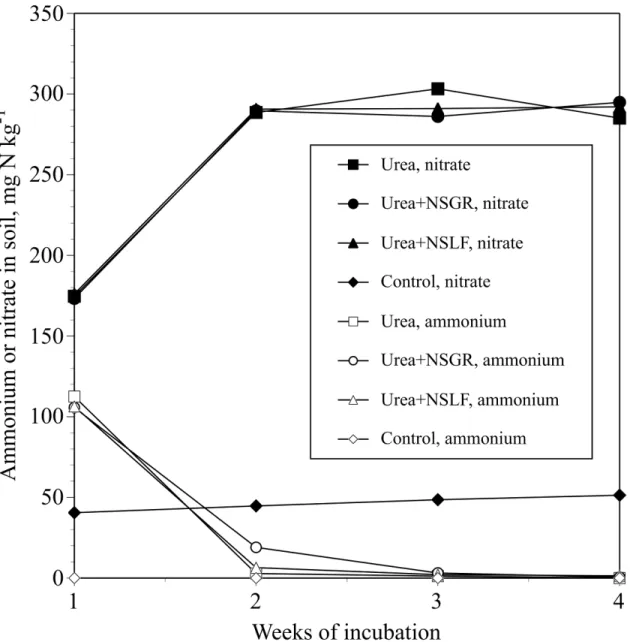
The effects of Nutrisphere-N on urea hydrolysis by the Overly and Renshaw soil are shown in Figures 1 and 2. Adding either formulation to urea did not slow urea hydrolysis. The effects of Nutrisphere-N on the rate of nitrification for the Overly and Renshaw soil are shown in Figures 3 and 4. Nitrification rate was not slowed by adding Nutrisphere-N to urea. The decline in ammonium or buildup of nitrate was the same for urea, or urea plus either formulation of Nutrisphere-N.
Experiment 2
The effect of surface cover (bare soil vs. soil plus wheat straw), urea, and urea impregnated with NSGR on ammonia volatilization from the soil surface is shown in Figure 5. Adding NSGR only slightly reduced ammonia volatilization.
Experiment 3
The rate of nitrification of intact granules of urea or urea impregnated with NSGR is shown in Figure 6. Impregnating urea with Nutrisphere-N had no effect on nitrifcation rate. The decline in ammonium, or buildup of nitrate was the same for urea or urea plus NSGR.
The claim that Nutrisphere-N acts as an inhibitor of urease and nitrification could not be confirmed in these trials
References
1. Blaylock, A. and L. Murphy. 2006. Optimizing N management without ammonium nitrate. Fluid J. 14 (4): 20-22. Also available online at: http://tinyurl.com/ablaylock or http://www.fluidfertilizer.com/PastArt/pdf/54P20-22.pdf
2. Specialty Fertilizer Products. 2008b. Promotional video [Online]. Available at: http:// www.nutrisphere-n.com
3. Strem, Jan. 2007. Plant Nutrient Newsletter, Fall 2007. The Andersons Plant Nutrient Group, Maumee, OH. Document also available online at: http://tinyurl.com/jstrem or http://www.andersonsnutrients.com/wps/wcm/connect/895806804556a7c2b617fef49455893 d/Newsletter+March+2007+-+4+pages.pdf?MOD=AJPERES
Figure 1. Urea remaining in an Overly soil, as influenced by time of incubation, and application of urea, urea plus Nutrisphere-N for granular fertilizers (NSGR), and urea plus Nutrisphere-N for liquid fertilizers (NSLF). Experiment 1. Fertilizer was applied as a single 0.100 mL droplet to moist soil.
Figure 2. Urea remaining in a Renshaw soil, as influenced by time of incubation, and application of urea, urea plus Nutrisphere-N for granular fertilizers (NSGR), and urea plus Nutrisphere-N for liquid fertilizers (NSLF). Experiment 1. Fertilizer was applied as a single 0.100 mL droplet to moist soil.
Figure 3. Ammonium and nitrate extracted from an Overly soil, as influenced by time of
incubation, and application of urea, urea plus Nutrisphere-N for granular fertilizers (NSGR), and urea plus Nutrisphere-N for liquid fertilizers (NSLF). Fertilizer was applied as a single 0.100 mL droplet to moist soil.
Figure 4. Ammonium and nitrate extracted from a Renshaw soil, as influenced by time of incubation, and application of urea, urea plus Nutrisphere-N for granular fertilizers (NSGR), and urea plus Nutrisphere-N for liquid fertilizers (NSLF. Fertilizer was applied as a single 0.100 mL droplet to moist soil.
Figure 5. Ammonia loss from a Renshaw soil, as influenced by straw, commercial urea granules, or commercial urea granules impregnated with Nutrisphere-N for granular fertilizers (NSGR). Experiment 2. Fertilizer was applied as commercial urea granules or commercial urea granules impregnated with NSGR.
Figure 6. Ammonium and nitrate in a Renshaw soil as influenced by length of incubation and application of commercial urea granules, or commercial urea granules impregnated with Nutrisphere-N for granular fertilizers (NSGR). Experiment 3.
PROCEEDINGS OF THE
THIRTY-EIGHTH
NORTH CENTRAL
EXTENSION-INDUSTRY
SOIL FERTILITY CONFERENCE
Volume 24
November 12-13, 2008
Holiday Inn Airport
Des Moines, IA
Program Chair:
Darryl Warncke
Michigan State University East Lansing, MI 48824-1325 (517) 355-0270