On Centralized and Distributed Frequency Assignment in
Cognitive Radio Based Frequency Hopping Cellular Networks
Invited Paper
Daniel Willkomm
1, Wendong Hu
2, Daniel Hollos
1, James Gross
3, Adam Wolisz
11 Telecommunication Networks Group, Technische Universität Berlin, Germany, [email protected] 2 Advanced System Technology Labs, STMicroelectronics Inc., USA, [email protected],
3 UMIC Research Centre, RWTH Aachen University, Germany, [email protected]
Abstract—Frequency Assignment is an important approach to mitigate multi-cell interference in cellular systems. In this paper, we consider frequency hopping as one possible frequency assignment approach. In particular we focus our attention on cognitive radio cellular systems as one of the very promising future access technologies, taking IEEE 802.22 as an example. While the optimal frequency assignment for such a system is conceptually straightforward as well as computationally complex, we demonstrate that usage of distributed methods leads to a significant loss of assignment efficiency. In addition, we suggest means of mitigating this adverse effect.
I. INTRODUCTION
Frequency planning is an important method to control co-channel interference in multi-cell communication systems. It is based on solving the frequency assignment problem (FAP) [1]. The FAP consists of a set of cells, where neighboring cells have certain (static) interference relationships and hence, should not be assigned the same frequencies (also referred to as channels in the following) for operation. The goal of the FAP is the assignment of a pre-specified number of frequencies to each network cell while minimizing the total amount of frequencies needed. Mathematically, the FAP can be expressed as a graph coloring problem. The objective is to minimize the total number of colors by assigning each node one or multiple colors such that no two neighboring nodes have the same colors. This is typically performed on a graph where the nodes represent the set of cells and the edges between the nodes represent their interference relationships.
Graph coloring is mathematically difficult; the problem belongs to the class of NP-hard problems. Due to this, finding the optimal assignment for practically relevant systems requires prohibitively long computation times even with modern computational equipment. Therefore two alternative approaches are applied:
Sub-optimal algorithms that have a lower complexity operating on the entire graph.
Decentralized approaches, in which each node selects its frequency based only on partial knowledge of the interference graph. This allows for parallelization of the computation and leads to the most significant reduction of the computation time.
In the usually investigated wireless cellular networks with static frequency assignment both these approaches achieve remarkably good results in the sense of minimizing the number of frequencies necessary for assuring a given level of traffic.
However, in the last decade an increased interest is observed in systems that are not “frequency-static” but change their operational frequency. Such systems do provide better immunity both against fading and interference. Such an approach is referred to as frequency hopping. It is intuitively clear that, if each cell applies frequency hopping, the FAP approaches a new level of complexity. Thus, the issue of reducing the computational complexity becomes critical – and thus the promising decentralized approach described above is especially attractive.
In this paper we consider a special instant of frequency hopping systems – the emerging IEEE 802.22 standard [2, 3] for cognitive radio (CR) based wireless regional area networking. Its goal is to allow communications in temporarily unused TV bands (called secondary communications) but vacate the band if the owner of the band (called the primary user – PU) returns. In order to ensure unimpaired operation of the PU, a used channel has to be sensed periodically by the 802.22 system. A Dynamic Frequency Hopping (DFH) mode [4] [5] [6] has been proposed to the 802.22 draft standard where a cell can hop over a set of channels. In this mode the channel to hop to is always sensed in parallel to the data payload transmission on the current channel, enabling non-disruptive communications. Although the hopping frequency is rather slow (in the order of seconds), there are evidently tough requirements on the computational complexity of the frequency assignment algorithm as the time dimension is added to the FAP. On the other hand we believe that such optimization is feasible – in contrary to systems with much faster frequency hopping (like Bluetooth, see Section II.).
The remaining of this paper is organized as follows. In Section II we discuss related work regarding approaches for frequency hopping. In Section III we present our system model and formulate the problem statement. In Section IV we present a precise centralized optimization approach to be used as reference for comparison, and introduce a candidate decentralized approach. Then, in Section V we investigate the performance of the distributed approach. Finally, we conclude the paper in Section VI by a discussion of options for improvement of the distributed approach.
II. RELATED WORK
The issue of “static” graph coloring for channel assignment is well documented in literature and it has been frequently applied to cellular network planning. Standard references for this can be found in [7] [8]; for more details refer to [1].
Frequency hopping has drawn significant research attention in the context of GSM cellular systems, Bluetooth and WLAN (among others). In GSM, frequency hopping is an optional mode to mitigate fast fading and co-channel interference. Once every TDMA frame (which has a duration of 4.17 milliseconds) the transmit frequency for each terminal is changed according to a pre-specified hopping sequence. The impact of this hopping sequence (also referred to as Mobile Allocation List – MAL) design is studied in [9]. The authors propose a scheme which generates frequency lists assuming the knowledge about the frequency lists of neighboring, i.e. interfering, base stations such that interference between the neighboring (hopping) cells is within some specified constraint. Further work on the assignment of frequency lists in GSM systems can be found in [10]. In contrast, [11] investigates dynamic frequency hopping in GSM and compares it to random hopping. The frequency hopping pattern of a mobile is adapted based on measurements made at the base station and the mobile. The recalculation is done after every TDMA frame. The paper [11] studies several degrees of dynamic adaptations if the currently used frequency list is not satisfactory. However, [11] does not consider a jointly performed frequency list assignment over several cells.
Frequency hopping is also applied in Bluetooth systems for similar reasons (i.e. mitigating interference and fading). Hopping is performed about every 0.5 milliseconds and Bluetooth cells choose from several pre-specified hopping sequences. However, the Bluetooth Special Interest Group (SIG) worked out an Adaptive Frequency Hopping (AFH) method for second generation Bluetooth devices to improve the interoperability between Bluetooth and other systems like WLAN [12]. AFH allows Bluetooth to adapt to the environment by identifying fixed sources of interference and excluding them from the frequency hopping list. This process of re-mapping also involves reducing the number of channels to be used by Bluetooth. The Bluetooth specification requires a minimum set of at least twenty channels.
III. SYSTEM UNDER STUDY AND PROBLEM STATEMENT A. Single Cell Hopping Operation
A cognitive radio based secondary cell, as specified by the IEEE 802.22 working group, operates at any point in time on one arbitrary channel out of N available ones. The maximum time period a secondary cell is allowed to interfere with a primary user is given byTmax ; consequently, the operating channel must be vacated at least after each Tmax period (in
order to be sensed and re-validated). Note that there are additional delays to be considered here, like the time needed for sensing the new candidate operating channel (Tsense), and the time needed for switching the operating channel of the cell
(Tswitch). The quiet time used for sensing (Tquiet) is defined as
switch sense
quiet T T
T = + . We assume Tmax to be a multiple
integer of Tsense+ Tswitch and since Tsense>>Tswitch we do not consider switching times in our investigations (Tswitch= 0).
The base station (BS) can select from two basic modes of operation. The non-hopping (“listen before talk”) mode uses static channel assignment where the data communication is periodically interrupted (every Tmax ) in order to perform sensing on that channel. Obviously, this mode can not provide the required quality-of-service (QoS) for delay-sensitive data flows. However, in this case the FAP can be solved by applying one of the several existing graph coloring algorithms based on
either global or local knowledge (hence, following either a centralized or decentralized approach).
In the hopping mode [4, 5] the BS switches the cell to a new channel with periodicity of Tmax seconds, even if its current channel is not used by a PU. The potential new working channel is previously sensed in parallel to the data communications on the current channel. Hence, in the hopping mode the data communication is interrupted only by a time span of Tswitch, which we assume to be marginal. If no new channel is found to be available (due to PU or CR system activity), the base station switches to the non-hopping mode and immediately schedules a sensing period in order to check the current working channel for PU activity.
B. Cellular Operation
We consider a (large) area where a set of V distinct CR cells are located. Depending on the distance between terminals and base stations (BSs) of several cells, it is possible that cells interfere with each other when operating on the same channel. We model this in form of an interference topology graph G = (V, E) where V =
{
v1,...,vn}
represents the set of CR cells and) , ( ) ,
(i j ∈E i j if vi and vj are within each other’s interference range (thus, the CR cells vi and vj cannot operate on the same channel at the same time). We assume that cells have means to discover the interference relationships within their neighborhood through the exchange of control messages. The overhead due to this message exchange is not taken into account in the following.
The presence of primary users is assumed to be static as well as the structure of the interference graph. Furthermore, we assume that if a PU appears, it affects all CR cells in the network. Dynamically appearing and disappearing PUs as well as only locally visible PUs are subject to future work
C. Problem Statement
Clearly, the hopping approach has the potential to support (almost) continuous service provision and thus the QoS needed for real-time applications. Additionally, the achievable throughput is higher in the hopping mode (5% higher in 802.22 with Tmax = 2 s and Tsense =0.1 s). However, a network operating in hopping mode requires a larger amount of channels compared to the non-hopping mode.
The channel usage is an important metric due to two reasons. The smaller the number of channels a CR network requires, the lower is the probability that a CR cell is operating on a channel which is reclaimed by a PU. In addition, the smaller the number of required channels, the more CR cells can operate on the same set of channels. Therefore, in this paper, we investigate the difference in terms of channel usage between non-hopping and hopping modes, i.e. the consequences of frequency hopping for the FAP
In particular, we compare two different approaches: centralized and distributed channel assignment. In the centralized approach a single node in the network has global knowledge and can compute the optimal frequency hopping assignments for all cells. On the other hand, the distributed approach relies on each cell to decide independently about the next frequency to be used based on the currently occupied frequencies of its neighbors (and of the PUs).
IV. GENERATION OF HOPPING SEQUENCES
In this section, we describe the process of generating the hopping sequences in a cluster of CR cells. We first describe
the general approach followed, which was originally introduced in [4]. Subsequently, we introduce two algorithms for the hopping pattern generation. The first one is based on a central entity, which computes the hopping sequences for all cells based on global knowledge of the interference between cells (i.e., given the complete interference graph). In this approach the central entity has to distribute the generated hopping patterns to all cells in the network. The second approach is a decentralized algorithm, where each cell decides independently on its next used channel based on its local view of the interference and channel occupancy of neighboring cells.
The underlying idea of the hopping approach used in CR cellular network is a Phase Shifted Operation [4] of neighboring CR cells. The operation (i.e., the channel selection, as well as the jump to a new channel) of two neighboring cells is always time shifted by one quiet time (Tquiet). That means a cell has Tquiet time units to perform sensing, choose a new working channel, jump to the new working channel, and announce the jump to its neighbors before a neighboring cell does the same. No two neighboring cells are allowed to hop to a new channel at the same time. Provided reliable communication between the cells [16], this always ensures a collision free channel selection.
It has been demonstrated in [4] that a set of Nq
overlapping cells can operate continuously using Nq +1 channels as long as the length of a single transmission (T m a x )
is larger than the product Nq∗Tquiet . This observation is
referred to as the “N+1” rule [4]. Imposing the above explained hopping pattern of time shifted jumps is, however, only possible in case of strict coordination, which motivates the concept of DFH Community (DFHC) as described in [4].
Figure 1 - Revolver Hopping Operation
The general idea that we follow for the hopping sequence generation is based on a hopping approach introduced in [4]. We refer to this approach as Revolver Hopping (RH). After
max
T is over, a cell chooses a new working channel. Since each
cell's operation period is time-shifted by one or multiple Tquiet
against the operation periods of all neighboring cells, there is always enough time to perform channel sensing on the next working channel before the cell performs a channel hop. Figure 4.1 shows an example of the RH operation for 3 neighboring cells (i.e. all cells are mutually interfering with each other).
A. Centralized Approach
In the hopping mode, the central entity needs to generate for each cell in the network a channel hopping sequence that consists of a set of assigned channels and the corresponding schedule for channel hopping among the assigned channels (i.e. when to hop and to which channel). Assuming that global knowledge is available, we suggest the following procedure:
Initially, the central entity computes the chromatic number G
χ and the corresponding channel assignments for the cells in the network, which is represented by the graph G, by solving the following Integer Linear Programming (ILP):
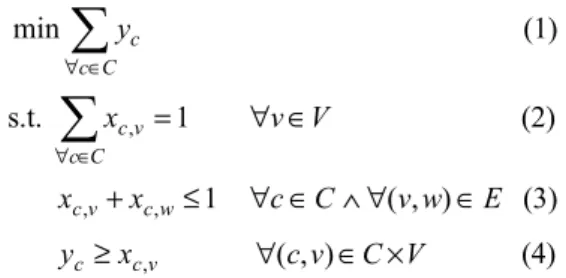
∑
∈ ∀c C c y min (1) s.t.∑
∈ ∀ = C c v c x, 1 ∀v∈V (2) xc,v+xc,w≤1 ∀c∈C∧∀(v,w)∈E (3) yc≥xc,v ∀(c,v)∈C×V (4)where xc,v is a binary assignment variable of color c and node v, constraint (2) assures that each node is assigned a color, and constraint (3) assures that neighboring nodes do not get the same color. Note that yc is an indication variable denoting the usage of color c in the network (constraint 4). The network is represented by its interference graph G = (V, E) as introduced in Section III.B. C is the set of colors (channels) available.
Next, the central entity generates a fixed hopping sequence for each cell. Based on the channel indices of the initial channel assignments computed above, the hopping sequence is generated as follows: First, all CR cells that have been initially assigned the channel with index One switch to channelχG+1 simultaneously. After Tsense+ Tswitch, a shifted phase, all CR cells that were initially assigned the channel with index Two switch to channel One. The process is repeated until the last group of cells (assigned with channel index of χG) are tuned to channel χG−1. When a channel switching completes, each network cell updates its channel index with the channel number of the new working channel that it just switched to and operates on the new working channel for a duration of T m a x , after which the next channel switching should be performed. The subsequent channel switching of each cell follows the same rule as the initial one as described above. That is, a cell on channel Xswitches to channelX−1, and the cell on channel One switches to channelχG+1. This results in a periodic channel hopping sequences for all cells. Note that we assume there should be enough time for the cells to perform data communications, sensing, and channel switching, i.e., the following condition should hold:
G switch
sense T
T
Tmax/( + )≥χ (5)
The total number of channels required to operate the network is exactly χG+1 [4] due to the fact that hopping times are shifted – such that no two neighboring cells hop at the same time. This is a lower bound of a frequency hopping network regarding its frequency requirement. However, this minimum frequency requirement is based on strong assumptions. First, the central entity shall be employed to collect the information regarding the complete interference graph of the network. Secondly, the central entity shall solve the frequency assignment problem and afterwards distribute the computed hopping patterns to all network cells in a reliable manner. Therefore, we consider this approach in the following mainly for comparison reasons rather than proposing it for practical usage.
B. Decentralized Approach
Because of scalability concerns, the centralized approach described above may not be practically applicable to larger network sizes. Therefore, we are interested in generating the
hopping sequences in a distributed way and quantifying the performance of this scheme.
As a basis, we took the Distributed Largest-First algorithm (DLF) [13] originally designed to solve static FAPs. This approach is known to perform near to optimal even for large (static) FAPs in practical problem instances. We modified DLF to handle the problem of generating the hopping sequences for dynamic frequency hopping operation aiming to achieve a similar frequency assignment performance.
The basic idea of DLF is the following. After discovering their cell neighbors, each node of the interference graph (i.e. each network cell) collects information about the node degree (number of neighboring nodes) of each of its neighbors. The cells then choose their working channels in descending order of node degrees in the neighborhood, i.e. the cell with the highest node degree selects its channel first. For equal node degrees a random number is used for tie breaking. A cell always chooses the lowest channel available and distributes its choice within the neighborhood. This method ensures that no two neighboring cells can get the same channel (as only one channel is chosen at a time). A crucial assumption for this approach is obviously that cells can communicate with each other to exchange control information in a distributed manner.
Now consider the case of dynamic frequency hopping. We modify the DLF algorithm, referring to it as decentralized hopping approach (DHA). Each cell performs the following steps: First, it initializes its neighbor list in the way as specified for the DLF. Then, all cells perform the priority selection procedure of DLF; the cells with the highest priority within their neighborhood choose a working channel (the lowest channel index available), communicate their choice to their neighbors, and start using the channel. After this initial choice all cells with the second highest priority are allowed to choose their operating channel and so on. Up to this point, the channel allocation is identical to that of the DLF algorithm. Note, however, that there is always a time shift of Tsense+Tswitch between the channel selections of two neighboring cells.
After using a channel for Tmax seconds, a cell vacates the currently used channel and hops to the next available one with the lowest channel index. Note that the initial hopping order between the cells remains unchanged. This is due to the fact that all cells use their channel for the same amount of time (Tmax) and due to the property of DLF that no two neighboring cells select their channels at the same time.
Although the order of the channel selection is periodic among the cells, it might happen that – depending on the choice of all other cells – the selection of the channels themselves results in a non-periodic channel hopping sequence. This effect is due to the “dynamic” choice of the next operating channel during system operation, and is a major difference to the centralized approach.
V. PERFORMANCE EVALUATION A. Methodology
We randomly generated interference topology graph instances using Culbersohn's graph generator [14] on a 1 by 1 unit plane, with the number of nodes varying between |V| = 10 and 50. The nodes are connected (i.e., the cells interfere with each other) if their Euclidian distance is smaller than or equal to d, where we vary this distance between d = 0.35 and 0.6. We have generated 80 random graph topologies for each of those (|V|, d) pairs. We chose Tmax = 10 s and Tsense =0.1s, resulting
in N q = 100. Since the maximum number of nodes is 50, for
our investigation, it always holds thatN q ≥χG.
In case of the centralized approach (referred to as CH), we transform the graphs into integer linear programs and compute the chromatic number using CPLEX [15]. Based on the result, the central node computes the channel assignment and distributes it within the whole network, as described previously. Since we do not assume interference from the primary users, the assignment does not need to be changed over time and is always optimal.
In case of the distributed approach (DHA), we have implemented the DHA based on the above description. The initial channel usage is determined using the DLF. Afterwards, each node individually decides on which channel to jump to base on the channel usage of its neighbors. In our implementation, neighbor nodes can reliably exchange their current channel usage in zero time. The simulation time is set to 1000 s.
We observe the total number of channels each graph instance requires over time. The maximum number of channels required over time is taken as performance metric for each graph. Afterwards, we average that number for both the central and distributed approaches over the (|V|, d)-graphs for each (|V|,
d) pair.
B. Results
First, we present the results for the frequency requirement in non-hopping mode, i.e., the traditional frequency assignment problem. Afterwards, we study the same metric for the hopping mode, comparing the centralized, optimal solution to the DHA algorithm. We show that the performance difference between the centralized (CH) and distributed (DHA) approach increases significantly.
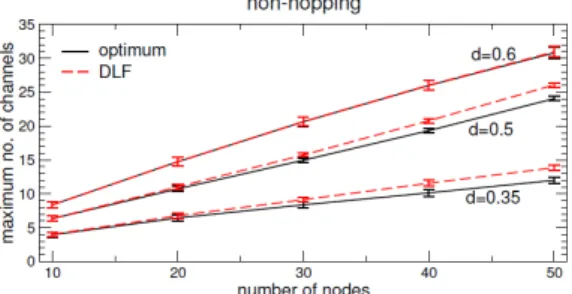
In Figure 2 we present results for three different interference distances (d = 0.35, d = 0.5, and d = 0.6) for the non-hopping mode. The key issue to observe from Figure 2 is that for the non-hopping mode, i.e. traditional graph coloring, the performance difference between the centralized (optimal) and decentralized approach (DLF) is rather small. For d = 0.6 the difference is almost zero. This is in accordance with previous publications and holds for a wide set of graphs. Hence, for the non-hopping mode, the decentralized approach is much more preferable due to its easy and overhead-less operation.
In Figure 3 we show the number of channels required for operating the hopping network in the centralized or distributed fashion described above. Comparing Figure 2 & 3 we observe that, for both centralized and decentralized algorithms, the hopping mode requires more channels. Whereas the difference between the centralized non-hopping and hopping approaches is rather small (χG+1 versus χG), the difference between the DHA and DLF is much larger (in other words, the cost of operating the network by the decentralized approach is much higher for the hopping mode). The DHA uses a lot more channels than the centralized hopping (CH) approach.
This performance difference is further investigated in Figure 4. Here we present the probability mass function (PMF) of the number of required channels to operate a network in hopping mode for the CH and the DHA. The graphs show the probability that the network occupies a certain number of channels for many different graph instances. The PMF’s for a small number of nodes (Figure 4(a)) of both approaches still
have a big overlap. For |V| = 50 (shown in Figure 4(b)),
This is in accordance with the results shown in Figure 3, where for small |V| the DHA can still achieve results comparable to
the optimum. For an increasing |V|, however, also the
difference between the DHA and the optimum increases.
Figure 2 - Average number of channels required for interference-free assignment for the non-hopping mode
Figure 3 - Average number of channels required for interference-free assignment for the hopping mode
(a) Left: |V| = 10, d = 0.35; Right: |V| = 10, d = 0.6
(b) Left: |V| = 50, d = 0.35; Right: |V| = 50, d = 0.6
Figure 4 - PMF of the channel requirement for the centralized and decentralized approaches for the hopping mode
VI. CONCLUSIONS
We have discussed the impact of frequency hopping on the required number of channels for IEEE 802.22 cellular networks. We have introduced the decentralized hopping approach (DHA) which supports frequency hopping for 802.22-like cellular networks. It has been shown that, unlike in non-hopping mode, this decentralized hopping approach performs much worse than the centralized one in terms of the number of required channels. This is important as the total number of required channels determines the potential impact of cognitive radio (i.e. secondary) interference on primary users.
The centralized hopping (CH) algorithm, however, needs only a moderate increase of required channels compared to the non-hopping centralized one.
There are several items we plan to investigate in the future: First, we are interested in studying the influence of the specific hopping approach used in this paper (i.e. the Revolver Hopping approach) and its decentralized realization (DHA) on the presented results. There may be other hopping approaches that can achieve better results, given the same amount of neighborhood information. Secondly, it would be important to answer the following questions: What is the influence of the amount of neighborhood information in each node? Can the performance of the DHA be improved by knowing the channel usage of all n-hop neighbors? Our preliminary results motivate the introduction of cooperation between hopping cells (forming for example communities). We will study the performance impact when such community has regional information about its vicinity and the corresponding overhead required for keeping this information up to date.
REFERENCES
[1] A. Eisenblaetter and A. Koster, Fap web page," http://fap.zib.de, 2001. [2] IEEE802.22 working group “IEEE802.22 Project Homepage” [Online].
Available: http://www.ieee802.org/22/
[3] IEEE P802.22/D4.0 Draft Standard for Wireless Regional Area Networks Part 22: Cognitive Wireless RAN Medium Access Control (MAC) and Physical Layer (PHY) specifications: Policies and procedures for operation in the TV Bands
[4] Wendong Hu, Daniel Willkomm, Murad Abusubaih, James Gross, George Vlantis, Mario Gerla, Adam Wolisz, Dynamic Frequency Hopping Communities for Efficient IEEE 802.22 Operation. IEEE Communications Magazine, Special Issue: Cognitive Radios for Dynamic Spectrum Access, vol. 45, no. 5, pp. 80–87, May 2007. [5] Wendong Hu, Eli Sofer. Doc: 22-05-0098-00-0000 STMicro-Runcom
PHY-MAC Full Proposal Outline. Technical Proposal Presented to IEEE 802.22 Working Group, Vancouver, Canada, January 2005
[6] Liwen Chu, Wendong Hu, and George Vlantis, James Gross, Murad Abusubaih, Daniel Willkomm, and Adam Wolisz“22-06-0113-01-0000 Dynamic Frequency Hopping Community,” Tech. proposal submitted to IEEE 802.22 WG, June 2006.
[7] B. Sanso and P. Soriano, editors. Telecommunications Network Planning. Kluwer Academic Publishers, 1999.
[8] A. Koster. Frequency assignment: Models and algorithms. PhD thesis, Universiteit Maastricht, 1999.
[9] P. Bjorklund, P. Varbrand, and D. Yuan, Optimal frequency planning in mobile networks with frequency hopping, Computers and Operations Research, vol. 32, pp. 169-186, 2005.
[10] J. Moon, L. Hughes, and D. Smith. Assignment of Frequency Lists in Frequency Hopping Networks. IEEE Trans. Veh. Technol., 54(3):1147– 1159, 2005.
[11] Z. Kostic, I. Maric, and X. Wang. Fundamentals of Dynamic Frequency Hopping in Cellular Systems. IEEE J. Select. Areas Commun., 19(11), 2001.
[12] Bin Zhen, Yongsuk Kim, and Kyunghun Jang. The analysis of coexistence mechanisms of Bluetooth. In Procs of Vehicular Technology Conference, pages 419–423. IEEE, 2002.
[13] M. Kubale and L. Kuszner, \A better practical algorithm for distributed graph coloring," in Proc. of Intl. Conf. on Parallel Computing in Electrical Engineering. IEEE, sept 2002, pp. 72 - 76.
[14] J. Culberson, A. Beacham, and D. Papp, \Hiding our colors," in CP'95 Workshop on Studying and Solving Really Hard Problems, Cassis, France, 1995, pp. 31-42. [Online] Available: citeseer.ist.psu.edu/culberson95hiding.html
[15] S. ILOG, ILOG CPLEX 9.0 - User's Manual, Paris, France, 2004. [16] Wendong Hu, Gerla, M., Vlantis, G.A., Pottie, G.J, Efficient, flexible,
and scalable inter-network spectrum sharing and communications in cognitive IEEE 802.22 networks. First International Workshop on Cognitive Radio and Advanced Spectrum Management, 2008.