Policy Resear_h
WORKING PAPERS Financial Policy and Systems Country Economics Department
The World Bank February 1993
WPS 1084
Stock Market Development
and Financial Deepening
in Developing
Countries
Some Correlation
Patterns
Dong He
and
Robert Pardy
Correlation analysis of cross-sectional data from 32 countries for 1984-90 shows a significant relationship between stock market development and financial depth. But time-series data for 1978-90 show significant correlations only for Asian econo-mies.
PolicyResch Working Papers disseiinate the rmdings of work in progress and encougedie echangeof ideas arnongBani gtaff and
Public Disclosure Authorized
Public Disclosure Authorized
Public Disclosure Authorized
Policy Research
Financial Policy and Systems
WPS 1084
This paper-a product of the Financial Policy and Systems Division, Country Economics Department-is part of a larger effort in the department to promote the development of sound securities markets. Copies of this paper are available free from the World Bank, 1818 H Street NW, Washington, DC 20433. Please contact Priscilla Infante, room N9-005, extension 37665 (February 1993, 39 pages).
Programs to develop securities markets are now Asian countries, but not for other countries in the a common feature of World Bank financial sample. Also, the correlations of the Asian data sector loans. Stock market development in are strongest after the mid-1980s.
particular is receiving considerable attention,
especially the legal and institutional underpin- He and Pardy test a "threshold hypothesis" nings required for successfil stock market that a certain level of financial depth may be development. necessary to allow stock market development to
take off. They find that available data do not The financial underpinnings needed have support the hypothesis.
received less study.
The results suggest that financial depth is a He and Pardy contribute to such a study by significant factor in stock market development in exploring the relationship between the degrees of most developing countries, but that country-financial depth and stock market development in specific factors (such as industrial policy and an economy. structure, foreign investment controls, and stock
market regulatory and operational infrastructure) Using a simple indicator of stock market have an equally strong influence on stock market development and several indicators of l;.-ancial growth.
depth, and using cross-sectional data from 32
developing countries ror 1984-90, they find a Case studies of economies in which stock strong correlation between the two factors. market development has been successful would
help elucidate the interplay between these Time-series data from 19 of these countries factors.
(for 1978-90) show similar correlations for most
The Policy Research Working Paper Series disseminates the findings of work under way in the Bank. An objective of the series is to get these findings out quickly, even if presentations are less than fully polished. The findings, interpretations, and conclusions in these papers do not necessarily represent official Bank policy.
Country Economnics Departnent The World Bank
STOCK MARKET DEVELOPMENT AND FINANCIAL DEEPENING
IN DEVELOPING COUNTRIES:
SOME CORRELATION PATTERNS
Table of Contents
1. Introduction ... I
H. Data Sources and Compilation ... 2
HI. Cross-Country Correlations . ... ... 4
A. Correlations inthe Period 1984-1990 .... ... 4
B. Correlations in the Period 1978-1990 ... 5
IV. Time-Series Correlations ... ... 6
V.
Some Tentative Explanations for the Observed Patterns ... 8VI. Concluding Remarks ... . 12
References ... ... 15
Appendix:
Country List ... 16I. Introduction
This paper is an empirical study of the relationship between the development of stock markets and the process of financial deepening. Specifically, it explores the correlation pattern between measures of stock market development and the development of the financial system in general.'
Fostering stock market development has become an important element in the World Bank's financial sector operations. Structural adjustment loans now often contain conditions related to capital market development, and the Bank provides technical assistance to many member countries on the legal, regulatory and on other aspects of the institutional framework for the development of stock markets. Also, governments in many developing countries have adopted policies designed to promote stock market development.
But there may be a limit to the effectiveness of such policies when the financial depth of an economy is limited and industrial development is primitive (Cho, 1992). The
development of the market requires well established industrial firms, sufficient savings and developed financial intermediaries, as well as well established legal, accounting, monitoring, and enforcement infrastructures.
The present paper seeks to explore the question of whether the degree of financial depth is a constraining factor in the development of stock markets. Its basic finding is that there is a significantly positive correlation between the level of stock market development and financial depth in a cross section of countries. Time series analysis shows that the
1Andrew Sheng originally suggested this topic and he, Yoon Je Cho and
Ross Levine provided helpful comments on earlier drafts of the paper. The research was undertaken by Dong He while a summer intern in CECFP under the guidance of Robert Pardy.
correlations are strong in the A.an economies but weak in other economies. We suggest that individual case studies should be helpful for us to understand the time path of the
development of the stock markets in these economies. NWe also suggest some refinements to
the measurement of stock market development. The paper is divided into six sections.
Section II describes the data and variables used in the study, Section III reports the results of cross-sectional analysis and Section IV reports the results of time-series analysis. Section V offers some explanations for the observed patterns and Section VI provides some concluding remarks.
II. Data sources and compilation
The data sample includes 32 developing economies which are l:sted in the appendix. The sample is confined to the markets which are covered by the IFC Emerging Markets Data Base (EMDB), which includes 20 markets in the IFC's Composite Index and another 12 markets not in the IFC's Composite Index.
"Stock market development" and "financial depth" are multi-faceted concepts and there are a number of indicators which can be used to measure them. In this study, the ratio of market capitalization to GDP (MCY) is used as a measure of the degree of development of the stock market. Annual figures of market capitalization (as at end of year) are available in the EMDB from 1977 for the 20 markets in the IFC's Composite Index, and from 1982 for the other 12 markets not in the IFC's Composite Index. We use three indicators as base measures of the depth of the financial system. The data for the variables were retrieved from
IFS data base.2 The three variables are:
M1Y: The ratio of MI to GDP. MI is the sum of currency held outside of banks and demand deposits other than those of the central govemment (IFS line 34).
2
The data for Taiwan are obtained from Statistical Yearbook of the Republic of China 1991, Directorate-General of Budget, Accounting and Statistics, Executive Yuan, Republic of China.
-QMY: The ratio of Quasi-Money Liabilities of the monetary authorities and deposit money banks to GDP. Quasi-Money Liabilities comprise time, savings, and foreign currency deposits of resident sectors other than central government (IFS line 35). DCPY: The ratio of Claims on the Private Sector by the Central Bank and Deposit Money Banks (domestic credit to the private sector) to GDP (IFS line 32d).
M1Y is commonly used as a measure of monetary depth, and QMY is used here as a measure of non-monetary financial depth. It would be more appropriate to include the quasi-liquid liabilities of both banks and non-banking financial institutions (NBFIs) in order to measure the overall financial depth of the economy. However, since data on the quasi-liquid liabilities of NBFIs are not readily available for most of the economies under study, only quasi-money is used. In addition, the ratio of claims on the private sector by the financial system to GD)P is used both as a proxy for the size of bank assets and as an indicator of asset distribution since it excludes financial credit to the government and publicly owned
enterprises (King and Levine, 1992). DCPY also measures the financing demands of the private sector.
We include the variable GNP per capita (GNPCAP) as an indicator of the general level of economic development. Relationships between this variable and other variables are discussed.
Also following King and Levine (1992), the problem of deflating stocks (Market
Capitalization, MI, Quasi-Money, and DCP) - measured at the end of the period - by GDP
flow - measured over the period - is mitigated by using the arithmetic average of this year's end-of-period and last year's end-of-period stock values. Thus, MCY in 1980 is the average of MC in 1979 and 1980, divided by GDP in 1980.
III. Cross-Country Correlations between Period Averages of the Indicators of Financial Depth and Stock Market Development
This section preserts correlations and graphs to highlight the relationship between indicators of financial depth and stock market development. There are two sample periods under consideration. One is from 1978 to 1990, and the sample for this period includes 20 economies which are constituents of the IFC's Composite Index. The other is from 1984 to 1990, and the sample for this period includes all 32 economies in the EMBD. Arithmetic averages are taken for all the five variables over these two periods respectively.
A. Correlations in the period 1984-1990
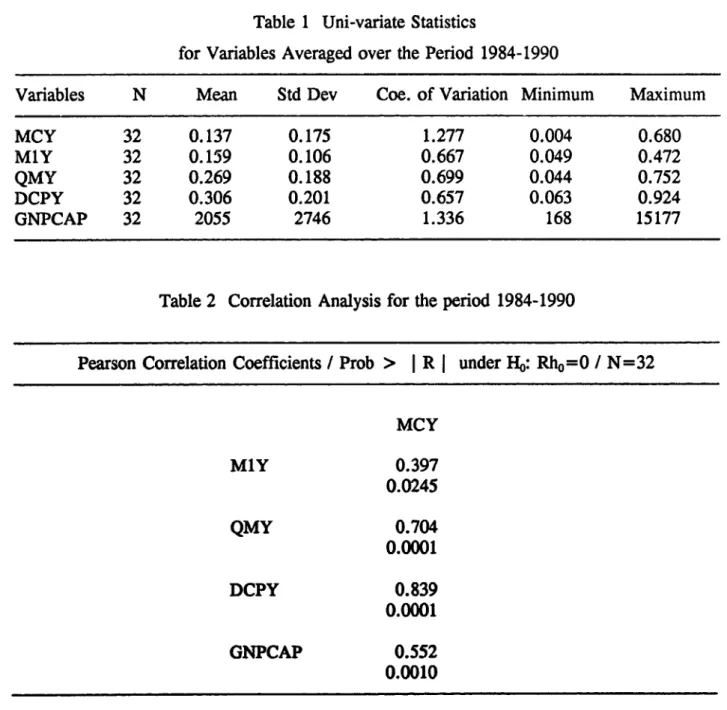
The levels of financial depth, GNP per capita and stock market development vary widely among the sample countries. But the level of stock market development has a much larger variation among the countries than the variations in financial depth. Table 1 presents
the relevant uni-variate statistics3. This suggests that stock market development is affected to
a greater degree by country specific factors than are measures of financial depth.
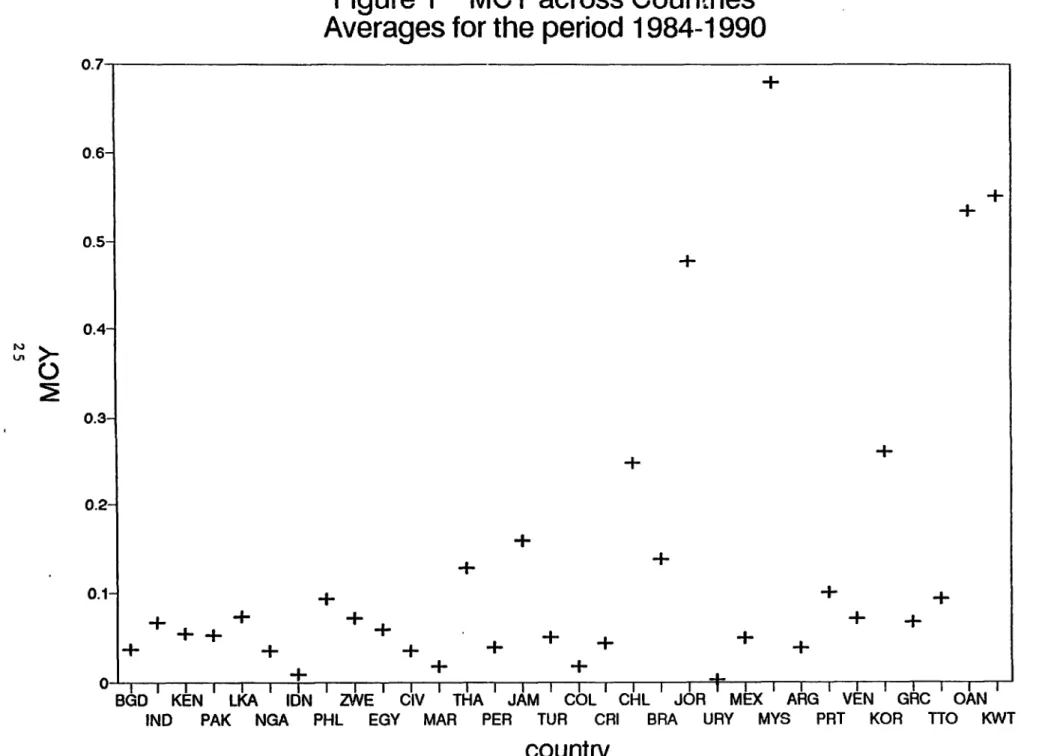
In the richer developing economies (as defined by GNP per capita), financial depth and the degree of stock market development are typically higher. Figures 1 and 2 show the distribution of MCY and QMY across the countries. In the figures, the countries are
arranged in an ascending order from left to right according to the levels of GNP per capita. It is clear that there is a rising trend in the two variables. In this period, on average
Malaysia, Kuwait, Taiwan, Jordan, Korea and Chile are the economies which have larger stock markets.
Countries with more developed stock markets (in terms of MCY) also have more financial depth as defined by the ratio of QMY to GDP or the ratio of MI to GDP. But the
3
development of the stock market appears to be more associated with non-monetary financial depth than with monetary depth. Table 2 shows that the Pearson Correlation Coefficient is significantly positive at 0.1% level foi 2MY, DCPY and GNPCAP, but not for M1Y (The Coefficient is significantly positive at 3% for M1Y). This is consistent with the supposition that the development of the stock market is accompanied by financial deepening. It is also worth noting that the correlation is the strongest between MCY and DCPY, which means that countries with more developed stock markets have financial systems that issue more credit to the private sector as a share of GDP than countries with less well developed stock markets. This implies that there may be a complementary rather than substitution relationship between stock market development and
financial intermediary growth. That is, a more developed st3ck market would allow firms to increase borrowing from financial intermediaries.
B. Correlations in the period 1978-1990
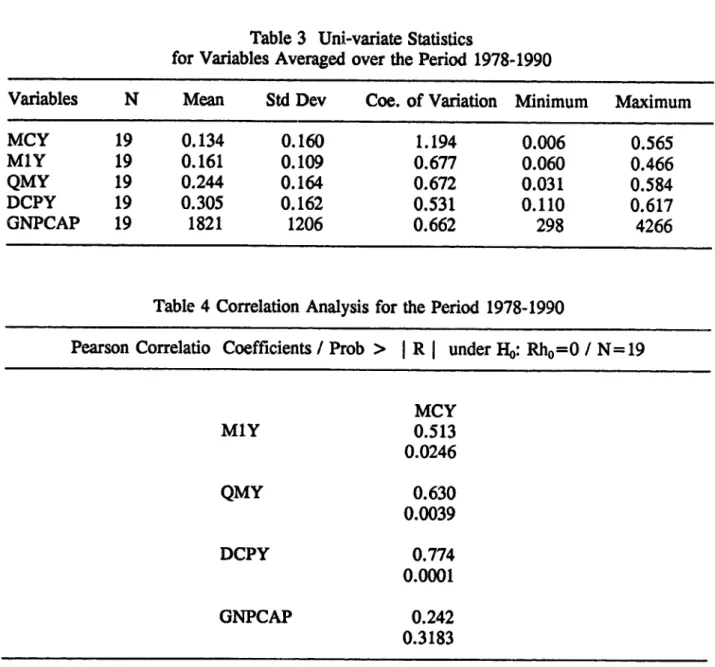
The same exercise as in the last sub-section is applied to the period 1978 to 1990, but to a smaller sample size (19), based on data from the IFC's Composite Index4.
This second data se. confirms the two patterns previously identified: the variations in the level of the stock market development across the countries are much larger than the variations in the level of financial depth across the countries; and the correlation of MCY with DCPY is the strongest among all the variables. These results are shown in Tables 3 and 4.
On the whole, the correlations in the period of 1978-1990 are weaker than those in the period 1984-1990. The weaker correlations for the longer period may reflect the fact that
4
The data series is much shorter for Zimbabwe and is excluded from our
in the late 1970s and the early 1980s the pattern of nlovement of th6 stock market is very different from that in the late 1980s.
Broadly speaking, there was a general upturn in the late 1980s in the size of the stock markets in the economies uader study. Figures 3 to 6 show the movement of MCY over time in these 19 economies grouped according to geographical areas. It can be seen from these figures that the pattern of movement of Market Capitalization as a proportion of GDP varied
widely amon; ;t the 19 economies. In East Asian countries, the ratio remained rath - stable
before the mid 1980s, but there were a sharp rise in Taiwan and Korea, and a moderate upturn in the Philippines from 1985. In South and South East Asia, the pattern of the movement of MCY in Malaysia was distinctively different from others. It had a higher starting point and it showed a discernible cyclical pattern. But the mid-1980s saw an uptum of the sizes of the stock markets in all five economies in this group. The pictures in the other two groups were more complicated.
The ratios had a much larger variation, especially in Latin America. But we can still see a general rise in the sizes of the markets since the mid-1980s in nearly all the economies in these two groups.
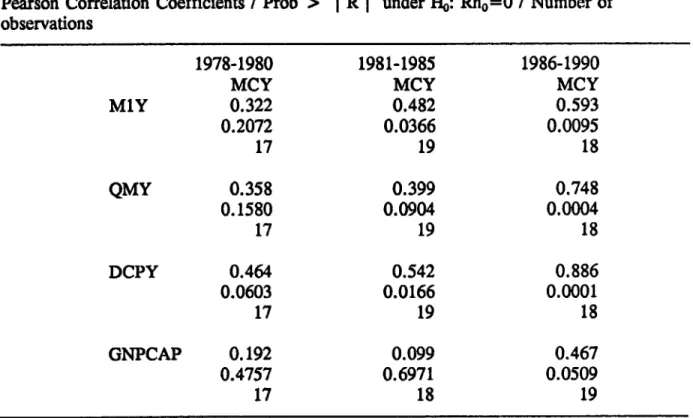
When the 1978-1990 period is divided into three sub-periods, the correlations in the period 1986-1990 are much more significant than in the two previous periods. This is evident from Table 5. We thus have to answer the question why there was a general upturn in the size of these markets after the mid-1980s and the correlations with the indicators of financial depth are more significant. Section V will provide some tentative explanations.
IV. Time-Series Correlations between the Indicators of the Development of the Stock Market and Financial Deepening
This section analyses the correlations between MCY and other variables over time in different economies. Since for the economies which are not included in the IFC's Composite
Index the data series available are too short, these economies are not dealt with in the
following analysis and only IFC's Index economies are included.5 The 19 economies are
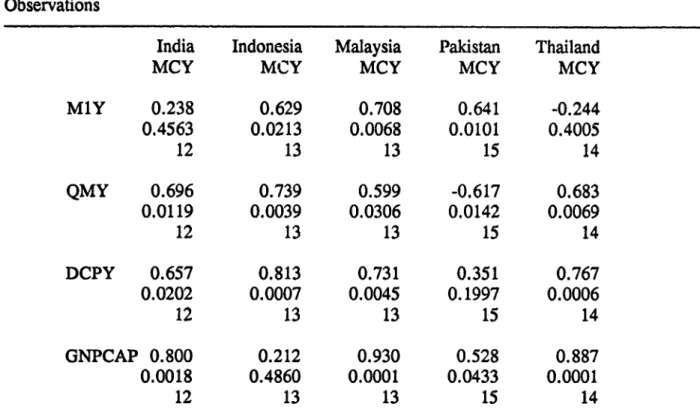
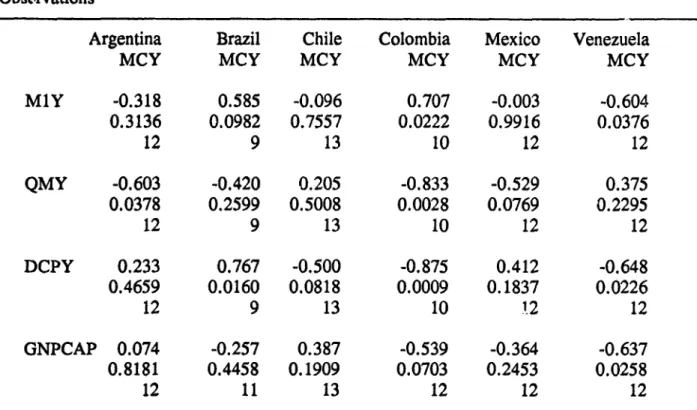
grouped according to geographical areas and Tables 6 to 9 present the results of correlation analysis, while Figures 7 to 10 show the distribution of MCY, M1Y, QMY and DCPY over time in Korea, Malaysia, Chile and Greece, selected each from one group. For reference, Figures 11 and 12 show the distribution of the four variables in the United States and Japan from the early 1950s.
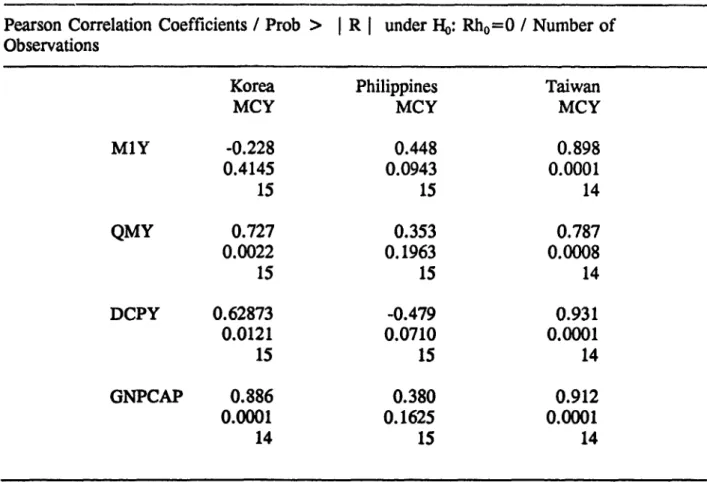
On the whole, the correlations in the Asian economies (except Pakistan and
Philippines) are much stronger than in the other economies. In fact, the contrast between the Asian economies and the other economies is very dramatic. While the correlations are
significant for most of the variables in Korea, Taiwan, India, Indonesia, Malaysia and Thailand, the correlations are not significant for most of the variables in other economies.
MIY remained relatively stable over time in most of the economies, while the patterns of movement of the other three variables are more heterogeneous. In most of the Asian economies (except in Pakistan and Philippines), there was an upward trend in MCY, QMY and DCPY, and they were highly correlated. (In Indonesia, the stock market remained very small until 1989, although a slight upward trend in MCY can be observed). On the other hand, the upturn in MCY around 1986 was generally much more dramatic than the increase in the indicators of financial deptn. In other economies, there was no consistent pattern of movement in these variables. In Brazil, Chile, Colombia, Greece, Jordan, and
Philippines, while financial C:pth as measured by QMY has been increasing, there was no
apparent trend in MCY, and there was no consistent pattern in the movement of DCPY either. For example, in Chile, the stock market declined continually in the early 1980s and the direction was reversed in 1985, and the direction of the movement of domestic credit to the private sector was exactly opposite.
5Zimbabwe is aot included since the time series available is too short
The patterns of movement of the variables are very different over time in USA and Japan as well. In Japan, there was an upward trend in all four variables, although MCY had a much more dramatic increase in the 1980s. In the USA, there were an apparent u.pward trend in QMY and DCPY, and a downward trend in M1Y. There was an upward trend in MCY, but it was noticeably more volatile.
V. Some Tentative Explanations for the Observed Patterns
Two principal correlation patterns need explaining. First, while it is true that after 1986, in the economies which had higher income levels and higher financial depth, the stock markets were typically larger or more developed, it was hardly true before 1986. This is evident from the cross-country correlations between the indicator of the size of the stock market (MCY) and the indicators of financial depth and GNP per capita, which are positively significant more for the period 1986-1990 than for the two previous periods. Second, over time the correlations are not significant except for the Asian economies. While we observe that in most of the Asian economies there was an upward trend in all the variables, in the other economies the patterns of movement of the variables were more heterogeneous and there was no consistent pattem among them. These two points are discussed in turn below.
Explanations for the First Correlation Pattern
One possible explanation for this correlation pattern is that the mid-1980s was a turning point for the economies which had a higher subsequent growth of the size of the stock market. One such turning point could be that there was a threshold leve! of income or a threshold level of financial depth reached in the mid-1980s abovw which the development of the stock market took off. If this was the case, before the mid-1980s, the stock market would remain small and inactive even though the levels of income and financial depth had been rising. We would thus observe a poor correlation between stock market development and financial deepening across countries. Around the mid-1980s, when the thresholds of
take off, countries which had higher levels of economic development and financial deepening would generally have larger stock markets and we would observe a higher correlation
between the variables.
If the threshold hypothesis were true, one might expect to observe about the same levels of financial depth and income in the economies where the stock markets had a general upturn in the mid-1980s. In reality, as measured in 1985, the levels of income and financial depth varied widely across the countries. This is evident from Figures 14 and 15 which show the levels of QMY and DCPY in 1985 and the level of GNP per capita in 1985 respectively. The patterns emerging from these figures do not seem to support the threshold hypothesis.
However, several difficulties make the threshold hypothesis almost untestable. One is that it is difficult to determine whether the upturn in the size of the market around the
mid-1980s was actually a take-off. In order to identify the take-off points, to determine whether there exist threshold levels of income and financial depth and to identify what the threshold levels are, it is necessary to have a long enough time series. The time series we have are apparently too short for such an exercise. As a further test, it would be revealing to compare the levels of economic development and financial deepening in the developed economies at the time when there were a broad upturn in the size of their stock markets. But even for the developed economies, the test is difficult to conduct because of lack of data. Figure 13 shows the movement of MCY in the United States from 19296. In 1929, the United States had a MCY of more than 60% and GNP per capita in 1982 constant prices was already US$5834. It is thus necessary to trace back much earlier, probably back to the end of last century when the major developed economies had a rise of the stock market. But data are very difficult to obtain for that early period.
6 The figures of market capitalization before 1983 were those of the New York Stock Exchange, while the figures after 1983 were those of all United
A second difficulty lies in the measurement of the levels of income and financial depth. What are usually available are the notional levels of income and financial depth. But it may be more appropriate to use the figures of levels of income and financial depth in the city where the stock market is located, since the financial centres where the stock markets are usually located tend to have much higher levels of income and better financial infrastructure than the national average. For example, when analyzing the causal factors behind the
development of the stock imiarket in India, it may be more appropriate to examine the
economic situation in Bombay rather than in India as a whole.
A third difficulty, which is more fundamental, is that reaching the threshold levels may only be a necessary but not a sufficient condition for the rise of the stock market. This would imply that although some economies might have reached the threshold levels a long time back the stock market could have remained dormant for various other reasons, and on the other hand, the market could take off in response to other factors long after the threshold levels had been reached. Thus there is no reason why we should expect to observe about the same levels of financial depth and income in the economies where the stock market had a general upturn in the mid-1980s.
An alternative to the threshold hypothesis would be one which emphasizes institutional changes occurring in the mid-1980s. One such institutional change was a net increase of international capital flow into those Asian economies in which we observe the take-off of stock markets and more general financial deepening. This capital inflow first took the form of direct foreign investment. After the Plaza Accord of 1985, the price competitiveness of the NIEs (Korea, Taiwan, Hong Kong and Singapore) was very much strengthened, since their exchange rates in effect depreciated substantially against the Japanese yen and major European currencies. As a result, Japanese export-oriented industries began transferring manufacturing facilities to NIEs by direct investment. The volume of direct investment from Japan to NIEs increased nearly by five-fold during the period 1985-1988 (Watanabe, 1991). And since 1987, there has been a net increase of direct investment from these NIEs to the economies which belong to ASEAN (Indonesia, Malaysia, Philippines and Thailand), in
response to the relative decline of'competitiveness in the NIEs. In 1988, the volume of direct investment from NIEs to ASEAN exceeded that from Japan to ASEAN (Watanabe, 1991). A consequence of these net capital inflows appears to be stimulation of the equity markets. The sharp rise of the stock markets in Korea and Taiwan was around 1986, while the big boom of the markets in Indonesia, Malaysia, Philippines and Thailand began in about 1988, coinciding in each case with the upturn in foreign investment.
Another channel of capital inflow is through portfolio investment in the form of
country funds. For example, in 1984, the first country fund, the Korea Fund, Inc., was listed on the New York Stock Exchange, with an initial value of $60 million. Since then, many local, regional, and global funds have been launched in international markets. Favorable treatment with regard to taxation and foreign exchange control was implemented in some of the countries and consequently these funds became very popular among international investors. Since it is more likely that these investors would invest in the equity markets of those economies which had better financial infrastructures, and conversely, the development of the equity markets would tend to increase the demand for other financial services, the development of the financial markets in general and equity markets in particular would tend
to go hand in hand in these countries.
Explanations for the Second Correlation Pattern
The lack of correlations between MCY and indicators of financial depth in most of the non-Asian economies over time may be due to two reasons. One is the effect of inflation. Table 10 shows the period averages of annual rates of inflation in the 20 economies under study. It is clear that the rates of inflation were much higher in Latin American economies. High inflation tends to introduce distortions and instability into our variables, since these variables are calculated by taking the averages of year-end values of stock variables and then dividing by a flow variable. In addition, high inflation could have opposite effects on MCY and QMY. While domestic equity investments can be more attractive in an environment of high inflation, quasi-money assets (which are generally fixed interest instruments) are likely
to be less attractive.7 The power of correlation analysis could be reduced as a result of these
distortions.
The other reason for the lack of correlation could be that the time period under consideration is relatively too short. Since share prices can be very volatile in a short time-span, market capitalization can also be very volatile. Thus the relationship between financial deepening and stock market development is unlikely to be stable in the short term. This would suggest that it is necessary to use a longer time period for the data series in order for the short-term fluctuations to be canceled out. However, Figu.e 13 shows that MCY in the United States had very large cyclical movements over a period of more than 60 years. The correlations between MCY and the indicators of financial depth in USA were unlikely to be
high even for this 60 year data series8. It is thus difficult to form a conclusive view.
VI. Concluding Remarks
Results from correlation analysis on cross-sectional data for the period 1978-1990 show that there is a significantly positive correlation between the indicator of stock market development, Market Capitalization as a proportion of GDP, and indicators of financial depth. Breakdown of the time period shows that the correlations are strongest during the late
1980s, which may be explained by the fact that there was a substantial increase in foreign investment in that period into the equity markets of those economies which had better developed financial infrastructure.
7
Although this argument is plausible in theory, it is not supported by all country experiences. Careful examination of the figures depicting the movements of financial variables over time reveals that the directions of movements of these variables were sometimes opposite to what this argument would predict. This could be the result of other mechanisms which offset the effects of inflation but we have identified no consistent pattern.
8
It can be seen from Figure 12 that the correlations in the period
However, results from correlation analysis on time-series data show that apart from the Asian economies, the colTelations are not significant. Hyper-inflation in the Latin American economies may have reduced the power of correlation analysis because of the distortions it introduced into the variables we constructed. Also the time series available are for a relatively short period and stock price volatility may have distorted the findings.
The results of cross-sectional and time-series analysis can be reconciled in that there might be bounds of variation of MCY. Although over time MCY fluctuated widely and there was poor correlation with the indicators of financial depth, these variations were bounded to a certain extent so that the means of MCY in that period of time still reflected the relative size of the market. Thus cross-sectionally, we can still observe high correlations between MCY and other indicators of financial depth. That is to say, in the economies which had better developed financial system, although the stock market fluctuated widely thus making the correlations over time poor, the means of MCY in these economies were still higher because the stock markets were larger and better developed.
A threshold hypothesis of stock market development proves to be difficult to test due to several factors. It is thus difficult to tell at one particular time whether one economy has fulfilled the necessary conditions for the development of its stock market. All we can say is that when an economy is well equipped with financial infrastructure it may have a better chance of attracting new capital into its equity market.
This paper has established some stylized facts concerning the relationship between the development of the stock market and the process of financial deepening. It would be helpful for future research in identifying the conditions for the development of the stock market if a wider range of data was considered. Firstly, detailed case studies would be useful for
identifying country-specific factors which may affect the course of development of the stock market. For example, examination of the general financial conditions should be supplemented by considering the role of industrial structure, foreign investment and stock market
market capitalization should be supplemented by others such as turnover ratio, market concentration ratio, as well as primary market data such as the volume of initial public offerings and rights issues. In addition, the overall significance of the stock market could be indicated by the share of the output and profits contributed by companies listed on the stock exchanges in those of the whole economy.
References
Cho, Yoon Je, "Capital market development: conceptual issues and policy options", background paper prepared for Internal Training Course on Promoting Capital Market in LDCs, April 1992, CECFP.
Dailami, Mansoor and Atkin, Michael, "Stock Markets in Developing Countries: Key Issues and a Research Agenda", World Bank Working Papers, October 1990, WPS 515.
Goldsmith, Raymond W., Financial Structure and Development, New Haven and London: Yale University Press, 1969.
King, Robert G, and Levine, Ross, "Financial Indicators and Growth in a Cross Section of Countries", World Bank Working Papers, January 1992, WPS 819.
Pardy, Robert, "Institutional Reform In Emerging Securities Markets", World Bank Working
Papers, May 1992, WVPS 907.
Watanabe, Kenichiro, "Financial reform in Asian economies and its implications", mimeo. The Bank of Japan, January 1991.
Appendix 1
Country List
ARG Argentina MYS Malaysia
BGD Bangladesh MEX Mexico
BRA Brazil MAR Morocco
CHL Chile NGA Nigeria
COL Colombia PAK Pakistan
CRI Costa Rica PER Peru
CIV Cote d'Ivoire PHL Philippines
EGY Egypt PRT Portugal
GDC Greece LKA Sri Lanka
IND India OAN Taiwan, China
IDN Indonesia THA Thailand
JAM Jamaica TTO Trinidad/Tob.
JOR Jordan TUR Turkey
KEN Kenya URY Uruguay
KOR Korea VEN Venezuela
Table 1 Uni-variate Statistics
for Variables Averaged over the Period 1984-1990
Variables N Mean Std Dev Coe. of Variation Minimum Maximum
MCY 32 0.137 0.175 1.277 0.004 0.680
M1Y 32 0.159 0.106 0.667 0.049 0.472
QMY 32 0.269 0.188 0.699 0.044 0.752
DCPY 32 0.306 0.201 0.657 0.063 0.924
GNPCAP 32 2055 2746 1.336 168 15177
Table 2 Correlation Analysis for the period 1984-1990
Pearson Correlation Coefficients / Prob >
I
RI
under Ho: RhO=0 / N=32MCY M1Y 0.397 0.0245 QMY 0.704 0.0001 DCPY 0.839 0.0001 GNPCAP 0.552 0.0010 17
Table 3 Uni-variate Statistics
for Variables Averaged over the Period 1978-1990
Variables N Mean Std Dev Coe. of Variation Minimum Maximum
MCY 19 0.134 0.160 1.194 0.006 0.565
MIY 19 0.161 0.109 0.677 0.060 0.466
QMY 19 0.244 0.164 0.672 0.031 0.584
DCPY 19 0.305 0.162 0.531 0.110 0.617
GNPCAP 19 1821 1206 0.662 298 4266
Table 4 Correlation Analysis for the Period 1978-1990
Pearson Correlatio Coefficients / Prob >
I
RI
under H0: Rho=0 / N= 19MCY MIY 0.513 0.0246 QMY 0.630 0.0039 DCPY 0.774 0.0001 GNPCAP 0.242 0.3183
Table 5 Correlation Patterns in Three Sub-periods
Pearson Correlation Coefficients / Prob >
I
RI
under H0: RhO=O / Number ofobservations
1978-1980 1981-1985 1986-1990
MCY MCY MCY
M1Y 0.322 0.482 0.593 0.2072 0.0366 0.0095 17 19 18 QMY 0.358 0.399 0.748 0.1580 0.0904 0.0004 17 19 18 DCPY 0.464 0.542 0.886 0.0603 0.0166 0.0001 17 19 18 GNPCAP 0.192 0.099 0.467 0.4757 0.6971 0.0509 17 18 19
Table 6 Correlation Analysis for the Economies in East Asia 1978-1990
Pearson Correlation Coefficients / Prob > R
I
under Ho: Rh0=0 / Number ofObservations
Korea Philippines Taiwan
MCY MCY MCY
M1Y -0.228 0.448 0.898 0.4145 0.0943 0.0001 15 15 14 QMY 0.727 0.353 0.787 0.0022 0.1963 0.0008 15 15 14 DCPY 0.62873 -0.479 0.931 0.0121 0.0710 0.0001 15 15 14 GNPCAP 0.886 0.380 0.912 0.0001 0.1625 0.0001 14 15 14
Table 7 Correlation Analysis for the Economies in South Asia 1978-1990 Pearson Correlation Coefficients / Prob >
I
RI
under HE,: Rh0=0 / Number ofObservations
India Indonesia Malaysia Pakistan Thailand
MCY MCY MCY MCY MCY
M1Y 0.238 0.629 0.708 0.641 -0.244 0.4563 0.0213 0.0068 0.0101 0.4005 12 13 13 15 14 QMY 0.696 0.739 0.599 -0.617 0.683 0.0119 0.0039 0.0306 0.0142 0.0069 12 13 13 15 14 DCPY 0.657 0.813 0.731 0.351 0.767 0.0202 0.0007 0.0045 0.1997 0.0006 12 13 13 15 14 GNPCAP 0.800 0.212 0.930 0.528 0.887 0.0018 0.4860 0.0001 0.0433 0.0001 12 13 13 15 14
Table 8 Correlation Analysis for the Economies in Latin America 1978-1990 Pearson Correlation Coefficients / Prob >
I
RI
under H0: Rh0=0 / Number ofObservations
Argentina Brazil Chile Colombia Mexico Venezuela
MCY MCY MCY MCY MCY MCY
M1Y -0.318 0.585 -0.096 0.707 -0.003 -0.604 0.3136 0.0982 0.7557 0.0222 0.9916 0.0376 12 9 13 10 12 12 QMY -0.603 -0.420 0.205 -0.833 -0.529 0.375 0.0378 0.2599 0.5008 0.0028 0.0769 0.2295 12 9 13 10 12 12 DCPY 0.233 0.767 -0.500 -0.875 0.412 -0.648 0.4659 0.0160 0.0818 0.0009 0.1837 0.0226 12 9 13 10 12 12 GNPCAP 0.074 -0.257 0.387 -0.539 -0.364 -0.637 0.8181 0.4458 0.1909 0.0703 0.2453 0.0258 12 11 13 12 12 12
Table 9 Correlation Analysis for the Economies in Europe/Mideast/Africa 1978-1990
Pearson Correlation Coefficients / Prob >
I
RI
under HO: Rh0=0 / Number ofObservations
Greece Jordan Nigeria Portugal Turkey
MCY MCY MCY MCY MCY
M1Y 0.700 0.388 0.109 -0.504 -0.627 0.0053 0.2126 0.7220 0.0789 0.0291 14 12 13 13 12 QMY -0.284 0.123 0.425 -0.245 0.485 0.3247 0.7042 0.1474 0.4199 0.1102 14 12 13 13 12 DCPY -0.264 0.238 0Q222 -0.744 0.002 0.3615 0.4564 0.4655 0.0035 0.9960 14 12 13 13 12 GNPCAP 0.126 -0.962 0.066 0.896 0.629 0.6664 0.0021 0.8312 0.0001 0.0283 14 6 13 13 12
Table 10 Annual Rate of Inflation (period averages, %) Country 1979-1980 1981-1985 1986-1989 Latin America Argentina 145.26 382.39 1191.63 Brazil 58.06 153.86 1056.40 Chile 36.21 21.49 19.42 Colombia 23.01 22.39 25.05 Mexico 20.67 62.38 75.78 Venezuela 13.67 11.12 38.84
Averages for the area 49.48 108.94 401.19
East Asia
Korea 20.47 7.34 5.45
Philippines 14.36 21.36 7.93
Taiwan 11.51 4.09 2.21
Averages for the area 15.45 10.93 5.20
South Asia India 6.71 9.35 8.41 Indonesia 14.13 9.74 7.40 Malaysia 5.06 4.69 1.80 Paldstan 8.78 7.20 6.78 Thailand 12.51 4.99 3.89
Averages for the area 9.44 7.19 5.66
Europe/Mideast/Africa Greece 18.82 20.67 17.41 Jordan 10.76 5.4 9.66 Nigeria 14.46 19.75 25.87 Portugal 20.98 23.30 11.33 Turkey 71.38 38.43 54.48 Zimbabwe 9.74 15.11 12.89
Figure 1 MCY across Countries
Averages for the period 1984-1990
0.7-+ 0.6-+ + 0.5 0.41
03
0.3- 0.2-0.1+ + + + +++ + + + + + + + + + + + I I I I I I I I I II I I I I I I I I I I I I I IBGD KEN LKA IDN ZWE CIV THA JAM COL CHL JOR MEX ARG VEN GRC OAN IND PAK NGA PHL EGY MAR PER TUR CRI BRA URY MYS PRT KOR TTO KWT
Figure 2 QMY across Countries
Averages for the period 1984-1990
0.8-+ 0.71 0.6- + 0.5- + + a + 04_ + +
a
0.3- + ~~~~~~~~~~~~ +++ + + 0.2- + + + + + 0.1 +++BGD KEN LKA IDN ZWE CIV THA JAM COL CHL JOR MEX ARG VEN GRC OAN
Figure 3 East Asia
The Movement
of MCY over time
1.4 1.2 0.8- 0.6-0.4 0 .2 - ... ... .... ~~~~~~~~~~~~~~~~... NG~~~~0 1 / I 1977 1978 1979 1980 1981 1982 1983 1984 1985 1986 1987 1988 1989 1990 1991
year
Figure 4 South Asia
The Movement
of MCY over time
0.8 0.64 6.2~~~~~~~~~~~~~~~~~~~~~~~~~~~~~~~~~~~~~~~~~~~~~~~~~~~~~~~~~~~~~~~~~~~~~~~~~~~~~~~~~~~~~~~~~~~~~~~~~~~~~~~~~~~~~~~~~~~~~~~~~~~~~~~~~~~~~~~~~~~~~~~~~~~~~~~~~~~~~~~~~~~~~~~~~~~~~~ 04-1977 1978 1979 1980 t981 1982 1983 1984 1985 1986 1987 1988 1989 1990
year
-8--
India + Indonesia *K MalaysiaFigure 5 Latin America
The Movement
of MCY over time
0.7 0.6 0.5 o.4I 0.3 0. 0.1C
_1
W-
---
w--~~~-
-
-~-'----.__-'
-,-_
-5*
--y
>e
''''''''
,
--- ~ ~ ---O-|| _|I{tI I I Il I I I 1977 1978 1979 1980 1981 1982 1983 1984 1985 1986 1987 1988 1989 1990 1991year
Figure 6 Europe / Mideast I Africa
The Movement
of MCY over time
0.6-0.5 0.4 8 0.3- 0.2- 0.1-…---c. . ---1977 1978 1979 1980 1981 1982 1983 1984 1985 1986 1987 1988 1989 1990
year
Figure 7 Korea
MOY, MlY, QMY and DCPY overtime
0.8-0.5 0~.4
0.4
M MY ...- ... 0.2 ... ... 0.1-1976 1977 1978 1979 1980 1981 1982 1983 1984 1985 1986 1987 1988 1989 1990 1991year
Figure 8 Malaysia
MCY, M1Y, QMY and DCPY over time
0.9
0.8-07
0.6
1: ~0.50.4
B~~~~~~~~~~~~~~~~~~~~~~~~~~~~~~~~~~~~~~...
'...
..
..
0.3- 0.2-0.1* I 1976 1977 1978 1979 1980 1981 1982 1983 1984 1985 1986 1987 1988 1989 1990year
Figure 9 Chile
MCY, M1Y, QMY and DCPY overtime
| MCYM1Y
-QMY---DCPY
0.7-0.7 . -- - … -0. I 0.4 0.2- 0-1979 1980 1981 1982 1983 1984 1985 1986 1987 1988 1989 1990 1991year
Figure 10 Greece
MCY, M1Y, QMY and DCPY overtime
0.5. 0.45. g H ,- ... . _ , E~~~~~~~~~~~~~~~~~~~~~~~~~~~~~~~~~~~~~~~~~~~~~~~~~~~~~~~~~~~~~~.... 0.4. > 0.3-0 ...-0- ,. -1 0.25 1
MCY
--- ~0.2-0o.15 0.1-*0.05 1976 1977 1978 1979 1980 1981 1982 1983 1984 1985 1986 1987 1988 1989 1990
year
Figure 11 Japan
MCY, M1Y, QMY and DCPY overtime
1.4 1.2 EL
@>
0.6
1-952 1954 1956 1958 1960 1962 1964 1966 1968 1970 1972 1974 1976 1978 1980 1982 1984 1986 1988 1953 1955 1957 1959 1961 1963 1965 1967 1969 1971 1973 1975 1977 1979 1981 1983 1985 1987 1989year
0.
Figure 12 USA
MCY, M1 Y, QMY and DCPY over time
0.9-0.7-~~~~~~~~~~~~~~~~~~~~~~~~~~~~~~~~~~~~~~~~~~~~~~~~~~~~~~~~~~~~~~~~~~~~~~~~~~~~~~~~~I 0.6-~~~~~~~~~~~~~~~~~~~~~~~~~~~~~~~~~~~~~~~~~~~~~~~~~~~~~~~~~~~~~~~~~~~~~~~~~'. 0.8 > a i 4: - . . . : !~~~~~~~~~~~~~~~~~~~~~~~~~~~~~~~~~~~~~~~~~~~~~~~~~~~~~.... 04 .... ... . .... .. ...
0.7-o0.2
0.1 . ...o
1951 1953 1955 1957 1959 1961 1963 1965 1967 1969 1971 1973 1975 1977 1979 1981 1983 1952 1954 1956 1958 1960 1962 1964 1966 1968 1970 1972 1974 1976 1978 1980 1982 1984year
Figure 13 USA
The Movement
of MCY from
1929 to 1991
0.8-~ 0.6~~~~~~~~~~~~~~~~~ .. . ... . . .... ... ... 0 .68 . .. , ... . . . ... . . ,. ... ... ... ___. ... ... ... .... . ... ... ... ... ... ... .. 00 .5 . ... ... ...-... 0.4- .* -..-.-. '/ 'B 111 W ;' ;> 0.3- ... . . ... ... ... ... 1929 1935 1941 1947 1953 1959 1965 1971 1977 1983 1989 1932 1938 1944 1950 1956 1962 196 1974 1980 1986year
Figure 14 GNP per capita in 1985
in US$ at 1987 constant prices
5000-- 4500- 4000- 3500-
*-3000-oc
~j2500-0L 0LZ
2000-
100-50AR CHL GRC 'IND' 'KOR MYS' AN PHL 'THAI VEN
Figure 15
QMY and DCPY in 1985
0.7- 0.6-
0.5-
0.4- ~0.3- 0.2-0.1-ARO CL GR IDN KOR' MYS 'OAN' PHL' THA' VN
BRA CHL IND JOR MEX NGA PAK PRT TUR ZWE
Policy Research Working Paper Series
Contact
Title Author Date for paper
WPS1 072 Costs of Alternative Treatments for Brooke R. Johnson January 1993 0. Nadora
Incomplete Abordlon Janie Benson 31091
Janet Bradley
Aurora Rabago Ordofhez Catia Zambrano
Leonard Okoko
Leticia Vazquez Chavez Paulina Quiroz
Khama Rogo
WPS1 073 Fiscal Aspects of Developing Peter J. Montiel January 1993 R. Vo
Country Debt Problems and Debt-Service 31047
Reduction Operations: A Conceptual Framework
WPS1074 How Moving to World Prices Affects David G. Tarr January 1993 N. Artis
the Terms of Trade in 15 Countries 38010
of the Former Soviet Union
WPS1 075 Many Paths to Skilled Employment: Adrian Ziderman January 1993 PHREE
A Reverse Tracer Study of Eight Robin Horn 33680
Occupations in Colombia
WPS1 076 A Presumptive Pigouvian Tax on Gunnar S. Eskeland January 1993 C. Jones
Gasoline: Analysis of An Air Pollution 37699
Control Program for Mexico City
WPS1 077 Risk Management Prospects for Panos Varangis January 1993 D. Gustafson
Egyptian Cotton Elton Thigpen 33714
Takamasa Akiyama
WPS1 078 The Evolution of Welfare and Poverty Christiaan Grootaert January 1993 E. Vitanov
Under Structural Change and Economic 38400
Recession in Cote d'lvoire, 1985-88
WPS1 079 How Useful Are Integrated Household Christiaan Grootaert January 1993 E. Vitanov
Survey Data for Policy-Oriented 38400
Analyses of Poverty? Lessons from the C6te d'lvoire Living Standards Survey
WPS1080 A New Regional Price Index for C6te Christiaan Grootaert January 1993 E. Vitanov
d'lvoire Using Data from the Ravi Kanbur 38400
Intemational Comparisons Project
WPS1081 Correcting for Sampling Bias in the Lionel Demery January 1993 E. Vitanov Measurement of Welfare and Chrstiaan Grootaert 38400 Poverty: The Case of the Cote d'lvoire
Pollcy Research Working Paper Series
Contact
Title Author Date for paper
WPS1 082 What Do Governments Buy? The Shantayanan Devarajan February 1993 C. Jones Composition of Public Spending and Vinaya Swaroop 37699 Economic Performance Heng-fu Zou
WPS1083 Finance and Growth: Schumpeter Robert G. King February 1993 D. Evans
Might Be Right Ross Levine 38526
WPS1084 Stock Market Development and Dong He February 1993 P. Infante Financial Deepening in Developing Robert Pardy 37665 Countries: Some Correlation Patterns