Abstract— Man has mostly preferred to live in communes and settle in particular areas to survive. Together with the growth of population and immigration, these settlement areas have developed into cities in time. Depending on the rapid growth in science and technology, the economical, cultural and social structures of the cities and so their physical appearances change continuously. Within this rapid and non-ecological structural change and growth, the necessity of open green areas is usually ignored. In fact, open green areas have significant positive effects on man’s psychological renewal, as well as social and cultural development. From this point of view, open green areas are one of the most important spaces in the urban environment that should be considered during the S trategic Environmental Assessment (S EA) process of urban planning. In this study, Geographic Information S ystems (GIS ) and Remote S ensing (RS ) techniques were used for determining suitable lands for open green areas within S EA process in Eski sehir city centre. In addition, the importance of GIS and RS technologies for handling multi-data sets in EIA and S EA studies are also discussed. As a result, environmental and ecological planning studies are performed by analyzing and overlaying hundreds of different data sources. Therefore; the RS and GIS based methodology described in this manuscript is very useful for environmental and ecological planning studies compared with traditional assessment methodology.
Index Term— Environmental Impact Assessment, Geographic
Information S ystems, Open Green Areas, S trategic
Environmental Assessment
I. INTRODUCTION
In 1970, Environmental Impact Assessment (EIA) was first
S. N. Çabuk is with the Directorate of Planning of Odunpazarı Municipality, Camkoru Sk. No:4, Eskisehir T URKEY (e-mail:
H. Uyguçgil is with the Satellite and Space Sciences Research Institute, Anadolu University, 2 Eylul Campus, Eskisehir T URKEY (e-mail:
A. Çabuk is with the Satellite and Space Sciences Research Institute, Anadolu University, 2 Eylul Campus, Eskisehir T URKEY (corresponding author to provide phone: +90 -222-3239129; fax:
+90-222-3222266; e-mail: [email protected]).
M. Inceoglu with the Architecture Department, Anadolu University, 2 Eylul Campus, Eskisehir T URKEY (e-mail: [email protected]).
developed as a tool to predict the environmental effects of any proposed activity prior to implementation and since then it has been widely used as an authorization mechanism. Strategic Environmental Assessment (SEA), on the other hand, is a considerably new environmental management tool. In SEA; environmental effects of certain plans and programs, as well as their alternatives are assessed before their implementation.
In Our Common Future Report (1987), while sustainable development was highlighted, an important detail came into the picture. According to report, the fragility of the Earth was realized from the photographs of the planet taken from space. These photographs played an important role in developing an environmental consciousness and thus, development requirements and environmental consequences were discussed in the same frame. In practice, the technology and development seem to stand in one scale of the balance while environment and protection concepts occupy the other one. From this point of view, sustainability is described as the point of balance. Regarding this, one may wonder how the technological advances can improve the quality of life, while it threatens the survival of the environmental cycles and so the survival of humankind at the same time.
EIA and SEA are the most important tools for the solution of this dilemma. Today, the method of this controlling the development is usually based on some legal necessities and processes such as EIA and SEA. It is necessary to properly balance the burdens that development projects are likely to put on the cities and the environment, to minimize the damage on the existing structure and to determine the proper development sites in order to meet the requirements in the long term. For determining the proper sites, many factors such as natural, cultural and physical properties are evaluated. Almost all of these factors are spatial data. Spatial data are outstandingly advantageous especially when the technological developments in the field of spatial data management are considered. Today, spatial processes are operated very fast and accurately. GIS is the most important technique to handle spatial data. The GIS software in the market can easily process, save and manage numerous data sets; make analysis, queries and overlay operations. GIS was first introduced as a tool to ease planning requirements, especially to provide rapid and accurate map overlay. Since then, it has been the most effective, accurate and the fastest tool for site detection.
The images captured with Remote Sensing (RS) techniques provide up-to-date data sources for many applications and
Using GIS and RS Techniques for the
Determination of Green Area Priorities within
the Context of SEA
processes such as EIA and SEA. In addition to this, RS images are significant for change detection. Environmental changes and effects of an activity can be traced easily with these images. Besides, RS and GIS data are also used for visualizations, which are quite helpful for decision makers to better understand the possible environmental effect s of the activities and the changes likely to take place in time.
The aim of this study is to emphasize the necessity of GIS for processes such as EIA and SEA, requiring fast and accurate spatial data management. To fulfill this aim, the use of GIS and RS techniques for SEA are discussed through a case in which proper lands for open and green area construction are determined. The data sets in this study were formerly used to determine the suitable lands for mass housing projects 1.
II. BRIEFINFORM ATIONABOUTSEA AND LITARATURE REVIEW
Although EIA has been implemented in many countries for many years, there are some practicing limitations due to various political, socio-economical, and cultural factors. Moreover, EIA is generally carried out at later stages. Thus, in recent years, the framework of SEA was introduced internationally as a supplementary tool for EIA, so that the deficiencies of EIA could be compensated 2.
The need for SEA comprise two main dimensions: SEA counteracts some of the limitations of EIA, and secondly, it more effectively promotes sustainable development. SEA can also deal with many of the EIA difficulties. It can incorporate environmental issues intrinsically into project planning by influencing the context within which project decis ions are made. It allows the consideration of alternatives or mitigation measures that go beyond the confines of individual projects. It can also allow for consultation on more strategic issues. SEA is also needed as a way of implementing the concept of sustainability. The key reasons for initiating SEA are also defined as follows 3-4:
1. to provide input on environmental and sustainability issues to planning decision making;
2. to reduce the number and complexity of project EIAs; 3. to assess cumulative impacts and identify
sustainability indicators.
Within this context, SEA can be defined as ―a systematic method of considering the effects on the environment of strategies, plans and programs helping to reduce or avoid environmental impact‖. SEA is ―the formalized, systematic and comprehensive method of evaluating the environmental effects of a policy, plan or program and its alternatives ‖ 5- 6.
SEA is a method that provides information on the nature and extent of environmental impacts arising from the construction and operation of the proposed projects and from the implementation of the proposed plans and programs. This information is the basis for the public participation and contributes to decision making on the consent for the projects and on the adoption of the plans and programs 7.
Although SEA gains widespread recognition as an environmental management tool, there are still questions about the quality of SEA decisions. As the major answer to this
question, the indirect effects of the probable effects that grows out of a policy or a plan and the difficulty to make accurate effect determinations, which is mostly based on predictions are pointed out 8.
It has been generally recognized that four tiers of strategic decision-making including law, policy, plan and program are subjected to SEA and related to all level of government from central and provincial to municipal. The relationships of these four tiers are as follows 6:
1. Law is an instruction for human‘s social and economic behaviors drawn up by the s tate and local congress, and implemented by all levels of government. A law is usually regarded as finalized design and embodiment of a policy.
2. Policy is the core of the four, which permeates into a series of plans or programs, and can be escalated to become a law through legislation procedure.
3. A plan means the arrangement of series of action -schemes with a specific spatial scope, a distinct temporal span and a clear purpose for implementing policies.
4. Program means a series of pertinent projects for implementing a specific plan. Both words ‗‗plan‘‘ and ‗‗program‘‘ are sometimes used confusedly, but plan denotes a series of large scale actions in a long period (e.g. 20-year plan), and program means a number of specific projects or actions which will be built or implemented in a rather shorter period (e.g. 5-year plan or year plan).
The basic phases of SEA, on the other hand, are as follows 9:
1. Definition of objectives. 2. Formulation of alternatives. 3. Scenario analysis.
4. Environmental analysis (including the use of objective and acceptable aggregated indicators, based on more traditional natural sciences).
5. Valuation (including the use of controversial aggregation methods, and political and ethical values). 6. Conclusions, review of quality/follow up measures, etc.
gaining sustainability in their article 14. Koornneef et al. (2007) investigated EIA and SEA as a procedural tool to assess and evaluate possible environmental effects of carbon capture and storage activities in Netherlands and bottlenecks in the application of SEA and EIA procedures on carbon capture and storage activities 15. Retief (2007), presented the results of research which evaluated the performance of SEA practice in South Africa in order to develop understanding of how SEA functions within a developing country with a voluntary SEA system. The research applied a combination of methods in a mixed research strategy, including a macro level survey of the SEA system together with case study reviews exploring micro level application 16. Garcia-Montero et al. (2007) gave information about a screening tool for strategic environmental assessment in the rapid evaluation of the environmental impact of land use change and infrastructure development plans 17. Bina (2007) proposed a number of promising fields of inquiry that could help respond to the growing expectations attached to SEA and strengthen its ‗strategic‘ dimension: revisiting the concept of assessment in SEA, promoting strategies for the introduction of SEA, and strengthening the contribution of theory to SEA practice in her article 18. Jackson and Illsley (2007) gave an approach adopted in Scotland, in which SEA forms part of an agenda for environmental justice and they analyzed the theoretical rationale for using SEA to deliver environmental justice in their article 19. Rydevik and Bjarnadottir (2007) aimed to attempt to give substance to the concept of context in relation to the implementation of SEA and to discuss the relevance of context consciousness and sensitivity in relation to one of the main aims given to SEA implementation i.e. to contribute to the ―integration‖ of environmental perspectives in planning processes 20. Jiricka and Pröbstl (2007) gave information about application of SEA in local land use planning using Alpine States experience as a case 21. Geneletti et al. (2007), Partidario (2007) and João (2007) investigated the answer of question of scale and data needs in SEA 22-23-24. Marull et al. (2007) gave information about the Land Suitability Index (LSI), a transparent, modular hierarchical system of cartographic indices aimed at delivering SEA of developmental land uses for regional planning (European Directive 2001/42/EC) using Barcelona experience as a case 25. Zhu and Ru (2007) examined how SEA has been practiced at the national level in China through 2005 and why it has been practiced in the manner observed 26. Salhofer et al. (2007) aimed to show how SEA can be applied in a waste management context. For this purpose a case study is described where a SEA process was undertaken to develop a regional waste management plan. The approach from this case study is compared to other methods 27. Tao et al. (2007) investigated why and how SEA is enacted as an effective tool to integrate the environment into land-use planning during the construction process of an environmentally friendly society in China, and identify factors that influence the integration. It presented characteristics of the land-use planning system, and reviewed the progress and current state of SEA in China 28. Donnelly et al. (2007) described environmental indicators for use in SEA as a tool for
providing a high level of environmental protection and integration between environmental consideration and the planning process 29. Perdicoúlisa et al. (2007) underlined the importance of causality for impact assessments and turned to SEA to examine the causality context of eleven guidance documents. Their findings showed that the handling of causality with regards to instruction, obligation and theoretical support was weak 30. Mörtberg et al. (2007) described biodiversity issues and SEA in planning of an urbanizing environment in their article and they gave a methodology for integrating biodiversity issues in SEA and planning within the context of landscape ecological assessment 31. Therivel and Walsh (2006) analyzed the status of SEA in the United Kingdom 1 year after the implementation of the European Directive on SEA and they summarized the regulatory basis for SEA in the UK, and lists relevant guidance documents in their article 32. Kuo and Chiu (2006) gave information about a method for the assessment of agritourism policy based on SEA and HIA combination in their article 33. Stoeglehner and Wegerer (2006) compared the Directive to the SEA-Protocol and shows which changes will be necessary in the EU-Member States due to the Protocol on the example of spatial planning in Austria and they described the similarities and differences between these two documents 34. Noble (2004) outlined a number of principles, based on the lessons learned from strategic and project level impact assessment practices, concerning the use of assessment panels in SEA decision-making, and attempts to provide some guidance for SEA practitioners 8. Cun-kuan et al. (2004) introduced the research achievements and practice of SEA in China, discusses the relationship of SEA and ―integrating of environment and development in decision-making (IEDD)‖, and relevant political and legal basis of SEA and the presented the framework and operational procedures of SEA administration and enforcement using nine cases 6. Say and Yücel (2006) explained the legal framework and operational procedure of strategic environmental assessment and national development plans in Turkey 35.
III. MATERIAL AND METHODS
The main material of the study contains spatially manageable natural, cultural, social, economic and physical (urban) data of Eskisehir. Table I illustrates the mentioned primary spatial data groups. When transferring into the GIS environment, all non-graphical data were processed on neighborhood basis.
TABLE I
SP ATIAL DATA GROUP S USED IN THE STUDY
DATA TYPE DATA NAME
Non-graphical data
Population data
Open and Green areas data Air pollution data
Graphical data
Neighbourhood borders Topographical data Soil data
Geological data Land use data
Transportation data and streets
Raster data 1/25.000 scale base maps Satellite images
The next stage of the study was to determine the priority classes and influence factors for the weighted overlay operation. When factors are examined to determine the suitable lands, it is not always possible to talk about standards. This is because standards may change depending on the local features, priorities and requirements. Consequently, in this study, priority classes were determined depending on the local features of the study area as well.
Weighted overlay is a technique where different input values are evaluated in the same environment. In weighted overlay technique; the first step is to classify all the attributes in a layer from the most suitable to the least. The next step is to determine points for each class, where the most suitable class should be given the highest point of the scale. The points of the classes will decrease accordingly with the decrease in the suitability. Areas, which are not suitable should be defined restricted and given the lowest point in the scale. In weighted overlay, only the integer raster data can be used. Hence, floating point raster data has to be reclassified to form integer raster values before the operation.
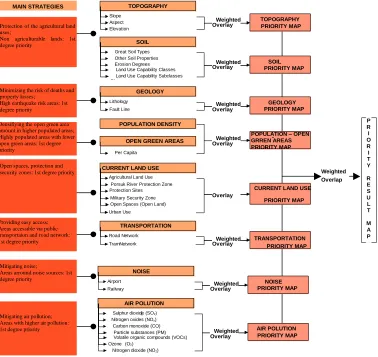
In this study, the data groups to be used within the same weighted overlay operation were determined. However, within the context of this study, weighted overlay was not utilized to define land suitability, but priorities for open green areas. After weighted overlaying the priority class points of each primary data group, primary priority maps were produced. In this study, two main data groups were used for weighted overlay, namely primary data groups such as geology, topography, noise and secondary data groups such as slope, aspect, great soil types etc. The values under secondary data groups are referred as attributes (for example andesite, basalt, gabro). The linear data such as fault line were evaluated with buffer analysis. In the last step of the overlay, primary priority maps were weighted overlaid and priority result maps were produced. Figure 2 illustrates the data groups used in the weighted overlay.
In the study, the attributes under the secondary data groups were classified in accordance with the priority to form open green areas and every priority class was given points. In case of buffer analysis, the priority classes were determined according to the buffer zones or proximity degrees. In this
study, four priority classes were determined as follows: - 1st degree priority / 4 points
- 2nd degree priority / 3 points - 3rd degree priority / 2 points - 4th degree priority / 1 point
As mentioned before, integer raster data was used for weighted overlay. Therefore, in the first place, all vector data were transformed into raster data with ArcInfo 9.0 Spatial Analyst. Afterwards, each raster data attribute in the layers was reclassified according to its priority class. Table II illustrates an example for the mentioned reclassification.
TABLE II
RECLASSIFICATION OF SLOP E ATTRIBUTE VALUES ACCORDING TO
PRIORITY CLASSES
Secondary
data group Attributes
Reclassification attributes
Priority class
Slope
0-10% 4
4th degree priority
10-20% 3 2nd
degree priority
20-25% 2 3rd
degree priority
> 25% 1 1st
degree priority
Each secondary data group was also appointed influence factors (percentages) where the sum of all influence percentages of secondary data groups under the same primary data group is 100. In defining the influence factors, seven strategies (Figure 4) were determined in this study as follows:
1. Constructing open green areas primarily in highly populated settlement areas,
2. Increasing agricultural capacity by protecting the agricultural lands; decreasing the erosion and protecting the soil,
3. Constructing a settlement area with high air quality and less noise problems,
4. Reserving earthquake risk areas for open green areas instead of housing and industry,
5. Selecting easily accessible lands (public transportation opportunities, road networks), 6. Preferring open spaces, security zones and
protection zones as priority lands for open green areas,
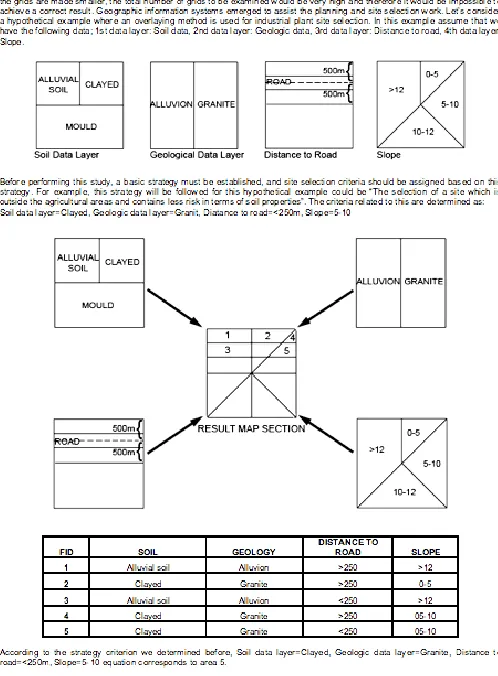
Fig. 1. A hypot hetical example for explaining overlay method
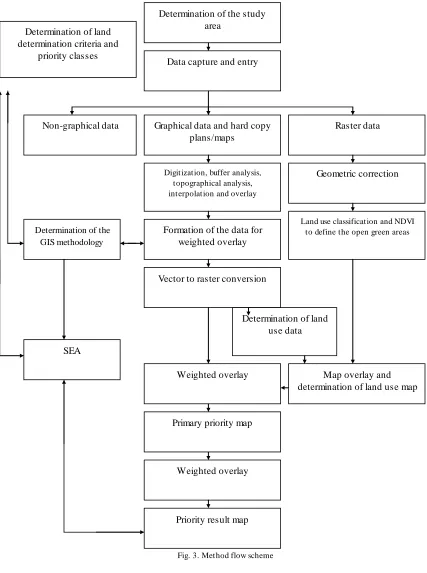
Fig. 3. Method flow scheme
Determination of the study area
Data capture and entry Determination of land
determination criteria and priority classes
Raster data Graphical data and hard copy
plans/maps Non-graphical data
Geometric correction
Land use classification and NDVI to define the open green areas
Map overlay and determination of land use map
Digitization, buffer analysis, topographical analysis, int erpolation and overlay
Formation of the data for weighted overlay
Vector to raster conversion
Determination of land use data
Weighted overlay Determination of the
GIS methodology
SEA
Primary priority map
Weighted overlay
TOPOGRAPHY Slope Aspect Elevation TOPOGRAPHY PRIORITY MAP SOIL
Great Soil Types Other Soil Properties Erosion Degrees
Land Use Capability Subclasses Classes
Land Use Capability Classes
GEOLOGY
Lithology Fault Line
OPEN GREEN AREAS
Per Capita
POPULATION DENSITY
CURRENT LAND USE
Agricultural Land Use Porsuk River Protection Zone Protection Sites
Urban Use
Open Spaces (Open Land)
TRANSPORTATION Road Network TramNetwork NOISE Airport Railway AIR POLUTION
Sulphur dioxide (SO2)(
Nitrogen oxides (NOx) Carbon monoxide (CO)
Nitrogen dioxide (NO2) Particle substances (PM)
Military Security Zone
Weighted Overlap Weighted Overlay AIR POLUTION PRIORITY MAP NOISE PRIORITY MAP TRANSPORTATION PRIORITY MAP CURRENT LAND USE
PRIORITY MAP POPULATION – OPEN GRREN AREAS PRIORITY MAP -GEOLOGY PRIORITY MAP SOIL PRIORITY MAP Weighted Overlay Weighted Overlay Weighted Overlay Overlay Weighted Overlay Weighted Overlay
Ozone (O3)
Volatile organic compounds (VOCs)
Weighted Overlay Protection of the agricultural land
uses;
Non agriculturable lands: 1st degree priority
Minimizing the risk of deaths and property losses;
High earthquake risk areas: 1st degree priority
Densifiying the open green area amount in higher populated areas; Highly populated areas with fewer open green areas: 1st degree priority
Open spaces, protection and security zones: 1st degree priority
Providing easy access; Areas accessible via public transportaion and road network: 1st degree priority
Mitigating noise;
Areas arround noise sources: 1st degree priority
Mitigating air pollution; Areas with higher air pollution: 1st degree priority
MAIN STRATEGIES P R I O R I T Y R E S U L T M A P
Fig. 4. Weighted overlay data
In the weighted overlay, each cell in a single layer was given a point value, which was calculated with the multiplication of the priority class point of the cell with the influence factor of the related secondary data group. The influence factors of the secondary data groups and the new values of the cells in each secondary data layer under the same primary data group were then again multiplied to get primary priority maps. Primary priority maps were also weighted overlaid with the same method to obtain priority result map (Figure 2). Table III summarizes the data groups, priority classes, po ints and influence values used for weighted overlay.
Besides the weighted overlay technique, other methods were also used during this study. For example, some data were generated as the result of the GIS analysis techniques. Moreover, hard copy plans and maps were digitized and some data were generated by overlaying. For the detection of open green areas from Landsat images within the study area, land use classifications and NDVI analysis were utilized. Land use data were generated by overlaying some raster data from different sources.
IV. RESULTS
Today, GIS and RS techniques have become inevitable for all phases of EIA and SEA. Especially, impact assessment methods require GIS and RS support in a large extent. The reason of this requirement is the necessity of handling many
complicated and different variants and incidents, which are changing in accordance with time and place 7.
GIS utilization for environmental practices is considerably old. The spatial dimension of the environmental information is one of the main reasons of GIS use in environmental practices. Ian McHarg first explained the necessity of overlay techniques for environmental sensitive planning in his ―Design with Nature‖ in 1969. Afterwards, this technique became one of the most important analysis techniques. In 1970s, a computerized overlay technique was developed. Then, GIS based modeling was introduced in 1980s. GIS became a tool for environment modeling. In1990s, GIS was accepted by almost everyone as the most proper method of working with environmental data 7.
Today GIS is used in all stages of the preparation of environmental assessments, due to its capacities for spatial data integration. GIS has the ability to store, integrate, analyze and display data, so it can be employed for data preparation, spatial analysis and presentation of results. Practitioners who prepare impact assessments generally use spatial data to perform the following tasks: screening and scoping, description of the project, establishment of the environmental baseline, impact mitigation and control, public consultation and participation, and monitoring and auditing. The advantages of employing GIS include the power of managing and organizing spatial data, the good visual capabilities and the ease of changing and updating the information 7.
The advantages of GIS support for EIA can be summarized as follows:
Spatial analysis and modeling capabilities for better impact assessment and evaluation,
Easy project area determination and alternative comparisons,
Easy storage, arrangement and updating capabilities for both graphical and non-graphical data.
Making the project apparent for all groups including the public who participate the impact assessment process with the technique of effective presentation. Most accurate and correct results in a short time. RS techniques can be used for the following steps of EIA and SEA:
Determination of existing land use, determination of vegetation type and density
Production of digital terrain model and maps
Tracing the environmental effects with the chan ge detection algorithms before, during and after the activity. The visualization techniques in RS software and three-dimensional modeling tools ease the job of decision makers. RS provides efficient monitoring and controlling activities.
V. DISCUSSION
It is not possible to use the traditional methods effectively, when the number of data used in the overlay is more than five 37. GIS enables us to make correct and fast analysis by using a good number of data sets. In this study, approximately 100 maps and 2000 different files were produced, updated and associated with each other in ArcInfo 9.0. The total file size was 25 GB. This means that in case of using traditional methods, more than three million grids (5x5 meters in size) should have been evaluated. It is impossible to say that this manual overlay method would provide the same accuracy, precision and speed. Besides, RS applications provide opportunities to better evaluate the impacts and monitor the site during and after the activity.
The priority result diestock that appears as the result of the analysis that are done in Eskisehir related to the results of the weighted overlay, which is practiced in this study, will be valuable for the introduce of the open-space areas and the practice of these areas within the extent of SEA studies. Making similar studies for all area usages that will be
introduced within the context of similar planning studies will provide the decisions that are related to the area to be defined in accordance with the most proper places and priorities.
The application of GIS and RS in SEA and EIA studies helps researcher in decision making process. These applications are very useful for producing, achieving, storing analyzing and managing the data. Mostly environmental and ecolo gical planning studies are performed by analyzing and overlaying hundreds of different data sources. For this reason; the RS and GIS based methodology described in this manuscript is very useful for environmental and ecological planning studies compared with traditional assessment methodology.
Data conversion from different sources can be easily done with GIS tools. Weighted overlay methodology can also be customized due to purpose or the subject. Reclassification and map algebra techniques expand the ability of spatial analyzing.
In this study, Landsat imagery was used to determine existing landuse, vegetation type and density. The accuracy of the study can be enhanced by using high resolution satellite imagery. Additionally, change detection analysis can b e done more accurately with high resolution satellite imagery. High resolution imagery usage is planned for future studies.
On the other hand, not only the green area priorities, but also the other subjects important for ecological and environmental impacts such as air, water, noise pollution limitations can also determined using RS and GIS integration. Due to for this purpose, specialists from appropriate disciplines should also support this project for Future Strategic Environmental Plans for Eskisehir.
Intercalarily, disaster mitigation plans , especially for the earthquakes which is extremely important for Eskisehir, should be prepared for future strategies. GIS and RS integration also provide powerful tools for this purpose. Lithological units, fault zones, liquefiable regions population density and the interactions among all, can be analyzed for earthquake risks using GIS. Risk maps are also data layers for city and regional planners.
TABLE III
DATA GROUP S AND VALUES USED FOR WEİGHTED OVERLAY
Influence Factor of Primary Priority Map
Primary Data
G roup Secondary Data G roup Attributes
Reclassification
Attributes Priority Class Priority Point
Influence Factor
P
R
IO
R
IT
Y
R
E
S
U
L
T
M
A
P
%5 Topography
Slope
% 0-10 4 4th degree priority 1
%60
% 10-20 3 3rd degree priority 2
% 20-25 2 2nd degree priority 3
> % 25 1 1st degree priority 4
Aspect
South 2 2nd degree priority 2
%40
North 4 4th degree priority 1
West 2 2nd degree priority 3
East 2 2nd degree priority 3
Southeast 1 1st degree priority 4
Southwest 1 1st degree priority 4
Northeast 3 3rd degree priority 2
Northwest 3 3rd degree priority 2
%20 Soil
Great Soil Ty pes
Brown Forest Soil 2 2nd degree priority 3
%20 Non-calcareous brown forest soil 3 3rd degree priority 2
Brown Soil 2 2nd degree priority 3
Non-calcareous brown soil 3 3rd degree priority 2
Alluvial Soil 4 4th degree priority 1
Colluvial Soil 4 4th degree priority 1
Other Soil Properties
Alkali-insufficient drainage 2 2nd degree priority 3
%15 Slightly salted-insufficient drainage 2 2nd degree priority 3
Slightly salted-alkali-insufficient drainage 2 2nd degree priority 3 Salted-alkali-insufficient drainage 1 1st degree priority 4
Rocky 2 2nd degree priority 3
Insufficient drainage 3 3rd degree priority 2
Erosion Degrees
Slight 4 4th degree priority 1
%15
Moderate 3 3rd degree priority 2
High 2 2nd degree priority 3
Very high 1 1st degree priority 4
Land Use Capability Classes
I-II 4 4th degree priority 1
%35
III-IV 3 3rd degree priority 2
V-VI 2 2nd degree priority 3
VII-VIII 1 1st degree priority 4
Land Use Capability Subclasses
Slope and erosion degradations 1 1st degree priority 4
%15 Soil incapability 2 2nd degree priority 3
Drainage and flood problem s 1 1st degree priority 4
%20 Geology
Lithology
Alluvion 1 1st degree priority 4
%50
Andesite 3 3rd degree priority 2
Basalt 3 3rd degree priority 2
Gabbro 4 4th degree priority 1
Granite 4 4th degree priority 1
Clay +m arl 2 2nd degree priority 3
Clay +m arl+tuff 3 3rd degree priority 2
Lim estone with clay + tuff 3 3rd degree priority 2
Lim estone 3 3rd degree priority 2
Conglom erate 3 3rd degree priority 2
Conglom erate+sandstone 2 2nd degree priority 3 Conglom erate+m arl 3 3rd degree priority 2
Sandstone 3 3rddegree priority 2
Marl+clay stone+lim estone 3 3rd degree priority 2
Melange 2 2nd degree priority 3
Marble 4 4th degree priority 1
Metadetritic 3 3rd degree priority 2
Peridotite 2 2nd degree priority 3
Serpentine 2 2nd degree priority 3
Schist 3 3rd degree priority 2
Tuff+tuffite 3 3rd degree priority 2
Fault Line
Zone 1: 0-50 m eter 1 1st degree priority 4
%50 Zone 2: 50-500 m eter 2 2nd degree priority 3
Zone 3: 500-1000 m eter 3 3rd degree priority 2 Zone 4: > 1000 m eter 4 4th degree priority 1
%15
Population Density and Open Green Areas
Population Density
0-100 person/ha 4 4th degree priority 1
%25 100-200 person /ha 3 3rd degree priority 2
200-250 person /ha 2 2nd degree priority 3 >250 person /ha 1 1st degree priority 4
Open Green Areas per capita
< 5 m 2/ person 1 1st degree priority 4
%75
5-10 m 2/ person 2 2nd degree priority 3
10-12 m 2/ person 3 3rd degree priority 2
TABLE III
(CONTİNUED) DATA GROUP S AND VALUES USED FOR WEİGTHED OVERLAY
Influence Factor of Primary Priority Map
Primary Data
G roup Secondary Data G roup Attributes
Reclassification
Attributes Priority Class
Priority Point
Influence Factor
P
R
IO
R
IT
Y
R
E
S
U
L
T
M
A
P
%5 Current Land Use
Agricultural Land Use
Wet-farm ing 4 4th degree priority 1
N
o w
e
ight
e
d ove
rl
a
y pr
oc
e
ss
.
Wet-farm ing (insufficient) 3 3rd degree priority 2 Dry -farm ing (fallowed) 4 4th degree priority 1
Viney ard 4 4th degree priority 1
Grassland 3 3rd degree priority 2
Meadow 2 2nd degree priority 3
Schrubbery 2 2nd degree priority 3
Porsuk River Protection
Zone 0-100 m 1 1st degree priority 4
Protection Sites Protection Sites 1 1st degree priority 4
Military Security Zone Military Security Zone 1 1st degree priority
4 Airport Open Spaces (Open Land) 1 1st degree priority 4
Urban Use Residential Areas 0 do not have priority 0
Industrial Areas 1 1st degree priority 4
%10 Transportation
Road Network
Access-easy 1 1st degree priority 3
%65
Access-difficult 2 2nd degree priority 2
Access-very difficult 3 3rd degree priority 1
Tram Network
Access to stations-easy 1 1st degree priority 3
%35 Access to stations-difficult 2 2nd degree priority 2
Access to stations-very difficult 3 3rd degree priority 1
%10 Noise
Airport
0-500 m 1 1st degree priority 4
%50
500-1000 m 2 2nd degree priority 3
1000-1500 m 3 3rd degree priority 2
>1500 m 4 4th degree priority 1
Railway
0-100 m 1 1st degree priority 4
%50
100-200 m 2 2nd degree priority 3
200-300 m 3 3rd degree priority 2
>300 m 4 4th degree priority 1
%15 Air-pollution
SO2
0-75 ton/y ear-km 2 4 4th degree priority 1
%15 75-150 ton/ y ear -km 2 3 3rd degree priority 2
150-300 ton/ y ear -km 2 2 2nd degree priority 3 >300 ton/ y ear -km 2 1 1st degree priority 4
CO
0-250 ton/ y ear -km 2 4 4th degree priority 1
%20 250-500 ton/ y ear -km 2 3 3rd degree priority 2
500-750 ton/ y ear -km 2 2 2nd degree priority 3 > 750 ton/ y ear -km 2 1 1st degree priority 4
PM
0-25 ton/ y ear -km 2 4 4th degree priority 1
%20 25-50 ton/ y ear -km 2 3 3rd degree priority 2
50-75 ton/ y ear -km 2 2 2nd degree priority 3 >75 ton/ y ear -km 2 1 1st degree priority 4
NOx
0-75 ton/ y ear -km 2 4 4th degree priority 1
%20 75-150 ton/ y ear -km 2 3 3rd degree priority 2
150-300 ton/ y ear -km 2 2 2nd degree priority 3 >300 ton/ y ear -km 2 1 1st degree priority 4
VOCs
0-15 ton/ y ear -km 2 4 4th degree priority 1
%10 15-30 ton/ y ear -km 2 3 3rd degree priority 2
30-70 ton/ y ear -km 2 2 2nd degree priority 3 >70 ton/ y ear -km 2 1 1st degree priority 4
O3
0-20 m icrogram /m 3 4 4th degree priority 1
%5 20-60 m icrogram /m 3 3 3rd degree priority 2
60-100 m icrogram /m 3 2 2nd degree priority 3 >100 m icrogram /m 3 1 1st degree priority 4
NO2
0-20 m icrogram /m 3 4 4th degree priority 1
%10 20-60 m icrogram /m 3 3 3rd degree priority 2
REFERENCES
[1] S. N. Çabuk, ― Site Selection Process for Mass Housing Projects
using GIS techniques in the context of SEA,‖ MSc t hesis, Dept. of Remote Sensing and Geographical Information System , Anadolu University, Eskisehir, T urkey, 2006.
[2] N.W. Kuo, T .Y. Hsiao, Y.H Yu, ― A delphi-matrix approach to
SEA and its application within the tourism sector in T aiwan ,‖ In:
Johnson E (ed), Environm ental Im pact Assessm ent Review, vol. 25,
pp. 259-280, 2005.
[3] C. Briffett, J.P. Obbard, J. Mackee, ― T owards SEA for the
developing nations of Asia,‖ In: Johnson E (ed), Environm ental
Im pact Assessm ent Review, vol. 23, pp. 171-196, 2003.
[4] T . Fischer, ― Strategic environmental assessment in post -modern
times,‖ In: Johnson E (ed), Environm ental Im pact Assessm ent
Review, vol.23, pp. 155-170, 2003.
[5] A. McLauchan and E. João, ― An independent body to oversee
strategic environmental assessment in Scotland: bureaucratic burden or efficient accountable administration?,‖ Graduate School of Environmental Studies, University of Strathclyde, Glasgow, Preliminary Report, 2005.
[6] B. Cun-kuan, L. Yong-sena, S. Jin-Chengb, ― Framework and
operational procedure for implementing Strategic Environmental
Assessment in China,‖ Environm ental Im pact Assessm ent Review,
vol. 24 (1), pp. 27-46, 2004.
[7] M. Vanderhaegen and E. Muro, ― Contribution of European spatial
data infrastructure to the effectiveness of EIA and SEA studies,‖ In:
Johnson E (ed), Environm ental Im pact Assessm ent Review, vol. 25,
pp. 123-142, 2005.
[8] B. Noble, ― Strategic environmental assessment quality assurance:
evaluating and improving the consistency of judgments in
assessment panels,‖ Environm ental Im pact Assessm ent Review, vol.
24 (1), pp. 3-25, 2004.
[9] G. Finnveden, M. Nilsson, J. Johansson, A. Persson, A. Moberg, T .
Carlsson, ― Strategic environmental assessment methodologies -
applications within the energy sector,‖ Environm ental Im pact
Assessm ent Review, vol. 23 (1), pp. 91-123, 2003.
[10]G. Stoeglehner and M. Narodoslawsky, ― Implementing ecological
foot print ing in decision-making processes,‖ Land Use Policy, vol. 25 (3), pp. 421-431, 2008.
[11]M. Höjer, S. Ahlroth, K.H. Dreborg, T . Ekvall, G. Finnveden, O. Hjelm, E. Hochschorner, M. Nilsson, V. Palm, ― Scenarios in
selected tools for environmental systems analysis,‖ Journal of
Cleaner Production, vol. 16 (18), pp.1958-1970, 2008.
[12]M. Hanusch and J. Glasson, ― Much ado about SEA/SA monitoring:
T he performance of English Regional Spatial Strategies, and some
German comparisons,‖ Environm ental Im pact Assessm ent Review,
vol. 28 (8), pp.601-617, 2008.
[13]J. Burns and A. Bond, ― T he consideration of health in land use
planning: barriers and opportunities,‖ Environm ental Im pact
Assessm ent Review, vol. 28 (2-3), pp. 184-197, 2008.
[14]J. Sinclair, A. Diduck, P. Fitzpatrick, ― Concept ualizing learning for
sustainability through environmental assessment: critical
reflections on 15 years of research ,‖ Environm ental Im pact
Assessm ent Review, vol. 28 (7), pp.415-428, 2008.
[15]J. Koornneef, A. Faaij, W. T urkenburg, ― T he screening and scoping
of Environmental Impact Assessment and Strategic Environmental Assessment of Carbon Capture and Storage in the Netherlands,‖
Environm ental Im pact Assessm ent Review, vol.28 (6), pp.392-414 2007.
[16]F. Retief, ― A performance evaluation of strategic environmental
assessment (SEA) processes within the South African context ,‖
Environm ental Im pact Assessm ent Review, vol. 27 (1), pp. 84-100, 2007.
[17]L. Garcia-Montero, I. Otero Pastor, S.M. Quintana, M.A.
Casermeiro, ― An environmental screening tool for assessment of
land use plans covering large geographic areas,‖ Environm ental
Science and Policy, vol.11 (4), pp.285-293, 2007.
[18]O. Bina, ― A critical review of the dominant lines of argumentation
on the need for strategic environmental assessment ,‖ Special issue
on SEA T heory, Environm ental Im pact Assessm ent Review, vol. 27
(7), pp. 585-606, 2007.
[19]T . Jackson and B. Illsley, ― An analysis of the theoretical rationale
for using strategic environmental assessment to deliver
environmental justice in the light of the Scottish Envir onmental
Assessment Act ,‖ Special issue on SEA T heory, Environm ental
Im pact Assessm ent Review, vol 27 (7), pp. 607-623, 2007.
[20]T .H. Rydevik and H. Bjarnadottir, ― Context awareness and
sensitivity in SEA implementation,‖ Special issue on SEA T heory,
Environm ental Im pact Assessm ent Review, vol. 27 (7), pp. 666-684, 2007.
[21]A. Jiricka and U. Pröbstl, ― SEA in local land use planning – first
experience in the Appine States,‖ Environm ental Im pact
Assessm ent Review, vol.28 (4-5), pp.328-337 2007.
[22]D. Geneletti, S. Baglib, P. Napolitanoc, A. Pistocchib, ― Spatial decision support for strategic environmental assessment of land use plans. A case study in southern Italy,‖ In: João E (ed), Special Issue
on Data and Scale Issues for SEA, Environm ental Im pact
Assessm ent Review, vol. 27 (5), pp. 408-423, 2007.
[23]M.R. Partidario, ― Scales and associated data – What is enough for SEA needs?,‖ In: João E (ed), Special Issue on Data and Scale Issues for SEA, Environm ental Im pact Assessm ent Review, vol. 27 (5), pp. 460-478, 2007.
[24]E. João, ― A research agenda for data and scale issues in Strategic Environmental Assessment (SEA),‖ In: João E (ed), Special Issue
on Data and Scale Issues for SEA, Environm ental Im pact
Assessm ent Review, vol. 27 (5), pp. 479-49, 2007.
[25]J. Marull, J. Pino, J.M. Mallarach, M.J. Cordobilla, ― A land
suitability index for Strategic Environmental Assessment in
metropolitan areas,‖ Landscape and Urban Planning, vol.81 (3),
pp.200-212, 2007.
[26]D. Zhu and J. Ru, ― Strategic environmental assessment in China:
Motivations, politics, and effectiveness‖, Journal of
Environm ental Managem ent,vol.88 (4), pp.615-626, 2008.
[27]S. Salhofer, G. Wassermanna, E. Binnera, ― Strategic environmental
assessment as an approach to assess waste management systems:
Experiences from an Austrian case study,‖ The Second Biannual
Meeting of the International Environm ental Modeling and Software Society - The Im plications of Com plexity for Integrated Resources, Environm ental Modeling and Software, vol. 22 (5), pp. 610-618, 2007.
[28]T . T ao, Z. T an, X. He, ― Integrating environment into land-use planning through strategic environmental assessment in China:
T owards legal frameworks and operational procedures,‖
Environm ental Im pact Assessm ent Review, vol. 27 (3), pp. 243-26, 2007.
[29]A. Donnelly, M. Jones, T . O'Mahony, G. Byrne, ― Selecting
environmental indicator for use in strategic environmental
assessment ,‖ Environm ental Im pact Assessm ent Review, vol. 27
(2), pp. 161-175, 2007.
[30]A. Perdicoúlisa, M. Hanuschb, H.D. Kasperidusb, U. Weilandb,
―T he handling of causality in SEA guidance,‖ Environm ental
Im pact Assessm ent Review, vol. 27 (2), pp. 176-187, 2007. [31]U.M. Mörtberg, B. Balforsa, W.C. Knolb, ― Landscape ecological
assessment: A tool for integrating biodiversity issues in strategic
environmental assessment and planning,‖ Journal of
[32]R. T herivel and F. Walsh, ― T he strategic environmental
assessment directive in the UK: One year onwards,‖ Environm ental
Im pact Assessm ent Review, vol. 26 (7), pp. 663-675, 2006. [33]N.W. Kuo and Y.T . Chiu, ― T he assessment of agritourism policy
based on SEA combination with HIA,‖ Land Use Policy, vol. 23
(4), pp. 560-570, 2006.
[34]G. Stoeglehner and G. Wegerer, ― T he Directive and the
SEA-Protocol adopted to spatial planning—similarities and differences,‖
Environm ental Im pact Assessm ent Review, vol. 26 (6), pp. 586-599, 2006.
[35]N.P. Say and M. Yücel, ― Strategic environmental assessment and
national development plans in T urkey: T owards legal framework
and operational procedure,‖ Environm ental Im pact Assessm ent
Review, vol. 26 (3), pp. 301-316, 2006.
[36]I. McHarg, Design with Nature. Natural History Press, Garden City,
New York, USA, 1969.
[37]Ş. Şahin and A. Çabuk, ―GIS use in environmental assessment
studies,‖ in Proc.Accessible GIS Conference, Ankara, 1998.
S. N. Ç abuk was born in Ankara, T urkey, in 1975.
She studied landscape architecture between 1993 -1997 at the Dept. of Landscape Architecture, Ankara University , Ankara, T urkey. She received her first MSc. degree on landscape architecture in 2000 from Ankara University and she completed her second master on remote sensing and geographical information system in 2006, Anadolu University, Eskisehir. She is continuing her doctorate education on landscape architecture at the Dept. of Landscape Architecture, in Ankara University, Ankara.
She worked as a GIS expert between 2001-2003 at American Geomatics Group Inc., in Ankara and then started her career as a landscape architecture at the department of planning in T epebasi Municipality, Eskisehir, in 2003. Since 2005, she has been working as a landscape architect at the department of planning in Odunpazari Municipality, Eskisehir.
Mrs. Çabuk is a member of Chamber of Landscape Architects and T urkish Quality Organization.
H.Uygu çgil was born in Eskisehir, T urkey, in 1966.
He graduated from Mining Engineering Department of Anadolu University in 1991. He received his MSc. on GIS from Osmangazi University in 1994. He completed his PhD. on geostatistics from Osmangazi University in 2007.
He worked as research assistant in Anadolu University Satellite and Space Sci. Res. Inst. between 1992-1998. Later he worked as GIS Department Manager in Greater Eskisehir Municipality between 1999-2009. He has been working as Assistant Professor in Anadolu University Satellite and Space Sci. Res. Inst. since July, 2009.
A.Ç abuk was born in Hatay, T urkey, in 1971. He
completed his BSc. on Landscape Architecture in Ankara University. He received his first MSc. on Environmental Management from International T echnological University and his second master degree on Environmental Economics from Ankara University.
He worked as researcher in different universities, T urkish Scientific and T echnical Research Council and some international companies. He has been working as academician in Anadolu University since 2002. Currently he is Director of Satellite and Space Sci. Res. Inst. of Anadolu University.
M. Ince oglu was born in 1972 in Karacasu, T urkey.
He received his BSc. on architecture in 1995 from Karadeniz T echnical University. In 1999, he completed his M.Sc. on architecture from Karadeniz T echnical University, Institute of Science, and Department of Architecture. He has completed his Ph.D. in 2007 in Yildiz T echnical University on architecture.