Voluntary Emissions Reduction Program for
Major Industrial Sources of Sulfur Dioxide in
Nine Western States and
A Backstop Market Trading Program
An Annex to the
Report of the
Grand Canyon Visibility Transport Commission
Submitted by the
Western Regional Air Partnership
to the U.S. Environmental Protection Agency
EXECUTIVE SUMMARY
The Colorado Plateau is a spectacular landscape of massive landforms, unique geology and vivid colors. People from around the world have experienced these wonders at Grand Canyon...and other national parks and wilderness areas on the Plateau. The panorama is a visual experience, and air quality is the key to full enjoyment. On hazy days, when visibility is reduced, the human eye perceives a loss of color, contrast and detail in the landscape...The Colorado Plateau has some of the best visual air quality in the United States. Paradoxically, this means that reduced visual air quality that might go unnoticed in other parts of the United States is starkly apparent on the Plateau. Visual air quality in the West is quite sensitive to relatively small increases in pollutants.
Grand Canyon Visibility Transport Commission
Recommendations for Improving Western Vistas, June 1996, page 1 In the July 1, 1999, promulgation of the federal rule to address the regional haze that impairs visibility in mandatory Class I areas, EPA considered both the recommendations and the supporting technical work of the Grand Canyon Visibility Transport Commission. Section 309 of the rule provides a special option to implement the Commission’s recommendations for the 16 Class I areas on the Colorado Plateau. However, in order for the states and tribes in the region to use the §309 option, an Annex to the Commission’s recommendations must be submitted by October 1, 2000 for EPA review.
The Annex was developed by the Western Regional Air Partnership (the WRAP), the successor to the Commission. The Annex defines stepped reduction milestones though 2018 for sulfur dioxide emission from large industrial sources in the 9-state Commission Transport Region that affects the Colorado Plateau. The Annex also sets forth provisions for a backstop emission trading program to be implemented if the milestones are exceeded. This program is only one part of the Commission’s comprehensive recommendations; other sources and other pollutants will be addressed as states and tribes prepare implementation plans due in 2003 and later.
The Annex has been developed over a three-year period by the WRAP’s Market Trading Forum, a group made up of state, tribal and federal agency personnel as well as industrial and environmental group representatives, and by the WRAP’s Initiatives Oversight Committee, a group that has similar representation. The resulting complete package of recommendations reflects the inter-relationships among the program elements and stresses the importance of a balanced proposal to address all stakeholder concerns. Further details can be found at www.wrapair.org.
2018 MILESTONE
The 2018 milestone of 510,000 tons, including a 30,000 ton set-aside for two copper smelters not currently operating (or 480,000 tons if the suspended smelters do not resume operation), represents a regional emission reduction of approximately 320,000 tons of SO2 from the 1990 baseline emissions of 830,000 tons, and is well on the way to the Commission’s goal of a 50 - 70% reduction by 2040. The regional haze rule requires that total reductions by 2018 be "better than BART," that is, greater than could be achieved by retrofitting 250 tons per year sources that were built between 1962 and 1977 and currently are operating without modern emissions controls. The WRAP estimated that BART
reductions would total approximately 170,000 tons by 2018.
INTERIM MILESTONES
After considerable investigation, the Forum determined that 1999 SO2 emissions, including expected emissions of 38,000 tons from the two smelters not currently operating, were about 690,000 tons. Interim milestones are intended to meet the Commission’s recommendation for steady and continuing reductions, while giving the regulated community operating flexibility in the early years and time to mesh planning for regional haze reductions with other factors such as electricity deregulation. The proposed interim milestones with the suspended smelters in and out respectively are 720,000/682,000 tons in 2003; 715,000/677,000 tons in 2008; and 655,000/625,000 tons in 2013. Milestones step down every fifth year.
TRIGGERING THE TRADING PROGRAM
States and tribes will collect an annual SO2 inventory. Compliance with the milestones is determined by an annual comparison of the rolling 3-year average of total regional emissions with the rolling 3-year average of the milestones. For 2018, total emissions will be compared with the 2018 milestone. If a milestone is exceeded, the trading program is activated, and emission allocations are made one year later with sources having 5 years from the year of exceedance to comply. Sources may comply by retrofitting to bring emissions below their allocation, by buying credits to emit from other sources that are able to comply more cheaply, or by retiring the source.
CERTAINTY THAT 2018 MILESTONE WILL BE MET ON TIME
With such a large proportion of the reductions scheduled to occur in the last 5 years of the program, it is important to ensure that all the reductions occur on time. Therefore, the proposal includes a
mechanism for the states and tribes to activate the trading program in 2013 if available evidence indicates the 2018 milestone will not be reached. Also, compliance with the 2018 milestone will be based on 2018 emissions alone (in addition to compliance based on a three-year rolling average of emissions), and sources that have not controlled their emissions in accordance with their allocations will be subject to financial penalties and a 2-to-1 offset of future emissions allocations for each ton of excess
emissions if the 2018 milestone is not met.
TRADING PROGRAM FEATURES
Details of the backstop trading program such as applicability, monitoring and reporting, trading
procedures, compliance requirements and penalties, are defined in the Model Rule that will be used as a template as participating states and tribes develop their implementation plans in 2003. States and tribes will agree to participate and administer the program by signing a memorandum of understanding. Sources that reduce their emissions below their allocation will be able to "bank" those credits for sale to other sources, within certain programmatic restrictions.
REASONABLY ATTRIBUTABLE BART AND GEOGRAPHIC ENHANCEMENT
The existing program to address "hot spots" where specific sources contribute to visibility impairment in protected Class I areas remains in place through 2018. Federal land managers expect to certify impairment only in Class I areas where sulfates are not decreasing, the sources are within 100 miles, and the sources are controlling less than 85% of their emissions. States and tribes intend that the program not be used to address regional haze, but focus on reasonably attributable impacts, and expect to develop guidance to address the distinction between the two. If there is a finding of reasonable attribution, states and tribes have 3 options: BART controls could be required on the attributable sources, emission reductions could be required from other sources, or, in advance of certification, reasonably attributable sources and states could negotiate a settlement to apply control measures.
ALLOCATIONS
If the program is triggered, 20,000 tons of SO2 allocations will be set aside for tribal interests, acknowledging that tribal lands are largely undeveloped and that tribes would not benefit from a plan based only on past emissions. Second, there will be a new source set-aside to accommodate growth within the region. Third, there will be an allocation for the California RECLAIM program. Fourth, existing sources will receive a "floor"allocation based on some specified level of control such as BACT, BART, LAER, and certain renewable energy sources also will be eligible to receive an allocation. The remainder of the allowances, which will decline over the years, will be allocated to existing sources. Each source’s allocation will be specified in state and tribal implementation plans due in 2003 and every fifth year thereafter. If the program is triggered, sources may buy and sell allowances to come into compliance.
STATE AND TRIBAL OPT-IN OR OPT-OUT
In the event that states or tribes with existing sources in the region choose to develop their regional haze plans under §308, proportional adjustments will be made to the milestones and the program
OTHER CLASS I AREAS
It is the intention of the states and participating tribes to demonstrate in the 2003 Implementation Plans, that the milestones and backstop trading program will satisfy the “greater reasonable progress than BART" requirements, and any other reasonable progress requirements for additional Class I areas through 2018. This demonstration will apply to all sources of sulfur dioxide participating in that
program. The work plan and resources needed to make this demonstration in the 2003 implementation plans will be identified and provided by the WRAP. Class I areas beyond the original 16 will be addressed in the Annex, even if only to identify the process and procedures to address this issue in the 2003 implementation plans.
Further, the states must evaluate other sources and pollutants in order to demonstrate reasonable progress for additional Class I area. Although it is their intent to do so, the states and tribes recognize that it may not be practicable to satisfy the additional Class I area requirements for all other sources of anthropogenic emissions besides stationary sources (e.g., mobile and area source sectors), and for all species of visibility impairing pollutants from stationary sources (e.g., NO x and PM), by the 2003
GLOSSARY OF ACRONYMS AND TERMS
BART Best Available Retrofit Technology. A requirement under Section 169A of the Clean Air Act and the provisions of 40 CFR subpart P.
BFS Baseline Forecast Scenario. Emission projections produced by the IAS based on assumptions of expected future economic conditions and known regulatory requirements.
CEMS Continuous emission monitoring system. The equipment required under 40 CFR part 75 to sample, analyze, measure and provide a permanent record of sulfur dioxide emissions.
EF Emissions Forum. The Emissions Forum is responsible for the oversight of the
assembly and quality assurance of the emissions inventories and forecasts to be utilized by the WRAP forums and oversees the development of a comprehensive emissions tracking and forecasting system.
FLMs Federal Land Managers. The Bureau of Land Management, U.S. Fish and Wildlife Service, U.S. Forest Service, and the National Park Service.
GCVTC The Grand Canyon Visibility Transport Commission. The GCVTC was authorized under section 169B(f) of the Clean Air Act and composed of the governors of eight western states (AZ, CA, CO, NM, NV, OR, UT, WY), four tribes (Acoma Pueblo, Hopi, Hualapai, and Navajo), four federal land managers (Bureau of Land
Management, U.S. Fish and Wildlife Service, U.S. Forest Service, National Park Service), the Columbia River Inter-Tribal Fish Commission, and the Environmental Protection Agency. The Commission was established to recommend methods to preserve and improve visibility on the Colorado Plateau, and submitted
recommendations to EPA in June, 1996.
IAS Integrated Assessment System. A computer model created by the GCVTC to generate information about future emissions of visibility impairing pollutants and the visibility impacts of those emissions on 16 Colorado Plateau Class I areas (including the Grand Canyon) based on expected future economic trends and a variety pollution control scenarios.
IOC Initiatives Oversight Committee. The Initiatives Oversight Committee provides general oversight for the coordination and development of air quality strategies necessary to promote the implementation of the GCVTC recommendations. The IOC refers issues to forums, reviews recommendations from forums and makes recommendations to the WRAP.
MTF Market Trading Forum. The Market Trading Forum is charged with implementing the stationary source recommendations of the GCVTC.
SO2 Sulfur dioxide.
WEB Trading Program
Western Emissions Budget Trading Program. The WEB Trading Program, or Web Program, is the backstop market trading program that will be triggered in the event regional emissions exceed any of the emission reduction milestones established for the region. The emissions reductions required under the trading program will ensure that future milestones are achieved.
WRAP Western Regional Air Partnership. The WRAP is a collaborative effort of tribal governments, state governments and federal agencies to promote and monitor implementation of recommendations from the Grand Canyon Visibility Transport
Commission (GCVTC). The WRAP may also address other common Western regional air quality issues as raised by its membership. The activities of the WRAP are
conducted by a network of committees and forums, composed of WRAP members and stakeholders who represent a wide range of social, cultural, economic, geographic and technical viewpoints.
I. BACKGROUND
"Historically, visibility has been defined as the greatest distance at which an observer can just see a black object viewed against the horizon sky. ...Nevertheless, visibility is more than being able to see a black object at a distance." (William C. Malm, Introduction to Visibility, CIRA, May 1999) The observer of the spectacular vistas in the Class I areas on the Colorado Plateau will notice the colors of the scenery, the complexity of the geologic features, the shadows of overhead clouds, and the inherent beauty of the landscape features. Particles in the atmosphere interfere with the observer’s ability to see and appreciate the landscape. Some particles scatter light so that the observer sees a gray-white glare; other particles absorb light so that the scene appears gray and definition of the features is lost. In the Western United States average visual range is about 100 - 150 kilometers, about one-half to two-thirds of the visual range that would exist without manmade air pollution. (Preamble, Regional Haze rule, 64 FR 35715)
Particles come from a variety of sources ranging from desert dust and forest fires to the gaseous emissions of cars and industrial sources that combine with other substances in the atmosphere to form particles. The specific pollutants affecting visibility are sulfates, nitrates, organic carbon, elemental carbon, and soil dust.
A. 1977 Clean Air Act
In 1977, Congress amended the Clean Air Act to include provisions to protect the scenic vistas of the nation’s National Parks and Wilderness Areas. In these amendments, Congress declared as a national visibility goal:
“The prevention of any future, and the remedying of any existing impairment of visibility in mandatory class I Federal areas which impairment results from man-made air pollution.
To address this goal, the Environmental Protection Agency (EPA) developed regulations to reduce the impact of large industrial sources on nearby Class I areas. It was recognized at the time that regional haze, which comes from a wide variety of sources that may be located far from a Class I area, was also a part of the visibility problem. However, monitoring networks and visibility models were not yet developed to the degree that was necessary to understand the causes of regional haze.
B. Grand Canyon Visibility Transport Commission
In 1990, Congress amended the Clean Air Act, and as part of these amendments created the Grand Canyon Visibility Transport Commission (GCVTC). The Commission was given the charge to assess the currently available scientific information pertaining to adverse impacts on visibility from potential growth in the region, identify clean air corridors, and recommend long-range strategies for addressing regional haze.
The GCVTC completed significant technical analysis and developed recommendations to improve visibility in the 16 mandatory federal Class I areas on the Colorado Plateau. The Commission found that visibility impairment in the Colorado Plateau was caused by a wide variety of sources and pollutants. A comprehensive strategy was needed to address all of the causes of regional haze. The GCVTC submitted these recommendations to EPA in a report dated June 1996 for consideration in rule development. These recommendations were:
• Air Pollution Prevention. Air pollution prevention and reduction of per capita pollution is a high priority for the Commission. The Commission recommends policies based on energy conservation, increased energy efficiency and promotion of the use of renewable resources for energy production.
• Clean Air Corridors. Clean air corridors are key sources of clear air at Class I areas, and the Commission recommends careful tracking of emissions growth that may affect air quality in these corridors.
• Stationary Sources. For stationary sources, the Commission recommends closely monitoring the impacts of current requirements under the Clean Air Act and ongoing source attribution studies. Regional targets for SO2 emissions from stationary sources will be set, starting in 2000. If these targets are exceeded, this would trigger a regulatory program, probably including a regional cap and market-based trading. During the next year, participants in the Commission's process will develop a detailed plan for an emissions cap and market trading program.
• Areas In And Near Parks. The Commission's research and modeling show that a host of identified sources adjacent to parks and wilderness areas, including large urban areas, have significant visibility impacts. However, the Commission lacks sufficient data regarding the visibility impacts of emissions from some areas in and near parks and wilderness areas. In general, the models used by the Commission are not readily applicable to such areas. Pending further studies of these areas, the Commission recommends that local, state, tribal, federal, and private parties cooperatively develop strategies, expand data collection, and improve modeling for reducing or preventing visibility impairment in areas within and adjacent to parks and wilderness areas.
• Mobile Sources. The Commission recognizes that mobile source emissions are projected to decrease through about 2005 due to improved control technologies. The Commission recommends capping emissions at the lowest level achieved and establishing a regional emissions budget, and also endorses national strategies aimed at further reducing tailpipe emissions, including the so-called 49-state low emission vehicle, or 49-state LEV.
• Road Dust. The Commission's technical assessment indicates that road dust is a large contributor to visibility impairment on the Colorado Plateau. As such, it requires urgent attention. However, due to considerable skepticism regarding the modeled contribution of road dust to visibility impairment, the
Commission recommends further study in order to resolve the uncertainties regarding both near-field and distant effects of road dust, prior to taking remedial action. Since this emissions source is potentially such a significant contributor, the Commission feels that it deserves high priority attention and, if warranted, additional emissions management actions.
• Emissions from Mexico. Mexican sources are also shown to be significant contributors, particularly of SO2 emissions. However, data gaps and jurisdictional issues make this a difficult issue for the Commission to address directly. The Commission recommendations call for continued binational collaboration to work on this problem, as well as additional efforts to complete emissions inventories and increase monitoring capacities. These matters should receive high priority for regional and national action.
• Fire. The Commission recognizes that fire plays a significant role in visibility on the Plateau. In fact, land managers propose aggressive prescribed fire programs aimed at correcting the buildup of biomass due to decades of fire suppression. Therefore, prescribed fire and wildfire levels are projected to increase significantly during the studied period. The Commission recommends the implementation of programs to minimize emissions and visibility impacts from prescribed fire, as well as to educate the public.
• Future Regional Coordinating Entity. Finally, the Commission believes there is a need for an entity like the Commission to oversee, promote, and support many of the recommendations in this report. To support that entity, the Commission has developed a set of recommendations addressing the future administrative, technical and funding needs of the Commission or a new regional entity and has asked the Operations Committee to complete detailed plans by September, 1996. The Commission strongly urges the EPA and Congress to provide funding for these vital functions and give them a priority reflective of the national importance of the Class I areas on the Colorado Plateau.
The stationary source recommendations were a key part of the overall Commission recommendations because they established a backstop trading program that would be implemented if the Commission goals were not met through voluntary measures. The projections and analyses undertaken by the GCVTC indicated that existing requirements under the Clean Air Act, coupled with voluntary measures undertaken by sources, would result in sufficient reductions to address visibility concerns. The purpose of the backstop trading program is to ensure that the emission reduction goals necessary to demonstrate reasonable progress in accordance with the regional haze rule do indeed occur – if sufficient reductions as defined by the milestones are not achieved, the backstop trading program will be activated to ensure further regional reductions. The backstop program would begin within one year after emissions are determined to exceed the relevant milestone, and compliance is required within five years after this determination. Program design elements such as rigorous monitoring and reporting, public availability of emissions and allowance data, as well as compliance information, would ensure confidence of the regulators and the public that requisite reductions are achieved under this backstop program. The GCVTC encouraged states and tribes to review the visibility impacts of uncontrolled pollution sources at Class I sites on the Colorado Plateau and make expeditious determination regarding the need for additional pollution controls pursuant to the Clean Air Act (CAA) to address reasonably attributable impairment. Until such time the trading program is triggered, however, all stationary source reductions for the widespread issue of regional haze will be of a voluntary nature.
The stationary source goals are described in greater detail below.
1. Implement existing Clean Air Act requirements through the year 2000.
Implementation of existing Clean Air Act requirements is expected to result in a significant decrease in sulfur dioxide emissions and their contribution to light extinction in the short term (1990-2000). ... States and tribes are encouraged to review the visibility impacts at Class I sites on the Colorado Plateau of uncontrolled pollution sources and make expeditious determinations regarding the need for additional pollution controls pursuant to the Clean Air Act. To the extent decisions are made to require additional emission reductions at existing facilities, the Commission supports the adoption of the best, most cost-effective strategies.
2. Establish stationary source emission targets as regulatory triggers.
a) An SO2 emissions target for stationary sources will be established effective in the year 2000. The level of the target would be calculated by (1) determining the amount of emission reductions that has actually been achieved (or legally committed to) between 1990 and 2000; (2) comparing the actual reduction to the 13% reduction from 1990 actual emission levels that was projected by the Baseline Forecast Scenario; (3) assuming the actual reduction is higher than the projected reduction, set the emissions target at a level midway between the projected and actual, unless any affected party convinces the Commission or its successor that a different distribution is needed (e.g., emissions growth in undeveloped areas, operational flexibility needs, deteriorating visibility). As part of this calculation, the 1990 emissions inventory will be compared to the reported emissions to 1995/1996 data now available from sources (all utilities and many stationary sources have Continuous Emission Monitors).
b) An ultimate SO2 emissions target for the visibility Transport Region will be established for the year 2040 that locks in the 50-70% reduction in SO2 emissions projected by the Baseline Forecast Scenario. Interim targets may also be needed to ensure steady and continuing emission reductions and to promote investment in pollution prevention (in accordance with five year review periods as described in #4 below).
c) Various emissions management options for stationary source NOx and PM will be explored, including considering the establishment of emission targets, in order to avoid any net increase in these pollutants from stationary sources within the region as a whole and to provide a foundation for future incorporation into a multi-pollutant and possibly multi-source market-based program.
3. Develop a plan for allocating trading credits under a regulatory program emissions cap.
a) Development of an equitable plan for allocating the trading credits among existing and future sources will be accelerated. The Commission expects that the targets will be met based on existing commitments and other actions that are likely to be required because of ongoing source attribution studies. However, in order to create economic incentives for early reductions as well as to provide flexibility and certainty to sources in planning future actions, participants in the Commission's process are committed to designing the plan before the EPA takes final action on the Commission s recommendations so that the elements of that program can be incorporated into the federal regulatory program. (The estimated date for completing development of the program is June, 1997). A number of factors will be considered in developing the program, including measures to:
• prevent new sources from causing the target to be exceeded;
• account for sources which achieve emission reductions early or have achieved maximum control efficiency;
• ensure that all allocations to tribal lands, rural areas and relatively undeveloped areas (e.g., clean air corridors) are of practical benefit; and
• account for the effects of increases or decreases of emissions on visibility. b) In order to generate information for development and implementation of the
incentive-based program, owners and operators of existing facilities located within the Transport Region should: (1) by 1997, notify states and tribes of existing or planned pollution control or prevention measures; and (2) report biannually on efforts that are being made to manage their emissions or engage in other transactions to voluntarily meet their emissions reductions
responsibility per the trading credit allocation scheme. These plans would not be incorporated as enforceable permit conditions or SIP revisions except as noted below.
4. Review compliance with targets and establish incentives.
Progress in complying with the emissions target(s) would be assessed in the year 2000 and at five-year intervals thereafter.
a) In 2000, or any subsequent five-year review period, if the regional target in effect at that period has not been exceeded no additional regulatory program will be required. Any source that has contributed significantly to achieving the needed reductions by going beyond compliance or achieving early reductions will be rewarded. For instance, the following rewards could be included: • an exemption from any interim target requirements that might be established;
• streamlined treatment in the permitting process; • ability to bank emissions; or
• bonus allowances if credits are used to achieve development on tribal lands or other areas that are relatively undeveloped.
Incentives will be further developed and included in the design of the program.
b) In 2000, or at any subsequent five-year review period, if the regional emissions target has been exceeded, a regulatory program (most likely an emissions cap and incentive-based market trading program) will be implemented. Any source that is exceeding the emission allocation presented in the plan will have no more than five years to come into compliance and any
reductions achieved will be discounted. Other disincentives will be developed and included in the design of the program.
5. Complete source attribution studies.
The Commission strongly encourages the EPA to complete, within one year, the source attribution study currently underway at the Mohave Power Project. Further, the Commission strongly encourages the EPA to take action consistent with the results of that study within twelve months of its completion. The Commission supports the commitment by the Mohave Power
Project to maintain voluntarily its emissions at or below current levels (e.g., an average of the past two year's emission levels).
6. Develop an improved monitoring and accounting system.
A major deficiency in the technical analysis associated with the GCVTC activities has been the lack of adequate and reliable monitoring data. In order for any visibility policy to be effective, there must be an adequate benchmark of existing conditions against which to measure progress. To obtain a better understanding of visibility throughout the Colorado Plateau, Class I areas other than Hopi Point in the Grand Canyon need to be included as receptors in visibility modeling and additional monitoring sites should be established.
Emissions in the Transport Region provide another benchmark against which to measure progress. An accurate and credible emissions accounting method will be essential in determining compliance with the emissions targets or caps. Shortcomings in the emissions inventory need to be remedied, and a method for routinely tracking emissions needs to be developed.
It is critical that the emissions monitoring and tracking system be developed quickly so that emission reductions achieved between now and the year 2000 can be recorded and so that those areas that are presently lower-emitting can receive appropriate credit. If an incentive-based regulatory program is implemented after the year 2000, early emission reductions achieved before the year 2000 should be awarded credit, provided established criteria are satisfied.”
C. Regional Haze Rule
On April 22, 1999, the EPA issued regulations to improve visibility in 156 national parks and
wilderness areas across the country by addressing regional haze. These regulations were published in the Federal Register on July 1, 1999 (64 FR 35714). The regional haze regulations require states to establish goals for improving visibility and to develop long-term strategies for reducing emissions of pollutants that cause visibility impairment.
The regional haze rule establishes in §309 specific SIP requirements which may be used by the nine "transport region states" included in the GCVTC analysis (Arizona, California, Colorado, Idaho, Nevada, New Mexico, Oregon, Utah, and Wyoming) and the 211 tribes in the same geographic area to satisfy the national regional haze rule requirements for the period from 2003 to 2018. These states and tribes also have the option to submit SIPs and TIPs under the nationally applicable §308
provisions. Because of the substantial work that has already been completed by the GCVTC, the §309 plans will be submitted by 2003 as opposed to as late as 2008 under §308.
In order for any of the transport region states to pursue compliance with the regional haze rule through §309, these states must submit an Annex to the Commission Report to EPA by October 1, 2000. The Annex is required to include quantitative emission reduction milestones for stationary source sulfur dioxide (SO2) emissions for the reporting years 2003, 2008, 2013, and 2018. These milestones must reflect "steady and continuing emissions reductions for the 2003-2018 time period...to provide for greater reasonable progress than would have been achieved by application of Best Achievable Retrofit
Technology (BART)." The Annex is also required to include documentation of a backstop market trading program to be implemented if current programs and voluntary measures are not sufficient to meet these emission reduction milestones.
While transport region states are also provided the option of complying with the rule through the provisions designed for the remainder of the states impacted by the regional haze rule, pursuit of §309 allows these states to capitalize on the work completed in the GCVTC, and therefore rely on previous modeling, inventories, and analyses for the 16 Class I areas on the Colorado Plateau. Additionally, sources in states pursuing a regional trading program will benefit from the cost effectiveness associated with the use of a trading program to achieve emission reductions. Though a regional trading program is also a compliance option under the alternative provisions of the rule, pursuit of the trading program under §309 allows incorporation of the work of the GCVTC and capitalizes on already existing regional relationships.
D. Western Regional Air Partnership
The Western Regional Air Partnership (WRAP) was established in 1997 as the successor organization of the Grand Canyon Visibility Transport Commission. The WRAP is charged with implementing the Commission recommendations, as well as addressing broader air quality issues that affect all western states. The WRAP is designed as a stakeholder-based organization. States, Tribes, Federal Agencies, environmental groups, and industry representatives work in a cooperative process to develop
recommendations that meet the environmental goals in the most effective way. The Committees and Forums of the WRAP have worked diligently over the last three years to develop the details of the Annex to the Commission recommendations.
It should be noted that the work of the WRAP with stationary sources is only one part of a complete package to address regional haze. Other forums established by the WRAP are working on control strategies for other contributors to haze, such as fire, road dust and mobile sources. The overall impacts of these programs on visibility will not be apparent until all the forums have completed their work and the results have been modeled.
II. EXPLANATION OF DECISIONS
In this Annex to the Grand Canyon Visibility Transport Commission Recommendations, the Western Regional Air Partnership (WRAP) provides details to the Environmental Protection Agency (EPA) regarding regional sulfur dioxide (SO2) emissions milestones and a backstop trading program that
would be triggered if the milestones are not met in future years. The details of the program are complex and inter-related. Decisions made regarding one element of the program may only be acceptable to the stakeholders that have participated in this process within the context of expectations for how other portions of the program would function. For this reason, the Annex needs to be viewed as an overall package, recognizing that the needs of various stakeholders have been balanced to achieve a program that all of the stakeholders can accept. Any future changes to the milestones and backstop trading program would need to be viewed within this context, recognizing that changing one element may have rippling effects throughout the entire program.
The Regional Haze Rule that was published on July 1, 1999 outlines two paths that States and Tribes may follow to address the impacts of regional haze on Class I areas within their jurisdiction. This Annex outlines the stationary source requirements that would be adopted by a State or Tribe if they choose to implement the Grand Canyon Visibility Transport Commission Recommendations. States and Tribes may also choose to address regional haze by adopting a different set of strategies under §308 of the rule. The submittal of the Annex by the WRAP does not commit any State or Tribe to adopt these provisions into their State or Tribal Implementation Plans (SIPs or TIPs). The States and Tribes in the Visibility Transport Region will work closely together over the next few years to finalize the complete package of strategies recommended by the Grand Canyon Commission, and will make final decisions by December 31, 2003 regarding their participation in the backstop trading program. Tribes are not bound by the same deadlines as the States, and may have the opportunity to join this program at a later date, although this is an unresolved issue pending legal review by EPA.
A. Sulfur Dioxide Milestones
The SO2 milestones establish the environmental goals of this program. As long as regional emissions of
SO2 from major stationary sources remain below these milestones, either through voluntary measures or through other Clean Air Act requirements, all of the reductions called for by this program will remain voluntary. However, if stationary source SO2 emissions are in excess of any of these milestones, the backstop trading program will be triggered to achieve the reductions and ensure future milestones are attained. The determination of milestone levels has thus been both critical and controversial.
After lengthy discussions, the WRAP has agreed to the following regional SO2 milestones for stationary
1GCVTC Recommendations, June 1996, page 37. 264 FR 35770
Regional Sulfur Dioxide Milestones for Stationary Sources Emitting More than 100 TPY
(Tons Per Year)
Year 2003 2008 2013 2018 Maximum Milestone (Smelters In*) 720,000 715,000 655,000 510,000 Minimum Milestone (Smelters Out*) 682,000 677,000 625,000 480,000
* Two Western copper smelters (BHP San Manuel and Phelps Dodge Corporation Hidalgo) suspended operations in 1998 for economic reasons. As discussed in detail later in this
document, the milestones have been established with a set-aside in the event that these smelters resume operation in the future.
U The 1990 GCVTC baseline was approximately 830,000 tons per year of SO2.
U The initial GCVTC goal is a 13% reduction from the 1990 baseline in the first decade, equating to approximately 722,000 tons per year by 2000.
1. Milestone Requirements
a. 13% Reduction by 2000.
The Grand Canyon Commission committed to achieve a 13% reduction in regional sulfur dioxide emissions between 1990 and 2000.1 The regional haze rule further requires that,
The plan submission must include provisions requiring the monitoring and reporting of actual stationary source sulfur dioxide emissions within the State. The monitoring and reporting data must be sufficient to determine whether a 13 percent reduction in actual stationary source sulfur dioxide emissions has occurred between the years 1990 and 2000, and whether milestones required by section 51.309(f)(ii) have been achieved for the transport region. The plan submission must provide for reporting of these data by the State to the Administrator. Where procedures developed under section 51.309(f)(2) and agreed upon by the State include reporting to a regional planning organization, the plan submission must provide for reporting to the regional planning body in addition to the Administrator.2
Recent emission inventories show that the region should meet the 13% reduction level set forth in the Commission’s Recommendation, and will probably exceed this goal. Regional SO2 emissions for the
3 Grand Canyon Visibility Transport Commission Report, June 1996, pages x-xi.
1998/99 time period were approximately 652,000 tons of SO2 (with operations at two smelters
suspended during this period), which is an emission reduction of 22% from the 1990 baseline. It is important to note that the emission measurement technique for utilities has changed since 1990 due to the requirements of EPA’s national acid rain program. Emissions in 1990 were measured using a mass-balance technique where the sulfur content of coal was measured, and then SO2 emissions were
calculated based on the amount of coal burned during that year. Emissions today are measured using continuous emission monitoring systems (CEMS). The CEMS typically measure higher emission levels due to a number of factors. It is difficult to quantify this “CEMS Bias,” however, if it were calculated, the actual emission reduction from 1990 levels could be even greater than 22%.
The SIPs and TIPs that will implement the Annex provisions will not be submitted until 2003. The WRAP commits in the Annex to develop a regional emission inventory of SO2 emissions from all
stationary sources with emissions greater than 100 tons/year of SO2 for the year 2000. The inventory
will be collected and quality assured according to existing State and Tribal rules, and then compiled at the regional level by the WRAP’s Emission Forum. The 2000 inventory will then be compared to the 1990 inventory to ensure that the 13% emission reduction goal has been achieved. The States and Tribes that participate in the backstop trading program will include this regional inventory as part of their Implementation Plan submittals in 2003.
b. Steady and Continuing Emission Reductions.
The Grand Canyon Visibility Transport Commission took a long-term view towards improving visibility in the 16 Class I Areas of the Colorado Plateau. The visibility modeling and emission reduction
strategies were to be analyzed over a 50-year period from 1990 to 2040. The Commission developed the following definition of reasonable progress towards improving visibility:
Reasonable Progress: Reasonable Progress refers to progress in reducing human-caused haze in Class I areas under the national visibility goal. The Clean Air Act indicates that “reasonable” should consider the cost of reducing air pollution emissions, the time necessary, the energy and non-air quality environmental impacts of reducing emissions, and the remaining useful life of any existing air pollution source considered for these reductions. The GCVTC Public Advisory Committee has developed the following definition: “Reasonable progress towards the national visibility goal is achieving continuous emission reductions necessary to reduce existing
impairment and attain steady improvement of visibility in mandatory Class I areas, and managing emissions growth so as to prevent perceptible degradation of clean air days.” 3
The Commission also established objectives for the stationary source recommendations: • to achieve significant reductions in sulfur dioxide emissions in the near term;
4Grand Canyon Visibility Transport Commission Report, June 1996, page 33. 5 64 FR 35773
emissions over the long term;
• to avoid increases of other visibility-reducing pollutants within the Transport Region as a whole from stationary sources.4
When EPA adopted §309 of the Regional Haze rule, specific requirements for the Annex were established to address the issue of reasonable progress.
309(f)(I) The annex must contain quantitative emission reduction milestones for stationary source sulfur dioxide emissions for the reporting years 2003, 2008, 2013 and 2018. The milestones must provide for steady and continuing emission reductions for the 2003 - 2018 time period consistent with the Commission’s definition of reasonable progress, it’s goal of 50 to 70 percent reduction in sulfur dioxide emissions from 1990 actual emission levels by 2040, applicable requirements under the Clean Air Act, and the timing of implementation plan assessments of progress and identification of deficiencies which will be due in the years 2008, 2013, and 2018.5
There are a number of principles that were used by the WRAP when deciding on the interim milestones to be included in the Annex.
• Visibility improvement to natural conditions is a long-range goal that is expected to take 60 years or more to achieve.
• The commitment to achieve a 13% reduction in SO2 emissions by the year 2000 should
not be undermined by future growth in the region.
• Early emission reductions, including the significant reductions that have occurred since 1990 should be considered.
• Reductions that have been legally committed to by the year 2000 should be captured in the milestones. Reductions that occur or are committed to after the year 2000 should occur under the milestones.
• The Commission strategies need to be viewed as a whole. There may not be steady progress in all categories at all times, and the overall package is needed to ensure that visibility improves on the Colorado Plateau.
• Flexibility at the beginning of the program is necessary to give a voluntary/ incentive-based program the opportunity to work.
for pollutants other than SO2 will not be determined until approximately 2008 and the
outcome of those negotiations will determine the future viability of some older facilities. The utility industry also is concerned that it is facing additional uncertainties from potential new controls for SO2, NOx, PM, ozone, CO2, mercury, and NSR reform.
The timing of these is uncertain, but various mixes of controls under these programs may affect the economic viability of generating units. Additional uncertainty is caused by the fact that the industry is being deregulated at an uneven pace, bringing into question how costs for new pollution control will be addressed. Delaying a significant portion of the capital expenditures needed to comply with this program until after 2013 allows for all of these control requirements to be met in the most cost-effective manner possible.
• Adequate emission reductions need to occur by the end of the planning cycle to meet the reasonable progress and regional haze BART requirements of the regional haze rule. A “down payment” is needed in the interim years to ensure continuing emissions decreases and so that all of the emission reductions are not left until the end of this long-range planning cycle. In addition, mechanisms are needed to ensure that the reductions planned by 2018 actually do occur, and to ensure that the region does not begin the next planning cycle significantly “in the hole”.
• Tribes strongly support an aggressive definition of reasonable progress and the achievement of BART-equivalent reductions as quickly as possible. At the same time, tribes need to ensure that tribal allocations provide a practical benefit, and that the trading program does not hamper economic development on tribal lands.
• Headroom is necessary to account for natural fluctuations in production and emissions, increased utilization of plants, data errors, and uncertainty in emission projections. In addition, new source growth needs to be accommodated. It is also anticipated that sources will manage their emissions below the milestone to ensure that the program is not accidentally triggered by an unexpected increase in emissions.
The milestones developed by the WRAP go steadily downward throughout the planning cycle, with the most significant reductions occurring between 2013 and 2018 (see Figure 1). It is important to note that the western United States is growing rapidly, and these milestones include significant growth in addition to emission reductions that have already been legally-committed to in the region. For example, utility emissions are projected to grow by approximately 50,000 tons over this time period due to increased utilization of existing plants and the construction of new plants to meet growing demand for electricity. This growth is offset by significant emission reductions from the Mojave Generating Station in Nevada and reductions from a number of power plants owned by Public Service Company of Colorado along the Front Range.
Regional SO
2Milestones
300000 400000 500000 600000 700000 800000 900000 1990 2000* 2003 2008 2013 2018 tons/yearSuspended Smelters In Suspended Smelters Out Figure 1.
* The emissions for 2000 shown on this graph represent the goal of a 13% reduction from 1990 emissions established by the GCVTC. It is important to note that the 1990 and 2000 emission levels are based on mass balance measurements for utilities, whereas the milestones for 2003 through 2018 represent CEM measurements. The overall difference between these measurement techniques has been the subject of much discussion and has not yet been definitively resolved.
While the milestones go steadily downward from 2003 to 2018, the WRAP deliberately chose to provide flexibility up front while requiring greater reductions in the last 5 years of the planning period. The WRAP believes that this is consistent with the definition of reasonable progress as envisioned by the Grand Canyon Commission. The overall reductions between 1990 and 2018 will be between 39% and 44% (depending on the future operations of the suspended copper smelters). This overall
reduction provides significant progress towards meeting the Commission’s goal of 50% to 70%
6 64 FR 35773
is a much greater potential to achieve these reductions in a cost-effective manner. The region may be able to benefit from strategies to attain the PM2.5 and ozone standards, leading to a coordinated
strategy as envisioned in the regional haze rule for other areas of the country where regional haze plan submittal dates are tied to the nonattainment plans for PM2.5. Other programs, such as the air toxics
control requirements under Title III of the Clean Air Act may also help the region meet the emission reduction goals because the required control technology may also reduce SO2. The Commission’s
definition of reasonable progress recognized that cost, as well as the other statutory factors described by section 169A of the Clean Air Act must be considered as part of the overall picture.
c. Greater Reasonable Progress than Regional Haze BART.
The regional haze rule contains an additional test for the regional SO2 milestones. “The emission
reduction milestones must be shown to provide for greater reasonable progress than would be achieved by application of best available retrofit technology (BART) pursuant to section 51.308(e)(2) and would be approvable in lieu of BART.”6
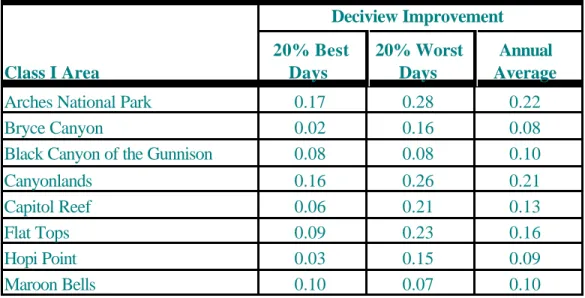
Attachment D of the Annex contains a detailed demonstration of how the milestones developed by the WRAP provide for greater reasonable progress than BART for regional haze. The demonstration outlines the process that was used by the WRAP to estimate the emission reductions that would occur in the region if BART determinations were made for all applicable sources in the region. Additional considerations are also addressed such as the degree of visibility improvement anticipated to be achieved and the increased benefits achieved by including all large stationary sources of SO2 in the program.
The demonstration is included as an attachment in part to emphasize that the 2018 milestone is a negotiated, policy-driven number, and is not directly derived from emission inventory formulas. The WRAP’s Committees and Forums have expended considerable effort over the last year to improve the emission inventory projections and to estimate the impacts of future control requirements. The data have informed the debate, and the intense effort to improve and understand the data was necessary for the stakeholders involved in the process to understand the impacts of various proposed milestone levels. However, there was also the recognition that the data will never be perfect, and that the
question of greater reasonable progress than BART is a broader question that is also informed by other policy considerations.
There may be changes in the emission inventory estimates as the 2003 SIPs are developed. However, the WRAP has confidence that the milestones as defined in this Annex achieve the goals established by the Grand Canyon Visibility Transport Commission and the Regional Haze Rule. The milestones established in this Annex are not anticipated to change unless major differences in the underlying data
that were used to develop the milestones are discovered during the development of the implementation plans due in 2003.
2. Provisions for Future Adjustments to the Milestones. a. Suspended Smelters.
There are currently two smelters in the region that have temporarily suspended operations due to economic considerations. The two smelters are the Phelps Dodge Corporation’s Hidalgo smelter in New Mexico and BHP’s smelter in San Manuel, Arizona. It is estimated that the smelters emit 22,000 tons and 16,000 tons of SO2, respectively. Uncertainty arises from the fact that it is currently unknown
whether these shutdowns will become permanent or whether the smelters will resume operation. If the smelter shutdowns are treated as temporary and the smelter emissions are included in the milestones but the smelters do not in fact resume operation, then this addition could inappropriately inflate the
milestones. Conversely, if the shutdowns are treated as permanent and the emissions for these sources are not considered in the development of the milestones but the smelters resume operation, then this deduction could inappropriately under-represent the year 2000 emissions and milestones, leading to milestones that are too low.
The Annex contains provisions that recognize and address the unique uncertainty surrounding the two smelters that are shut down for economic reasons. The Annex is designed to neither over- nor under-estimate the smelter emissions or milestones in light of the uncertainty. The emissions from the two suspended smelters are not included in the milestone initially. However, the Annex contains provisions to automatically adjust the milestones upward in the event one or both smelters are brought back on line. The key elements of the proposed methodology are described below.
(i) Smelter Emissions Provisionally Excluded from Milestones. The emissions associated with the two smelters currently shut down for economic reasons are not initially included in the milestones to reflect that these emissions are not, in fact, occurring. At the same time, it is specifically acknowledged that the milestones will automatically be adjusted in the future to account for the emissions from these two suspended smelters if they resume operations. If either one of the smelters resumes operation, there would be an allocation to the smelters and an appropriate, automatic upward adjustment to the milestones. If these programmatic adjustments were not made and the backstop cap-and-trade program was triggered, the entire allocation for regional new source growth could be consumed by these smelters resuming operation.
(ii) Automatic Adjustment of Milestones Without SIP Revision. It is possible that the smelters could be brought back into operation within a year. The WRAP wants to ensure that the Annex and SIPs are structured to adjust the milestones in this event, without the need for further SIP revision. At the same time, there are a number of different circumstances in which the smelters could resume operations, each with different environmental consequences.
The Annex outlines the different circumstances in which an adjustment would be made to address startup of one or both smelters. These circumstances include the following scenarios:
(1) startup of one or both smelters under circumstances that do not require new source permitting, and that reflect the best estimate of immediately past emissions levels, (2) startup of one or both smelters under circumstances that do not require new source
permitting but result in significantly lower emissions because of an unforeseen development, and (3) startup of one or both smelters under circumstances that require new source permitting where emissions may be equal to or less than past levels.
In the latter scenario, the new emissions level would be determined by the appropriate permitting authority. The determination as to whether or not a smelter needs to go through NSR will be based upon current EPA requirements.
(iii) Determining the Appropriate Emissions Amount to be Reinstated. In the event one or both smelters resume operations, it is critical to determine the appropriate emissions amount to be added to the milestones. The best estimate of annual emissions for these sources is based on their operations prior to shutdown (1997/98) as follows:
Phelps Dodge Corporation, Hidalgo Smelter 22,000 tons
BHP, San Manuel Smelter 16,000 tons
Making this determination now has several important policy advantages including basing it on more current data, rather than a determination many years from now looking back at potentially stale
information. Further, because the best estimate of immediately past emissions represents the maximum amount that the milestones could be adjusted upward in the event the smelters resume operation, it helps define in advance for the regulated community and the public the bounds of the regional emissions cap.
At the same time, the level of emissions associated with the other potential smelter startup scenarios cannot be pinned down firmly at this time and will depend on a variety of unpredictable factors. The Annex outlines the considerations that the permitting authority will use to define the appropriate adjustment to the milestones under these different circumstances.
(iv) Ensuring the Smelter Contingency is Transparent to the Public and Regulated Community. The regional haze rule incorporates the recommendation of the Grand Canyon Visibility Transport Commission to provide for steady and continuing emission reductions. The WRAP believes that the evaluation of this requirement should take into account the uncertainty associated with the smelter emissions status. At the same time, the WRAP recognizes the concern those unfamiliar with the program may have if they perceive the milestones being adjusted upward during the middle of program
implementation. Nevertheless, the WRAP believes the more straightforward approach is to recognize the current uncertainty surrounding the smelters and to craft a program that better tracks the real world conditions including the possibility that the shutdown may become permanent or that operations may resume.
(v) Smelter set-aside if one or more of the smelters don’t resume operation. The copper industry has raised concerns that, unlike other industrial SO2 sources in the region, it operates in a world market,
making it difficult to pass on increased operating expenses. The additional cost incurred significantly effects their ability to be competitive in a world market. When the price of copper is low, the high-cost producers are the first to feel the effect. Since 1980 the copper industry has seen the loss of six smelters in the United States. A small portion of the lost smelter capacity has been made up by the remaining smelters. In the last two years, three smelters have gone on standby due to economic conditions. It is important to maintain the remaining smelter capacity as a part of the suspended smelters set-aside. In 1990, the GCVTC and the IAS forecasted that the copper smelters in 2018 would have 78,000 tons of emissions. Within the GCVTC region, there are two smelters on economic standby. The most recent emissions from these smelters are 38,000 tons SO2. The remaining operating smelters have
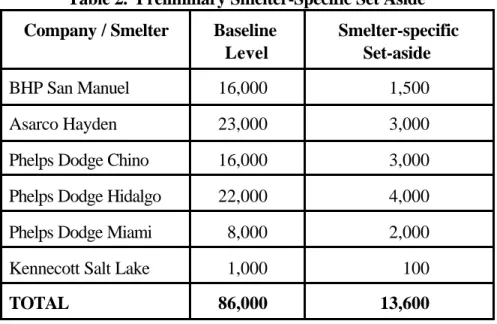
current emissions of 48,000 tons, some 30,000 tons below the IAS forecast for 2018. This is a significant reduction over the forecast. In order to maintain the smelting capacity forecasted for the smelters within the region, the remaining smelters may decide to increase throughput to pick up some of the capacity lost if one or both of the smelters currently on standby don’t come back up. Currently, these remaining smelters are not operating at 100% capacity. If these smelters increased throughput to a level that would not trigger NSR, the copper industry estimates that emissions would increase by a maximum of 13,600 tons SO2. Therefore the Annex includes provisions for a 13,600 ton set-aside that
could only be used to increase existing capacity. This set-aside will be available only if one or both of the suspended smelters do not resume operation. In addition, the set-aside may not be traded if the backstop trading program is triggered.
The following table identifies the preliminary facility-specific set-aside for each smelter to be used to maintain smelter capacity.
Company / Smelter Baseline Level
Smelter-specific Set-aside
BHP San Manuel 16,000 1,500
Asarco Hayden 23,000 3,000
Phelps Dodge Chino 16,000 3,000
Phelps Dodge Miami 8,000 2,000
Kennecott Salt Lake 1,000 100
TOTAL 86,000 13,600
This increase in emissions is not outside the NSR program and, if a smelter increases throughput through the addition of equipment, the smelter may be required to go through NSR. Also, this additional increase in emissions cannot be greater than that allowed in the individual smelter’s permit and will not exceed the amount of the smelter set-aside. The SO2 allowance in this set-aside cannot be
traded in the market. It is the sole intent of these allowances to be used to make up some of the lost smelting capacity if one or both smelters don’t come back up. If these allowances are used, the corresponding milestone will be increased by that amount not to exceed the amount in the set-aside.
b. State and Tribal Opt In/Opt Out Provisions
(i) Demonstration of Reasonable Progress. The GCVTC recognized that regional haze was a regional problem, and focused its technical and policy work on developing regional solutions. The emission projections, visibility modeling and economic modeling were developed at the regional level, and assumptions were made that may not be valid locally but were expected to balance out throughout the region as a whole. This is especially true for the stationary source recommendations. The back-stop trading program envisioned by the GCVTC would allow the market to find the most cost-effective emission reductions throughout the region rather than specifying reductions for each source in the region through a command-and-control program.
When EPA promulgated the regional haze rule in July 1999, western states and tribes were offered two options for complying with the rule. The first option was to implement the GCVTC recommendations, as outlined in section 309 of the rule, with a SIP submittal due in 2003. The second option was to develop a SIP by the year 2008 as outlined in section 308 of the rule that would demonstrate that the state was on a 60-year glide path to reach natural visibility conditions. The question is how to adapt the GCVTC recommendations for stationary sources to the possibility that:
• One or more states may choose to develop a SIP under section 308 of the rule instead of implementing the GCVTC regional strategies;
• States not currently participating in the WRAP may want to opt-in to the back-stop cap and trade program; and
• Tribes, which are not required to develop a TIP by a specific date, may wish to participate in the regional strategies at a later date.
Section 309(e) of the regional haze rule states:
“Any Transport Region State may elect not to implement the Commission recommendations set forth in paragraph (d) of this section. Such States are required to comply with the time lines and requirements of section 51.308. Any Transport Region state electing not to implement the Commission recommendations must advise the other states in the Transport Region of the nature of the program and the effect of the program on visibility-impairing emissions, so that other States can take this information into account in developing programs under section 51.309.”
This paragraph of the rule provides for the possibility that some of the GCVTC states may not chose to implement a SIP under section 309 of the rule, opting, instead, to submit a SIP under section 308. States that develop SIPs under section 308 are not required to complete their SIPs until approximately 2008, which is well after the deadlines established under section 309. These states will not be able to advise the other states in the region of the effect of their strategies until their SIPs have been adopted. The following paragraphs outline the approach followed by the WRAP to deal with the uncertainties associated with the diversity of potential approaches to complying with the stationary source
requirements of the Regional Haze Rule, and to allow states and tribes to choose the best option for their individual situation.
First, the WRAP has developed the backstop trading program, and technical demonstrations based on full participation of the states and tribes in the transport region. (In actuality, very few tribes have major SO2 sources, but those few were included in the emissions inventory on which the milestones are based.) The strategies were developed on a regional level, and many of the individual elements, such as the 50%-70% emission reduction of SO2 by the year 2040, would be difficult to apply to individual
states and tribes.
Second, in the Annex and the 2003 SIPs, the WRAP will make the assumption that states and tribes that do not participate in the program will achieve emission reductions equivalent to BART for sources within their jurisdiction and other regional strategies of the GCVTC. Therefore, as long as the states and tribes that developed SIPS and TIPS under section 309 of the rule implement the regional strategies, then the overall goals of the Commission will be met.
However, at the time of the submittal of 2003 SIPs, the milestones will need to be adjusted to exclude emissions from non-participating states and tribes. The adjustment is important, because it would not be equitable to trigger a trading program based on the activities of states and tribes that are not participating in the program.
The allocation process described in Section III.D.7 of the Annex will be used to determine an estimated emission budget for each State and Tribe in the region for each of the milestone years. The budgets for each of the participating states and tribes will, when added together, equal the regional milestone. The portions of the budget that were retained at the regional level for tracking purposes will be addressed as follows:
(A) Tribal Allocation. The 20,000 ton tribal allocation will be included in the milestone, and will not be affected by the number of states that participate in the program. The WRAP recognizes that this allocation may become a significant part of the milestone only if few states participate in the program. This concern is counter balanced by the recognition that a critical mass of states and tribes will be necessary to create an effective program. If this critical mass is not achieved, then states and tribes are unlikely to develop Implementation Plans under '309.
(B) New Source Set Aside. The new source set-aside will be divided proportionally using growth estimates that were used to estimate the magnitude of new source growth in the region. These estimates were based on state-specific growth projection. Although state specific projections will be used to adjust the set-aside in accordance with state participation, once adjusted, the new source set aside is regional.
Because the allocation methodology may not be fully consistent with the methodology used to determine the BART level emission reductions, if the allocation methodology is used as the basis for adjusting the milestones in the event that a state opts out of the program, it will be necessary to review the adjusted milestones that are applicable to those states remaining in the program to ensure that the greater reasonable progress than BART requirement is met for those states.
Finally, in the 2008 SIP review, the WRAP will re-evaluate the GCVTC strategies in light of the programs that have been developed by transport region states under section 308 of the rule. If these programs do not achieve the assumed emission reductions, the WRAP will evaluate the magnitude of the shortfall and, if necessary, make adjustments to the programs that were developed under section 309 of the rule in order to meet the goals of the GCVTC.
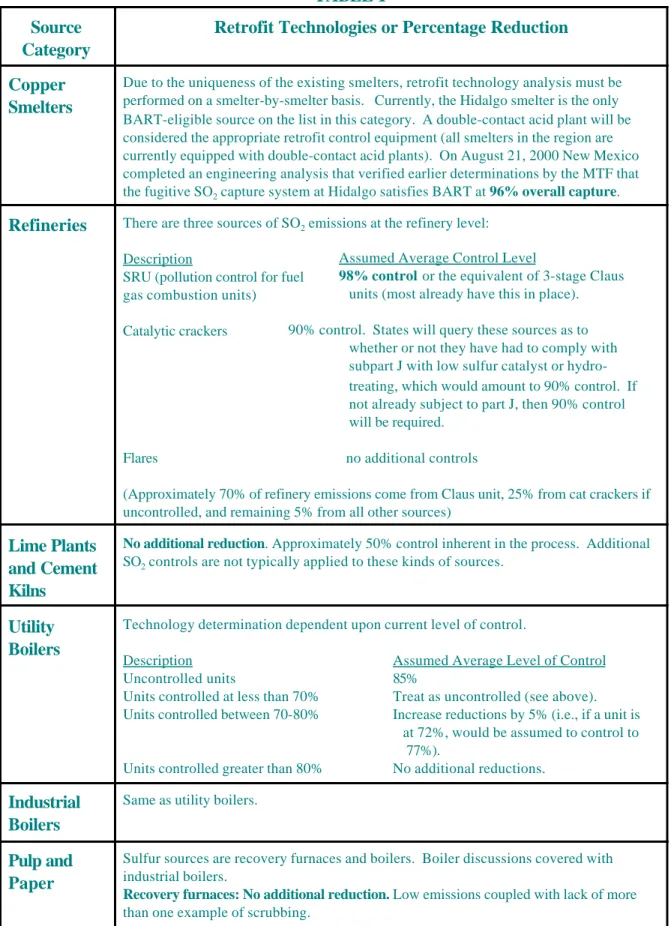
(iii) Best Available Retrofit Technology for Regional Haze. When estimating the regional emission reductions in the region due to the installation of Best Available Retrofit Technology (BART) for regional haze, the regional haze rule outlines a 2-step process. First, the states must complete “an analysis of the best system of continuous emission control technology available and associated emission reductions achievable for each BART-eligible source within the State subject to BART.” Second, the states must complete “an analysis of the degree of visibility improvement that would be achieved in each mandatory Class I Federal area as a result of the emission reductions achievable from all sources subject to BART located within the region that contributes to visibility impairment in the Class I area...” The GCVTC identified the visibility transport region for the 16 Class I areas of the Colorado Plateau. This transport region consists of 9 states and 211 tribes. In order to complete the analysis of regional haze BART, the states and tribes need to estimate appropriate retrofit control technologies for all BART-eligible sources in the transport region, and assess the visibility improvement due to the installation of these technologies. This regional analysis needs to occur under both sections 308 and 309 of the rule. However, there will be a timing issue; the states that choose to develop a 309 SIP will need to complete the analysis by 2003 while those that develop a 308 SIP will not need to complete this analysis until 2008. The proposed solution to the timing problem is to complete an analysis of regional haze BART for all transport region states and tribes using a source category approach for the 2003 SIPs. These source category estimates may then need to be re-evaluated in the 2008 SIP review based on the regional haze BART determinations that are made by states that develop SIPs under §308 of the rule.