Czech Technical University in Prague
Faculty of Electrical Engineering
Department of Circuit Theory
Applying Articulatory Features within Speech Recognition
Disertation thesis
Ing. Petr Mizera
Ph.D. programme: Electrical Engineering and Information Technology
Branch of study: Electrical Engineering Theory
Supervisor: Doc. Ing. Petr Poll´
ak, CSc.
Thesis Supervisor:
Doc. Ing. Petr Poll´ak, CSc. Department of Circuit Theory Faculty of Electrical Engineering Czech Technical University in Prague Technick´a 2
160 00 Prague 6 Czech Republic
Declaration
I hereby declare I have written this doctoral thesis independently and quoted all the sources of information used in accordance with methodological instructions on ethical principles for writing an academic thesis. Moreover, I state that this thesis has neither been submitted nor accepted for any other degree.
In Prague, August 2019
... Ing. Petr Mizera
Abstract
This thesis deals with possible applications of Articulatory Features (AF) in speech recog-nition systems with special focus on improvement of Czech spontaneous speech recogni-tion. As spontaneous speech is caused by frequent occurrence of coarticulation process, assimilation and reduction of phones and as AF contain the information about speech production mechanisms, they might represent a possible way how to improve results of these systems. So, the potential contribution of AF-Based TANDEM ASR architecture on the tasks of the recognition or phonetic segmentation of spontaneous speech is described in this work as well as their performance under more adverse acoustic conditions.
As the first result, the multi-valued AF classes for Czech and four East-European languages (Slovak, Polish, Hungarian, and Russian) were defined and unified and further work was focused on the estimation of AF using artificial neural networks. The suitability of standard and advanced acoustic speech features were analyzed for the AF estimation, mainly from the point of view of temporal context at the input of ANN/DNN network. The optimum length of 210÷310 ms was found across languages. The Czech AF classes were estimated with the average FAcc around 90%. The behaviour of AF estimation in mismatched or adverse noisy acoustic conditions was also studied and the robustness of DCT-TRAP features was proved as the best choice for this task.
The application of AF within ASR was realized in the form of AF-Based TANDEM system, however, baseline ASR systems had to be prepared, mainly Czech casual speech recognition system with focus on optimization of acoustic and language models as well as the usage of different corpora resources for this task. The performance of the AF-Based TANDEM system was then analyzed for the English phone recognition and Czech ASR tasks. Positive impact of this system was observed for standard monophone (mono) and triphone (tri1) systems, which are based on MFCC features. The ASR combination of GMM-HMM/DNN-HMM with the AF-Based TANDEM system on the level of lattice with decoded hypotheses significantly improved baseline results.
Finally, phonetic segmentation task was analyzed using various type of acoustic model architectures (GMM-HMM, DNN-HMM, and AF-based TANDEM) as well as focusing on proper pronunciation variant selection. It was done for the following two task: read English (TIMIT) and casual Czech (NCCCz) and two-stage forced-alignment with com-bination of DNN-HMM and optimized monophone-based system was proposed and the improvement of phone boundary determination was proved for both tasks. The 93% phone boundaries accuracy on the level of 30ms criteria was achieved for read speech in TIMIT, the accuracy around 90% was achieved on for casual one in NCCCz.
Keywords: articulatory features, automatic speech recognition, casual speech recogni-tion, phonetic segmentarecogni-tion, Kaldi
Abstrakt
Pˇredloˇzen´a disertaˇcn´ı pr´ace se zab´yv´a moˇzn´ymi aplikacemi artikulaˇcn´ıch pˇr´ıznak˚u (AF) v ´uloze rozpozn´av´an´ı ˇreˇci s uˇzˇs´ım zamˇeˇren´ım na zlepˇsen´ı rozpozn´av´an´ı spont´ann´ı a ne-form´aln´ı ˇreˇci pro ˇceˇstinu. Zejm´ena ˇreˇc vytvoˇren´a pˇri neform´aln´ıch rozhovorech je velmi ovlivnˇena ˇradou fonetick´ych jev˚u jako jsou koartikulace, asimilace ˇci redukce hl´asek d´ıky m´enˇe pˇresn´e artikulaci. Artikulaˇcn´ı pˇr´ıznaky, kter´e obsahuj´ı informaci o produkci ˇreˇci, se proto nab´ızej´ı jako jedno z moˇzn´ych ˇreˇsen´ı pro zlepˇsen´ı pˇresnosti rozpozn´av´an´ı neform´aln´ı ˇreˇci. Pr´ace popisuje potenci´aln´ı pˇr´ınos TANDEM syst´em˚u zaloˇzen´ych na AF v ´uloh´ach rozpozn´av´an´ı a fonetick´e segmentaci spont´ann´ıch promluv.
Pr´ace se nejprve zab´yv´a definic´ı a popisem artikulaˇcn´ıch pˇr´ıznak˚u pro ˇcesk´y jazyk a ˇctyˇri v´ychodoevropsk´e jazyky (slovenˇstinu, polˇstinu, mad’arˇstinu a ruˇstinu), pro kter´e byly artikulaˇcn´ı tˇr´ıdy sjednoceny. Druhou v´yznamou ˇc´ast´ı pr´ace je implementace klasifik´ a-tor˚u AF tˇr´ıd z ˇreˇcov´eho sign´alu zaloˇzen´ych na b´azi hlubok´ych neuronov´ych s´ıt´ıch, vˇcetnˇe v´ybˇeru vhodn´ych akustick´ych pˇr´ıznak˚u pro odhad AF. Hlavn´ı pozornost je vˇenov´ana op-tim´aln´ımu nastaven´ı ˇcasov´eho kontextu na vstupu DNN s´ıtˇe. V´ysledkem experiment´aln´ı ˇc´asti pak je nalezen´ı ˇcasov´eho kontextu v rozmez´ı 210÷310 ms pro vˇsechny analyzo-van´e jazyky. AF tˇr´ıdy byly pro ˇceˇstinu odhadnuty s pˇresnost´ı 90% na ´urovni klasifikace v kr´atkodob´ych ˇcasov´ych r´amc´ıch. D´ale byla anal´yzov´ana pˇresnost odhadu AF v ˇsumu a nepˇrizp˚usoben´ych akustick´ych podm´ınk´ach. Zde se prok´azala robustnost DCT-TRAP pˇr´ıznak˚u a jejich vhodnost pro AF klasifikaci.
V dalˇs´ı ˇc´asti pr´ace jsou pouˇzity AF v rozpozn´avaˇc´ıch na b´azi TANDEM architektury s c´ılov´ym zamˇeˇren´ım na implementaci a optimalizaci rozpozn´av´an´ı neform´aln´ı ˇreˇci. Ne-jprve vˇsak byly vytvoˇreny z´akladn´ı syst´emy resp. akustick´e modely (GMM-HMM, DNN-HMM resp. TANDEM). Pˇresnost AF-TANDEM syst´emu byla studov´ana na rozpozn´av´an´ı anglick´ych hl´asek a ˇcesk´e ˇreˇci. Experimenty uk´azaly pozitivn´ı pˇr´ınos AF-TANDEM na ´
urovni monofonn´ıch a trif´onov´ych syst´em˚u. Kombinace GMM-HMM/DNN-HMM a AF-TANDEM syst´em˚u s AF-TANDEM syst´emem uk´azala v´yznamn´e zlepˇsen´ı oproti z´ aklad-n´ımu syst´emu tr´enovan´eho bez AF pˇr´ıznak˚u na ´urovni dek´odovan´ych hypot´ez.
Posledn´ı ˇc´ast pr´ace je vˇenov´ana fonetick´e segmentaci realizovan´e pomoc´ı r˚uzn´ych aku-stick´ych model˚u (GMM-HMM, DNN-HMM a AF-TANDEM) s pˇrihl´ednut´ım na vhodn´y v´ybˇer v´yslovnostn´ıch variant. Experimenty byly provedeny pro dvˇe ´ulohy: anglickou ˇctenou ˇreˇc a ˇceskou neform´aln´ı ˇreˇc. Zv´yˇsen´ı uspˇeˇsnosti automatick´e segmentace bylo dosaˇzeno algoritmem dvouf´azov´e fonetick´e segmentace, kde komplexn´ı DNN-HMM sys-t´em je pouˇzit pro z´ısk´an´ı fonetick´eho pˇrepisu pro n´asledn´e automatick´e zarovn´an´ı pomoc´ı optimalizovan´eho monofonn´ıho syst´emu. V pˇr´ıpadˇe sloˇzitˇejˇs´ı ´ulohy, jako je neform´aln´ıˇreˇc, kombinace dvou typ˚u DNN-HMM syst´em˚u vedla na 90% pˇresnost urˇcen´ı hranic hl´asek. Pro anglickou ˇctenou ˇreˇc byly hranice urˇceny s 93% pˇresnost´ı.
Kl´ıˇcov´a slova: Artikulaˇcn´ı pˇr´ıznaky, automatick´e rozpozn´av´an´ı ˇreˇci, rozpozn´av´an´ı ne-form´aln´ı ˇreˇci, fonetick´a segmentace, Kaldi
Acknowledgements
First of all, I would like to thank my supervisor Doc. Ing. Petr Poll´ak, CSc. for his excellent guidance and support during my Master and PhD studies at the Czech Technical University in Prague. He introduced me to digital speech signal processing and automatic speech recognition areas.
Special thanks belong to my colleague Michal Borsk´y for infinite and fruitful discus-sions about ASR during our PhD study and for being my true friend. I would also like to thank Jan Bartoˇsek for valuable discussions about Phonetic segmentation and Prosody.
Finally, the special thanks go to my wife Misa for her love and support during this hard journey. Thank you my family for supporting me during my studies at universities.
List of Tables
3.1 Data subsets for creating AM . . . 29
3.2 Data subsets for AF experiments . . . 29
3.3 Average values of SNR [dB] . . . 30
3.4 The evaluation subset statistics . . . 30
3.5 Data subsets for creating AM . . . 31
3.6 Data subsets for creating AM . . . 32
3.7 The NCCCz evaluation subset statistics . . . 32
3.8 SpeechDat-E data subsets . . . 33
3.9 CtuTest & CzLecDSP data sets . . . 33
3.10 TIMIT data sets used in presented evaluations . . . 34
3.11 Baseline results for particular databases with matched LM . . . 38
3.12 The results for particular databases using CNC340k LM . . . 39
3.13 The results for all channels in SPEECON using CNC340k LM . . . 39
3.14 WERs of LVCSR in the phase of AM optimization . . . 43
3.15 WERs of LVCSR with various 2-gram a 3-gram LMs on particular tasks. . 44
3.16 DNN-HMM casual speech recognition (TA3) with merged bigram LMs. . . 44
3.17 DNN-HMM with various weights of NCCCz in merged LMs on TA3 task. . 44
3.18 Impact of pronunciation variation in DNN-HMM system . . . 45
4.1 AF classes for English . . . 48
4.2 Phonetic categorization of Czech consonants . . . 50
4.3 Phonetic categorization of Czech vowels . . . 50
4.4 AF classes for the Czech language . . . 50
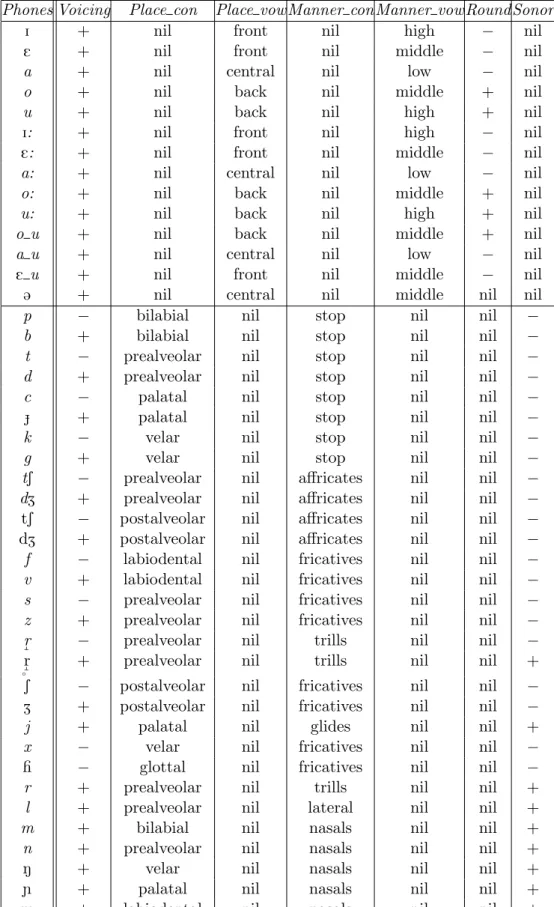
4.5 Summary of articulatory features per particular Czech phones . . . 51
4.6 Phonetic categorization of consonants for SK . . . 53
4.7 Phonetic categorization of vowels for SK . . . 53
4.8 Phonetic categorization of consonants for PL . . . 53
4.9 Phonetic categorization of vowels for PL . . . 53
4.10 Phonetic categorization of consonants for HU . . . 54
4.11 Phonetic categorization of vowels for HU . . . 54
4.12 Phonetic categorization of consonants for RU . . . 54
4.13 Phonetic categorization of vowels for RU . . . 54
4.14 The absolute improvement of AF estimation accuracy. . . 57
4.15 Setup size of MLP for the best results with mfcc features. (Ep. = Epoch) . 58 4.16 Setup size of MLP for the best results with plp features. (Ep. = Epoch) . 58 4.17 The best setup size of MLP for the best results classification of AFs. . . 62
4.18 The best results estimation of AFs for the optimum length of context in-formation. . . 63
4.19 The best results estimation of AFs for Czech. . . 64
4.20 Comparison the best results of AF classification. for Czech . . . 65
4.21 Optimum setup size of MLP for the best results with DCT-TRAP features. 66 4.22 Average FAcc of AF estimation for manually labelled. . . 69
4.23 FAcc of DCT-TRAP AF estimation for speech degraded by car noise. . . . 70
4.24 The particular results for the optimized feature setup. . . 74
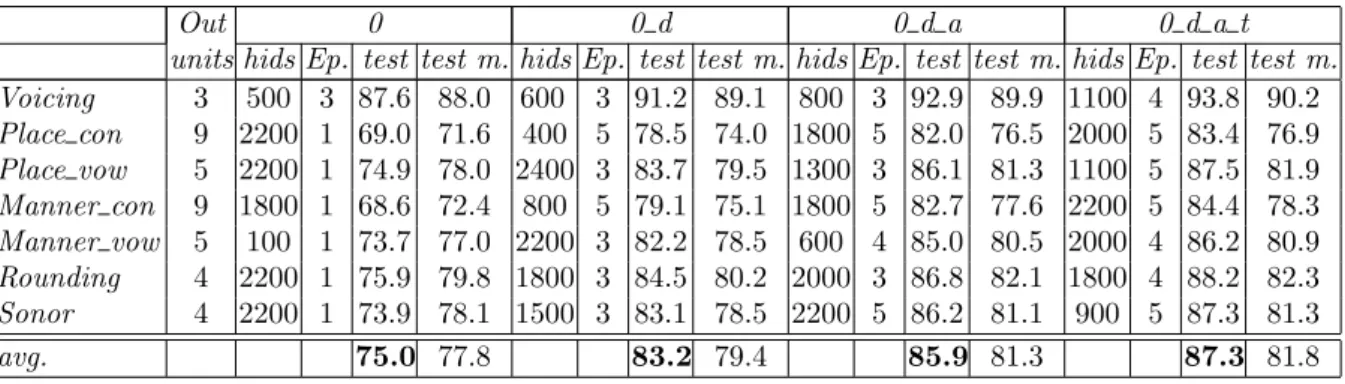
4.25 The impact of hidden layers on DNN-based AF estimation for Czech. . . . 75
4.26 The particular AF results. . . 77
5.1 Achieved PER for baseline models and AF-TANDEM systems. . . 83
5.2 Achieved PER for AF class specific DNN-HMM systems. . . 84
5.3 The impact of AMs combination. . . 84
5.4 WER results on Speecon - OFFICE CS0 test set . . . 85
5.5 WER results on NCCCz test set . . . 86
6.1 Results of direct phonetic segmentation, PER= 0, PCorr= 100 . . . 93
6.2 Optimization of monophone AM for direct phonetic segmentation (P ER= 0,P Corr = 100) . . . 93
6.3 Phonetic segmentation with canonic lexicon . . . 95
6.4 Phonetic segmentation with TIMIT-variant lexicon . . . 95
6.5 Phonetic segmentation with canonic lexicon extended by TIMIT variants . 95 6.6 Lexicon timit-variants - statistics . . . 96
6.7 Pronunciation variant recognition . . . 97
6.8 NCCCz Lexicons variants - statistics . . . 99
6.9 Results of direct phonetic segmentation of casual Czech . . . 101
6.10 lexicon A - canonical pronunciation . . . 102
6.11 lexicon B - canonical pronunciation extended with rule based pronunciation variants . . . 102
6.12 Pronunciation variant recognition for casual Czech . . . 103
6.13 The results for phonetic segmentation in mismatched scenario . . . 104
List of Figures
2.1 The principle structure of the ASR system . . . 6
2.2 MFCC feature extraction . . . 8
2.3 PLP feature extraction . . . 9
2.4 Feature extraction used in GMM-HMM systems. . . 12
2.5 Symbolic structure of DNN network. . . 15
2.6 Architecture of DNN-HMM ASR system . . . 17
2.7 Feature extraction used in DNN-HMM systems. . . 18
2.8 Architecture of TANDEM ASR system . . . 19
2.9 Speech signal - time/frequency domain . . . 20
2.10 Speech vocal tract (source [3]) . . . 21
2.11 Artificial model for generation of speech signal . . . 22
2.12 The IPA table - 2018 revision . . . 24
4.1 The evaluation of AF estimation for automatically labelled test set. . . 57
4.2 The evaluation of AF estimation for manually labelled test set . . . 57
4.3 Number of hidden layer units optimization for input feature of MFCC. . . 59
4.4 Number of hidden neurons in MLP optimization for input PLP or MFCC feature. . . 61
4.5 The evaluation of AF estimation for lengths of context information for static features. . . 63
4.6 The evaluation of AF estimation for Czech . . . 63
4.7 Number of hidden neurons in MLP optimization for DCT-TRAP features. . . 67
4.8 FAcc of AF estimation for automatically labelled OFFICE test set. . . 68
4.9 FAcc of AF estimation for automatically labelled CAR test set. . . 68
4.10 Average FAcc (across all AFs) for mismatched condition. . . 69
4.11 The evaluation of AF estimation for various ASR features and DNN setups. 72 4.12 The evaluation of AF estimation for lengths of context information for static features. . . 73
4.13 The optimization of DCT-TRAP feature. . . 73
4.14 The AF results for all languages. . . 76
5.1 Illustrative example of visualized AF features. . . 80
6.1 Phone Beginning Error P BE for particular phone classes. . . 93
6.2 Illustrative example of the work with the LexFix tool . . . 98
6.3 Illustrative example of phonetic segmentation results with the canonical pronunciation. . . 100
6.4 Illustrative example of phonetic segmentation results with the reduced. . . 100
6.5 Phone Beginning Error PBE: GMM-HMM vs. Tandem . . . 104 xiii
List of Acronyms
AF Articulatory Features.ANN Artificial Neural Network. ASR Automatic Speech Recognition.
CMVN Cepstral Mean Variance Normalization. DCT Discrete Cosine.
DFT Discrete Fourier Transform. DNN Deep Neural Network. FAcc Frame Accuracy.
GMM Gaussian Mixture Models. HMM Hidden Markov Model. LDA Linear Discriminant Analysis. LM Language Model.
LSTM Long Short-Term Memory.
LVCSR Large Vocabulary Continuous Speech Recognition. MFCC Mel-Frequency Cepstral Coefficients.
ML Maximum Likelihood.
MLLR Maximum Likelihood Linear Regression. MLP Multilayer Perceptron.
MMI Maximum Mutual Information. PCA Principal Component Analysis. PER Phone Error Rate.
PLP Perceptual Linear Prediction.
RNN Recurrent Neural Network. TRAP Temporal Pattern.
TTS Text To Speech.
VAD Voice Activity Detection.
VTLN Vocal Tract Length Normalization. WER Word Error Rate.
Contents
Abstract v
Abstrakt vii
Acknowledgements ix
List of Tables xi
List of Figures xiii
List of Acronyms xv
1 Introduction 1
2 ASR and Articulatory Features: State-of-the-Art 5
2.1 Conventional GMM-HMM ASR system . . . 5
2.1.1 Cepstral-based speech features . . . 7
2.1.2 GMM-HMM based Acoustic Modelling . . . 11
2.1.3 Language Modelling & Dictionary . . . 13
2.1.4 Recognition graph, decoding . . . 14
2.2 DNN-based speech recognition . . . 15
2.2.1 DNN-HMM-based Acoustic Modelling . . . 15
2.2.2 TANDEM architecture of ASR . . . 17
2.3 Articulatory Features within Speech Technology . . . 20
2.3.1 Speech Production . . . 20
2.3.2 Speech description at phonetic level . . . 23
2.3.3 Applications of Articulatory Features . . . 23
2.4 Goals of the thesis . . . 25
3 Experimental ASR Framework 27 3.1 Kaldi toolkit . . . 27
3.2 Used corpora for training & testing of ASR . . . 28
3.2.1 Czech SPEECON . . . 28
3.2.2 CZKCC - Czech car speech . . . 30
3.2.3 NCCCz - Nijmegen Corpus of Casual Czech . . . 31
3.2.4 SpeechDat-E Corpora . . . 32
3.2.5 CtuTest - Czech read journal sentences . . . 33
3.2.6 CzLecDSP - Czech technical lectures . . . 33
3.2.7 TIMIT . . . 34
3.3 Evaluation criteria . . . 34 xvii
3.4 Particular results of the Czech ASR (LVCSR) . . . 35
3.4.1 Setup of common ASR modules . . . 35
3.4.2 Basic LVCSR Under Various Condition . . . 37
3.4.3 ASR framework for Causal Czech Recognition . . . 40
4 Estimation of AF for Czech and other languages 47 4.1 Articulatory features for analyzed languages . . . 47
4.1.1 AF set for English . . . 48
4.1.2 AF set for Czech . . . 49
4.1.3 AF sets for Speechdat-E languages . . . 49
4.2 AF Estimation techniques . . . 55
4.2.1 MLP-based AF estimation with common acoustic features . . . 55
4.2.2 Extended temporal context in AF estimation . . . 60
4.2.3 AF estimation under adverse acoustic conditions . . . 65
4.2.4 AF estimation using DNN . . . 70
4.2.5 AF estimation for Speechdat-E languages . . . 75
5 Applying Articulatory Features within Speech Processing 79 5.1 Visualization of estimated AF . . . 79
5.2 AF application for ASR & Phone Recognition . . . 81
5.2.1 AF-Based Phone Recognizer for English . . . 82
5.2.2 The AF-based TANDEM system for Czech . . . 84
5.3 AF in Biomedical Speech Applications . . . 86
6 Phonetic Segmentation and Pronunciation Detection 89 6.1 Phonetic segmentation state-of-the-art . . . 89
6.2 Phonetic Segmentation Framework . . . 90
6.3 Baseline Phonetic Segmentation for English . . . 92
6.3.1 Optimum AM for direct phonetic segmentation . . . 92
6.3.2 Phonetic segmentation with pronunciation variability . . . 94
6.3.3 Pronunciation recognition . . . 96
6.3.4 Summary . . . 96
6.4 Phonetic segmentation of Czech casual speech . . . 97
6.4.1 The NCCCz lexicon . . . 98
6.4.2 Optimum AM for direct phonetic segmentation . . . 99
6.4.3 Segmentation with reduced pronunciation . . . 101
6.4.4 Reduced pronunciation recognition . . . 102
6.5 Impact of AF for phonetic segmentation . . . 103
6.5.1 Summary . . . 105
7 Conclusions 107 A Summary of articulatory features mapping ... 111
Chapter 1
Introduction
As the voice represents the most effective way of communication between humans, the idea of developing a system which would allow to process human-machine communication has been a natural interest for researchers from the early 20th century. It will be soon 100 years since a real application first used voice iteration [22]. The huge effort and enthusiasm of speech researchers allowed to transform the dreams about a natural human-machine communication to a real voice technology system which are now used in real life conditions. Of course, the big progress in information technologies and the digital revolution boosted the development of voice technologies. High performance computing clusters containing graphical processing units make it possible to train and deploy voice-driven systems based on Artificial Intelligence (AI).
Various applications are commonly used in our daily lives. The list includes dictation systems [84] enabling us to replace keyboard input with a natural speech, virtual agents and voice-controlled devices to smart homes, cars, or mobile phones [15], on-line subtitling, archiving, or monitoring of broadcast or TV programs [138], analysis of speech in medical application for diagnostic purposes, general identification of speaker, or many others.
The research in the field of automatic speech recognition (ASR) started using speech recognition based on Dynamic Time Warping (DTW) [125]. Since then, the field has made a great progress towards the Large Vocabulary Continuous Speech Recognition (LVCSR) based on hidden Markov models (HMM) which were proposed by Jelinek from IBM labo-ratories [54] in 1980s. This statistical approach using combined Gaussian Mixture Models (GMM) and HMM has become the state-of-the-art for many years. In 1990s, artificial neural network (ANN) was suggested to replace GMM in HMM modelling. The hybrid ANN/HMM ASR system was proposed by Morgan [91] where a multi-layer perceptron (MLP) network was used to estimate the HMM state-posterior probabilities. This ap-proach was designed to overcome limits of the GMM/HMM apap-proach, specifically the fact that modeled features must have a Gaussian distribution [124]. A TANDEM
tecture was later proposed by Hermansky, where the an MLP was used as a classifier generating phoneme posterior probabilities which were then transformed, decorrelated and used as features on the input of standard GMM/HMM-based ASR system [47].
The final great leap, in terms of recognition accuracy, came with the adoption of the deep neural network (DNN) and deep-learning techniques to model the acoustic and the language components of the speech. The Microsoft Research team[21], [48], [23] proposed a system based on context-dependent deep neural network - hidden Markov models (CD-DNN-HMM) [21], [48], [23] and the architecture was, for a time, a mainstream solution for all LVCSR tasks running in real-time. The most recent trend, enabled by an increase in computational power and the availability of huge amount of data, includes ASR that model simultaneously the whole recognition chain, i.e. so called End-To-End ASR systems (proposed by Google in 2015 [16]). End-to-End, and DNN-based ASR systems in general, are currently at the top of research interest and they typically achieve a very high accuracy in normal conditions for a majority of world languages.
The precision of an ASR is worse in the case of spontaneous or casual speech, where the pronunciation of particular words can be strongly reduced. Creating a robust ASR system for spontaneous speech has been a challenge for several decades which makes it a popular research topic. Also, the situation of strongly adverse environmental conditions, i.e. when background noise in recorded speech is very high, can decrease the accuracy of an ASR. Many times, it is also not possible to use too complex architectures (e.g. for embedded systems) or a system development is constrained by a limited amount of available data. In such cases, traditional approaches based on GMM-HMM architecture still play a very important role as a looking for an optimization of speech features computed in the front-end part of general ASR system.
The idea to use Articulatory Features (AF) for extension of standard speech features used in ASR is one possible way of how to improve the robustness of spontaneous or noisy speech recognition. The speech production knowledge is a natural part of an ASR system and the examples include using decision trees for triphone state tying or Vocal Tract Length Normalization (VTLN) to reduce speaker variability. It has been showed that including AF for acoustic modelling in a TANDEM system and for pronunciation modelling can achieve very good results in the task of spontaneous speech recognition for the English language [33], [80], [73]. Concerning the Czech language, the issue of spontaneous speech has been worked on for several years [138], [52], [113], [116], [96], [114]. However, the achieved word error rate (WER) is still rather low, about 50%.
Therefore, the general motivation of this work is to find an optimized approach of AF estimation for Czech and other languages and to analyze the contribution of AF in real-life applications, mainly for robust spontaneous and casual speech recognition.
3 Finally, the thesis is organized as follow.
• Chapter 2 summarizes the state-of-the-art in ASR and discusses usage of AF within speech technology and goals of this thesis are defined.
• Chapter 3 describes the ASR framework and speech databases which are used in the experimental part for training and evaluation of AF classifiers, AM, phone rec-ognizer, and automatic phonetic segmentation. The chapter presents the baseline LCVSR results under various conditions. Finally, the design of ASR system for Czech casual speech recognition task is presented and analyzed.
• Chapter 4 describes the multi-values AF classes for Czech language. The unification of AF for four East-European languages (Slovak, Polish, Hungarian, and Russian) is also presented. The chapter provides a design of AF classifiers with focus on optimum structure of MLP/DNN, type of input features and studies the optimum temporal context at the input of MLP/DNN networks. The accuracy of AF classi-fiers for all languages is presented.
• Chapter 5 presents the results of experiments focusing on the contribution of AF in the task of phoneme recognition for English and the task of ASR for recognition of Czech read and casual speech. The incorporation of AF information into ASR is analyzed in the form of AF-TANDEM system and using combination of ASR decoded hypotheses. Then, the possible contribution of AF in Clinical applications is discussed.
• Chapter 6 deals with automatic phonetic segmentation of English read speech and Czech casual speech. The chapter analyzes the impact of various types of AMs (GMM-HMM and DNN-HMM) on the accuracy of phone boundaries determination for both languages. The two-stage forced-alignment is proposed, described and analyzed in this chapter. Finally, the chapter describes the process of canonical NCCCz lexicon review and updated the LexFix tool for these purposes. The impact of irregular pronunciation on automatic phonetic segmentation of Nijmegen Corpus of Casual Czech with created lexicon is analyzed.
• Chapter 7 summarizes the content and contributions of this thesis and discusses the next potential work with AF.
Chapter 2
ASR and Articulatory Features:
State-of-the-Art
The automatic speech recognition task represents the complex problem which requires knowledge from various research areas such as mathematics, digital signal processing, ar-tificial intelligence, acoustics, phonetics, phonology and linguistics. Therefore, the goal of this chapter is to introduce an ASR system, describe the state-of-the-art ASR archi-tectures, and discuss challenges and motivation for the research described within this thesis.
2.1
Conventional GMM-HMM ASR system
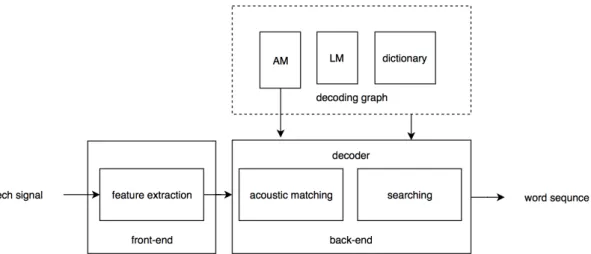
Generally, the goal of the recognizer is to decode an input speech signal which contains an encrypted linguistic message spoken by a speaker to a word sequence. The structure of a modern ASR recognizer consists of five basic modules: feature extraction, a acoustic model, a language model, a pronunciation dictionary, and a decoder, and it is shown in 2.1.
The module of feature extraction segments a discrete sequence of speech samples to short frames and transforms frames from time to frequency or cepstral domain. The feature extraction process removes redundant information from speech signal (fundamen-tal frequency, a phase) and keeps only the information which is important for acoustic modelling. The benefit of cepstral features is that they are decorrelated, which is pre-ferred by GMM-based acoustic modelling, but also due to the fact that similarly sounding speech units create clusters in the cepstral domain. To improve the robustness of cepstral features, cepstral-mean normalization is commonly applied to reduce channel or speaker variably.
The acoustic model describes the acoustic variability of modelled speech units. The 5
Figure 2.1: The principle structure of the ASR system
selection of the speech units is largely arbitrary but the typical choice is to use mono-phones (i.e. context-independent mono-phones) or trimono-phones (context-dependent mono-phones). The stochastic approach based on HMM coupled with GMM has been traditionally used to tackle the variability in both time and cepstral domains for several decades.
The purpose of the language model (LM) is to model dependencies between particular words in a sentence. Typically, rule-based or stochastic models are used. The parameters of a stochastic LM are trained on huge text corpora. The dictionary contains mapping between words and theirs pronunciations.
Before the decoding process starts, the acoustic, language models and dictionary are compiled to a complex decoding graph which represents the source of knowledge for the decoding process. The decoding process starts with computation of features which are then passed to a decoder that computes acoustic scores in an acoustic matching block and combines them with language scores that are stored in the recognition graph. The process ends by searching a large hypotheses space for the word sequence which maximizes a posterior probability for given input sequence of features.
From a mathematical point of view, the recognition problem can be formulated using the following equation:
c
W= arg max W
P(W|O) (2.1)
where W = w1, w2, ..., wn is the sequences of spoken words, O = o1, o2, ..., oj is the se-quences of the feature vectors andWc represents the decoded hypothesis. The conditional
2.1. CONVENTIONAL GMM-HMM ASR SYSTEM 7
probability can be re-written applying Bayes theorem to
c
W= arg max W
P(O|W)P(W)
P(O) (2.2)
where the P(O|W) represents acoustic model, P(W) represents language model and P(O) is the feature vectors probability (it is independent of W).c
2.1.1
Cepstral-based speech features
To solve the speech recognition problem means to solve a pattern classification problem. The design of suitable features is critical for this approach. Various methods of feature extraction were designed with regards to understanding how the speech is produced by a human production system and how the speech is perceived by a human auditory system. This chapter describes a category of cepstral features which model spectral properties of a shot-time speech signal. Cepstral coefficients are used as features for speech recognition due to arguments based on speech production and perception knowledge [76]. The first is that the cepstrum deconvolves voice source from the vocal tract. The second is that humans perceive sounds in critical bands. The most common feature set includes the so called mel-frequency or perceptual-linear-predictive cepstral coefficients (MFCC of PLP). Articulatory features represent another category of ASR features which are based on speech production knowledge. The process of speech production and the AF features is discussed and described in section 2.3.
Short-time spectral analysis
The goal of the feature extraction component shown in 2.1 is to convert speech signal to sequences of features vectors for further classification describing well a variation of non-stationary speech signal characteristics during the time. Discretized and quantized analog speech signal is usually saved in 16bit Pulse-Code Modulation (PCM) format (µ-law/a-law represent formats used in 8k telephone domain). Digital speech signal is then represented as a sequence of samplesx[n] ={x[0], x[1], ..., x[N −1]}, where N is number of samples.
A preemphasis filter is often used as the first step in the extraction process for many speech features. The objective of the preemphasis is to amplify high-frequency components as a compensation for their attenuation during human production [115]. The filter is designed as a 1st order FIR filter described by one coefficient representing the zero point of its transfer function.
The signal is then split into quasi-stationary short-time frames and each short-time frame is multiplied by a weighting window w[n] (usually Hamming window). The typical window length and the shift is 25 ms and 10 ms respectively. The window is applied to compensate for the effect of spectral leakage in the spectrum computed on the basis of the DFT (realized by an FFT, Fast Fourier Transform algorithm). This procedure represents the first part for a majority of feature extraction techniques.
Mel-Frequency Cepstral Coefficients
MFCC cepstral features were designed to model human auditory system. They approxi-mate nonlinear behavior of human perception as a function of frequency and the compu-tation process is shown in Fig. 2.2.
Figure 2.2: MFCC feature extraction
Computed real and imaginary spectral components still contain a lot of redundant information for a classifier, so the phase information is discarded and the magnitude spec-trum is transformed using a filter bank to reduce number of spectral components. For MFCC features, this next step involves using the mel-based filter bank which approxi-mates the non-linear perception of frequencies by the human auditory system. Mel-based filter bank consists of overlapping triangular filters which are linearly spread on the mel-frequency scale. These values represent the energy in particular mel-frequency bands. Such a filter bank is usually realized using DFT, where the mel-based logarithmic filter-bank ener-giesgj are computed as a multiplication of square magnitude spectrum and the frequency response Hmel,j of the j-th filter as
gj =ln N/2 X k=0 |S[k]|2H mel,j[k] for j = 1, 2, ..., M , (2.3)
where S[k] is DFT-based spectrum, N length of analyzed frame in samples, and M the number of bands in used filter bank. Finally, gj is a real and even sequence which is transformed to cepstral domain using Discrete Cosine Transform (DCT) to obtain cepstral
2.1. CONVENTIONAL GMM-HMM ASR SYSTEM 9 coefficientscn, i.e. cn = r 2 P P X j=1 gjcos πn P (j−0.5) forn = 1, 2, ..., M . (2.4)
The low dimensional MFCC coefficients describe the shape of magnitude spectra which represents the configuration of vocal tract, zeroth-cepstral coefficient c0 is related to the
power of signal, and MFCC coefficients do not contain information about fundamental frequency. The standard practice is to use 13 MFCC for GMM-HMM systems as the application of DCT decorrelates the features on top of transforming them to the cepstral domain. For DNN-HMM system, the filter bank coefficients gj (FBANK) are sometimes preferable, but a high dimensional MFCC are also used quite often.
Perceptual Linear Prediction
Perceptual Linear Prediction analysis (PLP) represents an alternative to MFCC and it is the second most frequently used approach for speech feature extraction. PLP was developed by Hermansky [46] and the computation process is shown in Fig. 2.3.
Figure 2.3: PLP feature extraction
The close similarity of MFCC and PLP features can be clearly observed from the diagram. The digitized speech signal is transformed to the short-time power spectral domain and then transformed in several steps which aim to exploit knowledge of the hu-man auditory system (critical-band analysis, equal-loudness-curve and intensity-loudness power-law application). The filter bank is implemented in the power spectral domain and consists of the trapezoidal filters which are equally spaced on the bark scale.
The extraction process ends with the computation of cepstral coefficients using LPC (Linear Predictive Analysis), i.e. modified power spectrum is modeled using all-pole autoregressive (AR) model of the orderp. More specifically, inverse DFT transforms power spectra to autocorrelation coefficients and then, Yule-Walker method is used to estimate
the autoregressive coefficients ak. The final PLP cepstral coefficients are obtained from the autoregressive coefficients using recursive formula as
cn =−an− 1 n n−1 X k=1 (n−k)akcn−k, for n= 1, 2, ..., p.
Temporal context information
It was shown by many authors that the long temporal contextual information is very important for increasing accuracy of ASR systems [92], [103]. The above mentioned cepstral features describe a speech signal in short-time frames which capture temporarily limited information about speech units modelled by a classifier. To capture the longer temporal context and to improve the ASR accuracy, the delta (dynamic), delta-delta (acceleration), or third differential (delta-delta-delta) features are often concatenated into the final feature vector. These features describe the evolution of static features [62] and thus capture the movement of the vocal tract during the phonation. Dynamic features are computed from static features using simple difference formula which is applied across a window dn = K P k=1 k∗(cn+k−cn−k) 2∗ K P k=1 k2 , (2.5)
where dn represents the delta coefficients for current feature framecn and K determines the size of the contextual window (2K + 1). Its typical value is 2. The acceleration as well as the third differential coefficients are computed in the same manner as the delta coefficients.
Another approach to integrate the long temporal contextual information into ASR that is typically used in TANDEM system [47] is the use of the TempoRAl Pattern (TRAP) based features. The TANDEM system and DCT-TRAP features are described in 2.2.2.
Normalization techniques
Normalization methods are commonly used in ASR or speaker recognition systems to compensate for convolution noise distortion which is caused by channel and speaker vari-ability (e.g. different type of microphone for AM training and testing) or by stationary additive noise. The set of possible options includes two basic techniques. The first option is the Cepstral Mean Normalization (CMN) where mean cepstrum is subtracted from each short-time static cepstral vector. Second option is the Cepstral Mean and Variance Normalization (CMVN) where the subtraction of average cepstrum is followed by a scal-ing (dividscal-ing by standard deviation). Both of these techniques can be computed on per
2.1. CONVENTIONAL GMM-HMM ASR SYSTEM 11
utterance or per speaker basis. In the case of per utterance basis, the mean and standard deviation are estimated from all frames within one utterance. The computed stats are then applied on all frames to provide zero-mean and unit-variance cepstral features for next processing [24]. The former is preferred in online ASR systems whereas the later in offline systems.
LDA-based and speaker-dependent features
An alternative option to dynamic features on how to incorporate temporal context into the feature vector is to stack the static features with a context window of lengthl, where l is the number of preceding and following frames added to the current frame. It is often used as an input to MLP/DNN classifiers in various tasks such as voice activity detection (VAD), phone recognition or DNN based ASR systems. Concerning convention GMM-HMM system, it can be used as well, however, the dimension of stacked features must be reduced using Linear Discriminant Analysis (LDA) [43] as well as decorrelated using Semi-Tied Covariance (STC) [34] transform. The features processed in such a way are suitable for modelling by HMM with diagonal covariance matrix in a GMM-HMM system [108].
This target feature vector of the size 40 can be further speaker-adapted using feature-space Maximum Likelihood Linear Regression (fMLLR) and these features are used in modern LVCSR systems with GMM-HMM architecture as a standard setup. Fig. 2.4 illustrates the whole processing chain from raw MFCC to final features which are fed into the decoding block.
2.1.2
GMM-HMM based Acoustic Modelling
As it was mentioned before, speech signal is a non-stationary signal. The same speaker, when asked to phonate the same speech unit, can produce signals with a large degree of variability due to the speaking rate, speaking style, quality of the pronunciation or state/age of the speaker. To efficiently model this variability in representation, the stochastic approach was introduced very early on and it still represents an important part of ASR systems working in real-live conditions.
The Gaussian Mixture Models and Hidden Markov Models (GMM-HMM) combination represented the first conventional approach for AM which was widely used by the speech community. The HMM model is finite-state automaton which is characterized by the following parameters:
• non-emitting/ emitting states,
Figure 2.4: Feature extraction used in GMM-HMM systems.
• A transitions matrix,
• initial state probabilities
The structure of a HMM model is defined by a configuration of non-emitting and emitting states. The non-emitting states are used for initial and target states and are mainly for concatenation of particular models to high level structures. The emitting states in HMM are described by a probability density function and they are used to model relationship between HMM state and acoustic observation (e.g. triphones clusters in cepstral domain). The movement between particular states is defined by transitions matrix and its transition probabilities. The commonly used structure for speech unit modelling is a left-right HMM model. The model consists of 3 emitting states without skips which model triphones (8-15 states are used in a word-model) and typically 5 emitting states configuration is used for silence modelling. The GMM distribution was found to be effective for modelling of speech units in cepstral space. An n-dimensional Gaussian function is defined by the following equation
N (o, µ, C) = p 1 (2π)N|C j| ·e−12(o−µ) TC−1(o−µ) (2.6)
where N is dimension of the Gaussian function which is equal to the dimension of a feature vectoro,µis vector of mean values andC is a covariance matrix which describes shape or rotation of distribution. When particular dimensions in feature vectors are decorrelated, the Gaussian function with diagonal covariance can be used. This is a typical situation, because cepstral features fulfill well above mentioned assumption thanks to DCT in the last step of MFCC computation. Above mentioned Gaussian distribution is used in acoustic model for state description in a generalized form of the GMM, i.e. as the weighted sum of several Gaussian functions (mixtures). Probability density function
2.1. CONVENTIONAL GMM-HMM ASR SYSTEM 13
which describesj-th state of HMM models is then defined as
bj(o) = M X m=1 cjm·N o, µjm, Cjm , (2.7)
where M is number of Gaussian mixture components and cjm is weight of particular Gaussian mixture. To estimate the parameters of a GMM-HMM model, several training algorithms were successfully developed, i.e. Maximum Likelihood (ML) estimation based on Baum-Welch algorithm, discriminative training based on Maximum Mutual Informa-tion (MMI) [18], boosted Maximum Mutual InformaInforma-tion (bMMI), or Minimal Phone Error (MPE) [55].
2.1.3
Language Modelling & Dictionary
Further important component in ASR is the language model (LM), which covers the linguistic level of spoken and written language and models order of word sequence in recognized utterance. Typical conventional approach used for LM is based on n-grams, which models history ofn1 words. Regarding the equation 2.2, the goal of the LM is to estimate apriori probability of a word sequence P(W) based on the following equation
P(W) =P(w1)P(w2|w1)P(w3|w1w2)....P(wi|w1w2...wi−1) =
n
Y
i=1
P(wi|w1, ...wi−1), (2.8)
whereP(wi|w1, ...wi−1 represents the probability of the wordi which has dependency on
i−1 previous words [37].
Since estimating the probability of a word depending on large number of previous words is practically impossible, bigrams or trigrams (i.e 2-grams or 3-grams) represent the most frequently used LMs for decoding within conventional ASR. The higher orders of n-grams (4-grams or 5-grams) are typically used during re-scoring of decoded hypotheses. The n-gram models are trained on large text corpora, but to deal with the problem of sparse data for some n-grams, smoothing techniques must be involved. The commonly used smoothing methods are Good-Turing (GT), Kneser-Ney (KN) and Witten-Bell (WB). Another typical problem of a LM is the mismatch between train corpora and target domain for ASR. Therefore, the LM interpolation methods are used to adapt a generic LM to the target recognition domain.
Additional kind of a special LM is a class-based n-gram model, where the words with similar meaning can be included in a class. Typical examples is a class based LM for ASR designed to control devices, e.g. GPS commands, where we can have class for countries,
cities or streets. Nowadays, some systems use LMs based on neural networks where recurrent (RNN) or long short-term memory (LSTM) neural networks are used to model longer dependencies more efficiently [145].
As the purpose of this thesis is the study of an impact of special features within conventional ASR system, the basic setup based on n-gram LMs are discussed in the corresponding experimental parts of this thesis.
The next important component in a ASR system related to language-level description is pronunciation dictionary containing pronunciations for every decoded word. In fact, it joins the modelling at the level of AM and LM respectively. Pronunciation dictionaries contain usually a mapping from orthographic level of a word to canonical phonetic form, i.e. regular pronunciation. In case a lexicon containing good representation of multiple recognition domains is created, automatic methods called g2p (grapheme-to-phoneme) conversion can be used to learn this mapping. For some languages with strong and regular relationship between written and pronounced form of a word, g2p conversion can be defined on an expert level. Czech is such a language and all further described work uses] such g2p tool.
2.1.4
Recognition graph, decoding
The acoustic model, language model, and lexicon represent the key resources of knowledge which need to be put together and saved in an effective format for a searching process in the recognizer. These particular modules of ASR systems are nowadays typically based on Weighted Finite State Transducers (WFST) which allows to simplify the representation of above mentioned parts. A final static recognition graph is then given by a composition of particular automata as
HCLG=H◦C◦L◦G (2.9)
where HCLG represents final WFST decoding graph, H is HMM topology for modelled triphones, C represents conversion of monophones to context-dependent phones, L is a lexicon mapping words →monophones, and G is a probabilistic grammar or a stochastic language model. The symbol ◦ is used for the composition operation which is applied to join above mentioned parts, i.e. automata (modules) H,C, L, and G.
A minimization and determination operation are involved to remove redundant paths from the final decoding graph. This step has significant impact of a size of the graph and the speed of decoding and it represents the main reason to use WFST approach. The process of compilation and minimization of a decoding graph is not a goal of the thesis too and it is used as a standard module in the experimental part. More details can be
2.2. DNN-BASED SPEECH RECOGNITION 15
found in the following resources [90], [109], [107]. Finally, the token-passing algorithm is typically used to find the best hypotheses for a given observation feature vector and the decoded output can be represented using one-best/n-best results or a lattice [109].
2.2
DNN-based speech recognition
The section describes two widely used approaches for integration of artificial neural net-works with a HMM-based ASR architecture.
2.2.1
DNN-HMM-based Acoustic Modelling
An alternative approach to GMM for estimating of emitting probabilities within an HMM is based on artificial neural networks and the architecture is called as ANN-HMM hybrid ASR system and it was introduced early by Morgan [91]. In this configuration, MLP-based ANN structure was used for classification of senons which represent states of context-dependent triphones in an AM. Nowadays, these feed-forward neural networks with several hidden layers, called as DNN were found as the most efficient way for AM [48]. DNN-HMM approach significantly improves the accuracy of an ASR when compared to legacy GMM-HMM architectures and it represents an important milestone in the AM development.
DNN definition
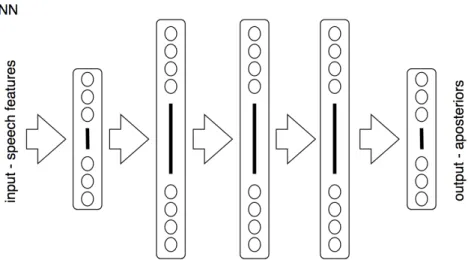
DNN structure consists of an input layer, several hidden layers and an output layer as shown in Fig. 2.5. The input layer distributes the speech features, and therefore the number of its neurons depends on the size of an input feature vector. Each neuron output in the hidden layer is defined by a commonly used sigmoid activation function
fk(zk) = 1
1 +ezk, (2.10)
which is applied on inner neuron potential zk computed as a general weighted sum of the neuron inputs zk =bk+ I X j=1 wjkxj, (2.11)
where the weightswjk and biasbk are associated with thek-th neuron. The DNN output represents a posteriori probability of a given HMM state and the possible value is in the range of 0 ÷ 1. It is computed by a softmax activation function defined for the k-th output neuron and particular neuron potentials zj as
fk(zk) = ezk K P j=1 ezj . (2.12)
The size of the output layer is always given by a number of classified classes (monophones, triphones, senons).
DNN acoustic model and its training
The integration of DNN to HMM based acoustic models is demonstrated in 2.6. As it was mentioned, DNN provides a prediction of context-dependent triphone state probabilities. Computed a posteriori probabilities of the triphone states are also often transformed to likelihood domain by dividing with a priori probabilities of particular triphone states, which is estimated from a train data set.
Concerningthe training of a DNN-HMM acoustic model, it can not be done from scratch as is the case for a GMM-HMM acoustic model. The training process is typi-cally split to two stages. First, the GMM-HMM system is trained to prepare targets for DNN-HMM training obtained by a forced alignment which associates context-dependent triphone states with particular frames. Then, the process of DNN training can start with random initialization of weights or with the initialization of hidden layers based on Re-stricted Boltzmann Machines (RBMs) [48]. Further, cross-entropy objective function is used together with a backpropagation algorithm. The discriminative training approaches
2.2. DNN-BASED SPEECH RECOGNITION 17
Figure 2.6: Architecture of DNN-HMM ASR system
were adapted for DNN-HMM as well and they represent the next improvement of AM quality [110].
Features used for DNN-HMM architecture
Typically, the short-time feature vectors based on cepstrum and delta and delta-delta features can be used at an input of a DNN. Usually, the features are simply stacked with a temporal context without any further processing as it is not necessary to perform decorrelation for DNN-based models. On the other hand, it is strongly recommended to realize the mean and variance normalization of used features if they are used as an input of a DNN.
Concerning nowadays used DNN-HMM systems, they often use previously mentioned advanced LDA-based features, however, they are still further stacked with the temporal context of several frames to increase the number of input information. An illustrative block scheme of feature extraction procedure using MFCC is in Fig. 2.7.
2.2.2
TANDEM architecture of ASR
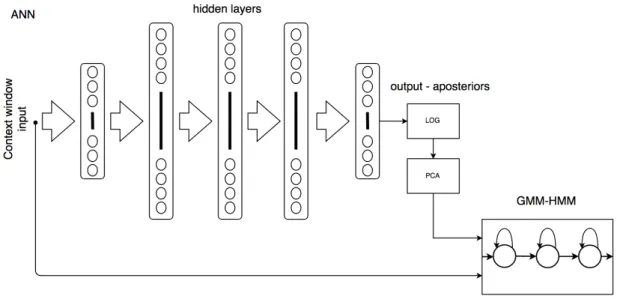
Based on the first MLP-HMM based ASR system development, the TANDEM architecture was introduced by Hermansky [47]. The TANDEM system consists of the MLP network, which is used to extend front-end processing and it is followed by the convention GMM-HMM architecture for the AM. Such an architecture is shown in Fig. 2.8. The design
Figure 2.7: Feature extraction used in DNN-HMM systems.
procedure of a TANDEM system can be split into two stages. In the first stage, MLP classifier is trained to map input feature vector to context-independent phoneme classes. Then, the trained MLP classifier is used as a feature extractor component and produces class probabilities per frame. The class probabilities are also called a posterior features. Assuming GMM modelling of features, the logarithm operation and Principal Component Analysis (PCA) are applied on a posterior features to obtain decorrelated features with Gaussian distribution which are suitable for GMM-HMM acoustic modelling. All methods developed for the convention GMM-HMM acoustic modelling (e.g. speaker adaptation or discriminative training) can be used to improve a TANDEM system.
A posterior-feature-based GMM-HMM TANDEM system achieves better results in noisy acoustic conditions when compared to the conventional cepstral-based GMM-HMM or hybrid MLP-HMM ASR systems. However, its performance on ASR tasks in clean conditions were similar to cepstral based GMM-HMM system. Various setups of the feature processing pipeline used within GMM-HMM acoustic modelling were analyzed during last two decades [38], [29], [140]. Simply post-processed a posterior features used within the first TANDEM classifiers are typically combined with standard PLP-∆-∆∆-HLDA-39 features for LVCSR ASR tasks [7]. Around 2008, the TANDEM system was improved with the bottleneck features (BF), which were proposed by Grezl [38]. The architecture with BF overcame the convention cepstral based GMM-HMM ASR system for the first time in [40], [39]. Later, the more complex hierarchical structure of BF extractors were developed for ASR, speaker recognition or language identification tasks [140], [81], [27].
In the case of features for MLP/DNN classifier, the stacked MFCC/PLP cepstral features or TRAP based features are commonly used to represent longer temporal context. As it was discussed, the purpose of using time context information in ASR is to describe the process of co-articulation produced within human speech production.
TANDEM system was first to apply TRAP feature-extraction technique which is based on using the temporal trajectories of spectral power in the individual critical bands. The technique was proposed by Hermansky and Sharma in 1998 and the analysis of various variants continued in [139], [29]. Both mel or bark filter banks are used and the temporal
2.2. DNN-BASED SPEECH RECOGNITION 19
Figure 2.8: Architecture of TANDEM ASR system
trajectories of critical band energies are independently classified or compressed using DCT.
First, the signal is filtered with a preemphasis filter, followed by the auditory spectral analysis. Typically, the number of bands in the auditory spectral analysis is smaller than within the standard MFCC computation and this setup was found to be a good compro-mise. It enabled to decrease a computational complexity of a MLP and it still proved to yield sufficient accuracy in the classification task. The temporal patterns were created within a context window per each critical band and temporal patterns were compressed using the DCT to decrease the input vector dimension and to increase their decorrelation. In the end, concatenated DCT coefficients represent the DCT-TRAP feature vector on the input of classifier. The significance of contextual information in the task of phone recognition was analyzed in detail for English language in [103], [102], [128] and found to be around 90-110 ms.
As discussed before, the authors in [128], [38] showed that TRAP based features can significantly improve the performance of ASR systems and phone recognition and they have became common for front-end processing in the TANDEM systems. Only one work [112] has applied TRAP to the estimation of AF. In addition, an inclusion of longer context at the input of an ANN-based AF classifier was discussed in [137]. As a result, the next chapter presents the analysis of DCT-TRAP-based estimation of AF for Czech and English language.
2.3
Articulatory Features within Speech technology
Previously discussed approaches of speech representation based on spectral or cepstral analysis respectively are used in many ASR systems with a very good performance under standard conditions. However, when acoustic conditions as well as speaking style with analyzed utterance are worse, these standard features reach their limit due to the possible removal of particular details of a signal characteristic during smoothing procedure as well as due to removing some further information, e.g. about fundamental frequency, etc.
An option on how to improve the representation of a speech signal under more adverse conditions is to include useful information about human speech production or articulation. We are speaking about so called Articulatory Features and they represent one possible way of how speech production knowledge can be incorporated into the ASR systems. Within further sections, speech production process is briefly summarized as well as known applications of AF within speech recognition system are discussed.
2.3.1
Speech Production
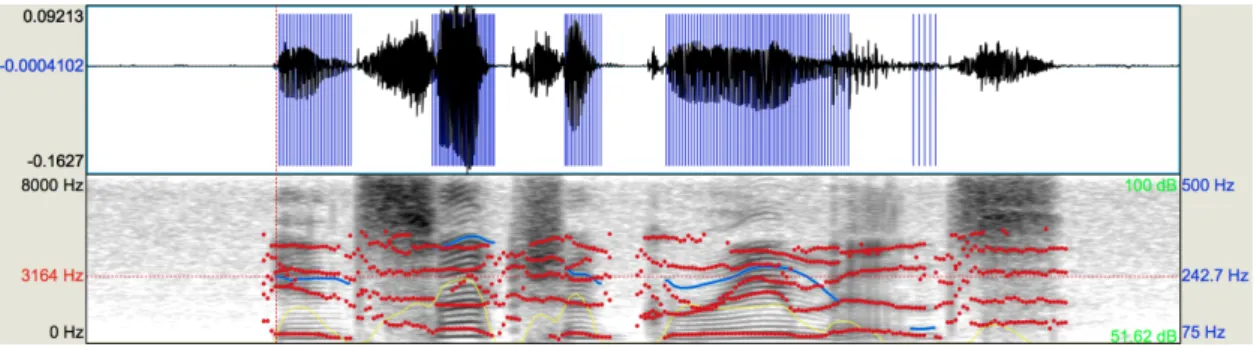
The speech signal is an acoustic signal determined by the air flow which comes out of the mouth and which represents the basis of a speech generation. It is generated by the asynchronous movement of various muscles in the voice tract and therefore, the speech signal is a non-stationary signal, however, it can be considered as quasi-stationary signal in short-time periods. The quasi-stationary character allows to process the digitized speech signal using DFT framework in spectral domain as was discussed in section 2.1.1 with regards to auditory features. The quasi-stationary character can be clearly observed in time and spectral domain in Fig. 2.9.
Figure 2.9: Speech signal - time/frequency domain
The whole process of speech production starts in the respiratory system, where the air flow is expelled from lungs, continues to pass through the trachea into the larynx where the vocal tract is located. An important part of the larynx related to speech generation are the vocal folds. They modulate the rising air-flow. When the vocal cords are tight,
2.3. ARTICULATORY FEATURES WITHIN SPEECH TECHNOLOGY 21
Figure 2.10: Speech vocal tract (source [3])
the rising air-flow generates a glottal cycle which includes glottal open instant and closure instant (pitch marks). The pitch marks can be automatically detected and they are represented using blue lines in Fig 2.9. They are commonly used in the pitch-synchronous segmentation during building of TTS systems or are used for speed modification which is widely used as data augmentation method in an AM [67]. It means that the periodic vibration of the vocal folds creates the voice source signal, which forms the basis of the human voice.
The vibration period of the vocal cords is called the fundamental period or the pitch periodT0 and its inverse value f0 = 1/T0 is the fundamental frequency. The fundamental
frequency is also commonly used in ASR systems for Asian languages and it can be automatically estimated via auto-correlation based methods [36]. The estimated contour of f0 is shown as the blue line in Fig. 2.9.
The fundamental frequency is an important basic feature of voiced sounds. The voice-less voices are generated by a stream of air passing through the open vocal folds and therefore do not contain the fundamental tone. If the vocal cords and vocal tract are completely calm and open, only breathing occurs. Consequently, the voicing allows to distinguish between voiced and unvoiced speech consonants, so it represents an important AF class.
Concerning further speech production process, the air-flow is modulated in the vocal tract cavities and it is radiated out as acoustic sound waves from the mouth and nostrils. The vocal tract represents a key component of speech production and its anatomy is shown in Fig 2.10. It consists of various organs which are called articulators. The acoustic
resonance frequencies of those cavities are also called the formants (the estimated formant frequencies are plotted as red line in spectral domain in Fig. 2.9), which help to distinguish among individual phonemes.
The articulation system consists of oral, nasal and pharyngeal cavities. The pharynx, the soft palate, the hard palate, the alveolar ridge, the tongue, the teeth and the lips represent organs which are involved in the speech production process. The articulation organs have an direct impact on a character of produced speech sound and allow to distinguish among particular vowels and consonants. The tongue is an active organ in the vocal tract and its position has an impact on a creation most of speech sounds. Typically, when the tongue touches the soft palate the velar consonants are created, when alveolar ridge is touching the tongue alveolar consonants are produced or the dental consonants are created when the tongue touches the front teeth [122]. The changes in shape and position of the articulators takes some time, which is referred to as the co-articulation. Position of articulators as well as their possible movement is the bases to define AF classes. Likewise. The vocal tract and movements of articulators is unique for each speaker which allow to use them as human characteristics in Voice Biometry.
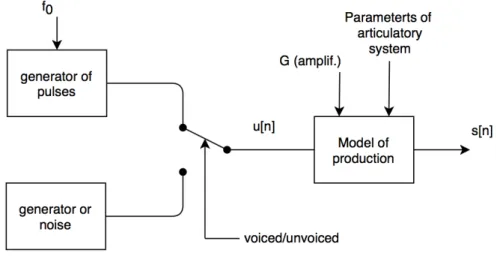
Signal model of speech production
To model the speech production process, the pulses/noise generators and a digital filter need to be defined. Digital filter model allows to generate quasi-stationary speech sig-nal s[n] based on periodic updates of its parameters. The block diagram of the speech production model is shown in Fig. 2.11.
Figure 2.11: Artificial model for generation of speech signal
2.3. ARTICULATORY FEATURES WITHIN SPEECH TECHNOLOGY 23
represent the vocal cords and their task is to simulate a voice/unvoiced character of air-flow. The shape of target spectrum is modeled by digital filter representing the vocal tract. Typically, an all-pole filter is used for modelling the resonators (cavities) in a articulatory system and its parameters can be estimated using an LPC. The volume is simulated by the parameeter G (amplification coefficient).
2.3.2
Speech description at phonetic level
The alternative description of the speech production is using the articulatory phonetics and phones. The phone is the acoustic realization of a phoneme, which represents a phonological unit, which allows to distinguish between words. The Czech language has 9 allophones. The phones allow to describe a speech sound with regards to the configuration of the articulation system. Each language has its specific phones set and the unification of language specific phones created of The International Phonetic Alphabet (IPA). The IPA charts is shown in Fig. 2.12. The vowels and consonants classes in IPA table are widely used as articulately features for ASR systems. The difference between standard MFCC/PLP speech features and AFs is that AF describe properties of vocal rather tract than properties of acoustic signal. Therefore, the AF contains complementary information about the speech production.
2.3.3
Applications of Articulatory Features
Articulatory features contain useful information about human speech production or articu-lators and represent one of the ways how speech production knowledge can be incorporated into the ASR systems. Summary and challenges of using the speech production knowledge in ASR systems are synoptically mentioned by Kirchhoff in [65], Livescu in [78], [80], King and Frankel in [61], Metze [85] and Mitra [87]. The most important arguments for using speech production knowledge in ASR can be summarized in the following points:
• speech data can by used more effectively because some AFs can be shared across a group of phonemes,
• AFs enable better modelling of the co-articulation, assimilation and reduction pro-cess which are present especially in spontaneous or casual speech [33],
• AFs can help in adverse conditions when background or convolutional noise is present [65], [66], [86],
• AFs are more suitable for the usage in multilingual tasks in comparison to the usage of language-universal phoneme set.
ts kp∞ ∂ p b t d ≥ … c ï k g q G / m İ n = Ò N Î õ r R ⱱ | Ç F B f v T D s z S Z § ˆ ć J x V X å © ? h H ñ L æ ¨ ø j » l Ï ´ K > ≤ ' ù ë p' < ú t' ¥ Ä k' Ù ì s' i y é è ∑ u I Y U e P ɘ Â ‰ o π E { ä ɞ μ O ¿ ⁄ a ‹ A ş e_ “ e# Ê e! č e$ ∆ e@ ≈ e% e~ ™ eÔ eÑ È e& ÿ Ã Õ ¤ ª – ó w ◊ ç ê S x í Ω Ö 9 n9 d9 ∫ b∫ a∫ 1 t1 d1 3 s3 t 3 0 b0 a0 ’ t’ d’ î tîdî
£
t£
d£ 4 t4 d4 7 O7 W tW dW ) e) Í OÍ ≠ t≠ d≠ ö dö ± u± Ú tÚ dÚ ” d” 2 e2 ı tı dı } d} á eá â : + e+ 6 e6 ¨6 ` n` À eÀ BÀ 8 e8 5 e5 Ø ã aØ ° e °"
®foUnπ"tISπn®
É eÉ ò eò * e* ù Ù . ¨i.⁄kt Å N(Bilabial Labiodental Dental Alveolar Postalveolar Retroflex Palatal Velar Uvular Pharyngeal Glottal Plosive Nasal Trill Tap or Flap Fricative Lateral fricative Approximant Lateral approximant
Symbols to the right in a cell are voiced, to the left are voiceless. Shaded areas denote articulations judged impossible.
Clicks Voiced implosives Ejectives
Bilabial Bilabial Examples: Dental Dental/alveolar Bilabial (Post)alveolar Palatal Dental/alveolar Palatoalveolar Velar Velar Alveolar lateral Uvular Alveolar fricative
Front Central Back Close Close-mid Open-mid Open
Where symbols appear in pairs, the one to the right represents a rounded vowel.
Voiceless labial-velar fricative Alveolo-palatal fricatives Voiced labial-velar approximant Voiced alveolar lateral flap Voiced labial-palatal approximant Simultaneous and Voiceless epiglottal fricative
Affricates and double articulations can be represented by two symbols joined by a tie bar if necessary. Voiced epiglottal fricative
Epiglottal plosive Primary stress Secondary stress Long Half-long Extra-short Minor (foot) group Major (intonation) group Syllable break
Linking (absence of a break)
LEVEL CONTOUR or Extra high or Rising
High Falling
Mid Highrising
Low Lowrising
Extra Rising-low falling Downstep Global rise Upstep Global fall
THE INTERNATIONAL PHONETIC ALPHABET (revised to 2018)
CONSONANTS (PULMONIC) © 2018 IPA
CONSONANTS (NON-PULMONIC)
OTHER SYMBOLS
DIACRITICS Some diacritics may be placed above a symbol with a descender, e.g. VOWELS
SUPRASEGMENTALS
TONES AND WORD ACCENTS
Voiceless Breathy voiced Dental Voiced Creaky voiced Apical Aspirated Linguolabial Laminal More rounded Labialized Nasalized Less rounded Palatalized Nasal release Advanced Velarized Lateral release Retracted Pharyngealized No audible release Centralized Velarized or pharyngealized
Mid-centralized Raised ( = voiced alveolar fricative) Syllabic Lowered ( = voiced bilabial approximant) Non-syllabic Advanced Tongue Root
Rhoticity Retracted Tongue Root
2.4. GOALS OF THE THESIS 25
These advantages and recommendations for incorporating speech production knowl-edge to ASR have motivated researchers for several decades and a lot of research has been done to develop end-to-end ASR systems based on the speech production knowledge (both observation modelling and pronunciation modelling are based on AFs). Therefore, a lot of research was focused on using AFs in other speech applications such as:
• spontaneous, conversational ASR [33],
• pronunciation modelling [77],
• phone recogniton [120], phonetic segmentation [49]
• spoken term detection [111],
• speaker recognition, speaker verification [130],
• robust speech recognition [41],
• voice conversion [11],
• multilingual or cross-lingual ASR [73], [146],
• application for under-resourced languages [8],
All these areas have been thoroughly studied recently. The above mentioned advan-tages and applications incorporating AFs represent the motivation for this work. The main focus on the Czech language systems lies in the following tasks:
• spontaneous, conversational ASR,
• robust speech recognition,
• phone recogniton,
• phonetic segmentation segmentation.
2.4
Goals of the thesis
On the basis of the above summary of the start-of-the-art in the given research field, the motivation of this work is to study the properties of articulatory features same as their potential contribution in several tasks of speech recognition, phone recognition and phonetic segmentation, both with the main focus on the processing of the casual and spontaneous speech. The challenge attempt to solve the task of spontaneous speech recognition have been employed by the researchers in the speech community for several decades and it is still a very current topic.
The solution to this problem requires using modern techniques of feature extraction, acoustic modelling and also pronunciation and language modelling. The main motivation of this work should be to incorporate the speech production knowledge using articulatory
features to the state-of-the-art ASR systems and to develop a robust spontaneous speech recognition system. Special attention will be paid to the systems working for Czech.
Finally, goals of this thesis can be summarized more precisely in the following points.
• The study of articulatory features contribution for speech recognition and phonetic segmentation.
• In general, to explore modern techniques of feature extraction and acoustic modelling with a special focus on the possible contribution of articulatory features to the description of spontaneous and casual speech (with further applications in the field of informal speech recognition).
• More specifically, perform the optimization of AF estimation and AF-based phone recognition for Czech and English (possibly also for other languages); for this pur-pose the modern approaches based on DNN.
• To contribute to the processing of speech collected under adverse conditions because informal speech is typically produced in the real environment, often with some level of disturbances (background noise, cross-talks, distant speech, etc.); such approach should be then applied also to other robust speech recognition systems (e.g. in the car environment).
• In the application field, to implement an AF-based phone recognition, a phonetic segmentation, and a AF-TANDEM-based ASR system for the task of spontaneous and informal recognition (focused mainly on Czech, but other languages will be also included).
• Concerning the implementation issues, to use modern toolkits available in the speech research community allowing the realization of above mentioned applications, i.e. KALDI, TNet; the use of our private feature extraction tool CtuCopy will be also extended to include newly designed feature extraction techniques; and the created final implementations will be publicly available.
• Regarding the experimental part, to conduct experiments under various acoustic conditions, i.e. standard read speech (database SPEECON, TIMIT), the speech containing higher level of background noise (car speech data), spontaneous speech (data containing technical lectures), and finally casual speech (Nijmegen Corpus of Casual Czech).
• As a by product of experimental part, special selections of suitable speech data, language models or lexica from available resources completed possibly by additional information according to the requirements of above mentioned experiments are also supposed to be prepared; these data should be then publicly available for the research community when it is allowed by particular license conditions.

![Figure 2.10: Speech vocal tract (source [3])](https://thumb-us.123doks.com/thumbv2/123dok_us/10012529.2493624/39.892.311.631.170.496/figure-speech-vocal-tract-source.webp)