S. Zeytun, A. Gupta
A Comparative Study of the Vasicek
and the CIR Model of the Short Rate
© Fraunhofer-Institut für Techno- und Wirtschaftsmathematik ITWM 2007 ISSN 1434-9973
Bericht 124 (2007)
Alle Rechte vorbehalten. Ohne ausdrückliche schriftliche Genehmigung des Herausgebers ist es nicht gestattet, das Buch oder Teile daraus in irgendeiner Form durch Fotokopie, Mikrofilm oder andere Verfahren zu reproduzieren oder in eine für Maschinen, insbesondere Datenverarbeitungsanlagen, ver-wendbare Sprache zu übertragen. Dasselbe gilt für das Recht der öffentlichen Wiedergabe.
Warennamen werden ohne Gewährleistung der freien Verwendbarkeit benutzt. Die Veröffentlichungen in der Berichtsreihe des Fraunhofer ITWM können bezogen werden über:
Fraunhofer-Institut für Techno- und Wirtschaftsmathematik ITWM Fraunhofer-Platz 1 67663 Kaiserslautern Germany Telefon: +49 (0) 6 31/3 16 00-0 Telefax: +49 (0) 6 31/3 16 00-10 99
Vorwort
Das Tätigkeitsfeld des Fraunhofer-Instituts für Techno- und Wirtschaftsmathematik ITWM umfasst anwendungsnahe Grundlagenforschung, angewandte Forschung sowie Beratung und kundenspezifische Lösungen auf allen Gebieten, die für Tech-no- und Wirtschaftsmathematik bedeutsam sind.
In der Reihe »Berichte des Fraunhofer ITWM« soll die Arbeit des Instituts konti-nuierlich einer interessierten Öffentlichkeit in Industrie, Wirtschaft und Wissen-schaft vorgestellt werden. Durch die enge Verzahnung mit dem Fachbereich Ma-thematik der Universität Kaiserslautern sowie durch zahlreiche Kooperationen mit internationalen Institutionen und Hochschulen in den Bereichen Ausbildung und Forschung ist ein großes Potenzial für Forschungsberichte vorhanden. In die Be-richtreihe sollen sowohl hervorragende Diplom- und Projektarbeiten und Disser-tationen als auch Forschungsberichte der Institutsmitarbeiter und Institutsgäste zu aktuellen Fragen der Techno- und Wirtschaftsmathematik aufgenommen werden. Darüber hinaus bietet die Reihe ein Forum für die Berichterstattung über die zahl-reichen Kooperationsprojekte des Instituts mit Partnern aus Industrie und Wirt-schaft.
Berichterstattung heißt hier Dokumentation des Transfers aktueller Ergebnisse aus mathematischer Forschungs- und Entwicklungsarbeit in industrielle Anwendungen und Softwareprodukte – und umgekehrt, denn Probleme der Praxis generieren neue interessante mathematische Fragestellungen.
Prof. Dr. Dieter Prätzel-Wolters Institutsleiter
A Comparative Study of the Vasicek and the CIR
Model of the Short Rate
Serkan Zeytun, Ankit Gupta
July 23, 2007
Abstract
In this work, we analyze two important and simple models of short rates, namely Vasicek and CIR models. The models are described and then the sensitivity of the models with respect to changes in the param-eters are studied. Finally, we give the results for the estimation of the model parameters by using two different ways.
1
Introduction
The movements of interest rate play an important role in the decision of invest-ment and risk manageinvest-ment in the financial markets. One-factor models are a popular class of interest rate models which is used for these purposes, especially in the pricing of interest rate derivatives. One-factor models are represented by the following stochastic differential equation
dr(t) =µ(t, r(t))dt+σ(t, r(t))dW(t) (1)
where µandσare the drift and the diffusion term of the interest rate process,
respectively, and W is a Brownian motion.
The Vasicek and CIR models are two important models of short rate in the class of one-factor models. Although there are many extensions of these models in the literature, they are still popular because of their tractability and their closed form solutions for various interest rate derivatives. In this work, we will focus on these two models.
2
Vasicek Model
Vasicek (1977) assumed that the instantaneous spot rate under the real world measure evolves as an Orstein-Uhlenbeck process with constant coefficients. For a suitable choice of the market price of risk, this is equivalent to assume that
r follows an Ornstein-Uhlenbeck process with constant coefficients under the
risk-neutral measure as well, that is under Q
wherer0,κ,θandσare positive constants. Under the physical measureQ0, the model follows :
dr(t) = [κθ−(κ+λσ)r(t)]dt+σdW0(t), r(0) =r0, (3)
where λ is the market price of risk. Notice that for λ= 0 the two dynamics
coincide, i.e. there is no difference between the risk neutral world and the subjective world. However, this process here assumes that the market price of risk has the form of
λ(t) =λ r(t) (4)
which is a popular assumption in the literature. Under this choice we obtain a short rate process that is tractable in both measures. The market price of risk
can be chosen as constant, i.e, λ(t) =λ.
The most important feature which this model exhibits is the mean reversion,which
means that if the interest rate is bigger than the long run mean (r> θ), then the
coefficientκ(>0) makes the drift become negative so that the rate will be pulled
down in the direction ofθ. Similarly, if the interest rate is smaller than the long
run mean (r< θ), then the coefficientκ(>0) makes the drift term become
pos-itive so that the rate will be pulled up in the direction of θ. Therefore, the
coefficientκis the speed of adjustment of the interest rate towards its long run
level. There are also compelling economic arguments in favor of mean reversion. When the rates are high, the economy tends to slow down and borrowers require less funds. Furthermore, the rates pull back to its equilibrium value and the rates decline. On the contrary when the rates are low, there tends to be high demand for funds on the part of the borrowers and rates tend to increase. This feature is particularly attractive because without it, interest rates could drift permanently upward the way stock prices do and this is simply not observed in practice.
Other attractive features of the model is the availability of a closed form
solu-tions forrtwhich is obtained by integrating the risk-neutral equation mentioned
above. The solution of the model is, for eachs≤t
r(t) =r(s)e−κ(t−s)+θ(1−e−κ(t−s)) +σ
Z t
s
e−κ(t−u)dW(u). (5)
Here the interest rates are normally distributed and the expectation and variance are given by E{r(t)|F(s)}=r(s)e−κ(t−s)+θ(1−e−κ(t−s)) (6) V ar{r(t)|F(s)}= σ 2 2κ h 1−e−2κ(t−s)i (7)
One unfortunate consequence of a normally distributed interest rate is that it is
possible for the interest rate to become negative. However, as t→ ∞, the limit
of expected rate and variance, as long as κ > 0, will converge to θ andσ2/2κ
The Vasicek Model possess an affine term structure (ATS) i.e. the term struc-ture has the form
p(t, T) =F(t, r(t);T) (8)
whereF has the form
F(t, r;T) =e(A(t,T)−B(t,T)r), (9) and where A and B are deterministic functions. It turns out that the existence of an affine term structure is extremely pleasing from an analytical and a com-putational point of view, so it is of considerable interest to see which model has an affine structure.
This feature also made the model successful and famous because of the ease to calculate the term structure with given formulaes with no need of simulation of short rates. The model has the term structure given by :
P(t, T) =A(t, T)e−B(t,T)r(t) (10) where A(t, T) = exp θ− σ 2 2κ2 [B(t, T)−T +t]−σ 2 4κB(t, T) 2 (11) B(t, T) = 1 κ h 1−e−κ(T−t)i (12)
Jamshidian (1989) showed that the price at timet of a European option with
strike K, maturity T an written on a pure discount bond maturing at time S
can be easily calculated and is given by
ZBO(t, T, S, K) =w[P(t, S)Φ(wh)−KP(t, T)Φ(w(h−σp))], (13)
wherew= 1 for a call andw=−1 for a put, Φ(.) denotes the standard normal
cumalative function, and
σp = r 1−e−2κ(T−t) 2κ B(T, S), (14) h = 1 σp ln P(t, S) P(t, T)K+ σp 2 (15)
3
Cox-Ingersoll-Ross Model
In this model, under the risk-neutral measure Q, the instantaneous short rate
follows the stochastic differential equation
dr(t) =κ(θ−r(t))dt+σpr(t)dW(t), r(0) =r0, (16)
whereκ,θ,σ,r0are positive constants, andW(t) is a Brownian motion. When
we impose the condition 2κθ > σ2then the interest rate is always positive,
oth-erwise we can only guarantee that it is non-negative (with a positive probability to terminate in zero).
The drift factor κ(θ−r(t)) is same as in the Vasicek model. Therefore, the
short rate is mean-reverting with long run meanθand speed of mean-reversion
equal to κ. The volatility termσ of the Vasicek model is multiplied with the
term p
r(t), and this eliminates the main drawback of the Vasicek model, a
positive probability of getting negatice interest rates. When the interest rate
approaches zero then the volatility termσp
r(t) approaches zero, cancelling the
effect of the randomness, so the interest rate remains always positive. When the interest rate is high then the volatility is high and this is a desired property.
Under the objective measureQ0, the model follows the process
dr(t) = [κθ−(κ+λσ)r(t)]dt+σpr(t)dW0(t) (17)
where λis a constant and W0(t) is a Q
0-Brownian motion. The market price
of risk has the form of
λ(t) =λpr(t) (18)
and, so it depends on the level of the interest rate. Again, this is a popular choice which we do not justify here.
If we work in the risk-neutral measure Q, then the conditional expectation
and the conditional variance of the short rate are given by
EQ{r(t)|F(s)} = r(s)e−κ(t−s)+θ(1−e−κ(t−s)) (19) V ar{r(t)|F(s)} = r(s)σ 2 κ e−κ(t−s)−e−2κ(t−s)+θσ 2 2κ 1−e−κ(t−s) 2 (20)
In the CIR model, the short rate admits a noncentral chi-square distribution. The density function for the interest rate process is
pr(t)(x) =pχ2(ν,λt)/ct(x) =ctpχ2(ν,λt)(ctx) (21) where ct = 4κ σ2(1−exp(−4κ)) (22) ν = 4κθ/σ2 (23) λt = ctr0exp(−κt) (24)
and χ2(ν, λ) is the noncentral chi-squared distribution function with ν degrees
of freedom and non-centrality parameter λ.
The CIR model provides explicit solutions for the bond prices. The model
has affine term structure, so the price of a zero-coupon bond at time t with
maturity T has the form
P(t, T) =A(t, T)e−B(t,T)r(t) (25) where A(t, T) = 2hexp {(κ+h)(T−t)/2} 2h+ (κ+h)(exp{(T−t)h} −1) 2κθ/σ2 , (26)
B(t, T) = 2(exp{(T−t)h} −1)
2h+ (κ+h)(exp{(T−t)h} −1), (27)
h = pκ2+ 2σ2. (28)
Another important feature of the CIR model is that there is a closed form formula for the call option price written on a zero coupon bond. The price of a
European call option at time twith maturity T > t, strike priceK, written on
a zero-coupon bond maturing atS > T, is
ZBC(t, T, S, K) =P(t, S)χ2 2r[ρ+ψ+B(T, S)] ;4κθ σ2 , 2ρ2r(t)exp{h(T−t)} ρ+ψ+B(T, S) −KP(t, T)χ2 2r[ρ+ψ] ;4κθ σ2 , 2ρ2r(t)exp{h(T−t)} ρ+ψ (29) where ρ = ρ(T−t) := 2h σ2(exp{h(T−t)} −1) (30) ψ = κ+h σ2 (31) r = r(S−T) := ln(A(T, S)/K) B(T, S) (32)
4
Sensitivity of the models for the parameters
Vasicek and CIR are two of the historically most important short rate models used in the pricing of interest rate derivatives. Some of the parameters play a big role in the pricing of a financial derivatives or in the forecasting of a process, while some of them do not affect them so much. Therefore, depending on what we want to price or forecast, it is important to check the sensitivity of the models with respect to different parameters.
4.1
Sensitivity of short rate simulation for the model
pa-rameters
In this part we analyze the effect of the parameters, when we use either the Vasicek or the CIR model in simulation of the short rate.
Discretization of the models by the Euler method results in the discretized version of the Vasicek model as
rV(ti+1) =rV(ti) +κ[θ−rV(ti)]∆t+σ
√
∆tZi+1 (33)
while the discretized version of the CIR model is
rC(ti+1) =rC(ti) +κ[θ−rC(ti)]∆t+σ
p
rC(ti)
√
If we change κby an amount ofδκ then our discretized models are rκV(ti+1) =rV(ti) + (κ+δκ)[θ−rV(ti)]∆t+σ √ ∆tZi+1 (35) and rκC(ti+1) =rC(ti) + (κ+δκ)[θ−rC(ti)]∆t+σ p rC(ti) √ ∆tZi+1. (36)
So, the change in the short rate for one unit of discretization in time is
∆κVrV(ti+1) =rVκ(ti+1)−rV(ti+1) =δκ(θ−rV(ti))∆t (37)
for the Vasicek model, and
∆κCrC(ti+1) =rCκ(ti+1)−rC(ti+1) =δκ(θ−rC(ti))∆t (38)
for the CIR model. This shows that, if we increase κ then the next value of
the short rate increases by δκ(θ−r(t
i)∆t) in both Vasicek and CIR models
when the current short rate is below the long run mean, and decreases by the same amount when the current short rate is above the long run mean. So,
the change in κwill not affect the short rate in long term, just effect the time
which is necessary for the interest rate to come back to the long-run mean level. On the other hand, when the kappa is increased the variation of the interest rate decreases, so the volatility decreases. Therefore, kappa is important in the pricing of the financial instruments which are affected by the volatility, but are not dependent on the long term expected value of the simulated interest rate.
0 1 2 3 4 5 6 7 8 9 10 −0.1 −0.05 0 0.05 0.1 0.15 0.2 0.25 Time Interest Rate kappa = .1 kappa = 1 long run mean = .06
Figure 1: Sensitivity of Vasicek
model forκ 0 1 2 3 4 5 6 7 8 9 10 0.02 0.03 0.04 0.05 0.06 0.07 0.08 0.09 0.1 Time Interest Rate kappa = .1 kappa = 1 long run mean = .06
Figure 2: Sensitivity of CIR
model forκ
The change inθbyδθ gives
rVθ(ti+1) =rV(ti) +κ[(θ+δθ−rV(ti)]∆t+σ
√
∆tZi+1 (39)
for the Vasicek model, and
rθC(ti+1) =rC(ti) +κ[(θ+δθ−rC(ti)]∆t+σ
p
rC(ti)
√
∆tZi+1 (40)
for the CIR model. Then the changes in the short rate are
0 1 2 3 4 5 6 7 8 9 10 0 0.02 0.04 0.06 0.08 0.1 0.12 0.14 Time Interest Rate
Figure 3: Sensitivity of Vasicek
model forθ 0 1 2 3 4 5 6 7 8 9 10 0.04 0.05 0.06 0.07 0.08 0.09 0.1 0.11 0.12 0.13 Time Interest Rate
Figure 4: Sensitivity of CIR
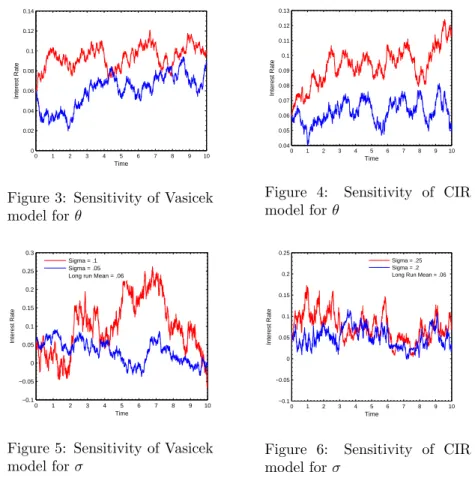
model forθ 0 1 2 3 4 5 6 7 8 9 10 −0.1 −0.05 0 0.05 0.1 0.15 0.2 0.25 0.3 Time Interest Rate Sigma = .1 Sigma = .05 Long run Mean = .06
Figure 5: Sensitivity of Vasicek
model forσ 0 1 2 3 4 5 6 7 8 9 10 −0.1 −0.05 0 0.05 0.1 0.15 0.2 0.25 Time Interest Rate Sigma = .25 Sigma = .2 Long Run Mean = .06
Figure 6: Sensitivity of CIR
model forσ
Therefore, the increase in θ increases the next step value of short rate in the
both models. So, it is a crucial parameter in the estimation of the model.
Following the same way for both models, a change in σ causes a change in
interest rate
∆σVrV(ti+1) =δσ
√
∆tZi+1 (42)
for the Vasicek model, and
∆σCrC(ti+1) =δσ
p
rC(ti)
√
∆tZi+1 (43)
for the CIR model. So, the change inσeffects the short rate in both models. A
fixed amount of change inσeffects the short rate simulation more in the Vasicek
model than the CIR model, because in the CIR model the volatility contains the
p
r(t) term and this term decreases the effect of a change inσ. We can realize
that also from the Figure 5 and Figure 6. 0.05 increase in σ is quite visibile
in the Vasicek model, but that is not the case for the CIR model. The change
in short rate can be negative or positive depending on the sign of δσ and the
random term. Also note that, the amount of change in the short rate is highly dependent on the random term. Because of the standard Brownian motion,
in the long term, the effect of the change in σ does not effect the expected
value of the interest rate, but it increases the variations. Therefore, if we are
if we are interested in pricing of some financial instruments which are affected
by the variations in the short rate dynamics in short term, then σis a crucial
parameter for us.
4.2
Sensitivity of bond prices for the model parameters
In this part the analysis is done to see how the variations in the various param-eters affect the zero-coupon bond prices generated by the models. The method used is to fix two parameters and vary the third one to study the impact of varying parameter on the bond prices at a given time for different maturities. We use plots of bond prices for analysis as it is not easy to get formulas for the changes in bond prices caused by a change of a parameter.
Figure 7 and Figure 9 show the effect of κ to bond prices driven by Vasicek
model for two different values of σ. When the σ is small then the effect of κ
is less compared with the case of high σ. With a small σ we get nearly same
bond prices for different κ values. An increase inκ decreases the bond prices
and after a certain value of κ the effect of the κin the bond prices is almost
nothing. When we increase the σ, then theκplays a bigger role in the pricing
of the bonds (Figure 9). Figure 9 shows that with low κ value and high σ it
is possible to get bond prices bigger than 1. This is because of the possibility
of negative interest rates in Vasicek model. With smaller κthe probability of
getting negative values of short rate is higher and a high volatility increases this
probability further. A highκvalue makes this probability negligible and we get
more bond prices which are less than 1.
0 2 4 6 8 10 0.55 0.6 0.65 0.7 0.75 0.8 0.85 0.9 0.95 1 ← kappa = 0.1 kappa = 1 → Time to Maturity Bond Prices
Figure 7: Vasicek bond prices
with differentκ’s (σ= 0.02) 0 2 4 6 8 10 0.55 0.6 0.65 0.7 0.75 0.8 0.85 0.9 0.95 1 ← kappa = 0.1 kappa = 1 → Time to Maturity Bond Prices
Figure 8: CIR bond prices with
differentκ’s (σ= 0.02)
When we use CIR model, instead of the Vasicek model to price bonds, we get similar results except bond prices more than 1 (Figure 8 and Figure 10). This result because of the positive interest rates in CIR model. From the figures the
variation of the bond prices with differentκvalues looks like smaller in the CIR
model, but this is not the case. In the figures, we use same values of σ but
typically values ofσ are higher in the CIR model. When we increase theσ we
0 2 4 6 8 10 0.5 0.6 0.7 0.8 0.9 1 1.1 1.2 1.3 1.4 ← kappa = 0.1 kappa = 1 → Time to Maturity Bond Prices
Figure 9: Vasicek bond prices
with differentκ’s (σ= 0.1) 0 2 4 6 8 10 0.55 0.6 0.65 0.7 0.75 0.8 0.85 0.9 0.95 1 ← kappa = 0.1 kappa = 1 → Time to Maturity Bond Prices
Figure 10: CIR bond prices
with differentκ’s (σ= 0.1)
The effect of the θ for bond prices in Vasicek and CIR model is more straight
(Figure 11 and Figure 12) compared with the other parameters. In both models,
a increase inθdirectly effect the bond prices and we get lower bond prices. The
only difference is seen when we have lowθvalues. With a smallθvalue we can
get bond prices greater than 1 in Vasicek model because of the possibility of negative interest rates, while it is not possible in CIR model.
0 2 4 6 8 10 0.5 0.6 0.7 0.8 0.9 1 1.1 1.2 mean = 0.01→ mean = .1 → Time to Maturity Bond Prices
Figure 11: Vasicek bond prices
with differentθ’s (σ= 0.1) 0 2 4 6 8 10 0.4 0.5 0.6 0.7 0.8 0.9 1 ← mean = 0.01 mean = .1 → Time to Maturity Bond Prices
Figure 12: CIR bond prices
with differentθ’s (σ= 0.1)
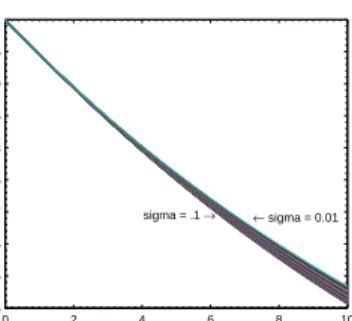
Figure 13 and Figure 14 show the different levels of bond prices for Vasicek
and CIR model for different levels of σ. The variation of the bond prices w.r.t.
same σvalues are higher in the Vasicek model, becauseσis typically higher in
the CIR model (In the CIR model, volatility term contains p
r(t) in addition
to volatility term of the Vasicek model. To compensate this difference, the σ
term of the CIR should be higher). In both models, lower σvalues give lower
bond prices and higher σvalues gives higher bond prices, while the sensitivity
of bond prices for a change inσis higher with highσvalues. Also note that, in
Vasicek model, a bond price higher than 1 (because of the possibility of negative
0 2 4 6 8 10 0.55 0.6 0.65 0.7 0.75 0.8 0.85 0.9 0.95 1 sigma = 0.01 → ← sigma = .1 Time to Maturity Bond Prices
Figure 13: Vasicek bond prices
with differentσ’s 0 2 4 6 8 10 0.55 0.6 0.65 0.7 0.75 0.8 0.85 0.9 0.95 1 ← sigma = 0.01 sigma = .1 → Time to Maturity Bomd Prices
Figure 14: CIR bond prices
with differentσ’s
5
Calibration and estimation of model
parame-ters
5.1
Calibration of model parameters using bond prices
In this section, we calibrate Vasicek and CIR models to analyze the efficiency and stability of the models. To find the model parameters, we apply the clas-sical Least-Square technique to the actual Canadian zero-coupon bond data. The data was taken from the Bank of Canada website. While zero-coupon rates are not themselves directly observable, the monthly data has been generated by them from the Svensson model as implemented by Bolder and Streliski (1999). This data correspond to the first day of each month, from January 1997 to December 2006. The market zero-coupon rates incorporated into our measure-ment system will include fourteen observations with 3-month, 6-month, 1-year, 1.5-year, 2-year, 3-year, 4-year, 5-year, 7-year, 10-year, 15-year, 20-year, 25-year and 30-year time to maturities. The optimization problem was solved using the algorithm Direct which finds the global minima of the objective function. The code for the direct algorithm was taken from a free source available on the internet. The algorithm used by the Direct method is described here briefly. DIRECT is a sampling algorithm. That is, it requires no knowledge of the ob-jective function gradient. Instead, the algorithm samples points in the domain, and uses the information it has obtained to decide where to search next. A global search algorithm like DIRECT can be very useful when the objective function is simulation or when the dimension of the objective function is small. The DIRECT algorithm will globally converge to the minimal value of the objec-tive function. Unfortunately, this global convergence may come at the expense of a large and exhaustive search over the domain, and using a limited number of evaluations and iterations can cause to find a local minima. The name DI-RECT comes from the shortening of the phrase ”DIviding DI-RECTangles”, which describes the way the algorithm moves towards the optimum.
Because of the usage of a limited number of evaluations and iterations in the optimization algorithm we could have got local minima in some optimizations
which made the standard error high in some cases. To see the trend of the parameters better we also included the approximations of the parameter values by applying a smoothing function to the graphs.
Calibration results for theκin the Vasicek and CIR models are given in Figure
15 and Figure 16, respectively. Results for both models are unstable. However, this is not particularly a big problem, because, as we concluded in the
sensi-tivity of the bond prices for κ in the previous section, that kappa is a crucial
parameter only when the σ is high andκis small. Only in that situation the
bond prices are highly sensitive to κ. If we compare the calibration results for
κand σthen we can observe that when the κis small then the corresponding
σis also small, and this eliminates the effect of theκ.
1997 1998 1999 2000 2001 2002 2003 2004 2005 2006 2007 −1 −0.75 −0.5 −0.25 0 0.25 0.5 0.75 1 1.25 1.5 1.75 2 Time
Kappa, The Mean Reversion Speed
Figure 15: Calibration results forκin Vasicek model
1997 1998 1999 2000 2001 2002 2003 2004 2005 2006 2007 −1 −0.75 −0.5 −0.25 0 0.25 0.5 0.75 1 1.25 1.5 1.75 2 Time
Kappa, The Mean Reversion
Figure 16: Calibration results forκin CIR model
Figure 17 and Figure 18 show the calibration results forθ. From the figures, it
is clear that the results in both models are inline with each other. There is no
19970 1998 1999 2000 2001 2002 2003 2004 2005 2006 2007 0.015 0.03 0.045 0.06 0.075 0.09 0.105 0.12 0.135 0.15 0.165 0.18 0.1950.2 Time
Mean, The Long Term Interest Rate
Figure 17: Calibration results for θin Vasicek model
19970 1998 1999 2000 2001 2002 2003 2004 2005 2006 2007 0.015 0.03 0.045 0.06 0.075 0.09 0.105 0.12 0.135 0.15 Time Mean
Figure 18: Calibration results forθ in CIR model
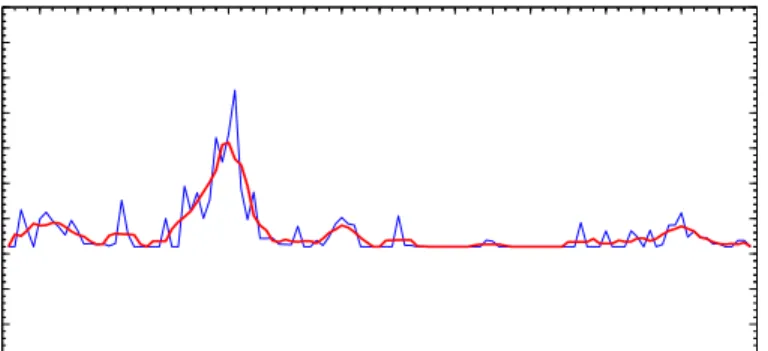
Calibration results of the models for σ are given in Figure 19 and 20.
Cali-bration of the CIR model gives higher value ofσ as what was expected. The
Vasicek model gives more stableσestimates compared with the CIR model, so
this model can be prefered to infer the volatility structure of the Canadian bond prices.
Summing up all conclusions for the calibration of the models using bond prices
we see that for both Vasicek and CIR, estimates κand θ were similar, while
Vasicek has more stableσestimates for the Canadian bond prices than the CIR
1997 1998 1999 2000 2001 2002 2003 2004 2005 2006 2007 −0.1 −0.05 0 0.05 0.1 0.15 0.2 0.25 0.3 0.35 Time
Sigma, The Volatility
Figure 19: Calibration results forσin Vasicek model
1997 1998 1999 2000 2001 2002 2003 2004 2005 2006 2007 −0.2 −0.15 −0.1 −0.05 0 0.05 0.1 0.15 0.2 0.25 0.3 0.35 0.4 0.45 Time
Sigma, The Volatility Parameter
Figure 20: Calibration results for σin CIR model
5.2
Estimation of the parameters using historical short
rates and calibration of market price of risk
In this section, we assume short rate under the subjective measure Q0 in the
Vasicek model follows
dr(t) =κ∗(θ∗−r(t))dt+σ∗dW(t) (44) and in the CIR model follows
dr(t) =κ∗(θ∗−r(t))dt+σ∗pr(t)dW(t). (45)
where λis a constant which features the market price of risk. Using historical
data for the interest rates we can estimate the parameters of the models under the objective measure. Changing the measure by Girsanov’s Theorem we can go back to the risk-neutral measure, and under this measure our parameters are
κ=κ∗−λσ∗, θ= κ∗θ∗
κ∗−λσ∗, σ=σ ∗
.
Then, using these parameters which depend on λ only, we can calibrate the
model forλby using the current bond prices. This λcan then be used to
cal-culate model parameters under the risk-neutral measure and the market price of risk for the models.
To estimate the real world parameters we used the historical overnight rates data for Canada starting from the beginning of 1994 to the end of 2004. We used 8-year data to estimate the parameters. For estimation of the parameters from the historical time series data, we used two-stage estimation method of Philips P. C. B. and Yu J. (2005). This method estimates parameters of the diffusion term and drift term separately. In the first step, the parameters of the diffusion term are found by a quadratic variation type estimator. In the second step, an approximate likelihood function is maximized to find a maximum like-lihood estimator of the parameters of drift term.
After estimating the real world parameter, last day’s zero coupon bond prices
were used to calibrate the models for λ. This λ is then used to change the
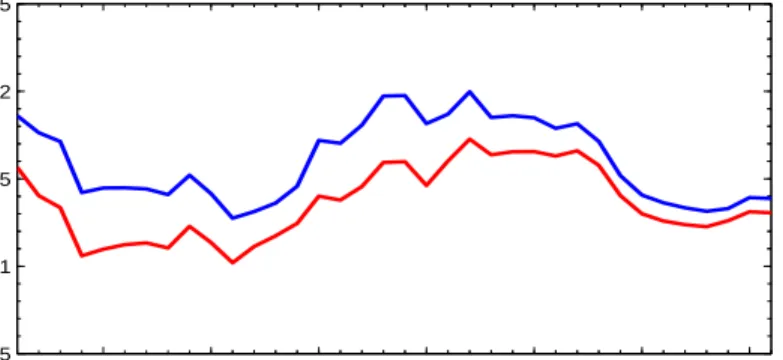
measure and find the parameters of risk-neutral world. After calculating the parameters for the first 8-year data, we shifted the time frame one month fur-ther and used the last 8-year data and applied the same procedure to this data. This process was repeated for 36 observations,i.e. for each month till the end of 2004. The results are given in Figure 21, 22, 23 and 24 (blue curves are for the Vasicek model while red ones are for the CIR model).
5 10 15 20 25 30 35 0.5 1 1.5 2 2.5 Time
Kappa, The Mean Reversion Speed
Figure 21: Estimation results forκin Vasicek and CIR models
The Vasicek and CIR models gives almost the same results for all parameters. The long rum mean is the same in both models while the speed of mean
rever-sion is a little bit higher in the Vasicek model. σfollows the same trend in both
models and the difference in the level of σ comes from the inclusion of p
r(t) term in the volatility term of the CIR model. Figure 24 gives the market price of
risk for the models, i.e. λ(t) =λr(t) for the Vasicek model, andλ(t) =λp
r(t) for the CIR model. We have similar results also for the market price of risk of the models.
5 10 15 20 25 30 35 0.04 0.045 0.05 0.055 0.06 0.065 0.07 Time
Theta, The Long Term mean
Figure 22: Estimation results forθin Vasicek and CIR models
5 10 15 20 25 30 35 0 0.02 0.04 0.06 0.08 0.1 0.12 0.14 Time
Sigma, The Volatility Parameter
Vasicek CIR
Figure 23: Estimation results forσin Vasicek and CIR models
5 10 15 20 25 30 35 0 0.5 1 1.5 Time
The Market Price of Risk
Vasicek CIR
Therefore, we can not decide which model is better for the historical short rate data of Canada as both methods gives similar results for all parameters.
6
Conclusions
This work has been focused on the study of two endogenous one factor models, namely the CIR and Vasicek model. In the first part, we studied the basic features of the two models and did a comparative study to see how the various parameters affect the dynamics and pricing of bonds evaluated using the two models. The analysis showed that the two models were quite similar in the way they react to changes in the parameters. However, due to the multiplication of
the square root term in the CIR model, a particular change inσdid not affect
the prices of the bonds as it did in the Vasicek model. Moreover the value of sigma in the CIR model was generally high, which can be misleading at times. On the other hand, a high sigma in the Vasicek model could result in negative interest rates which is not observable in reality.
In the second part of the work, we applied the models to a given data set, in an attempt to study and analyze the nature of fits of the models. First, we calibrated the models using the bond prices, thus getting the parameters in the risk neutral world. The results of the two models seemed quite similar, but again the calibration gave a higher sigma in the CIR model, which was rather unstable. However, the results could also have been questionable due to the optimization procedure we used. We applied two different optimization algorithms to check the correctness of the results and the two methods yielded similar results. The parameters of the models were also estimated using the historical overnight interest rates. The two stage method was used in the esti-mation procedure. The parameter values driven by the estiesti-mation had exactly the same variations over time for the two models, again showing that for the given data set, the two models were quite similar. However, the Vasicek model seemed to perform better due to the more stable volatility parameter.
In the given data set it is quite clear that the models exhibit quite nice fit. The question of choosing a model is answerable in terms of what we want to price. In general if the interest rates are far away from zero, the Vasicek model can be given an edge over the CIR model, due to the tractability of the model and also the availability of closed form solutions even for more complex financial interest rate derivatives. However, if the interest rates are closer to zero then working with the Vasicek model can become cumbersome due to the possibil-ity of negative interest rates which can yield some illogical results and prices. However, in data which are not as smooth and well-behaved as the given data set, time dependent models would be much better in explaining the features of the term structure. Typically, the Vasicek and CIR models do not effectively handle a complex term structure. In this case, a smaller number of parame-ters prevents a satisfactory calibration to the market data and the zero coupon curve is likely to be badly reproduced, and also the shapes like the inverted yield curves cannot be explained by these models. In that case time dependent models which fit the current term structure perfectly would be better.
References
[1] Brigo, D., and Mercurio, F., Interest Rate Models - Theory and Prac-tice.
Spinger-Verlag Berlin Heidelberg 2001, 2006.
[2] Cox, J.C, Ingersoll, J.E, and Ross, S.A., A Theory of the Term Structure of Interest Rates.
Econometrica 53 (1985), 385−407.
[3] Phillips, P.C.B, and Yu, J., A Two-Stage realized Volatility Approach to the estimation for Diffusion process from Discrete Observations. Cowles Foundation Discussion Paper No.1523(2005).
[4] Vasicek,O., An Equilibrium Characterization of the Term Structure.
Journal of Financial Econometrics 5 (1977), 177−188.
[5] http://www4.ncsu.edu/˜ctk/Finkel Direct/. [6] http://www.bankofcanada.ca/en/rates/index.html.
Published reports of the
Fraunhofer ITWM
The PDF-files of the following reports are available under:
www.itwm.fraunhofer.de/de/ zentral__berichte/berichte 1. D. Hietel, K. Steiner, J. Struckmeier
A Finite - Volume Particle Method for Compressible Flows
(19 pages, 1998)
2. M. Feldmann, S. Seibold
Damage Diagnosis of Rotors: Application of Hilbert Transform and Multi-Hypothe-sis Testing
Keywords: Hilbert transform, damage diagnosis, Kalman filtering, non-linear dynamics
(23 pages, 1998)
3. Y. Ben-Haim, S. Seibold
Robust Reliability of Diagnostic Multi- Hypothesis Algorithms: Application to Rotating Machinery
Keywords: Robust reliability, convex models, Kalman fil-tering, multi-hypothesis diagnosis, rotating machinery, crack diagnosis
(24 pages, 1998)
4. F.-Th. Lentes, N. Siedow
Three-dimensional Radiative Heat Transfer in Glass Cooling Processes
(23 pages, 1998)
5. A. Klar, R. Wegener
A hierarchy of models for multilane vehicu-lar traffic
Part I: Modeling (23 pages, 1998)
Part II: Numerical and stochastic investigations (17 pages, 1998)
6. A. Klar, N. Siedow
Boundary Layers and Domain Decompos-ition for Radiative Heat Transfer and Diffu-sion Equations: Applications to Glass Manu-facturing Processes
(24 pages, 1998)
7. I. Choquet
Heterogeneous catalysis modelling and numerical simulation in rarified gas flows Part I: Coverage locally at equilibrium (24 pages, 1998)
8. J. Ohser, B. Steinbach, C. Lang
Efficient Texture Analysis of Binary Images (17 pages, 1998)
9. J. Orlik
Homogenization for viscoelasticity of the integral type with aging and shrinkage (20 pages, 1998)
10. J. Mohring
Helmholtz Resonators with Large Aperture
11. H. W. Hamacher, A. Schöbel
On Center Cycles in Grid Graphs (15 pages, 1998)
12. H. W. Hamacher, K.-H. Küfer
Inverse radiation therapy planning - a multiple objective optimisation approach (14 pages, 1999)
13. C. Lang, J. Ohser, R. Hilfer
On the Analysis of Spatial Binary Images (20 pages, 1999)
14. M. Junk
On the Construction of Discrete Equilibrium Distributions for Kinetic Schemes
(24 pages, 1999)
15. M. Junk, S. V. Raghurame Rao
A new discrete velocity method for Navier-Stokes equations
(20 pages, 1999)
16. H. Neunzert
Mathematics as a Key to Key Technologies (39 pages (4 PDF-Files), 1999)
17. J. Ohser, K. Sandau
Considerations about the Estimation of the Size Distribution in Wicksell’s Corpuscle Problem
(18 pages, 1999)
18. E. Carrizosa, H. W. Hamacher, R. Klein, S. Nickel
Solving nonconvex planar location prob-lems by finite dominating sets
Keywords: Continuous Location, Polyhedral Gauges, Finite Dominating Sets, Approximation, Sandwich Algo-rithm, Greedy Algorithm
(19 pages, 2000)
19. A. Becker
A Review on Image Distortion Measures
Keywords: Distortion measure, human visual system
(26 pages, 2000)
20. H. W. Hamacher, M. Labbé, S. Nickel, T. Sonneborn
Polyhedral Properties of the Uncapacitated Multiple Allocation Hub Location Problem
Keywords: integer programming, hub location, facility location, valid inequalities, facets, branch and cut
(21 pages, 2000)
21. H. W. Hamacher, A. Schöbel
Design of Zone Tariff Systems in Public Transportation
(30 pages, 2001)
22. D. Hietel, M. Junk, R. Keck, D. Teleaga
The Finite-Volume-Particle Method for Conservation Laws
(16 pages, 2001)
23. T. Bender, H. Hennes, J. Kalcsics, M. T. Melo, S. Nickel
Location Software and Interface with GIS and Supply Chain Management
Keywords: facility location, software development, geographical information systems, supply chain man-agement
24. H. W. Hamacher, S. A. Tjandra
Mathematical Modelling of Evacuation Problems: A State of Art
(44 pages, 2001)
25. J. Kuhnert, S. Tiwari
Grid free method for solving the Poisson equation
Keywords: Poisson equation, Least squares method, Grid free method
(19 pages, 2001)
26. T. Götz, H. Rave, D. Reinel-Bitzer, K. Steiner, H. Tiemeier
Simulation of the fiber spinning process
Keywords: Melt spinning, fiber model, Lattice Boltzmann, CFD
(19 pages, 2001)
27. A. Zemitis
On interaction of a liquid film with an obstacle
Keywords: impinging jets, liquid film, models, numeri-cal solution, shape
(22 pages, 2001)
28. I. Ginzburg, K. Steiner
Free surface lattice-Boltzmann method to model the filling of expanding cavities by Bingham Fluids
Keywords: Generalized LBE, free-surface phenomena, interface boundary conditions, filling processes, Bing-ham viscoplastic model, regularized models
(22 pages, 2001)
29. H. Neunzert
»Denn nichts ist für den Menschen als Men-schen etwas wert, was er nicht mit Leiden-schaft tun kann«
Vortrag anlässlich der Verleihung des Akademiepreises des Landes Rheinland-Pfalz am 21.11.2001
Keywords: Lehre, Forschung, angewandte Mathematik, Mehrskalenanalyse, Strömungsmechanik
(18 pages, 2001)
30. J. Kuhnert, S. Tiwari
Finite pointset method based on the projec-tion method for simulaprojec-tions of the incom-pressible Navier-Stokes equations
Keywords: Incompressible Navier-Stokes equations, Meshfree method, Projection method, Particle scheme, Least squares approximation
AMS subject classification: 76D05, 76M28
(25 pages, 2001)
31. R. Korn, M. Krekel
Optimal Portfolios with Fixed Consumption or Income Streams
Keywords: Portfolio optimisation, stochastic control, HJB equation, discretisation of control problems
(23 pages, 2002)
32. M. Krekel
Optimal portfolios with a loan dependent credit spread
Keywords: Portfolio optimisation, stochastic control, HJB equation, credit spread, log utility, power utility, non-linear wealth dynamics
(25 pages, 2002)
33. J. Ohser, W. Nagel, K. Schladitz
The Euler number of discretized sets – on the choice of adjacency in homogeneous lattices
34. I. Ginzburg, K. Steiner
Lattice Boltzmann Model for Free-Surface flow and Its Application to Filling Process in Casting
Keywords: Lattice Boltzmann models; free-surface phe-nomena; interface boundary conditions; filling pro-cesses; injection molding; volume of fluid method; in-terface boundary conditions; advection-schemes; up-wind-schemes
(54 pages, 2002)
35. M. Günther, A. Klar, T. Materne, R. Wegener
Multivalued fundamental diagrams and stop and go waves for continuum traffic equations
Keywords: traffic flow, macroscopic equations, kinetic derivation, multivalued fundamental diagram, stop and go waves, phase transitions
(25 pages, 2002)
36. S. Feldmann, P. Lang, D. Prätzel-Wolters
Parameter influence on the zeros of net-work determinants
Keywords: Networks, Equicofactor matrix polynomials, Realization theory, Matrix perturbation theory
(30 pages, 2002)
37. K. Koch, J. Ohser, K. Schladitz
Spectral theory for random closed sets and es-timating the covariance via frequency space
Keywords: Random set, Bartlett spectrum, fast Fourier transform, power spectrum
(28 pages, 2002)
38. D. d’Humières, I. Ginzburg
Multi-reflection boundary conditions for lattice Boltzmann models
Keywords: lattice Boltzmann equation, boudary condis-tions, bounce-back rule, Navier-Stokes equation
(72 pages, 2002)
39. R. Korn
Elementare Finanzmathematik
Keywords: Finanzmathematik, Aktien, Optionen, Port-folio-Optimierung, Börse, Lehrerweiterbildung, Mathe-matikunterricht
(98 pages, 2002)
40. J. Kallrath, M. C. Müller, S. Nickel
Batch Presorting Problems: Models and Complexity Results
Keywords: Complexity theory, Integer programming, Assigment, Logistics
(19 pages, 2002)
41. J. Linn
On the frame-invariant description of the phase space of the Folgar-Tucker equation
Key words: fiber orientation, Folgar-Tucker equation, in-jection molding
(5 pages, 2003)
42. T. Hanne, S. Nickel
A Multi-Objective Evolutionary Algorithm for Scheduling and Inspection Planning in Software Development Projects
Key words: multiple objective programming, project management and scheduling, software development, evolutionary algorithms, efficient set
(29 pages, 2003)
43. T. Bortfeld , K.-H. Küfer, M. Monz, A. Scherrer, C. Thieke, H. Trinkaus
Intensity-Modulated Radiotherapy - A Large Scale Multi-Criteria Programming Problem
Keywords: multiple criteria optimization, representa-tive systems of Pareto solutions, adaprepresenta-tive triangulation, clustering and disaggregation techniques, visualization of Pareto solutions, medical physics, external beam ra-diotherapy planning, intensity modulated rara-diotherapy
44. T. Halfmann, T. Wichmann
Overview of Symbolic Methods in Industrial Analog Circuit Design
Keywords: CAD, automated analog circuit design, sym-bolic analysis, computer algebra, behavioral modeling, system simulation, circuit sizing, macro modeling, dif-ferential-algebraic equations, index
(17 pages, 2003)
45. S. E. Mikhailov, J. Orlik
Asymptotic Homogenisation in Strength and Fatigue Durability Analysis of Compos-ites
Keywords: multiscale structures, asymptotic homoge-nization, strength, fatigue, singularity, non-local con-ditions
(14 pages, 2003)
46. P. Domínguez-Marín, P. Hansen, N. Mladenovi ´c , S. Nickel
Heuristic Procedures for Solving the Discrete Ordered Median Problem
Keywords: genetic algorithms, variable neighborhood search, discrete facility location
(31 pages, 2003)
47. N. Boland, P. Domínguez-Marín, S. Nickel, J. Puerto
Exact Procedures for Solving the Discrete Ordered Median Problem
Keywords: discrete location, Integer programming
(41 pages, 2003)
48. S. Feldmann, P. Lang
Padé-like reduction of stable discrete linear systems preserving their stability
Keywords: Discrete linear systems, model reduction, stability, Hankel matrix, Stein equation
(16 pages, 2003)
49. J. Kallrath, S. Nickel
A Polynomial Case of the Batch Presorting Problem
Keywords: batch presorting problem, online optimization, competetive analysis, polynomial algorithms, logistics
(17 pages, 2003)
50. T. Hanne, H. L. Trinkaus
knowCube for MCDM –
Visual and Interactive Support for Multicriteria Decision Making
Key words: Multicriteria decision making, knowledge management, decision support systems, visual interfac-es, interactive navigation, real-life applications.
(26 pages, 2003)
51. O. Iliev, V. Laptev
On Numerical Simulation of Flow Through Oil Filters
Keywords: oil filters, coupled flow in plain and porous media, Navier-Stokes, Brinkman, numerical simulation
(8 pages, 2003)
52. W. Dörfler, O. Iliev, D. Stoyanov, D. Vassileva
On a Multigrid Adaptive Refinement Solver for Saturated Non-Newtonian Flow in Porous Media
Keywords: Nonlinear multigrid, adaptive refinement, non-Newtonian flow in porous media
(17 pages, 2003)
53. S. Kruse
On the Pricing of Forward Starting Options under Stochastic Volatility
Keywords: Option pricing, forward starting options, Heston model, stochastic volatility, cliquet options
(11 pages, 2003)
54. O. Iliev, D. Stoyanov
Multigrid – adaptive local refinement solver for incompressible flows
Keywords: Navier-Stokes equations, incompressible flow, projection-type splitting, SIMPLE, multigrid methods, adaptive local refinement, lid-driven flow in a cavity
(37 pages, 2003)
55. V. Starikovicius
The multiphase flow and heat transfer in porous media
Keywords: Two-phase flow in porous media, various formulations, global pressure, multiphase mixture mod-el, numerical simulation
(30 pages, 2003)
56. P. Lang, A. Sarishvili, A. Wirsen
Blocked neural networks for knowledge ex-traction in the software development process
Keywords: Blocked Neural Networks, Nonlinear Regres-sion, Knowledge Extraction, Code Inspection
(21 pages, 2003)
57. H. Knaf, P. Lang, S. Zeiser
Diagnosis aiding in Regulation Thermography using Fuzzy Logic
Keywords: fuzzy logic,knowledge representation, expert system
(22 pages, 2003)
58. M. T. Melo, S. Nickel, F. Saldanha da Gama
Largescale models for dynamic multi-commodity capacitated facility location
Keywords: supply chain management, strategic planning, dynamic location, modeling
(40 pages, 2003)
59. J. Orlik
Homogenization for contact problems with periodically rough surfaces
Keywords: asymptotic homogenization, contact problems
(28 pages, 2004)
60. A. Scherrer, K.-H. Küfer, M. Monz, F. Alonso, T. Bortfeld
IMRT planning on adaptive volume struc-tures – a significant advance of computa-tional complexity
Keywords: Intensity-modulated radiation therapy (IMRT), inverse treatment planning, adaptive volume structures, hierarchical clustering, local refinement, adaptive clustering, convex programming, mesh gener-ation, multi-grid methods
(24 pages, 2004)
61. D. Kehrwald
Parallel lattice Boltzmann simulation of complex flows
Keywords: Lattice Boltzmann methods, parallel com-puting, microstructure simulation, virtual material de-sign, pseudo-plastic fluids, liquid composite moulding
(12 pages, 2004)
62. O. Iliev, J. Linn, M. Moog, D. Niedziela, V. Starikovicius
On the Performance of Certain Iterative Solvers for Coupled Systems Arising in Dis-cretization of Non-Newtonian Flow Equa-tions
Keywords: Performance of iterative solvers, Precondi-tioners, Non-Newtonian flow
(17 pages, 2004)
63. R. Ciegis, O. Iliev, S. Rief, K. Steiner
On Modelling and Simulation of Different Regimes for Liquid Polymer Moulding
Keywords: Liquid Polymer Moulding, Modelling, Simu-lation, Infiltration, Front Propagation, non-Newtonian
64. T. Hanne, H. Neu
Simulating Human Resources in Software Development Processes
Keywords: Human resource modeling, software pro-cess, productivity, human factors, learning curve
(14 pages, 2004)
65. O. Iliev, A. Mikelic, P. Popov
Fluid structure interaction problems in de-formable porous media: Toward permeabil-ity of deformable porous media
Keywords: fluid-structure interaction, deformable po-rous media, upscaling, linear elasticity, stokes, finite el-ements
(28 pages, 2004)
66. F. Gaspar, O. Iliev, F. Lisbona, A. Naumovich, P. Vabishchevich
On numerical solution of 1-D poroelasticity equations in a multilayered domain
Keywords: poroelasticity, multilayered material, finite volume discretization, MAC type grid
(41 pages, 2004)
67. J. Ohser, K. Schladitz, K. Koch, M. Nöthe
Diffraction by image processing and its ap-plication in materials science
Keywords: porous microstructure, image analysis, ran-dom set, fast Fourier transform, power spectrum, Bartlett spectrum
(13 pages, 2004)
68. H. Neunzert
Mathematics as a Technology: Challenges for the next 10 Years
Keywords: applied mathematics, technology, modelling, simulation, visualization, optimization, glass processing, spinning processes, fiber-fluid interaction, trubulence effects, topological optimization, multicriteria optimiza-tion, Uncertainty and Risk, financial mathematics, Mal-liavin calculus, Monte-Carlo methods, virtual material design, filtration, bio-informatics, system biology
(29 pages, 2004)
69. R. Ewing, O. Iliev, R. Lazarov, A. Naumovich
On convergence of certain finite difference discretizations for 1D poroelasticity inter-face problems
Keywords: poroelasticity, multilayered material, finite volume discretizations, MAC type grid, error estimates
(26 pages,2004)
70. W. Dörfler, O. Iliev, D. Stoyanov, D. Vassileva
On Efficient Simulation of Non-Newto-nian Flow in Saturated Porous Media with a Multigrid Adaptive Refinement Solver
Keywords: Nonlinear multigrid, adaptive renement, non-Newtonian in porous media
(25 pages, 2004)
71. J. Kalcsics, S. Nickel, M. Schröder
Towards a Unified Territory Design Approach – Applications, Algorithms and GIS Integration
Keywords: territory desgin, political districting, sales territory alignment, optimization algorithms, Geo-graphical Information Systems
(40 pages, 2005)
72. K. Schladitz, S. Peters, D. Reinel-Bitzer, A. Wiegmann, J. Ohser
Design of acoustic trim based on geometric modeling and flow simulation for non-woven
Keywords: random system of fibers, Poisson line pro-cess, flow resistivity, acoustic absorption,
Lattice-73. V. Rutka, A. Wiegmann
Explicit Jump Immersed Interface Method for virtual material design of the effective elastic moduli of composite materials
Keywords: virtual material design, explicit jump im-mersed interface method, effective elastic moduli, composite materials
(22 pages, 2005)
74. T. Hanne
Eine Übersicht zum Scheduling von Baustellen
Keywords: Projektplanung, Scheduling, Bauplanung, Bauindustrie
(32 pages, 2005)
75. J. Linn
The Folgar-Tucker Model as a Differetial Algebraic System for Fiber Orientation Calculation
Keywords: fiber orientation, Folgar–Tucker model, in-variants, algebraic constraints, phase space, trace sta-bility
(15 pages, 2005)
76. M. Speckert, K. Dreßler, H. Mauch, A. Lion, G. J. Wierda
Simulation eines neuartigen Prüfsystems für Achserprobungen durch MKS-Model-lierung einschließlich Regelung
Keywords: virtual test rig, suspension testing, multibody simulation, modeling hexapod test rig, opti-mization of test rig configuration
(20 pages, 2005)
77. K.-H. Küfer, M. Monz, A. Scherrer, P. Süss, F. Alonso, A. S. A. Sultan, Th. Bortfeld, D. Craft, Chr. Thieke
Multicriteria optimization in intensity modulated radiotherapy planning
Keywords: multicriteria optimization, extreme solu-tions, real-time decision making, adaptive approxima-tion schemes, clustering methods, IMRT planning, re-verse engineering
(51 pages, 2005)
78. S. Amstutz, H. Andrä
A new algorithm for topology optimization using a level-set method
Keywords: shape optimization, topology optimization, topological sensitivity, level-set
(22 pages, 2005)
79. N. Ettrich
Generation of surface elevation models for urban drainage simulation
Keywords: Flooding, simulation, urban elevation models, laser scanning
(22 pages, 2005)
80. H. Andrä, J. Linn, I. Matei, I. Shklyar, K. Steiner, E. Teichmann
OPTCAST – Entwicklung adäquater Struk-turoptimierungsverfahren für Gießereien Technischer Bericht (KURZFASSUNG)
Keywords: Topologieoptimierung, Level-Set-Methode, Gießprozesssimulation, Gießtechnische Restriktionen, CAE-Kette zur Strukturoptimierung
(77 pages, 2005)
81. N. Marheineke, R. Wegener
Fiber Dynamics in Turbulent Flows Part I: General Modeling Framework
Keywords: fiber-fluid interaction; Cosserat rod; turbu-lence modeling; Kolmogorov’s energy spectrum;
dou-Part II: Specific Taylor Drag
Keywords: flexible fibers; k-e turbulence model; fi-ber-turbulence interaction scales; air drag; random Gaussian aerodynamic force; white noise; stochastic differential equations; ARMA process
(18 pages, 2005)
82. C. H. Lampert, O. Wirjadi
An Optimal Non-Orthogonal Separation of the Anisotropic Gaussian Convolution Filter
Keywords: Anisotropic Gaussian filter, linear filtering, ori-entation space, nD image processing, separable filters
(25 pages, 2005)
83. H. Andrä, D. Stoyanov
Error indicators in the parallel finite ele-ment solver for linear elasticity DDFEM
Keywords: linear elasticity, finite element method, hier-archical shape functions, domain decom-position, par-allel implementation, a posteriori error estimates
(21 pages, 2006)
84. M. Schröder, I. Solchenbach
Optimization of Transfer Quality in Regional Public Transit
Keywords: public transit, transfer quality, quadratic assignment problem
(16 pages, 2006)
85. A. Naumovich, F. J. Gaspar
On a multigrid solver for the three-dimen-sional Biot poroelasticity system in multi-layered domains
Keywords: poroelasticity, interface problem, multigrid, operator-dependent prolongation
(11 pages, 2006)
86. S. Panda, R. Wegener, N. Marheineke
Slender Body Theory for the Dynamics of Curved Viscous Fibers
Keywords: curved viscous fibers; fluid dynamics; Navier-Stokes equations; free boundary value problem; asymp-totic expansions; slender body theory
(14 pages, 2006)
87. E. Ivanov, H. Andrä, A. Kudryavtsev
Domain Decomposition Approach for Auto-matic Parallel Generation of Tetrahedral Grids
Key words: Grid Generation, Unstructured Grid, Delau-nay Triangulation, Parallel Programming, Domain De-composition, Load Balancing
(18 pages, 2006)
88. S. Tiwari, S. Antonov, D. Hietel, J. Kuhnert, R. Wegener
A Meshfree Method for Simulations of In-teractions between Fluids and Flexible Structures
Key words: Meshfree Method, FPM, Fluid Structure Interaction, Sheet of Paper, Dynamical Coupling
(16 pages, 2006)
89. R. Ciegis , O. Iliev, V. Starikovicius, K. Steiner
Numerical Algorithms for Solving Problems of Multiphase Flows in Porous Media
Keywords: nonlinear algorithms, finite-volume method, software tools, porous media, flows
(16 pages, 2006)
90. D. Niedziela, O. Iliev, A. Latz
On 3D Numerical Simulations of Viscoelastic Fluids
Keywords: non-Newtonian fluids, anisotropic viscosity, integral constitutive equation
91. A. Winterfeld
Application of general semi-infinite Pro-gramming to Lapidary Cutting Problems
Keywords: large scale optimization, nonlinear program-ming, general semi-infinite optimization, design center-ing, clustering
(26 pages, 2006)
92. J. Orlik, A. Ostrovska
Space-Time Finite Element Approximation and Numerical Solution of Hereditary Linear Viscoelasticity Problems
Keywords: hereditary viscoelasticity; kern approxima-tion by interpolaapproxima-tion; space-time finite element approx-imation, stability and a priori estimate
(24 pages, 2006)
93. V. Rutka, A. Wiegmann, H. Andrä
EJIIM for Calculation of effective Elastic Moduli in 3D Linear Elasticity
Keywords: Elliptic PDE, linear elasticity, irregular do-main, finite differences, fast solvers, effective elas-tic moduli
(24 pages, 2006)
94. A. Wiegmann, A. Zemitis
EJ-HEAT: A Fast Explicit Jump Harmonic Averaging Solver for the Effective Heat Conductivity of Composite Materials
Keywords: Stationary heat equation, effective ther-mal conductivity, explicit jump, discontinuous coeffi-cients, virtual material design, microstructure simula-tion, EJ-HEAT
(21 pages, 2006)
95. A. Naumovich
On a finite volume discretization of the three-dimensional Biot poroelasticity sys-tem in multilayered domains
Keywords: Biot poroelasticity system, interface problems, finite volume discretization, finite difference method
(21 pages, 2006)
96. M. Krekel, J. Wenzel
A unified approach to Credit Default Swap-tion and Constant Maturity Credit Default Swap valuation
Keywords: LIBOR market model, credit risk, Credit De-fault Swaption, Constant Maturity Credit DeDe-fault Swap-method
(43 pages, 2006)
97. A. Dreyer
Interval Methods for Analog Circiuts
Keywords: interval arithmetic, analog circuits, tolerance analysis, parametric linear systems, frequency response, symbolic analysis, CAD, computer algebra
(36 pages, 2006)
98. N. Weigel, S. Weihe, G. Bitsch, K. Dreßler
Usage of Simulation for Design and Optimi-zation of Testing
Keywords: Vehicle test rigs, MBS, control, hydraulics, testing philosophy
(14 pages, 2006)
99. H. Lang, G. Bitsch, K. Dreßler, M. Speckert
Comparison of the solutions of the elastic and elastoplastic boundary value problems
Keywords: Elastic BVP, elastoplastic BVP, variational inequalities, rate-independency, hysteresis, linear kine-matic hardening, stop- and play-operator
(21 pages, 2006)
100. M. Speckert, K. Dreßler, H. Mauch
MBS Simulation of a hexapod based sus-pension test rig
Keywords: Test rig, MBS simulation, suspension,
101. S. Azizi Sultan, K.-H. Küfer
A dynamic algorithm for beam orientations in multicriteria IMRT planning
Keywords: radiotherapy planning, beam orientation optimization, dynamic approach, evolutionary algo-rithm, global optimization
(14 pages, 2006)
102. T. Götz, A. Klar, N. Marheineke, R. Wegener
A Stochastic Model for the Fiber Lay-down Process in the Nonwoven Production
Keywords: fiber dynamics, stochastic Hamiltonian sys-tem, stochastic averaging
(17 pages, 2006)
103. Ph. Süss, K.-H. Küfer
Balancing control and simplicity: a variable aggregation method in intensity modulated radiation therapy planning
Keywords: IMRT planning, variable aggregation, clus-tering methods
(22 pages, 2006)
104. A. Beaudry, G. Laporte, T. Melo, S. Nickel
Dynamic transportation of patients in hos-pitals
Keywords: in-house hospital transportation, dial-a-ride, dynamic mode, tabu search
(37 pages, 2006)
105. Th. Hanne
Applying multiobjective evolutionary algo-rithms in industrial projects
Keywords: multiobjective evolutionary algorithms, dis-crete optimization, continuous optimization, electronic circuit design, semi-infinite programming, scheduling
(18 pages, 2006)
106. J. Franke, S. Halim
Wild bootstrap tests for comparing signals and images
Keywords: wild bootstrap test, texture classification, textile quality control, defect detection, kernel estimate, nonparametric regression
(13 pages, 2007)
107. Z. Drezner, S. Nickel
Solving the ordered one-median problem in the plane
Keywords: planar location, global optimization, ordered median, big triangle small triangle method, bounds, numerical experiments
(21 pages, 2007)
108. Th. Götz, A. Klar, A. Unterreiter, R. Wegener
Numerical evidance for the non-existing of solutions of the equations desribing rota-tional fiber spinning
Keywords: rotational fiber spinning, viscous fibers, boundary value problem, existence of solutions
(11 pages, 2007)
109. Ph. Süss, K.-H. Küfer
Smooth intensity maps and the Bortfeld-Boyer sequencer
Keywords: probabilistic analysis, intensity modulated radiotherapy treatment (IMRT), IMRT plan application, step-and-shoot sequencing
(8 pages, 2007)
110. E. Ivanov, O. Gluchshenko, H. Andrä, A. Kudryavtsev
Parallel software tool for decomposing and meshing of 3d structures
Keywords: a-priori domain decomposition, unstruc-tured grid, Delaunay mesh generation
(14 pages, 2007)
111. O. Iliev, R. Lazarov, J. Willems
Numerical study of two-grid precondition-ers for 1d elliptic problems with highly oscillating discontinuous coefficients
Keywords: two-grid algorithm, oscillating coefficients, preconditioner
(20 pages, 2007)
112. L. Bonilla, T. Götz, A. Klar, N. Marheineke, R. Wegener
Hydrodynamic limit of the Fokker-Planck-equation describing fiber lay-down pro-cesses
Keywords: stochastic dierential equations, Fokker-Planck equation, asymptotic expansion, Ornstein-Uhlenbeck process
(17 pages, 2007)
113. S. Rief
Modeling and simulation of the pressing section of a paper machine
Keywords: paper machine, computational fluid dynam-ics, porous media
(41 pages, 2007)
114. R. Ciegis, O. Iliev, Z. Lakdawala
On parallel numerical algorithms for simu-lating industrial filtration problems
Keywords: Navier-Stokes-Brinkmann equations, finite volume discretization method, SIMPLE, parallel comput-ing, data decomposition method
(24 pages, 2007)
115. N. Marheineke, R. Wegener
Dynamics of curved viscous fibers with sur-face tension
Keywords: Slender body theory, curved viscous bers with surface tension, free boundary value problem
(25 pages, 2007)
116. S. Feth, J. Franke, M. Speckert
Resampling-Methoden zur mse-Korrektur und Anwendungen in der Betriebsfestigkeit
Keywords: Weibull, Bootstrap, Maximum-Likelihood, Betriebsfestigkeit
(16 pages, 2007)
117. H. Knaf
Kernel Fisher discriminant functions – a con-cise and rigorous introduction
Keywords: wild bootstrap test, texture classification, textile quality control, defect detection, kernel estimate, nonparametric regression
(30 pages, 2007)
118. O. Iliev, I. Rybak
On numerical upscaling for flow in hetero-geneous porous media
Keywords: numerical upscaling, heterogeneous porous media, single phase flow, Darcy‘s law, multiscale prob-lem, effective permeability, multipoint flux approxima-tion, anisotropy
(17 pages, 2007)
119. O. Iliev, I. Rybak
On approximation property of multipoint flux approximation method
Keywords: Multipoint flux approximation, finite volume method, elliptic equation, discontinuous tensor coeffi-cients, anisotropy
(15 pages, 2007)
120. O. Iliev, I. Rybak, J. Willems
On upscaling heat conductivity for a class of industrial problems
Keywords: Multiscale problems, effective heat conduc-tivity, numerical upscaling, domain decomposition
121. R. Ewing, O. Iliev, R. Lazarov, I. Rybak
On two-level preconditioners for flow in porous media
Keywords: Multiscale problem, Darcy‘s law, single phase flow, anisotropic heterogeneous porous media, numerical upscaling, multigrid, domain decomposition, efficient preconditioner
(18 pages, 2007)
122. M. Brickenstein, A. Dreyer
POLYBORI: A Gröbner basis framework for Boolean polynomials
Keywords: Gröbner basis, formal verification, Boolean polynomials, algebraic cryptoanalysis, satisfiability
(23 pages, 2007)
123. O. Wirjadi
Survey of 3d image segmentation methods
Keywords: image processing, 3d, image segmentation, binarization
(20 pages, 2007)
124. S. Zeytun, A. Gupta
A Comparative Study of the Vasicek and the CIR Model of the Short Rate
Keywords: interest rates, Vasicek model, CIR-model, calibration, parameter estimation
(17 pages, 2007)