This document and trademark(s) contained herein are protected by law as indicated in a notice appearing later in this work. This electronic representation of RAND intellectual property is provided for non-commercial use only. Unauthorized posting of RAND PDFs to a non-RAND Web site is prohibited. RAND PDFs are protected under copyright law. Permission is required from RAND to reproduce, or reuse in another form, any of our research documents for commercial use. For information on reprint and linking permissions, please see RAND Permissions.
Limited Electronic Distribution Rights Visit RAND at www.rand.org
Explore RAND Project AIR FORCE View document details
For More Information
the RAND Corporation.
6
Jump down to document CIVIL JUSTICEEDUCATION ENERGY AND ENVIRONMENT HEALTH AND HEALTH CARE INTERNATIONAL AFFAIRS NATIONAL SECURITY POPULATION AND AGING PUBLIC SAFETY SCIENCE AND TECHNOLOGY SUBSTANCE ABUSE TERRORISM AND HOMELAND SECURITY TRANSPORTATION AND INFRASTRUCTURE WORKFORCE AND WORKPLACE
The RAND Corporation is a nonprofit
research organization providing
objective analysis and effective
solutions that address the challenges
facing the public and private sectors
around the world.
Purchase this document Browse Books & Publications Make a charitable contribution
This product is part of the RAND Corporation monograph series. RAND monographs present major research findings that address the challenges facing the public and private sectors. All RAND mono-graphs undergo rigorous peer review to ensure high standards for research quality and objectivity.
Prepared for the United States Air Force
Approved for public release; distribution unlimited
PROJECT AIR FORCE
Contractor Logistics
Support in the
U.S. Air Force
The RAND Corporation is a nonprofit research organization providing objective analysis and effective solutions that address the challenges facing the public and private sectors around the world. RAND’s publications do not necessarily reflect the opinions of its research clients and sponsors.
R
®
is a registered trademark.© Copyright 2009 RAND Corporation
All rights reserved. No part of this book may be reproduced in any form by any electronic or mechanical means (including photocopying, recording, or information storage and retrieval) without permission in writing from RAND.
Published 2009 by the RAND Corporation
1776 Main Street, P.O. Box 2138, Santa Monica, CA 90407-2138 1200 South Hayes Street, Arlington, VA 22202-5050 4570 Fifth Avenue, Suite 600, Pittsburgh, PA 15213-2665
RAND URL: http://www.rand.org
To order RAND documents or to obtain additional information, contact Distribution Services: Telephone: (310) 451-7002;
Fax: (310) 451-6915; Email: [email protected]
The research described in this report was sponsored by the United States Air Force under Contract FA7014-06-C-0001. Further information may be obtained from the Strategic Planning Division, Directorate of Plans, Hq USAF.
Library of Congress Cataloging-in-Publication Data Boito, Michael, 1957–
Contractor logistics support in the U.S. Air Force / Michael Boito, Cynthia R. Cook, John C. Graser.
p. cm.
Includes bibliographical references. ISBN 978-0-8330-4576-8 (pbk. : alk. paper)
1. United States. Air Force—Weapons systems—Maintenance and repair. 2. United States. Air Force—Weapons systems—Maintenance and repair—Costs. 3. Logistics—Contracting out—United States. I. Cook, Cynthia R., 1965– II. Graser, John C. III. Title.
UG1103.B656 2009 358.4'1411—dc22
iii
This monograph is part of a RAND Project AIR FORCE (PAF) proj-ect, “Weapon System Costing Umbrella Project.” To improve the tools used to estimate the costs of future weapon systems, the project focuses on how recent technical, management, and government policy changes affect overall cost.
This monograph describes the increasing use of contractor logis-tics support (CLS) in the operating and support (O&S) phase of the weapon system life cycle and examines the associated funding, cost, performance, and management issues. Appendix B summarizes many of the laws, regulations, directives, and instructions that govern the use of CLS in the Air Force.
The research reported here was sponsored by Lt Gen Donald J. Hoffman, former Military Deputy, Office of the Assistant Secretary of the Air Force, Acquisition, and Blaise J. Durante, Deputy Assistant Secretary of the Air Force, Acquisition Integration, and was conducted within the Resource Management Program of PAF. The study’s techni-cal monitor is Jay Jordan, Technitechni-cal Director for Cost and Economic Analysis Research of the Air Force Cost Analysis Agency.
This monograph should be of interest to those who plan for and manage the logistics support of Air Force weapon systems and to cost analysts who are responsible for O&S cost issues. A number of other PAF documents address weapon system acquisition issues and cost- estimating issues related to weapon system development and pro-curement. Recent PAF documents that address weapon system O&S include the following:
iv Contractor Logistics Support in the U.S. Air Force
In
• Rethinking How the Air Force Views Sustainment Surge
(MG-372-AF), Cynthia R. Cook, John A. Ausink, and Charles Robert Roll, Jr., look at sustainment surge (increasing weapon system repair workload due to the operational demands of war-time or contingency operations) and how the nature of surge has changed, whether legislation has hindered management’s abil-ity to develop effective and efficient ways to manage surge, and whether it is possible to improve the effectiveness and efficiency of surge planning.
In
• Price-Based Acquisition: Issues and Challenges for the Defense
Department Procurement of Weapon Systems (MG-337-AF), Mark
A. Lorell, John C. Graser, and Cynthia R. Cook assess price-based acquisition, a major acquisition reform the Department of Defense (DoD) is using in an effort to reduce costs and enhance acquisition efficiency. The essence of price-based acquisition is the notion that DoD should establish “fair and reasonable” prices for goods and services without extensive cost data from suppliers. In
• Budget Estimating Relationships for Depot-level Reparables in the Air Force Flying Hour Program (MG-355-AF), Gregory H. Hildebrandt develops estimating models to explain the histori-cal net sales of flying depot-level reparables. The models relate net sales to aircraft characteristics, operational tempo, and time-related variables.
RAND Project AIR FORCE
RAND Project AIR FORCE (PAF), a division of the RAND Cor-poration, is the U.S. Air Force’s federally funded research and devel-opment center for studies and analyses. PAF provides the Air Force with independent analyses of policy alternatives affecting the devel-opment, employment, combat readiness, and support of current and future aerospace forces. Research is conducted in four programs: Force Modernization and Employment; Manpower, Personnel, and Train-ing; Resource Management; and Strategy and Doctrine.
Additional information about PAF is available on our Web site: http://www.rand.org/paf/
v Preface . . . iii Figures . . . ix Tables . . . xi Summary . . . .xiii Acknowledgments . . . .xix Abbreviations . . . xxiii ChAPTEr OnE Introduction . . . 1
Maintenance of Weapon Systems and the Use of Contractor Logistics Support . . . .1
Purpose of This Monograph . . . .4
Research Approach . . . .5
Organization of This Monograph . . . .7
ChAPTEr TwO Background and Policy Guidance on CLS Use . . . .9
Background . . . .10
Key Laws Affecting CLS Use . . . .10
Key DoD Directives and Instructions That Affect CLS . . . .12
Key Air Force Direction That Affects CLS . . . .13
vi Contractor Logistics Support in the U.S. Air Force
ChAPTEr ThrEE
Funding and Cost Issues Associated with CLS Use . . . .17
Findings and Observations: CLS Funding and Costs . . . .18
How Does the Air Force Define CLS for Funding and Costing? . . . .18
What Programs Use CLS, and How Much Does Each Spend on CLS? . . . 24
Programs That Account for the Growth in CLS Over the Last Seven Years. . . 26
What Are the Key Cost Drivers for CLS? . . . .29
Observations and Conclusions About CLS Funding and Costs . . . .33
ChAPTEr FOUr Assessing the Performance of CLS . . . .35
Cost and Performance: Comparing CLS with Organic Support . . . .35
How Does the Government Measure CLS Performance and Using What Metrics? . . . .35
What Has Contractor Cost Performance Been Like for Major Programs Using CLS? . . . 38
How Effective Has CLS Proven for Major Programs Using CLS? . . . 43
Discussion on CLS Supply Support . . . .45
How Does CLS Price Growth Compare to Organic Cost Growth? . . . . .47
Do Contractors Have Inherent Advantages or Disadvantages in Performing Some Tasks? . . . .49
Observations on CLS Performance . . . .51
Conclusion . . . .52
ChAPTEr FIvE CLS Management . . . .55
Current Processes for Choosing CLS and Ongoing CLS Management . . . .55
Reasons Existing Programs Use CLS . . . .57
How Are Tasks on CLS Contracts Defined and Funded? . . . .65
Why Do CLS Contracts Have So Little Variable Funding? . . . 68
How Much Insight Does the Government Have Into the Contractor’s Costs? . . . .69
How Are CLS Contract Prices Determined? . . . .72
Observations on CLS Management . . . .73
ChAPTEr SIx Implications for Cost Analysts . . . .75
Funding Sources May Shift at Different Stages of Support . . . .75
CLS Affects the Amounts and Proportions of Costs Reported in Non-CLS O&S Elements . . . .76
The Nature and Scope of CLS Tasks Differ Among Programs . . . .76
Cost and Cost Growth . . . 77
Some CLS Costs Are Accounted for Differently Than Are the Corresponding Organic Costs . . . .78
It Is Difficult to Generate Cost-Estimating Relationships for Total System O&S Costs Because Funding Constraints Affect Much of the Total Cost . . . .78
ChAPTEr SEvEn Summary and recommendations . . . .81
Summary of Findings. . . .81
Recommendations . . . .82
Require Centralized Decisions on Buying Design and Technical Data or Use Rights to Data . . . .83
Require a Uniform Format for Cost Data . . . .85
Provide Centralized Guidance to Achieve Flexibility . . . 87
Strengthen Centralized Expertise to Optimize CLS Use . . . 88
Retain Choices for Logistics Services . . . .91
APPEnDIxES A. Comparison of Supply-System Performance on CLS and Organic Programs . . . .93
B. Laws, Directives, regulations, Instructions, and reports That Affect CLS Use . . . 99
ix
1.1. Air Force Spending on CLS and Organic Maintenance . . . .3
3.1. Air Force CSS for Weapon Systems . . . .19
3.2. Air Force CLS Spending by Type of System, FY 2006 . . . 22
3.3. Air Force Aircraft Operating and Support Costs, FY 2006 . . . 23
3.4. Top 14 Largest Air Force Aircraft CLS Programs in FY 2006 and Their Growth Since FY 2000 . . . 24
3.5. Growth in Aircraft CLS and Aircraft Organic Maintenance Funding . . . 26
3.6. Aircraft CLS Program Costs, Largest Cost-Growth Programs . . . 27
3.7. Inventory of Aircraft with Growing CLS Programs . . . .29
3.8. Key Drivers of Aircraft CLS by Element of O&S Cost . . . .32
5.1. CLS Use and Fleet Size . . . .63
A.1. TNMCS Rates and Standards, Selected Trainer Aircraft . . . 94
A.2. TNMCS Rates and Standards, Selected Cargo Aircraft . . . .95
A.3. TNMCS Rates and Standards, Selected Fighter Aircraft . . . 96
xi
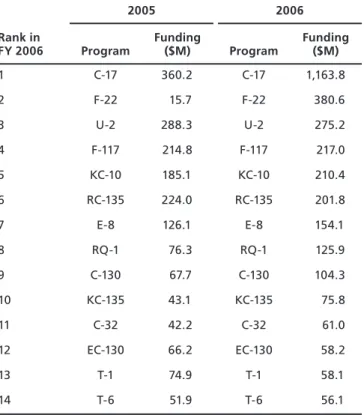
3.1. Fourteen Largest Air Force Aircraft CLS Programs . . . .25
4.1. Metrics Used to Assess CLS Performance . . . .37
5.1. Reasons Cited for Use of CLS . . . .61
5.2. Guaranteed and Variable Funding Amounts in the Nine Largest CLS Contracts . . . .67
xiii
The Air Force devotes enormous resources to operating and main-taining its weapon systems. In fiscal year (FY) 2006, the Air Force spent almost $36 billion on weapon system O&S, measured in con-stant FY 2004 dollars.1 The Air Force has a range of choices when
con-sidering how best to sustain weapon systems and components. It can do the work in-house using organic facilities, it can pay contractors to do the work (subject to some congressionally imposed limits), or it can engage in a mix of the two approaches.2
This monograph addresses CLS, which is defined as contractor sustainment of a weapon system that is intended to cover the total life cycle of the weapon system and generally includes multiple sustain-ment elesustain-ments. CLS does not include interim contractor support, a temporary measure for a system’s initial period of operation before a permanent form of support is in place. CLS also excludes contractor sustainment support for a specific sustainment task that the Air Force would otherwise conduct itself; a typical example would be a weapon system’s prime contractor providing sustaining engineering.3
1 O&S includes all costs of operating, maintaining, and supporting a fielded system, including costs for personnel; consumable and repairable items; organizational, intermedi-ate, and depot maintenance; facilities; and sustaining investment. Data from an Air Force Total Ownership Cost management information system query in January 2007.
2 Federal laws require that government facilities conduct at least one-half of all depot main-tenance work and that the government retain certain core mainmain-tenance capabilities. Chapter Two discusses this and provides specific references.
3 In practice, there is some overlap among the various kinds of contract support. The Air Force identifies and funds the varieties of contract sustainment support using
element-of-xiv Contractor Logistics Support in the U.S. Air Force
The Air Force has increasingly chosen CLS as an alternative to organic support of weapon systems over the last several years. The Air Force increased its use of CLS by more than 150 percent in constant dollars from FY 2000 to FY 2006, a rate far greater than the 30 percent increase in spending on weapon system O&S over the same period.
Despite the Air Force’s increased use of CLS, several of the unan-swered questions about its management and use might be of interest to decisionmakers. We examine these questions, and when appropriate, provide recommendations for more effective use of CLS:
What is driving the growth of CLS in the Air Force? •
How has contractor performance under CLS compared to initial •
estimates of cost and performance? What are the key cost drivers for CLS? •
How are the prices for CLS contracts determined? •
Do weapon systems have characteristics that are associated with •
using CLS; if so, what are they?
How does the Air Force manage its compliance with laws govern-•
ing the use of CLS?
Does using CLS have disadvantages? •
What does using CLS imply for O&S cost estimating? •
We approached these questions in four ways. First, we reviewed the laws, regulations, and instructions that govern the use of CLS in DoD and especially in the Air Force. This helped us understand limits and requirements that Congress and DoD have imposed on the Air Force for the use of CLS, as well as the official implementation of poli-cies and procedures. We also reviewed reports from the Government Accountability Office (GAO) and DoD Inspector General, which were helpful in understanding problems and issues with the use of CLS over time.
expense investment codes (EEICs) in its financial system. EEIC 578 is intended to capture CLS. We have used funds coded as EEIC 578 to identify CLS in this study. Chapter Three describes this coding more completely. Air Force Instruction (AFI) 63-111 dated October 21, 2005 defines the kinds of contract support.
Second, we examined the Air Force Total Ownership Cost man-agement information system to understand the magnitude of CLS use and cost trends for the Air Force as a whole, by type of system, and by individual program.
Third, because the Air Force does not require detailed or uniform financial reporting of CLS costs in a corporatewide financial system, we obtained CLS brochures for individual programs to gain greater insight into the nature of CLS. Programs that do use CLS prepare these brochures annually. Each brochure contains a narrative describ-ing the support provided and its cost by task. These brochures allowed us to address questions about key CLS cost drivers—specifically, about the kinds of tasks for which CLS is used.
Fourth, we spoke with a wide variety of people knowledgeable about the use of CLS. We held discussions with representatives of roughly a dozen large programs that use CLS. We also interviewed personnel experienced in logistics, contracting, and CLS financial and program management. These people worked at Air Force operational commands and Air Force Materiel Command, Headquarters U.S. Air Force (HQ USAF), the Office of the Secretary of Defense, the GAO, and the weapon system contractors that provide CLS.
This combination of approaches allowed us to address most of the research questions satisfactorily. Some issues regarding CLS perfor-mance remained unresolved, as we will discuss.
We found that 86 percent of the Air Force’s CLS spending is on aircraft systems, with the remainder on space, missile, munitions, and other kinds of systems. (See p. 22.) Most of the growth in CLS spend-ing in this decade has been in aircraft systems, with the C-17 and F-22 programs increasing the most because more aircraft are being delivered and because both programs recently transitioned from interim contract support to CLS. We found no evidence that the costs of ongoing and long-term CLS contracts are increasing at a faster rate than comparable organically supported programs. Rather, the increase in CLS spending is due mostly to decisions to support most new aircraft systems with CLS, while the legacy systems that they replace tend to be supported organically. (See pp. 24–29.)
xvi Contractor Logistics Support in the U.S. Air Force
We were unable to determine how CLS had performed relative to initial estimates because we found that initial estimates generally either were not developed or were not documented and retained. (See pp. 40–41.)
The key cost drivers for CLS on aircraft programs are depot main-tenance for airframes and engines and the repair and replacement of parts. (See pp. 31–32.) Aircraft CLS programs have a wide scope of tasks, so contractors on some programs provide a substantial number of field-support representatives, or technicians, who perform mainte-nance at the flight line. Contractors on other programs provide much of the sustaining engineering. On practically all, if not all, aircraft CLS programs, contractors provided supply-chain management. (See pp. 20–21, 31–32, 93.)
We found that CLS prices for major weapon systems are seldom determined by competition. Exceptions to this norm are typically for commercial-derivative products. (See p. 72.) Prices depend on the type of contract. CLS contracts use a variety of contract vehicles and types. For cost-type contracts or tasks, the contractor is reimbursed for costs incurred plus a fee. For fixed-price contracts or tasks, government per-sonnel generally examine the number of labor hours and the mate-rial costs the contractor has proposed to determine whether both are reasonable. The price is determined by the negotiated labor hours, the contractor’s hourly labor rate(s), expected material usage and cost, plus a fee (profit). (See pp. 72–74.)
CLS contracts often guarantee a large amount of funding to the contractor in each fiscal year. This limits the flexibility of the Air Force to reduce funding levels without violating the terms of the contract. (See pp. 68–69.)
Competition is often impossible because the government lacks the technical data or the data rights needed to allow third parties to maintain the equipment, so only the original equipment manufacturer, which has the technical data, can do the maintenance. (See p. 58.)
We found that the availability of CLS cost and performance data varied among individual program offices. (See pp. 69–74.)
Several weapon-system characteristics were associated with the use of CLS, including programs that were commercial derivatives, were
highly classified, were complex, had a small fleet, or had started as advanced concept technology demonstrations. Two additional condi-tions associated with the use of CLS, although not with characteristics of the weapon systems, were a lack of data rights and the decision of a senior Air Force official. (See pp. 57–65.)
Certain limitations affected our ability to address all the issues satisfactorily. The most serious is the lack of detailed cost and perfor-mance data on CLS contracts, which limits our ability to assess the cost and performance of CLS relative to initial estimates or govern-ment performance of comparable work. The lack of detailed cost and performance data on CLS contracts also severely limited our ability to provide improved tools or guidance to cost estimators.
Also note that we did not specifically address issues associated with the use of performance-based logistics or public-private partner-ships, which are sustainment approaches DoD has emphasized for the last several years.
The final chapter discusses five changes that should improve the Air Force’s ability to use CLS effectively. The Air Force is in the process of implementing some of the changes:
To preserve the option of sustainment by organizations other 1.
than the contractors that manufactured the equipment, the Air Force should require centralized decisions on buying design and technical data or usage rights to such data. (See pp. 83–85.) To facilitate future analysis and estimation of O&S costs, the 2.
Air Force should require collection of CLS cost data in a stan-dardized format, as specified by the Office of the Secretary of Defense Cost Analysis Improvement Group, and should retain the data centrally. (See pp. 85–87.)
To ensure that the corporate Air Force has the flexibility to 3.
adjust funding levels for all aircraft sustainment programs, the Air Force should provide centralized guidance to achieve flex-ibility in CLS contracts. (See pp. 87–88.)
To improve its ability to manage CLS across the enterprise, the 4.
Air Force should strengthen data collection and analysis and expertise and make the data and expertise available to
pro-xviii Contractor Logistics Support in the U.S. Air Force
gram office personnel. This could be done by centralizing and strengthening an organization with logistics responsibilities and/or by strengthening a career field, such as acquisition logis-ticians. (See pp. 88–91.)
The Air Force should strive to retain choices for logistics services 5.
over the life cycle of the weapon system. The first four changes support this goal. (See pp. 91–92.)
xix
We would like to thank Lt Gen Donald J. Hoffman, Military Deputy, Office of the Assistant Secretary of the Air Force, Acquisition; Blaise J. Durante, Office of the Deputy Assistant Secretary of the Air Force, Acquisition Integration; and Maj Gen Art Morrill, HQ USAF/ILP,4
for cosponsoring this research, and Jay Jordan, Air Force Cost Analy-sis Agency, for providing technical direction. Jay Jordan also provided useful comments on a draft of the monograph.
We also wish to thank the two leaders of the CLS Integrated Product Team (IPT) formed by HQ USAF Logistics, Installations, and Mission Support, Lt Col Randy Mauldin and Yvonne Fernandez, who graciously allowed us to join the IPT and supported our study efforts. Our membership in the IPT allowed us to study and partici-pate in the solution of issues along with the rest of the team. Member-ship on the IPT also made it easier to identify and communicate with people in the Air Force who are knowledgeable about CLS.
Many people in the Air Force, Office of the Secretary of Defense, and other organizations were generous in sharing their time and knowl-edge of logistics support with us. In particular, we would like to thank Grover Dunn, HQ USAF/A4I, for his time and insights.
In many cases, we attended meetings or participated in telecon-ferences with several representatives from an office. Rather than listing the names of all of the people with whom we spoke, we list their orga-nizations in alphabetical order:
4 We show the rank and organizational affiliations of the individuals acknowledged here at the time we worked with them on this study. Some individuals have since moved to other organizations.
xx Contractor Logistics Support in the U.S. Air Force
Air Force Materiel Command, Acquisition Logistics Division •
Air Force Materiel Command, Depot Programs Division •
CLS providers, various representatives •
F-35 Program Office •
GAO •
HQ USAF, Logistics, Installations, and Mission Support and •
Maintenance
HQ USAF, Logistics, Installations, and Mission Support •
Operational commands, various representatives •
Office of the Secretary of Defense, Cost Analysis Improvement •
Group
Under Secretary of Defense for Acquisition, Technology, and •
Logistics
Program offices, various representatives: C-17, Distributed •
Common Ground Systems , F-22, F-117, Joint Surveillance Target Attack Radar System, RC-135, Space-Based Infrared Systems, T-1, T-6, T-38, U-2
Secretary of the Air Force, Acquisition Center of Excellence Ross-•
lyn, Virginia
Office of the Deputy Assistant Secretary of the Air Force, •
Contracting
Office of the Deputy Assistant Secretary of the Air Force, Acqui-•
sition Integration
Office of the Deputy Assistant Secretary of the Air Force, Cost •
and Economics
Office of the Deputy Assistant Secretary of the Air Force, Instal-•
lations, Environment, and Logistics Warner Robbins Air Logistics Center •
We also wish to thank our RAND colleagues Nancy Moore and Ray Pyles, who shared insights on logistics issues, and Obaid Younossi and Laura Baldwin for reviewing drafts of this monograph and provid-ing useful feedback that improved its quality. Mary Chenoweth and Ellen Pint conducted thorough reviews and provided comments and suggestions that provided further improvements. Charles Robert (Bob)
Roll, Jr., provided the initial guidance on the project and support during the research. He passed away before the project was completed.
xxiii
ACTD advanced concept technology demonstration
AFB Air Force base
AFEE Air Force Element of Expense AFI Air Force Instruction
AFMC Air Force Materiel Command AFPD Air Force Policy Directive
AFSO 21 Air Force Smart Operations for the 21st Century AFTOC Air Force Total Ownership Cost
ALC air logistics center
BRAC Base Realignment and Closure CAIG Cost Analysis Improvement Group CLS contractor logistics support
COTS commercial-off-the-shelf CSS contract sustainment support DLR depot-level reparable
DoD Department of Defense
DoDI Department of Defense Instruction EEIC element of expense investment code FAR Federal Acquisition Regulation FSR field support representative
xxiv Contractor Logistics Support in the U.S. Air Force
FY fiscal year
GAO Government Accountability Office
HQ headquarters
HQ USAF/A4/7 Headquarters U.S. Air Force, Logistics, Installations, and Mission Support (Formerly HQ USAF/IL and HQ USAF/LG)
HQ USAF/A4I Headquarters U.S. Air Force, Logistics,
Installations, and Mission Support, Innovation and Transformation
HQ USAF/ILP Headquarters U.S. Air Force, Installations and Logistics, Plans and Resources
ICS interim contract support
IG inspector general
IOC initial operational capability IPT integrated product team LCMP life-cycle management plan
MERLIN Multi-Echelon Resource and Logistics Information Network
O&M operation and maintenance O&S operating and support
OEM original equipment manufacturer OLAP Online Analytic Processing
OMB Office of Management and Budget OSD Office of the Secretary of Defense PBL performance-based logistics PDM programmed depot maintenance PEO program executive officer
POS preoperational support
SAF/AQ Assistant Secretary of the Air Force, Acquisition SORAP source of repair assignment process
TNMCS total not mission capable supply UAV unmanned aerial vehicle
1
Maintenance of Weapon Systems and the Use of Contractor Logistics Support
The Air Force devotes enormous resources to operating and maintain-ing its weapon systems. In fiscal year (FY) 2006, the Air Force spent almost $36 billion on weapon system operating and support (O&S), measured in constant FY 2004 dollars.1 The Air Force has a range
of choices when considering how best to sustain weapon systems and components. It can do the work in house, using organic facilities; it can pay contractors to do the work (subject to some congressional limits); or it can apply a mix of the two approaches.2
Organic repair is a massive undertaking. Work takes place at gov-ernment depots, such as the three major air logistics centers (ALCs), a number of intermediate repair facilities, and at flight lines on operating bases around the world. Managing organic repair efficiently has been a challenge for the Air Force throughout its existence. The Department of Defense (DoD) reported that the Air Force spent $5.1 billion on organic depot maintenance and an additional $4.6 billion for private
1 This number includes direct costs, such as crew, maintenance personnel, fuel, and repair parts, and indirect costs, such as base operating support costs (Air Force Total Ownership Cost [AFTOC] management information system, January 2007).
2 Federal laws require that at least one-half of depot maintenance work be performed at government facilities and that the government retain certain core maintenance capabilities. Chapter Two discusses these requirements in greater detail.
2 Contractor Logistics Support in the U.S. Air Force
depot maintenance in FY 2005 in then-year dollars (Office of the Sec-retary of Defense [OSD], April 2006).
The Air Force also purchases sustainment services from a large range of commercial companies. The term contract support includes various types of support for systems, equipment, and end items that contractors provide. Contract sustainment support (CSS) provides for one or many logistics tasks or sustainment elements that organic logistics organizations would otherwise perform and can provide for all or part of the weapon system. Contractor logistics support (CLS) is a subset of CSS; the key distinctions are that CLS normally involves
multiple sustainment tasks, usually for the life of the weapon system. Examples of common CLS tasks are aircraft and engine overhaul, repair and replenishment of parts, sustaining engineering, and supply chain management.
Both organic sustainment and CLS have their benefits. Organic sustainment gives the Air Force maximum control over when and how the work gets done. The Air Force benefits directly from any efficiency improvements. The Air Force also has a guaranteed source of supply.3
Using contractors for logistics support also has strengths. Propo-nents of CLS contend that profit-seeking companies will bid for the work at a lower cost, with competition as the spur, and will do the work more efficiently to earn a profit. This is particularly true if the system is a derivative of a commercial product and if an existing group of com-panies competes for the work (as for the KC-10). Having the prime contractor, the original equipment manufacturer (OEM), perform the repair work could offer economies of scale because this organization would manage the total supply chain. An OEM providing CLS can also offer savings by using existing repair facilities and specialized tool-ing, because production tooling can later be repurposed for mainte-nance and repair.
Both sides of the debate offer reasoned arguments but little doc-umentation to tip the balance of evidence in favor of either organic
3 The congressional debate on these benefits resulted in the so-called 50-50 rule, which addresses keeping capacity in house as a way to reduce risks in case of a surge or for other reasons. See the discussion in Cook et al., 2005.
or CLS. We do know that the Air Force has often chosen CLS over organic support on major programs during the past several years. The Air Force’s use of CLS more than doubled in constant dollars from FYs 2000 to 2006, a rate of increase far greater than for its spending on organic maintenance of weapon systems.4 Figure 1.1 illustrates this
growth.
O&S costs for the Air Force jumped markedly in FYs 2002 and 2003 because of wartime operations, and the increase in CLS costs mir-rors the overall Air Force trend over the period. However, the additional
4 We approximated organic maintenance costs by subtracting the costs of crews, fuel, CLS, and indirect support from weapon system O&S costs. These are maintenance costs directly associated with weapon systems and do not include indirect O&S costs associated with a base, site, or location. The organic weapon system maintenance costs have grown 9 percent in constant dollars during the same period. (AFTOC Online Analytic Processing [OLAP] data by weapon system and by cost analysis improvement group [CAIG] element, May 2007.)
Figure 1.1
Air Force Spending on CLS and Organic Maintenance
SOURCE: AFTOC OLAP report by weapon system and CAIG element, May 2007. NOTE: Constant FY 2004 dollars. Organic maintenance costs are approximated as total operation and support costs less crew, fuel, CLS, and indirect support.
RAND MG779-1.1 Spending ($ billions) 20 15 10 2005 2004 2003 Fiscal year 2002 2001 2000 2006 5 25 0 CLS Organic maintenance
4 Contractor Logistics Support in the U.S. Air Force
large increase in CLS costs in FY 2006 contrasts with O&S spending for organic logistics support. The increase of more than $1 billion in one year in CLS costs reflects primarily the transition of the C-17 and F-22 programs from interim contract support (ICS) funded in the air-craft procurement account to CLS. CLS costs for these programs are expected to grow as their inventories increase.
Purpose of This Monograph
The Air Force is facing severe budget pressures as it tries to simultane-ously recapitalize its aging fleet of aircraft, operate and maintain them in support of the global war on terrorism, and accomplish other mis-sions. Responses to these budget pressures include a reduction of man-power authorizations and a servicewide initiative of business process improvements known as Air Force Smart Operations for the 21st Cen-tury (AFSO 21).5 In this environment of limited resources and
compet-ing demands for those resources, it is especially important for decision-makers to be able to allocate resources wisely.
This monograph has two objectives. One objective of this research was to understand CLS use in the Air Force better and make recom-mendations, if called for, to enhance decisionmaking in this area. We wanted to determine what data exist to make comparisons of cost and performance and inform decisions and how the Air Force might retain options once a logistics support provider is chosen.
A secondary goal was to highlight challenges for cost estimators who are working with the O&S costs of Air Force programs and pro-vide better estimating tools, if possible. We were unable to develop cost-estimating tools because CLS costs are not collected and reported in a standard and detailed format suitable for cost analysis.
Understanding CLS costs is important for several reasons. A better understanding of CLS costs would allow policymakers and cost
5 AFSO 21 encompasses the implementation of lean initiatives that the Secretary of the Air Force and the Chief of Staff of the Air Force directed in a November 7, 2005, memorandum.
estimators to compare CLS costs with organic support costs by task, understand what is driving costs for CLS contracts and thereby fore-cast potential growth in costs better, determine whether incentives are working to reduce costs; determine whether contract profits are reason-able, and include CLS costs in cost models along with organic support costs.
Research Approach
We addressed Air Force use of CLS in four ways. First, we reviewed the laws, regulations, and instructions that govern CLS use in DoD, especially in the Air Force. This helped us understand the limits and requirements Congress and DoD have imposed on Air Force use of CLS, as well as the official implementation of policies and procedures. We also reviewed relevant Government Accountability Office (GAO) and DoD Inspector General (IG) reports, which helped us under-stand problems and issues related to current and historical use of CLS. Appendix B summarizes this literature review.
Second, we examined available Air Force financial system data to understand the financial magnitude of CLS use and to observe cost trends, for the Air Force as a whole, by type of system and by indi-vidual program. The AFTOC management information system was our main source of financial information. AFTOC is the authorita-tive source because it provides cost information on all major Air Force weapon systems, including aircraft, space, and missile systems, in a standard format. These data allowed us to corroborate and quantify in dollars what we learned in the other approaches about the kinds of systems for which CLS is used and where CLS use is growing. Unfor-tunately, because Air Force policy does not require detailed or uniform financial reporting of CLS costs, AFTOC does not contain detailed CLS costs, and generally displays all CLS costs as a lump sum for each weapon system.
Third, we obtained CLS brochures for individual programs for greater insight into the nature of the CLS and its cost. Each program office using CLS prepares an annual CLS brochure that includes a
nar-6 Contractor Logistics Support in the U.S. Air Force
rative describing and costing each support task for the system, ulti-mately providing greater detail than AFTOC supplies.6 CLS brochures
contain CLS cost estimates for the fiscal year in which they are submit-ted and for future years. The numbers in the brochures do not reflect actual obligations and may thus differ from the actual obligations reported in AFTOC, although the differences are usually fairly small for the fiscal year in which the brochures are prepared. Although the brochures reflect estimates rather than actual CLS expenditures, they are useful because of their level of detail. The brochures allowed us to address questions about the key cost drivers of CLS, that is, the kinds of tasks for which CLS is used.
Fourth, we spoke with a wide variety of people knowledgeable about CLS use. We joined an ongoing CLS Integrated Product Team (IPT) organized by Headquarters U.S. Air Force, Logistics, Installa-tions, and Mission Support (HQ USAF/A4/7), which proved extremely helpful. The IPT was formed to assess the risks associated with fund-ing reductions and to determine mechanisms for establishfund-ing flexibility and standardization in future CLS contracts and for making appropri-ate risk trade-offs. Our participation in the IPT made us aware of the visibility and flexibility issues, and gave us access to program office personnel who had extensive experience with CLS on a variety of pro-grams. We also spoke individually with IPT participants representing roughly a dozen large programs using CLS.
We also established relationships with personnel experienced in logistics, contracting, and CLS financial and program management from Air Force operational commands, Air Force Materiel Command (AFMC), Headquarters U.S. Air Force (HQ USAF), OSD, GAO, and weapon system contractors providing CLS. By holding only not-for-attribution discussions with these individuals, we have ensured that the findings reported here are not associated with any individual or office.
This combination of approaches allowed us to address most CLS use issues satisfactorily, although some issues about CLS performance remain unresolved.
6 The level of reporting detail in the brochures varies from program to program and depends upon the cost reporting negotiated on each CLS contract.
Organization of This Monograph
Chapter Two provides the background for the Air Force’s use of CLS. The discussion includes a review of applicable laws, DoD and Air Force instructions and regulations, and GAO and DoD IG reports and a description of the current Air Force process for choosing a source of repair for Air Force weapon systems.7 Chapter Three summarizes Air
Force funding of CLS and related contract sustainment services; breaks out CLS by type of weapon system; and most closely, examines CLS costs on aircraft programs. The material on aircraft programs includes an assessment of the kinds of tasks typically performed on CLS con-tracts. In Chapter Four, we discuss using cost and effectiveness for assessing CLS performance, and in Chapter Five, we address the Air Force’s process for choosing CLS and the ongoing CLS management and associated issues. Chapter Six covers the implications of the find-ings for cost estimators addressing Air Force O&S costs. In Chapter Seven, we summarize the overall discussion and recommend policy changes. Appendix A compares total not mission capable–supply rates and standards for selected CLS and organically supported aircraft. Finally, Appendix B summarizes the relevant laws, reports, and DoD and Air Force directives, regulations, and instructions.
9
This chapter summarizes the results of our review of the legislative and policy history of the Air Force depot system and Air Force use of CLS. Some of the challenges the Air Force currently faces in using and managing CLS spring from existing law. Two legal requirements in particular are relevant to this study.
First, 10 USC 2466 requires doing at least 50 percent of depot maintenance in house, using organic government organizations. There-fore, at most, contractors can perform only the remaining 50 percent. Second, Title 10 of the United States Code, Section 2464 (10 USC 2464) requires DoD to determine which logistics capabilities are considered core; these must be owned and operated by the govern-ment. Core logistics capabilities are defined as the technical competence and resources necessary to maintain and repair weapon systems during peacetime and during mobilizations, contingency situations, and other national emergencies. A related section of the code, 10 USC 2462, requires DoD to procure noncore maintenance from private sources if they are cheaper than organic sources.
This chapter also summarizes key DoD and Air Force directives, regulations, and instructions that implement legislation and otherwise affect Air Force use of CLS and other forms of contract support. The review in this chapter is not intended to be exhaustive but rather to summarize key legislative and administrative direction that affects the Air Force’s use of CLS. Appendix B offers a broader summary.
10 Contractor Logistics Support in the U.S. Air Force
Background
The current Air Force organic depot system had its roots in activities leading up to and during World War II, when the U.S. armed forces expanded rapidly in response to the aggression of the Axis powers. Aside from Kelly Air Force Base (AFB), which had been an Army Air Corps base since before World War I, all the other depots were opened in the late 1930s or early 1940s. Because the private sector was fully engaged in producing new equipment for the armed forces, these public-sector depots were established and expanded to perform maintenance on weapon systems (Heivilin, 1993). After World War II, the Cold War established the need for permanent depot maintenance expertise to repair increasingly complex weapon systems.
Despite cycles of downsizing and expansion during the last half of the 20th century in response to Korea, Vietnam, and Operation Desert Storm, the Air Force maintained its five major depots until the Base Realignment and Closure (BRAC) Commission in 1995 recommended closure of two ALCs.1 Kelly and McClellan AFBs closed in 2001,
leav-ing the Air Force with Warner-Robins, Hill, and Tinker AFBs as sites for its major depot maintenance activities.
Key Laws Affecting CLS Use
Over the years, Congress has maintained an active interest in the loca-tion of organic depots. This interest stems not only from a naloca-tional security perspective, the desire to ensure that national defense had strong support from the depot-level maintenance and repair activities, but also from more parochial reasons. Congress formally recognized the requirement for a “core logistics activity” for the first time in the 1984 National Defense Authorization Act, which directed DoD to maintain an in-house logistics capability that could respond to
mobi-1 The Air Force also closed a sixth depot at Newark AFB, Ohio, which specialized in the repair of guidance and navigation systems, in 1996.
lizations, national contingencies, and other emergency requirements (Cook, Ausink, and Roll, 2005).2
This requirement is found in 10 USC 2464, “Core Logistics Capabilities.” This section, originally passed by the 98th Congress in 1984, discusses the need for core logistics capabilities that are gov-ernment owned and operated (including govgov-ernment personnel and equipment), directs the Secretary of Defense to identify core logistics capabilities, and defines core logistics capabilities as those that are nec-essary to maintain and repair the weapon systems and other military equipment, among other provisions.
Congress has also taken an active role by directing what propor-tion of DoD depot maintenance workload could be performed by con-tractors (private sources) and what must be performed organically, at DoD depots. One reason for this directive is the large number of fed-eral jobs involved with the depot activities in sevfed-eral states. In fact, Air Force depots are major employers in all states in which they are located. Supporters of the depots have formed the House Military Depot and Industrial Facilities Caucus, a loose confederation of members of the House of Representatives interested in DoD’s depots and their activi-ties. To codify their interests, Congress has passed legislation to guide depot-level maintenance and repair activities, limit using contractors in providing that support, and require regular reporting on spending in this area.
The key legislation is found in 10 USC 2466, “Limitations on the Performance of Depot-Level Maintenance of Materiel.” This section discusses limitations on the amount of depot-level maintenance and repair workload that contractors can perform relative to the amount government facilities perform. The original restriction on contractor workload was a maximum of 40 percent, as set in 1988. Congress increased that maximum to 50 percent in the FY 1998 Defense Autho-rization Act. The 2005 version of 10 USC 2466 sets the current limit:
Not more than 50 percent of the funds made available in a fiscal year to a military department or a Defense Agency for depot-level
2 See Chapter Two of the 2005 report for a further discussion of the history of congressio-nal actions related to this issue.
12 Contractor Logistics Support in the U.S. Air Force
maintenance and repair workload may be used to contract for the performance by non-Federal Government personnel of such workload for the military department or the Defense Agency.
However, in the same legislation, Congress also changed its definition
of workload, specifying that DoD also include work subcontracted to
private companies via public depots and include ICS, which is funded differently from CLS and which had previously been excluded.
A third important provision is 10 USC 2462, “Contracting for Certain Supplies and Services Required When Cost Is Lower.” This section directs the Secretary of Defense to procure each supply or ser-vice necessary to accomplish the authorized functions (other than those the Secretary of Defense determines military or government personnel must perform) from a source in the private sector if that source can provide the supply or service at a cost lower than it would cost DoD to provide the supply or service. This legislation implies that the DoD will determine the low-cost provider and award the work accordingly.
The National Defense Authorization Act for FY 2007 included a provision that should affect the ability of program managers to com-pete sources of repair over the long term. Public Law 109-364, Section 802 (2006) amends 10 USC 2320, “Rights in Technical Data,” and requires
program managers for major weapon systems and subsystems of major weapon systems to assess the long-term technical data needs of such systems and subsystems and establish correspond-ing acquisition strategies that provide for technical data rights needed to sustain such systems and subsystems over their life cycle.
The assessment is to be done before contract award and is to consider priced contract options for the future delivery of technical data.
Key DoD Directives and Instructions That Affect CLS
The preceding section identified the key legislation affecting CLS use: the requirement to identify core maintenance capabilities, limit
con-tracting of depot maintenance to 50 percent of the workload, and award noncore work to the lowest-cost source, whether public or pri-vate. DoD has directed its components to implement these laws.
DoD Directive (DoDD) 4151.18, Maintenance of Military Mate-rial, promulgates the requirements of 10 USC 2464 for inherently gov-ernmental and core capability requirements and noncore capability requirements under competitive sources in accordance with 10 USC 2462 and 10 USC 2466. Maintenance program management is to begin when program acquisition activities begin, and core depot capa-bility requirements are to be identified as early as possible in the acqui-sition life cycle. The directive requires establishing core capabilities no later than four years after initial operating capability (IOC). It also requires identifying core capabilities for individual components and calculating the associated depot workloads.
DoD Instruction (DoDI) 4151.20, Depot Maintenance Core
Capabilities Determination Process, implements policy, assigns
respon-sibilities, and prescribes procedures in accordance with DoDD 4151.18 and 10 USC 2464. This instruction specifies that the size of the core workforce accommodate the required workloads within the time limits of specified Joint Chiefs of Staff scenarios. Core capabilities and the related workloads must be able to adjust to changes in force struc-ture, technology, or doctrine; introduction of new weapon systems; aging or modification of existing weapon systems; etc. Core require-ments will be reviewed at least biennially or more often if necessary or appropriate.
Other DoD directives, instructions, and regulations affect the use, management, and reporting of CLS. Appendix B summarizes some of this additional direction.
Key Air Force Direction That Affects CLS
The Air Force has issued directives and instructions that implement congressional and DoD direction and that specify processes and orga-nizations for implementing such direction.
14 Contractor Logistics Support in the U.S. Air Force
Air Force Policy Directive (AFPD) 20-5, Air Force Product
Sup-port Planning and Management, establishes the framework for
imple-menting product-support management in the Air Force. Product sup-port is to begin early in the acquisition phase of a weapon system, preferably during concept and technology development, and is to pro-vide a seamless transition to sustainment. The directive states that the primary focus of product support is on optimizing customer support and achieving maximum weapon system availability at the lowest total ownership cost. It directs program managers to document the strategy in a product-support management plan, which is considered a living document that should be updated as the weapon system progresses through its successive phases. This directive is being superseded by a new AFPD, according to comments we received in March 2008 from the Office of the Deputy Assistant Secretary of the Air Force, Acquisi-tion IntegraAcquisi-tion.
Air Force Instruction (AFI) 63-107, Integrated Product Support Planning and Assessment, places responsibility for both acquisition and sustainment product support planning on the program manager. This instruction addresses the life-cycle management plan (LCMP), which integrates the sustainment strategy documented with the product-sup-port management plan and the acquisition strategy. Chapter 5 of the instruction discusses the source-of-repair assignment process (SORAP), which the Air Force uses to allocate its depot workloads, at length. The program manager initiates the process; Headquarters AFMC (HQ AFMC) provides the program manager a determination of core main-tenance requirements and other assistance during the process.
AFI 63-111, Contractor Support for Systems, Equipment and End
Items, defines the various kinds of contract support, including CLS.
This instruction calls for the program manager to prepare a brochure on CLS requirements, identifying budget needs by task. It also man-dates using contract support for training devices.
AFI 21-102, Depot Maintenance Management, assigns responsi-bilities for depot maintenance management to Headquarters U.S. Air Force, Logistics (HQ USAF/A4/73) and HQ AFMC. HQ AFMC is 3 Formerly HQ USAF/LG.
responsible for assessing minimum organic depot maintenance require-ments and for determining depot maintenance sources of repair in accordance with the criteria of DoDD 4151.18. The instruction requires HQ AFMC to establish a comprehensive depot maintenance program with each ALC for all new system acquisitions, including logistics management for the life of each system.
Implications of Laws and Regulations That Affect CLS Use
Congress has long had an interest in government depots because of the jobs and economic activity they provide. Current law requires that government depots perform at least 50 percent of the Air Force’s depot maintenance and that the government retain a core logistics capabil-ity able to meet both peacetime and surge maintenance requirements. These laws effectively limit how the Air Force uses CLS. The Air Force is finding ways to use CLS and still meet both core and 50-50 con-straints by having government depots perform work on CLS programs so that the workload counts as organic. Such public-private partner-ships are allowed under 10 USC 2474, “Centers of Industrial and Tech-nical Excellence: Public-Private Partnerships” (see Appendix B). The Air Force’s process for identifying sources of repair for new programs begins with a determination of whether laws allow room for a given program to consider contractor sources of repair. If so, the Air Force can explore these sources and choose CLS if it is a better value to the government than organic support. The Air Force violated the 50-50 law earlier this decade and has funded its depot work close to the limit since then. Barring an unlikely change in these laws, the Air Force will continue to need to choose carefully when and for what kind of work it uses CLS and, when it does use CLS for depot work, will need to be able to prove that it is the most cost effective source of repair. The DoD and the Air Force have promulgated directives, instructions, and regulations to implement congressional intent regarding CLS and to institute processes for selecting and managing CLS.
17
This chapter begins with a financial overview of contract support and CLS funding for weapon systems in the Air Force, then narrows the scope to CLS funding by type of weapon system (i.e., aircraft, missile, munitions, other, space). While the discussion will include observa-tions about CLS costs that are applicable to Air Force programs in general, our analysis is based on an examination of the types of tasks and associated costs for the 14 largest Air Force aircraft CLS programs reported in AFTOC for FY 2006.
We will address these specific questions:
How does the Air Force define CLS for funding and costing? •
What programs use CLS ? •
How much does each program spend on CLS, and how much in •
total?
Why are CLS costs growing? •
What are the key cost drivers for CLS?
• 1
Because insufficient data were available, some of these questions could not be answered to our satisfaction. This raised concerns about limi-tations on the data needed to manage CLS; the suggestions for CLS policy improvements in Chapter Seven reflect these concerns.
1 Specifically, we explore this question in terms of element of O&S cost, such as flight line maintenance, depot-level reparables (DLRs), and aircraft or engine overhaul.
18 Contractor Logistics Support in the U.S. Air Force
Findings and Observations: CLS Funding and Costs
How Does the Air Force Define CLS for Funding and Costing?
CLS is a subset of the more-inclusive term contract support, which includes various types of support for systems, equipment, and end items that contractors supply. The Air Force financial system uses sev-eral element of expense investment codes (EEICs) to refer to contract support funding. AFI 63-111 defines contract support as including pre-operational support (POS), ICS, CSS, and total contract training. The instruction explains that CSS can be provided for many logistics tasks or sustainment elements that organic logistics organizations would otherwise perform and for all or part of the weapon system. When the CSS is for multiple sustainment elements, the funding is normally coded as EEIC 578, CLS. This chapter takes a brief look at funding for CSS to provide context; the rest of the monograph focuses on CLS, defined as the efforts funded by EEIC 578.2
Most of the contract support costs reported in AFTOC that are identifiable as such are in the following EEICs:
EEIC 554—Critical Space Contract Operations •
EEIC 555—Critical Space Operations–Direct Support •
EEIC 570—Contractor Operated Installations •
EEIC 578—Contractor Logistics Support •
EEIC 583—Sustaining Engineering by Contract •
EEIC 592—Miscellaneous Contract Services •
EEIC 594—Contract Technical Data. •
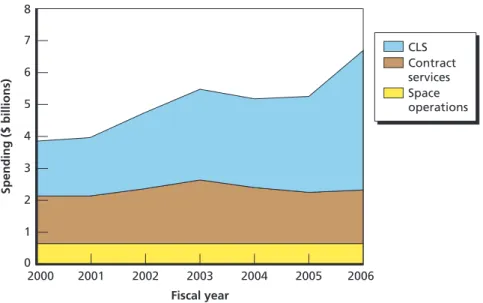
Figure 3.1 illustrates the funding for a broad range of CSS associ-ated with weapon systems in the Air Force over the past several years. In Figure 3.1, CLS reflects EEIC 578; Contract Services includes EEICs 570, 583, 592, and 594; and Space Operations includes EEICs 554 and 555. Figure 3.1 does not include CSS that is not associated directly with weapon systems, which support the primary mission of the Air
2 To obtain the data, we queried AFTOC by weapon system and EEIC. The data reflect obligations in each fiscal year and exclude costs funded by procurement accounts for which EEICs are not available. Unless otherwise noted, AFTOC is the source of the cost informa-tion in this chapter.
Force. The figure does include indirect costs, those for activities that are identifiable with an installation, site, or location, such as base oper-ating support. Indirect costs include little CLS, although their cost of contract services has risen significantly over the last several years.
Figure 3.1 shows that, while the funding for space operations and contract services for weapon systems has remained fairly constant over the past few years, funding for CLS has grown rapidly, by more than $2.6 billion from FY 2000 to FY 2006. Space operations include con-tractor support other than CLS. Space operations are a small subset of CSS and are managed separately from other programs, so this mono-graph does not address them, except to briefly contrast that support with aircraft CLS. Contract services for weapon systems are mostly for aircraft systems. Their funding levels are largely stable and represent a mix of services, including contractor operated facilities and
instal-Figure 3.1
Air Force CSS for Weapon Systems
SOURCE: AFTOC OLAP, query by type of weapon system and EEIC, January 8, 2007. NOTES: Constant FY 2004 dollars.
Data shown do not include contract sustainment support for indirect costs not attributable to weapon systems because they have little CLS.
RAND MG779-3.1 Spending ($ billions) 7 6 5 4 3 2 2005 2004 2003 Fiscal year 2002 2001 2000 2006 1 8 0 CLS Contract services Space operations
20 Contractor Logistics Support in the U.S. Air Force
lations, sustaining engineering by contract, engineering management support services, and program management support. We have also excluded these elements from this study.
At least two other EEICs contain contract support. One is EEIC 579, Interim Contractor Support. However, AFTOC reports almost no spending for this EEIC. Our experience suggests that, because ICS is funded through procurement appropriations, it is not recorded in AFTOC. The omission is significant because programs spend a lot of money on ICS before the transition to CLS or organic support. For example, in FY 2005, the C-17 program spent more than $900 million on ICS, and the F-22 program spent $377 million on “Performance-Based Agile Logistics Support,” both funded from the Aircraft Pro-curement appropriation.3 This highlights a difficulty cost estimators
face when attempting to identify all sources of sustainment funding. A second code that contains some contract support is EEIC 54*, Purchased Equipment Maintenance (the asterisk indicates that this two-digit code has many sublevels, such as EEIC 543 for purchased engine maintenance). EEIC 54* is mostly depot maintenance and is supposed to reflect purchases from within DoD and other government organizations, not contract support. In reality, government depots accept funding from Air Force customers and subcontract some of the work to contractors. The reverse also happens when contractors sub-contract some of their effort to government depots. In both cases, the accounting is lost at this level of reporting; as a result, these numbers only roughly approximate whether government or contractors actu-ally performed the work. Purchased Equipment Maintenance totaled $2.7 billion in FY 2006. It is not possible to tell from AFTOC data how much of this amount may have been subcontracted to contractors. These examples highlight the difficulty of putting together a compre-hensive picture of depot-level contract support for Air Force systems.
EEIC 578 for CLS is used when CSS is intended to extend through a weapon system’s entire life cycle and, generally, for multiple sustainment elements. A classic example of CLS use was for the F-117 program: The contractor provided some squadron-level maintenance,
repair and replenishment of parts, depot maintenance, sustaining engi-neering, and supply chain management, among other tasks. In short, the F-117 contractor provided virtually every kind of logistics support that organic Air Force elements would otherwise provide. Other codes for contract services, primarily the EEICs listed earlier, are used for interim, rather than permanent, CLS; for selected, limited elements of contract support when most of the support is provided organically; and for CLS for space systems.
The definition of CLS is important because it excludes significant spending on similar contract support across the Air Force as a whole, as well as on significant portions of individual programs. Most sig-nificantly, this definition of CLS excludes ICS funded by the Aircraft Procurement appropriation used to support programs including the C-17 and F-22, as mentioned earlier. The large increase in CLS fund-ing between FYs 2005 and 2006 reflects in large part the transition of support for these two programs from ICS to CLS.
More idiosyncratically, on some individual programs, such as the B-2 program, some of the CSS is coded as CLS but most is not, even though the same type of support is coded as CLS on other programs. So, in this case, the identification of CLS by EEIC is not consistent across programs. For the B-2 program, the coding of CLS changed in FY 2007, so AFTOC shows CLS as such.
The definition of CLS used in this monograph includes only work coded as EEIC 578. This narrow definition was used to enable identifi-cation of CLS costs in AFTOC and because, without intimate knowl-edge of how every aircraft program in the Air Force is sustained, we had no other way to identify CLS programs.
Figure 3.2 shows that, of the $4.4 billion the Air Force spent on CLS for aircraft, space, missile, munitions, and other systems in FY 2006, 86 percent was spent on aircraft systems (including engines and avionics) according to this definition.
Aircraft systems account for a large majority of total O&S costs and of CLS costs in the Air Force. While a majority of total Air Force CLS funds are spent on aircraft systems, space systems rely to a greater extent on contractor support for their operations and maintenance (O&M). This is consistent with our discussions with satellite program
22 Contractor Logistics Support in the U.S. Air Force
office personnel, who told us that space systems consist of three seg-ments: space, control, and ground. They said that the Air Force always relies on contractor support for the space segment, almost always uses contractor support for the control segment, and usually uses contractor support for the ground segment. Most of the space-system contractor support is reported in EEICs 554 and 555. More than 50 percent of the O&S cost of space systems is attributable to contractor services. A perusal of CLS brochures for space systems indicates that almost all of the contractor effort is contractually fixed each year. This is consistent with the on-off nature of space systems and the requirement for them to be operational at all times.
Funding for aircraft systems is more closely tied to their usage (that is, how much they are flown) than is funding for munitions, space, or missile systems. Significant portions of aircraft O&S funding, such as fuel, consumables, and DLRs, are determined largely by flying hours. In contrast, munitions and missile systems are maintained and kept in a state of readiness to be used, and space systems are either operational or not.
Figure 3.2
Air Force CLS Spending by Type of System, FY 2006
SOURCE: AFTOC OLAP, query by type of weapon system and EEIC, January 8, 2007. RAND MG779-3.2 Aircraft Missiles Munitions Other Space 4% 86% 1% 3% 6%
Because a large majority of Air Force CLS funding is spent on air-craft systems and because their funding is more linked to actual system use and is therefore easier for Air Force decisionmakers to adjust, we will focus on aircraft CLS programs in the remainder of the monograph.
Figure 3.3 provides further insight into CLS funding for aircraft systems. It illustrates the proportions of funding and amounts spent on the largest elements of aircraft O&S costs, such as military and civil-ian personnel costs and DLR costs, in FY 2006. The Air Force spent $30.9 billion on O&S for aircraft systems in FY 2006. The data from AFTOC show that the largest element of O&S cost for aircraft systems is military personnel, at 30 percent of the total. Most of these are main-tenance personnel. The second-largest element of cost in FY 2006 was CLS, at 12 percent of the total, followed closely by aviation fuel and organic repair and purchase of DLRs.4
4 Costs shown in Figure 3.3 and described here are from an AFTOC OLAP query by weapon system, EEIC, and fiscal year (January 8, 2007). CLS costs reflect EEIC 578 only. DLR costs include the organic cost to purchase and repair reparable items.
Figure 3.3
Air Force Aircraft Operating and Support Costs, FY 2006
SOURCE: AFTOC OLAP query by type of weapon system and EEIC, January 8, 2007.
NOTE: Constant FY 2004 dollars.
RAND MG779-3.3 Civilian personnel Purchased-equipment maintenance DLR flying Aviation fuel CLS Military personnel All else $2.4 billion 8% $9.3 billion 30% $3.7 billion 12% $5.6 billion 18% $3.8 billion 12% $2.6 billion 8% $3.6 billion 12%