Topic detection using paragraph vectors to support active learning in
systematic reviews
Kazuma Hashimoto
a,1, Georgios Kontonatsios
b,1, Makoto Miwa
c, Sophia Ananiadou
b,⇑ aGraduate School of Engineering, University of Tokyo, Tokyo, Japan b
School of Computer Science, National Centre for Text Mining, University of Manchester, Manchester, United Kingdom c
Department of Advanced Science and Technology, Toyota Technological Institute, Nagoya, Japan
a r t i c l e i n f o
Article history:Received 26 January 2016 Revised 4 April 2016 Accepted 5 June 2016 Available online 10 June 2016
Keywords: Systematic reviews Citation screening Topic modelling Paragraph vectors Document embeddings Active learning
a b s t r a c t
Systematic reviews require expert reviewers to manually screen thousands of citations in order to iden-tify all relevant articles to the review. Active learning text classification is a supervised machine learning approach that has been shown to significantly reduce the manual annotation workload by semi-automating the citation screening process of systematic reviews. In this paper, we present a new topic detection method that induces an informative representation of studies, to improve the performance of the underlying active learner. Our proposed topic detection method uses a neural network-based vec-tor space model to capture semantic similarities between documents. We firstly represent documents within the vector space, and cluster the documents into a predefined number of clusters. The centroids of the clusters are treated as latent topics. We then represent each document as a mixture of latent topics. For evaluation purposes, we employ the active learning strategy using both our novel topic detection method and a baseline topic model (i.e., Latent Dirichlet Allocation). Results obtained demonstrate that our method is able to achieve a high sensitivity of eligible studies and a significantly reduced manual annotation cost when compared to the baseline method. This observation is consistent across two clinical and three public health reviews. The tool introduced in this work is available fromhttps://nactem.ac.uk/ pvtopic/.
Ó2016 The Authors. Published by Elsevier Inc. This is an open access article under the CC BY license (http:// creativecommons.org/licenses/by/4.0/).
1. Introduction
Systematic reviews involve searching, screening and synthesis-ing research evidence from multiple sources, in order to inform policy studies and guideline development[1]. In evidence-based medicine, systematic reviews are vital in guiding and informing clinical decisions, and in developing clinical and public health guidance[2]. In carrying out systematic reviews, it is critical to minimise potential bias by identifying all studies relevant to the review. This requires reviewers to exhaustively and systematically screen articles for pertinent research evidence, which can be extre-mely time-consuming and resource intensive[3].
To reduce the time and cost needed to complete the screening phase of a systematic review, researchers have explored the use of active learning text classification to semi-automatically exclude irrelevant studies while keeping a high proportion of eligible stud-ies (i.e., sensitivity of at least 95%) in the final review[4–6]. Active learning text classification is an iterative process that
incremen-tally learns to discriminate eligible from ineligible studies. The pro-cess starts with a small seed of manually labelled citations that is used to train an initial text classification model. The active learner will then iterate through several learning cycles to optimise its pre-diction accuracy. At each learning cycle, the active learner auto-matically classifies the remaining unlabelled citations. A sample of the automatically labelled citations is validated by an expert reviewer. Finally, the validated sample is used to update (re-train) the classification model. The process terminates when a con-vergence criterion is satisfied (e.g., 95% of eligible studies is identi-fied by the active learner).
Key to the success of the active learning approach is the feature extraction method that encodes documents into a vector represen-tation that is subsequently used to train the text classification model. Wallace et al. [5]proposed a multi-view active learning approach that represents documents using different feature spaces, e.g., words that appear in the title and in the abstract, keywords and MeSH terms. Each distinct feature space is used to train a classifier, e.g. Support Vector Machines (SVM). Multiple sub-classifiers are then combined into an ensemble classifier using a heuristic (e.g., majority votes). With regard to the active learning selection criterion (i.e., a function that determines the next sample
http://dx.doi.org/10.1016/j.jbi.2016.06.001
1532-0464/Ó2016 The Authors. Published by Elsevier Inc.
This is an open access article under the CC BY license (http://creativecommons.org/licenses/by/4.0/).
⇑ Corresponding author.
E-mail address:[email protected](S. Ananiadou).
1 These authors contributed equally to this work.
Contents lists available atScienceDirect
Journal of Biomedical Informatics
j o u r n a l h o m e p a g e : w w w . e l s e v i e r . c o m / l o c a t e / y j b i nof instances to be validated by the reviewer), the authors employed uncertainty sampling. The uncertainty selection criterion selects those instances for which the classifier is least certain of their clas-sification label. To enhance the performance of the active learner, they introduced an aggressive undersampling technique that removes ineligible studies from the training set which convey little information. The aggressive undersampling technique aims at reducing the negative effect of class imbalance that occurs in sys-tematic reviews, i.e., a high percentage of ineligible studies tends to overwhelm the training process. For experimentation, they applied the proposed method to three clinical systematic review datasets. They showed that the uncertainty-based active learner with aggressive undersampling is able to decrease the human-workload involved in the screening phase of a systematic review by 40–50%.
Whilst good results are obtained in the clinical domain, Miwa et al.[4]demonstrated that the active learning approach yields a significantly lower performance when applied to public health reviews. The authors argued that the identification of relevant studies is more challenging in this domain compared to others, e.g., clinical documents. This can be attributed to the fact that the public health literature extends across a wide range of disci-plines covering diverse topics (e.g., social science, occupational health, education, etc.) [7]. To alleviate problems introduced by challenging public health articles, the authors proposed to learn a topic-based representation of studies by employing the widely used Latent Dirichlet Allocation (LDA)[8], a probabilistic and fully generative topic model. They further investigated the use of a certainty-based selection criterion that determines a validation sample consisting of instances with a high probability of being rel-evant to the review (as opposed to the previously introduced uncertainty sampling[5]that selects instances with low classifica-tion probability). Experimental results determined that topic-based features can improve the performance of the active learner. Moreover, the certainty-based active learner that uses topic fea-tures induced by LDA exceeded state-of-the-art performance and outperformed the uncertainty-based active learner[5].
Topic models are machine learning methods that aim to uncover thematic structures hidden in text. One of the earliest topic modelling methods is the probabilistic Latent Semantic Indexing (PLSI)[9]. PLSI associates a set of latent topicsZwith a set of documentsDand a set of wordsW(D,Ware observed vari-ables). The goal is to determine those latent topics that best describe the observed data. In PLSI the probability distribution of latent topics is estimated independently for each document. In practice, this means that the complexity of the model (i.e., number of parameters to be computed) grows linearly with the size of the collection. A further disadvantage of PLSI is the inability of the underlying model to generalise on new, unseen documents (i.e. the model is not fully generative). Extending upon of PLSI, LDA assumes that topic distributions are drawn from the same prior distribution which allows the model to scale up to large datasets and better generalise to unseen documents.
In this article, we present a novel topic detection model to accelerate the performance of the active learning text classification model used for citation screening. Our topic detection method can be used as an alternative approach to the LDA topic model to gen-erate a topic-based feature representation of documents. The pro-posed method uses a neural network model, i.e., paragraph vectors [10], to learn a low dimensional, but informative, vector represen-tation of both words and documents, which allows detection of semantic similarities between them. Previous work has demon-strated that paragraph vector models can accurately compute semantic relatedness between textual units of varying lengths, i.e., words, phrases[11]and longer sequences, e.g., sentences, para-graphs and documents [10]. While the standard bag-of-words
approach (i.e., a document is represented as a vector of the words that it contains) has been frequently employed in various natural language processing tasks (e.g., text classification, sentiment anal-ysis), paragraph vectors, which take into account factors such as word ordering within text, have been shown to yield superior per-formance[10].
To our knowledge, our work is the first that utilises the vector representations of documents produced by the paragraph vector model for topic detection. We hypothesise that documents lying close to each other in the vector space form topically coherent clus-ters. Based on this, our approach clusters the paragraph vector rep-resentations of documents by applying the k-means clustering algorithm and treats the centroids of the clusters as representa-tives of latent topics, assuming that each cluster corresponds to a latent topic inherent in the texts. After detecting latent topics in a collection of documents, we represent each document as ak -dimensional feature vector by calculating the distance of the doc-ument to thekcluster centroids. Additionally, our topic detection model computes the conditional probability that a word is gener-ated by a given topic and thus readily determines a set of represen-tative keywords to describe each topic. The topic-based representation of documents is used to train an active learning text classification model to more efficiently identify eligible studies for inclusion in a review. The contributions that we make in this paper can be summarised in the following points:
1. We propose a novel topic detection method that builds upon the paragraph vector model. We introduce various adaptations to the paragraph vector method that enable the underlying model to discover latent topics in a collection of documents and summarise the content of each topic by meaningful and comprehensive text labels.
2. We incorporate the new topic detection method with an active learning strategy to support the screening process of systematic reviews.
3. We conduct experiments, demonstrating that our topic detec-tion method outperforms an existing topic modelling approach when applied to semi-automatic citation screening of clinical and public health reviews.
2. Methods
In this section, we detail our proposed topic detection method. We then provide an overview of the active learning process used in our experiments and discuss the evaluation protocol that we fol-low to asses the paragraph vector-based topic detection method. 2.1. A paragraph vector-based topic detection method
2.1.1. Word vectors
Several approaches on representing the meaning of words using mathematical expressions such as vectors and matrices have been proposed, with neural network models recently gaining much attention[11–13]. Neural network models usually fully parame-terise the word vectors; in other words, each wordwhasn param-eters in its word vector:
v
ðwÞ ¼ ðxw1;xw2;. . .;xwnÞ. The parameters are used to estimate the conditional probability that a target words will appear, given its context words. The parameters for each word are initialised with random values, and then adjusted in the learn-ing process whose objective is to maximise the conditional probability:pðwtjwtN;wtNþ1;. . .;wt1Þ ð1Þ wherewtis the target word andwtN;wtNþ1;. . .;wt1areNcontext words that occur beforewt. During the learning process, the param-eterised vectors of the context words are used and updated, and the
vectors of words which appear in similar contexts (i.e., used in sim-ilar contexts) are updated simsim-ilarly. As a result, the vectors of words which are likely to appear in similar contexts appear close to each other in the vector space. Such word vectors have proven to be use-ful in many NLP tasks, e.g., part-of-speech tagging and named entity recognition[13,14]. The trained models can then be used to predict the target word with the highest conditional probability, given its context words.
2.1.2. Paragraph vectors
More recently, a neural network model has been proposed that is able to induce word vectors and paragraph vectors jointly[10]. While word vectors represent only words, paragraph vectors rep-resent phrases, sentences, paragraphs and documents of arbitrary length. In this work, we use paragraph vectors to model docu-ments. Given a document d, its representation is defined as a parameterised vector
v
ðdÞ, in the same way as for word vectors. In this model, the vector parameters are adjusted simultaneously to predict target words according to their context words and doc-uments in a similar way to the previously described word vector learning method [11]. The probability that a target word will appear in a given context is conditioned not only by the context words but also by the document:pðwtjwtN;wtNþ1;. . .;wt1;dÞ
¼
r
ðsðwtÞ ½v
ðwtNÞ;v
ðwtNþ1Þ; . . . ;v
ðwt1Þ;v
ðdÞÞ ð2Þ wheresðwtÞis a weight vector for computing the conditional prob-ability,rðÞ
is the logistic function,½;is the concatenation of vec-tors, andddenotes the document including the sequence of words. By modelling and maximising the probability using both word and paragraph vectors, the paragraph vectors are adjusted to capture co-occurrence statistics of words within the documents. Just as word vectors capture similarities between words, paragraph vectors capture similarities between documents. Paragraph vectors repre-senting documents covering the same topic are thus likely to lie close to each other in the vector space. Recent work has used para-graph vectors to detect similarities between Wikipedia articles and research papers[15].2.1.3. Topic detection by clustering paragraph vectors
Topic models assume that a set of documents has a specific number of latent topics, and words in a document are probabilisti-cally generated, given the document’s topics. For example, if a topic assigns high probabilities to the words ‘‘alcohol”, ‘‘drunk”, and ‘‘ac-cidents”, we can infer that the topic is about alcohol-related acci-dents. Our novel contribution is the development of a topic detection method using the paragraph vector model. To aid the study identification process of systematic reviews, it is useful to capture semantic similarities between articles and group studies according to the latent topics within them. Since typical approaches to topic models are based on bags-of-words, important
information that can be used to calculate semantic similarity, e.g., word order, is lost [16,17]. In contrast, the paragraph vectors approach allows us to incorporate more detailed contextual infor-mation into our topic detection method.
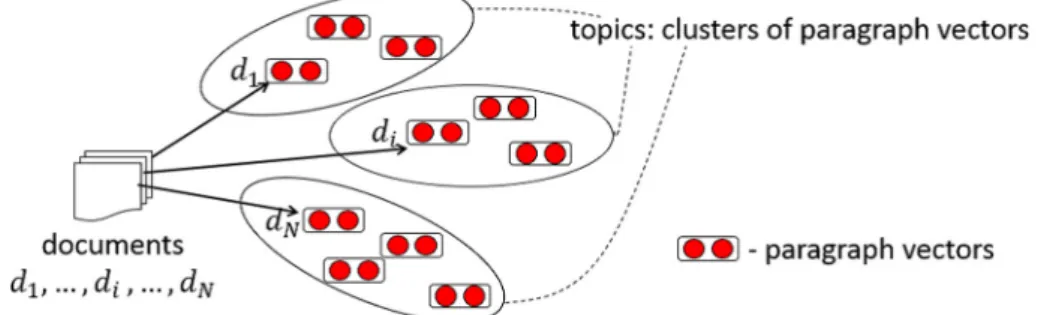
Fig. 1 shows an overview of our proposed topic detection method. To detect the latent topics inherent in a set of documents, we first cluster the learned paragraph vectors using thek-means clustering algorithm to obtainKcluster centres of the paragraph vectors. As a distance metric for k-means clustering, we use the cosine similarity between paragraph vectors (i.e., spherical k -means[18]). Whilst alternative distance metrics could be used in k-means clustering (e.g., Euclidean distance), previous work has demonstrated that the cosine of the angle between word or para-graph vectors provides robust results[11,15]. We treat theK clus-ter centre vectors
v
ðc1Þ;v
ðc2Þ;. . .;v
ðcKÞas the representations of theKlatent topicsðc1;c2;. . .;cKÞ. We then derive aK-dimensional topic-based representation ðt1;t2;. . .;ti;. . .;tkÞ of a document by considering the dot product between the paragraph vectorv
ðdÞof the document and the paragraph vectors
v
ðc1Þ;v
ðc2Þ;. . .;v
ðcKÞ of the K cluster centroids. The i-th feature value of the topic-based document vector determines the degree of correlation between the document and thei-th latent topic and is calculated as follows: ti¼ expðv
ðdÞv
ðciÞÞ P jexpðv
ðdÞv
ðcjÞ ð 3Þ2.1.4. Inducing topic descriptors
Given that paragraph vectors are trained by solving word pre-diction tasks, we can compute the conditional probability pðwjdwÞthat a word wis generated given a document dw. Con-cretely, the probability is computed by omitting the context infor-mation in Eq.(2):
pðwtjpdwÞ ð4Þ
Using the cluster centre vectors, we can determine a set of words that best describe a given topic, since the cluster centre vec-tors are in the same vector space as the paragraph vecvec-tors. The probability pðwjciÞ that a word w is generated given the i-th
ð16i6KÞtopic is computed by normalising the prediction scores for the words given thei-th topic as follows:
pðwjciÞ ¼
expðsðwÞ
v
ðciÞÞP
jexpðsðwjÞ
v
ðciÞÞ ð5Þ
wheresðwjÞis the weight vectors for calculating the word predic-tion scores in the paragraph vector model.
2.1.5. An example of topics and descriptive topic labels
Fig. 2shows an example abstract from the Cooking Skills data-set (Table 1summarises the characteristics of the dataset) with the 4 most important topics induced by the proposed topic detection
(i.e., PV topic detection) method and the LDA topic model. The two topic detection methods are trained by setting the number of topics to 300. Moreover, each topic is characterised by the top 5 words (i.e., descriptive topic labels) with the highest probability of being relevant to that topic. An exact match between words that occur in the abstract and the topic descriptors is highlighted by a solid green line for the PV topic detection method and with a dashed blue line for the LDA topic model.
The automatically assigned topic descriptions show that the two topic detection methods tend to induce thematically coherent topics which are also representatives of the underlying abstract. For example, topics 3 and 4 extracted by the paragraph vector-based topic detection method seem to be related to two of the key points discussed in the abstract (i.e.,‘‘. . .feeding practices for infants and young children. . .” and ‘‘childhood obesity”). Moreover, it can be noted that both models capture synonymous or semanti-cally related words that occur as keywords in the same topic (e.g., ‘mother/maternal’, ‘overweight/obesity’).
2.2. Evaluation settings 2.2.1. Evaluation method
To evaluate the proposed topic detection method, we investi-gate the performance of a certainty-based active learning classifier using topic-based features extracted by our paragraph vector-based method and the baseline LDA model. We employ a certainty-based active learning classifier, previously presented in Miwa et al.[4]. A high-level view of the active learning strategy is illustrated inFig. 3. In our approach, citations are represented as a mixture of topics induced by a topic modelling approach (e.g., the proposed topic detection method or LDA). The two topic
models used in this work are unsupervised methods. Thus, we extract topics from the complete set of citations.
An expert reviewer initiates the active learning process by man-ually labelling a small sample of citations. This labelled sample, encoded into a topic-based representation, is then used to train an SVM text classification model. The trained model automatically classifies the remaining unlabelled citations and determines the next sample of citations to be validated by the reviewer according to a certainty-based criterion, i.e., instances for which the classifier has assigned a high confidence value of being relevant to the review. The certainty selection criterion has been previously shown to better address class imbalance (i.e., a significantly skewed distribution of eligible and ineligible studies)[4,19]that occurs in systematic reviews. In a succeeding iteration, the reviewer validates the next sample of citations which is used to augment the training set with additional labelled instances. The iterative process terminates when at least 95% of eligible studies are identified by the active learner[3–6], ideally without needing to manually label the entire list of citations.
In our experiments, we simulate a human feedback active learn-ing strategy [4,5] given that the employed datasets are already manually coded with gold standard classification labels. At each learning iteration, we construct a sample of 25 studies (i.e., instances for which the classifier has assigned the highest proba-bility of being relevant to the review) and we validate the sample against the gold standard. The validation sample is subsequently used to re-train the text classification model. Following previous approaches, we repeat learning iterations until the active learner has screened the complete list of citations.
2.3. Datasets
We report the performance of the active learner when applied to the first stage of the screening process (i.e., screening of titles and abstracts). Cross-validation experiments are performed on two publicly available clinical datasets[5]and three public health datasets, previously used in Miwa et al.[4].Table 1summarises the
Fig. 2.Examples of topics and descriptive topic labels extracted by the paragraph vector-based topic detection method (i.e., PV topic detection) and the LDA topic model from an abstract within the Cooking Skills dataset. Topic labels that are present in the abstract are highlighted with solid green lines for the paragraph vector-based topic detection method and with dashed blue lines for LDA. (For interpretation of the references to colour in this figure legend, the reader is referred to the web version of this article.)
Table 1
Characteristics of clinical and social science reviews used for experimentation. Dataset Scientific # citations
domain
Ratio of eligible to ineligible studies (%) COPD Clinical 1606 12
ProtonBeam Clinical 4751 5 Cooking Skills Public health 11,515 2 Tobacco packaging Public health 3210 5 Youth development Public health 15,544 10
Fig. 3.High-level view of a certainty-based active learning strategy[4]used for citation screening.
five datasets that we use for experimentation accompanied with the: (a) underlying domain, (b) number of citations and (c) per-centage of eligible studies. It is noted that the size of the five employed datasets varies significantly, from small clinical review of approximately 1600 citations (i.e., COPD) to a large public health review of more than 15,000 citations (i.e., Youth Development). Additionally, all five datasets contain a very low percentage of eli-gible studies that range between 2% and 12%.
2.3.1. Settings for machine learning methods
In order to maximise the performance of the active learner, we tune the parameters of the topic modelling methods. Specifically, we train the paragraph vector-based topic detection method by setting the dimensionality of word vectors to 300, the dimension-ality of document vectors to 1000 and the number of training epochs to 500. We then applied thek-means algorithm to cluster the paragraph vectors into 300 clusters which resulted in a topic-based representation of 300 dimensions. With regard to the base-line LDA topic model, we used the freely available MALLET toolkit [20]. Additionally, we performed hyperparameter optimisation for every 10 Gibbs sampling iterations and set the total number of iter-ations to 500. As in the case of the proposed topic detection method, we used 300 LDA topics to represent documents. To train an SVM text classification model, we used the LIBLINEAR library [21]with a dual L2-regularised L2-loss support vector classification solver.
2.3.2. Evaluation metrics
We evaluate the performance of the active learning process, over different learning iterations, using two metrics, namely Yield and Burden[4,5]. Yield determines the percentage of eligible stud-ies identified by the active learner while burden the percentage of studies that are manually labelled (i.e., manual annotation cost). The overall goal of active learning is to achieve a high yield perfor-mance of at least 95%[3,4,6]while minimising the screening bur-den. We calculate yield and burden as follows:
yield¼ TP M þTPA TPMþTPAþFNA ð6Þ burden¼TP Mþ TNMþTPAþFPA N ð7Þ
whereNis the total number of citations,TP;TN;FPandFNthe num-ber of true positive (eligible studies), true negative (ineligible stud-ies), false positive (studies that are incorrectly classified as eligible) and false negative instances (studies that are incorrectly classified as ineligible), where the superscriptMandAdenote manual and automatic screening decisions, respectively. In the definition of bur-den, the sumTPMþTNMrepresents the number of studies that are manually labelled and used for training the system while TPAþFPAis the number of studies that are automatically classified as being relevant to the review but still need to be manually vali-dated by a human reviewer in order to be included in the final review.
As a further evaluation, we use the work saved over sampling at 95% recall (WSS@95%) which shows the percentage of ineligible citations that can be safely and automatically excluded (i.e., reviewers do not need to manually validate these instances for inclusion in the review) when the underlying active learner yields a recall performance of 95%. Previous approaches [6] used the WSS@95% metric to evaluate the performance of automatic classi-fication approaches that takes into consideration only automatic screening decisions. In an active learning scenario, WSS@95% can be estimated as follows:
WSS@95%¼ ð1burdenÞover a yield performance of 95% ð8Þ
3. Results
We investigate the performance of active learning, in terms of yield and burden, over an increasing number of manually labelled instances that are used for training. During the last iteration of the active learning process, both yield and burden are 100% since the active learner has identified all eligible studies but with the maxi-mum manual annotation cost (i.e., the complete citation list is manually screened).
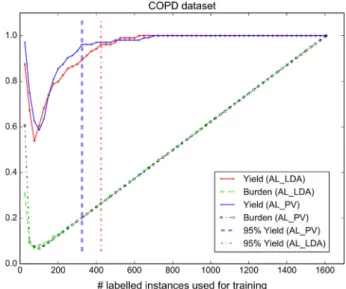
Figs. 4 and 5show the yield and burden performance achieved by the active learning models when applied to the COPD and Cook-ing Skills datasets, respectively (please refer to the supplementary material for the yield and burden performance of the models on the other datasets). We denote with AL_PV an active learning model that uses topic features extracted by our proposed para-graph vector-based topic detection method and with AL_LDA the baseline active learning model that employs LDA topic features. The dashed vertical lines indicate when an optimal yield perfor-mance of 95% is reached. In all cases, the burden perforperfor-mance fol-lows a U-shaped pattern. This can be explained by the fact that
Fig. 4.Performance (yield and burden) achieved by the AL_LDA and AL_PV models when applied to the clinical COPD dataset.
Fig. 5.Performance (yield and burden) achieved by the AL_LDA and AL_PV models when applied to the public health Cooking Skills dataset.
during the initial learning iterations where a small number of instances is available for training, the active learner erroneously predicts that the majority of studies is relevant to the review which results in an increased screening burden. As we extend the training set with more labelled instances, the burden performance des-cends since the active learner obtains a more stable classification performance. Finally, the screening burden increases again but this time linearly (although some fluctuations are observed) with the number of labelled instances.
In the clinical COPD dataset, the AL_PV method shows approx-imately the same burden performance with the AL_LDA model. However, our active learning strategy converged faster to a high yield value when compared to the baseline AL_LDA method. The AL_PV method improved the yield performance of the baseline model by approximately 3–7% in the COPD dataset. For a given manual annotation workload of 17% (i.e., 17% of the instances were manually labelled), the AL_PV method automatically identified 91% of relevant studies compared to 87% of relevant instances retrieved by the AL_LDA method. By increasing the manual annotation work-load to 20%, the AL_PV method achieved a yield performance of 96% while the baseline AL_LDA a yield performance of 89%. With regard to the Cooking Skills dataset (i.e., public health review), we observe that during the early learning iterations the perfor-mance obtained by the AL_PV model slightly fluctuated and in some cases the model obtained a lower yield and burden perfor-mance than the AL_LDA. In subsequent learning iterations, the AL_PV achieved a superior yield and burden performance com-pared to the baseline.
3.1. Reduction of manual annotation workload
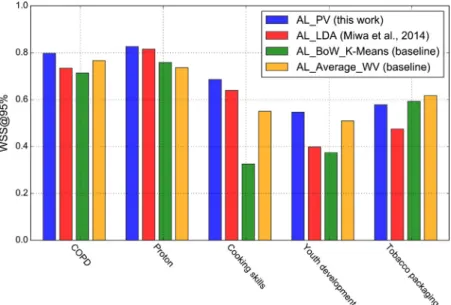
In this section, we evaluate the paragraph vector-based topic detection method by computing the work saved over sampling at 95% recall (WSS@95%). We further implement two additional base-line methods, namely the AL_BoW_K-Means and the AL_Aver-age_WV. The two baseline methods follow a similar approach to our proposed method to compute a vector representation of docu-ments. Firstly, they apply the k-means algorithm to generate k¼300 document clusters. Secondly, they induce a feature repre-sentation of documents by computing the distance of a document to thekcluster centroids. The AL_BoW_K-Means method usesk -means over a standard BoW representation of documents. The
AL_Average_WV performsk-means clustering over themean word representationof documents, i.e., the average of vectors for words that appear in a document. Word vectors are obtained by the word2vec tool[11]using the same parameter settings as in the paragraph vector model (i.e., 500 training epochs and 300 dimen-sions for the word vectors). A key difference between the AL_PV and the AL_Average_WV method is that the former approach trains word and document vectors jointly while the latter method trains word vectors alone.
Fig. 6summarises WSS@95% scores obtained by the four active learning models (AL_PV, AL_LDA, AL_BoW_K-Means and AL_Aver-age_WV) across clinical and public health reviews. It can be noted that in 4 datasets, our proposed active learning method outper-formed the AL_LDA by a statistically significant margin.2 The improvements varied between 5%in the COPD and Cooking Skills reviews to 10% in the Tobacco packaging and 15% in the Youth development review. For the ProtonBeam review, we observed an insignificant improvement of 1%achieved by AL_PV in comparison to the AL_LDA model. The AL_BoW_K-Means and AL_Average_WV methods obtained a slightly higher WSS@95% performance than the AL_PV model in the Tobacco Packaging review (i.e., 1–4%). How-ever, the AL_PV method surpassed the performance of the two base-line methods in the remaining 4 datasets (i.e., 3–6% in the COPD review, 1–9% in the Proton review, 13–33% in the Cooking Skills review and 4–17% in the Youth Development review).
4. Discussion
The experiments that we conducted demonstrate that the pro-posed topic detection method can improve upon a state-of-the-art semi-automatic citation screening method[4] that employs the standard LDA topic model. In clinical reviews, our topic detection method outperformed the LDA-based model by 1–5% while in pub-lic health reviews we observed larger performance gains between 5% and 15% in terms of WSS@95. These results suggest that the paragraph vector-based topic detection model can substantial reduce the manual annotation workload involved in both clinical and public health systematic reviews.
In our approach, we followed a retrospective evaluation proto-col [5,4]where automatic screening predictions were compared
Fig. 6.WSS@95% achieved by the AL_PV and AL_LDA active learning models across clinical and public health reviews.
2
against completed systematic reviews. This retrospective evalua-tion assumes that human reviewers screen at a constant rate which is not always the case in live systematic reviews. For example, O’Mara-Eves et al.[3]outlined that reviewers tend to make faster screening decisions once they have processed the majority of the important studies. Based upon this, we plan to integrate our topic detection method with bespoke systematic review systems[22,23] and assess the performance of active learning in real application scenarios.
Moreover, we will investigate alternative uses of topic mod-elling techniques that can further facilitate the study identification phase in systematic reviews. Specifically, although the literature of some disciplines is indexed using well-organised (e.g., using con-trolled vocabularies) bibliographic databases, e.g., MEDLINE[24] or EMBASE[25], this is not so for all disciplines, which can result in decreased performance of search strategies. Additionally, the PICO framework (Is this intervention (I) effective (Outcome) for this population (P) compared with this other intervention (C)) which is commonly used to structure pre-defined questions matching clinical needs, ill suits public health reviews[26]. Unlike clinical questions, public health questions are complex and may be described using abstract, fuzzy terminology, excluding defining a priori an adequate PICO question. Thus, topic modelling approaches that automatically discover groups of semantically related words and documents can be used to organise the most rel-evant evidence in a dynamic, interactive way that supports how public health reviews are conducted.
5. Conclusions
In this paper, we presented a new topic detection method to support the screening phase of systematic reviews. Our proposed method uses a neural network model to identify clusters of seman-tically related documents. By treating the cluster centroids as rep-resentatives of latent topics, we enable the model to learn an informative and discriminative feature representation of studies. This new topic-based representation of studies is utilised by an active learning text classification model to semi-automatically identify citations for inclusion in a review and thus directly reduce the human workload involved in the screening phase.
We evaluated our approach against an active learning strategy that employs topic-based features extracted by Latent Dirichlet Allocation (LDA) in both clinical and public health reviews. Exper-imental evidence showed that the neural network-based topic detection method obtained an improved yield and burden perfor-mance when compared to the baseline method. Additionally, we demonstrated that in four out of five reviews, the proposed method drastically reduced the manual annotation cost while retaining 95% of eligible studies in the final review.
Conflicts of interest statement
The authors declare that they have no conflict of interest.
Acknowledgements
This work was supported by MRC (‘‘Supporting Evidence-based Public Health Interventions using Text Mining”, MR/L01078X/1).
Appendix A. Supplementary material
Supplementary data associated with this article can be found, in the online version, athttp://dx.doi.org/10.1016/j.jbi.2016.06.001. References
[1]D. Gough, S. Oliver, J. Thomas, An Introduction to Systematic Reviews, Sage, 2012.
[2]I. Chalmers, L.V. Hedges, H. Cooper, A brief history of research synthesis, Eval. Health Prof. 25 (1) (2002) 12–37.
[3]A. O’Mara-Eves, J. Thomas, J. McNaught, M. Miwa, S. Ananiadou, Using text mining for study identification in systematic reviews: a systematic review of current approaches, Syst. Rev. 4 (1) (2015) 5.
[4]M. Miwa, J. Thomas, A. O’Mara-Eves, S. Ananiadou, Reducing systematic review workload through certainty-based screening, J. Biomed. Inform. 51 (2014) 242–253.
[5]B.C. Wallace, T.A. Trikalinos, J. Lau, C. Brodley, C.H. Schmid, Semi-automated screening of biomedical citations for systematic reviews, BMC Bioinform. 11 (1) (2010) 55.
[6]A.M. Cohen, W.R. Hersh, K. Peterson, P.-Y. Yen, Reducing workload in systematic review preparation using automated citation classification, J. Am. Med. Inform. Assoc. 13 (2) (2006) 206–219.
[7]C.C. Beahler, J.J. Sundheim, N.I. Trapp, Information retrieval in systematic reviews: challenges in the public health arena, Am. J. Prev. Med. 18 (4) (2000) 6–10.
[8]D.M. Blei, A.Y. Ng, M.I. Jordan, Latent Dirichlet allocation, J. Mach. Learn. Res. 3 (2003) 993–1022.
[9]T. Hofmann, Probabilistic latent semantic indexing, in: Proceedings of the 22nd Annual International ACM SIGIR Conference on Research and Development in Information Retrieval, ACM, 1999, pp. 50–57.
[10] Q. Le, T. Mikolov, Distributed representations of sentences and documents, in: Proceedings of the 31st International Conference on Machine Learning (ICML-14), 2014, pp. 1188–1196.
[11]T. Mikolov, I. Sutskever, K. Chen, G.S. Corrado, J. Dean, Distributed representations of words and phrases and their compositionality, in: Advances in Neural Information Processing Systems, 2013, pp. 3111–3119. [12]R. Collobert, J. Weston, L. Bottou, M. Karlen, K. Kavukcuoglu, P. Kuksa, Natural
language processing (almost) from scratch, J. Mach. Learn. Res. 12 (2011) 2493–2537.
[13]J. Turian, L. Ratinov, Y. Bengio, Word representations: a simple and general method for semi-supervised learning, in: Proceedings of the 48th Annual Meeting of the Association for Computational Linguistics, Association for Computational Linguistics, 2010, pp. 384–394.
[14]P.D. Turney, P. Pantel, et al., From frequency to meaning: vector space models of semantics, J. Artif. Intell. Res. 37 (1) (2010) 141–188.
[15]A.M. Dai, C. Olah, Q.V. Le, G.S. Corrado, Document embedding with paragraph vectors, in: Proceedings of the NIPS Deep Learning Workshop, 2014. [16]H.M. Wallach, Topic modeling: beyond bag-of-words, in: Proceedings of the
23rd International Conference on Machine Learning, ACM, 2006, pp. 977–984. [17]X. Wang, A. McCallum, X. Wei, Topical n-grams: phrase and topic discovery, with an application to information retrieval, in: Proceedings of the Seventh IEEE International Conference on Data Mining, IEEE, 2007, pp. 697–702. [18]I.S. Dhillon, J. Fan, Y. Guan, Efficient clustering of very large document
collections, in: Data Mining for Scientific and Engineering Applications, Springer, 2001, pp. 357–381.
[19]J. Fu, S. Lee, Certainty-enhanced active learning for improving imbalanced data classification, in: Proceedings of the 11th International Conference on Data Mining Workshops, IEEE, 2011, pp. 405–412.
[20] A.K. McCallum, Mallet: A Machine Learning for Language Toolkit. <http://mallet.cs.umass.edu>.
[21]R.-E. Fan, K.-W. Chang, C.-J. Hsieh, X.-R. Wang, C.-J. Lin, Liblinear: a library for large linear classification, J. Mach. Learn. Res. 9 (2008) 1871–1874. [22]B.C. Wallace, K. Small, C.E. Brodley, J. Lau, T.A. Trikalinos, Modeling annotation
time to reduce workload in comparative effectiveness reviews, in: Proceedings of the 1st ACM International Health Informatics Symposium, ACM, 2010, pp. 28–35.
[23]W. Yu, M. Clyne, S.M. Dolan, A. Yesupriya, A. Wulf, T. Liu, M.J. Khoury, M. Gwinn, GAPscreener: an automatic tool for screening human genetic association literature in PubMed using the support vector machine technique, BMC Bioinform. 9 (1) (2008) 205.
[24] US National Library of Medicine National Institutes of Health. <http://www. ncbi.nlm.nih.gov/> (accessed 2016-01-05).
[25] Embase: Biomedical Answers. <http://www.embase.com/> (accessed 2016-01-05).
[26]E. Fineout-Overholt, B.M. Melnyk, A. Schultz, Transforming health care from the inside out: advancing evidence-based practice in the 21st century, J. Prof. Nurs. 21 (6) (2005) 335–344.
![Fig. 3. High-level view of a certainty-based active learning strategy [4] used for citation screening.](https://thumb-us.123doks.com/thumbv2/123dok_us/1356051.2681410/4.892.487.791.100.486/high-level-certainty-active-learning-strategy-citation-screening.webp)