Arantxa Pascual Valero
COOPERATIVE AGENTS IDENTIFYING ANGLES USING
SWARM INTELLIGENCE
2 Nottingham Trent University
School of Architecture, Design and the Built Environment
Cooperative Agents Identifying Angles Using Swarm Intelligence Arantxa Pascual Valero – June 2011
3
Abstracto
Inteligencia; dícese de la capacidad del ser humano para procesar la información del entorno, así como recogerla del exterior.
Hasta hace algún tiempo, tal y como se puede observar de la definición anterior, se pensaba que la inteligencia era algo que pertenecía exclusivamente al ser humano ya que se creía que la inteligencia era algo que dependía de las estructuras internas del cerebro y su interacción con el mundo exterior. Ahora, la forma de interpretar este concepto es muy amplia. Gracias a diversos estudios realizados por varias ramas de la ciencia se ha establecido la definición de inteligencia como la capacidad de relacionar los conocimientos adquiridos para resolver una situación específica y / o problema.
Por lo tanto, un ser humano puede ser tan inteligente como un agente racional no vivo.
Esta definición, sin embargo, es aún incompleta, ya que implica que la inteligencia es unitaria, pero ¿puede ser un agente "tonto" por sí mismo ser inteligente en un nivel jerárquico superior? ¿Podría ser que un agente posee la inteligencia en un entorno de grupo? La respuesta es sí y a esto se le denomina inteligencia de enjambre.
Gracias a este tipo de inteligencia, este proyecto aborda el problema
en el que varios agentes independientes
deben colaborar conjuntamente para identificar una amplia variedad de ángulos.
4
del algoritmo, por medio de la inteligencia de enjambre, para identificar la relación angular de una forma geométrica.
5
Abstract
Intelligence; said of the human being’s capacity to process information from the environment, as well as collect it from the outside.
Until some time ago, as it can be seen from the definition above, it was thought that intelligence was something that belonged exclusively to the human being as it was believed that intelligence was something that depended on the internal structures of the brain and its interaction with the outside world. Now, the way to interpret this concept is quite wide. Thanks to various studies conducted by various branches of science has established the definition of intelligence as the ability to relate acquired knowledge to solve a specific situation and/or problem.
Thus, a human being can be as smart as a rational agent non-alive.
This definition, though, is still incomplete because it implies that intelligence is unitary, but can an agent be “dumb” by itself but be intelligent in an upper hierarchical level? Could it be that an agent owns intelligence in a group environment? The answer is yes and it is called swarm intelligence.
Thanks to this type of intelligence, this project deals with the problem where several independent agents collaborate together to identify a wide variety of angles.
Thus this project describes the analysis and design of the algorithm, by means of swarm intelligence, identifies the angular relationship of a geometric shape.
6
Contents Acknowledgements
List of illustrations, figures and tables List of acronims
Chapter 1. Design in Context 1.1. Introduction
1.2. Aims and Objectives
1.3. Creating and Managing the Workplan 1.3.1. Task Identification
1.3.2. Gantt Chart 1.3.3. Pert Chart 1.4. Summary
Chapter 2. Historical Background 2.1 Introduction
2.2 Bio-inspired Computing Models 2.3 Evolutionary Computation
2.4 Swarm Intelligence
2.4.1. What is it known as Swarm intelligence? 2.4.2. Classification of Swarm Intelligence
2.4.3. Properties of Swarm Intelligence Systems. 2.4.4. Studies and Applications of Swarm Intelligence. 2.4.5. Swarm Intelligence Projects.
2.5 Multi Agent System
2.5.1. Multi Agent System Projects 2.6 Summary
7 3.1 Introduction
3.2 System Flowchart
3.3 Functional System Requirements 3.4 Conceptual Model
3.5 Graphical User Interface
Chapter 4. Design and Implementation 4.1 Design Choices
4.1.1. Object-oriented Programming 4.2 Designing the Algorithm
4.3 Implementation 4.3.1. Use of Processing Chapter 5. Future Work Chapter 6. Conclusions Appendix
References Bibliography
8
Acknowledgements
I would like to thank Dr. Philip Breedon, my thesis supervisor, for offering me this interesting and challenging project. I am really grateful to David King, my colleague supervisor, for his patience, advices and suggestions.
I would also like to thank the Escola Politècnica Superior d’Enginyeria de Vilanova i la Geltrú, my Spanish Engineering School, for giving me the chance to follow this studies in the Nottingham Trent University. Many thanks to all my friends, who were present when I needed help, either physically or through the net; and, of course, to my father Joan and my mother Sandra and the rest of my family who were always there, supporting me and my ambitions and encouraging me to carry on.
9
List of Illustrations, Figures and Tables Table 1. Task Identification
Figure 1. Beowulf Figure 2. Gantt Chart
Figure 3. Gantt Chart – Detail of tasks’ features Figure 4. Gantt Chart – Detail of tasks’ progress Figure 5. Pert Chart
Figure 6. Blocks of birds Figure 7. Bees colony
Figure 8. Ants working together Figure 9. Termites nest
Figure 10. A swarm of robots collaborate to pass an obstacle. Figure 11. Symbrion and Replicator projects.
Figure 12. Multi agents Figure 13. Robocup
Figure 14. Sensors diagram Figure 16. Conceptual model Figure 17. Main screenshot
Figure 18. Agents surrounding a shape Figure 19. Mathematical reason
10
List of Acronyms
F.R.-F.N.R.S. Fonds de la Recherche Scientifique / Fund for Scientific Research.
11
Glossary
Darwinism and Darwinian principles. Darwinism is a set of movements and concepts related to ideas of transmutation of species or of evolution based on Darwin’s Theory of Evolution. Principles that summarises Darwin’s work are:
Variation; there is variation in every population.
Competition; organisms compete for limited resources. Offspring; organisms produce more offspring that can
survive.
Genetics; organisms pass genetic traits on to their offspring.
Natural selection; those organisms with the most beneficial traits are more likely to survive and reproduce.
Jean-Louis Deneubourg. Professor from Université Libre de Bruxelles and Senior research Associate from F.R.-F.N.R.S. He has taken part in many research related to bio-inspirited systems.
Donald Becker. He is a notable developer well known for writing many of the Ethernet drivers for the Linux operating system. Thousands of computers around the world routinely use his drivers to connect to the Internet. Becker, in collaboration with Thomas Sterling, created, created Beowulf clustering while at NASA, using software to connect many inexpensive PCs to solve complex math problems typically reserved for classic supercomputers.
12
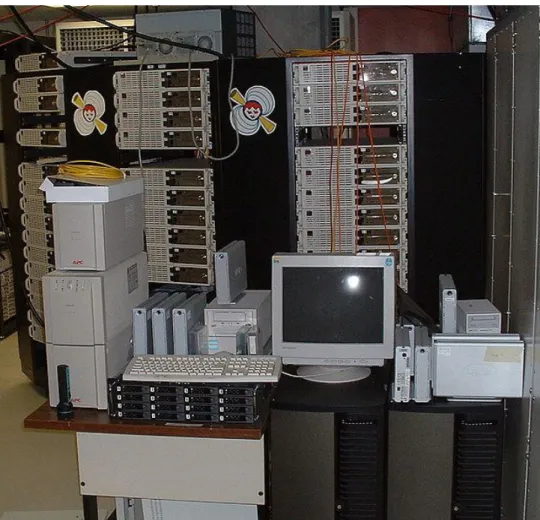
Beowulf. It is a specific computer built in 1994. Beowulf is a class of computer clusters similar to the original NASA system.
13
Chapter
1
D
14
1.1. INTRODUCTION
Whenever, human being is more interested in having fully aware of its surroundings. Sometimes, it is impossible to have absolute control of the environment and then tasks that should have been done by humans are derived to external agents who are able to execute them. It is the case of this project, which raises the possibility that several agents or robots are able to recognize angles and, in consequence, shapes. This can be used, in the future, for construction, for example; where human mobility is quite limited and therefore the analysis of the surface then the recognition of the materials’ shapes is vital for building.
In the following sections, aims and objectives; and work plan are described in order to get success on the project’s development.
1.2. AIMS AND OBJECTIVES
One of the purposes of this project could be the one described in the previous section “1.1. INTRODUCTION”. However, the main aim of the project owns a personal nature.
This dissertation is an academic requirement to complete the degree of Software Engineering. What is pretended with this is to demonstrate all the skills that have been acquired throughout the degree.
15
As for the objectives, it is necessary to know that the most important concerns in multi-agent cooperative systems are focused on the construction of models related with the communication, the interaction and the behaviour of agents participating in a task.
Then, this project deals with behavioural aspects of cooperative agents while they are evolving in a task.
The main goal of it is to examine the capability of a group of randomly moving agents, with simple sensors, to identify a range of different angles through their interaction with each other and the angle being indentified in order to produce guidelines for further research regarding object recognition through shape.
To proceed it, first of all, it will be necessary the creation of a simulate system to prove that the algorithm that controls the behaviour of those agents works correctly. Once it has been proved, as a future work, the movement of the simulation step to the real world will be performed.
1.3. CREATING AND MANAGING THE WORKPLAN
Once the aims and objectives of this project have been set, it is necessary to define guidelines and handling dates in order to make effective the resolution of the work.
This section is divided in the following subsections: task identification, Gantt chart and pert chart.
16 1.3.1. Task Identification
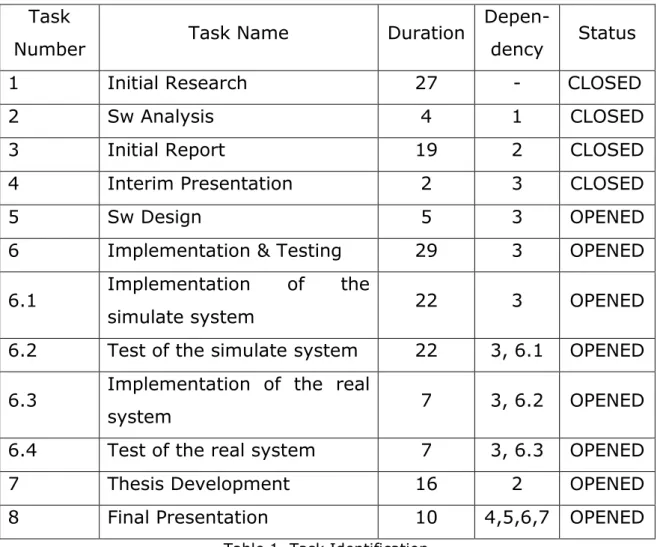
The overall objectives for the project are listed in this section. On it, is described the task name, the duration, which is given in days; the dependency and the status:
Task
Number Task Name Duration
Depen-dency Status
1 Initial Research 27 - CLOSED
2 Sw Analysis 4 1 CLOSED
3 Initial Report 19 2 CLOSED
4 Interim Presentation 2 3 CLOSED
5 Sw Design 5 3 OPENED
6 Implementation & Testing 29 3 OPENED 6.1 Implementation of the
simulate system 22 3 OPENED
6.2 Test of the simulate system 22 3, 6.1 OPENED 6.3 Implementation of the real
system 7 3, 6.2 OPENED
6.4 Test of the real system 7 3, 6.3 OPENED
7 Thesis Development 16 2 OPENED
8 Final Presentation 10 4,5,6,7 OPENED
Table 1. Task Identification
1.3.2. Gantt Chart
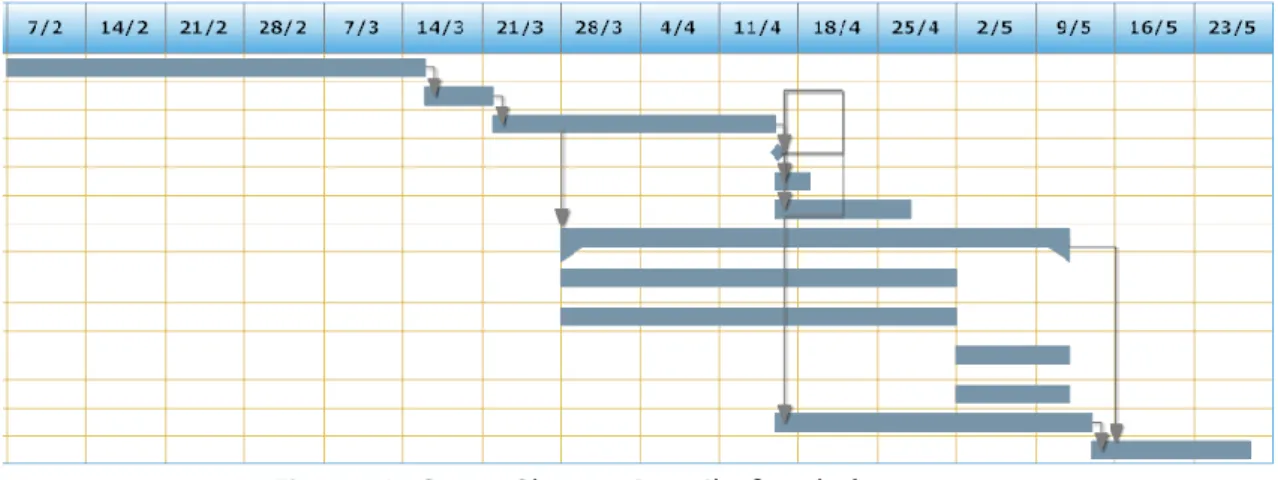
This kind of bar char illustrates, graphically, the project schedule. The start and finish dates of the different tasks of this project are shown in this Gantt chart.
17
Figure 2. Gantt Chart
Figure 3. Gantt Chart – Detail of tasks’ features
18 1.3.3. Pert Chart
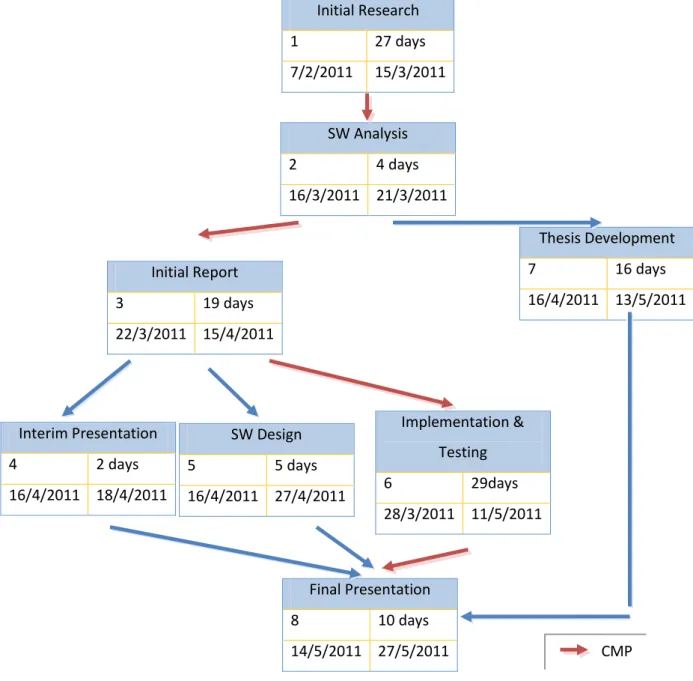
In this subsection, Pert chart is designed to analyze and represent the tasks involved in this project. Then, what is the difference between Gantt chart and Pert chart? Basic information such as name of tasks or tasks’ dates are given in both models but Pert chart is commonly used in conjunction with the CMP. CMP is useful to be aware of the tasks that can cause an adverse effect in case of delay.
Figure 5. Pert Chart
Initial Research 1 27 days 7/2/2011 15/3/2011 SW Analysis 2 4 days 16/3/2011 21/3/2011 Thesis Development 7 16 days 16/4/2011 13/5/2011 Initial Report 3 19 days 22/3/2011 15/4/2011 Interim Presentation 4 2 days 16/4/2011 18/4/2011 SW Design 5 5 days 16/4/2011 27/4/2011 Implementation & Testing 6 29days 28/3/2011 11/5/2011 Final Presentation 8 10 days 14/5/2011 27/5/2011 CMP
19
1.4. SUMMARY
In this first chapter, aims and objectives have been set. They are: To built an algorithm in order to recognise shapes through its
angles.
Prove the algorithm in a simulated system. Implement the algorithm in the real system.
Immediately afterwards, the work plan has been described to get the dissertation finished on time.
20
Chapter
2
H
21
2.1. INTRODUCTION
With more and more robots moving into our lives it is necessary to make them more autonomous and let them cooperate and communicate with each other.
The main idea with agents is that it would not be necessary to give them orders but let the individual agent to decide what to do based on how it perceives the environment.
This chapter introduce to the lector into the multi agents system and the swarm intelligence world.
2.2. BIO-INSPIRED COMPTUTING MODELS
Biologically inspired computing, also known as bio-inspired computing, is a field of study that is based on social behaviour and emergence from natural systems to solve wide problems.
Algorithms that are based on this model are able to simulate the behaviour of natural systems to design methods of searching, learning and behaviour.
The main characteristics of these algorithms are:
They are able to copy a phenomenon which can be found on nature.
22
They present a parallel structure. That means that multiple agents work in parallel.
They are able to adapt, which means that they modify the model and parameters in accordance with the values that they collect from the environment.
Some areas of study encompassed under the cannon of biologically inspired computing are “Evolutionary Computation” and “Swarm Intelligence”. Both are described in next sections.
2.3. EVOLUTIONARY COMPUTATION
Evolutionary computation is based on Darwinian principles. It can be divided in three big areas:
Genetic Algorithms.
Evolutionary programming. Evolution strategies.
The use of Darwinian principles for automatons was originated in the fifties. It was not until the sixties that three distinct interpretations of this idea began to be developed in three different places.
John Henry Holland, together with his students of the University of Michigan, developed a method called genetic algorithm.
Holland’s interest was in machine intelligence, and he and his students developed and applied the capabilities of genetic algorithms to artificial systems. Holland’s systems were adaptive because of their robustness in spite of changes and uncertainty in the environment.
23
Further, they were self-adaptive in that they could make adjustments based on their interaction with the environment over time.
At the same time, in the United States, Larry J. Fogel and his colleagues developed what they named evolutionary programming. Evolutionary programming uses the selection of the fittest, but the only structure-modifying operation allowed is mutation, there is no crossover. Fogel and his colleagues mainly worked with finite state machines and were interested in machine intelligence, and they were able to solve some problems that were quite difficult for genetic algorithms. Fogel described evolutionary programming as taking a fundamentally different approach of genetic algorithms:
<<The procedure abstracts evolution as a top-down process of adaptive behavior, rather than a bottom-up process of adaptive genetics. It is argued that this approach is more appropriate because natural selection does not act on individual components in isolation, but rather on the complete set of expressed behaviors of an organism in light of its interaction with its environment.>>
In Germany, Ingo Rechenberg and Hans-Paul Schwefel were experimenting with mutation in their attempts to find optimal physical configurations for a series of hinged plates in a wind tunnel and a tube that delivered liquid. The usual gradient-descent techniques were unable to solve the sets of equations for reducing wind resistance. They began experimenting with mutation, slightly perturbing their best problem solutions to search randomly in the nearby regions of the problem space.
24
Rechenberg and Schwefel used the first computer available at the Technical University of Berlin to simulate various versions of the approach that became known as evolution strategies.
Research developments in Germany and the United States continued in parallel, with each group unaware of the other’s findings until the 1980s when they became closer. Nowadays, researchers in these three areas of evolutionary computation are communicating and working more with each other.
2.4. SWARM INTELLIGENCE
2.4.1 What is it known as Swarm Intelligence?
According to Drs. Marco Dorigo and Mauro Birittari from Université Libre de Bruxelles, Belgium, it is called Swarm Intelligence to:
<<The discipline that deals with natural and artificial systems composed of many individuals that coordinate using decentralized and self-organization. In particular, the discipline focuses on the collective behaviours that result from the local interactions of the individuals with each other and with the environment.>>
Examples of systems studied by swarm intelligence are colonies of ants and termites, schools of fish, flocks of birds, herds of land animals. Some human artefacts also fall into the domain of swarm intelligence, such as some multi-robot systems, and also certain computer programs that are made to solve optimization and data analysis problems.
25
Figure 6. Blocks of birds Figure 7. Bees colony
Figure 8. Ants working together Figure 9. Termites nest
2.4.2 History of the term
The term of Swarm Intelligence was introduced by Gerardo Beni and Jing Wang in 1989 on a paper about Cellular Robotic Systems.
26
2.4.3 Classification of Swarm Intelligence
Swarm intelligence has a marked multidisciplinary character since systems with the above mentioned characteristics can be observed in a variety of domains. Research in swarm intelligence can be classified according to different criteria:
Natural vs. Artificial
It is normally to divide swarm intelligence research into two areas according to the nature of the systems under analysis. It is spoken therefore of natural swarm intelligence research, where biological systems are studied; and of artificial swarm intelligence, where human artifacts are studied.
Scientific vs. Engineering
An alternative and more informative classification of swarm intelligence research can be given based on the goals that are pursued: it can be identified a scientific and an engineering stream. The goal of the scientific stream is to model swarm intelligence systems and to singularize and understand the mechanisms that allow a system as a whole to behave in a coordinated way as a result of local individual-individual and individual-environment interactions. On the other hand, the goal of the engineering stream is to take advantage of the understanding developed by the scientific stream in order to design systems that are able to solve problems of practical relevance.
The two dichotomies natural/artificial and scientific/engineering are orthogonal: although the typical scientific investigation concerns natural systems and the typical engineering application concerns the
27
development of an artificial system, a number of swarm intelligence studies have been performed with swarms of robots for validating mathematical models of biological systems. These studies are a kind of speculative nature and definitely belong in the scientific stream of swarm intelligence. On the other hand, one could influence or modify the behavior of the individuals in a biological swarm so that a new swarm-level behavior emerges that is somehow functional to the solution of some task of practical interest. In this case, although the system at hand is a natural one, the goals pursued are definitely those of an engineering application. In the following, an example is given for each of the four possible cases.
Natural/Scientific: Foraging Behavior of Ants
In a now classic experiment done in 1990, Deneubourg and his group showed that, when given the choice between two paths of different length joining the nest to a food source, a colony of ants has a high probability to collectively choose the shorter one. Deneubourg has shown that this behavior can be explained via a simple probabilistic model in which each ant decides where to go by taking random decisions based on the intensity of pheromone perceived on the ground, the pheromone being deposited by the ants while moving from the nest to the food source and back.
Artificial/Scientific: Clustering by a Swarm of Robots
Several ant species cluster corpses to form cemeteries. Deneubourg was among the first to propose a distributed probabilistic model to explain this clustering behavior. In his model, ants pick up and drop items with probabilities that depend on information on corpse density which is locally available to the ants. Beckers et al. (1994) have programmed a group of robots to implement a similar clustering
28
behavior demonstrating in this way one of the first swarm intelligence scientific oriented studies in which artificial agents were used.
Natural/Engineering: Exploitation of collective behaviors of animal societies
A possible development of swarm intelligence is the controlled exploitation of the collective behavior of animal societies. No example is available in this area of swarm intelligence although some promising research is currently in progress: For example, in the Leurre project, small insect-like robots are used as lures to influence the behavior of a group of cockroaches. The technology developed within this project could be applied to various domains including agriculture and cattle breeding.
Artificial/Engineering: Swarm-based Data Analysis
Engineers have used the models of the clustering behavior of ants as an inspiration for designing data mining algorithms. A similar work in this direction was undertaken by Lumer and Faieta in 1994. They defined an artificial environment in which artificial ants pick up and drop data items with probabilities that are governed by the similarities of other data items already present in their neighborhood. The same algorithm has also been used for solving combinatorial optimization problems reformulated as clustering problems.
2.4.4 Properties of Swarm Intelligence systems
A typical swarm intelligence system owns the following characteristics:
29
It is composed of many individuals.
The individuals are relatively homogeneous; that means they are either all identical or they belong to a few typologies.
The interactions among the individuals are based on simple behavioural rules that exploit only local information that the individuals exchange directly or via the environment.
The overall behaviour of the system results from the interactions of individuals with each other and with their environment, that is, the group behaviour self-organizes.
The main property of a swarm intelligence system is its ability to act in a coordinated way without the presence of a coordinator or of an external controller. Many examples can be observed in nature of swarms that perform some collective behaviour without any individual controlling the group, or being aware of the overall group behaviour. In spite of the lack of individuals in charge of the group, the swarm as a whole can show an intelligent behaviour. This is the result of the interaction of neighbouring individuals that act on the basis of simple rules.
Most often, the behaviour of each individual of the swarm is described in probabilistic terms: Each individual has a stochastic behaviour that depends on his local perception of the neighbourhood.
Because of the above properties, it is possible to design swarm intelligence system that are scalable, parallel, and fault tolerant:
Scalability means that a system can maintain its function while increasing its size without the need to redefine the way its parts
30
interact. Because in a swarm intelligence system interactions involve only neighbouring individuals, the number of interactions tends not to grow with the overall number of individuals in the swarm: each individual's behaviour is only loosely influenced by the swarm dimension. In artificial systems, scalability is interesting because a scalable system can increase its performance by simply increasing its size, without the need for any reprogramming.
Parallel action is possible in swarm intelligence systems because individuals composing the swarm can perform different actions in different places at the same time. In artificial systems, parallel action is desirable because it can help to make the system more flexible, that is, capable to self-organize in teams that take care simultaneously of different aspects of a complex task.
Fault tolerance is an inherent property of swarm intelligence systems due to the decentralized, self-organized nature of their control structures. Because the system is composed of many interchangeable individuals and none of them is in charge of controlling the overall system behaviour, a failing individual can be easily dismissed and substituted by another one that is fully functioning.
2.4.5 Studies and applications of Swarm Intelligence
This section presents briefly a few examples of scientific and engineering swarm intelligence studies.
31 Clustering Behaviour of Ants
Ants build cemeteries by collecting dead bodies into a single place in the nest. They also organize the spatial disposition of larvae into clusters with the younger, smaller larvae in the cluster centre and the older ones at its periphery. This clustering behaviour has motivated a number of scientific studies. Scientists have built simple probabilistic models of these behaviors and have tested them in simulation. The basic models state that an unloaded ant has a probability to pick up a corpse or a larva that is inversely proportional to their locally perceived density, while the probability that a loaded ant has to drop the carried item is proportional to the local density of similar items. This model has been validated against experimental data obtained with real ants. In the classification this is an example of natural/scientific swarm intelligence system.
Nest Building Behaviour of Wasps and Termites
Wasps build nests with a highly complex internal structure that is well beyond the cognitive capabilities of a single wasp. Termites build nests whose dimensions (they can reach many meters of diameter and height) are enormous when compared to a single individual, which can measure as little as a few millimetres. Scientists have been studying the coordination mechanisms that allow the construction of these structures and have proposed probabilistic models exploiting stigmergic communication to explain the insects' behaviour. Some of these models have been implemented in computer programs and used to produce simulated structures that recall the morphology of the real nests. In the classification this is an example of natural/scientific swarm intelligence system.
32
Flocking and Schooling in Birds and Fish
Flocking and schooling are examples of highly coordinated group behaviours exhibited by large groups of birds and fish. Scientists have shown that these elegant swarm-level behaviours can be understood as the result of a self-organized process where no leader is in charge and each individual bases its movement decisions only on locally available information: the distance, perceived speed, and direction of movement of neighbours. These studies have inspired a number of computer simulations that are now used in the computer graphics industry for the realistic reproduction of flocking in movies and computer games. In the classification these are examples respectively of natural/scientific and artificial/engineering swarm intelligence systems.
Ant Colony Optimization
Ant colony optimization is a population-based metaheuristic that can be used to find approximate solutions to difficult optimization problems. It is inspired by the above-described foraging behaviour of ant colonies. In ant colony optimization (ACO), a set of software agents called "artificial ants" search for good solutions to a given optimization problem transformed into the problem of finding the minimum cost path on a weighted graph. The artificial ants incrementally build solutions by moving on the graph. The solution construction process is stochastic and is biased by a pheromone model, that is, a set of parameters associated with graph components (either nodes or edges) the values of which are modified at runtime by the ants. ACO has been applied successfully onto many classical combinatorial optimization problems, as well as to discrete optimization problems that have stochastic and/or dynamic components. Examples are the application to routing in
33
communication networks and to stochastic version of well-known combinatorial optimization problem, such as the probabilistic travelling salesman problem. Moreover, ACO has been extended so that it can be used to solve continuous and mixed-variable optimization problems. Ant colony optimization is probably the most successful example of artificial/engineering swarm intelligence system with numerous applications to real-world problems.
Particle Swarm Optimization
Particle swarm optimization is a population based on stochastic optimization technique for the solution of continuous optimization problems. It is inspired by social behaviors in flocks of birds and schools of fish. In particle swarm optimization (PSO), a set of software agents called particles search for good solutions to a given continuous optimization problem. Each particle is a solution of the considered problem and uses its own experience and the experience of neighbour particles to choose how to move in the search space. In practice, in the initialization phase each particle is given a random initial position and an initial velocity. The position of the particle represents a solution of the problem and has therefore a value, given by the objective function. While moving in the search space, particles memorize the position of the best solution they found. At each iteration of the algorithm, each particle moves with a velocity that is a weighted sum of three components: the old velocity, a velocity component that drives the particle towards the location in the search space where it previously found the best solution so far, and a velocity component that drives the particle towards the location in the search space where the neighbour particles found the best solution so far. PSO has been applied to many different problems and is another example of successful artificial/engineering swarm intelligence system.
34 Swarm-based Network Management
The first swarm-based approaches to network management were proposed in 1996 by Schoonderwoerd et al., and in 1998 by Di Caro and Dorigo. Schoonderwoerd et al. proposed Ant-based Control (ABC), an algorithm for routing and load balancing in circuit-switched networks; Di Caro and Dorigo proposed AntNet, an algorithm for routing in packet-switched networks. While ABC was a proof-of-concept, AntNet, which is an ACO algorithm, was compared to many state-of-the-art algorithms and its performance was found to be competitive especially in situation of highly dynamic and stochastic data traffic as can be observed in Internet-like networks. An extension of AntNet has been successfully applied to ad-hoc networks. These algorithms are another example of successful artificial/engineering swarm intelligence system.
Cooperative Behaviour in Swarms of Robots
There are a number of swarm behaviours observed in natural systems that have inspired innovative ways of solving problems by using swarms of robots. This is what is called swarm robotics. In other words, swarm robotics is the application of swarm intelligence principles to the control of swarms of robots. As with swarm intelligence systems in general, swarm robotics systems can have either a scientific or an engineering flavour. Clustering in a swarm of robots was mentioned above as an example of artificial/scientific system. An example of artificial/engineering swarm intelligence system is the collective transport of an item too heavy for a single robot, behaviour also often observed in ant colonies.
35
Figure 10. A swarm of robots collaborate to pass an obstacle.
2.4.6 Swarm Intelligence projects
Swarm intelligence is commonly used in swarm robotics area.
Swarm robotics is a comparative young field of science, focusing on the development of limited single robots which are able to perform direct and indirect communication with each other and to create dynamic horizontal systems with a collective behaviour.
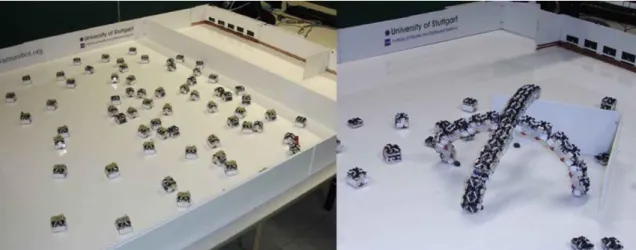
Open source research projects in this field include SWARMROBOT, conducted in a cooperation of the University Stuttgart and University Karlsruhe in Germany. The team developed the "Jasmin" robot, a simple single robot as with the capability to create a system of more than 100 cooperating nodes.
36
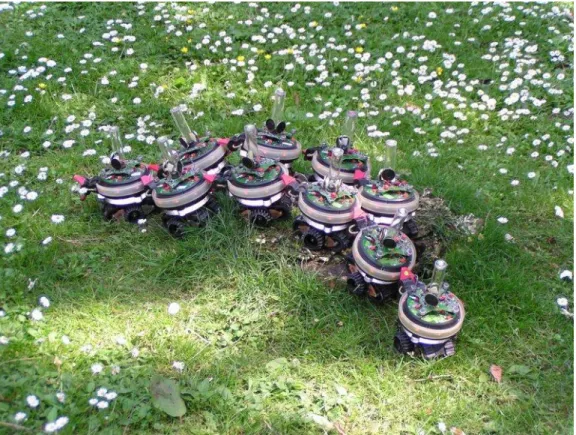
Two other notable projects are SYMBRION and REPLICATOR, financed by the European Union from 2008 until 2013 with 13M € (£11,470). Both are focusing on super-large-scale swarms which can symbiotically share resources such as CPU and energy supplies, as well as combining their respective actuators and sensors. The projects originate from research works from the open-source SWARMROBOT projects.
Figure 11. Symbrion and Replicator projects.
2.5. MULTI AGENT SYSTEM
In Computer Science, a Multi-Agent System is a system composed of
several agents capable of mutual interaction. The agents can be autonomous (i.e. whose decisions are not controlled by another entity) or not; although for the system to be called Multi-Agent, at least two autonomous entities must interact, each of those having the possibility to control several sub-entities. The agents can be artificial (robots, software agents) or natural (human beings, animals).
Multi-Agent systems have become a very active field of research inside Swarm Intelligence, partly because:
37
1. The computational power available today allows researchers to simulate complex multi-agent scenarios which were impossible to be modelled some decades ago.
2. It is more and more believed that complex behaviours and self-organization can be manifested in a multi-agent system through the interaction of simple individual strategies, thus allowing the development of interesting complex applications by building only simple agents.
One shall not forget as well that another important factor of the development of studies in multi-agent environments is the military interest exhibited by some countries. Indeed, building teams of autonomous robots appears more reliable (if one entity is destroyed, the others can continue their job) and cheaper (most of the time the simple entities are identical, thus reducing production costs) than other solutions.
Research in Multi-Agent Systems is focused on several topics, among which are found:
Beliefs, desires, intentions and knowledge. Cooperation and coordination.
Multi-agent learning.
Distributed problem solving, etc.
In this project, the interested topics are cooperation, coordination and learning or classifying.
38 2.5.1 Multi Agents System projects
Multi agent system is a technology that thanks to its advantages, as it has been seen in the section above, it is increasing. There are many projects which use this technology but just two of them have been selected to explain in this section.
In the first one, robots are divided into two teams, black and silver. A number of objects are placed on a grid cross sections. These objects are also divided into black and silver. It is assumed that only black team robots can pick up black objects and only silver team robots can pick up silver objects. The goal of the robots is to find all objects and move them out of the grid.
Figure 12. Multi agents
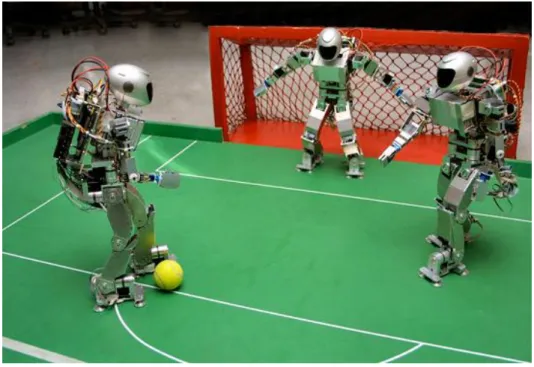
The second one consists in a Robocup where robots are divided into two teams, team A and team B. All the robots placed in one team have to collaborate with each other to score the maximum goals in opponents’ goal and to avoid being scored.
39
Figure 13. Robocup
2.6. SUMMARY
In this second chapter, the history of swarm intelligence has been covered.
First of all, its background has been described, terms as “bio-inspired computing model” or “evolutionary computation” have been introduced.
Subsequently, swarm intelligence has been studied deeply. In this section, the term has been defined and classifications, possible applications and projects have been described. Main characteristics have been described, as well; they were:
40
The individuals are relatively homogeneous; that means they are either all identical or they belong to a few typologies.
The interactions among the individuals are based on simple behavioural rules that exploit only local information that the individuals exchange directly or via the environment.
The overall behaviour of the system results from the interactions of individuals with each other and with their environment, that is, the group behaviour self-organizes.
But the very main property was the ability to act in a coordinated way without the presence of a coordinator or of an external controller.
To end the chapter, the technology of multi agent systems have been introduced.
41
Chapter
3
S
42
3.1. INTRODUCTION
In order to develop a software project in a successfully way, it is extremely important that before beginning to code the programs that will build the software application, it is necessary to have a fully comprehension of software requirements.
Pressman states that the task of requirements analysis is a process of discovery, refinement, modeling and specification. It is refined in detail the scope of the software and it is created models of data requirements, information and control flow and operational behavior.
Alternative solutions are analyzed and assigned to different pieces of the software.
The analysis of requirements allows specifying the role and performance of the software, shows the system interface and establishes the restrictions that the software must follow.
Thus, this chapter outlines the specification of the software application.
3.2. SYSTEM FLOWCHART
In this subsection it is shown the features that the system should be able to offer. This flowchart is useful to get a first idea of how the system should interact with the rest of agent and situations.
44
The flowchart above describes the basic performance of the system:
There will be a determined number of agents inside an arena. Every agent will walk randomly through the arena until bumping into a shape. Then, the agent will change its status. Consequently, it will start working with its neighbours to proceed with the correct identification of the angle.
3.3. FUNCTIONAL SYSTEM REQUIREMENTS
This section specifies the actions that the system must be capable to perform without taking into consideration any kind of physical restriction.
Thus, in this subsection, the behavior of system’s inputs and outputs are specified in a clear, concise and unambiguous way.
The elements that will interact with the system are called agents or robots. Their requirements are:
They must be able to move randomly; following any direction. When they find a wall belonging to the arena’s boundaries, they
must be able to change the direction to proceed with the search.
When one agent collides with other agent, they must be able to change the direction to proceed with the search.
45
Requirements above suggest that agents should be provided of some sort of element to detect presences. Evidently, agents are equipped with different level of sensors:
Figure 14. Sensors diagram
The inner sensor ring detects proximity to an object, the outer senses the state of any other agents. In this case the outer sensor ring has been divided into 8 segments, however the program should be set so this can be changed to any amount (for example 8, 10 and 12 should be enough). The more segments the agents’ sensor ranges have the more accurate the data will be.
46
Initially, agents start having 0 as state.
When they bump into a shape, their state changes to 1.
3.4. CONCEPTUAL MODEL
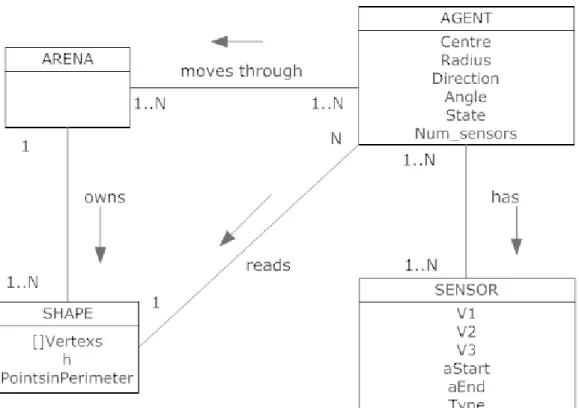
The goal of the conceptual model is to visualize semantics extracted from the functional system requirements to be implemented.
Figure 16. Conceptual model
Attributes’ meaning: AGENT:
Centre; an agent is represented by a round shape. This attribute keeps the centre of the round.
47
Radius; this attribute keeps the radius of the round.
Direction; the direction of an agent is represented by a straight line. This line is delimited by two coordinates which are the centre of the round and this attribute, and then the last one helps to keep the direction where the agent will move.
Angle; rotation angle of the direction. State; it keeps the status of the agent.
Num_Sensors; it keeps the quantity of segments that a sensor will be split.
SENSOR:
V1, V2, V3; a sensor is represented by a triangle and an arc. These three attributes corresponds to every single vertex of the triangle.
aStart; corresponds to the angle that starts the arc. aEnd; sets the angle to stop.
Type; sets the kind of sensor, it can be inner or outer.
SHAPE:
[]Vertexs; corresponds a matrix that will keep the vertexs of the shape.
H; keeps the height between the upper vertex and the base of the shape.
pointsInPerimeter; keeps every single coordinate that belongs to the perimeter of the shape.
48
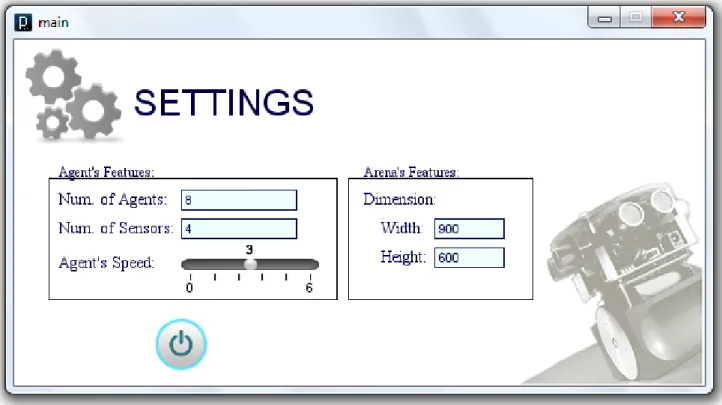
3.5. GRAPHICAL USER INTERFACE
A useful Graphical User Interface (GUI) should be provided, in order to modify parameters.
Most of the recent Object-Oriented programming languages have extensive libraries to create a GUI, for example Processing owns libraries such as Intersfacia or G4P which provides elements like textbox and buttons.
A first orientation of what could be the main screen is described below:
It should allow modifying parameters such as: the number of agents, the number of sensors, the agents speed and the arena dimension, which includes the width and height of the arena.
49
50 Chapter
4
D
D
e
e
s
s
i
i
g
g
n
n
a
a
n
n
d
d
I
I
m
m
p
p
l
l
e
e
m
m
e
e
n
n
t
t
a
a
t
t
i
i
o
o
n
n
51 4.1 DESIGN CHOICES
From these requirements, several design choices were made, and they are described below.
4.1.1 Object-Oriented Programming
It appeared quite soon that Object-Oriented Programming would be a relevant paradigm to use to build the system, since it brings very useful features: abstraction, modularity, and reusability.
First, thanks to abstraction, it can elaborate some generic rules about how to define an Agent, and by using abstract classes several agents can be designed to fit into the system.
The modularity feature would be useful, for example, to separate the simulation and the display.
The reusability feature is a requirement for the project. Object-Oriented Programming usually makes it easier to have reusable programs.
Finally, the multi-agent problem is well suited for an Object-Oriented approach: every agent can be represented as an object, and several agents can be handled easily, by creating several instances of a super class Agent.
52 4.2 DESIGNING THE ALGORITHM
The resolution of the algorithm follows a basic trigonometric relation. See the following example for further explanation:
Figure 18. Agents surrounding a shape
From the situation above, it is obtained the following: Arena
Angle
53
Figure 19. Mathematical reason
In this moment there are two right triangles, then it can be applied the following relations:
For the right triangle in the left:
For the right triangle in the right:
Then the resulting angle will be:
This is the mathematical reason existing behind the algorithm, but how is it developed?
54 Here there is a scheme:
Void IdentyingAngles(){ redistributeAgents(); findHeight();
calculi(); }
The procedure redistributeAgents() move agents so that they are placed as the ideal scene. The ideal scenario corresponds to the one drawn above. Not always this situation will be performed for this reason this procedure is needed.
The procedure findHeight() makes possible the obtainment of the point that arises from the intersection of the height and the bottom of the triangle.
Finally, calculi() applies the formula described above.
4.3 IMPLEMENTATION
This chapter outlines the main features of the implementation.
At first it was thought to include the code in the appendix section, but at last it has not been included because, otherwise, the quality of the reading would have been decreased. The code will be attached in the CD that will be given on the exhibition day.
55 4.3.1 Use of Processing
The choice of Processing for the Object-Oriented programming language was dictated by pragmatic reasons: I was told to use it.
Processing is an open source programming language and environment which helps to create images, animations, and interactions. Initially developed to serve as a software sketchbook and to teach fundamentals of computer programming within a visual context, Processing also has evolved into a tool for generating finished professional work.
Processing is a dialect of Java; the language syntax is almost identical, but Processing adds custom features related to graphics and interaction. The graphic elements of processing are related to PostScript and OpenGL.
56
Chapter
5
F
57
As it was said in the first chapter of this dissertation, the main goal of the thesis was to examine the capability of a group of randomly moving agents, with simple sensors, to identify a range of different angles through their interaction with each other and the angle being indentified in order to produce guidelines for further research regarding object recognition through shape.
To proceed it, first of all, it was necessary the creation of a simulate system to prove that the algorithm that controls the behaviour of those agents worked correctly.
This goal has been achieved, but now what is next? To finish the work it is necessary to assemble the real scenario, then the next step to follow is to move the algorithm done in the simulate system to the real system.
This will probably change some aspects from the simulate algorithm, because the simulate algorithm is done in a perfect situation where noise doesn’t exist at all. Real life doesn’t work like this and this fact will affect the program.
58
Chapter
6
C
59
The main objective of this project has always been the performance of an algorithm that, used by non-living rational agents, robots merely described, is able to identify a finite range of angles.
Then, what has been learned from this thesis? And therefore, what it can be found on it? It has been learned to work with another kind of mentality. This dissertation describes, in an intensive way, swarm intelligence methodology. It provides the definition and characteristics; and explains its origins. On it, it is also shown which projects have been done based on this type of mindset.
Once research has been done and the concepts above have been understood, it is time to proceed with the development of the simulation program. This process consists of three parts:
1. The analysis phase; which analyzes, if you will forgive the repetition, the necessary requirements to meet the objectives. 2. The design phase; where it is determined what should be the
main algorithm to the right identification of the angle.
3. The implementation phase, this phase performs the actual programming.
Reaching to the software solution has not been easy since the very beginning of the thesis. During the execution of it were made some huge mistakes that were needed to correct for the right performance of it. This fact has delayed the resolution several times.
60
Appendix
Swarm Intelligence in Cellular Robotic
Systems
Beni, G. and Wang, J. (1989)Proceedings of NATO Advanced Workshop on Robots and Biological Systems
Vol 102
Cellular Robotic Systems
Large (but finite) number of robots operating in n-dimensional space with distributed control. There is no central controller, memory or clock and robots can only talk to others next to it. The robots are autonomous, but have to cooperate with the other robots to achieve some predefined goal.
Pros:
Each robot can be quite simple because they work together to achieve the goal.
Very reliable because of high redundancy.
Parallel processing of tasks (each robot does a little bit of the job)
Cellular robotics is related to the study of cellular automata. CAs are homogenous, static and synchronous, CRSs on the other hand are capable of processing information and matter (because the robots are intelligent), which is a big deal! In order to process matter they say that cellular robot systems have to be heterogeneous, kinetic and asynchronous (this seems to be because matter is embodied so the robots have to be too and this is a requirement of embodiment).
61
Distributed computing is also related to CRS because there are “protocols” common to each robot, like say avoiding collision, and protocols that the robots follow are (apparently) similar to problems faced in distributed computing. Collision avoidance which governs collective movement for instance, is similar to the problems of mutual exclusion, leader finding and so on.
Swarm Intelligence
Machine: does mechanical behaviour Automaton: informational behaviour
Robot: displays mechanical and informational behaviour
Intelligent robot: “A robot whose behaviour in response to a change in the environment external to the robot is neither random nor predictable … from physical measurements of the environment”.
Which means that it’s not random or predictable from the state of the environment.
To achieve this, a robot has to have an internal model of itself, and combined with observations on the environment it can decide its own behaviour based on some controller algorithms. Internal robot behaviour is when the robot modifies its model or its algorithms. It follows that a memory is necessary in an intelligent robot.
Robot system Intelligence
A robot can’t be made of automatons because they can’t process matter, but it can be made entirely of machines. Machines must in some way process information because they have states and states means information. Machines are simpler than robots so we can make an intelligent robot out of lots of simple machines with limited information processing ability.
62
Behaviour is specified in terms of the robot doing a fixed thing in response to a particular pattern in the environment, this leaves two kinds of behaviour we can have: pattern analysis (recognition) and pattern generation. Automata can do the first kind but you need an intelligent robot to do the second kind. This is the more interesting kind of behaviour, consequently restricting ourselves to…
“Systems of non-intelligent robots exhibiting collectively intelligent behaviour evident in the ability to produce unpredictably „specific‟ ([i.e.] not in a statistical sense) ordered patterns of matter in the external environment”
This can apply to any system, if the system is statistically predictable then it could also mean self organising systems too. The author’s definition of “intelligent robot” doesn’t apply to SO systems because they are statistically predictable. It’s all about the unpredictability plants follow a genetic code which is fixed, so even though it’s really difficult and would take forever you could conceivably work out how a plant will develop, we think they are unpredictable purely because the internal model is inaccessible. Robots whose internal model is inaccessible are not necessarily intelligent it just means you don’t know how it is controlled.
Upon defining unpredictability:
“[If] the infinite time behaviour of a system capable of universal computation is in general unknowable in any finite time, […] the problem is formally undecidable”.
Interesting intelligent behaviour is when a system is not just unpredictable after infinity steps but after every steps this they call “step-wise unpredictable” (although how is this different from
63
random?). This can happen if any of the robot’s components are “step-wise unpredictable”. The problem of predicting the system is intractable if it takes longer to predict the next step than for the next step to actually be done.
Swarm Intelligence
“Systems of non-intelligent robots exhibiting collectively intelligent behaviour evident in the ability to unpredictably produce „specific‟ ([i.e.] not in a statistical sense) ordered patterns of matter in the external environment”.
Basically swarm intelligent systems are “unpredictable” for their definition of unpredictable (which is thorough) and they produce results that are “improbable” so are in some way surprising or unexpected.
To summarise, unpredictability can be broken down into:
Statistical unpredictability: can’t be predicted with maths.
Inaccessibility: Can’t access the robot’s internal model so can’t find out how itreally works. If you can access this and predict the robot it is no longer unpredictable.
Undecidability: after infinity steps if it can’t be predicted it is unpredictable.
Intractability: takes longer to predict than to do. Non-representability (I have no idea).
If it displays the last 2 features then it is swarm intelligence. For a given definition of intelligence.
65
References
Dennis, Wixom, Roth. Systems & Analysis Design. Third edition
Mehlhorn Kurt, Sanders Peter. Algorithms and Data Structures. The Basic Toolbox.
Jacobs Harold R. Geometry. Second edition.
Spears William M. Evolutionary Algorithms. The role of Mutation and Recombination.
Reas Casey, Fry Ben. Getting Started with Processing.
Eberhart Russel C., Shi Yuhui, Kennedy James. Swarm Intelligence (The Morgan Kaufmann series in Evolutionary Computation)
66 Bibliography http://www.spaceandmotion.com/Charles-Darwin-Theory-Evolution.htm http://en.wikipedia.org/wiki/Darwinism http://coevolucion.net/index.php/component/content/article/89-inteligencia-de-enjambre http://en.wikipedia.org/wiki/Swarm_intelligence http://sci2s.ugr.es/docencia/doctoCaminos/Sesion-1-a.pdf http://en.wikipedia.org/wiki/Evolutionary_computation http://www.talkorigins.org/faqs/genalg/genalg.html http://calypso.inesc-id.pt/docs/Back-Hammel-Schwefel.pdf http://leurre.ulb.ac.be/index2.html