Accountability in Cloud Computing and Distributed Computer Systems
Hongda Xiao2014
Traditionally, research in computer security has focused on preventive techniques such as passwords, authentication protocols, and encryption. With the rise of internet technologies, especially cloud computing and distributed computer systems, preventive measures have proven inadequate, and security researchers have sought to complement them with accountability mechanisms. Despite widespread agreement on its importance, “accountability is not yet a unified research area. This thesis advances the state of accountability research by systematically comparing a significant amount of existing work in the area and designing practical accountability mechanisms for realistic scenarios in cloud computing and distributed computer systems.
First, we propose a framework to categorize research on accountability mechanisms with respect to time, goal, information, and action. Our systematization effort shows that more sparing use of the word “ac-countability” is desirable, because it is currently used by different researchers to mean different things. Our conception of the term dispels the mistaken notions that accountability precludes anonymity and privacy and that it requires centralized authority.
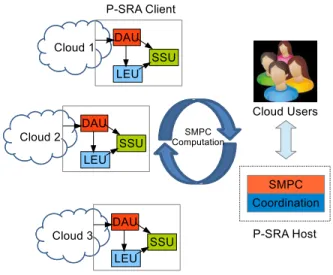
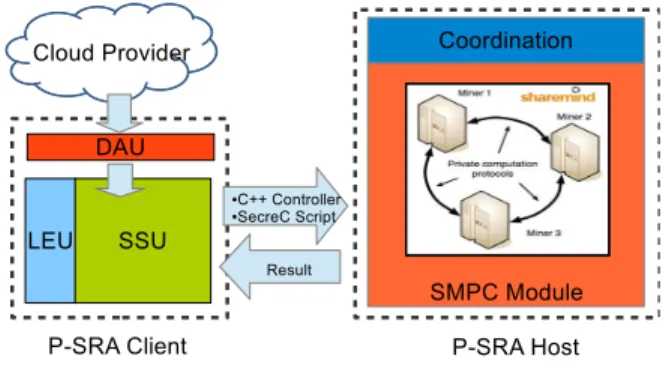
Second, we present a privacy-preserving structural-reliability auditor (P-SRA) for cloud-computing sys-tems. P-SRA enables evaluation of the reliability of cloud infrastructure without compromise of cloud-infrastructure providers privacy. We present the privacy properties of P-SRA and evaluate a prototype im-plementation built on the Sharemind SecreC platform [BK13]. P-SRA is not only a mechanism for holding cloud-service providers accountable but also an interesting application of secure multi-party computation
(SMPC), an extensive body of privacy technology that has not often been used on graph problems, which are inherent in structure-reliability auditing.
Third, we extend our study of the accountability of cloud-service providers to cloud-service users; rather than focusing only on reliability, we consider general properties of cloud infrastructure. We develop the
notion ofcloud user infrastructure attestation, which enables a service provider to attest to a cloud-service user that the infrastructure as a whole has the properties that the cloud-cloud-service user has requested. Here, “infrastructure including both the computing nodes on which the users virtual machines run and the interconnection of these virtual machines. We propose a novel type of secure-hardware component called aNetwork TPMto guarantee the integrity of the cloud infrastructure information, and we design attestation protocols that leverage existing verifiable-computation techniques. Our protocols protect the privacy of the service provider, who does not need to reveal the physical infrastructure and its details to the cloud-service user or to any third parties.
Finally, we study accountability in the operation of cloud-scale data centers — specifically on the actions that should be taken when violations of system policies or other abnormal events are detected. We focus on rapid reallocation of virtual machines in response to threat detection. We formally define virtual-machine reallocation as an optimization problem and explain how it differs from the general virtual-machine alloca-tion problem. Virtual-machine reallocaalloca-tion is NP-hard, but we provide an efficient, two-layered, heuristic algorithm that decomposes the problem and then applies optimization techniques to much smaller problem instances. Our approach incurs only small optimality losses and may be applicable to other aspects of data-center and cloud security.
A Dissertation
Presented to the Faculty of the Graduate School of
Yale University in Candidacy for the Degree of
Doctor of Philosophy
by Hongda Xiao
Dissertation Director: Professor Joan Feigenbaum
First, I would like to thank my advisor, Professor Joan Feigenbaum, for guiding me into the research field of computer security, sharing with me her enthusiasm and insights, supporting me when I was in the most difficult time during my PHD studies, teaching me how to write good papers, helping me edit my papers and presentation slides, encouraging me to fight for my dreams, and so many other things that I dont have space for here. Because of her, my PHD studies become an exciting and rewarding journey.
Next, I would like to thank my wife Grace, who always believes in me unconditionally and will bring me an amazing gift from God our son Jason. I would like to thank my parents, Tianlong Xiao and Bing He, who always support me no matter what happens and have given me everything that they have to help me pursue my dreams. I would like to thank my grandfather, Wenbing He, for appreciating the progress I have made, and to wish him rest and peace in Heaven. I would like to thank my grandmothers, Shuqing Wang and Yuchan Liu, who are always proud of me. And I thank my parents-in-law, Hao Guo and Xuenong Kang, Uncle Tianya Xiao, Uncle Tianzhi Xiao, Uncle Tianbao Xiao, Uncle Pei Guo, Uncle Xuejun Kang, Aunt Xiuqin Wang, Aunt Dandan He, Aunt Jun He, Aunt Lichun He, Aunt Lihua He, Cousin Hongyu Xiao, Cousin Chong Zheng, and Cousin Yinggang Li for giving me so many wonderful moments in my life.
I would also like to thank my co-authors and collaborators for their enthusiasm in research and for all of their hard work: Professors Bryan Ford and Joan Feigenbaum for guiding me and helping me to finish the work of Chapter 3; Professors Jakub Szefer and Joan Feigenbaum for proposing the interesting problem of cloud user infrastructure attestation in Chapter 4; Professor Jakub Szefer for all of his efforts on the work of Chapter 5; Professors Aaron Jaggard and Rebecca Wright for collaborating on the work in Chapter 2; Ennan Zhai, David Wolinskey, Hongqiang Liu, Xueyuan Su, and Professor Bryan Ford for our joint work on the SRA system [ZWX+]; and fellow PhD students Debayan Gupta and Aaron Segal for helpful discussions about SMPC.
Finally, I acknowledge the National Science Foundation for supporting my research with grant CNS 1016875.
1 Introduction 7
2 Systematizing Accountability in Computer Science 10
2.1 Introduction . . . 10 2.2 Related work . . . 12 2.3 Aspects of Accountability . . . 13 2.3.1 Time/Goals . . . 13 2.3.2 Information . . . 14 2.3.3 Action . . . 14
2.3.4 Applicability of this framework . . . 15
2.4 Survey of Approaches . . . 15
2.4.1 Accountability solutions . . . 16
2.4.2 Formalizations of accountability . . . 23
3 Structural Cloud Audits that Protect Private Information 30 3.1 Introduction . . . 30
3.2 Related Work . . . 31
3.2.1 Secure Multi-Party Computation . . . 31
3.2.2 Cloud Reliability . . . 33
3.2.3 Fault Trees . . . 33
3.3 Problem Formulation . . . 34
3.4 System Design . . . 36
3.4.1 System Overview . . . 36
3.4.2 Privacy-preserving Data Acquisition . . . 38
3.4.3 Subgraph Abstraction . . . 39
3.4.4 SMPC and Local Computation . . . 40
3.4.5 Privacy-preserving Output Delivery . . . 45
3.5 Implementation . . . 47
3.5.1 P-SRA Prototype . . . 47
3.5.2 Case Study . . . 49
3.5.3 Large-Scale Simulation . . . 50
4 Cloud User Infrastructure Attestation 54 4.1 Introduction . . . 54
4.2 Related Work . . . 55
4.3 Cloud User Infrastructure . . . 57
4.4 Cloud User Infrastructure Attestation . . . 59
4.4.1 Threat Model . . . 59
4.4.2 Attestation of Server Architecture . . . 60
4.4.3 Attestation of Topology Infrastructure . . . 60
4.5 Implementation . . . 71
4.5.1 Prototype of Topology Infrastructure Attestation . . . 71
4.5.2 Case Study . . . 72
4.5.3 Large Scale Simulation . . . 74
5 On Virtual-Machine Reallocation in Cloud-scale Data Centers 78 5.1 Introduction . . . 78
5.1.1 VM Allocation vs. Reallocation . . . 79
5.1.2 Random Selection and Hot Spares . . . 79
5.2 Cloud-scale Data Centers . . . 80
5.3 The VM-Reallocation Problem . . . 82
5.3.1 Threat Model . . . 83
5.3.2 Threat Examples . . . 83
5.3.3 Problem Formulation . . . 84
5.3.4 Computational Complexity . . . 85
5.4.1 Overview of the Two-Layer Approach . . . 88
5.4.2 First-Layer Optimization Problem . . . 89
5.4.3 Second-Layer Optimization Problem . . . 90
5.4.4 How to Partition the Problem . . . 92
5.5 Experimental Evaluation of the Two-Layer Approach . . . 92
5.5.1 Efficiency of the Two-Layer Approach . . . 92
5.5.2 Accuracy vs. Improved Performance . . . 93
5.6 Related Work . . . 95
6 Conclusion and Open Problems 97 6.1 Systematizing Accountability in Computer Science . . . 97
6.2 Structural Cloud Audits that Protect Private Information . . . 99
6.3 Cloud User Infrastructure Attestation . . . 99
3.1 System Overview . . . 37
3.2 Full Dependency Graph ofC1. . . 41
3.3 Abstracted Dependency Graph, suitable for SMPC . . . 41
3.4 Fault Tree Based on Dependency Graph in Figure 3.3 . . . 42
3.5 Topology-path Form of Dependency Graph in Figure 3.3. . . 43
3.6 Implementation in Sharemind SecreC . . . 48
3.7 Multi-level Structure of Cloud Service . . . 50
3.8 Components in Data CenterDC1: Core, Agg, and ToR represent core router, aggregation switch, and top-of-rack switch. . . 51
3.9 Performance of algorithms. On the X axis, “Common” represents the common-dependency finder, 2 through 4 represent the failure-sampling algorithm with sampling rounds at various powers of 10, and “Min” represents the minimal-FS algorithm. . . 52
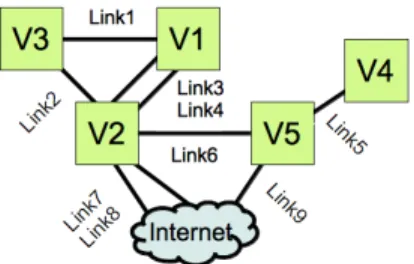
4.1 User infrastructure example with multiple VMs and links among them . . . 57
4.2 Cloud infrastructure example. . . 58
4.3 Cloud user infrastructure example, showing mapping of the user infrastructure, Figure 4.1, onto the cloud infrastructure, Figure 4.2. . . 59
4.4 Network TPM Design . . . 62
4.5 Virtual and Physical Networks . . . 63
4.6 Physical Topology Discovery Protocol Data Unit . . . 66
4.7 Property-based Attestation Protocol of Topology Infrastructure . . . 70
4.8 Prototype of Topology Infrastructure . . . 72
4.9 Example 1 of Topology Infrastructure . . . 73
4.10 Example 2 of Topology Infrastructure . . . 74
4.11 Example 3 of Topology Infrastructure . . . 74
4.12 Running Time of Topology Measurement Protocols . . . 76
4.13 Running Time of Topology Attestation Protocols . . . 76
4.14 Memory Usage Comparison of Topology Attestation Protocols . . . 77
5.1 Logical architecture of a data center, modeled after OpenStack “Grizzly” logical architecture [Gri]. The highlighted elements would be modified to integrate our reallocation code into OpenStack. The modified parts fall into one of the seven core components; nova-guard is a new, optional part that we propose. The blue dashed boxes logically group parts of each of the seven core components. The solid lines represent API calls from outside of the core components; they are routed on the public network. The dashed lines represent API calls between the core components; they are routed on the management network. . . 81
5.2 Typical data center network, modeled after [GHJ+09]. . . . . 82
5.3 Overview of the two-layer approach . . . 89
5.4 Comparison of the performance of different approaches. . . 93
2.1 Overview of accountability approaches. . . 16
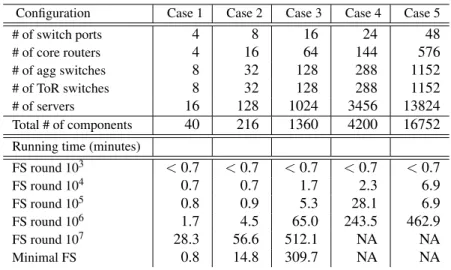
3.1 Configuration of Test Data Sets . . . 52
3.2 Performance of the LEU of a P-SRA client . . . 53
4.1 Simulation Cases of Cloud User Topology Infrastructure . . . 75
5.1 Results of binary programming using CVXOPT . . . 86
5.2 Results of binary programming using Gurobi . . . 86
5.3 Results of linear programming using CVXOPT . . . 87
5.4 Results of linear programming using Gurobi . . . 88
5.5 Results of two-layer linear programming using CVXOPT . . . 93
Introduction
Traditionally, computer-security research has focused onpreventiveapproaches to security and privacy. Al-though preventive techniques, such as passwords and authentication protocols, are still indispensable in com-puter systems, purely preventive approaches have proven to be inadequate in the internet era. As more and more daily activity moves online, users in different administrative domains must exchange information and transact business without the benefit of a common set of policies and credentials. With the development of cloud computing and large-scale, distributed computing systems, information-security researchers have realized the importance ofaccountability mechanismsto complement preventive mechanisms. Outsourcing computations to powerful third parties and distributed organizations of large-scale systems accelerates the process of data sharing and cooperation between different parties who do not necessarily trust each other. It is difficult, if not impossible, to guarantee service-level agreements between cloud-service users and providers or to enforce the policies of the distributed systems by pure preventive mechanisms.
Despite widespread agreement about its importance, accountability is not yet a unified research area yet. Different researchers use the term “accountability” to mean different things. In Chapter 2, we propose a framework to systematize much of the existing computer-science research on accountability. We provide a high-level perspective on the appropriate focus of accountability work in computer science, and we categorize existing work along three axes: time, information, and action. With respect to time, we consider five standard approaches to violations and potential violations of security policies: prevention, detection, evidence, judg-ment, and punishment. With respect to information, we examine the type(s) of credentials used by system participants, the components of evidence of compliance with or violation of a security policy, and who must have access to credentials and evidence for the system to function. With respect to action, we examine the operational structures of accountability mechanisms and the systems that use them to achieve privacy and
security. Our systematization effort has revealed the need for more sparing use of the word “accountability” and, more generally, for more precise and consistent terminology. Our formulation of accountability also dis-pels the mistaken notions that accountability precludes anonymity and privacy and that it requires centralized authority.
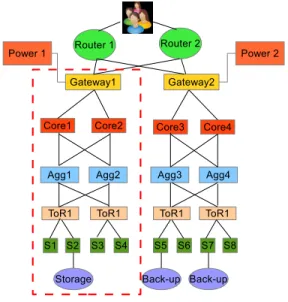
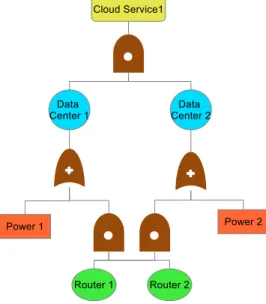
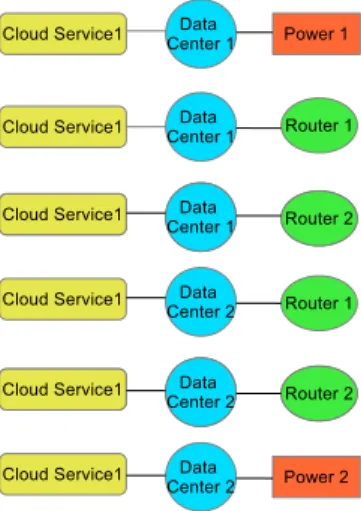
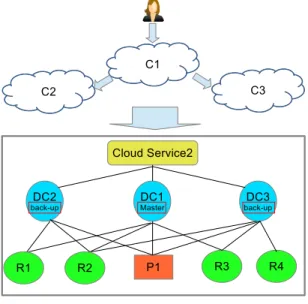
We then proceed to design accountability mechanisms for practical cloud computing and distributed com-puting systems. In cloud-comcom-puting systems, cloud-service users need to hold cloud-service providers ac-countable for providing reliable cloud services. It is natural for cloud-service providers to use redundancy to achieve reliability. For example, a provider may replicate critical state in two data centers. However, if the two data centers use the same power supply, a power outage will cause them to fail simultaneously; repli-cationper sedoes not, therefore, enable the cloud-service provider to make strong reliability guarantees to its users. On the other hand, cloud-service providers may be unwilling to reveal sensitive information about their equipment and operational procedures to cloud-service users or any third parties, because doing so may compromise their businesses. In Chapter 3, we present a privacy-preserving structural-reliability auditor (P-SRA), discuss its privacy properties, and evaluate a prototype implementation built on the Sharemind SecreC platform [BK13]. P-SRA is not only an accountability mechanism that enables cloud-service users to hold cloud-service providers accountable; it is also an interesting application ofsecure multi-party computation
(SMPC), which has not often been used for graph problems. It achieves acceptable running times even on large cloud structures by using a novel data-partitioning technique that may be useful in other applications of SMPC. Moreover, it demonstrates that accountability can be achieved without compromising the privacy of the system participants.
In Chapter 4, we continue our study of techniques that allow cloud-service users to hold cloud-service providers accountable. Rather than focusing on just one property (reliability), as we did in Chapter 3, we con-sider the general question of how to determine whether the promised properties of cloud infrastructures have actually been delivered. Cloud-service users need assurance that they have received cloud resources with the properties that they paid for and that their virtual machines function as expected. A practical accountability mechanism should enable cloud-service providers to attest to cloud-service users that the resources they have provided satisfy the users’ requirements. In particular, in addition to attestation that the computing resources delivered have the desired properties, such as processor speed or amount of memory, cloud-service users need attestation about the networking infrastructure that connects the virtual machines they are running in the cloud. We develop the notion ofcloud user infrastructure attestation, which attests to the properties of the whole infrastructure that a cloud-service user has requested from a cloud-service provider, including both
the computing nodes where the virtual machines run and the interconnection of these virtual machines. We propose the use of a novel secure-hardware component called aNetwork TPMto attest to the properties of the networking infrastructure; it is meant to work in concert with traditional TPMs that attest to the properties of the computing nodes. On top of these hardware security anchors, we build protocols that are able to attest to the properties of the infrastructure that the user has leased from the provider. In addition, our protocols protect the privacy of the provider, who does not need to reveal details of its physical infrastructure to the user or to any third parties.
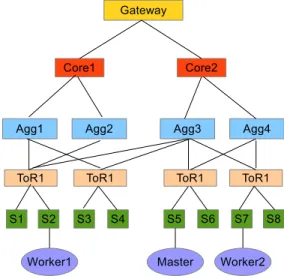
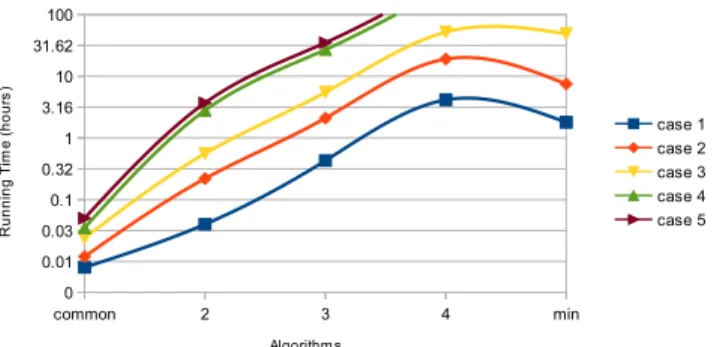
Finally, we study accountability in the operation of cloud-scale data centers — specifically on the actions that should be taken when violations of system policies or other abnormal events are detected. In Chap-ter 5, we investigate the data-integrity and data-security problems in cloud-based data cenChap-ters, which are often organized in a distributed manner. Unexpected and sudden events in data centers, such as detection of an unauthorized physical intruder or a critical security event, require prompt responses if data integrity and security are to be protected. Standard responses include resource reallocation and migration of computation or data away from the affected hosts. Previous research in this area has focused on implementing fast and efficient migration strategies. However, past work has not often explored how to select the target machines to which computation and data should be migrated after the occurrence of sudden events. We focus on rapid re-allocation of virtual machines in response to threat detection. We formally define virtual-machine rere-allocation as an optimization problem and explain how it differs from the general virtual-machine allocation problem. Virtual-machine reallocation is NP-hard, but we provide an efficient, two-layered, heuristic algorithm that decomposes the problem and then applies optimization techniques to much smaller problem instances. We use large-scale simulations to demonstrate that the two-layered approach is fast enough for the configurations of real-world data centers, with only small and tolerable optimality losses. Our layered approach may be applicable to other aspects of data-center and cloud security problems.
In Chapter 6, we present some open problems and directions for future research on accountability in cloud services and distributed computing systems.
Systematizing Accountability in
Computer Science
2.1
Introduction
Traditionally, computer-science researchers have taken apreventiveapproach to security and privacy in on-line activity: Passwords, authentication protocols, and other before-the-fact authorization mechanisms are designed to prevent users from violating policies and to obviate the need to adjudicate violations and punish violators. Purely preventive approaches to security and privacy have proven to be inadequate as more and more daily activity moves online, and users in different administrative domains must exchange information and transact business without the benefit of a common set of policies and credentials. Many information-security researchers have thus sought accountability mechanisms to complement preventive mechanisms. Despite widespread agreement that “accountability” is important in online life, it is not yet a unified research area. Indeed, the word is used by different researchers to mean different things and is not always defined explicitly.
It is our thesis of this chapter that the lack of agreement about definitions and formal foundations is impeding progress on accountability research and adoption of accountability technology. We offer this sys-tematization as a step toward remedying this situation. Our starting point is a succinct, high-level perspective on the appropriate focus of accountability work in computer science: Accountability mechanisms should en-able actions to be tied to consequences and, in particular, enen-able violations to be tied to punishment. Guided by that fundamental goal, we categorize existing work on accountability along three axes: time, information, and action.
With respect to time, we consider five standard approaches to violations and potential violations of
curity policies: prevention, detection, evidence, judgment, and punishment. Roughly speaking, these ap-proaches can be linearly ordered in time. First, one tries to prevent violations. When that cannot be done, the goal is to detect violations. If a violation is detected, or even suspected, it may be necessary to gather evidence that can later be used to render a judgment about precisely what happened and whom or what to blame. Finally, actions can be tied to consequences by meting out punishment to the violator. A single accountability mechanism can address one or more of these five phases; most do not address them all. A stand-alone authentication or authorization mechanism that is purely preventive should not be called an “ac-countability” mechanism, but before-the-fact authorization can be part of a larger system that also addresses the later phases of accountability.
With respect to information, we examine the type(s) of credentials the system participants use, what con-stitutes evidence of compliance with or violation of a security policy, and who must have access to credentials and evidence for the system to function. To what extent does the system rely on participants’ identities, and how is “identity” defined? If identity is used, how broadly does a participant’s identity become known? Who learns about a violation when one occurs, and how soon after the fact of the violation does he learn it? The role of identity is important because of the widespread but mistaken perception (discussed below) that ac-countability is inherently in tension with anonymity. Interestingly, some of the works that we cover in this systematization effort regard identification of wrongdoers as the final step in a process—as judgment and punishment, in the terms introduced above. In these systems, an act that violates a security policy triggers the identification of the violator who, until he committed the violation, was anonymous. It is assumed that identificationper sewill ensure that the violator is held accountable, but precisely what it means for someone to be “held accountable” is not specified. At the other end of the spectrum, some of the works that we cover assume that all participants have persistent identities,i.e., that anonymity is not an issue, and deal exclusively with formal protocols for presenting evidence, adjudicating a claimed violation, and meting out punishment if the claim is validated. This lack of agreement about the scope of “accountability” research is one of our main motivations for undertaking this systematization effort.
With respect to action, we examine the operational structures of accountability mechanisms and the sys-tems that use them to achieve privacy and security. Are system actions centralized or decentralized? What actions must be taken to deal with a violation? In particular, does a violation triggerautomaticpunishment (such as the destruction of anonymity discussed above), or must evidence of a violation be presented to a
mediator, who invokes a formal adjudication protocol and, if necessary, a punishment protocol? If there is a mediator, is it an entity that is already part of the system, or is it someone external to the system (like a
judge who is only called in for the purpose of adjudicating)? To what extent does the functioning of the sys-tem assume continued participation by or access to the violator? That actions could be tied to consequences automatically,e.g., without identification of the actors or the invocation of a formal adjudication protocol, is not a new or radical idea but rather one that has been the subject of extensive study in at least one discipline, namely Economics, in which the design ofincentive-compatiblesystems and protocols is a standard goal. The simplest and best-known example of an incentive-compatible protocol in Economics is the 2nd-price Vickrey auction. The policy that bidders are supposed to comply with is “bid your true value.”1 For many natural distributions on the bidders’ values, no bidder can improve his utility by lying; indeed, with positive probability, his utility will be decreased if he lies about his value. Thus, actions areautomaticallytied to consequences, and no explicit punishing action is taken. The violator is not identified, and, in fact, no one else even knows that there was a violation.
One barrier to unification and systematization of this technical area is the word “accountability” itself. In common parlance, “holding him accountable” connotes “making him account for himself” or “making him stand up and be counted.” The sentiment conveyed therein has considerable social value, and it causes people to resist using the term to describe approaches that may not entail an official “account” by the wrongdoer. This erroneous assumption that “accountability mechanisms” must require the identification of those who violate policies so that violators can be brought to “account” is widespread in the technical community as well, where it raises the hackles of those who conclude that accountability is inherently in tension with anonymity. The fact that “tying actions to consequences” can be accomplished without identifying wrongdoers, as the study of incentive compatibility in Economics clearly demonstrates, gives us hope that this erroneous assumption can be corrected and that the technical community will embrace accountability as an effective tool in situations where preventive measures are inadequate and will recognize that it does not preclude anonymity.
2.2
Related work
The focus of this chapter is on accountability solutions and formalizations in Computer Science; that type of related work is discussed in detail below. Other work on accountability in Computer Science includes arguments by Weitzneret al. [WABL+08] and by Lampson [Lam09] about the need for accountability and security-by-deterrence (such as might be provided by accountability). In early work on accountability in Computer Science, Nissenbaum [Nis97] studied barriers to accountability in contexts involving software.
1This might not be explicitly stated as a policy requirement, but that does not affect incentive compatibility. In considering this in the
context of accountability, we may assume that we are in a setting in which this goal is an explicit policy and that we want to ensure that violations of this policy are punished.
Chockler and Halpern [CH04] build on the Halpern–Pearl [HP05] framework of causality to give formal definitions of both responsibility (the extent to which something is a cause of an event) and blame (which additionally considers the epistemic state of an agent who causes an event). This does not directly provide a definition of accountability, but these notions might be used to inform actions (such as punishment) taken in response to a policy violation.
Outside of Computer Science, Mulgan [Mul00] has traced the evolution of “accountability” in Public Administration from its core meaning of being able to be called to give an account (e.g., of one’s actions). Grant and Keohane [GK05] have given a definition in the context of nation states interacting with each other. Our focus is not on approaches outside of computer science, of which these are but a small sample, so we will not discuss them in more detail here. (Feigenbaumet al. [FHJ+11, FJW11] provide more discussion of non-Computer Science approaches to accountability.)
2.3
Aspects of Accountability
As we survey approaches to accountability, we evaluate how they address three broad aspects of accountabil-ity: time, information, and action. In our analysis, we typically think of accountability with respect to some policy violation (in a very general sense); the “time” aspect considers when the system is invoked relative to the time of the violation. The “information” aspect considers what is known and by whom, while the action aspect concerns what is done and by whom.
2.3.1
Time/Goals
In surveying approaches to accountability, it becomes clear that different systems are focused on different times relative to a policy violation; this often corresponds to different goals for the system. As one example, the formal framework of K¨usterset al. [KTV10] explicitly models (and focuses on) judgments or verdicts,
i.e., declarations that a violator is guilty of committing a violation. By contrast, the formal framework of Feigenbaumet al. [FJW11] focuses on punishment, which typically follows a declaration of guilt. (Within this punishment-focused framework, there need not be a judgment that identifies an individual entity as guilty; so this is indeed distinct from a focus on judgment.)
Motivated by such differences, we consider a spectrum of times, relative to a policy violation, at which each system/framework/mechanism might play a role. We identify the points below on this spectrum. While we categorize, and refer to, these based in terms of their goals/effects and not in terms of strict temporal relationships, there is a natural temporal ordering of these effects.
PreventionThe system is (at least partially concerned) with preventing violations and plays a role before the violation occurs.
Detection The system facilitates, enables, etc., detection of a violation (either as it occurs or after it occurs).
EvidenceThe system helps gather or preserve evidence about a violation that may be used against the accused violator (e.g., in a court of law); in some settings, this may be connected to detection.
JudgmentThe system renders a verdict about an entity’s guilt with respect to a policy violation. (This might be a verdict in a court of law or,e.g., a determination by a system administrator that a particular user violated local policy.)
PunishmentThe system punishes a policy violator in some way.
As we will observe below, a single system might be involved at multiple points on this spectrum.
2.3.2
Information
One question about accountability is the extent to which it implicates privacy. Two aspects of this are the information learned about a violation and the information learned about the violator (or even individuals who do not violate any policy). In studying this, we ask the following related questions about accountability systems:
• Is identity required to participate in the system? If so, how broadly is a participant’s identity known (e.g., is it only learned by a trusted third party, is it learned by a limited set of entities, or is it potentially learned by all participants)?
• Are violations disclosed? If so, how broadly (with the same set of possible answers as for identity)? How soon after the violation is this information learned?
• Is the violator identified as such? If so, how broadly is this identification made (with the same set of possible answers as above)?
2.3.3
Action
We identify different aspects of actions within the system, both in general operation and to detect and punish policy violations.
• Does the system respond to a violation (in the gathering of evidence, judgment, and punishment) in a centralized or decentralized way?
• If violators are punished, is this done (in the terms of Feigenbaumet al. [FJW11]) “automatically” or in a “mediated” manner? If there is a mediator, is this an entity that is already part of the system, or is it a specialized external entity?
• To what extent does the functioning of the system rely upon continued participation by, or access to, the violator? For example, is the violator only punished if he continues to interact with the system?
2.3.4
Applicability of this framework
The three broad aspects described above can be used to characterize various approaches to accountability in Computer Science; we do this in the following section. As new accountability systems and approaches are developed, they can also be analyzed within this framework.
In addition to being broadly applicable, we argue that our framework captures essential aspects of ac-countability at a useful level of granularity. Insofar as “acac-countability” relates to violations (of policy, law,
etc.), either actual or possible, the “time” aspect of our framework allows us to compare the relative times at which different systems have effects. The “information” and “action” aspects separate system characteristics that should be compared separately without producing an unmanageably high-dimensional framework.
2.4
Survey of Approaches
There are many different Computer Science approaches to accountability. We discuss a variety of account-ability solutions (in Section 2.4.1) and accountaccount-ability formalizations (in Section 2.4.2) that take on different values along the axes we identified in Section 2.3.
Table 2.1 summarizes our analysis of systems and formalizations that exemplify broader areas of ability research in Computer Science. The columns correspond to the aspects and sub-aspects of account-ability discussed in Sec. 2.3; the reasoning that supports the entries in the table is described in the section of this chapter listed in the leftmost column. Where applicable, the discussion in the text also notes other possible answers or answers that might arise in related but distinct solutions or formalizations. Some systems are defined in general ways that do not enforce a particular categorization for some or all of the columns; we discuss below the range of values they allow or what the most likely categorizations are.
Time/Goals Information Action
Section Approach/Paper Pre
v
ention
Detection Evidence Judgment Punishment Identity
Requirements for P articipation V iolation Disclosed? V iolator Identified as Such? Centralization without V iolation? Centralization with V iolation? Punishing Entity? Requires Ongoing In v olv ement? Solutions
2.4.1 PeerReview [HKD07] 4 4 4 Broad Broad Broad Decent. Decent. N/A No 2.4.1 PEREA [TAKS08] Med. Unique Unique No Cent. Cent. Internal No 2.4.1 ASMs [MOR01] 4 4 4 Broad Broad Broad Decent. Decent. N/A No 2.4.1 E-Cash [CHL06] 4 4 4 Unique Broad Broad Cent. Cent. N/A No 2.4.1 iOwe [LSL+11] 4 4 4 Med. Broad Broad Broad Decent. Decent. Internal No 2.4.1 Buchegger Med. Broad Broad Broad Decent. Decent. Internal Yes
& Boudec [BLB03]
2.4.1 A2SOCs [FZML02] 4 4 Med. Unique Broad Broad Cent. Cent. Int./Ext. Formalizations
2.4.2 K¨usterset al. [KTV10] 4 4 4 Broad Decent. Cent. N/A No 2.4.2 Bella &
Paul-son [BP06]
4 Limited Limited Limited Cent. Cent. N/A No 2.4.2 Yumerefendi 4 4 4 Broad Broad Broad Cent. Cent. N/A No
& Case [YC04, YC05, YC07] 2.4.2 Feigenbaum et al. [FJW11] A/M 2.4.2 Jagadeesan et al. [JJPR09]
4 Broad Broad Broad Decent. Decent. N/A No 2.4.2 Barthet al. [BDMS07] 4 Broad Broad Broad Cent. Cent. N/A No 2.4.2 Kailar [Kai96] 4 Broad N/A 2.4.2 Backes et
al. [BDD+06]
4 4 Broad N/A
Table 2.1: Overview of accountability approaches.
2.4.1
Accountability solutions
PeerReviewThe PeerReview system of Haeberlen, Kouznetsov, and Druschel [HKD07] provides a notion of accountabil-ity in distributed systems. They take an “accountable” system to be one that “maintains a tamper-evident record that provides non-repudiable evidence of all nodes’ actions.” In the asynchronous setting considered by Haeberlenet al., the possible violations are not responding to a message (to which a response is prescribed by the protocol) or sending a message that is not prescribed by the protocol. The potential for message delays
means that the former cannot be conclusively proved; this gives rise to a distinction between suspicion and certainty, both of which are included in the system.2
The design of PeerReview includes, at each node in the network, a detector module that implements the system; this will indicate either suspicion or certainty that another node is violating the protocol. It makes use of a tamper-evident log that each node maintains of its own interactions (and that can be obtained by other nodes as they need it). Taken together, these range over thedetection,evidence, andjudgmentparts of the Informationaspect of our framework.
Nodes must be identified to participate in a distributed protocol that incorporates PeerReview; for the Informationaspect of our framework, their identity is made known to a broad set of other participants. The security goals for PeerReview include that every node that fails to acknowledge a message is eventually suspected of violating the protocol byeverynode that does follow the protocol, so the disclosure of a violation and the identification of the violator as such are broad/broad. Under the Action aspect, PeerReview is
decentralizedboth without and with violations and there is no punishing entity (not applicable). If a violator no longer participates, then that node will be viewed as not responding to messages and will be suspected by other nodes; thus, the systemdoes notrequire ongoing involvement on the part of the violator.
Anonymous blacklisting systems
Like e-cash systems, anonymous blacklisting systems allow anonymous participation. In contrast to e-cash, participants in these systems are not identified when they commit a violation; instead, they are blacklisted (i.e., their credentials for participation are revoked) without identifying them. Henry and Goldberg have recently surveyed this space of systems [HG11] and identified three broad subspaces thereof: pseudonym systems, Nymble-like systems, and revocable anonymous credential systems. These provide varying levels of privacy (ranging from pseudonyms to complete anonymity without trusted third parties); however, as the privacy guarantees are strengthened, the feasibility of implementation decreases.
As an exemplar of this class of systems, we will take the PEREA revocable anonymous credential system of Tsang, Au, Kapadia, and Smith [TAKS08]. The user must first register with the system. Depending on the setting, this might require some form of identity; however, the user obtains a credential that can subsequently be used to authenticate herself to the service provider without revealing her identity. The service provider may subsequently revoke the client’s credential for any reason, without requiring a trusted third party to do so; this prevents the client from authenticating herself in the future, but it does not reveal anything about her 2For example, one system goal is that nodes that ignore messages should eventually be suspected, in perpetuity, by all honest nodes
identity to anyone (nor does it link her various anonymous actions, among other properties).
For theTime/Goalsaspect, this providespunishment (mediated), because the punishment is carried out by the service provider (in blacklisting the anonymous credential). While this is presumably based on the detection of some violation and the judgment of guilt, PEREA itself is not used to do these things. For ourInformationaspect of accountability, the systemmightrequire some sort of identity to register, so we categorize this asunique. Importantly, however, the violator is not identified as such (although the violation is known by the service provider), so we categorize the last two sub-aspects of this asunique/none. The registration and authentication require somecentralizedaspects (regardless of whether there is a violation); the punishing entity is part of the system (internal), but punishment does not require the ongoing participation of the violator (does not).
Accountable signatures
When digital signatures allow multiple potential signers, either because many individuals could generate the signature or because a valid signature requires multiple signers to generate it, “accountability” has the potential to become an issue in ways that it is not when there is only one potential signer. There are many different approaches to signatures with multiple potential signers; as an exemplar of this area, we take the work by Micali, Ohta, and Reyzin on “accountable-subgroup multisignatures” [MOR01] that explicitly took “accountability” as a goal. Their definition of this goal was
Accountability means that, without use of trusted third parties, individual signers can be identi-fied from the signed document.
As noted by Micaliet al., other approaches with multiple potential signers allow sets of individuals (possibly just a single individual) to generate signatures on behalf of a larger set of individuals in such a way that the individual(s) who produced the signature cannot be identified.
For accountable-subgroup multisignatures as defined by Micali et al., all members of the group run a key-generation protocol once; the signing protocol takes, from each signer, a description of the set of signers and their public keys, the message being signed, and the individual signer’s secret key. The signers then produce the signature, which can be verified (when input with a message and a set of purported signers) by anyone. This is secure (and Micaliet al. describe a secure scheme for accountable-subgroup multisignatures) if an attacker cannot (except with negligible probability) produce a valid signature for a messagemwhere the setSof individuals who purportedly signedmincludes an honest participant who did not execute the signing
protocol.3The set of purported signers provides a guarantee to the verifier of the signature; the signers may not know each other. As Micaliet al. note [MOR01]:
Then, assuming that P2 [one purported signer] has not been corrupted,P1[another purported
signer] is assured that the verifier will deem the signature valid only if the person whom the verifier knows asP2actually participated in the signing protocol on [mandS].
This approach provides accountability through identity; from the perspective of holding policy violators “accountable,” it neither judges nor punishes violators. TheTime/Goalsproperties that this approach does provide arguably depend on the type of policy under consideration: the security definition providesprevention
of successful forgeries anddetectionof forgery attempts, while it providesevidence of violations that are carried out by someone using his own identity for signing (analogous to, e.g., an officer of an company signing his/her own name to an improper corporate check). With respect to theInformationaspects of this approach, identity is definitely requited, and a participant’s identity is potentially known to abroadset of other individuals. We may take two different views of the questions of whether the violation is disclosed and whether the violator is identified as such. Under the first, the violation consists of an attempted forgery. This is detected by the verifier, but the violator might not be identified; we categorize this case asunique/none. Under the second view, no forgery is attempted but the (valid) signature on the message indicates that the signers have committed some (non-identity) violation. In this case, the violation is disclosed (because it is embedded in the message), and the violators (the signers) are identified as such, to a broad set of participants; we categorize this asbroad/broad. For theActionaspects of this approach, the signatures can be generated in adecentralizedway (with or without a violation); this does not incorporate punishment, so we consider the punishing entity to benot applicable; finally, thisdoes notrequire ongoing involvement by violators. E-cash
Pioneered by David Chaum in the early 1980’s [Cha82, Cha83], e-cash was designed to have the anonymity and untraceability properties of physical cash: A user should be able to withdraw money from the bank and spend it with a merchant without revealing her identity, and the merchant should be able to deposit the money received into his account without the bank learning how individual users spent their money. Due to the repli-cable nature of the strings of bits that represent digital money, a primary issue to resolve in realizing e-cash is how to prevent or deter “double-spending,” in which users or merchants make and spend (or deposit) multi-3Micaliet al. [MOR01] discuss issues of adaptive corruption and prove the equivalence of security notions that involve attackers of
ple copies of electronic coins. A solution to this [CFN90] provides consequences for double spending using cryptographic mechanisms that break the anonymity of double spenders. These solutions rely on identity for accountability. Depending on the context of the system, loss of anonymity might or might not be sufficient punishment in and of itself. If not, the system would need to rely on an external mechanism to provide any additional punishment.
Chaum’s solutions, and many that grew out of them, have a model in which the bank is a centralized party that checks for double spending. Chaum’s initial proposals [Cha82, Cha83] were “on-line,” in the sense that the bank must be involved in every transaction in order to prevent double-spending. Chaum, Fiat, and Naor [CFN90] introduced “off-line” e-cash, in which double-spending was not strictly prevented, but the identity of double-spenders would be revealed by the bank after-the-fact, including providing an incontestable proof of the violation (including protecting against a cheating merchant who might try to collude with a customer in order to undetectably allow double spending and/or attempting to frame an innocent customer as a double-spender).
While a complete survey of e-cash schemes is beyond the scope of our work, we note that there have been many proposals that take different approaches and provide different properties, including differences in prevention vs. detection, centralization vs. decentralization, and security vs. efficiency. An interesting example in trading off security and efficiency is Rivest and Shamir’s MicroMint [RS97], which is designed so that small-scale fraud will be unprofitable, while large-scale fraud will be detectable.
A recent exemplar of the off-line approach, proposed by Camenisch, Hohenberger, and Lysyanskaya [CHL06], explicitly addresses accountability as a goal to be balanced with privacy, while extending the accountability goals beyond double spending. Specifically, in addition to detection of double spending, their work supports spending limits for each merchant, motivating by concerns that anonymous e-cash can allow undetectable money laundering. A user’s anonymity and untraceability is guaranteed as long as she does not violate either policy (double spending or spending limits). Violations can be detected, including determining whether a user or a merchant cheated. When a violation is detected, the bank becomes (mathematically) able to identify the violating user as well as trace the other activities of the violating user. ForTime/Goals, the system therefore does not rely on prevention. It includesdetection,evidence, andjudgment. The consequence of detecting cheating is that a user loses her anonymity and untraceability. As noted above, this might be considered to provide sufficient punishment, but in general could need to be supplemented with additional punishment external to the system. RegardingInformation, identity is an inherent part of the system, but honest parties are guaranteed anonymity. The bank learns about violations and the identity of violators at the time that
coins violating the policy are deposited with the bank. ForAction, the system relies on the bank as a central authority. Users can spend coins at merchants without the involvement of the bank, but users must obtain all coins from the bank and merchants must deposit all coins with the bank, at which time violations can be detected.
iOwe
As we have discussed, many e-cash systems rely on the use of a centralized authority in order to provide their security and accountability properties. Given the decentralized context of peer-to-peer systems, it can be undesirable to rely on a centralized authority for monetary purposes. To this end, a number of decentralized currency systems have been proposed, including [ZCRY03, LSL+11, Nak].
We study the iOwe currency system [LSL+11] as an exemplar of such systems. iOwe allows peers in a decentralized peer-to-peer system to exchange currency backed by system resources. Peers create “iotas” as promises of future work. Iotas can be exchanged for work as payment, or “redeemed” with their originators for work, along the line of standard “IOU”s, but with greater liquidity. iOwe does not prevent double-spending, but addresses it by using signature chains that allow detection by a peer (possibly but not necessarily the originator) seeing the same iota twice, using the two signature chains as a proof of misbehavior, and applying a punishment mechanism that expels detected cheaters and all iotas they issued from the system. Thus, on theTime/Goalsaspect, iOwe usesdetection,evidence,judgment, andpunishment (mediated).
iOwe peers have a persistent identity within the system, but these identities need not be tied to external identities and users are not prevented from creating multiple peers (or “Sybils”) within the system. iOwe limits the potential for a user to benefit from double spending using by adding a layer of reputation to the system. Specifically, peers build up trust of other peers by participating in the system (creating, spending, and redeeming iotas), and peers only accept iotas that were both issued by peers they trust and only ever held by peers they trust. In this way, “Sybil” peers are not able to create iotas, because they have not been able to build up trust. A peer therefore can deflect blame for double-spending to another Sybil node it has created, but the peer will be punished by losing the value of any outstanding iotas it holds that were issued by or ever held by the expelled Sybil. In terms of ourInformationaspect, violators are identified by their (weak) identities within the system. The violation is disclosed to any peer that receives the duplicate iota, possibly when returned to the issuer but possibly earlier. In keeping with the decentralized nature of peer-to-peer systems, theActionaspect is entirely decentralized. Both the normal operation and the handling of violations are done in a decentralized way, with individual peers able to detect and verify double spending
and to implement their own part of the punishment by no longer trusting the violator. (Similar punishment is extended to peers who refuse to redeem iotas they have issued; we omit discussion of that component of the system here.)
Reputation systems
Reputation systems have received much attention in various settings. Even when not explicitly motivated by “accountability,” aspects of accountability are closely related to the natural use of these systems. In particular, an action that depends on the reputation of another node could very easily (unless the other node is always indifferent to which action is chosen) be viewed as potential punishment.
As an example of a reputation system, we consider the one for mobile ad-hoc networks proposed by Buchegger and Boudec [BLB03]. Each nodeiin the network has, for each other node jthat it tracks, a trust rating and a reputation rating. The reputation rating, which affects howibehaves towards j, is affected by bothi’s direct interactions with jand information obtained about jfrom other nodes (in particular, nodes that eitheritrusts or that have experiences with jthat are similar toi’s experiences). Ifi’s view of jis sufficiently bad, theniwill avoid routing through j, andiwill ignore future route requests from j. (While we view this as punishing jfor misbehaving in the routing protocol, Buchegger and Boudec explicitly note that they do
notpunish nodes that give inaccurate reports in the reputation system.) The particular (modified Bayesian) approach to updating reputation is unrelated to the accountability properties of this system.
For theTime/Goalsaspect of accountability, this providespunishment (mediated)through the avoidance of a node in routing and ignorance of its route requests. Arguably, this is also providing a sort ofjudgment, but in an average sense (over many different violations and non-violations); because of that averaging, we will not categorize this as providingjudgment. (Similarly, this requires that violations are detected, but the reputation system propagates that information instead of actually doing the detecting.) For theInformation aspect, identity is definitely required4and is known to abroadset of other participants. Similarly, the point of a reputation system is to identify violators as such (in a fairly broad way), disclosing the violations, so we categorize this asbroad/broad. For theActionaspect, this isdecentralizedboth without and with a violation. There are punishing entities—the other nodes in the network, which areinternal—but punishmentdoesrely on the continued participation of the violator (because punishment takes the forms of routing around and ignoring the violator).
A2SOCs
Farkas, Ziegler, Meretei, and L¨orincz [FZML02] described an approach (Anonymous and Accountable Self-Organizing Communities, or A2SOCs) to “anonymous accountability” with multiple levels of identities (in-cluding pseudonyms). They use both “internal” and “external” notions of accountability and give protocols to provide these. The former notion means that a pseudonym can be “held responsible” for its actions (even under different pseudonyms that are not publicly linked); this is done by the other members of the virtual community. By contrast, “external accountability” is used to mean that the real-world entity connected to the pseudonyms is identified and this real-world identity may be given to,e.g., the police when a real-world crime has been committed. Both the linking of different pseudonyms that belong to the same agent and the release of an agent’s real-world identity require broad community agreement (although this assumes that the trusted third party has, as required, deleted keys that it initially used to register pseudonyms).
Within theTime/Goalsaspect of our framework, we categorize the approach of Farkaset al. as providing
evidence(e.g., through the linking of pseudonyms and providing real-world identities to outside agencies),
judgment(because the virtual community can, and must, agree to help link different pseudonyms or to reveal a real-world identity), andpunishment (mediated) (via either the community or the external authorities). Within theInformationaspect of our framework, identity is initially needed only for registration, which reveals it to theuniquetrusted third party. However, violations are disclosed in abroadmanner, and (either as a pseudonym or as a real-world identity), violators are identified as such to thebroadcommunity. The trusted third party means that, in our Action aspect, the system iscentralized both with and without violations. Depending on the level of the violation (and whether pseudonyms are linked or a real-world identity is revealed), the punishing entity can be either internal or external to the community, so we classify this asboth. The punishment might (e.g., for within-community punishment) or might not (e.g., for banishing a user or for external punishment) require ongoing involvement by the violator, so we do not classify the system in this respect.
2.4.2
Formalizations of accountability
There have been several proposed formalizations of accountability. These, too, take different interpretations of accountability and therefore can apply to different solutions or to different properties of those solutions. We discuss different approaches to formalizing accountability, as well as one that formalizes the related notion of auditability.
Accountability through judging
K¨usters, Truderung, and Vogt provide a model for accountability. In an intuitive description of their defini-tions, a protocol provides accountability if a specified “judge” (who might or might not have an additional role in the protocol) is able to issue “verdicts” about misbehaving participants (“violators,” in our terminol-ogy) in a way that is both fair and complete. Specifically, the judge should never blame protocol participants who behave honestly (fairness), and, whenever the protocol fails to meet its specified goals, the judge should blame at least some misbehaving participants (completeness). It is left external to this analysis what the con-sequences for violators should be and how they should be enforced. Thus, for ourTime/Goalsaspect, the model addressesdetection,evidence, andjudgment. Note that the judge is not required to produce evidence in the form of proofs that others can use, but, if the system provably satisfies fairness, the very existence of the judge’s verdict in fact serves as that evidence.
The required verdicts in their model are positive Boolean formulae “built from propositions of the form dis(a), for an agenta, where dis(a) is intended to express thatamisbehaved.” Thus, for ourInformation aspect, this method relies on participating agents to have identities in whatever system is being analyzed. They do, however, allow for the possibility of verdicts that do not identify individual violators, by allowing disjuncts. In this sense, a violator might or might not be explicitly identified as such. (However, they point out that individual accountability, in which individual violators are identified, is highly desirable in practice to deter parties from misbehaving.) Violations are disclosed at least to the judge, as well as to any parties to whom the judge shares the verdict.
ForAction, the definition requires the existence of a judge to provide the required verdicts, suggesting a centralized system. However, one could imagine applying their definitions to a decentralized system such as iOwe [LSL+11], described in Sec. 2.4.1, where different parties can act as judges for different violations, for example, proving results such as: if partyPdouble-spends an iota, then another partyQcan act as a judge and holdPaccountable.
Connecting actions to identities
Bella and Paulson [BP06] have formalized properties of two particular “accountability protocols” and verified these using the Isabelle tool; these protocols connect actions to identities.5 The particular protocols that they studied were for non-repudiation [ZG96] and certified email [AGHP02]; here, we focus not on these 5This broad approach is also embodied in the Accountable Internet Protocol [ABF+08] of Andersenet al. They identify the lack of
protocols individually but on the class of accountability protocols that they exemplify (i.e., that corresponds to the properties identified in [BP06]).
In the approach of Bella and Paulson,
[a]n accountability protocol gives agents lasting evidence, typically digitally signed, about ac-tions performed by his peer.
They note that many authentication protocols prove the involvement of a participant to one other participant (e.g., via an encrypted nonce), but that these do not provide evidence that is suitable to take to a third party. Indeed, one of the two goals they identify for accountability protocols is that
an agent is given evidence sufficient to convince a third party of his peer participation in the protocol.
(The other goal is a notion of fairness in which either both participants receive, or neither participant receives, evidence about the other’s participation.) Bella and Paulson explicitly note that judging is left to humans who are not modeled in their analysis. For the Time/Goalsaspect of our framework, we thus say that their approach (and the accountability solutions that fall within their model) provideevidencebut not other parts of this aspect.
Both protocols considered by Bella and Paulson involve two regular participants a trusted third party; all three of these parties learn the identities of the participants, but those identities are not broadcast further. For theInformationaspect of our framework, we will thus say that identity is required in alimitedsense. Violations (captured in the protocol exchanges, not attempts to circumvent the protocols themselves) are revealed through the evidence that the protocols provide, and the violators are identified as such; because this information is provided to the other participant but not broadcast, we say that the other two parts of this aspect arelimitedandlimited.
For theActionaspect of our framework, the trusted third party is required regardless of whether there is a violation, so we identify the Bella–Paulson approach ascentralized/centralized. There is no punishing entity (not applicable), and there is no requirement that a violator continue to participate in the protocol (does not). Accountability for network services
Yumerefendi and Chase [YC04] have outlined an approach to accountability for network services that respond to client requests. In so doing, they have articulated a definition of accountable services, described a general method for achieving this, and sketched its application to three different settings; they subsequently used
this approach in a more detailed description of network storage with accountability [YC07]. Here, we are interested in their general definition and method, which may be applied beyond the settings they noted.
Yumerefendi and Chase say that accountable systems should have actions that are: provable and non-repudiable; verifiable (with the ability to prove misbehavior to any third party); and tamper-evident (regard-ing the states of the system). (These foster the goal they identified in related work [YC05], which argued for accountability as a design goal, of “assign[ing] responsibility for states and actions[.]”) Considering the Time/Goalsaspect of our framework, this means that the systems provide bothdetectionandevidence. It is envisioned that auditors are involved (who might examine the evidence that the service has behaved cor-rectly); while these might arguably be viewed as lying outside of this system, we will include them (clients may verify that the service correctly maintained its state) and so also view this approach as providing judg-ment. (The subsequent extension of this approach to network storage [YC07] reinforces audit as an important component of this approach and the fact that any participant may act as an auditor.)
This approach to accountability has systems publish signed, non-repudiable digests of their internal states. As Yumerefendi and Chase observe, client actions (and potentially identities) may be incorporated into the services’ states, so, under ourInformationaspect, we categorize this as requiring identity that may be re-vealed (or at least checkable by) abroadset of participants. Violations are also identified to abroadset, and violators are likewise identified to abroadset of participants.
For theActionaspect of our framework, regardless of whether there is a violation, the service plays a cen-tral role in providing digests and proofs of its correct behavior, so we identify this ascentralized/centralized. There is no punishing entity (not applicable). Although the service publishes digests of its state, it needs to respond to later requests to provide proofs of its correct behavior. Insofar as the system is aiming to provide proofs of correct behavior, this requires ongoing participation; however, if others will be at least suspicious if no proof is forthcoming, then thisdoes notrequire the ongoing participation of the violator.
Accountability in terms of punishment
Feigenbaum, Jaggard, and Wright [FJW11] give an abstract definition of accountability in terms of punish-ment and then capture this formally in terms of traces and utility functions. Their definition of accountability includes punishment that is “automatic” in the sense that it is not meted out in conscious response to a viola-tion (which would be “mediated” punishment as noted above). Coupled with this, they also explicitly do not require identity, and they note the possibility of punishment occurring (thus providing accountability) without anyone other than the violator knowing that a violation occurred.
The Feigenbaumet al. framework can capture systems with,e.g., varying identity requirements, so the classifications that we have been using for theInformationandActionaspects of accountability are not at all determined without considering a particular system. For theTime/Goalsaspect, this framework addresses onlypunishment (automatic and mediated)and no other sub-aspects.
Accountability through audit
As one exemplar of accountability through the use of auditing, we consider the work of Jagadeesan, Jeffrey, Pitcher, and Riely [JJPR09], who describe a formal operational model for distributed systems with a notion of accountability that is obtained through auditing. In particular, the auditor(s) in a system may “blame” a set of participants for a violation,i.e., name the members of that set as potential violators. This gives rise to multiple desiderata (such as whether everyone blamed is a violator and whether all non-violators are able to ensure that they are not blamed) for the audit system; these are treated as accountability properties, but they do not change the underlying approach of blaming (sets of) individuals for violations.
We identify the blaming of individuals in the Jagadeesanet al. model withjudgmentwithin theTime/Goals aspect of our framework. (While the auditors rely upon evidence to make their judgments, the notion of ac-countability captured by this framework seems to fit much more with the judgment itself.) Because sets of individuals are blamed using their identities, some sort of identity is required to participate; while this might not be broadcast throughout the system, there are no restrictions on it, so, within theInformationaspect, we say that the identity required to participate isbroad. Violations are disclosed, and violators are identi-fied as such, in similar ways, so we identify those parts of this aspect asbroad/broad. While auditors are trusted in this system, they do not have a global view (i.e., they interact with the system as participants); for theAction aspect of accountability, we thus say that the centralization without/with a violation is de-centralized/decentralized. This framework is not concerned with punishment, so the punishing entity isnot applicable. Judgment can be made without the presence of the violator, so this systemdoes notrequire the ongoing participation of a violator.
As a second exemplar of accountability through audit, we note the work of Barth, Datta, Mitchell, and Sundaram [BDMS07], who defined a logic for utility and privacy that they applied to models of business practices (such as healthcare systems). In their application to healthcare systems, agents in the system are responsible for things like tagging messages (e.g., to ensure that sensitive health information is not forwarded to the agents responsible for scheduling patient appointments). Barthet al. say that an agent is accountable for a policy violation if the agent did an action that occurred before the violation (from some perspective on
the system’s behavior) and also did not fulfil his responsibilities. They then give an algorithm to identify accountable agents (via communication logs). While an “accountable agent” might not be the cause of the violation in question, this can be determined by a human auditor, who can repeat the process until the agent who caused the violation is identified.
Within theTime/Goalsaspect of our framework, this approach has elements ofdetection,evidence, and
judgment. (The last is as with the work of Jagadeesanet al.; here we also include the first two elements becauseevidenceis provided through the tagging requirements, anddetectionis provided by the notion of “suspicious” events, which can be used to find incorrectly tagged messages.) With respect to identities, the disclosure of violations, and the identification of violators, this approach is similar to that of Jagadeesanet al.; in theInformationaspect of our system, we thus say that the approach of Barthet al. isbroad/broad/broad. Here, the auditing engine (which is used even in the absence of a violation) and the human auditors (who determines whether an agent is the cause of a violation) appear to be centralized, so we say that, in theAction aspect, centralization without/with a violation is againcentralized/centralized. Similarly to the Jagadeesanet al. approach, the punishing entity isnot applicable, and the systemdoes notrequire the ongoing participation of a violator.
Analyzing accountability in logical frameworks
Kailar [Kai96] developed a logical framework for analyzing accountability in communication protocols and considered sample applications to electronic-commerce protocols. He defined accountability as
the property whereby the association of a unique originator with an object or action can be proved to a third party (i.e., a party who is different from the originator and the prover).
Accountability goals in a protocol might include that a customer can prove that a business agreed to sell a particular item at a particular price or that the business can prove it provided that item to the customer. Once these goals are formalized for a particular protocol, and the message contents are formalized, Kailar’s framework can be used to derive information about who can prove what to whom. These results can then be compared against the original accountability goals.
Within theTime/Goalsaspect of our framework, we categorize Kailar’s approach as providingevidence
because the analysis of a particular protocol can determine whether an association between an agent and an action/object can be proved to a third party (although it is the underlying protocol itself that actually provides the evidence). Considering theInformationaspect of our framework, the use of identities are inherent in Kailar’s definition of accountability. It is most natural for these identities to become broadly known through
participation in a protocol (e.g., when signing messages that might be seen by any agent on the network), and there is no restriction on their distribution built in to the logical framework, so we classify this asbroad. The disclosure of violations and the identification of violators as such might vary across protocols analyzed using Kailar’s framework, so we do not classify it in these respects. Similarly, the different components of theActionaspect of our framework are not relevant at this level of abstraction, so we do not classify Kailar’s framework with respect to those.
Backes, Datta, Derek, Mitchell, and Turuani [BDD+06] used a protocol logic (similar to one originally used for authentication) to prove properties of contract-signing protocols. One of these properties was ac-countability, which they defined as follows:
Accountability means that if one of the parties gets cheated as a result of [the trusted third party] ˆ
T’s misbehavior, that it will be able to hold ˆT accountable. More precisely, at the end of every run where an agent gets cheated, its trace together with a contract of the other party should provide non-repudiable evidence that ˆT misbehaved.
As an example of such evidence, Backeset al. give the example of terms that can be used (in the logic they define) to derive a term that captures the dishonesty of the trusted third party.
Considering the approach of Backeset al. within theTime/Goalsaspect of our framework, we say that this is focused on determining whether the protocols they study provideevidence. (Because this is defined in terms of being able to derive a judgment of dishonesty using the protocol logic, this also has aspects of
judgment.) Within theInformationaspect of our framework, we say that this requiresbroad knowledge of identity (because this concerns the behavior of trusted third parties); the disclosure of the violation and the identification of the violator as such are not determined by the Backeset al. framework (although these would likely bebroad). The presence of the trusted third party means that the contract-signing protocols have a centralized aspect to them, but this requirement is not imposed on the accountability analysis (although it seems that the proof of dishonesty would typically be derived without centralization). There is no punishing entity, and ongoing involvement by the dishonest trusted third party is also not determined.
Structural Cloud Audits that Protect
Private Information
3.1
Introduction
Cloud computing and cloud storage now play a central role in th